Fighter: So how do you do it?
Black Mage: Not that I know everything about that... but you start with parallel lines that intersect and you go from there.
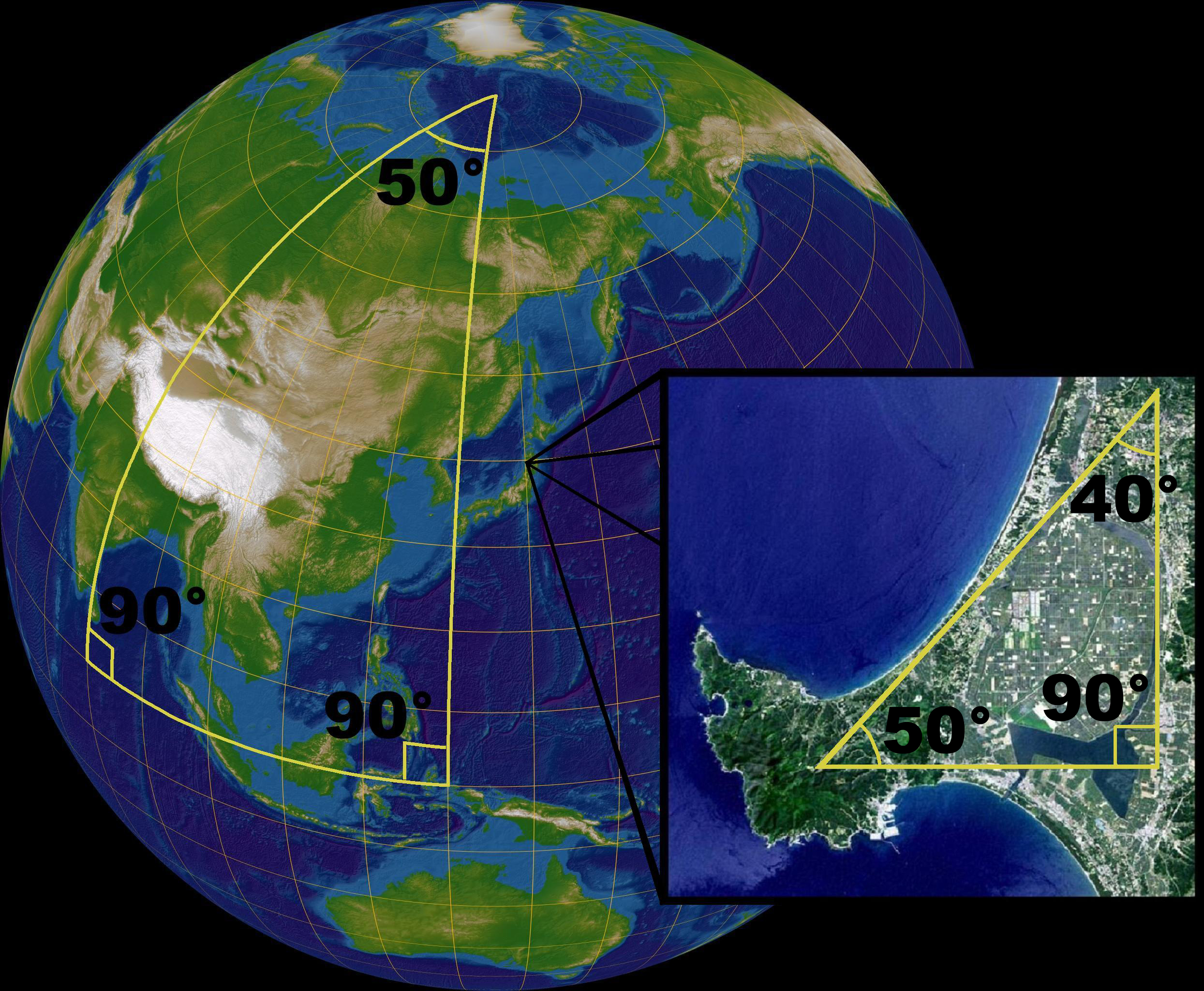
A staple of Cosmic Horror Story and of Mind Screw artworks. Elder Gods, Old Ones, the Reality Warper, The Omnipotent and other cosmic entities tend to bend the laws of physics to suit them. Why make a triangle where the angles add up to 180 degrees, when you can make one where they add up to 200 degrees in a flat space and get some extra room? Even the very body of a particularly squamous thing may exhibit this, though more often it shows up in architecture as physically-impossible buildings — occasionally sentient themselves.
Alien Geometries are often depicted as being dangerous to the sanity of normal humans; where you have to read the Tome of Eldritch Lore for it to drive you crazy, just looking at this stuff can have an unpleasant effect on your mental stability. Or at least really give you a headache.
More innocuous forms may appear normal. Then you realize that it is physically impossible for something this size to fit in that, or you travel a short distance and find yourself kilometers away, or you turn left and end up to your right. Doubly fun if found in the Mobile Maze.
The term "Non-Euclidean" gets used often to describe shapes and structures that don't make logical sense, though it's not always correct. It was used by H. P. Lovecraft to describe the impossible angles and shapes found in alien structures in his works, though not all impossible geometries would be counted as "non-Euclidean"; that term refers to certain geometric forms that don't behave like a "flat" surface but still form a consistent and logical geometry, e.g. the spherical geometry of our Planet Earth, where a curved path is likely to be the shortest path if the distance is five digit kilometers. (It's possible to construct a 2-dimensional non-Euclidean geometry on a curved surface in Euclidean space, but a three-dimensional non-Euclidean geometry requires spacial distortion, such as might be induced by a powerful gravitational field.)
Eldritch Locations are a good place to find this. Sometimes it is a single wall or building that is just a little... off. See also Hyperspace Is a Scary Place, an entire alternate universe that just does not make sense. A Minus World in video games might be considered one due to unintentional programming bugs. This might also manifest as an Unnaturally Looping Location.
Compare with Bizarrchitecture, Sinister Geometry, and Scooby-Dooby Doors (when done for comedy).
Examples:
- Omega Mart: Several areas in the store have places that are larger than they appear, such as the freezer in the Frozen Drinkables section distorting the further you walk or the T-shirt rack hiding a maze in the pole it's attached to.
- The Maze card in Cardcaptor Sakura creates a maze that isn't bound by normal spatial physics.
- Several Doraemon's gadgets can bend dimension and create such effect. For example:
- The 'Space-Bending Tape' can make those who attempt to enter a house never getting into it, by forming a dimensional loop outside the house, so that when they 'walk into' the house they are actually walk out of it.
- One of the features of 'A-maze-ing Maze' is to make windows connect only to the inside of a house while still showing what's outside, making the complicated maze created by the gadget even harder.
- 'Fourth Dimensional House Block', if detached from the building it's put, leaves those who are trapped in it staying on the same floor no matter they go upstairs or downstairs.
- While it doesn't mess with dimension directly, the 'Hypnotizing Megaphone' can manipulate characteristics of an object so thoroughly that it enables affected object to work in a way that is effectively this trope, such as making the window of the first floor reaching the ground floor, or making a ladder as tall as Tokyo Tower to the climber while still appears normal to anyone else.
- These dimension-bending gadgets are often put into Mundane Utility, such as keeping a unwanted person from entering a house/room, making a house Bigger (and Taller) on the Inside, or just for the plain fun of it. Not that they aren't dangerous if used carelessly, in which the user(s) can be trapped in the twisted dimension forever, though such danger is downplayed most of the time and the most serious problem involved will only be Potty Emergency.
- The haunted mansion in Ghost Hunt's "The Bloodstained Labyrinth" arc takes the already confusing and vast mansion that has suffered from numerous odd additions and renovations over the years, and adds in the physics-breaking abilities of tortured spirits.
- Mononoke in the Zashiki-Warashi arc, where the cast is trapped in infinite, identical copies of the same room.
- Neo Human Casshern shows what appears to be a metal bolt of lightning — or a metal construct — striking from the sky and staying in place for several days, inciting a transfer of what we are led to believe is superdimensional energy into our dimension. This energy is visible in the form of sparkling mystical runes hovering in the air facing the observer. It's awesome.
- Neon Genesis Evangelion:
- The Angel Ramiel in Rebuild of Evangelion manages to pull this off with some aplomb; its internal facets constantly shift as it moves, and the very first time we see it shift shapes from its fairly mundane octahedron to... other things, we see that it is somehow impossibly deep and one piece all at the same time... and then it starts changing shape when firing beams of pure killing. The effect is enhanced by the fact that what it does is almost painfully easy to render in CGI, but to see a physical object actually do it would be skull-crackingly horrifying.
- Leliel in the original series appears out of nowhere over the city as a giant, floating sphere with black and white stripped patterns on it. But when the Evas fire at the Angel, the sphere fades out to dodge the shots, then casts a shadow which absorbs everything into it. It's then discovered that the sphere isn't its body: the angel is a 600-meter wide and 3 nanometer thick disc that is connected to a Dirac Sea. The floating object is actually a 3D shadow that appears when the Sea is opened. It gets even more mind numbing when you realize that the "shadow" is NOT intangible: it casts its own shadow and can physically interact with other object. It even bleeds when Unit 01 tears its way out.
- Pretty much every Angel in both the television and Rebuild universes seems to exercise this trope. Special points go to the Rebuild version of Zeruel, for being apparently solid and hollow at the same time, and being full of blood while also able to unravel itself into razor-sharp ribbons.
- The Reverse World in Pokémon: Giratina and the Sky Warrior is an Escher-like place where "up" varies, but apparently only for landbound creatures (see the Pokémon Platinum note in Video Games below).
- Witches in Puella Magi Madoka Magica live in sprawling horror-filled labyrinths. Their alien nature is highlighted by Russian- and Czech-inspired animation, whose flat cut-out geometry is in stark contrast to the cutesy Japanese animation in the rest of the show.
- The third season of Sailor Moon does this when one of that season's miniboss squad accidentally breaks reality, resulting in the entire house becoming a zone of warped space.
- The Eternal Spiral in Uzumaki is a spiral in both the three spatial dimensions and in time. This results in the protagonists coming back to Kurozu-cho after being gone for a relatively short time, to find that months or years have passed in the town. The center of the structure is completely frozen in one everlasting moment.
- Paintings by H. R. Giger, famous for his design of the Xenomorph in Alien, though his work tends more to towards the horror aspect than the impossible. He also likes to paint landscapes having sex with themselves. Think about that for "scenery porn".
- M.C. Escher could be considered to make "lite" versions; notwithstanding that, his style is often used to represent them. Some of his works are geometrically accurate representations of the sorts of triangle-mangling spaces described in the intro (hyperbolic planes in the Circle Limit sketches for example). And yes, his work does have an impact on one's sanity... Some of his works are what have been called lampoons, because they work by violating normal conventions of art (like things that are behind other things being blocked from view by the things they are behind). The effect of violating rules of art that are present to mimic reality is to make the image look strange for reasons that are not always obvious.
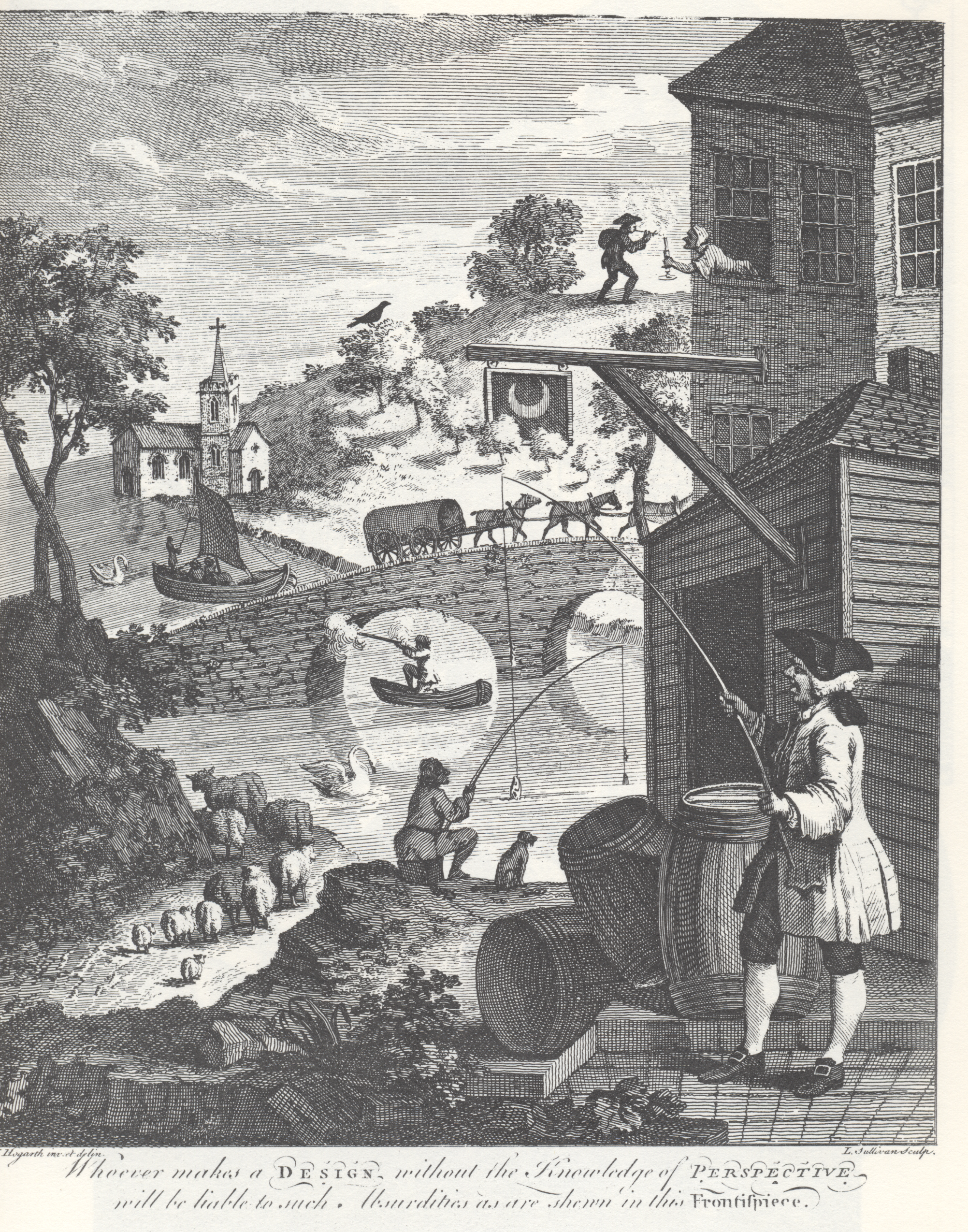
- William Hogarth's print False Perspective◊ is meant to be a parody of mistakes made by bad artists, but ends up looking very much like a prototype of Escher's style.
- The artwork of Ivan Seal often features shapes that seem like normal objects or people...but miscolored, taken from odd perspectives, and having all the details erased until they look like discomforting, amorphous blobs. Works brilliantly when paired with the similarly surreal music of The Caretaker.
- Lamput: The staircase room in "Art Gallery" has weird geometry like the M.C. Escher work "Relativity", with Lamput and the docs defying gravity as they walk around it. In one scene, there are two staircases next to each other, one appearing to go up and one going down; Specs Doc and Lamput walk on different staircases and the latter ends up larger after reaching the other side while Specs Doc somehow shrinks. They return to their normal sizes when they walk the other way.
- Alpha Flight: Shaman's medicine pouch has its own laws of physics, able to hold far more than its volume, as well as responding to its owner's wishes as to what he wants. Anyone inexperienced in Shaman's magic style who looks into the pouch risks going catatonic.
Don't turn it inside out.
- The Bojeffries Saga: The Bojeffries' house has a trapdoor that ought to lead to the loft but which opens in the back garden.
- ElfQuest: During the Troll War sequence, Wendy Pini drew one panel with deliberately Escheresque geometry, showing a spiral staircase from the side with the characters at the top appearing much bigger than those at the bottom.
- The Elric Saga: A scene from First Comics' Elric: The Sailor on the Seas of Fate depicts Elric in the captain's cabin, leaning down to look at a model ship. The viewpoint zooms in through the model ship's porthole, revealing Elric and the captain inside.
- Fantastic Four: This is generally how much of Galactus's technology is portrayed in Marvel Comics. An alternate universe version of Reed Richards once spent decades figuring out the technology of a single room in the alien creature's massive home. Galactus's house, the Worldship Taa II, also qualifies; it's a gigantic spaceship that dwarfs nearby planets without altering their gravitational fields.
- Justice League of America: In JLA: Rock of Ages, the Joker nearly drives Superman and the Martian Manhunter mad by trapping them in a maze-like satellite, the structure of which is controlled by his subconscious mind.
- The Legend of Zelda: A Link to the Past (1992):
- The Ice Palace of the game is featured in the comic, except it is called the Ice Tower and spans both sides of a canyon◊.
- Ganon's Tower is replaced by a creepy, mace-like structure in space◊.
- The Ice Palace of the game is featured in the comic, except it is called the Ice Tower and spans both sides of a canyon
- Miracleman: The crashed alien spaceship is probably one of the most distinct of Moore's uses of the trope, and is thus very difficult to describe. The people who board the ship all suffer from headaches and dizziness from the sheer disorientation that navigation of the craft causes.
- Superboy: At one point in Superboy and the Ravers Marx moves Event Horizon to a small sub-dimension that looks straight out of an M.C. Escher drawing with partiers dancing on multiple surfaces of the bizarre, disjointed and in most cases lazily spinning architecture with gravity working just fine for them, even if they're standing on opposite sides of the floor/ceiling/wall.
- Supergirl: In Bizarrogirl, Supergirl visits Bizarro World's Metropolis', an odd, unsettling place where buildings bend and twist in ways that completely ignore gravity and other laws of physics.
- Superman: In his Silver-Age wrap-up, Whatever Happened to the Man of Tomorrow?, Alan Moore reveals Mr. Mxyzptlk's "true" form, described by Lois Lane as consisting of "height, length, breadth, and a couple of other things... looking at it made my head hurt". Moore likes having characters encounter and be upset by non-Euclidean phenomena; later in the same comic the room containing the Phantom Zone portal is described as eerie and unpleasant.
- Swamp Thing: The Demon Etrigan employed Alien Geometries in an incantation to create a path from here back to Earth during Alan Moore's run, when Swamp Thing rescued his beloved Abigail from Hell:
"Thou quantum imps and cherubs by whose dance
Is substance formed to shape the fields we know
Your perfect waltz that conjures form from chance
Must pause to free us from these wastes below.
By root of minus nine and circle squared
Set right and true against dimensions three
Let our ill-angled passage be prepared
Between the folds of rare geometry". - Tom Strong: Alan Moore does this again in Tom Strong's Terrific Tales where Strong and Svetlana X find a Russian space station has become crystal-filled and Bigger on the Inside with multiple centers of gravity. The whole thing was caused by a chance encounter with a higher-dimensional cosmic particle.
- Wonder Woman Vol. 2: Olympus is given its iconic Escheresque look in the series. Whatever you're standing on is "down" for you; almost everything is a "floor" if you step onto the surface in question. Just try not to fall out any windows because the whole place is a floating mass of waterfalls, gardens and jutting Greek architecture in a pocket dimension and you'll be falling for centuries if no one catches you (also you land in Tartarus so bad move all around).


- Calvin and Hobbes
- In one strip, the law of perspective is repealed, meaning that the sizes of objects no longer depend on how far away they are, making it impossible to tell where anything is. This is all happening in Calvin's imagination, of course.
- In another sequence, when Calvin was told to look at things from multiple perspectives he took literally and started seeing things as a Cubist painting, and another time when he used supposed lack of depth perception as an excuse for running into furniture.
- An in-universe example, when Calvin's dad tries to show Calvin a fun fact about how the outer and inner edge of a vinyl disc complete a full rotation at the same speed, but any one point on the outer edge moves a much greater distance much faster than a point on the inner edge at the same time. The last panel shows Calvin wide awake in his bed, late at night, still struggling to wrap his head around this idea.
- The Alarmaverse:
- As Ponyville Town Hall transforms into a portal to the void, it becomes spatially inverted.
The edge which should have been closest to Ditzy was now farthest away — the pillar now appeared concave rather than convex — without a single atom of the pillar being disturbed from its place.
- When traveling through a Krasnicker tube, one can see shapes outside the tube. Those shapes aren't constrained by Euclidean geometry, or logic for that matter.
- As Ponyville Town Hall transforms into a portal to the void, it becomes spatially inverted.
- The Arithmancer: Hogwarts runs on this. Not only do the interior's measurements not match the outside, the corridors have different measurements across different floors. And parallel corridors in a rectangle aren't necessarily the same length, even after testing that they all meet at right angles.
- In the Pokémon fanfic Ash's Return, the doors in Glitch City manifest this way to anyone trapped inside.
- A Boy, a Girl and a Dog: The Leithian Script: This The Silmarillion fanfic provides two examples:
- Angband — more or less the equivalent to here in this setting — was erected and designed by Morgoth, and it is built in very weird shapes that make no sense to men or elves. People who has been inside barely can describe the place (beyond vague words such like "ugly", "burnt", "angled", "deep", "rough" and "paths and overpasses winding up and down and you never know what direction you are going towards") or they do NOT want to remember what it is like. The ex-thrall confirms that nothing of its design suggests that it was built by elves, and Luthien said that none of the architecture seemed designed with people in mind at all, but it was actually designed to NOT seem homely.
- The Halls of Mandos are a minor example. They are an underground network of halls, tunnels and corridors dug under the Aman's Western ranges. The stonework and architectural style is plainly different of anything built by men, walls and rooms can be rearranged with enough will force and distance and direction work in strange ways, but at least you can understand the designs.
- Child of the Storm: There's Hogwarts, which is a bit eerie, as per canon (even more so, since it's explicitly alive), but it's far from the weirdest example.
- The Red Room's base in the Nevernever, an Eldritch Location to begin with, once Harry and Maddie cut loose on each other. The sky becomes an ocean of boiling lava, the snow falls upwards in strange helix-shaped columns, and the stars fall from the sky to fill the gorges of the mountain-range with 'lakes of cold star-fire', all as mere side-effects of their Psychic Powers going at full blast. It only gets creepier from there.
- There's also the remnants of the fortress beneath the Hogwarts Lake, which has been thoroughly warped by the sleeping subconscious mind of the Elder Wyrm beneath it. Suffice to say, the Barrow-Wights are the least of your problems.
- Asgard's royal palace is also demonstrated to be a played down version of this, like Hogwarts, with the narrative stating that this sort of thing happens to all magical buildings eventually.
- The Fallen Fortress has this, in part because its internal dimensions are controlled by the powerful spirit/minor league Eldritch Abomination that exists within it. Going up often equals going down, falling down a previously non-existent chute can drop you into a room with a solid roof, the floors can go from solid to permeable to non-existent in the blink of an eye, you can sprint as fast as you can without making an inch of progress, and the difference between illusion and reality is more or less what the spirit decides it is.
- In Children of an Elder God, the city of R'Lyeh is an Eldritch Abomination-created five-dimensional dreamworld stuck into the real universe where the laws of physics are polite suggestions. When the buildings are forced to obey gravity and exist in a three-dimensional space, the whole place collapses.
- This is how Beetlejuice describes the Neitherworld in Cinderjuice. He compares it to the features menu on a DVD, saying that if you go far enough in one direction you eventually come back out the other side.
- A Different Medius has the Dead Sea, which resembles a cross between an M.C. Escher painting, and Cthulhu's domain.
- Inverted for Ditzy Doo in Elementals of Harmony. Her cutie mark talent is for planeswalking, so she can handle eleven dimensions with no problem. It's when she has to try and get by with only three that she gets in trouble.
- Fallout: Equestria - Project Horizons: At one point there is an attack spell that appears to be this. It appears as some sort of distortion, and shatters bone without damaging flesh. Light would be distorted if the space it moved through was. Flesh is stretchy and can survive the fact that the angles on a triangle no longer add up to 180 degrees. Bone, not so much.
- The Great Alicorn Hunt: It's stated that Pinkie Pie's pinkie powers come from the ability to see and act in more dimensions than most. In addition to being able to move in more spatial dimensions than normal (which lets her do things like lean through a magic mirror to give a hug to someone hundreds of miles away), she can see a short distance forwards in time and change probability.
- Harry Potter and the Methods of Rationality, in line with the original Harry Potter series, has this: Hogwarts' corridors which can change when you aren't looking. The number of stairs you climb has only a passing correlation to your actual elevation when you look out the window. At least one corridor is tiled in pentagons, a feat not possible in normal 3-D space. The stairway in Ravenclaw Tower is described as being straight when viewed from the inside and actually climbing it, but viewed from the outside, logically only a spiral staircase could fit.
- The Night Unfurls: The interior of the Malys Estate, which is featured in Chapter 22 of the original, seems to have ever-expanding dimensions. Imagine how nauseous one would be when traversing through the place. In particular, Kyril advises Sanakan and Hugh not to look too hard, especially at the roof above them that stretches seemingly forever. Then again, Eldritch Abomination Shamuhaza resides within, so naturally the place won't really make sense.
- The Parselmouth of Gryffindor: Bot only is Hogwarts still an unmappable, Bigger on the Inside architect's worst nightmare of a castle, but the Forbidden Forest is like that too. For instance, have to hop through certain clearings on one foot and then pass the same bush twice, if you actually want to progress forward.
- Pony POV Series:
- Discord's castle in the Dark World. It constantly shifts both interior and exterior — seemingly as much of its own will as Discord's — and for bonus points, even contains a void that's a portal to his cousin Ponythulhu's domain.
- The Elders' true forms are this. They can be viewed in full, but attempting to follow one part of them to another causes it too seemingly stretch on to eternity. They also appear as a child and an adult at the same time. And that's just what ponies have been able to describe about them, as most just give up trying at that point. While shown with the Alicorn Elders, this is only explained by Word of God indirectly, as mortal ponies who notice such things cannot view the Draconequi Elders Havoc and Entropy, due to their true forms not being safe for their sanity.
- In A Prize for Three Empires, the walls of Marcus Immortus' out-of-reality palace are both solid and fluctuating. Carol Danvers feels queasy just by staring at them.
- In the Danny Phantom/Beetlejuice crossover fanfiction Say It Thrice, this is a pretty good description of the Ghost Zone. In her report, Maddie Fenton remarks that structure of the Ghost Zone does not reflect normal forms of geometry and physics. Instead, it appears to be closer to a Moebius Loop or a Klein bottle, but not quite.
- Scootamom: Princess Celestia's first attempt at knitting goes very wrong, and the resulting... something manages to warp time and space around itself. It makes ordinary ponies ill just looking at it.
- In the Magical Girl Crisis Crossover Shattered Skies: The Morning Lights, the city of "Jamais Ville", located inside the palace that the villains use as their headquarters, is an Eldritch Location with no clear purpose. Completely empty and much larger than the asteroid that the palace rests on, it subjects people within its boundaries to surreal and horrifying phenomena, including a row of houses which have five sides all at perfect right angles, random reversals and subversions of time, space, and the laws of physics, and in one case, a character stumbling over her own fresh corpse.
- Thousand Shinji: The inside of the Black Moon during Third Impact fits this. It was a space of distorted reality where two different universes were mingling and two billions of souls were being collected to feed with their energies the gestation of four new gods. In that place things had many layers, and viewing something from different angles could change completely what was seen. Depending on the angle a particular room could look a cathedral-like chamber coated in repugnant organic issue, a void with a misshapen beast floating in the centre, or a huge, pregnant Rei Ayanami going into labour.
- The tesseract-thingies during the "beyond the infinite" sequence from 2001: A Space Odyssey. Just look at them, and the way they move. Even more impressive when you consider that they were created in the pre-digital era using 28 precisely-timed exposures.
- The Parisian sewer catacombs the protagonists descend into in As Above, So Below. The weirdness starts almost immediately when a tunnel they take leads them somehow back to a tunnel they avoided, then they go through several rooms which look like rooms they had gone through earlier even they are always travelling downward, and it culminates in them finding a manhole cover at the bottom of a pit; when they remove the cover and climb down through the manhole they somehow pull themselves up onto a street in Paris.
- An indie black-and-white short film of The Call of Cthulhu by the H. P. Lovecraft Historical Society does a particularly good job of getting this idea across, in a scene (faithfully adapted from H. P. Lovecraft's story) wherein a victim falls into a crevice which an optical illusion has led the audience to believe is a convex crag of rock.
- Cube 2: Hypercube is a rare example of this trope being employed in a visual medium. The actual warped geometry shows up only a few times due to the special effects required being rather expensive; the rest of the time it's showcased indirectly (e.g. duplicates of characters showing up).
- Grave Encounters plays with this quite a bit a short distance into the movie. The doors that should lead outside now lead to more hallways, corridors are either entirely blocked off or in wrong locations, and time seems to pass at its own rate inside the demonic hospital which makes it impossible to tell what time it is without a watch or cellphone.
- The Haunting (1963) uses this to emphasize Hill House's surreal and unsettling atmosphere. All the doors are hung just slightly off-center and the rooms are built on strange angles. "There isn't a square corner in the place".
- Dream levels in Inception are built like this deliberately by the level's "architects", in order to trap and delay the subconscious projections of the dreamers to keep them from attacking. The strange architecture can even be weaponized, as demonstrated by Arthur at one point, where he flees from a projection shooting down at him from the top of a staircase... only to have Arthur alter the stairs into a Penrose Staircase (looping stairs) and attack the projection from behind.
- In the Mouth of Madness: When Linda Styles investigates the interior of Sutter Cane's (who is basically an amalgam of Stephen King and H.P. Lovecraft) evil church in Hobb's End, she opens a door to find a small unoccupied room with a typewriter. After she turns around and opens the door again, it's now a giant room with Caine typing in the far corner.
- In the Tall Grass: The maze inside the tall grass is not bound by the laws of physics and can change constantly. This is visually demonstrated when Becky and Cal try to find each other by jumping up simultaneously. The first time, they're about ten yards apart. The second time, despite not having moved, it's suddenly a hundred yards.
- The climactic scene of Labyrinth takes place in an Escher-esque landscape where 'up' varies. The scenery was based on a drawing by M.C. Escher.
- Last Year at Marienbad was shot within several castles and edited together to create a lack of continuity in the castle and a strange, disorienting effect.
- Marvel Cinematic Universe:
- In the climax of Ant-Man when Scott goes sub-atomic and enters the quantum realm where all concepts of space and time cease to exist.
- Thor: Ragnarok: On Sakaar, Thor is thrown into a circular containment room with the other slave gladiators. When he runs through the room, he immediately loops back around to his starting point, way sooner than he should have. His cellmate Korg explains that the room isn't really a circle, more like a "freaky circle".
- The Overlook Hotel in The Shining has some very subtle impossibilities that can only be noticed on repeated viewings and piecing together different scenes shot from different angles, such as hallways that lead into walls, windows that can only be seen from inside, hotel rooms that seem to overlap the same space, and doors located too close together to lead to separate rooms. There's much debate among the fandom about whether these are a subliminal attempt to disorient the audience, or simply accidental inconsistencies in set design.
- The Red Matter-generated black holes in the Star Trek (2009) movie. From the front, they look like your average swirling, funnel-shaped Negative Space Wedgie. Approach from the side, and you can see that it's missing its third dimension.
- The neighbourhood affected by the supernatural forces in Terrified has a few examples, such as a man becoming sealed inside a cupboard, but only being visible when the back of the cupboard is broken into and not when the cupboard door is opened, as well as some demonic creatures hiding under a man's bed which can only be seen when viewed through from the bottom of the bed and not from the sides.
- Willy Wonka & the Chocolate Factory uses a few examples to highlight just how bizarre the factory and its creator are. At the start of the tour, Wonka leads the guests into and out of a small room, but even though they leave through the same door that they used to enter, they find themselves in a completely different hallway from where they started. This hallway then narrows and shrinks until they reach a small door, which then opens up into the chocolate room and reveals a much larger door on the other side. Later in the tour, the Wonkamobile goes through a strange car wash.
- If you try to map the Citadel in the The Citadel of Chaos, you'll quickly find its rooms are connected in contradictory ways and sometimes occupy spaces that should be beyond the outer walls. Maybe Jackson just wasn't too strict about the layout, but it is called the Citadel of Chaos...
By Author:
- Robert A. Heinlein:
- The short story —And He Built a Crooked House— involves an architect who, inspired by higher-dimensional geometry and high real-estate prices, builds a house in the shape of an unfolded hypercube. Then an earthquake makes it fold in on itself into a hypercube, so to the architect's delight it's eight times roomier on the inside than on the outside. Just one small problem: the house's new topology makes it a bit difficult to leave once you're inside. When you do get outside, you may have a whole new problem.
- A math-nerd resident of Second Life actually went and reproduced the Crooked House in 3d, and if it's still rezed somewhere public you can actually walk through it. Not a real hypercube of course but some excellent special effects. Here's the story with video.
- Another math-nerd made a film adaptation of the story as his final for Geometry.
- A math-nerd resident of Second Life actually went and reproduced the Crooked House in 3d, and if it's still rezed somewhere public you can actually walk through it. Not a real hypercube of course but some excellent special effects. Here's the story with video.
- The short story By His Bootstraps involves a time-travel machine, constructed by aliens, housed in a building which is described in these terms
- Glory Road had the hero and companions invading a tower "where the architect used a pretzel for a straight-edge". It's so convoluted that it took hundreds of spies decades to figure out a route to the MacGuffin.
- The Number of the Beast, as well: we're only seeing dimensions x, y, z; but there are at least three others which can be rotated around or extended along, and which apparently can be used to travel between universes. This is a conceit to let him run through every literary universe ever, and have a massive Crossover event. The novel culminates in a party, in what is effectively the Crooked House, with every single character he created attending (plus several guests). Special mention goes to the literary critics lounge, which was shaped like a Klein bottle... once you were inside.
- The short story —And He Built a Crooked House— involves an architect who, inspired by higher-dimensional geometry and high real-estate prices, builds a house in the shape of an unfolded hypercube. Then an earthquake makes it fold in on itself into a hypercube, so to the architect's delight it's eight times roomier on the inside than on the outside. Just one small problem: the house's new topology makes it a bit difficult to leave once you're inside. When you do get outside, you may have a whole new problem.
- Stephen King:
- Inverted in the Night Shift short story "I Am the Doorway". An alien lifeform sees a boy walking with a sieve under his arm: "an abominated creature that moved and respired and carried a device of wood and wire under its arm, a device constructed of geometrically impossible right angles".
- In the short story "1408", the titular room's door is crooked to both the left and the right. Or not at all. Maybe it can move? It gets worse from there.
- In the novel From a Buick 8, the titular car is actually an interdimensional portal/device that only looks like a car. It's noted that the human eye perceives it as a car because that's the only image the mind can supply for the actual shape of the device.
- Nightmares & Dreamscapes — Played straight within the short story "Crouch End", a Cosmic Horror Story within the Cthulhu Mythos. Within the Dark World alternate London, "She said it was as if she were no longer on earth but on a different planet, a place so alien that the human mind could not even begin to comprehend it. The angles seemed different, she said. The colors seemed different".
- C. S. Lewis:
- In That Hideous Strength, one character is briefly imprisoned in the "Objectivity Room", where everything is slightly off — the spots on the table are arranged just short of obeying a pattern (even a broken one), the similar specks on the ceiling are almost the mirror-image of the table, and the peak of the arched entryway looks like it might be just a fraction off-center to the left. Or not. Maybe the right? And let's not start on the paintings... Justified: The room was specifically built this way to drive people crazy so they'd be suitable hosts for the demonic powers.
- The Great Divorce: Heaven and Hell don't conform to the laws of physics of the living world: Hell is a dreary, nigh-infinite gray plain, and yet it is somehow smaller than one of Heaven's atoms and contained within a crack in the ground in Heaven; travel between the two requires a change in size. As for Heaven, it is an immense place that makes the solar system seem small by comparison, and the ghosts who arrive there are said to take in more sensory information than would be possible on Earth due to this hugeness.
- The Last Battle, the final volume of The Chronicles of Narnia, ends in a world that's essentially the opposite of reality, in that the closer you get to the center, the more there is.
- He also appeared to use this in Out of the Silent Planet, but the room turns out be normal human geometry, just a very unusual sort.
- H. P. Lovecraft loved non-Euclidean geometry:
- The sunken city of R'lyeh in The Call of Cthulhu. The gate that seals the Great Old One himself opens, and the sailors can't even be sure whether it's a vertical door or a horizontal hatch — even though one of them climbed or walked up its surface! Shortly afterward, a unfortunate human is swallowed up by an angle of masonry which is acute, but behaves as if it were obtuse.
- The Antarctic city in At the Mountains of Madness.
- Perhaps most explicit in "The Dreams in the Witch House" where a mathematics student discovers the unearthly topology of his own bedroom serves as an extra-dimensional portal. Well, he was renting it because of its reputation as being haunted. This was a bad idea.
By Work:
- The children's picture puzzle book "The 9 Tasks of Mistry: An Adventure in the World of Illusion" by Chris McEwan is filled with impossible landscapes, tricks of perspective, and Bizarrchitecture.
- The Monoliths in 2001: A Space Odyssey have the dimensions 1 by 4 by 9... "And how naive to have imagined that the series ended at this point, in only three dimensions!"
- Alice's Adventures in Wonderland: Alice, in Lewis Carroll's Through the Looking Glass set to walk to a hill and always finds herself walking into the doorway of the house. Finally, when she walks away from it, she reaches it. Lampshaded by the Red Queen, when Alice finds herself unable to run quickly. "Now, here, you see, it takes all the running you can do, to keep in the same place. If you want to get somewhere else, you must run at least twice as fast as that!" The Queen is able to travel much faster, since she is a Queen, and can cross the width and breadth of the chessboard in a single move.
- The Belgariad: The Wizard Beldin has a twisted stick with only one end. He uses it to keep children occupied so they don't bother him.
- The Starfish structures in Blind Lake have disturbing interior geometry. Robot probes (and people) who go in too far don't come back. The deep interior seems to be entirely exempt from the usual rules of time and space.
- In Chronicles of Chaos, Vanity's secret passages often don't add up, geometrically, with the places they go to and lead from.
- In A Clash of Kings, Daenerys enters the House of the Undying Ones in Qarth. Once in the antechamber, she makes four consecutive right-hand turns without returning to her starting point.
- In Ambrose Bierce's "The Damned Thing", a creature, judged by ignorant folk to be a mountain lion (from its leavings, since the creature itself is never seen), is a color that the human eye cannot see and makes noises that the human ear cannot hear. This inverts this already inverted trope because the color is natural and it is humanity that has become too alien (or at least insensitive) to comprehend it.
- In the Deathstalker series the AIs of Shub constructed a world of their own to live on. Unfortunately for humans who might visit, it exists in more dimensions than they can perceive and so is unhealthy to look at for extended periods of time. The Madness Maze, despite a relatively innocuous appearance, had convoluted, nigh-sentient path designs that would either evolve you into a higher being or tear you apart.
- Deep Secret: The Hotel Babylon has halls where you can go around more than four right angles before coming back where you started, thanks to the building being on top of a bunch of ley lines.
- Discworld:
- Bloody Stupid Johnson, architect, Bungling Inventor, and general anti-genius regularly does this kind of stuff entirely by accident.
- He once designed a letter-sorting machine whose central component was a wheel that had π equal to exactly three (he did this because he thought that the usual equation π = 3-and-a-bit was "a bit untidy"). This causes it to sort out letters it hasn't had put in yet, among other oddities.
- Empirical Crescent, a row of terraced houses where every door and window leads somewhere other than where you'd expect it to lead. At least it makes it easier to get rid of rubbish — just toss it into the garden. After all, it might not be your garden. The reason for this corruption of dimensions occurs because the row of houses is crescent-shaped on the outside only. Inside, it's supposedly laid out like a straight row. Presumably the two configurations conflict. Occupants had a tendency to leave in the middle of the night, often without stopping to pack...
- It's also stated in Thud! that he invented the 13-inch foot and a triangle with three right angles. Note that the Discworld is not a sphere (circles with π = 3 and triangles with three right angles both do in fact appear in non-Eulidean spherical geometry).
- The Colour of Magic mentions one of the gods using a 7-sided (but still cube-shaped) die to cheat. The same book also mentions, among the eye-watering creations of the temple of the Ichor God Bel-Shammaroth, that the floor tiles are perfectly tessellating octagons. This is something which, due to maths, is impossible in Euclidian space.
- The buildings of the Unseen University, which have been rather strongly influenced by the vast amount of magic that has flowed through its halls over the centuries, have floors and rooms where logic says they simply could not exist. Magic is as much a part of the architecture as cement. It is specifically noted that there are rooms in which gravity changes direction through the day and windows that only exist on one side of their walls. When the senior faculty got their hands on a map from a specialist wizard who assured them it should be accurate for a few hours or so it was compared to an exploding chrysanthemum.
- The Library of the Unseen University has so many ancient magical texts that it distorts space-time like an elephant on a trampoline, dimensions and gravity being twisted into the kind of topographical spaghetti that would cause even M.C. Escher to go for a good lie sideways. That's quite apart from the fact that it serves as a gateway into L-Space, and is therefore linked to all libraries everywhere in all points of space, time and reality. Technically, it contains every book that has ever been written, every book that is ever going to be written, and every book that ever could have been written (whether it actually was written or not). Once, the Librarian took a trip deep into the shelves, passed tribes of lost students, and ended up in the same library in the past. In addition, any sufficiently large collection of books (magical or otherwise) can exert the same effect as the Unseen University Library since any high quantity of knowledge can warp space as if it were a huge amount of mass.
- In one book, this is rather beautifully summed up as "Knowledge = Power = Energy = Mass. A good bookstore is just a genteel black hole with a smile".
- Death's house is bigger on the inside than on the outside, being the size of a cottage on the outside, but the size of a small castle on the inside. This is not so much intentional, but is rather the result of a slight blindness to ordinary architecture on Death's part (he forgot that things were not supposed to be bigger on the inside when he made the place and can't quite manage to make them fit now). Many of the rooms have the peculiar effect of being enormous at the same time as being regularly sized. Death's room in particular is stated to be about a mile wide, but most can be crossed in only a few steps. The real killer is that Death himself is weirded out by this last fact. This is because it's ordinary humans (like Albert) who cross the room in a few steps, even though it's clearly a mile wide. Death's theory is that the human mind refuses to accept the true size of the room, and acts as if it were normal-sized. And for humans, it seems like it's Death that acts weird, by either moving through very solid walls (he cannot even see) or suddenly appearing from thin air when they were in a small, empty room just a second ago (when he moves through that mile wide space and not the short, straight path the humans usually take). Death's realm is weird.
- The exterior portion of the Tooth Fairy's domain in Hogfather has Alien Geometries based off the poor understanding of size, proportion and three-dimensional imagery present in a child's drawing. The massive white gap where there ought to be a horizon is particularly unsettling.
- The Gnarly Ground in Lancre is a seriously bizarre landscape of crags and valleys "scrunched up" into a small area, overlapping in space; what geographical features you see there and have to deal with depend largely on your mindset. It makes a good hiding place. It is also known that how you perceive features of the Gnarly Ground depends a great deal on your own outlook. What one person sees as a shallow stream at the bottom of a ditch bridged by a large slab of rock can appear to others as a roaring torrent pounding over boulders at the bottom of a deep gorge bridged by a narrow, shaky bridge of balanced rocks. The most disturbing aspect of this is that how one perceives the features controls how one interacts with them, so one person may see you hanging by your fingertips while another sees you standing in the stream.
- Unseen University's mad but Good with Numbers Bursar has posited that there is an extra number between three and four, which he calls "umpt" (as in, "umpteen" minus ten).
- The Bugarup University (the UU's counterpart in Fourecks) has a tower which is only thirty feet tall at the bottom, but half a mile tall at the top, making it both significantly taller and significantly shorter than the Unseen University's famous (and surprisingly Euclidean) 800-foot tall Tower of Art, depending on where you're standing.
- In Pyramids, when a far too large pyramid is under construction its usual buggery with the Fourth dimension of time is so heavy it starts messing with the other three as well. As a result, certain people find their dimensions a little rolled over (resulting in flat shapes that keep moving in a single direction), and close to the climax of the book the semi-built pyramid flips around, and so does the entire Kingdom of Djelibeybi, disappearing into a single near-invisible unidimensional crack in the ground that needs extremely advanced mathematics to find and enter.
- Due to Rincewind's experiences, his hourglass is noted as resembling something a glass-blower would've made with the hiccups inside a malfunctioning time machine, where the sand even flows backwards in some spots. Death is entirely unaware of when Rincewind is going to die, despite having a pretty good knack for the estimate, because of this.
- Bloody Stupid Johnson, architect, Bungling Inventor, and general anti-genius regularly does this kind of stuff entirely by accident.
- While The Divine Comedy's Hell and Purgatory have clearly defined geography, that of Paradise is more complicated. The spheres of Heaven correspond to the celestial spheres of a geocentric universe, but can equally well be seen as orbiting around God in the Empyrean, or as all existing in the same space. To enter Paradise or cross between the spheres, one must Ascend to a Higher Plane of Existence, rather than doing any physical climbing. The structure of Heaven has been interpreted as an early description of the fourth-dimensional hypersphere.
- The Dresden Files: When Merlin built the prison on Demonreach, he improved security by constructing the wards simultaneously at five separate points in time. Yes, at five different times all at once. Try to wrap your head around that one.
- In An Elegy for the Still-living, the main character spends a few minutes walking down a forest path before realising he is seeing the same scenery looping over and over again. Also, this passage:
After the man had fallen through every place and every time that ever he had even imagined, he began to fall through the places that his mind could not conceive. He passed into structures that did not follow geometry, saw shapes that had no edges or sides, that extended into themselves and into all directions. He saw triangles with one hundred eighty one degrees. He saw minds that had no reason or morality. He saw colors indescribable to others. He saw the true shapes of his dreams, and the ten dimensions of the earth and sky. He saw what no one saw, felt what no one felt. He heard sounds with his finger tips, and tasted with his ears. He had secrets whispered to him in a language that can't be translated.
- In the eighth book of the Everworld series, the main characters are cast into an inverted realm where the ground they stand on is above their heads, and gravity pulls them up, with the colors of everything reversed for good measure. This naturally strongly bothers David, April, Jalil, and Christopher. Senna, however, likes it, and compares the reversed plane to fine art.
- The House of the Maker from The First Law trilogy by Joe Abercrombie. The protagonists enter about halfway up, walk around a bit inside but never ascend or descend, then exit on the roof. Most of the characters can't wait to get out of the place, even if it does involve crossing the narrow, rail-less, hundred-foot-high bridge. And there's always the possibility of leaving the place before entering it.
- In Flatland, the two-dimensional protagonist A. Square struggles to fathom the third dimension when he is introduced to it by a travelling sphere, and it almost drives him insane. In a dream he sees that inhabitants of one-dimensional Lineland are similarly incapable of comprehending the second dimension. And let's not even get into Pointland's issues. Many sequels have been written. Flatterland (Ian Stewart) has even more bizarre geometry, including a hyperbolic world, a fractal world, a grid world, and so on.
- In the first The Gatekeepers book (Anthony Horowitz), the main character is prevented from escaping evil witches trying to sacrifice him to let the Old Ones back into the world by some sort of higher-dimensional loop: no matter which direction he sets out in, he always ends up back at his starting point. Of course, it might have been just a mental effect, not actually altering space.
- The Laputans from Gulliver's Travels use these for their houses... causing them all to collapse.
- The Harry Potter series features this in many places. Hogwarts, especially the stairs, constantly rearranges its layout; in the films this was depicted very mechanically, but in the books it was implied that sometimes a staircase would just lead to a different place without anything ever being seen to move. There are also rooms that change size and shape, the Room of Requirement being a prominent example later in the series whose layout and contents depend entirely on what the person entering it needs. There are also examples outside Hogwarts, such as tents which are not just bigger on the inside, but actually contain an entire multi-storey house including furniture and fully-fitted kitchens and bathrooms. Diagon Alley and the Knight Bus are other examples that change size and shape, both inside and out, depending on what is needed at the time or who is looking.
- The Hitchhiker's Guide to the Galaxy:
- The interior of Slartibartfast's Bistromathics ship in Life, the Universe and Everything.
- The new and improved Guide in Mostly Harmless shifts through a few inexplicable forms.
- The cave in Hollow Places. Its layout transforms with every visit. Rooms change in shape and order. Corridors alter directions. Formations appear and disappear. On one occasion, the cave led up to what should be miles in the sky rather than descend into the ground (which, of course, could not be seen from outside). During Austin’s (the protagonist's) final trip, he encounters paths that loop into each other in impossible ways. The only consistent features are the presence of the inscribed column and the primary anomaly wherein people are teleported to the location of their choosing after walking eighty-one steps past said column.
- "The Hounds of Tindalos", by Lovecraft's friend Frank Belknap Long, features ravenous creatures of weird geometry who travel through time and space, and the only way to avoid them once they're on your trail is to completely avoid sharp angles (such as in a completely circular room).
- House of Leaves starts with a house that is 1/4th inches Bigger on the Inside than on the outside. They are only able to measure all the way across because a closet mysteriously appeared in the house when they left for a week. They also get slightly different measurements with every method they try until confirming the final number with a very accurate method — you'd normally think this is because of measurement deficiencies, but in retrospect... Also, this discrepancy disappearing is, believe it or not, the cue for things to get worse.
- A feature of the bizarre planet in The Inverted World. Within about a dozen miles of the "optimum", everything is pretty much Earth-like. Go any farther than that, however, and things start to distort unpleasantly. Because the optimum is constantly moving, the entire City has to move after it to avoid destruction. Even weirder, in the novel version, it turns out that the Inverted World is actually EARTH — the inhabitants of the City only perceive it the way they do because their perceptions (and possibly their physical reality) have been altered.
- In Joe Golem and the Drowning City this is a trait of the elder creatures and their artifacts. The Pentajulum of Lecter (essentially an ornate heart), an object with the power to trespass realms is described as having eternally changing features, being sometimes round, sometimes angled, sometimes both at the same time, and having incomprehensible geometries, sometimes appearing to be four-dimensional and things of the sort.
- MARZENA makes use of the Gromoviti Znaci, the Thunder Mark of Perun from Slavic Mythology, which doubles up as an optical illusion making you see all matters of shapes and figures. There's also the G-Net, which by not being bound by earthly laws and by being fully accessible via holo wearables, allows its users and denizens to see and do geometrically impossible things.
- The classic science fiction short story "Mimsy Were the Borogoves" (inspiration for the movie The Last Mimzy) is about a set of toys from The Future that wind up in the hands of a pair of present-day children, a brother and sister. Adults examining it soon realize that the various beads and parts move in ways that shouldn't be physically possible, and conclude that they are educational toys meant to teach kids geometry. Present-day adults aren't mentally flexible enough to learn it, but the kids can. The father then walks into the kids' room to discover that they've figured out how to move hyperdimensionally, and he's horrified as they just walk off into nothingness and disappear.
- In Mouse (2017), the Pocket Dimension created by the Antiochus Algorithm has geometry that works like in a video game, where trying to leave one side of the map causes you to reappear at the other, causing a steady rain of groundwater from the sky.
- October Daye: Knowes tend to have these.
- ALH: Windows look out at different times of day. You can walk down a hall and be three floors higher at the other end than you started.
- Shadowed Hills: Windows in the same room can look out at different locations (and seasons).
- In the unclaimed areas of the Summerlands, distance isn't always consistent. If you really, really need to get somewhere, then wherever it is you want to go will become closer to you.
- Greg Egan's Orthogonal trilogy features a(n oxymoronically) straightforward example: Time is fundamentally the same as space, meaning that there are technically four spatial dimensions and no such thing as time. The trope is even discussed in-universe when Yalda hypothesizes "four-space" and Giorgio points out how batshit insane it sounds.
Giorgio: So according to your theory, an object could have a trajectory entirely orthogonal to our own?
Yalda: Yes.
Giorgio: It could move with infinite velocity?
Yalda: Yes, that's how we'd describe it. But that's no stranger than saying that a vertical pole has an 'infinite slope': unlike a mountain road, it gets where it's going vertically without bothering to go anywhere horizontally. An object that gets where it's going without bothering to move across what we call time isn't doing anything pathological; in reality, there's nothing 'infinite' about it. - Paraiso Street features Ptiamuzcuaro, the Land of the Dead, which contains bridges that turn sideways, leaning skyscrapers that go from concave to convex depending on their mood, and streets that loop back upon themselves. The Breach also counts, being a rip between realities that appears as a gargantuan crystalline tunnel where the laws of physics break down.
- In Protector, the Brennan Monster amuses himself by creating full scale replicas of some of Escher's art, using things like artificial gravity to make them work.
- The protagonist of Return from the Stars comes back to Earth after over a hundred years of absence. In the meanwhile, architecture has changed/evolved so much and so confusingly that when he first steps out into a spaceship depot, everything around looks to him like an abstract, shapeless muddle of pathways.
- In the fifth volume of Alan Dean Foster's Spellsinger series, Jon-Tom encounters a perambulating prime, a creature/artifact/object which embodies mathematical chaos and constant change. It is described as "good-sized" and as "beautiful" but otherwise consists of impossible shape after impossible shape constantly sliding into one another. How much of the perambulator's appearance is "real" and how much is the mind struggling to make sense of something truly alien isn't clear.
- In the Spiral Arm series, there is the Ouroboros Circuit, an artifact of a race of Precursors known as the people of sand and iron. At first glance, it looks like a wreath of tangled wires; but if you try and trace the wires with your eyes, and you'll find yourself staring into hyperspace.
- Star Trek:
- In the Star Trek Shatnerverse novel The Return, The Borg have built a hypercube base inside a subspace tunnel.
- In the Star Trek: Voyager novel The Final Fury, Captain Janeway, Tuvok, and Neelix arrive aboard a Fury planet wherein the hallways and doors meet at angles that aren't quite "right" — literally and figuratively — and the aliens themselves despise those who follow the "right-angle" or "right-hand path".
- Star Wars Legends: A rare franchise example can be found in Lando Calrissian and the Mindharp of Sharu. In it the titular character finds the titular artifact — which seems to exist in several dimensions simultaneously and as such it really hurts just to look at it. Lando then uses it to unlock the passage into the Great Pyramid of Sharu — where he is expanded in size several dozen times, while his droid companion is shrunk to the size of a louse. There are even more examples in the book: the aliens who built it were very, very alien indeed by Star Wars standards.
- The Stormlight Archive: The intricate geometric designs that Cryptics use instead of heads invoke this trope. And in Words of Radiance, a Cryptic named Pattern manifests in the Physical Realm as a complex geometric pattern, implied to be based in quantum uncertainty.
- In Time's Eye by Arthur C. Clarke, there are spherical alien objects that apparently have a 1-to-3 ratio for their diameters and circumferences, instead of a one-to-pi ratio.
- The Third Policeman has several different forms of this. The most prominent example would be the police barracks, which are two-dimensional on the outside and seemingly three-dimensional on the inside. There's also Eternity, which loops, and the inside of Mather's walls.
- Threshold by Caitlin Kieran contains a fossil in a shape that cannot exist, causing the heroine to black out when she looks at it too long. What is this sinister shape? A regular heptagon.
- Thursday Next's Uncle Mycroft, among his other Mad Science projects, developed "Nextian Geometry" with his wife, said to be based on how a cylinder looks like a rectangle from the side, which allows one to use a circular cutter on dough without any left over: it makes circles tesselate.
- 'The sci-Fi novel Triton features a description of a fantastically complex fantasy board game (great for long space voyages!) with a single dodecahedral die (d12) with seven blank faces and 13 Fantastic Zodiac signs. It would have to be icosahedral (d20; 7+13=20 and very much not 12) for that to work unless spacetime shennanigans were involved.
- In Stephen Baxter's short story collection Vacuum Diagrams, the story The Eighth Room deals with something similar to Heinlein's story. However, in this case, the room was not created accidentally... it's more of a logic puzzle. There's also another short story by Baxter called "Shell", set on a planet that is folded in on itself. There is no sky — people looking up see the other side of the planet curving over them, as if it's a shell. When one character uses a hot-air balloon to explore the other side, she witnesses the "shell" flatten out and then become curved normally, while the land she just left curves into a shell over the sky.
- In the Venus Prime series, the interior of the Amalthean world-ship is described as being made up of nested spiral shells. The diagrams at the back of the last book don't help to make it any easier to comprehend.
- This happens a lot in the Warhammer 40,000 Expanded Universe when the Powers of Chaos are involved.
- In Graham McNeill's Ultramarines novel Dead Sky Black Sun, the city in the Eye of Chaos features this — producing a Mobile Maze with it.
- In Dan Abnett's Eisenhorn novel Xenos, the saruthi "tetrascapes" include regular octagons that nevertheless tessalate. Eisenhorn rescues some green soldiers from such a tetrascape, and later chooses them over experienced soldiers to go into one. Wise of him: the green soldiers had actually seen a tetrascape before, and the experienced ones hadn't. As a result, the "greens" manage to shoot and kill dozens of enemies, but the elite Deathwatch Space Marine attached to Eisenhower's squad can't hit anything thanks to the effect the twisted geometries have on ballistics.
- In Dan Abnett's Gaunt's Ghosts novel His Last Command, a Chaos warp gate throws Maggs and Mkoll into a place where stones hang in the sky and the stars are all wrong (both), as well as being bitterly cold. Also, their vox units register as both within ten kilometers and out of range.
- In Ben Counter's Horus Heresy novel Galaxy in Flames, Death's Tomb is bigger on the inside than the outside — as well as other repulsive features.
- In Graham McNeill's Forges of Mars novel Gods of Mars, the physical form of the Breath of the Gods — an alien machine which can revive dying stars and create entire solar systems — is a swarm of metal blades whirling around a core of glowing energy. The machine is not connected to or supported by anything, and the blades occasionally pass through each other as if they were intangible. The sight of it does funny things to the human mind.
- The Way Series features an asteroid hollowed out by people from... elsewhere, with seven chambers running along its internal axis. The first six contain cities, parks, a spaceport and loading area, and power generators. The seventh chamber goes on forever, contains objects made from redistributing probability over space, and a mathematical singularity running along its centre. Then things start to get weird.
- The Wheel of Time:
- The Aelfinn and Eelfinn ("the Finn") inhabit one or more separate dimensions described by the author as having radically different natural laws. Successive windows do not show what one might expect. That the magic system in the series is heavily geometric likely has a great deal to do with why its use is explicitly forbidden there. The doorways into their realm also resemble this in the "real world", and are described as "twisted".
- Though it's less apparent, the same is true of the Ways, an artificially constructed dimension meant for quick travel. Except in one dream sequence (which, for complicated reasons, probably reflects the reality of the Ways), the realm is extremely dark, but travelers there have noted that by the arc of the bridges they're walking on, the platform they've just arrived at should be directly beneath the last. During the dream sequence, it becomes apparent that the platform-islands extend infinitely downward — and unless you follow the bridges with your eyes, appear to be on the same plane. The doorways seem to be a description of a three-dimensional Möbius strip.
- A significant plot device in A Wrinkle in Time deals with folding space-time through a fourth space-dimension for teleportation.
- Doctor Who:
- The Expanded Universe speculates that this is the default setting for the interior of a TARDIS, and that the Doctor's TARDIS projects a more easily comprehended interior so as not to freak out the Doctor's human companions. She is just a sweet old thing. Even if the above speculation is incorrect, the Bigger on the Inside dimensions of the TARDIS are occasionally enough to disturb someone, most memorably with Jackson Lake's mild panic-attack in "The Next Doctor". From his reaction, it was giving him claustrophobia and agoraphobia at the same time.
- "Castrovalva": The city of Castrovalva itself is built like this, as part of a trap to destroy the Doctor. It appears perfectly normal, but if you try to leave the centre of town, no matter what direction you travel, you'll soon end up back there. When the city starts breaking down, it begins to resemble an Escher picture.
- "The Lodger": The Doctor uncovers an alien time-distortion device similar to the TARDIS in the upstairs flat of a British apartment building. Amy, poring over the building plans for the address, discovered that the building didn't even have an upstairs, it was a one-story building. Perception filters kept people from noticing anything out of the ordinary.
- "Journey to the Centre of the TARDIS": while the TARDIS interior looks like a fairly ordinary albeit vast spaceship, the TARDIS is revealed to be capable of tying its internal spatial and temporal dimensions into knots. At one point it threatens to do this to trap some thieves inside forever to stop them stealing some of its technology. This is something the TV show occasionally alluded to in the past with the TARDIS being able to delete and move rooms about and having an "unstable pedestrian infrastructure", and novels, comics, and audios have expanded on this for years, but this episode marks the first time we've actually seen it first hand.
- Goosebumps (1995): In the episode "The Haunted House Game", there's the titular house. Nadine and Jonathan enter through the front door but somehow end up in the basement. They look out of a window to get their bearings, but it only shows the giant board game they started at that contains the same house they are standing in.
- In the Night Garden... is a BBC kids' show (from the people who made Teletubbies) where the various characters often ride around the eponymous garden in the Ninky-Nonk (a train without tracks) or the Pinky-Ponk (an airship). When they're boarding, these vehicles are comfortably large enough to accommodate all of them, yet when they're actually in motion the Ninky-Nonk is small enough to run up trees and over branches, and the Pinky-Ponk is small enough to get knocked off course by a toy ball.
- Neverwhere does a very nice demonstration of this in passing. The protagonist is led down into the London Underground, then through a door, and down a stair case. This continues, always going down, until they reach a small door and step out on to the roof of a building.
- In Rose Red, the titular mansion is like this. Sometimes. It was built to perfectly normal standards, but after a series of incidents it went from "just" haunted to something more, and may in fact have been sentient. Features include staircases leading into ceilings, dead-end hallways that screw with perspective, rooms that weren't there a minute ago (or were there but aren't any more), and other hilarities. About the only guaranteed stable locations are the entryway, the attic and the arboretum, and even then the things in them often are moved around or fully animate.
- In Severance (2022), the offices of Lumon Corporation are just...off. The building already looks unsettling on the outside, with its weirdly angled mirrored parking lots. On the inside it has endless white hallways, dark elevators that only go down, giant (but low-ceilinged) offices with only a few desks in them, and an entire full-scale replica of Kier Eagan's house.
- Stargate SG-1: The spacecraft used by the Goa'uld are relatively normal... until you notice the pyramid on top. Naturally, the entire spaceships can fold up so that their central pyramid can land on a planet-bound pyramid. Not to mention how a triangular-pyramid-shaped spacecraft can land on a square-pyramid.
- The plot of the (admirably silly) Star Trek: Voyager episode "Twisted" where the ship becomes a maze where no door or hallway leads the same place twice due to a Negative Space Wedgie.
- Similarly, in Star Trek: TNG "Where Silence Has Lease", the Enterprise winds up in a Negative Space Wedgie and Genius Loci where physics goes right out the window. They drop a beacon and head directly away from it only to find themselves heading directly toward it, they explore another ship where leaving a room results in re-entering the room from a different door, etc.
- Threshold involved an alien invasion. The aliens used devices that apparently contained more that four dimensions, and cannot be fully perceived visually. Just seeing or hearing the signals originating from these "beacons" can kill or transform the view into an alien agent, with triple DNA helix where earthlife has only contains double. The aliens themselves are usually seen in dreams; crystal forests where spider-like entities are only partially seen.
- The Twilight Zone (1959): In the episode "Little Girl Lost", a little girl falls through a portal in the wall of her bedroom into an alternate dimension, in which space is twisted, distorted and nonsensical to ordinary human perception. Fortunately, the family dog's superior hearing and sense of smell help get the little girl back into our dimension before the portal closes forever.
- In Warehouse 13, the personal effects of permanent prisoners of the Warehouse are stored in the Escher Vault, which is basically a three-dimensional M.C. Escher painting. Authorized personnel use special goggles to follow along with the vault's ever-shifting perspective. Unauthorized personnel are never seen again unless they have Super-Speed.
- In Christian eschatology, the end of the world is accompanied by the sky rolling up like a scroll. If this wasn't Mind Screw enough, it also involves everyone on Earth witnessing the return of Jesus. At once. Even though the earth is a sphere.
- A bit of interpolation between these two, and with modern theoretical physics, and we have a possible Mind Screwdriver: The end of the world splits the fabric of space across all of the 3-dimensional universe, revealing Eternity, from which Jesus emerges and destroys the wicked with the brightness of his coming, which may as well mean that their heads a'splode from the Mind Screw of it all.
- The angel that guards the Garden of Eden is described as wielding a fiery sword that "turned every way", such that the sword is always between any potential intruders and the Garden regardless of which direction they approach from.
- The sleeve designs for the first two LPs by the Blue Öyster Cult revolve around bizarre and unsettlingly alien landscapes and architectures. The cover designs for the first two albums, Blue Öyster Cult and Tyranny and Mutation, are credited to Bill Gawlik, who was also responsible for the specific design of the hooked cross used as the band logo. Gawlik is said to have been heavily influenced by the monumental architecture of dictatorships, specifically Albert Speer's grandiose ideas for remodelling Nazi Berlin.
- Within the Wires: The connections between Grainne's house and the rest of the world take a greater or lesser amount of time to travel, for no readily apparent reason. Driving into town takes 20 minutes; driving back frequently takes several hours.
- In the 2300 AD module Bayern, explorers who penetrate the cluster nodes at the heart of the Pleiades end up in the four-dimensional realm of the AGRA Intelligence. They may discover that the Pleiades is just one part of a galaxy-spanning megastructure, go insane, end up dimensionally flipped, or all of the above before they leave.
- And, as you'd expect, Call of Cthulhu and CthulhuTech occasionally include this for...well, we all know why.
- Dungeons & Dragons:
- The Classic Dungeons & Dragons system delved deep into this trope with its boxed set for PC Immortals, redefining game-reality in terms of five spatial dimensions. Mortal creatures exist in three, Immortals in four, and Old Ones in five. Which three a mortal creature occupies can vary: Nightmare-reality creatures share only one spatial dimension with Normal-reality beings such as humans, and "nippers" from the Astral Plane overlap with dimensions of both Nightmare and Normal reality. As for how all this applies to the geometry of the planes themselves, thinking about it could give you migraines.
- Several places on the Outer Planes have this trait.
- In the Queen of the Demonweb Pits module, the players venture into the Abyss to confront Lolth, the demon queen of the spiders. Lolth's titular domain consists mainly of long, open passageways hanging in space. Even though these passages pass over and below each other, they never ascend or descend in any way.
- The Ever-Changing Chaos of Limbo is the plane embodying the Chaotic Neutral alignment, and as such is a maelstrom of mixed elements where "down" is whatever direction you want it to be. The githzerai who colonized the plane take advantage of this when building the monasteries floating in that chaos, which look like structures designed by M.C. Escher.
- The centerpiece of the Planescape setting is Sigil, a city that is effectively its own demiplane, connected to others only by portals in the forms of doors. It resembles the inside of a tire; it's a tube that wraps around on itself, so you can look up and see buildings in the sky, walk straight for hours and end up in the same place, and open any door and end up somewhere else. Gravity seems to work for whatever ground you're standing on right now and light is just sort of there. To top it all off, it's floating on the top of an infinitely-tall spire in the middle of a plane that is both infinite and finite. The best part, though, is that, since Sigil exists completely separate from any other plane, there is a chance that it has no outer surface.
- Even some monsters have this trait. A 3rd Edition creature is the "elder eidolon," basically a Lovecraftian golem. Beyond being older than humanoid civilization, covered in glyphs from long-dead languages, and causing hallucinations from their mere proximity, elder eidolons "incorporate what should be impossible geometrics" into their designs. This translates into a deflection bonus to their Armor Class, presumably as swords and arrows have trouble drawing a straight line across a figurative sheet of crumpled graph paper to hit their target.
- In F.A.T.A.L. one of the many, many rolls in character creation is Anal Circumference—basically, how big your butthole could stretch safely. In the first edition, it was possible to get a zero or even a negative number in this roll, making it so that at best you have no anus (though knowing FATAL that's a good thing) and at worst you lacked an anus so hard that there were less assholes in the world because of your mere existence.
- GURPS Illuminati University describes a campus which teaches human students and everything else capable of paying the exorbitant university fees how to function as Mad Scientists, World-Conquering Dictators, Marketing Specialists, and other strange jobs. The campus is a stereotypical university: the campus has an open area or "Quad" in which students and staff may pause for reflection, study, impromptu lectures and other activities from which adventures may spring. Illuminated University has The Pent, which has five sides for no particular reason; students who happen to have a protractor handy will discover that all five of the corners have 90-degree angles. One of the dorms is stated as having rather similar angles.
- Invisible Sun: Due to any laws of reality in the Actuality being arbetrary at best, buildings in the city of Satyrine stretch in impossible directions and streets wrap around themselves like Mobius strips. Structures move, and avenues repeat. Places trail off into seeming nothingness. Until you really know your way around, getting lost in Satyrine is practically a given.
- Mage: The Awakening has the Twisting Maze Zone, a localised distortion of reality caused by Abyssal forces. While it looks chaotic, a constantly shifting jumble, this is actually because its directions extend into the fourth one as well. Unlike many examples, mages can use this to their advantage, using their will to walk through hidden parts of it to teleport around-in fact, they must, as the way to banish it is to walk through the areas of the Zone as they normally are-i.e., sans Twisting Maze-thus forcing them to apply to Earth laws.
Once that is done, the Zone literally Logic Bombs itself out of existence, causing anybody nearby to gain a brief glimpse into the space-time continuum. Should someone have the force of will to process it, they have an epiphany about how the world works, resulting in an Experience Point gain. If no one does anything about it though, the Zone grows so bad that it ends up rewriting history so that it—and the area it affects—ceases to exist. - Over the Edge: The Terminal. Its Al Amarja's massive airport, nine-storeys high and built like a maze. Navigating it is so difficult, people need to hire guides. Of course, the best part is when you leave the airport and see that it's built like a step-pyramid. An upside-down step-pyramid.
- Exalted:
- The dimensions of Primordial world bodies are often based on their moods and personalities. For the more focused and stable ones, the worlds are typically consistent and predictable. For others, you get things like spatial relationships that are constantly rearranged, being able to pass from one side of a layer to another with no obvious transition, and having a sun that is inexplicably always right above you while also being at the center of a spherical arrangement. This makes travel around Malfeas... interesting. Once you enter the dimension proper, you must cross Cecelyne, the Endless Desert, for five days to actually get to the Demon City. No, it doesn't matter if you're walking on foot, riding on horseback, or piloting a First Age airship. The trip always takes five days. Then you get to the Demon City, which is layers upon layers stacked on top of one another — but each layer has Ligier, the Green Sun, shining above it, no matter how deep down it is.
- Some of the stranger engineering feats in Creation are also able to do this. Cold House, the manse of the Deathlord Eye and Seven Despairs, is somehow situated both in a shadowland in Creation and overlooking the Mouth of the Void down at the depths of the Underworld at the exact same time.
- Pathfinder: Found in several locations, such as the Chaotic Evil plane of the Abyss (particularly in its lower, Qlippoth-infested layers), the Land of Faerie known as the First World, and most of the interior layouts of Baba Yaga's hut (which change depending on the hut's current location).
- Warhammer Fantasy has the Imperial capital of Altdorf, courtesy of the Ritual Magic performed by the High Elves to make space to build the Colleges of Magic there — not clear space, make space. Although it looks normal, the city is slightly Bigger on the Inside and impossible to map; people have to navigate by landmarks and by instinct.
- Warhammer 40,000:
- This is the near-universal hallmark of things made in the name of Chaos. For example the Dark Eldar capital Commoragh has spatial anomalies, "wandering shadows that tear apart the unwary" and many other dire things. It lies deep within a nest of extra-dimensional tunnels.
- The Webway in general seems to follow alien geometries. In particular, gravity seems to always point towards the tunnel floor/walls. In Path of the Outcast there is a city built into a large spherical chamber in the Webway where buildings cover the entirety of the chamber walls and a person on the streets would see the city curve up and into the "sky". Commorragh is even worse since the place is filled with portals, meaning that walking down the street might actually involve travelling the distance of several lightyears.
- Werewolf: The Apocalypse has the Black Spiral Umbral Realm. Being a Spirit World the Umbra is pretty odd at the best of times, but normally follows at least the guidelines of the laws of physics, if only because visitors expect it to. But the Black Spiral... from the outside it looks like just a spiral pattern on the floor in black. Once you start walking it seems longer, twistier and with entirely too many dimensions. In fact it's a path into the mind of the Wyrm. No-one's ever come out the other side sane.
- The Transformers already skirt the trope, what with size and mass-changing and the oddness of the scales...but then we come to the Autobot Micromaster Countdown's playset. He's a deep space explorer. He has an interstellar rocket and a command base. The base is used to launch the rocket. But also fits inside the rocket: mgnaaaaa!
- A minor example in Danganronpa: The swimming pool occupies a space one story above the floor of a multi-leveled gymnasium. This trope is implied, though it may be due to lack of consideration on the creator's part.
- Demonbane, being derived from the Cthulhu Mythos, has this at several points. The characters describe the Deep Ones' artwork as "unpleasant" and headache-inducing, though they cannot say why, exactly. Later, the towers of R'lyeh are described as being "twisted in straight lines", with the protagonist lampshading how that doesn't make any sense.
- Later on in The Letter, the Ermengarde Mansion is able to continuously rearrange its rooms.
- 8-Bit Theater:
- Black Mage's face is apparently so hideous as to be non-Euclidean — the hat keeping his features in shadow prevents people from being driven insane just by looking at it, as seen here. A more recent strip implied that revealing himself would destroy the universe, but this was just an idle daydream.
- When the Light Warriors enter the new-and-improved Temple of Fiends, Black Mage criticizes its infantile sense of twisted geometry (the room is merely upside-down for no reason), claiming that to "draw out ancient and malevolent forces of the underverse" you need to "start with parallel lines that intersect".
- Black Mage's face is apparently so hideous as to be non-Euclidean — the hat keeping his features in shadow prevents people from being driven insane just by looking at it, as seen here
- In Adventurers!, when Imposis is just about to leave, Ardam points out that nothing he does seems particularly impossible. Imposis gives him a Penrose triangle and continues on his way, leaving Ardam to hold it in his hands and stare at it until he gets a headache.
- Awful Hospital: The Hospital is one of many overlapping "Zones" in the whacked-out multiverse of the Perception Range — Like Another Dimension, except what you see and how it's structured depends on your ability and willingness to perceive it. To complicate it further, it's shot through with links into other Zones and is heavily implied to be unraveling under attack by Eldritch Abominations. One new feature is the Plank Maze, which consumes random locations within the Hospital and links them with a nonsensical network of passages.
- Chainsawsuit: Cthulhu gets caught using non-Euclidean dice during a game of Humans and Habitats.
- A few arcs in Fans! (notably the whole of Book 5) centered around a power-object called the 23-Sider, an RPG die with 23 identical sides. When the 23-Sider was formed in Book 5 it warped reality.
- Girl Genius:
- At one point, Agatha can be seen holding a three-pronged blivet.
- Later on, Trelawney Thorpe takes Gil to see Queen Albia's Henge, which one cannot locate without knowing the right path, and which one cannot see until "turning the corner".
- At one point
- Gunnerkrigg Court, In Chapter 19, "Power Station", the buildings at Zimmingham look pretty normal from nearby, but long-distance shots reveal that they are at crazy angles relative to each other.
- In The Inexplicable Adventures of Bob! the alien Nemesites know how to make buildings that are bigger on the inside. Molly describes such a building as "all tesseracty and Whovian!" This becomes a plot point when that building is destroyed, and all of its chunks of debris expand outward and fly away from each other as they "drop into normal spacetime.'' This saves a character who was trapped inside from being crushed.
- The Mineral MacGuffin Borfomite is described as hyperdimensional matter, and firing a particle beam through it will cause the beam to weave in and out of normal spacetime, allowing it to penetrate almost any barrier.
- The real interior of the Cone Ship turns out to be this, taken to Acid-Trip Dimension levels.
- Freefall manages to imply a subversion. It's not shown what Sam looks like inside his suit, but he feels the need to reassure onlookers that he exists in only three spatial dimensions.
- In Homestuck, the evil planet of Derse (and presumably, its good counterpart, Prospit) has inner depths and corridors that twist upon themselves in ways that challenge the rational mind, as shown in this sequence. It is clearly not just a bunch of buildings built around a central point. The core of its moon is hollow, and there it can be seen that the moon is somehow held together by chains that are loose and just float there.
- The physical layout of the Crypt in Mountain Time is ever-changing, to the point that characters can go down a flight of stairs and end up climbing up into the next room. Certain areas are more resistant to change, however; these places tend to be full of brunch restaurants.
- Problem Sleuth: You cannot descend into the sky because the universe is not upside-down!
- According to Questionable Content, dildos can have alien geometries too.
- Saturday Morning Breakfast Cereal: The strip for 2014-05-15 has a Russian doll that contains the person holding the doll.
- Pip in Sequential Art chose to prove his superiority in Cubeminer by building "Escher's Staircase". The next page shows that with a few tweaks you sometimes can build this in a 3D game. But there's no guarantee that the physics engine will survive an attempt to process it.
- Synodic Reboot: The mysterious highway Kristan visited in his dream has roads that curve and twist beyond what should exist anywhere in the reality he is used to, also existing in what appears to be an empty, dark void.
- From Tales of the Questor, we have the Unseleigh castle... Yet another homage to M.C. Escher's "Relativity".
- The polygons in Triangle and Robert tend to have their own style of geometry, leading to strips like this or this.
- The Toymania store that serves as the main setting for TRU-Life Adventures is bigger on the inside than it is on the outside. Subverted, though, in that it's a fluke of how the measurements were taken.
- Various Happenings: According to a snippet of lore, placing magically imbued objects near one another can create this effect (be it intentionally or not) as demonstrated in the corresponder's home.
- The author of xkcd drew a comic about hyperbondage (see slide 5) for a cartoon-off against Farley Katz.
- The Escherian Stairwell, named after the artist M.C. Escher, is an apparently physics-breaking architectural construct that supposedly exists on the campus of the Rochester Institute of Technology. As showcased in the linked video, the stairs seem to have the uncanny ability to loop back on themselves indefinitely, making for some amusing interactions when showing them to first-time students and guests. In another video posted on the same channel, a student explains how the entire hoax was a social experiment to find how many people could be fooled into thinking something so impossible could exist using nothing but some actors, clever camerawork and editing, and a cheesy, educational show gimmick.
- The web-serial Ash & Cinders features a mythological land that restructures itself as it pleases, and with little regard to the life in the immediate area. The main characters even travel through a forest while it's changing into a mountain.
- A video by Birchpunk features a commercial for Tesseract residential complex, selling apartments at the starting price of 50000 rubles for a meter to the power of five. It looks like a standard apartment building, but in the shape of, well, a tesseract, and is likely a reference to Heinlein's —And He Built a Crooked House— described above. The slogan is "The ability to live in impossible geometry!"
- Fine Structure describes universes with more dimensions than ours this way.
- The Knight Shift contains an upstairs hallway with doors that only lead out of the door at the end of the hallway. When that door is sealed shut they lead outside.
- Protectors of the Plot Continuum:
- Depending on who's writing any given story, PPC Headquarters is either merely a huge labyrinthine building, or a partially sentient structure that's always shifting around. Either way, it's easy to get lost inside the place, and oftentimes the only way to find the place you're trying to go is to distract yourself and not think about it. The place was built by Plant Aliens, who seem to be able to navigate it just fine.
- The Word Worlds are extremely literal when interpreting poorly phrased or illogical prose, resulting in eye-blinding sights or mind-bending shapes. Placing a non-canonical location in the wrong place can do truly gruesome things to the local landscape.
- Buildings frequented by the Slender Man often develop these, sometimes reaching full-blown Eldritch Location levels. Don't expect a door to lead to the same room it did two minutes ago.
- Marble Hornets: When Jay investigates Brian's abandoned house near the end of season one, he gets bounced around between rooms and eventually finds himself in the disused bathhouse from an earlier entry. The next entry shows something similar happening in his house.
- Everyman HYBRID: the cast is out on a hiking trip in the middle of a bright, sunny day, exploring an old abandoned house in the middle of nowhere, deep in a wooded area. A door in the basement of the house leads to a sprawling beach in the middle of the night. In a later episode, they find a crawlspace in Jeff's house that leads them to the aforementioned abandoned house miles away. Later still, Vinny finds a house that either warps him to different parts of the cast's homes, or is an equally weird mishmash-ed replica. That last one gets even weirder later on, when Vinny suggests he and his friends are fictional constructs and their "houses" have always been like that.
- Appears a couple times in Sevenshot Kid. Usually it serves as a prelude to something horrible.
- The Hell Hotel in the Halloween Episode of Tribe Twelve.
- One Hundred Yard Stare: When Avery, Macy, and Ellie first run from the Slender Man there is a good dosing of this, with them starting in a yard of some sort and ending up, after a jaunt in a building, next to a moving train.
- The Metal Glen from Ruby Quest displays aspects from this. First there's the metal shutter in Ruby's room, which sometimes opens to a window and sometimes to a passage. Then half of the Brig turns upside-down, gravity and all. Then it gets weirder.
- The Dionaea House. All of them. The one in Boise, for example, has a second floor that is not visible from the outside. It says something that this is not the strangest thing about it.
- Carmilla's room in the Whateley Universe. It keeps changing size and shape. Its door moves from building to building. It's possible to walk in and out of it without using any known entrance. There's a reason the staff at Whateley Academy calls it the H. P. Lovecraft Room.
- The Fear Mythos has The Empty City, also known as the City of Empty Shadows or DEVOURER. It's a living city which intentionally makes itself into Alien Geometries in order to make sure its victims stay within it until they die. Or worse.
- Fredrik K.T. Andersson managed to invert this.
- Bravemule, the saga of a Dwarf Fortress, gave the dwarves an utterly bizarre culture with Blue-and-Orange Morality. Among other things, any shape that is not rectangular is "unscrupulous". An accidentally-created octagonal room was thus treated as horrible and incomprehensible, giving dwarves Catapult Nightmares and such.
- TV Tropes: The Inverted Trope example on PlayingWith.Mile Long Ship. How exactly do you get a ship whose length is a negative number? You start with a ship with zero length and then you make it shorter.
- In Welcome to Night Vale the station management room is, as far as they can tell, too large to fit in the radio station building.
- Intern Dana ends up stuck in the forbidden dog park (Do not take your dog to the dog park. Do not go to the dog park. Do not look at the dog park. Do not think about the dog park.), and notes that although it looks like it's the size of a city block when you're standing still, she was able to walk along one of the black walls that surround it for two weeks without reaching a corner.
- When Dana gets stuck in the desert other-world, she gets trapped in a geographic loop; no matter how long she walks, or in which direction, she always finds herself heading towards the mountain with a blinking red light. Incidentally, children in Night Vale are taught in school how to deal with geographic loops, using a simple memory device: knife.
- Also the House That Doesn't Exist. It seems like it exists, like it's just right there when you look at it, and it's between two other identical houses, so it would make more sense for it to be there than not, but...
- Monster Factory hosts use a third-party save editor to do this to Truck Shepard, at one point causing our hero's cheek to clip through a wall.
*to a Red Shirt scientist in the tutorial level* "Look, I can save you! Grab my chin! Grab my lips! Noooo! I can taste you!"
- The Unforgotten Realms Live universe is one giant Cube; in the center of this cube is an island with a guy living there. This island? It's where the sun is. The guy on the Island's job is to turn the Sun on and off. And the stars of the Night sky? They are the lights coming from other cities in the Sky. Did I mention that this isn't a Cosmic Horror series, but a Fantasy series?
- SCP Foundation has its own subpage here.
- In Mortasheen, this is where the Xenogog lives naturally, only coming into ours with a screw up in a time travel experiment.
- Buttered Side Down: The protagonist often runs into these, as part of his physics-defying shenanigans.
- Retrieving a Frisbee has the unfortunate protagonist suffering from shifting geometries, as the rooftop he just climbed to, no more than a story tall, seems to grow several hundred meters when he's right on top and he wasn't looking, and goes back to normal once he makes it back down the hard way. Then again, it may just be a matter of perception... And earlier, he was throwing a frisbee through one side and catching it from the other, so it might be Real After All.
- Cheating Death has the protagonist somehow leaping into his own throat to dislodge a stuck meal he was choking on; he even jumps up and down on it, to no avail.
- Eating Something Spicy has the protagonist somehow grabbing the sun with the usual "pinch the sun" perspective trick, and putting the hyperhot marble in his noodles to make them spicier. He is forced to put it back right after with the same trick.
- Retrieving a Frisbee
- Suicide Mouse: At first glance, the scenery appears to be a standard Wraparound Background of buildings, but during the part where there is disturbing murmuring and screaming in place of the music, the sidewalks start to warp in impossible directions and the buildings become floating rubble.
- Mad God: During a surgery of The Assassin, the doctor reaches his arms further into his exposed chest cavity than should be physically possible. Chalk it up to more of this movie's surreal-ness.
- In the Adventure Time episode "The Real You", Finn uses his magically-granted super intelligence to create a fourth-dimensional bubble. It looks like a cube wire-frame constantly inverting itself (a tesseract) before it collapses into a black hole.
- Batman: The Brave and the Bold has a standard-issue Escher magical library in the Batman Cold Open of "The Eyes of Despero". Batman is largely unfazed by the shifting gravity, and actually uses it to good effect.
- Final Space: In episode 3, Gary and Avocato are send to the Lazarus Trap; a dimension filled with dozens of stairs, going in all directions. Even impossible ones. And Your Mind Makes It Real is in full effect here.
- The Foghorn Leghorn cartoon "Little Boy Boo" plays this for laughs. Foghorn is playing hide and seek with a child genius and hides in the coal bin. The kid performs a few calculations and then digs Foghorn out of the lawn. A very befuddled Foghorn protests that he was in the coal bin, but the kid just shakes his head and holds up the calculations. Foghorn then goes to look inside the coal bin, but decides "No, I'd better not look. I just might be in there".
- The titular Foster's Home for Imaginary Friends sometimes exhibits a non-malevolent version of this combined with Bigger on the Inside. In one episode, Mac is attempting to leave for dinner from the house's roof, but they go down a flight of stairs and through a door to end up back on the roof (prompting Mac to confusedly remark "But we went down"). They later fall down a trap door from somewhere in the middle of the house, sending them back to the roof again, and Mac declares "This is downright unnatural".
- Hilda: In episode 11, Hilda and the Woodman end up in a magic house that gives them everything they desire, but doesn't want them to leave. When they try to escape anyway, the house starts adopting alien geometries in order to keep its prisoners captive, like forming rooms with stairs going in all directions (and a door in the floor), and an attic door that leads straight back to the living room downstairs.
- In the episode "Dziura w całym" of Polish series Przypadki Zwierzo-Jeża the main character digs a shallow hole to bury the leaves he had raked, but falls in and ends up in extensive cave system. His attempts to leave through three different tunnels lead him first to an upside-down world, then into the spout of his teapot and finally right into his own bedroom.
- Comic example: the Flanders's rebuilt house in The Simpsons episode "Hurricane Neddy" features many impossible features.
- Xiaolin Showdown: When Omi goes back in time to meet Dashi, the original Xiaolin Master, and get a new puzzle box to imprison the escaped Wuya, the challenge that Dashi sets for Omi takes place in a setting that is based on some of M.C. Escher's "alien geometry" drawings.
- Studies of the cosmic microwave background radiation suggest that space better fits a Poincaré dodecahedron than a sphere. When you get to an outer face you Wrap Around to the opposite face. Except the faces don't exactly line up, so you also rotate one tenth of a rotation.
- Euclidean geometry, mathematically speaking, is a special case: it only applies to forms in a space with zero curvature (for the two-dimensional case, a perfectly flat plane); something that is, strictly speaking, an abstract concept (in light of the fact that time and space are demonstrably curved by gravity.) Consider that you cannot, in Euclidean geometry, draw a triangle with three right angles, but it is perfectly possible on the surface of a sphere. The Poincaré dodecahedron, to make its angles meet without gaps, lives on the hyper-surface of a hyper-sphere.note
- Other proposed topologies for the Universe are the doughnut or the Picard's Horn (also known as ''Gabriel's Horn''). Analysis of data from the Planck mission suggest the Universe to be flat with a margin of error of just 0.5%, with other studies of the same data ruling out several proposed geometries for the Universe. However, that may simply mean its curvature is too small to be detectable by Planck as well as the signals left in the CMB by its topology; instead of being flat and infinite, the signals do not exist yet because of the large extent of the Universe and light has not had enough time to make them.
- The effects of gravity are described by the curvature of spacetime, which means that in truth, geometry is not Euclidean at all. As a famous test of this, we can see stars which should be hidden behind the Sun during a solar eclipse, due to the light following the shortest path in curved space towards us. Time is also curved, in a sense, as clocks will run slower in places where classically the gravitational potential is lower relative to clocks at greater potential. This effect too, was measured using high precision atomic clocks. Some astronomers who like thinking outside the box suggested that one might put a satellite 550 AU away from the sun. At this point, the aforementioned curvature of the spacetime bends light just right, making it possible to use the sun itself as, essentially, the primary lens of a huge gravitational telescope. This idea is called a solar foci telescope.
- Black Holes take the spacetime warping of massive objects to the extreme. Due to the singularity being both infinitely dense and infinitesimally small, the curvature of spacetime becomes infinite as well. Any spacetime trajectory running from inside the event horizon to the outside universe ends up going backwards in time. Our understanding of physics completely breaks down when the extreme conditions of black holes are involved, and as there is literally no way to actually observe what happens beyond the event horizon, their inner workings are completely shrouded in mystery. In other words, black holes are so weird that it's impossible to determine how weird they are!
- Spherical geometry isn't just something for universe-scale models. The surface of the earth is represented as a two-dimensional non-Euclidean space every time you look at a map. As mentioned previously, a sphere can have a triangle with three right angles on it, and the earth is (approximately) a sphere.
- An example: Start at the North Pole. Go to the equator. Turn right 90 degrees. Continue along the equator. Turn right 90 degrees. You will reach your starting point. Nifty, huh?◊
- An example: Start at the North Pole. Go to the equator. Turn right 90 degrees. Continue along the equator. Turn right 90 degrees. You will reach your starting point. Nifty, huh?
- Many implementations of Conway's Game of Life wrap the edges of the grid, so the cells technically live on the surface of a torus. Or in the case of a 3D implementation, a hypertorus. Some starfield simulators do this, too. Stars that vanish off one edge of the volume of space appear at the opposite one, resulting in the stars being positioned on the 3D surface of a 4D torus. These wraparound connections are used in the communications paths for processes or threads in some concurrent programs.
- There are multiple projections used on pictures, most commonly the gnomonic projection. The fisheye projection is also well-known. The reason these are necessary is that people see in elliptic geometry. As a simple example, imagine that you are standing on a railroad track, facing along the track. If you look straight down, the rails will look parallel, but if you look straight forward, they will intersect. If you look halfway between, you should be able to see where they're parallel and where they intersect, despite being perfectly straight.
- General relativity predicts that objects in a gravitational field shrink relative to those outside of the field. Essentially, when looking from the outside in, massive objects like stars or planets are actually Bigger on the Inside. This is due to the fact that what we experience as gravity is actually the mass of planets causing space to shrink in its presence. This means that straight lines, like those of laser light, become bent in the presence of mass. This is why planets orbit other planets, and light gets bent in a gravitational field: they are following the curved lines of space around the planet. The best analogy of this is placing a mass on a rubber sheet, and watching it deform the rubber around it. Letting a ball spin around the mass is rather similar to planets orbiting one another, as the balls just follow the curved paths of the rubber sheet.
- Gaze upon the optical effects of special relativity. Drugs wish they could do this.
- That's not even taking into account the metric signature of space. In essence, time as a dimension is counted as the 'opposite' of space, leading to (among other strange results) the fact that two points along the path of a photon in spacetime are always considered to have zero distance between them. The reason why this is important is it means that the weird, seemingly inconsistent results produced by special relativity can be explained by looking at the situation from different angles.
- Gaze upon the optical effects of special relativity.
- The Mandelbrot Set is a two-dimensional slice of a four-dimensional object that represents the eventual fate of iterating the map z → z + c, where z and c are complex numbers (two dimensions each). Start with z=0 and try different values of c, and you get the usual two-dimensional view of the Mandelbrot set (which is, properly, only the boundary of the usually-black region representing points that do not escape to infinity). Fix a value for c and try different starting points for z, and you get a Julia set. The complete four-dimensional object stacks all the two-dimensional Julia sets along a complex dimension for a total of four real-valued dimensions.
- A tesseract is a "four dimensional cube". Just as a square is only one face of a cube, a cube is only one "face" of a tesseract. Think about that for a second. The vertex of the tesseract is adjacent to four edges, the vertex figure of the tesseract is a regular tetrahedron. The dual polytope of the tesseract is called the hexadecachoron and... oh no I've gone cross-eyed.
- Scarier still, people have built computer models Rubix Hypercubes which people have successfully solved. For your headache-inducing pleasure. A 5D version has also been made. And then a guy got to seven...
- If you want a quick view of just how confusing tesseracts can be, see here. Lovecraft would be proud. (Or actually he'd probably be nihilistically horrified at the alien, inhuman cosmos revealed by science, but whatever.)
- Tesseracts are really just the start of a really long and dark journey. Even a Hilbert cube is a really simple example when compared to some of the other stuff. It is also a cuboid of countably infinite dimension. Studying maths at uni sort of gets you used to this stuff...
- Scarier still, people have built computer models Rubix Hypercubes which people have successfully solved. For your headache-inducing pleasure
- Try solving a 4D maze. Just 3*3*3*3 takes about half an hour, and that's if you've gotten used to moving around in 4D.
- Most people think of M.C. Escher when asked about impossible shapes, such as the impossible triangle and impossible cube. This is actually a misconception. Oscar Reutersvärd was an artist from the 1940s was hailed as "The Father of Impossible Figures". Seriously, just Google image search his name and everything that comes up is a total Mind Screw.
- Try wrapping your head around the Moebius Loop, something that can be made in seconds with just a piece of paper. It's a loop with a half-twist with only one side and one edge. Similarly, the Klein bottle, which is a closed surface and only has one side, rather than having an inside and an outside. (3-D models have one part intersecting another; a proper Klein bottle would go back and forth through the fourth dimension at that spot.)
- Pittsburgh, Pennsylvania's downtown area is called the "Golden Triangle" and is indeed triangular. To the uninitiated, though, some of the turns feel like 90 degrees as you're trying to navigate. Making three "turns" and ending up back where you started has flummoxed more than one out-of-town driver (and more than its share of locals, too).
- One Pittsburgh native suggests that in order to truly understand the city's geometry, eleven-dimensional string theory may be necessary.
- One Pittsburgh native
- "Mystery spot" attractions use tricks of architecture to simulate this trope. Gravity hills do the same thing, but with natural tricks of topography.
- How to turn a sphere inside out.
- Both Google Earth and Apple Maps provide a 3D representation of the Earth's surface, made up of a combination of 2D aerial photos and 3D topography information. Sometimes disagreements between this data result in images of melting trees, spaghetti-like roads, bizarrely deformed buildings and more. See: Postcards From Google Earth, Glitches in Apple Maps.
- Gabriel's Horn is a geometric figure that has a finite volume, but infinite surface area.
- In ultrametric geometry, all triangles have two sides of the same length, repeatedly moving a short distance doesn't result in moving a longer distance (no matter which direction you move), and every point inside a ball is its center.
- Anecdotal accounts of dreams suggests that the parts of our brain in charge of three dimensional space and short-term memory don't work all that well when we're asleep, resulting in passages to nowhere, doors that weren't there before (or the "there was a hole here, it's gone now" effect), or sudden jumps in physical location.
- Curved Spaces is a program that shows off quotient spaces of manifolds of constant curvature. One of the simpler ones is a dodecahedron where each of the pentagons is made entirely of right angles.
- Though there isn't anything impossible or mind-boggling about the actual shapes, trypophobia is somewhat similar to this concept in the sense that it's the shapes themselves that cause a negative reaction. In trypophobia, holes, circles, and other small shapes that are clustered together illicit a reaction of disgust and sometimes even fear in the viewer. It doesn't matter what they actually are, whether it be the cells of a beehive or the bumps on a person's skin, as it is the shapes and their density themselves that cause the reaction. In that sense, they are somewhat conceptually similar.
- String theory predicts the existence of over 10 spatial dimensions; most of them, however, would be curved into themselves in an extremely small scale (think a millionth of a proton) so we cannot perceive them. One way to imagine them would be like drawing a line on a piece of paper; it looks like it only has one dimension, but if you zoom in really close, the drawn line would also have a width and a height.
- "Alien geometries" that are "unpleasant" to watch, much like in described in the trope page, are possible with virtual reality headsets. For example, if something (like for example text) that should be on the front is instead too far back, farther than the geometry that ought to be behind it, this breaks the stereoscopic effect and causes a bad visual dissonance that may be physically unpleasant to watch with both eyes (with one eye it's ok because there is no stereoscopic effect then).