
Main characters: Main Characters
PC-98 Era: PC-98 Games (Highly Responsive to Prayers, Story of Eastern Wonderland, Phantasmagoria of Dim. Dream, Lotus Land Story, Mystic Square)
Windows Era — Main Games: Touhou Koumakyou ~ the Embodiment of Scarlet Devil | Touhou Youyoumu ~ Perfect Cherry Blossom | Touhou Eiyashou ~ Imperishable Night | Touhou Kaeidzuka ~ Phantasmagoria of Flower View | Touhou Fuujinroku ~ Mountain of Faith | Touhou Chireiden ~ Subterranean Animism | Touhou Seirensen ~ Undefined Fantastic Object | Touhou Shinreibyou ~ Ten Desires | Touhou Kishinjou ~ Double Dealing Character | Touhou Kanjuden ~ Legacy of Lunatic Kingdom | Touhou Tenkuushou ~ Hidden Star in Four Seasons | Touhou Kikeijuu ~ Wily Beast and Weakest Creature | Touhou Kouryuudou ~ Unconnected Marketeers | Touhou Juuouen ~ Unfinished Dream of All Living Ghost
Windows Era — Other: Side Games | Other Official Works
Between 1996 and 1998, the first five games in the Touhou Project series were made for the NEC PC-98 computer by a doujin circle known as Amusement Makers, of which ZUN was a part.
So far Reimu, Marisa, Alice, and Yuuka are the only characters to have appeared in the Windows series, albeit with significant changes from their original incarnations. After a history of inconsistent statements on the topic, ZUN has confirmed in an interview that the PC-98 games are canon except when contradicted by later games.
This page is for Touhou characters who debuted in Highly Responsive to Prayers, Story of Eastern Wonderland, Phantasmagoria of Dim.Dream, Lotus Land Story, and Mystic Square.
Debuted in Highly Responsive to Prayers
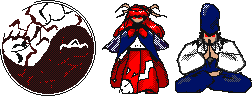
- Gatekeeper
- Shingyokunote
The gatekeeper to Hakurei Shrine, and the first boss in the entire series. Very little is known about Shingyoku, as it has neither dialogue nor an official profile.
- Collision Damage: The only enemy in this game who can do so, as they'll try to charge into Reimu in their orb form. Other bosses stay up in the air away from her.
- Curtains Match the Window: The female form is an Evil Redhead with red eyes.
- Death from Above: When in ball form, Shingyoku tries to squash Reimu.
- Degraded Boss: Sort of. Story of Eastern Wonderland, Subterranean Animism, and Undefined Fantastic Object have enemies that appear to be based on Shingyoku's main form.
- Evil Redhead: The female form is red-haired and evil.
- Gender Bender: One form appears female, another looks male. The concept of yin and yang represents duality, after all.
- Horned Humanoid: The female form has four horns.
- Leitmotif: "The Positive and Negative"
- Meaningful Name: Shingyoku can be written in kanji as 神玉, which translates to "divine orb".
- Pink Girl, Blue Boy: Not exactly, but the Female's red hakama and the Male's blue one stand out.
- Red Eyes, Take Warning: Is a villain and both their male and female forms have red eyes.
- Warm-Up Boss: This is the first boss in Highly Responsive to Prayers (and, by extension, the entire franchise). This is probably why it has one of the lowest health pools and has some of, if not the, most simplistic attacks in the game.
- Would Hit a Girl: One of its attacks in its ball form involves it trying to crush Reimu, which characterizes it as a villain.
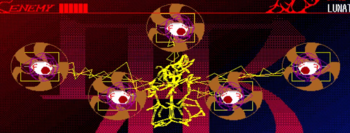
- Evil Eyes
- YuugenMagannote
A generic boss Reimu encounters in the Makai, YuugenMagan is a set of five independently moving eyes that are connected by electricity.
- Ambiguous Gender: Their gender is never even hinted at.
- Combination Attack: All five eyes join their beams to produce a star shape.
- Damage-Sponge Boss: Its health rivals the Final Bosses, who have the highest health pools in the gamenote .
- Extra Eyes: Made of nothing but eyes.
- Eye Beams: It can shoot beams from its eyes. One of its attack is the eyes shooting beams at each other, forming a pentagram. This pentagram then shoots bullets at you.
- Faceless Eye: It takes the form of five disjointed eyes connected by electricity.
- Instant Runes: Not as ornate as usual, but for one attack all five eyes fire beams that combine into a five-tipped star (pentagram).
- Intangible Man: The connecting point of electricity vaguely looks like a person but cannot be hit by the Orb.
- Leitmotif: "Angel's Legend", a theme she also shares with Mima in the first game.
- Obviously Evil: Although there's no real information about the bosses in this game, we are talking about a cluster of disembodied eyes with the title "Evil Eyes" and the kanji for "evil" is displayed in the background during the battle...
- Purple Is Powerful: A dangerous opponent that's partially colored purple.
- Red Eyes, Take Warning: Has red eyes and is a dangerous boss for Reimu with the title of "Evil Eyes".
- Wake-Up Call Boss: Despite only being the second boss in the first gamenote , YuugenMagan is clearly a step up in difficulty compared to Shingyoku. Despite having more hitboxes, it's less predictable and its attacks often cover more of the screen. Also, surprisingly, it has some of the highest health in the game.
- Wolfpack Boss: A group of five eyes that attack Reimu.

- Innocent Devil
- Elisnote
Elis is the second boss Reimu faces in the Makai. She is a blonde girl that has devil wings, can turn into a bat, and carries a wand. Little else is known about her.
- Animorphism: She can turn into both a small and a large bat.
- Facial Markings: Has a star on the left cheek.
- Good Wings, Evil Wings: Has bat wings and is a villain.
- Leitmotif: "Magic Mirror," a lower-pitched version of which is used for Kikuri.
- Magic Wand: Holds a wand with a star cutout on it.
- Our Vampires Are Different: Implied. She's referred to as a devil, and vampires are a type of devil in the Touhou universe, while she turns into a bat throughout her fight. However, she's not officially confirmed to be a vampire, and her bat transformations work differently from those of the Scarlet sisters (Kurumi, the only other vampire, is never seen transforming); while Elis can transform into two kinds of bats and can still take damage while transformed, the Scarlet sisters only have one transformation, which they use specifically when their Contractual Boss Immunity activates.
- Purple Is Powerful: Her design incorporates some purple and she's a powerful boss, at least in Hard mode.
- Teleport Spam: Erratically teleports around the screen, especially early into her fight.
- Winged Humanoid: She looks like a human girl who has vampiric wings.
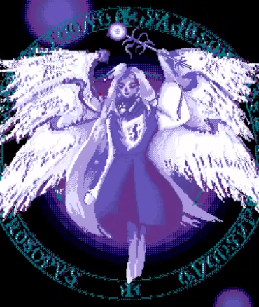
- Angel of Death
- Sarielnote
Sariel is an angel of death and the Final Boss of the Makai route.
- Ambiguous Gender: Downplayed. All other versions of Sariel are male, and the sprite could be intended to be of either gender. Sariel's ending artwork, however, is much more distinctly feminine.
- Clipped-Wing Angel: Her second phase, which has much less health than her first phase.
- Fallen Angel: Because she resides in a world of demons, and because the Sariel she is based on is recorded in some writings as a fallen angel, she is widely regarded as being one herself.
- Final Boss: If you picked the Makai route in Highly Responsive to Prayers, then Sariel is the last boss you face.
- The Grim Reaper: Of the Azrael variety.
- Heavenly Blue: She's an angel that wears mostly blue.
- Instant Runes: Has a circle of magic around her.
- Leitmotif: "Now die, for the debt you have accumulated" / "Now, Until the Moment You Die" and "Let's Die All Together", later renamed Civilization of Magic.
- Magic Wand: Has a weird looking one.
- Our Angels Are Different: Her first form is a seraph-like due of her six wings and has a weird shard on her chest which is her weakspot. Her second form is a silhouette of her first form with six more wings extending from the figure.
- Palette Swap: She turns gold during one of her attack phases.
- Sequential Boss: She has two forms you have to take on.
- Sinister Silhouettes: Her second form, which is a silhouette of her first form, but with much larger wings. It looks similar to the cover art of the Windows games.
- Taking You with Me: The original title of her second leitmotif, Death Will Take You With Me, indicates that this is what she was trying to do when Reimu defeated her.
- Winged Humanoid: Six angel wings.
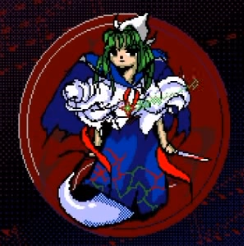
- Vengeful Ghost
- Mimanote
A vengeful spirit whom Reimu originally ran into during her trip into Jigoku. She later reappeared in Gensokyo, trying to get revenge on not just Reimu, but all people. After being shot down a second time, she gives up being evil and spends her time hanging around the Hakurei Shrine and making fun of Reimu.
- 1-Up: Drops an extra life early into her boss fight in the second game.
- A God I Am Not: Zig-Zagged. She contemplates about becoming a Shinto god in her Mystic Square good ending, but decides to take it easy and goes to bother Reimu instead. But then, in her Extra ending, she considers that maybe she could become a god after all.
- Chuck Cunningham Syndrome: Despite being present in four out of the five PC-98 games, a fan favorite, and having a significant connection to one of the characters who became the face of the franchise, she has yet to even be mentioned in the Windows series.
- In Curiousities of Lotus Asia, Reimu makes an offhand comment that her shrine was once taken over by an evil spirit, which is what Mima (an evil spirit) once did.
- Before Ten Desires, one of the PC-98 music re-release CDs has her on cover.
- In Urban Legend in Limbo, one of Reimu's alternate colors appears to be a Mima palette.
- Colliding Criminal Conspiracies: Her excuse for going to Makai in Mystic Square is that tourist devils are "trespassing on her turf".
- Consummate Liar: Subversion. While she is quite capable of sticking to the trope, she more often than not just tells flat out lies for fun.
- Curtains Match the Window: In most of her in-game appearances, Mima has green eyes and green hair.note
- Defeat Means Friendship: The original one in Touhou, although your mileage may vary on how "friendly" she and Reimu become. They're not trying to kill each other on sight anymore, at least.
- Escaped from Hell: In her debut, she's fought at a hokora in Hell, with the implication that she was sealed in said hokora and broke out. In subsequent games, she's at large throughout Gensokyo and neighboring worlds rather than back inside her seal in Hell.
- Final Boss: The Stage 5 boss of "Story of Eastern Wonderland".
- Fog Feet: She is generally seen with a ghost tail peeking under her dress.
- Ghost Amnesia: She doesn't even remember how she became... whatever she is.
- A Glass of Chianti: In Mystic Square's Extra ending she has wine served by Meido Alice.
- Lady of Black Magic: Cool and confident, she has incredibly strong magical powers.
- Leitmotif: She's racked up a few of them:
- Her first theme was "Angel's Legend," which she shared with YuugenMagan in the first game.
- "Complete Darkness," which played during the final showdown of Story of Eastern Wonderland.
- "Reincarnation," her theme from Phantasmagoria of Dim.Dream, which is arguably one of the fandom's favorite songs. ZUN gave the song an official remix in Dolls in Pseudo Paradise, which is (at least for now) the closest we'll get to a PC version.
- Her first theme was "Angel's Legend,"
- Lunacy: In her Phantasmagoria of Dim.Dream ending, she wished that the Full Moon will always be in the sky so that she will be at full power at all times. Yumemi grants it a little too literally, by placing the Moon in geosynchronous orbit.
- Our Ghosts Are Different: She denies being "dead" and refers to herself as simply being a soul. Given that Shinto is an animism in which anything, from living beings to objects, places and even words or concepts can harbour a soul, this makes more sense than you'd think, but Mima is still pretty different even by Shinto standards.
- Power Gives You Wings: Grows four additional wings in her final attack phase in Story of Eastern Wonderland.
- Prison Escape Artist: She has escaped sealing at least twice, once before fighting Reimu in the first game, and again after losing to her in the second game (likely three times, if we assume Reimu sealed her back in the hokora after the fight in the first game). The fact Mima keeps hanging around the shrine and pestering Reimu in the third and fifth games suggests that either she keeps getting sealed and escaping, or Reimu stopped bothering because she figured there's no way to restrain her for very long.
- Promoted to Playable: She serves as one of the bosses in the first gamenamely and, in the second game, she's the Final Boss. During the rest of her appearances in the PC-98 era, however, she's one of the Player Characters.
- Purple Is Powerful: She's a powerhouse and her design in Story of Eastern Wonderland incorporates some purple.
- Recurring Boss: Originally a lower level boss in Highly Responsive to Prayers, she returned as the final boss of Story of Eastern Wonderland.
- Say It with Hearts: A good deal of her dialogue in Mystic Square.
- Sealed Evil in a Can:
- Was this very, very briefly in the Story of Eastern Wonderland ending.
- Played more straight in her backstory, where she is described to be sealed in the Hakurei Shrine's hokora. Though she breaks out pretty easily and very often.
- Stringy-Haired Ghost Girl: She decides to dress like a stereotypical ghost girl for fun in her good ending in Mystic Square.
- Sword Beam: In Highly Responsive to Prayers, she uses a knife to shoot lasers.
- Villainous Breakdown: In the second game, Mima loses some of her composure before the final part of her fight begins. Also, she doesn't seem to take it well when Reimu defeats her.
- Wake-Up Call Boss: She serves as this in her debut. While she's only the second boss in the game (if you're in the Jigoku routenote ) her attacks are quite nastier than Shingyoku's and she has (slightly) more health than it.

- Hellish Moon
- Kikurinote
The second boss Reimu meets in Jigoku, Kikuri is a bronze disk. Okay, there's an image of a girl on the disk, but it's still pretty strange.
- Attack Its Weak Point: The only part of her that can be damaged is her forehead.
- Battle Aura: Has a sun-like fire aura around her.
- Eye Beams: One of her attacks consists of her firing lasers from her eyes. It's an unusual example in that she does this with her eyes closed rather than open, since she's never shown opening her eyes in the whole game.
- Leitmotif: "Magic Mirror," a higher-pitched version of which is used for Elis.
- Lunacy: She's called the "Hellish Moon", and sure enough, one of her attacks involves rising tides.
- Making a Splash: One of her attacks is raising a tidal wave. In Hell. Don't question it.
- Power Floats: Beyond the disk itself, the engraving shows a ball of energy hovering.

- Astral Knight
- Konngaranote
- Ambiguous Gender: Their gender is never stated and their sprite appears rather androgynous. Unlike Sariel, Konngara is only seen from over their shoulder in the ending.
- Excuse Me While I Multitask: Carries a sake plate while fighting Reimu, from which they fire more bullets.
- Final Boss: Is the last foe Reimu faces in the Jigoku route.
- Horned Humanoid: Has a single horn protruding through their forehead, possibly indicating the character to be an Oni.
- Leitmotif: "Swordsman of a Distant Star"
- Mood-Swinger: Similar to the dual-personality Yakshas they're possibly based on, Konngara frequently switches moods during their boss fight. Konngara's facial expressions actually telegraph which attack will come next.
- Public Domain Character: Based off of the minor deity Konngara-douji, but it's unknown how much Konngara actually represents the figure.
- Red Eyes, Take Warning: A dangerous enemy with red eyes.
- Sword Beam: With bullets and lasers.
Debuted in Story of Eastern Wonderland
- Turtle
- Genjii
An old turtle who serves as Reimu's transportation (since she hadn't yet learned how to fly under her own power), and on occasion attempts (unsuccessfully) to be her mentor, or at least give her advice. Disappeared without a trace after Mystic Square, though Word of God has stated that he's "probably living in the lake at the back of the shrine".
- Chuck Cunningham Syndrome: Genji was one of the characters that didn't make it when the series was brought to Windows.
- Flight: He can fly through unknown methods, and its how Reimu gets around before she figures out how to fly under her own power.
- Older and Wiser: He's Reimu older advisor, although Reimu rarely ever heeds his advice.
- Older Sidekick: He's much older than Reimu but serves as her number two.
- Sapient Steed: He's a sapient turtle that Reimu rides around.
- The One Guy: The one male character in the PC-98 games.
- The Quiet One: He becomes this from his second appearance onwards, where he has no dialogue whatsoever.
- Wise Old Turtle: A giant, wise old turtle that serves as Reimu's advisor, as well a means of flying, in the early games. However, from the sixth game onwards, since Reimu is capable of flying on her own, Genjii is nowhere to be seen. ZUN Hand Waved it as him retiring and living quietly in the pond behind the shrine.
- What Happened to the Mouse?: If Reimu defeats Yachie in Unfinished Dream of All Living Ghost's VS mode, she comments that a flying tortoise brings back a distant memory, implying that Reimu has not seen Genji for a very long time, suggesting he has either left the Hakurei Shrine completely or even potentially passed away.
A recurring enemy in the PC-98 era, particularly in the early stages. They were also artificially created by Rika.
- Ambiguous Situation: Rika claims to have created them, but how true this is and how it factors into their nature is unclear. They appear in the next three games while Rika is never seen, mentioned or alluded to again, and it's unclear how an engineer would be able to create what seem to be ghostly creatures.
- Artifact Mook: In their debut game, Rika claims to have created them. However, they continue to appear throughout the next three games despite Rika never being seen or referenced again, and their connection to her is never touched back on either.
- Color-Coded for Your Convenience: In Phantasmagoria of Dim.Dream, like all other stage enemy variants, their color indicates how many times you must hit them to defeat them:
- Red - 1 hit
- Green - 2 hits
- Blue - 3 hits
- Purple - 4 hits
- The Goomba: They're mainly encountered in the early stages of most PC-98 games and they're the simplest enemies. They also go down in one hit (regardless of the Player Character) and only pose a threat while in groups. Like many examples, they have simplistic designs, as they're just ghost-like creatures with their tongues out.
- Maniac Tongue: Have their tongues out constantly, and are enemies.
- One-Hit-Point Wonder: Part of why they're The Goomba? It takes one hit to put them down. The only exception is Phantasmagoria of Dim.Dream, where, like all other stage enemy variants, they're Color-Coded for Your Convenience to indicate how many times you must hit them, which can be from 1 to 4 times.
- Took a Level in Badass: In Story of Eastern Wonderland and Lotus Land Story, they return at the beginning of the Extra Stage, where, while still going down in one hit, they're much more aggressive and have a real shot at hitting you.
- Engineer
- Rika
Some sort of scientific genius. Before Story of Eastern Wonderland she creates a bunch of monsters and ghosts and decides to hang out at the Hakurei Shrine while Reimu was gone. Naturally, she gets her ass kicked. She later challenges Reimu on more even grounds riding the Evil Eye Sigma. First boss in a Touhou shooting game, and first extra stage boss.
- Badass Normal: Unlike every other humanoid boss in the game, she doesn't fight by herself, but instead with the machines she has created, implying that aside from her genius engineering, she is powerless.
- Brainy Brunette: She's a brunette and a competent Wrench Wench who created the Bakebake.
- Breaking the Fourth Wall: Does this big time in the extra stage, with her and Reimu discussing this would have been Stage 2 had Reimu chased Rika during the main story, and that this fight will be harder than anything else since it's the Extra stage...
- Leitmotif: "She's in a Temper!"
- Magic from Technology: In her stage 1 dialogue, she claims to have created evil spirits and monsters somehow.
- Meaningful Name: "Rika" means "science", with different kanji.
- Mundane Utility: Inverted. Despite possessing knowledge of the combustion engine, she uses it to build tanks as opposed to say, a car.
- Million Mook March: She has an army of monsters and tanks at her disposal. Or rather, had one before Reimu trashed everything.
- No Name Given: Is only called ??? in the Stage 1 scenario, and never introduces herself. You only learn her name in the Extra Stage, when Reimu asks her.
- Not Helping Your Case: When Genjii calls her suspicious, she takes offense and retorts that she created the bakebake, prompting Reimu to do a Face Fault.
- Not-So-Harmless Villain: She's first introduced as the Stage 1 Boss, but is ranked along with Yukari as one of the hardest extra stage bosses.
- Recurring Boss: She's first seen as the stage 1 boss, then comes back for the extra stage with a new tank.
- The Rival: Set up to be Reimu's rival during the second game, but nothing much really came out of it.
- Sentry Gun: Uses autonomous guns as tools in her stages. The manual refers to them as cannons.
- Schizo Tech: She drives tanks around in notably science-free Gensokyo.
- Superboss: Manages to be both the first boss and the Superboss by fighting in a new tank in the extra stage.
- Tank Goodness: Despite both tanks being destroyed by Reimu in short order, you have to give her credit given that she built them both by herself.
- Took a Level in Badass: She's such a pushover in Stage 1 that when they meet again, Reimu calls her a small fry. Of course, during said Extra Stage, she turns out to have become the toughest opponent in the game.
- Unlimited Wardrobe: Despite being a relatively obscure character, Rika is noted for having several different outfits, most of them containing a bowtie somewhere.
- Wrench Wench: She's a technological genius capable of building entire tanks by herself.
- Abnormal Ammo: She shoots kanji. Specifically, the kanji 呪, meaning curse.
- Curse: Implied. Her bullets are in the shape of the kanji 呪 which means 'curse'.
- Evil Redhead: She's a redhead who attacks Reimu and Genji.
- No Name Given: She's unnamed.
- Red Is Violent: Her hair, part of her dress, and her bow are all colored red. She also attacks Genji and Reimu.
- Samurai
- Meira
Attacks Reimu in an attempt to get the Hakurei powers for herself. Fails, and is never heard from again.
- Bifauxnen: Has to declare herself as a woman to Reimu, who either isn't listening or doesn't care.
- Hyper-Destructive Bouncing Ball: Her last attack is to sheath her sword and release several spheres that bounce around the screen. Hmmm, so that's why she wants the power of Hakurei...
- Leitmotif: "Power of Darkness"
- Mistaken for Gay: Reimu thinks she's flirting with her when she expresses her desire to take Hakurei's powers. Reimu either thought she was a man or was fine with it.
- Not Listening to Me, Are You?: Says this after Reimu's romantic daydreaming.
- Sword Beam: She can fire spread shot bullets using her sword.
- Sword Lines: She can carve a diamond shape in the air with these, which then starts shooting bullets.
- Dual Boss: A downplayed case as they're midbosses. However, both of them are fought together.
- No Name Given: Both of them are unnamed.
- Red Is Violent: They're partially colored red, and they try to defeat Reimu and Genji.
- No Name Given: They're all nameless.
- Red Is Violent: They all attack Genji and Reimu plus they're partially colored red.
- Shows Damage: Type I. When Reimu damages the final sphere enough, it changes from grey to several colors.
- Wolfpack Boss: There are five of them. Downplayed, however, in that the first four are destroyed during the first phase of the fight, leaving the fifth to do most of the work on its own.
- 1-Up: Drops an extra life when defeated the second time.
- Light Is Not Good: She has an angel-like appearance due to her angelic wings and holy attire. However, she also attacks Reimu and Genji.
- No Name Given: We're never given her name.
- Recurring Boss: Downplayed as she's a midboss. However, she's fought twice in stage 4 in the second game.
- Winged Humanoid: She looks like a human woman, albeit one with angelic wings.
- Evil Eye Sigma
A flying tank built by Rika. Noted for being the first Extra-Stage Boss and being rather difficult to destroy.
- Alliterative Name: Its name definitely seems to be a play on this with "Sigma" looking a lot like an "E".
- Fake Difficulty: While usually regarded as one of the harder Extra Stage bosses, Touhou 2 dosen't have Focus. This means any attempt at Evil Eye Sigma is effectively a No-Focus run. In terms of actual patterns; Evil Eye Sigma is easily the simplest Extra Stage boss.
- Contractual Boss Immunity: Averted. Unlike every other Extra Stage boss, Evil Eye Sigma dosen't become invulnerable while bombing.
- Faceless Eye: It's a tank in the shape of a giant, disembodied eye.
- Good Wings, Evil Wings: It has two bat wings.
- Holy Halo: Has an angelic looking halo floating on top of it.
- Insistent Terminology: It has little in common with actual tanks, but Rika refers to it as one because she's a tank engineer.
- King Mook: It's effectively a boss version of the winged evil eye enemies that appear throughout the game.
- Made of Iron: A bit too literally. This tank takes way more firepower to bring down than the ones Reimu encountered in the main story.
- Leitmotif: "The Tank Girl's Dream"
- Self-Destruct Mechanism: Self-destructs upon defeat. Reimu can get hit by the resulting explosion.
- Superboss: Is operated by Rika as the Extra Boss.
- Stuff Blowing Up: During the last two phases of the fight, it causes explosions all over the screen.
- Taking You with Me: When defeated, it self-destructs. If you don't get away from the explosion, you'll lose a life.
- Tank Goodness: It's a big flying tank, and Reimu's toughest opponent in the game.
Debuted in Phantasmagoria of Dim. Dream

- Hardworking witch who dreams of love
- Ellen
A witch that's eternally young in both body and mind.
- All Witches Have Cats: She's accompanied by the cat Sokrates. He even appears on her player sprite.
- Blessed with Suck: She does not grow old, but forgets things constantly. This memory loss causes her to remain somewhat childish.
- Captain Ersatz: Is blatantly a copy of the protagonist of Hatarakimono, a manga by one of ZUN's favorite artists.
- Leitmotif: "Tabula Rasa ~ The Empty Girl"
- Really 700 Years Old: She states that she is unable to grow old.
- Weak, but Skilled: In Phantasmagoria of Dim. Dream, she has horrible stats, but her EX attack plus her charge ones are quite difficult to deal with.
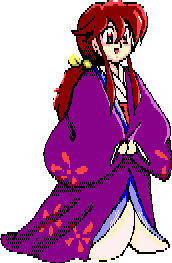
- A princess dreaming of beauty in danmaku
- Kotohime
A princess, who is also a cop. Yeah, she weirds out pretty much everyone she meets, and not just because of her occupational choices.
- Cloudcuckoolander: She's a princess who thinks she's a cop and likes to randomly collect things that only seem to interest her. The title of her theme suggests that she's insane.
- The Collector of the Strange: Her profile says that "as a proprietor of feelings most people don't have, she's something of a collector of things normal people don't find interesting".
- Cowboy Cop: Loose cannon princess cop who blows things up and doesn't play by the rules.
- Dirty Cop: Played for Laughs in her ending, where she has Reimu thrown in jail for no particular reason, just for the hell of locking someone up.
- Fair Cop: Claims to be a policewoman who is "undercover" as an ordinary person. Given that her idea of an "ordinary person" is a princess...
- She visits Reimu in her police uniform in the epilogue if she wins.
- Flying on a Cloud: She rides atop a big cloud when summoned as a boss.
- Genius Ditz: Despite telling Yumemi to her face that science is heresy, Kotohime recognizes the electrical equipment in the ship, and her victory quote to Chiyuri is to start reciting the Periodic Table.
- It Amused Me: Suggested as her most likely motivation for exploring the "ruins" with all the other player characters. This is supported when she defeats Yumemi and can't think of anything to wish for. And when she finally makes her wish, she puts Reimu in jail just for the hell of it.
- King Incognito: Inverted. She is seemingly a princess, but after defeating Yumemi, she claims to be an undercover cop (nevermind the fact that a princess is hardly inconspicuous).
- Leitmotif: "Maniacal Princess"
- Mad Bomber: Not Ax-Crazy, but she is both mad and likes blowing stuff up.
- Ninja Pirate Zombie Robot: She's a Cloudcuckoolander bomber princess cop.
- Say It with Hearts: Shows up in the late-game encounters with Chiyuri and Yumemi.Chiyuri: ... You'd better do what I say if you know what's good for you!Kotohime: Okay, I will. ♥
- Sheltered Aristocrat: According to her profile, she isn't allowed to leave home very often because of her strange personality. In addition, the characters who do recognize her tell her she should go home, suggesting that she doesn't have permission to be out this time, either.
- Stuff Blowing Up: Most of her attacks are explosives.
- Unusually Uninteresting Sight: Most of the other characters react with intrigue or confusion in their Mirror Match victory quotes. Kotohime's only comment, however, is a matter-of-factly "Oh dear, it's me".
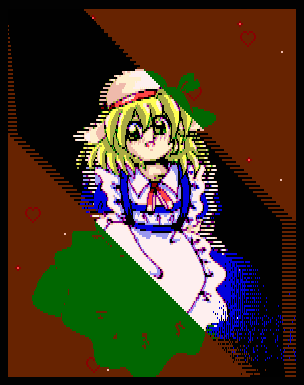
- Maiden poltergeist who's lost her dreams
- Kana Anaberal
A poltergeist produced by an unstable girl. She normally haunts a western mansion, but the owner has gotten used to her, so she's bored.
- Animal Motifs: "Soul Bird" just about sums it up. Kotohime's victory quote asks if she's a birdkeeper.
- Just Ignore It: The owner of the mansion she was haunting stopped paying attention to her, so she plans to search for a new home.
- Leitmotif: "Vanishing Dream ~ Lost Dream"
- Make Some Noise: Her charged shot is named "Energy Noise", implying it to be a sound based attack. Makes sense when you consider her species, as the word "poltergeist" literally means "noisy spirit", and in folklore, inexplicable loud noises are often attributed to them.
- Meido: She wears a maid's uniform.
- Our Ghosts Are Different: She's a poltergeist who was created by the mind of a mentally unstable girl.
- Poltergeist: She's the first poltergeist in the series. Her sound based Charged Attack is also in line with folklore, as "poltergeist" means "noisy spirit" and inexplicable noises are attributed to them.
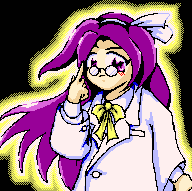
- Scientist that looks for dreams
- Rikako Asakura
A rare inhabitant of Gensokyo that values science above magic. Despite this, she's actually a very powerful magician.
- The Heretic: Reimu calls her heretical because she's one of the few people in Gensokyo who values science over magic.
- Jet Pack: Doesn't use flying magic to go around due to her dislike for it, and instead uses a jetpack.
- Labcoat of Science and Medicine: As a scientist in a world where that's an uncommon profession, she stands out wearing a labcoat.
- Leitmotif: "Visionary Game ~ Dream War." It's (supposedly) the longest theme in Touhou history.
- Meaningful Name: "Rika" means "science", by changing the second kanji.
- Purple Is Powerful: She's one powerful magician and she's got purple hair plus eyes of the same color.
- Schizo Tech: Flies around in a jetpack in a setting where most of the technology is pre-industrial.
- Willfully Weak: She's quite strong magically, but she dislikes magic too much to use it often.
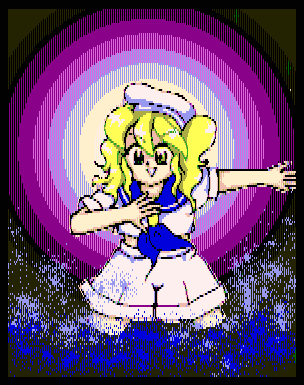
- Resident of fantasy that runs through time
- Chiyuri Kitashirakawa
Chiyuri is Yumemi's assistant and mostly spends time collating her research data. She also put out the fliers advertising the contest to reach the center of the "ruins" that recently appeared in Gensokyo. She doesn't always have a clear idea of what her boss intends, which results in her getting whacked over the head when she treats the contest winner rudely (read: threatens them with a gun). Yumemi then orders her to fight the heroines in order to collect more data. Oh, and her major is in "comparative physics". Whatever that means.
- Alternate Self: She has a Gensokyo counterpart who can use magic.
- Butt-Monkey: Scolded, whacked in the head, and thrown a chair at by Yumemi in multiple storylines... She does get the luxury of hitting Yumemi's head with a chair, but it's more out of necessity rather than revenge. Specifically, she hits Yumemi to dissuade her from destroying the world after losing.
- Card-Carrying Villain: She tries to hold the winning character hostage because she thought it would be dramatic.
- Get a Hold of Yourself, Woman!: Played for Laughs. In most endings, she snaps Yumemi out of a Villainous Breakdown via giving her a Cranial Eruption with a chair.
- Hard Head: Yumemi hits her on the head a lot. She returns the favor to stop her from nuking everyone. With a chair.
- Improbable Age: To us, anyway. Chiyuri is a 15-year-old who graduated from college at 11 and graduate school at 13; however, this is the norm for her dimension.
- Leitmotif: "Sailor of Time".
- Magic from Technology: Fights with fhe artificial magic that Yumemi developed.
- Mirror Match: She fights herself in a comedic sequence.
- Number Two: She's Yumemi's assistant, helping with her research.
- Teen Genius: She's in her teens and a supergenius. This is apparently normal in her dimension.
- The Man Behind the Man: It's revealed in Ellen's scenario that Chiyuri was the one who wrote the pamphlets inviting people to the Ruins; and promising a 'present to give happiness'. Yumemi's reaction to Ellen bringing this up strongly implies Yumemi was not even aware Chiyuri did this or made such a promise; making Chiyuri the actual instigator of the game's events.
- Time Master: ...Maybe. She's got a definite time theme going on with her theme, attack names, and bomb, but none of this manifests during gameplay and it's never mentioned in the story.
- Verbal Tic: Ends most of her sentences with "ze," a tic that would end up being heavily associated with Marisa in the Windows games. Apparently a Shout-Out.

- Fantasy legend
- Yumemi Okazaki
Yumemi is a professor of "comparative physics" at a university in another dimension where all natural forces have been explained by a Grand Unified Theory. When she dares to suggest that the theory doesn't explain magic, she is laughed out of the university and sets off on a journey to prove that it exists. Her ship lands in Gensokyo to capture someone to use in her experiments. Asskicking ensues and she leaves empty-handed. In spite of her disappointing failure, she still rewards the heroines generously.
- Badass Cape: Wears one during fights as her "battle wear". Her text on the selection screen states she's obsessed with them.
- Badass Normal: Probably the most standout example of this trope across the entire series, if not in video games entirely considering the scope of the beings she contends with. She is not only merely an 18 year old human girl, but a naturally powerless one at that: no magic or special qualities whatsoever. To circumvent this, she manages to scientifically synthesize imitation magic significant enough to be the final boss of what is commonly considered the most difficult game in the series to 1cc.
- Big Bad: The main villain of Phantasmagoria of Dim. Dream. Though she turns out to be really quite amicable.
- The Captain: Captain of a probability space hypervessel.
- Cross Attack: She fights with cross-shaped explosions. Ellen asks if she's a Christian.
- Earth-Shattering Kaboom: Threatens to blow up the Earth with a "four-dimensional positron bomb" after her defeat. She claims she's only kidding, but that doesn't stop Chiyuri from whacking her over the head with a folding chair.
- Evil Redhead: She's the primary baddie in Phantasmagoria of Dim. Dream and her hair is red.
- Final Boss: As she's the stage 6 Boss of Phantasmagoria of Dim. Dream, she's the game's last obstacle.
- For Science!: Attempts to kidnap the player character as proof of her findings.
- Improbable Age: Is a college professor despite being only 18.
- I Say What I Say: Twice during her story after she meets her clone; Chiyuri asks who the real Yumemi is, and they reply "Both of us!!" in unison; later, when she prepares to fight herself, they both say "In other words... Everything will be fine once I get rid of you".
- Leitmotif: "Strawberry Crisis!"
- Magic from Technology: Yumemi has nearly perfected replicating magic and divine power by pure science by the time the player meets her.
- Make a Wish: Due to the ad Chiyuri put up, Yumemi agrees to grant the player character's wish to the best of her abilities if she defeats her. She gets slightly frustrated when Kotohime can't think of one.
- Mirror Match: Fights a copy of herself that Chiyuri accidentally created.
- Nightmare Fetishist: In her player mode, she gushes over everything that just tried to kill her.
- Red Eyes, Take Warning: Her eyes are colored red. She's also the Final Boss and the main baddie in Phantasmagoria of Dim. Dream.
- Slipknot Ponytail: Her braid comes loose when you defeat her.
- Sure, Let's Go with That: Implied in Ellen's scenario; where when Ellen mentions pamphlets saying she'd get something for going to the Ruins. Chiyuri says she wrote them, and Yumemi's reaction is 'A pamphlet? Let me see'. She then sees the wish promise and decides to go along with it anyway, on a condition.[That Ellen helps Yumemi with her research]. This also indicates the whole wish-granting scheme was Chiyuri's idea and Yumemi was not even aware of that part.
- Teen Genius: An 18-year old supergenius capable of imitating magic with science.
- They Called Me Mad!: She became a laughingstock of her world when she presented her theory on magic.
- Transformation Sequence: Subverted, she just puts on a cape.
- Villainous Breakdown: She's left frustrated after any of the Player Characters (sans Chiyuri) defeat her, though she calms down and accepts her defeat after a Get a Hold of Yourself, Woman! moment.
- Younger than She Looks: While she looks like she's in her twenties, she's actually eighteen.
- Ruukoto
When (and if) Reimu beat Yumemi, she asked for an assistant who could handle all of the day-to-day chores around the shrine. What she got was a nuclear-powered robot maid who isn't necessarily good at her job. After this, Ruukoto was never seen again.
- Captain Ersatz: She's the "safe" alternative to To Heart's Multi.
- Meido: First maid of Touhou.
- Robot Maid: She is a robot Yumemi built for Reimu to take care of chores around the shrine.
Debuted in Lotus Land Story
- No Name Given: We never learn its name.
- Plant Mooks: A giant flower attacking the player character.
- Zero-Effort Boss: Mostly shoots away from you. If you stand directly in front of this midboss, you barely need to move to dodge the bullets.
- Supernatural Creature
- Orange
A mountain youkai that gets attacked by the player character for no particularly good reason.
- Battle Aura: Her aura indicates her hitbox.
- Breaking the Fourth Wall: She warns you not to expect her to be easy just because she's the stage 1 boss.
- Clipped-Wing Angel: Orange turns blue once her health meter depletes far enough... but you probably finished her off before you noticed the change.
- Colourful Theme Naming: According to the game's coding, she's called Orange, which is clearly referencing the color of the same name.
- Leitmotif: "Decoration Battle"
- No Name Given: Her name is never actually seen in-game. In the cutscenes, she's just "???" The only times her name is shown are in the game's internal code, its omake, and Mystic Square's Extra Stage staff roll.
- Redhead In Green: An orangehead with green and yellow clothes, which later would share visual similarities with Hong Meiling due to this.
- Warm-Up Boss: Her status as the first boss in Lotus Land Story is apparently why her bullets give you plenty of breathing room and are slow-moving. It's even possible to defeat her before she fully performs one of her attacks without bombing.

- Vampire Girl
- Kurumi
A vampiress that attempts to stop the player from reaching the island in the lake filled with blood.
- Forgot About His Powers: Unlike the other vampires in the series, she is never seen using a bat transformation in combat, or at all, even though going off the other examples, it would likely be handy in a fight.
- Game-Breaking Bug: If you have low rank on Easy Mode; Kurumi on one of her patterns will attempt to shoot a negative amount of bullets. This crashes the game. Doubles as unintentional Easy-Mode Mockery as this can only occur on Easy Mode, and even then if you are doing particularly badly.
- Leitmotif: "Scarlet Symphony ~ Scarlet Phoneme"
- Make Some Noise: Her powers are implied to be sound-based, due to her theme name (Phoneme), the danmaku reflecting off the borders and her being a vampiress, and thus the bat-like analogies with the echolocation.
- Our Vampires Are Different: The first confirmed vampire in the series, if Elis isn't one.
- Recurring Boss: She's both the mid-boss and end boss of stage 2. Kurumi is the only PC-98 character to do this.
- Theme-and-Variations Soundtrack Her Leitmotif is a fourteen-second motif repeated in several keys.
- Winged Humanoid: She looks human, apart from her large bat wings. They count toward her hitbox.
- 1-Up: Drops an extra life when defeated.
- Animate Inanimate Object: A mirror with a will of its own.
- No Name Given: We never learn its name.
- The Porter of a Mansion
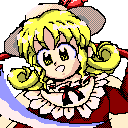
- Elly
The gatekeeper to Yuuka's mansion. She's completely useless at her job, letting both Reimu and Marisa by. Not that Yuuka even needs a gatekeeper, considering her own power and how isolated her mansion is...
- Bad Liar: Played for Laughs. If you're playing as Marisa, Elly tries and fails to lie to her that she defeated Reimu. The fact she greatly sweats while claiming this probably didn't help.
- Battle Butler: An unusual instance in which the warrior servant of the Stage 6 boss is not the second-to-last enemy in the game. Elly is only the stage 3 boss.
- Breaking the Fourth Wall: In the demo version, Elly explains to Reimu and Marisa that the game ends here. Both heroines complain about this.
- Combat Pragmatist: She'll hit you with anything she can, including ripping up floor tiles to throw at you.
- Gate Guardian: She guards the gate to Yuuka's mansion, though she is utterly awful at her job. Although this may have something to do with a vampiress inhabiting the only route to her gate.
- The Grim Reaper: Her design is based on the Ankou version of a Grim Reaper; which is a French inspiration.
- Leitmotif: "Bad Apple!" and "Spirit Battle ~ Perdition Crisis". Due to a famous fan vid, the former is much better-known than Elly herself.
- Mind over Matter: Her ability to hurl floor tiles and throw her scythe like a boomerang could be explained by some form of telekinesis.
- Nigh-Invulnerability: Before she starts to throw her scythe. Notable as it's the only time a Stage 3 boss has a survival phase in any Touhou game, the only survival phase in PC-98, and the first survival phase in any Touhou game [Unless you really want to count Evil Eye Sigma self-destructing as a "phase"].
- Precision-Guided Boomerang: When she throws her scythe, it spins repeatedly as it flies towards you, then returns to her.
- Sinister Scythe: Wields a scythe in her boss fight and is opposed to Reimu and Marisa.
- Spin to Deflect Stuff: When she throws her scythe, it spins in the air and blocks your shots. The only shot that can bypass it is Marisa-A with her piercing laser.
- Worf Had the Flu: Elly claims this is the case when forced to admit she lost to Reimu/Marisa, her excuse being that she hadn't fought in a long time. However, since this is the only time we ever see her, it's impossible to know whether an Elly at the top of her game could have defeated Reimu or Marisa.
- 1-Up: Drops an extra life when defeated in her second encounter in Lotus Land Story, as well as in her encounter in Mystic Square.
- Degraded Boss: Downplayed. She's still a midboss when she reappears in Mystic Square, but she appears in Stage 3 rather than Stage 4.
- King Mook: As a fairy who appears as a stage midboss, she's this to the fairies that appear as regular enemies elsewhere in the game.
- No Name Given: We never learn her name.
- Recurring Boss: She's encountered twice in her debut game. Averted in Mystic Square, where she's only encountered once.


- [PC-98]
- Oriental Demon
- Yuuka
- [Windows]
- Flower Master Of The Four Seasons
- Yuuka Kazami
An old and extremely powerful flower youkai first found living in the dream world, Mugenkan, and currently inhabiting the Garden of the Sun. She is sleeping at the time and only defends herself because Reimu and Marisa broke in and woke her up. Naturally, she loves her flowers and is actually more like a force of nature than a typical youkai.
- Affably Evil: She speaks gracefully and politely even as she's threatening to reduce you to atoms. Akyuu puts it best in her article in Perfect Memento in Strict Sense:The stronger the youkai, the more polite they normally are.But you must not cross her.
- Ax-Crazy: Her PC-98 version is heavily implied to be incredibly sadistic and entertained by violence, even proudly proclaiming that genocide is just a game to her.
- Berserk Button: Those caught disturbing her flowers have a nasty habit of getting vaporized on the spot.
- Blue-and-Orange Morality: Is generally peaceful and polite. If she is disturbed in any way, she is consistently recognized as one of the most dangerous beings in Gensoukyou. The problem is figuring out what disturbs her. Abusing flowers: death. Running a flower shop, where they are cut up, arranged with other cut flowers, and left to die: perfectly okay. If you are weak and don't disturb her, she'll ignore you as not worth her time; antagonize her, and she kills you. If you are strong and disturb her, she happily challenges you to a formal but non-lethal duel. When accused of being behind an incident, she makes no claims to be innocent, even though she is, and in fact actively goads the accuser into a fight. If PC-98 depictions are still considered canon, she once invaded the underworld, told the Satan equivalent she did it because she was bored, and says that genocide is just a game, whether it's on humans or demons. Debate still rages whether she actually believes that or only said it to piss Shinki off. If asked, her answer would probably be "yes."
- Breaking the Fourth Wall: Mainly in her bad ending in Mystic Square where she talks to the player, asking them to try again another time in a kind fashion.
- Demoted to Extra: After her return in Windows. She debuted in Lotus Land Story as the final boss who had to be fought two stages in a row, and then was Promoted to Playable in Mystic Square. At this point in time, she was so prominent a character she even made it into Kioh Gyoku as a Guest Fighter. After the leap to Windows, she wasn't seen again until Phantasmagoria of Flower View, where she was part of the roster and a late game boss, still presenting her as an important character as a result. However, she has only made background cameos in print works and in the fighting games ever since, not even getting to appear in any of the scene games.
- Doppelgänger Attack: A few of her attacks as Lotus Land Story's final boss.
- The Dreaded: Far and away one of the most feared youkai in Gensokyo. Case in point, eyewitnesses' accounts on Yuuka's article in Perfect Memento in Strict Sense revolve around her doing ordinary activities (such as chatting with flower shop owners, visiting the shrine, or smiling at villager in a flower garden)... Only to intimidate everyone with her mere presence.
- Final Boss: The Stage 6 boss of Lotus Land Story.
- The Gadfly: Loves rubbing people the wrong way. Goes hand in hand with It Amused Me. How much is up to the reader.
- Green Thumb: Being a flower youkai, her power is the manipulation of flowers. Unlike other Touhou characters who have vague or seemingly useless powers that can potentially be dangerous, her flower manipulation really isn't suited for battle at all. This doesn't hinder her, though, since she already has a lot of raw physical and magical power.
- Guest Fighter: Shows up in Kioh Gyoku as a playable character.
- It Amused Me: When she's a protagonist, her main motivations for picking fights were "it amused me".
- Just Here for Godzilla: In-Universe. The other characters assume because she's a flower-manipulating youkai that she's responsible for the events of Phantasmagoria of Flower View. In reality she's just there to enjoy the mass flower blooming before the incident is resolved.
- Lady of War: According to Perfect Memento in Strict Sense, she incorporates flower petals in her attacks and her fights are said to be beautiful to watch.
- Leitmotif: Like Mima, she's racked up a few:
- "Sleeping Terror", the theme when you first fight her.
- "Faint Dream ~ Inanimate Dream", her final boss theme in Lotus Land Story.
- "Lovely Mound of Cherry Blossoms ~ Flower of Japan", her theme in her cameo appearance in Kioh Gyoku.
- "Gensokyo Past and Present ~ Flower Land", her theme from Phantasmagoria of Flower View.
- "Sleeping Terror"
- Let's Fight Like Gentlemen: Provided the opponent isn't someone who crossed her, Yuuka enjoys a good, fair fight with rules discussed beforehand to prevent unnecessary deaths.
- Mighty Glacier: Relatively speaking, with the slowest move speeds in Phantasmagoria of Flower View (so slow that some characters can outspeed her even while they're in Focus Mode and she isn't) but with very high charge speeds matched only by Reimu, Aya and Tewi, as well as a reputation for being very old and powerful. Since in most Touhou games the protagonist is a One-Hit-Point Wonder who relies on dodging to survive (and she's never appeared in the fighting games), in her playable appearances she's technically more of a Glass Cannon.
- Moe: Invoked in her bizarre character profile in Kioh Gyoku, with ZUN repeatedly referring to her as "youkai moe~" and the term became almost endemic. Possibly a pun - moe literally means budding. That and various offical things casting her in a cute light.
- Names to Run Away from Really Fast: In-universe, Akyuu's profile on her states you should never interact with under any circumstance.
- Akyuu also lists her "Human Friendliness Level" as "worst". This put her below youkai that still hunt humans like Rumia, the human-hating Medicine, and the insane human-blood drinking vampire Flandre. She is the only character to get the Worst rating.
- Nightmare Fuel Station Attendant: She acts like she was just teasing... with jokes about genocide and murder.
- Not Me This Time: She's the prime suspect behind the flowers blooming in Phantasmagoria of Flower View, as she has caused an incident before and is a youkai of flowers, but it turns out to be a (mostly) natural phenomenon.
- Parasol of Pain: She always carries a parasol (though it is actually a flower that never withers).
- Perfect Run Final Boss: Just like with Kaguya, if you used a continue before the final stage, you never saw it. If you lost all your lives during it, it would end immediately. Unlike Kaguya, it also doubles as Easy-Mode Mockery.
- Promoted to Playable: Although she's the stage 5 and 6 boss of Lotus Land Story, she's one of the Player Characters in Mystic Square and Phantasmagoria of Flower View.
- Psycho Pink: Both of her outfits in her debut incorporate pink, in which she's mentally unwell plus antagonistic to the Player Character. Averted in Mystic Square, in which she no longer sports pink. Further averted when she reappears in the Windows era, as she has a different and more affable personality.
- Recurring Boss: In Lotus Land Story, she first appears as the stage 5 boss, then comes back for the final stage.
- Red Eyes, Take Warning: Her redesign in the Windows era depicts her as red-eyed and she's one of the strongest characters in Gensokyo. Averted in the PC-98 era, in which she has green eyes.
- Right Man in the Wrong Place: Her route in PoFV is only because random people kept running into her and accusing her of starting the whole Incident. Her response is a Sure, Let's Go with That.
- Same Character, But Different: Yuuka in the PC-98 canon was a demonic Humanoid Abomination heavily implied to be, if nothing else, a complete and utter monster, happily talking about her interest in brutally killing anyone she meets without a second thought. Come her reintroduction in Phantasmagoria of Flower View and she's not only changed species to a flower Youkai, but has taken much more benign personality (provided one doesn't damage her flowers). She's even stated to frequent the Human Village's florist, and is largely amicable to humanity.
- Say It with Hearts: Much of her dialogue in the PC-98 games.Yuuka: In a few hours, you'll become a mist of atoms. ♥
- Stronger with Age: One of the most powerful beings in Gensokyo, purely as a result of being around for so long.
- Time Abyss: Let's put it this way: Eiki Shiki declared that her "sin" is that she's lived for too long. When she said this about a human, said human had lived for over a millennium. Now, consider how much longer youkai already live than humans.
- Took a Level in Kindness: Pre-Windows Yuuka is an actively malevolent youkai who stirs up trouble and throws around homicidal threats. Post-Windows Yuuka is a largely dormant (if a bit trollish) youkai who's polite towards villagers and seldom does any harm beyond spooking off those who invade her garden.
- What Kind of Lame Power Is Heart, Anyway?: In a world where even the weakest powers get some kind of powerful application, Yuuka's ability to manipulate flowers is as simple as making them bloom and turning them to face the sun. Great for gardening, not so much for fighting. However, in the end that doesn't really matter since she's so physically and magically powerful due to her great age.
- World's Best Warrior: Yuuka is a very long-lived and wisened youkai, and therefore has quite possibly the strongest raw physical and magical power out of everyone in Gensokyo, to the point that her foes need their spoils from the Superpower Lottery just to match her.
- 1-Up: Drops an extra life while leaving.
- Ambiguous Situation: While Yuuka had a Ball of Light Transformation in the main story, it's not clear whether this orb is her, or someone else with the same ability, or if it really is just an orb.
- Collision Damage: Unlike other midbosses, the orb has no collision.
- Hold the Line: The orb is invulnerable. Instead, you must survive all of its danmaku until it leaves on its own.
- Nigh-Invulnerability: You can't hit the orb, and must Hold the Line until it leaves.
- No Name Given: We never learn its name.
- Maid
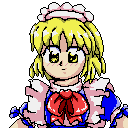
- Mugetsu
The goddess of the dream world the player character stumbles into during the Extra stage, apparently.
- Card-Carrying Villain: Boasts that she thinks nothing of human lives.
- Contractual Boss Immunity: She and her sister are the first Extra Bosses in the series to have a bomb shield.
- Giant Space Flea from Nowhere: Mugetsu is not in any way connected to the main plot. She just attacks for the lulz.
- Leitmotif: "Illusion of a Maid ~ Icemilk Magic"
- Meido: She seems to like wearing the uniform.
- More Dakka: Though not as brutal as her sister's, her timeout danmaku are hard. You can see them here.
- Physical Goddess: It's not really clear whether she actually created it or not, but she claims that the dream world that the Lotus Land Story's bonus stage takes place in is "her world".
- Superboss: One of the two extra stage bosses of Lotus Land Story.
- Teleport Spam: Moves around erratically via this, making her very difficult to hit.
- Demon
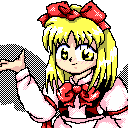
- Gengetsu
Mugetsu's older sister and a demoness. Seriously, that's about all we know about her.
- Big Sister Instinct: She fights the player character to avenge her defeated younger sister.
- Contractual Boss Immunity: She and her sister are the first Extra Stage bosses to have Bomb immunity.
- Divinely Appearing Demons: She is stated to be a demon, but she looks like an angel instead.
- Giant Space Flea from Nowhere: Gengetsu is not in any way connected to the main plot. She just fights because you're beating up Mugetsu and has no idea why Reimu and Marisa are even there.
- Increasingly Lethal Enemy: Exaggerated to the point of essentially being a Time-Limit Boss. It is common for Touhou extra stage bosses to have a final attack which becomes progressively more deadly as time goes on, but in Gengetsu's case, timing out her maxed out spread is not merely very hard - under normal conditions, it is virtually impossible.
- Gengetsu is also unique in the sense that while most Extra and Final bosses have a final attack that has a punishing timeout phase if you try and cheese the fact the attack becomes more intense as the boss' HP drops; Gengetsu does this on almost every single phase.
- Intangible Man: While moving around. She also dosen't have a physical hitbox, so you can't die by crashing into her. Probably a good thing given her Teleport Spam.
- Kamehame Hadoken: Can also break out a spark, though it's not quite as big as Yuuka's.
- Leitmotif: "Cute Devil ~ Innocence"
- More Dakka: This is what happens if you try to time out Gengetsu's final attack. Fans don't call it "Gengetsu Rape Time" for nothing.
- Stronger Sibling: Breaking the Touhou tradition, she's the older sister but still the stronger one.
- Superboss: The other extra stage boss of Lotus Land Story.
- Unbuilt Trope: Mugetsu and Gengetsu were the first of many pairs of sisters that would appear throughout the series. However, in future pairs such as Remilia and Flandre, Shizuha and Minoriko or Satori and Koishi, the younger sister is usually the stronger one, whereas here it's the other way around, so they look like an inversion of the trend in hindsight.
- Winged Humanoid: She looks human and she's got angel wings, despite being a demoness.
Debuted in Mystic Square
- King Mook: Acts as this to the other demons that appear as regular enemies throughout the stage.
- No Name Given: We never learn her name.
- Shock and Awe: The wheel surrounding her seems to be made of lightning.
- Spectacular Spinning: Her wheel spins continuously at a high speed.

- Gate Keeper
- Sara
Another one of those useless gatekeepers, Sara guards the doorway to Makai. Seems to consider humans food.
- Gate Guardian: She protects the gate to Makai.
- I'm a Humanitarian: Refers to Reimu as "prey".
- Leitmotif: "Magic Formation ~ Magic Square"
- Spectacular Spinning: During some of her attacks, she spins at a very high speed.
- Theme Naming: Both hers and Luize's names are shout outs to characters created by the same artist who created Ellen.
- Animate Inanimate Object: A mirror with a will of its own.
- Fictional Constellations: The mirror's surface has a constellation in the shape of a cross drawn on it. It's not the Southern Cross, however, as it has 5 stars instead of 4.
- No Name Given: We never learn its name.

- Demon Boundary Person
- Luize
A tourist from Makai. Had the bad luck of running into the heroine before she could make it to Gensokyo.
- Battle Aura: Has a ghostly one in stage 4.
- Eyes Always Shut: Most of the time anyway.
- Leitmotif: "Spiritual Heaven".
- Palette Swap: When she reappears as Stage 4 midboss, her hair and details on her outfit become blue, and her eyes become red.
- Recurring Boss: Stage 2 boss and stage 4 mid-boss, although her mid-boss appearance has different coloring.
- Red Eyes, Take Warning: Her eyes turn red in her second appearance as the Stage 4 midboss.

- [PC-98]
- Witch of Death
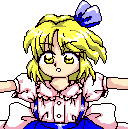
- Alice
- [Windows]
- Seven-Colored Puppeteer
- Alice Margatroid
Another magician that lives in the Forest of Magic, and neighbor to Marisa. Her power is magic, with her signature ability being the manipulation of her dolls. She's mostly aloof and self-confident, but is still willing (if reluctant) to work together with Marisa and isn't above showing kindness to others.
- Action Bomb: She sends dolls stuffed with gunpowder to blow up in people's faces.
- Alice Allusion: Aside from the obvious references, her name becomes a Stealth Pun when you remember that she now lives in Gensokyo (since "Gensokyo" literally means "fantasy land"...or "Wonderland", if you will).
- Attack Drone: Her dolls do most of the attacking.
- Attack Reflector: She has this in Mystic Square; during her Stage 3 boss fight, she uses a mirror that fires pellets when shot by the player character.
- Badass Bookworm: Like all Magicians she researches to improve the strength of her magic.
- Beneath the Mask: The official profiles (as well as Suika) call her out on her assuming a cool, confident front to hide her timid and cowardly true persona.
- Black Magician Girl: Somewhat, as she eskews more traditional magic in favour of puppetry.
- Breaking the Fourth Wall: Along with Marisa in Subterranean Animism. This continues into the Extra stage, where after defeating the mid-boss, Alice says to Marisa: "Look, it's the extra dungeon for after you beat the game. Good luck!"
- Creating Life: Her greatest ambition is to create a doll that can act independently instead of being puppeteered by her magic.
- Creepy Doll: Her dolls are usually depicted as more cute in official material, but some of her spellcards certainly suggest this trope with names like "Eerily Luminous Shanghai Dolls" and "Hanged Hourai Dolls". Not to forget that most of them are armed, shoot, or explode.
- Curtains Match the Window: Has yellow eyes to match her blonde hair in PC-98 canon.
- Deadpan Snarker: Her dialogue with Marisa in Imperishable Night and to a lesser extent Subterranean Animism consists essentially of the two witches throwing snarky comments at each other and occasionally at their opponent. She's much more polite and subdued when speaking alone to the other characters, so we can just blame the black-white's bad influence.
- Demoted to Extra: Hit hard by this. Alice was the Extra Boss in her debut game, as well as one of the most prominent characters in the series during the original Windows trilogy, appearing not just as the Stage 3 boss of Perfect Cherry Blossom, but also Marisa's partner in Imperishable Night, a member of the playable roster in Immaterial and Missing Power, and a recurring character in print works, putting her roughly on the same level as the likes of Remilia, Yuyuko, and Yukari. After the Soft Reboot in Mountain of Faith, however, her prominence dwindled rapidly, and after appearing as one of Marisa's shot options in Subterranean Animism and as Cirno's final boss in Hisoutensoku, she was eventually relegated to a rarely appearing and mentioned background character with no significant role. As of 2023, she has yet to have had a speaking part since 2009.
- Early Installment Character-Design Difference: Originally, she had a more childish appearance and her dress had a different design. She also now sports a red headband, while in her debut she wore a blue ribbon instead. Her dolls had a much simpler design as well.
- Eating Optional: According to Akyuu, Alice hasn't needed to eat or sleep since she became a youkai magician, but she does so anyway.
- Elemental Powers: When using her grimoire, she gains control over fire, ice, and possibly other elements as well.
- Everything's Better with Rainbows: Her moniker is the "Seven-Colored Puppeteer", and she fires multicolored danmaku.
- Expy: According to ZUN, her PC-98 incarnation was heavily inspired by Alice.
- Final Boss: She's the last opponent in Cirno's story in Hisoutensoku.
- Flunky Boss: She summons her dolls as part of many of her attacks. She does avert it in her Extra Boss fight, where she relies entirely on her grimoire.
- For Science!: Attacks Reimu, Marisa, and Sakuya in Perfect Cherry Blossom because she needed test subjects for their dolls, and they just so happened to be there. This also extends to her appearance as the final boss of Cirno's campaign in Hisoutensoku, where she uses the hapless fairy as a test subject for her new Titania and Goliath dolls.
- Hyperspace Arsenal: While fighting she seems to use an infinite amount of dolls.
- Kamehame Hadoken: Seems to have some form of strong beam attack, although it is inconsistently named. In the fighting games at least, it's fired out of a doll much like Marisa uses her mini-Hakkero to fire her Sparks.
- Leitmotif: Where to begin?:
- From Stage 3 of Mystic Square, "Romantic Children" and "Plastic Mind"
- From the Extra Stage, "Alice in Wonderland" and "The Grimoire of Alice".
- From Perfect Cherry Blossom, "The Doll Maker of Bucuresti" and "Doll Judgment ~ the Girl Who Played with People's Shapes"
- From Stage 3 of Mystic Square, "Romantic Children"
- Kaleidoscope Eyes: Perhaps fittingly for someone with the title "Seven-Colored Puppeteer", in Windows canon she goes from having blue eyes in Perfect Cherry Blossom to green in Immaterial Missing Power, orange in Imperishable Night, and then green again in Scarlet Weather Rhapsody and Hisotensoku.
- Mage Species: Alice eventually became a youkai magician as a result of her research into magic.
- Make My Monster Grow: The Level Titania & Goliath Doll, her last 2 cards in Cirno's Final Boss fight in Hisoutensoku have her dolls turn gigantic. The latter is a Survival Card.
- Marionette Master: Her puppets have no degree of automation, so even though she uses them to clean her house, it doesn't really make it much easier since she has to micromanage every single one of them. It makes her habit of holding one-sided conversations with them a little odder, too.
- Mundane Utility: Alice uses her doll army to do the chores.
- Recurring Boss: In Mystic Square, she is the stage 3 boss and the Extra stage boss, then in Perfect Cherry Blossom, she appears multiple times in stage 3.
- Same Character, But Different: In Mystic Square, Alice is a resident of Makai, supposedly a demon created by Shinki like everyone else there. However, when she was reintroduced for the Windows series, her background was changed so that she is a youkai magician living in the Forest of Magic (and, at least according to Akyuu, she was born human and became a magician through training). She also looks much older, despite there only being one game between appearances and no one else aging as distinctly, and has gained a surname and a focus on dolls.note
- Shout-Out:
- Her last name is a reference to Miss Murgatroyd in Agatha Christie's A Murder Is Announced.
- There's also the Alice in Wonderland thing, of course. Her extra stage in Mystic Square even comes with card soldiers and a BGM outright named "Alice in Wonderland".
- She has Rozen Maiden dolls as alternate palettes in Hisoutensoku.
- Spell Book: Since her appearance as superboss in Mystic Square, she's always seen carrying a sealed book, but hasn't opened it since then. This is what happened when she did. In Mystic Square it's titled "The Grimoire of Alice" while the Windows book has no visible label, but it's strongly implied that she still owns a book by that name.note
- Superboss: In Mystic Square. She's also the only superboss in all of Touhou that gives the player an ending and credit sequence after beating her, although it is actually a list of all the PC-98 characters.
- Theme Naming:
- Location Theme Naming: Many of Alice's spell cards are named for places. Most famous are her "Eerily Luminous Shanghai Dolls" and "Hanged Hourai Dolls", to the point where fanworks almost universally portray her with individual dolls named Shanghai and Hourai, although in Perfect Cherry Blossom she seems to have quite a large collection from all over the world, such as "Chalk White Russian Dolls" and "Benevolent French Dolls".
- Colourful Theme Naming: Using a color theme similar to the one used in Ran, Chen, and Yukari's names, Alice's title is the "Seven-Colored Puppeteer". Since Reimu is only a red and white shrine maiden, Alice asserts that Reimu is only 28.5714% (or 2/7ths) as strong as her in the dialogue before her boss fight.note
- True Sight: Has the ability to perceive Keine's true form, Mokou's immortality, and the invisible light of the full Moon just by a glance.
- Unknown Rival: Reimu doesn't recall her name both times they fight after her initial appearance, first in the extra stage of Mystic Square. She fails to recognize her completely in their reunion in Perfect Cherry Blossom. Naturally, Alice was annoyed. She didn't really seem to care much after that, and they're shown to be on at least decent terms later on.
- Vitriolic Best Buds: Alice and Marisa spend most of their time onscreen together snarking at each other, but she's implied to be genuinely a close friend of hers.
- Willfully Weak: She never fights at her full strength, because she's afraid of what it might mean if she lost while going all out. This idea is often connected to the fact that she carries a grimoire that she's never been seen opening since her PC-98 appearance.

- Black Witch
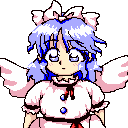
- Yuki
Tries to stop the player character once she gets into Makai, alongside Mai.
- Battle Aura: Gains red aura when Mai is defeated.
- Collision Damage: Averted. She's the only boss in this game to have no collision hitbox.
- Dual Boss: Alongside Mai. The two are also Midbosses in Samidare.
- Ironic Name: Yuki means "snow", but she uses fire magic. It's her teammate that uses ice magic.
- Leitmotif: "Crimson Maiden ~ Crimson Dead!" and "Forbidden Magic," which she shares with Mai.
- Playing with Fire: She specializes in fire-based magic.
- Red Oni, Blue Oni: With Mai. Yuki's the Red Oni, being the more aggressive of the two.
- Roaring Rampage of Revenge: If you defeat Mai first, Yuki becomes enraged and cuts loose on you.
- Turns Red: If Mai is defeated before her.
- White Witch
- Mai
Fights the heroine alongside Yuki. Quiet. Usually.
- An Ice Person: She specializes in ice-based magic.
- Dual Boss: Alongside Yuki. The two are also Midbosses in Samidare.
- False Friend: Despite acting as Yuki's friend, she calls Yuki "dead weight" when she loses and says Yuki was dragging her down. Ironically, she's considered to be the easier of the two. Her leitmotif is even called Treacherous Maiden ~ Judas Kiss.
- Good Wings, Evil Wings: Angelic wings. And when Yuki is defeated they turn into white demon wings.
- Leitmotif: "Treacherous Maiden ~ Judas Kiss" along with "Forbidden Magic," which she shares with Yuki.
- One-Steve Limit: Somewhat broken, with Hidden Star in Four Seasons introducing Mai Teireida. However, that Mai is spelled 舞, while this one is spelled マイ. Funnily enough, both are part of a Dual Boss (Mai from this game with Yuki, and Teireida with Satono).
- O.O.C. Is Serious Business: Mima's apparent power prompts Mai to actually speak in Yuki's presense, which surprised the latter.
- Red Oni, Blue Oni: With Yuki. Mai's the Blue Oni.
- Shout-Out: To The Divine Comedy, in which the ninth circle of Hell represents the sin of treason and is frozen over in ice.
- The Quiet One: She's normally pretty quiet, unless you beat Yuki first. If you do, she suddenly starts using sentences without ellipses.
- Turns Red: If Yuki is defeated before her.
- Winged Humanoid: Has either angel wings or white demonic wings depending on whether or not Yuki's been defeated first, though she otherwise looks human.
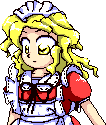
- 1-Up: Drops an extra life when defeated.
- King Mook: Acts as this to the other demons that appear as regular enemies throughout the stage.
- No Name Given: We never learn her name.
- Maid
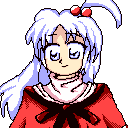
- Yumeko
A blade-throwing maid and one of Shinki's strongest servants. Tries to protect Shinki from the heroines. Fails.
- Curtains Match the Window: Has blond hair and yellow eyes.
- Flechette Storm: Technically, they're swords, but she uses them like knives.
- Intangible Man: Woman in her case, but she can temporarily phase out while moving.
- Leitmotif: "Doll of Misery"
- Magnum Opus: Shinki outright says "Out of everything I've created, Yumeko was of the highest caliber..." in every scenario except Marisa's, although when pressed by Mima on it she claims Yumeko is "a normal inhabitant of Makai" and "not a golem".
- Ninja Maid: The original one from the series, Shinki's warrior maid and one of her strongest servants.
- Space Master: Implied to be capable of manipulating space, with her being intangible when moving, the background being distorted during her fight, and her swords having fancier materializing animations compared to other projectiles in the game.
- Storm of Blades: Her bullets are lots and lots swords.
- Goddess of Devil's World
- Shinki
The creator of Makai. Since she allowed a travel agency in Makai to organize tours into Gensokyo, the heroines decide to beat her up.
- Affably Evil: The whole reason that Reimu, Marisa, and Mima went to fight her is that she was allowing demons from Makai to cross over to Gensokyo as tourists. This started causing problems there.
- Creating Life: Explicitly stated to have created Yumeko and all other Makai residents. Whether or not this includes Alice is up to speculation and individual interpretation.
- Dark Is Not Evil: Has white hair, dresses in blood-red robes with black and white hems, has dark wings covered in ominous symbols, is the creator of the Realm of Demons and all of its demonic denizens, yet she completely averts the White Hair, Black Heart, Red and Black and Evil All Over and Evil Wings tropes and flips the idea that demons are evil on its head for good measure.
- Death In All Directions: Literally in the later portions of her winged form attack, including Beam Spam and even More Dakka than usual.
- Final Boss: Being the stage 6 boss of Mystic Square, she's the last boss in said game.
- Energy Weapon: Has a particularily awe-inspiring penultimate attack that covers most of the screen in sweeping lasers and bullet patterns. She actually ends up destroying Makai with this attack. The attack pattern was later reused by Byakuren as her "Devil's Recitation" Spell Card... Well, of course it would be a recitation: Shinki declared it first.
- God Empress: She is the divine creator of Makai and all of its denizens plus is their official ruler.
- The High Queen: You'd think the creator and ruler of the Demon Realm would fit the other trope but, no, Shinki's genuinely pretty nice, and the invasion of Earth was not so much an "invasion" as it was an unannounced tourism venture.
- Leitmotif: "Legendary Illusion ~ Infinite Being". The fangame Magus in Mystic Geometries adds "AN ORDEAL FROM GOD" (composed by ZUN).
- Person of Mass Destruction: At the end of her final attack phase, in the background you can see a bunch of buildings going up in flames.
- Physical Goddess: And is not one of the lesser goddesses, either, being borderline omnipotent, capable of creating her own world, filling said world with lifeforms and destroying it when she goes all-out.
- Power Gives You Wings: Grows six white seraphic wings for battle. Which then change color to a more demonic purple.
- Oddly, she loses them again during the final attack, perhaps because she is exhausting the last of her power.
- Satan: For the Touhou universe, as she's the Goddess of Makai, has white seraph wings that may turn a demonic purple, and lives in "Pandaemonium." Of course this being Touhou means:
- Satan Is Good: She is a friendly person despite being ruler of Makai, but can get very annoyed if one attacks her.
- Winged Humanoid: Has six purple wings with red markings.
- 1-Up: Drops an extra life when defeated.
- Animate Inanimate Object: A playing card with a will of its own.
- King Mook: Acts as this to the card soldiers that appear as regular enemies throughout the stage. A bit literal due to wearing a crown as well.
- No Name Given: We never learn their name.
