
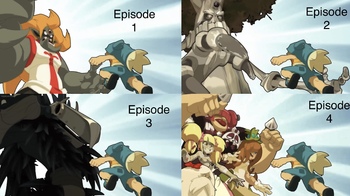
Razor: Giant monster of the week?
Episodes where the characters fight a villain who is expeditiously defeated at the end, never to be dealt with again. Essentially, the Monster of the Week serves as the Big Bad of a single episode. Can be seen as the complete antithesis of a Story Arc, or a Story Arc compressed into one episode. Sometimes, use of a plot element like Arc Welding can bring together what appear to be unrelated threats, but other times they are established as being minions of the ultimate Big Bad from the start.
The term (a play on Movie of the Week) was originally coined by the writing staff of The Outer Limits (1963), which sought to distinguish itself from its biggest competitor, The Twilight Zone (1959), by promising viewers a new monster every episode. Out of its 49 episodes, only around 8 twisted or outright eschewed the formula.note
Variations crop up from time to time, though the most generic term is "Villain of the Week". The 4400 and Smallville, for example, are sometimes discussed in terms of the "Freak of the Week". Mystery of the Week is the detective series version of this trope.
Sometimes, the monsters get ridiculous, especially in fillers, where they are almost always themed after the plot of the episode. Futari wa Pretty Cure had a giant vacuum cleaner early in its run, for example; Digimon Adventure, a walking garbage dump.
This actually is not a bad thing. Monster of the Week (and perhaps Monster Munch) can be used to establish characters or setting. Or perhaps lead to a much bigger Story Arc - such as deliberately showing the characters developing as they have to learn new tactics to overcome their foes, sustain injuries from more powerful monsters, or even setting up things such as He Who Fights Monsters. Additionally, some shows that use this formula have no wider plot whatsoever, and do not need to, since the core "defeat the villain" episodic plot can be more than enough to maintain audience engagement as long as the plots themselves remain interesting.
It's actually Older Than Print... several pieces of old mythologies about folk heroes can be interpreted as a recurring Monster of the Week.
Sub-Trope of One-Shot Character. Often used in collaboration with Adventure Towns, may or may not be Monogender Monsters. See also Robeast, Monster of the Aesop, and Single Specimen Species. Contrast Monster Mash, Rogues Gallery and Villain Exclusivity Clause.
See Continuity Creep and Not So Episodic, for heavy overlap.
Not to Be Confused with Shaenon Garrity's The X-Files parody webcomic Monster of the Week, or with the Apocalypse World style Tabletop Game of the same name.
Examples:
- Akame ga Kill!: The first few arcs center around Night Raid offing disgraceful elements of the Empire one by one.
- Akiba's Trip: Each episode focuses on a particular hobby, which the villain of the week's scheme coincidentally revolves around.
- This is the one of the recurring criticism behind Aldnoah.Zero. After the seemingly promising first three episodes, the technical aspect of its slow-paced combat slowly thrown away in favour of introducing (and defeating) more and more Kataprakths at least per one to two episodes, ensuring more mecha-action in every weeks. Even moreso in the second season onwards.
- This gets played with in Akazukin Chacha, as, on occasion, one of the monsters would be brought back to fight Chacha again rather than just making a single appearance.
- In Angels of Death, Rachel and Zack progress through a tower that is managed by a group of serial killers whom they will need to face off against on each floor.
- Inverted in Assassination Classroom. Koro-sensei is the Villain Protagonist of the assassination side of the plot, and in each story he foils an assassination attempt made by a different student, teacher, or character from outside the classroom.
- Bleach started out like this, with Ichigo fighting a different hollow each chapter. Though after Rukia got taken back to Soul Society, it became more Story Arc focused. Even during the Arrancar arc, he and his allies duel with Lieutenants, Captains, Arrancars, etc, all count as part of this.
- Cells at Work! has some elements of this in early volumes, with many chapters revolving around the immune cells having to deal with some new pathogen or other threat.
- Chainsaw Man: Each of the main arcs has the Devil Hunters encountering a major Devil.
- With the exception of the series' recurring antagonist Vicious, most Cowboy Bebop episodes centered around a single villain or group of villains that was never heard from again after the end of the episode (some were two-parters).
- The anime Dai-Guard hangs a lampshade on this one by having scientists predict that the conditions necessary for the alien giant monster invaders to appear will repeat themselves roughly once every week.
- Devil May Cry: The Animated Series: Dante would battle a demon each episode. In the first episode, he spared a demon he considered too weak, this comes back to bite him once said demon becomes the last opponent in the final episode.
- Every season of Digimon starts out this way as the new characters learn the ropes and the viewers learn the new characters (and in some seasons, new universe).
- In the case of Digimon Tamers, this is generally held to be what killed the show's American ratings as a true Big Bad was not introduced until the trip to the DigiWorld 24 episodes in.
- Digimon Frontier states that most all monsters are sub races of Digimon, save a few, from the start.
- Dororo (2019) follows this, with Hyakkimaru battling a demon while gaining one of his body parts back.
- Dragon Ball:
- Dragon Ball GT: In an interesting display of symmetry, the show used this format in the Black Star Saga (the first arc) and the Shadow Dragon Saga (the final arc).
- In the Tournament of Power Arc of Dragon Ball Super, there are episodes that generally involve fighters outside of Universe 6 and 7 that never get heard from again after they are taken out. For instance, one episode pits three Universe 4 warriors against Master Roshi, while one episode pits two assassin warriors in an episode focused on Tien. Even though they are introduced at the start of the tournament, they don't get any real introduction until their respective episodes.
- The Jyarei Monsters from Eto Rangers. This is a variant of the trope, however: they disguise themselves as characters of the Novel Worlds, so before the Eto Rangers can do battle they first have to use the Revealing Mirror on the disguised Jyarei to get them to reveal their true form.
- Figure 17 Tsubasa & Hikaru plays this completely straight, although there is strong continuity as well. By the end of the series the monsters don't even look different from each other — they just get slightly upgraded powers. This does become less prominent as the plot goes on, however, as emphasis shifts toward Tsubasa and Hikaru's relationship, with some episodes not featuring a Maguar at all, and others being dedicated to particularly large and important, multi-episode fights.
- Fist of the North Star's Kenshiro regularly faced off against villains of the week, often with some weird Nanto or Hokuto-derived power that he had to overcome, moreso in the anime than in the manga, and the series varied between these and genuine story arcs.
- Fullmetal Alchemist played this for the first volume before going into the main plot (which it would keep through the entire series); interestingly it was still only one of the chapters of the first volume that didn't affect the story in any way. Likewise, some early episodes of the 2003 anime adaptation had a version of this: if there's a plot-important character in the episode we have not seen before, he is probably the villain of the week. The main exception to this rule is Rose. 'Course, a fair share of these episodes turned out to be important to the plot later.
- Played straight in GaoGaiGar with the Zonders, though taking things in canon time passage it could more likely be considered the "monster-of-the-half-a-week."
- GeGeGe no Kitarō uses this for every adaptation with Yokais. While the first four animes used the format with no intricate plot, the 2007 and 2018 series use it with an ongoing Myth Arc.
- Played straight by Genesis of Aquarion, though at first the monsters were just regular Cherubim Soldiers with some kind of new ability that the team had to find a way to overcome by using lessons from earlier in the episode to unlock a new attack.
- The Getter Robo series did this a lot. The original, G, Go, and to an extent New all used this trope. Even the crossover movies were monsters of the week.
- Ghost in the Shell: Stand Alone Complex has two types of episode: "Stand-Alone" episodes that deal with a one-shot villain or case, and "Complex" episodes that advance the overall Story Arc of the season.
- In Guardian Fairy Michel, every episode has a fairy turned into a monster that the heroes must stop and purify.
- Hellsing Ultimate: Each episode had the Millennium Lieutenants with their overconfidence thinking they're a match for Hellsing... before Alucard tears them to shreds.
- Inuyasha was this for nearly every episode outside the last anime story arc, usually having some demon or monster getting their hands on a jewel shard. Once the manga got past the point of the anime ending, it changed up a little bit. The sequel series Yashahime: Princess Half-Demon also goes with this, with a new monster battled while also exploring the Half-Demon Princesses' relation and past.
- JoJo's Bizarre Adventure began this in Stardust Crusaders. As the heroes go on their journey to defeat the Big Bad; a Stand User, sometimes two, shows up to eliminate them. The previous two Parts were more arc-based.
- Kekkaishi follows this trope, with a strange new Ayakashi or two attacking the Karasumori site every night. But it's justified through the actual behavior of the Ayakashi, the motives of more dangerous ones, and the steady plans of the Kokuboro.
- Kekko Kamen: Every chapter had the eponymous heroine battling a sexual deviant hired as a "punishing teacher" by Toenail of Satan. A running gag in the work was that most often than not the "teachers" were parodies of other characters i.e the crew of Cyborg 009 reimagined as members of a tailoring department.
- Kemono Jihen: The Inugami Detective Agency handles cases to exterminate Kemono, supernatural creatures akin to the monsters of lore when they cause trouble in the city.
- Kill la Kill plays with this trope a bit. In the first four episodes, Ryuko fights three minor Club Presidents who have all the makings of this trope- only stopping to try to skip right to Satsuki herself between the second and third. However, once Ryuko beats the third, she gets strong enough to reduce her fight with another Club President to a short Curb-Stomp Battle and promptly finishes off the rest in a montage.
- Kinnikuman first began this way, Monster Extermination arc, before it became the Professional Wrestling series it became famous for.
- Nightmare/eNeMeE in Kirby: Right Back at Ya! would provide King Dedede with a new monster with which to try to kill Kirby just about every episode. Naturally, Dedede is just too cheap to buy more than one at any one time. He did go into debt buying them. eNeMeE actually had to send a monster to collect the debt without him realizing (at first), though it still ended up being defeated. Some of the monsters were from the games, like the Ice Dragon and Mumbies, but others weren't.
- Magical Girl Lyrical Nanoha started out like this, then Fate intervened. Even before that she collected some Jewel Seeds off-screen and several per episode.
- Both parodied and played straight in Magical Project S, which has Pixy Misa summoning a new "Love-Love Monster" in half of the episodes. The show and its characters are quite aware of both the futility of these creations (as the incantation of "Calling Mistakes" suggests) and their formulaic nature (in an episode where Misa introduces a small army of them, Sammy dryly says "I've seen all those already").
- Mega Man NT Warrior goes with this, each episode involves Lan and the others dealing with an evil Net Navi and their operator.
- My-HiME runs like this: The heroic girls (Himes) wield weapons and CHILDs to fight off monsters called Orphans threatening their school. After a Wham Episode midway, the formula continues, except that this time, it's the CHILDs who are lined up on the chopping block as the Himes engage in a battle royale where There Can Only Be One.
- Mazinger Z and its sequels, Great Mazinger and UFO Robo Grendizer, are considered the 1970s paragon in spite of actually subverting the trope. Dr. Hell often sent two, three or even more Mechanical Beasts at a time as well. And the original manga averted it completely. The monsters gang up on Mazinger more often than not. It also was subverted in Mazinkaiser, where Dr. Hell sends a large number of monsters at once against Z and Great Mazinger, and wins.
- Averted in Shin Mazinger, probably because it stuck more closely to the original manga. Dr. Hell never just sends one monster out into battle, and usually has backup plans should his monsters fail.
- Mob Psycho 100: Early on, Mob and Reigen perform exorcisms on various ghosts and spirits causing trouble. Mob would soon battle with agents from Claw.
- Mobile Suit Gundam, while extremely arc-based, still managed to introduce a lot of new enemy Mobile Suits in a monster-of-the-week fashion. It's why in the series/movies, the Federation has only five unique mobile weapon designs, while the Zeon have seventeen. Subsequent series' set in the same time period and supplementary materials have added more designs for both sides, but always heavily weighted in Zeon's favor. This was incorporated into the lore as part of the reason Zeon lost the war: Much like Germany in World War II, a lot of time and resources was lost to multiple designs competing for the same role(s), while the Federation picked a handful of designs that worked and stuck with them. Subsequently, Federation designs tended to be variations of the GM(though variations of the Gundam, Guncannon, and even Guntank show up from time to time), while the Zeon would have entirely new Mobile Suits added, on top of variations of the classic Zaku/Gouf/Dom designs.
- Mobile Fighter G Gundam is THE best example in Gundam, because this was the entire point behind the series, to draw on the monster of the week fanbase, or more specifically the robot of the week fanbase, because that was how most robot shows were done prior to Gundam.
- SD Gundam Force did something like this during early on. Basically, the Dark Axis' Quirky Miniboss Squad would use a Control Horn on a robot in Neotopia, such as a swan ferry or a train, turning it from a helpful Mobile Citizen into a dangerous menace, and it would be the Gundam Force's job to destroy the Horn. According to the Zako Zako Hour, the Dark Axis (or at least Zapper's squad) were not very good at making new weapons, so they have to steal everything. This stopped after Episode 9 as the Dark Axis began sending in better warriors to attack Neotopia.
- Moriarty the Patriot starts out like this before Sherlock Holmes shows up and the Continuity Creep takes over, with each "Monster" of the week being yet another noble that the Moriarty brothers are planning to murder.
- Neon Genesis Evangelion also started like this. From the 13th Angel's attack on, however, even though each monster is still gone at the end of the episode that introduced it, every mental scar left behind by the monster's attack remains, building up and taking its toll over time. Evangelion's cast is on its last legs by the time the 17th Angel kicks the bucket. Cue The End of Evangelion.
- One-Punch Man has this in spades. There's a chance there will be a monster to beat at least once per arc. Trope gets exaggerated, when Monster Assocation is introduced, with multiple monsters appearing for sometimes even few seconds just to be killed.
- In Panty & Stocking with Garterbelt, the main duo occasionally battle a renegade demon causing mischief around the city, though they're somewhat more outlandish than usual.
- Phantom Quest Corp. is comedy/horror sitcom style series which follows a case-by-case format (referred to as "Incident Files"). Each of its 4 episodes are its own stand alone adventure, complete with a different villain, or supernatural horror.
- Pokémon: The Series is well known for this. Some Pokémon get to be the monster of the week multiple times. Within the first 24 episodes, Gastly was monster of the week twice: when he was impersonating a statuified woman, and as part of the Lavender Town episode with its evolutions.
- For a while in Popcorn Avatar, this is how many of the Asura and their avatars appear in front of Kurando.
- In The Powerpuff Girls anime adaptation Powerpuff Girls Z, the Powerpuff Girls tended to fight one-shot antagonists created by the black Chemical Z rays when they weren't fighting any of their traditional adversaries. They often only appeared for one episode because their episodes always ended with the monster either being permanently returned to normal by Professor Utonium or having a Heel–Face Turn. The anime's interpretation of Him also created some one-shot villains by exposing random people, plants, and inanimate objects to dark particles he released throughout the city.
- Integral to the Pretty Cure series. Invariably, they're possessed objects turned rampaging beasts which the heroines fight, defeat and purify, albeit there are cases of animals and even people being possessed. In the first two seasons the villains summoned ghost-like spirits (Zakenna and Uzaina respectively) to create the monsters; in following seasons, the bad guys used different tools to achieve the same results, such as masks (Kowaina), spheres (Hoshina from PC5s sequel GO!GO!), diamond-shaped cards (Nakewameke), wilting Flower Hearts (Desertrian), corrupted musical notes (Negatone), clown noses containing a Cure Decor (Akanbe), black magic and two or more objects (Yokubaru), "prickly power" i.e negative energy (Oshimaida), smaller spirits called Nanobjogens (Megabjogens), colored orbs (Yaraneedas), emblems of the Bundle Land Bandits (Ubauzos), energy from the Underg Empire (Lanborgs) and dark energy that possesses animals (Garugarus). The exceptions to the rules are the Jikochuus (created with the selfish and petty thoughts of a person's heart without the need of possessing anything), the Saiarks (Jumbo-sized Choiarks that take one or two attributes of the Victim of the Week) and the Zetsuborgs (Small, gray lock-like creatures whose bodies are formed by the attributes of the Victim of the Week as well). Kira Kira Pre Cure A La Mode is noteworthy for featuring a spin on this trope by having a group of antagonists, the Kirakiraru Thieves, act like the monsters during the first half of the series. The second half, however, featured a more traditional yet different take by having every bad guy summon a monster by different means that still involved the possession of an object: a ventriloquist's dummy (Bibury), tarot cards (Elisio) and imp-like clay dolls called Nendos (Glaive). The only villain who didn’t do it in that season was Julio, who just fought the Cures repeatedly with a changing weapon.
- One notable example from Doki Doki Pretty Cure. The Greater-Scope Villain and True Final Boss is the final Monster, since he was only indirectly responsible to the plot and was never the Big Bad. He even gets defeated in the same way like any other.
- This trope gets averted in Star★Twinkle Pretty Cure, where the villains just use Mooks instead. Then it gets double averted when they actually do start using monsters called Nottoreiga in Episode 6. Even so, they are shaping to be less commonly used than the other Monsters of the Week due to the way they're required to be summoned: the bad guy needs to capture a Star Color Pen to corrupt it into a Dark Pen and then use it to steal the imagination of the Victim of the Week to call forth a Nottoreiga. Given that the Precures will be getting most of the Star Color Pens first, this leaves the villains with fewer chances to employ this trope. Eventually, the series settled on with only Aiwarn being able to summon Nottoreiga. After Aiwarn went AWOL after one too many defeats, not new Nottoreiga have appeared in the series. The villains went back to employing mooks and giant mooks to attack the Precures.
- Puella Magi Madoka Magica starts out like this. The format gets dropped before the halfway mark. One such monster manages to kill off a major character in the third episode.
- Played with and used straight by RahXephon. The Dolems mainly show up on a once-a-week basis, although some of them survive their initial appearance and go on to reappear later.
- The majority of Martial Arts and Crafts opponents in Ranma ½ ended up like this, from the comical and ridiculous (Sentaro Daimonji of the Martial Arts Tea Ceremony School, Picolet Chardin of La Belle France School) to the serious and dramatic (Prince Herb, Ryu Kumon, Saffron). Then the anime took it above and beyond with outlandish rivals of the week who used toys, eggs, calligraphy, or even crepes. Only rivals who had preexisting relationships with the cast, such as Ryouga, Mousse, and Ukyou, were given the chance to stick around and become regular characters.
- This is the basic structure of RIN-NE so far, albeit longer than most of the examples on this page — most cases take two or three chapters to solve.
- Rosario + Vampire started as your typical Unwanted Harem monster of the week manga, until it became focused on more serious and involved story arcs. The anime adaption continued to be a fanservice-laden comedy into its second season, much to the chagrin of the fandom.
- Sailor Moon is the most famous of this, with the monsters of the week — at least 80% of the time — also being Monogender Monsters, females in this case. None of the monsters ever survive the episodes they were introduced in, with the only two exceptions being Regulus (because Nephrite only used him as a distraction and never summoned him again after that) and Cenicienta (because the episode she appeared in was a two-parter).
- Samurai Pizza Cats: Lampshaded in one episode, where the Big Cheese introduced the robot menace he'd prepared for this episode with "Monster of the week, please enter and sign in."
- Shaman King: This is used for the 2001 anime, with Yoh and his allies battling with a shaman on their way to the tournament, and fighting one of Hao's minions when he sends them after Yoh.
- In Sonic X, the first 26 episodes of the first series had Dr. Eggman's randomly deployed robots, each one with an E-(insert number here) as their serial number, and the first 11 episodes of the first half of the second series had random Metarex encountered by Sonic and co. along their journey to save the universe from the Metarex.
- For about the first half of Speed Grapher, Suietengu's plan to recapture Kagura is to have his henchmen sic a different Euphoric on Saiga. They never live more than two episodes after being introduced.
- Spriggan: On each of his missions, Yu would battle with the head of an organization hunting for an artifact or a creature that comes from the related object.
- Played straight in SSSS.GRIDMAN like its previous series. A Kaiju pops up to attack the city, Gridman then materializes to defeat it. SSSS.DYNɅZENON would also follow this.
- The first two seasons of Stitch! had several episodes where Stitch and his best friend in that series Yuna meet a yokai whose unique powers or abilities causes the episode's conflict somewhere on Izayoi. Also, as with its Western predecessor Lilo & Stitch: The Series, various Experiments—both old ones from that show and ones newly introduced for this show—also appear, especially during the second and third seasons, usually causing mischief for Stitch to stop like before. Dr. Hämsterviel even modified many of the experiments (primarily in the Denser and Wackier third season) that he somehow acquired in the years after the events of Leroy & Stitch to give them different powers than before and/or improve their already existing powers to cause evil on his bidding.
- Tengen Toppa Gurren Lagann plays this straight. In the first episode, the Lagann is introduced as well as a minor enemy. Next episode introduces some more mecha, including the Gunzan (later Gurren). The third episode introduces the first actually recurring villain, who's more of an anti-villain. By Episode 6, the show actually starts straying becoming more serialized rather than episodic, but maintains its monster of the week standard until Episode 15, where the MOTW is actually the first Big Bad. The second half reversed this, by having the good guys introduce more and more powerful mecha to kick the enemy's ass, most notably after Team Dai-Gurren goes to space.
- Tentai Senshi Sunred shows how this trope plays out from the monsters' point of view: The Evil Organization Florsheim has a stable of monsters who rotate between branch offices, letting them challenge the local heroes with fresh monsters on the regular. Monsters also retire (usually after receiving enough beatdowns) and require Florsheim to cultivate new local talent and pair them up with their own veterans to get them used to battling heroes. Florsheim's Kawasaki branch has the problem that their local 'Arch-Enemy' Sunred is a Comically Invincible Hero (retired), and battling him is usually very traumatising (luckily he is a Technical Pacifist and never kills). As such, while fights with Sunred usually involve a newcomer, Florsheim also need a few regulars around that can serve as Recurring Villains.
- Tiger & Bunny: As corporate-sponsored superheroes, Sternbild First Leagues are tasked to take on NEXT criminals that the police have trouble capturing.
- This caused a Dub-Induced Plot Hole in the English Macekre of Tokyo Mew Mew. If there's now an "army" of monsters of the week, why do we only see one at a time?
- Trigun Stampede: The show has Vash and the others encountering an opponent in each episode, though they don't necessarily always defeat them by the episode's end, and each encounter plays out as part of a larger story.
- In Umi Monogatari, the first few episodes have Marin and Kanon battling creatures that Sedna summons. This pattern gets abandoned halfway through the series as it focuses on more personal battles.
- Ushio and Tora started this way with the titular duo battling a rogue Yōkai monster causing mayhem whenever it pops up. The series would later shift away from this into being more arc-focused.
- Witch Hunter Robin got a new witch every week for the first half. Then things changed rather abruptly.
- In Yo-kai Watch, with the yo-kai. Each episode features several sections, with at least one of those sections featuring an odd situation, Nate finding out it's caused by a yo-kai, then beating said yo-kai in some way or another, though he doesn't always defeat it. Sometimes the end of the part is played for laughs with a failed resolution, but this is pretty rare.
- Yu-Gi-Oh!:
- Early chapters of Yu-Gi-Oh! generally featured a "bully of the week." His role was typically to scam or beat up Yugi's friends, at which point Yugi would challenge him to a Cooking Duel or the local equivalent. Most notably, The Rival Kaiba started out like this, but then...
- The anime based on the manga, and its spin-offs, have a Duelist of the Week who pops up with a new deck gimmick and quirky personality to challenge the hero. With very, very few exceptions, these characters will be defeated in a single episode and will never appear again. If they're lucky, they'll get a two-part episode before they vanish. Yu-Gi-Oh!: Capsule Monsters has different monsters to defeat for each of the five trials to return home.
- Zatch Bell!: The series starts off like this, and this is the format between major story arcs. In-Universe, this is justified by several demon children learning that Zatch is in Japan, and wanting to eliminate what they think is an easy target.
- Catch! Teenieping: Almost every episode in Season 1 features Princess Romi attempting to find and catch a loose Teenieping who likes to cause trouble and mischief for innocent townspeople.
- Gaju Bhai has the title character, a movie actor from Jollywood, going to Gajrajpuri and fighting off a different villain in each episode.
- Happy Heroes has the heroes go up against a different monster, usually summoned in one way or another by the primary antagonist Big M., in a vast majority of episodes. However, some of the monsters make recurring appearances, and a few even have detailed personalities and backstories.
- In Kung Fu Wa the Kwei are evil spirits in the shape of white orbs with vaguely evil faces on their surface that can possess objects and living creatures, turn them into monsters and cause destruction, they can only be stopped by sealing them in the Ancient Scroll.
- Zakia Al Thakia involves the titular superheroine battling a different type of foe in each episode, primarily living inanimate things such as hamburgers, clouds, and vending machines, along with others such as aliens and cats.
- Many comics tend to have a story with a one-shot villain every now and then. It would be easier to list comic books and comic strips that DON'T utilize the monster of the week trope.
- Wonder Woman Vol 1: Marston seemed to be using all villains outside of Paula, who reformed and became a hero, only once at first. Then they started reappearing years later, with ties to current villains or looking for revenge but Marston died before there was any real payoff outside of the connection between Hypnota and the slavers of Saturn and the initial formation of Villainy Inc.
- In the old The Dandy comic strip, Jack Silver, the villainous Captain Zapp had a device known as a Duplicator, which could create a living, breathing copy of any picture that was fed into it. Every week, he would use the strange creatures the machine produced to commit crimes, before being stopped by Jack Silver and his gadget of the week.
- Each volume of Scott Pilgrim has the titular character battling one of Ramona's Seven Evil Exes.
- Superlópez: A common format in the early stories. Chiclón, Luz Luminosa, the Galactic Gladiator, Morgana the Witch or the Atomic Nightmare are all one-off villains, never appearing again.
- Every week, the Amazing Three of Jackpot had to battle a monster created by the evil Vogler, who could bring any monster he thought up to life.
- The Lion King Adventures follows this format, featuring an absolute plethora of villains, monsters and aliens.
- Most chapters of My Brave Pony: Starfleet Magic deal with the good guys blowing up Titan's recently created monster/Chrysalis's new changeling/the recent monster made by the main villain of each Season.
- In Tomica Hero Rescue Pups
 , the Rescue Force and Paw Patrol blow up each episode's super-droids and super-disasters.
- Done in two terms in Magical Girls Unite Retransformed. Half of the chapters focus upon facing a Witch and turning them back into a Puella Magi, the other half focuses on recruiting other magical girls, in which case the monster is an established villain.
- Sev Trek Pus In Boots spoofs Star Trek's use of this trope.
Lt. Barf: Captain, we are being hailed. I recommend we go to Red Alert!
Captain Pinchhard: We haven't even met them! Isn't that a little premature?
Lt. Barf: Every week we encounter aliens who try to destroy or take over the ship. It would save a lot of time if we assumed the worst now. - Dramatically subverted in Spider-Man: Across the Spider-Verse. When Miles first encounters the Spot as he's trying to rob an ATM in a gas station, he's incredibly casual and relaxed about it despite knowing nothing about the guy or his powers. He explicitly refers to him as a "villain of the week" on more than one occasion when dealing with him; Gwen and other Spider-People also get in on this, deeming him useless and too comical of a villain to be taken seriously. The humiliating scorn results in the Spot going completely off the deep end when combined with a Trauma Conga Line of other tragedies he's had since the accident that caused his mutation, resulting in him getting a better handle on his powers, enough to travel to other universes. Spot then proceeds to power himself up with dark matter from multiple Super-Colliders until he becomes a Humanoid Abomination who can threaten the entire multiverse and declares his specific intent to kill Miles' father so that Spider-Man will finally respect/fear him as an Arch-Enemy.
- Each Godzilla movie usually sees Godzilla going up against a new daikaiju that's emerged to terrorize Japan, particularly in the first Showa series. The later eras of Godzilla movies had more reoccurring rivals, due to the financial failure of Godzilla vs. Biollante, resulting in the studio deciding to play it safer with pre-established characters.
- In a similar manner, Gamera fights a new monster every movie, some even being recycled from previous films. The sole exception is Gyaos, which is thus far the only monster to appear in several movies, rather than just being a one-off antagonist.
- The James Bond film series generally follows a "Diabolical Mastermind of the Week" formula. This was moreso common in films after the Sean Connery era, as due to a legal dispute Eon Productions couldn't use Ernst Stavro Blofeld, and so they created one-shot evil masterminds to go up against Bond instead.
- Each Terminator film usually has a "Terminator of the Week" sent back in time to kill Sarah and/or John Connor.
- Alex Rider would be sent on a mission to stop the Evil Plan by whoever's plotting it.
- In the Animorphs series, whenever Visser Three (Big Bad of the series who possesses the same shape-shifting abilities as the titular heroes) would personally participate in a battle, he would do so by assuming the form of a new exotic alien creature that clearly outmatched the Earth animals that the Animorphs themselves had taken the forms of. Subverted by the fact that it is the same character every time, only in a different form. Played straight in later books with one-shot antagonists like Queen Soco and the Inspector.
- The Captain Underpants series has the titular character facing off against a new villain in each book.
- The Doc Savage novels are always this except one because Doc is so good at what he does (lobotomies).
- Beyond the Deepwoods, one of the books of The Edge Chronicles, is basically this. Twig has to face a (deadly) menace every chapter in this book.
- This trope is actually Older Than Steam. Journey to the West is lately made up of monster of the week encounters, or in this case monster of the chapter.
- The Dresden Files has this, particularly in the first three books in the series. Storm Front has an evil sorcerer, Fool Moon has werewolves, Grave Peril has a ghost called "The Nightmare". Later books continue this somewhat, with Summer Knight focusing on Faeries and Death Masks on fallen angels, but both of become significant returning elements as the series continues. Later books focus more on recurring allies, enemies, and story threads that the series has built up over time, although there is also often a monster of the week element happening alongside it.
- Goosebumps, much like The Outer Limits (1963), adds this formula to its The Twilight Zone (1959) influence. Almost every book deals with the everyman kid heroes encountering(or in some cases becoming) a new monster or supernatural entity that's featured right on the cover art. A few later books however (such as Fright Camp, Scream School or Are You Terrified Yet) avert this by having no supernatural elements and making the conflict a mundane one.
- In Princess Holy Aura, the frequency of the monsters increases, so by the end of the book the Maidens are close to facing a monster per week, which also is lampshaded, though not all monsters are shown in action. Some of the monsters they face are; a dhole, a shoggoth, a crazy rhyming axe murderer, and a phantom clown.
- In the books of Star Wars Legends, earlier-written ones in particular, the vast majority of villains are only there for the book or trilogy, and books set later or earlier completely forget that these villains ever existed. Odd, considering that they tend to be Imperial forces. The exceptions are Aaron Allston's run on the X-Wing Series, which had the campaign against Warlord Zsinj; the Coruscant Nights trilogy, which had one-book guest appearances by Prince Xizor and Aurra Sing; and roughly anything Timothy Zahn writes.
- The villain usually had a new superweapon, too: "the Death Star but Better" sums up all of them. The Tarkin was "the Second Death Star before the Writers Knew about the Real Second Death Star", World Devastators are "the Death Star but Slow and Productive", the Nightcloak was "the Death Star but with Climate Change", Darksaber was "the Death Star but Minimalistic", the Eclipse was "the Death Star but also the Executor", the Galaxy Gun was "the Death Star but with Really Long Range Nukes", Centerpoint Station was "the Death Star but also Long Range", and the Sun Crusher was "the Death Star but God-Mode Sue". As you can guess, people who prefer the Death Star as an ultimate weapon hate every single one of them. Particularly since about half of these have characters popping up to exclaim that this superweapon is worse than the Death Star, omg!
- Galaxy of Fear has a different horror or threat for each book. The first six can all be traced back to the Mad Scientist Big Bad, who had a lot of projects going. The others are mostly unrelated.
- In the Trixie Belden series, there's almost always a new villain in every book.
- In Journey to the West, the pilgrims have to fight their way through many independent forces of demons and their monsters, which are treated as powerful roadblocks.
- Zeus Is Dead: A Monstrously Inconvenient Adventure has an in-universe, reality TV version of this with Monster Slayer in which Jason Powers stalks and kills a new monster each week. (When the Greek gods returned to the world, mythological monsters weren't far behind. There are now harpies off the coast of North Carolina and a hydra in Lake Michigan.)
- The premise of the Bailey School Kids book series is that each book has the children encounter an unsual person whom they believe to be some kind of supernatural creature, with no clear indication whether or not the children's suspicions are true.
- Isaac Asimov:
- Black Widowers: The stories have a "mystery of the month" format, where each meeting has a guest who provides a puzzle for the characters to solve. Meetings where there is no mystery simply don't have stories written about them, but are implied to exist.
- The Foundation Trilogy:
- "The Psychohistorians": Taking place when Seldon is still alive, he invites a mathematician to discuss his psychohistory and sneaks in a private nocturnal meeting with the man. This prompts Chief Commissioner of Public Safety, Linge Cheng, to imprison, then exile, Seldon to stop his schemes.
- "The Encyclopedists": Salvor Hardin, mayor of the planet Terminus, tries to get the Encyclopedia Foundation to deal directly with the threat of the four neighboring kingdoms. Unfortunately, their leader, Lewis Pirenne, is an Obstructive Bureaucrat as dense as a brick. It takes Seldon's reveal that the Encyclopedia Galactica was a scam in order to set the colony of Terminus in motion before they're willing to deal with the problem. By then Mayor Hardin has already taken control of the situation.
- "The Mayors": Salvor Hardin, mayor of the planet Terminus, is facing internal revolutionary elements on Terminus, led by Sef Sermak. At the same time, they're facing a threat from Anacreon, where Prince Regent Weinis, uncle to the King of Anacreon, is making a power play for his country to take control of Terminus.
- "The Merchant Princes": Foundation politicians Sutt and Manlio are still clinging to the power of the Scam Religion, so they try to weaken the blossoming Traders by sending an agent to undermine Master Trader Huber Mallow during his mission on Korell, a world staunchly against the Foundation's religion. During the last third of the story, after Mallow has defeated his political opponents, he is faced by the planet of Korell itself, which has declared war on the Foundation. Mallow uses the Foundation's economic powers to win by declaring a trade embargo on Korell. Despite winning every battle, Korell is forced to surrender due to civil revolt during wartime hardships.
- "The General (Foundation)": General Bel Riose is a massive threat against the Foundation, fully immune to their previous tactics, as political maneuvers are useless on him, the Foundation's religion is long dead and nuclear embargo can do nothing to him as he has Empire technology. He manages to severely weaken the Foundation's hold on the Periphery, and even lay siege to the Foundation's doorstep by taking some of the Four Kingdoms, its inner core worlds. He's also surprisingly likable, fairly noble, and philosophical. His main concern is reigniting the glory of the Empire, with no ulterior motives whatsoever, which makes his inevitable defeat by the politics of the inner court of the Empire rather heartbreaking. The timing of the attacks favoured him, too; the Foundation government is much weaker than the capitalists running the corporations. We have foreshadowing that a class struggle between the plutocrats and the common traders is forthcoming.
- "The Mule": Seldon expected the conflict in this era to be democracy against tyranny, pitting the advocates for independence against the advocates for strong central organization. However, their disagreements had to be put on hold to deal with an unexpected threat.
- "The Mule": The Mule is an apparently unstoppable Galactic Conqueror who successfully defeats Seldon and shatters the plan nearly beyond saving. The Mule is miles above anything the Foundation has ever faced, causing Terminus to fall for the first and only time ever in its history. Yes, the Foundation loses to him. He does this with relative ease, outsmarts Foundation's insurgents and in Part Two, starts his plan of tracking down the legendary Second Foundation, which is surrounded in myth and rumored to be able to defeat him.
- "Search by the Mule": Rather than some psychohistorical imperative, last week's threat continues. Equal parts attention are given to the villain of this work (the Mule and his minions) and to The Hero of this work (First Speaker and their Second Foundation), making them mutual antagonists.
- "Search by the Foundation": The primary conflict here is a silent showdown between the First and Second Foundations, with the First being notably more antagonistic, since they have become extremely paranoid of any psychic since the Mule and thus want to destroy the Second, which is an entire nation of psychics. Simultaneously, the First Foundation is also facing war with the remnants of the Mule's empire and its current leader, Lord Stettin. The Second Foundation manages to masterfully trick and outmaneuver the First into thinking they have been defeated, while Lord Stettin is a mere cover up who has been manipulated from the beginning by a Second Foundationer, the whole war being a farce to give the First Foundation the confidence to stand on its own.
- Many of the Franny K. Stein books have Franny having to fight a monster or villain whose existence is at least partially her responsibility.
- Despite many works by Rick Riordan form their own self-contained Myth Arc, many (Especially his earlier works) have this formula appear in which a monster or opponent from mythology threatens the main characters, and they are dispatched within one or two chapters. Considering the source material, this is likely invoked:
- Percy Jackson and the Olympians, prior to The Last Olympian (the conclusion to the original pentology and the end of the Wham Episode that was The Battle of the Labyrinth), has a common formula: Our heroes are sent on a quest, and along the way end up fighting a few monsters or opponents that serve as obstacles to them. While there are a few who are working as a group, for the most part the monsters are fighting by themselves, specifically targeting the heroes who either walk into their operation or because a reward was promised.
- The Kane Chronicles, primarily in The Red Pyramid, features the titular Kane siblings encountering obstacles that are often dispatched
- The Heroes of Olympus also uses the formula where the heroes are continuing on their quests, but much more like The Kane Chronicles, sticks mostly towards progressing its overall arc and the Myth Arc itself. While situations like these do appear in the last two books of the quintet, they are much fewer in number and are almost always something they are informed of ahead of time. Which leads to the last two which contrast the most:
- In contrast, The Trials of Apollo and Magnus Chase and the Gods of Asgard more or less ditched this. Virtually every opponent encountered serves a purpose to either the current objective or the myth arc.
- The Give Yourself Goosebumps gamebook Curse of the Cave Creatures also features monsters of the week in which the Cave Spirit sends creatures after the player, who the player has to defeat in some way.
- Solar Defenders: The Role of a Shield, being a Power Rangers pastiche, takes place in a world where regular monster attacks every Thursday are an expected part of the normal routine.
- The stories of many folk heroes often end up this way. Often, reading collections of such things will highlight how certain monsters met their demise, or how certain things came to be.
- Greek Mythology in particular is full of this, featuring a hero who fights a strong opponent or a monster. Even some of Homer's epics such as The Odyssey features quite a bit of obstacles in Odysseus's path that are only around for a few instances. The Twelve Tasks of Hercules stand out, as Hercules had to face a different monster or villain each time.
- Residents of Proserpina Park largely takes a creature of the week format. The primary plot of each episode involves the cast encountering, or learning about, a new creature from mythology or folklore.
- The science fiction radio show Alien Worlds had the heroes confront a different villain or alien race with sinister intentions in every adventure.
- The game Monsterhearts (based on Apocalypse World's rules) can run on this trope, if one of the players is using the Chosen skin.
- The aptly-named Monster of the Week game (also based on Apocalypse World's system) is Exactly What It Says on the Tin.
- Although a different medium, episodic RPG campaigns also fall into this pattern, as gaming groups usually get together to play once a week.
- Most early cases in Ace Attorney follow this format, being self-contained cases with a killer who is caught in their first appearance and isn't relevant to the game's over-arching plot. In the second game, no case is connected to the others and the last one simply has far more impact to the main characters than every other case. Later games have begun subverting this, however, with early case villains often having minor ties to a greater conspiracy that forms the game's Story Arc.
- In Bomberman 64: The Second Attack!, Bomberman and Pommy on their travels to each planet would do battle with a member of the BHB Army's Astral Knights led by Rukifellth to gather the Elemental Stones.
- In Danganronpa: Ultra Despair Girls, while Komaru and Toko are traveling through Towa City, each chapter has them fighting a member of The Warriors of Hope who uses a remote-controlled Mini-Mecha to fight them.
- Platformer entries that were released after Rareware's tenure on the Donkey Kong Country series generally had a unique major new villain for each, but Donkey Kong Jungle Beat in particular solely consists of Donkey Kong beating up an antagonistic Kong, Roc, Hog, or Tusk at the end of each world.
- Dragalia Lost has this structure a lot of the time, especially early on. There are many events that mainly just focus on Euden and friends taking on a different fiend.
- The Fire Emblem series uses this for bosses of most chapters. In general, most games begin with the main army fighting isolated skirmishes against a few irrelevant bandit leaders, before the greater Story Arc begins.
- Ganbare Goemon usually has the eponymous hero and his friends battling a new zany villain in every game. In the series, it's rather rare for characters aside from the core quartet and the supporting cast i.e Impact, the Old Wiseman and Omitsu to appear more than once, even as cameos. The most noteworthy aversions is Kabuki, a cyborg kabuki warrior who has appeared in four games and Taisamba and her various versions.
- In Killer7, the titular Killer7 hunt down a major target in each mission after receiving intel of their crimes and location.
- Killer is Dead: The main focus is an assassination agency that only targets killers heading out on each mission to take them down.
- A large amount of Kirby games' plots follow this, each game being based on one Big Bad at a time (the major exception being the Dark Matter Trilogy).
- The Legend of Heroes: Trails:
- Trails in the Sky: In each chapter, Estelle and Joshua, along with some of their allies, would deal with a major villain, who turns out to have been Unwitting Pawns of the true Big Bad. In Sky - Second Chapter, the Enforcers of Ouroboros are introduced as the one responsible for the incident in each area for every chapter.
- Trails through Daybreak: The general structure of the story goes like this. In each chapter, Van and his party get a request from someone, goes to the location mentioned by said requester, get wrapped up in whatever problem the place has at the time, and ends with Van using the Grendel and beating the chapter's villain with the party assisting him.
- Mega Man:
- The sets of 8 Robot Masters in the Mega Man (Classic) series easily fall into this. The Game Boy spin-offs do this with the Mega Man Hunters/Rockman Killers (and Quint) and the Stardroids as well, while the sole Genesis game in the series (The Wily Wars) had the Genesis Unit. Then, there's the major villains fought before Dr. Wily.
- Mega Man Battle Network follows this format, with Lan and Mega Man getting involved in a incident being caused by criminal's Net Navi, then jacking into the net to battle them.
- Noel The Mortal Fate: Each episode follows Noel and Caron dealing with one of Russell Burrows' subordinates sent to kill them.
- No More Heroes follows this with Travis hunting down the main Assassins on the rank board to be the Number 1 assassin. This also applies to the two sequels, though in all three games, a good chunk of the monsters become The Unfought, frequently being killed by another character before Travis ever fights them.
- Persona:
- The monthly Full Moon Shadows that the party fights in Persona 3 at first seem to fall into this category; however, later on, it is revealed that they are all actually fragments of a single Shadow, Death, who is the herald of Nyx, the one destined to bring about The End of the World as We Know It.
- Persona 4 does this with the team rescuing whoever's trapped inside the TV world and battling their Shadows to make them repent.
- Persona 5 has the Phantom Thieves in each chapter entering the mental Palaces of a criminal individual to make them confess their crimes.
- Sly Cooper does this, with Sly and the gang taking down a major criminal while shutting down their crime operations.
- Super Mario Bros.
- Unlike the rest of the franchise, Super Mario RPG and Paper Mario does this, with a major villain in each chapter, and at least one Big Bad unique to the game.
- Mario Party DS: In Story Mode, while on-route to Bowser's Castle, Mario and the group assist an ally when they're being troubled by one of the usual series enemies at each area.
- Luigi's Mansion (Series):
- Luigi's Mansion: Dark Moon: Each boss of every location has a creature or object possessed by a Possessor.
- Luigi's Mansion 3: Each floor of the hotel is haunted by a major ghost that Luigi encounters as he tries to catch them.
- The Wario franchise (outside of WarioWare) mostly does this, featuring Wario going up against a new antagonist standing in his way of getting even richer. Wario World also has Wario battling a monster created by the Black Jewel at the end of each level. The only recurring antagonist he has is Captain Syrup, who only served the role in Wario Land 1 and II.
- Super Robot Wars: Not only do the heroes have to deal with most (if not all) of the villains and monsters from their respective series (including those mentioned above), but there's also a new latest threat to stop on top of everything else.
- Tokyo Mirage Sessions ♯FE: In each chapter, the team finds a Mirage gate emerging at a major location in Shibuya, with the main boss being a monstrous version of a Fire Emblem villain.
- Tokyo Xanadu: The story follows this formula of isolated incidents caused by Elder Greeds, with said monsters being the last bosses of each chapter. This goes on until Chapters 5 and 6, where an Arc Villain is introduced to be the cause of the Grim Greeds wreaking havoc in those chapters, and the last chapters put focus into fighting the Big Bad.
- Most Touhou bosses only appear as the main boss once and then either turn good or at least befriend Reimu, Marisa or both the next game they're seen, though this doesn't stop the occasional misunderstanding, especially in the Fighting Game or PVP spinoffs, or are never seen again outside of a Gaiden Game. This has continued for 15 games and counting (discounting decimal-numbered games!).
- Undertale does this. The Human Child would encounter a major monster character who'll be the main obstacle for each new area they enter. Deltarune has The Delta Warriors facing off with a major villain in each chapter who rules over a Dark Fountain.
- A literal example in The World Ends with You. Each week of the Reaper's Game is presided over by a "game master." These are especially powerful Reapers who, what do you know, transform into monstrous versions of themselves when you get to fight them.
- Xenoblade Chronicles 3: While some of Moebius get more screentime to themselves and serve as primary villains, a fair number of them only serve to be the Arc Villain of a Hero's recruitment quest.
- DSBT InsaniT has a different monster showing up in every episode with varying threat levels. Koden even references this trope in 'The Camping Webisode'.
- Mega Man Dies at the End does this in the first season. Mega Man would hunt down a target on his hit-list such as the BattleToads, Samus, and BomberMan to obtain their abilities.
- Quirky Misadventures of Soldine the Cyborg: The first three mini-movies follow this format. The fourth one contains Night of the Living Mooks and a Quirky Miniboss Squad, but the fifth one returns to the classic format.
- Sonic Zombie: Every entry in the series has at least one. Godzilla with the Tank, Satan, Zombie Knuckles, Hornhog Sonic with Monster Silver, a sea monster, Monster Bowser and the giant carnival sewer worm.
- The first three chapters of Agents of the Realm has the girls face three bleeds: a bear-bleed, spider-bleed and bird-bleed.
- Gorgeous Princess Creamy Beamy parodies and plays this straight (albeit, in an arc-based way) with its Instant Monsters, for obvious reasons. So far, three of them have been defeated, with the former two being sentient everyday objects, and the third being human (however, the side effects of the potion on him were unintended).
- The Green Knight generally follows this structure, with the main protagonists facing off against a different kind of fairy everywhere they stop.
- The Sword Interval dedicates each of its story arcs to dealing with a different monster. Justified, as the protagonists are monster hunters.
- Ash & Cinders often has the trio facing off against different strange perils in between their Fetch Quest to retrieve their stolen half-brother.
- The web fiction serial Dimension Heroes often has the Dimensional Guardians fighting a new monster in every chapter, though it must be pointed out the fights still help to advance the story arc.
- New York Magician: Not many (as there aren't that many stories, all told), but they definitely have this vibe.
- Stellar Ranger Dark Star zigzags this throughout the series:
- Series One plays it straight, with Baron Stellos sending out a new Hollow Heart minion each chapter or few chapters.
- Series Two averts it entirely, instead putting the focus on the five Savage Star Generals.
- Series Three downplays it. The various Fallen Star prisoners often serve as enemies for the Rangers to fight and are treated like this, but they are given much less focus than the Hollow Hearts were, and are less frequent.
- The Adventures of Figaro Pho: Every episode focuses on a different phobia, usually manifesting said phobia as a character who serves as the villain for the episode.
- Amphibia: Most of Season One episodes see Anne and the Plantars having to contend with some horrible species of wildlife.
- Aqua Teen Hunger Force usually follows this rule, with the monster somehow spawning out of Shake or Carl's short-sighted actions or out of nowhere. This arguably counts as a parody, as said monsters usually turn out to be more obnoxious than evil. Although the cast usually gets killed or horribly maimed regardless.
- Archer: Unsurprisingly for a show set in a spy agency, most of the show follows this format. A good chunk of episodes have the format of "ISIS is hired for a mission, and either succeed by the skin of their teeth or bungle it completely" Season 5 and 8 avert this, having more long-form storytelling, and while Season 7 has a story arc running throughout, still mostly follows this.
- Batman: The Animated Series:
- "The Underdwellers" spotlights a villain called the Sewer King who never appears again. He's sufficiently creepy for a Batman villain, but it's just as well he never returned, since he was really only good for one story (that is, showcasing the evils of child slavery).
- The same could be said of Baby Doll, as she only ever had two appearances and was limited in both motive and ability compared to other, more menacing Batman villains.
- Batman Beyond: Most episodes have Terry fighting one-shot villains, though recurring villains such as Inque, Powers, Shriek and others are also fixtures of the show.
- Ben 10 lives on this. Considering the strange and varied varieties of trouble that tend to occur wherever Ben goes, one feels sorry for this kid's hometown if summer vacation ends. Sometimes inverted in a few seasons, where the Monster of the Week wasn't just what Ben faced, but what he became.
- Big Hero 6: The Series: In each episode, the Big Bad turns each one of the Season 1 villains into a more powerful monster.
- Biker Mice from Mars frequently had Lawrence Limburger summon a one-shot antagonist to defeat the Biker Mice or distract them from ruining his schemes. Unusually for this trope, some of the Monsters of the Week would occasionally come back for another episode.
- Bonkers had very few recurring villains, most episodes having the titular character and his human partner dealing with a different human or toon criminal.
- Chip 'n Dale: Rescue Rangers typically had Chip, Dale, Zipper, Monterey Jack, and Gadget Hackwrench face one-shot antagonists in episodes that didn't focus on their main enemies Fat Cat and Professor Norton Nimnul.
- Code Lyoko: XANA would use his specters to take control of an object, person, or animal, to take out the Lyoko team.
- Courage the Cowardly Dog faces off against a new monster or villain in every episode. In one episode near the end of the series, several old villains band together to try and get their collective revenge on the "stupid dog".
- Creepy Crawlers: The Crime Grimes are each a different monster made by the main villain Guggengrime to carry out his plans and defeat the insectoid heroes.
- Cybersix: Doctor Von Reichter would send one of his genetic-created monsters for Jose to put to use in a scheme to defeat Cybersix and put the city under his control.
- Danny Phantom fights with a ghost in each episode, either from his usual Rogues Gallery, or an entirely new threat.
- Defenders of the Earth features several guest antagonists, the first to appear being Shogoth from "A Demon in His Pocket". A common plot device throughout the series involves Ming trying to use the Monster/Villain of the Week to conquer the Earth and/or eliminate the Defenders.
- Dino Squad had a somewhat interesting variation on this. While it did have a central villain mutating normal animals into prehistoric creatures, and doing so was part of his master plan to take over the world, he only did so to gather scientific data to improve the mutation process. The mutants were almost never created to facilitate some other evil plan.
- Dragon Hunters: Each episode features a battle against a different "dragon"; by the end of the episode, the creature has been vanquished, proved harmless or freed. Sometimes said dragon makes a cameo in another episode (for example the Giant Spider from "Billy Thoughnut" reappears in "Farewell Lian-Chu" and "By the Book" as a minor antagonist.
- DuckTales (2017) has a major monster/villain dealt with on each of the Duck family's adventures.
- The Epic Tales of Captain Underpants runs on this, with the main characters facing a villain every episode that's either indirectly or directly caused by their actions.
- Fangface has a group of teenagers Walking the Earth catching monsters and solving crimes, with the twist that one of the teens is a monster himself - a werewolf.
- Garbage Pail Kids Cartoon: All antagonists are one-shot villains. Ironically, the first episode's villains, the Funbusters, promise vengeance after the Garbage Pail Kids drive them away.
- Gargoyles: The Manhattan Clan would do battle with someone of their usual Rogues Gallery or dealing with Xanatos's schemes. This continues to play out during the World Tour arc with the group encountering a supernatural threat.
- Ghostbusters: The various ghosts of both The Real Ghostbusters and Extreme Ghostbusters fit neatly into this trope. Justified as it is their work description to deal permanently with the ghosts. The ghosts of Filmation's Ghostbusters were more like a Rogues Gallery with one-shot monsters and ghosts being the exception.
- The Godzilla Power Hour: This was basically the entire plot of the show; there was no overarching myth arc or continuity, simply Godzilla fighting some random new menace in each episode, although it was sometimes multiple menaces at once or in rapid succession.
- Godzilla: The Series has a new creature of some sort in every episode. However, most of these monsters are actually pretty good, and they range from a petroleum-eating goo blob, to a swarm of ants big enough to uproot and carry a tree. Some monsters would occasionally reappear after "Monster Island" was established, however.
- Gravity Falls makes use of this trope especially during its first season, with different monsters or other supernatural weirdness every episode. Though later on, it starts focusing more on the overall series' Myth Arc.
- Hero: 108 has Big Green visiting a kingdom and doing battle with the animal leader to convince them into joining their group.
- Inspector Gadget: Dr. Claw has a new special MAD agent almost every week, who will never be seen again after the episode they appear in. The Sequel Series Gadget and the Gadgetinis does the same, but also has some one-time villains with no connection to M.A.D. or Dr. Claw.
- Hilda: Each episode or "Chapter" will involve Hilda and friends having an encounter or a conflict with some sort of magical creature.
- Invincible runs with this. Mark would battle with a villain each episode, while the incident of Omni-Man killing the Guardians in the first season is investigated by others.
- Jackie Chan Adventures usually features a cast of recurring villains, especially a Big Bad who serves as the main antagonist of the current season's storyline. However, there are a sizable number of filler episodes scattered throughout the series, which featured some minor villains and monsters who do not appear outside of single (or a few) episodes.
- King of the Hill has someone on almost every episode who wants to take advantage of the main characters or just be a jerk to them, and never appear again.
- Lastman has literal monsters (the Wrens): a few of those are used as monster of the week and killed off at a rate of one per episode... But some of them (Rizel, the Passenger, Eric Rose...) are longer lasting antagonists. However even one-time Wrebs are used to move the plot along and can do lasting damages, even killing one of the secondary characters.
- Lilo & Stitch: The Series runs on this trope, but with a twist. All of the monsters in this show, known as the Experiments, are genetically-engineered alien creatures created by Jumba Jookiba (with Stitch himself also being one of these Experiments). In each episode, Lilo must help Stitch find and confront another one of the latter's many "cousins", who are usually running around and causing trouble, and rehabilitate them into peaceful creatures that can use their powers for good.
- Martin Morning demonstrates this, with the odd twist of the protagonist being the new monster each episode.
- Martin Mystery was this kind of show, with the characters being sent to investigate a mystery that always ended up being caused by a monster.
- Megas XLR practically lives off this, along with a fair bit of lampshade hanging. "Let's go check out what bad guy I get to whoop this week!"
- Men in Black: The Series has the variant of "Alien of the Week", albeit in some few episodes the villain of the week is human. And not every new alien featured in an episode was necessarily evil or dangerous.
- The Mighty Heroes: Nearly every episode has the heroes fight a different villain.
- Mighty Max has its share of one-shot antagonists. Some of them are affiliated with the series' main villain Skullmaster, but the majority work independently.
- Miraculous Ladybug: The Big Bad Hawk Moth uses magical butterflies called Akumas to turn ordinary people suffering from extreme negative emotions into brainwashed supervillains, making them both Monster and Victim of the Week. He helps them get revenge on whoever wronged them in exchange for them stealing the heroes' Miraculouses for him.
- Monster Force had Count Dracula as a Big Bad, but the majority of the series had the Monster Force combating one-shot monsters who are working independently, though Dracula did try to recruit some of the one-shot monsters to fight for his side.
- Moville Mysteries: Nearly every episode has Mo and his friends dealing with a different supernatural creature.
- My Adventures with Superman revolves around Superman fighting a supervillain and learning the extent of the mystery technology they're using.
- My Life as a Teenage Robot runs on this trope. Most of the villains only appear for about one or two episodes, get beaten by Jenny, and never appear again.
- My Little Pony 'n Friends: Each villain usually gets a multiple-part story, but never appears again after their defeat. In fact, there's only one instance of a returning villain — a trio of witches who appear in both the movie and the first serial for the series, though they share both of their appearances with another villain.
- My Little Pony: Friendship Is Magic tends to follow this format in its first several seasons; each premiere or finale features a new villain who is freed from a thousand-year imprisonment and tries to conquer Equestria. After Season 6, however, the show switches to reusing older villains; Queen Chrysalis, in particular, has multiple returning appearances, and the final season focuses on a team of returning villains working together.
- Oh Yeah! Cartoons: The four Super Santa shorts each have a different villain in them: a sapient toy rabbit in "Jingle Bell Justice", a descendant of Ebenezer Scrooge in "Naughty", a Bad Santa in "South Pole Joe", and a Mad Scientist who attempted to create an army of mutant vegetables in "Vegetation".
- The Owl House: The first season is mostly this, with Luz dealing with a monster or antagonistic character while around The Boiling Isles.
- In Ozzy & Drix, the main duo would eliminate a threat to Hector's body each episode.
- Patrol 03: Every episode has Professor Molo create a new monster to aid in Pamela's latest plan to get rid of the mayor or make him look bad that the titular Patrol 03 have to stop.
- Piggsburg Pigs! was, somewhat unexpectedly for a cartoon about Funny Animal main characters, an example of this. Unexpectedly because the monsters that ended up driving every story weren't used for humor themselves. Considering how every episode ends up being about some monster/demon/alien escaping the Forbidden Zone, one would be forgiven for thinking there'd be more done than putting up a few warning signs.
- The Powerpuff Girls: When not facing their Rogues Gallery, the Girls mostly just take on different monsters.
- Primal (2019): During their travels across the land, Spear and Fang encounter a variety of vicious animals each episode; a herd of mammoths, a horde of bats led by a Giant Spider, and savage ape-men.
- Quack Pack: Nearly every episode has Donald Duck, Daisy Duck, and Donald's nephews Huey, Dewey, and Louie face a one-shot antagonist, usually mad scientists or thieves.
- ReBoot: Most episodes have the heroes stop the User from winning a game, with the variety of different player characters the User controls serving a similar function to the trope of every episode having a different antagonist.
- Regular Show features one-shot antagonists in almost every other episode, though sometimes the conflict wasn't about a true villain or literal monster, but rather some sort of daily task turned into a supernatural problem. One special episode even involved the villain of the week bringing several previously fought villains back for revenge.
- Rick and Morty would deal with a different villain each episode, whether it's a one-shot character or a rogue alien species.
- Samurai Jack faces off against a different villain or monster in every episode, with the only recurring antagonist being Aku, the Shapeshifting Master of Darkness. This was the case until the fifth and final season, which had an actual story arc that introduced a few more recurring foes: The Omen, The High Priestess, and Scaramouche the Merciless.
- Scooby-Doo is famous for its use of People in Rubber Suits pretending to be monsters, which remain among the most well-known and archetypal examples of this trope. Some incarnations even occasionally fought actual monsters.
- The Spectacular Spider-Man has Spider-Man fight a supervillain of the week.
- Though a lot of these were the result of the machinations of one or more of the show's three Big Bads — Tombstone, Doc Ock, or Norman Osborn, rather than isolated encounters. What's really interesting is the show's justification for why there are so many supervillains running around: The Big Bads had them created to keep Spider-Man busy and thus unable to interfere with their standard criminal operations.
- Speed Buggy had the characters getting entangled with the exploits of various criminals and evil masterminds every episode.
- Star Wars: The Clone Wars: Most episodes have a "Separatist commander of the week" who's in charge of the Battle Droids and usually has a Tactical Droid assisting them. One episode even had a Tactical Droid be the main villain.
- Static Shock: While several of the Bang Babies are recurring villains, most of them were one-shot antagonists.
- Steven Universe started out with the focus being on the protagonists fighting random monsters, going after certain artifacts, or dealing with a mess caused by the titular hero, while using that as a backdrop for worldbuilding and character development. This was the dynamic even in the more Slice of Life-oriented episodes. Halfway through the first season, however, it slowly introduced a Myth Arc and ditched the style altogether; nowadays the Slice of Life episodes tend to be more... Slice of Life.
- SWAT Kats: This phenomenon crops up as the "Missile of the Week" used to deal with the current problem at hand. Lampshaded by Razor in "Unlikely Alloys" upon seeing Zed.
- Sym-Bionic Titan: General Modula would send a Mutraddi Megabeast to annihilate the heroes that also comes with its own unique abilities. Sometimes the sent Mutraddi isn't a megabeast, possessing more intellect than the larger beasts, even the flashback episodes had antagonistic Galalunins as the threat.
- Teen Titans occasionally had some one-shot villains (besides the ones where the Brotherhood of Evil reunites them). Some villains were lucky to have more than two appearances.
- Totally Spies! typically operates under this format, though some villains do escape from prison from time to time. Also inverted in that one of the spies often gets turned into a monster (well, Cute Monster Girl at worst) as well.
- Transformers: Robots in Disguise (2015) is based on the premise of Bumblebee and his team recapturing escaped Decepticons, with almost every episode having a new Decepticon appear as the antagonist.
- Trese revolves around the adventures of Filipino Occult Detective Alexandra Trese, who faces off against a variety of mythical monsters and other supernatural villains associated with Philippine Mythology.
- The Twisted Tales of Felix the Cat had a fairly large gallery of one-shot villains and monsters for Felix to fight, such as The Sludge King, The Bermuda Triangle, Jeepers Creepers, The Elf and many others. This is especially distinct in the context of the Felix the Cat series, which only had a handful of recurring villains and very few one-shot villains prior to this revival.
- Underdog: The titular character often fights one of these (usually an alien) when he isn't fighting Simon Bar Sinister or Riff Raff.
- The Venture Bros.: Discussed by the Pirate Captain at his booth in "The Buddy System." He touts the benefits of being a "small-time diversionary menace," playing off his original role as a parody of a Scooby-Doo villain, as opposed to a career supervillain.
- Voltron: Legendary Defender is notable for subverting this, despite its Super Robot source material. There's only three Robeasts in the entire series — seven, if you count enemy mechas and one plant monster.
- Wakfu generally started like this. The villain of each episode shows up in the opening credits throughout season 1, though as the show progresses into season 2 and beyond, it begins to turn away from this format.
- Xiaolin Showdown has the Xiaolin Monks fighting someone from their Rogues Gallery or a new supernatural creature for a Shen Gong Wu.
- Yogi's Gang: Each episode features a different villain or team of villains reveling in or encouraging bad behavior, from vandalism to cheating to air pollution.
