

Tenchu is a series of stealth based games originally developed by Acquire and later K2 LLC and FromSoftware that features a Ninja duo from the Azuma clan. The original game from 1998 was the first 3D stealth game, beating Metal Gear Solid to the market by 7 months; Stealth Assassins sold over a million units and spawned several sequels across various consoles that expand its story. The story starts with a demonic sorcerer named Mei-Oh trying to take over the land of Lord Gohda whom the two ninja of the Azuma clan, Rikimaru and Ayame serve.
Stealth gameplay is the standard fare for the genre- sneaking, assassinating people while they are unaware, and so on. What sets it apart is the setting, which is feudal Japan. Tools available to the player are all stock Ninja tools, though the open nature of the levels and their multi-purpose uses means that experimentation can be both rewarding and fun. In addition, getting spotted isn't really a big deal, as the player characters can actually fight back rather well even if they're spotted. This is also one of the few games that actually somewhat discourage a Pacifist Run, with bonuses being rewarded to players that assassinate every enemy in the level. All of this comes together to form a rather arcadey stealth game, facilitated by the games multiple unlocks and short run times.
Aside from the games listed further below, the Tenchu franchise also include these titles:
- Tenchu: Time of the Assassins (2005), a PSP game set after Wrath of Heaven. Includes the largest selection of playable characters to date and the return of the Level Editor (with online-sharing capabilities).
- Tenchu: Dark Secret (2006), a Nintendo DS game set after the second game. Deals with the titular ninjas trying to protect a Damsel in Distress from an Evil Overlord who wants to cause Hell on Earth. Plays from a top-down perspective and has more focus on setting traps and gathering resources.
- Tenchu Z (2006), a Xbox 360 game that serves as a distant sequel set some unknown time after the other games. Rikimaru is now an NPC and your teacher, since you can create the protagonist. Only game in the series to make use of a character creation system. Also the only one where Ayame has missed the cut.
- Tenchu: Shadow Assault (2008), a downloadable game. An unrelated puzzle game that borrows the series' setting and characters.
This video game contains the following tropes:
- Action Girl: Ayame, Rin, and the female playable character from Tenchu Z. They are all highly-trained ninja that can kill their targets in the blink of an eye.
- Anachronic Order: Tenchu 2, Tenchu DS, Tenchu 1, Fatal Shadows, Tenchu 3, Time of the Assassins, Shadow Assassin, and some unknown years after, Tenchu Z.
- Another Side, Another Story: Tenchu 2 and 3 include a third secret character whose story runs parallel with that of Rikimaru and Ayame.
- Aristocrats Are Evil: Everyone except Lord Gohda appears to be this. A common sight in most games is that of a corrupt merchant selling out the daughters of his debtors to a corrupt minister of Gohda's realm.
- Artificial Stupidity: Guards will panic if they spot a body and chase you if you get spotted, but inevitably reset back to their patterns if they can't find you for upwards to half a minute. Then they'll just march over the bodies they spotted before like they were never there. The guards (and in Z, even the boss fights) will also happily march to the edge of water, even lining up to try to get you no matter how many times you knock them into the drink. And then there's cases like using the wall cover or hanging just off a ledge where by all means you should get spotted, but a guard will just walk right on by none the wiser.
- Back Stab: The series' iconic stealth kills.
- Bears Are Bad News: A recurring enemy in the series. They are usually simply Giant Mooks found in cave/forest-type stages, although Fatal Shadows presents one as a boss, which was later made playable in Time of the Assassins.
- Big Bad:
- Tenchu: Stealth Assassins has Lord Mei-Oh, seeking to plunge the land into chaos and death.
- Tenchu 2: Birth of the Stealth Assassins has Lady Kagami of the Burning Dawn, a ninja seeking to free herself and her group from the shadows of servitude.
- Tenchu 3: Wrath of Heaven has the Dark Wizard Tenrai, seeking to increase his powers for his own ambitions.
- Tenchu: Fatal Shadows has Jyuzou of the Kuroya, seeking to break free of the traditional life of a ninja and is responsible for burning down Rin's village.
- Tenchu: Time of the Assassins has Onikage as the Big Bad in all characters' stories except his own and Tesshu's; whose old friend Jinai takes the role.
- Tenchu: Dark Secret has Lord Kagemasa of Hakkaku who is possessed by the demon Kubira; and plots to open the gateway to the underworld so demons may take over the land of the living.
- Tenchu: Shadow Assassins has Onikage pulling the strings of everyone once again to destroy the house of Gohda and the Azuma ninja.
- Bilingual Bonus: Tenchu means "Divine Punishment", which is what you dish out.
- Bowdlerise: In the UK the games were modified to comply with contemporary laws about depicting ninja weapons. This meant that shurikens were replaced with kunai throwing knives; these would be the versions released in mainland Europe too.
- Captain Ersatz:
- Tesshu is a blatant homage to the Hissatsu series, as he's inspired by the earliest protagonists, acupuncturist Fujieda Baian and bonesetter Nenbutsu no Tetsu. His exclusive weapons, the Bamboo Gun and the hanging wire, are also iconic weapons from the series.
- Wang Xiaohai from Birth of the Stealth Assassins is based on Mongolman from Kinnikuman
- Tachibana Jubei from Birth of the Stealth Assassins is an obvious ersatz of Yagyu Jubei.
- Tajima from Wrath of Heaven is an homage to Unosuke, the Big Bad from Yojimbo.
- Masashi Kishimoto of Naruto fame has openly admitted that Kakashi is based off of Rikimaru. Orochimaru resembles Onikage, too.
- Captain Obvious: The Mooks tend to be this.I'm dying... Ohhhhh... I'm dying...
- Child Soldier: Rikimaru and Ayame were trained from a young age to become Azuma Ninjas, and undertook their first missions when they were 18 and 14 years old, respectively.
- The Computer Is a Cheating Bastard: AI boss characters tend to have unlimited ninja items while you can only carry limited amount of items; Onikage has unlimited healing potions, Lady Kagami has unlimited shuriken/kunai and hand grenades, and many other bosses have unlimited smoke bombs.
- Cool Big Sis: Ayame acts like this to Gohda's daughter, Princess Kiku.
- Cool Sword: Izayoi. Specially in Tenchu 3, where its magical properties are first shown.
- Corrupt Bureaucrat: A very common Tenchu enemy.
- Damsel in Distress: Kiku gets kidnapped once in each main game.
- Dead Character Walking: Original has a player-accessible Debug Mode that can cause all sorts of amusing glitches when abused: If you jump into a Bottomless Pit and then use the debug menu to teleport back to the beginning of the level after you drop to 0 HP, you'll be essentially invincible and all enemy attacks go through you. However, this also gives you the same Super Drowning Skills the enemies suffer from, but thanks to the debug menu, you can teleport yourself out of the water as well and revive yourself on command: depending on how long you let your character drown before you revive them, their lower torso might disappear entirely or they might turn completely invisible with only their weapon floating in the air.
- Deadpan Snarker: Ayame provides plenty of sass to her enemies before she kills them.
- Deliberate Values Dissonance: Since the games are set around 16th-century feudal Japan, the characters have values that are rather old fashioned or sexist from a modern point of view. In Stealth Assassins for example, if Rikimaru was sent to assassinate a corrupt Minister who's taking bribes, the Minister accepts his fate and asks Rikimaru to help him commit Seppuku. But if Ayame is the one to the assassinate him, the Minister is offended that a woman was sent to kill him and fights back. Even the protagonists are guilty of this with Rikimaru expressing that women shouldn't be warriors despite the fact that his partner Ayame is one.
- Devious Daggers: Ayame wields a pair of kodachi/daggers, and boy can she use them.
- Died Standing Up: Occurs multiple times throughout the series;
- Dual Wielding: Ayame wields a pair of daggers as her weapons. Occasionally enemies or bosses also appear wielding two weapons, usually katanas.
- Extremity Extremist: Onikage is all about kicks, only using his hands for special grabs in Wrath of Heaven and sometimes blocking.
- Finishing Move: The Stealth Kills function like this. The final skill in Tenchu 3 being a cinematic One-Hit Kill may also count.
- The Guards Must Be Crazy: Saw a dead teammate over there? They stay alert... for all of 1 minute before resuming patrol as if nothing ever happened. Worse if using an animal-sound mimicking item/skill, which will make the guards relax after hearing a cow, chicken or dog and assuming those were the culprits!
- Guns Are Worthless: Played straight with enemy guns, which are slow and easy to avoid, even if they have unlimited ammo and infinite reach. Averted with the player's Bamboo Gun which, while sluggish and hard to aim, packs the strength of a bazooka and can heavily damage, or even kill, most things in one shot.
- High-Pressure Blood: And plenty of it!
- Invisibility Cloak: An unlockable item in Tenchu 2, Wrath of Heavens and Fatal Shadows.
- Level Editor: Tenchu 2 introduced one which allowed players to create and save stages using one of 10 predetermined sets, based on game stages. The mode was originally in Shinobi Gaisen and is brought back in Time of the Assassins.
- Master of Disguise: An unlockable item in the earlier games. It allowed one to transform into a mook or innocent civilian for a short amount of time, or after delivering a kill. It and the Invisibility Cloak have the same effect with the difference that while the invisibility lasts for a shorter amount of time and you can only carry 1, it allows multiple kills for its duration while the disguise item lasts longer and you can carry up to 3 of them, but it wears off instantly if you kill someone with it active.
- Ninja: Ninja in this game are not suited to open hand-to-hand combat like the Samurai are, but are the undisputed masters of the stealth kill.
- Ninja Log: The Ninja Rebirth item, which resurrects the player if they are killed when equipped.
- Ninja Pirate Zombie Robot: Ninja Pirate Animal Demon.
-
 Nintendo Hard: These games aren't necessarily complex in their stealth mechanics, but the combat mechanics are intentionally terrible so you can't just brute force missions usually - and a good number of targets turn into boss fights which can be quite difficult to deal with as a result. And if that wasn't enough, try going for Grandmaster rankings, which require as many stealth kills as possible without killing civilians or, on harder difficulties, getting spotted a single time (bosses obviously not withstanding). And you need to keep hitting this rank to get some of the better items that can help mitigate said bosses as well as help with more Grandmaster rankings. It's that kind of series.
 - Off with His Head!: Totally random but happens frequently in the first game if an enemy is killed with a jump slash.
- One-Steve Limit: Averted, though in different games. There are two characters named Nasu: a corrupt aristocrat in Wrath of Heavens, and a Dirty Old Man that doubles as a massage giver in Fatal Shadows. There are also up to three Echigoya characters in various games, and they're all corrupt merchants with a thing for harassing geishas.
- Pirate: The Baoliusung Gang from part 2 are a Chinese gang of pirates, while the foreign pirates from the first game are the more traditional kind.
- Rank Inflation: Thug, Novice, Ninja, Master Ninja, Grand Master from the first game. Later titles have different rank names but follow a similar type of escalation.
- Rape Is a Special Kind of Evil: Among the Echigoya clan's extensive rap sheet is rendering the daughters of their clients into prostitution if they fail to pay their debts.
- Remixed Level:
- One of Tenchu's main features is that the levels play different depending on which character you choose, either through differing enemy placements or having different objectives.
- Tenchu 2 features new takes on the Storm the Castle and mountain stage from the first game, the latter even with the same Tengu enemies!
- Fatal Shadows brings in a mostly-complete recreation of the 3rd/cave level and 4th/checkpoint level from the first game, although many areas in the latter are closed off and split into two different missions.
- Rule of Cool: Some of the stealth kills are ridiculously complicated. Ayame does things that make pro wrestling finishers look basic.
- Scars Are Forever: Rikimaru sports a scar over his right eye, and it's awesome. He got it in Tenchu 2 at the start of the timeline, and still has it in Z, set some unknown years after the last released entry.
- Secret Character: Each game in the series (bar the first game) has a third unlockable character.
- Time of the Assassins has 5 different characters to play in story mode, and many more for use in the Level Editor.
- Shout-Out: The dark tone and the focus on assassinations, especially of corrupt bureaucrats and evil aristocrats, is reminiscent of the Hissatsu series. This is especially blatant with Tesshu, who seems directly taken from the series.
- Simultaneous Arcs:
- Rikimaru, Ayame and Tatsumaru's stories in Tenchu 2 happen at the same period of time, and they complement each other entirely so one has to play all three to completion to see the full picture.
- Fatal Shadows works similarly, although there's a single story mode with Ayame and Rin taking turns each mission, the former dealing with foreign enemies of Gohda and the latter with getting revenge for her Doomed Hometown.
- Averted in Tenchu 3, where the three playable characters' stories are entirely independent and tell very different stories with the same bad guys.
- Spell My Name With An S: Go(h)da.
- Spiritual Successor: Found in the Shinobido series, designed by Acquire after they lost the license to FromSoftware. While significantly different in core design, as the Shinobido series is more open-ended between faction allegiances, skills and gear as well as Multiple Endings, a number of similarities and elements to the Tenchu games remain such as the focus on stealth kills and using the Ki meter for awareness of nearby foes.
- Storming the Castle: Gohda castle has been stormed or infiltrated numerous times.
- Super Drowning Skills: Averted for the player, as every single character can swim and even dive (albeit not indefinitely) as well as use a bamboo stick to hide beneath the water surface while keeping an air supply. Played straight for every enemy, however - if they so much as sink a foot into water, they'll instantly drown. Even funnier, Tenchu Z lets this happen to two major plot bosses if you're stubborn enough to try.
- It can also be done in the very first game, because most boss fights let you move around the entire level while fighting your opponent. If you feel like knocking Onikage off the roof of Goda's castle so you can drown him in the river that runs outside the castle wall, you can.
- Video Game Cruelty Potential: Tenchu Z counts kills you personally commit, even if by an item trap you laid around. However, it's entirely possible to non-lethally knock out civilians and then nudge them into water. No consequence, because their death wasn't caused by a direct action!
- Video Game Cruelty Punishment: Killing non combatants and allies (even if they die because they stomp on caltrops you have scattered) will inflict severe penalty on your score.
- What Measure Is a Mook?: The player can often hear the mooks utter some lines while hiding in the Shadows. That includes lines such as "The doctor said I should stay away from dangerous business for a while" (said by a ninja of all people) and "I need to cut down on my drinking, or my wife will be mad at me again". Though that might not be intentional. You could feel sorry for mooks getting murdered seconds after saying "I'm sure tonight will be completely uneventful".
- Released in 1998 for PlayStation
Tenchu: Stealth Assassins (Rittai Ninja Katsugeki: Tenchu) is the first game in the series, focused on an apparent series of unrelated missions carried out by Rikimaru/Ayame by orders of Lord Gohda. Half-way through, Onikage makes his appearances and the protagonists are descend into hell itself to save Gohda's daughter from Onikage's master, Lord Mei-Oh. The original Japanese version was in an unfinished state with clunky controls and graphics, so the western version was reworked, while adding two new stages and three alternate enemy layouts. Eventually the Japanese market got an Updated Re-release under the subtitle Shinobi Gaisen, which included all the upgrades plus a brand-new Level Editor. Later in 1999 Tenchu: Shinobi Hyakusen was released, a Japan-only Mission Pack made of 100 fan-submitted levels created with Shinobi Gaisen's Level Editor.
- An Arm and a Leg: Performing a non-cinematic stealth kill will often take off an arm of the hapless mook you killed. Some versions of the game allow decapitations too.
- Artificial Stupidity: In the original Japanese release dead bodies are effectively "out of play". Guards and civilians can walk down a blood-soaked street littered with corpses without being alarmed. The international release would change things up by having guards investigate any discovered bodies before returning to their usual patrols like nothing happened.
- Bilingual Dialogue: Ayame understands Captain Balmer's Spanish, but she always responds in her native tongue.
- Breath Weapon: The fire-eater scroll allows Rikimaru/Ayame to release a potent fire breath at enemies, whereas the skinny, big-headed cultists in Stage 6 have it as a natural ability.
- Cult: The Manji is a cult of deranged, deformed people under the (apparent) influence of a mysterious rock. The sudden appearance of Onikage after killing their leader and fire-breathing enemies also found in Mei-Oh's lair implies Lord Mei-Oh may have a hand in that.
- Debug Room: A Debug Mode can be accessed in game which allows for all sort of crazy things like controlling enemies/bosses/civilians/animals, creating your own layouts with enemy patterns and behaviors (and saving it on a Memory Card) and even assign an enemy/boss to the 2nd controller and play co-op!
- Dual Boss: The first boss in the original Japan release is a fight against the weak merchant Echigoya and his bodyguard. The international release would change this by making the bodyguard a mid-boss while Echigoya runs off to another part of the map.
- Dull Surprise: The voice acting is known for being very wooden when the dialogue isn't suffering from Engrish.
- Early-Installment Weirdness: From the guards being unable to react to any dead bodies (Original Japanese release only), to certain control and design elements that were improved upon in the sequels, it can be tough for some fans to come back to the first game after playing the later ones.
- Evil Weapon: Mei-Oh's sword, Shichishito. Besides being a somewhat Empathic Weapon with cursed powers, it also has electric attacks.
- Flower from the Mountaintop: Mission 8's goal is to obtain a flower grown at the very top of a mountain to cure Princess Kiku.
- Gratuitous Spanish: Balmer, the foreign pirate. The English version is not that bad (though the thick Cuban accent certainly doesn't help), but the Japanese original on the other hand...
- Mad Libs Catchphrase: Ayame has the Bond One-Liner "you won't ___ where you're going."
- Outside-Genre Foe: Mei-Oh, a Humanoid Abomination from another world with a sword that shoots lightning, who comes pretty much out of nowhere in a game that until this point was grounded in reality. His name literally translates to "King of Hell".
- Pre-Asskicking One-Liner: Ayame tells the King of Hell that she's not impressed with him, after backflipping into Hellmouth. She actually says, "SHUT UP AND TELL ME WHERE KIKU IS!"Rikimaru: Your guards are dead. And you are next.
- Seppuku: One of the missions involves executing a corrupt minister, but if the player is using Rikimaru, he will plead with the minister to take the honorable route and perform seppuku, which he will and Rikimaru will assist by decapitating him. If the player chooses Ayame, she will insult and agitate the minister until he lashes out, resulting in a boss battle.
- Soundtrack Dissonance: Features really quite pleasant and soothing classical guitar BGM, while you drop onto hapless mooks and decapitate them.
- Stay in the Kitchen: Whereas Minister Kataohka will honorably commit seppuku if Rikimaru confronts him, he'll challenge Ayame, stating that he will "not allow a woman to scold (him)".
- Storming the Castle: Mission 9 is set in Gohda's own castle, now taken over by Onikage and his demon ninja. The Azuma Ninja thus has to infiltrate it and reach the top to defeat him.
- Stripperiffic: The secret armor for Ayame, accessible only via a secret code on the item screen.
- Super Drowning Skills: Enemies can't swim, but Rikimaru and Ayame can. This gives the player a major advantage they can exploit.
- Teleport Spam: Mei-Oh. Hoo-boy does he love teleporting around...
- Updated Re-release: When the game was brought over for an international audience, 2 new levels were added, controls and AI were improved. The result was more difficult than the original release but was more stable and consistent. This was later released back in Japan by the name of Tenchu: Shinobi Gaisen.
- Warmup Boss: Echigoya is reeeeeally slow at both moving and shooting, telegraphs every attack he makes and has a rather mediocre life bar. Sasaki (Echigoya's personal bodyguard) will never block or jump while the player can block his attacks.note
- Worthy Opponent: Senjuro Akechi considers Rikimaru this, and laments that they stand as enemies loyal to their lords before battle. Face him with Ayame, though, and he'll express anger and disbelief both at his sister's defeat and his own. Again, this is 16th-century Japan.
- Released in 2000 for PlayStation
Tenchu 2: Birth of the Stealth Assassins is a Prequel to the first, focus on the two characters' graduation into ninjas and their first assignments serving Gohda. Introduced the Level Editor mode (originally used in Shinobi Gaisen) and includes a third secret character.
- A Million Is a Statistic: Suzaku dismisses Rikimaru's shock at the Burning Dawns evil plan potentially killing countless innocent lives with this;Suzaku: "We live in an age of war. People die every day."
- Amnesiac Dissonance: Tatsumaru loses his memory and helps the Burning Dawn massacre his own clan. He regains his memory but chooses to remain one of the bad guys out of guilt.
- Back from the Dead: Suzaku is revived atop the wreckage of the Burning Dawn fleet, once he's revealed to be Onikage.
- Bare-Fisted Monk: Wang Xaohai, a Chinese pirate expert in hand-to-hand combat.
- Big Stupid Doo Doo Head: As a child, we learn that Ayame was not very creative with insulting her enemies; such as saying Boron smells or Genbu is a big idiot.
- Bittersweet Ending: Rikimaru & Ayame are the only Azuma ninja left, but thanks to their efforts Gohda castle stands strong.
- Break the Cutie: Both Rikimaru and Ayame go through this, seeing their friend Tatsumaru betray them, kill their master/father figure and renounce them to join Kagami in her attack against Gohda. Ayame really gets the worse of it, as she had a crush on Tatsumaru.
- Cherry Blossoms: The stage set in the Cherry Tree Hill has a huge tree and the whole area covered in blossoms.
- Color-Coded for Your Convenience: The soldier mooks in the first part of the game wear different colors to indicate who they serve. Green=Motohide, Purple=Toda, Blue=Gohda.
- Cool Boat: The Fire Demon.
- *Crack!* "Oh, My Back!": Urano Takehito will ocassionally stop his attack due to his bad back, being a really old man.
- Digital Bikini: Of the "original outfit too risque" variety. Compare Ayame's Japanese
 ◊ costume to her US◊ one.
 - Doomed Hometown: The Azuma village, although it doesn't happen until near the end of the story.
- Dragged by the Collar: One of the new abilities added to your ninja's skill-set is the ability to drag bodies and hide them from view.
- Dragon with an Agenda: Kagami served Lord Toda as head of his ninja group, but betrayed him in order to pursue her own dreams.
- Evil Counterpart: Lord Toda for Lord Gohda (both lord over their lands, but Gohda is benevolent while Toda is power-hungry) and the Burning Dawn for the Azuma ninja (both are ninja groups serving their lords, but the Azuma are completely loyal to Gohda whereas the Burning Dawn betrayed Toda for their own needs).
- Evil Feels Good: Subverted; underneath all her evil laughter and gloating, Kagami feels terrible for the innocent deaths she caused, as evidenced by her brief breakdown in the quarantined village. However, she believes it is too late for her to abandon her cause, for the sake of her followers and all those who died for her, making her all the more tragic.
- Fallen Hero: Tatsumaru.
- Forgiveness Requires Death: Poor Tatsumaru.
- The Four Gods: The Lords of the Burning Dawn are named after them.
- Genocide from the Inside: Suffering from Amnesiac Dissonance and having become a Lord of the Burning Dawn, Tatsumaru wipes out his own clan, leaving few survivors besides Rikimaru and Ayame.
- I Don't Like the Sound of That Place: Demon Mountain.
- Island Base: Kubon island, hideout of the Baoliusung Gang.
- Just You and Me and My GUARDS!: Toda calls forth two soldiers right before his boss battle with Tatsumaru.
- Light Is Not Good: The Burning Dawn have rejected the life of darkness and embraced the light.
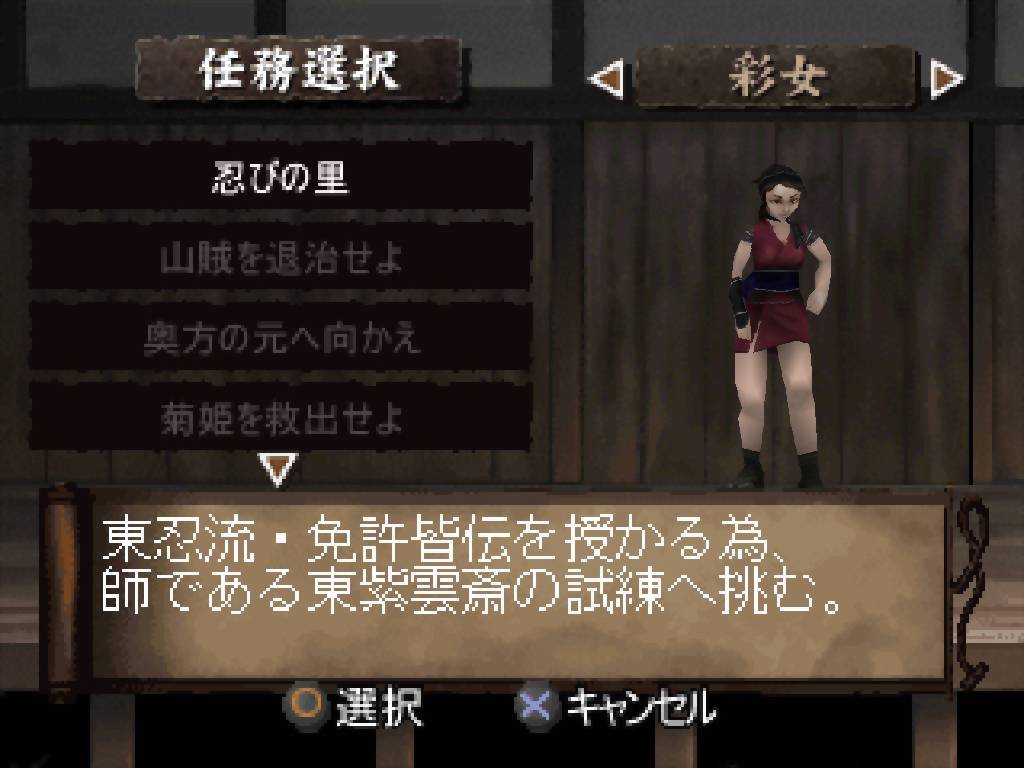
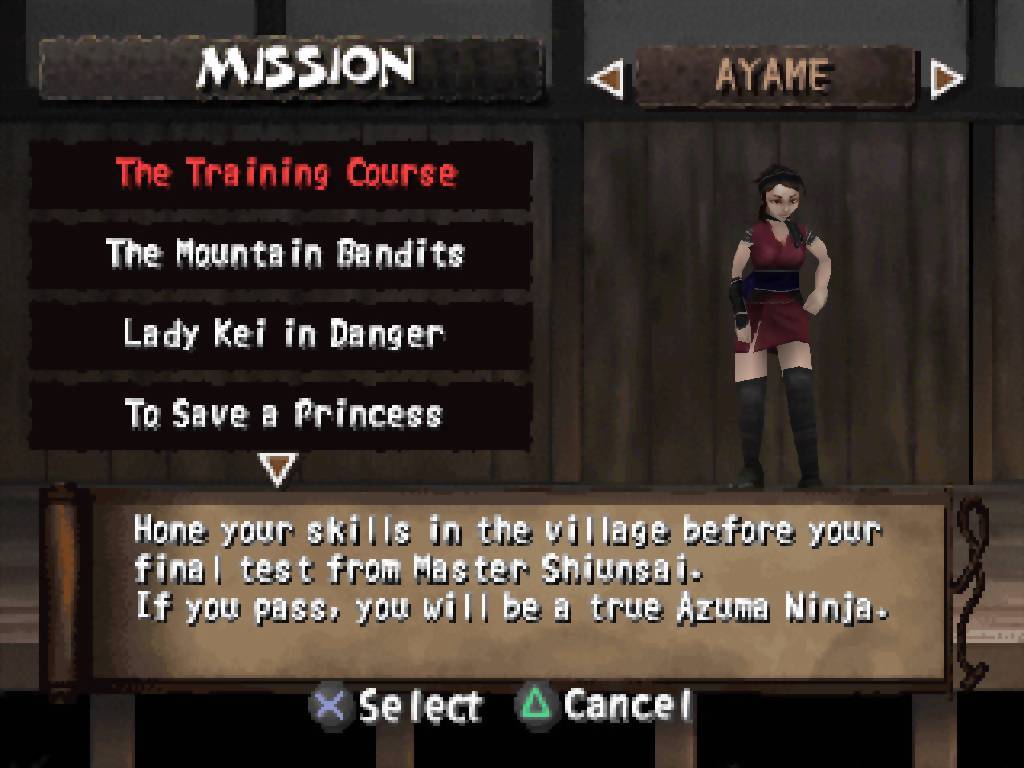
- Mid-Season Twist: It's in the 6th or 7th missions that Rikimaru & Ayame discover Tatsumaru's amnesia.
- My Master, Right or Wrong: Genbu refuses to stop fighting as he feels he owes Kagami for all she did for him.
- Napoleon Complex: Byakko is supremely arrogant for someone so short.
- No Good Deed Goes Unpunished: Zigzagged. Rikimaru's refusal to finish off Tatsumaru lead to the latter gaining a cheap shot that blinded him in one eye. On the other hand, his act of mercy also lead Lady Kagami to spare his life in return.
- Not-So-Safe Harbor: The Secret Harbor, which is taken over by the Burning Dawn before Rikimaru leads Gohda's army to take it back from them.
- Panthera Awesome: Byakko's pet tiger Chiro, who assists him in fighting Rikimaru and Ayame.
- Passing the Torch: Master Shiunsai passes down the Izayoi to Tatsumaru, and with it, leadership of the Azuma clan... This turns out to be a 10-Minute Retirement, as Tatsumaru makes a Face–Heel Turn shortly after.
- Ayame later gives Izayoi to Rikimaru after Tatsumaru dies.
- Pre-Asskicking One-Liner: Rikimaru makes one before every boss battle.
- The Reveal / The Stinger: Suzaku is Onikage.
- Rewarded as a Traitor Deserves: Tohda kills Motohide after he kidnaps Kiku.
- Sssssnake Talk: Suzaku hisses in his speech. Also done with The Snake, a mini-boss who fights Ayame in the Quarantine village.
- Smoke Out: Parodied by Genbu, he drops a smoke bomb to escape from Ayame after their initial fight, only to get stuck in a window. Ayame frees him of his predicament with a swift kick. He tries a similar tactic on Kubon Island only to disguise himself as a rock in plain sight. Ayame tosses a grenade into his alleged hiding spot and sends him running.
- Soft Reset: By holding Start+Select.
- Stripperiffic: Lady Kagami's outfit doeesn't leave much to the imagination.
- Sword Cane: Master Shiunsai wields one with incredible speed for someone so old.
- Sword over Head: Lord Gohda is engaged in a sword fight with his uncle, who has led a revolt against him. Being the good and noble lord Gohda hesitates after disarming him, and lowers his weapon. His uncle then shoots him. It is then that the player controlled Rikimaru steps in, cuing a boss fight. After the fight, the trope occurs again, with Rikimaru poised over the uncle. Being a ninja, Rikimaru slashes, but Gohda leaps in and takes the slash to his back. The uncle, touched by this, proceeds to scamper off and kill Gohda's wife and kidnap his daughter. Nice guy.
- Later, during the battle against Tatsumaru, Rikimaru hesitates to strike down his former friend, who takes the opportunity to slash Rikimaru's face, scarring him for the rest of the series.
- Threatening Shark: There's one in the water during the Secret Harbor missions. Amusingly it counts against your mission score if it spots you like it would any other enemy.
- Visionary Villain: Kagami's dream is to build "a world ruled by the ninja". In other words, her dream is to destroy the noble system in Japan so ninja can be freed from their obligation to serve the nobles and obtain the rights to live their own lives without hiding in darkness "like a thief".
- You Have Failed Me: Suzaku kills Yukihotaru after she loses to Rikimaru.
- You Killed My Father: Shiunsai reflects on how Tatsumaru killing him was fate after he killed his father. Slightly subverted in that he never knew it, so it was not personal.
- Released in 2003 for PlayStation 2 (as Wrath of Heaven); 2004 for Xbox (as Return from Darkness); 2009 for PlayStation Portable (as Tenchu 3 Portable, Japan only)
Tenchu 3: Wrath of Heaven is a direct sequel starting where the first game left off. Each character has their own individual and independent storyline, which are quite different and contradictory between them. They all center on a new Big Bad, the dark wizard Tenrai, and his attempt to take over Gohda's land by either claiming Lord Mei-Oh's power (Rikimaru's story) or a set of three MacGuffins (Ayame's). The first entry in PlayStation 2, Wrath of Heaven refined the gameplay of the first two and introduced several new features, including a set of ninja skills to unlock, extra weapons beyond the basic ones and the ability to wield enemy weapons. It also included a set of co-op missions and a Versus Mode with several of the bosses playable. It later got an Updated Re-release for Xbox titled Tenchu: Return from Darkness, with added stages and online capabilities.
- 20 Minutes into the Future: The special "Through the Portal" mission puts Rikimaru in a modern time setting against a Corrupt Corporate Executive who's also a cyborg.
- A.I. Breaker: If an enemy that has spotted you ends up in a hole they can't walk out of and has not lost track of you, they'll jump out. The problem is that they'll do this while still making a beeline for your position, and being that they're completely defenseless while in the air this leaves them wide open to getting smacked back into the hole where the process can be repeated until they're disposed of. Not terribly useful at its face in a game where getting caught is a bad thing, but as it turns out the arena for Tesshu's last two bosses is such that this can be mercilessly exploited, trivializing them if you picked up a spear on the way there.
- Artificial Stupidity: Intentional, but still exaggerated. The Decoy Whistle (which Tesshu also has variant of built into his abilities) makes an animal noise, which will immediately cause alert enemies/civilians to go from their !? (actively looking to you) state to a normal state. Where this gets silly is that it works unconditionally, even if they're currently looking at a body; and in the sheer insanity of how effective it is, with guards calming down after hearing a cow or cat sound as if the animal in question is the only logical culprit for the clearly-slashed-apart-with-a-katana corpse they are looking at!
- Asian Rune Chant: As a method for learning new moves.
- Back from the Dead: Rikimaru returns from his apparent death at the end of the original Tenchunote . Tenrai has the power of resurrection and all members of the Group of Six (most notably Tatsumaru) are this.
- Badass Normal: Tesshu is just a thug-for-hire, but can go toe-to-toe with the ninja main characters.
- Body Horror: In Ayame's story, Tenrai's One-Winged Angel form is an incomplete transformation into a giant snake. Aside from his more serpent-like facial features, the flesh from his arms is falling off leaving exposed bones surrounded by partially melted skin.
- Brutal Bonus Level: "Through The Portal", where half the mooks are armed with fast firing pistols and the True Final Boss is the hardest to beat in the entire game.
- Call-Back: The instigating mission with assassinating Echigoya is a call back to the first mission of Stealth Assassins. Both games involve killing a merchant named Echigoya, Ayame will taunt Echigoya and his partner by saying "You have been bad boys", and Echigoya's bodyguard will deliver a Pre-Asskicking One-Liner "Looks like you picked the wrong party to crash".
- Clockwork Creature: The specialty of Dr. Kimaira is his wooden robot army.
- The Computer Is a Cheating Bastard: Alert enemies are capable of blocking attacks even if you're directly behind them. They'll just do an instant 180 turn and bam, blocked. They're also very much capable of grabbing you in the middle of an attack string if they feel like it, giving them quite a bit in common with unfair fighting game opponents.
- Corrupt Church: Surprisingly they are corrupt Buddhists. Don't see that often.
- Deadly Doctor: Tesshu works as a doctor by day, but during the night he's an assassin for hire.
- Died Standing Up: Ganda in Ayame's story.
- Dirty Cop: The mooks Rikimaru kills in the bonus mission "Through The Portal".
- Disney Death: After defeating Onikage in his third mission, the real Onikage will cut Rikimaru's throat, as the Onikage who was killed was a body double. After Onikage attempts to summon Lord Mei-Oh from the portal, the real Rikimaru emerges instead. The Rikimaru who you had been playing as up to this point was his shadow, and a fight between the real Onikage and Rikimaru begins.
- Donut Mess with a Cop: Upon being stealth killed, the obese cops from "Through the portal" will mutter "I need Donuts, Donuts... from hellnut..."
- Eagle Land: "Through The Portal" is a firm Type 2: It's set in an office building in a city where smog blots out the sky, the mooks consist entirely of morbidly obese Dirty Cops, and the final boss is a blond-haired Corrupt Corporate Executive.
- Fat Bastard: The Mooks from the bonus mission "Through the Portal" are all obese cops who can be overheard complaining about their weight.
- Follow the Money: Some of the mooks Tesshu kills carry gold.
- Gag Dub: The B-side audio option, detailing Rikimaru's quest for the secret invention (toilet paper), Ayame's battle against a shady modeling agency, and Tesshu's adventures as a homosexual.
- Guide Dang It!: It's possible to skip Stealth Kill animations by pressing the Circle Button. This is actually extremely helpful considering that the world does not freeze during these animations, so it's a distinct possibility that you'll end up sighted from letting them play through. Does the game itself or its manual mention that you can do this? Nope!
- Incendiary Exponent: A Power-Up ki attack of Tesshu gives him a fiery aura, and each punch sets enemies on fire.
- Innocent Innuendo: Ayame hears Tajima telling one of the kidnapped villagers "What a nice pair you have, now let me show you mine!" They are, of course, playing poker.
- Just You and Me and My GUARDS!: The second boss in both Rikimaru and Ayame's paths calls for guards to back him up. Played with in that while Rikimaru has to fight the boss with his guards, Ayame proceeds to slaughter them during the cutscene, leaving the boss to be just her and him.
- Mad Scientist: Dr. Kimaira.
- Magical Eye: Rikimaru's Dohjutsu. Sealed in his right eye by Shiunsai because he "was not ready at the time", it allowed him to overcome Tenrai's evil power. Worth noting it seems to have been Ret-Gone afterwards, as no further mention of this ability is ever made.
- Master of Disguise: Hyakubake, a member of Tenrai's group with this ability. He faces Rikimaru as Ayame and viceverse in their respective storylines.
- Murder, Inc.: The Muzen (Tesshu).
- One-Winged Angel: After defeating Tenrai in his human form, he will use the power of Mei-Oh to transform into an Oni (Rikimaru's story) or the two power stones in his possession to become a serpent like monstrosity (Ayame's story).
- Playing Possum: It's possible to feign death but doing so causes you to slowly lose health as you bleed, so it's possible to actually die.
- Poisoned Weapons: A special hidden weapon for Ayame, the Dokuto, which poisons with every strike. Suffice to say that this effectively completely cripples the enemy/boss in question, who will be stunned every second for each slash he receives.
- Poisonous Person: Tenrai's One-Winged Angel form in Ayame's story is this, a serpent-like monstrosity who can poison with a mere touch and is immune to poison himself, rendering the above-mentioned Dokuto worthless.
- Silliness Switch: The B-side dialogue option.
- This Is for Emphasis, Bitch!: If Rikimaru is killed by the Dirty Cop mooks in Through the Portal, they will taunt his corpse saying "That's what you get, bitch!"
- Trapped in Another World: Explains how Rikimaru survived the end of the first game.
- Useless Useful Spell: Ninja Mind Control. Its stated effect is that it will cause an enemy who is struck with it to attack other enemies for a period of time. While the description is upfront that it doesn't work on bosses, what it neglects to specify is that it also does not work on normal enemies in boss encounters, meaning it's ineffective against Nasu's guards in Rikimaru's Stage 1 or against the zombie horde in his Stage 6 (nevermind that it's not unlocked in the first place until Stage 8), which immediately means it serves no purpose unless you've been spotted within the stage. The problems don't stop there, however, as the attack required to activate the effect is also incredibly slow and short ranged, meaning that it's universally easier to just dispatch the enemies yourself than to try to hit one of them with it, and even if you land the hit the duration is so short that the affected enemy will probably only even attempt one or two hits before it wears off. Another useless one is Ayame's Wrath of Heaven. Both Rikimaru and Ayame's Wrath of Heaven is an attack with a long wind-up that reduces their health to 1, regardless of if it lands or not. Problem being is that whereas Rikimaru's version is a One-Hit Kill that will dispose of bosses just as easily as anything else provided they're stunned first, Ayame's is not and in fact simply doesn't do enough damage to justify its use in any situation. It's a pity too, considering that she has two stages which begin with a boss fight where something like Rikimaru's Wrath of Heaven might be highly desired when going through the second and third layouts of each stage, whereas Rikimaru has none.
- You Are the Translated Foreign Word: The subtitle "The Wrath of Heaven" is somewhat redundant as that is what the translation of the word "Tenchu" is.
- Released in 2004 for PlayStation 2; 2010 for PlayStation Portable (as Tenchu Kurenai Portable, Japan only)
Tenchu: Fatal Shadows is an Interquel set between the first and third game, focusing on Ayame's mission in enemy territory and the exploits of a former ninja, Rin, looking for the ones who burned down her secret ninja village. It's very similar gameplay-wise to Wrath of Heavens and features a few small new additions, such as enemy-based Stealth Kills.
- Arranged Marriage: Jyuzou reveals to Rin that he was betrothed to her before he left the Hagakure to found the Kuroya. Rin doesn't take it well.
- Blind Weaponmaster: Nasu the masseuse carries a hidden sword in his cane. Being a Fat Bastard fighting inside a small arena helps his combat chances.
- Call-Back: Bougetsu cave is revisited from the first game. You can overhear some mooks say that the cave used to be owned by "some big guy"; referring to Goo; the boss of that level.
- Call-Forward: Tesshu and Zennosuke's entire appearance is this.
- The Cameo: Tesshu and his boss Zennosuke appear in one of Rin's chapters.
- Cutting Off the Branches: The gallery bio for Kumagorou the bear establishes him as the son of the bear who fought alongside Goo in Tenchu: Stealth Assassins, and Ayame was the one who killed his father; this confirms that Ayame was the one to rescue Rikimaru from the bandits in the first games third mission.
- Doomed Hometown: Hagakure village is the home of Rin, and is burned down by the Kuroya at the start of the game.
- Dragon Their Feet: If Ayame failed to kill Ranzou after his Time-Limit Boss fight, he will attempt to stealth kill Ayame during the ending cutscene after Jyuzou has been killed.
- Dual Boss: Futaba and her twin brother Hitoha are fought together in chapter 10. Killing one of them will cause the surviving twin to change their fighting style against Rin.
- Dual Wielding: Exaggerated with Shinogi, he fights Ayame using three swords, carrying one of them between his teeth.
- Eyepatch of Power: Big Bad Jyuzou sports a patch over his right eye and is the leader of the Kuroya, as well as the final boss.
- Hand Cannon: Rin can obtain a one hit wonder bamboo gun. Suffice to say that a well-aimed shot deals a lot of damage if not directly One-Hit Kill.
- Instrument of Murder: Shou from the Kuroya fights with a shamisen concealing a freakin' machine gun.
- Mercy Kill: Jyuzou comforts and stabs the mortally wounded Shou after Rin bests him in battle.
- Multi-Mook Melee: Red Blade mode, which lets one select a specific stage/mook variety to fight until death. It also includes a Boss Rush option.
- Murder, Inc.: The Beniya and the Kuroya.
- Parasol of Pain: Jyuzou has as main weapon a sword hidden within an umbrella, which he uses in a battohjutsu style.
- Skippable Boss: Nasu can be stealth killed if Rin finds the hidden room underneath his massage parlor, bypassing his boss fight entirely.
- Time-Limit Boss: Ranzou has to be defeated in 90 seconds if you want to kill him then and there, otherwise he will knock down Ayame and flee.
- Warmup Boss: Tatsukichi is pathetically slow and loves informing you when she's about to attack. Not to mention grabbing her ends the fight with a quick neck smack.
- Where I Was Born and Razed: Futaba and Hitoha were natives of Hagakure village who aided the Kuroya in destroying their hometown. It is later revealed that Jyuzou was next in line to become leader of the Hagakure, but chose to raze the village instead due to his disdain for the traditional ninja lifestyle.
- You Have Failed Me: Jyuzou kills his lover Tatsukichi if you spare her life.
- Released in 2008 for Wii; 2009 for PlayStation Portable
Tenchu: Shadow Assassins finally continued forward with the plot. Got an Unexpected Gameplay Change, with fights represented in first person.
- Demonic Possession: Implied in the end that Onikage has possessed Ayame.
- Dragon Ascendant: Onikage takes centre stage as the Big Bad of this game after serving as The Dragon to most of the previous antagonists.
- In Name Only: The play style is barely like the other games at all— While stealth is key, combat amounts to "If you have a sword, play a minigame, if you don't have a sword, don't get seen again, or it's game over." note
- The Mole: Someone within Gohda castle appears to be acting as one for the Big Bad.
- What the Hell, Hero?: Rikimaru is forced to stab through Princess Kiku to get to Onikage, who was holding her hostage. Princess Kiku more or less orders Rikimaru to do it, but it's implied Rikimaru is now no different from his mortal nemesis.
