
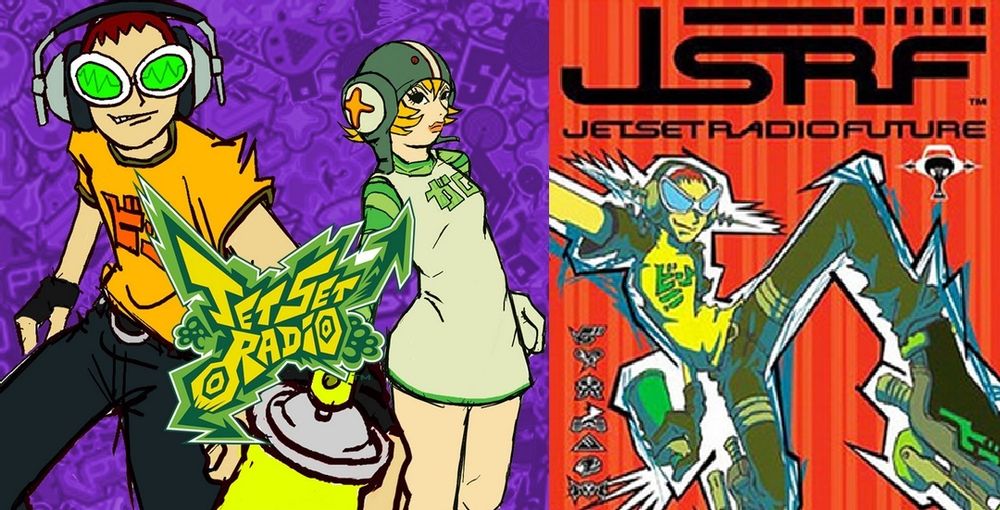
Jet Set Radio (originally known as Jet Grind Radio in the NTSC U/C region) is a platforming/skating game released by Sega for the Sega Dreamcast in 2000, developed by Smilebit, who were made up of previous AM-6 employees, responsible for the Panzer Dragoon series. The game is centered around roller-blading street gangs consisting of teens and young adults called rudies, who battle for turf by spraying graffiti around the streets of Tokyo-to. Meanwhile, the rudies' culture is under attack by an evil corporate conglomerate called the Rokkaku Group which seeks to homogenize the city and whose leader seeks to take over the world through demonic means.
The game is also known for pioneering the use of Cel Shading to create cartoonish characters and backgrounds using 3D polygon graphics, and its use in this game popularized the style in interactive media as a whole. Additionally, the game is also remembered for its eclectic soundtrack.
In 2002, a sequel was released for the Xbox called Jet Set Radio Future. Set rather ambiguously to the first game, Future is more of a "remix". The story is much the same, with some new twists and new elements, though the characters of the game are very different, and the city of Tokyo-to has seen a very drastic overhaul. The game was made to play much faster, replacing the joystick graffiti spraying with a simple 'hold the button and run' system, as well as making grinding a much more important skill (as well as making it easier to do).
Despite heavy promotion from Sega, neither game sold that well. JSRF was bundled with new Xbox consoles along with Sega GT 2002. While both games received critical acclaim and are fondly remembered, sales weren't enhanced as much as one would hope — people would often buy the console bundle, but return the game to buy a copy of the original Halo: Combat Evolved, thus copies of the combo disc are plentiful on the secondary market.
Despite everything, the series was very well received, even to this day, with Jet Set Radio considered to be one of the Dreamcast's defining games, and Jet Set Radio Future being considered one of the Xbox's best exclusives. The games have gotten plenty of love from the Sega Superstars crossover games, especially All-Stars Racing, which features nothing but Future representation. The game was also featured in Hi-sCoool! SeHa Girls in late 2014.
The original Jet Set Radio was re-released in full HD on Xbox Live Arcade, Play Station Network, and PC in September 2012, netting the series a boost in popularity. It was also released on iOS and Android, but these versions have since been removed due to a percieved low quality from SEGA.
Not to be confused with Jet Set Willy, a completely unrelated game.
A Spiritual Successor, Bomb Rush Cyberfunk, was released in 2023 by Team Reptile (Lethal League), which apes much of JSR's style. The only difference is that game has the characters use other movement options in addition to roller blades, like bikes, skateboards, and even free-running.
At the end of 2023 at The Game Awards, Sega announced several new titles in classic series as part of a POWER SURGE project, including a brand new Jet Set Radio game.
See also Air Gear, a manga that was inspired by this series.
The Jet Set Radio series contains the following tropes:
- 100% Completion: In JSRF, after beating the main storyline, if you collect every collectable in a level (which requires you to meet several prerequisites to make them all appear), you unlock additional challenges that require you race against the clock which, when completed in a set, gets you another character. The crushing thing is that some of the "new" characters share the same stats as another core character, and are pretty much just a different skin/model and voice. Further added to in that, should you redo all your graffiti in all levels, you get absolutely nothing. Seriously.
- Aborted Arc: Rokkaku Gouji's son takes over for his recently-deceased father at the end of the original game. This is never followed up on, especially since Future is essentially a re-imagining of the original game rather than a direct sequel.
- Absurdly Spacious Sewer: This game takes it to the extreme, especially in JSRF, where the Tokyo Underground Sewage Facility is a sprawling, multiple-story high monstrosity of a level. Expect to spend a few chunks of both games in these.
- Acid-Trip Dimension: The final boss level in JSRF.
- Action Commands: In the original game, large and xtra large graffiti tags require you to move the stick in the patterns the game indicates to successfully tag the wall. Characters with a higher Graffiti stat have a lower spray can cap and have to perform more complex commands to complete these tags, but they receive more points as a tradeoff. This was axed in JSRF, which simply has you spray larger tags in the same way as small ones.
- Actionized Sequel: Future takes several steps to keep the player skating around. Tagging is simplified to a mere button press, the areas are much bigger to explore, getting up to speed and turning are ridiculously easy compared to the first game, and grinding on rails allows you to chain tricks together to speed up and build up a high score.
- Adaptation Dye-Job: And how. Tab/Corn goes from brunette to blond (and so does Piranha/Boogie), Yoyo goes from being a redhead to having lime green hair, and Combo goes from having black hair to blue hair. Not to mention everybody changes outfits, and most of the changes are pretty significant, too.
- Adaptational Villainy: The Noise Tanks from the original Jet Set Radio were Playful Hackers who weren't particularly evil (with their crimes largely being minor things like selling pirated software, causing blackouts in residential areas and stealing the GG's dog). In Jet Set Radio Future, the Noise Tanks are still mischievious, but are Retconned into cyborgs created by Rokkaku who are determined to destroy the GG's.
- Aggressive Play Incentive: In Classic, certain characters have to perform more elaborate controller motions when spraying any of the larger graffiti patterns, leaving them exposed to police attack for longer, but also vastly increasing the point payout upon completion, making Jet rankings easier to obtain.
- All Crimes Are Equal: Graffiti removal is Serious Business. For first-time offenders, a plainclothes cop skips the handcuffs and blows your head off with a magnum. Twice, and a SWAT team gets called in. Three times, and the army starts to roll in with tanks and helicopter gunships.
- All There in the Manual: The year Future takes place is never explained in-game, but according to pre-release details and advertisements, it's set in the year 2024. Some details about characters in Classic are also only seen in the manual.
- Afro Asskicker: The Golden Rhinos each look they they've stepped out of a Tarantino film, with seventies hair and mustaches.
- Amazing Technicolor Battlefield: The finale of JSRF.
- Amazing Technicolor Wildlife: Potts, a blue pooch (green in JSRF).
- Amazon Brigade: The Love Shockers and Rapid 99.
- Anthropomorphic Zig-Zag: Once unlocked as a playable character, Potts can transform from a quadruped into a rollerblading, spraycan-wielding canine of justice. This occurs as a result of his dog-napping by the Noise Tanks, who outfit him with a helmet which makes Potts believe he's a cow. During a second playthrough, the Noise Tanks finally agree to 'fix' Potts - but only if you earn a "Jet" ranking in every stage.
- And Your Reward Is Clothes: In JSRF, several hidden characters are often nothing more than re-skins; despite having to get a "Jet" rank on several difficult challenges to play as minor characters and antagonists, several of them turn out to be pretty much the same thing. Note that it's not even subtle sometimes with certain combinations: Cube, the ex-leader of Poison Jam, is different only in clothes and color, even retaining the same skills and dances; the same applies for YoYo, Beat and their robot counterparts, who are identical save for different colors and an altered model respectively.
- Art Attacker: Your strange graffiti is somehow strong enough to knock out policemen and destroy machinery, up to and including helicopters and giant mecha.
- Ax-Crazy: Hayashi - though considering who he works for, it might not be much of a stretch. Hayashi's been known to blow up police cars if his toadies fetch him the wrong flavor of candy.Prof. K: Can you believe this fool?
- Badass Longcoat: Hayashi wears one, complete with a High Collar of Doom.
- Bald of Evil: Gouji Rokkaku sports a vampiric goatee, but his head is completely bare.
- Battle in the Center of the Mind: When Rokkaku sucks you and hundreds of bystanders into his Humongous Mecha, you are transported into an acid-trip version of Tokyo-to filled with shadow creatures that constantly run after you. During all this, Rokkaku situates himself on the highest part of his dreamworld where he then transforms himself into a giant monster on skates. You have to grind and jump all the way up in order to fight him.
- Big Applesauce: Grind City. You can see the Brooklyn Bridge from Bantam Street, though that stage is allegedly modeled after Chicago.
- Fulton Street Folly: Averted with Grind Square (a parody of Manhattan's Times Square). The streets are deathly quiet, with the only foot traffic consisting of uzi-packing mooks.
- Bilingual Bonus:
- Rude boy, rudeboy, rudie, rudi or rudy were common terms for juvenile delinquents and criminals in 1960s Jamaica, and have since been used in other contexts.
- Many of the GG's have katakana of their name or part of it somewhere on their character. Tab has it written on the front of his beanie, Mew has it tattooed under her left eye, and Gum (in some artwork) has it tattooed on the inside of her left thigh.
- The Rokkaku Group's logo is a hexagon - "Rokkaku" is Japanese for "hexagon".
- Gouji's final boss form in Future, A.Ku.Mu, means "Nightmare" in Japanese.
- "Blind Idiot" Translation: Though it never gets downright incomprehensible, it's clear that Future's English script is just a straight translation of the Japanese script, but with a ton of typos, grammatical errors, and mismatched subtitles thrown in.
- Blonde, Brunette, Redhead: The initial three GG's in JSR; Gum is blonde, Tab is brunette (though whether his hair is brown or black is anyone's guess), and Beat is a redhead.
- Bloodless Carnage: Even getting hit by a missile will merely knock you off your feet for a while.
- Bloodier and Gorier: The original Jet Set Radio had plenty of violence, but it was largely cartoonish in nature, with Gouji being the only character to have unambiguously died. The sequel took the safety brakes off and gave the bad guys gruesome deaths.
- Bowdlerize: Some songs in both games had certain lyrics cut in order for the games to retain a Teen rating. For example, in "Birthday Cake", the original version has a verse that goes: "It's moldy mom, isn't it? // I DON'T GIVE A FLYING FUCK THOUGH!!!" The game's version cuts right to the chorus after the "It's moldy, mom..." lyric. Another example, "I'm Not a Model" had a segment where a woman goes into disturbing detail on giving oral sex. This part was cut in the game version for obvious reasons.
- Buccaneer Broadcaster: Tokyo-to's gang activity is reported via a pirate radio station named Jet Set Radio, hosted by DJ Professor K.
- Burning Rubber: The skates in JSRF emit plumes of flames when you go fast enough.
- Car Fu: Classic's cops have no compunctions about running you over with their cruisers or motorbikes.
- Cast of Snowflakes: The GG's express this trope the best out of all the street gangs, as every member has their own distinct outfit and character model. The other gangs count when compared against each other, but their individual members all look like their fellow members.
- Cel Shading: The original game was the first to do this with both black outlines and the use of two-tone shading on characters.
- Changing of the Guard: In JSR, Yo-Yo is a character unlocked near the end of the first chapter. In Future, he replaces Beat as the first person you play as and who has to go through the tutorial. Subverted as he's kidnapped and rendered unplayable for about two-thirds of the game.
- Character Select Forcing: On your first playthrough, the Grind City flashbacks may only be played through as Combo or Cube. You can select anybody you like during a New Game Plus.
- Chekhov's Gun: In Chapter 5 of Future you can see an evil-looking tower in the background. No attention is drawn to it, and no one mentions it, so you'd assume it to just be a background element, right? Turns out it's the device used by the Big Bad at the end of the game to absorb some sort of energy from the people of Tokyo-to, and sends you and them into an alternate dimension.
- City of Adventure: Tokyo-to in either game, as either version of the city is a sprawling metropolis with many distinct districts.
- Climbing Climax: In Jet Set Radio Future.
- Cluster F-Bomb:
- The song Rockin' the Mic, which features a lot of S-bombs and N-bombs.
- "Rock It On" near the end of the song.
- Cold Sniper: If you see a red laser sight pointed at you, it means a Golden Rhino sniper is nearby. Luckily, they're complete cowards and run away if you confront them head-on.
- Collision Damage: Bumping anyone in any way in the original can send you flying in the opposite direction. Not only is the damage and knockback reduced in Future, but if you bump an enemy in the back, they take damage!
- Combat Commentator: Professor K fills this role in the sequel, providing such useful gems as, "Wow, you're pretty flammable!"
- Company Cameo: There are several nods to Sega in the first game:
- The semi-trucks have mudflaps reading "SEGA".
- Grind City has signs advertising sega.com.
- In the HD rerelease, unlocking the Secret Character Potts the dog nets you five bonus graffiti tags. The large one is a graffiti-styled Sega logo.
- Cooking Duel: The gangs resort to competitions of skating and tagging skills to settle their differences directly. All of the 'boss' battles are just tagging people within a set time limit. It Makes Sense in Context.
- Conveniently Empty Building:
- The moment the military shows up, pedestrians magically vanish from the scene. Needless to say, this removes some of the guilt associated with crashing helicopters into the pavement.
- When you fight the Immortals on Highway Zero in Future, you can clearly see busy traffic before the cutscene, but after that's over, all vehicles disappear to make way for your battle.
- Couldn't Find a Pen: Coin's final instructions to his friends before dying were, fittingly enough, written in graffiti. It's a cryptic mural featuring rhinos, an airplane and an arrow pointing to Tokyo-to. Presumably, the Rhinos didn't catch onto its meaning.
- Corrupt Corporate Executive: Rokkaku Gouji, who already owns the city by buying up all the major players and businesses. Now he wants to make it official by becoming Mayor.
- Crawl: Grind Square has a couple of fake news tickers.
- Culture Police: The uniformed police, military, and later trained assassins all play this role, trying to suppress a skater counterculture.
- Defeat Means Playable:
- The rival gangs (and even Gouji!) end up becoming playable, should you rack up enough points.
- Points aren't even required to recruit Cube. You just have to continue playing until she comes back out of hiding.
- Demoted to Extra: The Love Shockers in Future were greatly sidelined, only appearing as underlings of the Noise Tanks. Combo also suffered from this, with all of his plot relevancy being transferred to Cube.
- Disney Villain Death: Gouji's ultimate fate in Classic.
- Dismantled MacGuffin: The Devil's Contract, a vinyl record rumored to summon a demonic entity. Somewhere along the line, the record was broken into three shards and scattered between Grind City and Tokyo-to.
- Disproportionate Retribution: Thinking of tagging up the streets of Tokyo-to? Be prepared to have tanks and helicopters with missiles coming after you, and that's just for people who dare to spray a couple of districts up.
- Dramatic Stutter: Once he's safe inside his trippy light show, JSRF's Gouji suddenly goes all SHODAN.
- Don't Try This at Home: Both games on start-up display a message stating that, while graffiti is art, doing it as an act of vandalism is a crime.
- Dub Name Change: A large amount of the GG's have different names between regions; among others, the guy in the blue jumpsuit and beanie is Tab in English and Corn in Japanese, the girl in the blue sundress is Mew in English and Bis in Japanese, and the lanky guy in the orange jacket is Slate in English and Soda in Japanese.
- Edible Theme Naming: Probably unintentional, but some of the rudies have names like Beat (beet), (bubble)Gum, Corn, Soda, and Garam (Malay for salt).
- Egopolis: The drive behind Rokkaku's crackdown on the streets in Future is to pave the way for his "Rokkaku Expo", essentially branding everything with his logo.
- Elite Mooks: The Golden Rhinos replace the police after you've run through all the levels once, all of them being far more deadlier than the regular cops.
- Enemy Chatter: The police dispatcher and Onishima can be heard barking orders over their radio. Gouji and his Golden Rhinos take over the airwaves later.
- Evil Brit: The unseen voice commanding the Golden Rhinos over their PA system.
- Evil Counterpart: "DJ Big Gouji" could be seen as an evil counterpart to Professor K.
- Evil Knockoff: Zero Beat, an advanced robot based on Beat and meant to take on the rudies at their own game.
- Evil Laugh: Onishima, Assassin #4 Hayashi, and Gouji in equal measure.
- Evil Tower of Ominousness: Gouji Rokkaku's lair in both games. In JSRF, he can't be bothered to name it.Gouji: The name of this tower is — well, blah-diddly-blah-blah. ITS NAME IS IRRELEVANT!
- Evil Twin: NT-3000 is a robotic clone of Yoyo.
- Expressive Hair: Professor K's electrified hair is in a constant state of motion.
- Eyepatch of Power: The Love Shockers wear these as part of their gang uniform.
- Face–Heel Turn: Yoyo in JSRF. Later subverted when it’s revealed that he really was kidnapped the whole time, and the Noise Tanks had used NT-3000 to make the GG's think he had turned on them.
- Flashback Effects: The flashbacks to Grind City appear in sepia tone, then slowly shift to color.
- Fluffy the Terrible: The cutesy Rokkaku mascot, a gold rhino in overalls. At the end of the game, the Rhino statue on the front of Gouji's building comes to life and starts belching fire.
- Forced Tutorial: JSRF's is ridiculously easy, even if you're a new player.
- For the Evulz: Unlike his counterpart in the first game, the Gouji of JSRF is truly crazy.
- Fourth-Wall Mail Slot: Professor K reads aloud a couple letters from "Mr. Osaki", who is beset by roaches in his home. K jokingly advises him to burn his house down (which he does).
- Gameplay Grading: Upon completing a level, you're given a ranking based on how many points you got. They all share the theme of being related to mobility: from worst to best, there's Pedal, Motor, Engine, Turbo, Nitro, and finally Jet.
- Gang of Hats: A rather... quirky variety of these hang out around the city and defend their turf. Most of them are just kids, though.
- Gas Leak Cover-Up: Gouji's death and the implosion of his building in JGR is written off as "a construction accident".
- Gas Mask Mooks: Assassin #3 and his posse.
- Generic Graffiti: Averted in JGR, as some of the characters have their own tags. This isn't the case in JSRF, where each gang has their own range of tags. The player can choose to avert or play with this, by choosing what they want to spray on the walls.
- Genius Sweet Tooth: The Noise Tanks are noted to have sworn off health food, subsisting entirely on artificial chemicals and sweeteners. Subverted in that not only their poor diet contributed to their defeat (roller skating like this demands some personal fitness), DJ Professor K also vaguely implies in the ending that they abandoned it in favor of fruits and veggies. ("The Noise Tanks are in repair.")
- Genre Mashup: The soundtrack, composed by Hideki Naganuma, incorporates elements of many genres such as rock, funk, and techno to make a very unique sound.
- A God Am I: Rokkaku, towards the end in either game.
- Goggles Do Nothing: Fairly ubiquitous amongst the cast, along with Cool Shades.
- Gondor Calls for Aid: In the Regional Bonus missions, Combo and Cube are forced to flee Grind City after the Golden Rhinos kidnap (and possibly murder) the third member of their gang.
- Gonk: Soda/Slate, an incredibly lanky dude with only a few strands of hair atop his head, a pill-shaped head half-obscured inside his jacket, and a nose that looks like Squidward's.
- Good Guns, Bad Guns: The Rhinos are packing some serious heat: Mac-10s and dragonovs.
- Good Hair, Evil Hair: Onishima inverts this trope by sporting a two-foot pompadour and a stubble. Oddly enough, this hairstyle is associated with delinquents in Japan.
 A clue to Onishima's enigmatic, tortured past?
 - Graffiti of the Resistance: This is the premise in the games. Rokkaku and his corporation have bought practically all of Tokyo-toto in the future; your player character is a gang leader who sticks his middle finger to Rokkaku by spraying graffiti all over the town.
- Gratuitous Japanese: Gouji does this in the cutscene before his boss fight in JSRF.
- Grind Boots: The rudies' rollerblades automatically attach to metallic surfaces, allowing for seamless grinding on rails, with the player not having to worry about keeping their balance.
- Hand Cannon: Onishima totes around a pistol as big as his massive pompadour.
- Hidden Depths: Call Gouji a Corrupt Corporate Executive all you want, but you have to admit; having turntablism skills so good that you can both summon demons and absorb the souls of Tokyo-to would not be something to gawk at.
- Hit the Ground Harder: In Future, at least. Fall damage will happen upon landing once your character has begun their "I'm falling and screaming" animation. If you keep pulling air tricks on the way down, you won't get hurt upon hitting the ground. Because falling stylishly stops the force of impact from happening, of course!
- Hoist by His Own Petard: The Golden Rhinos of JSRF make colorful departures when defeated, such as getting hit by a stray missile fired from a Rokkaku harrier jet. The flamethrower assassin is immolated when her flame tank explodes, and then crushed by a falling billboard sign which she had previously set aflame.
- Hot-Blooded Sideburns: Professor K's JSRF incarnation.
- Hotter and Sexier: Gum, Mew/Rhyth, and Cube's outfits are skimpier in JSRF. And then there's Yoyo.
- I Have Your Wife: Pet version. The Noise Tank's path in the first game sees them kidnapping Potts and holding him hostage.
- "I Know You're in There Somewhere" Fight: Against Poison Jam (who would have thought?). In the penultimate level, Rokkaku attaches brainwashing helmets to the trio and then sics them onto you.
- Idle Animation: All of the Rudies dance if left alone.
- Imperial Stormtrooper Marksmanship Academy: Dashing or grinding rails renders you basically invulnerable to police gunfire. Averted while you're on the ground, where you have to be really evasive to avoid gaining a few dozen pounds of lead.
- Improbable Weapon User: Every Rudie with a spray can. Adding to the fun, all the spray cans floating about are described in the tutorial as concentrated "Soul of the Streets". You're not just knocking down the police with graffiti, you're doing it with Soul juice!
- Improvised Weapon: Graffiti has the ability to blow up skyscrapers, helicopters and mecha on a regular basis. Helicopters can at least be justified in that you cover the cockpit with it, but buildings have no excuse.
- In a Single Bound: All rudies can jump six to nine feet in the air from a standing position, and grinding or wall-riding can let them leap even farther.
- Inconsistent Dub: Several characters went through various name changes between the first game and Future, sometimes not even related to their Japanese name. Two characters in particular went through three names: Bis/Mew/Rhyth, and Sugar/Pirahna/Boogie.
- Informed Attribute:
- The character profiles on the official Japanese site for JSR (as well as the official Japanese guide)
 list a single defining characteristic and a favorite thing for each Rudie. But many of these traits aren't even in the instruction manual, never mind in the actual game. For example, Garam is apparently short-tempered and Mew likes money.
 - Yoyo's profile for both games describe him as a Self-Proclaimed Liar, which could explain why Professor K calls him "a guy who'll blow your mind with his silver tongue" in Future.
- The character profiles on the official Japanese site for JSR (as well as the official Japanese guide)
- Irony: Hideki Naganuma is well-known for the crazy funky electronic beats of both games (plus Sonic Rush), but his work in the first game is actually the tamer stuff, with Deavid Soul and F-Fields providing the loudest, funkiest, craziest, densest, and closest to what someone today would picture Naganuma doing.
- Japanese Delinquents: The games are all about them and their struggles against the city police.
- Jet Pack: Assassin #2 and his cronies have jetpacks, allowing them to rain gunfire on areas that other mooks can't, making them paticularly deadly.
- Kids Versus Adults: It's teenage gangs versus the cops, as well as a conglomerate that also has it out for them.
- Large Ham:
- Rokakku Gouji is a modest example. He's voiced by Charles Martinet.
- Onishima's first in-person line is belting out a loud "GOTCHA!", and his radio requests for backup have him yelling for paratroopers, helicopters and tanks - and receiving them.
- DJ Professor K mans the local Large Ham Radio, regularly shouting its name and extending the last syllable for a few seconds. One such shout provides the game's Title Scream.
- Rokakku Gouji is a modest example.
- Laughing Mad: Gouji's last moments in JSRF.
- Law Enforcement, Inc.: Rokkaku Gouji buys out the police department prior to the games' start, replacing them with his own forces as the real police are stuck in their offices.
- Le Parkour:
- The GG's combine this with their rollerblades, grinding on handrails, highway dividers, fences, and wires, and riding on walls before leaping far away.
- Assassin #5 isn't a big believer in stairs.
- Lemming Cops: A few times in JSR:
- In "Monster of Kogane", spraying the large tag on the wall near the water tower to begin with will prompt two cop cars to speed over to where you are and then attempt to bring the vehicles to a stop. Emphasis on "attempt", as they fail at this and then drive over a cliff into the water.
- During the revisit to Benten, you can trigger a hidden scene in which dozens of pursuing Rokkaku sedans crash into a giant, flaming pileup.
- Letter Motif: The NTSC-U/PAL versions introduces three new characters from out of town: Coin, Combo, and Cube.
- Living Statue: Gouji's corporate Mascot, a giant cartoon rhino, is stationed on the front of his building. The statue comes to life during the final battle and begins breathing fire.
- Load-Bearing Boss:
- Defeating Rokkaku causes his entire skyscraper to explode.
- Rokkaku's Humongous Mecha starts to collapse after you defeat him at the end of JSRF.
- Locomotive Level: JSRF has a variant, in the sense that you're chasing after a locomotive robot.
- Lonely at the Top: At the conclusion of the first game, Combo speculates this might have been the case with Gouji Rokkaku.He didn't know how to deal with people that he couldn't buy with his money. Maybe it really is lonely at the top... or maybe he's just another eccentric millionaire.
- Mad Bomber: Assassin #4 has bombs strapped to his chest, and has planted several throughout Shibuya - he's particularly fond of placing them near cars. He also lobs molotovs and is surrounded by flunkies who may detonate themselves if they miss a tackle.
- Made of Phlebotinum: According to the opening narration, the Rudies' skates are powered by newly-developed "Netrium" batteries.
- Malevolent Masked Men: Poison Jam and the Noise Tanks.
- Man of Wealth and Taste: Gouji, again.
- Market-Based Title: The original game was renamed "Jet Grind Radio" in America due to there being a band named Jet Set Satellite, and they feared that people would associate this game with them. The radio station is still referred to as "Jet Set Radio" in-game however, and the only changes are the title screen and the graffiti saying "To Jet Set Radio" in the intro is changed to "To Jet Grind Radio". This conflict was long gone by the time that JSRF and the HD re-release of the original came out, although the GBA port still retains the "Grind" title.
- Masked Luchador: Assassin #1 is a hulking, masked wrestler who also employs judo kicks.
- Mecha-Mooks: The Noise Tanks in JSRF, who are now out and out robots instead of geeky kids in high-tech gear.
- Megacorp: Rokkaku Corporation. The logo is emblazoned on gas stations, satellite dishes, and trucks marked "Rokkaku Depot" (using the same typeface as Office Depot). Taken even further in Future, where the Rokkaku symbol can be seen on street signs, hydro plants, and construction equipment.
- The Men in Black: The Golden Rhinos, a group of dudes boasting suits and afros. Professor K announces their arrival by referring to them as a new gang; it's plain to see, however, that they're working for Rokkaku Corp. Their 'graffiti' is merely Rokkaku advertisements plastered over your own tags.
- Mercy Invincibility: You get a small grace period of invincibility after taking damage, indicated by your character flashing red. Quite helpful when getting chased by the various dogs, assassins with whips, attack helicopters, and jetpack gunners throughout the game.
- Mini Dress Of Power: Gum and Rhyth in either game, which doesn't stop them from skating like their gang members.
- MockGuffin: The Devil's Contract is revealed to be a hoax at the end.
- Mr. Exposition: DJ Professor K, who tells you what's going on in the city, tells you where to go in it, and tells you what needs doing when you get there.
- My Name Is ???: Normally, you're told the name of each character that joins the GG's as soon as you unlock them. However, the final Secret Character has their name written as "???" on the unlock prompt to avoid spoiling who it is before you see them for yourself: the GG's pup, Potts.
- Mythology Gag:
- Yoyo's robot doppelganger in Future wears his hoodie up, which, combined with its green color, seems like a reference to his original appearance.
- Also in Future, Potts shares an idle dance with the Noise Tanks, the gang responsible for kidnapping him and connected to unlocking him in the original game.
- The Napoleon: Captain Onishima is a very short little man with an aggressive temper.
- Never Say "Die": Coin's body is plainly visible in a cutscene, lying dead at the foot of his mural. Nobody ever refers to him as such: rather than avenge Coin, Cube asks the gang to help her for "the sake of Coin." The ending states that he was another victim of Gouji's machinations, but doesn't explicitly say "assassinated."
- New Game Plus: In the original game, you return to Chapter 1 after completing the game, but retain any new team members you recruited and Graffiti Souls you collected.
- Nintendo Hard: Larger levels in the first game can be quite frustrating: you have to find and tag dozens of spots with graffiti, while collecting spraypaint cans (most characters can only hold between 15 and 30 cans, some spots use up seven of them, and endgame levels tend to have at least one section with no cans at all) and running away from police and assassins, who will come at you in helicopters and on jetpacks even while you're tagging. On a time limit.
- No Communities Were Harmed: Weirdly subverted. Tokyo is referred to by name, but it bears almost no resemblance to the real Tokyo. Also, Tokyo-to is actually the full name of Tokyo ("to" is a suffix meaning "city/metropolis").
- No Indoor Voice: Professor K. He mellows out in JSRF.
- No Kill like Overkill: The Tokyo-to Police and the Rokkaku Police believe in this heart and soul. Their initial response to vandals is to send a squad of police to forcibly arrest the delinquent with batons. Beat that, and they'll send policemen armed with guns to shoot you dead. Beat that, and then they deploy military vehicles to stop graffiti, and it only gets more lethal from there.
- No OSHA Compliance: Especially prevalent in Future with the industrial levels. The Skyscraper District, for example, has a number of construction sites with absolutely no safety rails or nets to stop workers (or you) from falling 50 plus stories to their death. Pharoah Park does have some safety features, but that's a very small part of the level. Sky Dinosaurian Square is an entire theme park placed precariously between the skyscrapers of Tokyo, again, with nothing beneath the tracks and attractions.
- Occidental Otaku: Combo can be assumed to be this. He has a yen necklace, has no trouble speaking to the GG's, and very likely got the idea for his gang from the various gangs around Tokyo. And it's not like they couldn't have changed his necklace in the western release (Cube got an entire redesign for the west).
- Oddly Small Organization: The rival gangs have three members each. (Or at least we assume, since we only see three at once. It's likely that the other gangs are around the same size as the GG's.)
- One-Winged Angel: When Rokkaku transforms into A.KU.MU during your Battle in the Center of the Mind.
- One-Woman Wail: Gouji's boss music.
- Out-of-Character Alert: The intro to JSR's penultimate mission, "Beneath the Mask'', has them comment on the odd state of Poison Jam:Those faceless vandals...
Poison Jam arrived without their masks!
Something's wrong with this picture.
Have they been brainwashed? - Patrick Stewart Speech: The narrator drops a fairly Anvilicious one in JSRF's ending.
- Perky Goth: JSR's token gaijin chick Cube wears a black-and-red ensemble, but is generally cheerful, punctuating her level completion with a smile and "I got mad skills!".
- Player Headquarters: The GG's' garage. (Though it's more like an abandoned construction site in Future.)
- Playlist Soundtrack: A favorite of the series. In the first game, each level has a small playlist of music, usually only containing songs pertaining to a specific area (eg. You usually wouldn't hear "Sneakman" in Kogane-Cho). In Future, the music is instead divided by chapter (except for the sewer levels that always have their own playlist) due to the increased length. Justified since the music is coming from the eponymous pirate radio station, Jet Set Radio, and the protagonists are constantly listening to it.
- Police Are Useless:
- When assassins with guns and firebombing-throwing terrorists go after you, the police are nowhere to be seen. One intro states that they're too scared to even touch them.
- The Tokyo-to police don't even show up once in Future, as sometime before the game begins, Rokkaku Gouji bought out the police department to allow his Rokkaku Police to operate without interference.
- Posthumous Character: It's strongly implied that Coin was murdered for his vinyl record. This was left vague enough for gamers to
 scour the game trying to unlock him, though.
 - The Power of Rock: A rare evil example, as Gouji's plan in both games revolves around harnessing music for an evil plan.
- Power Trio: Beat, Gum, and Tab/Corn initially comprise the GG's' gang.
- Psycho Electro: Assassin #6 can only attack by electrifying rails. This makes him more a nuisance than a genuine threat.
- Punk Punk: The "Graffiti/Skater Punk" variation.
- Pyromaniac: Both games feature a flamethrower-wielding assassin with a love for torching cities.
- Randomized Title Screen: Jet Set Radio's title screen shows gameplay of a random member of the GG's skating around in one of four levels; in order, Shibuya, Kogane, Benten, or Bantam Street (Grind Square isn't showcased).
- Real Is Brown: JSRF has a brownish tint compared to its predecessor.
- Recursive Import: After Classic introduced some extra content and bug fixes in its NTSC and PAL exports, the result were rereleased back in Japan as De La Jet Set Radio.
- Regional Bonus:
- The North American release of JGR contains two extra missions in Grind City, sandwiched between the two run-throughs of Tokyo-to. These later made it onto the Updated Re-release in Japan and the 2012 release in all regions.
- Also, each regional release of the game had some songs that the other version didn't. Most of these region-exclusive songs were included in the HD re-release though.
- Remixed Level: The second half of JGR consists of beating the same three city districts again — only this time, the maps aren't segmented into individual missions; you have to tag the entire district at once, and you'll be dealing with the Golden Rhinos and their assassins on top of that.
- Resistance Is Futile: Hayashi quotes this directly during a surprise raid.
- Ridiculously Human Robot: The Noise Tanks, Zero Beat, and the fake Yoyo.
- Robot Buddy: Roboy, a jive-talking robot who saves your game, gives you tutorials, and sets up street challenges.
- Rollerblade Good: Magnetic and rocket-propelled rollerblades, no less.
- Rule of Cool: The whole game runs on this.
- Rushmore Refacement: The Lady Liberty statue in Grind Square is sporting a rhino's head, courtesy of Gouji's gang.
- Sampling: Very prevalent in both games' soundtracks.
- Sanity Slippage: Over the course of JSRF, Hayashi's already-lacking sanity wears down more and more with each defeat he suffers.
- Saving the World With Art: Both games are initially about rollerskating around and tagging over the graffiti of other roller gangs. Halfway through the game, there's a shift and you start tagging the art of the Rokkaku Group, becoming The Last DJ and resisting the evil group. In the end, you manage to defeat the final boss who is a demon summoned by the Corrupt Corporate Executive using nothing but your graffiti. The sequel has you doing all of the above as well, but the graffiti can now be used to cure poison and purify the streets.
- Scoring Points: Deceptively important — Earning a "Jet" ranking in each level is the key to unlocking characters in the first game. Tagging and performing stunts adds to your score, as does completing the level with lots of time left on the clock. In Future, it instead unlocks some of the Graffiti Souls.
- Sealed Evil in a Can: In the first game, it's revealed in the later levels that the Golden Rhinos are searching for a record called the Devil's Contract, which can apparently summon demons. Rokkaku wants it so he can Take Over the World.
- Secret Character:
- In the first game, getting a Jet rank in all levels of a district nets you one of their gang members as a playable character; a Noise Tank for Benten-Cho, a Love Shocker for Shibuya-Cho, and a Poison Jam for Kogane-Cho. Grind City follows this with the Golden Rhinos' gang leader, Gouji Rokkaku.
- In both games, the GG's dog, Potts is an unlockable character.
- Sequel Hook: The first game ends with Gouji being defeated, but the final narration segment claims that his son took over the Rokkaku company after his father's defeat, setting the stage for further graffiti fighting.
- Serial Escalation: The police in both games will keep resorting to more ridiculous and deadly means to stop the graffiti issue. When you deploy an prototype combat mecha piloted by a psychotic detective to squish one teenager, you know you've gone a tad insane.
- Shabby Heroes, Well-Dressed Villains: In both games, the normal/modified clothes of the GG's and other gangs are contrasted with the Elite Mooks of the Golden Rhinos, dressed with black suits and ties, and the Big Bad Gouji Rokkaku, who is a Man of Wealth and Taste.
- Shout-Out:
- Surprisingly, to Downtown's Hamada and Matsumoto of all things. The original Jet Set Radio (and its remakes) feature an XL-size graffiti of Hamada giving Matsumoto the Dope Slap as per their trademark.
- Very easy to miss: the Golden Rhinos' black cars are a hardtop version of Axel's cab. note
- Guitar Vader's "Super Brothers" is apparently about Mario and Luigi. The very first line talks about how they're going to "come go to rescue Peach".
- "That's Enough" repeats the phrase "Comin' at ya," popularized in 90's Hip Hop songs like "How I Could Just Kill a Man" by Cypress Hill and "Shame On A Nigga" by Wu-Tang Clan.
- Professor K is essentially a Gender Flip of Lynne Thigpen's unnamed DJ character in The Warriors.
- Similar Squad: Combo's gang on the other side of the Pacific also roller-skates and tags up the city. Chapter 2 begins with them joining the GG's, where they fit right in.
- Sinister Silhouettes: Gouji's son, as pictured in the ending sequence of the first game.
- Sissy Villain: Hayashi. He sports a huge health bar, but is no more powerful than the regular Rokkaku mooks you face.
- Skate Heaven Is a Place on Earth: Almost everything that's narrow can be used as a rail to grind, from fences to benches to guardrails, and skaters can also wallride on many of the game's walls to pick up speed.
- Soul Brotha:
- Professor K, though not out spraying with the GG's, blasts funky music from his radio station.
- One of the songs in the game is actually called "Sweet Soul Brother", and is aptly about one.
- Spell My Name With An S:
- The GG's dog is "Potts" in the original releases of the first game, and "Pots" in Future and the HD rerelease.
- The first name of the head of the Rokkaku Group is variously "Goji" and "Gouji".
- Spider Tank: Rokkaku supplies Hayashi with one of these, complete with police lights.
- Spiritual Successor: Inverted. The manga/anime Air Gear and the Korean MMORPG Street Gears were both inspired by Jet Set Radio's style and premise.
- Spontaneous Choreography: Each gang seemingly has a dance number prepared in advance.
- Story Branching: A very minor version. Depending on whether you tackle the Noise Tanks or Poison Jam's home turf first, either Potts will be kidnapped, or the GG's hangout will be infested with frogs.
- Summon Backup Dancers: During the final battle with Rokkaku, gyrating cage dancers are suspended from revolving cranes.
- Super Drowning Skills: Causes a deduction in health, after which the player climbs out of the water. Perhaps justified because they are wearing rollerblades.
- Super Window Jump: In Bantam Street, there's a three-story building with windows you can leap out of on two of the stories (you can also leap into them by way of wallriding).
- Suspiciously Similar Substitute: The obvious example is Onishima/Hayashi, who are basically interchangeable as detectives trying to stop the Rudies running wild. Hayashi's only defining feature is how bonkers he is.
- Swiss-Army Weapon: Player characters can use spraypaint to stun police officers, give their rollerblades a crazy boost, disable machinery, cover spotlights, disable bomb timers, operate switches, essentially anything they need done. In JSRF, it just looks like spraypaint, but is in actuality the soul of the streets. Uh-huh.
- Sympathetic Inspector Antagonist: Captain Onishima in JSR since he's just doing his job, Hayashi to a lesser extent in JSRF since he's psychotically violent.
- Tank Goodness: Hayashi and Onishima are both a little crazy for tanks.Hayashi: Send in ALL the tanks!!
- Technology Marches On: In-Universe, Roboy was an obsolete Noise Tank Model (NT-1000) that was taken by the GG's, repaired and reprogrammed.
- Thanking the Viewer: Jet Set Radio's credits end with the character you defeated the Final Boss with spraying a tag reading "Thanks for playing!!" on the video screen at the Shibuya bus station.
- There Was a Door: Played for laughs in the first stage of Kogane. One method of crossing the river is plowing through a half-dozen plaster wall apartments. It's not until later that Garam shows you a cleaner and quicker route that uses a wall-ride to leap over the basin.
- Thriving Ghost Town: Averted. The game's most important character is Tokyo-to itself, and is designed to overwhelm the player with the sprawl of the urban landscape, populated by endless terrified NPCs.
- Title Drop: Inevitable, as the pirate station the game is based around is called "Jet Set Radio". But in the sequel, Professor K goes out of his way to say "Jet Set Radio Future!" near the endgame.
- Title Scream: "JET SET RADIOOOOOOOOOOOOOOOOOOOOOOO!" In the original North American version, the title was screamed by the Crazy Taxi announcer; in the HD version it's instead shouted by DJ Professor K.
- Tokyo Is the Center of the Universe: Both variations are here. The game proper is set in Tokyo-to, and you briefly visit Grind City, the setting's New York City.
- Translation Convention: Despite hailing from the states, Combo and Cube have no trouble communicating with the Japanese Rudies. Possibly justified in that JSR's setting exists somewhere between reality and punk fantasy.
- Unblockable Attack: The first Assassin you encounter, #5, has a whip which cannot be dodged by dashing.
- Victory Pose: Everyone has a special dance they do upon completing an objective.
- Villain with Good Publicity: No one makes the connection between the Golden Rhinos, a notorious gang of Asian killers, and Gouji Rokkaku, whose corporate mascot is... a gold rhino. Gouji's sheer wealth probably makes this a Justified Trope, though.
- Voice of the Resistance: Professor K through the titular radio station.
- Volumetric Mouth: Professor K has a pretty big mouth.
- What Happened to the Mouse?: Rapid 99 are in Future's plot for a grand total of five minutes, and are never brought up or seen again. In conversations with your fellow rudies, they're built up pretty well, so it makes you wonder why their appearance is short.
- When All You Have Is a Hammer…: Your solution to everything in this series involves rollerblading, spraypainting, or both. This includes the final boss of JGR; he converts the roof of his office tower into a giant turntable, and to defeat him, you have to platform to the adjoining towers and spray graffiti over his occult symbols.
- When Things Spin, Science Happens: In JSRF, Gouji's DJ booth is adorned with a 'halo' of spinning radio antennae.
- White Gangbangers: Some of the gangs qualify. Poison Jam are a good example, and they also worked for an Asian boss for a while. The main characters are a mix of ethnicities, including White, Black, Japanese and possibly other kinds of Asian.
- Wicked Heart Symbol: The Love Shockers' graffiti and symbol are in the image of a broken heart.
- Woman Scorned: Professor K jokes that the Love Shockers are entirely comprised of these.Love broke their hearts, and now they're looking to do some breaking of their own!
- You All Look Familiar: Not only there are a limited number of pedestrian designs, but each pedestrian of a particular design exclaims the exact same thing when bumped into. Every. Single. Time. One level features dozens of women in identical orange jumpsuits in rows (presumably doing morning exercises or something) that all exclaim "Ah! He touched my butt!" in comically high voices.
- You Are Number 6: The Rokkaku "Assassins" are each numbered from #1-6. They appear in the remixed version of previous levels after you cause enough trouble, essentially replacing the military.

