
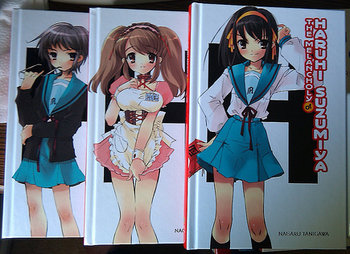
While related to Manga and Anime, light novels are actually prose, written in short paragraphs and conversational language for fast reading and interspersed with manga-style illustrations. Light novels are very popular in Japan, chiefly among teenagers and young adults. In the 2000s and early 2010s, very few of them had made their way to English-language markets, but this changed around 2013 when Yen Press created a successful strategy of marketing them to the people who read novels and not just anime/manga fans. There are also a relatively large number of translated yaoi light novels. Since many illustrators of light novels previously drew hentai, a lot of novels have racy illustrations interspersed with the text to capitalize on their talents.
The term "light novel" is a misnomer. While many people believe that the word "light" in the name means the novel is short (they usually don't last much longer than 200 pages, somewhere between a long novella or a very short novel, but some are outright doorstoppers) or that it uses manga-style illustrations (while most light novels have illustrations in them, there are some that don't have any), the truth is that this actually refers to the text inside. Modern light novels use simpler, easier-to-read everyday kanji as opposed to "hard" novels, which generally contain much older words which, even for Japanese readers, may necessitate keeping a dictionary on hand to understand. This distinction is Lost in Translation because Japanese is one of the only languages in the world where multiple writing systems are routinely used in the same sentence. The closest parallel in the Western world is probably the distinction between mass-market popular fiction and higher level literary fiction.
Light novels commonly get adapted to Manga and Anime, and more often than not are promptly displaced by said adaptations outside Japan for the reasons stated above. This is so common that some light novels are mistakenly believed to be anime or manga even if they don't have such an adaptation, or, oddly, that every Japanese-derived book adapted into anime/manga is a light novel regardless of text simplicity.note Sometimes it may be the other way around, and a manga or anime project may get a Tie-In Novel or Novelization in the form of a light novel. Either way, due to the close-knit relationship between the media and their habit of sharing illustrators, light novels have come to be seen as manga and anime's text-based cousin.
Light novels have been around for longer than most would assume, existing in some form at least since The '80s, when authors like Hideyuki Kikuchi and Baku Yumemakura made a career out of light, fantasy-oriented short novels. With the rising popularity of Hajime Kanzaka's Slayers, followed by Kouhei Kadono's Boogiepop Series a decade later, light novels started taking their established format, which eventually took a jump in the 2000s with Shakugan no Shana and A Certain Magical Index, the point in which the genre became inextricably joined with the anime and video game business. The peak of the wave came in 2006 with Haruhi Suzumiya, after which light novels basically skyrocketed in popularity and number. Some of the last seminal works, like Sword Art Online, still redefined the genre in new ways, popularizing elements like the Harem Series and the Isekai Sub-Genre, which are near-ubiqutious in the light novel market today.
Chinese-language literature has a somewhat similar phenomenon, particularly in Taiwan, though there is also a growing online force on Mainland China. Although the term "light novel" is not typically used in China for such works,note for convenience they will be listed here. Most, if not all of them are Web Serial Novels.
The rough Western equivalent would be Young Adult Literature, which is typically aimed at teenaged and up readers (with the upper age, depending on the authority, ranging from 25 to 34), or Pulp Magazine due to its escapist plots and Beige Prose style. However, publishers are making efforts to market light novels to adult readers, while there are several Young Adult and even Children's books that aren't "light" by any stretch of the imagination (the later Harry Potter books come to mind).
See also Stock Light-Novel Everyman, Stock Light-Novel Hero and Stock Light-Novel Calamity Princess.
Light novel series with pages on this wiki:
(Series marked with a * have a North American release at least in part.)
- .hack//AI Buster *
- 2.43 Seiin High School Boy's Volleyball Team
- 7th Dragon III: UE72 Mikan no Yuuma
- 7th Time Loop *
- The 8th Son? Are You Kidding Me?
- 86 EIGHTY-SIX *
- Absolute Duo
- Accel World *
- Accomplishments of the Duke's Daughter *
- Adachi and Shimamura *
- The Advent of Death's Daughter
- Aesthetica of a Rogue Hero
- Agents of the Four Seasons *
- Ai no Kusabi *
- Akashic Records of Bastard Magic Instructor *
- Akikan!
- The Alchemist Who Survived Now Dreams of a Quiet City Life *
- Alderamin on the Sky
- Allison
- All You Need Is Kill *
- Altina the Sword Princess *
- Alya Sometimes Hides Her Feelings in Russian *
- Am I Actually the Strongest? *
- Amagi Brilliant Park *
- The Ambition of Oda Nobuna
- And You Thought There Is Never a Girl Online?
- Angel Beats!
- The Angel Next Door Spoils Me Rotten *
- Ankoku Kishi Monogatari
- Another Note *
- Anti Magic Academy The 35th Test Platoon
- Apocalypse Alice
- Apocalypse Bringer Mynoghra
- The Apothecary Diaries *
- Apparently, Disillusioned Adventurers Will Save the World *
- An Archdemon's Dilemma: How to Love Your Elf Bride *
- Aria the Scarlet Ammo *
- Arifureta: From Commonplace to World's Strongest *
- The Aristocrat's Otherworldly Adventure
- Ascendance of a Bookworm *
- Assault Lily
- Assassin's Pride
- The Asterisk War *
- Asuka Of The Scarlet Sky
- Asura Cryin'
- Avesta of Black and White
- Baccano! *
- Backstabbed in a Backwater Dungeon *
- Baka and Test: Summon the Beasts
- Bakemonogatari *
- Balancing My Support Magic and Summoning Magic in a Different World
- Ballad Of A Shinigami *
- Banished from the Hero's Party *
- Battery
- Beast Tamer
- Beatless
- Being Able to Edit Skills in Another World, I Gained OP Waifus
- Ben-To
- Berserk: The Flame Dragon Knight
- Berserk of Gluttony *
- Beyond the Boundary
- Bibliophile Princess *
- Black Blood Brothers
- Black Bullet *
- Black Clover: The Book of the Black Bulls
- Black Clover: Order of Knights Book
- Black Lagoon
- Black Summoner *
- Bladedance of Elementalers
- BlazBlue: Phase Shift
- Bleach: Can't Fear Your Own World
- Bleach: The Death Save the Strawberry
- Bleach: We Do Knot Always Love You
- Bludgeoning Angel Dokuro-chan
- Bodacious Space Pirates
- Bofuri: I Don't Want to Get Hurt, so I'll Max Out My Defense. *
- Boogiepop Series *
- Book Girl *
- Book of Bantorra
- Bottom-tier Character Tomozaki *
- The Boy Who Swore Revenge On The World
- A Brave Heart of Red Rose
- Breakthrough with the Forbidden Master
- Brothers Conflict
- By the Grace of the Gods *
- Campfire Cooking in Another World with My Absurd Skill *
- Campione!
- The Case Files of Jeweler Richard *
- Cat Planet Cuties
- Cave King
- A Certain Magical Index *
- Chainsaw Man Buddy Stories *
- Cheat Magician Life That Started From Being Judged Useless
- Chillin' in Another World with Level 2 Cheat Powers *
- Chillin' in My 30s After Getting Fired from the Demon King's Army
- Chivalry of a Failed Knight
- Chrome Shelled Regios
- Chuuko demo Koi ga Shitai!
- The Circumstances Leading to Waltraute's Marriage
- Clash of Hexennacht *
- Classroom of the Elite *
- Class Teni De Ore Dake Haburaretara *
- Clockwork Planet *
- Coffin Princess Chaika
- Cold Series *
- The Combat Baker and Automaton Waitress
- Combatants Will Be Dispatched! *
- The Conqueror from a Dying Kingdom *
- Cooking With Wild Game *
- Cop Craft
- Corsair
- The Creation Alchemist Enjoys Freedom
- Crest of the Stars *
- Crusher Joe
- Cube×Cursed×Curious
- Culinary Chronicles of the Court Flower *
- Cursed Sword Master
- Dad Is a Hero, Mom Is a Spirit, I'm a Reincarnator
- Dances with the Dragons
- Danganronpa
- Danjon No Maou Wa Saijaku
- Date A Live *
- Dear Nemesis
- Deathbound Duke's Daughter *
- The Death Mage Who Doesn't Want a Fourth Time *
- Death March to the Parallel World Rhapsody *
- Death's Daughter and the Ebony Blade *
- Demonbane (three prequel novels)
- Demon King Daimao *
- Demon Lord, Retry! *
- Demon Slayer: Kimetsu no Yaiba - Shiwase no Hana *
- Demon Slayer: Kimetsu no Yaiba - Katahane no Cho *
- Demon Slayer: Kimetsu no Yaiba - Kaze no Michishirube *
- Denpa Teki na Kanojo
- Der Werwolf: The Annals of Veight *
- The Detective is Already Dead *
- The Devil Is Making A City
- The Devil is a Part-Timer! *
- Devil May Cry * (two that are prequels out of a total of four)
- DDD (aka Decoration Disorder Disconnection)
- Didn't I Say to Make My Abilities Average in the Next Life? *
- Did You Know that a Playboy Can Change His Job to a Sage?
- Digimon:
- Dirty Pair *
- Disgaea Novels
- Dog & Scissors
- Dokkoida?!
- Dont Worry Mama
- Do You Love Your Mom and Her Two-Hit Multi-Target Attacks? *
- Dragon Crisis!
- Dragonar Academy
- Drugstore in Another World *
- Dungeon Busters *
- Dungeon Defense
- The Dungeon Seeker
- Durarara!! *
- Earl and Fairy *
- Eien no Filena
- Elegant Yokai Apartment Life
- The Eminence in Shadow *
- The Empire of Corpses
- The Empty Box and Zeroth Maria *
- Endo and Kobayashi Live! *
- Eromanga Sensei
- Etsusa Bridge
- Even Though I'm a Former Noble and Single Mother
- Evil Dragon Reincarnation
- Evillious Chronicles
- Cloture of Yellow
- Evil Food Eater Conchita
- Fifth Pierrot
- Gift From the Princess Who Brought Sleep
- The Lunacy Of Duke Venomania
- Praeludium Of Red
- Praefacio Of Blue
- Wiegenlied of Green
- The Tailor of Enbizaka
- Judgment Of Corruption
- The Muzzle Of Nemesis
- Master Of The Heavenly Yard#
- Original Sin Story Crime
- The Executioner and Her Way of Life *
- Expecting to Fall into Ruin, I Aim to Become a Blacksmith
- The Extraordinary, the Ordinary, and SOAP! *
- Failure Frame: I Became the Strongest and Annihilated Everything With Low-Level Spells]] *
- The Failure Red Mage Is Unmatched In Sage Time
- Fake Saint of the Year
- Falling in Love With the Villainess
- The Familiar of Zero
- The Faraway Paladin *
- Farming Life In Another World *
- Fate/Apocrypha
- Fate:Lost Einherjar
- Fate/Requiem
- Fate/strange Fake
- Fate/Zero
- Fire Girl
- Fixed Damage
- A Fox's Tale
- From A Knight To A Lady
- From the New World
- The Fruit of Evolution
- Fujimi Orchestra
- Full Clearing Another World under a Goddess with Zero Believers *
- Full Dive
- Full Metal Panic! *
- Fullmetal Alchemist *
- Fushi no Kami *
- Gad Guard
- Gakuen Kino
- Gamers! (2015)
- Garbage Brave
- Garden of Avalon
- The Garden of Sinners
- Gargoyle of the Yoshinagas
- Gate - Thus the JSDF Fought There
- Gekkou
- The Genius Prince's Guide to Raising a Nation Out of Debt (Hey, How About Treason?) *
- Genkai Level 1 Kara No Nariagari
- Genocide Online
- Ginban Kaleidoscope
- Girlish Number
- Girls Kingdom *
- Girly Air Force
- GJ-bu
- Goblin Slayer *
- Gokudō
- Golden Time
- Gonna Be the Twin-Tail!!
- Good Luck! Ninomiya-kun
- The Good Witch of the West *
- Gosick *
- The Great Cleric *
- The Greatest Demon Lord Is Reborn as a Typical Nobody *
- The Greatest Magicmaster's Retirement Plan *
- Grimgar of Fantasy and Ash *
- Grimoire of Zero
- Ground Control to Psychoelectric Girl
- Guardian Ninja Mamoru
- Guin Saga *
- Gun-Ota ga Mahou Sekai ni Tensei Shitara... *
- Haganai
- Hanabishi Fusai no Taima-chou
- Harem in the Labyrinth of Another World
- Haruhi Suzumiya *
- Haruka Nogizaka's Secret
- The Haunted Bookstore - Gateway To A Parallel Universe
- Hazure Skill: The Guild Member with a Worthless Skill... *
- Heaven's Memo Pad
- Heavy Object
- Hentai Prince and the Stony Cat
- Hensuki: Are You Willing to Fall in Love with a Pervert, as Long as She's a Cutie?
- Here Comes the Three Angels
- The Hero and His Elf Bride Open a Pizza Parlor in Another World *
- The Hero is Overpowered but Overly Cautious *
- The Hero Laughs While Walking the Path of Vengeance a Second Time
- The Hero Who Returned Remains the Strongest in the Modern World
- The Hero Who Seeks Revenge Shall Exterminate With Darkness
- The Hidden Dungeon Only I Can Enter *
- Higehiro *
- High School D×D *
- High School Prodigies Have It Easy Even in Another World *
- High☆Speed! (2013)
- Higurashi: When They Cry (originally a visual novel)
- Hiraheishi wa Kako o Yumemiru
- The Holy Grail of Eris *
- Horizon in the Middle of Nowhere
- How a Realist Hero Rebuilt the Kingdom *
- How Not to Summon a Demon Lord *
- How to Build a Dungeon: Book of the Demon King *
- How to Raise a Boring Girlfriend *
- Humanity Has Declined
- Hundred
- Hyouketsu Kyoukai no Eden
- I am the Sorcerer King (Korean)
- I Couldn't Become a Hero, So I Reluctantly Decided to Get a Job
- I Got a Cheat Skill in Another World and Became Unrivaled in the Real World, Too *
- I Had That Same Dream Again *
- I Left the A-Rank Party
- I May Be a Guild Receptionist, But I'll Solo Any Boss to Clock Out on Time *
- I Saved Too Many Girls and Caused the Apocalypse *
- I Shall Survive Using Potions! *
- I Swear I Won't Bother You Again! *
- I Want to Eat Your Pancreas
- I Was Caught up in a Hero Summoning, but That World Is at Peace
- I Was Reincarnated as the 7th Prince
- I'm a Behemoth, an S-Ranked Monster, but Mistaken for a Cat, I Live as an Elf Girl's Pet *
- I'm the Evil Lord of an Intergalactic Empire! *
- I'm Giving the Disgraced Noble Lady I Rescued a Crash Course in Naughtiness *
- I'm In Love With the Villainess *
- I'm the Queen in This Life
- I'm Quitting Heroing *
- I'm a Royal Tutor in My Sister's Dress
- I'm the Villainess, So I'm Taming the Final Boss *
- I've Been Killing Slimes for 300 Years and Maxed Out My Level *
- I've Somehow Gotten Stronger When I Improved My Farm-Related Skills
- The Iceblade Sorcerer Shall Rule the World *
- The Ideal Sponger Life *
- If Her Flag Breaks
- If It’s for My Daughter, I’d Even Defeat a Demon Lord *
- Immoral Darkness *
- In Another World, I Am Called: The Black Healer
- In Another World with My Smartphone *
- The Inconvenient Life Of An Arousing Priestess *
- Infinite Dendrogram *
- Infinite Stratos *
- Inukami!
- INVADERS of the ROKUJYOUMA!? *
- The Invincible Little Lady *
- In the Land of Leadale *
- Irina: The Vampire Cosmonaut *
- Iriya no Sora, UFO no Natsu
- The Irregular at Magic High School *
- Irresponsible Captain Tylor
- Is It Tough Being A Friend
- Is It Wrong to Try to Pick Up Girls in a Dungeon? *
- Is This A Zombie?
- Isekai Cheat Magician
- Isekai Omotenashi Gohan
- Isekai Onsen Ni Tensai Shita Ore No Kounou Ga Tondemosugiru
- Isekai Walking
- The Isolator *
- Itsuka Tenma no Kuro Usagi
- Izure Shinwa No Ragnarok
- Japan Summons
- Jigoku No Gouka De Yakare Tsuzuketa Shounen
- JK Haru is a Sex Worker in Another World *
- JoJo's Bizarre Adventure 4th Another Day
- JoJo's Bizarre Adventure: Over Heaven
- Jorge Joestar
- Jujutsushi Wa Yuusha Ni Narenai
- Juni Taisen: Zodiac War *
- Kabukibu!
- Kagerou Daze *
- Kakuriyo: Bed and Breakfast for Spirits
- Kamikaze Girls *
- Kämpfer
- Kanokon
- Karin *
- Katanagatari
- Kaze no Stigma
- The Kept Man of the Princess Knight *
- Kieli *
- Kings Proposal *
- Kino's Journey *
- Kirby (Light Novel)
- Knight's & Magic *
- Kokoro Connect *
- KonoSuba *
- Kou 1 Desu Ga Isekai Joushu Hajimemashita
- Kuma Kuma Kuma Bear *
- Kure-nai
- Kyo Kara Maoh!
- Kyouran Kazoku Nikki
- Ladies versus Butlers!
- Last and First Idol *
- Lazy Dungeon Master *
- L: change the WorLd
- Legend of the Galactic Heroes *
- The Legend of the Legendary Heroes
- The Legendary Moonlight Sculptor
- Let's Start An Inn On The Dungeon Island
- Level 1 Strongest Sage
- Level Up Just By Eating
- Library War
- Lillia & Treize
- A Lily Blooms in Another World *
- Listen to me, girls. I am your father!
- Little Witch Academia: The Nonsensical Witch and the Country of the Fairies * (adaptation)
- Lodgeworld
- Log Horizon *
- Loner Life In Another World *
- Looking Up at the Half-Moon
- Lord El-Melloi II Case Files
- Lord Marksman and Vanadis
- Lost Universe
- Love, Chunibyo & Other Delusions!
- A Lullaby Sinister *
- Maburaho
- The Mage Will Master Magic Efficiently in His Second Life
- The Magic in This Other World Is Too Far Behind! *
- Magic User's Club (Mahou Tsukai Tai!)
- Magical Explorer *
- Magical Girl Raising Project *
- The Magical Revolution of the Reincarnated Princess *
- Magical Warfare
- Magician's Academy
- Magika Swordsman and Summoner
- Magistellus Bad Trip *
- Mai-HiME Destiny (Alternate Continuity to the anime series)
- Management of Novice Alchemist *
- Manuke FPS Player Ga Isekai E Ochita Baai
- Maou Na Ore To Fushihime No Yubiwa
- Maoyu
- Märchen Mädchen
- Maria Watches Over Us
- The Master of Ragnarok & Blesser of Einherjar *
- May I Ask for One Final Thing?
- Mayo Chiki!
- Mayoi Neko Overrun!
- Maze Megaburst Space
- Me, a Genius? I Was Reborn into Another World and I Think They've Got the Wrong Idea! *
- Might As Well Cheat
- Mikagura School Suite
- Mirage of Blaze
- The Misfit of Demon King Academy *
- MM!
- Mnemosyne
- Mobile Suit Gundam Twilight AXIS
- Mobile Suit Gundam Unicorn
- Modern Magic Made Simple
- Modern Villainess
- Momokyun Sword
- Monster Girl Doctor
- The Most Heretical Last Boss Queen: From Villainess To Savior *
- Mushi-Uta
- Muv-Luv
- Mushoku Tensei: Jobless Reincarnation *
- My Daughter Left the Nest and Returned an S-Rank Adventurer *
- My Entire Class Was Summoned To Another World Except For Me
- My Happy Marriage *
- My Instant Death Ability is So Overpowered... *
- My Lady Just Wants to Relax
- My Little Sister Stole My Fiance *
- My Mental Choices are Completely Interfering with my School Romantic Comedy
- My Next Life as a Villainess: All Routes Lead to Doom! *
- My Repair Skill Became An Almighty Cheat
- My Room Is A Dungeon Rest Stop
- My Sister, My Writer
- My Status As An Assassin Obviously Exceeds The Hero's *
- My Stepmom's Daughter is My Ex *
- My Unique Skill Makes Me OP Even At Level 1 *
- My Youth Romantic Comedy Is Wrong, as I Expected *
- Myriad Colors Phantom World
- The Mystic Archives of Dantalian
- NAKAIMO - My Little Sister is Among Them!
- Nanana's Buried Treasure
- Nanatsuiro★Drops
- Nyaruko: Crawling with Love!
- Naruto Hiden
- Neon Genesis Evangelion: ANIMA *
- No. 6
- Ninja Slayer
- Nito's Lazy Foreign World Syndrome
- No Game No Life *
- No-Rin
- Now I'm a Demon Lord! Happily Ever After with Monster Girls in My Dungeon *
- An Observation Log of My Fiancée Who Calls Herself a Villainess
- Occultic;Nine *
- Ōkami-san
- On a Godless Planet
- Oni Ai
- Only the Ring Finger Knows
- Only Sense Online
- Orc Eroica *
- Oreimo
- Oreshura
- Oresuki
- Osamake
- Otherside Picnic *
- Otherworldly Izakaya Nobu
- Oto × Maho
- Otome Game No Heroine De Saikyou Survival
- Our Home's Fox Deity
- Our Last Crusade or the Rise of a New World *
- Outbreak Company *
- Outburst Dreamer Boys
- Overlord (2012) *
- Parallel World Pharmacy
- Persona x Detective NAOTO
- The Pet Girl of Sakurasou
- Pita-Ten *
- Please Teacher!
- Pocket Monsters: The Animation
- Pretty Boy Detective Club *
- Prince of Stride
- Prison Life is Easy for a Villainess *
- Problem Children are Coming from Another World, aren't they?
- Puella Magi Madoka Magica (adaptation)
- Purple Haze Feedback
- Qualia the Purple *
- Queen Millennia
- R15
- Rail Wars!
- Rakuin No Monshou (Emblem of the Branded)
- Rascal Does Not Dream of Bunny Girl Senpai *
- Raven of the Inner Palace *
- Read or Die
- Reborn as a Space Mercenary: I Woke Up Piloting the Strongest Starship! *
- Reborn as a Vending Machine, I Now Wander the Dungeon *
- Reborn to Master the Blade *
- Rebuild World *
- Record of Grancrest War
- Record of Lodoss War *
- Record of Wortenia War *
- Reign of the Seven Spellblades *
- Reincarnated as a Dragon Hatchling *
- Reincarnated as the Piggy Duke: This Time I'm Gonna Tell Her How I Feel! *
- Reincarnated as a Sword *
- The Reincarnated Sword Saint Wants To Take It Easy
- The Reincarnation of the Strongest Exorcist in Another World
- Remake Our Life! (Bokutachi no Remake)
- The Remarried Empress
- Re:Monster
- Rental Magica
- Restaurant to Another World *
- The Reunion With Twelve Fascinating Goddesses
- Revolutionary Girl Utena
- Re:Zero *
- Rise of the Outlaw Tamer and His S-Rank Cat Girl
- The Rising of the Shield Hero *
- Rising × Rydeen
- Rokka: Braves of the Six Flowers *
- Roll Over and Die *
- Rose Princess Hellrage
- Rune Soldier Louie
- RWBY: The Session
- The Ryuo's Work Is Never Done! *
- S (2005) *
- Sabikui Bisco
- The Sacred Blacksmith
- The Saga of Tanya the Evil *
- Sagrada Reset
- Saikyou Juzoku Tensei
- The Saint's Magic Power Is Omnipotent *
- A Salad Bowl of Eccentrics
- Samurai Girls
- Sasami-san@Ganbaranai
- Satou Kashi no Dangan wa Uchinukenai
- Saving 80,000 Gold in Another World for My Retirement *
- The Savior's Book Café Story in Another World
- Scrapped Princess *
- SD Gundam The Last World
- Secrets of the Silent Witch *
- Seirei Gensouki: Spirit Chronicles *
- Seraph of the End: Guren Ichinose: Catastrophe at Sixteen *
- The Seven Deadly Sins *
- Seven Senses of the Re'Union
- Seventh *
- Sexiled: My Sexist Party Leader Kicked Me Out So I Teamed Up With A Mythical Sorceress! *
- Shakugan no Shana *
- Shangri-La
- She Retaliated Because Her Entire Family Was Wrongfully Executed
- Shimoneta
- Shingan no Yuusha
- Shinkyoku Soukai Polyphonica Crimson
- Shin Sakura Taisen the Novel: Hizakura no Koro
- Shomin Sample
- Shōnen Onmyōji
- Shounen Hollywood
- Side-By-Side Dreamers
- A Simple Survey
- Sister Princess
- A Sister's All You Need *
- Skeleton Knight in Another World *
- Sky Wizards Academy
- Slayers *
- Slow Life in Another World (I Wish!) *
- Smile of Condemnation
- So, I Can't Play H!
- So I'm a Spider, So What? *
- The Son of the Hero
- The Sorcerer King of Destruction and the Golem of the Barbarian Queen
- Sorcerer Stabber Orphen * (Two series; the original "Haguretabi" and the comedic "Mubouhen")
- The Sorcerer's Receptionist *
- Spice and Wolf *
- Spirit Migration
- Spy Classroom *
- SSS-Class Suicide Hunter
- Starship Operators
- The Story of Saiunkoku
- The Strange Adventure of a Broke Mercenary *
- Strawberry Panic! *
- Strike the Blood *
- The Strongest Sage with the Weakest Crest
- Student Council's Discretion
- Sugar Apple Fairy Tale *
- Sukisho
- Sunday Without God
- Super Cub
- Suppose a Kid from the Last Dungeon Boonies Moved to a Starter Town *
- Survival in Another World with My Mistress! *
- Suterareta Yuusha No Eiyuutan
- Sweet Reincarnation
- Sword Art Online *
- Taishō Baseball Girls
- Tales of Reincarnation in Maydare
- Tearmoon Empire *
- Telepathy Shoujo Ran
- The Pilot's Love Song
- The Princess and the Pilot
- The Testament of Sister New Devil
- That Time I Got Reincarnated as a Slime *
- There's No Freaking Way I'll be Your Lover! Unless… *
- There Was No Secret Evil Fighting Organization *
- Thermal Operator
- The Third: The Girl with the Blue Eye
- This Is Screwed Up, but I Was Reincarnated as a GIRL in Another World! *
- Toaru Hikuushi e no Seiyaku
- Tokyo Ravens
- Toradora! *
- Torture Princess: Fremd Torturchen *
- Torture Tower doesn't sleep
- Trapped in a Dating Sim: The World of Otome Games is Tough for Mobs *
- Trash Skill Gacha
- Trinity Blood *
- The Triskelion in the Deserted City of Tokyo
- True Tenchi Muyo! *
- Tsuki Tsuki!
- TSUKIMICHI -Moonlit Fantasy- *
- Tsurune
- Tsuyokute New Saga
- The Twelve Kingdoms *
- Two As One Princesses
- Tytania
- Ultimate Antihero
- Ulysses: Jeanne d'Arc and the Alchemist Knights
- Unbreakable Machine-Doll
- The Undead King's Reign of Peace *
- Undefeated Bahamut Chronicle
- The Undetectable Strongest Job
- The Unexplored Summon://Blood-Sign
- The Unique Cheat of the Man Dragged in by the Four Heroes
- Unlimited Fafnir
- Unlock City
- Unnamed Memory *
- The Unwanted Undead Adventurer
- Vamp!
- Vatican Miracle Examiner
- Venus to Mamoru!
- The Vexations of a Shut-In Vampire Princess *
- Villager A Wants to Save the Villainess No Matter What!
- The Villainess Flips the Script!
- Villainess Level 99 *
- The Villainess Lives Again
- The Villainess Turns The Hourglass
- The Villainous Daughter's Butler, I'll Crush the Destruction Flags
- Violet Evergarden
- Wandering Witch: The Journey of Elaina *
- A Warrior Exiled by the Hero and His Former Lover
- Washio Sumi Is a Hero
- Watashitachi no Tamura-kun
- The Way to Protect the Female Lead's Older Brother *
- The Weakest Tamer *
- The Weakness of Beatrice the Level Cap Holy Swordswoman
- Welcome to Autumnport
- Welcome to the Impregnable Demon King Castle
- Welcome to Japan, Ms. Elf! *
- When Supernatural Battles Became Commonplace *
- A Wild Last Boss Appeared! *
- The World is Full of Monsters Now
- Why Shouldn't a Detestable Demon Lord Fall in Love? *
- Wise Man's Grandchild
- Woof Woof Story
- World Break: Aria of Curse for a Holy Swordsman
- World Customize Creator
- WorldEnd: What Do You Do at the End of the World? Are You Busy? Will You Save Us? *
- World Teacher: Special Agent in Another World *
- The World's Finest Assassin *
- The Wrong Way to Use Healing Magic *
- Yakitori: Soldiers of Misfortune
- You Like Me, Not My Daughter?! *
- Your Forma *
- Yumegari
- Zaregoto *
- The Zashiki Warashi of Intellectual Village
- Coiling Dragon (盘龙)
- Cultivation Chat Group (修真聊天群)
- Demon Sword Maiden (妖刀姬)
- Desolate Era (莽荒纪)
- Ding Hai Fu Sheng Lu (定海浮生录)
- The Distinguished Cute Master
- Douluo Dalu (斗罗大陆)
- Eclipse Hunter (玄日狩)
- Fox Demon Cultivation Manual (狐妖修炼指南)
- Grandmaster of Demonic Cultivation: Mo Dao Zu Shi (魔道祖师)*
- ½ Prince (½王子)
- Heaven Official’s Blessing: Tian Guan Ci Fu (天官赐福)*
- The King's Avatar (全职高手)
- The Legend of Sun Knight (吾命騎士)
- Lord of Mysteries
- Mistakenly Saving the Villain (论救错反派的下场)
- Nine Star Hegemon Body Art
- Novoland
- The Obsessive Shou Moves On (偏执受想开了[重生])
- Qiang Jin Jiu (将进酒)
- Qian Qiu (千秋)
- The Record of Unusual Creatures (异常生物见闻录)
- Release That Witch (放开那个女巫)
- The Scum Villain's Self-Saving System: Ren Zha Fanpai Zijiu Xitong (人渣反派自救系统) *
- Sha Po Lang (杀破狼)
- Tian Bao Fu Yao Lu
- The Ugly Empress
- Unruly Phoenix Xiaoyao
- Way of Choices
- Wu Chang Jie (无常劫)
- Wushuang (无双)
- You Yao
- Zhen Hun (镇魂), or more commonly known as Guardian.
Original English Language Light Novels: Much like Original English Language Manga, there are a small group of authors writing in the style of light novels.
- American Kitsune
- A Most Unlikely Hero
- The Anime Trope System: Stone vs. Viper
- The Beginning After the End
- Daybreak on Hyperion
- My Friend Took Me To A Feline Therapy Place For My Anxiety And I’m Starting To Wonder Where The Cats Are?
- God Complex
- Harem Prince
- My New Dungeon Life: Rise of the Slave Harem.
- Please Let Me Be A Seiyuu
- Reaper (Ivan Navi)
- The Reincarnated Vampire Just Wants To Enjoy Her New Life
- Rolitania
- Tokyo Demons
- VALKYRIE: Into the Heavens
- WIEDERGEBURT: Legend of the Reincarnated Warrior
Companies that publish Light Novels:
- Alphapolis
- Kadokawa
- Dengeki Bunko (ASCII MediaWorks)
- Fujimi Fantasia Bunko (Fujimi Shobo)
- Kadokawa Sneaker Bunko (Kadokawa Shoten)
- MF Bunko J (Media Factory)
- HJ Bunko (Hobby Japan)
- Overlap Bunko
- Type-Moon
- Nitro+ Books (nitro+)
Companies that translate Light Novels into English:
- Cross Infinite World
- Hanashi Media
- J-Novel Club
- Monogatari Novels
- One Peace Books
- Seven Seas Entertainment
- Sol Press (business operations suspended as of August 2021, more info here
 )
)
- Tentai Books
- Vertical, Inc.
- Yen Press
