
This is when a character hates and/or blames another one for something that is at best only partially their fault. Evidence may be willfully ignored or misinterpreted to support their position, and it usually takes a titanic effort to get the hater to change their mind (if any is even possible). Sometimes, it just happens once they see the other character.
This trope comes in a few variations that, while distinct enough to probably be their own tropes, will be grouped to avoid confusion. They are: misplaced/overinflated blame, inarticulate dislike, and ungrounded jealousy/prejudice.
When it's misplaced or overinflated blame, the hater assigns blame to the character (often more than justifiable) not through some misleading evidence, but out of an emotional need to blame someone (often in situations where no blame could be assigned). If the character did deserve some blame, the hater will react much like in a Comical Overreaction or Minor Injury Overreaction and latch on to them as a convenient target. What's sad about this is that a hero who suffers from Samaritan Syndrome may well let the hater nurse this grudge if they actually did fail, even in some minor way, out of overblown guilt. Some heroes will allow this even if they didn't earn it to allow the hater an outlet, which usually comes back to haunt them as the hater goes on to exact Misplaced Retribution.
An inarticulate dislike is (oddly) easier to quantify. The hater has a genuine dislike for the character, but either can't or won't put it to words. It may be that the hater feels insecure or jealous, and rather than face those feelings, they sublimate the dislike into a nebulous cloud of barely coherent Insane Troll Logic directed at the character. Or it may be a truly irrational hatred that has no basis in reality. Because of this vagueness, the hater may end up disliking seemingly random traits of the character, which can be noted when it isn't an issue if other people do it.
Lastly, ungrounded jealousy or prejudice stems from hating something that the character has no control over, such as being disabled or extremely beautiful. While in these cases, the hater has a concrete "reason" and definable focus for their hate, it's just not rational to hate someone for something they have no control over. Now, if said character abused their disability or advantage to manipulate others or rested on their laurels, it wouldn't be this trope.
It bears repeating that in all of these cases, the hater may suffer from You Are What You Hate due to Internalized Categorism, and is sublimating the blame, guilt, or jealousy for some other thing the hated has, is, or has done into a more "acceptable" irrational hatred rather than face the ugly truth inside themselves. Getting the hater to notice this or admit to it usually requires that they Kick The Wrong Dog in the pursuit of their prejudice.
Compare the Inspector Javert, who pursues someone regardless of their culpability. The Armoured Closet Gay's hatred of gays is usually born of this, and so is most hatred for any Category Traitor. Sometimes overlaps with Feeling Oppressed by Their Existence. Commonly the reason behind Sitcom Arch Nemeses, can be a reason for It's Not About the Request.
Examples:
- Beyblade: Metal Fusion: Argo Garcia hates Ginkga and his friends the moment he sets his eyes on him for no apparent reason and attacks Yu in hopes of sabotaging Gingka's chances of advancing into the final of the World Beyblade championship. Ultimately, his plan fails, and he started hating Tsubasa just for beating him fairly. In Beyblade: Shogun Steel, he (along with his family) creates the organization DNA to get revenge on Tsubasa just for beating him that one time.
- Danganronpa 3: The End of Hope's Peak High School: Juzo Sakakura has an extreme hatred of Naegi for being hailed as a hero despite all the lives his decisions have cost... and despite Naegi himself doing his level best to save everyone. He's actually jealous of Naegi, because while both of them had opportunities to stop Enoshima (Naegi during the first game and Sakakura when he discovers her connection to the riots in Side: Despair), Naegi actually went through with it while Sakakura folded under Enoshima's blackmail.
- Dragon Ball: Plan to Eradicate the Saiyans: The four Ghost Warriors are created by the remnants of the Tsufurian race, and thus are fueled by the hatred and anger towards the Saiyan race. The four Ghost Warriors take the form and personalities as well as the memories of past villains that were killed by the heroes, namely Freeza, Cooler, Tullece/Turles and Lord Slug. While Freeza and Cooler had legitimate reasons to hate the Saiyans, Tullece and Slug did not. While it's true that Slug was killed by Son Goku, anything he says about the sins the Saiyans committed towards his and Piccolo's race is not remotely true (only Vegeta has killed a single Namekian village, but Goku and Gohan are regarded as saviors by the Namekians) and the evil Lord Slug would have no idea of what happened on his home planet since he was far away conquering planets with his demon clan. Tullece's hatred towards the Saiyan race is even more illogical since he is a proud Saiyan himself who loved doing the evil lifestyle of the Saiyans. Part of this is justified since the Ghost Warriors aren't actual the real people they're imitating and are made by the hatred of the Tsufurian race, yet the inclusion of Tullece and Slug was truly bizarre.
- El-Hazard: The Magnificent World: In the first OAV, Jinnai comes to view Makoto as a hated enemy and rival, for no other reason than he's Always Second Best when compared to him. Makoto, in his turn, isn't even aware that his actions have been pissing Jinnai off.
- Eyeshield 21: Kongo Agon is an all around Born Winner and he hates everyone who is not as talented as him and go to great length to completely crush them in and outside the field. He started playing American Football because it allows him to crush other people's dreams and because he could steal the scholarship of Kurita because he judged him too fat.
- Food Wars!: Asahi Saiba has it in for protagonist Soma Yukihira during the series' final arc. To contextualize, Soma's father Joichiro visited Asahi's orphanage when he was young, and taught him how to cook becoming a Parental Substitute of sorts. Unfortunately, when Joichiro's wife died he had to return to Japan to raise Soma, leaving Asahi behind. As a result, Asahi hates Soma for "stealing" Joichiro from him when Soma didn't even know about what was going on.
- Fruits Basket:
- Ren Sohma's reasons for hating Akito, her own daughter, are completely nonsensical and shallow. In the end, she's just an overgrown brat throwing a tantrum because she wasn't the only special woman in Akira's life and Akito was practically worshiped since before she was born because of her status as the Zodiac's "God". Ren despised being around Akito so much that she missed Akira's final words to her, never hearing just how special he thought their love was because the "God" was their child.
- Kyo's father is just as bad, viewing Kyo as nothing but a horrible monster and treating him like he's subhuman because he was cursed by the Cat, something that Kyo had no control of whatsoever. He went so far as to mistreat his wife just for giving birth to Kyo, to the extent she was Driven to Suicide.
- Tohru's entire family on her father's side, barring her grandfather. Tohru is a Nice Girl who's never anything but polite to them, but they don't reciprocate her kindness, hate her, and treat her like an unwanted guest at best and a humiliating burden at worst simply because her mother was a Former Teen Rebel and they automatically assume Tohru is the same. It reaches the point where her grandfather actually encourages Tohru to go back to the Sohmas just to get away from them.
- Kyo hated Yuki from the moment they first met and blames him for all of his problems, like his unfair treatment at the hands of the rest of the Sohma family, simply because Yuki is the Rat of the Zodiac, the one closest to God, and the Rat's trickery in the legend is the entire reason the Cat is the pariah of the Zodiac in the first place. Eventually, Kyo, after a healthy dose of Character Development, acknowledges that he never actually hated Yuki for who he was and that none of his misfortune was his fault, but was so miserable that he felt he needed somebody to blame.
- My Hero Academia: It is Played for Laughs for the most part, but nevertheless Neito Monoma's unrelenting obsession with upstaging and demeaning the students of Class 1-A at every possible moment (even going to their dorm before he leaves the school for the day, almost every day, to spend some time insulting them) goes way past inter-class rivalry and straight into this territory, with even his fellow class students and closest friends being occasionally unnerved and wondering just what the hell is wrong with him.
- Naruto: This is a big part of Sasuke Uchiha's motives in the later half. While he had a perfectly legitimate reason to hate his elder brother Itachi for the murder of the entire Uchiha clan (plus some Mind Rape), he let himself get consumed with Revenge Before Reason. As a direct result, when he later learns that Itachi performed the massacre on orders from Leaf Village because the Uchiha were planning a coup, his craving for vengeance transfers over from Itachi to the Leaf Village as a whole for using his brother and living happy lives because of it. It's a sign of his declining sanity.
- One Piece:
- The leaders of the New Fishman Pirates hate humans for years of Fantastic Racism but, by Hody Jones' own admission, never experienced any of it for themselves. Their hatred stems from the negative environment they grew up in, and have no personal grudge against mankind. It's described as a 'grudge without substance'. Hody in particular latched onto the ideas of hatred against humanity because of the belief that carrying out revenge against humans would make him a hero.
- Fisher Tiger, one of Fishman Island's heroic figures, also had an irrational hatred of humanity, though he did have that firsthand experience to a major degree when he was Made a Slave. He knew intellectually that good humans existed, but could never fully get over his own hatred, especially when the people of Koala's village sold him out to the Marines just after he brought her home. This resulted in his death when he refused a transfusion of human blood that could have saved his life.
- In Pokémon: The Series, Harley has an irrational hatred for May, essentially blacklisting her only because she made some off-handed comments about his Cacturne being "scary" and his cookies being "not half-bad" (which were meant to be compliments). He later claims that his dislike of her stems from an incident in his childhood, when a girl who looked like May stole his snack in kindergarden, but it's implied he was making up the whole story.
- The Quintessential Quintuplets: Nino tends to come off as this in the early chapters towards Fuutarou. While it's true that Fuutarou wasn't doing himself any favors and gave a bad first impression of himself, her reasons to antagonize with him and sabotage their study sessions (even drugging him to get him to fall asleep) are mostly grounded on the fact that she sees him as an interloper in their home and fears that he will disrupt the bond between her and her sisters. This heavily contrasts with Itsuki, who previously had an encounter with Fuutarou where, despite his initial jerkish behavior, she tried to be nice to him and he replied rather rudely, thus giving her a more valid reason to dislike him, while Nino tends to be mean to him without provocation. Also, Itsuki finds herself feeling sympathetic to his economical situation, while Nino actively tries to get him fired from his tutor job with little to no consideration for the troubles this could cause him (given that he needs the money to support his family) or her sisters (they all need to raise their grades), and this kicks off a spat between the two of them. Unlike most examples, Nino eventually gets better, as when she discovers that the boy she fell in love with was none other than Fuutarou himself and the reason why she treats him harshly is because of her fear that his presence will keep the sisters apart as they realize their differences (and given what comes after the second half of the story, her fears are not exactly unfounded since she and the rest of her sisters are now competing for Fuutarou's affection that at one time nearly destroyed the family once). She feels deeply ashamed of how she treated him, and resolves to be as nice to him as possible to make up for it.
- Rosario + Vampire: Gyokuro Shuzen despises Akasha Bloodriver, her husband's mistress, so much for being Issa's favorite that she joined Fairy Tale, an anti-human extremist organization, and tried to destroy the world purely to spite her dream of human/monster co-existence.
- In SPY×FAMILY, Yuri's hatred of his brother-in-law Loid is a downplayed example. While his Big Sister Attraction does play a part, Yuri makes it clear that his dislike of Loid stems first and foremost from not trusting the man, since he (rightfully) finds it suspicious that Loid's been married to Yor for a year without him ever knowing about it. Nevertheless, his hatred goes into this territory when Yuri starts seeing everything Loid does as antagonistic. When Yuri asks if Loid has an Affectionate Nickname for Yor, Loid says he just calls her "Yor". Yuri gets mad at this, saying "that's our thing", despite the fact that Yor is the woman's name. Yuri even admits that Loid is basically perfect — Loid is a good cook, handsome, charming, a doctor, and rich. All things that just make Yuri even more angry, since he can't find a good reason to hate Loid. Ironically, Yuri's hatred of Loid, purely by accident, makes him correctly believe that Loid is a spy for WISE, but his superiors won't believe him because he bases it solely on hatred.
- Post Avengers vs. X-Men, Wolverine despises Cyclops because he killed Charles Xavier...while the Phoenix Force- a mind-warping Eldritch Abomination with godlike power- was possessing Cyclops. Wolverine has seen firsthand that the Phoenix Force overwhelms its hosts' minds, often driving them to insanity, and that no mortal mind note can control it. (And that Xavier was trying to kill Cyclops at the time.) He also knows that Tony Stark forced the Phoenix into Cyclops' brain, and Cyclops himself had no choice or agency in the matter. Yet he decries Cyclops as a murderer, demands he be imprisoned, and never once acknowledges that maybe the alien, sun-eating god in Cyclops' head at the time influenced his actions in any way. Cyclops actually points this out in Bendis' Uncanny X-Men, not that Wolverine listens. Logan most likely uses Xavier's murder as an excuse to hide his previous enmities towards Cyclops. It should also be noted that shortly prior to the events above hostilities between Cyclops and Wolverine had reached a new level due to disagreements over the methods the X-Men had been using, so Xavier's death may well have been The Last Straw for Wolverine.
- Aquaman: For most of the character's history, the titular character's Arch-Enemy Black Manta dedicated his life to making Aquaman suffer and despised him with all of his being, despite having no real motivation for any of it. There were two attempts to give Manta a Freudian Excuse (one where he was kidnapped by pirates, and another where he was tortured in a mental asylum throughout his childhood to cure his Hollywood Autism), but since Aquaman was only tangentially related to either, it still came across as this and both were quickly ignored. The New 52 subverted this, establishing Manta hated Aquaman for accidentally killing his father when Aquaman went after Manta, mistakenly believing Manta had killed his beloved stepfather.
- In Batman: Hush, this is invoked by Tim Drake, pretending to completely hate and mistrust Selina Kyle regardless of evidence and the opinions of those who know her better as part of one of Bruce's gambits.
- Fantastic Four: Doctor Doom has built his entire career as a supervillain around spiting his old college pal Reed Richards for a freak lab accident that left him disfigured. Reed didn't actually cause the accident or anything. In fact, he actually tried to warn Doom that his calculations had errors that could lead to disaster before the experiment began. Doom just ignored him out of arrogance. Doom's subsequently decided that Reed obviously sabotaged the experiment, and spends every waking moment since then trying to destroy Reed, his friends, and family because, otherwise, he'd have to admit Reed was simply smarter than him and that he made a mistake. That said, he may be closer to the mark than he knows. Ben Grimm admitted (in a sort of last will video, played when he was thought dead) that he messed with the wiring of Doom's device because he was upset with Doom's treatment of his friend Reed. He has since harbored a secret fear that he may be responsible for Doctor Doom's becoming a scarred villain.
- The Incredible Hulk: General Ross's initial obsession with hunting down The Hulk. His motivations are a combination of his overprotectiveness of his daughter Betty, and a deep down envy of Hulk's might and power.
- Noble Causes:
- The Noble family despise Frost, constantly assume the worst about every action he takes and mistrust him no matter what he does. To be sure Frost is a full blown Chaotic Neutral who robs jewellery stores for kicks, but the fact that many of the Nobles refuse to cut him some slack even as he’s actively saving their lives or immediately assume he's plotting to stab them in the back when he tries to negotiate their peaceful exit from hostile territory shows they’re incapable of being objective where he’s concerned. Doc hates Frost for fairly obvious reasons; while Rusty and Race hate him because he‘s a living, breathing reminder that the mother they idolise isn’t perfect and the image of the ideal superhero family they’ve had to live up to their entire lives is a lie. Zephyr, who has more ambivalent feelings towards their parents and the family; and Liz, who doesn’t have the Nobles’ baggage, are more sympathetic towards him but are still prone to knee-jerk hostility at times. The only one who consistently gives him a fair shake is Celeste, as she also feels like an outsider to the family.
- Spider-Man:
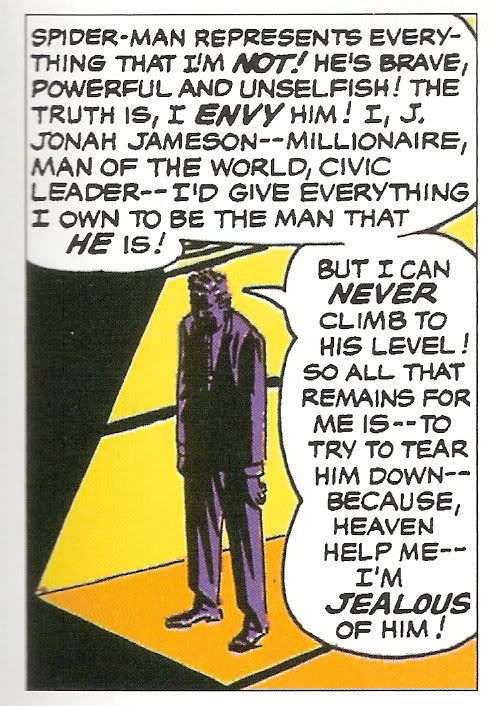
- J. Jonah Jameson, while almost never outright villainous, scratches the limits of the impossible in regards to his hatred of Spider-Man. He despises him with extreme passion, constantly referring to him as a menace, nevermind the fact that Spidey has saved Jonah's life, and New York and the world, on a regular basis. Whether or not there's an explained reason for it depends on the adaptation, but even when there is an excuse, it generally falls apart given everything Spider-Man's done for the world. In an early Lee/Ditko story he privately admits he is jealous from Spider-Man's selflessness◊. Though there's a number of other reasons as to why he dislikes masked vigilantes, his hatred is possibly related to the fact that Spider-Man shows up in his newspaper, and just making a crusade after him sells more papers.
- Eddie Brock's entire reason for hating Spider-Man was that Spidey unwittingly exposed his shoddy journalism, although mentally bonding to the also-unstable Venom symbiote didn't help either party. It took decades in real-time and years in comic book time for Brock to get over it and become a better person.
- J. Jonah Jameson, while almost never outright villainous, scratches the limits of the impossible in regards to his hatred of Spider-Man. He despises him with extreme passion, constantly referring to him as a menace, nevermind the fact that Spidey has saved Jonah's life, and New York and the world, on a regular basis. Whether or not there's an explained reason for it depends on the adaptation, but even when there is an excuse, it generally falls apart given everything Spider-Man's done for the world. In an early Lee/Ditko story he privately admits he is jealous from Spider-Man's selflessness
- Superman:
- Lex Luthor's legendary vendetta against Superman has, over the continuities, various causes. All of them agree on the fact that Luthor, in truth has relatively little objective reason to waste so much time, money, and effort on attacking the Man of Steel beyond sheer jealousy. Superman himself has called him out on this numerous times, which only makes Lex hate him even more. General consensus is that Lex hates the mere fact that Superman exists.
- General Zod's hatred towards Jor-El is clearly unwarranted; Zod was wholly responsible for the criminal activities that he conducted, even if he was right that the Kryptonian Court were delusional and corrupt and Jor-El was simply abiding by his planet's laws, though considering that Zod and Jor-El were once friends, his feelings of being betrayed and sold off to be imprisoned in an interdimensional jail were quite personal.
- Near the end of Superman: Up, Up and Away!, Superman (who had spent most of one year Brought Down to Normal and only recently regained his powers) confronted Luthor, after the horrific end of the latter's "Everyman Program". Superman reminds Luthor of the numerous times Luthor claimed he could change the world for the better if Superman didn't keep getting in his way. Superman points out that he'd been gone for an entire year; all Luthor did with that time — when Superman literally could have done nothing to stop him — was make contingency plans for Supes coming back.
- In All-Star Superman, Supes even says "you could have saved the world years ago if it mattered to you, Luthor".
- Trapped in a rocket ship that his technopathic powers made out of Superman's Birthing Matrix, Hank Henshaw went mad and reasoned to himself that Superman put him in there, fearing he was too dangerous. Thus, he decided to try to get back at him by attempting to destroy the Earth while wearing his face.
- In Supergirl: Cosmic Adventures in the 8th Grade, Lena Thorul (Lex Luthor's little sister) hates super-heroes with a passion even though they have not done anything to her (and she does not change her mind when she finds out her best friend is Supergirl). Her reasons are extremely generic and they differ with each rant (super-beings supposedly being jerkasses to normal humans, their powers undermining human achievement...), boiling down to Lena parroting her big brother's opinions and lies.
- All For Luz:
- Antagonistic Governor Maxwell shows to have a complete hatred of Quirks when they started popping up and wants to have them completely wiped out just days after they appeared, despite not suffering personally at the hands of one. Overall, Maxwell’s actions are simply derived by his own disdain for superpowers and wishes them gone.
- Tyler's attitude is this for the LGBT community and superpowers that supersedes any love he has for own family, which his daughter found out first hand, despising and disowning Julia for being gay, and proceeding to have her sent off to the Governor's Death Camp to be murdered just days after she gained a Quirk.
- Chaos Theory Z: Or at least mistrust, from Krillin towards Kayos, from the moment they first meet and Kayos mentions how he’d use poison to take down Goku if he had to. It’s not to the extent that Krillin won’t fight alongside him or listen to him when he has good ideas, but he still has some mistrust for Kayos’s underhanded tactics. Soon enough, the rest of the Z Fighters agree that he’s being unreasonable with the grudge, and he finally lets it go after Kayos intercepts Vegeta’s Galick Gun for them, almost dying in the process.
- Severus Snape still hates Harry in Deadly Nightshade even after learning the boy isn't related to James Potter at all, but rather the result of a one-night stand between Bruce Wayne and Lily Evans's sister Ivy aka Pamela Isley. Instead Snape hates Harry for "being the wrong sister's child" and that Lily died for him despite Harry being her nephew rather than her son.
- In Emancipation, Dumbledore firmly believed that everything which conflicted with his plans for the Greater Good note was the fault of Snape and his evil Slytherin machinations.
- Equestria: A History Revealed: The Lemony Narrator attempts to pin the blame of every terrible moment in Equestrian history on Celestia, even when it's clear that she had nothing to do with it. She tries to connect Celestia to events that had nothing to do with her, and seems to take great joy in relishing in her failures. Given that the fic is to cover all of Equestrian history, it makes for some great leaps in logic to reach her desired conclusions. But it's all Played for Laughs though, simply because Loose Change's Insane Troll Logic makes her such an Unreliable Narrator that it loops back around to funny. Reading between the lines makes it clear that Loose Change's hatred of Celestia is due to jealousy over the fact that, as an earth pony, Loose Change can't use magic.
- Everything has a Price: Peter Parker hates Tony Stark because he's a billionaire and in fact once sent him hate mail about why billionaires can never be heroes. In reality, Peter's hatred boils down to being upset that Uncle Ben's death put them in debt and a total misunderstanding of how money works. Notably, he believes that Tony couldn't possibly be a philanthropist if he hasn't "spent his precious money" to completely solve climate change, permanently end world hunger, or "pay the college tuition of every student in the world", ignoring that even Tony Stark doesn't have that much money.
- Remus Lupin in the Harry Potter fanfic Family Night has a bad case of Irrational Blame. He decides that it's Harry's fault Sirius died and that he won't come to the titular Family Nights that Hogwarts starts holding (four times a year the parents come in to take a look at their children's work) unless Harry improves his work ethic. It soon becomes clear that he has completely unreasonable expectations, insisting even as Harry works himself to the point of collapse that he isn't working hard enough. Not helped by the fact that Harry is already blaming himself and therefore thinks that Remus is being perfectly reasonable. Even Snape can see that Remus is being irrational in his treatment of Harry.
- Detective Stabler refuses to let go of his insistence that Xander is a pedophile who kidnaps and rapes teenage girls in Father Goose and the Black Knight, simply because he's investigating such a case and Xander runs the "Cleveland Home for Gifted Girls". After he and Benson interrogate Xander, they're sent a set of photos that show them clearly assaulting Xander and given a warning that if they step out of line again, charges will be filed. As a result, Stabler rages against the idea of being "blackmailed by some scumbag." The fact every girl there clearly adores Xander has no bearing on his decision. Stabler also gets round the clock monitoring (both stakeouts and cameras) on the place until the local police captain pulls them off as a waste of manpower. Notably, the only illegal activity they have any evidence of Xander committing is possessing an illegal concealed weapon (part of Xander's cane breaks off to form a stake) and the ADA openly states she's not interested in arresting a crippled man for having a sharpened stick.
- Eirin's feelings towards an age-regressed Reimu in the second of the Gensokyo 20XX can be surmised as a variant of this, as she was resentful and envious for reasons not known.
- Amy in Hardlight completely despises Taylor from the moment she meets her. Initially, it's played as her hating Taylor because her stepmother is Purity, a former member of the same gang that killed Amy's adoptive aunt. However, even though Taylor very much isn't a nazi and just wants to be a hero, Amy still hates her. It's later revealed that Amy's hatred is due to internalizing her adoptive mother's Black-and-White Insanity. Taylor has a great deal in common with Amy: Both being the child of a villain, both can heal others, both are lesbians. But if Taylor isn't evil then that would mean Amy isn't either and she can't handle her entire worldview being flipped so suddenly. Amy ends up having a mental breakdown as a result and is Put on a Bus.
- Learning How to Be a Witch: Emperor Belos despises Lucila to a horrifying extent. While it was hinted that Belos disapproved of Hunter being with Lucila before in Hollow Mind, it is revealed that he believes that Lucila is distracting Hunter from being the Golden Guard. Once the truth is revealed and confronts Belos in his mind, it confirms that Belos hates Lucila and blames her for turning Hunter again him but is willing to murder the both of them. The ending of Edge of the World shows that Kikimora is hunting Hunter and Lucila for Emperor Belos, and in Labyrinth Runners, it's revealed that Belos plans on petrifying her. It hinted that Belo's hatred is deeper than just distracting Hunter; it implied and was confirmed by the author that Belos is projecting his hatred of the witch his brother fell in love with onto Lucila, the brother who he murdered for loving a witch. Belos hating Lucila is lampshaded by Luz in Hollow Mind and by Raine in O Titan Where Art Thou.
- Living The Dream (Kickass222urmom): Cody Benson's reason for wanting to kill Lance is entirely nonsensical. Back on Earth, Cody Saved Lance from a random mugging, but during the skirmish Cody lost a check. A check that had the money to save his father from a Loan Shark. Not only does he not realize he can get another check, he also pushes blame onto Lance.
- The Jorgensons in Lost Boy have had it out for Hiccup the moment Stoick introduced him to them. Whenever something does not go their way, they try to take it out on Hiccup. Whenever they cannot go after Hiccup directly, they try and rally the village against Hiccup. If they cannot do that, they go after Hiccup in-secret. Even when Snotlout does something so stupid that even his parents won't defend him on it, he will try and rationalize it as being Hiccup's fault.
"You are the only parasite here," [Snotlout] threatened. "And now you're lying about me..." Hiccup backed up a pace and felt the bench hit the back of his thighs.
"What-making sure people know what you've done is lies?" Hiccup replied, though he could feel his hands trembling. "Boy, you need to learn what the definition of a lie is. Here's a clue-it's something that isn't true! Not something you did but don't want people to learn about! And by the way, I'm working in the forge-or was until you arrived. You're supposed to be on the fire crew-don't see you putting out any fires…and there are plenty to choose from!"
"I'm the Heir!" Snotlout sneered. "I should be protecting the village!" - Sora in Lost Boys clings to severely overinflated blame of Ventus for destroying his home and ruining his life (but for Ventus's support, he really couldn't help, nor predict, Vanitas taking him over. He was honestly trying to help). Just the mere mention of his name, or any attempt to clear it, is enough to send Sora over the edge. In the sequel, Broken Heroes, when Ven wakes up, Sora is so driven with hatred and anger that he EXPLODES and reminds you why you shouldn't mess with him. If Kairi and Riku weren't there to stop him, it would be very likely Sora would have ended up killing Ven.
- Peace Forged in Fire: Defied. Morgan avoids the problem of her tactical officer Sahuel t'Khnialmnae being ex-Tal'Shiar, against whom Morgan's fellow captain D'trel has a pathological hatred, by ordering her command crew to not mention Sahuel's "prior affiliations" in D'trel's hearing.
- Raijax in Ripples, Waves, Tsunamis sees pirates as monsters that destroy everything people care about and leave ruin and misery behind, Marines as being only 1/10 decent, and the World Government as being thoroughly evil. Now, all things considered, none of that is unreasonable; heck, he doesn’t attack Marines, and he doesn't even hold pirate offspring responsible for Sins of the Father. The only real irrational part is that he utterly refuses to believe that anyone who sails under a Jolly Roger isn't a monster... up until Nami jogs his memory.
- Shadows over Meridian:
- Vathek has this for Jade/Kage, refusing to see her as anything other than a monster created by Phobos, ignoring evidence to the contrary and insulting her immediately and repeatedly when seeing her again. The story's authors have addressed this by pointing out that he's blinded by his hatred of Phobos and belief in allies like "the Mage", and as such will not readily stop believing the story that she's a monster Phobos created, which makes her an easy target for his anger. However, by the next day after this encounter, Vathek has had time to think over everything that was said without the heat of the moment, and has seemingly let go of his hate of Kage — while he still fears her, it's confirmed that he does feel guilty of his treatment of her and is willing to acknowledge she was telling the truth.
- Caleb also has this for Kage. He refuses to believe that she's not Phobos' minion or that she's telling the truth about "the Mage" (even when presented with the comatose Nerissa), even going so far as to abandon the Guards during the attack on the castle because some of them questioned the likelihood of her connection to Phobos, and making it clear that he intends to execute her if he gets the chance.
- Fai to R!Syaoran in Shatterheart. Fai hates R!Syaoran for the actions of his clone who betrayed the group and ripped Fai's eye out despite knowing that Syaoran wasn't at fault and he attempted to stop his clone. To Fai's credit, he does eventually realize how unfair he's being to Syaoran and does grow past it.
- Bakugou utterly despises Midoriya in the Sleeper Hit AU. Why? Because he has the audacity to have persevered and become the first Quirkless Pro Hero after all the abuse and discrimination he faced, including Aizawa expelling him from U.A. on their first day while claiming he 'lacked potential'. Having thoroughly convinced himself that Midoriya only ever wanted to become a Pro to spite and upstage him, he's utterly furious to learn that he actually succeeded, and attempts to blame all his problems on him. Especially the ones he creates for himself by going after him.
- Vale, the heroine of the Hunger Games fanfiction Some Semblance of Meaning, is usually a Horrible Judge of Character in that she trusts people she shouldn't. However, when it comes to Career tribute Obsidian, her hatred of him tends to fall into this. Sure, he is from District One (the home of a tribute who killed Vale's best friend in a previous Hunger Games) and is a trained killer, but he shows surprising kindness toward her and even saves her life more than once. Eventually, she does get over her hatred and warm up to him after they become allies.
- The Story of Apollo, Daphne and Luca: An Italian Tragedy: Vincenzo doesn't like Alberto, but doesn't know the reason of this despise. Later, the truth comes to light: Vincenzo has fallen for Luca and this means that Alberto is now his rival for the sweet young sea monster's affections.
- Once Upon a Time/Marvel Cinematic Universe fanfic Swapping Genres: Regina instantly hates Captain America before even meeting him for little reason. It's pointed out that just mentioning him is enough to make her angry.
- Three Strikes: When Trigger’s heritage (her Belkan decent and that her father is Solo Wing Pixy) comes to light, many at the 444 start to hate her. Count in particular, although it seems he is just looking for a reason to distances himself from everyone. After Operation Three of a Kind everyone but Count is back on her side. It just takes longer for him to reconnect with her.
- In Total Drama fanfic Total Drama: Cody's Redemption, Gwen has this towards Cody. Despite Cody doing nothing to warrant this hatred and hooking her up with Trent, she still treats him with distress. Even Gwen's friends Leshawna and Trent don't understand why she hates Cody, pointing out he's done nothing to her. And Gwen refuses to give them a straight answer on why she hates Cody. It's finally revealed that Gwen had some bad experiences with geeks in the past and, sadly, is taking all that resentment out on Cody. However, Gwen reached the limit of her hatred during an argument with Cody when she told him to kill himself, causing Cody to run away. Gwen was horrified with herself for saying that and admitted she mess up.
- Ultimate Spider-Woman: The fact that he wears a flaming, demonically-grinning pumpkin head should be enough to indicate that Jack O'Lantern isn't exactly the sanest of people. However, his obsessive hatred of his Arch-Enemy Spider-Woman goes far beyond the enmity between most heroes and villains. Jack's hatred encompasses overinflated blame (Jack blames Spider-Woman for protecting the innocent bystanders he enjoys preying on and for interfering with his sick "fun"), ungrounded prejudice (because Spider-Woman didn't give in to her dark side the way he did) and inarticulate dislike (the fact that Spider-Woman uses her powers to protect innocent people when she could be wreaking all kinds of havoc makes Jack's blood boil) to the point where he spends half his time plotting larger criminal schemes and the other half of the time obsessing over Spider-Woman and how he wants to make her suffer.
- Doraemon: Nobita's Great Adventure in the South Seas: The villain Cash despises the titular robot cat for reasons unknown. When realizing he could trigger Doraemon's Berserk Button by calling Doraemon a raccoon, Cash would repeatedly call Doraemon exactly that while having the main characters held captive. And when everybody managed to escape, Cash then unleashes his Leviathan, ordering his monster to devour everybody... "especially that stupid blue raccoon!"
- In Turning Red, Ming dislikes Miriam and considers her a bad influence on Mei, more than any of her other friends, for no obvious reason. The ending shows her making an effort to get over it, having realized her attitude towards Miriam — and, to a lesser extent, Priya and Abby — was unfair.
- Wreck-It Ralph: The Nicelanders despise Ralph for being the villain who wrecks their homes... even though it's just his job to wreck their apartments; it's literally what he was created to do, and their very existence depends on it. Also, win or lose, their homes pop back to normal once the game is over, so they're not inconvenienced by it in any way, while Ralph has to live in a literal garbage dump and is shown to be a perfectly nice guy off the clock, so their dislike of him is utterly illogical.
- The Garbage Pail Kids Movie: Juice seems to have an absurd amount of hate for Dodger, despite no reason being given.
- In Sonic the Hedgehog (2020), Rachel is the hateful sister-in-law of Sheriff Tom Wachowski, who constantly tells her sister to divorce him (and this is before Tom becomes a wanted fugitive by the government because he's helping Sonic). Not only is she crazy and hateful enough to tell her sister to divorce Tom right after a casual (as in the "hi, honey, I am driving and wanted to say 'I love you'" kind) call, the specific reason she hates Tom so much is never mentioned at allnote . She gets better in the sequel, though.
- This Is the End: Jonah Hill hates Jay Baruchel with a passion for seemingly no reason, to the point of wanting the latter dead.
Jonah: (to God during his Prayer of Malice) I hate Jay so fucking much. I think he might be the worst person you ever created.
- The Butcher Boy: Francie develops one towards the Nugents, blaming them (especially Mrs Nugent) for every bad things that happens in his life. It's implied he's actually jealous of them for being a happy and stable family, something the Bradys will never be.
- Vento of the Front in A Certain Magical Index despises the Science Side of the world because she and her brother were critically injured in a ride that claimed to be scientifically proven safe and doctors were able to save only one of them.
- At least two groups in Cheat Magician Life That Started From Being Judged Useless hate the protagonist Kento for very irrational reasons.
- The first, Funayama Sr., falls into the "Needs someone to blame" category. He is the leader of the most prominent construction company (in universe) of Japan and his son winds up missing, along with over 200 others when the school he's attending mysteriously collapses, and the police first refuse his services to assist in clearing the debris to find survivors and second refuse to divulge any information, because they can't, when letters start coming in from the rest of the missing students. Then unscrupulous reporters publish Kento's photo as the poor kid was visiting his mother's grave, and he learns from his friends, who also have missing kids, that the letters sent back describe that Kento is in a polygamous relationship, so BLAMO, Kento must be the mastermind, and damn it all, either he'll get his son back from Kento, or beat the boy to death. Who cares what the actual evidence says.
- The second is a self-proclaimed "civil group" that openly hinders any and all rescue attempts or attempts at reconciliation from the actual guilty parties to the point they send a Deep Cover Agent at Kento and try to kill him and when he succeeds anyway, try to booby trap the press conference with explosives, actually kidnap both returning isekai victims and their families, and when they try to smuggle the latter out of the country, their escape vehicle is not only staffed with people armed to the teeth, as if they intend to start a war, but the ship has a nuclear weapon as a self-destruct dead-man switch. While the JSDF, the Japanese Diet, and the police all speculate on motives, the only motive any of their agents has openly stated is that Kent entered a polygamous relationship in the country of Landsheldt, where polygamy is legal, recognized by law, and justified by the sheer danger of monster attacks.
- Lots of this in the Deryni works:
- Some members of the Camberian Council feel free to deride Morgan and Duncan for being half-breeds (having one human and one Deryni parent) as if they could choose their parents.
- In The Bishop's Heir, Caitrin twits Archbishop Loris over the failure of his assassin to kill Duncan McLain; in response, Loris mutters, "The archfiend Morgan came to his aid. He used his Deryni sorcery to heal him." Never mind that healing was a miraculous sign of Christ's divinity.
- Morgan, Duncan and other characters dissect anti-Deryni prejudice on the part of humans much the same way; people don't choose their innate talents any more more than they choose their physical traits or other skills, so it's better to consider what people do rather than what they are.
- Diary of a Wimpy Kid:
- Greg's hatred of Fregley. Sure, he's not the most normal guy in the world, but he does not deserve the harsh treatment Greg gives him.
- Greg's hatred of Patty, as she's only implied to be a Teacher's Pet at worst and never actually interacts with Greg. In the movie adaptation, however, this trope is averted.
- When Rowley was having dinner with the Heffley family one night, he accidentally dropped a plate and broke it. Frank has treated Rowley like a Lethal Klutz ever since.
- Fifty Shades of Grey:
- Christian loathes his birth mother, blaming all of his delinquent behavior and present-day issues on the fact that she was a "crack whore" (his nickname for her) who was unable to protect him from her pimp and who didn't feed him properly. That level of resentment seems pretty harsh when memories and flashbacks show that his mother was unable to even protect herself from being beaten by the pimp, that she loved her son enough to bake a birthday cake for him, and, based on Christian's focus on having submissives within their late teens to early twenties because they remind him of his mother, that she was in her teens herself when she gave birth and had to raise a child on her own, in terrible conditions. It also comes across as harsh, given that Christian doesn't direct anywhere near that level of hatred towards the pimp himself, who was the one who actually did hurt Christian.
- In the third book, Ana's ex-boss Jack Hyde breaks into her home with the intention of abducting, raping and possibly killing her. Christian, who is at a business conference that day, ordered Ana to stay home instead of going out with her best friend; Ana defied him and thus isn't home when Hyde broke in. When Christian and Ana discuss this, Christian, rather than being relieved that Ana is okay, is absolutely livid that she defied him to the point that he outright states that he wants to hit her, even though her defiance saved her life. While the reader is probably meant to infer that he's angry because he has irrefutable evidence that his Control Freak desires would have got his wife killed, the Das Sporking team pointed out that he comes off as having hired Hyde to abduct and murder his wife, and is furious that Hyde failed.
- Older Than Feudalism: In The Four Gospels, none other than Jesus claims this is true of his enemies' attitude toward him. Considering how irrational you'd have to be to hate an All-Loving Hero, he clearly had a point.
"But the word that is written in their Law must be fulfilled: ‘They hated me without a cause.’" (John 15:25)
- In Galaxy of Fear, the Arranda kids hate The Empire and every single Imperial they see. Well they would, they're orphans of Alderaan. But this series averts Black-and-White Morality in that while there's certainly plenty of evil in the Empire, it's emphasized in the story that parts of it do good and there are definitely good individuals in it. The kids even hate people who worked for it for a while, to their uncle's dismay.
- Harry Potter:
- Severus Snape has always hated Harry and treated him like dirt throughout the entire series. While the two cultivate a genuinely antagonistic relationship with one another, nearly all of Snape's hatred towards Harry stems from his hatred of Harry's father James. James and Snape utterly depised one another as students (Snape toward James because of the latter's better family life, talents and being just as good while James toward Snape because he was a fervant admirer of the Dark Arts among other reasons.) When Harry has his first class with Snape, James Potter has already been dead for a decade. Personality wise, Harry and James are very different (Harry tends to take more after his mother), however Snape's hatred blinds him to that fact. It's also possible his hatred of Harry stems from the fact he's living proof that Lily, Harry's mother, chose James over him.
- The hatred Uncle Vernon, and to a lesser extent, Petunia, holds for Harry is unwarranted and unjust. They intensely disliked his parents for being 'weird' and passed that prejudice onto Harry. Petunia though is more personal, since she always felt inferior to her younger sister Lily since she went to the magic school and doubled down on her want for 'normalcy' to deal with it.
- Ron quickly starts hating Viktor Krum (because he went to the Yule Ball with Hermione) and just about every boy Ginny dated (because, well, they dated Ginny). The only exception to the latter would be Harry. His behavior tends to be lampshaded by various characters, usually Hermione.
- Dolores Umbridge absolutely loathes part-human beings, from giants to werewolvesnote to centaurs to goblins and everything else. She doesn't show hatred towards ones who pose a threat to people. She hates all of them, referring to them as "half-breeds" and generally treating them with disdain. Not that she has anything but disdain for everyone but herself. Given her behavior towards Hagrid and the centaurs, she also seems under the impression that part-humans all share "near-human intelligence" and thus treats them like small children, which is especially insulting considering that Hagrid and the centaurs are clearly of human intelligence (well, Hagrid can be a bit of an idiot sometimes, but so can all humans, including Umbridge). The only reason remotely given for his mindset is Sirius's guess that she's afraid of them. And then we learn from Word of God that he is right. Her megalomania and desire to control and dominate leads her to feel insecure by those who cannot be categorized and she is unable to accept the existence of people outside her sphere of control. In the movie, she also tells Harry and Hermione, "You know, I really hate children."
- In Prospero's Daughter, Eramus is always at Miranda. Even learning he was cursed to feel that way does not give him pause. Learning that he could have recovered what he had lost if only he had not kept blaming her for — that does give him pause.
- The Rising of the Shield Hero: The King of Melromarc constantly belittles and even abuses his authority to hamper Naofumi's efforts, such as denying him just reward for his troubles and the possibility to do a class change to become stronger (something all heroes need as the waves of monsters grow in strength and number every time) solely because he's the Shield Hero. It's later revealed that this is because demi-humans worship the Shield Hero as a god, and he hates demi-humans because some of them apparently took away his little sister. It's even more irrational considering that not only did he project his hatred on someone who wasn't to blame, but the king was willing to risk going to all-out war with other countries or being wiped out in the waves of monsters just for petty, unjustifiable revenge against demi-humans as a whole.
- Jane Rizzoli of the Rizzoli & Isles series of books is a plain/average looking woman who frequently displays an irrational hatred of beautiful women, as if they had any control over how they looked, and/or somehow stole their good looks away from her.
- A Song of Ice and Fire:
- Cersei hates her brother Tyrion because she blames him for their mother's Death by Childbirth. Only in the later books do we find out that Cersei heard of a prophecy saying she will be killed by her younger brother. Its implied she misinterpreted it.
- Quite a lot of the abundant factionalism, sexism, racism and classism found in the series is repeatedly shown to have a whopping great wedge of this supporting the various grievances and "justifications". Even the goodish guys aren't above writing whole groups of people and families off for highly emotive, questionable reasons. Sure, every side can find both fictional and non-fictional rationalizations to hate on another to seek revenge for perceived wrongs done... but, that's kind of the whole problem. Although families like the Boltons, Greyjoys and Freys really don't help themselves by how they react to being panned by public opinion.
- In the Whateley Universe, Kayda, who is very insecure and suffering from a lot of mental health problems when she first arrives at Whateley, is told about Loophole, a brilliant gadgeteer, and immediately loathes her, building up a picture in her head of a bossy, snobby know-it-all who constantly tells everyone else what they're doing wrong. Kayda has actually met Loophole, but Elaine doesn't like her codename, so Kayda has no idea that they're the same person. Once she finds out that they are, she's completely blown away.
- The Wheel of Time:
- Gawyn Trakand displays this trope toward the main character, Rand. When second-hand news states Rand has done something terrible to Morgase, he believes it immediately and develops an all-consuming hatred for the man despite two loved ones who both defend Rand wholeheartedly. This includes misplaced/over-inflated blame as the terrible event is something for which Gawyn feels an emotional need to blame someone as he can't go back and change what happened; later it becomes unfounded jealousy/prejudice due to Rand being the hero.
- Demandred, one of the series' main villains, displays an absolutely massive level of hate for Rand (originally for Rand's prior incarnation, Lews Therin) that far outstrips anything the Dragon ever did to him- at least from anybody else's perspective. From Lews Therin's POV, it was a friendly rivalry. From Demandred's, it was being repeatedly shown up for his whole life in every single aspect of his life, including height. When he finally snapped, it's said that he came to hate Lews Therin (and later Rand) more than anyone had ever hated anything, and for far less direct cause than many of his fellow Forsaken had to hate LTT. In the last book, however, Rand clearly does feel somewhat guilty over the fact that he, as Lews Therin, encouraged their rivalry and indirectly contributed to Demandred's deteriorating mental state.
- Gawyn Trakand displays this trope toward the main character, Rand. When second-hand news states Rand has done something terrible to Morgase, he believes it immediately and develops an all-consuming hatred for the man despite two loved ones who both defend Rand wholeheartedly. This includes misplaced/over-inflated blame as the terrible event is something for which Gawyn feels an emotional need to blame
- One episode of 3rd Rock from the Sun revolved around Dick discovering that the cafeteria lady at his college hated him for no particular reason. What makes this even funnier is that he wasn't upset about the fact she hated him, but the fact that she had no reason to hate him (for context: a lot of other recurring characters hated him as well, but it was them being sick of his belligerent know-it-all attitude, and he was perfectly okay with that).
- Principal Snyder on Buffy the Vampire Slayer hates and mistrusts all young people (suggested to be a result of being bullied during his youth), but reserves a special loathing for Buffy and her friends. He appears to have decided she is dangerous based on her having been kicked out of her previous school, but goes much further than should be acceptable for someone in his position. At one point he even expels her for being a suspect in a crime she was soon cleared of (Kendra's death, which he probably already suspected she was innocent of), and Joyce has to go over his head to get Buffy re-enrolled.
- Crais from Farscape had an irrational, borderline psychotic hatred of protagonist John Crichton, who accidentally caused the death of Crais's brother. He eventually admitted he was actually trying to protect his rapidly waning career.
- In one episode of The Golden Girls, Rose becomes obsessed with the fact that one of her co-workers hates her for no real reason, since she considers herself somebody that everyone likes. Her efforts to befriend him only make things worse, until he agrees to be her friend on the condition that she never contact him again.
- In How I Met Your Mother, Robin despises her co-worker Patrice; they've never had a single conversation that didn't involve Robin screeching at her. This despite Patrice being quite possibly the nicest, friendliest person since Mister Rogers.
- The Legend of Xiao Chuo: Within hours of her arrival Xi Ge becomes convinced Yan Yan is her rival and is conspiring against her. For added stupidity she comes to this conclusion before she even meets Yan Yan.
- Morgana toward Guinevere in Merlin. The "official" reason is that Morgana is jealous of Guinevere's destiny in becoming Queen of Camelot but the build-up and the pay-off to this Story Arc has been less than satisfactory. On returning from a year-long absence from Camelot (that the audience never gets to see), Morgana instantly has no qualms about the betrayal, backstabbing and attempted murder of her dearest friend. No explanation is given for her sudden hatred, and by the time Morgana starts having prophetic dreams that Guinevere is in fact destined to be Queen, there is no sense of regret or hesitation in targeting Gwen. Instead Morgana jumps straight to homicide with lines like "I would rather drown in my own blood than see that woman on my throne." The sheer, inexplicable vehemence with which Morgana plots Guinevere's death is just...well, inexplicable.
- The Office is probably one of the most hilarious and famous examples. Michael's hatred of Toby has been a Running Gag on the show. Despite liking almost everyone else that he works with, Michael hates Toby with a passion. Michael explains that he hates Toby because "Toby is in HR, which technically means he works for Corporate. So he’s really not a part of our family." Toby constantly tries to tolerate Michael's rude behavior, tries to be nice to him, and doesn't have problems with anyone else. Michael even mocks Toby for being divorced and even rejects Toby's attempts to help Michael through tough times (The Deposition is probably one of the most famous examples). Ironically, the episode "Take your Daughter to Work Day" has Michael get along very well with Toby's daughter Sasha and is one of the only episodes where Michael is nice to Toby.
- It's understandable once you realize that due to Michael's management style, he would have been in front of HR numerous times. Toby, as nice as he tries to be, is the one who always has to tell Michael no.
- Jim also showed signs of the Toby hate when he was left in charge in "Survivor Man." Toby, because Michael had made his birthday celebration a 5 minute party in the parking lot, calmly asks if he could have his own, since it was "Birthday Month" at the office. Jim had this to say in a interview: Toby's great. He's great, but sometime he can be a little bit much. (mimicking Toby's voice)"I don't see the harm in that" Well, it's a cake, Toby, so come on!
- Amusingly, David Wallace, the Chief Financial Officer from Corporate, has a similar loathing for an HR worker named Kendall. It's every bit as bizarre as Michael's fixation, if not more so, since Wallace is shown to be one of the nicest characters on the show, and he brings it up during Jim's interview, which they were both being perfectly jovial in: "We have this very irritating HR guy here. He's probably the only person you're not going to like."
- This is what Evil Queen Regina feels towards Snow White on Once Upon a Time. Regina's mother Cora puts the young Princess Snow in danger so Regina will rescue her, enabling Cora to marry Regina off to King Leopold. Snow is delighted by the idea of having a new mother, and Regina begins to care for her. However, Regina is in love with the stable boy, Daniel, so she doesn't want to marry Leopold. Snow discovers Regina and Daniel's affair, but basically understands Regina's explanation that although Leopold is a good man, Regina doesn't love him but instead loves Daniel and wants to be with him; she promises to keep their secret. Cora then tricks Snow into revealing Regina's secret, by claiming she only wants to help Regina be happy and by playing off of Snow's idealized concept of a mother due to the loss of her own. Cora then murders Daniel. Regina is angry at Cora, but inexplicably assigns at least as great a measure of blame to the child Snow White who was manipulated by the same harridan who destroyed her own youth, and dedicates the next four decades to efforts at destroying Snow's happiness.
- Oz: El Cid, the leader of the Latinos, despises his underling Miguel Alvarez for no apparent reason. He leads the rest of the gang in bullying Alvarez and frequently tries to get him killed to satisfy his vendetta, and he loses his mind when Alvarez escapes prison before he can kill him. He eventually admits that his hatred is pretty baseless.
- The entire Parks and Recreation department have a longstanding yet inexplicable hatred of the library department.
- Leslie, whose defining characteristic is otherwise that she's downright smothering in how forcefully she tries to nurture and be nice to everyone, is constantly mean and abrasive towards Jerry, who is clumsy and incompetent but also supremely meek and well-meaning. She does try to do something to help him from time to time, but it never lasts long before she starts finding everything he says and does inherently offensive again. No explanation is ever given - it's just one more thing that makes Jerry such an absolute Butt-Monkey.
- Everyone except Ben has an irrational hatred for calzones. It doesn't even appear to be a Pawnee quirk as Chris also seems to dislike them.
- In Scrubs, Dr. Cox has an irrational hatred of Hugh Jackman. John C. McGinley, his actor, jokes that he hates him because he's a better actor.
- The Janitor also counts to this with JD. Why? Because JD blocked a door with a coin...accidentally.
- Dr. Cox and JD towards Lester Hedrick, Sacred Heart's grief counselor. They're openly hostile to him, despite the fact that he's only ever shown doing his job with a great deal of compassion. He tells the pair that he's used to this treatment from doctors, because he forces them to face the fact that there are people they simply can't save. The fact he isn't remotely intimidated by Dr Cox also doesn't help.
- Seinfeld:
- Jerry and Newman had a mutual Irrational Hatred of each other, making them Sitcom Arch Nemeses. Both are prone to waxing poetical about how vile and detestable the other is, but these statements are usually devoid of actual reasons for their hatred.
- In Season 4, Joe Davola had an Irrational Hatred of Jerry after somehow deciding Jerry was responsible for Davola losing a job at NBC. Davola making plans to kill Jerry was a Running Gag throughout the season. Of course, Davola is mentally disturbed and spends most of the season off his meds.
- Jimmy Rave hates toilet paper more than anything else in the world. He punched a hole in a wall and challenged Nigel McGuinness to a fight without honor at ROH Fifth Year Festival for throwing some at him.
- "The Fallen Goddess" Athena seems to be a magnet for it. She once cut a promo on how she first thought Malia Hosaka disliked her for being a rookie, but time went on and Malia still hated her. So she worked to "correct" every single issue Hosaka had with her till she was at her wits end. Malia's answer to why she kept antagonizing Athena could be paraphrased as "You suck and I'm better than you." Meanwhile in SHIMMER, both Mercedes Martinez and Cheerleader Melissa have tried to cripple her, seemingly just for being a competent opponent, even though they faced several others without doing the same.
- CHAOS had a confusing collective mission to torture New Japan Pro-Wrestling commentator Shinpei Nogami, with none more dedicated to the cause thant Takayuki Iizuka and Toru Yano. They would frequently jump the announcers table to get at him for no discernable reason. Once during the winter New Japan ended up running in a building without heat, which Yano and Iizuka took as an opporutunity to strip Nogami of his clothes and laugh as he continued to try and do his job while shivering. When Yano and Iizuka drug Nogami from his seat to the ring and announced their intentions to kill him then and there Montel Vontavious Porter and Manabu Nakanishi decided they had seen enough and ended up taking quite a beating for the sin of getting Nogami to safety.
- Back between 2010-2013, Kevin Steen hated El Generico and Jim Cornette so much he turned into a low-grade version of an Omnicidal Maniac, devouring fan signs (or a cooling fan at PWG Death to All But Metal) for having the slightest hint of them and repeatedly threatening to destroy the entire business and replace it with a Wretched Hive of scum and villainy, starting with Ring of Honor.
- Hana Kimura had an eerie case of this with Mayu Iwatani in World Wonder Ring STARDOM. While unprovoked cruelty was a calling card of Oedo~tai, the Power Stable Kimura was a part of, she took it a step further by masterminding several attempts to abduct Iwatani and even interrupted a match with an attempted public execution by directing other Oedo~tai members to bring the STARDOM stage down on Iwatani's head.
- In Jasper in Deadland, Agnes is hated by her own father, because he can't look at her without being reminded of her mother and thinking about how he couldn't save her when she became fatally ill.
- Copen in the Azure Striker Gunvolt series has this towards septimanote users (also known as "adepts") after an adept killed his father.note He's even willing to kill adepts that don't pose any threat to humanity whatsoever. Unfortunately, it becomes clear by the end of the second game that he not only hasn't learned his lesson, but doesn't even think he should because of what he's already doing; after learning that his sister Mytyl is really an adept herself (the "cyber diva / muse" septima originally belonged to her), he decided to cut all ties to his family and just disappear, essentially taking a very lopsided look at the issue.
- Vicki Vale and Oswald Cobblepot from Batman: The Telltale Series have justified reasons for hating Thomas Wayne, Hamilton Hill and even Carmine Falcone. But their hatred of Bruce Wayne is not so justified, since Bruce had no idea what his father had done and was as horrified to find out the truth as everyone else in Gotham. And even if he had known, he was just a child at the time.
- The character Grace from Dragon Age II exemplifies this trope. She blames Hawke for the death of her lover Decimus, an insane blood mage who attacked Hawke without provocation even after Grace begged him not to. Even if Hawke assisted her in escaping the templars in Act 1, she accuses Hawke of betraying her to the templars and faults the Champion for forcing her to go on the run with no supplies and practically no time to prepare, ignoring the fact that she and her fellow mages would have been slaughtered without Hawke's intervention. By Act 3, her grudge has bloomed into a full-blown desire for revenge. It may have been simply be that Grace can't accept her capture was the result of her own failings. Fittingly, when she becomes possessed the demon possessing her is a Pride demon.
- Dissidia Final Fantasy presents its version of Gabranth this way. Every character has the majority of their memories lost when they're drawn into the conflict; in Gabranth's case, while he retained his hatred towards Basch for abandoning their family when they needed him most, he's lost any memory of what he hates. As such, he channels it onto everything and anything around him.
"Hatred is what drives me!"
- Fallout: New Vegas:
- Yes Man has a rather bizarre hatred of the Great Khans. While it might have come from hearing Benny privately insult them, he is particularly fixated on wanting them in particular to suffer, despite being one of the least influential factions of the game, but cannot force you to do so. If you manage to get the Khans to leave the Mojave peacefully, Yes Man will hope that they get eaten by radscorpions.
- In the DLC Dead Money, it's revealed over the course of the heist into the Sierra Madre that Dean Domino (now a ghoul and one of your companions) was trying to rob Frederick Sinclair, creator of the Sierra, for all this fortune prior to the nuclear war that caused the Fallout setting. If Dean's still alive by the end, you can ask him why he had such a beef with the apparently cheerful, philanthropist Sinclair. His response? "He was just too damn happy", and he needed to be "brought down a peg". Dean is apparently prone to this, as if you're "impolite" (read, refusing to placate his ego for the entire DLC), he'll try to kill you after you get into the Sierra Madre.
- Final Fantasy VII has Barret return to what's left of Mount Corel to a less-than-warm welcome, up to and including a physical assault by the townspeople. This is because Barret was in favor of Shinra building a Mako reactor there years ago. Thing is, everyone else except Dyne also approved it. The whole town took part in making it happen, and yet it's only Barret who gets blamed for Shinra razing the town to the ground. The blame should ultimately fall on Shinra — which Barret does, hence why he started AVALANCHE to fight them — but Mount Corel just blames Barret for everything, and Barret seems to think he's partly responsible.
- The Legend of Zelda: Breath of the Wild: The elderly Zora (aside from King Dorephan and Kapson) harbor resentment towards Link regarding Mipha's death which is very misplaced for many reasons:
- They accuse Link of "forcing" Mipha to become a Champion but it had been Princess Zelda who had recruited Mipha and it was Mipha who accepted the position all on her own.
- They also blamed Link for "failing to protect her" when Link is Zelda's bodyguard, not Mipha's. Not to mention when Calamity Ganon struck, each Champion went to their respective Divine Beast while Link stayed with Zelda.
- And finally, the elders are the only ones who seemed unwilling to accept their Champion died in the line of duty, whereas the Rito, Gorons and Gerudo all made peace with losses of their own. Even the younger Zora who also knew Link in the past don't hold anything against him.
- KanColle: Akebono hates the player Admiral, though she's still loyal and her dislike is mostly expressed as verbal abuse. She does have a Freudian Excuse for it; the historical Akebono was Mis-blamed (starting with being held responsible for Shouhou's loss at Coral Sea, despite Akebono not being her escort), mistreated, and given the worst assignments by her IJN superiors. Some of her lines indicate that wants to like the Admiral, but finds it hard to let go of her paranoia that they'll turn out like her old bosses.
- In Persona 5 Strikers, Monarch Alice Hiiragi instantly develops a hatred against Ann Takamaki when finding out Ann is a fashion model, accusing her of being an Alpha Bitch of the sort that had made Alice's life miserable. Not only is Ann nothing of the sort, but Ann herself was a victim of bullying and Slut-Shaming while at school, just like Alice. But Ann's repeated insistence that she's not a bully fall on deaf ears. It's only after taking down her Shadow that Alice finally listens to reason.
- Star Control: The VUX hate humanity because Humans Are Ugly. For this reason, they want to exterminate the species (though they claim a diplomatic faux pas on the human's part during first contact as an excuse). Hilariously, they will even admit to knowing full well that this is irrational and unreasonable of them, that humans cannot help looking the way they do, but humans are just so repulsive to them that they don't care.
- Star Wars: The Old Republic: Many an Imperial or Sith NPCs towards aliens, and sometimes, it seems, with people in general. Most Imperials and Sith are simply arrogant and xenophobic, but some advocate straight-out genocide.
- When Solid Snake calls about Sonic in Super Smash Bros. Brawl, Snake says something about Sonic "rubs him the wrong way". When Octacon asks Snake why he doesn't like Sonic, Snake says he just doesn't like him for whatever reason.
- Reyes from Tomb Raider (2013) is openly hostile towards Lara for most of the game, going as far as blaming her for the Endurance's crash, as well as the deaths of Grim, Roth and Alex (the latter two right to her face, immediately after they happen), all of which she had absolutely nothing to do with. An optional journal entry implies that she's been antagonistic towards Lara long before the events of the game, too.
- Ace Attorney:
- In Phoenix Wright: Ace Attorney – Trials and Tribulations, it is revealed that the reason Godot hates Phoenix is because he blames him for the death of Mia Fey, despite Phoenix being Locked Out of the Loop on the events leading up to her death (namely, her investigation of Redd White) and only stumbling onto the scene later. Mia herself doesn't blame Phoenix for anything, but Godot still does. Eventually, he admits that he was really just desperate for someone to blame to ease his own guilt about not being there to prevent it- something that is itself irrational, as he was in a coma due to Dahlia Hawthorne poisoning him.
- A great many people in the series hate defense attorneys in general, viewing them as scum who live only to get criminals out of prison. While a few amoral defense attorneys exist, nobody seems to comment on how defense attorneys are needed for the people who are wrongfully arrested (which seems to happen quite frequently). In addition, nobody seems to comment on the many corrupt prosecutors that focus purely on convicting the first person accused of a crime.
- Professor Layton vs. Ace Attorney has the people of Labyrinthia hate both defense attorneys (for the abovementioned reason) and witches. While the leader of all witches, the Great Witch Bezella, did attack the town hundreds of years ago, the townsfolk consider a person being a witch to be a crime in and of itself and are perfectly fine with putting any proven witches in an iron coffin and dropping them into a fiery pit. In fact, before Phoenix's intervention, it never occurred to them not to punish witches who hadn't actually committed a crime. By the end of the game, their hatred of witches is explained: the Storyteller - Espella's father - incorporated it into the mass hypnosis of the townspeople, intending to have the purging of witches and eventual killing of Bezella serve as a sort of hardcore therapy for his daughter (who blamed herself for burning her town down and believed a witch possessed her when it happened).
- Dual Destinies has the antagonist Aura Blackquill, who has allowed her certainty that a nine-year-old child murdered a grown woman to shape the last decade of her life. Albeit that she's absolutely correct that her brother was wrongfully accused of the crime and is on death row because of it. And once the true murderer is found, she does give up gracefully.
- Phoenix Wright: Ace Attorney – Spirit of Justice takes people's Irrational Hatred of defense attorneys to an extreme in the Kingdom of Khura'in. Phoenix is faced with nuclear heat from the moment he steps into a courtroom and reveals that he's a defense attorney, with the crowd calling for his head on a plate. That's not much of a euphemism, considering that the Kingdom even has a law that gives the same punishment to any lawyers that defend a suspect that is found guilty (read: execution for murder). In this case, this is because the Big Bad blamed prince consort Dhurke for the death of his wife Queen Amara (in reality the Big Bad did it in order to usurp her), and Dhurke happened to be a defense attorney (and it certainly didn't help that said Big Bad was initially a prosecutor), so the Big Bad spent 23 years using anti-attorney propaganda to slander Dhurke in particular and to reduce his pool of potential allies in the legal system.
- In Aiyoku no Eustia, there is a whole special force dedicated to hunting and capturing people who (allegedly) have an infectious disease that causes them to grow wings. They are reviled and outcast by pretty much everybody. Which makes little to no sense considering that the plot-defining problem of that soaring city is the fear of falling out of the sky. Faced with that, having people with wings around should sound more like a glimpse of hope than a predicament. Needless to say, the winged ones are neither sick nor dangerous and Man is the actual problem.
- In Daughter for Dessert, Cecilia blames the protagonist for Lainie’s death, and seeks to destroy his life because of it. She "forgets" some important details that would refute her belief on this issue (for example, their father had cut Lainie off by the time of her death).
- Zigzagged in Double Homework with how the press (and some of his schoolmates) treat the protagonist following the Barbarossa incident. On the one hand, he had been warned about what might happen, but on the other, the avalanche could have happened regardless of what he did, and anyway, none of them is aware of all the details of what happened that day.
- Basic Instructions has a man asked about his pet peeves. The man says that he doesn't hate anything, because hatred is an unproductive emotion. He's then asked what he thinks about John Mellencamp and goes on a furious rant about what a sell-out he is. It's then pointed out that the man has devoted a significant portion of his energy to hating somebody who has no idea he even exists. "I don't find that funny." "I'll bet he would."
- The main character from the Smackjeeves comic Betovering suffers from this as part of a curse. While a few people are immune (his family, his crush, his best friend), most people literally hate him on first sight and will do everything to make his life hell.
- In Commander Kitty, Zenith absolutely hates Nin Wah for being an "imperfect" cyborg. This seems to also extend to jealously over Nin Wah having her own button for the reader to buy when she doesn't.
- Susan from El Goonish Shive is a self-aware case. She knows that her dislike of men is irrational ever since she understood that it was little more than a backhanded excuse for her father being an unfaithful jerk. Despite this, she still can't help but instinctively mistrust mens' intentions. According to Susan, her friend Catalina is even worse.
- Hetty from Gunnerkrigg Court absolutely loathes her owner Adam, who she blames for trapping her in a doll's body, and pulls charming little tricks on him, like putting fiberglass in his bed. Keep in mind that Adam is just another court student, had nothing to do with the events that lead to his ownership of her and doesn't even know that he owns Hetty.
- The most excuse Vriska Serket from Homestuck ever gives for throwing Tavros off a cliff is "His weakness offends me!" Given Vriska's personality, she's almost certainly lying to herself, and her true motivations remain a common debate among fans.
- Subverted in Romantically Apocalyptic. Cloudcuckoolander Manchild Pilot initially seems to inexplicably loath Mr. Snippy, attacking him, setting up traps for him to stumble into, and throwing food cans at him, with it being implied that Pilot views him as a competitor for Zee Captain's love. However, flashbacks gradually reveal Pilot was a private detective assigned to assassinate Snippy, who was believed to be a member of a terrorist group, and was left amnesiac and brain damaged after being caught in the explosion of a car bomb. The only thing he could really remember was that Snippy was a "shady character", with the fact that the terrorists who had kidnapped Snippy (something Pilot may or may not have been able to realize) tied him up in nano-tape not helping at all.
- Ollie from Something*Positive has an irrational hatred of Davan, to the point that he considers him his Arch-Enemy. He blames Davan for killing his directing career before it could really start, even though it was own mistakes concerning copyrights that killed his play. Davan actually feels bad about this. He's used to being hated, but only after he's done stuff to earn it. He doesn't think too much about it, though other characters warn him to be careful, since irrational hatred + resources to act on it (Ollie has a lot of money) = danger.
- RPC-584 - The Star, The Hateful from the RPC Authority hates humans, all of them no exception, so much so it wants to make us go extinct. The reason for this? As far as anyone can tell, there isn't any.
- As detailed in Time Heals No Wounds and Resentment and Insanity (along with some stories after that), Toki's hatred of Frailine (then called "Jaynine"), as, while she was a brat, the latter was only a baby when the former was suffering abuse and neglect, making this also a case of Misplaced Retribution, considering Toki felt that abusing Frailine was payback towards her late abusive mother.
- Also Bunny and Madgie, however, the feeling is rather mutual but its clear that Bunny hasn't liked the latter at all since she was born, as mentioned in Bunny Bitch.
- Cecil of Welcome to Night Vale has this going for Steve Carlsburg. It's implied to be mostly due to Steve marrying Cecil's sister.
- One other reason may be because Steve openly talks about things that the citizens of Night Vale are expected to never mention, which could get him and the people around him into a lot of trouble.
- Will Harrangue from Ben 10: Ultimate Alien basically is to Ben Tennyson what Jameson is to Spider-Man; for no apparent reason, he obsessively hates Ben, constantly calls him a menace, spends thousands of dollars to build a Killer Robot to eliminate him and even praises alien invaders for getting rid of him.
- Bob's Burgers:
- Bob and across-the-street Italian restaurant owner Jimmy Pesto hate each other equally in what Linda describes as a years-long pissing contest. The implied reason is Mutual Envy over Bob's skill at cooking and Pesto's financial success, but they're certainly not going to admit that.
- Mr. Dowling, who runs the bank Bob uses, is an extremely petty man who has no respect for him, mocking him for his limited funds and has no issue rejecting him for loans. Unlike Hugo Habercore and Jimmy Pesto, despite how ultimately petty their reasons are, have reasons for being dicks to him, Dowling doesn't seem to have such reason.
- Played for Laughs in the DuckTales (1987) episode "Master of the Djini". Glomgold actually manages to pull The Bad Guy Wins against Scrooge by claiming a magic lamp and using it to torment him, only to accidentally reset it all with a badly worded wish. He ends up being chased by Scrooge in the reset timeline for reasons neither can even remember.
Scrooge: Come back here, Glomgold! Something tells me I should be very angry with you.
- The Fairly OddParents!: Mr. Turner's "rivalry" with Dinkleberg boils down to this. At first, it seemed to be out of jealousy that he had a lot of disposable income, but even that fell apart in later seasons. Adding to this, Dinkleberg eventually became as nice as Mr. Rogers, yet Mr. Turner just hated him.
- Family Guy: Quagmire's hatred for Brian plays with this. As he once blatantly pointed out, he has perfectly good reasons not to like Brian, however more than a few times he often thinks the worst of him for a minor inadvertent offense, leading him to excessively lash out verbally and physically. As these increased, Brian started hating Quagmire back and so began pushing his buttons deliberately, making him more a Sitcom Arch-Nemesis.
- Meg herself called them out on how she's always being treated as a Butt-Monkey, and very quickly discovered that without her in the family to — in her own words — "act as a lightning rod", the entire family turns on each other.
- Even though Bertram, Stewie's half-brother, became friends with him at the end of his first appearance, he continues to antagonize Stewie in his future appearances to come. It's never even explained why he doesn't like Stewie at all.
- Futurama: Professors Farnsworth and Wernstrom have carried on a long feud for an exceptionally petty reason, namely Farnsworth docking Wernstrom a few points for penmanship on a quiz.
- Demona from Gargoyles has nursed a murderous hatred of humanity for over 1000 years because humans killed her clan. It's irrational because her clan only died because she betrayed the humans that liked/tolerated her clan to the humans that ended up killing them out of paranoia. This happened twice. In one episode, the Weird Sisters put Demona in a hypnotic trance and asked a series of Armor Piercing Questions, to make her confront the fact that she was far more culpable for the deaths of her kinsmen than humanity. After the trance was over, she angrily backpedaled and went right back to plotting genocide.
- The Ghost and Molly McGee: The otherwise all-loving Molly McGee has an irrational hatred of magicians and their fake magic tricks.
- The Recess episode "Nobody Doesn't Like T.J." deals with the only kid in the school who doesn't like TJ, causing TJ to obsess over why the guy doesn't like him. In the end, the person just tells him that he doesn't need a reason to dislike TJ. He just does. And even he thinks TJ's cool, but he still dislikes him all the same. And because it's a Saturday Morning cartoon and thus Lighter and Softer, he then gives TJ the Aesop of the week: that TJ shouldn't get so obsessed about it that he's letting his friends aside.
- The Simpsons: In the early seasons, Ned Flanders is a sweet, friendly guy, yet Homer hates him either out of jealousy or just because he wants someone to hate. Interestingly, this was originally a deliberate inversion of the common sitcom trope of the annoying neighbor who drives the protagonist nuts. In this case Flanders is portrayed as a completely blameless, perfect neighbor, yet Homer still hates him.
- The episode "Stark Raving Dad" provides us with a rare In-Universe view of this trope: when Homer is Mistaken for Insane because of a Humiliation Conga and put in an insane asylum, he makes things a hell of a lot worse for himself by constantly being enraged at Bart (a major contributor to said conga). When Marge finally arrives to talk the doctor into letting Homer go, the doctor is horrifed to discover that Bart is an actual person and Homer's child instead of a paranoid hallucination.
- South Park: Cartman has an irrational hatred of... well just about anything that pushes his buttons. It starts with jews, hippies, and gingers... and it goes on and on from there. Though it's hard to say how much of this is genuine hatred and how much is just Cartman resorting to severe Disproportionate Retribution.
- Star vs. the Forces of Evil: After being reborn as an infant in the season 3 finale, Meteora still hates Marco. 2/3 of the way into season 4, she's temporarily aged up to a teenager and it's confirmed she has no memory of her previous life (in which Marco was her Arch-Enemy) and has no idea why she hates him. Apparently it's just that her hatred of him was so intense than it was burned into her soul, and a minor thing like having no memory of it won't erase the hatred. That said, she's still capable of tolerating and even being nice to him.
- In The Venture Bros., there may or may not be a reason why the Monarch is so obsessed with tormenting Dr. Venture. If there is one, we've never been told it, making the Monarch's constant arch-villainy against Venture come off as baseless. Dr. Venture is completely in the dark as to why he hates him and any attempt to get a reason out of the Monarch just results in him getting indignantly furious that it's not obvious to everyone else. The Reveal in the Grand Finale Big Damn Movie that they are brothers (Dr. Venture's father gave a clone of his son to Monarch's parents) does not really brings an answer because neither of them knew that until the film's end and does not solve the problem — when presented with the opportunity to bury the hatchet and be brothers, Monarch refuses and storms off to continue arching Rusty.
