
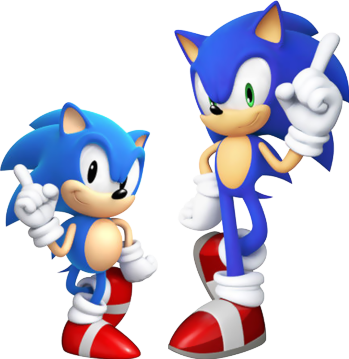
Sonic: What you see is what you get! Just a guy that loves adventure! I'm Sonic the Hedgehog!
Sega's flagship franchise and one of the most popular video game properties of all time.
This platforming plethora of ring-collecting and badnik-charging stars the titular Sonic the Hedgehog , a real cool blue dude with Super-Speed and a knack for taking whatever thrill rides he can find. Opposite to the blue blur is one Dr. Ivo Robotnik— better known as Dr. Eggman— a mustached Mad Scientist with a big gut, a bigger robot army, the biggest ego around, and a life goal of using his scientific know-how (with unique power sources like the Chaos Emeralds being a plus) to achieve world domination. Naturally, the free-spirited Sonic doesn't approve of Eggman's ambitions, and Eggman really hates that hedgehog for expressing said disapproval through scheme-thwarting time and time again, so the series follows wherever the endless conflict between fat man and kinetic Funny Animal will take them next.note
Since Eggman's always striking back with another new trick up his sleeve, Sonic's usually got some help in the form of his supporting cast, including: Miles "Tails" Prower (as in "miles per hour"), a two-tailed fox kit serving as Sonic's trusty sidekick and Heli-Critter transport; Knuckles the Echidna, Sonic's hot red foe-turned-friend with the physical power to match his namesake; Amy Rose, his love-struck Fangirl with a Genki Girl attitude and a mallet you don't wanna mess with; and the cavalcade of all the other friends and allies he's made over the years.
Originally created in 1991 for the then-fledgling Sega Genesis (and not-so-fledgling Sega Master System) by a group of fifteen people (who were later to be named Sonic Team) tasked with creating a mascot to compete with the face of video games, Sonic quickly became the gaming company's mascot, immediately replacing Sega's previous mascot, Alex Kidd. The spunky, ever-lovin' cobalt-blue insectivore grew in strength and speed with each sequel to put its creators into a healthy competitive spot with Nintendo (and other, lesser gaming companies, most notably Hudson Soft and SNK) during the 16-bit Console Wars.
The games were positively brilliant. The sprites were incredibly well-drawn, the levels were huge and expansive with a few alternate paths, and they incorporated many design features like loops, corkscrews, and crumbling ledges that were never seen before in any game. Many entertainment companies were given the license to produce no less than four cartoon series, seven comic series, countless books, a Sunday comic strip, and even an OVA, all to capitalize on Sonic's success. For a short while, Sonic managed to overshadow Mario, Mickey Mouse and even Bugs Bunny themselves in worldwide popularity, due to the technical whizziness of the series' concept (helped by Sega dropping the term "Blast Processing" into its ads) and the proto-Badass nature of its main character. (This was the predecessor to the eventual family-friendly versus mature games debate, with a hedgehog with an attitude standing in for killing beeyotches.)
Of course, SEGA's success with Sonic did not by any means go unnoticed by their competition, both in the West and in their home court of Japan, and in the wake of the release of the original trilogy for the Genesis, a slew of Mascot with Attitude platformers would hit the video game market. Most mascots might have taken the form of more or less subtle imitations of Sonic, but they were all pretty blatantly meant to cash on the series' popularity. These imitators would continue to be a somewhat dominating presence on the video game market throughout the rest of The 16-bit Era of Console Video Games, and the popularity of the subgenre would first truly start to wane in the late 1990s, even with how other big names like a certain bandicoot or dragon took inspiration from it.
Sonic, meanwhile, reached an Audience-Alienating Era during the run of SEGA's Saturn console, which was a good deal less successful than its predecessor. The spinoff game, Sonic R, was the only noteworthy Sonic game on the console. Sonic X-treme was announced, but it was cancelled due to a permission dispute between developers, and filled in at the 11th hour by an upgraded port of the Genesis game Sonic 3D: Flickies' Island.
Around the turn of the millennium, the series got revitalized in a truly three-dimensional incarnation on SEGA's final home console, the Dreamcast. Sonic Adventure and Sonic Adventure 2 were noted for their production values, larger scope and ambitious plotlines, but also criticized for questionable choices and other teething problems; such as the screwy camera and awkward controls usually found in platformers that tried to make their first jump to 3D. Still, both Adventure games were reasonably successful for their time, with the first being the highest-selling title and resident Killer App for the Dreamcast, and the second's port of Sonic Adventure 2: Battle being the highest-selling third-party game for the Nintendo Gamecube, bringing in a massive slew of new fans in the process.
Following Sega's transition to a third-party developer in the early 2000s, Sonic Team attempted to address the Adventure games' concerns with Sonic Heroes, which focused more on team-based gameplay and less on story. The physics, graphics, and gameplay of its successor Shadow the Hedgehog also drew some ire, but it mainly received criticism for its melodramatic story and dialogue.
And then came the game simply titled Sonic the Hedgehog, usually referred to as Sonic the Hedgehog (2006) or "Sonic '06", which was released in late 2006 for the Xbox 360 and early 2007 for the PlayStation 3. By forcing the game out for a Christmas release, what was yet another attempt to undo the issues with the series's Video Game 3D Leap became an Obvious Beta that accentuated the issue. Among the game's many criticisms was the Havok physics engine and loading times reaching lengths that hadn't been seen in almost a decade.
As the ire towards the 3D Sonic games reached its peak, Sega went for a simpler route with Sonic Unleashed in 2008, getting rid of much of the main cast and completely revamping the gameplay to a simpler style involving "boosting", much like Dimps' 2D Sonic Rush series, while pairing it with a completely different gameplay style for variety. The tone was also considerably lighter than the progressively serious tone that characterized the previous games. Unleashed received a mixed reception for the latter style, but it was considered a step in the right direction for giving the series the exhilarating speed experience it needed and addressing much of the problems that previous Sonic games had.
Sega listened to the reception and refined the boost-centric gameplay for the Nintendo-platform-exclusive Sonic Colors in 2010 and the milestone-celebrating Sonic Generations in 2011, further reducing the prominence of the large cast and lightening the tone to a more humorous Saturday morning cartoon-like tone. Sonic Lost World continued the latter trend, but introduced a completely new Super Mario Galaxy-inspired gameplay style, which had led many to ponder if Sega went too far with the Lighter and Softer trend just as they did with the Darker and Edgier trend before. Despite this, Colors and Generations were both viewed as some of the best games that the franchise had in years, with the latter having strong sales and an active modding scene even a decade later.
In 2017, Sega released Sonic Mania, a new 2D side-scroller done in the style of the original 16-bit games. Developed by long-time fans and former romhackers, and using an engine and style replicating the feel of the original games, the game has received wide critical acclaim, essentially made up for previous attempts to bring the classic 2D gameplay back and, at least for the time being, creating a lot of goodwill for the franchise once again. However, on the 3D side of things, Sonic Forces attempted a return to the boost gameplay and more serious storytelling, but received middle-of-the-road reviews for its short length and heavily linear gameplay, despite its Character Customization feature being widely praised.
Sonic Team would take the reception of Forces to heart, and set out to make their next game the best they could. The end result of their efforts, Sonic Frontiers, would release in 2022 and receive much more positive reception, with fans and most reviewers praising its emphasis on open world exploration and combat, and a much more involved story compared to Forces, quickly becoming the best selling title in the series since its 90s heyday.
As mentioned, some titles in the series have been notable for suffering mixed-to-negative critical reception. In line with all the controversy, large varieties of theories exist to explain why the Sonic series is struggling in terms of reviews, such as hastened development for deadlines, no talent or caring from the development team, over-reliance on "overgimmicky" gameplay styles or features, taking the series in too dark a direction, unpleasable demands from nostalgic fans, or the inability to give the franchise a concrete identity.
Nevertheless, the series remains massively popular and beloved by many in spite of the above controversies. Do not let all that has been stated above fool you — beyond all the disappointments, the constant jabs, and the notorious fanbase, people still love Sonic the Hedgehog.
A feature-length Live-Action Adaptation based off the franchise was also released by Paramount in 2020, after having been stuck in Development Hell since the 1990s. Neal Moritz of The Fast and the Furious fame and Tim Miller of Deadpool executive produced this film, while Jeff Fowler, best known for the 2004 short Gopher Broke, made his feature film directorial debut. In spite of an earlier controversy regarding Sonic's original design for the movie (which was later redesigned in response with input from veteran Sonic artist Tyson Hesse), the film released as a hit with audiences and the box office, being widely acknowledged as avoiding the issues of most video-game-to-film adaptations, and launching a series of its own (starting with a sequel in 2022, as well as a third installment and spin-off series in 2024).
Sonic has also appeared in every Super Smash Bros. game since Brawl.
Games and other media featuring Sonic:
- Sonic the Hedgehog (Sega Genesis, 1991): The one that started it all! Dr. Eggman's searching for the Chaos Emeralds while turning all of the animals into his robotic slaves! Are you a bad enough dude to help Sonic thwart his scheme?!
- Sonic the Hedgehog 2 (Sega Genesis, 1992): Dr. Eggman's after the Chaos Emeralds again, this time to fuel his new superweapon, the Death Egg! This time, Sonic is joined by his new friend, Tails, in the fight to stop the mad scientist!
- Sonic the Hedgehog CD (Sega CD, 1993): With Eggman now set on conquering the Little Planet to lay claim to its Time Stones, Sonic is chasing him across the past, present, and future to thwart him! Amy Rose tags along, while Sonic finds a new rival in his robotic clone, Metal Sonic!
- Sonic 3 & Knuckles: After the events of Sonic 2, the Death Egg crash-lands into Angel Island. Eggman hopes to use the Master Emerald on the island to re-power it, and to further his plans, he's set the island's guardian, Knuckles, after Sonic and Tails!
- Sonic the Hedgehog 3 (Sega Genesis, 1994)
- Sonic & Knuckles (Sega Genesis, 1994)
- Knuckles the Echidna in Sonic the Hedgehog 2 (unlocked by locking-on a Sonic & Knuckles cartridge with Sonic the Hedgehog 2)
- Blue Sphere (unlocked by locking-on a Sonic & Knuckles cartridge with any other SEGA Genesis game)
- Sonic Adventure (Sega Dreamcast, 1998) : Dr. Eggman's new plans for world conquest have brought about an ancient monster known as Chaos. As Sonic and Tails fight to stop him, Knuckles seeks out the shattered fragments of the Master Emerald, Amy fights to save an innocent bird from a particularly persistent robot, Big becomes seperated from his beloved pet Froggy, and E-102 "Gamma" goes rogue and starts hunting down its fellow Badniks.
- Sonic Adventure DX: Director's Cut (Nintendo GameCube, PC, 2003)
- Sonic Adventure 2 (Sega Dreamcast, 2001): Sonic finds himself on the run from the police in a case of mistaken identity! It's a race against time as he, Tails, and Knuckles fight to thwart a new scheme by Eggman and his new friends, Shadow and Rouge, to use a secret weapon hidden in space!
- Sonic Adventure 2: Battle (Nintendo GameCube, 2001)
- Sonic Heroes (Nintendo GameCube, Xbox, PlayStation 2, 2003): Eggman's going to conquer the world in three days! It's up to the dynamic trio of Sonic, Tails, and Knuckles to stop him! Along for the ride are three other teams of heroes for triple the fun!
- Sonic the Hedgehog (Xbox 360, PlayStation 3, 2006): The country of Soleanna is under siege by Eggman as he seeks out an ancient power known as the "Iblis Trigger". Sonic sets out to stop him, but finds himself in the crosshairs of Silver, a mysterious hedgehog from the future...
- Sonic Unleashed (Sonic World Adventure in Japan) (Wii, PlayStation 2, Xbox 360, PlayStation 3, 2008): Eggman's cracked the world open like an egg, and it's up to Sonic, along with his new friend Chip, to collect the Chaos Emeralds and set things right, while also struggling against a mysterious affliction turning him into a monster!
- Sonic the Hedgehog 4
- Sonic the Hedgehog 4: Episode I (iOS, Wii, PlayStation 3, Xbox 360, PC, Android, 2010)
- Sonic the Hedgehog 4: Episode II (PC, PlayStation 3, Xbox 360, Android, iOS, 2012)
- Sonic the Hedgehog 4: Episode Metal (unlocked by having an Episode I save file on the same platform as Episode II)
- Sonic Colors (Wii, Nintendo DS, 2010) : Welcome to Eggman's Incredible Interstellar Amusement Park, a new funfair powered by innocent aliens called Wisps! It's up to Sonic to use the power of the Wisps to dismantle Eggman's twisted carnival!
- Sonic Colors Ultimate (PlayStation 4, Xbox One, Nintendo Switch, Google Stadia, PC, 2021)
- Sonic Generations (Xbox 360, PlayStation 3, PC, Nintendo 3DS, 2011): Eggman has unleashed the Time Eater, a mysterious monster that is erasing history! It's up to Sonic to set things right, along with his new ally... his younger self!
- Sonic × Shadow Generations (PC, PlayStation 4, PlayStation 5, Nintendo Switch, Xbox One, Xbox Series X|S, 2024)
- Sonic Lost World (Wii U, Nintendo 3DS, PC, 2013): On the mysterious planetoid known as the Lost Hex, Eggman has unleashed the Deadly Six, a group of Zeti out to destroy the world...but not if Sonic has anything to say about it!
- Sonic Mania (Nintendo Switch, PlayStation 4, Xbox One, PC, 2017): Eggman has a new toy in his possession: the Phantom Ruby, a reality-warping bauble! Can Sonic and his allies stop him in this retro-style adventure?!
- Sonic Forces (PC, PlayStation 4, Xbox One, Nintendo Switch, 2017): Eggman's taken over over 99% of the world, and it's up to Sonic and the Resistance to overthrow him and save the planet, along with Sonic's allies: his "Classic" self, and you!
- Sonic Frontiers (PC, PlayStation 4, PlayStation 5, Nintendo Switch, Xbox One, Xbox Series X|S, 2022): Sonic's friends are trapped in a virtual prison on the mysterious Starfall Islands, and only our blue hero can save them! But who is the mysterious Sage who is trying to stop him?
- Sonic Superstars (PC, PlayStation 4, PlayStation 5, Nintendo Switch, Xbox One, Xbox Series X|S, 2023): Eggman's recruited Fang the Hunter and the mysterious Trip the Sungazer to plunder the Northstar Islands! It's up to Sonic and company to harness the Chaos Emeralds' powers to stop them!
- Sonic the Hedgehog (8-bit) (Sega Master System, Game Gear, 1991)
- Sonic the Hedgehog 2 (8-bit) (Sega Master System, Game Gear, 1992)
- Sonic Chaos (Sonic & Tails in Japan) (Sega Master System, Game Gear, 1993)
- Sonic the Hedgehog: Triple Trouble (Sonic & Tails 2 in Japan) (Game Gear, 1994)
- Sonic Blast (Game Gear, 1996)
- Sonic the Hedgehog Pocket Adventure (Neo Geo Pocket Color, 1999)
- Sonic Advance (Game Boy Advance, 2001)
- Sonic Advance 2 (Game Boy Advance, 2002)
- Sonic Advance 3 (Game Boy Advance, 2004)
- Sonic Rush (Nintendo DS, 2005)
- Sonic Rush Adventure (Nintendo DS, 2007)
- Sonic Rivals (PlayStation Portable, 2006)
- Sonic Rivals 2 (PlayStation Portable, 2007)
- Sonic Drift (Game Gear, 1994) (Japan only)
- Sonic Drift 2 (Game Gear, 1995)
- Sonic R (Sega Saturn, PC, 1997)
- Sonic Riders (Nintendo GameCube, Xbox, PlayStation 2, 2006)
- Sonic Riders: Zero Gravity (Wii, PlayStation 2, 2008)
- Sonic Free Riders (Xbox 360 Kinect, 2010)
- Mario and Sonic at the Olympic Games (Wii, Nintendo DS, 2007)
- Mario & Sonic at the Olympic Winter Games (Wii, Nintendo DS, 2009)
- Mario & Sonic at the London 2012 Olympic Games (Wii, Nintendo 3DS, 2011)
- Mario & Sonic at the Sochi 2014 Olympic Winter Games (Wii U, 2013)
- Mario & Sonic at the Rio 2016 Olympic Games (Wii U, Nintendo 3DS, 2016)
- Mario & Sonic at the Tokyo 2020 Olympic Games (Nintendo Switch, 2019)
- Sega Superstars (PlayStation 2, 2004)
- Sega Superstars Tennis (Wii, Nintendo DS, PlayStation 2, PlayStation 3, Xbox 360, 2008)
- Sonic & Sega All-Stars Racing (Wii, Nintendo DS, PlayStation 3, Xbox 360, PC, 2010)
- Sonic & All-Stars Racing: Transformed (Wii U, Nintendo 3DS, PlayStation 3, Xbox 360, PC, 2012)
- Team Sonic Racing (Nintendo Switch, PlayStation 4, Xbox One, PC, 2019)
- Sonic Jam (Sega Saturn, Game.com, 1997)
- Sonic Mega Collection (Nintendo GameCube, 2002)
- Sonic Mega Collection Plus (Xbox, PlayStation 2, 2004)
- Sonic Gems Collection (Nintendo GameCube, PlayStation 2, 2005)
- Sonic's Ultimate Genesis Collection (Xbox 360, PlayStation 3, 2009)
- Sonic Classic Collection (Nintendo DS, 2010)
- Sonic Origins: A Compilation Re-release of the Genesis-era platformers; includes a story mode that ties each of the stories together. (Nintendo Switch, PlayStation 4 and 5, Xbox One & Series X/S, PC, 2022)
- Sonic Origins Plus: An update has Knuckles the Echidna playable in Sonic CD, Amy Rose playable in the four main titles, and the inclusion of all 12 Game Gear Sonic titles. (Nintendo Switch, PlayStation 4 and 5, Xbox One & Series X/S, PC, 2023)
- SegaSonic the Hedgehog (Arcade, 1993)
- Knuckles' Chaotix (32X, 1995)
- Tails Adventure (Game Gear, 1995)
- Sonic 3D: Flickies' Island (Sonic 3D Blast in North America) (Sega Genesis, Sega Saturn, PC, 1996)
- Shadow the Hedgehog (Nintendo GameCube, Xbox, PlayStation 2, 2005)
- Sonic Storybook Series (Wii)
- Sonic and the Secret Rings (2007)
- Sonic and the Black Knight (2009)
- Sonic Boom
- Rise of Lyric (Wii U, 2014)
- Shattered Crystal (Nintendo 3DS, 2014)
- Fire & Ice (Nintendo 3DS, 2016)
- Flicky (Arcade, 1984): Technically not a Sonic title and it predates the franchise by seven years, but it does feature the first appearance of Flicky, who would go on to become one of the franchise's main animal buddies. Its gameplay would also inspire Sonic 3D: Flickies Island, which acts as a pseudo-isometric reimagining of the game.
- Sonic Eraser (Sega Genesis, 1991):
 Japan-only Sonic puzzle game, made for the Sega Meganet.
 - Sonic's Edusoft: An unreleased Edutainment Game developed for the Sega Master System around 1991.
- SegaSonic Bros.: An arcade puzzler by the creator of Bubble Bobble given a limited location testing in 1992; it never received a full-scale release. Stood under the radar for over two decades.
- Sonic Spinball (Sega Genesis, Sega Master System, Game Gear, 1993)
- Dr. Robotnik's Mean Bean Machine (Sega Genesis, Sega Master System, Game Gear, 1993): A Dolled-Up Installment of Puyo Puyo made as a tie-in to the Adventures of Sonic the Hedgehog cartoon.
- Puyo Puyo Tetris 2 (Nintendo Switch, PlayStation 4 and 5, Xbox One & Series X/S, PC, 2020): Sonic appears as a Guest Fighter in this game, likely as a homage to the aforementioned Mean Bean Machine, plus the fact that the recent Puyo Puyo games have also been made by Sonic Team. Sonic is actually the first proper Guest Fighter the series has ever had.
- Sonic the Hedgehog's Gameworld: A game for the ill-fated Sega Pico edutainment console in 1994.
- Wacky Worlds Creativity Studio: Technically not a Sonic game, but Sonic appears as the game's mouse cursor, Tails appears as an interactive stamp, and both are prominently featured on the games box art.
- Tails and the Music Maker: One of three games featuring Sonic's two-tailed friend as the star, and released for the Sega Pico in 1994.
- Tails' Skypatrol (Game Gear, 1995) (Japan Only)
- Sonic Labyrinth (Game Gear, 1995)
- Sonic the Fighters (also known as Sonic Championship) (Arcade, 1996)
- Sonic's Schoolhouse (PC, 1996)
- Sonic the Hedgehog The Screen Saver (PC, 1996)
- Sonic Shuffle (Sega Dreamcast, 2000)
- Sonic Pinball Party (Game Boy Advance, 2003)
- Sonic Battle (Game Boy Advance, 2003)
- Sonic Chronicles: The Dark Brotherhood (Nintendo DS, 2008)
- Big's Big Fishing Adventure 3: The Trial (Browser game, 2016)note
- Super Smash Bros.: Sonic has appeared as a major Guest Fighter in these games:
- LEGO Dimensions: A Sonic the Hedgehog Level Pack known as "Sonic Dimensions" was introduced on November 18, 2016, which comes with a physical Sonic minifigure and models of the Tornado and Speed Star.
- Minecraft: As part of Sonic's 30th anniversary, Gamemode One created and released an official Sonic-themed DLC pack that allows players to race through a selection of Zones as Sonic and friends.
- Sonic Speed Simulator: An official Roblox game of all things, created by the creator of Sonic Onset Adventure, and notably not yet complete.
- The Murder of Sonic the Hedgehog: A short Visual Novel released for free on April Fools' Day 2023.
- Waku Waku Sonic Patrol Car - a kiddie ride in the form of a police car with a monitor embedded inside. Japan only. Also arguably Sega's earliest attempt to bring a Sonic game into arcades, predating SegaSonic the Hedgehog by a whole year.
- SegaSonic Popcorn Shop - basically a popcorn vending machine with a game for kids to play while they wait for their popcorn to be ready.
- SegaSonic Cosmo Fighter - another kiddie ride with an embedded monitor, this time in the form of a jet. While this game is exclusive to Japan for the most part, a localized version of it did show up at the now-defunct Sega World Sydney.
- Sonic the Hedgehog kiddie ride - a kiddie ride in the form of Sonic's car in Sonic & Sega All-Stars Racing.
- Sonic Jump (Mobile, iOS, Android)
- Sonic Jump Fever (iOS, Android, 2014)
- Sonic Dash (iOS, Android, 2013)
- Sonic Dash 2: Sonic Boom (iOS, Android, 2015)
- Sonic Runners (iOS, Android, 2015)
- Sonic Runners Adventure (Android, iOS, 2017)
- Sonic Forces: Speed Battle (iOS, Android, 2017)
- Sonic Racing (Apple Arcade, 2019)
- Cookie Run: Kingdom: A crossover event with the Sonic Franchise was released from September 17, 2021 to October 16. During the event, players were able to obtain Sonic Cookie and Tails Cookie, and play in the temporary game mode: Sonic's Green Hill.
- Sonic Dream Team (Apple Arcade, 2023)
- Sonic Rumble (iOS, Android, 2024)
- Animated Series:
- Adventures of Sonic the Hedgehog (1993)
- Sonic Christmas Blast (1996)
- Sonic the Hedgehog (SatAM) (1993-1994)
- Sonic Underground (1999)
- Sonic X (2003-2005)
- Sonic Boom (2014-2017)
- Sonic Prime (2022-2024)
- Adventures of Sonic the Hedgehog (1993)
- Live-Action Series:
- Knucklesnote (2024)
- Animated Shorts / OVA:
- Sonic the Animation (1994)
- Sonic the Hedgehog: The Movie (1996 JP, 1999 US)
- Sonic: Night of the Werehog (2008)
- Ghost Tale (2023)note
- Sonic Mania Adventures (2018)
- Team Sonic Racing Overdrive (2019)
- Chao in Space (2019)
- Sonic Colors: Rise of the Wisps (2021)
- Sonic Drone Home (2022) note
- Sonic Frontiers Prologue: Divergence (2022)
- Sonic & Friends (2023-)
- Sonic Superstars: Trio of Trouble (2023)
- Crossovers:
- The Fight for the FoxBox (2003) note
- OK K.O.! Let's Meet Sonic (2019) note
- Film series:
- Sonic the Hedgehog (2020)
- Sonic the Hedgehog 2 (2022)
- Sonic the Hedgehog 3 (2024)
- Crossovers:
- Wreck-It Ralph (2012)
- Ready Player One (2018)
- Ralph Breaks the Internet (2018)
- Chip 'n Dale: Rescue Rangers (2022)note

- Sonic the Hedgehog Story Comic (manga)
- Sonic the Hedgehog Promo Comic (AKA Sonic The Hedgehog Number 1)
- Sonic the Hedgehog (various loosely-related manga, published in several different parts of Shogaku Ninensei from 1992 to 1994)
- Shogaku Ninensei (2nd Grade)
- Shogaku Ichinensei (First Grade)
- Shogaku Sannensei (Third Grade)
- Shogaku Yonensei (Fourth Grade)note
- Shogaku Gonensei (Fifth Grade)
- Shogaku Rokunensei (Sixth Grade)
- Bessatsu CoroCoro Comic Special
- Sonic the Hedgehog (Archie Comics) (Nov. 1992-July 2017)
- Sonic Universe (Feb. 2009-July 2017)
- Sonic the Hedgehog/Mega Man: Worlds Collide
- Sonic the Hedgehog/Mega Man: Worlds Unite
- Sonic: Mega Drive
- Sonic the Comic (Fleetway)
- Sonic Adventures
- Dash & Spin; Super Fast Sonic!! (manga, published in CoroCoro Comic)
- Sonic X
- Various Sonic manga from Dengeki Nintendo DS:
- Sonic Unleashed
- Sonic and the Black Knight
- Sonic Chronicles
- Sonic Colors
- Sonic Generations
- Sonic Boom
- Sonic Comic (webcomic, published on Sonic Channel)
- Sonic the Hedgehog (IDW) (April 2018-ongoing)
- Sonic the Hedgehog 2: The Official Movie Pre-Quill (March 2022, tie-in for the 2022 film sequel)
- Stay Sonic
- Sonic the Hedgehog Bible
- Sonic and the Tales Of...
- Sonic Channel wallpaper cover stories (a number of stories posted on Sonic Channel with accompanying wallpapers that tell a story arc)
- Sonic the Hedgehog Adventure Gamebooks
- Sonic the Hedgehog and the Silicon Warriors
- Sonic the Hedgehog in Castle Robotnik
- Sonic the Hedgehog in Robotnik's Laboratory
- Sonic the Hedgehog in the Fourth Dimension
- The Sonic the Hedgehog Joke Book
- Sonic Boom (sub-franchise)
- Sonic: Live in Sydney
- Sonic the Hedgehog Twitter
- The character himself as a Virtual YouTuber on the Japanese social media accounts.
