Plagues of locusts everywhere,
Or a cataclysmic earthquake
I'd accept with some despair,
But no! You sent us Congress!
Good God, sir, was that fair?"
1776 is the name of a 1969 Broadway play by Sherman Edwards and Peter Stone, and its 1972 film adaptation, featuring William Daniels in the role that made him a star. It's a mostly accurate depiction of the hurdles and loopholes that the Founding Fathers went through in order to separate from Great Britain... well, once you take out the all-singing, all-dancing part, it is, anyway.
It could be said that one of the greatest battles during The American Revolution didn't take place on any battlefield, but in Philadelphia's Independence Hall amongst the delegates of the Second Continental Congress, as they debated over how (and whether) to approve the Declaration of Independence and establish the United States as a separate nation.
Daniels plays John Adams (later the first-ever Vice President and second President of the United States), a Boston revolutionary who spearheads the effort for the American Colonies to break from Britain and form a new independent nation. All sorts of reasons are brought up for this, including taxation without representation and the alienation that the Atlantic Ocean brings. With the help of Yoda-like Benjamin Franklin and a heel-dragging Thomas Jefferson — who is so homesick he can barely write the Declaration of Independence — he puts forth these reasons... which are almost immediately savaged. It takes a minor miracle just to get the whole thing to a spot where it can be voted on, much less ratified; that would require unanimity.
Though light-hearted in many parts (it's almost impossible to get through the number about who will write the Declaration without laughing), it also contains poignant looks at how difficult decisions had to be made (the South viewed slavery as an economic necessity and walked out en masse upon hearing Jefferson, a fellow Southerner, condemn it). In addition, a report from a soldier on the front (the haunting "Mama, Look Sharp" number) drives home just how much, and yet how little, the piece of paper will mean.
The musical got a 1997 revival on Broadway, starring Brent Spiner as Adams. A Gender Flip production consisting entirely of women and non-binary, transgender, and genderqueer actors of various ethnicities directed by Diane Paulus had a Broadway premiere in 2021.
Not to be confused with a 300 parody made by Robot Chicken, or with Jon Bois' 17776.
This work contains examples of the following tropes:
- AcCENT upon the Wrong SylLABle:
- "The Lees of Old Virginia", uh, prominent-Lee uses this trope. Even after the song, Richard Henry Lee continues to make Lee-based puns.
- During one of the dispatches it is announced that Washington's troops are carousing in the "Rar-uh-TAN" River. New Jersians who live not far from said river know it as the "Rar-uh-tin" River.
- One to modern ears. In the show, "Maryland" is pronounced "Mary Land," rather than the modern pronunciation of "Marilynd," as is appropriate to the time period.
- Actually Pretty Funny: When Franklin compares being called an Englishman without the full rights of one to calling an ox a bull, "He's thankful for the honor, but he'd much rather have restored what's rightfully his," to gales of laughter from the congress, Dickinson simply retorts, "When did you first notice they were missing, sir?" Even Franklin bursts out laughing at that. (Ironically, this is because Howard da Silva, who originated the role, was irritated that Dickinson's final line was added, and wanted Franklin to "win" by showing he was above getting riled.)
- Alliterative List: When Adams is singing "Piddle, Twiddle and Resolve":John Adams: You see, we piddle, twiddle, and resolve,
Not one damn thing do we solve,
Piddle, twiddle, and resolve,
Nothing's ever solved
In foul, fetid, fuming, foggy, filthy Philadephia! - All There in the Manual:
- There is a souvenir program out there that shows pictures from the movie and some behind-the-scenes stuff, including the names of the rest of the delegates seen in the movie (mostly Southerners to fill out the dance line in "Cool, Cool, Considerate Men") For example, the man that yelled "Will someone shut that man up?" during "Sit Down, John" is Georgia delegate George Walton.note
- The screenplay was later published in paperback format with an extensive afterword.
- Alone in a Crowd: After Wilson flips and votes Yea, the independence motion passes. Dickinson, who was trying to talk him into voting Nay, is left the only man on his feet, in the middle of the room with everyone staring at him, as his isolation becomes clear.
- Always Someone Better: When Adams fetches up against conservative powerhouse John Dickinson, he gets creamed by the man's powerful personality, charisma, and general ability to get people to like him. Dickinson, in turn, backs down when Franklin sighs, finally gets out of his chair and turns the finest wit in the colonies on his ass.
- Answers to the Name of God: Inverted, when Adams complains that in the earth was created in the same amount of time it took for Jefferson not to write a draft of the declaration.Jefferson: (cheekily) Someday you must tell me how you did it.
- Armor-Piercing Question: Jefferson, speaking of black slavery, says that "the rights of man are deeply wounded by this infamous practice!" And Rutledge utterly nails him with, "Then see to your own wounds, Mr. Jefferson, for you are a practitioner! Are you not?!" Jefferson is clearly shaken by this; publicly, he commits to freeing all of his slaves when the time is ripe. He doesn't. Jefferson couldn't stay solvent even with slaves, but nobody with an estate as big as his could stay solvent without them. And at the end of "Molasses to Rum," a musical number about how it's New England sea traders who buy and sell the South's slaves in the first place, Rutledge concludes: "Mr. Adams, I give you a toast! Hail Boston! Hail Charleston! Who stinketh the most?!"
- Armor-Piercing Response: As Adams is trying to explain the need for a declaration, one of the other members of Congress asks what its purpose would be. Thomas Jefferson gets up and says, "To place before mankind the common sense of the subject, in terms so plain and firm as to command their assent." Congress is silent for several seconds after that.
- Arson, Murder, and Jaywalking: Played for laughs with John Adams during "Piddle, Twiddle and Resolve":Adams: A second flood, a simple famine, plagues of locusts everywhere,
Or a cataclysmic earthquake, I'd accept with some despair.
But no, You sent us Congress! Good God, Sir, was that fair? - Artistic License – History: Since they didn't have transcripts of the actual events beyond the basic parliamentary records of Congressional activity, putting all the notes and diaries into a narrative required this.
- Many historical figures were dropped from the production, as the entire complement of the Congress would have been too unwieldy for Broadway (particularly as some, like John Adams' firebrand cousin Samuel, would have been crying out for a signature scene or song). Of the 65 delegates in the actual Congress, only 30-35 are ever shown.
- The debate over American Independence did not boil down to an argument over the phrasing of the Declaration and whether slavery ought to be condemned, as it more or less does in the movie. While the wording of the Declaration was debated, Congress had, in a surprisingly lucid moment, decided to vote on the issue first and argue the wording of the document after the fact, i.e. Congress had already voted in favor of independence before making changes to the Declaration.note The fictionalized debate did serve to make the musical more politically correct by modern standards, and more dramatic since it added an element of "what are you willing to compromise?" to the mix. And it set up one of the musical's most profound comments on American Politics, Franklin's "Whether you like it or not, John, these men will become part of the country you hope to create" (a very, very significant line in this era where phrases like "un-American" are used so frequently in political debate). Still, historically speaking, slavery was not in any way the point on which the issue of independence hinged. It probably could have been, but the Revolutionary leaders, as a whole and by silent agreement, passed the buck for the next generation to deal with.note
- As admitted in the DVD Commentary, Martha Jefferson never visited her husband in Philadelphia.
- There was no vote mandating that a motion for independence had to be unanimous ... but, as Hancock acknowledges in the play, there was an understanding that acting on anything less than unanimity risked a fatal split in the colonies.
- Regarding the song "Cool, Cool, Considerate Men" and its line "Never to the left, forever to the right", the concept of Left and Right Wing politics came about due to the French Revolution, more than a decade later, which would make this terminology an anachronism under normal circumstances. In-Universe, however, they are referring to the sliding board used to track their votes, which would bring it back into historical accuracy... if said board itself were not an invention of the play.
- The labeling of the anti-independence faction as "conservative" was itself an anachronism. Every man in the Continental Congress was a liberal in the classical sense. The true conservative position in English politics at the time was vehemently pro-monarchy and would have found the idea of an unauthorized congress distasteful no matter what they were discussing. However, they do represent the relatively conservative position within the Continental Congress at the time.
- Thomas McKean was born in Pennsylvania to parents who emigrated from Ireland as children. He may have been an Ulster Scot by descent, but it's highly doubtful that he had such a prrronounced accent. (As it happens, Pennsylvania delegate James Wilson did have a pronounced Scottish accent — he was born in Carskerdo, Scotland — but is here portrayed as mostly Overshadowed by Awesome compared to his colleagues Ben Franklin and John Dickinson.)
- Richard Henry Lee gets elected governor of Virginia and leaves for good after his short time in the show. This never happened in real life, but it was a necessity because his comedic nature would have heavily undercut the show's drama, so they had to get him out to keep the tension intact. Some productions have Lee return for the ending to sign the Declaration as he did in real life, but they keep him in the back so that he doesn't overshadow the event.
- As the Good Book Says...:
- Quoth Jefferson, regarding the slavery debate, "These people shall be free."
- Dickinson strikes back with a misquoting of one of the Gospels when he leads the southern delegates in a walkout, just as Chase, the Maryland delegate, decides to vote for independence.Dickinson: What is a man profited, if he shall gain Maryland and lose the entire South? (beat) Matthew 16:26.
- Batman Gambit: Franklin asking John Hancock to poll the Pennsylvania delegation, a double Gambit in which both levels depend on Wilson's milquetoast personality. With Pennsylvania voting last for independence, by polling them individually, this makes Wilson the last vote of the entire movement for independence. Franklin bets that Wilson will not want to be the man who singlehandedly denied America their independence when every other state agreed to it. As there seems to be no protocol to the order in which the delegates were polled (if it were alphabetical, Dickinson would've come before Franklin), Franklin is also betting that the secretary will call the least prominent delegate - Wilson, by far - last. Wilson proves Franklin correct, votes in favor of it, and creates a unanimous vote.
- The Big Board: A slider board showing the vote tally. There is also a tear-off calendar counting down to July 4th. Both were invented by the playwrights for dramatic expedience.
- Big Damn Heroes:
- Reverend John Witherspoon's arrival in Congress before the resolution on independence is struck down, a somewhat understated one since (despite the stakes) it's a lighthearted scene.
- Caesar Rodney riding eighty miles in failing health to show up just in time for the vote (a real event, famous enough that it's on the Delaware quarter).
- Abigail's saltpeter arriving after the Southern walkout, renewing Adams' determination.
- Big "NEVER!": Adams does a few of these.
- Big "SHUT UP!":
- The opening number, "Sit Down, John," is this in song form. It even ends with one man crying "Will someone shut that man up?"
- Adams, to Franklin, Livingston, and Sherman after Adams chooses Jefferson to write the Declaration, at the end of "But, Mr. Adams."
- Bittersweet Ending: The film ends with the Declaration signed and independence declared — and years of a turbulent and desperate war that did not look winnable ahead of them. As Washington had mentioned, his army was in terrible shape, his money and credit were all gone, and the British had the strongest navy in the world. That bit in the Declaration about pledging "our lives, our fortunes, and our sacred honor" wasn't just emotionalism. Notably, the finale music played as Thomson summons the various delegates for their signatures and the Liberty Bell tolls isn't triumphant and hopeful but discordant and chilling.
- "Blackmail" Is Such an Ugly Word: Dickinson takes this stance as his defense when Adams attempts to denounce Dickinson's preservation of personal property:Adams: That precious "status quo" you keep imploring the people to preserve for their own good is nothing more than the eternal preservation of your own property!
Dickinson: Mr. Adams, you have an annoying talent for making such delightful words as "property" sound quite distasteful. - Blood on the Debate Floor: Adams — dear Mr. Adams — and Dickinson calmly talking out their differences. With canes. Secretary Thomson recorded several stick fights during congressional debates, but didn't name the participants.
- Bowdlerise: Until the Blu-Ray release, the only version of the movie to reach televisions was a severely-edited copy that obscured or completely removed many of the raunchier bits, including the whole New Brunswick sequence and the latter half of Franklin's "it's like calling an ox a bull" exchange with Dickinson. Even the version that hit the theaters was badly chopped, among other things excluding lines that made it clear Rutledge's opposition to the slavery clause was not due to mindless evil, but because he saw it as a betrayal of a promise that the independence faction would allow states to govern themselves as they saw fit. It's also missing a whole musical number, "Cool, Cool, Considerate Men," which was cut at the behest of President Richard Nixon by Jack Warner.
- British Stuffiness: John Adams demonstrated something akin to this, reflecting the Puritan ethos imported with the original Plymouth settlers that reigned supreme in Massachusetts in his day and for a long time thereafter. For example, he prudishly expresses astonishment that Mister and Mrs. Jefferson would conjugate at an improper time of day.note Adams: There's work to be done!
Franklin: Obviously!
Adams: Good God... you don't mean to say that... I mean they're not going to... in the middle of the afternoon?
Franklin: Not everybody's from Boston, John!
Adams: Incredible ... - Bunny-Ears Lawyer: Richard Henry Lee, of the Lees of Old Virginia.
- Catchphrase
- MacNair: "Suh-weet Jesus!", echoed at least once by Franklin.
- Adams: "Oh good God" and "Incredible."
- "Obnoxious and disliked" is both this and a Phrase Catcher for Adams.
- Morris: "New York abstains, courteously."
- Chekhov's Gun:
- The absence of the delegation from New Jersey is repeatedly brought up, which keeps their arrival from being a deus ex machina.
- Just when the South has walked out and Adams has lost all hope, the saltpeter that he requested from Abigail early on arrives unexpectedly, giving him the spirit to rally Franklin and Jefferson for one more try at winning over the needed delegates.
- Calm Before the Storm:
- The night before the vote is to take place, Adams sends Franklin and Jefferson off to try and bring the last few holdouts around, then finds himself alone in Independence Hall where he beings pondering, the song "Is Anybody There?", what is to happen the next day, concluding with the lyrics, "How quiet, how quiet the chamber is. How silent, how silent the chamber is."
- After the vote has been taken, and the resolution on American independence adopted, one final dispatch from General Washington arrives to report that battle is imminent, and that he must defend New York from a 25,000 strong British army with only 5,000 men of his own."And I begin to notice that many of us are lads under the age of fifteen and old men, none of whom could truly be called soldiers. [...] As I write these words, the enemy is plainly in sight beyond the river. How it will end, only Providence can direct, but dear God, what brave men I shall lose before this business ends."
- Chekhov's Gunman: James Wilson is far from the protagonist, mainly providing comic relief as Dickinson's toady — until he has to cast the deciding vote on independence at the show's climax.
- Chessmaster: Franklin. The director's commentary points out that Franklin is often staged in the background of the big debate scenes, observing.
- Composite Character: The John Adams in this musical is something of an amalgam of the real John Adams and his cousin, Samuel Adams.
- Cool Horse: Lee's horse, especially during "The Lees of Old Virginia". It begins when Lee remarks "may my horses turn to glue..." — at which point the horse nudges Lee in the chest. And it ends when Lee rides away — because any horse capable of standing still whilst someone runs up behind him (in his blind spot, no less) and leaps onto his back without bucking, rearing, or bolting automatically qualifies for the description. You can see the clip here, with the nudge at 1:05, and the leap onto its back in the final 15 seconds. (Incidentally, Ron Holgate had never so much as sat on a horse prior to filming. It doesn't show.)
- Covers Always Lie:
- The posters and DVD cover for the film version seem to imply that there is going to be a major romantic plot point involving John and Abigail. They do have many scenes in the movie, but not enough to justify being displayed quite so prominently.
- The DVD cover also features one-scene-wonder Richard Henry Lee — in fact, one Lee on each side of Jefferson and Martha's embrace, which dominates the cover. Protagonist John Adams does not appear at all, which is either ironic (given that this show helped to raise his profile after being ignored by historians for a couple hundred years) or fitting (given Adams' accurate prediction that history would forget him in favor of Franklin and Washington).
- Crowd Song: No one in Congress likes John Adams, apparently. "Sit down, John!" (He is obnoxious and disliked, though.)
- Cue the Sun: In his song, Dickinson delights that it happens anytime Adams is gone.
- Cutting the Knot: Franklin asking that the Pennsylvania delegation be polled. That leaves Wilson as the swing vote. He instantly buckles and votes with the majority.
- Darkest Hour: This musical does not end on the triumphant note you'd expect. The British have landed at New York, the newly formed U.S. of A. is facing the British Royal Navy at a time when it was the biggest, best, most dominant navy in the world, over a quarter of the colonists are on the British side, and every man in that room is at risk of being hanged for treason. Nobody expected to win that war. For Doom the Bell Tolls indeed...
- David Versus Goliath: A comical version in "But, Mr. Adams," seeing as how Ken Howard (Jefferson) stands a full eleven inches taller than William Daniels. In real life, the height disparity between Jefferson (6'2") and Adams (5'7") was certainly notable though not as dramatic as in the film — Daniels is indeed 5'7", but Howard stands at a particularly impressive 6'6".
- Delicious Distraction: In the 1972 film adaptation, when Adams is addressing Chase:Adams: America is awaiting your decision, Mr. Chase! The world is awaiting your decision! (looks at Chase's plate) What's that? Kidney? (Chase angrily slaps Adams' finger away from his plate)
- Deadpan Snarker:
- Mostly Franklin, but Adams and Jefferson get their moments in.Adams: Do you mean to tell me it's not yet finished?!
Jefferson: No, sir. I mean to say that it is not yet begun.
Adams: (flabbergasted) You've had a week, man! A whole week! The entire earth was created in a week!
Jefferson: Someday, you must tell me how you did it. - Dickinson provides some good Snark-to-Snark Combat.Franklin: ... to call me [an Englishman] without those rights is like calling an ox a bull. He's thankful for the honor, but he'd much rather have restored what's rightfully his.
Dickinson: When did you first notice they were missing, sir?Hancock: I'm concerned over the continual absence of one-thirteenth of this Congress. Where is New Jersey?
Dickinson: Somewhere between New York and Pennsylvania.
- Mostly Franklin, but Adams and Jefferson get their moments in.
- Decided by One Vote: Even within the context of unanimity. James Wilson of Pennsylvania must break the tie between pro-independence delegate Franklin and anti-independence delegate Dickinson. Guess which way he votes ...
- Played with in the case of New York's Lewis Morris: by frequently abstaining courteously, his abstinence gives John Hancock tie-breaking power, and he usually makes favorable decisions. Otherwise, some decisions might have been defeated if Morris had voted nay.
- Democracy Is Flawed:Franklin: What do you think, Doctor? Democracy. What Plato called "A charming form of government, full of variety and disorder." [beat] I never knew Plato had been to Philadelphia.
- Department of Redundancy Department: The several committees in a "A committee formed to address (subject), designated as the (subject) committee format:Thomson: "A committee formed to answer all congressional correspondence, designated as the Congressional Correspondence committee", "A committee formed to consider the problem of counterfeit money, designated as the counterfeit money committee," "A committee formed to study the causes of our military defeat in Canada ..." Thomson: A committee formed to keep secrets, designated as the secrets committee.
- Desperate Plea for Home: In the song "Mama, Look Sharp", a wounded soldier calls for his mother to bring him home so he can die of his injuries there.
- Dies Wide Open: "Mama, Look Sharp" is mostly sung by a dying minuteman. The last verse, sung by the now-dead minuteman's mother, talks about closing his body's eyes before she buries him."I'll close your eyes, my Billy,
Them eyes that cannot see." - Dirty Old Man: Franklin loves the ladies, and Hopkins of Rhode Island loves to joke about it.Adams: Wake up Franklin! We're going to New Brunswick!Franklin: Like hell I am. What for?Hopkins: The whoring and the drinking!<Franklin instantly pops up out of his chair and marches out behind Adams and Chase>
- Does This Remind You of Anything?: When Martha sings "He Plays the Violin", about how Jefferson wooed her despite not speaking much, she's definitely only talking about his musical skill. Not any other sort of prowess.
- Drum Roll, Please: A military drumroll precedes General Washington's name at the end of every dispatch, even when Thomson doesn't read out the name itself.
- In addition, the movie version plays the execution drum roll at crucial moments as a background reminder of the stakes that are being played for.
- Dynamic Entry:
- As it looks like the question of debating independence will be a close vote, Stephen Hopkins from Rhode Island sneaks out "to visit the necessary." He comes back to a 5 to 5 tie (New Jersey absent, and New York having abstained ...courteously).Hopkins: In all my years, I never seen, heard, nor smelled an issue that was so dangerous it couldn't be talked about. Hell yes!! I'm for debating anything!! Rhode Island says Yea!
- Richard Henry Lee gallops up to the steps of Congress and bursts in through the doors bearing Virginia's proposal for independence.
- As it looks like the question of debating independence will be a close vote, Stephen Hopkins from Rhode Island sneaks out "to visit the necessary." He comes back to a 5 to 5 tie (New Jersey absent, and New York having abstained ...courteously).
- Dying Alone: "Mama, Look Sharp" is sung from the perspective of a young militiaman who dies before his mother finds him.
- The Eeyore: George Washington, through his dispatches. He's always commenting on the things that are going wrong (which admittedly are plentiful). Whenever a dispatch comes in, the Congress knows that they're in for something discouraging and Adams gets a very dismayed look when one arrives while he's trying to convince Chase that the American "military" is capable of standing up to that of Britain.Col. Thomas McKean: Ooch, that man would depress a hyena.
- Empathic Environment: When the "obnoxious and disliked" Adams leaves Congress for a week, the previously unbearable weather lets up, as Dickinson remarks in song:And, look,
the sun is in the sky,
a breeze is blowing by
and there's not a single fly
I sing Hosanna, Hosanna,
and it's cool - Et Tu, Brute?: After Rutledge denounces Adams, the other delegates leave in disgust for the evening. When Franklin encourages John to remove the slavery clause, John thinks Franklin should have left along with the pro-slavery delegates. After a heated remark, Franklin denounces Adams' stubbornness, urging John to show some cooperation with the others in spite of their differences in order to convince the others to support independence.
- Everyone Has Standards: Benjamin Franklin has very little love for his (literal) bastard child William, the Royalist Governor of New Jersey. However, upon hearing that William has been arrested, the very first thing out of Dr. Franklin's mouth is a genuinely concerned question: "Tell me, is he unharmed?" Opposing views or not, that's still his son.
- Evil Lawyer Joke: Seeing Volleying Insults below; ironic in that the participants in the volley, Adams and Dickinson, were both lawyers.
- Exploding Calendar: Downplayed due to the pages being removed by hand to show the passage of time.
- First Law of Tragicomedies: Played straght, but downplayed by making the transition rather gradual, and including some humor, even if it is a bit dark, all the way through.
- Flat Character: Hewes, Bartlett, and Read are perhaps the most prominent examples of this. Hewes, in particular, has practically all of his actions decided by fellow southerner Rutledge — and the relationship is not explored nor developed like it is with Hall.
- Foil: Dickinson, Rutledge, and Wilson/Hall to Adams, Franklin, and Jefferson.
- For Doom the Bell Tolls: The eerie bell-ringing that accompanies the signing and final tableau. The delegates are signing a document that they know could hang them for treason.
- Foregone Conclusion: Of course, it's a matter of historical record that Thomas Jefferson is going to write the Declaration, and it's going to be signed. It speaks to the musical's worth that even though the audience obviously knows how it's going to end, there is still actual conflict and suspense found in how it's going to be done.
- Freudian Slippery Slope: Adams introducing himself to a post-coital Mrs. Jefferson.Adams: Did you sleep we— ...erm.
Franklin: (gasps)
Adams: What I mean is, did you lie comforta— ....uhh. - Fridge Logic: In-universe, when Martha Jefferson explains that she and Tom dance to his violin playing (and uses Franklin to demonstrate), Adams is perplexed and wants to know who is playing the violin.
- Flynning: The brief stick-fight between Adams and Dickinson in the Congressional chamber is rather unconvincing flynning when it's not just the two men grappling.
- Gallows Humor:
- The Congress engages in a bit of quite literal gallows humor before signing the Declaration and thereby committing treason against the English crown, for which they very well could end up on a gallows.Hancock:: Alright, step right up, gentlemen. Don't miss your chance to commit treason.
Franklin: Hancock is right. This document is our passport to the gallows. But there's no backing out now, for if we do not hang together, we shall most assuredly hang separately.
Col. Thomas McKean: In my case, hangin' won't be so bad; one snap and it'll be all over, just like that. But lookit [skinny] Read there! He'll be dancin' a jig long after I'm gone!
Hancock: Gentlemen, forgive me if I don't join in the merriment, but if we are arrested now, my name is still the only one on the damn thing! - Shown Their Work: In real life, Franklin did indeed say something like the words attributed to him during the actual signing of the Declaration. McKean's joke about hanging faster than Read is paraphrased from a quote by Declaration signer Benjamin Harrison. note
- Caesar Rodney indulges a bit earlier when he asks if Lyman Hall's doctorate is in medicine or theology.Dr. Hall: Both, actually. Which may be of service to you?
Caesar Rodney: By all means, the physician first! Then we shall worry about the other one!
- The Congress engages in a bit of quite literal gallows humor before signing the Declaration and thereby committing treason against the English crown, for which they very well could end up on a gallows.
- Gender Flip: In the 2021 Broadway revival, the cast consisted entirely of women, non-binary, and genderqueer actors.
- Gentleman Snarker: The most eloquent of Congressmen have learned the English Parliament-style trading of witty, well-mannered barbs quite well, but being "rougher, simpler, and more violent" than the English they occasionally degenerate into shouting and even one physical fight.
- The Ghost: Your Obedient <drumroll> G. Washington.
- Girls Like Musicians: "He Plays the Violin" explains how soft-spoken Thomas Jefferson managed to win over his beloved wife.
- Glad I Thought of It: Played for Laughs. Adams is happy to take the credit for the Declaration and uses this trope as why:
- Adams: Nothing to worry about. It's a masterpiece. I'm to be congratulated.
Franklin: You, John...?
Adams: For making him write it.
- Glad You Thought of It: Franklin uses this ploy to make the blustery Richard Henry Lee do his bidding. First, he asks how to get the proposal for independence moving again, and Lee realizes that someone else should make the claim, which Franklin already counted on. The Pennsylvanian then makes a big show of wondering who could possibly have enough power in Virginia to sway the House of Burgesses to draft a resolution on the subject, and an eager Lee declares that he himself is the perfect choice. Quoth Franklin: "Oh, why didn't I think of that?"
- Good Is Not Nice: Adams ordering a dying Caesar Rodney to be dragged out of bed to vote.Col. Thomas McKean: Aye, what a bastardly bunch we are!
- Government Procedural: The entire musical is one long attempt to jockey for votes.
- Grammar Nazi: John Adams, dear Mr. Adams, insists that it's "unalienable," not "inalienable". He relents when Jefferson refuses to change it, but assures that he'll "speak about it with the printer later". Funny thing is, he did! Jefferson used inalienable in his draft, but unalienable was used on the published declaration. Whether or not John Adams actually was the source of this is unknown, but he did use "unalienable" in his personal handwritten copy.
- The Greatest Story Never Told: Adams seemed resigned to the fact that history books wouldn't remember his contributions to American independence, assuming they would only mention Franklin and Washington.Adams: I won't be in the history books anyway, only you. Franklin did this and Franklin did that and Franklin did some other damn thing. Franklin smote the ground and out sprang George Washington, fully grown and on his horse. Franklin then electrified him with his miraculous lightning rod and the three of them — Franklin, Washington, and the horse — conducted the entire revolution all by themselves.(Adams waits a few beats for Franklin's reply before he turns around to see Franklin smiling, waiting for another Beat before speaking)Franklin: ... I like it.
- Ham-to-Ham Combat:
- The exchange of wits where Franklin complains about the noise Dickinson is making.
- The heated exchange when Dickinson and Adams resort to exchanging insults.
- Happily Married: John and Abigail Adams, Thomas and Martha Jefferson. Both of them, incidentally, are Truth in Television.
- The Adamses, in particular, were desperately in love with each other both before and during all fifty-four years of their marriage, and wrote some of the spiciest love letters known to history during their long separations. The title of "Yours, Yours, Yours" was lifted directly from several of John's letters to Abigail, and whole passages from those letters (including "write to me with sentimental effusion") were taken almost intact from their letters as well. If anything, the musical slightly underplays the depths of trust, love, and affection between them.
- Sadly, despite how much in love they were, Jefferson and his wife didn't have nearly as much time together, as Martha died tragically young. (The Martha Jefferson listed as Jefferson's First Lady is actually his daughter.) Jefferson never remarried, and continued to mourn his wife for the rest of his life.
- Head-in-the-Sand Management: Adams's frequent insult towards Dickinson and his supporters: that their wealthy lifestyles have made them out-of-touch with the average Americans they represent, and that they drastically underestimate the bad blood that's been stored up by the rebellion.
- Heat Wave: The miserable heat in Philadelphia at the time of the play comes up repeatedly.Congress: It's hot as Hell, in Philadel-phia!
- Heh Heh, You Said "X": When Thomson calls for the vote on the debate, the Rhode Island delegate is out using "the necessary". When he then states, "Rhode Island passes," Congress breaks out laughing.
- Hidden Depths: Franklin is surprised to learn that Adams is an excellent dancer.Adams [to Franklin]: We still do a few things in Boston, Franklin!
- Historical Domain Character: With the exception of the courier and McNair's assistant — called only "Leather Apron" — every single person who appears in the Congressional chambers, speaking role or not, is a historically documented personage. Yes, even Thomson and McNair were real people.
- Historical Hero Upgrade: Inverted. James Wilson, portrayed in the film and musical as a non-entity who voted for independence because he didn't want the notoriety of being the one who voted it down, was in fact a committed independence man who delayed his vote until after he checked with his constituents to make sure they agreed with him — and to do so, was partially responsible for the postponement that the film shows as engineered by Adams and Franklin. Chalk this up to the availability of information in the 1960s; both Wilson's and Adams' roles in the process were considered rather inconsequential.
- Played straight with Secretary Thomson. While he is a genuine historical figure, very little was known about him then or since — and what little is known is far from flattering — so the authors were either free or forced to flesh out his character to fit the story.
- For that matter, the John Adams in the play is a bit of a composite of the historical John Adams and his more radical cousin Sam.
- Both Adams and Franklin are portrayed as staunch opponents of slavery. Franklin claims to have started one of the first anti-slavery associations in America. This is not true, though he did speak out against slavery in the last years of his life. His final public act was in the form of a petition asking Congress to abolish slavery and the slave trade. (For his part, while he was still incredibly racist by modern standards, John Adams did dislike the practice of slavery, employed free men throughout his life even when slaves would've been cheaper, and ultimately helped ensure Massachusetts was one of the first states to abolish slavery when he helped rewrite the state constitution in 1780.)
- Played straight with Secretary Thomson. While he is a genuine historical figure, very little was known about him then or since — and what little is known is far from flattering — so the authors were either free or forced to flesh out his character to fit the story.
- Historical Villain Upgrade:
- Mostly averted. Rutledge and Read do come around, and while Dickinson does not sign the Declaration, he still joins the American army and is given a standing ovation when he leaves Congress. However, Dickinson is changed from a reasonable moderate to a conservative hardliner specifically to serve as the major antagonist of the piece. The real Dickinson served with distinction and returned to play a key role in the Constitutional Convention.
- If approached from the real Adams' point of view, this Rutledge is definitely upgraded. Adams thought Rutledge was a waste of political space ("jejune, inane, and puerile," among other things); likewise, he thought Dickinson was "very modest, delicate, and timid" — quite a difference from the political steamroller in the play/movie. He was much more impressed by Richard Henry Lee (whom the stage/movie version of Adams apparently considers an idiotic blowhard).
- Hollywood Costuming: Abigail Adams and Martha Jefferson have very inauthentic hairstyles; half their hair pinned up and the rest hanging down in back is much more akin to the long flowing locks of the era when it was filmed, and bears no resemblance to the real styles worn in the 1770s or any proximate time period. On Abby it can perhaps be forgiven, since she appears in a fantasy/dream sequence and it could be argued John is imagining her as she would appear if she had let her hair down in private. But the real Martha Jefferson would never have run around Philadelphia, or any public place, with her hair hanging down like that. Scandalous!
- Hollywood Night: Both averted and not. The "Piddle, Twiddle and Resolve" number is clearly shot at night in front of the Independence Hall facade, but the later duet where John and Abigail walk across their farm at "night" is obviously a blue-filtered daytime shot. Then again, it is an imaginary/dream sequence, and the filter use may have been an intentional stylistic decision to emphasize that.
- Honor Before Reason:
- John Hancock all but promises Adams that he will do whatever Adams wants him to do, because he is from Massachusetts like Adams. Adams tells him to remain neutral as President of Congress; otherwise, any victory for independence would be tainted.
- This is also why Hancock breaks the tie vote on the Declaration; he is bound by debate rules to bring the unity vote to the floor. By giving Adams and company time to get the Declaration written (and approved), he keeps the resolution alive where it would have died early. (It was the best he could do in the situation.)
- Hot-Blooded: John Adams is so hot-blooded that the temperature can shoot up to ninety degrees when he's around.
- Hot Potato: The responsibility of writing the Declaration of Independence; visually lampshaded in the Broadway production and film, with the Declaration Committee actually passing around a quill pen in classic hot-potato style during "But, Mr. Adams."
- A House Divided: The utopian Adams refuses to budge on the slavery issue, foreseeing a future cataclysm if they don't stop it here and now (To be fair, he's right, and in real life he predicted it all but to the year). But the Southerners, led by Rutledge, promise to kill the Declaration if the government tries to abolish slavery. In the end, even Jefferson admits they have to strike it.Adams: (snatches the paper from Jefferson and shoves it in Rutledge's face) There you are, Rutledge, you have your slavery, little good may it do you. Now vote, damn you.
- This is John Hancock's reason for breaking the tie, in favor of requiring unanimity for the vote for independence. If Independence passes with less than a unanimous vote, Hancock fears the possibility that Britain will press the militias of the dissenting states into serving the British Army, and thus pitting brother against brother in the war that's certain to come, and already is happening.
- Hufflepuff House: Some of the thirteen colonies represented at the convention have less prominence than others.
- About ninety percent of the North Carolina spokesman's dialogue is announcing that he'll yield to whatever position the South Carolina delegation is taking. His only other memorable line is a brief comment about how the Declaration of Independence should mention fishing rights.
- The delegates from Connecticut and New Hampshire have a decent number of lines, but are mainly Satellite Characters who rarely if ever talk about their states.
- Hypocrite: When Adams objects to slavery as being an offense against God and man in in the service of "filthy purse strings", Rutledge points out how the northern colonists have profited considerably from importing slaves into the American colonies despite not owning any themselves:John Adams: Economy. Always economy. There's more to this than a filthy purse-string, Rutledge! It is an offense against man and God!
Hopkins: It's a stinking business, Mr. Rutledge, a stinking business!
Edward Rutledge: Is it really now, Mr. Hopkins? Then what's that I smell floating down from the North? Could it be the aroma of "hy-pocrisy"? For who holds the other end of that filthy purse-string, Mr. Adams? Our northern brethren are feeling a bit tender toward our black slaves. They don't keep slaves! Oh, no. But they are willing to be considerable carriers of slaves to others. They're willin'! For the shillin'. Or haven't you heard, Mr. Adams? Clink, clink. - Hypocritical Humor:
- Richard Henry Lee's first scene. In the opening number, Lee darts his eyes around and suggests opening a window, and is shouted down. Seeing his position is unpopular with the chorus, he prompt-Lee joins in.
- When Ben Franklin and John Adams leave Thomas and Martha to have their long-anticipated reunion (Ben was born in Boston and lived there until age 17 when he fled to Philadelphia):Adams: Good God, you don't mean ... they're not going to ...? In the middle of the afternoon?
Franklin: Not everybody's from Boston, John!
- I Have No Son!: "Son? What son?", says Franklin when he's asked about his son William, the royal governor of New Jersey, and when he learns William's been captured, the first words out of his mouth (once he's sure his son is unharmed) are a delighted inquiry about why exactly the Continental Army has arrested "the little bastard." In Real Life, Franklin met his son only once in the last 15 years of his life after William came out for Britain—and William was a bastard in the sense of his parents being unmarried.
- I Need a Freaking Drink: With the southerners ready to vote them down, the other delegates immediately start calling for McNair to fetch the rum. Even Rhode Island's Stephen Hopkins is frequently in the mood for a tankard of rum throughout the play/film.
- I Want My Mommy!: Done heartbreakingly with "Mama, Look Sharp," about a young militiaman (not even a soldier, really) dying alone.
- I'm Going to Hell for This: Downplayed for laughs when Adams and Franklin go to investigate the situation in New Brunswick:Adams: Wake up, Franklin, you're going to New Brunswick!
Franklin [drowsily]: Like hell I am. What for?
Hopkins: The whoring and the drinking!
[Franklin and Adams set out for New Brunswick] - In-Camera Effects: During the "He Plays The Violin" dance in the garden, seen here, with the dolly shot starting at 3:25.
- Incoming Ham: Richard Henry Lee.Lee: YOU SENT FOR ME, BENJAMIN?
Adams [to Franklin]: Never!
Lee: HELLLLO, JOHNNY! - Indy Ploy: The entire struggle for a motion on independence. (Note especially that Adams makes up the whole concept of a declaration of independence purely to stall for time.)
- Instantly Proven Wrong: Just as John Adams is extolling the condition of the Continental Army ("Never has training been more spirited, never have spirits been higher"), a courier arrives with a message from General Washington describing the deplorable condition of the army, the raucous behavior, disrespect, and general unsuitability of the average colonial soldier.
- Intro Dump: After John and Abigail Adams, Franklin, and Richard Henry Lee are introduced in the opening scenes, the arrival of Dr. Lyman Hall of Georgia provides an opportunity to introduce most everyone else in Congress to both Hall and the audience.
- Ironic Echo: Abigail complains that John called her, among other things, pigeon-toed. John responds, "Well, there you have me. You are pigeon-toed." Later, when John complains that he's pig-headed, Abby says, "Well, there you have me, John. You are pig-headed." Both smile.
- It Will Never Catch On: MacNair doesn't think that "The United States of America" is a good name for the new country. Nobody listens to him because he's not actually a member of the Congress.
- It's Personal/Papa Wolf: Lewis Morris of New York abstains ("Courteously!" as always) from every vote since New York never told him what to vote for. Then when it comes time to sign the Declaration of Independence he finds out the British have seized and destroyed his home, his family has fled their state and his eldest sons have joined the Continental Army to fight the invaders. "To hell with New York. I'll sign it anyway!"
- Jerkass Has a Point:
- "Molasses to Rum", so very much. Sure, Edward Rutledge is arguing for slavery, but when he points out that Jefferson himself owns slaves, and that Adams's Boston is the main home of the traders who bring the slaves in from Africa — a slave trade which is, in a way, even more horrifying than slavery itself — he not only has a point, but it's historically accurate.
- To a lesser degree, Dickinson raises a fair point that open revolution is hardly the final option on the negotiating table with Great Britain; moreover, challenging England's military supremacy is a rather suicidal idea (even Franklin concedes this is true). The original cut of the movie paints Dickinson in a more sympathetic brush by deleting the scene where he croons "Cool, Cool, Considerate Men", which all but spelled out that he is a commissar protecting his business interests.
- Though Dickinson's insistence that the vote should be unanimous is portrayed as another tactic to kill the bid for independence, Hancock agrees with him and casts the tiebreaker vote in favor of unanimity. He explains this is because to do otherwise would force the loyalist states to fight the independent ones, putting the new nation on a foundation of fratricide and immediately branding the new nation with "the Mark of Cain."
- Jerk with a Heart of Gold: Adams. He does have a heart of gold. Somewhere. For instance, he really does love his wife, even if he makes fun of her for being pigeon-toed (fortunately, she gives as good as she gets). And he really does want the best for his country and its people. Unfortunately, he's also pedantic, condescending, and a loose cannon, endangering the vote for independence even as he stumps for it. After Jefferson is strongly persuaded to write the Declaration and comes up with nothing due to writer's block and being away from Martha for so long, Adams makes arrangements for Martha to come to Philadelphia so she can inspire Jefferson to start writing effectively.
- Large Ham:
- Richard Henry Lee, Jefferson's fellow Virginian.
- Rutledge's song "Molasses to Rum" plants him firmly in ham territory.
- Ben Franklin cannot sit down without doing so in a noteworthy manner.
Franklin: What are you staring at? Haven't you ever seen a great man before? - Laser-Guided Karma: Dickinson, the leader of the Tories, begins the play by ganging up on John Adams. In the end, Dickinson stands utterly alone.
- Letting the Air out of the Band: When his wife comes to visit, Jefferson starts to reprise "He Plays the Violin" on his... violin. It quickly peters out as Adams and Franklin listen in.Adams: I tell you Franklin, it's positively indecent!
- Lower-Deck Episode: The Lower Deck Scene where MacNair, his assistant and the courier sit in the chamber by themselves and snark about Congress just before the courier's song, "Mama, Look Sharp".
- Make-Out Kids: Tom and Martha. When Martha arrives in Philadelphia, she and Tom immediately lock lips; they're completely oblivious to John's attempt to introduce himself and Franklin to the lady. The next day, Tom's only good-morning is a written message telling Adams and Franklin to go away because he wants to take Martha back to bed. John is quite scandalized.Adams: Incredible!
- Mathematician's Answer: When inquiring about the absence of the New Jersey delegates:John Hancock: I'm concerned over the continued absence of 1/13th of this Congress. Where is New Jersey?John Dickinson: Somewhere between New York and Pennsylvania.
- Meaningful Background Event: Some productions have Richard Henry Lee return for the final scene so that he can sign the Declaration as he did in real life, but they keep him hidden among the ensemble so that his boisterous personality doesn't take away from the gravitas of the moment.
- Midword Rhyme: Several examples, including "Sit Down, John":It's ninety degrees,
have mercy, John, please!
It's hot as hell,
in Philadel-
phia!" - Minor Character, Major Song:
- Ron Holgate as Richard Henry Lee, who has just one major scene and a minor one, but carries some great big wonderful slabs of roast pork in "The Lees of Old Virginia."
- "Mama, Look Sharp", sung by an unnamed character who barely — if ever — so much as speaks through the rest of the play, and yet is one of the most gut-wrenching songs ever performed on stage.
- Martha Jefferson's "He Plays the Violin". Martha is the only character in the musical to only appear in one scene, but she refuses to be forgotten.
- Mood Whiplash: After the members of Congress leave for the evening, McNair, his assistant and the Courier are able to relax, enjoy some rum and poke fun at the various delegates...and then when he's asked if he's seen any fighting, the Courier cheerfully says that he saw his two best friends get shot dead on the very same day. Thus begins "Mama, Look Sharp", one of the saddest songs in Broadway history.
- My God, What Have I Done?: When Washington's final missive comes through and the Congress learns that he's preparing to fight the 25,000 strong British army with a force of only 5,000 men, the congressmen are sobered by the knowledge that their committal to the declaration will not only mean their possible deaths, but the certain deaths of many thousands of other men.
- Musical World Hypotheses: Largely Alternate Universe, if John Adams yelling at his fellow committee members to stop singing But Mr. Adams and getting embarrassed when Lyman Hall catches him singing Is Anybody There? are to be considered, but Adams' duets with Abigail are a clear case of All In Their Heads, being Adams' Imagine Spot of his correspondence with his wife back in Braintree.
- New England Puritan: John Adams is viewed as this by his peers. Specifically, his seen as moralistic for his unwavering stance on independence and later defending the anti-slavery clause in the declaration.
- Nice Job Breaking It, Hero: John Adams's stubbornness in insisting that the anti-slavery clause remains in the Declaration results in the delegates from Georgia and the Carolinas walking out of the convention until the offending passage is removed, which almost makes Samuel Chase's of Maryland's decision to vote for independence pointless.
- Nice Job Fixing It, Villain: When Judge Wilson (though not really a Villain but definitely an antagonist) gives John Adams and Benjamin Franklin the means to delay the vote on Independence until the Declaration is written by mentioning earlier that they had to "define the nature of the beast."
- "Not So Different" Remark: When Adams and Bartlett condemn the slave trade, Rutledge reminds them, brutally, that it's northern sailors and businessmen who carry slaves to the South in the first place.
- Not-So-Omniscient Council of Bickering:
- Continental Congress is pretty dysfunctional at the beginning of the show.Franklin: What do you think, Doctor? Democracy. What Plato called "A charming form of government, full of variety and disorder." [beat] I never knew Plato had been to Philadelphia.
- Also a pretty accurate description of the New York Legislature:Lewis Morris: Mr. President, have you ever been present at a meeting of the New York legislature?
[Hancock shakes his head "No"]
Lewis Morris: They speak very fast and very loud, and nobody listens to anybody else, with the result that nothing ever gets done.
- Continental Congress is pretty dysfunctional at the beginning of the show.
- Not That Kind of Doctor: Averted with Bartlett (though it's not touched on at all), as well as Hall. When asked if his doctorate was in medicine or theology, Hall cheerfully answers that it's actually both and asks Rodney which may be of service to him. Played straight with Franklin, though, whose doctorate is an honorary one.
- Nothing Exciting Ever Happens Here: The members of the Congress are so bored that everybody rushes to the window when MacNair announces that the fire wagon has arrived nearby.
- This is probably historically accurate. The appearance of a fire wagon attracted children and adults to the loud noises and interest in which building had caught fire.
- Naval Blockade: In the first scene Adams includes blockading the colonies' ports in his list of British atrocities while trying to spur Congress to action.
- Obstructive Bureaucrat: Subverted. Hancock seems this, especially when he concurs for the requirement of unanimity. He is actually following the Rules of Order to the letter, giving Adams' faction every legal opportunity to advance the cause of Independence.
- An Odd Place to Sleep: After delivering Martha to Thomas Jefferson, Adams imagines talking with his own wife Abigail, falling asleep at the bottom of the stairs to Jefferson's room. He even freshen up the next morning using a nearby rain barrel.
- Oh, Crap!:
- When Rutledge takes the floor, Franklin murmurs to Adams, "Look out." A moment later, he earns this reaction from Jefferson:Edward Rutledge: "I was wondering if you could repeat a small passage: The one beginning 'He has waged Cruel War'note "
[Jefferson stands up abruptly.] - Jefferson in "But, Mr. Adams" when he realizes he's the only one left to take the quill.
- When Rutledge takes the floor, Franklin murmurs to Adams, "Look out." A moment later, he earns this reaction from Jefferson:
- The Oner: In the movie, the opening scene of Adams descending the staircase from the bell tower, entering the Continental Congress, and delivering his opening monologue before the first song is all one take. The filmmakers note in the DVD commentary how difficult it was building a camera rig that would give a smooth transition from descending from the ceiling into the Congress chamber. There's a noticeable bump as the camera is wheeled off the extending platform used to film the stairs part of the shot. Look for it when Adams stops to adjust his jacket.
- One Scene, Two Monologues: The Continental Congress segments of "Sit Down, John" are a rare occasion on which this trope is pulled off well with singing.
- One-Steve Limit: Very much averted; three of the five biggest characters (Adams, Dickinson, and Hancock) are all named John; plus, there's Jonathan Witherspoon. Also, we have two Thomases (Jefferson and McKean), and, if we're counting The Ghost, two Georges (Washington and Read). Played somewhat straight, however, since the men use their last names most of the time.
- O.O.C. Is Serious Business:
- Benjamin Franklin usually maintains a somewhat-facile demeanor of a jocular, randy older gentleman. It's when he drops the act and becomes earnest is when all stop to listen. Emphasized when, in debate with Dickinson, Franklin passionately describes the new people Americans have become and how they need a new nation: Dickinson, for once, is rendered momentarily speechless.
- And then, of course, there’s “The issue here is independence!”
- About that same time (the low point for the Independence supporters)...John Hancock: McNair!
McNair: Yes, I know. The flies.
Hancock: No. A rum.
- This being the same John Hancock who briefly suspended Hopkins' rum privileges for abuse of them, a Bostonian no less proper than John Adams himself.
- Original Position Fallacy:
- Benjamin Franklin snarks at one point that rebellions are only illegal when other people are doing them.
- During the "But, Mr. Adams" number, Thomas Jefferson happily sings along with the other committee members' excuses to not write the Declaration of Independence... until he realizes that that leaves only him without an excuse, and so he'll be stuck in Philadelphia writing the thing and won't be able to go home to see his wife.
- Overshadowed by Awesome: James Wilson of Pennsylvania is, unfortunately, a victim of this. While he is one of the more plot-relevant characters in the musical's ensemble cast, it's hard to be as memorable with the deuteragonist and the main antagonist in the same delegation as he. While he does get a scene of his own to shine in at the show's climax, he's quickly overshadowed by the other Pennsylvanians once more. He casts the deciding vote for independence, only for his name not to be called up to sign the Declaration in favor of Dr. Franklin.
- Over Used Running Gag: Lampshaded at the end of the "Lees of Old Virginia" reprise. Lee would keep going, if only Franklin and Adams were not forcib-Lee removing him from the stage. (All subsequent puns are met with John Adams reacting exasperated-Lee.)
- Overly Long Gag: The cards Hopkins had printed up, of which Franklin wants a dozen — "Dear sir: You are, without any doubt, a rogue, a rascal, a villain, a thief, a scoundrel and a mean, dirty, stinking, sniveling, sneaking, pimping, pocket-picking, thrice double-damned no-good son-of-a-bitch."
- Perfectly Cromulent Word: "Unalienable" versus "inalienable."
- Phrase Catcher: Adams, dear Mr. Adams, is "obnoxious and disliked".
- Place Worse Than Death: The City of Brotherly Love, which Adams reports on as "foul, fetid, fuming, foggy, filthy Philadelphia." Adams also mentions "At a stage in life when other men prosper, I'm reduced to living in Philadelphia." Ben Franklin's home base was Philly, which doubtlessly colored the envious Adams' impressions of it.
- Politically Correct History: See
 Executive Meddling; even so, the film is a remarkable paragon of historical accuracy and thus counts as an aversion.
 - Political Correctness Is Evil: A clear demonstration that this attitude has been a part of American culture for longer than American culture has been American. Jefferson is eventually obliged to remove all mention of a war, the British parliament, and, more dramatically, slavery. He does draw the line at not calling the king a tyrant. The entire Congress's threshold snaps in a very different place, when a North Carolina delegate objects that nowhere in Mr. Jefferson's declaration does he mentions deep-sea fishing rights.
- John Adams even lampshades this:
John Adams: This is a revolution, dammit! We're going to have to offend somebody! - Power Trio: Adams as id, Franklin as superego, Jefferson as ego.
- Precision F-Strike: When Morris abstains courteously and the vote on independence is deadlocked:Hancock: Mr. Morris ... What in Hell goes on in New York?!
- Pungeon Master: Lee using his name in place of "-ly." He does it extensive-Lee!
- The Quiet One: Thomas Jefferson. He speaks a fair bit; he is certainly not a mute like most examples of this Trope. He just doesn't have as much dialogue as Adams or Franklin despite being about as important to the plot as them. When he DOES speak, it MATTERS.
- Rabble Rouser: Adams is not one, but Dickinson tries to portray him as one in his efforts to turn the congress against independence.
- Rag Tag Bunch Of Misfits:
- The Founding Fathers definitely qualify.Franklin: What will posterity think we were? Demi-gods? We're men, no more no less, trying to get a nation started against greater odds than a more generous God would have allowed.
- General Washington describes the Continental Army this way almost verbatim.Washington (in a dispatch read by Thomson): Dear sir, it with the utmost despair that I must report to you the disorder and confusion that reign in every department. The Continental Soldier is as nothing ever seen in this or any other century. He is a misfit, ignorant of hygiene, destructive, disorderly and totally disrespectful of rank. Only this last is understandable, as there is an incredible reek of stupidity amongst the officers. The situation is most desperate at the New Jersey training ground in New Brunswick, where every able-bodied whore in the colonies has assembled. There are constant reports of drunkenness, desertion, foul language, naked bathing in the Raritan River, and an epidemic of The French Disease. [Syphilis]
- Franklin also uses these exact words:Franklin: He's [Samuel Chase] in Annapolis right now, describing a ragtag collection of provincial militiamen who couldn't drill together, train together, or march together. But when a flock of ducks flew over, and they saw their first meal in three full days, sweet Jesus, could they shoot together! It was a slaughter!
- The Founding Fathers definitely qualify.
- Reality Is Unrealistic:
- In the DVD Commentary recorded many, many years later, the play's writer revealed that he originally intended Adams to note that if they leave in the slavery clause, war would break out in about a century, in yet another example of lifting dialogue directly from the founders' writings. He used only the second half of the quote, "posterity will never forgive us," because he was afraid people would think it was him speaking in hindsight, rather than an actual historic observation by (Sam) Adams.
- In something of a meta-example (and another use of Adams' own writings), Adams' comment to Franklin about history forgetting him and focusing exclusively on Franklin and Washington (and Washington's horse) is dead-on — until well into the twentieth century, Adams' pivotal role in getting the Declaration passed and signed was almost systematically overlooked by historians besotted with the more traditionally heroic Washington and the poly-competent Franklin. The horse was an embellishment of the writers', however.
- Roger Ebert (and probably others) blasted the film version in his review calling it "an insult to the real men who were Adams Jefferson, Franklin and the rest" for being an unrealistic portrayal, unaware just how much of the conflict was true.
- In the
- Realpolitik: Why Jefferson's clause about the slavery issue is removed from the Declaration of Independence; yes, it's hypocritical and everyone knows it, but the Southern states have based much of their economy on slavery and the Declaration can't get their support unless the reference to slavery is struck out. When Adams demurs at removing the clause, Franklin, after mentioning his own anti-slavery credentials, gives him a "The Reason You Suck" Speech (see below) about how gaining independence is impossible without compromising their principles.
- "The Reason You Suck" Speech: Franklin rebukes Adams' being even more obnoxious and disliked than usual when the delegates walk out of Independence Hall after Rutledge points out that a lot of slave traders are from Boston:Franklin: We've no choice, John. The slavery clause has got to go.
Adams: Franklin, what are you saying?
Franklin: It's a luxury we can't afford.
Adams: "Luxury"? A half million souls in chains ... and Dr. Franklin calls it a 'luxury!' Maybe you should have walked out with the South!
Franklin: You forget yourself sir. I founded the FIRST anti-slavery society on this continent.
Adams: Oh, don't wave your credentials at me! Maybe it's time you had them renewed!
Franklin: The issue here is independence! Maybe you have forgotten that fact, but I have not! How dare you jeopardize our cause, when we've come so far? These men, no matter how much we may disagree with them, are not ribbon clerks to be ordered about - they are proud, accomplished men, the cream of their colonies. And whether you like it or not, they and the people they represent will be part of this new nation that you hope to create. Now, either learn how to live with them, or pack up and go home! [turns back to Adams] In any case, stop acting like a Boston fishwife. - Rhetorical Question Blunder: "But, Mr. Adams" —Adams: Now then, sir, will you be a patriot? Or a lover?
(beat)
Jefferson: A lover.
Adams: No! - Rule-Abiding Rebel: Played for drama and comedy, as many of the delegates (or even most) are not at all sure whether they are intending to rebel against the crown permanently. And John Adams isn't necessarily the best ambassador of his cause.Adams: This is a revolution, dammit! We're going to have to offend somebody!
- Rule of Three:
- "I have come to the conclusion that one useless man is called a disgrace, that two are called a law firm, and three or more become a Congress!!"
- "Law practice down the pipe. Farm mortgaged to the hilt. At a stage when most men prosper, I am reduced to living in Philadelphia." (This could also be considered an example of Arson, Murder, and Jaywalking.)
- Running Gag: Several, with different scopes: John Adam's being obnoxious and disliked being the most obvious — and, like many of the others, historically accurate.
- Thomson's repeated interruptions.Thomson: Oh, for heaven's sake, let me get through it once!
- Benjamin Franklin invented the stove. The musical makes sure we know it.
- The Heat Wave, and whether or not they should open the windows.
- "Saltpeter!"/"Pins!"
- New York abstains (courteously).
- This becomes a Berserk Button for John Hancock.
"Mr. Morris ... What in hell goes on in New York?!"- Jefferson borrows the phrase, for "Virginia abstains," in a slightly different context.
- The absence of the New Jersey delegation (because it's stuck somewhere between New York and Pennsylvania)
- Hopkins and the rum gags, hollering out for MacNair to fetch him something. John Hancock joins in once.
- "... Except for Ben Franklin."
- Every letter from the army is from your obedient — drumroll — G. Washington.
- Subverted by James Wilson of Pennsylvania, who, in an attempt to keep the Congress from ignoring him, keeps seconding fellow Pennsylvanian John Dickinson's motions even though each delegation only has one vote. Until the moment he breaks with Dickinson to cast the deciding vote on independence in a poll of the Pennsylvania delegation. Franklin deliberately points out that now all eyes are on him, "every mapmaker in the world is waiting for your decision," and he can't bring himself to agree with Dickinson and go down in history as the man who prevented American independence.
- Richard Henry Lee's addiction to adverbs. He uses them constant-LEE!
- John Hancock's flyswatter.
- Thomson's repeated interruptions.
- Sarcasm Failure: At the beginning:MacNair: Better get yourself back down to Congress, Mister Adams. Gettin' ready to vote, and they say they can't settle such an important question without Massachusetts bein' there.
Adams: (bored) I can just imagine. All right, what burning issue are we voting on this time?
MacNair: (earnest) On whether or not to grant General Washington's request ... that all members of the Rhode Island Militia be required to wear matchin' uniforms.
Adams: ... Oh, good God. - Self-Deprecation:
- "Two [useless men] are called a law firm." John Adams was a lawyer — in particular, he was famous for defending the British soldiers after the Boston Massacre.
- Adams could have been aiming a bit of self-deprecating humor at himself and/or a Take That! at his lazy contemporaries, much like when he decries the Congress he's a part of.
- Later in the song he does it again:
Adams: Good God consider yourselves fortunate that you have John Adams to abuse, for no sane man would tolerate it! - Shaped Like Itself is combined with They're Called "Personal Issues" for a Reason:Hall: I'm here without instructions, able to vote my own personal convictions.
Rutledge: (menacingly) And they are ...?
Hall: (coolly) Personal.- Inverted in the song "Cool, Cool Considerate Men", several verse lead-ins resemble patriotic songs that then change into the song exhorting the desire to protect what they have and not "risk losing". Benjamin Franklin later comments "Those who would give up essential liberties for a little temporary safety deserve neither liberty nor safety."
- Shout-Out/Call-Forward: Washington's dispatch about "drinking and whoring" in New Brunswick, New Jersey is historically accurate, but it is almost certainly also a reference to that city's playing host to Rutgers University — which would be well-known to the New York-based writers (particularly Charles Edwards, being as he was raised in Newark and settled in Parsippany) as a place for debauchery. Witherspoon's reaction is also a bit of a sly joke about what parents used to think about the town until their children actually get there.
- Shout-Out: In-universe, Jefferson has one for Thomas Paine in his reason to have a declaration, "To place before mankind the Common Sense of the subject, in terms so plain and firm as to command their assent".
- An odd one, in the opening credits drum section, right after "Presented by Columbia Pictures": a quote of the drum sequence opening to 20th Century Fox.
- Shouting Free-for-All: Not actually seen, but Lewis Morris describes meetings of the New York legislature as everyone speaking very fast and loud without listening to anyone else as he apologetically explains to the congress why his delegation has never received any instructions from said legislature.
- The Show Must Go On: Real-life example: Howard da Silva insisted on doing all three of the opening "press" performances right after his heart attack, although he could barely walk.
- Shown Their Work: A book on the play notes what parts were accurate, what parts were left out, and what parts were admittedly fudged for the sake of the narrative. Considering how much of this they actually got right, this musical remains the Trope Codifier for stage-based Historical Fiction - most of what we see is accurate, even if there are a few uses of Artistic License – History for the sake of drama.
- In a more minor example, when the delegates rush outside to see where the fire wagon is going, one speculates that the City Tavern might be on fire (much to Stephen Hopkins's consternation). This was a real establishment in Philadelphia with that exact name (it is not a reference to a generic "city tavern") and was located in the direction that everyone is looking - four blocks east and a block south of Independence Hall.
- "Cool, Considerate Men" was a phrase used by Caesar Rodney at the time to describe Dickinson and the conservative faction.
- Sitting on the Roof: John Adams can be found in the bell steeple whenever he's most upset.
- Slave Market: The song "Molasses to Rum" is all about the "Triangle Trade", and more specifically the hypocrisy of how Northerners profit from (and participate in) the slave trade while condemning Southern slaveowners; in the middle of the song, there's a spoken-word reenactment of a slave auction.
- Smart People Know Latin: Edward Rutledge, although in this context it's more a marker of social class. Col. McKean mistakes it for French.
- Smite Me, O Mighty Smiter: John complaining to God for stranding him in Philly with these idiots.
- The Smurfette Principle: These are, after all, the Founding Fathers. As far as the cast of characters is concerned, the only women present are Martha Jefferson and Abigail Adams, the latter only appearing in dream sequences, speaking her letters to John.
- Snark-to-Snark Combat: This exchange between Franklin & Dickinson:Franklin: Please Mr. Dickinson, but must you start banging? How is a man to sleep?
Dickinson: Forgive me, Dr. Franklin, but must you start speaking? How is a man to stay awake? [laughter] We'll promise to be quiet - I'm sure everyone prefers that you remained asleep.
Franklin: If I'm to hear myself called an Englishman, sir, I assure you I prefer I'd remained asleep.
Dickinson: What's so terrible about being called an Englishman? The English don't seem to mind.
Franklin: Nor would I, were I given the full rights of an Englishman. But to call me one without those rights is like calling an ox a bull. He's thankful for the honor, but he'd much rather have restored what's rightfully his.
Dickinson: When did you first notice they were missing, sir? - Southern Gentleman: Edward Rutledge is this, very much.
- Suddenly Shouting; John Hancock is prone to this, when Wilson seconds Dickinson's motion that the vote on the resolution of independence are to be unanimous.note
- Hancock has another such moment when the tally is deadlocked 6-6 and once again:
Lewis Morris: Mr. Secretary, New York abstains, courteously.
Hancock: Mr. Morris... WHAT IN HELL GOES ON IN NEW YORK?! - Song of Prayer: After storming out of Congress following "Sit Down, John", Adams pauses outside and begins singing/complaining to God about Congress, how they do nothing and if the Lord is going to put a curse on them, couldn't it be something more tolerable? Like a cataclysmic earthquake?
- Surrounded by Idiots: John Adams' lament up until near the end, echoed by George Washington's dispatch about the "reek of stupidity" among his officers. Ben Franklin straightens him out by telling him that his fellow congressmen are "not ribbon clerks to be ordered about. They're proud, accomplished men; the cream of their colonies ... Now either learn how to live with them, or pack up and go home!"
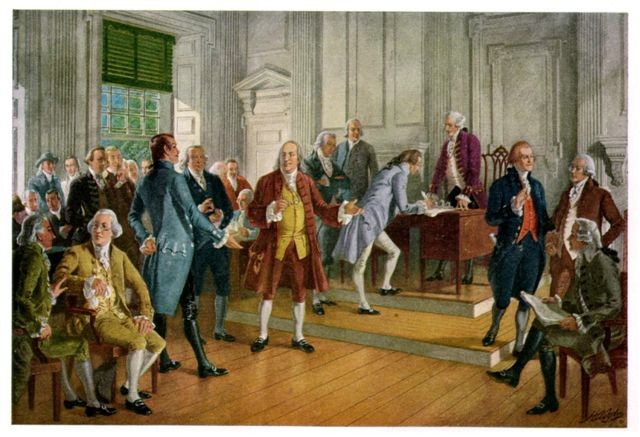
- Tableau: The final moments of the film — and the play — reproduce this painting◊.
- Take a Third Option:Adams: Tell me Mr. Thompson, out of curiosity, do you stand with Mr. Dickinson or do you stand with me?
Thompson: I stand with the general.
[beat]
Thompson: Well, lately, I've had the oddest feeling he's been writing his dispatches... to me! - Take That!:
- "I have come to the conclusion that one useless man is called a disgrace, that two are called a law firm, and three or more become a Congress!!" This is never, ever, not relevant.
- The New York legislature gets it particularly hard. New York only ever abstains ("Courteously!") when called upon to vote, because the New York Legislature had never bothered to give the New York delegation any instructions, as "they all talk very loud, and very fast, and nobody listens to anybody else, with the result that nothing ever gets done." This was just as true in 1972 as it was in 1776, and as any New Yorker will tell you, it's still true today. In the show's Broadway debut, this line got the biggest laugh out of all of them.
Morris: To hell with New York, I'll sign it anyway. - Tempting Fate: When Adams tries to convince Chase of Maryland that they can win the war against England, he lays it on a little too thick.Adams: Why, as chairman of the war committee, I can state for a fact that the Army has never been in better shape. Never have troops been more cheerful. Never have soldiers been more resolute! Never have training and discipline been more spirited! (the courier enters) Oh, good God.
- Title by Year: A 1969 Broadway play, named after the year it takes place in.
- Toilet Humor: "Rhode Island passes"; also the "calling an ox a bull" exchange.
- Tritagonist: John Adams, Benjamin Franklin and Thomas Jefferson on the side of independence from Britain.
- Dickinson and Rutledge, in favor of having the colonies remaining as British territories, can be considered the deuteragonists and foils to Adams, Jefferson and Franklin. The closest thing the "villains" have to a third member would be Wilson.
- Truth in Television:
- Vast amounts of dialogue and even song lyrics were lifted intact from the writings of the various Founding Fathers. In particular, "obnoxious and disliked" is a paraphrase of John Adams' own description, many decades after the fact, of how he felt he was viewed by the Founders and the nation in general note (although many historians feel he was an Unreliable Narrator in this respect), and his duets and discussions with the mental image of his wife Abigail are composed of passages from their letters to each other — including the "Saltpeter!"/"Pins!" Running Gag. Some of the most poetic passages, including "write to me with sentimental effusion", are direct quotes.
- Similarly, every motion made on the floor of Congress, and every modification proposed or made to the Declaration (including the briefly heard objection about it not mentioning deep-sea fishing rights!) come directly from either the Congressional minutes or Jefferson's own notes from the revision of the Declaration into its final form.
- The five dispatches read during the play are all composed of snippets taken from General Washington's actual dispatches.
- Thomson recorded the final vote as 12 to nothing, with one abstention, but his records don't state if it was indeed New York.
- And even though the passage of the Declaration did not in actuality work out to a nail-biting final vote the way the movie portrays, Judge Wilson did in fact switch sides at the very last minute, changing Pennsylvania's vote from "nay" to "yea"; his reason for this has been debated by historians for decades.
- Victorian Novel Disease: Played very straight with Delaware delegate Caesar Rodney, who had skin cancer that was killing him at the time of the Continental Congress, although it's dramatically underplayed with the small patch covering his cheek — in truth, Rodney was missing literally half of his face due to primitive surgery/cauterization treatments and kept the afflicted area hidden under a green kerchief wrapped around his head. However, he was not quite so near his deathbed as depicted here. His eighty-mile ride during a thunderstorm, suffering the effects of the cancer and asthma, is no less impressive, but he was absent because he was trying to stiffen the spines of his fellow Delawareans. The cancer itself took his life in 1784.
- Villain Song: "Cool, Considerate Men" fits, "Molasses to Rum" defines.
- Vitriolic Best Buds: Franklin is as embarrassed by John's blowhard attitude as everybody else in Congress, but does his level best to save Adams's bacon whenever he can. Adams is put off by Franklin's libertine lifestyle even as he recognizes Franklin to be the brain trust of his revolution, a harsh truth which diminishes his own contributions; in a droll scene, he predicts Franklin will wind up taking credit for the whole thing. But, at the end of the day, their constant sniping is generally affectionate, and the two men manage to cooperate and collude enough to get the Declaration made and signed.
- Adams and Jefferson. Adams is loud, demanding, and abrasive to Jefferson, while Jefferson quietly snarks back when they're in private. But Jefferson smoothly saves the floundering Adams by providing the justification for the Declaration, even winking to let him know he's got this, and Adams is sympathetic enough to him to send for his wife when he can't go home to visit her. The historical Adams and Jefferson were close friends up until their presidencies, when their political differences got too bitter, but they eventually reconciled. Adams' last words, spoken the evening of his death in Quincy, MA on July 4, 1826, were reported to be "Thomas Jefferson survives" — unaware that Jefferson had died earlier that same day at Monticello in Virginia.
- Volleying Insults: "Coward!" "Madman!" "Landlord!" "Lawyer!"
- War Is Hell:
- "Mama, Look Sharp." A young militiaman, not even a soldier, dies alone and calling for his mother.
- Thomson, who has been unfailingly dull throughout the story, chokes back tears when reading Washington's lament over sending so many boys to their deaths.Thomson: Lately, I get the feeling he's been writing to me.
- We ARE Struggling Together: One of the big, big takeaways from the play is that independence was a Foregone Conclusion only in the hindsight of history. Moreover, the victory of the independence movement was built on a lot of backroom dealing and hustling. And what's more, the new nation's ability to back the Declaration was and would remain in serious question for at least half a decade.
- Welcome Episode: Dr. Lyman Hall's arrival at Congress allows the audience to meet all the remaining (important) members of the cast.
- Wham Line:
- "Just a moment. I ask that the delegation be polled."
- "I'm sorry, John — my vote is 'yea.'"
- The moment that gives Adams his second wind:Adams: Abigail — what's in these kegs??
Abby: [singing] Saltpetre, John!
- What the Hell, Hero?:
- All the damn time to Adams. And he always deserves it, too. Even long-suffering Franklin gets tired of Adams' holier-than-thou antics when he crosses the line and impugns Franklin's anti-slavery "credentials". Kindly light-hearted old Ben lets him have it with both barrels:Franklin: The issue here is Independence! Maybe you've lost sight of that fact but I have not! How dare you jeopardize our cause, when we've come so far? These men, no matter how much we may disagree with them, are not ribbon clerks to be ordered about! They are proud, accomplished men, the cream of their colonies. And whether you like them or not, they and the people they represent will be part of this new nation that YOU hope to create. Now, either learn how to live with them, or pack up and go home, but in any case, stop acting like a Boston fishwife!
- "Molasses to Rum" is this for the entire North, noting that despite opposing the issue of slavery, northerners participate in and support the slave trade at all levels.
- All the damn time to Adams. And he always deserves it, too. Even long-suffering Franklin gets tired of Adams' holier-than-thou antics when he crosses the line and impugns Franklin's anti-slavery "credentials". Kindly light-hearted old Ben lets him have it with both barrels:
- Wild Card: Lyman Hall, the new delegate from Georgia. Cautiously, he sticks to the party line of the southerners, but overrules them by the end.
- Worthy Opponent: When Dickinson says "I regard America no less than does Mr Adams," he's not kidding; Adams and Dickinson are portrayed as both fundamentally good men and true patriots who merely differ on what they believe is best for their country. As Dickinson resigns from Congress, unable to sign the Declaration in good conscience, and sadly leaves to join the Army, Adams leads the delegates in rapping the tables with their knuckles (in the German tradition) in salute. Dickinson would later go on to sign the United States Constitution.John Adams: Gentlemen of the Congress, I say ye, John Dickinson!
- Writer's Block: Jefferson, in regards to the Declaration, much to the consternation of Adams.John Adams: Do you mean to say that it is not yet finished?
Thomas Jefferson: No sir. I mean to say that it is not yet begun. - You Need to Get Laid:
- Jefferson spends a week struggling with Writer's Block. His wife arrives, and suddenly all is well.
- It's heavily implied that John Adams' obnoxious attitude is at least somewhat due to his not being able to be with Abigail. Another piece of trivia lifted straight from history; John openly admitted in an early letter to Abigail that the longer he's apart from her, the crankier he gets, and he'd been away from her for quite awhile by the time the musical is set.
- Your Approval Fills Me with Shame: Edward Rutledge's "Molasses to Rum" number praises the Northern states' commerce of bibles and rum, and their importation of slaves, which makes it possible for Southern landowners to have slaves in the first place. New Hampshire's Josiah Bartlett eventually becomes disgusted by Rutledge's hammy singing of the slave auctioneer's cries, and asks Rutledge to cease.
- Your Little Dismissive Diminutive: Addressing Jefferson, Edward Rutledge refers to the Declaration of Independence as "your little paper there."
- Your Terrorists Are Our Freedom Fighters: Discussed quite a bit. Dickinson claims that it's always Boston starting the troublenote and views independence as a road to anarchy and mob rule, while he prefers to reconcile with Mother England. Franklin also provides a couple of pithy quotes:"Treason is a charge invented by winners as an excuse for hanging the losers."
"Rebellion is always legal in the first person, as in our rebellion! It is only in the third person, their rebellion, that it becomes illegal."