
Like we care.
Now shut up and enjoy the show.
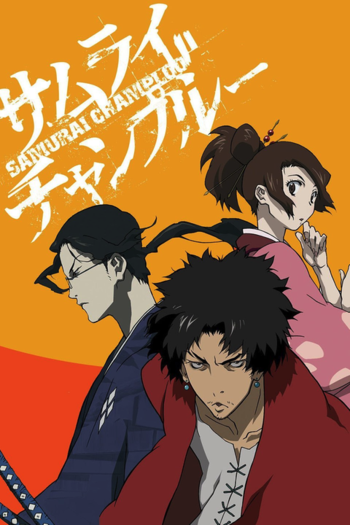
Samurai Champloo is an anime series created by Shinichiro Watanabe (of Cowboy Bebop fame) and produced by Manglobe, their first series.
The show is set in a Schizo Tech version of Edo period Japan (specifically the Bakumatsu era), featuring elements of action, adventure and comedy blended with a soundtrack predominantly rooted in hip-hop. The animation is often extremely dynamic, with a focus on highly choreographed action sequences.
The story begins when three people happen to meet during a brawl at a teahouse: a brash vagabond called Mugen, a stoic Rōnin called Jin, and a young waitress named Fuu. Mugen and Jin are outstanding swordsmen who consider each other Worthy Opponents and just want to duel it out, but Fuu manages to rope them into her own personal quest to find a mysterious samurai who "smells of sunflowers". And so the unlikely trio begin a journey across Japan, encountering dangerous enemies, dark secrets and extreme oddities along the way.
Since the three main characters don't care about each other's lives in any meaningful way, they tend to remain entirely oblivious to each other's plotlines over the course of episodes and arcs — often until it's too late. The episodes are typically self-contained, and the show has an extensive cast. Apart from the main trio, though, most characters only appear once or twice; rarely more than three times.
The show matches traditional Japanese culture to hip-hop music with a stylized form of samurai swordplay known as chambara, much in the same way Cowboy Bebop married Science Fiction to blues and Jeet Kune Do. Champloo's soundtrack features hip-hop instrumentals by artists such as the late Nujabes, Force of Nature, Tsutchie, and Fat Jon among others. It also features many traditional Japanese songs, accompanied by shamisen music.
The world of Samurai Champloo is deliberately anachronistic. Characters' costume design and attitudes, and the show's editing methods reflect heavily towards international hip-hop culture. Mugen fights in a style that resembles both Capoeira and breakdancing. Also, despite its alleged setting in the Edo period (though with a wild mixture of historical events ), many of the expressions used by the characters are modern slang or English-influenced.
Regarding its storytelling and underlying themes, many elements of the show stem from modern-day insights on the human condition as put through the unyielding taskmaster known as hierarchy, making for a juxtaposed drama comparing how life is not so much different as it was back in the old days. Be it from government corruption, class separation, discrimination, advantageous abuse, and the criminal life, Fuu, Jin, and Mugen come to face some of the more unwholesome aspects of the Tokugawa Era brought to light, all while surviving its strict rules on society.
The show's name comes from the Okinawan word "chanpurū" (e.g. goya champuru), which means to mix or blend. Thus, the title may be translated as "Samurai Remix" or "Samurai Mashup", keeping with the series' blended theme.
Most likely due to the popularity of Cowboy Bebop, it was licensed for North American distribution by Geneon nearly a year before Fuji TV even aired the show in Japan. The show can now be viewed on Hulu, YouTube, and Netflix. It aired on [adult swim] back in 2004. Reruns aired on [adult swim]'s Toonami in 2016.
A 2 volume tie-in manga debuted in Shōnen Ace on August 2004. Tokyopop licensed the manga in an English release in North America and Madman Entertainment lit for an English release in Australia and New Zealand.
A PlayStation 2 game, Samurai Champloo: Sidetracked was released after the show aired. It was developed by Suda51's Grasshopper Manufacture, written and directed by Suda himself, and had a plot mostly unrelated to the events of the show outside of characters and mood.
For another, darker, take on this theme, see Afro Samurai.
This show provides examples of:
- A-Cup Angst: Fuu is noticeably frustrated when Jin and Mugen pay attention to a woman at a bar who is fairly well endowed.
- Accidental Athlete: Mugen is drafted into playing baseball against the Eagleland navy team after the Japanese organizer sees how fast he can run from the restaurant he failed to pay at, in addition to the fact that he can throw a baseball hard enough to knock down a wooden tower about a mile away.
- Alliterative Title: English episode titles use this literary device. Japanese titles are in a traditional aphorism format.
- Airplane Arms: Mugen when trying to catch Yatsuha and get his money's worth. This is made even more amusing when the dub has Mugen add airplane noises to match.
- Ambiguous Situation: Episode 22 is a weird episode involving mushrooms, zombies, spicy wasabi, and a meteor crashing down from space and killing everyone. Was everything really the results of a Mushroom Samba? Fuu expresses doubt about eating the mushrooms and ultimately isn't shown eating them, yet still experiences the same horrors that Mugen and Jin do. Was the episode unknowingly now the viewpoint of Mugen and/or Jin while they were tripping? It would explain Fuu's involvement if it was. Regardless of theories and speculation of what actually happened, there is no explanation for anything.
- Animal Athlete Loophole: In a baseball game against the Eagleland Navy, ninja Kagemaru is a little shorthanded. Even after conscripting Mugen, Jin and Fuu, he needs five more players. So he gets a really old man (who dies in his first at-bat), Fuu's pet flying squirrel Momo, and a dog. When one of the American sailors objects, the umpire consults a rulebook, and rules that "I can't find anything about dogs in the rulebook. He's good."note
- Animation Bump: In one episode, there is a dude with the Fred Flintstone beard trick to save money. Ten minutes later they cut the rain. Yeah.
- Anime Accent Absence: Averted. Both the Dutchman in Edo and the priest in episode 19 have very, very bad Japanese pronunciation.
- Anti-Climax: In the final episode, Once all enemies have been dealt with, Mugen and Jin finally face off against each other for the fight they promised to have since meeting. Despite the fact both were already worn and weary from their previous battles only minutes ago, they will not be denied this time. Mugen and Jin charge at each other for a deathblow strike... only for their katanas break in two against each other as if all the wear and tear accumulated from the previous battles throughout the series had finally caught up to the blades.
- Artistic Age: Mugen, Jin, and Fuu are 19, 20, and 15, respectively. All of them look at least a few years older, although Fuu certainly acts 15.
- Awesomeness by Analysis: Mugen, though not overly given to intellectual pursuits, can be an insanely quick study when he wants.
- Back-to-Back Badasses:
- In Mugen and Jin's first fight, the former does a flip over the latter's back that temporarily puts them back-to-back.
- In "Elegy of Entrapment (Verse 1 and 2)", both Jin and Mugen fight Sara with their backs against each other at one point.
- Jin and Mokuro.
- Balloon Belly: Mugen, on occasion. With Fuu, it's a case of balloon body.
- Baseball Episode: NINJA BASEBALL!
- Battle Amongst the Flames: After someone sets the teahouse on fire in episode 1, Mugen and Jin still decide to continue their fight.Mugen: I can't imagine a more perfect setting.
- Battle Discretion Shot: In episode 1, as Mugen and Jin are about to fight in the burning teahouse, it cuts to a title card as hip-hop scratching is heard in the background.
- Beast and Beauty : In the second episode, Mugen is hired to kill an ogre that is terrifying the locals, but it is actually a trap set by the vengeful Ryujiro, who also kidnaps Fuu. She is guarded by the "ogre", who is actually Oniwakaru, a tall, handicapped man physically and mentally scarred by the abuse from those who feared his appearance. Although he tells her he killed a lot of people, Fuu pities him. A few hours later, Mugen comes to rescue Fuu, but his reflexes are slowed by the poison given to him by a prostitute bribed by Ryujiro, so he is easlily defeated by Oniwakaru. Ryujiro decides to kill Fuu, but Oniwakaru breaks his neck, before being stabbed by Mugen. Fuu asks the giant why he saved her life and he says "You weren't afraid of me. I'm not alone anymore," and dies watching the fireflies Fuu showed him.
- Beastly Blood Sports: In episode 11, Mugen bets on a stag beetle fight.
- Belligerent Sexual Tension:
- How fans of Fuugen often justify the pairing; based primarily on their constant arguing/making fun of/insulting each other despite repeatedly rescuing (Mugen, moreso)/crying over (Fuu, obviously) each other. It also helps that there's this gem by
 Word of God:Watanabe: "Spike and Mugen aren't very straightforward in expressing themselves. For example, even if there's a girl they like standing right in front of them, they don't pursue her directly - in fact, they do the opposite, they ignore her almost. I think that part is kind of like me. If I was to sum it up, it's kind of like being a little contradictory or rebellious."
 - Entirely canonical example with Mugen and Yatsuha: Mugen spends the entire episode trying to have sex with her, she divides her time between manipulating him through this and beating the crap out of him when he gets too forward. At the very end of the episode, however, she cheerfully tells her brother that she intends to marry Mugen once they're both finished with their respective quests.
- How fans of Fuugen often justify the pairing; based primarily on their constant arguing/making fun of/insulting each other despite repeatedly rescuing (Mugen, moreso)/crying over (Fuu, obviously) each other. It also helps that there's this gem by
- Between My Legs: The shot when Mugen confronts Shoryuu.
- Big Damn Heroes: Happens often — usually Mugen, Jin and/or Momo, given Fuu's outstanding tendency to get herself kidnapped or otherwise in trouble. Jin is a particularly notable example in episode 25.
- Big Eater: All three of them, but especially Mugen and Fuu (see Balloon Belly above).
- Big "NO!": From a minor character in a later episode.
- Big "OMG!": The priest from episode 19 screams this when he is about to be crushed by, rather fittingly, a giant crucifix.
- Blinded by the Light: Fuu uses a pair of fireworks to confuse and blind the guards at the execution site so Mugen and Jin can escape.
- Blind Weaponmaster: Sara shows some characteristics of this, especially when she defeats and nearly kills both Jin and Mugen with her spear skills.
- Blind Without 'Em: Subverted: It turns out Jin's glasses were just for show, much to Mugen's surprise. The fact that he's very attached to them probably led to this misunderstanding.
- Blood from the Mouth: Countless times, and just about always fatal.
- Blood Knight: Mugen and Shōryū mainly, though Kariya Kagetoki has shades of it.
- Bloodstained Glass Windows: Okay, so the church in episodes 25-26 doesn't have any glass windows, and the one in episode 19 has none at all, but they are churches, and people are fighting in them, so...
- Bodyguard Crush: Fuu seems to idolize both Jin and Mugen at different points in the series. Jin is very protective of Fuu, but whether this is a romantic interest, a brotherly/fatherly interest or just yojimbo dutifulness is difficult to say. His emotional restraint makes this even more difficult to fathom, even though he seems to be more in tune with Fuu's emotions, as he's usually the one who notices when Fuu feels down or the one who runs after her when she leaves. On the other hand, brash Mugen is often argued to be in denial of a crush on Fuu; he rushes to her rescue very noticeably in numerous episodes while Jin engages a different enemy and the two tend to interact a lot more than Fuu and Jin. This tends to make him a more popular choice for
 Shipping with Fuu than Jin.
 - Born in the Wrong Century: Kariya Kagetoki and Jin.
- Bound and Gagged: Happens to Fuu a few times.
- Bowdlerise: The original [adult swim] broadcast back in 2006 was edited to remove blood and nudity (especially in episode five, where the ukiyo-e paintings were edited to have nipples removed and remove the paintings of Japanese women getting raped), and had swear words bleeped out with a record scratch effect (which most viewers claimed was a creative way of doing it, as it fit with the show's hip-hop aesthetic and wasn't as jarring as bleeping or muting, along with being more cost-effective than having the dialogue re-written to be less offensive and getting the voice actors in to record the new lines). Now that Toonami is back and airing shows that are much worse in terms of bloody violence and cursing (though some sex and nudity is still censored, as seen in Kill La Kill and when Cartoon Network finally aired the long-banned Outlaw Star episode "Hot Springs Planet Tenrei" in 2018. However, the censorship for sex and nudity isn't as heavy or invasive now as it was back in the late-1990s into the mid-2000s), Samurai Champloo is more-or-less uncut and uncensored (at worst, the offending scenes are lightly edited).
- Bread, Eggs, Milk, Squick: In "Elegy of Entrapment, Verse 2", when Fuu and Jin sense that Sara is being manipulated, Mugen responds with "Take your pick. We've dined and dashed, snuck through a checkpoint, and, oh yeah, killed people."
- Break the Cutie: Koza in "Misguided Miscreants" is already broken before the episode begins, because she's been living on a destitute island all her life with no family or friends, only sticking around Mukuro because there was nobody else, and she knows she can't survive on her own. Then her situation only gets worse.
- Brick Joke: At the end of the last episode, Fuu reveals that the coin she had flipped had actually landed on heads, meaning Mugen and Jin had been free to fight each other the whole time.
- Broke Episode: One of the three major episode situations of Samurai Champloo. Usually the responsibility for getting money/food/other necessary items falls on Jin; Mugen and Fuu force him to pawn his swords at least twice and his glasses once. However, in episode 11, Jin borrows at least one Ryō from Mugen (won it on beetle sumo wrestling) to "buy a woman," so it might be warranted in the rest of the series.
- Brush-Off Walk-Off: The "Misguided Miscreants" arc sees Mugen return to his home island, only to get involved in a lot of trouble over finding pirate treasure with his childhood friend Koza, who has developed chronic dependency on others and Chronic Backstabbing Disorder just to survive. After she gets her revenge on Mukuro by having Jin kill him for her, she runs off with her new boyfriend after thinking that she can finally leave that criminal island and start a new life. When they both see a limping implacable Mugen marching along the same road, her boyfriend attacks and gets effortlessly cut down. Koza begs for Mugen to end her life as well, as death would be better than continuing her life of destitution at this point. Without saying a word, Mugen just keeps on walking and leaves her to her fate of being alone.
- But for Me, It Was Tuesday: Mugen doesn't remember many of the people who come after him in the series in a rare (anti)heroic example of this:One Armed Man: I'm not going to let you say you forgot about this arm.
Mugen: Sorry...who are you? - The Cameo/Take That!: Mugen admits he killed some "weird old guy", who happens to be Mito Komon. Hilarious, if you know the context.note
- Carrying the Antidote: The deranged, revenge-driven Ryujiro in episode two.
- Character Development: Most prominent in the last arc where it shows how much Mugen, Jin, and Fuu changed since their meeting.
- Chromatic Arrangement: The three random rappers.
- Clip Show: Disorder Diaries is about fifty percent clip show, with the rest being a bit of character development and a bunch of MANZO THE SAW!
- Clueless Detective: Manzo the Saw.
- The Comically Serious: Jin.
- Contrived Clumsiness: In the third episode, Jin and Mugen leave Fuu to fend for herself. She wanders through an alley where two men are; they nudge a vase into her path for her to break, she apologizes, they tell her to pay up, she tells them she doesn't have any money, so they use the pretext to kidnap her.
- Creative Closing Credits: Ep 17 and 26 which eschews the usual credits for different images and songs.
- Credits Gag: The zombie episode. The closing credit start as usual but then the music suddenly slows to a crawl and stops before being replaced by a very eerie tone as the pictures continue to roll. Until it suddenly reaches a grave stone and hand suddenly pops out of it before going full screen to show the lead zombie of the episode pulling himself out and roaring at the camera. A fitting way to end such a bizarre episode.
- Curse Cut Short: In episode 1, after seeing the old man getting harassed at the teahouse, Fuu shouts "YOU GUYS ARE A BUNCH OF—" before being taken away.
- Cutlass Between the Teeth: Mugen in one scene when climbing a cliff.
- Damsel in Distress: Fuu. Given how often she gets in trouble, often being Bound and Gagged, she comes off as rather sensible for hiring two capable bodyguards. This is Truth in Television. In Edo period Japan, it was not only incredibly dangerous, but actually illegal for a teenage girl to travel without some sort of legal guardian like Fuu does. She would be stopped and questioned by law enforcement on sight, unless brothel "recruiters" got her first (like one of the episodes shows).
- Dance Battler: Mugen may very well be the ultimate example.
- Deadly Sparring: One episode deals with a disgraced martial arts student from China who took to killing his sparring opponents when they couldn't defeat him, an action which horrified his peers and the dojo master.
- Death Is the Only Option: Jin uses a move that abandons defense and allows the enemy to stab him in order to get close enough to stab the enemy.
- Defective Detective: Manzo the Saw.
- Delayed Narrator Introduction: Manzo does this where he introduces who he is after he'd already been the voice narrating.
- Deliberate Injury Gambit: That's how Jin finally manages to defeat Kariya Kagetoki. As Jin's sensei explained, this is the only way to injure an opponent much stronger than yourself.
- Determinator: Mugen, but only when enticed by hot ninja nookie. Jin as well in the very last episode. Okuru definitely counts in Episode 17. He is shot twice by flaming arrows, but instead of falling over and dying, he pulls one of the arrows out of his chest and stabs a soldier to death with it before jumping off a cliff into the waterfall basin. Mugen is convinced he's still alive.
- Deus ex Machina:
- In Episode 9, Mugen and the unnamed government official attempt to escape from Tengu by starting a fire and escaping as they attempt to put it out. They get caught anyway, but during the fight the Tengu's marijuana crops burn up and everyone gets high off the smoke; by sheer luck, the smoke crosses over to the checkpoint where Jin and Fuu are about to be executed, allowing them to escape.
- Usually avoided with Momo-san. Although the critter could be a Deus ex Machina in a lot of situations, it tends to just sit there or run away scared. It only really helps out twice or thrice.
- Dine and Dash: On one occasion, Mugen orders extra food, and then assures Jin and Fuu that he's got it handled, despite the three of them being in Perpetual Poverty. When it comes time to pay, Mugen "handles" it by... taking a runner's stance and bolting out the door, leaving the other two to fend for themselves from the angry staff.
- Disability Superpower: Sara. With the exception of Kagetoki, she is easily the most dangerous fighter in the series.
- Does This Remind You of Anything?: In his introductory episode, there are a couple of scenes where it looks/sounds like Manzo the Saw is masturbating, but it turns out to be something innocent (i.e. exercising with his unique weapon). This is probably because he's a parody of Hanzo the Razor, who engaged in some unique sexual practices.
- Double Entendre: A conversation during Isaac Kitching's (a.k.a., the guy from Holland's) last scenes goes a little something like this. Normally, it wouldn't sound so bad. However, if you remember why Isaac came to Japan in the first place as Jouji, it takes on a whole new meaning:Isaac: But someday, the country will come to accept people like me. Someday, this country won't be so tight-assed.
Mugen: Like anybody's gonna be able to relax their ass with you around. - The Dulcinea Effect: Zigzagged throughout the series:
- In the first episode, Mugen offers, unprompted, to help Fuu with her teahouse's thug problem... in exchange for food. When said thugs actually threaten to cut off her fingers, Mugen lounges on his table until Fuu promises him dumplings to save her.
- However, as early as the second episode, Mugen nearly verges into Always Save the Girl status, barely reacting to the woman who poisoned him until she mentions that Fuu is in danger and killing anyone who gets in between himself and Fuu (including Oniwakamaru, who would have surrendered).
- Played perfectly straight in the episode eleven with Shino, whom Jin immediately falls in love with.
- Eagleland:
- The baseball episode. The Americans, which include the people who invented the sport, are portrayed as blatantly cheating, violent, murderous thugs who consider the Japanese team to be ignorant savages. When the game dissolves into a beaning match which ends with Mugen as the last man standing, he then yells "Go back to your own damn country!" The narrator then helpfully adds that the Americans went home in shame, with a profound fear of the Japanese people.
- It's a fond, borne-out-of-mutual-love-and-admiration Type Two variation, in case you were wondering.
- Earn Your Happy Ending: Fuu finally meets her father, in time to see him killed by Kariya, who is in turn killed by Jin. While recovering from their injuries, Mugen admits that he doesn't want to kill Jin anymore, and Jin admits that after spending years as a loner, he's glad to have friends to travel with. Fuu suggests they should meet again sometime, and they all go their separate ways.
- Evasive Fight-Thread Episode: Played straight or subverted, depending on the episode.
- Everything's Deader with Zombies: An episode ("Cosmic Collisions"), which, funny enough, focuses on mushrooms.
- Evil Colonialist: "Francisco Xavier", who claims to be a descendant of the original (eventually Saint) Francis Xavier, the Portugese monk who brought Christianity to Japan. His constant condescension and firearms that are impressive by today's standards mark him as a Western-style villain... until it's revealed that he's actually a Japanese guy who was taking advantage of the Christian underground for his own profit.
- Evil Counterpart: Mukuro and Kariya Kagetoki, for Mugen and Jin, respectively.
- Expository Hairstyle Change: An example that requires knowledge of Edo-era fashion: Jin's very long bangs/sideburns plus long ponytail are a strange hairstyle for a samurai. Most other samurai in the series either have the short bangs plus ponytail style suitable for teenagers and apprentices or the tonsured style favored by older men, especially bureaucrats. When we start seeing Jin's backstory flashbacks, it becomes clear that he used to have the apprentice style, but stopped cutting it after he became a ronin. His bangs have gone from above his eyebrows to his jawline, suggesting that the time between the flashbacks and the main series timeline is about 3-6 months.
- Expy:
- Mugen resembles Spike Spiegel in the hairstyle, and they're also both voiced by Steve Blum in the English dub. However, Mugen and Spike are quite different characters otherwise; Mugen is as aggressive as Spike is laid-back.
- Sara is an homage to the blind swordsman Zatoichi.
- Fuu is based on Ai Hayakawa from the character designer's previous work, Final Fantasy: Unlimited — right down to the hair bun/ponytail hybrid.
- Field of Blades: Seen in the opening sequence.
- Fingore: How Mugen counts on the fingers of the daimyo's son in the first episode (less severe than usual examples, though).
- Fire-Forged Friends: Fuu managed to convince Jin and Mugen to be her bodyguards through persistence and getting in the middle of their Duel to the Death. The first handful of episodes show the group on really shaky ground, often with all of them splitting up or Mugen and Jin restarting the duel early, and definitely runs into With Friends Like These... from time to time. By the halfway point, they have come to respect each other, but pelt each other with numerous snide comments out of habit, and Mugen and Jin start taking the responsibility of protecting Fuu seriously.
- Flash Step: Kariya, and briefly Jin. In both cases they're less "almost teleporting" and more "Kitty Pride-ing".
- Foreshadowing: In Episode 5 "Artistic Anarchy", during the match of shogi against the old man, Jin mentions how his master used to say shogi is similar to swordfight in that the one who manages to read ahead wins and says how he was never able to beat his master in shogi. When the old man asks him if Jin was able to best him in swords, the audience doesn't learn the answer. We later learn that Jin did end up defeating his master, and it is the primary reason why he is Walking the Earth.
- Freudian Trio: Mugen's the Id; Jin's the Superego; Fuu's the Ego.
- Games of the Elderly: The B-plot of an episode had Jin spend time gambling with an old man at a game of shogi while other old men watched in awe. This meets back up with the A-plot when it turns out Jin's opponent is also the head of a human trafficking ring Mugen and Fu have been dealing with.
- Gangsta Style: Mukuro.
- Genocide from the Inside: The samurai that Mugen interrogates about Okuru believes that Okuru killed his own clan before attacking other samurai from the Matsumae clan. It's not true. Okuru's clan was wiped out by disease, and he attacked the samurai in the middle of a Heroic BSoD when he saw them destroying and setting fire to his village to contain the epidemic rather than try to help survivors.
- Genre-Busting: Not to the extent of Cowboy Bebop, but it features at least elements of many genres.
- Gonk: Once in a while, especially the guy who hits on Fuu while she's making scary faces.
- Government Conspiracy: Although it isn't discussed much, the driving force behind the series is essentially the shogunate's attempts to drive the Christians, of whom Fuu's father is the leader, out of Japan.
- Gratuitous English: The song in the closing credits of episode 26. Hell, even the American baseball players in episode 23. Complete with gratuitous profanity and racial slurs.
- Gratuitous Italian: A single example in the manga. Immediately lampshaded by Fuu.
- The Grotesque: Oniwakamaru.
- Ham and Deadpan Duo: Mugen and Jin
- Heavy Voice: Fuu gets one whenever she gorges herself to bloatation.
- Henohenomoheji: The baseball catcher doll in episode 23 "Baseball Blues" has a Henohenomeheji on its face.
- Heroic Comedic Sociopath: Mugen (though lower on the "sociopath" than most).
- High-Dive Escape:
- An early episode has an assassin dueling with Jin. After Mugen kills his employer, he tells Jin that there's now no need for him to kill, and gives a We Will Meet Again before calmly walking away.
- Mugen possibly qualifies for this as well, in a flashback scene where he escaped a justifiable execution by leaping backward off the cliff to fall into the ocean below, complete with manic wide-eyed grin all the way down. However, this might have been more of an attempted suicide than escape - it was a high cliff - given the speech just before when he claimed he didn't accept help from anyone, least of all into his grave. That he survived was apparently just a lucky coincidence.
- High-Pressure Blood: Though not as often as usual examples.
- Historical Villain Upgrade: Needless to say, the real Alexander Cartwright and Abner Doubleday weren't nearly as unlikeable as they're portrayed in episode 23.
- Hollywood Healing: Both Jin and Mugen (the latter more so than the former) get multiple deep cuts and heavy bruising, cough up copious amounts of blood, and lose teeth, but usually in one episodes' time are healed right up. Their numerous injuries are never mentioned or seen in the following episode. This is somewhat justifiable, given that they're making a long journey on foot, and some time may be presumed to pass between one episode and the next.
- How We Got Here: The first episode ("Tempestuous Temperaments") opens In Medias Res, with Mugen and Jin facing death at the execution stand, and moments later the scene fades to "Three Days Earlier"... which is a present-day metropolis before the scene fast-forwards two days ahead back to the Edo period, which explains how Mugen and Jin got in trouble in the first place.
- Iconic Item: All three of the characters have signature weapons that they carry with them from start to finish in the series. Although Fuu is the only one to never once use her little pink blade for anything other than carrying her dangly charms.
- Idiosyncratic Episode Naming: The original Japanese titles are all yojijukugo, four-kanji idioms that have to be translated as a single unit (ex: Episode 24 is Seishiryuten, which translates most closely as "The Circle of Transmigration"). The closest English literary device would be a cliche idiom like "the sound and the fury", but that really misses out on the classically poetic connotations of yojijukugo. The English episode titles try to get some of that poetic mojo back with full-on Beowulf-style alliteration, one of the oldest poetic forms in the English language (ex: Episode 24 becomes "Evanescent Encounter").
- Implausible Fencing Powers: Mugen and Jin both use them regularly, mostly of the "inhuman speed and precision" style (such as cutting arrows out of the air), or one notable incident where the two of them simultaneously Clean Cut through a pair of fruit stacked on Fuu's head, while both of them are blindfolded and hungover. Individual enemies they face bring their own brand to the table: one channels Ki Manipulation through his sword and can kill people without cutting them, and another is a Blind Weapon Master, for example.
- Improv Fu: This characterizes Mugen's fighting style, especially against Jin's traditional Master Swordsman. He uses Dance Battler moves, and his sandals have metal sheets on the bottom to act as multiple deflection points.
- Incest Subtext: Completely one-sided. At one point in "Misguided Miscreants", Mukuro caresses Koza's face. The implication that the two are Not Blood Siblings does little to allay the squick.
- Informed Attribute: Mugen is frequently referred to as physically ugly and unattractive, but he sure doesn't look it (most of the time).
- Instrument of Murder: In the first part of "Hellhounds for Hire", Jin is disguised as a woman carrying a shamisen (a traditional Japanese instrument similar to a guitar). When asked to play a song on it, he pulls his katana from the neck, and reveals that he is actually a samurai. He also happened to have smoke bombs hidden in the body of the instrument. Sara's shamisen is a slightly more traditional example of this trope, with a spear serving as the neck and the tuning heads doubling as throwing darts.
- Invincible Hero: Mugen and Jin are pretty overpowered until much later on...
- Jidaigeki: A notably subversive take on the genre; besides the deliberate anachronisms, much of the cast are people from the fringes of Edo-era society who are typically wholly absent in most Jidaigeki works.
- Jump Scare: Happens in "Cosmic Collisions", right at the end of the closing credits: the relaxing credits theme suddenly distorts and fades away, a grave is shown, then a hand emerges from the ground, followed by the whole body of a zombie who screams at the camera.
- Kabuki Theatre: The trio attend a Kabuki play with Isaac Titsingh. Isaac confesses that he enjoys it because the all-male actors must don makeup and clothing in order to play the parts of women as well as men. This allows him to see men in a more feminine light and find them more attractive.
- Ki Manipulation: With a twist: the main characters don't use it (save for Mugen on one single, lucky occasion), and your garden-variety bad guy doesn't, either. Only a handful of villains have them, and they're the toughest in the Champloo universe.
- Knight, Knave, and Squire: Jin is The Knight, a Ronin Samurai who was taught swordsmanship in a dojo; he is chivalrous and only battles worthy opponents, considering everyone else beneath his notice. Mugen is The Knave, completely self taught, with a battle style that is all over the place; he's a criminal and Combat Pragmatist and extremely rude and aggressive to the point he'll start a fight with someone who looks tough just because he's bored. Fuu is The Squire; young and inexperienced with no fighting abilities, she often ends up being a Damsel in Distress, but the main plot hinges upon her decision to team up with the two fighters.
- Large Ham: Bundai and Manzo the Saw.
- The Last DJ: Jin.
- Lighter and Softer: Compared to Cowboy Bebop. Though Cowboy Bebop had goofy episodes, and Samurai Champloo had serious episodes, Champloo tended to have a lighter tone overall with a number of very outlandish visual gags. While Bebop has a Downer Ending, Champloo has an almost completely upbeat ending, with the three main characters parting ways as friends and the only entirely sorrowful aspect being the death of Fuu's ailing father.
- Lemony Narrator: Several episodes have one who makes anachronistic references to the future; all of those narrated by Manzo definitely count.
- Locked Out of the Loop: Well, "locked" implies more investment in the mystery than they actually have. Jin and Mugen spend 99% of the series without a clue what Fuu is really looking for. Jin just doesn't care, and Mugen can't bring himself to pay attention. They eventually steal Fuu's diary to get a better idea of what's going on, but that plan fails fairly quickly. Mugen doesn't even realize that Fuu has a pet squirrel until halfway through the series.
- Look Behind You
- Made of Iron: Jin and Mugen are pretty damn persistent. While they can't entirely shrug off serious injury, Mugen survives being stabbed, falling off a cliff, almost drowning and getting shot. Jin should have drowned twice and survives a freakin' suicide technique.
- Mama Bear: Sara once was one.
- Marijuana Is LSD: In "Beatbox Bandits", Mugen's fight scene with the warrior priests is quite colorful and non-euclidean due to the burning cannabis fields.
- Martial Arts for Mundane Purposes: In one episode, some of the best swordsmen in Japan use their skills... to play baseball. Subverted when Mugen tries to use his breakdance fighting skills to pitch... and throws foul ball after foul ball after foul ball.
- Maybe Magic, Maybe Mundane: The encounter with Heike Shige and his men. On one hand, the mushrooms were strongly implied to be hallucinogenic, and there is no explanation made of how the trio was able to eat nothing but wasabi for days while doing heavy labor and not collapse, or how they were able to survive a meteor strike. On the other hand, Fuu didn't eat any of the mushrooms, but she saw Shige and his men as well and was the first to notice something off about them, and walked right into the middle of the mass grave that a horde of zombies rose from while Mugen and Jin were off in the shack, and she appeared to have seen the same things that they saw. The whole thing is extremely ambiguous, and no mention was ever made of it after the episode.
- Mirror Character: Mugen and Jin. At first glance, they seem to be as different as night and day. Mugen's incredibly brash and always itching for a fight, while Jin's calm and composed and an honourable warrior. Their colour schemes and general attitude also reflect this. However, the two are a lot more like each other than they'd like to admit, right down to both being morally ambiguous drifters and excellent swordsmen. Mugen claims to be a loner and hates everyone, but he already shows some heroic tendencies and concern for Fuu by the second episode. Meanwhile, Jin is actually rather cold, irritable, and even arrogant, especially in regards to Mugen. Both Mugen and Jin also enjoy the company of prostitutes (though Mugen enjoys them more so), both love to fight, and both never back down from a challenge. At the end of Fuu's quest, they both grow to become better people.
- Mistaken for Gay:
- At one point, an old man (actually an assassin guising himself as a harmless weakling) comes across Jin in a hot spring. They have a (largely one sided) conversation about fireflies, until the stranger gives a suggestive smile and comments that sometimes the male fireflies can attract other male fireflies instead of females. Jin promptly excuses himself.
Jin: Time to go...- Mugen shows surprise when Jin later pursues a prostitute, and explicitly states this was the reason.
- Model Scam: Subverted. The artist that approaches Fuu in this way is attracted to Fuu, but turns out to be harmless. Doubly subverted, as the true use for his art was Not So Harmless.
- Monochrome Past: Shōryū's backstory in "Lethal Lunacy" is definitely this, well-presented with a black-and-white 1930s film style.
- Motivational Lie: Yatsuha gets Mugen to help her battle ninjas by promising to have sex with him; afterwards, she knocks him out.
- Mr. Fanservice: Jin, when his hair is loose and he is not wearing glasses. Or even when he is.
- Mukokuseki: Almost completely averted. Everyone has dark eyes, and hair color is mostly black or dark brown. Several characters' eyebrows even look Japanese. When a Dutch character shows up, the characters note his unusual features with red hair and blue eyes. Subverted with the prefect's son in the first episode, who has bleach-blond anachronistic hair.
- Multi-Part Episode: There are four two-part episodes ("Hellhounds for Hire", "Misguided Miscreants", "Lullabies of the Lost", "Elegy of Entrapment") throughout the series, and one three-part episode at the very end ("Evanescent Encounter").
- Mundane Made Awesome:
- 'This is a story of men whose souls burned with a passion for baseball!'
- Learning to read.
- "Beetle Sumo". It's really just two bugs on a rock trying to push each other off. But you throw in mood lighting, dynamic camera angles, and sparks when they push against each other...
- Painting graffiti.
- The eating contest, complete with commentators and asking important existential questions.
- Mushroom Samba:
- An incident involving a burning field of pot, and maybe the episode where they ate mushrooms and were attacked by zombies, died, and got hit by a meteor. "Maybe" because so far no-one has a concrete explanation for what the hell happened. Most believe the mushrooms they ate were bad, but the fact that Fuu isn't shown eating any of the mushrooms puts that theory into question.
- The female assassin in Episode 2 passes a poisonous mushroom to Mugen via kiss - it's called "the single night mushroom" because that's how long you're expected to live if you combine it with sake.
- My Life Flashed Before My Eyes: In Episode 14, as Mugen is drowning, he has flashbacks of his hellish childhood in Ryukyu, and of Koza and Mukuro, while a tear jerkingly beautiful song plays in the background. Though technically he does die at this point, he comes back to life through sheer force of will.
- My Master, Right or Wrong: Many unnamed characters. In a variation, they don't seem sickened by the evil of their actions; they justify their actions on the basis that a samurai's honor depends upon obeying his master's orders. Jin calls them out on it in the first episode.
- Myth Arc: The trio's search for the samurai who smells of sunflowers.
- Negative Continuity: While there is an acknowledged Myth Arc (see above), several episodes come across as rather significant filler that has no bearing on the ongoing plot. The two episodes right before the 3-part finale show everyone getting either severely injured or possibly killed while the finale shows everyone in perfect health.
- Never Found the Body: Repeatedly. On several occasions, the opponent didn't fall for it either. Oddly enough, it seems to be inversely proportional to actual combat strength. The more powerful enemies seemed to completely fall for it, while relatively weak ones did not.
- Never Learned to Read: Mugen. Until he did.
- New Era Speech: Yakuza boss Rikiei gives some to Mugen about his views of the future and his criminal enterprise. Rikiei views that Japan's social hierarchy is coming apart and soon, status won't mean anything. Rikiei's acquiring of money is how he views success in this new era especially at the expense of others.
- Ninja: Yatsuha and Kagemaru.
- Non-Human Sidekick: Momo the flying squirrel.
- No One Could Survive That!: Said word for word after the Rope Bridge incident. Probably implied elsewhere.
- The Only One Allowed to Defeat You: Jin and Mugen, mutually.
- Oh, Crap!: Mugen, involves explosives. Twice.
- Otaku: Isaac. He has an extreme fascination with Japan and Japanese culture.
- Parental Abandonment: All three in various ways: Fuu, literally her parents; Jin, his master; and Mugen, his whole family.
- Percussive Pickpocket: Shinsuke steals from Fuu (and others) in this manner at the beginning of "A Risky Racket".
- Performer Guise: There is an episode where Jin infiltrates a Yakuza-run brothel by disguising himself as a surprisingly convincing geisha carrying a shamisen (a traditional Japanese instrument similar to a guitar). When asked to play a song on it, he pulls his katana from the neck, and reveals that he is actually a samurai. He also happened to have smoke bombs hidden in the body of the instrument.
- Perma-Stubble: Mugen has one.
- Pirate: Mugen, formerly. Mukuro and Koza as well.
- Platonic Prostitution: Played straight and later subverted in the same scene, in that Jin pays for time with a prostitute to rescue her. And then they make love (completely implied and not shown of course).
- Plucky Girl: Fuu.
- Precision F-Strike: In the English dub, Jin swears exactly one time (oddly enough in his introduction).Jin: To serve your lord and do his bidding, is that honorable? Even if that lord is an unimportant piece of shit?
- Pretty Fly for a White Guy: Isaac.
- Progressive Era Montage: The first one does it backwards as a gag, as the "three days earlier" scene first mistakenly shows a bustling modern city, then "rewinds" through 200-odd years of development and urbanization, until finally arriving at a sleepy post-town of the mid-to-late Edo Period.
- Psycho for Hire: Ryujiro Sasaki and the Three Brothers.
- Purely Aesthetic Era: The series opens with a title card declaring that it is not historically accurate. It then gleefully throws everything it can get its hands on, from hip-hop to baseball, into the Edo period of Japan.
- Purely Aesthetic Glasses: Jin. He can see without them. They're also anachronistic.
- The Quiet One: Jin.
- Rain Aura
- "Reading Is Cool" Aesop: Mugen learns to read in "War of the Words" and uses his new knowledge to win a graffiti battle.
- He also takes it a bit too far, later vandalizing everything in reach with his newfound written words (including his friends, their clothing, and their possessions).
- Recap Episode: Episode 12.
- Red Light District: This series will tell you more about Edo-period brothels than you ever expected to know.
- Red Oni, Blue Oni: Mugen and Jin are classic examples. Mugen is red, Jin is blue — this color-coding extends even to their character flashbacks, with Jin's tinted cool blue and Mugen's burning orange (Fuu's flashbacks are gold or green-tinted). Mugen is associated with fire, Jin is associated with water. In the opening sequence, Mugen is associated with the rooster, Jin is associated with fish.
- Retcon: When the context of Jin's fight with his master is finally given in episode 25, the scene plays out differently from the way we've seen it in previous flashbacks.
- The Reveal: Though we don't know the full information behind the Samurai Who Smells of Sunflowers until the final few episodes, a lot is revealed in Episode 19, "Unholy Union." His name is revealed, his status as a Japanese Christian, and his relationship to Fuu: he's her father.
- Riddle for the Ages:
- Ridiculously Cute Critter: Momo the flying squirrel.
- Rock–Paper–Scissors: It's the samurai way of doing things!
- Rocks Fall, Everyone Dies: The ending of the completely random zombie episode ("Cosmic Collisions").
- Rōnin: Jin.
- Rope Bridge: Featured in episode 21.
- Rule of Cool: A lot of the things going on subscribe to this. It. Is. Awesome.
- Samurai
- Schizo Tech: Pretty much the entire premise, really.
- Searching for the Lost Relative: This is one of the big reveals from the serie. The "Samurai who smells of sunflowers" that Fuu hired Jin and Mugen to find is her father, a Japanese Christian who is a target of the government. He initially left Fuu and her mother to protect other believers, then stayed away after the government performed a harsh purge of the Christians, knowing that he and those around him would be targets for the wrath of the Shogunate. When Fuu finds him in the final episodes, he's on death's door due to tuberculosis, not even able to get up from his bed.
- Serious Business:
- Baseball.
- Learning to read, although justified.
- Shirtless Scene: Several, but Jin's in the last episode is especially memorable.
- Shout-Out: Lots of 'em. For example, the opening sequence of episode 18 features silhouettes of the main trio sitting in front of a movie screen.
- Shown Their Work: Despite the Anachronism Stew, several parts of the show, including everything mentioned about the Shimabara Rebellion, are historically accurate. More can be found under the Trivia tab.
- Shrouded in Myth: The Ghost of Yoshitsune. Sort of. It all turned out to be a combination of rumors about Anti-Villain Okuru and Jin (including one about how handsome he is), deliberately spread by Yukimaru.
- Single-Stroke Battle
- Sinister Scythe: Umanosuke, leader of the three brothers.
- Snap Back: All three of the main characters die in an explosion at the end of Episode 22, complete with a resolute "The End." In the remaining four episodes of the series, this is never mentioned again. The general consensus is that they ate bad mushrooms and the whole episode was a hallucination, but considering Fuu at the least isn't shown eating any and still experienced all the same things just raises further questions.
- Stealth Pun: When the illiterate Mugen learns to write, he writes his name with the ∞ symbol. His name means "Infinity" in Japanese.
- The Stinger: Shige rising from the grave during the end credits of Episode 22.
- The Stoic: Jin. Sara too, enough to give Jin a run for his money and his life. The Kawara boss as well. The two engage themselves in a very charming conversation in the fourth episode.
- Stock Wushu Weapons: Ukon from Lethal Lunacy came back from China with an insane bloodlust, a mastery of deadly martial arts and a typical dao instead of his uchigatana.
- Straight Man and Wise Guy: Jin and Mugen
- Suspiciously Specific Denial: Fuu.Mugen: You're jealous, aren'tcha?Fuu: Huh?! Of course I'm not jealous! What in the world would lead you to believe I'm jealous?! Nope! Lone wolf wannabes like Jin with that far-off look of theirs, the kind that doesn't let you know at all what they're thinking, are so not my type. (Mugen rolls over, asleep and snoring, and she grimaces and snaps) And they snore!
- Swipe Your Blade Off
- Sword Beam: Shoryuu.
- Sword Fight: Inevitably, up to and including many of its subtropes:
- Flynning is notably averted. It's the speed of the action that adds excitement to the fight scenes, not the amount of movement. Jin and Mugen's rivalry even started because they were accustomed to a Single-Stroke Battle and were annoyed it took longer than that. The movements used were often very carefully choreographed into the script, making each fight scene distinct from all the others.
- Barehanded Blade Block: A subversion, in the 25th episode Mugen kills the first of the three brothers by allowing his claws to go through Mugen's hand in order to deliver the killing blow.
- Tall, Dark, and Snarky: Both Jin and Mugen.
- Tengu: The crazed mountain-priests in episode 9 disguise themselves as tengu.
- Thematic Theme Tune
- Theme Tune Rap: And it's in perfect English.
- Thick-Line Animation: At times.
- Toplessness from the Back: The artist who wants to draw Fuu asks her to lower her kimono collar, invoking this.
- True Art Is Incomprehensible: In-universe example: Fuu meets a struggling artist named Hishikawa Moronobu (an actual historical figure who helped make the Ukiyo-e art style famous), who can't seem to find a good inspiration for his works. He sees Fuu, and is inspired to create a famous painting called "Backwards Beauty". Fuu said she liked the painting because he gave her very large breasts.Mugen: (to Fuu, about Hishikawa) Are you sure you wanna let that guy go?
Fuu: I don't really care. I mean, he did give me a great set of hooters.
Mugen & Jin: (in surprised shock) Set of hooters?! - True Companions: The main trio of Jin, Mugen, and Fuu. In some ways, they seem to hate each other. But underneath it all, they're steadfast companions.
- Victoria's Secret Compartment: Fuu has a pet flying squirrel named Momo who lives in her kimono.
- Vitriolic Best Buds: The main trio fit pretty comfortably in the Type 2 category, especially Mugen and Jin.
- Vomit Indiscretion Shot: Some of the losers of the Edo eating contest.
- Wham Line:
- Jin to Mugen: "Take care of Fuu," leaves Mugen completely blank for a second.
- Mugen's "I have lived through every form of misery you can imagine; I have nothing to learn from you," to the middle brother makes him cut all the semantics and finally snap.
- Fuu's final line of dialogue in the last episode also applies.
- William Telling: Our three adventurers are (as usual) broke, so they try to raise money with a demonstration of their swordplay. Mugen and Jin are blindfolded and have to cut two fruits balanced one-on-top-of-the-other upon a nervous Fuu's head. It doesn't help that Mugen and Jin are visibly hung-over from last night's debauchery.
- Wrecked Weapon: A double instance is the result of Mugen and Jin finally having their to-the-death duel in Ep. 26. It's a somewhat unusual use of the trope, since instead of magnifying their rage, this gives both guys an honorable means of waiving a promise neither of them wants to fulfil.
- "You!" Squared: Done repeatedly between Jin and Mugen.
* Zombie Apocalypse: All Just a Dream... we think.
