

WipEout (sometimes styled as wipEout or wipE'out") is a series of futuristic racing games developed by SCE Studio Liverpool (formerly Psygnosis), widely regarded as the PlayStation's answer to Nintendo's F-Zero series.note
Players races on gravity-defying race tracks using a variety of AG (Anti-Gravity) crafts boosting at speeds of several hundred kilometers per hour (sometimes going faster than the speed of sound), while exchanging weapons fire and attempting to avoid potential elimination from taking too much damage (an element introduced in the second game). Unlike many other racing games at the time, gravity and momentum plays a huge part in controlling these high-speed crafts, requiring when to use its air-brakes and (later on) side-shifting features to perfectly maneuver the tracks as each track has sharp corners, banking turns and narrow shortcuts that guarantees your craft crashing into a nearby wall and losing a lot of speed.
Visuals, atmosphere and music are three of the hallmarks of the WipEout series; the first three games were made in cooperation with well-known Sheffield design agency The Designers Republic (tDR) and the games' soundtracks consisted of an extensive collection of songs from underground Electronic Music acts, many of whom would become rather successful in the games' aftermath.
The original WipEout, released in 1995, was the first non-Japanese game for the PlayStation. Seven mainline installments have been produced since:
- Nintendo 64: WipEout 64 (1998; strange, as Psygnosis was a Sony subsidiary by this point)
- PlayStation: WipEout 2097/WipEout XL (1996) and WipEout 3/wip3out (1999; Special Edition rerelease in 2000)
- PlayStation 2: WipEout Fusion (2002) and a port of WipEout Pulse (2008)
- PSP: WipEout Pure (2005, launch title) and WipEout Pulse (2007)
- PlayStation 3: WipEout HD (2008; WipEout HD Fury expansion in 2009)
- Vita: WipEout 2048 (2012, launch title; has cross-platform multiplayer with WipEout HD Fury)
The first two games were also ported to the Sega Saturn and PC, among other platforms.
The future of the series is currently in doubt, as developer SCE Studio Liverpool was shuttered in 2012 and no news has been announced of what will come of this franchise. However, PlayStation 4 remasters of HD, HD Fury and 2048, collectively called Omega Collection were announced during PlayStation Experience 2016 and were released on 6 June 2017. Publisher Rogue Games and developer Amuzo released WipEout Merge (announced as Wipeout Rush), a new game for iOS and Android devices, in 2022.
A new studio, R8 Games, has announced a new game titled Pacer (also known by its working title Formula Fusion). With R8 Games partly comprised of several former Psygnosis and SCE Studio Liverpool members, it should come as no surprise that Pacer looks like a WipEout (mostly the first three games, since tDR returns as artists) game in all but name.
Several groups in the fandom have set out to create Fan Sequels of their own after the closure of Studio Liverpool, such as Slipstream GX, set after a long slumber of AG racing scene. Its sister game, BallisticNG, aims to mimic the visual and gameplay quirks found in 2097 and 3, along with modding, VR support, and also a mode that allows you to use the "modern" physics (those from Pure onwards).
Not to be confused with a game show involving finding which answers don't belong, or that obstacle course show with the Big Balls based off of Most Extreme Elimination Challenge (and by extension, Takeshi's Castle).
Also has a page for the teams and individuals of the series.
This game series contains examples of:
- Achievement Mockery: HD and Omega Collection have the trophy "Deadly Momentum" for getting eliminated in a race on Novice difficulty, specifically by an AI opponent.
- Actionized Sequel: Fusion has a bigger focus on the combat aspect than the rest of the series. There's a larger variety of offensive items, weapon power is introduced as a stat, and league mode gives ranking points for eliminating other competitors, ensuring you still get some points even if you yourself get eliminated.
- Advancing Wall of Doom: The Quake Disruptor weapon. The wall is a tsunami of asphalt.
- All There in the Manual: Most WipEout games barely mention that there even is a story to the game. However, supplementary material (including older websites that are now dead) provided two centuries worth of backstory to anti-gravity racing, and all of the companies and groups involved in it. It's almost scary how much there is compared to how much is visible in the games themselves.
- Animesque:
- This series features Japanese-inspired visual designs for the fictional branding, especially in the earlier PS1 entries and HD Fury.
- 3 has Curly (the announcer), which is based on cute Japanese mascots and was even voiced by an actual Japanese woman.
- Anti-Grinding: In Fusion, if you attempt to grind the credits at the very beginning of the game in order to fully upgrade your AG craft, the other AI's crafts will end up being fully upgraded as well in order to prevent you from cheating.
- Artificial Stupidity: In the early games, opponents followed predetermined paths at fixed intervals from each other. This got toned down a bit for the series's later installments.
- They also didn't use half of the weapons. When they gained access to all weapons for Fusion, it became clear why. For one, it made unlocking weapons a bad thing: Being able to fire one Quake or Gravity Blast for every six times you got nailed with one from any of the 15 other ships on the track isn't a good trade-off. Things got more balanced in this regard with Pure and its comparative lack of area effect weapons, though it is still hard to overtake a pack of ships without getting Mines or a Bomb in your face every time you are about to catch up.
- Art Shift: Pure's downloadable Omega League has tracks that were designed by popular non-Sony artists. As such, they can get a little... weird in comparison to other tracks in the game. The same game's Zone-exclusive tracks look as if they were inspired by copious amounts of drugs.
- Ascended Glitch: Subverted. Triaki's ship in Pure was glitched in a way that gives it the lowest deceleration rate out of every other ship in the game, making it a popular team for all the wrong reasons. Not only was this fixed for Pulse and HD/Fury, the developers went out of their way to explain the glitch, by stating that the team implemented a reverse-inertia deceleration system to give their ship the unfair advantage against everyone else, resulting in them losing their champion status once it came to light.
- Awesome Aussie: Triakis, the team representing Australia in Pure, Pulse and HD. They were originally a weapon-making conglomerate formed by the fusion of three smaller industries, and in Pure, they boasted the best ship in the game due to a bug.
- Awesome, but Impractical:
- The Plasma Bolt was a One-Hit Kill in earlier games, but had a long charge time and only goes in a straight line. As of Pulse, it is slightly easier to use but no longer a guaranteed KO. In 3, it was both easy to use and an instant kill. Elimination contests came down to how many plasma bolts you got. Luckily, elimination mode was revamped in later games, though Pulse has an overpowered unlimited duration Leech Beam in eliminator mode.
- In 2097 and Pure, the Quake was a situational example. In these games, it had a set speed that was the same for every speed class. For most speed classes, the Quake would be too fast to avoid, but in Phantom class, the Quake moved about as fast as one of the ships. This not only kept it from hitting anyone who wasn't directly in front of the user of the Quake but also blocked their view of the track.
- Beehive Barrier: The Shield in HD.
- Beware the Nice Ones: Van-Uber is pretty much this trope in the form of a racing team. Sure, they adopt a philosophy of winning races fair and square without using weapons, but they developed one of the most powerful weapons systems in the league, with a straight-up black hole as their Secret Art.
- Bilingual Bonus: In Pure/HD/Pulse, "Harimau" is the Malay/Indonesian word for "tiger."
- Blood Knight: Goteki 45 fit this trope to a T during the events of 3, spawning rumors that it was created to jeopardize the sport's philosophy.
- Blood Sport:
- Well, you have weapons: What comes next should be expected (unless you're playing the original game, in which the weapons merely slowed opponents down. Even then officially 1 of the 8 playable characters was killed) In Eliminator mode, players must eliminate a select number of opponents before the race ends.
- Came to a head in Fusion, which had more craft on the tracks and a much greater focus on weaponry. Story-wise, this was due to the rampant corruption going on behind the scenes in the F9000 league. According to in series canon 6 racers were killed in 2166 at Temtesh Bay and 1 of the playable characters was left paralysed.
- Bookends:
- The very first track you race in the original game is Altima VII. The final track raced in 2048 (the final mainline game in the series as of writing)? Altima.
- Pierre Belmondo passed on just hours after his great-granddaughter Natasha is born.
- Boring, but Practical:
- The Autopilot powerup. Especially effective in the faster speed classes, wherein you're given a brief reprieve to get your bearings or for those nasty corners on more difficult circuits.
- The Turbo powerup. A quick burst of speed forward. Enough said.
- And the humble Missile, which is usually an amazing sleeper weapon because it has long range and a powerful effect.
- In the first two games, there was the (Shockwave/Electrobolt), which would slow down the target while doing virtually no damage; despite this, the slowdown added up to more time lost than any of the explosive weapons, and it was the best weapon in those games (followed by the Missile). It was removed in WipEout Fusion because the development team considered it useless. Fools.
- The Energy Shield. Time it correctly and you'll make it through the Quake unharmed... and if you do, everyone around you (and in front of you if you're right in front of the Quake user) gets knocked senseless, leaving you with a chance to take the lead. Every bit as good as shooting that Quake yourself!
- Bowdlerize: Notable on the series' soundtracks. For example:
- In 2097/XL, "Firestarter" by The Prodigy is censored, using the instrumental version due to drug references and profanities in the lyrics.
- "Sick" by Utah Saints got the same treatment in Fusion.
- "Big Groovy Fucker" by Plump DJs got renamed to "Big Groovy Funker" for 'Fusion.
- Brutal Bonus Level: The Piranha Challenge in 2097 (racing on all 8 tracks in Phantom class in sequence), the texture-less Prototype tracks in 3, and the A+ Class races in 2048 (10-lap single races in every track in the game's equivalent of Phantom class with the most difficult AI opponents in the game).
- Bragging Rights Reward: In 2048, certain Prototype crafts are this. One particular example is the Pir-Hana Prototype.
- The Cameo: If you look carefully during the futuristic car sequence in WipEout 2048's opening cinematic, you'll spot some MotorStorm cars. MotorStorm is made by Evolution Studios, a PlayStation-exclusive developer that is very similar to Studio Liverpool - enough that several ex-Liverpool veterans jumped to Evolution when Studio Liverpool was shut down.
- Canon Discontinuity: WipEout Fusion was poorly received among the series fan base due to changes in gameplay, the removal of teams dating back to the original game, and lackluster visual design (being the first entry without The Designers Republic's input). The backstory to Pure undid most of these changes, attributing the excesses of Fusion to In-Universe Executive Meddling and the placement of profit over ethics.
- Cast from Hit Points:
- Wip3out introduced the short-lived "Hyperthrust" system, allowing racers to expend shield energy for an boost in speed as long as the dedicated button was held similarly to how boost works in anti-gravity contemporary F-Zero. Having replaced the Turbo pick-up, Hyperthrust remained exclusive to 3 as the idea was shelved in favor of bringing back the Turbo in Fusion onward.
- The concept of diverting shield energy for a speed boost would be re-introduced in Pure with the barrel roll. Barrel rolling consumes a percentage of your energy and gives you a speed boost if you complete the roll before landing. Note that the energy is still used even if you fail to get the boost.
- Character Level: In 2048 you gain Experience Points from races to rank up. The higher your rank, the more crafts available to you. Most crafts are unlockable at certain levels, including Prototype Crafts. HD had team loyalty, which unlocked ships and cosmetic options such as different skins for team craft, and alternate HUD designs modeled after past games in the series such as 2097 and 3.
- Cherry Tapping:
- Running into walls or other competitors can cause Critical Existence Failure at low ship energy levels. Nudging opponents to death is very possible and very hilarious.
- This is the natural follow-up to firing a Shield Raider (AG Systems's Super Weapon) in WipEout 64, which leaves the unlucky target with 1 point of energy if it hits.
- City Noir: There are many tracks in the series with this backdrop. Examples include Gare D'Europa in 2097, Vohl Square in Fusion (which is fittingly enough Tigron's home turf), and Basilico in Pulse.
- Coca-Pepsi, Inc.: EG-R Technologies and Xios International merged into EG-X Technologies after the events of Fusion.
- The Computer Is a Cheating Bastard:
- Rubberbanding AI ensures you will never win a race by more than a few seconds. In tournaments, the same opponent will always finish all races in first place, unless you finish first in which case he gets a guaranteed second (barring some highly focused strategic weapon play on the player's part).
- In the PSP iterations, the opponents will have unlimited boost usage in the first lap. Oh, and you always start in the last position. Good luck catching up!
- Competitive Balance: Every craft has its own set of stats. Different teams generally have the same stat specializations from game to game, but the exact stats (as well as the actual scale of stat measurement) usually vary between games.
- Computer Voice: "Contender eliminated", as well as on weapon pick-up. Some games also use the voice to notify players about incoming weapons.
- WipEout HD's computer voice reads off a pre-flight checklist before a race begins."Shield levels: check. Engines: check. Ship functions: check. Switching to manual."
- In 2048, when you unlock a craft, you get a computer voice that reads some info on it. It also says what weapons you picked up, and tells you if you got a normal pass or an "Elite Pass". The weapon pickups are unique because the voice is different depending on the team and their country of origin. For example, Qirex's computer voice has a deep Russian accent, whilst AG Systems has a cutesy Japanese accent.
- With the added WipEout HD + Fury DLC for 2048, you can now access those ships too. However, due to the different menu system, the computer voice announcing your team is now done at the Team Select screen rather than when an event is started. This results in the rather pleasing possibility to just keep tapping team icons to hear the voice list them.
"FEISAR. Auricom. Icaras. Goteki 45. Mirage..."
- WipEout HD's computer voice reads off a pre-flight checklist before a race begins.
- Corrupt Corporate Executive: Comes to a head in Fusion's F9000 league.
- Cosmetically-Advanced Prequel: Despite being a prequel to the very first game, 2048 looks (and plays!) more like a somewhat grittier version of HD than the first game.
- Crapsack World/Crapsaccharine World: While the background material has always been deliberately vague, there have always been hints that things aren't as utopian as the art style suggests.
- The world is apparently so obsessed with a violent sport that when the F9000 league collapsed prior to Pure, it caused a global recession and several wars, and if the trackside advertising is anything to go bynote , the megacorps that sponsor the teams are major forces in the world. However, when Pulse introduced track descriptions before each race, it went from hints to outright stating how bad the world had gotten. Some of the terrible events outlined include: The Greenland Icecaps melting, an epidemic in Nova Scotia leading to quite a substantial city being abandoned, the entire city of Seattle being under Orwellian-style surveillance, references to the "ashes of Geneva" and the "last remaining coral reefs", and a Grey Goo scenario actually occurring in Wales!
- Also, with the introduction of Harimau, whose motive is to promote peace and clean living. This indicates that there are still massive environmental problems present in the world, as they are willing to go to such an extreme as to enter the violent AG racing league in the name of saving the planet. Promotional material for Pulse also stated that Harimau has a program in place to bring back the world's tiger population, as tigers apparently went extinct 150 years before the events of the game.
- Mostly subverted in 2048 since it's a prequel of sorts.
- Also downplayed in 3 and Pure onwards. In the first two games, the world was obviously more dystopic and dark compared to the brighter and cleaner style that the series embraced afterward. With this, the dark breakbeat soundtrack of the first two games was replaced with a brighter, cleaner soundscape. Perhaps it could be said that as the Electronic Music scene shifted to lighter Trance during this same time period, the series simply followed its lead.
- Critical Existence Failure:
- Your craft is usually destroyed once you have no shield energy left. Since it's percentage-based, it becomes a bit jarring when you play a Zone Mode race and have only 1% energy left.
- Subverted in Fusion, which has a "Damage Simulator" that can be toggled in the Options menu.
- Crutch Character: In 2048 you start off with the moderately fast Feisar Speed. It's the fastest vehicle for you from when you start till you either unlock the Pir-Hana Speed or rank up high enough. However, though it is certainly important, WipEout isn't entirely based on speed.
- Damn You, Muscle Memory!:
- Unlike any other game in the series, Fusion's mines are dropped one at a time instead of all at once.
- Pulse's button layout switches the "Fire" and "Absorb" buttons around.
- 2048's default control scheme is "Racer," which mimics the standard controls of other racing games (such as putting the brakes on a single button). People who have played previous games in the series before picking up 2048 have been known to become confused by this and immediately set the control scheme to the classic WipEout layout.
- Dash Attack: Piranha's superweapon in Fusion, the Penetrator, is built for this; using it causes a burst of speed similar to a Turbo, but it also surrounds the ship's nose in energy and causes it to home in on the closest ship in front of it, making it a perfect weapon to use when stuck behind a damaged opponent.
- Death Is a Slap on the Wrist: During 2048's Elimination Races, getting your craft destroyed sets you back 1 point, which is easily gained back within a few seconds.
- Death Trap: The 2048-exclusive Pir-hana Prototype. Possibly the world's fastest coffin. No steering. Airbrakes only. Have fun!
- Deflector Shields: Loads of 'em. There's the temporary Shield, the Reflector, the Force Wall, etc... In fact, the only reason that ships are capable of taking multiple weapon hits without exploding violently is that deflector shields are mandatory (with their strength depending on the team being used).
- Design Student's Orgasm: The first three installments fit this trope, being designed by The Designers Republic, a design agency that always uses this trope.
- Diegetic Interface: A blink-and-you'll-miss-it shot in 2097's intro shows the game's HUD on the viewscreen of one of the craft.
- Difficult, but Awesome: The Racing Game. Aside from airbrake control, it's mostly smooth sailing, but in order to compete at the highest level, you have to know every nook and cranny of every track like the back of your hand, such as where to use Turbos and where to barrel roll (including barrel roll spots on seemingly flat surfaces accessible only by side-shifting or nose pitching!).
- Firing the Quake Disruptor backward by coming to a full stop and turning your ship to look at racers behind you. It's quite shocking to be on the receiving end, especially if you don't know this is even possible. Some games (such as Fusion and HD Fury's Eliminator events) make this much easier to do, but by other means that can still make it difficult to race effectively (like using the rear view in Fusion).
- Using high jumps to cut across (and in some cases with earlier installments, clipping through) specific parts of the track where you'll not be immediately set back for flying out of bounds. The technique itself is hard enough to use, made harder by having to know precisely where on the track it can be used at all.
- HD has pitch control, which can determine how closely a ship can hug the track (which is vital to keeping at a high speed) or if a jump delivers enough height to barrel roll. Like jump shortcuts, effective control of the craft's pitch is made even harder by the fact that a pilot needs to know precisely when to pitch the nose up or down at a specific spot on the track in order to take full advantage of the technique. Barrel rolling without enough airtime ends up still eating your energy even though you don't the boost, but knowing where and when to pull it off can give a leg up on the competition.
- The FEISAR Prototype in 2048 will test how well you can keep to your racing line and pass over speed-pads.
- Difficulty by Acceleration: Zone races use this.
- Difficulty Levels:
- The five speed classes, from slowest to fastest: Vector, Venom, Flash, Rapier, and Phantom.
- Vector class is removed in later games. However, Vector is only painfully slow in the third game and Pure. How the difficulty scale evolved:
- WipEout: Venom / Rapier.
- 2097 and 3: Vector / Venom / Rapier / Phantom.
- Pure: Vector / Venom / Flash / Rapier / Phantom.
- Pulse and HD: Venom / Flash / Rapier / Phantom.
- Going beyond Phantom in a zone event in HD will have you reach Super-Phantom, and eventually Zen, Super-Zen, Sub-Sonic, Mach 1, and Super-Sonic.
- 2048 uses D, C, B, and A-class. Going past that in Zone will get you to A+, and then starts counting what multiple of Mach speed you're currently going at.
- Do a Barrel Roll: Later games (starting with Pure) enable Star Fox-style barrel rolls that drain health, but if completed, cause a turbo boost when the ship lands. Exaggerated in 2048, where the AG-Systems Prototype can pull off a double barrel roll.
- Downloadable Content:
- The PSP titles have new tracks, vehicles and songs that can be brought in.
- HD had Fury, an entire expansion that brought in new game modes in addition to tracks, ships and songs.
- Driven to Suicide: A significant chunk of Overtel's board of directors committed suicide when important documents highlighting Overtel's corruption were leaked in the backstory to Pure. Those who didn't wound up arrested.
- Driving Up a Wall: The later games (from Pure onwards) allow the hover-racing vehicles to do this with the aid of special magnetic track sections. Previous games included the occasional loop or 90-degree banked turn, but these relied on physics to sling the craft around them - stopping would make the craft drift "sideways" toward ground level.
- Dying Moment of Awesome:
- To the dismay of many fans, Studio Liverpool folded not long after the release of 2048.
- A part of Studio Liverpool went on to form Sawfly Studio. Unfortunately, the studio has no plans to resurrect the series. Another game developer formed by former Liverpool employees, Firesprite, has expressed an interest in reviving the series, but as of this writing, this interest hasn't borne fruit.
- Eagleland: Played as a Type 1 with Auricom, as the representative of the United States and Canada.
- Its portrayal is generally positive, as shown in its being the first to withdraw from the corrupt F9000.
- In Fusion their superweapon was a Kill Sat, but the team leader told you to 'please not use it too much' because it violated the 'beauty of the sport'. (Sorry, I can't hear you over the CONTENDER ELIMINATED. Heh.)
- Early-Bird Cameo: Piranha is mentioned as a parts manufacturer in the ship specifications section of the first games manual, set almost a full half century before their debut as a racing team in 2097.
- Early-Installment Weirdness: The first game is markedly different art-wise and has a few gameplay quirks not kept in the sequels, such as the crafts being invincible.
- Endless Running Game:
- Zone mode, in which the craft handles accelerations itself, and keeps going faster until the player can no longer successfully steer through the track and blows up from lack of hull integrity.
- Detonator mode in HD Fury is similar to Zone in that you endlessly fly around the course and go faster and faster, but with the added objective of destroying mines for points.
- Energy Weapon: The Plasma Bolt, Electro Bolt, Energy Leech, among others.
- Extinct in the Future: Tigers went extinct at some point, but fortunately Harimau helped them come back through cloning. A track description in Pulse mentions "the last remaining coral reefs", so it looks like Harimau's still got some work to do...
- Fan Sequel: Due to the series carving its own unique niche in the racing genre, some fans have taken it upon themselves to make WipEout-inspired games following SCE Studio Liverpool's closure. One of the most prominent of these is SlipStream GX, which tries to tell the story of what happened between Fusion and Pure. There's also BallisticNG, which was heavily inspired by the original PlayStation trilogy, even going as far as allowing players to mimic the PlayStation's visual quirks, along with Steam Workshop support, and the ability to import your custom music and sound effects.
- Fictional Document: Loads of them, including various team ship specifications and even branding guidelines.
- Fragile Speedster: Faster crafts tend to have weaker shielding. This is Icaras' hat in all of their appearances.
- Game-Breaking Bug: The PlayStation 2 version of Pulse can and will randomly corrupt your entire memory card. Worst of all if you have savefiles from Gran Turismo 3: A-Spec and Grand Theft Auto: Liberty City Stories in your memory card, they're corrupted too. The former cannot be deleted and the file size reads "File size ? kbytes" while the latter even the savefile icon is fine, you cannot load the savefile as if was corrupted.
- Glorious Mother Russia: Qirex, as representative of Russia. Its portrayal is neither good nor evil, as it was created to
 use AG technology to make as much money as possible, but it is one of the most beloved teams of the franchise.
 - The Glorious War of Sisterly Rivalry: The Tetsuo sisters, Arial and Arian, were known to be bitter rivals on the track, even going as far as to race for opposing teams Auricom and Qirex during the F3600. Arial was the pretty, popular one, while Arian was the snarky, intelligent one.
- Guest Fighter: The unlockable Medievil team in Pure. The DLC added ships patterned after Jak and Daxter and SOCOM.
- Harder Than Hard: WipEout HD's Elite difficulty is punishing, particularly on Phantom Class. Aside from getting very aggressive with weaponry, the AI ships can quickly turn through the sharpest corners as if they're constantly running Autopilot while STILL maintaining high speeds. In short, it's WipEout AI upgraded with F-Zero's AI tendencies.
- HP to One:
- The Shield Raider, AG Systems's Super Weapon in 64, did this to its target.
- Fusion's multiplayer-exclusive Global Drain did it to almost everyone on the track, including the user! Naturally, it was one of the many casualties of Pure's release.
- Inconsistent Spelling: Icaras (spelled with two 'A's) in Wip3out.
- "Instant Death" Radius: Pulse's Repulsor was an Eliminator-exclusive weapon that violently shoved away enemy ships in a large radius around the user: It was an incredibly powerful weapon due to its range, power, and likelihood of catching enemy ships in the attack radius.
- Instant 180-Degree Turn:
- HD Fury and 2048 give ships the ability to turn 180 degrees at the press of a button during Eliminator events. The latter's AG-Systems Protoype can even spin 180 degrees during normal races.
- The craft's description even makes a point of saying that it took the team quite some time to find a pilot who could withstand the resulting g-forces.
- HD Fury and 2048 give ships the ability to turn 180 degrees at the press of a button during Eliminator events. The latter's AG-Systems Protoype can even spin 180 degrees during normal races.
- Interface Screw:
- The first two games have an energy weapon that slows the target ship and alters its controls. Pure has the Energy Disruptor, which is similar, but has a much more varied set of effects.
- 2048 has a mild one in regards to the HD Fury content. The numerous ships are all still ranked on a 1-10 whole numbers system, with nothing under a 7. These craft were originally ranked out of 100 with visible differences; this fidelity in performance is preserved and weight isn't shown at all. Thus, two craft with "identical" stats when selected in 2048 can actually feel vastly different on the track.
- Invisibility Cloak: Available as a weapon pick-up in 3 and as Piranha's superweapon in 64.
- It's All About Me: Icaras in the early years. A team assembled by an eccentric businessman mostly as a publicity stunt, they promised their new, blindingly fast craft would revolutionize the sport. They didn't even finish a race for two whole seasons (due to having the durability of wax and feathers) and complained that none of the tracks were appropriate for their new ideas on the sport. Even bitter rivals Qirex and Auricom agreed they didn't like Icaras very much.
- It's Personal: The reason behind FEISAR's hatred towards Icaras during the events of Pure and Pulse. The pan-European team bought out Icaras during the events of the F9000, and following the rebirth of AG racing, the United Kingdom splintered from FEISAR to resurrect Icaras. Overlaps with We Used to Be Friends, as seen below.
- Jack of All Stats:
- Auricom ships are generally average but balanced in all aspects. In Pulse and HD, this is Mirage's hat (aside from being the weirdest-looking ship in the stock game). Assegai and Qirex also count; they have slight boosts in handling and shield, respectively, but they are otherwise average.
- Most Agility class crafts in 2048.
- Japan Takes Over the World:
- Anti-gravity inventor Pierre Belmondo's AG Systems is bought out by a Japanese conglomerate by the time of the first game.
- Gratuitous Japanese, especially on the first game's European cover artwork.note
- Kawaisa, which adorn various track billboards and a few ship decals.
- Kill It with Fire: Fusion had a flamethrower weapon. It wasn't very effective.
- Kill It with Ice: Fusion had a Cryo Rocket as the superweapon for Tigron.
 It was ''very'' effective. See Oh, Crap! further down the page for why.
 - Life Drain: 64's Shield Raider did heal the user slightly, but it was much more focused on dealing damage than on healing. Later games included a more balanced version called the Leech Beam (or Energy Drain in 3).
- Lighter and Softer: The series underwent this during 3, with the visual style becoming significantly streamlined and the soundtrack shifting towards Trance from the dark breakbeat the first two games used. As this shift was occurring in the Electronic Music community that WipEout built itself around, the games followed suit to keep with the times.
- Lightning Bruiser: Usually, the Qirex craft. Triakis, Auricom and Piranha in HD.
- Luck-Based Mission: Fusion and its multi-track championship format where you have to consistently finish in a good position, along with the existence of the Gravity Bomb and Cryo Rocket, which were almost guaranteed to respectively drop you all the way to the bottom of the pack or eliminate you in one hit and pocket change. During the course of the game, you were very likely to have at least one championship ruined by some of the various cheap shots in the game. This was dialed down in later installments.
- Macross Missile Massacre: In the earlier games, the AI was unable to use the most advanced weapons and generally stuck to projectiles, which they used eagerly as you approached first place. Most of them missed, even the homing weapons, but the constant spam of incoming weapon warnings was a little unnerving.
- Magikarp Power: 2048's FEISAR Prototype is the AG craft that demands precision. It starts out slow but it'll rack up permanent boosts in speed when passing over speed pads, but the speed will reset after taking damage or finishing a lap.
- Crashing into walls can decrease your speed, the amount of slowdown depending on how hard you hit them.
- Mechanically Unusual Class: The unlockable prototype ships have unique abilities normal ships don't, but usually possess a Necessary Drawback to balance them out.
- MegaCorp: The sponsors of the various leagues, as well as the owners of some of the teams (Triakis, for instance).
- Overtel, which owned the Qirex team until they dissolved it before the events of Fusion, also controlled most in-universe communications networks.
- Harimau and FEISAR avert this, however. The former is explicitly named as a humanitarian charity on the Pure website, and the latter is a government-owned research firm (FEISAR stands for Federal European Industrial Science And Research).
- Pho-Ku Corporation and their mascots (Curly, Angryman, Lady, and Dr. Spaceman) used to have one hell of a publicity, at least until after 3. Even then, it's downplayed. No matter how big of a mistake in the consumer culture Pho-Ku Co. used to be in The Designers Republic's artwork, in the original WipEout series the former are used mainly as a setting device, and are not relevant to the game's actual plot.
- Mercy Mode: HD and 2048 feature a Pilot Assist function, that helps the player keep their craft away from the track walls. While it's certainly useful for newbies, more experienced players leave it turned off since it actually prevents them from taking optimal lines through corners.
- Mighty Glacier: Most Fighter-type ships are this in 2048.
- The best example in 2048 is the Qirex Fighter: It has a lot of health, has the highest damage output of most Fighter crafts, but has the drawback of a low top speed.
- The Auricom Prototype in a nutshell. It can dish out massive damage but due to the need for a Necessary Drawback, it can't use defensive weapons. At least getting hit by weapons won't slow you down or send you flying across the track, and it can restore its own health over time!
- Minimalistic Cover Art: The covers themselves normally aren't examples, but in-game menus and HUDs have a distinctly stripped-down feel to them, especially in 3. Even the backdrop was the same coffee shade of brown as this trope's poster boy, Autechre's Tri Repetae. That's not much of a surprise, however, when you realize that The Designers Republic was involved in creating both of these.
- More Dakka: FEISAR's superweapon in Fusion is essentially a souped-up Missile, shooting three in rapid succession. In the same game, EG-R's superweapon is a group of three small drones that lock onto a random target and swarm it with projectiles, to the point that they can be potentially lethal. Fusion also had the Proton Cannon, a minigun pickup which is notable as the only weapon from Fusion to become part of the main set of weapons in most of the games after it.
- The Movie: Not a literal example, but the first game had a humorous billboard that said, "Stuff explodes in Wipe Out: The Movie!"
- Multinational Team:
- FEISAR, the official team of United Europe, has headquarters in 12 countries. The games use the resulting inefficiency to explain why FEISAR's ships are so slow. Icaras, originally introduced as a British team in 3, also becomes this in the later games.
- Similarly, Assegai is the official team of the United African Nations, though it's unknown how many different nations the UAN spans.
- Multiplayer-Only Item: The Multiplayer-only "REVCON" weapon, which reverses the opponent's controls.
- Necessary Drawback: 2048's Prototype crafts are usually held back by one.
- The first unlockable Prototype: The Feisar Prototype can achieve ridiculous speeds even for Wipeout, but it only speeds up when hitting speed pads, and the speed goes down when damaged or when entering a new lap.
- Second unlockable: The Auricom Prototype. It deals a decent amount of damage and doesn't get slowed down or knocked around when hit by a weapon, and can heal itself over time. It can't pick up defensive weapons though, and if you aren't careful, you won't notice when your craft is low on energy.
- Third unlockable: AG-Systems Prototype. Fast, ultra-agile and hard-hitting, with the ability to perform a more powerful Double Barrel Roll and Combat Flip during normal races, but it has the weakest shielding in the game.
- Fourth unlockable: Qirex Prototype. It sacrifices the ability to pick up regular weapons for an infinite-ammo Minigun that reloads every 2 seconds. Oh, and said minigun is even more powerful than the Plasma.
- Final unlockable: Pir-Hana Prototype. The fastest ship in the game hands down, but it cannot steer without using the airbrakes.
- Nerf:
- The Mines pickup got its rate of fire reduced in 3. Meanwhile, in Pure and later games, the rate of fire was drastically increased, which it means all mines could be deployed in a single second!
- Averted with the Shield pick up: Since 2097/XL, you can turn it off in order to use the weapons.
- The Turbo pickup received this in Fusion: You can no longer speed up after getting hit by a Quake, as your craft will still continue to slow down temporarily. This was finally removed in Pure.
- Nitro Boost: Two weird examples exist in addition to the standard item-based and pad-based turbos:
- In 3, the Hyperthrust system allowed ships to boost at any time, but at the cost of rapid health loss and the lack of a dedicated turbo item.
- Fusion's multiplayer included the Turbo Enforcer, which fired like a missile but instead forced an opponent to turbo. It was meant to be used before tight corners in order to boost opponents into track walls or out of the track on sections without walls, but its ability to literally give away a race to an opponent likely contributed to it being a Fusion-exclusive item.
- Nintendo Hard: The earlier games had a rather unforgiving learning curve. WipEout HD is also considered by some to be the hardest in the series, but later patches introduced difficulty levels for those who struggled against the insane AI and speed.
- Nostalgia Level: Bonus and downloadable content tends to include track remakes from earlier games. Notably, WipEout 3: Special Edition included eight tracks from the first two games, Pure has 2 tracks from each of the main games preceding it (4 are only available through DLC), and HD/HD Fury is entirely composed of tracks from Pulse and Pure.
- Between every game (including the mirrored and slightly altered track clones in WipEout 64), the Altima VII/Altima track appeared four times; Talon's Reach, Gare d'Europa and Karbonis V appeared three times.
- No Plot? No Problem!: Subverted with a passion. While there is little to no story exposition in the games themselves, the levels of backstory explained via the various game manuals is just insane.
- Oddball in the Series: Fusion, for a number of reasons —
- First and foremost; there are no speed classes in the game (e.g., Vector, Venom, Rapier, etc.)
- Secondly, in place of the above, you can upgrade your craft's performance with credits earned from AG League races. Doing so also alters the cosmetic appearance of your craft, with it changing in increments of 25%.
- Then there's the track design ethos — as opposed to one-and-done tracks in other entries, each track has three different variants a la Ridge Racer, which can be raced forward or backward. Doing the math, you have a grand total of 42 different tracks in the gamenote , the most unique tracks in any game in the series!
- This is the only game in the series where visible damage is shown on your ship relative to your remaining energy, though it can be toggled off if you so desire.
- This is the only game where pilots are visibly seen being rescued after being Eliminated. Ironic, given how corrupt the F9000 as a whole was.
- Series staples AG Systems and Qirex are absent here, being succeeded by G Tech and Tigron Enterprises, respectively.
- Firestar in the first WipEout aside, this is the only game in the series to have multiple tracks that take place outside of Earth (Katmoda-12 takes place on the moon, and Devilia is set on the fictional planet Novon).
- Oddly Named Sequel:
- Just look at the list of game titles. Fusion added or changed a number of gameplay elements, while Pure was intended as a return to the series' roots.
- 2048, being a prequel, was titled after the year it takes place in. The same goes for 2097.
- Oh, Crap!:
- Enabled by the weapons announcer, which gives you just enough time to brace for impact, but rarely enough time to actually dodge the incoming weapon (if it can be dodged at all). Later games mention what weapon you're about to get creamed by:"Shields critical. Quake."
- The Cryo Rocket weapon in Fusion can easily cause this reaction. Its most noticeable effect was that colliding with anything while its freezing effect was active would take off half of your shield: Getting hit with a weapon would destroy you instantly. If you didn't explode before you realized what was happening, you could survive by making absolutely no mistakes for the next ten seconds. Needless to say, the AI is much better at avoiding random collisions, making the weapon all but useless when the player is holding the weapon.
- Enabled by the weapons announcer, which gives you just enough time to brace for impact, but rarely enough time to actually dodge the incoming weapon (if it can be dodged at all). Later games mention what weapon you're about to get creamed by:
- One-Hit Kill: The Plasma Bolt in earlier iterations.
- Painfully Slow Projectile: The Plasma Bolt has always been this relative to the other weapons in the series, to balance out its massive damage potential.
- Perfect Play A.I.: The Autopilot power-up, more and more so as the series goes on. As of HD Fury, it displayed maneuverability and performed stunts that players might not be able to do normally, which is also why it's a popular weapon even among expert players.
- Prequel: 2048, the PlayStation Vita launch title, takes place four to two years before the first game, before anti-gravity racing has become an established sport.
- Product Placement:
- The first game has conspicuous advertising for Psygnosis' other titles. 2097 followed suit with a level of Red Bull ads that almost made it feel like a promotional game, on top of the pervasive signage devoted to the soundtrack artists. Later games have mostly parodied this trope, through the placement of fictional advertisements for teams and race sponsors throughout the tracks in very conspicuous locations.
- The Red Bull ads are almost Truth in Television, since the drink sponsors many "extreme" sports in the real world, so Anti-Gravity racing would be right up their street. Also, since 2097's release, Red Bull now sponsors not one, but two Formula One teams.
- One badly thought-out update to WipEout HD added advertisements to the loading screens, which were quickly removed after backlash. The additional load time spent waiting for the ad didn't help its case.
- Fusion had Kappa ads. For the uninformed, Kappa is an Italian sportswear brand.
- Don't forget Fusion's Utah Saints advertisements. Their song "Sick" (Albeit censored as an instrumental) is also featured in the game's soundtrack.
- Pure has loads of it. In addition to the Guest Racers listed above, the European release of the Delta League DLC has two ships branded with Puma logos, as well as copious advertising for them along the tracks of the league itself. In Japan, instead of the Puma branding, there are multiple DLC packs made in partnership with Coca-Cola, one of which gives players a ship that's basically a flying Coke bottle.
- The first game has conspicuous advertising for Psygnosis' other titles. 2097 followed suit with a level of Red Bull ads that almost made it feel like a promotional game, on top of the pervasive signage devoted to the soundtrack artists. Later games have mostly parodied this trope, through the placement of fictional advertisements for teams and race sponsors throughout the tracks in very conspicuous locations.
- Regional Bonus: Pure has loads of DLC, but you can't get it all in one region. Some of the Guest Racers are exclusive to the American release, while other track packs and liveries remain exclusive to either the European or Japanese regions. The European version of Pure also supports game sharing, allowing up to 8 players to play the game on a limited selection of tracks with only one copy of the game.
- Pulse takes this even further, as its DLC was only available in Europe.
- Re-Release Soundtrack: The 1997 release of the PC and Saturn versions for XL/2097 replaced the licensed tracks from the original 1996 PlayStation version with a pure CoLD SToRAGE soundtrack.
- Rouge Angles of Satin: Is it "Piranha", or "Pirhana"?
- The team name "Piranha" from 2097 was somehow consistently turned into "Pirhana" in 3, and then changed back for Fusion.
- Lampshaded when they realized their mistake: Piranha/Pirhana is a merger of the teams "Pir" and "Hana". This merger is referenced in 2048, where the team appears as "Pir-hana."
- RPG Elements: Fusion is the only game that ditches the class system to instead allow to upgrade ships between two distinct levels (for reaching 25, 50, 75, and 100% ship upgrades) through a token system. Each level is accompanied by ship redesigns too!
- Rule of Cool: The Quake Disruptor sends a massive ripple down the track, damaging all opponents that it hits. It would be completely unworkable in real life, but it's certainly impressive. The premise of the game itself is as well, as a matter of fact.
- Secret Art: In 64 and Fusion, every team gained access to an incredibly powerful special weapon only they can use, called their Super Weapon.
- Secret Character: Prototype crafts in 2048 are technically this. You need to pass a certain pilot level, find the corresponding Prototype Challenge event on the event map, and complete it.
- Scenery Porn:
- One suspects that this is half of the reason that WipEout has an autopilot pick-up (the other half being the higher difficulty levels).
- Zone Mode strips the track environment down to basic colors and (in later games) uses it as a giant trippy visualizer for whatever music happens to be playing.
- Is it possible for menus to be scenery porn? 'Cause they are.
- The intro and the backgrounds in 2048.
- One suspects that this is half of the reason that WipEout has an autopilot pick-up (the other half being the
- Serious Business:
- Wars break out in the aftermath of the scandal-ridden F9000's collapse between Fusion and Pure.
- The home base of Goteki 45 gets bombed shortly after the events of 3.
- Shark Tunnel: A staple of the series.
- Shout-Out:
- Auricom's name is a reference to Psygnosis's rail shooter Novastorm, in which one of the generic enemy ships is said to be manufactured by "Auricom Systems".
- Piranha's motto in Fusion, "Just when you thought it was safe...", references the tagline to Jaws 2.
- Sliding Scale of Idealism Versus Cynicism: The series slides back and forth through the spectrum. It started as balanced with the first two installments. 3 was mostly idealistic - being Lighter and Softer than the first two games. Fusion falls firmly in the cynicism end of the scale, due to the rampant corruption happening in the sport during the events of the game. Pure is firmly idealistic, because of AG racing's comeback and brisk rising in popularity according to the backstory. Pulse slides across both ends of the scale, while HD and 2048 are balanced for the most part.
- Sliding Scale of Shiny Versus Gritty: The settings cover the whole spectrum, with everything from smog-belching powerplants and Blade Runner-style cities to immaculate public parks and high-end shopping malls. HD Fury extends this to the ships themselves: The HD ships are covered in dirt and mud, whereas the Fury ships appear as if they were washed just before the race begins.
- Smart Bomb:
- The Quake Disruptor is effectively the racing game version of a smart bomb: When used, it damages (if not destroys) all ships, mines, and bombs in a large range in front of the user. As it covers an entire section of the track, the only ways to avoid getting hit are to not be in its range, to use a shield item just before impact, or to be off the track completely.
- Detonator mode's EMP works like a Quake, destroying all mines and bombs in its blast radius. However, its range is dependent on how many EMP pads the player drives over before unleashing it.
- Start My Own: The backstory to Pure has a Qirex engineer being disappointed by their new designs and starting her own team. Ironic considering how Qirex started.
- There Are No Good Executives: Averted: Only a few of the teams are corrupt. Even Qirex, founded to capitalize on the tremendous commercial demand for AG technology and fielding heavy, aggressive ships, has always been portrayed as aggressive, but playing by the rules and winning fair and square. Their parent company Overtel, however, plays this trope straight. Early EG-R and Goteki-45 companies were also extremely suspect, though any wrongdoing on their part was never confirmed (due to the collapse of the league and their base of operations being leveled, respectively).
- Too Awesome to Use / Too Cool to Live: The Drag Racer in 3:SE. Only available in the Japanese version, and even then only on a couple of the prototype tracks (which you only unlock after getting everything else) where you will only face other Drags. It has a top speed of 10/5 (so twice as high as the already ludicrously fast Icaras; it can reach speeds in Vector class that the other teams would struggle to match in Phantom) and average (so perfectly workable) stats in everything else. If it were allowed in the main game, it would annihilate everything else on the grid. It hasn't been seen since.
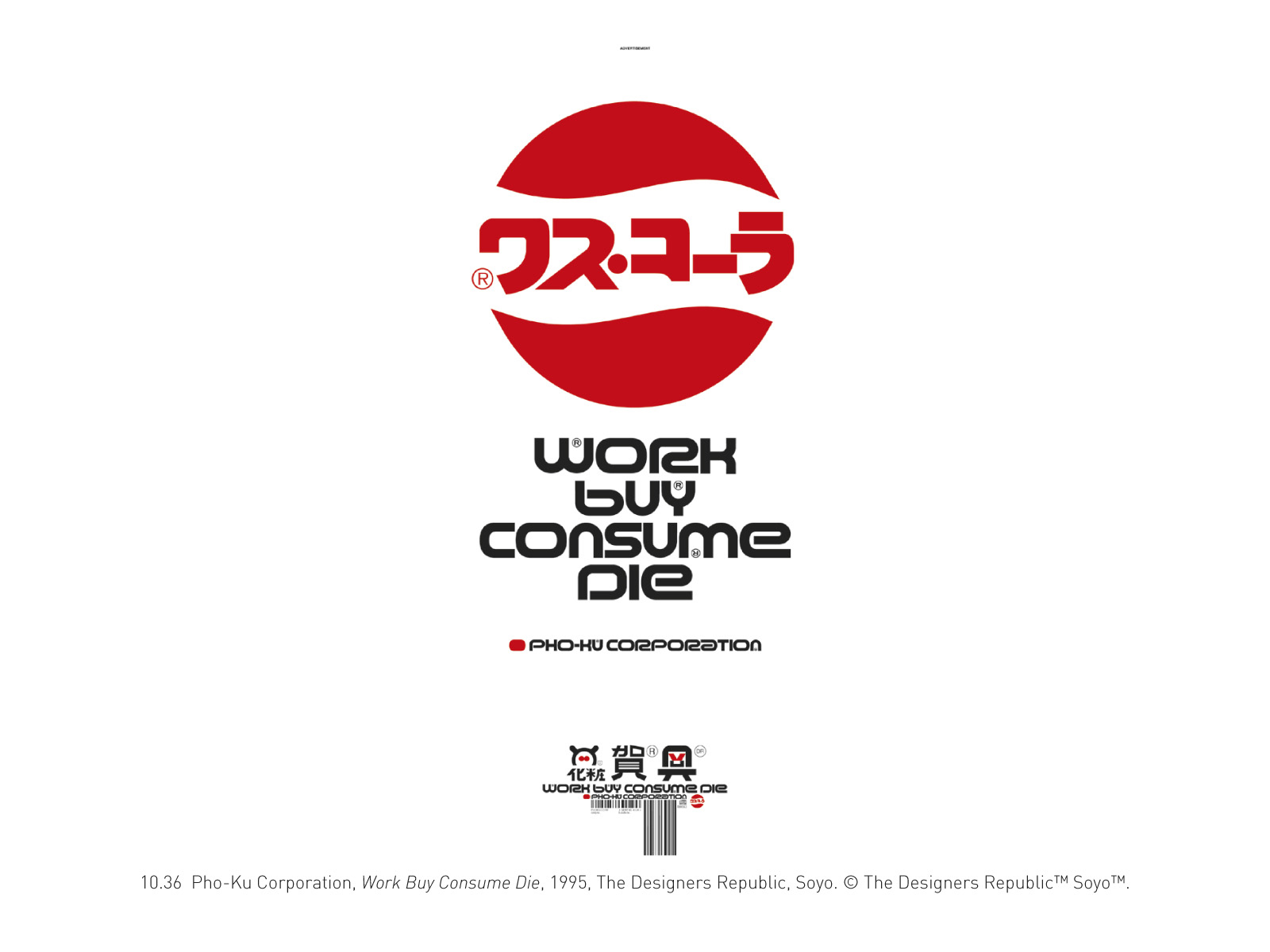
- Tradesnark™: Most logos in the earlier games (specifically 1 and 2097/XL) have a conspicuous "©", "®", or "™" marking. And it's not just logos: Even the typeface, while it's not obvious on its' smaller, in-game look, have ®s inside most of their curvings. Hell, even before you begin the race in 2097, you get to see "LOADING™" every time! There's a reason behind that - consumerism was a running theme in most of The Designers Republic's works from the mid-to-late '90s, moreso in their Customized Terror exhibition, so it's only natural that some of that style would slide in from some of their commissions. Work Buy Consume Die◊ seems to have influenced 2097's design the most, however.
- The overabundance of trademarks was toned down by 3 as tDR went for a minimalistic and angular approach, and dropped by Fusion to use them more realistically.
- [Trope Name]: Also courtesy of tDR, this trope's present in 3's minimalistic menus, where you're first greeted with words "WIPEOUT THREE TITLE SCREEN" (unless you have Special Edition). Before the demo mode and the obligatory tDR-specific credits, you'll also be able to see "WIPEOUT THREE LOGO" (with no actual logo present) and "TEXT READS LEFT TO RIGHT".
- Unexpected Gameplay Change: HD Fury's Detonator mode is essentially a shoot-em-up inside a racing game.
- Updated Re-release:
- WipEout 3: Special Edition added tracks from the first two WipEout games and altered several other aspects of the game, such as improving a few ship stats.
- Omega Collection bundles HD, the Fury expansion, and 2048 together, adding support for 4K resolution, HDR, as well as more stable framerates. An update also added PSVR support.
- Vehicular Combat: Pretty much the Trope Codifier of this subgenre on PlayStation.
- Wacky Racing: Although the visuals and setting are more serious than most wacky racers, the in-game premise is basically supersonic hovercraft shooting weapons at each other.
- Wave-Motion Tuning Fork: Auricom's original super weapon, ''Energy Sphere'', which, other than being chargeable, behaves mostly like the Plasma Bolt.
- We Care: "Let's be friends!" is AG Systems' slogan in 3.
- We Used to Be Friends: FEISAR's current relationship with Icaras, after the UK's breakup from the former to resurrect the latter before the events of Pure.
- You Don't Look Like You
- XL ditched the first game's pseudo-realistic homogenized, detailed ship designs in favor of a more sci-fi look. The American version of it and WipEout 64 also had completely different logos than any of the games that came before or after them.
- When The Designers Republic left the series, Fusion had a radically different visual style by a different design group which was not well received by long-term fans. Pure fixed this by returning to a style closer to classic WipEout.
- The vehicles in WipEout HD's Fury expansion pack are... quite different. They look more like separate parts attached to each other to form the ship's body, unlike preceding WipEout games, where ships look more solid.
- Goteki45's ship in Pure is unlike either of their other appearances and was the most unusual design that was included in the basic game.
- Happens once again in 2048 with AG crafts becoming more streamlined. Justified in that the game takes place earlier in the timeline than the other games.
- The craft in the aforementioned video also resembles a piece of WipEout concept art that's been doing the rounds since 3, so it might also be a case of technology catching up with the artists' visions.
- Page complete. Gold medal awarded!
