
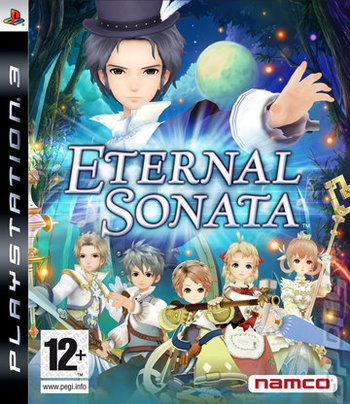
Eternal Sonata Japanese title is a role-playing video game developed by Tri-Crescendo and published by Namco Bandai Games. The Xbox 360 version of the game was released on June 14, 2007 in Japan, September 17, 2007 in North America, and October 19, 2007 in Europe. The game was also released on the PlayStation 3 with additional content Japanese title on September 18, 2008 in Japan, and in North America on October 21, 2008, and in Europe on February 13, 2009.
It is notable for its use of classical piano pieces, educational cutscenes featuring real paintings and photographs (in contrast to the cel-shading graphics of the game) and lush landscape design.
Frédéric François Chopin, the famous Polish pianist and composer, is on his deathbed at the age of 39. Feverish from tuberculosis, he hallucinates a dying dream in which he is exploring a strange fantasy world that seems to parallel aspects of his own life and music. Polka, a young girl with an uncanny resemblance to Frédéric's dead little sister, is one of the inhabitants of this otherworld.
As someone who has developed magical powers (which is feared as a symptom of impending death), she is shunned by the world and lives a lonely life selling herbal medicine to a nearby village. When The Empire introduces a mysterious new wonder drug that threatens what little business she gets, Polka begins an epic journey across the land to meet with the Evil Overlord, Count Waltz, in person and plead her case to him.
Frédéric, believing that this dreamworld is a form of purgatory for his soul, joins Polka on her quest so that he may see the dream to its conclusion and pass peacefully onto the afterlife. But as he continues forth, he is given more and more reason to doubt that initial conclusion. Is Polka just a conjuration of his dying mind, or is she a real person living in an Alternate Universe that Frédéric has somehow tapped into? And if he truly is the Cosmic Keystone of this world, then what will happen when Frédéric finally breathes his last?
The battle system reflects the latest influences in RPG design at the time it was created. Your character is given a set interval of time with which to move or attack, and the special moves available to your character depend on whether they're standing in light or shadow. Some environments have moving clouds and the like, making it a challenge to keep characters in locations where your intended abilities can be used. It is possible to block, counter, and build up a chain called the Harmony Gauge in order to boost the power of your special attacks.
The RPG gameplay is accompanied by both original and arranged pieces by the virtuoso composer, and the action is occasionally interspersed with sequences that relates the events to the very real drama of the historic Chopin. An encounter with an unbeatable swordsman in a rain-soaked jungle reflects Chopin's near-fatal bout of tuberculosis on Mallorca during the rainy season. Escaping from the castle dungeons with the aid of La Résistance parallels Chopin leaving his native Poland mere days before the November Uprising throws the country into chaos, and so forth...
The game was first released for the Xbox 360 in 2007, then for the PS3 (with added features and a somewhat altered plot) in 2008. The PS3 adaptation includes two characters upgraded to playable status, new dungeons and character costumes and a number of significant additions and improvements to the game's story and script. On the downside, though, while the Xbox 360 version includes Achievements, the PS3 one does not support Trophies, as it was a launch title for the PS3 and was apparently created before the PlayStation Network and Trophies were conceived of.
There is also a manga adaptation of the game. However, it is only 10 chapters long and changes many aspects of the story drastically.
This game provides examples of:
- Absurdly Spacious Sewer: Ritardando's sewer is big enough to house orphans and a bunch of rats the size of beat. It's also quite pretty, as far as sewers go.
- Acrofatic: Tuba is surprisingly quick for such a big guy.
- Always Save the Girl: Allegretto, more so in the PlayStation 3 Updated Re-release.Allegretto: (to Frederic, PS3 version) Why did Polka, of all people, have to suffer like that? What the hell is wrong with this world!? Damn it! You! You come barging into our world out of nowhere, then just leave when you get tired of it! This is supposed to be your dream, right?! Well then, why couldn't you do anything!? No. That's not it. It isn't a dream at all. It's real. And I don't know what, but I have to do something!
- American Kirby Is Hardcore: A weird example. While the Japanese
 ◊ and US◊ Xbox 360 covers are both pretty cutesy, the original US PS3 boxart acting as the page image above is almost misleading.
 - Anachronism Stew: Certain namings and the descriptions of some equipment reference elements of mythology or popular culture that likely wouldn't have been familiar to Chopin, or originate from times after Chopin's death.
- Most obviously, neither Jazz nor Salsa existed while Chopin was alive.
- And Your Reward Is Clothes: The PS3 version added alternate outfits for Polka, Beat and Allegretto, the three characters that you use to navigate in the field at various points. While most of these were easy to find, at least one of them was in an obscure area of a dungeon that was added for the PS3 version. When selected from the menu, the new costume takes effect for the character in the field the moment you exit the menu.
- Apologetic Attacker:
- Polka frequently says "I'm sorry!" after hitting a monster with her parasol.
- Chopin would sometimes state "You've done nothing wrong." after defeating an enemy.
- Arbitrary Headcount Limit: The party size climbs to ten in the 360 version, and a rather large twelve in the PS3 version, possibly a record for any RPG not named Final Fantasy VI, Chrono Cross, Radiata Stories, or Suikoden, but you'll only ever have three characters in the active battling party.
- The Artifact: The Chopin storyline is fades into the background after the first chapter or two
 because Chopin himself is less concerned with whether or not he's dreaming.
 - Artistic Age:
- If you didn't know any better, you'd think Chopin was a teenager.
- It is jarring to walk up to girls the same height as Polka (who is 14) who talk about cooking for their husbands.
- Artistic License – History:
- Chopin uses a conductor's baton as a weapon. In real life, Chopin was not a conductor, just a (phenominally talented) pianist; any conducting that he would have done would have been at the piano, and thus done without a baton.
- The game makes a strong reference to Chopin's younger sister Emilia and the PlayStation 3 version goes further by having him lament Emilia's fate (she died when she was 14, Polka's age) in the opening and having a possible ending sequence in which he addresses a soliloquy to Emilia. There is little evidence of the sort of relationship Chopin had with Emilia; certainly not enough to provide a historical justification for lines such as "Emilia, I have never once forgotten you. Who would have thought that my memories of you, would create a world as vibrant and alive as this one is?"
- Back from the Dead:
- Claves if you complete the PS3-specific bonus dungeon.
- Depending on your interpretation, Chopin.
- Background Magic Field: The battles take place on open plains that all the characters / creatures can move around in, with different magical attacks (and for the creatures, sometimes different physical forms) available when attacking from areas of light or shade.
- Bare-Fisted Monk: Falsetto fights with her bare hands and feet. While she can equip brass knuckles and similar weapons, equipping different weapons doesn't change the character's in-battle appearance.
- Battle in the Rain: All encounters in the Agogo Forest while it's raining but particularly the battle with Fugue.
- Because I Said So: A mother's stated reason when a boy asks why he shouldn't go near Polka, or anyone who glows (from using magic) like she did. The real reason is irrational fear that the magic disease is contagious.
- Becoming the Mask: Claves and Princess Serenade both fell in love with the people they were supposed to spy on and sympathized with their cause.
- Beethoven Was an Alien Spy: One of the main characters is Frédéric François Chopin. Who knew he could kick so much ass with a conductor's baton? In fairness, it's (apparently) all a dream, so his extra skills are at least explained. And by the end he gets godlike power.
- Betty and Veronica: Falsetto and Claves are both after Jazz, although which is the Betty and which the Veronica is less obvious than in many cases. Rough-speaking martial artist Falsetto appears to be the Veronica but was Jazz's childhood friend while soft-spoken and polite Lady of War Claves appears to be the Betty but is a spy for Waltz.
- Beware the Nice Ones: Just because the nice girls are wearing frilly dresses doesn't mean you should underestimate them.
- Polka is sweet and kind, but is prone to shouting "Stay out of my way!" as she casts her area effect Nuke Spells.
- March is sweeter and kinder, and can at higher levels effortlessly cut through enemies like a hot knife through butter.
- It's advisable not to get on Beat's bad side either. Tuba learned that the hard way.
- BFS: As wielded by Jazz. It's bigger than Cloud's!
- Bittersweet Ending/Downer Ending: Chopin finally chooses to believe that his dreamworld is real, which breaks the Stable Time Loop it's trapped in and allows Polka and the rest to live in a new future. However, this causes him to 'die' in our reality, leaving behind the people in the real world who still care about him. The start of the final credits where Chopin's spirit leaves his body, walks over to his piano, and accompanies the ending theme can be seen a symbol of how he lives on in the real world through his music. Whether the ending is the former or the latter is dependent on the individual and how "real" they see the dream world in comparison to Chopin's conclusion.
- Bonus Dungeon: Mysterious Unison and The Church of Ezi in the PS3 version.
- Boss Bonanza: The game generally only pits you against one or two bosses per chapter. The final chapter requires you to defeat a Dual Boss to earn the right to enter the Double Reed Tower of Sand, which is two towers, each of which must be ascended twice with a boss fight on each ascent. This lets you fight the apparent final boss (another Dual Boss in the PS3 version). The real Final Boss shows up shortly thereafter.
- Breaking the Fourth Wall:
- The Main Characters speak directly to the player during the first half of the ending credits in the Xbox 360 version. This is replaced by a soliloquy by Chopin in the first ending of the PS3 version.
- The Encore mode ending simply has the Main Characters repeating quotes without addressing the player.
- Calling Your Attacks:
- Every single playable character, as well as all of the human bosses, announce their special moves. When they use charged up Echoes they'll recite some poetic lines. They ranges from quick, to-the-point shouts, to near-filibusters that required the voice actor to take a breath during the read.
Chopin: Triumphant victory! The hoofbeats of the brutal horde approach! Legion Fulminante! - Charged Attack: Echoes and Harmony Chains boost the power of attacks and, later in the game, allow for chaining characters' special movies one after the other (assuming they are capable of attacking or healing from their current position).
- Cheerful Child:
- Beat tends to stay upbeat throughout events that would probably traumatize many other eight-year-olds.
- March similarly marches along with a merry smile.
- Chick Magnet: Jazz attracts Claves, Falsetto, and Viola.
- Chirping Crickets: Done using the blowing wind variant. The party is trying to decide whether or not to use a secret passage, so they turn to Allegretto to make the decision. He decides to go for it, commenting "You know what they say - 'If you don't go into the lion's den, you can't count your chickens.'" There is a sound of wind blowing from the tunnel and after a pause, Viola comments "That doesn't make any sense."
- Comes Great Responsibility: In Lament Mirror in the PlayStation 3 Updated Re-release, Salsa is alone with Frederic and hankering for some food. She asks Frederic why he doesn't use his magic powers to magic up a steak for them. He replies that "Magic is not a tool of convenience," and continues that even if such a thing were possible, their first thought should be of the children starving in the cities. Salsa is not persuaded by this logical argument and breaks down in a tantrum, causing Frederic to Face Palm.
- Come to Gawk: There's a Magic Researcher on the second floor of Baroque Castle. If the player visits him after completing the Lament Mirror sequence (available only in the PlayStation 3 Updated Re-release of the game), he will ask if the party has come to laugh at them and orders them to "Get Out!" Polka and Frederic, however, note that he's studying magic and quickly explain that they're both magic users, delighting him as he rarely gets to meet live magic users, and he reveals a lot of interesting information.
- Convection, Schmonvection: The Wah Lava Cave is a cavern filled with lava that your party ventures through with no ill effects other than admitting to being rather hot when they first enter it. Granted, almost the entire game is supposed to be Chopin's dream...
- Curtains Match the Window: A number of characters, most notably Claves.
- Cute Bruiser:
- Salsa and March are short little girls who can tear up the battlefield with chakrams.
- Polka will beat you senseless with a parasol.
- Did You Just Punch Out Cthulhu?: On Encore mode on the PS3 version, you can face The Great EZI as an optional boss, who is implied to be a deity.
- Dual Boss: Waltz and Calamity Wilhm along with Ogre King and Wicked Shrub. In the PS3 version, Waltz and Ruined Body.
- Dub Name Change: From Japanese to English, Jitterbug's name was changed to Jazz, and Chopin was changed to Frederick. Many of the other names were kept without changes; however, if you play the game using the French on-screen text, a number of other characters' names change:
- Beat becomes Piccolo
- Viola becomes Harpe
- Falsetto becomes Mazurka (A mazurka is a type of Polish folk dance, and Chopin composed several of them, one of which can be listened to on a piano in the tavern in Forte)
- Serenade's poodle puppy changes from Minuet to Menuet.
- Oh, and Frederic and Serenade both gain accent marks over the "e"s in their names.
- Fugue becomes Staccato
- Guitar becomes Banjo
- Rondo becomes Rumba
- Count Waltz, of course, becomes Comte Valse
- Incidentally, Jazz is still Jazz.
- A number of the attack names change: The original Orange Cure and Earth Growth are changed to Orange Glow and Earth Heal for Polka. For Princess Serenade they decided to change her "Word:" skills to "Verbum:".
- Dying Dream: The premise of the story is Chobin walking about a (supposedly) dream world while he's dying.
- Elegant Gothic Lolita: This influences much of the character design, but especially Falsetto.
- Elite Four: Count Waltz has four agents working directly under him: Legato, his right-hand man, the big lug Tuba, the cruel and calculating Fugue and the Dual Wielding assassin Rondo. He actually has two other agents, Claves and Serenade, but both are spies and don't work directly under him.
- Escapism: Escapism, and learning to overcome and accept hard truths of life, is one of the key themes of the game.
- Anti-Escapism Aesop: As such, this aesop is the primary one taught by the game.
- Evil Plan: The heroes gather to stop Count Waltz from mining mineral powder which he plans to use to create an army of Super Soldiers and invade the neighboring country.
- Exposition Break: The game is lengthy on the cutscenes in general, but special mention goes to the slow-paced Chopin history lessons.
- Face Palm: Done by Chopin in the PS3 version when listening to Salsa whine about being trapped in Lament
- Fake Difficulty: Start the Bonus Dungeon and you will unlock Party Level 6 which allows you to chain up to 6 special attacks. The catch? Every time you use one, the button's mapping changes randomly, meaning that you should un-memorize the controller's mapping. It only happens whenever one uses a skill, not at every button press like a number of descriptions set it up to be. note
- Fake Longevity: Why else would you need to get special water from the end of a graveyard to give to a child to feed a plant; defeat a ghost in the basement of a church; have to board a pirate ship to defend a military vessel that has its own guards and guns; or climb a temple/tower as requested to by a priest.
- Fantastic Flora:
- The main one is the Heaven's Mirror, a flower that hides in its buds during the daylight and releases it all in a brilliant display at exactly 2 A.M. in the morning. This is symbolic of player character Polka (who releases great inner light to ward off darkness) and the time of death of the famous real-life composer Frederic Chopin.
- There's also the Simile flower, which only blooms with water from Simile Spring and wilts if you water it with regular water.
- Fetch Quest: Retrieving specific water which just happens to be behind a graveyard to feed a dying plant for a child living with La Résistance. Nothing plot worthy happens during this sequence.
- Final Speech: Claves. It takes so long that you might die before she does.
- Flunky Boss: A lot of bosses are accompanied by mooks that you would've encountered in the previous dungeon. Unrest and Dolce are both accompanied by more powerful mooks.
- Foregone Conclusion: Chopin dies; in our world. However, if he defeats the player party then he will wake up because the victory convinced him he was dreaming.
- Gainax Ending: Did you really expect the fever dream of a dying man to make sense?
- Gameplay and Story Segregation:
- It's said that nobody is buying floral powder from Tenuto anymore because of the cheapness of the mineral powder. Yet just about every store in the game that sells items to your party carries healing powers that are described as powders made from flowers from Tenuto. This sort of segregation is probably also the reason why, once your party has a massive amount of Gold, Allegretto and Beat don't hand a bunch of it over to the kids in the sewers so they don't have to live there anymore.
- This is also the main reason why Allegretto can't stop mocking Beat's obsession with photography, even though 12 haphazard shots of any random monster nets you more Gold than he's probably seen in a year, maybe even his entire life. Bringing Beat to early game boss fights just for the photos can actually supply enough money to last the entire rest of the game.
- Even if you go through the trouble of getting Claves back from the bonus dungeon Mysterious Unison, the game basically acts as if she isn't there for any few remaining scenes in which her presence would be a factor, including the game's ending sequence. In fact, the only time this isn't true is in the Updated Re-release exclusive bonus dungeon in which you can get an altered scene with her presence in the party.
- Glowing Flora: The Heaven's Mirror flowers absorb sunlight during the day and bloom and open at night, releasing the light in a beautiful display.
- Gratuitous Foreign Language: The attack names are in English in the Japanese version, and some of Chopin's are in French, Italian, and Polish. Additionally, for the PlayStation 3 Updated Re-release with Serenade as a playable character, two of hers are in Latin and one is in French.
- Green Aesop: A little bit in the game, with light pollution and humans being "masters of destruction" (Thank you, Falsetto), and a lot more in the credits, with the characters breaking the fourth wall and talking to the player about such issues as "Can you think of any other things that are helpful at the time but dangerous in the long run?" and "Minor inconveniences with huge long-term effects."
- "Groundhog Day" Loop: The ending - clarified in the PS3 version - explains that the events of the game have repeated over and over again. This is why the game starts with the last scene and how Polka got ahold of Allegretto's charm before he gave it to her. Chopin's presence in the most recent cycle breaks the loop and happy endings occur.
- Guide Dang It!:
- For anyone without an ear for music, and even some that do have an ear for music, the third test in Xylophone tower is too difficult without a guide because the keys don't light up. If you fail it three times it relaxes the difficulty.
- There's a grandmother lady in the hotel in Baroque in Chapter 4 whom you must speak with to hear a poem in order to obtain a Score Piece later in the game. It's one of the only things in the game that can be Permanently Missable if you don't remember to talk to her (naturally this includes the reward you get for using the Score Piece later on). Another missable entry are the optional rematches with Captain Dolce, requiring backtracking, examining obscure bits of the field map, and answering NPCs with the correct dialogue options. You cannot return to most locations after visiting them the first time, so if you miss something, it's most likely gone until your second playthrough.
- Hartman Hips: Most females to a certain degree, but Claves and Falsetto really stand out here.
- Have a Nice Death: When you lose to certain bosses they will talk about their victory and your loss.
- Heads I Win, Tails You Lose: If the heroes lose against Tuba it's Game Over. If the heroes win against Tuba, he orders a couple of mooks to throw them in jail.
- He Knows About Timed Hits: Polka and Allegrettos' early-game battle tutorials. "The animals that live in the forest around here aren't really very strong, so I should be able to defeat them without too much trouble. But, just to be safe, I'll go over the basics of how to fight again."
- Henpecked Husband: The father of the rascal Phil, who later becomes a Score Piece sidequest participant and is specifically referred to as "Henpecked Phil's Father."
- Heroic Sacrifice: Polka attempts one of these at the end of the game. Chobin invokes Rule Zero and not only reverses it but makes it unnecessary.
- Hey, You!: When the party reaches the summit of Mt. Rock, Allegretto addresses Crescendo and Serenade (a prince and princess respectively) with a hearty "Hey, guys!"
- Historical Beauty Update: Chopin was a gorgeous hunk in Real Life, but he's outright Bishōnen in this game.
- Hopeless Boss Fight: Against Fugue the first time Frederick and Polka meet him.
- Hyperspace Arsenal: An odd case in that the game allows you carry up to 99 of any item at all that can be purchased or dropped by monsters, including weapons and armor. This is despite the fact that every character has their own unique type of weapon that only they can equip and most armor can only be equipped by a few different characters, or in some cases, only one. Another oddity is that while you can carry 99 of an item, each item has a weight that limits how many can be stocked into a separate inventory that is used during battles.
- Hypocritical Humor: When Fugue tells Count Waltz that he couldn't find any glowing agogos in Agogo Forest, Waltz orders him straight back there and warns him "I won't listen to another report of failure." Fugue leaves and Legato comes in to inform Waltz about the good progress they're making with their mining operations at Mt. Rock, only for Waltz to tell him "There's no need to report when things are going well."
- Improbable Weapon User: Whilst many of the weapons are somewhat improbable, combining as they do design elements of musical instruments with more traditional weapons, there's Beat's combination clarinet/gun/nadziak (a spiked hammer that was used in the Polish rebellion), and Chopin himself hitting enemies with a conductor's baton.
- In Medias Res:
- Subverted at the very beginning. The player is lead to believe they will see the first scene again later in the game, as it appears to be set in the future. However, due to the game's "Groundhog Day" Loop this is actually the end of the previous cycle, before the game chronologically happens.
- Played straight with the Baroque sequence. You begin this portion of the game with Beat and Polka in an outside courtyard area of Baroque Castle and then go into a Flash Back sequence involving how they got rescued by a Baroque ship and then fought off a ship full of pirates (at which point the items you collect on the two ships suddenly appear in your presnt inventory).
- Infinity +1 Sword: Alegretto's final weapon, Silver Star, is a sword that critically hits 100% of the time.
- Innocent Flower Girl: Polka is the page image; sweet natured girl with a teriminal illness that sells floral powder.
- Instant Messenger Pigeon: Claves sends a dove to Baroque to deliver the message to Prince Crescendo that Princess Serenade is a Forte spy. Not only does the dove make it safely, but it survives the bitter cold to land neatly upon the prince's window.
- Instrument of Murder: A clarinet/gun/mallet, a BFS with trombone pipes, a fencing rapier shaped like a conductor's baton...
- Insult to Rocks: "Really though, comparing sea water stirred up by the beauty of the moon to the ugly waves created by the effects of human desire is rather an insult to the ocean."
- Insurmountable Waist-Height Fence: An early quest will force you to find some food for a bunch of goats blocking your path on a bridge. Said bridge is about four feet long and is built over little more than a trickling stream. Does your party think of going around and wading through ankle-deep water? Of course not.
- Inverse Dialogue/Death Rule: Claves, one of the main Love Interests, has a dying monologue that drags on forever.
- Involuntary Group Split: Tuba destroys the Cabasa Bridge the party is on at the end of Chapter Two, splitting them up. You play the following two chapters as one of the groups - Allegretto, Viola and the Andantino members in Chapter 3 and then Polka, Beat, Salsa and Frederic in Chapter 4.
- Irrelevant Sidequest:
- There's a fairly extensive trading sidequest early in the game that ultimately results in nothing more than a key to a temple that can easily be obtained by simpler means. The only upshot is you get to keep a minor accessory that you would otherwise be forced to give up. What's worse, you ultimately end up not needing the key in question, but the plot demands that you obtain it anyway.
- The Score Piece sidequest is entirely unconnected to the plot of the game.
- It's All Upstairs From Here -
- The Double Reed Tower of Sand. Twice, unsurprisingly.
- The Xylophone Tower almost immediately prior to the Double Reed Tower of Sand qualifies too.
- Joke Item:
- Most of the EZI items are useless, or worse, do harm to your characters. If you're playing the Xbox 360 version, then it's still worth collecting them all in order to gain an Achievement, if you like gaining Achievements for XBox Live. If you have the PS3 version, they are just something to collect for fun, as this version doesn't connect to the PlayStation Network.
- You can find a note in Andante telling you to look by the waterfall. When you do, Allegretto discovers a note which reads "Here's my address, big boy. Come on by and we'll have some fun!" The game then states you have "acquired some guy's address." There is a sound of paper shredding and then you get another message— "Tore up some guy's address."
- Just Like Robin Hood: Allegretto and Beat steal from a bakery to feed homeless people in the sewers. The taxes in the town are so high that, without Allegretto and Beat playing Robin Hood, they would likely starve to death.
- Kissing Discretion Shot: In the ending, Allegretto and Polka share a passionate hug in the renewed Tenuto flower field and then the camera pans away for a wide shot of the scenery just as they begin to kiss.
- Large Ham: A lot of the voice actors chew the scenery
- Chopin likes to contemplate his navel like an actor on a stage
- Liam O'Brien is clearly having a hell of a time playing Count Waltz.
- Letters 2 Numbers: The various "321" references in association with the god EZI. Even the achievement on the Xbox 360 version for collecting all EZI items is worth 321 gamerscore.
- The Lifestream: The Very Definitely Final Dungeon features an afterlife for people who die of mineral powder.
- Main Character Final Boss: Frédéric himself becomes the final boss of his own game due to his realization that the entire world he's in is simply a dream undergoing a Stable Time Loop and that he's actually dying in the real world. You get a different ending depending on if your party wins against him or loses to him.
- Messianic Archetype: Polka is an All-Loving Hero who dies to save others and is reborn afterword. This is the hinge of the plot's super-structure and Chopin does his own messanic thing to end the "Groundhog Day" Loop that forces it to repeat itself.
- Mighty Glacier: Jazz has the highest attack stats and hit points, but he's also one of the slowest-moving characters and does not have a turn as frequently as the rest.
- Mixed Metaphor: The earlier mentioned (see Chirping Crickets) "If you don't go into the lion's den, you can't count your chickens."
- Multiple Endings: If you lose to Chopin in the final battle, he wakes up in the real world. The PS3 version of the game also bears some changes on the normal ending. Additionally, the PS3 version has at least three different sequences that can be shown during the first set of closing credits. What's odd is that there doesn't seem to any specific trigger that determines which ending you get. The endings are as follows:
- Frederic appears on a black background and addresses a soliloquy directly to his late sister, Emilia.
- Photos of various scenes from throughout the game are shown.
- The characters appear and recite lines from the game. However, they don't directly address the player like in the Xbox 360 version and some of the lines they use are ones that are exclusive to the PS3 version.
- Mundane Made Awesome: Salsa finds a skull-and-crossbones-adorned pirate hat, puts it on her head, and declares it to be the "ultimate treasure". The fanfare and background make it a Funny Moment. If the Captain Dolce questline is pursued, she will comment that she wants the hat returned.
- Musical Theme Naming: The characters, their attacks, the places they go to etc.
- Mythology Gag: A most curious meta example. In the Scrapbook bonus included in the PlayStation 3 Updated Re-release, there's a picture called "No way!" in which Frederic appears to have a ghostly hand on his shoulder and Allegretto, who took the photo, is all "W-What's that on Frederic's shoulder?" In one of the scenes following a boss fight in the Double Reed Tower, Allegretto makes fun of Beat's camera by suggesting that it could take pictures of ghosts. The curious thing, though, was that this scene was only in the Xbox 360 version and replaced by something else entirely in the PlayStation 3 one.
- New Game Plus: Beating the game allows to play in Encore Mode. All enemies are about 1.5x stronger, but you are allowed to change your Party Level at any time (in a normal playthrough, the Party Level increases throughout the game and cannot be changed manually.) You also keep all Score Pieces you found in your first playthrough, and have access to all of the music you unlocked from the menu. A number of new sidequests open up as well.
- Nintendo Hard: Many elements of the battle system have been altered in the PlayStation 3 Updated Re-release to remove things that were easy in Xbox 360. Both roaming enemies and bosses give less EXP, bosses often substantially less. Beat's photos are harder to get Rank A and while in the original even Rank C sold for a lot of gold, in the update the best Rank A generally sell for less than a Rank C of the same monster from the original. Characters learn certain Special Attacks at different levels (usually, though not always, ones less favorable to the player) and one of the most painful - Angel Trumpets (the main items used for reviving) carry a weight of three in the item set instead of two.
- Nothing Can Stop Us Now!: Count Waltz in the first battle against him because he has the main party pinned with an army of dragons and acquires the means to create glowing apogos. This is only in the original Xbox 360 version which happens to be the only battle against him.
- Nothing Personal: Rondo after she fatally attacks Claves.Rondo: You fool. The information you provided us was very valuable. But I was ordered to kill you if your identity was revealed. Don't take it personally.
- Older Than They Look: Look at Chopin's picture and then realize that while he looks like he's in his early 20's, he's actually 39.
- One-Steve Limit: There are two characters that are called Bass - one of them is a member of Andantino and the other is a flunky of the pirate captain Dolce.
- Odd Name Out: Baroque City, while still musically relevant, stands out among Forte, (sus)Tenuto, Ritardando, and Andantino as a style of music, rather than a musical direction.
- The Hanon Hills also count, as the locations are generally named after musical terms of some sort, but these are actually a tribute a person— Charlie Louis Hanon, a famous French piano pedagogue, who is known for a series of training exercises for pianists.
- One-Winged Angel: Step 2 in Waltz's Evil Plan involves creating a improved version of the mineral powder which can transform the user immediately into a monster. This happens to Legato near the end of the game.
- Onscreen Chapter Titles: The game is divided into eight chapters which are displayed on-screen. Each is titled after the name of a Fryderyk Chopin piece featured in the chapter, such as "Chapter 3: Fantaisie-Impromptu" and "Chapter 6: Tristesse." "Final Chapter: Heaven's Mirror" actually features a piece which was created for the game as a piece that the fictional Chopin featured in the game composed. In the original Xbox 360 version, the chapter number and title were all featured on one line. For the PlayStation 3 version, the names of the compositions were displayed beneath the chapter numbers.
- Palette Swap:
- Heinously used to turn a roster of about thirty types of monsters into seventy. Also used to turn early game bosses into mini bosses in the Final Dungeon. In the PlayStation 3 Updated Re-release, March Lamp Shades this when after the party defeats the White Jewel in the Double Reed Tower; she notes that its appearance was similar to a monster in the Agogo Forest (the Baby Dragon fought by Allegretto and Beat), so she examined it and found that the texture of its hide was different and a lot more durable.
- Technically this applies to March and Salsa also, but it 's forgivable considering they're twins.
- Polar Opposite Twins: The twins, Salsa and March, are not only opposite in personality but use solar- and lunar-themed attacks, respectively. Additionally, when you find a weapon for one that does greater damage to light creatures, there's a complimentary one nearby that does greater damage to dark creatures.
- Public Domain Soundtrack: It's only expected that this game would feature several Chopin pieces.
- "The Reason You Suck" Speech: PS3 Waltz delivers a nice one in the final battle against him in the Double Reed Tower, with shots specially directed against Crescendo and Polka. Allegretto tries a Kirk Summation but Waltz shrugs it off.
- Red Oni, Blue Oni: Salsa (red; aggressive, loud etc) and March (blue; friendly, soft-spoken, etc). Even their hair are the respective colors! March's Blue Oni tendencies are even more pronounced in the PlayStation 3 Updated Re-release - there are several references to her being passionate about research that aren't present in the Xbox 360 version.
- Required Party Member: For some boss battles, a particular character will automatically force out the person in the 3rd party slot if they're not already in the party. For this reason, it's always best to make sure your healer isn't in that slot.
- The game will also do the opposite on 3 occasions, forcing a member out and being replaced by whoever's in the 4th slot. It does this for the final boss, of all things.
- Reverse Psychology: in the PlayStation 3 Updated Re-release Waltz sensibly orders his dragons to take out the party. Since trying to take on a group of dragons would be a very bad idea, Salsa and March goad him by telling him that the party is "under the protection of the glowing agogos," with Viola noting that they've already defeated all of his other "little henchmen." This is successful in convincing Count Waltz to decide "If those bumbling idiots couldn't manage it, then why don't we see what I can do!"
- Royals Who Actually Do Something: Cresendo considers the peace of Baroque to be his personal responsiblity and much of the plot is directed (and/or bogged down) by what he thinks he should do to fufill this responsibility.
- Save Scumming: Poison status is extremely useful against bosses that are affected by it and can be inflicted by using an item. Not only does it cause them to lose HP at the beginning of each turn, but it also causes them to stagger, lessening the amount of time they have to attack your party. Bosses that are affected by it, however, are also generally resistant to it, meaning there's a fair chance that the item won't inflict it. Fortunately, however, there is always a save before a boss, meaning that you can just reset until you get the result you want.
- Say My Name: Allegretto gives a very dramatic POLLLLLLLLKA! when she attempts her Heroic Sacrifice by leaping off the cliff at the end of the game.
- Scenery Porn: Even the sewers are pretty.
- Screw Destiny: Allegretto in the PlayStation 3 Updated Re-release.Allegretto: (regarding Polka) Sacrifice her life?! There's no way I'd let her do something like that!Solfege: I don't wish to lose her, either. But I don't think we can fight fate.Allegretto: (makes a slashing motion with his arm to indicate he doesn't hold with that) Who cares about fate anyway?!
- Small Reference Pools: Surprisingly averted, as the game has multiple items and some attacks that refer to the generally underused The Kalevala.
- Soap Opera Disease: Polka's illness has no symptoms other than 'capable of using magic' but it will kill her somehow in the near future. This causes her much pain and informs a number of plot events.
- So Long, and Thanks for All the Gear: There are numerous instances where you switch between different groups of party members. Whenever you do, the party members that are left behind keep whatever equipment they have for the time being and you don't get it back until they rejoin. Not a problem with weapons, since each character has their own unique type, but definitely troublesome with accessories and armor and particularly egregious if you choose to use Crescendo and Serenade for the final boss battle of Lament Mirror in the PS3 version, since you don't get them back for two chapters. Don't even think about equipping anything good to Claves, who dies at the end of Chapter 3. Though she can rejoin if you visit Mysterious Unison in Chapter 7, at which point you can finally get back anything that was equipped.
- Speaks Fluent Animal: Part of the second trading sidequest involves finding the ingredients for a magic candy that allows one to talk to animals, which you ultimately give to an item merchant who wants to be able to talk to his horse. (Absurd! No one can talk to a horse, of course!) Also, there's a woman in Baroque you can help out whose husband has disappeared into the Sharp Mountains. Viola is somehow able to understand a dog whose barking "tells" her that the husband is in danger and needs help.
- Stable Time Loop: The game gradually reveals that everyone has made this journey before. At the end, Polka casts herself off a cliff only to emerge as a little girl falling from the sky into her mother's arms, where she repeats the past seven or so years of her life all over again. Only Chopin's death breaks the cycle. This also explains the extraordinarily high volume of fortunes on the tree near the end of the game in a place that would be implausible for average people to venture; they're all Polka's fortunes.
- Stealth Pun: Sop and Rano, two girls in Tenuto Village whose combined names make "soprano." Also, March's line "experience is what counts" upon winning a battle.
- The Stinger: The story of the snail and the caterpillar at the end of the game. Make sure to wait about a minute once you receive the screen that says "Fin," or you will miss it.
- Stuck Items: You can't unequip the Weapons or Armor slot, only swap.
- Sure, Let's Go with That: When the party is supposed take care of the "ghosts" underneath the Mandolin Church, Allegretto decides to jet and fetch Polka. Viola suggests that the reason he's leaving is because he's scared of ghosts, and he happily seizes on that excuse, stating that he never told anyone before, but he's super-scared of ghosts.
- Tagalong Kid: Played straight with Beat, who has no personal reason to be on this adventure, but averted with March and Salsa. They are the guardians of Agogos Forest which is threatened by Waltz's mineral powder mine.
- Tagline: "Cross the bridge between dreams and reality."
- Taking You with Me: Tuba tries this when the heroes defeat him a second time at Cabasa Bridge at the end of Chapter Two. It doesn't work, see Involuntary Group Split above.
- Talking Is a Free Action: For any character uttering one of their soliloquys prior to launching a charged-up Special Attack, the Action Gauge stops cold. This is a good thing, since a couple of these soliloquys take longer for them to say than a full turn of the Action Gauge.
- Team Pet: Arco, Viola's squirrel... thing...It rides on her shoulder but doesn't contribute to the story much or to combat at all.
- That's an Order!: Count Waltz to Legato in the PlayStation 3 Updated Re-release after Legato is initially hestitant about drinking the enhanced mineral powder, though he phrases it as "This is not a request."
- That Wasn't a Request:
- Averted in the original Xbox 360 version where Count Waltz demands that the party surrender Polka and she surrenders herself right away.
- In the PS3 version the party has realized that it's not really Polka that Waltz is after, but rather the glowing agogos, and Polka initially refuses Count Waltz's "request."Polka: There's no way I'll go with you. Besides, I already know what it is I have to do. I know what to do to really help everyone.Count Waltz: You people don't quite understand the situation. Do you honestly think you have any say in the matter? How unfortunate. And just as I was going to respond to Prince Crescendo's little bid for peaceful negotiations. You will hand the girl over to me immediately. Because I'm afraid that if you don't, you're dead.
- These Hands Have Killed: In the ending of the PlayStation 3 version, Frederic stares at his hands in this manner after he wakes up following Polka's sacrifice. Technically he didn't, but he blames himself for not being able to do anything to stop what happened.
- They Call Me MISTER Tibbs!: When the party first meets Crescendo, Beat has trouble pronouncing his name, so he suggests that he could call him "Captain," since he's the captain of the Baroque ship. Crescendo chuckles and says that the party may feel free to call him whatever they like. After they learn that he's a prince, Beat and Salsa continue to refer to him as "the Captain," even though Polka states "You two need to stop calling him the captain. You should call him Prince Crescendo for he is the Prince of Baroque."
- This Cannot Be!: In the PlayStation 3 Updated Re-release this is uttered by Count Waltz in the second battle against him. "I can't believe this. How could I lose? Impossible. I will not accept it. I will never accept defeat!"
- This Is as Far as I Go: If the player attempts to exit Mysterious Unison without Claves's soul in complete unison, she states "I'm afraid this as far as I can go" and leaves the party until the player re-enters the dungeon.
- Too Awesome to Use: The Saint's Mirror item, which revives anyone that is KOed and restores them to full HP. They can only to be found normally as treasure in the main gameplay, with another available as a drop from a boss fought only in Encore Mode. While there was a regular enemy that dropped them in the Mysterious Unison Bonus Dungeon, it was an extremely rare drop. Further complicating things in the original Xbox 360 version was that they carried an item weight of 10, meaning that an end-game item set filled with just those (and low-level healing items filling the gaps) would be counted on two hands. The PlayStation 3 version changed this to 2, making their inclusion in your item set at least more practical.
- Trailers Always Spoil: The official trailer for the game's PlayStation 3 release shows Count Waltz performing his best move, Apocalypse Fall, as well as Polka making her attempted Heroic Sacrifice and Allegretto's wail of POLLLLLKA after she does so.


- Two Lines, No Waiting: In the first chapter as well as after the bridge collapses the main characters will be seperated and played apart in different segments.
- Updated Re-release: The PS3 version adds several quests, changes two NPCs to playable characters, tweaks several game mechanics and enemy stats, alters the script slightly, and changes other less-noticeable things.
- Utopia Justifies the Means: Count Waltz made the zombie cure the only one the general public could afford and ruined the Agogo Forest while making them, sure, but he did make a miracle cure. He even invoked this in the PS3 version during his "The Reason You Suck" Speech. He is clearly being an ass though, as his goal is to turn them into monsters."Terrible? Why, whatever do you mean? It was entirely for the sake of my subjects that I developed the most effective medicine possible."
- The Very Definitely Final Dungeon: Double Reed Tower is beautiful and ethereal and you will know that it is the final dungeon before you even step foot in it. Unfortunately, it is also repetitive as one must climb up two separate, yet identical towers and then back down both.
- Videogame Historical Revisionism: Averted. The developers worked with the Chopin Society in Warsaw in order to make sure they were as historically accurate as possible. The only flaw is Chopin using a conductor's baton despite being a pianist in real life (which is understandable; have you ever tried to fight someone with a piano as your weapon)?
- Wake-Up Call Boss: The combat up to and including the encounter with the pirates on the Baroque ship can be straightforward if a little tedious, but the fight with Captain Dolce definitely requires changing up the battle strategy to be more fleshed-out than "attack until it dies".
- White Magician Girl: Princess Serenade is a pretty princess with a heart-shaped staff, she's a love interest to another character, an Actual (and Martial pacifist) and she can heal. However, she deals massive amounts of damage.
- Work Off the Debt: When Frederic, Polka, Beat and Salsa are rescued by a Baroque Ship, Beat asks Prince Crescendo if there's anything they can do to thank them, and suggests "This little squirt [Salsa] could wash dishes for you!" Salsa is not amused, but Crescendo says that it's fine, that they don't owe him anything. Later, however, when a pirate ship shows up to menace the Baroque Ship, the party goes aboard to fight off the pirates.
- Worthless Treasure Twist: A variation in that the party finds a real pirate's treasure of gold and jewels, but what Salsa values most is a genuine pirate hat to replace the one she lost after the fall from the bridge that separated the party.
- Would Hit a Girl: Averted even outside of battle. In one particular cutscene, Jazz slaps Falsetto. You don't hate him for it because it comes across more as a Get A Hold Of Yourself Man than abuse and also because he hugs her afterword.
- Year Inside, Hour Outside: The events that happen in the dream world are indicated to be taking place in the real world in a period of just over three hours in terms of the time from when Frederic starts the dream till when he dies.
