
So, let us say that there is this guy who happens to be a hitman. The best in town. He will usually be an urban legend, moving swiftly beneath the concrete jungle, leaving no evidence behind, and fulfilling his jobs with the utmost care up to the point of perfection. Mossad? CIA? KGB? It does not matter, his targets drop like flies. No job is too hard and there is no one which he can not kill.
...Or is there? For perhaps even this cold-hearted killer will Never Hurt an Innocent (usually a child). And not only does he not do his job, but he may even turn against his employer to save the life of the very same person he was supposed to kill. This guy we're talking about? He is a hitman with a heart.
A common trope in a number of dark comedy and action movies is to have a sympathetic assassin as either the protagonist or a secondary character. Although their job is to commit murder for money, they also have a number of traits that make them sympathetic to the audience. This occasionally overlaps with Evil Is Cool and The Gunslinger, though the Hitman With A Heart is usually more of an Anti-Hero/Anti-Villain presented as a sympathetic human being, with some positive traits rather than being truly evil. He is also often racked by a number of "uncool traits", such as neuroticism, reclusiveness, some sort of substance addiction, or presented as an otherwise damaged individual.
Sometimes the hitman will have a code that makes him more easily acceptable by audiences, such as only killing criminals, or refusing to kill women and children, or not going after the family of his targets. He may take pains to make his hits painless, possibly even Cradling Their Kill. Or he may be saddled with a child or an innocent to protect. Commonly he will have to turn on his old employers (be they Government types or Mafia dons) after he refuses to perform a certain hit and has to deal with a Contract on the Hitman.
There is some Truth in Television to this. A mob hitman is a hired gun who only accepts hits on mobsters, period, and might fit the description.
A blend of The Atoner and Professional Killer, and can (sometimes) overlap with The Gunslinger or Friendly Sniper. Sometimes is A Lighter Shade of Grey. May result from falling In Love with the Mark. If this trope comes in the backstory variety, it's a Sympathetic Murder Backstory. If his reluctance to kill the target doesn't cue a Heel–Face Turn, it might just be a case of evil having a lot of standards. If the hitman in question is also a superhero, see Superhero Packing Heat. See also Badass and Child Duo, which this may result in.
Examples:
- Assassination Classroom:
- Lovro Brovski seems to care for the assassins he has trained and them to him as well. After he was shown to be alive after apparently being killed by the Reaper, Karasuma asked him to see Irina, who has been worried about him.
- The "Extra Class" four-parter is about four assassins who decide to help out the owner of their favourite bar when they discover that she is having problems with a Loan Shark.
- Blanca in Banana Fish, a professional assassin hired by Golzine and Lee Yut Lung who genuinely cares about his former pupil Ash, despite how hard he tried to keep his emotions at bay. Having to go against Ash upsets him, but he still sticks to his job.
- Berserk: On one hand, Guts has hardly ever felt bad about killing tons of enemies as part of being a mercenary, and doesn't hesitate to accept the more murky assassination missions from Griffith during the Golden Age Arc as long as all of his targets are assholes. That includes killing Count Julius in his home, slaying Griffith's attempted poisoner, and then offing the crooks Griffith hired to kidnap Minister Foss' daughter so that they can't try to blackmail Griffith afterwards. On the other hand, he has no wish to harm innocent bystanders and still has a soft spot in his heart for kids because of what he went through. Accidentally killing Julius' son Adonis during that first mission causes him to go My God, What Have I Done?—to the extent of holding the boy's hand to comfort him as he dies, and once he's out of danger he experiences a Heroic BSoD.
- Train Hartnet of Black Cat grows into one of these in his Origin Story. Initially a cold-hearted sociopath who will kill anyone (even his own mission partners), he starts to grow a conscience when he freezes upon realizing one of his targets is holding a child. Meeting Saya Minatsuki and slowly turning his life around as they became closer completes his Heel–Face Turn. He starts sparing his targets, which gets him on Chronos' shit list, and when Creed murders Saya in front of him, Train finally stops being an assassin altogether, although he'd still kill people in cold blood when given enough of a reason, even as a Sweeper.
- The protagonist of City Hunter is an unusual case in that he doesn't kill anyone after the first few episodes, but remains a dodgy and fairly unsavory character (played for laughs at that). His heart is clearly shown whenever he gets serious however.
- The titular character of Crying Freeman, Yoh "Crying Freeman" Hinomura may epitomize this trope. A former artist, Hinomura is kidnapped and brainwashed to be a hitman (even eventually taking over his mob) but retains his sense of morality. His codename comes from his reaction to his new career — whenever he kills, he silently cries for his victims. His wife Emu Hino (who actually was his target at first, but he preferred to take her in rather than killing her) is similar, becoming a master swordswoman with a cursed sword. Both grow into their roles but retain their sense of honor.
- Hit from Dragon Ball Super is a thousand-year-old assassin who is willing to kill just about anyone, but he does have a sense of honor (best shown when he throws the match against Monaka in the Champa arc because Goku threw the match against him), actively avoids any collateral, and a Spirited Competitor when someone actually manages to rival him.
- Bandou from Elfen Lied could be counted for this Trope. Despite his intro as a Psycho for Hire and the other times where he acts the part after, he's not all bad, specially towards Shrinking Violet Mayu.
- The protagonist of Golgo 13 in some ways. Duke Togo(Golgo 13 himself) is willing to take any assignment without any moral qualms or visible emotion. However, the stories present his victims as somewhat deserving of their fate (unless the victim is a witness, who Duke will kill just for being at the wrong place at the wrong time). But he'll sometimes go out of his way to put a job to a more morally tidy end.
- 'Madman' Bunji Kugashira from Gungrave anime is a ruthless, lonely hitman. However, he is a Kindhearted Cat Lover and explicitly states that he won't hurt a kid. When he encounters Grave and Mika, he asks Mika to leave while he faces Grave. He gains an upper hand in the fight, and when he's about to deal a killing blow to Grave, Mika begs him not to kill Grave. Bunji only tells her to shut up, but Mika keeps begging. Bunji soon loses his cool, but he just snaps at her and fires some misdirected shots to scare her.
- Franca and Franco from Gunslinger Girl, the latter more so than the former. They are very discriminating about their targets and Franca refuses to kill children, in part because of the ideal she fights for in the first place, to the point where she'd rather let a mission be jeopardized rather than let Pinocchio kill his neighbor and would've tried to steer away from Rico had not Franco forced their car back and hit Rico.
- Hell's Paradise: Jigokuraku: Gabimaru the Hollow is a supposedly fearsome, ruthless shinobi who would kill scores of enemies without any remorse. However, spending time with his wife made him more reluctant to kill people outright, which is what led to his village betraying him and putting him in the shogunate's custody. He won't hesitate if he has kill again, but he'll still feel immense regret while doing it.
- Ogami Itto from Lone Wolf and Cub also fits, though in a different way. He becomes an assassin as a consequence of the only way he can satisfy his honor as a devout Buddhist while taking revenge on the clan that framed him for treason. Ogami usually goes after deserving targets, but will kill innocents if asked; one story has him attempting to kill a "living Buddha" — an extraordinarily enlightened Buddhist monk. But he also tends to do missions for free if the mood takes him-if the circumstances intrude upon him, thrusting him into the middle, or if the nature of the mission impresses him deeply enough.
- The titular Madlax is an assassin at the beginning of the series, and is a generally kind and friendly young woman, although she doesn't seem particularly torn up about her massive body count.
- Mobile Suit Gundam Wing:
- Heero Yuy is an interesting case; he begins the series as a trained assassin/soldier who resents himself for feeling guilt over killing (and repeatedly attempts suicide), but his interactions with the rest of the cast lead to him valuing his life and maturing into a confident, compassionate guardian angel.
- According to the manga and to Frozen Teardrop, Heero's father was another Hitman with a Heart, Odin Lowe (the assassin of the first Heero Yuy, actually). Lowe's death scene in Episode Zero says it all.
Odin: Listen... Don't forget what I told you... before we left.... It's the last lesson this old fool can give you. Th-the last few years... we spent together... w-weren't so... bad...
- Kaina Tsutsumi, better known as Lady Nagant from My Hero Academia was one of the criminals released by All For One from the Tartarus prison and sent after the protagonist with the intent of capturing him and bringing him to the villains so they could steal his power. She was originally a hero who killed heroes who shed a bad light on the profession or villains who were planning but hadn't yet committed crimes. She eventually turned on the system and was locked away under the pretense of having killed another hero. So when All For One offers her the job of killing the boy standing between them and the collapse of the system that she despises she takes it and goes after him, believing that whatever chaos that comes after will be preferable to the police state she viewed society as. But after she hunted him down, Izuku realized her situation and attempted to reach out to her, countering that All For One's tyrannical rule would be a lot worse and that the current system could change, eventually getting through her. Which is when All For One revealed that he had intentionally sought her out for this to happen and detonated the power he had given her to complete the job, intending to further emotionally damage Izuku to force him into his hands.
- Technically, every single shinobi character in Naruto fits this trope: they are all professional assassins, and even the villains are eventually portrayed as having sympathetic motivations.
- Zabuza Momochi grows a heart after his Morality Pet Haku is killed, and remains so for approximately five minutes before his Redemption Equals Death. When revived as an Edo Tensei zombie, he is offended by being forced back into his old profession. He wants to just go back to being dead.
- This also applies to the good guys. Remember Hinata Hyuga, the cute blushing girl? Yeah, she once buried a guy alive (albeit in the anime). Assuming, of course, that those Genin in the Forest of Death survived the trap that she and Shino laid for them, which was far from obvious. And which rookie was the first one to be shown killing someone onscreen? If you guessed Sasuke, you are wrong. It was Choji.
- The two main ladies of Noir, Kirika and Mireille, pick and choose which assignments they'll take; nevertheless it's shown that this takes a heavy toll on at least one of them spiritually; so the other suggests that they'll "look for the light" in the last episode.
- Reborn! (2004): Reborn (the hitman, not the series) seems to have developed into this, be it by Character Development or Characterization Marches On. Possibly due to Tsuna and Uni seeming to encourage a desire to protect, or his being cursed into an infant changing his perspective.
- Sagara Sanosuke from Rurouni Kenshin, though a milder example, is introduced as a hired fighter who determines his fee by how much he enjoys a fight, but he often quits if the fight is too easy, as he hates to see people being picked on by someone stronger. He also objects to being treated like an assassin:
Sanosuke: Whether he lives or dies is his luck. It's beyond my control. I just need to enjoy my fight, that's all.
- Soul Eater perfectly exemplifies this trope as the legendary samurai warrior, Mifune, has a backstory featuring him turning his back on his mob boss employers to protect his target, the child witch Angela.
- Yor in SPY×FAMILY is a master assassin, originally taking the job to provide for herself and her brother after their parents died. She later marries Loid to maintain her cover and becomes a Good Stepmother to Anya, coming to truly care for both of them. Despite this, she's prone to thinking Murder Is the Best Solution (especially when Anya is in danger), though she would Never Hurt an Innocent. Mission 29 reveals Yor carefully goes through intelligence on her targets, and all are unrepentant criminals actively hurting her country and its people.
- The Terrifying Hitman and the Little Girl by Rimukoro (the creator of The Helpful Fox Senko-san) features a hitman who adopts a homeless and traumatized girl he finds on one of his jobs. Before meeting her, he was a deeply jaded Death Seeker with a morbid sense of humor (joking that he wants her to experience happiness so her despair is all the more meaningful when he finally kills her), but he soon realizes that she's given him a reason to live.
- In Tokyo Shinobi Squad, the Narumi-kai are effectively Professional Killers by trade and are responsible for wiping our entire security details and other shinobi squads. But their refusal to take on lucrative contracts that would have them exploiting the helpless makes them the good guys in a dystopian Tokyo.
- Wolfwood in the Trigun manga turns out to be one of these after it's revealed he's an operative from the Eye of Michael assassination outfit. In the anime, he's a more heroic figure, though it's not clear exactly what he was trained for (probably assassination).
- Hitman (1993) features a number of assassins of varying degrees of callousness. The star of the book only kills people whom he regards as "deserving it" (i.e., Mafia dons, super-criminals, etc.), although characters do point out the stupidity of this from time to time. He was also sick on Batman's boots once, which is awesome. The hero's best friend only acts the same for the sake of the friendship.
- One particular storyline had a Mafia boss that Tommy Monaghan had crossed agreeing to drop the vendetta in return for an unpaid hit... but Tommy quite reasonably figured that the boss would pick someone that Tommy wouldn't consider deserving of death as the boss's way of punishing Tommy.
- One notable point of this trope is how people used to see things in black and white get confused with Tommy's stance on the job. It's one of the things that makes his relationship with Tiegel (who is a cop) complicated.
Tiegel: How do you do it? How do you commit murder for money, and still manage to come across as a nice guy?
Tommy: I dunno, I... It ain't like there's some kinda rulebook that goes with the job, says you gotta behave like a piece of crap all the time just 'cause of what you do. What can I tell you, Tiegel. I'm nice to the folks I like. [...] Look, yeah, I kill people. Bad people. It ain't like I'm sneakin' up behind union guys with a thirty-eight, or whackin' some poor bastard who can't make the payments. I ain't trynna excuse what I do, you know? But Jesus, I ain't apologizin' for it, neither...
- The main character of I Killed Adolf Hitler is portrayed as a sympathetic guy capable of love. In his world, it's just a normal legal job.
- Kev Hawkins, ex-SAS trooper and current assassin/dirty tricks man for the British Government, is portrayed as a colossally messed up loser who just happens to be rather good at killing people. He first appeared in the Comic Book The Authority. A major plot point is Kev wondering 'What if they order me to kill someone innocent'?
- King Mob, one of the stars of The Invisibles, is a trained assassin who slowly becomes more and more disgusted at the murders he's committed and eventually takes a vow of Technical Pacifism.
- Finnigan Sinister and Ramone Dexter from Sinister Dexter follow this trope to a certain degree. While they adhere to the "Gun Shark Code" which means they won't kill police or innocents, they will happily take on any contract, reasoning that the target must be guilty of something at least since they have a price on their head.
- The Killer (Le Tueur): The Killer slowly becomes more human over the course of the comic, developing a few genuine friendships and feeling deeply protective of his quiet girlfriend, whom he eventually decides to let in on his secret.
- Miho is not only an assassin, she is likely the deadliest one — and the deadliest person — in Sin City. Still, she usually sides with the good guys. Usually.
- The Darkness: Jackie Estacado is a mob hitman, but he only ever intentionally goes after other mobsters and crooks. He tries to avoid killing innocent people at all costs, and he's shown to treat his crew with a great deal of respect.
- X-23 from the X-Men series of books seems to fit this. She does lack a major moral compass, but she does her best to protect her friends. Wolverine was this in the past as well, and now that he has a code of morals and remembers what he did, seems racked with guilt.
- Deadpool is a Mercenary, who will gleefully kill his targets while spouting corny one-liners. But he does have moral standards. In a recent story, he plans to draw out his evil clone by publicly threatening to do something he would never do — kill a child.
- Linked to Deadpool is his recurring foe Hitmonkey. Hitmonkey is an uplifted monkey who, as his name suggests, works as a hitman. However he only takes hits on criminals, mobsters, or other assassins and will even drop a pursuit to help bystanders who are in danger. He has come after Deadpool a few times but lately seems to have largely dropped his vendetta against the merc with a mouth.
- In the Grant Morrison run on Animal Man, Mirror Master drew the line at killing a mother and her children. He actually helped the bereaved take revenge when someone else lacked the same scruples.
- Elektra. She is an assassin by trade and many times in her career, traumatic events (and in some cases, sorcery) have "purified" her soul. It does turn dark again sometimes and makes her a loose cannon for heroes and villains alike.
- The Further Adventures of Indiana Jones: Despite being a loyal Nazi and trained assassin, Hans Degen shows a surprising amount of honor and decency in #22, refusing to kill Indy while owing him his life, assisting him in a heroic mission to try and erase that life debt, and ultimately dying on Indy's behalf while admitting his former target was the better man of them.
- Spider-Man: Spider-Man has occasionally dealt with a hitman named Chance who will admit to being a murderer for hire, to a point. As he tells the Life Foundation, he does not work for terrorists. (In fact, many of his hits tend to be other criminals and other Asshole Victims.)
- The Will in Saga is willing to kill anyone he's paid to, including the parents of a newborn, but goes to great lengths to save a child Sex Slave.
- The Wildstorm: Michael Cray, IO's best hitman, who has been doing assassination missions for them for a long while. Initially appearing like a Scary Black Man, he turns out to have a lot of depth to him and gets very suspicious after being ordered to hit Angie Spica when he sees a photo of her in a fire fight clearly scared out of her mind, leading him to wonder just how many of his other targets IO has been lying to him about. Unfortunately, this heart leads him to go from being manipulated by IO to being manipulated by Christine Trelane...
- Vampirella: A side story from Warren Times, "Hit Six". Hit Six is a woman. Wouldn't Hit a Girl? Check. In Love with the Mark? Can't admit to himself, but double check. Defector from Decadence: OK, that's technically a spoiler, but triple check. The twist you can guess from the source - this woman is about the opposite of a helpless victim. Bullets will fly left and right before they may happily ever after adore their ankles.note
- On the clock Cheshire is a seductive and ruthless assassin for hire. Off the clock, she tries to be a loving and nurturing mother to her little girl Lian. Played with unfortunately, as the "Heart" aspect gradually became diminished after Cheshire dropped a nuclear bomb on the country of Qurac while her relationship with Lian got incredibly strained due to the bevy of Cheshire's fucked up emotional issues. She's reached a point where she ultimately doesn't want to be this if it means having to face her failures and admit all the carnage, bloodshed and misery she caused were her own fault.
- Child of the Storm:
- The Winter Soldier refuses to kill children. No one has yet figured out why, but the Red Room eventually decided that it was more trouble than it was worth to try and make him, especially since he did everything else so efficiently. HYDRA, on the other hand, either didn't know or didn't care. This is ultimately part of the reason for their downfall.
- Like canon, Deadpool doesn't harm kids, he's pretty amiable even when he's on the clock and make it clear that his job is just a job, it's Nothing Personal, and he's Happily Married. Oh, and he takes his markers seriously, dropping his job when Alison calls one in. He's also mildly horrified when he realises he's been half-hitting on someone underage (in this case, Carol, who's notably younger than she looks) because Everyone Has Standards.
- In Mega Man: Defender of the Human Race, Mr. Black is revealed as this, which makes him a target for his associates.
- The Masks We Wear: Other hired guns and assassins view Slade as one, but being John Grayson, a man that became a Talon to protect his family, he doesn't see himself like this at all because he knows he's brought pain and suffering to innocent people as a Talon.
- Mirai SMP: Technically Techno's a hitman's assistant... Despite not actually doing any hitman work himself, his occupation earns him the role of The Dreaded among the other players. This leads to problems for him, as he doesn't actually want to hurt anyone and is very uncomfortable with how scared everyone is of him.
- Spider-Man: Into the Spider-Verse: On the clock, the Prowler is an utterly terrifying No-Nonsense Nemesis. He doesn't give a single damn that the new Spider-Man is obviously just a kid; his boss ordered him to find him and kill him, so he'll get the job done, without any funny quips or offers of mercy. Off the clock, however, he's Aaron Davis, a funny, charming guy who likes to goof around with his teenage nephew and encourages his interest in art. So when he finds out his nephew is the new Spider-Man...
- Trolls World Tour: Hickory, being a mercenary hired by Queen Barb to get Poppy and her string, spends some time with her and when she reveals she has the string with her, desperately tries to get her to run away with it and is genuinely distraught when she gets captured.
- 3 Days to Kill: Ethan is a CIA assassin who kills multiple men early on at their orders (which, unlike in later examples, are definitely not self-defense). He seems worn out by his work and after learning he's dying of cancer, tries to get his family money. Ethan also seeks to repair his relationship with his estranged daughter Zooey before its too late and doesn't really seem bad in general, even with his profession. It helps that the people he opposes always are much worse.
- Leddo from The Alzheimer's Case refuses to kill a child, which gets him into a lot of trouble.
- Anna: Though a highly-skilled assassin, Anna hates it and most of the film involves her effort to quit.
- Robert Rath, the Cold War veteran killer played by Sylvester Stallone in Assassins, as opposed to his antagonist, young up-and-comer Miguel Bain (Antonio Banderas).
- Mark Wahlberg plays this type of character in The Big Hit. He has no problem executing targets but has a soft spot for women, whether he personally knows them or not. He is also slavishly devoted to his love interests and is eager to please his friends. His kindness is frequently abused.
- The Boondock Saints:
- Il Duce, who has a very Leon-esque code concerning women and kids, and who turns out to be the long-lost father of the McManus brothers.
- The McManus brothers as well, knocking unconscious the wife of one of their victims rather than killing her. They are also not pleased when Rocco wants to kill Smecker, who let them off at the beginning of the film—or when Rocco holds a gun to a priest's head.
- The film version of Jason Bourne was this. His amnesia was caused by, among other things, his unwillingness to kill a father in front of his children, which would force him to kill them all, despite training as an assassin and conditioning for obedience. When he is confronted with that situation, it results in a cognitive dissonance that effectively breaks his conditioning, resulting in the loss of memory exacerbated by two almost-lethal gunshot wounds.
- Vincent of Collateral is familiar enough with the trope to pose as one of these. It's more of a lie, though—he's closer to an Unfettered Professional Killer.
- The titular protagonist of Elektra was an assassin for hire. When she found out that her targets are a girl and her father, it promptly led to her Heel–Face Turn (which was later revealed to be the whole point of the contract).
- Lok and O, the rival assassins from Fulltime Killer. The film starts out like a knock-off of Assassins, justified by the fact that the cinephile Lok purposefully apes the film, but eventually both assassins are revealed to be surprisingly nice guys. The main female character ends up dating both of them.
- Ghost Dog from Ghost Dog: The Way of the Samurai. An untraceable assassin who spares a woman from his latest job, (despite the fact that he has no idea who she is and could identify him) and forms a friendship with a young local girl over the books they read.
- In Grosse Pointe Blank, the lead turns down a French government commission to blow up a Greenpeace boat by saying, "No way-I have scruples." That the French did this in real life
 (with their own agents, not a hitman) makes this line a joke, but also a reference to the somewhat thin line between assassins and terrorists. Indeed, one of the film's villains, hired to assassinate the protagonist, is mentioned as being a former member of a violent Basque separatist group.
- In Gunpowder Milkshake, Sam is a highly efficient and ruthless assassin, but she implies early on that she does not take contracts on children. Later in the story she can't resolve herself to abandon a kidnapped little girl and even tries to save her father after she shot him. She is rather quick to adopt Mama Bear tendencies toward the girl too, while losing nothing of her efficiency.
- The eponymous character from Hitman is even more sympathetic than his video game predecessor. Although still a cold professional he appears to possess more empathy and insight than most characters from the movie.
- Hitman (1998): The titular hitman is a contract killer who masquerades as a police officer in civilian disguise and strives to uphold the law.
- The Hitman's Bodyguard: Darius Kincaid, the eponymous hitman, has built his entire career around the concepts of Never Hurt an Innocent and Pay Evil unto Evil; everyone he's murdered has willfully committed evil acts (his first murder was the man who murdered his father). This is the main reason why he opposes Dukhovich (he witnessed the massacre of an entire village under Dukhovich's command) and is willing to testify at his trial.
- In Bruges is about two likable hitmen dealing with the aftermath of the younger one accidentally killing a little boy during his first hit. The older one is then assigned to off the younger one, but reflexively throws the job when he sees his target about to take his own life in grief. Did we mention it's a dark comedy?
- The deeper incarnations of James Bond. The Bond One-Liner version doesn't count, though.
- Bond himself explains his case in The Man with the Golden Gun (ironically, a film where he acts like a Jerkass most of the time) when Scaramanga, an assassin that does not fit this Trope, tries to convince Bond that they aren't so different. Bond is disgusted by the thought, telling the villain that the people he kills are themselves killers, unlike Scaramanga who enjoys it, which leads to this:
Scaramanga: You do not enjoy it, Mr. Bond?
Bond: I admit that killing you right now would be quite enjoyable... - As you might expect, Scaramanga decides to stop the pleasantries right there and make his official challenge to Bond.
- Bond himself explains his case in The Man with the Golden Gun (ironically, a film where he acts like a Jerkass most of the time) when Scaramanga, an assassin that does not fit this Trope, tries to convince Bond that they aren't so different. Bond is disgusted by the thought, telling the villain that the people he kills are themselves killers, unlike Scaramanga who enjoys it, which leads to this:
- John Wick. Despite his reputation as a fearsome, deadly and incredibly dangerous hitman known as "The Boogeyman" and "Baba Yaga", he's actually an affable, courteous person who only wants to have a normal life, but whatever you do, do NOT provoke him, because if you do, John will kill you. No matter how rich or how powerful you are, no matter how many bodies and guns you throw at him, no matter how far or how fast you run, John Wick will kill you.
- John Woo's The Killer (1989), whose title character played by Chow Yun-Fat accidentally blinds a beautiful singer during a hit and sets out to perform one last hit to get the money to have her eyes fixed. He does have a larger heart than usual examples, though, even going as far as to take a little girl to the hospital after she takes a bullet during an ambush meant to kill him.
- Kill Bill: Karen Kim, a rival hitwoman hired to take out The Bride, decides to abandon her assignment after learning that The Bride is pregnant and planning to walk away from her career as an assassin. Before she leaves, Karen offers The Bride a sincere congratulations on her pregnancy.
- Yi-ming, from A Killer's Blues, adopted the toddler daughter of his last victim and convinced his girlfriend to raise her as a foster child, with Yi-ming frequently visiting the girl as a Cool Uncle. He even kept the newspaper clipping of his victim's murder to remind himself what he owed the girl.
- Killers: Spencer, who's a nice guy aside from his work, though he claims most of his hits were bad guys. Still, he admits not liking it entirely, and quite after getting with Jen.
- Le Samouraï: Jef is a ruthless and brooding hitman who kills his targets without remorse, but he abides by a strict code of honor and chooses to die rather than kill an innocent lounge singer who was protecting him.
- Tim Roth is exactly this in The Liability. He opts out of finishing off Jack O'Connell (the liability). Also refuses to be taken to hospital when badly injured so that he can watch (from a distance) his (presumably estranged) daughter's wedding.
- The protagonist of Little Odessa, although the heart in question is a rather cold one.
- Lucky Number Slevin:
- Mr. Goodkat (played by Bruce Willis) was the contract killer whom the bosses hired to kill little Slevin. Goodkat couldn't go through with it, and raised the kid in his own trade so that one day he could get his revenge.
- Slevin himself is revealed to have become an assassin under Goodkat's mantle, but he's actually a pretty nice guy off the clock, such that nobody suspects him until it's too late.
- The Matador stars Pierce Brosnan as a lonely, damaged hitman who's starting to lose his edge.
- Averted in The Mechanic (1972), in which the sociopathy of the protagonist (played by Charles Bronson), and his young protege (Jan-Michael Vincent) are highlighted in several ways — for instance, Bronson realises Vincent has what it takes to be his understudy when the latter watches a former girlfriend who's slit her wrists to get his attention bleed over the course of several hours (she lives, but only because they give her the car keys so she can drive herself to the hospital). A more subtle scene is when Bronson is at the hospital, he walks past a young boy with an artificial leg without even a sympathetic glance. Contrast this with the remake which plays the trope straight, especially the second movie.
- This is the entire point of Mr. & Mrs. Smith (2005). Both are assassins (and it really isn't even clear what the goals of the two organizations they work for are) but can be rather decent types when not pursuing a mark. Both of them do seem to try and avoid civilian casualties; John even takes the time to shout warnings and get civilians to run away when he's just ditched a bomb.
- John Gant in No Name on the Bullet who doesn't kill for free and also doesn't kill except those whom he feels need killing. And he doesn't kill a single person in the entire movie.
- In Leon (AKA The Professional), Jean Reno's hitman is almost childlike in his innocence and simplicity. He takes in a young girl after her family is killed by criminals, and has a strict code against killing women or children.
- Punisher: War Zone has Frank Castle go through an existential crisis of Heroic BSoD proportions after killing an undercover FBI agent.
- In the film Real Time, Jay Baruchel's character is taken by Reuben (Randy Quaid), an assassin who is revealed to have an inoperable brain tumor. Reuben seems to be haunted by being an assassin and allows Jay's character an hour to get his affairs in order. Eventually, Reuben takes Jay's character into the forest at which point he announces his tumor and kills himself. Inside Reuben's jacket is an envelope that contains all the money that Jay's character can use to pay off the debts that landed him in this situation to begin with.
- John Lee (played by Chow Yun-Fat) from The Replacement Killers, who gets into trouble for refusing to shoot a cop's kid. "That is how Mr. Wei deals with his enemies. Through their families."
- Road to Perdition.
- Ko-Sau from A Taste of Killing and Romance, part of a line of Heroic Bloodshed hitman movies popular in 90s Hong Kong. He may be a ruthless killer, but stalls to save a child at one point and takes the heroine, a rookie assassin, as his protege.
- Wesley Gibson in Wanted tries to be a good guy. He is reluctant to kill someone just because a machine printing out a piece of cloth says so. He wants to be sure they are really bad people before offing them but gets sweet-talked into it by another assassin. Subverted in the original comic: Wesley is a Supervillain who happily rapes and slaughters because as a Supervillain he has the authority to get away with anything he does.
- Bruce Willis's character from The Whole Nine Yards and sequel The Whole Ten Yards. Jill qualifies even more so, seeing as she found herself unwilling to go through with killing such a Nice Guy as Oz, especially for someone as unpleasant as his wife.
- Downplayed with Harada in The Wolverine. While he isn't a hitman in the traditional sense, he's a bodyguard for the Yashida family. (By extension, serving as THEIR hitman. He and Viper are in an Enemy Mine arrangement during the film). Harada has a Heel–Face Turn near the end of the film after being spurned by Mariko for Logan. Shame that it ends up getting him killed in a Heroic Sacrifice.
- You Kill Me features Ben Kingsley as a mob hitman with the flaw of alcoholism-in a subversion, he has no moral qualms about killing (he likes it, as it the only thing he's good at) and just wants help with his drinking so he can go back to his job. He does, however, feel guilt because some of his targets died slower and more painfully due to his drinking problem, and tries to make up for it (it was with gift cards, but it's the thought that counts).
- So Close: The lead sisters are sympathetic hitwomen, but the real example of this trope is the hitman hired to kill them when they were children, who wound up adopting them instead.
- The assassin sent from Iran to America in Ferestadeh at first thinks he is serving the Islamic Revolution by killing an enemy of the revolutionaries. But by chance, while tailing his target, he winds up becoming friends with the guy and his family. His conscience won't let him kill, so he intends to defect. When the other Iranian agents in America find out about his defection, they assassinate him and then send another assassin. Bummer ending.
- Flammen & Citronen: Two Danish hitmen for the Resistance during World War II try to carry out the necessary task of eliminating informers without sacrificing their principles. But every day the Gestapo gets a little closer, and every day the Resistance leadership seems to demand more. One day Flammen is shocked to find the name of a certain woman on the hit list...
- Francis in Mr. Right has decided to stop being a hitman and now kills anyone who attempts to hire him, figuring they must be bad people.
- Violet & Daisy: Both of the title characters are pleasant, friendly girls aside from their profession. It's why they feel reluctant to kill The Guy upon receiving kindness from him.
- The Assassin: The title character, Nie Yin Niang, is a female example. She refuses to kill a man when his son is present and later decides not to kill Tian Ji'an because his death would plunge Weibo into chaos.
- The Assignment (2016): Frank is shown to have a soft side. He's got some good friends, loves dogs (later adopting one who'd been used for fighting), and displays genuine affection for his girlfriend.
- Vlad Taltos of Steven Brust's Dragaera series is an assassin and mob boss who will Never Hurt an Innocent and loves his wife Cawti, an assassin whom he met when she killed him (he got better).
- Rild-Sugata in Roger Zelazny's Lord of Light, who became a follower (or even the follower) of his original target. Rild is a religious assassin, directed by his Goddess (of Death, naturally) to kill this planet's version of the Buddha. Buddha is a fake, though — an immortal named Sam, who is trying to overthrow the Hindu pantheon (also immortal fakes). Rild converts to Buddhism (Samism?) and, it is strongly implied, becomes the real Buddha.
- Carson Wells from No Country for Old Men is a perfect example, being an experienced yet sardonically humorous and kind hitman whose job is to track his complete opposite; Anton Chigurh, a staggeringly brutal and evil Psycho for Hire. Unfortunately, he gets blown away by Chigurh.
- Andrew Vachss' character Wesley is the exact opposite of this trope. He pretends to follow a code, but only to avoid starting an argument with his Mafia clients.
- Rook, of Jim Butcher's Codex Alera: the "will do anything to keep her daughter safe" variant.
- The Dresden Files by Jim Butcher has a few:
- Kincaid will kill you if you harm Ivy or even threaten her happiness. Officially it's because he's paid for that.
- In Changes, we have Stevie D, an assassin hired to kill Harry. During the attack, he shoots Butters to clear his line of sight on Harry. Afterwards, he asks if the "little guy" was fine. He was. Butters had become Properly Paranoid about working with Harry, and wore a bulletproof vest.
- Jaqen H'ghar of A Song of Ice and Fire, who helped Arya because she saved his life. This is initially just a case of Balancing Death's Books in accordance with his death-worshiping religion, but by the time of their parting he clearly bears her affection and even offers to take her under his wing. The Guild of the Faceless Men, despite being a society of assassins, is portrayed rather sympathetically overall. They strictly avoid collateral damage, adjust their price so that the poor can afford their services if they have a good enough reason, and provide painless euthanasia for anyone who requests it.
- Inverted in Dean Koontz's book Watchers. The hitman Vince De Nasco believes he has a "Gift" that allows him to absorb the life energy of anyone he kills. This leads him to desire immortality and godhood, which is his reason for becoming a hitman. He loves killing young people, as their life energy is less tainted by the world, and his biggest dream is to kill a pregnant woman, to receive both her energy and the unborn child's. At one point he brutally tortures one of his targets before killing him upon learning the man is a habitual philanderer, and thus his life energy is too unclean. It really is all in his head. The main character guns him down at the end, the Hitman failing to demonstrate any Made of Iron abilities that one would think a literal power would allow him.
- Hawk from Robert B. Parker's Spenser novels is erudite, thoughtful, and has standards of conduct.
- It might not fit exactly, but the Assassins' Guild in Pratchett's Discworld series has high moral standards, which essentially bans non-contract targets from being killed (the rule is fairly un-policeable though, so a few do indulge in this). Interestingly, the Thieves' Guild follows close to the same moral standards for their line of work, to reduce collateral damage as much as possible.
- The Assassin's Guild also refuses contracts on any target that they don't consider to have a fair chance at defending themselves (the rich are always fair game, as if they had thought to prepare they could have hired guards).
To wit: Anyone worth Ankh-Morpork 10,000 or more was considered automatically capable of protecting themselves, or at least hiring people who could. Otherwise what was a person to do but sit with a loaded crossbow pointed at the door?
- The Assassin's Guild also refuses contracts on any target that they don't consider to have a fair chance at defending themselves (the rich are always fair game, as if they had thought to prepare they could have hired guards).
- Lawrence Block's Keller series focuses on a lonely, whimsical hitman whose favorite pastimes are walking his dog, doing crossword puzzles, and working on his stamp collection. Despite basically being a sympathetic loser prone to introspective fantasies, he doesn't have any scruples about who he kills—the target, assorted people who get in the way (even if innocent), and sometimes his clients are all fair game. Somehow, he still comes across as likeable.
- In one story, Keller discovered that his target was also his client: the man had terminal cancer and couldn't bring himself to commit simple suicide, so he needed a hitman to off him. Through an odd chain of events, he and Keller became more-or-less friends, and the fellow called Keller's boss to cancel the hit — refund not required. The story ended with Keller planning to kill him anyway.
- Fitzchivalry Farseer in the Farseer Trilogy works as assassin and diplomat for the Crown, as does his mentor Chade. Although YMMV on whether or not Chade fits this trope.
- A variant in Star Trek: Forged in Fire. Klingon servitor Do'Yoj is tasked with killing the infant Qagh, so as to conceal the shame of his albinism from the Klingon Empire. She refuses to go through with it; she just leaves him in the mountains instead. Of course, she expects this will kill him anyway, but at least her knife isn't tainted with a child's blood.
- Shane Fortunato and Carpenter from Jennifer Crusie and Bob Mayer's novel Agnes and the Hitman. Shane leaves work at a critical time when his uncle Joey, who he hasn't heard from in a while, calls him home to look after grumpy cook Agnes, who has people gunning for her because she is likely sitting on a five million dollar fortune; he then proceeds to fall in love with her over breakfast, pick up fondant for her, and get her a bridge, all in between taking out the odd assassin who shows up in the middle of the night, beating the crap out of dead-beat mobsters, carrying out an official mission, and solving and avenging his parents' murder. Likewise, Carpenter is an ordained priest who takes his girlfriend out to the movies when she's feeling down and also officiates said girlfriend's daughter's wedding when the original priest turns out to be a putz.
- The Paranoid Mage is such a deadly and unstoppable assassin that his nickname is The Ghost, for his ability to reach anywhere with spatial magic and kill his targets without a trace. In his first ever combat, before he really knows what he's doing, he headshots an entire coven of vampires and their attending mage, so fast that they don't even see him coming. As his skill increases, no one is immune to his attentions; archmages, rulers of Faerie, master vampires, he has ways to take them all down. He's also a devoted family man who only accepts hits on targets he considers to be menaces to society; anyone who doesn't threaten him or his loved ones, and doesn't prey on mundane citizens, is almost certainly safe. His first job was undertaken in order to rescue a woman whom the vampires had kidnapped, his first archmage kill was performing gruesome experimentation on kidnapped humans, and his first fae kills occurred when he rescued some fleeing civilians from a Wild Hunt.
- The huntsman from "Snow White", who is hired by the queen to assassinate the fairest of them all, ultimately can't bring himself to do so. Instead, he kills a boar and lets Snow White go.
- Ajutasutra in Belisarius Series is a variation of this. He has Undying Loyalty to Narses, the Roman traitor who is sort of his Parental Substitute. When Narses is ordered to assassinate Rana Sanga's family, he instead orders them hidden and Ajutasutra helps to engineer it. He also, on Narses' orders, tracks down the family of Dadadj Holkar, an official on the opposite side in order to help Narses have good relations with both sides.
- The SF novel Butterfly Planet by Philip E. High (which mostly deals with humanity making an evolutionary leap that splits it irrevocably into two distinct groups) shows one of these in flashback; the "typical" hitman of the past, as shown to an alien visitor late in the book, is one of these at least to the point where he can't bring himself to shoot a child and dies for it when the police catch up with him. The similarly representative hitman of the novel's present, by contrast... not so much.
- Graceling Realm has Katsa, who, due to her Killing Grace, must work as her uncle, the king's, thug, and is meant to hurt and torture anyone who dares cross the king. She secretly resents this job, though, and with the help of friends and allies, runs a Council that helps people in need. She also can't stand harming innocent people, which is made a point when she blatantly refuses to harm a man who was only trying to protect his children, despite her uncle's wishes, knowing it could get her into trouble.
- Dorothy Gale from The Wonderful Wizard of Oz is a sweet little girl, but she is hired by the eponymous wizard to assassinate the Witch of the West in exchange for being sent home. She kills the witch and then returns to the Wizard to be paid.
- The second book of The Raven Cycle, The Dream Thieves, introduces The Gray Man. He's assigned to hunt down the Graywaren and kill anyone who has it or gets in his way, but he's also very pleasant to the ladies of 300 Fox Way and quite polite. He even falls for Maura and refuses to kill or kidnap Ronan.
- Louis in The Charlie Parker Series relies heavily on his partner Angel to act as his conscience but was looking for a way to do good even before Angel came along.
- Yassen Gregorovich from the Alex Rider series fits into this, as even though he killed Alex's uncle at the start of the first book, he refuses to kill Alex, because Alex's father saved his life while they were working together.
- Villains by Necessity: Sam, who is an assassin but a caring, friendly person overall despite this.
- In the Dreamblood Duology, this is essentially what being a Gatherer is. They kill those who have requested to be gathered or those whose family has requested they be gathered, but it is done with true love and mercy and by weaving a most pleasant dream for those departing.
- The Stormlight Archive: Szeth hates killing, but that is the task that he is best at, and he has countless masters willing to use his powers.
- The Girl from the Miracles District has Nikita, who always carefully reviews the jobs she's offered before accepting them to see if they're not despicable and tries to limit innocent people's involvement unless it's absolutely necessary.
- The main character of Agent G by C.T. Phipps is a Downplayed Trope example of this. He's killed innocent people before and it haunts him. As such, he doesn't quit being an assassin (he can't anyway as Resignations Not Accepted) but is a Consummate Professional so to minimize innocent casualties as well as trauma by loved ones. Later, he realizes this makes no sense and has a full Heel–Face Turn.
- The Silerian Trilogy: Najdan is a good man aside from the whole killing people for a living thing. He started it to support his family, and only kills bad people in the series, which helps.
- Girls Don't Hit: Not much of one, but Joss does once let a target get away after learning he's being targeted just for being a gay closeted lover of another man, but he's shot by Echo almost immediately.
- Nadia Stafford: Nadia Stafford is a hitman who works for the mob but has a moral code forbidding her from targeting the innocent. She is a genuinely good friend and family member and is dedicated to ridding the world of evil.
- Breaking Bad and Better Call Saul give us Mike Ehrmantraut, Gus Fring's highly-efficient, no-nonsense "cleaner". Even though his job requires him to be a ruthless and methodical killing machine, he nevertheless does what he does to financially support his granddaughter. He also develops an affectionate father-son relationship with Jesse Pinkman, and consistently shows that he has a much better moral compass than Walt. All of this makes it exceptionally sad when Mike is forced to abandon his granddaughter and is needlessly murdered by Walt.
- On General Hospital the romantic male lead that all the women think is the bestest father/friend/lover ever is Jason Morgan the brain-damaged hitman. He's an unironic Marty Stu.
- Terminator: The Sarah Connor Chronicles.
- Terminators, despite their tendency to kill anyone who even slightly inconveniences them, have elements of this, though it's more to do with their programming than any sense of decency.
- Probably the best example is in "What He Beheld" when Cromartie has just wiped out an entire FBI HRT unit. The sole survivor, Agent Ellison, is desperately reloading his pistol when he looks up to see Cromartie standing right in front of him, pointing a pistol at his chest. Accepting the inevitable, Ellison closes his eyes and waits for death, but because he's neither a target nor a threat, Cromartie simply walks away.
- Later on, Cameron points out that Terminators "aren't built to be cruel", noting that while a Terminator will kill a target with ruthless efficiency, it won't torture or otherwise prolong the target's pain, and may actually try to help people who it isn't under orders to kill if that doesn't conflict with their mission.
- After she leaves Moya, Aeryn on Farscape works as one of these for a while. John asks when she became an assassin and she replies "When I found a cause that required it." Later on, she says she would have done the killing even without pay because the person deserved it so much.
- Heroes: Edgar is a Super-Speed assassin, but he has said things like "I've only killed when I've absolutely had to" that imply he doesn't really like what he does. Mixed with some Pet the Dog moments, this makes him something of an Iron Woobie.
- The titular hero of Callan played by Edward Woodward, better known as The Equalizer.
- Subverted in an early episode of Criminal Minds. The hitman felt extremely uncomfortable with killing women... didn't stop him from doing it, however.
- Person of Interest: In the second episode, "Ghosts", the hitman responsible for killing the character of the week's family is an apparently unrepentant killer, but he Wouldn't Hurt a Child.
- Timon from Rome, Atia's Jewish servant/bodyguard/hitman, eventually grows a conscience due to the influence of his religious cousin, who moves into town and begins calling him out on his criminal activities and the effect they have on his wife and children. This pays off in causing Atia's sadism to backfire on her; when she kidnaps Servilia and inflicts hours and hours of Cold-Blooded Torture on her, intending to kill her in the end, she expects Timon to carry it all out without question, but he finally turns on her ("I am not an animal! I am not a fucking animal!") and lets Servilia go.
- Boardwalk Empire: Richard Harrow is a very interesting treatment of this trope. He's a horrifically scarred veteran of World War I who essentially got the left side of his face blown off. Combined with his crushing shyness and awkwardness, this makes him The Woobie and we feel our heartstrings tugged when he makes friends with Margaret's children, (who were initially so distraught when seeing him without the mask that covers his empty eye socket that they cry hysterically at the sight) and we see his dream of having his face whole again and being in love. Then when he shoots a 14-year-old boy during a job or suggests wiping out an entire family in order to make the D'Alessio come out of hiding, we get reminded that his job in the war was being a Cold Sniper, and he didn't leave it behind on the battlefield. Throughout the series, this turns into a deconstruction of the trope. As Richard gets more and more humanized and forms the interpersonal connections, he dreams of falling in love with a nice girl and becoming a surrogate father to his blood brother Jimmy's son Tommy after Jimmy's death. It is shown that the violence he has participated in has taken a grievous toll on his mental health and psychological well being. He eventually becomes so sick of violence and killing that he is unable to be violent at all, not even to perform a Mercy Kill on a suffering animal, and even having tried sends him into a Heroic BSoD. As a result, when he's tasked by Nucky with performing One Last Job, he botches it badly, kills a sympathetic innocent bystander, gets mortally wounded in the process, and dies soon after.
- Mia from Hit & Miss is a mob assassin who is very good at — but does not revel in — her job. She ends up adopting her ex-lover's kids (one being their son biologically), therefore gaining a new family and is a kind, caring mother for them.
- In Game of Thrones, A Girl's last chance to prove herself to the Many-faced God is to assassinate an actress. The problem is, this is the first time she's been ordered to kill someone who by all accounts is a perfectly good and nice person. A Girl ultimately refuses to go through with it, and reclaims her identity as Arya Stark in the process.
- Logan's Run: The show's version of Logan was more this as compared to his literary counterpart (more of a Consummate Professional) or the Jerk with a Heart of Gold as portrayed in the movie. He was already having serious doubts about his profession before the series started, and while he had no problems with lethal force, he was at least willing to investigate the situation first, try a non-lethal approach second, and use lethal force as a last resort.
- The CSI: NY episode "Greater Good" had hitman Ronny DeSoto, who went to the police himself when his client changed the target of the ordered hit from a man to a woman.
- Helena from Orphan Black was raised by the Prolethean cult as a Laser-Guided Tyke-Bomb to assassinate clones (though the Proletheans neglected to inform her that she herself was a clone). Despite her ruthlessness, Helena is at least somewhat sympathetic from the start due to her abusive upbringing, and she even overcomes her indoctrination and joins the heroes during the second season.
- Hawaii Five-0: A hitman who has performed dozens of hits for a crime family has his conscience catch up with him. He keeps up the pretense of working for the family, only now he fakes his targets' deaths and sets them up with new identities.
- The Barrier: A couple of snipers working for the Police State are shown to avoid killing anyone else than their target to the extent that they can all while obeying orders. The situation isn't by the fact that one of them is in a forced Trading Bars for Stripes situation and one of his girlfriend's in-laws keeps being the person escorting his targets.
- Narcos: Jorge Velásquez, better known by his nickname Navegante, is one of the deadliest sicarios working for the Cali Cartel, but is also an Animal Lover and good with children, in his own, strange way (he hands an unloaded gun to a little boy to play with). He also refuses to kill Jorge Salcedo despite the latter being revealed as The Mole, which costs Navegante his life.
- Barry: The titular Barry Berkman would love nothing more than to leave his life as a professional hitman behind, and pursue a career as an actor and a relationship with his classmate Sally. Unfortunately, he keeps getting pulled back into the criminal world, or is forced to kill or threaten others to keep his secrets covered.
- Assassin's Creed:
- Altaïr of Assassin's Creed. At first, he started out as an arrogant, smug jerkass. However, after murdering his targets, he begins to understand the true meaning of being an assassin, thus becoming more wiser and humble to his next victims.
- Ezio from the sequel even moreso. Some side-quests include improving Monteriggioni and beating up unfaithful husbands for their wives. Brotherhood goes further with this, allowing Ezio to improve the infrastructure of Rome and recruit new assassins from citizens he has saved.
- Connor from Assassin's Creed III is probably one of the more extreme examples, both personality-wisenote and in how far he'll go for those in his community at the Davenport Homestead:
Connor: [while trying to chase pigs into a pen] The things I do for this place!!
- It can be added that unlike Ezio's Assassin recruits, all six of Connor's are specific individuals with quite a bit of backstory and Connor doing way more for them than simply rescuing them before they came to the Assassins.
- In fact, all of the Assassins are this concept. The entire purpose of the Assassin order is to safeguard the evolution of mankind into its own entity, and not to be bound by the dictates of others. The titular creed's tenets of "Nothing is true, everything is permitted" define this philosophy. The assassins also are not "hitmen" in that they (usually) aren't hired by an outside group to kill targets. They clash with the (somewhat) Well-Intentioned Extremist Templars because of their ideal for a world without conflict... achieved by removing free will, which have been the cause for conflict throughout history.
- Agent 47 from the Hitman series does not kill innocents unless absolutely required (eliminating witnesses or messengers), though this is primarily out of pragmatism. However, he is at times willing to go out of his way to rescue innocent people such as Mei Ling even when it brings no actual benefit to him and in the second game attempted to be The Atoner before events forced him to become an assassin once again. It's all in-story, though, since actual games don't penalize you too much for murdering civilians (aside from lowering the final rating a bit), and Silent Assassin actually encourages you to kill people instead of merely sedating them, due to the way anaesthetic works (the incapacitated person eventually wakes up and raises alarm).
- Blood Money is an aversion, where he is noticeably much more of a jerk and exhibits hostility in lots of scenes, even to Diana. By far the most heartless moment is where murders an very likely innocent postal worker after pretending to give him a tip.
- Absolution shows his softer side, however. He betrays the Agency to save a young girl from becoming something like himself, largely because it was Diana Burnwood's last request. He also shows some initial hesitation when shooting Diana.
- One optional conversation in the Chongqing level in Hitman 3 has 47 consoling a woman worried about losing a friend by telling her that aside from the fact that the friend agreed to meet her at night during the rain, she could always try picking up the tab when the two meet up. This is all despite the fact that the woman is a complete stranger who has nothing to do with his mission at hand.
- Jaffar from Fire Emblem: The Blazing Blade, who defrosts thanks to the friendship (and love, if you support them to A level) of his boss's daughter, Nino. From the same game, the Black Fang were an order of hitmen with hearts, their targets exclusively being corrupt nobles or criminals who escaped punishment. Over time, when Nergal began manipulating the group, they slowly began to avert this trope, forgoing their rule of only going after criminals and simply becoming a pricy assassin's guild.
- While he didn't start out as one, Zato-1 from Guilty Gear becomes much more of this after his resurrection. Having lost most of his emotions after coming back, he finds he can only true feel anything when he thinks of Millia Rage, his lover and a former member of the Assassin's guild who betrayed him in his first life due to the sins he had committed. Though he knows Millia won't reciprocate his feelings due to the pain he caused her before, he resolved himself to looking after her and helping her forge her own path in life. He also shows compassion to his former right-hand man Venom, and helps him out when Venom retires from being an assassin to become a baker.
- Blue from Assassin Blue only kills because he thinks doing so will end the war sooner. However, he turns on his boss when he realizes he's being sent to kill innocent people.
- Axel from Kingdom Hearts. He usually kills most of his enemies mercilessly, but often also spares the lives of even high priority targets when he feels like it, though usually it is out of curiosity to see how their stories turn out hence forth or even a whim, rather than truly mercy. However, he was truly moved by Roxas, his last target, to the point he betrayed his organization and turned against it and even sacrificed his life to destroy it. Granted, it helps that the two of them were best friends in the Organization before its shadier aspects drove them apart.
- Vasco Tessitore from Masquerada: Songs and Shadows is one of the friendliest characters in your party, he's also a high ranking member of the local Assassins Guild, to be fair, the guild issues contracts based on how much killing the target would benefit society.
- Mona Sax from Max Payne claims not to kill nice guys going so far as protecting Max when she is supposed to kill him, in the sequel she is perhaps a literal example as she refuses to do kill Max whom she was hired to kill since she has fallen for him.
- The Elder Scrolls IV: Oblivion: Depending on how you play, the Player Character can be one of these in the Dark brotherhood quest line as several quests allow (or encourage) you to not kill certain people.
- Nathyrra's backstory in Neverwinter Nights: Hordes of the Underdark paints her as one.
- Tommy in Mafia: The City of Lost Heaven, to the point that he lets two marks go because he knows them personally, which comes back to bite him in the ass.
- Thane Krios from Mass Effect 2. Warrior Poet, Religious Bruiser, optional romance for a female Shepard... and an extremely good assassin who viewed his body as a tool for his employers, with no more independent morality than Shepard's gun. Regardless, this guy is The Atoner, and even mentions atoning for his sins several times.
- Vashyron of Resonance of Fate. True, he's a killer-for-hire (or, in his words, a "merchant of death"), but he won't harm innocents and is extremely protective of Zephyr and Leanne.
- Both Kitana and Jade from Mortal Kombat are on the heroes' side, but neither has ever denied being an assassin by trade. Due to advanced age (10,000 years at least), each likely has a higher kill-count than anyone on this list.
- Played with in Dragon Age: Origins with Zevran. While he professes to enjoy the art of killing and has no moral qualms with the act, he only took the contract on the Player Character because he thought the Warden would kill him. He really feels tremendous guilt for at least one of his kills. If the player gets to know, he'll find out Zevran's training began as a child, and he was really a glorified slave. He kills because he knows nothing else. A romanced Zevran can be persuaded to give up the lifestyle altogether. The overall impression is that of a broken, damaged man who, while not entirely penitent, at least has some regrets.
- It's revealed that Leliana's past as a bard also involved assassinations. While she and Zevran both admit they enjoyed the killing or at least the "hunt" (with varying degrees of glee), a conversation between them reveals they also made sure to kill their targets as cleanly and quickly as possible.
- The Sniper from Team Fortress 2, while not especially sympathetic in history, has a family which disapproves of his career choice; he nonetheless loves them dearly. He is enraged at the Administrator when it is revealed she is using his parents as blackmail material. The other assassins have Pet the Dog moments as well.
- Mira from Knights of the Old Republic II: The Sith Lords. Technically she's a bounty hunter, but pretty much every other self-described "bounty hunter" goes right for the kill. She takes a point of pride in not taking hit jobs and capturing all of her marks alive (which eventually includes the Player Character).
- The Bounty Hunter of Star Wars: The Old Republic can be played as this, a Consummate Professional, or a Psycho for Hire, depending on the choices of the player. Light Side bounty hunters will try to minimize violence and sometimes end up sparing their marks, while Dark Side Bounty Hunters sometimes go out of their way to be as sadistic as possible, even when their contract doesn't call for it. The hunter's first companion, Mako, in particular, tends to favor merciful actions mixed with professionalism.
- Downplayed with the main character of Hotline Miami, who falls in love with a girl he finds on one of his jobs. It doesn't end well.
- The sequel reveals that Richter, the hitman who kills the above love interest is only doing what he's told because his sickly mother's life was being threatened.
- Both Corvo and Daud can be seen as this in Dishonored. Depending on how the player plays him, Corvo doesn't even have to kill a single person, instead subjecting his enemies to A Fate Worse Than Death. In fact, the player is encouraged to play the trope straight in order to achieve the best ending. Meanwhile, the game canonically depicts Daud as this, as he's torn with guilt over assassinating the Empress after seeing the consequences, and begs Corvo for forgiveness. The DLC expands on this by showing that Daud originally started as an assassin in order to get revenge on the corrupt nobles who preyed on the regular folk, and he recruited numerous disenfranchised citizens who had nowhere else to go into his ranks.
- Yakuza: Shintaro Kazama is the closest thing the series has to a Greater-Scope Paragon, with a legacy of unwavering honor and humanity that lasts for decades after his death. Nonetheless, he was one of the most renowned hitmen in the entire Tojo clan.
- Neon White: Though his memories are gone, the former assassin Neon White notes that his drive to win the demon-slaying competition "feels a lot like guilt", implying he's seeking forgiveness for some past transgressions.
- Shelly de Killer from Ace Attorney is a professional hitman, who kills for clients. Although, he puts his client's safety and trust above everything else. One of the reasons why he leaves a calling card by his victims is for this specific reason, namely so that his client wouldn't be suspected. He also detests backstabbers and those who betray others, which doesn't end well for Matt Engarde when De Killer finds out he had gathered evidence to blackmail him. When De Killer kidnapped Maya it's stated by his client that he did this on the client's orders. De Killer does however use Exact Words more than once which is ultimately why Maya is merely starved rather than anything else.
- Ace Attorney Investigations 2 brings us Ryōken Hōinbō/Sirhan Dogen, who, despite it not being a task to him and having no financial/personal incentive to him, saved two children who'd been abandoned in a car that was freezing; had Dogen not done this, the children would've almost certainly perished. He also only bullied and threatened the warden after finding out she made his godson suffer greatly and has a very loyal/heartfelt relationship with his Right-Hand Attack Dog, Anubis.
- The first case of Investigations 2 features the return of de Killer, who takes a hostage in order to force Edgeworth to investigate the murder of a man de Killer considered a Worthy Opponent. He figures out who the murderer is long before Edgeworth does, yet doesn't simply kill the murderer to avenge the victim but makes Edgeworth keep going and bring the murderer to justice, presumably because the victim was Lawful Good and would prefer it that way.
- Maki from Danganronpa V3: Killing Harmony is a downplayed example, despite being the Ultimate Assassin she's a Jerk with a Heart of Gold who really doesn't mean any harm to anyone and ended up becoming friends with Shuichi and Kaito. Doing her Free Time Events will have her say that she doesn't really like her job, but considers it necessary (both in that it keeps criminal disputes from escalating, and that it's the only way her orphanage gets funded), and she volunteered to save a friend from having to do it.
- Souichirou Kuzuki in Fate/stay night at first just seems to be Rin's stoic, bespectacled homeroom and Ethics teacher. He was actually raised from birth to be a living weapon, even if he was only intended for a single assassination. After that, he sunk into the identity prepared for him, knowing he'd done something evil, but hopelessly perplexed as to how to atone due to extremely atrophied interpersonal skills. At the time of the Fifth Holy Grail War, he found an injured woman who begged for his help. He unhesitatingly agreed, becoming the Master of Caster, who he would develop feelings for.
- Pennington in Fleuret Blanc. After he grew to love his daughter and family life, he decided to retire. He also spares Florentine in the ending, in part because she reminds him of his daughter, and in part because she helped him realize he should stop being a Professional Killer.
- The Green-Eyed Sniper: Shanti is an assassin who targets only untouchable criminals and would never hurt an innocent.
- Dead Winter: Monday doesn't show off his sympathetic side very often, but he does Pet the Dog a few times.
- Errant Story: Jon has a soft spotfor anything with ovaries.
- Viktor Vasko of Lackadaisy is a remorseless murderer, but is loyal to his employers and particularly kind to Ivy and Mrs. Bapka. His status as a killer appears to be largely a product of his experiences in World War I, and the effect that had on his mind. Downplayed with his ex-partner Mordecai, who is initially portrayed as a calculating yet brutal killer, and has certainly murdered people for some pretty shallow reasons, but does turn out to have some scruples, between some residual loyalty to Atlas May and his decision to spare Ivy Pepper in the animated pilot.
- In The Gamer's Alliance, Sylus defects from the Order of the Black Rose when he can't bring himself to kill people anymore.
- Dorf Quest features Goldmoon, the head of thieves' guild, who only accepts jobs against evil and corrupt. Thanks to her principles, her guild is more or less divided into two: Those who share her views, and those who'd like to kill and replace her for more lucrative jobs.
- Fantasy Powers League: One recent member, the Imperial Blue Bounty Hunter, is an ex-ninja assassin who vows to make right to the universe and become a cowgirl bounty hunter after John Wayne and the Cosmic Grand Butterfly visit her in a dream and tell her to shape up or else. Naturally her old ninja clan, not so stoked about her decision...
- Behind The Veil features Jack Raven, a former assassin who, after being confronted with the ramifications of some of his hits decided to only accept contracts on those people who he felt were more evil than he was.
- Desta T'Res of Cerberus Daily News is a rather open version of this. She only kills people she thinks deserve to die, generally murderers and slavers. Her employers are generally aware of this.
- "The Blue Avenger" does this with the origin story of a Champions character, who's a Captain Ersatz of the Green Arrow.
- Interdimensional assassin Lainya Vantrik in The Crew of the Copper-Colored Cupids has a code of honor from which she is quite vocal that she "will not swerve". Most notably, it includes not harming or endangering children (where "children" is defined generously enough to also include teenagers).
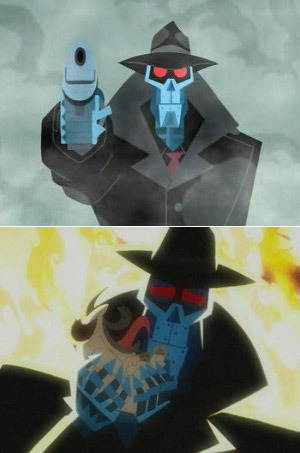
- The robot X-9 (pictured above) from Samurai Jack, unlike the other robots of the X's series, has a heart due to an Emotion Chip installed in his brain. He was so sympathetic to the audience that his death against Jack was one of the saddest moments of the series. The plot is part of the show's deconstruction of What Measure Is a Non-Human?: censorship rules meant that Jack couldn't harm living things even if they were entirely evil, but could wholesale slaughter mechanical lifeforms. X-9 demonstrates the folly of applying the rule so arbitrarily.
- Brock Samson on The Venture Brothers was trained as a deadly, omnicompetent super-agent, but his mentor impressed upon him a strict rule against killing women or children. He also appears to care for his charge's children even more than Dr. Venture does himself. But that last bit is not the least bit difficult to achieve.
- In Jonny Quest: The Real Adventures, Hadji's former guardian Pasha the Peddler was actually the assassin who was hired by Hadji's evil uncle and cousin to kill Hadji in order to usurp his family's kingdom. At the moment of truth, Pasha couldn't bring himself to kill the young Hadji and instead abducted him to protect them both.
- Parodied in the American Dad! episode "The One That Got Away". The hitman Roger sends after himself as a runaway persona brings both his kids with him. Even holding a gun to a woman's head while having a baby strapped to his chest.
- Jade Nguyen/Cheshire from Young Justice (2010). She does truly love her little sister Artemis and was willing to avenge her death before realizing it was faked. Season 2 shows that she and the Roy Harper clone (who would later be renamed Will) are married and have a child whom Jade named Lian which is Artemis' middle name. While she does leave Will and their daughter in season 3 she still does care for them and asks Artemis to give Lian a hug for her.
- Hit-Monkey: The title character has a code of "only killing killers" and protecting innocents. His Spirit Mentor Bryce mocks the idea as naive and counter-productive, but it's come back to save them a few times. A few other characters also follow a similar code, such as Yuki the Ghost Assassin who stopped pursuing them after seeing Monkey save a policeman's life.
- Richard "The Iceman" Kuklinski, one of the most infamous and prolific contract killers in history, claimed to have had a strict policy against murdering women and children. Whether this is true is disputed due to accounts of Kuklinski's home life.
- This interview with a Pakistani "target killer" has some element of this. Though he is extremely cold, he says that he cannot find peace, and what he does haunts him.
- As mentioned above, it's not entirely uncommon for mob hitmen and other such figures to be this, refusing to take jobs that involve hurting innocent people. Of course it's also not uncommon for this to be done for pragmatic reasons (murdering innocent people is a lot more likely to get the cops on your tail, and career criminals tend to despise people who harm the disabled, defenseless, or young; this is why child killers or molesters rarely last long in prison without constant protection. Mobsters also tend to drop members or hitmen who harm people not involved in their "business" since, as previously mentioned, it brings down a lot more heat from police). And keep in mind that people like this tend to have pretty warped moral codes (they do kill people for a living after all).
- During a period of severe depression, Angelina Jolie actually tried to hire a hitman to kill her. He agreed to meet with her in person, and — calmly and kindly — was able to talk her out of going through with it.
