
Everything in the episode seems completely against continuity, the characters act like they're on industrial-strength tranquilizers, and nothing makes sense within the pre-established context. If the show has a continuity, this episode will probably never be mentioned again, save perhaps as a throwaway joke, and none of the likely wild events will ever be repeated.
When the finale of a series is this, it's a Gainax Ending. An episode that is an Out-of-Genre Experience usually qualifies as well. When The Movie is this or one spontaneous series of events irrelevant to any previously established continuity see Non-Serial Movie. A single event within an otherwise standard episode is a Big-Lipped Alligator Moment. All Just a Dream is a frequent justification. Compare Oddball in the Series, which is a bizarre installment within a Series Franchise.
Has nothing to do with Superman's reverse counterpart or the continuity which he inhabits. This is also distinct from a Wham Episode in that in a wham episode, the changes are story-related and/or root themselves into the overall series. This trope is mostly meant for one-offs; though a later episode continuing the theme of an earlier Bizarro Episode that is still otherwise out of place is a Sequel Episode to the earlier one. If an otherwise Bizarro Episode makes more sense in light of a later Wham Episode, then the former becomes Innocuously Important. A Paranormal Episode can be this. Also, due to the random nature of dreams, it should be no surprise that a Dream Episode commonly overlaps with this. An Animated Episode is usually one of these as well.
Example subpages:
Other examples:
- This has really become a fairly popular trope to use in ads— possibly playing off the Internet's fascination with Japanese-crazy ads. See here
 (and if you see this one without seeing that one, it makes even less sense), this one, and this one, though only if you don't watch the last five seconds
- This Wine Gums ad.
- Cadbury are pretty good at this.
- The Hostess ads in Marvel and DC Comics of the 1970s and 1980s.
- Happy Heroes, being a sci-fi action series with a self-aware, fast-paced comedic edge to it, was bound to have a few oddball episodes here and there.
- Season 2 episode 20 has absolutely no focus on the Supermen fighting any monsters, instead being about Doctor H. wishing on a genie that he were married to Miss Peach, but with the genie placing unwanted side-effects on his wish that Doctor H. attempts to rectify with the other wishes he is given.
- Season 8 episode 36 has Big M., one of the more medium aware characters in the series, being transported to the studio that produces Happy Heroes and meeting the series creator, Huang Weiming, in person, not reacting as though he had any knowledge that he's in a cartoon at all. Big M. later gets his hands on a script for the show and erases a bunch of things and people, including Little M.; before the episode's events are revealed to be a dream.
- Garfield:
- The comic was always a commercially-friendly strip, that clearly knew what its remit was, and wasn't going to confuse its audience by going beyond that. Which makes the one time that it did all the more incongruous. In 1989, a multi-strip storyline saw Garfield alone in his apparently long-abandoned house. What really makes this strange is that it doesn't use this as a setup to a humorous or "safe" conclusion (as happened during a similar storyline elsewhere), but instead leads to a strange metaphysical/psychological horror ending where it turns out Garfield himself no longer exists and "wills" Jon and Odie back into "existence" through the power of denial, or madness. And that's it, no further explanation. Apparently Jim Davis intended this as a Halloween special, and the strip mirrors the 1976 Italian animation Allegro Non Troppo. Still the most unusual Garfield strip that has ever appeared.
- Much later (and less notably), an October 2008 arc involves one of the characters between Jon, Garfield, Odie, and (apparently) Pooky having a very strange dream wherein all four of them are randomly swapping heads around throughout the week. The arc abruptly ended on Thursday of that week without any of the characters being shown waking up from the dream nor who among them was actually having the dream in the first place (it's left ambiguous who it was between the four) being revealed.
- The comic was always a commercially-friendly strip, that clearly knew what its remit was, and wasn't going to confuse its audience by going beyond that. Which makes the one time that it did all the more incongruous. In 1989, a multi-strip storyline saw Garfield alone in his apparently long-abandoned house.
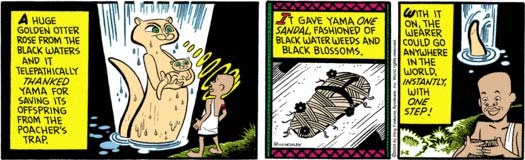
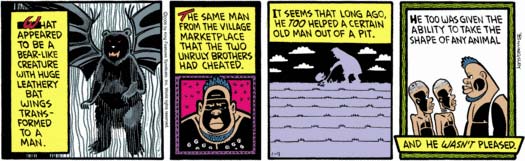
- Every year at Kwanzaa, Curtis runs a two-week-long Story Arc that involves new, made-up characters doing absolutely ridiculous things that resemble African folktales, with little concern for anything other than being awesomely over-the-top, often toeing the line between Rule of Cool and an outright Mind Screw. Past arcs have included a golden, telepathic otter and a magic sandal◊ and bat-winged bears◊, among others. Consensus among fans (or at least among The Comics Curmudgeon and his followers) is that these are among his best works; he even considers the otter "still the gold standard."
- Dilbert has had a few, such as the time Alice killed the Pointy Haired Boss then ripped another PHB out of a parallel reality to replace him, or the time Scott Adams himself got stuck in the strip, which lead to a parody of The Wizard of Oz.
- Calvin & Hobbes: The Series has "The Five Calvins", a completely out of place adaptation of "The Five Doctors" which is only referenced once after its conclusion.
- Chapter 122 of Guardians of Pokémon. The cast has just gotten back from a Trapped In Video Game Land arc, only Ash hasn't lost his Heroic Mime status, and then it turns out that Butch and Cassidy stole it just before they all left the video game world and now Butch is calling himself "Smash Ketchum" and using Ash's voice to hypnotize everyone over the radio. Then a battle happens and every time someone gets hit, their voice pops out of their body, leading to everyone switching voices for the rest of the episode.
- The Daria fanfic "God Save the Esteem" is usually a bit Darker and Edgier than the series. However, it is one of the few canon rewrites to actually adapt "Depth Takes a Holiday" (see below), and plays up the nonsense even more, with Jane nearly destroying Holiday Island with a Puff of Logic and Daria Breaking the Fourth Wall to address the reader at the end.
- Chapter 72-B of The Parselmouth of Gryffindor, posted on April Fools' Day, is a metafictional piece of fluff where the author drops in to announce the story's going on a hiatus to the characters.
- Halloween III: Season of the Witch has nothing to do with Michael Myers and instead has a plot that involves a mind-control conspiracy. What, you want continuity? Forget it. Not only does the film make no sense on its own, it's a standalone film with no connection to any of the other Halloween movies at all. Originally, the idea behind the Halloween movies was they'd have nothing in common except taking place on Halloween. The problem was the first one did too well and Myers became too much of an icon to make the other movies without him. Halloween III was an attempt to revive their original plans and was so poorly received it killed all possibility of making any other movies not centering around Myers.
- Initiation: Silent Night, Deadly Night 4 involved things like a Straw Feminist Religion of Evil and Big Creepy-Crawlies, among other bits of Mind Screw. The previous films were about serial killers prone to dressing up like Santa Claus.
- Silent Night Deadly Night 5 The Toymaker, also qualifies as it's loosely connected to even to the fourth movie. After the third, the movies mostly just became an Anthology series.
- Jason Goes to Hell: The Final Friday takes the franchise in a very different direction, with Jason less as an undead serial killer but as a demonic worm who can Body Surf. Future installments tend to act like it never happened. It says something that the comedic one with the Alice Cooper soundtrack, the crossover with Freddy, the one with the telekinetic girl, and the future one where Jason becomes a cyborg, all fit better in the series lore than part IX.
- A Nightmare on Elm Street Part 2: Freddy's Revenge has few thematic elements in common with the rest of the series, going for a Demonic Possession angle over the "dream killer" story of its predecessor. The original and the later sequels work as one continuous storyline, but the events of this one are largely forgotten.
- Slumber Party Massacre II, which is a musical full of Mind Screw where the psycho is a ghostly rockabilly who kills people with a drill attached to an electric guitar. The previous film was comedic, but not as random as this one, while the proceeding one was completely serious, and the villains of both of those were just crazy, non-supernatural guys.
- Star Trek V: The Final Frontier is this for the whole Star Trek canon. Many of the rules and conventions of the setting are ignored, the entire premise feels totally out of place ("the Enterprise crew tries to find God!"), it has no impact on the ongoing plot of the films, and the events are never mentioned again. Removing it from continuity entirely would have no effect on anything else in the franchise. It's been noted as feeling a lot like William Shatner wrote his own original sci-fi story, then simply changed the names to Trek characters.
- In the context of Star Wars, The Star Wars Holiday Special is essentially a string of bizarro episodes. It involves a Wookiee family watching a cooking show, some sort of strange Wookiee porn, a sci-fi action scene in cartoon form, a Wookiee watching an instructional video on how to assemble a transmitter (every step of which is shown to the audience), and Bea Arthur as a singing bartender on Tatooine. For decades, the only thing from it that was seen or referenced again was Boba Fett, and he only appears in the cartoon the Wookiees are watching. Life Day, the titular holiday, actually HAS returned in newer Star Wars media, but the events of this special are all but confirmed to be noncanon under Disney.
- Texas Chainsaw Massacre: The Next Generation, where Leatherface is now an effeminate Creepy Crossdresser whose new family (which includes a guy with a bionic leg) are employed by a government group or cult that is possibly controlled by aliens.
- An inverted example in The Theatre Bizarre. While the rest of the anthology shorts involve fantastic situations and standard genre tropes, "The Accident" is a dramatic story that deals with a mother and daughter discussing the nature of life and death after witnessing a fatal traffic accident. Many reviewers comment that the short feels out of place in a horror anthology largely about villainous characters, but also regard it as the best of the anthology, giving it a much needed heart.
- The unofficial "film" of the Ultra Series, Space Warriors 2000, an unlicensed film made by Thailand's Chaiyo Productions. It starts off as a Real-World Episode where a young boy named Nicholas receives an Ultraman toy from his father, and then the toy suddenly comes to life and tells Nicholas the history of the Ultramen, which then leads to a long, uninterrupted, 70-minute fight scene using recycled Stock Footage from every piece of media in the franchise up until that point, complete with plenty of Gag Dub thrown in where monsters are Suddenly Voiced. It gets really weird when the monster, Red King (who's established as a mindless beast for the entire show) taunts Ultraman with English: "Don't you know who I am?! I am Mr. Bad!"
- The Fighting Fantasy series of gamebooks, having over sixty installments and counting, is bound to have a few odd entries.
- Spectral Stalkers starts off as a rather normal adventure in the usual European medieval-inspired world of Khul, where your adventurer leaves a Fortune Teller's tent in a fair after hearing a prophecy that you're bound for an adventure out of this world. Then the adventure is followed by your character meeting a strange Winged Humanoid who hands you a crystal sphere called the Aleph, who can send you into different dimensions; what follows is a nonsensical series of adventures as you end up in a world with a purple Alien Sky, a land full of PigMan, a haunted castle, a giant chessboard, and a friggin' spaceship, where you can encounter aliens and cyborgs.
- Sky Lord, among the sub-series of books in a sci-fi setting, is the only one where your character is a four-armed alien soldier. You can also encounter various alien thugs, travel to all sorts of odd alien worlds (even by the series' standards) and a schizophrenic storyline that borders on Random Events Plot.
- "Bakerman" on the Midnight Oil album Red Sails in the Sunset. It's a Japanese school band playing an instrumental oompa ditty, in the middle of an otherwise pre-alternative rock album. Also very Mood Whiplash.
- Synchronicity: "Mother", a repetitive tune in 7/4 with screamed vocals and weird lyrics, shows up after the comparatively normal "Synchronicity I" and "Walking in Your Footsteps".
- "You're Gonna Die", a 9½-minute song (using the term loosely) at the end of Reel Big Fish's We're Not Happy Till You're Not Happy album. It's essentially nothing but screaming and static in the same vein as "Revolution 9" and even contains a Big-Lipped Alligator Moment of it's own in "Aaron is Made of Babies," a one-minute novelty song thrown smack-dab in the middle of the hectic track.
- "Anyone's Daughter" from Deep Purple's Fireball. The lyrics are typical DP — a man sleeps with a bunch of women and marries one of them when he gets her pregnant — but the music is in a Country and Western style that's out of place for this period of the band.
- Tell Me What to Swallow by Crystal Castles. A dark acoustic song in the middle of electronic stuff. Also Mood Whiplash.
- Judas Priest aren't total strangers to ballads, but even by their standards, the romantic soft rock ballad "Last Rose Of Summer" (from Sin After Sin) is an unexpected number from the metal masters.
- The hidden track in My Chemical Romance's The Black Parade, "Blood", is a song about drinking blood done in a vaguely Broadway style with bad sound quality, and it has nothing to do with the rest of the album. Bizarro indeed.
- "Look Who's Walking On Four Legs Again" by Local H is a twangy country ballad in the middle of a grunge album. It's actually a crossover between Scott Lucas's two bands, Local H and Scott Lucas And The Married Men, but if you're not expecting it, it's quite jarring. (A Local H-only version, titled "Look Who's Rocking On Four Legs Again" appears on the Another February EP.)
- The generally melodic, bubble-gum-pop band Sugar Ray begins their album "14:59" with 47 seconds of death metal, wherein a singer, not Mark McGrath, bellows "Be nice to your sister! Talk to your grandmother! Paint her a picture! Don't play ball in the house! Don't play with scissors! Be nice to caaaaaaaaaats!". It's sort of a joke about the fact that 14:59 was a New Sound Album — their previous two albums were more in the Alternative Metal style.
- How exactly does Jethro Tull bridge the first and second album sides of a dark, jazzy/avant-garde Concept Album (A Passion Play) pertaining to the afterlife? With the Story of the Hare Who Lost His Spectacles.
- "Plexiglas Toilet" on the Styx album The Serpent Is Rising. It's a Hidden Track, and is as silly a novelty song as its name implies. It also provides a bit of Mood Whiplash, coming as it does on the heels of "As Bad As This," a depressing Break-Up Song. Styx would never again record a song quite like it.
- Bon Iver's first, second, and fourth albums are mostly gentle, slow indie folk songs. The third album, 22, A Million, incorporates a lot of electronic and hip-hop production, including heavy sampling and audio effects.
- The Bible: Some of the prophet books, like the Book of Ezekiel, the Book of Daniel, and the Book of Revelation, set out prophecies for the future that can seem very strange to those who are not versed in the dense symbolism of the era, and have angels described in terms that make them into Eldritch Abominations, which is very alien to most people today.
- Invoked by ROH A Night Of Hoopla, an unauthorized show in a Chicago bar booked and directed by Truth Martini, featuring Satan. Drink as much as you want, just don't drive!
- AKIRA's 30th anniversary show in 2014 ran with a gimmicky theatre theme based on the film Heaven Can Wait, and told how AKIRA had died in an accident which was not meant to him, and had to confront the King of Hell (played by Masahiro Chono) and his minions in order to get his body back.
- WWE Survivor Series 89 was one for Bret Hart, since it was the only time he and Jim Neidhart were not on the same team, or even in the same match, during the original Hart Foundation's run. Bret was on the 4x4s with "Hacksaw" Jim Duggan, Hercules and "Rugged" Ronnie Garvin in their losing effort against the King's Court ("Macho King" Randy Savage, Canadian Earthquake, "Canada's Strongest Man" Dino Bravo and Greg "The Hammer" Valentine). In the prematch interview, it's odd, though funny, to see the normally reserved Bret brandishing a 2x4 and cutting the same kind of cartoonish No Indoor Voice promo as the other guys.
- Following the demise of Demolition and before Barry Darsow's reintroduction as Repo Man, he was Ted DiBiase's masked man for a match with Virgil on the August 18, 1991 WWF Prime Time Wrestling. Bobby Heenan called him "Murray from Michigan." He lost when Virgil blocked a splash with a punch. This was just a random moment that never led to anything.
- Crossed with WTH, Costuming Department?: At CZW Allentown Project, January 16, 2004, Sumie Sakai lost a match to Eddie Edwards as the masked Yellow Michinoku Ranger. You can see more here.
- You might be surprised to find that such a sane and relatively down to earth series as Adventures in Odyssey would have examples of this.
- The most notable example among listeners is "I Slap Floor", where some of the kids can't find Whit and ask Bernard what happened to him. Turns out, he and many of the other main characters are at home recuperating from the week before. The week before, many odd things began to happen, starting off with Whit giving odd or flat-out dangerous advice to the kids ("Look Mr. Whittaker, I pierced my own ears like you told me to!"), before even stranger things begin happening around town, such as Tom Riley, so he can pursue his dream of becoming a rodeo star, selling the Timothy Center to local swindler Bart Rathbone, who plans to turn it into a space camp that anyone can attend, Eugene and Connie fall in love and are going to get married ASAP, and the normally very incompetent detective Harlow Doyle is flawlessly solving crimes, among other odd things...and then it turns out that Big Bad Dr. Regis Blackgaard is behind all this, having returned to Odyssey disguised as a largely unseen minor character, and was using a mind-altering cologne to cause confusion all over town so taking over it would be a cinch. Turns out none of this happened and Bernard was pulling the kids' leg. Note that rearranging the letters in "I Slap Floor" spells: "April Fools".
- Other notable weird episodes include:
- "Bethany's Flood", where the titular character falls asleep during a bible study session about Noah's Ark and has a dream where the flood was caused by Christopher Columbus leaving the water on in the bath tub for 40 days and nights, among other things.
- The similar episode "The Seven Deadly Dwarves" where the same girl dreams she is "Snow Dewhite" who runs away from home and is captured by the eponymous characters (who represent the Seven Deadly Sins) but is fortunately rescued by The Good Stepladder Father.
- The much earlier (and missing) episode "Lights Out At Whit's End" which, long story short, ends with the entire cast (yes, including Whit and Tom Riley) freestyle rapping.
- "The Eternal Birthday", a random "Groundhog Day" Loop plot where Liz wishes everyday was her birthday. Guess what happens? It turns out that she was just in the Room Of Consequences the whole time. She went in there to live out her wish. Interestingly, the events of this episode were alluded to the next time Liz went in the Room of Consequences again in a later episode.
- "Push The Red Button", which exists as both a Live Episode and a shorter radio episode. The basic premise is largely the same and features crazy goings-on not seen since "I Slap Floor" in both forms, though: Eugene creates and accidentally activates a program meant to combine all of the programs and inventions at Whit's End into one...while Wooton and Whit are creating a Captain Absolutely story in KYDS Radio and Connie and Penny are in the Imagination Station visiting Michelangelo Buonarroti as he paints the Sistine Chapel ceiling. Havoc ensues as characters and elements begin disappearing from one invention/adventure and appearing in another, which spells trouble as the villain in the Captain Absolutely story (who is bent on eliminating all traces of beauty, goodness, and truth from the world with his ultra-defilation device) decides to eliminate all beauty, goodness, and truth from all time. which somehow begins affecting real life and causing Whit's End itself and everything in it to begin to collapse and vanish (since it was founded upon Whit's belief in God's beauty, goodness, and truth). Fortunately, the villain is vanquished by drawing him back to the present with a painting Penny created, causing his ultra-defilation device to backfire onto him (and turning him handsome in the process) and Captain Absolutely puts him away. However, Whit's End and everything else is still a mess. Matthew tries to fix everything by kicking the main computer...which causes Whit's End and all of Odyssey to explode. Cue Chris closing out the episode like usual. It's directly after that the episode is revealed to be All Just a Dream that Wooton had the previous night and was telling to everyone the next morning. Connie and the others are unimpressed.
- The Men from the Ministry is a relatively down-to-earth comedy/political satire, but has an episode called "The Day the Martians Came". Two Little Green Men land on England, hijinx ensue and... that's it. No All Just a Dream, no "Scooby-Doo" Hoax or anything like that, and the landing is never referred to again at all (admittedly in a series that runs on Negative Continuity). Note that this is the only episode where something explicitly supernatural happens.
- ESPN's Sam Miler claims that the first game of Major League Baseball's two-game London Series in 2019 between the Yankees and the Red Sox was one. Among the pertinent points:
- No pitcher lasted for more than three innings
- The starting pitchers were both pulled in the 1st, after each giving up six runs
- Half of the top half of both lineups was pulled at one point in the game, though this could be justified by the next one...
- The game lasted 4:42 for only the standard nine innings, roughly 50% longer than a normal game, with the first inning lasting nearly an hour. For context, the twelve-inning game that broke "The Curse of the Bambino" back in 2004 lasted 5:02.
- Chapter 3 of Danganronpa 2: Goodbye Despair is the strangest Danganronpa chapter ever. Akane attacks Monokuma but is defeated and when he's about to execute her, Nekomaru protects her and is recovered in a hospital. Then some people, for some reason, get infected by a disease that's making them change their personality which functions as the third motive. Nagito gets critically sick and is recovered in a hospital. After some time, Ibuki's body is found by Hajime, then Hiyoko's body is mysteriously found in the same room later...and it turns out Mikan is the killer because she was infected too by the disease. At the very end of the chapter, Nekomaru recovered but is now a robot.
- Turnabout Storyteller in Phoenix Wright: Ace Attorney – Spirit of Justice. Absolutely no relevance to the story and there's no mention of it after its end. While previous chapters were each of them a Wham Episode, in this chapter you play as Athena and you have to defend a drunk soba cook accused of killing the rakugo performer Taifu Toneido. The witnesses outside returning character Simon Blackquill are a "big-breasted" balloon artist named Geiru, and a performer with dissociative-identity disorder named Uendo. To find out the truth, they get Uendo drunk to bring out another personality and find out that Geiru might be culprit, and when she's suspected, she goes for a pirate-like persona. And it's not over, Geiru, who is exposed as the killer, killed Taifu with udon dough because...he didn't gave her title she wanted.
- Episode 20 of An Akatsuki's Life is weird. Really, really weird.
- The original Charlie the Unicorn video is merely weird and has two crazy unicorns talking nonsense. Then come episodes two, three and four, which are six minutes of continuous madness.
"STARFISH REALLY LOVES YOU!"
- The Happy Tree Friends episode "I've Got You Under My Skin" could easily count. It starts off relatively understandably (for the show, anyway), but then Giggles sneezes on Lumpy's face... he catches a cold, which Sniffles apparently thinks needs to be dealt with via "Fantastic Voyage" Plot. Whereupon the fact that Giggles is lying on the couch shivering with her brain coming out of the back of her head is almost completely forgotten. And did we mention that Happy Tree Friends isn't the kind of show you'd ever really expect to involve a "Fantastic Voyage" Plot?
- The Strong Bad Email virus involves reality breaking apart after Strong Bad gets emailed a virus. Much mindscrew occurs until Bubs fixes it by shooting a hole in Strong Bad's computer with a shotgun that appears as Homestar Runner's leg.
- GoAnimate: Caillou is usually depicted as getting grounded, but Uolliac videos involve Uolliac causing chaos with his reality-warping powers.
- El Goonish Shive:
- The "alternate paths" Sunday filler.
- Any of the Newspaper strips, which are specifically not part of EGS continuity (with few exceptions, such as two characters filming themselves debating what makes a "real" fan, which is still a departure from the magical dramedy norm).
- The "alternate paths" Sunday filler
- "Mulberry's Epic Yarn"
- High Fantasy webcomic Exiern spends a month at the bizarro as part of an Overly Long April Fools Gag when it is suddenly re-tooled as a group of trendy twenty somethings hanging out at a coffeeshop/strip club.
- Sluggy Freelance brought us Chapter 63: Safehouse, bringing us Torg taking up gardening, and coming up with increasingly surreal plans to protect the garden from chipmunks and deer, that all fail spectacularly, Bun Bun robbing a bank with the help of a talking bear and an old man with a huge mustache, and the entire main cast getting addicted to the latest computing technology and the possibilities it offers, and getting tangled up in weird online community shenanigans, and playing a suspiciously addictive online game which, after a hacker attack, starts a zombie apocalypse that only affects animals. While randomness is par the course for Sluggy, what makes this a bizarro episode is that it went on for an extended period of time right after a very dark storyline, and ignores all of the lingering questions, including the fate of a character that the group lost contact with and is on a dangerous mission, a character that refuses to accept that her friends thought to be dead are alive, and a plan to finally get rid of the resident psychopathic, ninja, Stalker with a Crush that caused said friends to become almost dead. Word of God seems to indicate the arc will bear no overall importance as well.
- Homestuck's Trickster arc revolves around a group of protagonists temporarily being turned into saccharine, sugar-rushing versions of themselves in colorful outfits, which begins during the End of Act 6 Act 5 Act 1. The plot starts getting increasingly bizarre, with the protagonists making equally colorful endgame weapons and Santa Statues with alchemy, as well as making plans for quadruple weddings for everyone because they think this will solve all their personal problems and conflicts. Except for Dirk who gets a new outfit but remains as deadpan as before. Officially, this all takes place inside Act 6 Act 5 Act 2 and ends with all the characters waking up hungover and having lost the item that changed them.
- Mountain Time's Bizarro Episode, River Valley Time, has all of the characters acting opposite to their usual personalities. Since Mountain Time is a Dada Comic, this means that the Bizarro Episode is the one strip that makes sense.
- Everyone Is Home: Occasionally, the comic will release a "shit-post comic" featuring much cruder artwork and writing, and using copious amounts of stock images. Needless to say—especially since these started during the long-running Revival Arc—these entries are ignored as part of the main continuity.
- The first Hateful Comparisons in Aitor Molina Vs. starts as a regular episode and ends too weird.
- Economy Watch: "It's An Economic Snowfall" is an entire skit/lore episode, and features more serious monologues and scenes compared to the rest of the show.
- Used and lampshaded in the fan sequel of Half-Life: Full Life Consequences: "What Has Tobe Riped Off". John Freeman creates a Stable Time Loop, by hitting himself and giving himself "amneesha":
Narrator: And so what happens means that it was nothing and just...(Scene change)The Nostalgia Critic: Ughhhhh... Big-Lipped Alligator Moment.A BIG LIPPED ALLIGATOR MOMENT! *fanfare*
- The Nostalgia Critic had one himself with "You're A Dirty Rotten Bastard". Opened and closed by Santa Christ (who after Kickassia heavily dislikes the Critic) like it was a story, going against a lot of established characterization to make Critic look like the biggest jackass in all the world, and never mentioned again. Although Roger the angel did reappear in the Scooby-Doo review.
- The Angry Video Game Nerd's review of Teenage Mutant Ninja Turtles III. With no warning he abruptly drops reviewing games for an episode and instead targets a movie. This was an artifact for a potential spinoff by James Rolfe to do film reviews as the Nerd, but he quickly changed his mind as he felt more comfortable talking about them as himself, leaving this one review as a bit of an anomaly.
- The Needle Drop:
- The review of Yung Lean's Unknown Death 2002, in which instead of reviewing the album, Anthony Fantano repeatedly proclaims in a deadpan voice that his hands have turned into bread, and spends the remainder of the video eating them in silence. The video description lists "BREAD" as his favorite AND least favorite track on the album (there is no such track), and gives an overall score of "BREAD/10".
- Also worth noting are Fantano's reviews of Limp Bizkit's Gold Cobra in which he spends the entire review eating food, and Big Sean's Dark Sky Paradise which consists of him repeating the word "no" over and over, ultimately giving the album a score of "NO/no"
- His review of Cease & Desist by Blarf was literally just him burping nonstop for four minutes, with no verbal or written score given out.
- Lampshaded in a video by Daniel Sulzbach, AKA MrRepzion, titled Am I really 19?. Daniel starts out the video by saying, "Well, hello my fellow tutti-fruits! I thinks I am going insane.". He then spends the rest of the entire video making totally random statements.
- Bacon Flavoured Thoughts! by Matt Santoro. The usually-sane Matt acts like a crazy person, and rambles about how bacon is fantastic. This contrasts his other videos, where they have some kind of plot, and Matt acts like a normal person.
- Parodied in the Clickhole article "When Good TV Goes Bad: The Worst Episodes Of The Best TV Shows," with list entries like a The Walking Dead prequel episode... set during the Wars of the Roses.
- videogamedunkey is already known for Surreal Humor, but then there's Pet Me Horse. It's just... it just is. At best guess, it's some kind of parody of WarioWare. It's one of the few videos he has Unlisted, which might mean it was too out-there even for him.
Dunkey: Pet pet pet. Pet pet the future.
- An inverted example occurs on Count Dankula's video on Bob Ross: as opposed to his usual Absolute Mad Lads videos, which talk about Creepy Awesome historical figures or ones that have Success Through Insanity, the tone is a lot more relaxed and respectful.
- The videos of Super Eyepatch Wolf tend to be fairly straight forward affairs where John Walsh goes in depth about the various media he cares about, such as recommendations and critiques, in-depth video essays, and things such as that. If it's anything else, it's something about his life or a deep dive into something he find important. His video Space Jam 2: How Warner Bros Is Lying to You starts out seeming to be about his analysis of the hidden dark themes and messages hidden in Space Jam, but quickly pivots to become the story of an elaborate conspiracy about an unmade sequel to the film known as Space Jam Two: Battle for Reality...which is actually an utterly bananas Fan Sequel written by John himself.
- The Interface Series: Post 49, "The Old Apple Nullity", is completely unlike the serious Cosmic Horror Story tone of the other entries. It takes place in a world that seems to be completely different from either of the main timelines of the series, instead set in a world where trees don't exist and a boy hangs his tire swing from literally nothing, referred to as an "existential nullity". The boy is told to chop down the nullity and does so, somehow. It turns out that trees in this world have been replaced with... giant flayed demon penises. This post is promptly never mentioned again, as if it never existed.
- Youtuber hazel usually does straight, lightly humorous examinations of old and niche topics, mostly pertaining to anime, manga, and video games, but "a normal creepypasta retrospective" is anything but. While hazel and guest co-host mae talk about the creepypastas in the video like they're well-established, they're actually original creations made for the video that were obviously based off real creepypasta, and everything leads up to a narrative climax where hazel and mae find out they've been speaking the creepypastas into existence...which is then shown to be fake itself. The description even reads "this is all fake lol".
