

A character who has been disabled for an extended period, often physically or visually, suddenly regains the use of their disabled organ. Expect a dramatic shot of the crutch being thrown away, or the discarded wheelchair clattering its way to oblivion.
Explanations for this tend to fall into five varieties:
- The character can override the disability through Heroic Willpower. This is most believable if it's a short-lived emergency override of a disability that makes normal physical activity very painful and difficult, but not outright impossible. Often seen in Physical Therapy Plots.
- 1a. The disability was psychosomatic in the first place, so Heroic Willpower was all that was ever needed to cure it.
- The disability was temporary, and rest and/or medical treatment have healed it in time for the plot-relevant moment.
- The character was only feigning the disability in the first place, or exaggerating their impediment.
- The otherwise incurable disability was miraculously cured through Divine Intervention or by Applied Phlebotinum.
- The disability could just disappear for no reason at all, possibly as a Retcon or as Canon Discontinuity.
This trope can provoke the implication that any disabled person who doesn't throw off their disability must somehow want to remain disabled. See Epiphany Therapy for characters throwing off mental disorders or psychological trauma.
See also Artificial Limbs, Beautiful All Along. Compare Abled in the Adaptation, where a character’s disability in the original is left out of an adapted work, and Healthy in Heaven, for when characters lose their disabilities in the afterlife.
Examples:
- An infamous Nuveen Investments commercial
 had the late Christopher Reeve standing up and walking away from his wheelchair, while explaining the importance of funding research for the treatment of disabled people. The ad, of course, used CGI to make him walk, and was supposed to engender hope for the future, but the ad mostly got Reeve What the Hell, Hero? reactions from the general public for making it look as though cures for paralysis would be available in the near future, and a few crushed people who were fooled into thinking that he really had been cured.
- Aldnoah.Zero:
- Played with in episode 23. For the last eighteen months, Princess Lemrina has been impersonating her comatose sister Asseylum to rally the Vers Knights. Due to her own disability, she has to pretend Asseylum had been paralyzed during the events of Episode 12 - not completely unlikely, since she was shot in the back and it could have damaged her back and/or spine. So when the real Asseylum, having woken up without having lost her mobility, delivers a speech to the Knights that culminates in her stepping right out of her wheelchair, it appears to be this, when really she'd never even pretended to be paralyzed.
- Played with similarly in a previous episode where Lemrina appears to do this, only to disengage her camouflage and reveal herself to be Asseylum, having just tricked Slaine into revealing his plans to subjugate Earth.
- This happens to Coco in the finale of Basquash!, as one of the last shots is her getting out of her wheelchair. Considering everything else in the series, it's very likely this was the phlebotinum version.
- Code Geass:
- In one of the last episodes of the second season of Code Geass, Nunnally overpowers the memory Geass the Emperor had put on her and opens her eyes through sheer force of will, after being blind from psychological trauma for years. (Her legs still don't work, though.)
- In the Alternate Continuity manga Nightmare Of Nunnally, Nunnally is healed of her blindness and inability to walk by the end.
- A rather dark usage in Cross Ange: Ange's sister Sylvia injured herself in a horse-riding accident when she was young, and as a result is paraplegic. In the final episodes, however, Ange guesses that the disability isn't physical and that Sylvia's used her injury as an excuse to rely on others, and gets her sister to start walking again to tie into An Aesop about standing on your own. The thing is, she does this by threatening her sister's life, forcing her to walk out of sheer terror that she was about to be killed. Also, it's glossed over how her legs would be capable of supporting her if she hadn't used them in years.
- Appears as a Justified Trope in the second season of Darker than Black. The heroine's brother is a Contractor who uses a wheelchair as part of his Remuneration. Typically of this trope, he suddenly rises from his wheelchair at a plot-important moment.
- Subverted in the Izaya Orihara spin-off of Durarara!!. Due to sustained injuries after his final fight with Shizuo, Izaya's arms are weak and using his legs causes him pain, so for the most part, he is confined to a wheelchair. As it turns out, these are psychosomatic injuries and if he took therapy, he could move around how he used to. Izaya refuses therapy and claims that it is his 'punishment'. However, it is implied PTSD is the cause behind this decision.
- In Fist of the North Star, one of the Nanto Roku Seiken, Shuu, recovers his eyesight at the brink of death, for a Tear Jerker moment where his greatest wish, seeing Kenshiro's grown-up face, is fulfilled, allowing him to die at peace, knowing the guidance of his star was not wrong.
- The manga and second anime of Fullmetal Alchemist feature Edward regaining his right arm in exchange for Alphonse sacrificing the connection between his soul and the armor and later Edward sacrificing his ability to perform alchemy as payment to drag his brother back from beyond the gate, and Roy Mustang regaining his sight through a Philosopher's Stone. Edward's case is zigzagged somewhat, since he lost his left leg in the same incident that led to him getting his arm taken away, but he actively decides to keep the leg as a prosthetic instead of getting it back.
- In the Honoo no Alpen Rose manga, a girl named Marie was paralyzed until she met Lundi. She then miraculously rose from her wheelchair to help him, after which he's limping on crutches and she's apparently fine.
- In the final arc of the seventh part of JoJo's Bizarre Adventure, main character Johnny Joestar regains his walking, which he had lost after being shot in the spine. A large part of his character before this moment consisted of him re-learning to ride a horse without the use of his legs.
- Kenichi: The Mightiest Disciple: Ryuuto Asamiya, aka Odin, ends up confined to a wheelchair after using a Dangerous Forbidden Technique against Kenichi. Later on, he recovers just in time to stand up and save Kenichi from his master Ogata.
- The religious anime film The Laws of Eternity features a rare posthumous example: Yuko meets Helen Keller in the Bodhisattva Realm of Heaven, where she is no longer blind nor deaf. Moreover, Happy Science claims that disabled people who meet the requirements to enter this realm will no longer be disabled after death.
- Hayate after Magical Girl Lyrical Nanoha A's. In her case, it's a combination of versions 2 and 4, with her paralysis being due to the Artifact of Doom draining her life, and even after they got rid of the magical source, it still required several years of medical treatment and physical therapy before she was able to walk.
- In episode 12 of Walkure Romanze, Mirielle, who was a wheelchair user due to a horse-riding accident, manages to regain the use of her legs after watching her sister Noel fight in the tournament. While Noel loses the match, she's not too upset about it in light of her sister being able to walk again.
- Using the Dangerous Forbidden Technique Mankai in Yuki Yuna is a Hero causes Heroes to lose bodily functions. Yuna loses her ability to taste foods, Fu loses eyesight in her left eye, Itsuki loses her ability to speak, and Togo loses her ability to hear in one ear. Later in the series, it's revealed Togo was a Hero who Forgot the Call, explaining why she needs a wheelchair. In the last two episodes both Karin and Yuna become seriously disabled, becoming blind-deaf on top of losing ability in their limbs (Yuna even ends up in a catatonic state). In the end though everyone's disabilities are fixed, or rather, the abilities they sacrificed are returned.
- 52: Ralph Dibny thinks that Dr. Milo is just pretending to be crippled in order to smuggle a magical artifact into the asylum in which he is incarcerated. Said artifact is one of the wheels on Dr. Milo's wheelchair. Horribly subverted when it turns out Milo really is crippled and has no legs. Ralph only realizes this after he had already removed the wheel and Milo was left helpless and crawling on the floor.
- Aquaman:
- Aquaman, along with other prominent Atlantean residents such as Mera, originally could only stay on dry land for an hour before growing weak and imperiled. Somewhere around Sub Diego, this was hand waved to him actually being able to survive on land but preferring remaining submerged according to a conversation with Martian Manhunter. Later, Mera is seen on land all through Blackest Night as she fights off the titular Zombie Apocalypse, and at the beginning of Brightest Day, enjoying a blissful reprieve with a newly revived Aquaman at the Curry Lighthouse. As if to set the latter into status quo, the post-Flashpoint canon officially states that Aquaman is fully amphibious as a Half-Human Hybrid who grew up living on land, as are Atlantean/other aquatic nobility including Mera.
- Batgirl: Following the New 52 reboot, Barbara Gordon returned to the role of Batgirl in Batgirl (2011) after decades as the paraplegic Oracle. In-universe, it's been retconned that she was only paralyzed for three years (of Comic-Book Time), and she and her family found some "miracle" doctors in Africa who healed her via a surgical implant that allowed her to walk. The cavalier glossing over of the lengthy recovery process that this would logically require did not please the fanbase, and it was hastily revealed that she hasn't thrown off the psychological effects, getting nasty flashbacks every time she sees a wheelchair ramp and dealing with a good deal of Survivor Guilt. Several stories have also featured the implant getting damaged, temporarily leaving Barbara unable to walk like before. The Heroes in Crisis crossover also revealed that she attends a type of superhero therapy for the psychological scars. During The Joker War, Babs was forced to temporarily disable the implants to stop the Joker from controlling her. As a result, she has gone into semi-retirement as Batgirl, returning to her role as Oracle and giving the mantle to both Stephanie Brown and Cassandra Cain as any further damage would return her to the chair for good.
- Batman: In Knightfall, Batman's eventually healed of his paralysis at the hands of Bane through the usage of his doctor, Sondra Kinsolving, who ended up having a healing ability. On the downside, though, the time he spent paralyzed meant he had to go through a crash course training session to regain his physical prowess.
- Daredevil: Over the years, Matt Murdock has regained his sight several times, such as in the Superior Iron Man miniseries. It never lasts long.
- Hawkeye: For a time, Clint's deafness was cured by Franklin Richards, but he lost his hearing again in Hawkeye (2012) when the Clown jammed arrows in each of his ears.
- The Incredible Hulk: In one story, Bruce Banner gets ALS and is eventually cured by Reed Richards using a complex procedure involving DNA samples taken from Brian Banner's corpse and infused into his damaged genetic structure by Ant-Man, the Hulk's transformation back into Banner infusing the new DNA into his system and healing his disease. (The issue ends with Banner Breaking the Fourth Wall, saying it's Just A Story and there's no real cure for ALS, encouraging people to donate to the research to Find A Cure.)
- When Bruce Banner was in control of the Hulk during the original Secret Wars (1984) he got his leg broken by Ultron. He was put into a brace by his friends, and returned to Earth he was still wearing it. When the Savage Hulk persona eventually reasserted itself the first thing it did was throw away the crutch Banner had been using, tear off the brace, and then proceed to total the Abomination as easily as he always had.
- Iron Man: After Tony Stark had his nervous system replaced after a great deal of damage, he had to relearn how to move. During that time, he was paralyzed from the neck down.
- Red Dwarf Smegazine: Rimmer pulls one at the end of the Red Dwarf USA pitch (where he was put in a wheelchair following the radiation leak rather than killed) in "Red Dwarf USA", standing up from his wheelchair to save his friends.
- Richard Dragon: Richard Dragon reveals in an issue of The Question that he actually can walk, and the wheelchair was just to screw with people.
- Runaways: In Avengers Arena, Nico Minoru had her left arm blown off in an attack. For about two years afterwards, she used a prosthetic arm as a replacement. When Runaways (Rainbow Rowell) opened, she suddenly had her left arm back. It was later revealed that the Staff of One had regenerated it sometime before the new series started.
- X-Men: Professor X, who routinely goes from paraplegic to perfectly healed and back again.
- In Dick Tracy, the Mayor's invalid wife pulls off the 'Heroic Will' version: rising from her invalid bed to shoot Mrs Pruneface and save her daughters.
- All Assorted Animorphs AUs: Deconstructed in "What if James, not David, became the seventh Animorph?". Morphing allows James to get his legs back, which makes him feel more frustrated that the world isn't adapted for wheelchair users.
- Code Prime: At the end of R1, Nunnally regains her sight through a combination of her own willpower and being exposed to the Matrix of Leadership. Later in R2, she’s outfitted with leg braces that help her walk while healing her muscles and nerves with nanotechnology.
- Dangerverse: Danger's werewolf taming powers makes Wolfsbane unnecessary and he eventually is completely cured of his lycanthropy. This allows all other werewolves to be cured too, if they choose.
- Ron's blindness is healed to an extent. And the Longbottoms regain their sanity after Meghan heals them. If anyone else has suffered the same fate, they are not provided with this option.
- Meghan also heals Dumbledore's cursed hand.
- A Diplomatic Visit: In chapter 2 of the second sequel Diplomacy Through Schooling, Tempest's horn is restored to its full length thanks to Discord. However, it's portrayed somewhat realistically in that she still needs training to learn how to use magic normally again, as she immediately displays the inability to lift so much as an eating utensil with her telekinesis. Celestia promptly offers to personally give her that training, which Tempest accepts.
- The Feralnette AU offers a Downplayed in a Flashback. After his wife's disappearance, Gabriel shamelessly exploited Amelie's concern about her childhood friend by using the various informal business arrangements she'd made with Emelie to try and milk Amelie's company dry. When confronted about this financial abuse, he attempted to guilt-trip her into letting it continue by implying Adrien would suffer if she cut him off. Amelie responded by painstakingly pushing herself up from her wheelchair, gaining just enough leverage to throw herself at Gabriel and drag him to the floor. She didn't magically regain her mobility, but still beat the shit out of him. And proceeded to kick his ass in court afterwards, to boot.
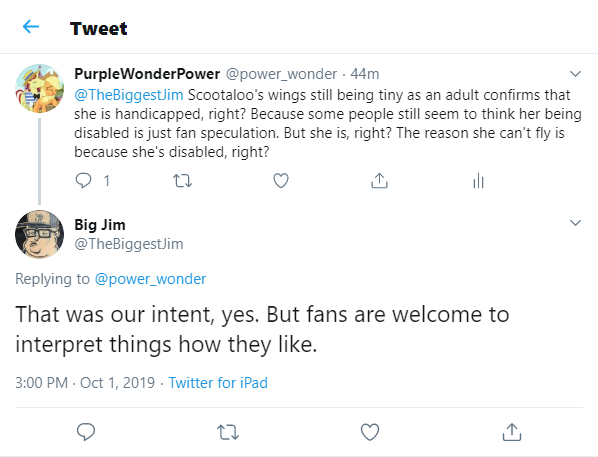
- Fimfiction.net has an entire folder dedicated to stories involving Scootaloo gaining the ability to fly. Some of them involve prosthetic wings or other assistive technology, but most of them have her flying naturally (or at least working towards that goal with the implication that she may one day achieve it), more in line with the spirit of this trope. Justified in that it was never explicitly established in-universe that Scootaloo was not expected to ever be able to fly.note
- Subverted by at least one story where Scootaloo overcomes her disability by learning to fly an aeroplane instead.
- In Flashback (MHA), Toshinori quickly gets his Game-Breaking Injury healed thanks to Eri reverting his age to his prime.
- A Moon and World Apart: A variant of type 4 (miraculous cure) happened to Vinyl Scratch in the past. Chapter 2 shows that she has an implant in her neck, which is related to her voice; chapter 13 reveals she was born without vocal cords, and that as soon as she was old enough to learn how to write, one of the first things she did with that ability was ask for a way to speak. Her parents promptly took her to the doctors and, after making sure she was fully informed, had an artificial voice box installed that substituted for the missing vocal cords. She admits it isn't perfect, but it does what she needs it to.
- This temporarily occurs to Neolani in Offspring. She was born blind but her mother Mipha's spirit temporarily gifts her the ability to see. However, Neolani's vision goes away when Calamity Ganon is defeated and Mipha's spirit moves on.
- Pokémon: Harmony and Chaos: One of the main traits of Flash Sentry's Riolu, Springer, is that he absorbed the energy of an Everstone years ago, preventing him from ever being able to evolve into a Lucario. In the penultimate chapter of the series though, Springer's bond with Flash becomes so powerful it overwhelms the Everstone energy he absorbed, allowing Springer to finally evolve into Lucario during their championship match against Shining Armor.
- Rufus in Final Fantasy VII: Advent Children does a type 3, revealing he was playing up his illness all along.
- In The First Christmas from Rankin/Bass Productions, shepherd boy Lucas is struck by lightning and left blind at the beginning. But in the climactic scene, his own happy tears restore his eyesight.
- In Lady and the Tramp, Trusty the Bloodhound had lost his sense of smell long ago, but when the Tramp is taken by the dog catcher, he manages against all odds to track him down.
- In WALL•E, the humans are incapable of walking thanks to extreme obesity and probable muscle atrophy due to their sedentary lifestyle. By the end of the movie, at least some have enough Heroic Willpower to fight that off and stand.
- Avatar: Jake Sully is able to walk againnote after having his consciousness transferred to an alien body.
- Beyond the Valley of the Dolls: Harris tries to kill himself after having drunken sex with Casey, succeeding only in losing the use of his legs. In the end, the shock of Z-Man's massacre somehow allows him to recover and walk again.
- Parodied in The Big Lebowski where, after it has been discovered that the title character (not the protagonist) has been a fraud in a number of aspects of his life, Walter suspects that he's faking being a cripple (he's not).
- In furry movie Bitter Lake, one of the characters mocks another for leaving his "retarded" brother to run his province while attending peace talks (he gets a mention on the movie's website as "half-witted"), who is then promptly forgotten. He appears at the end of the movie, claiming he never really was retarded, and that his brother only said he was to discredit him. He's also the villain of the movie.
- Change of Habit has a girl who developed autism from hiding behind a "wall of rage" to cope with Parental Abandonment. She is cured using rage reduction, now known to be an abusive quack therapy, which supposedly allows her to release the anger and interact normally.
- Some of the many adaptations of A Christmas Carol, most notably the Alastair Sim and George C. Scott versions, end with an epilogue depicting Christmas a year or two after Scrooge's redemption, and show a healthy Tiny Tim without his crutch, running to greet his "second father" Scrooge. The original book never says if Tim was able to give up his crutch or not, only that he didn't die.
- Cthulhu (2007). A disabled man who says he lost the use of his legs and testicles in an accident, offers the protagonist a chance to impregnate his wife. When he turns down the offer (as he's gay) he gets drugged and raped instead. When angrily confronting the wife later, he's surprised when the husband (who's got full use of his legs) attacks him. It turns out the whole thing was a setup by the local cult who needed his offspring for their own dark purposes. Another possibility is that he really was paralyzed — he implies the Order will give the use of his legs back to him if his wife births a child, which she did and they apparently lived up to their end of the bargain.
- The Dark Knight Trilogy: During the climax of The Dark Knight, Batman/Bruce Wayne ends up injuring his leg after falling off of a building with Two-Face; by the time of The Dark Knight Rises eight years later, the cartilage in his knee has deteriorated to the point that he requires either a cane or a powered leg brace to walk. After being defeated by Bane and reconditioning himself in the Pit, however, he is able to walk unassisted once again.
- In The Darwin Awards, Burrows is able to overcome his hematophobia when the North Side Killer is holding Siri hostage and cuts her: expecting Burrows to faint. Burrows remains conscious and is able to rescue Siri.
- Freddy in Dirty Rotten Scoundrels engages in a type three case while pretending it's type one.
- A famous "heroic" will example is the title character of Dr. Strangelove. As he enthuses over the upcoming end of the world, he rises from his wheelchair to describe his plan before proclaiming "Mein Fuhrer, I can walk!" Allegedly, this wasn't scripted—Sellers forgot in the moment that Dr. Strangelove was a cripple and ad-libbed the line to cover the mistake.
- Van Helsing does this in Jesus Franco's 1970 adaptation of Dracula starring Christopher Lee. During the film he suffers a stroke and becomes a wheelchair user, only to rise again shortly after in order to fend off Dracula.
- In The Ex, the ex-boyfriend (Chip) reveals he can walk; this ends up being his Moral Event Horizon as he was pretending to be handicapped for years.
- The "Run, Forrest, run!" scene in Forrest Gump is somewhere between the willpower and healing versions of this trope. As a child, Forrest was made to wear leg braces for scoliosis. The braces break off when he runs away from a group of bullies, revealing that he apparently doesn't need them anymore.
- This also bridged the plot problem between Forrest's early disability and subsequent events.
- In Frankenstein and the Monster from Hell, Sarah — who has been mute since a childhood trauma — regains her voice when she sees Simon being attacked by the monster.
- In God's Gun, Johnny is able to overcome his hysterical muteness and yell out a Big "NO!" when he thinks Clayton is reaching for a hidden gun to shoot Lewis.
- Mikey from The Goonies throws away his inhaler at the end, having apparently defeated asthma through life experience. (It can be aggravated by stress and anxiety, but that's probably a bit much.)
- The Hazing: Tim, who is afraid of the dark, cannot raise his voice above a whisper when in the dark. When the possessed Marsha tries to shove Delia through the portal to hell in the darkened cellar, Tim manages to find his voice and scream. This distracts Marsha long enough for Delia to turn the tables and hurl her through the portal.
- Mei does this out of Obfuscating Stupidity in House of Flying Daggers. She played the "role" of a blind girl to throw off the people after her group.
- Humoresque: Leon the concert violinist spends months despondent, a cripple unable to play his violin due to his arm being damaged in World War I. When Gina fakes a Suicide by Pills, Leon snaps out of it, picking her up with both arms and carrying her to a couch. Afterwards, he can play the violin again. Justified, sort of, when a doctor says Leon can break through the scar tissue in his shoulder with an act of will.
- The Bride from Kill Bill performs a classic type 1 recovery. After four years of lying in a coma, she discovers she can't use her legs due to muscle atrophy. Since she's a badass, she kills a couple people anyway. Afterwards she commands her legs to work again a bit at a time, starting with "Wiggle your big toe." A relatively short time afterwards, the Bride is not only walking again, she's driving off in the Pussy Wagon on a Roaring Rampage of Revenge.
- Happens twice in Limelight - first dramatically, then played for laughs. After having failed at suicide with sleeping pills and gas, the female lead believes she has become paralyzed and cannot move her legs anymore. Halfway through the movie, during a Rousing Speech to the male lead, she suddenly notices that she can walk again. Later, during one of her ballet performances, she feels paralyzed, not able to go on with the show. Her love interest is unimpressed and slaps her in the face which immediately sends her out of her paralysis.
- Listen to Your Heart: Ariana chooses to get a cochlear implant near the end of the film, over her mother's objections because there's a risk of complications, but it works fine and after this, she can hear.
- In Molly (1999), Molly, who is autistic and intellectually impaired, has genetically modified brain cells implanted in her brain, after which her intelligence and social skills both increase dramatically. At least until "Flowers for Algernon" Syndrome sets in.
- Parodied in Monty Python's Life of Brian when a blind man claims to be healed by Brian ("I was blind and now I can see!") only to immediately walk straight into a deep pit.
- Mythica: Marek starts out disabled due to a clubfoot, using a walking stick and leg brace. However, she's trained to fight in spite of it and gets quite nimble. Later, her foot is healed entirely.
- In A Nightmare on Elm Street 3: Dream Warriors, Joey manages to overcome his muteness to scream the Big "NO!" that shatters the mirrors and saves his friends.
- In Pearl Harbor, President Franklin D. Roosevelt's military advisers tell him that a retaliatory bombing raid against Japan can't be done. So he stands up on his paralyzed legs and tells them, "Do not tell me it can't be done." This isn't quite a straight example by virtue of being Truth in Television; FDR was still able to stand, and could even walk for short distances with the aid of a cane, but doing so was difficult and painful for him.
- The Princess Bride, "It's conceivable, you miserable, vomitous mass, that I'm only lying here because I lack the strength to stand. Then again ... perhaps I have the strength after all."
- Of course, in this case, the 'disability' was being (mostly) dead, and Westley did actually lack the strength to fight. It should be noted, however, that shortly after their escape, he had found the strength to perform the Kiss That Blew Them All Away.
- Quid Pro Quo: Isaac finds he can walk (though with difficulty) while wearing certain shoes. He can't understand how that could be at first. Fiona tells him he's really suffering hysterical paralysis-there's no damage to his spine. By the end of the film, he's begun walking again with a cane full time, proving she's right.
- Parodied in Robin Hood: Men in Tights by Blinken, after he falls out of the watchtower:
Blinken: I can see!
(runs straight into a tree after one step)
Blinken: No, I was wrong. - Scrooged: The TV network casts an acrobat as Tiny Tim in their Show Within a Show production of A Christmas Carol who casts off the crutches and does a backflip during the climax. Calvin, the "Tiny Tim" in Frank's personal supernatural holiday guilt trip, suffers PTSD-induced mutism, which he shrugs off in order to deliver the famous closing lines.
- Stella from Stella Maris has been paralyzed her entire life. Halfway through the film, she is given a surgery so that she can walk. After a three-year Time Skip, Stella's out of bed for good.
- Tales of Terror: If being dead can be considered a disability. In "The Facts in the Case of M. Valdemar", Valdemar's soul is trapped in his dead, putrefying body; unable to cause it to act in any fashion. Eventually his outrage grows so great that he is able to rise from bed long enough to extract wreak vengeance on his tormentor.
- In Talladega Nights: The Ballad of Ricky Bobby, he suffers a major crash and believes he is paralysed but his crew tells him it's all in his head. He proves them right when he stabs himself.
- Thelma: Due to Thelma's powers, her mother can walk again.
- Thunderheart. The protagonist encounters a bitter Native American ex-con in a wheelchair. Later he's revealed to be a government informant working with corrupt federal agents; The Reveal is accompanied by him getting out of his wheelchair to walk around the room while talking about how he committed the murder that sets off the plot.
- Tommy, of The Who's album/film of the same name (deaf, dumb & blind, but it was psychosomatic).
- In Transylvania 6-5000, the hunchbacked butler gradually stands up straight while delivering a speech about the indignities he and his family have suffered. His wife and son then stand straight as well, revealing that they'd only been stooping because that's what everyone expects of servants in a spooky Transylvanian castle.
- Famous Obfuscating Stupidity example at the end of The Usual Suspects.
- Parodied in Walk Hard, where Dewey Cox loses his sense of smell after accidentally killing his brother. It is revealed to be psychosomatic when he recovers his sense of smell after reconciling with his estranged wife.
- When Worlds Collide. When wheelchair-using Corrupt Corporate Executive Sydney Stanton sees the rocket taking off without him, he gets out of his wheelchair and staggers towards it in a futile attempt to save himself.
- Zorro, the Gay Blade: Esteban comes to Don Diego's home, where Diego has a broken foot from when he landed wrong while fighting Esteban's troops as Zorro. Esteban insists that Diego walk for him to prove he isn't Zorro. They end up "walking and jumping and running in place," after which Diego is in obvious pain.
- In This Alien Shore, Guerans can change aspects of their kaja, or mental disability, if they choose. Masada has programmed his brainware to compensate for the sensory distortions caused by his kaja, while Luis Hsing became completely neurotypical as soon as he was old enough to consent to the procedure. There's no pressure to become cured - a person's kaja is seen as a part of their natural essence, and changing some of it for the sake of their career is slightly frowned upon.
- Animorphs: Played straight and averted. Morphing is based on DNA alone, so it can heal all kinds of injuries like Loren's blindness. On the other hand, it only works on acquired disabilities, so conditions present at birth like cerebral palsy or cystic fibrosis will still be there when the person demorphs. And one character is an amputee with a sort of allergy to the morphing technology, which means he can't heal himself that way.
- In the Bigtime series, Lulu Lo spends the first book in a wheelchair because her back had been broken by an ubervillain, leaving her paralyzed from the waist down. In the second book, getting hit by an electrical attack by a different ubervillain revives the dead nerves in her body, allowing her to relearn to walk. She spends the third book alternating between her wheelchair and a walker, and in the fourth book has advanced to using a cane.
- Black Bat: Tony was blinded when acid was thrown on his face. A surgery returned his vision and left him with Super-Senses as well.
- Brother Cadfael: The Pilgrim of Hate contains a Divine Intervention example. Rhun is confirmed to be physically lame early in the novel, but during the festival of St. Winifred, he drops his crutches and walks up the steps to her reliquary. He becomes a recurring character in the series and retains the ability to walk whenever he appears.
- Grandpa Joe does this in Charlie and the Chocolate Factory, and the rest of Charlie's grandparents accomplish it by the end of the sequel. Justified as it never actually says they can't walk, it's just that they're really old and have stayed in bed 24/7 for years and therefore out of practice. All it takes is the right motivation (for Grandpa Joe, the chance to visit Wonka's factory; for the others, being told that if they don't get out of bed, they won't fit into the glass elevator).
- A modern sequel to A Christmas Carol called Mr Timothy posits that this eventually happens to Tiny Tim; better nutrition and medical care after Mr Scrooge got some much-needed attitude adjustment have reduced his disability to a barely noticeable limp and twinges in his knee if he has to walk long distances, and he describes with some relish the day when he broke his old crutch up for firewood. It doesn't really come up much for the rest of the book, which has very little to do with its predecessor, except when his bad leg picks the most inconvenient (or rather dramatic) possible moment to start acting up.
- Corwin in the Chronicles of Amber is blinded and imprisoned after a failed bid for the throne. He gets better. Corwin (and the people who blinded him) kind of expected that this might happen... his family is all-but-immortal and they tend to heal rather quickly (though in this case, it took years).
- In Curtain by Agatha Christie, Hercule Poirot is in a wheelchair for the entirety of the book. At the end, it is revealed that he did not require the wheelchair and used it to dispose of the body of the book's murderer, Norton.
- Subverted in The Dresden Files. Midway through the twelfth book, Changes. Harry breaks his back, paralyzing him from the waist down. He makes a Deal With the Queen of Air and Darkness to fix himself up and gain a level or two in Badass. In the fourteenth book, Cold Days, he briefly renounces her terms for the fix and promptly crashes to the floor, revealing that the Winter Mantle didn't heal him, it merely suppressed his injuries.
- Played somewhat straighter (albeit temporarily) for Michael. After almost dying due to wounds sustained in a fight against the Denarians in Small Favor, he retired because of the lasting impact of his injuries, needing to walk with a cane. During Skin Game however, he is granted Uriel's angelic grace, allowing for a spectacular He's Back! moment.
- The Epic Of Sundiata: For the majority of his childhood, Sundiata was unable to walk. After his father dies and Dankaran takes the throne, Sundiata miraculously gains the ability to walk and becomes a mighty hunter and warrior.
- In Fractured Stars, most kids who show signs of autism are normally taken in for normalization surgery. McCall and her older sister McKenzie were spared because their maternal grandmother was forcibly given brainwashing surgery that caused her to go insane and eventually commit suicide when their mom was ten, giving her a lifelong fear of hospitals and the empire. McKenzie eventually got the surgery voluntarily as an adult. McCall never did.
- Guardians of the Flame: Going into the other world has this effect on James Michael, as he changes from his usual wheelchair user self into Ahira, his game character, who's an able-bodied dwarf warrior. This is the main reason he never wants to go back.
- In Heidi, once Klara's wheelchair is disposed of and other characters help her practice walking, she's soon completely cured.
- In the Hurog duology, Ciarra eventually gains the ability to talk. Justified in that castle Hurog is a very unhealthy place to live in, as it is Powered by a Forsaken Child and Evil Tainted the Place. Once she's away from there, she gets better. It was probably psychosomagic.
- Eragon, of the Inheritance Cycle, has a most egregious one of these, losing the debilitating scar he picked up at the end of the first book. Combines heavily with Deus ex Machina, and as we find out in the fourth book, was the actions of the dragon eldunari who hid themselves in the ruins of the Riders' city.
- In Jane Eyre, Rochester is blinded by the fire that his wife set in Thornfield - one eye is knocked out entirely, but the other one heals over time. His severed hand never grows back, though.
- In the Lord Darcy Mystery short "Murder on the Napoli Express", one man has a pronounced limp when walking slowly, and virtually no limp when walking quickly. The limp is a poorly done excuse for carrying a Sword Cane.
- Gillian Grayson, in Mass Effect: Ascension, was established as having high-functioning autism that clearly has a serious impact on her thought processes and the way she relates to the world. By the end of the novel, when she's off Cerberus-provided experimental chemicals and wearing an environment suit, she's seen as being in somewhat better shape, but not remotely "cured". In (the Canon Discontinuity that is) Mass Effect: Deception her autism isn't mentioned; she had been an "unstable" twelve-year-old with a "temper", implying that she was in and got over an adolescent phase.
- Actively Defied and Averted in Messenger. Matty offers to heal Kira's deformed leg, but she refuses, claiming that her disability has become too big a part of her to just cast off.
- The Mysterious Benedict Society has type 3. The Big Bad, Mr. Ledroptha Curtain, usually travels around in a souped-up wheelchair, even though he is perfectly capable of walking. The wheelchair, as well as the sunglasses he typically wears, are used to hide that he has narcolepsy and falls asleep upon becoming very angry. (This, and he just enjoys it as a fast means of getting around.) The members of the Society are all very shocked when he rises from his chair after they confront him, but are able to get him to fall asleep by angering him. Later, in the sequel The Perilous Journey, when the members of the Society are researching his movements, they learn that he visited a museum and attempted to steal papers from it, pretending be his twin brother, Mr. Benedict. They contacted the police, but when they got there, Mr. Curtain unexpected leapt from his wheelchair and used a device to shock them.
- Njal's Saga: During the lawsuit against the Burners of Njál and his household, Njál's foster-son Thórhall Ásgrimsson must stay in his booth because he suffers from a large and painful boil on his foot, which forces him to limp and to walk only with a cane. After an intense legal battle, the Burners finally exploit the fact that the jury which passed verdict contained more than the allowed number of judges to declare the entire suit invalid at the last moment. When Thórhall hears this, he is so furious that he jumps up from his bed, grabs a spear, and drives it through the boil on his foot so that blood and pus pour out "like a brook"; then rushes to the law court without his cane and without limping and "so fast that the messenger could not keep pace with him", and kills the first man of the Burners' party he meets.
- In The Poisonwood Bible, Adah, who has walked with a slant and had difficulty talking all her life due to "hemiplegia," finds out she was misdiagnosed, and that her habits were learned in childhood rather than the results of a medical condition.
- One Redwall book has a hare in a wheelchair suddenly regain her ability to walk and spend every night dancing. It's justified by the fact that the disability was heavily implied to be psychosomatic in the first place.
- In The Roar by Emma Clayton, a few of the mutant kids are like this, notably a girl born without hands or feet, who uses metal prosthetics that she moves telekinetically.
- The Secret Garden:
- It's made clear that Colin was never disabled to begin with, but has been staying in bed out of paranoia and a royal fit of the sulks. For ten years. Once he's willing to try, he slowly gains strength.
- On the other hand, the same characters are eagerly talking about using willpower to cure Ben's back, which really does have something wrong with it... but he doesn't undergo such a dramatic transformation.
- Averted in the Animated Adaptation, where Colin is genuinely sick and his inability to walk comes from having to stay in bed for said illness.
- In The Speed of Dark, a new treatment is invented that can cure autism in adults, and Lou and his coworkers think about whether to undergo it or not. Everyone except Chuy ends up taking it. Even Linda, who was the most opposed, takes it years after the others do.
- In Starlight and Shadows, Shakti is near-sighted; a significant flaw for a priestess in drow society, which values physical perfection. Eventually, she uses the clerical powers granted to her as dual traitor-priestess of Lolth and Vhaerun to cure her eyes.
- A Sweet Valley High book had a character paralyzed after an accident. Subverted in that her paralysis was never intended to be permanent in the first place and that her doctors stated she would walk again after rest and physical therapy. However, she remained a wheelchair user long past her expected recovery time and it is soon realized that she is subconsciously creating her paralysis so that her boyfriend won't leave her. However, when her babysitting charge falls into the pool, she has to jump in to save him. Turns out the kid is a champion swimmer and did it on purpose to snap her out of it.
- In the book Wicked, Nessarose was born without arms, and cannot walk on her own - she always needs someone to steady her. The Silver Slippers, after Elphaba enchants them, give her the balance for independent locomotion.
- What Katy Did has Katy lose the use of her legs after she falls off a swing and suffers a spinal injury. Her father, a doctor, predicts that she will recover given time. It takes four years, but she learns to walk again by the end of the book.
- Averted with Katy's older cousin, Helen, who was left permanently paralysed as a result of an accident she suffered prior to the start of the story.
- Defied in Katy by Jacqueline Wilson, a modern retelling of What Katy Did. Katy, like her 19th Century counterpart, is left paralysed after she injures her back falling from a swing (one she makes herself while home alone after being banned from a family outing as punishment for disobedience) and is initially convinced that she can walk again with enough determination. However, she soon learns that it's sadly not possible - the damage to her spine is too severe - and adjusts to life in a wheelchair. A note by the author at the end of the book explains that she was concerned about the original novel's use of this trope and the message it gives to children. This suggests that, even if Wilson had gone down the route of having Katy learn to walk again, she would have presented it as a long, hard struggle with no guarantees of a complete recovery.
- Faolan from Wolves of the Beyond was born with a twisted paw and splayed toes. He's healed of his deformity in the fifth book.
- Near the end of Xenocide, Miro, who had been crippled and unable to talk properly, regains the use of his body as it was before the accident that disabled him. Not actually that miraculous, because what really happened was he discarded his old body and created a new one due to being instantly teleported Outside in order to... it's complicated.
- 7 Days (1998): Wheelchair user Dr. Ballard is given a chip that allows him to walk again. Unfortunately, said chip contains an alien consciousness that makes him homicidal, forcing Parker to back-step to prevent him from receiving the implant, leaving him in the wheelchair.
- Accused (2023): Discussed, with the notion Played for Drama in "Ava's Story". Ava, who's deaf, finds out that the baby she gave birth to as a surrogate is deaf too, while the baby's father wants her deafness cured with a cochlear implant (partially as he wants her to experience music like him, but also general ableism). She's strongly opposed to this, along with her husband KJ, as the implants can work badly, there's nothing so bad in being deaf, and it also affects deaf children with hearing parents poorly knowing they view them as "lesser". Ava kidnaps little Lucie as a result to prevent this, along with the other pain she experienced as a deaf child growing up with a hearing parent who didn't understand her.
- In the Season 1 finale of Agents of S.H.I.E.L.D., Fitz nearly drowns and suffers brain damage due to oxygen deprivation. In this episode, and for the first few episodes of Season 2, it's repeatedly stated that he'll probably never be the same again, and it's shown that he's lost a lot of mobility in his hands, can no longer speak coherently, suffers from violent outbursts and hallucinations, and seems to have lost much of his knowledge of engineering and physics that made him a valuable member of the team. He makes a slow recovery over the course of the first half of Season 2, and while his progress is quite amazing considering earlier fears he would literally be rendered catatonic and the fact that he'd made almost no improvement in the first few months after his injury, it's still broadly believable. However, after the mid-season break it's only rarely brought up and never shown to hamper him anymore, and notably the whole "life-changing injury" story for his character is never once mentioned in the whole of Season 3 when he's fully functional once again and any differences from his Season 1 characterization are attributed to the emotional trauma he's suffered. In-universe it's treated as an example of Heroic Willpower with a dash of Hollywood Healing, though the lack of follow-up suggests that it's been quietly retconned along with a few other details from Season 2.
- This is Zigzaged a bit, as like a lot of brain-damage plots, the actor keeps the subplot alive through a change in their performance they never quite drop, while the plot quietly drops it in favor of new developments. In Season 1, Fitz spoke in obnoxiously large words and rarely ever stumbled in his speech. As season 2 continued & Fitz improved, Iain De Caestecker developed the habit of using a more accessible vocabluary that was easier not to stumble over for someone who stuttered fairly regularly, as Fitz did for the rest of the series. For a similar example see the brain damage in CSI: Miami
- Wesley on Angel had been shot and used a wheelchair for a few episodes. In "Reprise", he (literally) rose to Cordelia's defense in order to intimidate Angel. It's a subversion, though, because as soon as Angel left, Wesley collapsed back into the wheelchair and told Cordelia to drive him to the hospital to fix his busted stitches.
- Played up, down, back and forth by Arrested Development, with a lawyer who fakes blindness in order to get jury sympathy. Michael figures this out and throws a heavy bible at her in court to prove it - unfortunately on the one day when she had been actually (albeit temporarily) blinded. After this, she stops pretending to be blind, claiming that being struck in the head with a bible miraculously cured her. For unrelated reasons, she is also faking a pregnancy.
- In Arrow, Felicity Smoak was a particularly egregious example of this. She was said to be "permanently" crippled after an assassination attempt, accepting the fact that she would be in a wheelchair for the rest of her life. However, the resident genius on Team Arrow invents a device enabling her to walk again, enabling her to dramatically get up from her wheelchair several episodes later to emphasize that she was in fact literally walking out of Oliver Queen's life.
- In The Big Bang Theory, Rajesh has Selective Mutism when in the presence of women (even when he isn't talking to them), and needs to be drunk in order to talk with them. At the end of the sixth season, after a girl he was getting used to broke up with him (via e-mail, no less, instead of in person), he gets extremely depressed. Penny attempts to console him, and it turns out that he wasn't drunk while talking with her, meaning he has been cured. This is a surprise for both of them.
- In Season Two of Buffy the Vampire Slayer, Spike is in a wheelchair for a couple of episodes after a cathedral falls on him, then reveals that he has healed and is just making Angel think he's still crippled while he's plotting against him.
- Michael from Burn Notice season 2 did this when he pretended to be asthmatic. He threw away his inhaler when he revealed himself to the bad guys.
- In the miniseries of Childhood's End a kid in a wheelchair gets shot by a gangbanger, but then the Overlords heal him with a beam of light and he stands up.
- In episode 4 of Class (2016), April uses the Shadow King's power to cure her mother's paralysis. This is short-lived and not much time is spent exploring it, possibly due to the difficulty of filming the scenes with an actress who really is in a wheelchair.
- CSI: NY borderlined this with Danny, combined with some Hollywood Healing. It was uncertain in the season 6 opener if he'd regain feeling in his legs after being shot. There are about four eps where he's in the chair, but by the end of the fifth ep, he's standing just fine.
- Doctor Who:
- The first character to rock a wheelchair in the series was actually one of the good guys: Dortmun, one of the leaders of the anti-Dalek resistance in "The Dalek Invasion of Earth". Dortmun uses a wheelchair due to one of his many failed attempts to devise an anti-Dalek explosive. And not coincidentally, he's a terrible leader whose super-explosives never do what they're supposed to. But then Dortmun finally redeems himself, confronting the Daleks and buying time for the others to escape by climbing out of his wheelchair and standing to face the Daleks at last.
- "Battlefield": The witch Morgaine pays for the damage her son did to an inn by using her magic to cure the landlord's wife's blindness.
- "The Unicorn and the Wasp": One character who uses a wheelchair turns out to be faking it.
- Downton Abbey:
- Matthew is told he'll never walk again after a bomb blast in the WWI trenches. A few episodes later, he starts feeling tingles but is told it's just psychosomatic. He finally bolts up out of his wheelchair to grab Lavinia when she falls. This is treated somewhat realistically, for a number of reasons:
- The 1915 medical technology wasn't sensitive enough to detect his chances of recovery.
- The doctor is revealed to have known there was a small chance but didn't want to give false hope, which is consistent with his depiction as medically conservative.
- Matthew sits down again immediately and has to undergo a long recovery, using a cane for most of the remainder of the series.
- During Season 1, Mr. Bates is shown having a bad leg from the Boer War. Bates has to rely on a cane and has issues with Downton's stairs. Yet in later seasons, Bates' injury turns into a 'subtle limp' with Bates' cane being written out with no explanation.
- Matthew is told he'll never walk again after a bomb blast in the WWI trenches. A few episodes later, he starts feeling tingles but is told it's just psychosomatic. He finally bolts up out of his wheelchair to grab Lavinia when she falls. This is treated somewhat realistically, for a number of reasons:
- Eureka: Due to an incident involving time travel, Kevin loses his autism. This gets handled about as well as one would expect given the prevalence of Throwing Off the Disability.
- Although given that his mother actively tried to thwart their attempts to return to their correct timeline, as she prefers him this way, might lend itself to some Unfortunate Implications.
- In The Flash (2014), Barry ends up doing this a few times:
- After being Brought Down to Normal by Blackout, he tries several methods of restoring his powers, but they all fail. Then Dr. Wells puts himself in danger. Blackout nearly kills him, but his mentor being in danger reawakens Barry's powers in a Came Back Strong way, allowing him to outrun Blackout's lightning bolts and, when Blackout starts draining him again, he proves himself to be Too Spicy for Yog-Sothoth.
- In season 2, he has his back (and morale) broken by Zoom after a Curb-Stomp Battle. When Grodd kidnaps Caitlin, Barry spends most of the episode on the sidelines, despite his spine being fully intact already, but the morale damage is still present, and Barry still lacks self-confidence. It takes his father's encouragement to bring him out of his funk and deliver a supersonic punch to Grodd, something that was a No-Sell the first time he tried it against the gorilla.
- In season 4, Cisco manages to bring Barry back from the Speed Force. Unfortunately, he Came Back Wrong and starts speaking in gibberish and drawing unknown symbols on the walls. Iris deliberately gives herself as a hostage to the Monster of the Week, knowing that, no matter what, Barry will always come for her. He does, even managing to break out of the Pipeline on his own, a feat no one else has managed to do. Came Back Strong again.
- In The Fresh Prince of Bel-Air, Will is shot in the back while being held up at an ATM, and he also recovers after a few episodes.
- Get Smart: Played for laughs: Art thief Leadside (in his eponymous episode, spoofing Ironside) has a unique disability: he can't walk, but he can run.
- Glee: Type Three: In "Wheels", Tina reveals to Artie that she's been faking her stutter to avoid people, and wants to stop. The actually disabled Artie takes the news quite badly, pointing out the Unfortunate Implications of pretending to have a disability.
- Much later on, Quinn gets in a car accident and the doctors aren't sure whether she'll be permanently in a wheelchair. She gradually makes a full recovery, but deliberately hides her progress because she thinks she'll get more sympathy votes for prom queen if people think she's permanently disabled. In the end, she decides to rig the election so Rachel wins instead, and reveals that she can stand up with some difficulty.
- Inverted in Heroes, as Daphne's disability comes back during the eclipse when her powers are turned off temporarily.
- Played straight in the first season, when Mr. Linderman heals Nathan's wife, who was paralyzed from the waist down, as a "gift" to her and Nathan.
- There's also Claire, whose power is cellular regeneration and hence, immortality. When her powers are stripped away during the eclipse, her lack of immune system leads to her swift death from multiple infections and diseases. Luckily, as soon as the eclipse ends, her powers come back and she returns to life.
- House's limp is all over the map. Partly this is due to treatments (of varying degrees of bakedness) that he tries over the course of the series, partly it's due to how much Vicodin/Methadone/Ibuprofen/whatever he happens to be taking at the time. It's implied that a substantial fraction of the pain may be psychosomatic.
- In an episode of The Incredible Hulk (1977) David Banner gets paralyzed from the chest down; when he Hulks Out at the end of the episode Hulk is at first paralyzed as well, but eventually recovers due to his Healing Factor, which heals Banner too.
- Subverted on Justified with Johny Crowder. After getting shot in season one, Johny is later shown to be using a wheelchair and appears to be paraplegic. However, when some man comes to kill him, he gets out of his wheelchair and walks out the back door to evade them. It is explained that he was not paralyzed from the gunshot but the injuries were severe enough that he is in considerable pain when he walks so he stays in the wheelchair most of the time. As the series progresses, Johny gets out of the chair more often and walks using a cane. It takes more than a year before he is able to walk without the cane and he is never as physically fit as he was in season one.
- An episode of Law & Order: Special Victims Unit ended with an apparently wheelchair-using woman being pushed into a swimming pool by her angry husband (who the detectives had just made realize had only her word that she was still disabled). She was indeed faking and the episode ends with the detectives, perhaps a little too smugly, informing her that she'll now be going to jail.
- Lost
- John Locke used to be in a wheelchair before he came to the island, where he regained the ability to walk.
- Rose's cancer was cured by the island, as was Jin's infertility.
- In the flashsideways, Jack operates on Locke and fixes his paralysis in the series finale.
- Midnight Mass (2021): Subverted. Father Paul seemingly calls upon Divine Intervention so that Leeza, a teenager paralyzed by a gunshot wound, can walk as the first real display of his ability to perform miracles, but it's clear that Father Paul's miracles aren't entirely on the level. Then it turns out her legs are only "fixed" because she's been infected with vampirism via spiked Communion wine. Her disability comes back at the end of the finale, which is actually a good sign because it means the "Angel" is probably dead and she won't turn.
- Never Have I Ever: For a year, both Devi's legs were just paralyzed with no explanation, so she has to use a wheelchair. However, she abruptly regains their use later. As the doctor found nothing physically wrong, this is ascribed to trauma at her dad's death (i.e. hysterical paralysis).
- Rumpelstiltskin does this twice in Once Upon a Time. In the season 3 premiere, he lets go of his cane and teleports into Neverland. In season 4, he throws his cane away after sneaking back into Storybrooke.]
- Ana Guerrico of Padre Coraje, who began in a wheelchair. Her recovery is a miracle (reading "miracle" not as an expression of something completely unlikely that happens in defiance of the willing suspension of disbelief of the audience, but an actual miracle with the associated religious controversies between the characters).
- Averted on Picket Fences for realism's sake, when the older brother recuperates after getting shot. The gradual reduction of his spinal cord's swelling, which restores his ability to walk, takes up a good part of that season, and his getting out of his wheelchair is preceded by episodes where he regains a sense of touch in his feet and the ability to urinate without a catheter.
- The Professionals. Type 5 occurs with George Cowley, who has a wound from the Spanish Civil War that still pains him. Later seasons however gave Cowley a more active role in the field, and his limp mysteriously disappeared.
- Parodied in a famous Saturday Night Live sketch which billed itself as an alternate ending to It's a Wonderful Life. George and the townsfolk think that Mr. Potter is pulling the Obfuscating Stupidity version and throw him out of his wheelchair. Sure enough, it turns out he's faking his paralysis as well.
- Sherlock: Subverted in "A Study in Pink": army doctor John Watson returns after being wounded in Afghanistan, now walking with a limp and cane. But, as pointed out by others, the limp and pain are not constant, and disappear when he is occupied with something dangerous, exciting, or curiosity-inspiring — letting them conclude it's mostly psychosomatic. They are right, and during the first episode, it happens more and more often for extended periods until the limp and the cane disappear entirely. We later learn that he was wounded in the shoulder, not the leg.
- Siren (2018): Downplayed. Merpeople stem cells can heal paralysis, it turns out. Ben's mom Elaine was paralyzed after being injured due to a boating accident, but gradually recovers somewhat using them and even gains some merpeople abilities like breathing underwater as a result. However, she's still mostly paralyzed so it isn't a complete cure.
- Lionel Luthor in Smallville. He is inflicted with genuine - albeit temporary - blindness, and eventually regains his sight. But, Lionel being Lionel, he turns this into Obfuscating Disability.
- Star Trek gives us Captain Christopher Pike, who's stuck in a wheelchair and unable to express himself other than by flashing a light "Yes" or "No." Captain Pike's mind is still alive in there, but nobody's figured out a way for him to use Morse code, or translate his brain activity into speech. So Spock takes matters into his own hands, risking his own career and Captain Kirk's command to help Captain Pike return to Talos IV, the planet of the obscene craniums. There, Captain Pike can live in a kind of dreamworld for the amusement of the sterile Talosians, but at least he'll be perfectly healthy.
- An interesting case happens in Star Trek with Julian Bashir. When he was a child, he apparently had a learning disability and allegedly had trouble telling a cat from a tree when other children were learning how to read. This led to his parents genetically engineering him.
- A Taxi episode has Louie taken to court by an old lady who he hit with his cab. When he learns that the woman is a notorious scam artist with a history of phony lawsuits, he decides to "prove" she's not really hurt during the trial by shoving her wheelchair toward a staircase so she'll jump out. Unfortunately for him, it turns out that in this particular case he really had injured her.
- Julian Wilkes was confined to a wheelchair during Season 1 of Viper, having been hit by a stray bullet years ago, when he got caught in a gang shoot-out crossfire while walking home from school. He returns in Season 4, now walking normally, having created a new bio-mechanical device that mimics the nerve tissues' electro-chemical reactions, and implanted it in his spine.
- In an Easter episode of The Waltons, Olivia is stricken with polio and for a while remains in her bed or a wheelchair — until she hears her youngest child crying out in a nightmare, and in her half-sleeping state gets up and walks down the hall. Apparently the cure for disability is to forget you're disabled.
- War of the Worlds (2019): It's not immediately obvious (except she is shown using a white cane in her introductory scene), but Emily is blind. Somehow, the alien signal makes her see again (though only intermittently), when she'd been diagnosed with a condition that was said to leave her permanently blind.
- An episode of Wings plays with this too. After Helen deliberately smashes her Jeep into Joe's office, he sues her when she refuses to pay. When she shows up at court hobbling on crutches and with her head bandaged, an infuriated Joe assumes she's pulling a Wounded Gazelle Gambit and proceed to kick the crutches out from under her, causing her to fall, then prods her with his foot, demanding that she get up. Only for Brian to show up and reveal that Helen had been in an accident on her way to court, meaning that her injuries are real and Joe just made himself look like a borderline abusive ex-boyfriend.
- The Witcher (2019): Yennefer has a facial deformity and hunchback initially, but she gets them removed with magic, at the cost of being left sterile.
- A Type 4 case occurs in the Wonder Woman (1975) episode "Anschluss '77". Fritz Gerlich regrows a leg he lost before the Second World War thanks to the same cellular replication technology later used in the episode to clone Hitler.
- Invoked by Roddy Piper during the buildup to his match with Adrian Adonis at WrestleMania III, he hosted a Piper's Pit where guest Jimmy Hart poked fun at a leg injury Piper had suffered. Hart presented humiliating gifts from other wrestlers (such as a pink cowboy hat from "Cowboy" Bob Orton, Piper's former bodyguard), but Piper turned the tables on Hart, humiliating him in the process. He followed it up by hopping off the set on his supposedly bad leg.
- Bret Hart would pull off a similar stunt in 2010, during his return to the WWE (formerly WWF). Despite patching things up with Shawn Michaels over a rather controversial event in the past, WWE owner Vince McMahon continued to hold a grudge, leading up to a match between the two at Wrestlemania 26. In the buildup to the match, Hart was injured while getting into his limo, as a car backed up into the door as he was getting in, damaging his leg. Hart, using crutches, was further taunted by McMahon, who thought he had the advantage going into their grudge match. During the contract signing, however, Hart stood up from his chair, tossed aside his crutches, and revealed that he wasn't injured and that he was ready to exact revenge on McMahon... which he did.
- One of the few high points of WWF's Invasion angle was when Vince McMahon brought in the legendary "Classy" Freddie Blassie to give the WWF roster a pep talk. Blassie rose from his wheelchair to give an impassioned speech about the history and legacy of the WWF, imploring the gathered wrestlers to not let the forces of the Alliance destroy what took so long to build.
- In Amahl and the Night Visitors, a Christmas Miracle allows Amahl to throw away his crutch and walk without it.
- A Justified example occurs in Ride the Cyclone, a musical that starts with six teenage choir members dying in a horrific roller coaster accident. Arriving in limbo, choir member Ricky Potts discovers that the degenerative disease that robbed his body of the ability to walk and talk (and that would have eventually killed him) no longer affects his ghostly form. Now that he's dead, his speech is back and he doesn't need his crutches to move around. He spends the rest of the musical dancing, singing, and playing the accordion alongside his abled classmates.
- Westeros: An American Musical: Walder Frey, who is by far the oldest character from the original story to make it onstage, needs a cane to walk. When he accepts an offer that would make one of his daughters Robb's Queen, he's so enthusiastic he briefly no longer needs his cane to stand up and manages somewhat of a Happy Dance.
- The musical adaptation of Wicked changed Nessarose's disability from being born without arms to needing a wheelchair, probably to simplify casting the role. In the second act, Elphaba changes Nessa's ordinary silver slippers into magical ruby slippers in order to give Nessa the ability to walk. It works but causes things to go From Bad to Worse.
- In Warhammer: Age of Sigmar, the powerful Daemon Oracle Kairos Fateweaver is able to see the past and the future but is blind to the events of the present. In an effort to counter this disability, Kairos has made a dark pact with the Lords of Change known as the Allscryers who know see the present for him and share their vision through their bound souls.
- Bloodborne: Gherman does this at the end of the game, standing up after spending the rest of the game in a wheelchair. Downplayed Trope as he clearly has a peg leg and always keeps a cane at hand, indicating that he can walk but that the wheelchair makes it easier for him to move around without discomfort, and when he does get up he's still visibly walking with a limp.
- Played for Laughs in Call of Duty: Black Ops II in the secret ending scene, when Woods jumps up out of his wheelchair and dismisses a dumbfounded Menendez's confusion with "That shit? Nah, I'm just fuckin' lazy."
- Dead or Alive: Prior to the first game, Hayate ends up crippled and comatose after Raidou breaks his back. He regains his mobility in the second game after Donovan has him kidnapped and experimented on.
- Black Comedy variant in JoJo's Bizarre Adventure: All Star Battle. Josuke has a Great Heat Attack based on his beatdown of Yuya Fungami, which involved healing Yuya before kicking the shit out of him, in the interest of fairness (since Yuya was hospitalized at the time). Josuke can do this to Johnny Joestar, who is paralyzed from the waist down and is unable to walk or even stand on his own. Hitting Johnny with the first blow of Josuke's Great Heat Attack will actually restore Johnny's ability to use his legs, as Crazy Diamond is a restoration-type Stand. It doesn't last, as the subsequent Rapid-Fire Fisticuffs apparently break's Johnny's spine again and returns him to his crippled state.
- Like a Dragon:
- Yakuza 0: Makoto has trauma-induced psychogenic blindness. When she's reunited with her estranged brother, Tachibana, after he's been tortured to death by the Dojima Family, her desire to see his face is so strong that she actually regains her sight. Downplayed in that her recovery happens gradually instead of all at once; at first she can only see shadows and vague outlines, and in the epilogue, she still hasn't fully recovered.
- In the prologue sequence of Yakuza: Like a Dragon set 18 years prior to the actual start of the game, Masato Arakawa (who is a wheelchair user due to getting hypothermia as an infant) uses a foreign-made ephedrine to allow himself to walk temporarily for his birthday. Unfortunately, he underestimates how long it works and his legs give out while making his way home. In the modern-day, after changing his identity to "Ryo Aoki" he was able to attain a lung transplant in America that gave him the ability to walk permanently.
- A downplayed example in the Mass Effect games: Joker has Vrolik Syndrome, which makes his bones extremely fragile, reducing him to an awkward limp for a walk. Whenever he runs or fires a gun, you know things are serious, and this happens twice in Mass Effect 2.
- Subverted and then played straight in Metal Gear Solid V: The Phantom Pain. Similar to the Kill Bill example detailed above, Snake's years-long coma gives him muscle atrophy. Despite the doctors apparently trying to maintain his muscle mass, when the hospital he's in is attacked, he can't move and needs to be given drugs to help him recover - however, they don't kick in immediately, and he has to crawl on the floor before they do. However, once Snake is safely out of the hospital, there's a time skip of a week and then he's back to his usual self, having completely recovered from the atrophy (though it's stated he's spent that whole time in constant physical training. Still not realistic, but at least an effort at explanation was made).
- Subverted in Morpheus. After her first trial with Jan Pharris' healing machine, Claire Moon managed to stand up in defiance of her polio. But it only lasts for a few seconds while she dances with Jan in a masquerade ball, before she drops to the floor as the polio swiftly returns.
- A type 1 example in Persona 5 where Ryuji, who lost his edge at running after his leg was broken, (it has since healed, but he's far from his prime) temporarily runs fast enough to secure a lifeboat for the Phantom Thieves and also manages to survive the explosion of the boat they're on. (albeit knocked out).
- In Shadow Warrior (2013), when Enra gives Orochi Zilla, Lo Wang's treacherous boss, a portion of his power, it's enough to completely restore function to his legs and grant superhuman strength to him, which he promptly demonstrates by kicking his wheelchair away.
- The Surge has the player character, Warren in a wheelchair at the beginning. His entire reason for working at CREO is so he can walk again by using an Exo-Rig, making this a Justified Trope. And he does get the Rig... though he's awake for it when it's installed.
- If My Heart Had Wings
- The hero, Aoi Minase, had to retire from competitive cycling due to a Game-Breaking Injury and returned to his hometown. In one route, he uses his bike to catch up to a car over the course of 30 kilometers and suffers no lasting ill effects from the exertion.
- Subverted and played much more realistically for one of the heroines, Kotori Habane. She lost the use of her legs in an accident and relies on a wheelchair for the whole story. At the end of her route, she decides to undergo surgery that will let her walk again... after months of intense recovery, rehabilitation, and physical therapy. Even then, she has to heavily rely on a cane and her wheelchair again if she pushes herself too hard.
- I Wani Hug that Gator!: Downplayed in the fourth "dance" ending. After a short "dance" between Inco and Olivia, she reveals that she's been "practicing," and asks Inco to trust her. After a short moment of suspense, Olivia surprises Inco, and all the other characters, by rising from her chair, using her tail for support, and the duo dance for a while. While her newfound ambulatory capabilities don't last past the scene, since her tail is tired, the two share an embrace, and a joyful laugh, as Damien and Inco help her back down.
- DEATH BATTLE! discusses Batgirl's neural implants in her battle against Spider-Gwen, pointing out that it had numerous flaws, especially in her line of work. It's a factor in her loss as well as her attempt to take out Spider-Gwen by collapsing rocks on her lead to one of the rocks smashing her back, causing her implants to malfunction.
- The Adventures of Dr. McNinja parodies The Incredible Hulk example above. One of the doctor's old college friends has a Hulk-type power, which is the result of his totally-not-Stephen-Hawking father's experiments to try to cure his own paralysis. His father will involuntarily hulk out too if he gets angry enough. He gets big, muscly, and purple, and falls out of his wheelchair since he's still paralyzed.
- Homestuck has two examples, the first being Tavros and the latter being Terezi. For Tavros, it's actually fixed via his legs being sawn off and replaced with robotic versions (Vriska even taunts him with his missing legs). The latter is somewhat of a Deconstructed Trope: She initially didn't want Aranea to fix her eyes, but during a downward spiral of self-loathing she ultimately agrees to it. This only makes it worse, due to Terezi's regret over the decision. Because of her current self-loathing, she saw her blindness as the "only cool thing about her".
- Used several times in Archer, all by Ray. The first time, it's revealed that he was actually feigning the disability, as the hospital let him leave with the wheelchair after being shot in the stomach, and everybody assumed he was disabled. The second time, he actually gets disabled, but Krieger builds him bionic legs - which he periodically forgets to repair, causing Ray to become disabled again.
- Subverted on The Cleveland Show when a disabled classmate named Gordon claims that Rallo and his friends inspired him so much that he's going to learn to walk again. He begins to climb out of his wheelchair, then laughs, because after all, he's actually paralyzed.
- Family Guy:
- Bonnie flies to Paris to have an affair, and her wheelchair user husband Joe finds out. To save his marriage he pulls the "heroic will" version and walks across the room... or so it appears. It soon becomes clear that it's actually Quagmire, tied to Joe's back, doing all the walking.
- One episode taking place during the winter has Joe crash his sled and suddenly regain the ability to walk... and during his celebratory dance, his son Kevin accidentally knocks Joe onto his neck with a sled, crippling him again.
Kevin: Sorry, dad!
Joe: (resigned) Just get the chair. - One episode has Joe revealing that God told him that he could walk one time. He was saving it for his daughter's wedding but used it to escape an uncomfortable conversation, instead.
- Lampshaded in that episode where they rescue Quagmire from a woman who gets a sexual thrill out of torturing him. They confront her and Peter tells Joe that now would be a good time to dramatically get out of his wheelchair.
- An episode of Fillmore! included a computer game reviewer who was in a wheelchair with both her legs in casts. When Fillmore and Ingrid try to bring her in for questioning about a stolen game system, she flees in the chair - then, when the chair gets stuck on uneven ground, she opens the casts, gets up, and attempts to run away. After being caught and questioned, she haughtily points out, "I never said I couldn't walk. I just prefer not to waste the excess energy." Fillmore is unimpressed: "You let people believe you were seriously injured. You don't just fake a double leg break!"
- Also notable in that while she might have been able to run, she had been faking disability for so long that she only made it a few feet before collapsing from exhaustion.
- Occurs in Hanna-Barbera's Heidi's Song, when Clara gets out of her wheelchair in order to defend her pet kitten against a Hawk.
- King of the Hill:
- Peggy had to go through this when her muscles had atrophied after being released from her body cast due to a skydiving accident. In this case, she chose to forgo normal physical therapy for Cotton's method, where he purposefully got her angry in order to provoke a response. It was still a long and involved process, though.
- "Dia-Bill-Ic Shock": Bill is diagnosed with diabetes, and later ends up hospitalized for a sugar spike after bingeing on a box of cookies. His jerkass of a doctor assumes that there is no hope of Bill making any meaningful changes to his lifestyle and tells him that he will eventually lose his legs to gangrene and that he may as well get himself a wheelchair now. Misinterpreting the doctor's angry ranting, Bill acquires a wheelchair and starts using it despite there being nothing wrong with his legs. Bill is at first depressed over his situation but then learns to enjoy life again after he meets a wheelchair athlete (who calls himself Thunder) and his rugby team. While getting drunk at a bar with his new friends, Bill subconsciously gets up from his wheelchair without realizing it and is accused of faking his condition. He tests his blood sugar in an attempt to prove that he has an actual medical condition but it comes up normal. In desperation, Bill starts eating handfuls of sugar in hopes of bringing back his diabetes, rendering himself disabled for real, and restoring his relationship with Thunder. Hank and Thunder show up and explain that Bill had cured himself of his diabetes with his recent upper-body workout regimen — that he could be legitimately inspiring without having to be Inspirationally Disadvantaged. Bill celebrates by visiting his doctor and proceeding to give him "The Reason You Suck" Speech before kicking his ass behind closed doors.
- Played for Laughs in The Old Man of the Mountain - an old man (not the title character) with bandaged feet limps around on a pair of crutches, only to get one look at Betty Boop's curves, and immediately finds himself reinvigorated, tossing aside the crutches.
- Downplayed with a Fictional Disability in The Owl House. Eda suffers from a curse that periodically turns her into a wild beast, in addition to several side effets like causing her to prematurely age and slowly sapping away her magic (eventually robbing her of the ability to use it altogether). Part way though season 2, she manages to make peace with the beast sealed inside her, and while this doesn't make her condition go away (she still can't use magic and has to continue taking her medication to manage her symptoms), it does significantly improve her quality of life by reducing the risk of transforming to only the most extreme of stressful situations.
- Used a couple of times in South Park:
- In "Krazy Kripples", Christopher Reeve regains the ability to walk (among other things) by sucking the stem cells out of an embryo.
- In "Bloody Mary", attending an AA meeting convinces Randy that he is powerless to overcome his drinking problem, and starts using a wheelchair for some reason. When sprayed with the blood of the eponymous Mary, he triumphantly stands up and throws his drink to the ground. Justified, of course, because he was only ever disabled in his hypochondriac mind. When the Vatican claims it wasn't a real miracle, Randy even goes back to acting sick, until the kids have to explain the situation to him.
- Subverted by Professor X in Wolverine and the X-Men (2009). The first time you see him in the future, he stands up and runs out of the Cerebro chamber. However, it quickly becomes clear that he is wearing robotic leg braces and he is later shown to be unable to use his legs without them.
- Increasingly becoming Truth in Television as new medical procedures restore hearing to the deaf or vision to the blind. Indeed, cochlear implants have become so prevalent that deaf communities are dying out in the United States from a lack of new members.
- An unfortunate belief about ADHD is that people eventually outgrow it. While some people do lose their symptoms upon reaching adulthood, in most cases the symptoms just change form, causing restlessness of both body and mind instead of hyperactivity. As a result, the disorder is underdiagnosed in adults.
- Many people have the belief that High-Functioning Autism is something that people eventually outgrow, since those who have it aren't stereotypically autistic. However, autistic people remain autistic even in adulthood — they're just better at hiding symptoms in public (called 'masking') than they were when they were younger and have learned how to better cope with neurotypical environments.
