

Not that we're complaining.
This basic theory underwrites Stripperiffic clothing, Impossibly Cool Clothes, and pretty much anything else you stick characters into: what makes clothing sexy is the potential for a catastrophic Wardrobe Malfunction. The Trope Namer is William Ware Theiss, costume designer on Star Trek: The Original Series, who first codified the concept. These costumes are not Always Female, but let's face it, they usually are.
The allure of this trope is all in the tease — precarious as these outfits seem, they will never, ever fail to keep everything covered (at least from the perspective of the viewer; other characters might be getting quite the eyeful). The TTT also takes advantage of an odd side effect: a particularly sexy outfit actually out-titillates frank nudity. Evidently, a woman who is not quite naked is more interesting than a woman who already is.
This trope is particularly common in Science Fiction and related genres, where exotic or futuristic landscapes (plus the Willing Suspension of Disbelief) make it seem plausible that these outfits could be everyday wear. However, on Will & Grace, Debra Messing occasionally wore outfits that would not be anatomically feasible for a better-endowed woman.
Though Theiss was a costume designer, according to Inside Star Trek: The Real Story by Herb Solow and Robert Justman, most of the costumes — following this theory — were actually somewhat more modest before being "improved" by Gene Roddenberry. According to the "Art of Star Trek" book, Theiss preferred to design costumes that only appeared to be in danger of slipping or coming off, through the use of strategically-placed sheer or skin tone fabric. He was further able to enhance the effect by the censorship rules of the time regarding what parts of the body could or could not be shown (the navel being the most well-known restriction). He found he could get surprising amounts of appeal from the carefully-arranged display of skin not generally considered erogenous.
Impossibly-Low Neckline ("What's holding it up?"),note Navel-Deep Neckline and Sideboob ("What's keeping those two strips in place?"),note Underboobs ("That shirt should ride up!"),note and Godiva Hair ("All she has to do is turn her head a little...") note are common forms of this. Strongly overlaps with Vapor Wear, when a costume's design seems incompatible with any undergarments.
Compare Wardrobe Malfunction. Contrast Fetish Retardant.
Examples:
- One Piece:
- There is nothing holding up Boa Hancock's robe except the sheer cruelty of the universe. This is MUCH more apparent in the animated version.
- And yet Rindou,
 her bazooka-wielding underling probably has her beat as far as this trope is concerned. Seriously, is her short jacket duct-taped to her nipples or something?
- And yet Rindou,
- Let's not even get into Sadi-Chan from the Impel Down arc. If you think the outfit is unbelievable, you should see her in the fight scenes in the animated versions; it defies reality.
- Nico Robin's outfit post-timeskip has her skirt resting just below her hips, revealing a lot of her pelvis and pubis area; realistically, the skirt is far down enough that it should just fall to the floor.
- There is nothing holding up Boa Hancock's robe except the sheer cruelty of the universe. This is MUCH more apparent in the animated version.
- Gaap in Umineko: When They Cry wears a dress that appears to have a pretty good-sized strip chopped out of it all the way down and very barely stitched back together with laces◊. It's been described as "a wardrobe malfunction waiting to happen."
- Apparently the author designed Gaap like this just to mess with an employee who enjoys doing cosplays of his characters.
- In Macross Frontier, Sheryl's stage outfits fit the trope enough. However, this is only an illusion, as most of the time, she's actually wearing a holographic body suit.
- Naruto:
- Mitarashi Anko is always depicted wearing nothing more than a miniskirt, fishnet shirt, and trench coat. Despite all of the acrobatics she gets into, that coat never swings fully open. (Averted, however, in the anime where all of the mesh shirts are filled in with grey, leaving some fans to believe that they're a form of chain mail.)
- An even more blatant example would be Yamanaka Ino's outfit as of The Last: Naruto the Movie. Her shirt and skirt almost fully expose her hips and abdomen, is barely above her groin and looks like it could slip off at any time, yet somehow stays on.
- Harribel in Bleach wears a tight top exposing underboob. Her pants, which barely consist of enough material to cover her inner thigh until just above the knee, are also held up only by a sash. Lilinette's vest also looks pretty malfunction-prone.
- Though the underboob never popping out is understandable, considering part of her hollow mask covers them.
- There's also Isane in the Beach Episode.
- This is played surprisingly in Bleach, considering how Stripperific many of the women's outfits can be. The female characters, despite fighting fairly often, suffer nowhere near as much Clothing Damage as male characters. You might be able to argue that this is because the women don't wear enough clothes to damage.
- The strangest invocation of this trope has to be in the gag manga Kidou Senshi Gundam-San. Char Aznable says this is why he wears his iconic mask.
- Liru's magic "top" in Magical Pokaan looks like it would be hard to keep in place even without suspenders pulling down on it.
- Cowboy Bebop's Faye Valentine. Particularly in the movie, which has a scene with strong rape overtones, wherein the one button that appears to be her top's only fixture is sliced away by the Big Bad. Given her figure, this should have resulted in her clothing flying open rather spectacularly. Since it didn't, we must conclude that her breasts are coated with an adhesive; it's the only way that scene makes any sartorial sense. Of course, since it's implied Faye dresses like that to distract people, she may need a certain amount of help keeping it on.
- Yumi Komagata from Rurouni Kenshin wears a top so low that it should not be physically possible to keep up, and indeed constantly looks like it's about to fall down. Word of God says that he's gotten letters from female fans attempting to cosplay as Yumi asking how she does it.
- In one Case Closed chapter, a woman dressed in what looks like a dress made out of a really long scarf appears, Navel-Deep Neckline included.
- Princess Tutu: Princess Kraehe wears a black tutu which looks like it might fall off at any second. Episode 13 of Princess Tutu Abridged even has the cast trying to figure out how it stays up at one point.
- Getsumen to Heiki Mina has Ootsuki Miina has an Impossibly-Low Neckline that her transformation has got to include double-sided tape to keep those puppies from popping out.
- An In-Universe example occurs in A Centaur's Life, in a village populated by mermaids and mermen who generally go around topless, a pair of teenage boys are more enthralled by a magazine featuring a girl in a bikini. One of them explicitly says it's different when they're covered up.
- In Yu-Gi-Oh!, Mai's Harpie Ladies◊ wear something that resembles a slingshot bikini, only skimpier, even while flying and fighting opposing monsters. In GX, Burst Lady's costume is even more unlikely.◊ (Justified, of course, as they're duel-disk created holograms, not living beings, but that still poses the question of how Duel spirits can wear them.)
- In an anime known for little fanservice, Momo's swimsuit from the first two OVAs of Girls und Panzer also qualifies. One wonders how she avoids a wardrobe malfunction.
- Kill la Kill: There is eventually introduced an entire organization whose members are only not technically "naked" because they have tactical belts with low hanging pockets.
- Kuroka from High School D×D has the classic kimono example, not only is nothing keeping it up, but it should fly open pretty much any time she moves. Maybe magic demon powers are keeping it in place.
- Raideen: Sharkin's Roman-soldier-style miniskirt always made him look one stiff breeze away from indecent exposure.
- Daphne in the Brilliant Blue: Absolutely nothing at all appears to hold on the bottoms of Rena and Shizuka's field outfits. This could be Maebari — a Japanese form of real life fetishwear which amounts to essentially a bikini made out of tape.
- In The Seven Deadly Sins, Merlin wears a jacket that is held in place across her chest by seemingly nothing. In the first fanbook it is referenced that she does indeed keep her clothing in place with magic.
- Tokkô: Kureha goes around wearing nothing above her waist except an unzipped leather jacket. Even when riding her motorcycle, it somehow stays in place.
- Chocolat Misu's combat outfit in Sorcerer Hunters consists of baggy trousers and a pair of thin suspenders. If a woman dressed like that in real life, the only way she could move without flashing her nipples would be to glue the suspenders in place.

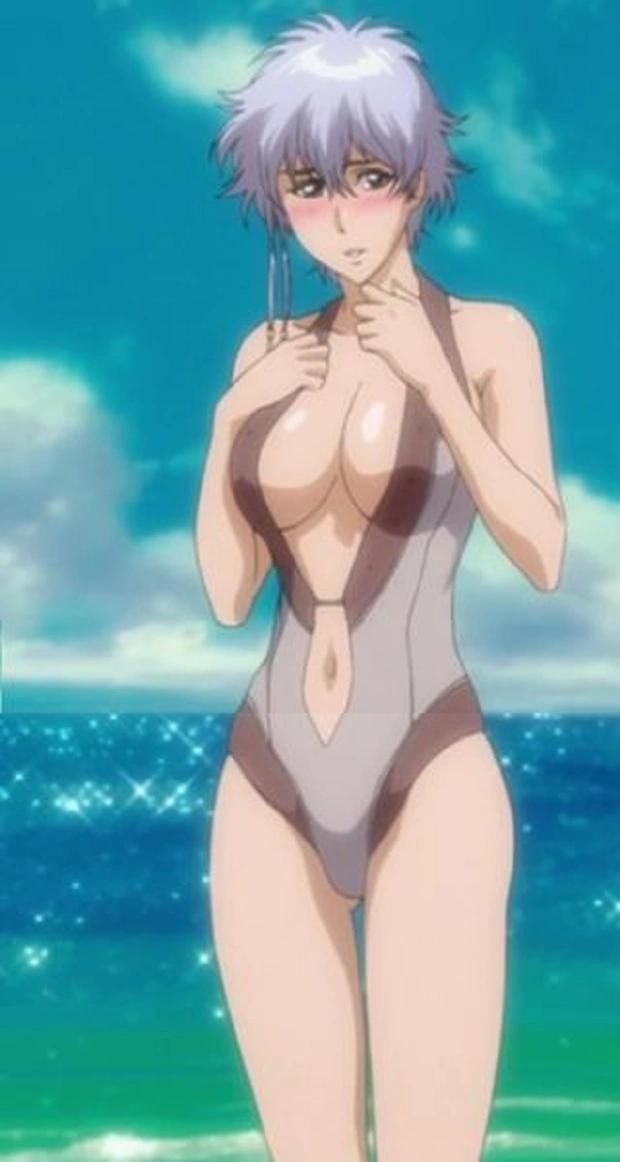


- Czech artist Alphonse Mucha, often considered a trope codifier for the Art Nouveau movement, produced a large number of posters showing attractive women in flowing robes which quite often illustrate this principle. (They’re never fully nude, although there’s a very occasional flash of actual nipple.) These posters have become hugely popular, and are often the subject of Pastiche or Affectionate Parody to this day.
- John Singer Sargent's Portrait of Madame X caused a minor scandal in its day. No doubt part of the fascination is that one strap of the lady's dress looks just a bit loose (it was actually off her shoulder in earlier versions). The model herself was never in danger, however: the bodice of her dress was rigid like a corset and couldn't have fallen if it wanted to.
- Ancient Greek tunics and dresses were open at one side. While there was enough fabric that nothing was actually going to show, the suggestion of it was always there (particularly on a windy winter day). The men's tunics invoked this trope much more strongly than the women's dresses because the tunics were cut no longer than absolutely necessary. Greek painting and statuary made heavy use of this trope: particularly in depictions of heroes, gods, and goddesses. Paintings and statues of course never wear underwear, and often wear only a strategically placed cloak. The most common style is to have a male wearing a cloth draped on the hips held in the left hand. Since the statue is immobile, the simulated cloth can't actually fall. But, we all know that if a guy did this in Real Life it would stay up for about five seconds. It's never used on female statues since there is no suggestion that the cloth would fall because women have wider hips. The female equivalent is to have the dress hanging by one shoulder pin.
- Cloak and Dagger: Dagger has an... implausible◊ costume. It's gotten worse over the years, as the character has gotten better-endowed and the costume has gotten skimpier, but even in earlier days the only reasonable explanation is that the thing is glued on.
- Lady Rawhide: A lot of jokes were made in-story about how Lady Rawhide managed to keep her breasts from falling out of her costume, and eventually, it actually happened in one story.
- Lanfeust: Cixi. At one point she shows up in what is essentially a bikini, cut into strips, and those strips arranged in spirals for maximum effect.
- Legion of Super-Heroes: Mike Grell's work in the mid-'70s gave nearly all the girls the Most Common Superpower, which didn't go at all well with most of their outfits, especially Princess Projectra. Those two laces holding it together were going to snap the minute she did anything strenuous. Either right before or during Grell's run, it was explained that most of the Legionnaires were, in fact, well into their twenties or even older in order to avoid unfortunate implications.
- Ms. Marvel: Carol Danvers' first costume was very skimpy before she got her iconic black leotard.
- Sin City: Discussed in the sub-story "Hell and Back"—Wallace draws erotic pictures for a lowbrow publication and pisses off its much more worldly boss when he turns in a nude whose nakedness is implied entirely via a sheet that covers her from head to toe. He is promptly ordered to redraw the picture without the sheet.
- Supergirl: Supergirl has fallen victim to ridiculously skimpy suits from time to time. Her one-time suit◊ in Adventure Comics #409 was completely backless and displayed her Sideboob prominently. In The Supergirl from Krypton (2004), Darkseid got her brainwashed and dumped into a cape, skintight trousers and an impossible bra. At the beginning of her Post-Crisis book, her midriff shirt was so tiny it almost displayed her underboobs. Finally, her alternate universe counterpart Power Girl is infamous by her boob window.
- Teen Titans: Starfire's outfit is part lingerie, part bondage gear.
- Vampirella: Exactly how Vampirella keeps her costume from falling off is a mystery. (Wizard Magazine claimed that for Real Life models who dress as the character at conventions, they use aerosol spray glue.) Some Harris (or was it already Dynamite?) story boldly declared the costume is a symbiont like the Venom thingie. Don't think too much about that.
- Warlord of Mars: Martian females◊ are dressed in nothing more than jewelry and gold ornaments and surprisingly never get fully exposed on page.
- X-Men:
- Emma Frost. As a member of the Hellfire Club, her outfit, while skimpy, was believable. (It was white lingerie resembling the kind that anyone could buy at Victoria's Secrets, combined with knee-high boots and a cape.) However, after her Heel–Face Turn, her outfits got more daring and more improbable in design. One good example was when she first joined the X-Men: her outfit combined Navel-Deep Neckline and Impossibly-Low Neckline, using a few strategically placed scraps of fabric to form a reverse "X" with her exposed skin. (Of course, the lingerie was a dress code for the Hellfire Club, but being the type of person she is, quitting the Club actually gave her a chance to be more daring.)
- Madelyne Pryor in the crossover Inferno (1988), as well as some later appearances. Her ragged outfit included a loincloth and one of the most famous cases of Underboobs in comics history. Especially given how often Madelyne raised her arms, it is widely assumed that only telekinesis was keeping her inside that costume!
- During Inferno, Havok's normal costume was shredded into the same form as Madelyne's during a brief Face–Heel Turn. Underpecs?
- The outfits worn by Jena and Madelyne Pyre in X-Men: Phoenix – Legacy of Fire are very tiny and not held by any sort of string. They must be using Mind over Matter to keep it in place.


- In one Beetle Bailey strip, Beetle, Killer, and Plato are in a nightclub where a dancer is performing onstage wearing a skimpy outfit made of flowers:
Beetle: Come on! We've seen the stage show twice already.
Killer: Let's see it again.
Beetle: How come?
Plato: He's waiting to see if they wilt.
- In Level Up (MHA), Izuku's Gamer style Quirk gives both Momo and Itsuka "sexy kimono" skins which are described as always looking one deep breath or wrong movement from falling off entirely.
- When Naruto meets Anko in Uchibi Sasuke, he discovers that the only think more distracting than boobs is clothing that looks like it will slip and show boobs. He even outright asks Anko how she holds it up.
If you saw boobs, then you saw boobs: awesome!
However, if there was the potential for boobs, then it made people focus on them with every fiber of their being, trying to make the clothing slip down the rest of the way by sheer force of will. The fact that no one had ever been able to actually do this was the real proof there was no such thing as psychic powers in the human gene pool (because the lack certainly wasn't for lack of trying), but people still hoped.
- In Filmation's Flash Gordon: The Greatest Adventure of All, Flash, Dale and Zarkov are captured by Beastmen soon upon crash landing on Mongo and dragged to their mountain settlement. Along the way, their clothing disintegrates with Dale's dress so shredded with one shoulder is completely bare to the point where the whole blouse is just about to fall open completely. The look is so alluringly that when the film was reedited into the Saturday-Morning Cartoon TV series instead, the gang had to be redrawn into their usual costumes to avoid imagery the NBC network could never allow in that timeslot.
- Duel in the Sun thrived under the trope. There's a reason Howard Hughes' advertising caused George S. Kaufman to call it "The Sale of Two Titties".
- Return of the Jedi: Was there any more to Leia's dancing-girl costume beneath the panels of cloth hanging from front and back of the waistline? According to Carrie Fisher on the DVD Commentary, there wasn't, and at times, crews standing behind her could see "all the way to Florida", as it were. Oola suffers a wardrobe malfunction as she is being dragged towards Jabba the Hutt, and again as she falls through the trap door. You can still see a short bit of the first malfunction in the current special edition. Older editions have longer scenes.
- Hammer Horror movies in particular lived on this trope. Women in form-fitting see-through nightwear that could slip off their smooth shoulders at any moment.
- Ursula Andress in The Blue Max. There is a protracted scene where she has a folded towel looped around her neck so that the two lengths of towel, draped strategically in front of her, both conceal most of a breast, or at least the nipples. Despite how she moves or speaks, despite how her unsupported breasts jiggle and move, her nipples are always concealed by the towel as if it was glued in place (and it probably was).
- Subverted in Vampirella — not very surprisingly, the iconic costume did have a nasty tendency to fall off, and the filmmakers had to adapt it into a more practical form. The original version only appears in some promotional photographs.
- All of Pamela Anderson's scenes in Barb Wire. Gene Siskel outright invoked the trope, stating that the entire film was about whether or not Anderson's breasts would pop out of her outfits.
- The giant, elaborate, torso-covering necklace and perilously secured sarong-like skirt that Isabella Rossellini wears in Death Becomes Her.
- Pharaoh: Ms. Fanservice Kama ensnares Crown Prince Ramses when she meets him in a temple wearing an outfit best described as bikini bottoms and a translucent gown. She's motivated, as she is a Honey Pot meant to get the new pharaoh to back the Phoenicians against the Assyrians.
- Tarzan and His Mate: Discussed Trope, as Arlington observes the flimsy dresses Holt has brought for Jane and says "The effect seems to be to promise to show something that is never quite shown." And outside that bit of lampshading, Jane spends most of the rest of the movie wearing a leather tank top and a flimsy loincloth down below. Later installments of the Tarzan series, after censorship got stricter, saw Jane wearing a more conservative one-piece.
- Carmen's Pure Love: Discussed Trope. When Carmen the model is deliberating on what outfit to wear, Hajime the artist, who's kind of sleazy, says "What makes an outfit attractive is the imagined naked body underneath."
- Queen of the Damned: Akasha appears to be wearing a Chainmail Bikini with no straps. It's just glued to her chest.
- In A Brother's Price, Jerin manages to convince himself that his nightshirt, which just about reaches his knees and is very thin, is almost as decent as a walking robe. Later on, though, he is very aware that the tight trousers with a codpiece he is expected to wear are a lot more titillating than naked legs.
- Vetinari mentions this in Terry Pratchett's Jingo. "Curiously, the purpose of the nautch girl or exotic dancer has always been less to reveal and more to suggest the imminence of revelation."
- All over the place in Piers Anthony works — Anthony is fond of having some characters go completely clothed, others go completely nude, and a third group go partially clothed. The first two groups are seen as more-or-less nonsexual, but the third is a major turn on.
- Discussed in Problem Children are Coming from Another World, aren't they? by Shiroyasha and Izayoi, with the former explaining this effect as the reason she invented a literal Magic Skirt.
- Likewise Discussed in Eight Worlds: Steel Beach as part of a larger exposition on why Our Nudity Is Different in Lunar society. In a closed environment with no nudity taboo, actual nudity is considered a sign of either stodginess or poverty, neither of which are particularly attractive.
- Within Alan Dean Foster's Sentenced To Prism, one young lady acting as a walking billboard sports clothing that flashes advertisements on it and occasionally turns transparent on parts of her body. The protagonists muse that the really titillating spots are never going to turn transparent, but people will keep staring at the ads just in case...
- In the Lensman series, several of the outfits that the society women wear are described in terms that bring this to mind. Apparently, scientific advances allow for more daring clothing.
- In his biography, Chuck Jones recounts how his fellow male students at college all told him how lucky he was to be taking art class, as he got to sketch beautiful nude models. When the woman disrobed and posed, however, Chuck found himself unaffected and sketched her as he would any other subject. Later that day, however, he was sitting outside in the common area between classes when a female student sat next to him to adjust her stockings. As she pulled back her skirt, all Chuck saw was the briefest glimpse of one of her bare thighs, but that was enough to force him to take a moment to compose himself before heading to his next class.
- This Alien Shore: Invoked by Jamisia when she blends in with a crowd of rich tourists by wearing a crotch-length skirt with a very short top.
Men. They were so funny, so predictable. They could pass by a dozen nudes and not pay attention to one, but hit them with a piece of clothing that might slip out of place and their eyes became riveted. It must be some evolutionary thing, survival of the fittest and all that; maybe from the days when a woman in a fur sarong might have been hiding an extra banana or two beneath her wrap, whereas a nude offered no food at all.
- When Dorinda Dances: Private detective Michael Shayne has been hired to investigate the matter of a young woman named Dorinda, who dances while totally nude. He shows his Sexy Secretary Lucy a photo of Dorinda on stage, and is mildly surprised when Lucy isn't offended. Lucy then says "Actually, I think those scraps of cloth and fig leaves dancing girls wear are what makes them vulgar."
- Star Trek: The Original Series:
- The android Andrea from "What Are Little Girls Made Of" has a costume with an upper portion that's merely two crossed strips of material. Off the set, models wearing this costume never failed to get a dramatically appreciative reception from at least the men.
- In William Shatner's Get a Life, he tells a story about how Gene Roddenberry talked that same outfit into a fashion show at a Sci-Fi con. According to one of the people there, the model apparently had to spend the evening "beating men off with a stick". Notable is the fact that Star Trek hadn't even aired yet.
- According to Herb Solow and Robert Justman's book on Star Trek, William Shatner couldn't stop hitting on Sherry Jackson, the actress playing Andrea, once he saw her in the outfit. Further, the first public modeled display of the costume was in Desilu Studios' lunch room, where Ms. Jackson entered in said outfit — according to Herb, forks stopped midway to people's mouths.
- Similarly, the top part◊ of the Greco-Roman-style outfit worn by Leslie Parrish (playing Lieutenant Carolyn Palamas) in "Who Mourns For Adonais?" consisted of a single swath of cloth draped across her breasts and slung over her shoulder. Most people who were there believed that nothing held it in place except its own weight, and were absolutely certain it was going to fall off at any second. Parrish, on the other hand, knew that it was stuck to her skin via massive amounts of two-way tape which had torn off chunks of skin during the original fitting; this is why she instead wore a bathrobe during all rehearsals, even the dress rehearsal.
- In "Mudd's Women", Maggie Thrett, playing the character of Ruth◊, suffered repeated wardrobe malfunctions during shooting — apparently one of her, ahem, assets refused to remain covered. (Unsurprisingly, the final version of the costume was another of Roddenberry's "improvements.") The ruined shot was saved for a Gag Reel, however.
- The android Andrea
- In a male example, one scene in an episode of White Collar had Neal Caffrey wearing nothing but some very low-riding sleep pants, with a waistband that looked very loose. You could practically hear the fangirls pleading for him to bend just a little further...
- With the amount of bouncing and jumping around Elvira, Mistress of the Dark does, it's a wonder her boobs never fell out of her dress. That's because she's a master (mistress?) of suspense.
- In the Buffy the Vampire Slayer episode "Sleeper", James Marsters is shown in bed with the sheet loosely bunched around his waist, just barely above the groin.
- By Game of Thrones's costumer Michele Clapton's own admission, the costumes of Dorne, the southernmost, hot region of Westeros, are not made of fabric; they are made of this trope.
Michele Clapton: I wanted it to look like one little pull of a strap and it would just drop to the ground.
- Non-fiction example: in the documentary series about women in the 17th century Harlots, Housewives, and Heroines, Dr. Lucy Worsley tries on the style of gown worn by the ladies at Charles II's court.
Dr. Lucy Worsley: Now, in contrast to the other one, it feels decadent and luxurious, and it also feels — although it's comfortable — it also feels like it could quite easily just sort of fall off.
Dr. Joanna Marschner: Well, I think that's most of the point, actually. - Although the male Gladiators on American Gladiators were generally more covered up that the women, Nitro's first season costume consisted of spandex shorts and two strips of fabric across the chest, which had a tendency to slip down his shoulders.
- Melanie from Hot in Cleveland in a trash bag-dress when she causes it to ride up in "Duct Soup".
- Perry Mason: In-Universe, both discussed and inverted in episode 1-4. A newspaper runs Perry's photo of a nude Chubby Carmichael (a morbidly obese film comedian), with a black bar covering his privates. A golfer, talking with his buddy about the photo, says "Is it me, or does printing a black bar over your jimmy make it look worse?"
- Star Trek: The Next Generation has a couple male versions:
- The men of Ligon II in the episode "Code of Honor" wear tops that are quite similar to that of Andrea in the original series.
- In the episode "Angel One", the men of the matriarchy planet Angel I wear blousy shirts that reveal a lot of chest. When Riker wears one for a one-on-one meeting with the planet's Elected One, Troi and Yar think he looks silly, though Yar admits "it's kind of sexy."


- Lady Gaga usually wears skin-tight clothing, bypassing this trope; but in the video for "Poker Face", one of her outfits is a crisscrossing number obviously inspired by the Star Trek Trope Codifier.
- Kylie Minogue's video for Can't Get You Out Of My Head features a stunning outfit that must be just about to fall off. A still image can be seen here. Apparently, there was a lot of double-sided tape involved.
- In The BBC's impressive library of music films, there is a late 1970's recording of Meat Loaf and Karla de Vita performing his "Paradise by the Dashboard Light" sometime around 1979, from the music show The Old Grey Whistle Test. This is an energetically acted song. What makes the clip especially mesmerizing is that Karla is performing in a filmy black top slashed to below the navel in front and open at both sides. She gets within millimetres of inadvertent exposure several times but, perhaps due to strategic tape, never quite gets there.
- That sort-of top that Beyoncé wore in the video for "Soldier" looked like a Wardrobe Malfunction waiting to happen.
- Taeler Hendrix is a walking advertisement for double-sided tape or whatever it is she uses to keep herself from falling out of her clothes.
- No, Hania The Howling Huntress' top did not come down during her match with Cherry Bomb at Valkyrie I: International Joshi Grand Prix, May 24, 2014, but, it looked like it could have.
- This Twitter post, about a picture from her match with Sage Sin Supreme at AWS/QPW Joint Show #2, April 29, 2017, reads, "That moment you...hope...Hania's boobs doesn't spill out."
- This Twitter post
- The Talmud (Sotah 8b) notes an aphorism "Undressed, naked and wearing shoes," the idea being that wearing shoes would emphasize that someone is otherwise naked. However, in context, it's referring to the shame involved rather than sexiness.
- In the Dungeons & Dragons 3.5 edition Player's Handbook, all of the female examples shown in the races chapter have clothing that looks ready to fall. Not to mention the Nymph in the Monster Manual, the Elemental Savant in Complete Arcane, for that matter just about any female character pictured in any D&D book. A notable exception is the iconic 3.5 rogue, the halfling Lidda, who's typically fully clothed from her neck to her toes. On the other hand, that type of clothing tends to be skintight, so...
- This is the modern design philosophy for Hot as Hell devils and Dark Elves in Warhammer 40,000 and Warhammer: Age of Sigmar, wearing just enough that they aren't technically showing anything but implying they could be at any time. Earlier versions of the models were outright topless.
- Azur Lane features plenty of this for its Ship Girls in either their default or paid alternate skins, where if swimsuits weren't enough, there are plenty of kimonos and dresses that look like they're about to fall off. One notable example being St. Louis in her Luxurious Wheels skin that features her in a flimsy dress that always looks like it's about to fall off, held only in place by two flimsy strings that are hard to notice due to her large breasts.
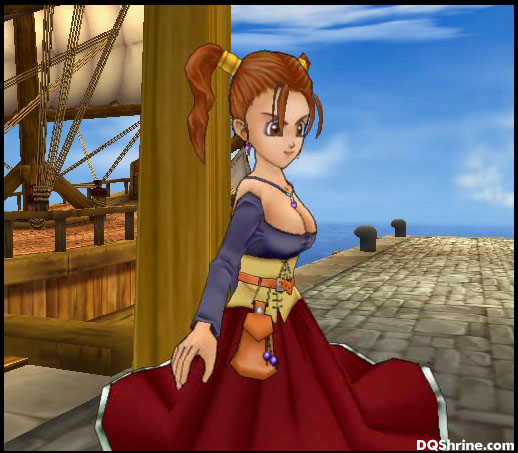
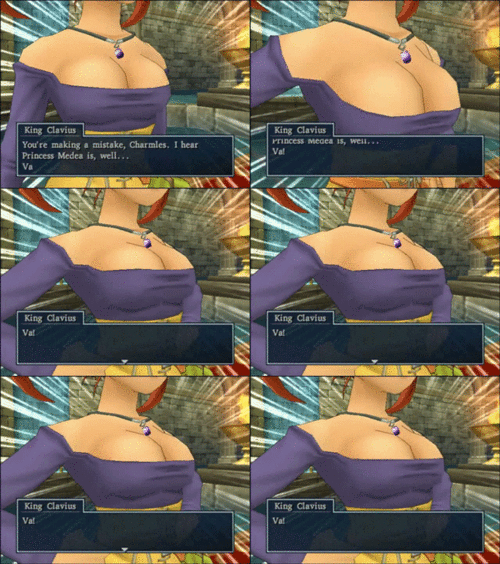
- Jessica Albert from Dragon Quest VIII. Her breasts are so large◊, and her top is so low,◊ one would think her nipples were glued to the neckline, with how they never explode out — even with her idle stretching,◊ her bouncing,◊ or her bending over.◊ The "Sex Appeal" (as her skill in the game is) of Jessica's dress is that she is essentially naked from the nipple up. As such, her top attracts much attention and many camera shots in the game.
- Kongōke Bosatsu "Hana" in Namu Amida Butsu! -UTENA- wears robes with an Impossibly-Low Neckline that only barely covers his nipples; then again, this guy has a pesky habit of stripping himself naked no matter the time and place…
- The entirety of the female cast of Soulcalibur — with the possible exception of Hilde — are participants in this trope, thanks to the implementation of female-focused clothing damage in Soul Calibur IV. In addition to, you know, the huge quantities of cleavage and the rather unusual designs that were carried on from earlier games.
- The award goes to resident Stripperiffic Ms. Fanservice, Ivy Valentine, who, with the exception of V, loses more and more of her already amazingly revealing default costume. By the time IV rolled around, her dominatrix outfit has been diminished into strips of leather held together by strings. (She was covered up more in V; the developers likely realized by then that if they made her outfit any more revealing, they'd probably have to change the game's ESRB rating.) By the time VI kicked in however, Ivy wore an even more revealing outfit that looks like any flex from her would send her flimsy tight clothing flying off her.
- The award goes to resident Stripperiffic Ms. Fanservice, Ivy Valentine, who, with the exception of V, loses more and more of her already amazingly revealing default costume. By the time IV rolled around, her dominatrix outfit has been diminished into strips of leather held together by strings. (She was covered up more in V; the developers likely realized by then that if they made her outfit any more revealing, they'd probably have to change the game's ESRB rating.) By the time VI kicked in however, Ivy wore an even
- Yoshino "Haru" Harusawa of Shin Megami Tensei: Devil Survivor wears an outfit that would do Theiss proud. Looking at her sprites, it's a wonder she isn't having a wardrobe malfunction every few seconds. Needless to say, she's a popular character.
- Specifically, she wears what would normally be a form-fitting dress, except that it's at least two cup sizes too big for her. This makes the top half hang off dangerously low.
- It doesn't help that she's constantly fiddling with the straps.
- And you know how significant that is when all the character animations are expressed in a few sprites. That's right; out of say, five sprites they drew of Haru, one of them is of her fiddling with the straps.
- The Angel: Her design from the original Devil Summoner, which was swapped out, but later made a glorious return for Strange Journey and the new Devil Summoner, can be described as so: a light chained blue scarf that barely covers the breasts and nothing else.
- Katsuragi of Senran Kagura wears an open dress shirt with a Navel-Deep Neckline. You would think that with all of her flipping around, her nipples would pop out any second, or at least she'd suffer an areola slip, but somehow her top always stays in place.
- Pretty much the entire cast of Disgaea: Hour of Darkness, males included. The archers are only kept decent by the camera angles.
- Dead or Alive Extreme Beach Volleyball: Unrealistic clothing physics are the only thing that keeps this from being an H-Game.
- This would probably explain the immense popularity of Sunspear◊ armor◊ and Kurzick◊ armor◊ among Guild Wars's Elementalists and Ritualists, respectively.
- Morrigan's robes in Dragon Age: Origins. There are more Stripperiffic examples, but the loose fit, the cleavage and Sideboob indicating lack of a bra, make it look like she could escape her top during any of her magical gestures.
- Averted in her appearance in Dragon Age: Inquisition; her robes are the same, but you can see that she's wearing a bra underneath them.
- Mai in Fatal Fury/The King of Fighters. Her outfit looks designed to fall off.
- Final Fantasy:
- Final Fantasy VII: Tifa Lockhart runs around kicking ass in a white tank top, leather mini-skirt, and combat boots. Then there are her assets.
- After Wol's outfit in Mobius Final Fantasy had to be changed for being "too sexy" for the playtesters, it's worth observing that he's actually slightly more dressed than some previous FF protagonists like Vaan or Tidus. The difference might have been how it looked like it was one gust of wind and two bootlaces away from falling off his body — Vaan and Tidus's outfits might be scant, but look secure, giving a sort of a more innocent, schoolboy feel as opposed to the stripper effect that Wol ended up with.
- The eponymous Lunna from the unofficial mini-expansion mod Lunna - Astray in Stardew Valley, is always wearning a white dress with one sleeve falling down to her right arm. According to her, the dress used to belong to the Wizard Rasmodius' ex-wife.
- In the Street Fighter games, Chun-Li doesn't exactly show that much skin (in fact, a lot of other females in the series, including Cammy, show more). Still, that skirt of hers... How she manages all those acrobatic flips and wicked kicks while not showing too much (yet still showing off her great legs) is hard to fathom.
- The reboot of Mortal Kombat. Most female fighters' outfits start off this way and get only worse as battle damage sets in (to the point where the only thing that could possibly be keeping some of them on is glue or magic, and the only thing keeping them from flashing is Barbie Doll Anatomy.)
- This trope is why some perceive North America's attempt to censor Tharja's swimsuit scene in the Fire Emblem: Awakening Summer Scramble DLC as more risque than the original version: in the original version, she's just adjusting her swimsuit bottom, in the censored version, thanks to some Scenery Censor, it looks like she's about to take the bottom off. Compare◊ for yourself.◊
- In God Eater Sakuya's Sexy Backless Outfit is held up only by a pair of strings tied behind her neck and back. With how much sideboob is showing,◊ it's a wonder nothing slips out.
- Along similar lines in the sequel, Nana wears a strip of fabric slightly too small to completely cover her breasts, held up by a single suspender. It must be seen to be believed.◊ Naturally, it never slips or malfunctions in any way.
- Along similar lines in the sequel, Nana wears a strip of fabric slightly too small to completely cover her breasts, held up by a single suspender. It must be seen to be believed.
- In Until Dawn, Sam's Modesty Towel manages to stay on her even while she's running away from the killer, despite the fact that it probably would have fallen off in real life. Some players might be disappointed but it's a survival horror game, not a sexy one.
- Valkyrie Drive -Bhikkhuni- has Viola's outfit. It's a miracle she doesn't have constant Wardrobe Malfunction with how low the neckline of her kimono is. Amusingly, she receives special versions of everyone's else costumes named "risque versions" that have been modified to show this.
- In Otomedius, there is almost no way the Stripperific outfits that barely cover the breasts of some of the characters can stay on when they are flying.
- Endless Frontier:
- The game's leading lady, one HRH Kaguya Nanbu, has huge tracts of land stuffed into a microdress held on by the cruelty of the Universe. She has an extremely acrobatic fighting style, which results in, uh, chestquakes, in keeping with the metaphor, but never a Wardrobe Malfunction. Whoever enchanted that thing deserves either a medal or to be hanged, depending on your perspective.
- Her successor in the never-released-overseas sequel, Neige, is just as, eh, perky and wears a maid costume with a similarly too-small blouse; also imbued with cosmic malice by a bashful sorceror. She has a Super Move Portrait Attack wherein the camera does a closeup full-body pan, with her skirt *just* managing to hide what kind of underwear she has on, if any.
- Krystal from Starfox Adventures is a Nubile Savage who wears a skimpy tribal outfit that's basically just a bra and a hazardously short loincloth. In particular, the way the loincloth stays on (two button clips, one on each of her hips) makes it physically◊ impossible◊ for her to be wearing underwear. note
- Sylvanas Windrunner's outfit, specifically her skin-tight pants, in Warcraft III and World of Warcraft. Prior to the Battle For Azeroth expansion, many wondered about her top as well (though tbf, it did look like it was reinforced with metal). While one can suspend disbelief in the case of the dragons who dress in similar styles, since their "clothes" may actually be body parts, one really has to wonder about Sylvanas. The front of her pants sits well below her belly button or even her hip line. If she jumped in the air, the fabric SHOULD be pulled down sufficiently as to show her vaginal opening. Of course, it never does: no matter how many crazy archery stunts she pulls.
- Trish, in Devil May Cry 4, goes undercover as "Gloria" in a ludicrous outfit with a Navel-Deep Neckline, semi-sheet sides, and only two little flaps of cloth in the front and back preserving her modesty. Her intro cutscene features kicks and flips that threaten to expose her entire crotch at any second, but nothing shows.
- Skullgirls: Cerebella, Ms. Fortune, Valentine, Eliza, and Black Dahlia all wear outfits so slinky that it's a wonder they don't straight up fall off during combat. Eliza at least has the excuse that her dress is actually created by her haemokinetic powers; she literally is holding it on with sheer willpower, but the others somehow contrive to jump, tumble, and beat the crap out of each other without once showing more than usual. Well, in the context fans would like.






- Averted in Oglaf with Vanka of Brogoria. She wears a very low-cut tunic with a Navel-Deep Neckline, but it often slips and exposes her breasts.
- A rare male example with Wuffle. As put by one fan, his suspenders get lower and lower every time he's drawn.
- In Holy Musical B@man!, Robin is a rare male example of this trope. All he's got on is a shirt, cape, mask, shoes, and briefs the whole musical. It gets worse after a scene where we see Superman and Batman rip off each other's Underwear of Power.
- Gaia Online:
- Ruby is wearing what appears to be a strategically tied bedsheet with no bra. The jury's out on whether it's being held up by her rack or by the sheer force of her hotness.
- Sam's original design couldn't find coveralls in her size, so the ones she had were open to her belly-button and on the verge of falling off.
- Todd in the Shadows discusses this in his review of Robin Thicke's "Blurred Lines": he claims that the unrated video, which features full-on topless women, is significantly less sexy than the TV version, where they're merely wearing Stripperiffic outfits. When the girls are still clothed, the viewer can at least still imagine them taking the clothes off, which will probably lead to sex. If they're already naked and sex still isn't happening, something must have gone wrong.
- This is parodied in The Simpsons episode "Gump Roast" when it's Agnes Skinner who wears a skintight dress to Homer's award ceremony as "Man of the Hour". Homer's father, her co-host, asks, "What's holding that dress together?", to which Sideshow Mel stands and answers, "The collective will of everyone in this room!"
- Invoked/Parodied on Adventure Time — Lumpy Space Princess is normally naked, being a sort of purple cloud-creature, but puts on a transparent dress (made from a used plastic bag) when she wants to seduce Finn. Due to her shape and attire, she only ends up failing.
- In one episode of Superman: The Animated Series, Lois and Clark are attending a fashion show, where Lois opines of one garment, "The only thing holding that dress up is faith."
- The page image is Minerva Mink from Animaniacs, who is basically this trope in cartoon weasel form.
