
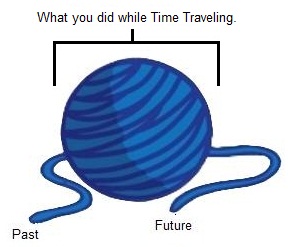
Excepting mundane travel from the past to the future at a rate of one second per second,note note no human has ever experienced Time Travel first hand. Indeed, we don't know if it's even possible.note So debating which time travel theory is right is much like trying to find the best flavor of Kool-Aid. Fans are aware and accepting of this, just like no one minds when Our Monsters Are Different, or two different series have different rules for magic, so long as the series' own internal rules are consistent.
Of course, sometimes they aren't. The Timey-Wimey Ball is the result of a series or movie where the writers are a wee bit confused or forgetful about exactly which kind of time travel can happen, sometimes within the span of one episode! One day You Can't Fight Fate because You Already Changed the Past (or at least not without the Butterfly of Doom coming along), but the next you can Screw Destiny and Set Right What Once Went Wrong by killing Hitler and changing the past for the better... until the Clock Roaches get hungry. Especially headachy because there's no Temporal Paradox, or if there is it's totally arbitrary.
The standard Hand Wave (if one is given) is that time is very complicated and the particulars of the situation affect how the rules apply in ways that a layperson wouldn't understand. Which is one of the many reasons why some fiction fans really, really hate time travel. (There are also a large number of characters who have "enjoyed" it who also really, really hate time travel, in part due to this trope.)
Despite the similar images the name might conjure, this is unrelated to Swirly Energy Thingy (although a Swirly Energy Thingy might very well have Timey-Wimey effects). Likewise, a Continuity Snarl is not necessarily related, though the presence of Time Travel-induced retcons can certainly make a character's past seem like a tangled up ball of yarn.
Compare Close-Enough Timeline. Occasionally, anything involving this may decide to pull out the Temporal Paradox card, and/or The Multiverse. A Time Crash is what happens when this isn't in play. See also Narnia Time. Aside from shape, unrelated to ball-shaped behavior tropes. You had better hope it is unrelated to Happy Fun Ball.
Warning: High chance of spoilers.
Example subpages:
Other examples:
- Doki Doki! PreCure's Non-Serial Movie handles this trope in what's probably the dumbest way possible. The Big Bad, frustrated at the Pretty Cures escaping their temporal prison as well as reforming one of his minions, decided to travel to the future and kill everyone there. Apparently, according to this movie, if there is no future to look forward to, the present will cease to exist (despite the fact that going to the future and changing things there affects jack squat in the present). It's telling that when the next time Pretty Cure decided to handle time travel again in HuGtto! Pretty Cure, they opted to scrap what DokiDoki established in exchange for the more manageable Multiverse Theory.
- Dragon Ball Super:
- The anime can get into this in the "Future Trunks" arc. Previously in DBZ, Trunks' time machine worked firmly on alternate time line theory. DBS sticks to that rule.. for that time machine. It then introduces divine time travel through the time rings, which works on Stable Time Loop, as do any actions done by the gods using divine ki. However the time machine and time rings are both active, and each can only do its own version of time travel. It gets confusing very quickly.
- For a more specific example that set off the entire plot: Trunks time-travels to the alternate past he created to get help against Goku Black. Black temporarily follows him and has a brief fight with regular Goku. Beerus and Whis, who were spectating, notice a similarity between Goku Black's ki and that of a Supreme Kai apprentice in universe 10, Zamasu. While they're investigating, Goku spars with Zamasu to find out why their energy is so similar. Zamasu really wasn't the most stable individual to begin with, and his defeat pushed him over the edge and prompted him to kill his master Gowasu to obtain a time ring, then use the Super Dragon Balls to swap bodies with Goku and then terrorize Future Trunks' timeline as Goku Black, which prompted Trunks to go back in time. Beerus and Whis then go back to creating alternate timelines by destroying Present Zamasu before he could kill Gowasu (the Time Ring prevented Goku Black from being erased by this) and warning the Beerus of Future Trunks' timeline about Zamasu's plan before it could happen, respectively.
- Fairy Tail:
- The Memory Days OVA features a plot where a magical book sends Natsu's team back six years in time for a few hours, creating a Stable Time Loop where they influence events from their past (Natsu getting the scar on his neck, and Lucy deciding to join Fairy Tail).
- Things get really complicated with Eclipse, a gate created by Zeref that enables Time Travel. Hisui plans to use the gate to travel 400 years back in time to kill Zeref, which would create a Temporal Paradox as Zeref would never have concocted the idea. This leads to a Bad Future where an army of 10,000 dragons in the past comes through the gate, and so Lucy uses the gate to stop this from happening. However, this creates a second Bad Future where Acnologia takes over the world seven years later, and so Rogue travels back to the day before Future Lucy arrives so he can stop Present Lucy from closing the door, resulting in a third timeline (the main one). Destroying the portal in this timeline prevents Future Lucy and Future Rogue from ever using it, thus sending them and the dragons back to their respective time periods. At this point, however, the timeline has become so jumbled that the damage caused by the dragons cannot be reversed, and everyone in that timeline still remembers what happened. Moreover, one of the dragons from the past is also influenced to keep a nickname that was given to him in the present, while another's ghost clearly remembers them.
- Ultear's Dangerous Forbidden Technique, Last Ages, reverses time at the cost of the user's lifespan. She compounds the aforementioned timeline hijinks by using it to prevent them from happening at all, only for it to send her a single minute into the past. However, the spell gives everyone in the world momentary foresight of what would happen within that minute, which works in the heroes' favor, seeing how a good number of them were dying at the time.
- Eclipse comes back into play again (this time in a much stabler way) when it's revealed Lucy's ancestor, Anna, worked with Zeref to send Natsu and the other Dragon Slayers 400 years from the past through the gate. For this to work, Anna left specific instructions for her descendants to open the gate on the other side when the time was right, which was passed along until it reached Layla, Lucy's mother, on July 7, X777, a good 14 years before the above fiasco happened.
- Another concept of time travel is discussed in the form of Neo Eclipse, Zeref's ultimate plan, which would theoretically allow Zeref to relive his own life with all of his present memories intact so he can prevent his family's death, avoid becoming cursed, and stop Acnologia before he grows too powerful. Unlike regular Eclipse, which is all but stated to keep any alternate timelines it has created intact, this spell would completely erase the current timeline from existence.
- There's at least one Stand user in every arcnote of JoJo's Bizarre Adventure capable of manipulating time (and at least one other that can predict the future but not travel through time). All of them seem to operate on slightly different rules as to whether or not the past and/or future can be changed.note
- The predictive Stand, Thoth, predicts specific events in the near future. No one, not even its user, can stop those events from happening, but they're always vague enough for Prophetic Fallacy to be in full effect; for example, it predicts that Jotaro would have his head split in half by an explosion, but the brother of Thoth's user disguised himself as Jotaro to avert suspicion and ended up being the one to be hit by an explosion. Of course, Thoth's predictions might not be so malleable after all — Jotaro dies onscreen twice in future parts, and both times his head gets split in half in the exact same pattern predicted by Thoth.
- In the next part, Yoshikage Kira's 'Killer Queen Bites The Dust' has the power to trap its victim in a one-hour time loop. Anything that happens in the loops will happen again in all subsequent loops, though the leadup to those happenings may be different; for example, when Hayato managed to stop the teapot from falling off the table, the handle of Kira's teacup broke a few moments later, spilling tea all over his jacket, and after Rohan triggered Killer Queen's bomb in the first loop, he still exploded in the subsequent loop even though he didn't trigger the bomb. However, if Kira ends the loops before they complete, events that should have been fixed no longer happen.
- In the part after that, Diavolo has the stand King Crimson, which is so infamously confusing that 'how does King Crimson work' has become a meme. First of all, King Crimson itself has a sub-Stand called 'Epitaph' that functions almost identically to Thoth, in that it can predict the future at a range of up to ten seconds, and the predictions it shows cannot be changed but are vague enough to be subject to Prophetic Fallacy. (This is seen in one story arc when Doppio is granted access to Epitaph but not King Crimson.) King Crimson's power, however, allows it to 'skip' those ten seconds, making it so that any unfavorable outcomes Epitaph predicts simply don't have to happen.
- Then there's Part Six, where Enrico Pucci eventually evolves his stand into 'Made in Heaven', which has the power to accelerate time. He uses this power to push the universe forward to the Big Crunch and recreate it. The new universe is exactly identical to the original, except that everyone living in it already knows everything that's ever going to happen to them and is unable to change it.note Only Pucci is capable of changing events, though once he's changed someone's fate, they are able to act freely, as anything they do from then on is considered a 'butterfly effect' repercussion of Pucci's actions.
- Finally, in Part Seven, Ringo Roadagain has the stand Mandom, which allows him to rewind time by six seconds. Unlike most previous time-travel arcs, Ringo can freely change anything that happens in those six seconds; he typically allows his enemy to deal him a mortal wound, memorizes their movements and position, then rewinds, dodges their attack, and kills them. He'd probably be the most formidable of all the listed users if not for the fact that everyone else can also remember what happened in the six seconds Ringo rewinds, and, if they're clever enough to figure out what his power is, can take advantage of it to change their actions as well.
- Mahou no Iroha: Time travel is apparently very possible with the help of magic, and the Magical Girl main character somehow changes some things but not others that leaves readers scratching their head.
- Natsu no Arashi! enjoys playing foosball with its Timey-Wimey Ball as characters jump back and forth across the hours, leading to a series of Stable Time Loops.
- Negima! Magister Negi Magi: Time travel watches pop up during the Mahora Festival arcs, creating Stable Time Loops, multiple copies of Negi running into each other, a Set Right What Once Went Wrong or two, and some Rule of Cool duels that exploit the effects of short-range Time Travel. However, it is later stated that long-range Time Travel creates Parallel Universes.
- Summer Time Rendering: Although the power to time travel comes from the same source, Shadow Ushio follows her own unique set of looping rules. Rather than returning by Mental Time Travel like Shinpei and Haine do, the Shadow Ushio who appears on the beach during the summer festival physically follows Shinpei to each new timeline and materializes somewhere near him, complete with any injuries she sustained from previous loops. This means that two Shadow Ushios can exist in a single timeline, an anomaly that Shinpei eventually realizes and exploits in order to repair her destroyed body in a later loop.
- Transformers: Armada:
- After Thrust shoots Starscream with the Requiem Blaster, we see a shot of Rad as an eight year old waking up in his parents' car and asking tiredly where the Mini-Cons are (implying his "present" mind was momentarily in his past body). Then cut to all the kids — possibly in an alternate future — being told by a slowly dying Hot Shot that the Transformers have all been eaten by Unicron because they didn't know that the Mini-Cons were servants of Unicron and were led to their doom. After this, cut to the kids now being at the moment of the Mini-Cons' creation millions of years ago inside Unicron. Rad then touches High Wire's hand and frees him (and by association all the other Mini-Cons) from Unicron's control by reminding them of their past/future happiness together. The Mini-Cons then know to go to Earth after they leave Cybertron to meet Rad and the other humans. Cut back to the humans returning mere moments before Thrust shoots Starscream, whereupon High Wire and his teammates combine into Perceptor and knocks the gun away, causing Thrust to miss Starscream completely. And none of this is EVER EXPLAINED.
- The Mini-cons who prevented Starscream from being blasted weren't taken along with the kids' inexplicable time-jump, and there is no reason for them to have done anything differently in the present. It can't even be due to the kids' actions in the past — the Mini-cons would never have gone to Earth to kick off the events of the series if not for the kids, so it's not a case of the "old" High Wire wanting Starscream to die but the "new" one saving him.
- Tsubasa -RESERVoir CHRoNiCLE-: The antagonist's grand scheme to revive a dead woman, and said dead woman's attempts to counter him, create an ungodly mess of paradoxes. The fact that Clow Kingdom only exists because its princess traveled into the distant past and purified their water source is the least of the problems. Far more baffling is that clones created of the main characters Syaoran and Sakura end up being reborn in the past and become the parents of the original Syaoran. Then original Syaoran made a wish which rewrote history so his parents instead gave birth to Watanuki, while Syaoran becomes a Paradox Person who was never born. By the finale, both Syaoran and Watanuki can no longer exist naturally and so rely on magical shenanigans to avoid being unmade, Syaoran by constantly hopping dimensions and Watanuki by sealing himself away.
- Justified in The Vertical World due to the genuinely complex mechanics behind time and space travel in the series.
- The Vertical World itself for the most part is a case of Stable Time Loop. The way time works inside it means the past, present and future can exist at simultaneous points, making it impossible to alter anything already known to be set in its "future" in some way.
- The simulation inside P.P. is set in the past, but its very existence is stated to have created "new history" and as a result is responsible for the Vertical World's already-established present. Ruska finds that its events can be altered by his own interference, though this doesn't alter the Vertical World's present further so much as create an Alternate Timeline.
- Earth itself can have its history altered through traveling to the past, but for most of the story is a case of You Can't Fight Fate as the party's attempts to change what happens to Earth the first time inadvertently causes the same problem, just with a different context.
- The story as a whole implies much of everything up to Ruska's final encounter with Kepler is a natural, immutable sequence of events that has happened before in some shape or form, and the diverging point that breaks the loop is Ruska's resolving to defeat Kepler and use the wormhole to alter Earth's past.
- There's a Back to the Future card game based on the film, where again each player is someone from an alternate timeline trying to manipulate the universe into one where they exist. However, one big difference is that after doing so, the time travelers have to stop Emmett Brown from inventing time travel so that nobody else can mess with it and their timeline becomes the only timeline. Paradox much?
- In Chrononauts, players are competing time travelers from alternate futures sent on missions into the past to recover various historical artifacts. Each player is playing tug-of-war with the timeline so that they can return home, which results in a very fluid history. If enough paradoxes pile up, they can even destroy the universe.
- In Time Agent, your objective is not to win. Your objective is to have already won... without Time Travel being invented. This is probably the least confusing part of the game.
- In US Patent #1 by Cheapass Games, each player has invented a time machine and hopes to profit from it, but the only one who will be able to profit is the one who holds a patent. Given that patents can be invalidated by proof of earlier work, the only patent that matters for a time machine is the chronologically first one. So the entire game consists of a race through time to be the first in line on the first day the Patent Office opens.
- Marvel Comics' Adam Warlock, specifically his evil future self The Magus embodies this trope. Adam Warlock met his futureself and immediately The Magus set about trying to ensure Adam would turn into him. This did not work when "Thanos" and the In-Betweener interfered and Adam was given a choice of timelines, wherein he chose the shortest. The Magus appeared again when Adam Warlock attained the Infinity Gauntlet and divested himself of his good self (The Goddess) and his evil self (The Magus). The Magus initiated the Infinity War, but was defeated. Later, to seal the Fault in space caused, in part by the Annihilation Wave, The Phalanx Invasion, and the War of Kings, Adam Warlock who, as he expanded magical energy slowly started turning into The Magus, used an "unused" timeline to repair the fault. That particular "unused" timeline was the one in which he became The Magus.
- The Avengers:
- Kang the Conqueror. Say the word "Kang" to a fan and they'll often shudder. His time-travel schemes are so complex that his future self, Immortus, is another major Avengers enemy, and the two can often be seen fighting each other. To give a sense of scale: most Marvel Handbook profiles are one to three pages long except for major characters like Spider-Man, Iron Man or Wolverine. Kang's gets six pages, and the bottom half of each page is devoted to Kang's timeline, which is chronological in years but requires jumping around from page to page to get Kang's chronological story.
- And his younger self, the Fantastic Four enemy Rama-Tut. Actually, Kang took on the Rama-Tut identity twice, and was villainous the first time and relatively benevolent the second time.
- At one point in the 70s, one of Immortus's schemes caused Kang to die, which since Immortus and Rama-Tut were Kang's future selves meant they promptly stopped existing. But the things they had already done still happened and... yeah. Soon enough it turned out Immortus was just fine (faking his death has become one of Immortus's "things"). Kang too.
- Not to mention the storylines involving alternate Kangs branching out from decisions he's made over the years.
- Made even more confusing with the addition of a fourth iteration of Kang in Young Avengers: Iron Lad who actually kills Kang in an attempt to prevent himself from becoming Kang and ultimately realizes the only way to save the future is to become Kang anyway. If you find yourself confused, know at least that you aren't alone:
Jessica Jones: Is this a time-travel thing? Because I hate time-travel things.
Iron Man: If it's Kang, it's a time-travel thing.
Jessica: See, this is why I hate Kang... - You can also thank Kang for raising one of the X-Men's greatest foes, Apocalypse.
- Kang's schemes also led to the temporally complex events of Avengers Forever, when Kang's attempt to prevent himself becoming Immortus led to a conflict which featured seven Avengers from six different time periods coming together to help Kang protect Rick Jones from Immortus and prevent humanity's darker possible futures (this team included Captain America from the end of the original Secret Empire storyline, Hawkeye just after Avengers: The Kree/Skrull War, Yellowjacket during his initial mental breakdown, Giant-Man and the Wasp from Rick's present, and Songbird and Genis-Vell from what appear to have been possible futures). At the halfway point the plot stops just to explain Kang's history. It takes a whole issue.
- During Bendis' run on two Avengers titles he floated the idea that time is both like a living thing (which it technically is, embodied by the Sentient Cosmic Force that is Infinity) that occurs all at once and is damaged by time travel. These theories were hypothesized by Iron Man during conflicts with Kang after one time travel too many to change one moment and defeat Ultron broke the spacetime continuum and collided multiple potential futures and parallel realities with their present. This would be revisited (or recycled based on how cynical one is) during Age of Ultron where another conflict with Ultron involving too much time travel led to another crash. This time the effects were further reaching, where instead multiple people in parallel universes were struck dead and others still were permanently shuffled around the multiverse.
- The DCU has all sorts of fun here, especially when Booster Gold is involved, but it's been proven time and again that trying to Screw Destiny usually ends badly. Aside from that, the Timey-Wimey Ball hurts Booster's head as much as it hurts the audience's.
- DIE:
- The more that the party learns about the timeline of Die's world, the less sense it makes to them: Sol says he created Die, yet when the spirit of Charlotte Brontë appears, she says that she and her siblings visited it frequently as children after receiving a gift of toy soldiers, which we later find out that Sol carved from Angria's sacred forests after becoming Grandmaster. And further complicating things, there's the matter of Angela's daughter Molly, who shows up in Die as a Fallen and looking years older than the last time Angela saw her, despite them only being back in Die a few months.
- The Fair eventually explain that this is all because of a Stable Time Loop: Die itself is sentient and capable of reaching through time to ensure its own existence. It subconsciously inspired the various writers whose works contributed to Die's world, as well as Sol to create the game, and later as Grandmaster to create the toy soldiers that were sent back to Charlotte and her siblings, while Eternal Prussia is currently using the remains of Glass Town to create the six dice that brought the party to Die. As for Molly and the other Fallen, they've been brought back from a future where Die has merged with Earth, which it will do once it has completed the loop by sending the dice back in time.
- The Flash:
- Professor Zoom has (retroactively) had his hands on the Timey-Wimey Ball from day one. In a single issue you see him edit his brother, parents, scholarly rival, and lover out of his own history, apparently to make sure he'll actually become the supervillain he is. It Makes Sense in Context.
- The Return of Barry Allen presented an interesting example of this when the "Barry Allen" who had returned turned out to be a version of Thawne who personally hadn't even met Barry yet even though he was now in a time period where Barry had killed him years ago.
- When the Professor started in on Barry's history, that ended with Flashpoint. Nice job breaking it, psycho.
- The Flash himself historically averted this trope when at all possible. Barry and Wally repeatedly refused to even try holding the Timey-Wimey Ball. Until Flashpoint. Nice Job Breaking It, Hero.
- The second Zoom came into being because he tried to grab the Timey-Wimey Ball and blew himself up. Unfortunately for him, his powers (unlike every other speedster) avert the trope.
- An issue of Impulse had a Mad Scientist invent a time machine, and attempt to change the past so that he would rule the world. Impulse and Max Mercury go back in time to stop him, but wind up stuck in the far distant past. Max lectures Bart on the Butterfly of Doom, and how even eating a fish might cause irreparable harm to the future. But then they discover that the mad scientist is now trapped in the past as well. The three of them decide that the best way to get home is to cause as much damage and destruction as possible. Their logic is that if they completely change the past, it will alter the future so much that the scientist will never exist, which means he will never invent his time machine, which means they won't have travelled to the past in the first place, which means they won't actually cause any damage at all and find themselves back home. Confused?
- Gold Digger: With all the dimension-hopping, time-traveling technology in Gold Digger, naturally there's a lot of Timey-Wimey Ball action going on. However, of special note is issue #50 of the color series, which features an artifact that is an actual ball of string that can warp time and space.
- Invader Zim (Oni) parodies the complexity of time travel a few times:
- In Issue 12, Zim claims that his actions in the Bad Future changed the past. Dib quickly points out that that isn't how it works, only to be told to shut up.
- In Issue 49, Zim messing about with time travel causes all the alternate timelines accessed via the Zimvoid to merge together. Again, an exasperated Dib tries to explain that's not how it works, only for Zim to ignore him, as whatever he did still got the result he wanted.
- Iznogoud: In Iznogoud's Childhood, Iznogoud experiments a type of time travel in which the present and the past happen at the same time for a while, which he tries to exploit by attempting to get rid of the Caliph's younger self. The whole thing eventually ends up being a Stable Time Loop, in which Iznogoud's time travel is what causes his younger self (who Used to Be a Sweet Kid) to transform into a jerkass. However, earlier in the comic, Iznogoud stabs younger Wa'at Alahf to test the time travelling nature, and that case works on a Ripple Effect basis, in which adult Wa'at Alahf shows up with a scar he'd never had.
- Legion of Super-Heroes: Two of their enemies are Anthropomorphic Personifications of time-tampering. A good instance of this happened in Legion of 3 Worlds. Superman, Saturn Girl, Lightning Lad and Cosmic Boy confront the Time Trapper and learn this incarnation is a future Superboy-Prime. When the Time Trapper and Prime meet, Trapper's insistence on getting Prime to listen to him causes Prime to get angry and slug him, causing a paradox-fueled explosion that erases the Trapper and causes Prime to disappear. Saturn Girl worries they just broke their Thou Shalt Not Kill rule, but three different Brainiac 5s suggest that Prime just disappeared somewhere else in time/space instead.
- Sonic the Hedgehog (Archie Comics) has an interesting variation at one point. Knuckles, juiced up on Chaos Energy, was given the chance to bring back everyone on the Floating Island through his power. To do so, he keeps bouncing back in time and stopping a certain event. Not only does that have bad consequences for him, but what he doesn't know is that he keeps futzing up the actual Sonic events, creating timelines such as a pure SatAM world, one based off of the 1995 OVA and a timeline where Robotnik never initiated his coup. At the end, Knuckles decides to stop that and just bring everyone back from the prison the Dark Legion launched them into.
- Teen Titans Go!: In Issue #31, a villain changes Robin's past to become his mentor and the other titans are helped by Good!Robin's future self a.k.a. Nightwing. During the epilogue, Beast Boy wonders how that Nightwing could exist at the same time as Bad!Robin and Raven handwaves it by saying they don't fully understand how Time Travel works.
- Limbo
 in the Marvel Universe (mainly shows up in association with X-Men) is an entire dimension of timey-wimeyness. When the X-Men entered and got separated, both Wolverine and Colossus encountered long-dead versions of each other, and managed to escape just fine in the end. Storm was stopped at one point by her older self, who had remained in Limbo for decades studying magic. And Nightcrawler killed his older self.
- The Transformers (Marvel): One can alter the past to suit the present. However, there is also the possibility that one travels to a different universe that is simply the same as your own. So thus, any attempt to travel back in time to, say, build a giant cannon to destroy the dark god who created you when he turns his attention to Earth in order to free yourself from his control as Galvatron tried to, can potentially end in failure as it is not your own universe. As it turned out, it WAS Galvatron's own universe.
- John Byrne's run on Wonder Woman Vol 2 has a classic example of the rules changing within a story. When Diana's mother becomes the new Wonder Woman, Jay Garrick recognises her as the mysterious woman who was involved in one of his adventures in The Golden Age of Comic Books, and who he never really met. When he tells Hippolyta this, she travels to the past in order to maintain the timeline by ensuring everything happens the way Jay remembers. Once she gets there, however, she decides to stick around and become the Golden Age Wonder Woman and a member of the Justice Society of America. History is therefore completely altered after all, but no-one seems to mind.
- All-New X-Men, which saw the original five X-Men being brought into the future, had a hard time deciding whether they were changing the timeline, creating a new one, creating several new ones, or just messing everything up – OR whether it had all already happened. Both this book and the tie-in Battle of the Atom had the added conundrum that while people from the past who were still alive in the present (and one who was dead in the present) were visiting the present, so were a bunch of people from the future, at least one of whom was presently visiting from the past. Several times. The storyline was ultimately resolved in Extermination (2018), where the original five X-Men were sent back to the past with their memories of the future blocked until they "caught up" with the present, providing their future selves with knowledge of how to stop the current crisis.
- Zipi y Zape: All the story about the time-travel machine built in a barrel revolves around this trope. In the first chapter, the twins use it to transform a wall lizard into its evolutionary ancestor (which turns out to be a crocodile). In all the other chapters, the twins use it themselves; it no longer makes anything appear in the present time, but depending on the chapter, it either just takes them to the past, or somehow transforms them in their ancestor (and, somehow, with all the knowledge and remembrances that those ancestors have). In one chapter, when their mother makes an omelette with an egg found in the past, the twins remark that its strange look is due to the fact that the egg had over two hundred years, even though the time travel should have prevented the egg from aging. Finally, in the last chapter, the twins get trapped in the future when their machine gets broken; strangely, in a rare example of an inverted San Dimas Time, it's said that house prices were getting higher because of the twins' absence.
- Discussed at length in The Parselmouth of Gryffindor: time-travel magic only exists thanks to a loophole in the rules of the universe, and so while theoretically it ought to allow you to change the past, in practice, magic does its best to manipulate probablity so that the result is a Stable Time Loop. The farther back in time you go and the more efforts you make to change the past, the more unstable space-time becomes until you're either obliterated or kicked back to your home time period.
- Child of the Storm features Doctor Strange, an expert time traveller who was altered by the Time Stone when he was younger and has spent all his extremely elongated lifespan (roughly 500,000 years and counting) manipulating history to the very specific end of defeating Thanos. As he becomes more prominent in the sequel, it's occasionally noted that time travel is extremely complicated - the general consensus is that you can change the past, but it's not easy and you really have to know what you're doing - and Strange generally declines to explain for two reasons. One, being cryptic and enigmatic is kind of his thing. Two, he dislikes "explaining temporal physics to neophytes". This is an audience, by the way, that includes Odin (though compared to Strange, when it comes to time travel, even Odin is a neophyte). When Thor takes umbrage at this, Strange (who is over 300 times older than Thor) snaps that he should be glad that Strange isn't calling him a child.
- In Harry Potter and the Methods of Rationality, the time turners are used much more frequently, which leads to this when two or more are involved. Dumbledore and Snape have to resort to charts.
McGonagall: Tell me your conclusions, but please, don't tell me how you figured it out.
- This is actually an inversion, or something. The writer doesn't appear to be confused about what kind of time travel is possible; rather, he works very hard to make sure that it follows consistent rules. And the characters know about these rules. But trying to work out the logical implications of these rules results in confused characters and confused readers.
- Trying to find loopholes in the rules has been shown to result in leaving angry notes for your past self not to do so.
- Kyon: Big Damn Hero has much more Time Travel going on than the original — to the point that at any point of story there is at least one open loop. Amusingly, Kyon once quoted the Doctor when trying to explain his understanding of Time Travel.
- In the Mass Effect's Crucible, the multiverses work mainly as "Overwriting the timeline" but later the CrucibleVerse itself become a hybrid version of both "Overwritting" and "Branching timelines". Basically, time can be seen as a river with different universes as balls floating in it. Each ball has in front of it what look like millions of almost identical versions of itself in different points spread across the width of the river while behind there's nothing. As the ball floats forward depending on how the river flows it'll take the place of one of the many copies and the others in line with it disappear. The potential what might have been's all disappear when the ball finally arrives. So as the future hybrids come to the present of the CrucibleVerse and change it, the Bad Future soon disappear to be replaced by a new future.
- But due to Sam, Aunties and their "employers"'s intervention, a new future, different CrucibleVerse is created by pulling the bad future backwards and, as it can't survive on its own, branching off from the main timeline like a Siamese twin. In new time line, the souls of those time travellers from the Bad Future are put into their younger bodies while alt.Jane meet her main counterpart to know everything that happened in the now disappeared bad future to change the new twin universe for the better. This also cause Life and Death from the main timeline to work double-duty since they partly exist outside of time and space.
- In My Immortal, the main character Ebony travels back in time to teach a young Voldemort about love. But when she does, the plot really starts to get strange. A few examples are that characters in the past know what will happen in the present, that items will not work in time-periods where they're not invented yet, and that people can't die outside their native time-period.
- In Castle fic "Flashforward", Kate Beckett of 2012 swaps places with her 2009 self, but when she attempts to follow up on the leads she's found on her mother's case in the future, she is killed by Senator Bracken's assassins, her death in 2009 erasing her 2009 self in the future and creating a timeline where America is on the brink of war with China. Fortunately, a time-travelling agent (employed by the organisation featured in "Time Will Tell") is able to recruit the Castle of the new 2012 and send him back to save Beckett's life, which results in a new version of 2012 where Montgomery survived his retirement and was able to provide information to confirm Bracken's role in Johanna Beckett's death in exchange for immunity for himself.
- Infinity Crisis;
- In Salvation Run, Mia Queen was actually Laurel's daughter rather than Felicity's, and also observes that the Snap never happened in the history she and Nora experienced.
- In All Kinds of Legends, a younger Vandal Savage is displaced from his universe into the reality of the League of Extraordinary Gentlemen, and is opposed by the Legends of Tomorrow after they have killed his future self but before he has even met them.
- In Skysurfin' Surprise, the Seventh Doctor and Ace are also revealed to be tracking the dimensionally-displaced Skrulls, despite previous stories depicting the Thirteenth Doctor as taking an active role in the investigation. Batman Family also adds the Eighth Doctor to the mix, with this version apparently pre-Time War and aware that both his past and future selves are investigating the crisis at other ends.
- The Star Trek: Voyager fic "Facets" is basically an expanded version of "Shattered" which goes into further detail of Chakotay's search of the ship's history, such as featuring Kes taking part in the final confrontation in Engineering or Janeway and Chakotay meeting an eight-year-old Miral from a timeline where Tom Paris became Captain after their deaths. At one point, Janeway and Chakotay find themselves in a frozen corridor with the body of an ensign that Chakotay knows died a year in his relative past, thus preventing the corridor being from a possible future, but only the reader is aware that the corridor originates from the alternate future erased in "Timeless".
- Charmed (1998);
- "Tempus Fugit" opens with Paige and Henry surviving the final battle and going back in time to save Piper and Phoebe, only to overshoot and end up going back to the moment when Prue was killed by Shax. Paige sacrifices herself to protect Prue, only surviving long enough to cast the vanquishing spell to defeat Shax, but the Elders subsequently ‘merge’ Henry with his past self, and Paige’s spirit evades the Angel of Death and does the same with her own younger self, allowing them to retain their memories of the future (although Henry naturally only knows what Paige already told him about the past and Paige’s memories are fragmentary).
- Once And Future Witches features the sisters and their allies working with past and/or future versions of the people they know. The core characters are the Charmed Ones of 1999 and 2007, resulting in Piper and Phoebe in particular working alongside their past/future selves. Other storylines involve the 2007 Paige and 1983 Leo going back to 1942 to chase up a lead, or 1999-Prue and 2007-Piper and Phoebe going to 1993 to retrieve a key item from Penny after interacting with Penny in 1983. At the fic’s conclusion, part of the plan to vanquish their enemy involves blessing a totem with power they’ll only gain from the totem being blessed in the first place.
- "Tempus Fugit
- "Top Secret" is a triple crossover between Quantum Leap, The X-Files and Lois & Clark where a tape delivered to the Daily Planet leads Lois, Clark, Mulder and Scully to Project Quantum Leap, where they subsequently discover a recording Scully will make when she Leaps a few years into the past to prevent Mulder's death. Although Mulder obviously isn't dead now, Scully obeys the instructions she left herself to go back in time and save his life.
- In the Power Rangers fic Power Rangers Mythos, after the alchemist Avanth destabilises the Morphin Grid of the year 2600 and kills most of the active Rangers, the last surviving Ranger, Fae the Yellow Ranger, must resort to desperate measures and use a time machine to recruit past Rangers to use the only remaining active Morphers to oppose Avanth. As a result, she recruits a new team of Rangers from different time periods, including Tommy Oliver during his time as the Green Ranger (Mighty Morphin' Power Rangers), Z Delgado (Power Rangers S.P.D.), Flynn McAllistair (Power Rangers RPM), Shelby Watkins (Power Rangers Dino Charge) and Adam Park (Mighty Morphin Power Rangers in Tommy's relative future).
- In the Titanic (1997) fic "Our Future is Now", Jack and Fabrizio reveal that they are actually time-travellers who came back to observe the lower-class passengers, but other parties come back to change history in a manner that leads to the Titanic never sinking. Rose is initially disturbed when Jack's explanation includes the revelation that, in a timeline where he was never on the ship, Rose would have drowned in Cal's stateroom, but after she decides to join Jack in the future, she is curious to learn that history still records the Titanic as having sunk. Jack explains that the time-travel method he used basically sent him into a different reality from the one that he and Rose are living in now, with the result that Titanic still sank in their current reality even if it didn't in Rose's original reality.
- In "Peter Pan's Got Kids?", the events of Hook become more complicated when a child version of Peter Pan appears in Neverland at the same time as Peter Banning; when Hook inflicts a wound on the younger Pan's shoulder, the same wound appears on Banning, suggesting that the young Peter is Banning's past self somehow displaced in time. However, after Hook's defeat, Tinkerbell explains that the young Peter comes from a separate timeline and his future is not automatically going to be to become Banning; the 'simultaneous' wound was just the result of their timelines briefly intersecting rather than a guarantee that they were the same version of Peter Pan.
- In "Spiderman: A Way Back Home", Gwen Stacy of The Amazing Spider-Man Series finds herself in the Marvel Cinematic Universe after the events of Spider-Man: No Way Home. Once Peter Parker (of the MCU) meets Gwen and works out where she comes from, he speculates that she came to his world because the three Peters curing Lizard and Electro of her world caused a subtle butterfly effect that changed the exact circumstances of Gwen's death. The fic concludes with Gwen returned to her Earth at a point before she even caught the cab to the airport, with the result that she and Peter-3 still remember the confrontations with Electro and Harry even though they now never happened.
- The Star Trek: Voyager fic "Stalemate" sees Ambassador Chakotay of the future depicted in the novels arrive on Voyager during the events of “Endgame” (written before Janeway was brought back to life by the Q). Despite the fact that the presence of Ambassador Chakotay should essentially negate Admiral Janeway's timeline, the ship is still visited by Admiral Janeway as it was in canon, the two future visitors spending some time together before Chakotay's death.
- In The Other Side (memoriaeterna), where basically the other half of the universe survived the Snap, when the new group of heroes attempt the "time heist" to retrieve the stones, Peter, Wanda and Strange arrive on Vormir at the moment that the canon Steve Rogers went there to return the Soul Stone following the events of Avengers: Endgame. Peter speculates that this happened because both groups travelled back to a point before their two timelines diverged, allowing them to visit the ‘same’ past.
- The Kim Possible fic “Time Cooties” is a one-shot linked to the fic “Nacho Boy and the Dragon Lady”, where Kim and Ron never knew each other as children but met as adults while Kim was going through a bitter divorce from Josh Mankey. The adult Kim of that reality is able to go back in time and change history to create the canon timeline by having Ron’s family transferred, and ends up meeting the canon Kim Possible during her visit to pre-K in “A Sitch in Time”. They are subsequently contacted by a version of Kim from another future where she is the head of Global Justice and married to Ron (and has no memory of teen Kim's trip to the past), all three Kims able to interact despite them coming from three distinct versions of history.
- Discussed in the Aladdin fic "A True Prince", where Genie interprets Aladdin's wish to be a prince by literally rewriting history so that Aladdin is now the prince of a neighbouring kingdom of Agrabah rather than just being dressed up to look like a prince. As a result of this change to history, while Jasmine now has no memory of Aladdin before he sneaks into Agrabah "in disguise" to meet her as he did originally, Jafar still retains some form of recollection of events, as Aladdin could have only acquired the lamp to make his original wish if Jafar led him to the Cave of Wonders in the first place, even if Jafar can't remember the exact events.
- In the Marvel Cinematic Universe fic "live not on evil", Wanda Maximoff's attempt to change history to save Vision and Pietro results in Peter Parker being sent after her by Doctor Strange, 'chasing' her through an alternate timeline. During Peter's attempt to catch Wanda, a series of out-of-sequence encounters with the Avengers of this timeline result in Peter bringing Vision back to life with the Soul Stone, blocking Nebula from linking up with her past self while on Morag, and providing Clint and Natasha with the Soul Stone on Vormir without anyone needing to sacrifice themselves. Most paradoxically, many of these meetings are only possible due to Peter being told he would do that by someone before he's done it but after the other party has experienced it.
- In The Power of Seven, after Voldemort abducts Harry and traps him in a comatose state for a few weeks, once he's rescued, Susan, Katie and Fleur put aside the idea of each waiting to bond with him over the course of the next few months (the ritual requires a full moon to be performed properly) and decide to do it all at once, using a time-turner to go back so that they can perform the rituals all at once and then rejoin the assault on the Death Eaters' base with no apparent time lost.
- On top of the above, Katie arrives at the moment of her bonding with Harry to find a future version of herself already there to give Harry a Twin Threesome Fantasy with both of them, with the Katies' words suggesting that Katie will only do that because she found herself with Harry when she arrived.
- In the Angel fic “Impact”, while waiting for Darla to give birth (“Offspring”), Angel Investigations are attacked by a Time Demon- a unique species charged with the responsibility of maintaining the flow of time- who attempts to kill Angel by using its weapon to switch Angel with the human version of him from “I Will Remember You”, only for Cordelia to intercept the blast herself. Back in 1999, Cordelia ‘wakes up’ at the moment that the Day was reset (she speculates that she arrived before Angel changed history and just doesn't remember it after the reset), and a later confrontation with the Time Demon establishes that the idea of alternate selves is inaccurate, with the result that the Time Demon could have killed the future Angel by killing his displaced human self. At the fic’s conclusion, Cordelia is returned to the present after sacrificing herself to save Doyle’s life, and after an initial period of confusion regains all memory of the new timeline, where Angel Investigations defeated many of their original threats with the aid of notes left by the future Cordelia, Cordelia recognising that these ‘new’ versions of her friends are still the same people just adjusted to new circumstances.
- A Crown of Stars tries to avert this. Daniel and Rayana explain Shinji and Asuka that they technically can stop Second Impact and other tragedies... but then Shinji and Asuka would be completely different people, ergo their fixes would be meaningless. So both gods use time-travel to undo the consequences of those tragedies.
- In Once More with Feeling Shinji remembers everything what happened in the original timeline, even though a lot of events are significantly different due to his actions.
- In The Second Try, Shinji and Asuka set to avert Third Impact, even though it'd mean that their beloved daughter will never be born. In order to avoid this, Kaworu sends Aki back in time, but she arrives several months later than her parents.
- Thousand Shinji: The Warhammer 40,000 gods changed the past so they never existed. Even so, Chaos Marine Khenmu and his brothers-in-arms keep existing, and the fragments of the gods still existed and remembered the original timeline.
- "Brother on Brother, Daughter on Mother" attempts to make some sense out of the trope as it applies to Star Trek (with the obligatory Shout-Out to the Trope Namer) with a variant of the many worlds theory wherein time is actually a rope made of strands of probabilistic outcomes that can tangle up. The purpose of the Time Police is to prevent that rope from "fraying" due to major temporal incursions; smaller incidents are usually papered over by the inertia of time itself.
- In the Harry Potter fic "For Want of an Outfit" time turners that aren't in use have a tendency to rewind themselves through time to a point where somebody will find and start using them. As they often travel much further into the past than they should be able to, they end up breaking their Stable Time Loop in the process and can send multiple copies back at once. Hogwarts at one point had twelve time turners produced by only three originals.
- In Hunters of Justice, Saturn Girl explains that thanks to the Flashpoint Paradox, the 21st century is a complete jumble of possibilities mashed together, making it next to impossible to accurately tell what's meant to happen between the 1940s and the 31st century. Legionaries are stationed all throughout the world in the past to monitor the flow of history and report back to their native time to keep accurate records. This is also a subtle nod to the many Continuity Reboots DC Comics has had in its long history.
- Crazy Irken and ? (Invader Zim-based crossover fic anthology by D_rissing and nightmaster000. note ): In the fourth chapter, Sizz-Lorr actually uses the phrase "timey-wimey particles" to explain how he could have spent 20 years trapped on Foodcourtia when the Foodening was only a few months ago. Zita, whom he's explaining this to, finds the wording and general explanation completely stupid.
- One episode of Mission to Zyxx involves a consultation with a being with centuries of perfect memory. It demonstrates that it can re-experience memories, and also draw other beings into those memories, and alter those memories, and leave people behind in those memories, and that people left behind in those memories will forget their own pasts to assimilate into the new timeline, and sometimes that means people in the old timeline have their memories changed and sometimes they don't... AJ gets repeated nosebleeds trying to keep up and the post-credits outtake is the actors getting confused during their own production.
- Dungeons & Dragons and Pathfinder organised play campaigns (Living Greyhawk, Pathfinder Society, Adventurers' League) feature interconnected modules which do not necessarily have to be played in order. This is often invoked to explain how a player character can have played in a later module before an earlier one.
- Feng Shui uses this trope quite effectively: The heroes can jump between 4 points in history by using the Netherworld. Transferring control of enough Feng Shui sites changes the future completely, except for anyone who's visited the Netherworld.
- Warhammer 40,000:
- This is a fundamental quality of Warp travel given that the flow of time relative to realspace changes randomly during transit. Navigation for The Imperium of Mankind requires the use of psychic Navigators to essentially feel their way to their destination, avoiding the worst of the warp storms and riding favourable currents to reach their destination. However, given the abovementioned mutability of time along the way, when you arrive is anyone's guess. The crew could be in transit for weeks or months at a time to arrive at their destination at the same time as when they left, centuries late, or even before they set out, if you even get there at all. A graphical history for a given ship would more closely resemble a circuit diagram than a timeline if plotted out.
- The Imperium has an entire agency dedicated to keeping track of time; the Ordo Chronos. Their job is much harder than it sounds, as good record-keeping and scheduling is critical for keeping The Empire running, but because of natural time dilation and unnatural dilation caused by the Warp, time passes differently across the galaxy and nobody's even sure what year it is anymore. The local measure of time on Earth is entirely dependent on a 25,000-year-old atomic clock in the Imperial Palace. Guilliman's attempt to fix the calendar practically led to a Civil War within the Ordos until he decided that a single logic couldn't be applied to spacetime on a galactic scale and every sector would have to use its own calendar.
- One specific example had an Ork leader accidentally end up at his starting location just before the fleet left, and then promptly attacked and killed his past self to get a spare of his favorite gun (the Waaagh! disbanded in the ensuing confusion).
- There is also a long-running war between Eldar Farseers (who can manipulate current events to change the future) and actual time travelers from the Necron dynasties and Imperial Inquisition (who may or may not have accidentally erased themselves from the timeline).
- One Imperial ship responded to a distress signal, but was ambushed in the Warp. Just before its destruction it managed to send out a distress signal...
- Apollo Justice: Ace Attorney manages the difficult trick of pulling this off in a game that doesn't feature time travel. In the last episode, Phoenix's investigation as shown would not be possible unless he could actually travel through time, rather than being able to select different times just being a tool for the convenience of the jury. He uses evidence he gathers in the present in the past, as well as evidence he gathers later in the same portion of the timeline in earlier incidents. Justified in that the investigation you see is a simulated version being played out by the jury.
- Time Hollow suffers from this trope at times. At one point, you rescue a mother and son from dying in a bus crash. Immediately afterwards, time refuses to change. So you try again. And again, nothing happens. Turns out the mother deliberately RE-changed events to cause her and her son's death. This is handwaved with an explanation that objects and people pulled or otherwise sent through a time warp become 'detached' in time. It may make your head hurt a bit more when you are able to talk to the mother, older, in the timeline in which you saved her, even though that timeline, from your perspective, DOES NOT EXIST because she keeps changing the past to prevent it.
- Virtue's Last Reward requires Sigma to betray Phi at a critical juncture in order to open a plot lock. Due to this being an incredibly ridiculous and out-of-character thing to do, it is highly likely the player will only try it after Phi betrays Sigma in the alternate branch where Sigma allied — which she explicitly declares she's doing only because of Sigma's betrayal in the other path. You could almost call this a Stable Time Loop, except that it's an interaction between two different alternate universes that can only connect through Phi and Sigma's Time Travel powers.
- This is also a possible explanation for Seven's Easy Amnesia in Nine Hours, Nine Persons, Nine Doors — because his past knowledge is in flux due to Akane's survival hinging on the outcome of his current situation, he can't remember things clearly until after the situation resolves.
- Red vs. Blue starts out with a Stable Time Loop when Church keeps going back in time and ends up causing almost every problem that happened to the Blue Team. Then in season five, Wyoming uses his time travel ability (which Church was originally using without knowing it) to try and win the battle. Tucker has Ripple-Effect-Proof Memory thanks to his sword and they end up doing things, and then undoing them. For example, Caboose is killed by the tank, and Tex gets knocked out/killed by Wyoming. In the "final draft" of the timeline, Tucker yells at Caboose to stay away, and warns Tex that Wyoming knows that she's there. Then it turns back into Stable Time Loop when Caboose's mental image of Sister, who is a guy, gets pulled into the real world. S/he ends up materializing next to a dead Wyoming, whose suit malfunctions, sending him all the way back to Sidewinder. Turns out, he was the mysterious "Yellow Church" that fans speculated about for years.
- Since the "Yellow Church" claimed his plan to solve the Sidewinder crisis "seemed like such a good idea at the time", it could be safe to speculate Sister/Yellow Church is there due to a further loop leading back to Sidewinder.
- The series later attempts to explain all this earlier time-travel nonsense during the "Recollections" trilogy of seasons by explaining that the Red and Blue soldiers are actually simulation troopers meant to test Freelancer troops against a myriad of mad situations and everything they were subjected to in Blood Gulch was in fact a controlled situation they weren't meant to understand.
- Actually Word of God from Burnie Burns has confirmed that Church going back in time repeatedly never really happened, and was merely Gamma and Omega trying to cause Alpha to fracture into more A.I. fragments. Nobody moved through time in Season 3. Yes this is a major retcon, but as of Season 8 it is considered the canonical explanation.
- Lampshaded in Sonic for Hire at the start of Season 6. As Sonic announces he would travel through time to make himself famous again, Tails points out the amount of inconsistent Plot Holes that would occur from this. With some of the characters being unaffected by the time effects, randomly having alterations on their bodies, or the universe falling apart.
- Used to great effect in The 10 Doctors. It's even mentioned by name as to how all ten Doctors can be in one place at the same time.
Third Doctor: You see... time is... well... it's...
Second Doctor: Well, it's... It's not linear... It is more sort of...
Tenth Doctor: It's... squishy-squashy...
Seventh Doctor: Wibbly wobbly.
Sixth Doctor: Semi-fluid!
Fifth Doctor: Gelatinous.
Ninth Doctor: Mushy-gooey.
Drax: Higgledy piggledy.
Fourth Doctor: Hi-ho the dairy-o!
Romana II: Green grow the rushes-o!
First Doctor: Alright, you lot! - Awful Hospital: The alien zones don't always use "time" as we humans understand it, but something called "layers." Chronology can sometimes jump around on its own, via layers, without Fern needing to enter a time machine:
Staph: As you read this letter, our kingdom will have undergone many generations of development... at least from our perception. Don't fret! In your own perception sphere, we are very much alive, and I'm certain you will have an opportunity to drop in and say 'hello.' Does that make sense? Sorry, we still don't really have a handle on how you experience the layers.
- In Bob and George most of the characters can never find out what kind of rule Time Travel goes by, and one person once said it can be changed by the setting on the time machine. However, it appears that they follow Stable Time Loop rules, as no time period is ever affected by what happens in another. Indeed, the only way time travel is different than going to a different dimension is that people think it may change history.
- Dr. Light's lab is clearly shown being pre-destroyed by a time ripple tearing through it and enforcing events from the new past. So yes, the past can be changed if you use the time machine right.
- The ending however, suggest a stable time-loop, as it ends with a suggestion from a time-travelling ghost of Zero telling Wily to not activate him so he won't kill everyone. Then they all fake their death and move to Acapulco to prevent a temporal paradox.
- There is a very good reason why "I hate Time Travel," is one of the more common Catch Phrases of the comic.
- At another point, Protoman adds a fresh level of murk due to a) lacking Ripple-Effect-Proof Memory and b) being paranoid enough to know he lacks Ripple-Effect-Proof Memory, by remarking that a time-travel story is exactly how he remembered the events in question...well, it's how he remembers it now.
- Dresden Codak: Dresden fucking Codak. This is what happens when Dada Comics undergo Cerebus Syndrome; leave your sanity at the door. The basic mechanics of the wimey-ball are pretty clearly laid out at the bottom of this page, though as always some inconsistencies appear if you think about it too much (somehow, the artificial wormhole doesn't split the timeline, but the natural one does).
- Earthsong has a bit of timey-wimey-ball action, since character are pulled together to one time, and then returned back to the moment they left after an indeterminate amount of time.
- The sequel fic Forever Janette intentionally invokes the Timey-Wimey Ball by subverting the show's use of San Dimas Time — by letting the Fifth Doctor meet the Master from the Seventh Doctor's time. It doesn't say how this is possible, other than a passing mention that the two Time Lords are "off-phase" from a common Gallifreyan synchronicity.
- Discussed in El Goonish Shive: Grace expresses confusion about how in Back to the Future Marty is affected by the Delayed Ripple Effect and while at the same time possessing Ripple-Effect-Proof Memory. Justin tells her that the sequels don't make sense of this inconsistency and further that time travel is not allowed to make sense.
- This page of the Midnight Crew intermission in Homestuck typifies the response. Though most of the time travel shenanigans seem fairly self-consistent, it's still hella complex.
- In the main continuity of the series, it gets worse when Future!Dave starts incorporating Time Travel shenanigans. And even he doesn't understand all the mechanisms behind it, his advice to the other characters (and the audience) is just basically "Don't overthink it."
Dave: see the thing with time travel is
Dave: you cant overthink it
Dave: you just got to roll with it and see what happens
Dave: and above all try not to do anything retarded
John: i'm just the timey-wimey messenger here.
- However, Magic A Is Magic A applies heavily and every form of time travel is internally consistent. The problem arises when there are at least four different forms of time travel, and possibly even more, all of which abide different rules
- Heroes of Time have two options. Either A) They change destiny and cause a branch timeline, or B) You Already Changed the Past. They naturally have some intuition about what changes cause what. Time magic practiced by the Felt is more loose, and can be used for pretty much any form of Time Travel. And then there's the weird stuff, like the Furthest Ring distorting space and time, potentially causing someone to meet their past selves by traveling in a straight line and Skaian portals.
- The Doctor's Trope-Naming soundbite is used in "Arisen Anew" from the Alternia Bound album.
- All the rules get thrown out the window when John touches a strange artifact that makes him unstuck from reality. He has the power to make real and permanent changes in the alpha timeline.
- In the main continuity of the series, it gets worse when Future!Dave starts incorporating Time Travel shenanigans. And even he doesn't understand all the mechanisms behind it, his advice to the other characters (and the audience) is just basically "Don't overthink it."
- Iji Reborn: Averted. The Iji that joins present Iji and Verde is not a past version of the present Iji, it is the Iji of Iji (Captain Lhurgoyf).
- Time travel in Irregular Webcomic! at first appears to work in a Stable Time Loop fashion, but then it's revealed that It's possible to "break" a Stable Time Loop, an action capable of destroying the entire universe. Several time loops have already been broken. And now Every universe, save the "espionage" theme universe, has been destroyed. They got better. And now apparently the timeline is too broken to go back pre-1933 (specifically the date of the Reichstag Fire). Complete with a link to this very article.
- Looking for Group has a big fat temporal loop in the Kethenecia arc in Book 3, but really the arc underlies the whole story so far. It's still uncertain if the protagonists can actually change the timeline should they chose to, since so far they did their best to fulfill the prophecies.
- It's openly stated by a member of the Time Police in L's Empire that all bets are off if you time travel via magic.
- Manly Guys Doing Manly Things heavily lampshades this trope. The main requirement to avoid the variety of paradoxes is "Don't think about time travel".
Jones: Nnnnnooo I still think that's not how time travel works...
Commander Badass: Look, anyone who watches as much Doctor Who as you do gotta know that technology more 're less runs on bullshit. - The characters of Melonpool handled time travel pretty responsibly the first two times. After they disable a mechanism that forbade them from being able to interact with things they had already done, including their past selves who were the time travelers, the whole affair became a convoluted mess and every new revelation had to be resolved by going back in time to stop themselves from changing what happened by going back in time to stop themselves from changing what happened. The moral of the story is: don't mess with time travel or your universe will implode.
- Trying to track the timeline changes in Misfile may lead to you repeating this trope name over and over and over again.
- Narbonic:
- An extended time-travel subplot establishes that it is difficult, but not impossible, to change your own history. Physical time-travel takes all the energy that exists in the Universe or, as it turns out, in some other universe that's just out of luck, but it's possible to transfer your consciousness back or forward in time into your own body, and you can undergo changes as a result of altered behavior. For instance, Dave never smoked. At several points, the question of paradoxes comes up, and it is immediately dismissed by pointing out that thinking about it could cause it to happen, so it's better not to.
- The same storyline provides an example of inconsistent time travel effects within a single sub-plot. Dave didn't cease to have ever smoked until after the time travel; however, Caliban's demotion, though also caused by the time travel, was established backstory before the time travel occurred.
- There don't seem to be any concrete rules to Sluggy Freelance Time Travel. Possibly justified by the presence of beings like Father Time, Uncle Time, and the Fate Spiders who have an interest in making sure time runs smoothly and/or in a fun way.
- The fact that the original fate spider gives up, quits his job and then only comes back after his successor has screwed everything up even more says a lot, at this point they seem to pretty much just watch and be amazed that all of creation hasn't gone up in flames already.
- In a later strip, Old-Riff says that Time Travel follows the branching timeline rules, and therefore you can't change the past, you're just abandoning the Bad Future in favor of a different universe. But really, the way it works, this revelation doesn't actually contradict anything, since from the characters' perspective, they would have no way of knowing.
- K'Z'K eventually explains the exact details here. If you travel back to the past and make changes, Khronus's Web of Fate will use probability manipulation to try to shift things back on course and create a Stable Time Loop, overwriting the original timeline with minor tweaks. If you manage to change things beyond the Fate Web's ability to create a Stable Time Loop, the altered timeline will split into an Alternate Universe. Under certain circumstances, the Fate Web's safety mechanisms can fail, which will cause a Time Crash, destroying the universe.
- This is probably gonna be the only way to understand the whole time traveling bit in Sonichu. To wit, Author Avatar Chris is launched into the future where he is able to help those in the future make the vaccine for homosexuality (even if that's not how it works) before being able to convince his future wife Lovely Weather he is his future self (despite the fact that he'd be ten or so years older) and do the nasty. He comes back, gives Magi-Chan Sonichu a Sonichu Ball and tells him to go back and get some of the vaccine to bring back to the past so they can cure everyone years earlier. And while he does talk to the past version of Lovely Weather, there's the case of the vaccine — if he brought the vaccine back from the past to cure everyone, why would there be a need for it in the future and oh, going cross-eyed.
- The Starship Destiny:
- The robot Gizmo goes back in time to kill Hitler, reasoning that he can then go back again and stop himself. Instead, his first iteration convinces him to join in, since he can just go back again, and stop himself. Predictably, they end up having dozens of Gizmos brutalizing Hitler before he's had enough and stops his first self... and gives him a video recording of the event.
- In another chapter, Gizmo went insane from a virus while saving the ship. The other crew members fix this by taking his head off (it contains his processors and memory drives), going back in time to just before he went insane, and switching heads, thus bringing his sane head back to the present while the insane one faces the virus (presumably, he can't go even insaner).
- Done hilariously badly in the abandoned indie RPG Zybourne Clock:
Imagine four balls on the edge of a cliff. Say a direct copy of the ball nearest the cliff is sent to the back of the line of balls and takes the place of the first ball. The formerly first ball becomes the second, the second becomes the third, and the fourth falls off the cliff. Time works the same way.
- Doctor Whooves Adventures, being a Doctor Who fanfiction, have a tendency. Traveler in particular.
- According to Huey in Ducktalez 5, the time-travelling Deweys all come from alternate timelines that are created when one of them tries to change history. Huey offers a situation, but that fails. Also, Dewey tries to ask for the Doctor's help, but that fails.
- Mind My Gap is a plot made of this. It seem at one point that up to four chronologically separate events with the same characters involved are happening at exactly the same time
- Phaeton has time travel mechanics, but also has laws, and etiquette, all to prevent this from happening. Still there are people who don't follow the "Six Minute Flux" mechanic and cause this.
- The Terminator variety is spoofed in the Atop the Fourth Wall, where time travel doesn't work on pants.
- Adventure Time: In "Is That You?", Jake and Finn ends up helping Prismo (who was seemingly Killed Off for Real in "Wake Up") with a plan that involves using a convoluted series of time loops and paradoxes to replace Prismo's original host with an alternate version of Jake. At one point Finn hangs a lampshade when he points out the whole plan "seems rickety as yoga balls".
- In the double-episode "Two Futures" of Captain Planet and the Planeteers, Wheeler uses a time pool to go back and prevent himself from receiving the fire ring. This results in a crapsack future because the Planeteers never became a team and saved the environment (though why they couldn't just find another guy to accept it is never explained). He then goes back and prevents himself from preventing himself from getting the ring. Then they both escape into the time pool again and merge for some reason. To make sure the viewers knew things were restored to normal, a scene from the utopian future is shown at the very end.
- Time travel in The Fairly OddParents! is... confusing. The first time Time Travel is used as a plot device, and in most subsequent appearances, history is very malleable and can easily be changed... with serious consequences.
- However, the episode "The Secret Origin of Denzel Crocker" appears to utilize a straight Stable Time Loop... however Timmy's time traveling, in addition to causing Crocker to lose his fairies as a kid, also gave him a much more sophisticated fairy-tracker which he didn't originally have as an adult, meaning that Crocker must have lost his fairies a slightly different way the "first time around".
- In a much later episode when Timmy wishes he were never born, a la It's a Wonderful Life, Jorgen reveals that Crocker's childhood would never have been ruined had Timmy never existed, which means that there was no "first time around" note . In other words, the writers wanted to use both Stable Time Loops and Temporal Paradoxes at the same time, resulting in a confusing mess. Cosmo did a lot to get little Crocker obsessed with fairies, but he only got the opportunity due to Timmy.
- Futurama:
- Time travel results in the creation of Stable Time Loops... except when it doesn't. In "Roswell That Ends Well", You Already Changed the Past is in effect, and everything makes sense. Then "The Why of Fry" contradicts this, and Fry succeeds in altering his own past (he doesn't prevent himself from getting cryogenically frozen, as he originally intended, but he does convince the Nibblonians to give him a better getaway scooter). Then, Bender's Big Score throws sense out the window: Bender's rampant time travel is revealed as the cause of some events from previous episodes (such as the fossilization of Seymour, and the first destruction of Old New York by flying saucers), while completely altering some other events (the final scene of "Jurassic Bark" gets retconned). Both stable time loops (like the tattoo on Fry's butt) and utter nonsense (like Hermes Conrad stealing his own body from the past) work equally well. Rather appropriately, Bender's time travel is carried out by a literal Timey-Wimey Ball.
- The entire existence of Lars Fillmore is built on a combination of a Stable Time Loop and an Alternate Timeline. In the future, Fry meets Lars before going back to his own time. He then takes another trip back in time by an hour, displacing the Fry that existed at that time and turning him into a "time-paradox duplicate." The duplicate eventually becomes Lars, following his other self to the future and inspiring his younger self to take on the false identity of Lars once he becomes injured enough to look and sound like Lars.
- Then there's Professor Farnsworth's time machine in "The Late Philip J. Fry", which could only go forward in time. When Farnsworth, Fry and Bender returned to a new, identical universe (making the Big Bounce theory true), it's impossible to know if the killing of the fish or Hitler did anything to Universe Two because they didn't get to stop in the 31st century to find out. They had to go around again to finally make a stop at Universe 3. This leads to all sorts of crazy implications as to what happened to the time traveling crew in the 2nd universe...do they kill their Universe 4 selves?
- On the DVD commentary for "Roswell", the writers say that they initially intended to avoid doing any time travel stories, because it's basically impossible to make them make sense, but eventually they couldn't resist.
- "You mustn't interfere with the past. Don't do anything that affects anything, unless it turns out you were supposed to do it. In which case, for the love of God, don't not do it!"
- Milo Murphy's Law has characters change the past through time travel frequently, yet also has a number of gags that rely on the assumption of a Stable Time Loop. It's also inconsistent about when characters can or can't remember events that got erased from the timeline.
- The Penguins of Madagascar has Kowalski try to stop two paradoxes that he created at the same time. While it's eventually resolved with a stable time loop, the second/third Kowalski couldn't have existed without having it's own paradox. It's... confusing. And the paradoxes effect time is only a few hours.
- The plot of a Pinky and the Brain episode, in which the mice try to obtain a "World Domination Kit" from the future. It doesn't even try to make sense, but suffice to say it ended with the lab full of hundreds of Pinkys and Brains, and the ending tune changed to "They're Pinkys, they're Pinkys and the Brain Brain Brain Brain Brain Brain Brain Brain Brain Brain."
- Randy Cunningham: 9th Grade Ninja: When the past was altered so the Sorcerer's imprisonment never happened, it got the Sorcerer free but didn't change the world in any way that reflected the damages he would have caused during eight centuries of altered history. No explanations were given.
- Rick and Morty: In "Rattlestar Ricklactica", Morty accidentally gives a species of racist alien snakes the secrets of the universe, causing them to band together to invent Time Travel to travel across space and time to kill Morty. Rick solves the issue by going back himself and inventing time travel for the snakes at an earlier point in their species' history. Things rapidly get out of hand because the snakes cannot decide what events should and shouldn't happen; the palace of Snake Hitler becomes a chaotic battleground of dozens of time travellers trying to either kill or save him. Eventually the Time Police have to get involved and erase the species from existence.
- In the finale of Samurai Jack, Ashi uses her powers as Aku's daughter to open a portal in time which sends her and Jack back in time to the point where Jack was sent to the future. Jack drops out just after Aku flung his past self into the future to begin with, and then kills Aku. Ashi hangs on for a weirdly long time after that (apparently at least a few weeks) before she collapses, having just enough time to explain that, because she was born of Aku way in the future, killing him in the past meant she was never born, before she faded from existence. Which raises the question: With Aku already dead, and therefore Ashi having never existed, who the hell is in the future to send Jack back in time to kill Aku?
- Sealab 2021: "Lost In Time" shows Stormy and Quinn trying to steal cable for Captain Murphy and inadvertently cause a rift that sends them back in time to just before they left Sealab (about 15 minutes). They try to prevent themselves from causing the rift, but past Captain Murphy is convinced they are evil dopplegangers and not time travelers, so he has them locked in the brig. When their past-selves cause the rift (again), they experience the same events but somehow the original pair is also in the brig when they get there. So now there's 3 Stormies and 3 Quinns running around. Since the time difference is only 15 minutes, each successive Stormy and Quinn react in the same way, and since each pair is unable to stop the next pair, the number of Stormies and Quinns keeps growing until the brig is filled with them and they have to start referring to each other by which iteration of the loop they came from (i.e. Quinn 1, Quin 2, "the 7s", etc). Eventually time itself is getting so screwed up that weird alternate versions of them start showing up too (like pixie versions, or Quinn as Jabba the Hutt and Stormy as Salacious Crumb). The Quinns band together to try and think of a solution, while the Stormies play dodgeball. Ultimately, one of the Stormies reveals that they've been using their communicator watch(es) the whole time (but only with already locked up Stormies). One of the Quinns borrows it to call the version who is out stealing cable and finally ends the loop by averting the next explosion. Then, instead of using the combined brain power of dozens of genius Quinns to solve major world problems, Captain Murphy has all the duplicates fight to the death in the gym for his amusement.
- Sonic the Hedgehog:
- Sonic the Hedgehog (SatAM) screws up its time travel rules quite confusingly. Sonic and Sally try to travel back in time to before Robotnik's coup in order to stop him, but soon discover that this is impossible and they can't change the past, merely act out or ensure predetermined events (Sonic causes Robotnik's arm to be robotized, saves his younger self from getting captured, etc.). However at the last moment Sally attempts to change the fate of her nanny by telling her future information and it works, even though it logically shouldn't have. Even more confusingly, Ripple-Effect-Proof Memory is in effect, so Sonic and Sally don't remember interacting with someone they now logically should. Sonic is appropriately confused.
- In the Adventures of Sonic the Hedgehog multi-parter Scratch and Grounder made it so a couple of Sonic's ancestors didn't meet, making Sonic disappear. But for some reason Tails is still there and able to fix this.
- South Park:
- In one episode, Cartman freezes himself and is thawed out 500 years in the future. He then makes repeated calls to Kyle via a phone that reaches back through time, which makes changes to his time. He and everyone else 500 years from now only know the world the way it is after the changes. However, when he makes one more change at the end that hugely impacts history, he only remembers what the world was like before the change, while from everyone else's point of view it's always been that way.
- In the episode "Goobacks" immigrants from the future come back through a time portal to get jobs in the present. When the townspeople try to improve the future so the immigrants will stay in their time period, the immigrants begin to fade away. A reporter notes that scientists say the time border follows Terminator rules meaning it's one way only and you can't go back as opposed to Back to the Future rules, where back and forth is possible, and Timerider rules, which are just plain silly.
- Static Shock has a one-shot time-traveling metahuman who briefly teams up with Static and Gear, only to decide her powers are too dangerous, go back in time to before the Big Bang, and steal her past self's bicycle so she couldn't get caught up in it. Would be a classic paradox were it not for the fact that Static and Gear still remember the previous version of what happened. Upon pointing this out, Gear comments that if you try too hard to figure it out, your head will explode.
- Teen Titans: "How Long is Forever?" deals with a supervillain named Warp from 100 years in the future who steals a device, which he knows he'll get away with because there's a Stable Time Loop and history books say it gets stolen on the night he returned to. In the fight, Starfire ends up flung 20 years into a Bad Future where the Titans have fallen apart without her. By the end of the episode, she manages to return to the present and saves the device, proving Warp wrong. If there's no stable time loop, why do the history books already claim Warp steals the device? Also, how can Starfire end up in a future where she disappeared while that same future results in her returning to the present, negating its own existence?
- This episode of Tek Jansen, a series of shorts originally created for Stephen Colbert's show, illustrates how bad (or awesome) this trope can get.
- A short summary for all the non-Americans who can't see the video: The Prince and his three attendants, one of whom is named Schlorb, crash land on a planet. Tek Jansen arrives (and to clarify arrives means appear out of nowhere with a time machine) from the future to protect them. Then a second Tek Jansen arrives from further in the future and shoots the first Tek Jansen. Tek explains that in five minutes the first Tek would have eaten a couple of berserker berries, gone insane, and attacked them. He then eats the berries and goes insane. A third Tek Jansen arrives from sometime and shoots the second Tek. He says that Schlorb explained everything to him, but does not remember when. A fourth Tek arrives from the future and sends the third Tek into the past because Schlorb has an important message for him. A fifth Tek accidentally arrives naked with some lady on top of a console. The fourth Tek leaves (and to clarify leaves means disappear with the time machine) with them. A sixth Tek walks on screen with two clean shirts and does not recognize the Prince or his attendants. A seventh Tek arrives and shoots the sixth Tek because one of the shirts had too much starch in it. The seventh Tek is then eaten by a slime monster. An eighth Tek arrives in some sort of armor and asks if he was eaten by the slime monster yet. The kids say yes and Tek leaves frustrated. A ninth Tek arrives and says that he is pretty sure that he needs to take Schlorb into the past, and proceeds to do so. A battered tenth Tek arrives and warns the kids to stay out of caves, then leaves. An eleventh Tek arrives and says he knows of a great cave that they can camp out in. A twelfth Tek arrives, shoot the eleventh Tek, hands the group an egg beater, tells them to hand it to the next Tek that appears, and leaves. The Prince points out that this is pretty fucked up. A thirteenth Tek arrives fighting a giant egg. Tek grabs the egg beater and leaves, still fighting the egg. A fourteenth Tek arrives and explains that all this time travel has opened a chrono-rift in the space-time continuum. He is going to go fix it, but he wants the kids to do exactly what the next Tek tells them to. He leaves. But then a large group of Teks arrive all pointing in different direction. They proceed to fight each other, and the episode ends on a cliffhanger. This all happens in two minutes. You got all that?
- There's a gigantic lampshade in Tripping the Rift. The crew saves the day by turning back time Superham-style: by flying the ship around a star counterclockwise really fast. While they're setting up, they discuss the inconsistency of the rules of time travel and the problems with changing the past.
- In X-Men: The Animated Series, Bishop keeps his memories of the previous chain of events when he returns into the future. Later the two parter "One Man's Worth" has the death of Charles Xavier before he founded X-Men resulting into a war-torn present. Wolverine and Storm from this changed reality travel into the past to help to save him. After the successful mission accomplishment they return into the future (present time) and for some reason lose all their memories about the Xavier-less reality.
