
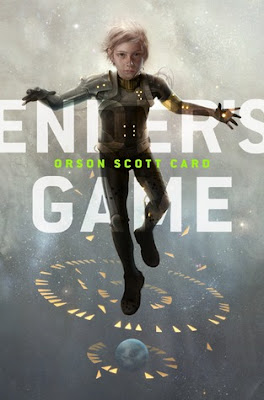
Ender's Game is the book that put Orson Scott Card on the map, and it remains his most famous work ever, with its sequel Speaker for the Dead a close second. It was first published in 1985.
In the not-too-distant future, mankind has barely survived two invasions by an insectoid alien race, formally known as Formics, but called Buggers by most of the viewpoint characters. As the threat of a third invasion looms nigh, the world's most talented children are taken to an orbiting Battle School. There they study physics, mathematics, history, psychology, politics, and play a lot of games. And the biggest, best game of all is the Battle Room, where they organize into "armies" and play 41-on-41 zero-G laser tag as the adults look on, searching for future commanders against the incoming menace.
Meet Andrew "Ender" Wiggin, six-year-old and third child of his family, a stigma due to the population restriction laws. He is the only one of his family to be accepted to the school, and so, leaving behind his parents, his loving sister Valentine, and his sadistic brother Peter, he leaves for Battle School... and things won't be at all easy.
The novel acted as a springboard for multiple series and other associated works, dealing with different time periods in the same canon.
- The first, consisting of A War of Gifts: An Ender Story, Ender in Exile, Speaker for the Dead, Xenocide, and Children of the Mind follow Ender in the far future and focus on worldbuilding and a hefty dose of ethical pondering. By Card's admission, Ender's Game was expanded from its short story form just to set up Speaker for the Dead.
- The second begins with Ender's Shadow, a retelling of Ender's Game from the viewpoint of Bean, one of his friends. The Shadow series then follows Bean in the Twenty More Minutes Into The Future Earth, consisting of Shadow of the Hegemon, Shadow Puppets, and Shadow of the Giant. The Shadow series—whose novels might accurately be described as Thrillers—is a more direct continuation of the original novel and its themes of war and politics (with Hegemon being described by its author as "a giant game of Risk"), and many more characters from the original book appear in it. Shadows in Flight loses the politics and is more contemporary with the Ender Sequels, though still a Bean story. It is concluded by The Last Shadow, a chronologically final novel that caps off both sub-series.
- The Formic Wars series, co-written with Aaron Johnston, is a prequel series showing Earth's earlier encounters with the Formics. A trilogy of novels, Earth Unaware, Earth Afire, and Earth Awakens, has been published, with a second sequel forthcoming.
- The Fleet School series, yet another P.O.V. Sequel, taking place after the end of the original novel, but focused on space rather than on Earth. The protagonist is Dabeet Ochoa, an incredibly smart (and incredibly arrogant) kid, who wishes to go to Fleet School (formerly known as Battle School), but attendance is reserved only to the so-called "Children of the Fleet" (i.e. kids of IF officers and enlisted). He catches the interest of Hyrum Graff (the Minister of Colonization).
In other works, there is also a short story collection called First Meetings. Marvel Comics has published Comic Book Adaptations of Ender's Game, Ender's Shadow, Speaker for the Dead, and Ender in Exile, as well as several one shots. Additionally, they launched the Formic Wars series, which function as prequels to the books.
The Film of the Book, Ender's Game, came out in 2013 after languishing in Development Hell for around two decades. Card served as a co-producer, and it was written and directed by Gavin Hood (X-Men Origins: Wolverine), starring Asa Butterfield as Ender, Hailee Steinfeld as Petra, Abigail Breslin as Valentine, Harrison Ford as Colonel Graff and Ben Kingsley as Mazer Rackham.
Compare Animorphs or Neon Genesis Evangelion, works which similarly deconstruct Kid Hero-focused science-fiction.
Ender's Game provides examples of:
- 2-D Space: Averted as Ender uses his understanding of 3-dimensional space to his early advantage at Battle School.
- Achilles in His Tent: Ender is allowed to go on leave between Battle School and Command School. He spends it on Earth, and decides he'd rather stay there, build a raft and lie around on a lake. The teachers are afraid of forcing him to return against his will since they need him fully committed, so they eventually send Valentine to shame him into returning voluntarily. She despises them for using her to manipulate Ender, but she does it anyway because she knows what's at stake.
- Adaptation Expansion: The novel greatly expands the original short story. It gives Ender a family and elaborates on his life before he was sent to Battle School, and it provides details about the enemy aliens and the background of the war. In the short story, Ender has no memories of life before Battle School, and the aliens are never named or described.
- Adults Are Useless: Justified as being part of Ender's Training from Hell. Alternatively, averted, as the adults are disturbingly good at what they do: making Ender's life suck.
- An Aesop: The novel rejects subtlety and symbolism in giving its message about what happens in a society that is consumed by fear in wartime, the same state Earth is in fighting the Formies. People at the top will cast morality and individual freedom to the winds (like how Ender's parents needed special permission to have a third child), children will lose their innocence (as Ender does in his time as a Child Soldier), and good people on both sides will die (which we see with, well, let's not spoil anything).
- Alas, Poor Villain: Ender's combination of empathy and pragmatism leaves him constantly feeling regret for the actions he takes to protect himself from his enemies. By extension, after Ender writes his book about the buggers, the whole of humanity considers Ender a monster for exterminating them, and his name is a taboo word.
- Aloof Leader, Affable Subordinate: Invoked by Ender. He, the overall commander, takes care of discipline so that the immediate commanders can bond with their troops better.
- Alternate History: the original version of the book, published in 1985, had a political situation that failed to include the end of the Cold War on account of it having not yet happened. The Shadow sequels, and an Updated Re-release in 1991, fixed these issues.
- The Alternet: The alt-Internet is called "the nets" and is depicted as several interconnecting but discrete networks, like in the old days of CompuServe and Prodigy (when the book was written). There's also the participation in important political debates on a by-invitation-only and closely moderated basis, rather than the free-for-all that politics on the modern Internet has become.
- Always Chaotic Evil: Deconstructed. Humanity considers the Formics inherently monstrous, causing them to take progressively horrific and morally-ambiguous steps to defeat them in the war, but by the end it turns out that the Formics' aggression was based on a misunderstanding and lack of communication. After Ender wipes out their entire species (an action that in most stories focused on Always Chaotic Evil species is perfectly justified), he discovers that lasting peace between humans and Formics may have been (and might still be) possible.
- And You Thought It Was a Game: While Ender and his toon leaders believe they are playing simulations, they are actually in command of a full invasion force.
- Angst Coma: Ender succumbs to exhaustion for a few days when he discovers that he unwittingly committed mass genocide/xenocide against the Buggers while believing he was only undergoing training for it. Justified in a number of ways: physical and mental exhaustion, the fact that he was trying to convince the military that he was ethically unfit for command, and possibly psychic backlash from being connected to the Buggers themselves at the moment he killed them all.
- Ape Shall Never Kill Ape: The Buggers did not realize that the humans they killed were individual entities rather than "appendages" of a dominant mind. When they do finally realize this, they are horrified and recognize that they have given humans ample justification to kill them in retribution.
- Arc Welding Ender's Game was originally followed by a number of sequels featuring Ender in the far future. The author later returned to the time period of the original novel by writing Ender's Shadow, a P.O.V. Sequel written from the perspective of Bean, one of Ender's friends. This was then followed by a number of Shadow novels taking place immediately after Ender's Game and Ender's Shadow. These two sub-series can be read completely independently from one another. However, later books start to get more interwoven, starting with Ender in Exile, a book set between Ender's Game and its original sequel Speaker for the Dead picking up an unresolved plot thread from the Shadow series. The two series became fully welded with the release of The Last Shadow, a chronologically final novel that acts as a finale for both sub-series.
- Arc Words:
- "The enemy's gate is down."
- "The game is over."
- Asshole Victim: Subverted. Ender still feels guilty over hurting his enemies in self-defense, no matter how terrible they are.
- Author Usurpation: Ender's Game is the only one of Orson's books that became mainstream, and it overshadows his other books.
- Badass Israeli: Invoked and subverted. There is a legend at Battle School that Jewish generals cannot lose, and Rat Army, led by the Jewish Rose "de Nose", is second in the ranking when Ender joins; on the other hand, Rose "de Nose" is portrayed as not really being that great, and it is pointed out that despite an all-Jewish triumvirate (American Jewish Hegemon, Israeli Jewish Strategos, and Russian Jewish Polemarch), it was the half-Maori, entirely non-Jewish Mazer Rackham who drove off the Second Invasion.
- Bathhouse Blitz: Bonzo and his lackeys corner Ender in the Battle School shower intending to humiliate and beat him for his perceived insults against them. Ender goads Bonzo into attacking alone. He then takes full advantage of being soaped-up and slippery, and kills Bonzo barehanded.
- Bathroom Brawl: Ender is attacked by bullies in the showers and he fights the leader while both of them are naked.
- The Benchwarmer: When Ender is assigned to Bonzo's army in Battle School, Bonzo mistakes the improbably young boy for an attempt at sabotage by the School administration and forbids him from taking part in the battles. By the fourth such match, he disobeys the order and singlehandedly turns a loss into a draw, making Bonzo hate him all the more.
- Begin with a Finisher: Ender's primary philosophy when it comes to fighting (and warfare): overwhelming shock & awe. Basically, thoroughly and savagely attack your enemy to the point where they never attempt any kind of retaliation out of outright fear. Don't just win this battle, win every battle to come.
- Near the very beginning of the novel, when he's being picked on by bullies, Ender knows that they'll never leave him alone if he just takes their abuse, so he brutally beats (and, unbeknownst to him at the time, kills) the leader of the gang to intimidate the rest of the group.
- In the Battle School, when he's confronted by a gang in the showers, he goads the leader into fighting him one-on-one, then proceeds to once again brutally defeat him. After that he gets a reputation as someone not to be messed with...
- And finally, at the end of the book when he's leading the fighters in the simulation, he instructs a fighter, instead of engaging the enemy fleet directly, to bypass it completely and try to just destroy the enemy's home planet.
- Beware the Nice Ones: Ender has his sister's compassion but his brother's ruthlessness (much to Ender's dismay).
- Bitch Slap: The Small Name, Big Ego Jerkass Bonzo backhands Petra when she interrupts him, drawing blood. It's an Establishing Character Moment for them both: in contrast to Bonzo's blustering nastiness, Petra shows Nerves of Steel and doesn't react to the slap at all.
- Bully Brutality: Applied by Peter Wiggin to his brother Andrew (ex. beating him up to a pulp after forcing him to "play Formic"). Inverted by Ender, who applies overwhelming brutality to his bullies to force them to stop.
- Bug War: Earth's forces are fighting against insect-appearing aliens.
- Cain and Abel: Ender and his older brother Peter are constantly competing, and the rivalry is not a friendly one. They don't reconcile until the Ender is half a galaxy away and the Peter is on his deathbed.
- The Chains of Commanding: Zigzagged. The reason Graff et al employ the And You Thought It Was a Game trope on Ender is to free him from this trope; because he thinks it's a training simulation with no consequences, he's free to do whatever he wants, make any sort of We Have Reserves sacrifices he wants, to win. And it works... until Ender discovers that whole "xenocide" thing, at which point he feels the consequences of his choices like never before.
- Chekhov M.I.A.: Ender's surprise guest on Eros: Mazer Rackham, who won the first war and then was kept alive through relativity in order to help win the next one.
- Chekhov's Gun:
- In his first battle, the other army is able to pass through the gate even though Ender isn't frozen. In his last battle, he wins by sending a boy through the gate, even though the other army hasn't been defeated yet.
- At Command School, Ender uses "Dr. Device" in one of the first battles, and the very last.
- A Child Shall Lead Them: Invoked. The military commanders are searching for child prodigies specifically due to their lack of awareness of the larger picture, so they won't be subject to fatal hesitation.
- Child Soldiers: Every Battle School participant joins under the age of 12, although they're (normally) not sent to fight until they're healthy adults, at which point they'll have been through a regular adult boot camp.
- Combat Pragmatist:
- There is NOTHING Ender won't do to win a fight and ensure it never happens again. He learned this lesson when he was five.Ender: It was just him and me. He fought with honor. If it weren't for his honor, he and the others would have beaten me together. They might have killed me, then. His sense of honor saved my life. I didn't fight with honor... I fought to win.
Bean: And you did. Kicked him right out of orbit. - Mazer Rackham reinforces the same lesson. War is about doing whatever you can to win. There are no rules except what you can do to your enemy and what you can stop him from doing to you — especially since, in this particular case, the buggers cannot communicate with humanity and have shown no interest in establishing peaceful relations. (Both Rackham and Ender express, at different points, a wish that this was the sort of war where the Geneva Conventions could possibly apply, but also acknowledge that it isn't.)
- There is NOTHING Ender won't do to win a fight and ensure it never happens again. He learned this lesson when he was five.
- Complacent Gaming Syndrome: In-Universe example. The other commanders at Battle School rely on tried-and-true strategies that have been in place for years. Ender wins by exploiting the flaws in them.
- Curb-Stomp Battle: Mazer Rackham hit one ship (the queen's) and his war was over. The fact that he was the only human on Earth to figure out how to do this is why he was kept around to be Ender's teacher.
- Deconstructor Fleet: Let us count the ways...
- A Kid Hero is called upon to save the world from aliens? Sounds like fun stuff... until you see the realistic treatment of Child Soldiers, with all of the brutal indoctrination and psychological trauma that accompanies fighting a war as a child. The Alien Invasion plot becomes a lot less "fun" when you realize the moral compromises that Earth's governments might make in the face of the very real threat of human extinction.
- A hyper-intelligent child successfully manages to save the human race? Sounds cool... until you see the realistic treatment of adolescent psychology, and of gifted children in particular. Ender's intelligence makes him Earth's best hope, but it also kills any hope of his developing actual friendships, and puts him in the uncomfortable position of having to learn to bend people to his will.
- The governments of Earth unite to build a space fleet and fight off an alien menace? Sounds like an uplifting idea... until you see the realistic treatment of global politics, written with the Cold War fresh on America's mind. Though the human race does triumph in the end, Peter and Valentine correctly guess that many rival nations have spent the decades arming for war with each other, planning for the day when they no longer have a common enemy to unite against. In the end, the International Fleet collapses into civil war the instant that the Buggers are defeated, and the political situation on Earth almost explodes... at least before an unexpected peacemaker shows up to fix everything.
- Despair Event Horizon: It's revealed at the end that the Bugger queens despaired the moment they lost the first battle of the Third Invasion. By then they had realized with utter horror and deep remorse that each human they had killed in the First and Second invasions was an independent, sapient being, as opposed to the drones in the Buggers' Hive Mind. Now they realized the humans were counterattacking in earnest. Summed up succinctly by the thought:
- The humans have not forgiven us. We shall surely die.
- Disproportionate Retribution: When Ender's attacked, he wins the fight and all subsequent ones all at once by beating his opponent so badly that not only will they never be able to hurt him again, but none of the witnesses will dare to pick a fight with him either."You might be having some idea of ganging up on me. You could probably beat me up pretty bad. But just remember what I do to people who try to hurt me. From then on you'd be wondering when I'd get you, and how bad it would be." He kicked Stilson in the face. Blood from his nose spattered the ground nearby. "It wouldn't be this bad," Ender said. "It would be worse."
- Dramatic Irony: Ender, one of the most compassionate people ever born, is a ruthless killer. Peter, a sociopath, gave the humans peace and unity. This is not lost on Ender. The scary part is that it makes sense, as Ender's empathy would allow him to understand and anticipate his enemies' plan and reactions and counteract them with brutal efficiency, whereas Peter's sociopathy would allow him to make rational judgments (once he gets over his homicidal tendencies) and ignore petty emotions that spark 90% of the human conflicts (such as nationalism, pride, or ambition).
- Drill Sergeant Nasty: Subverted. The purpose of the Drill Sergeant Nasty is to give the recruits a common adversary: they all hate him, and it draws them together into a team. He picks on someone so the rest will sympathize with him. Graff, on the other hand, tells the rest of the recruits that Ender is the greatest soldier ever, and none of them have a prayer of measuring up to him. This turns them against Ender and isolates him, forcing him to develop the leadership and command abilities they need from him.
- Early-Installment Weirdness: The Formics are normally referred to as the "Buggers" in this book. This slang gradually disappeared later in the series and is not used in The Film of the Book, since in British English it's a slang term for anal sex.
- Earth-Shattering Kaboom: The "Little Doctor" device is capable of destroying a planet, and is used for that purpose near the end of the book (though it disintegrates a target instead of blowing it up).
- Easy Logistics: Averted. Since there is no FTL travel, there is no way for a supply unit to catch up with a fleet outside its home system in a time period less than years. So they don't even try - every fleet sent to Formic space is essentially sent on a suicide mission. They're given enough supplies to make a one-way trip and fight a short campaign, after which they will either have taken the system and be able to colonize it, or they will be dead.
- Exclusive Clique Clubhouse: The kids at the Battle School are officially divided into "armies" and given specific barracks across the Battle School - the better to prevent fraternization and ensure competition between armies. Though none of them are given any special amenities, each army has its own particular character, and the the barracks are organized accordingly: Salamander Army is run like a dictatorship under Bonzo Madrid and the barracks only relaxes once he's out of the room, while Rat Army adopts a slobby, jocular demeanor to match Commander Rose "The Nose's" unprofessional attitude.
- Failed Future Forecast: The "Warsaw Pact" is still around and ready to threaten world peace after the Third Invasion is over. Retconned in the later books by calling it the New Warsaw Pact. (Apparently Warsaw is really unlucky when it comes to hosting conferences that involve conquest-minded Russian regimes.)
- Failed a Spot Check: When Ender is first assigned to Salamander, he doesn't know anyone there other than its commander is a boy named Bonzo Madrid, and Ender initially thinks Petra is him when she's the first one to talk to Ender. Initially this could be an understandable mistake, since everyone involved is a prepubescent and there isn't much physical difference between boys and girls at that age—except one obvious onenote Later on in that scene it's revealed she was standing there stark naked.
- Fantasy Creep: The series started out very hard sci-fi, to the point that there wasn't even faster than light space travel; it took hundreds of years to travel from planet to planet. The first sequel Speaker for the Dead had stranger concepts like aliens that turn into trees and superluminal communication, but the science behind them was thoroughly explained and grounded. By the third and fourth book, things got even stranger upon the discovery of "the Outside", a dimension that enables faster-than-light travel... but also creates clones of your siblings, transfers your mind to a different body, has you travel in a spaceship that is basically a box... It Makes Sense in Context but it's very unlike the first books.
- Flexible Tourney Rules: The teachers at Battle School start purposely stacking the deck against Ender as he racks up an unbroken string of wins, challenging him to adapt, and seeing how far he can bend without breaking.
- Foreshadowing:
- After a battle, students checking the stats are surprised to learn that there was still an active soldier on the losing army, as Ender had been ordered to sit in a corner and not move or fire his weapon and thus had escaped the notice of the victorious army. He later wins a battle by performing the victory ritual despite the fact that the two opposing armies are mostly intact, as everyone else had assumed that incapacitating all enemy soldiers was a prerequisite to victory.
- When Ender goes off his three-month leave on Earth before Command School at Val's persuasion, he thinks that she convinced him to leave Earth for another four, forty, maybe four thousand years. At the end of the book, Ender actually does leave Earth behind; thanks to the relativistic effects of space travel, his absence lasts centuries from Earth's point of view.
- In the first chapter, after Ender gets in trouble for a violent fight with a bully named Stilson and his friends, the investigating IF officers ask why he kept beating Stilson after knocking him to the ground. He answers "Knocking him down won the first fight. I wanted to win all the next ones, too. So they'd leave me alone." This foreshadows the ending, where the IF outright destroys the Buggers' home planet with Ender's help—thus ensuring that humanity wins all the next fights with the Buggers before they've even started.
- Full-Frontal Assault: Ender is attacked by Bonzo and many others while he's in the shower, so Ender is naturally naked, but Bonzo takes off his clothes after Ender goads him, telling him how cowardly it is to attack a kid who's naked in the shower and smaller than you, with lots of reinforcements.Ender: Be proud, Bonito, pretty boy. You can go home and tell your father, "Yes, I beat up Ender Wiggin, who was barely ten years old, and I was thirteen. And I had only six of my friends to help me, and somehow we managed to defeat him, even though he was naked and wet and alone - Ender Wiggin is so dangerous and terrifying it was all we could do not to bring two hundred."
- Future Slang: Battle School has its own lexicon of informal slang. Rookie recruits are called "launchies"note , a squad within an army is called a "toon" (presumably short for "platoon"), and "Neh?" "Eh." — borrowed from Japanese, where it essentially means "Right?" "Yeah." — is a frequent interjection in casual conversation.
- Gag Penis: When Ender first meets Rose de Nose, he's lying naked on his bed with the desk over his groin with an oversized set of genitals projecting onto it that waggle whenever he moves.
- Giant Corpse World: After Ender kills the giant in the video game, dwarves build a village in its skeleton.
- Gone Horribly Right: Ender was made to be the ultimate commander, with enough empathy and charisma to lead an army and understand the enemy. He eventually serves his purpose and is casually treated as an afterthought for the people who used him. This eventually means he becomes a Death Seeker, violates space law in the sequels by planting the Hive Queen on a planet with humans and Penguinos and encourages a colony to rebel because he knows that authority figures are manipulative liars who don't understand complex situations with aliens.
- Groin Attack:
- Ender incorporates this tactic while defending himself against Stilson, as part of his mentality to win the battle at all costs, regardless of the brutality. Notable in that he employs the groin attack after his opponent is already disabled and defenseless, as an example to deter any of his friends from coming after Ender.
- Subverted when Ender is ambushed later; he correctly surmises that his opponent will be expecting this move, which moves his head into position for Ender to deliver a head-butt. As with Stilson, he then inflicts the groin attack on his stunned enemy.
- Guilt-Free Extermination War: Subverted. After two consecutive Formic invasions resulting in the tens of millions of human deaths, the humans conclude that they must launch an all-out offensive against the Formics or be destroyed. However, the second invasion caused the Formics to realize that each individual human they killed was sentient (rather than an extension of a hive mind). They are horrified by that fact and have no intention of continuing hostilities, but also no way of communicating that to the humans.
- Hard Truth Aesop:
- The people you love can manipulate you. Ender resents how Graff can use Valentine as a pawn to give him what he wants. Valentine even admits at the end that she's manipulating Ender to become a Formic colony governor because she knows he is too traumatized to even think that far ahead and if it were up to him he'd let anyone kill him or use him, whether or not it made him happy. It says something that as Ender grows up in later books, he builds a new life apart from his big sister and creates an AI that is the perfect version of her.
- You don't have to forgive yourself to live a content life. Ender is certainly not happy at the end of the story, but he is calmer and more in charge of his destiny. He admits that even if the Hive Queen forgave him, he damn well doesn't because thanks to him, the Formics became humans' living nightmares. Ender writes the Hive Queen's eulogy under a pseudonym, which turns the tide over a thousand years so that Ender Wiggin is seen as a monster and the Formics as tragic beings.
- Hive Drone: The Formics will stop moving and die when their queen is killed.
- Honor Before Reason: After being goaded by Ender over ganging up on him in the shower, Bonzo Madrid decides to fight Ender one-on-one. It doesn't go well.
- Informed Ability:
- Ender claims that his combat prowess and compassion both come from how well he understands and loves his enemies. However, from what we actually see of his thought processes, he doesn't seem to understand anything about them beyond "they're hurting me because they're mean and jealous, and they might become too scared to hurt me if I seriously injure them." As for loving them, the only evidence of this we ever get is that he feels sad after killing or hurting them, and even then he seems to be more pitying himself in a Why Did You Make Me Hit You? way rather than actually regretting the action.
- We're told that Graff's strategy for doing the Battle School is based on doing whatever it takes to train commanders and going with whatever works, however harsh. That's why all his training methods had a 100% failure rate for 70-80 years before meeting Ender.
- Aside from Ender, the book provides very little evidence that any of the Battle School kids are the prodigies they're said to be. Maybe the most extreme example of this is Shen, who is identified by Ender as being among the best students he's worked with despite having done nothing to demonstrate any sort of special talent up to that point.
- Insectoid Aliens: The enemy alien race is insectoid in both physical appearance and in characteristics such as a Hive Mind of drones and workers controlled by a queen. This leads to both their official name, Formics (from the Latin word for ant), as well as the pejorative "Buggers"
- Instant-Win Condition: The Enemy Gate Is Down.
- Ender wins a match at Battle School by capturing the enemy gate without "killing" the entire enemy team, which up until that point was assumed to be necessary. This was set up earlier in the novel: Salamander Army loses a battle even though Ender is "wounded" but not fully disabled.
- When dealing with the Bugger queens, killing her will result in the "death" of all her drones.
- Insult Backfire: While still in school, Ender gets taunted by other kids sending covert IMs over the net-enabled school desks. Ender, who figured out how to do this in the first place, sees every message as a tribute to his intelligence.
- Insult to Rocks: Shen and Ender, on Bernard:Shen: He's a pig.
Ender: On the whole, pigs aren't so bad.
Shen: You're right. I wasn't being fair to the pigs. - Irony: Ender is a very compassionate and loving person (when he's allowed to be) and his brother Peter is a cruel and possibly sociopathic person. In the end, Peter goes down in history as the man who brought about world peace and is remembered as an international hero, while Ender becomes famous for destroying the Formic race and in the far distant future is remembered as a genocidal monster. Ender lampshades it while in Heroic BSoD. Justified because Ender himself saw the destruction of the Formics this way and gave himself a Historical Villain Upgrade in his memoir The Hive Queen.
- It's A Small Net After All: Averted. The "Net" in Ender's world is just about as accurate as someone in 1985 could predict. He even predicted Trolls, Sock Puppets, and the blogosphere.
- Keystone Army: Formic drones are remotely controlled by the queens. Kill the queen, and the army is decapitated.
- Kick Them While They Are Down: Ender continues beating Stilson even after Stilson is on the ground doubled over in pain, so the other bullies will think Ender's too crazy/dirty-fighting to mess with again. He doesn't know it at the time, partly because he's shipped off to Battle School right afterwards, but he kills Stilson when he does it.
- Kids Are Cruel: Although the very aggressive children such as Peter are prevented from attending, emotional abuse and bullying are common at Battle School, escalating to physical abuse in some cases.
- Loophole Abuse:
- It's unintentional on Ender's part but in his first army, Ender lands on the top of the coveted efficiency rankings. This is because the rankings penalize players for missing shots and being disabled or eliminated; since Ender has been forbidden from firing his weapon or participating in the battle in any way, he's literally at the top of the rankings for doing nothing.
- Ender quickly learns how to hack the messaging system by creating duplicate accounts of someone he wants to impersonate simply by adding a space to the end of their name. Embarrasing posts from that person then spam the system, causing all sorts of blackmail.
- Ender's entire modus operandi is to thoroughly master the rules of any game, then reinterpret or just plain screw them in new and imaginative ways. His teachers, counting on him to become the greatest living weapon in the history of humanity, are only too happy to let him do so, and have deliberately designed the school environment to favor such thinking. An example of this is when Ender, in a simulation battle against overwhelming odds, ignores the implied rule that all enemies must first be defeated and simply enters the enemy's gate, resulting in an Instant-Win Condition. The teachers constantly force him to come up with new ways to use this trope by closing off the loopholes he explores as soon as he exposes and exploits them. In a strange twist, some of the other army leaders, angry at Ender's perfect win streak, claim that the teachers are actually helping him, despite it being blatantly obvious that it's the other way around, seemingly unable to comprehend that he's simply that good.
- Lord British Postulate: An In-Universe case of this where, faced with a video game puzzle that appears to be Unwinnable by Design—both cups the giant offers Ender's Player Character are poisoned—Ender attacks and kills the giant instead after getting frustrated with Save Scumming and throws the whole game Off the Rails. This being 1985, Card can be somewhat forgiven for thinking that ruthlessly slaughtering NPCs would be an innovative solution rather than just ordinary Video Game Cruelty Potential: though the first three Ultima games, which named the trope, predate this book, he may not have heard of the fandom trend of PCs finding implausible ways to kill Lord British.
- Mature Work, Child Protagonists: This book and its spin-off, Ender's Shadow, both take place at a military school for children- Ender is 7 at the beginning of his story and Bean is 4. Although they grow up a bit during the story, they are still young teens at the end of the book- but it is clearly written for adults, featuring adult themes and a reading level far too difficult for most elementary schoolers to read at all.
- Meaningful Name: One of the Battle School leaders points out that "Ender," a mispronunciation of the name Andrew, can be taken to mean "Finisher," as they hope that he will finish the war between humans and the Formics.
- Moving the Goalposts:
- Once Ender's given his own army, the school starts screwing him over as hard as they can. His team are perpetually put through harder battles with more and more unfair rules to try to push his strategic abilities to the limit and teach him to win against vastly superior foes. Examples include: a battle where the enemy army is allowed to get in position ahead of time; a battle where disabled enemies revive after a short time; two battles in the same day when generally armies have at least a week in between to recuperate; and a battle against two enemy armies.
- At Command School, the virtual battles Ender has to lead get more and more blatantly unfair, with his army's ships being lower and lower quality while the enemy armies are bigger and stronger. Eventually he is pushed to the point where to make a statement, he wins a massive battle in the most self destructive way he could. Then it turns out all the battles that he had been commanding were real, and the final battle he attempted to win incorrectly was actually the Formic's home planet, meaning he had won the war.
- Multi National Team: The International Fleet and the children at Battle School come from a wide array of nationalities.
- My God, What Have I Done?:
- The Buggers feel tremendous regret upon realizing the fundamental mistake in how they had attempted first contact (that killing any human means killing a sentient person as opposed to a drone).
- Ender feels the same after realizing that all of his "practice battles" in command school were real, and he was sending real soldiers to kill or be killed.
- Naked First Impression: The children at Battle School have a pretty casual attitude toward nudity. When Ender first arrives in Salamander Army, Petra, the only girl in the army, is lounging around with the boys buck naked without a shred of shame.
- No-Holds-Barred Beatdown: Ender's approach to bullies, with the reasoning that if he only fights hard enough to win he'll probably have to fight again at some point; his strategy is to keep going until he has completely deterred not just his assailant, but also anyone else who may be inclined to attack him."The only way to end things completely was to hurt [his assailant] enough that his fear was stronger than his hate."
- Noodle Incident: Apparently Bonzo's was the second death ever at Battle School; the first was a suicide, but we never get any further details on the incident.
- "Not So Different" Remark: Ender struggles with the realization of how similar he is to his brother Peter in their capability to destroy.
- Nuclear Nullifier: There's an offhand mention of shields that "make it so nobody bothers with nuclear weapons anymore".
- Obvious Rule Patch: The immediate reaction to Dragon Army winning by exploiting an Instant-Win Condition in the Battle Room game is a new rule that all enemy soldiers must be killed or disabled before the gate can be opened.
- Performance Anxiety: In command school, Ender pushes more and more responsibility on Petra due to her competence. She eventually cracks under the pressure, and they almost lose a winnable battle before Ender notices. From that time on, Petra is only able to be entrusted with the most basic tasks since she can no longer perform under pressure.
- The Perils of Being the Best: It is because Ender is the best strategist at Battle School that he is targeted by enemies for attack, isolated by being singled out by the trainers, and ultimately tricked into committing xenocide against an entire alien race. Had Ender been an average strategist, none of these fates would have befallen him.
- Pet the Dog: Once the war is over, Graff is in this mode. When Ender is threatened by the Polemarch, Graff tries to rouse him from his Angst Coma. He's genuinely distraught when Ender says he doesn't care if he's assassinated, and gets doctors to treat him while the boy is sleeping for five days, putting an IV in him so he doesn't dehydrate or starve. It's also implied that he worked with Valentine to make Ender a governor of the Formic Colony, and not to make Ender another pawn in a war but to give him a chance to rebuild and dig out of his Heroic BSoD. In Ender's Shadow at least, Graff expresses remorse for what he did to multiple children and later books show that karma hits him when his own son ends up in the army, sometimes kidnapped by terrorists and outright not thinking much of parents that abandon their kids.
- Poor Communication Kills: At the end we find that the buggers were not evil or xenocidal as originally thought by humans, they were simply trying to colonize the solar system and weren't aware humans were intelligent on an individual level, so in their eyes killing a few million people was just their way of formally declaring their intent and asserting their ability to do so; "Hey, scooch over, will ya?". This was a big reason for Humanity's fear and hatred of the buggers; when they happened upon a human colony, they dismantled our technology to see how it worked - after they "dismantled" the colonists to see how they worked. They didn't understand how much that would piss us off any more than they could comprehend that we would kill a sentient queen, rather than the nonsentient workers. After their first two invasions, they realize this and stop, but by this point it's too late. Only at the very end does Ender learn this. He ends up being friends with the last queen who was created to both continue on her species and apologize.
- Population Control: Ender is a third child in a society where that's generally illegal, although he is a sanctioned exception to the rule. It is stated that despite his authorized status, it's a cause of tension in his family because both of his parents came from non-compliant families.
- Prohibited Hero Saves the Day: Ender is ordered to remain on the sidelines without firing his weapon and in disobeying is able to turn what would have been a close defeat into a draw.
- Pronouncing My Name for You: Bonzo make a point to Ender that his name is pronounced with two long o's (Bone-so), not Bon-zo.
- Ragtag Bunch of Misfits: Dragon Army seems like this, as none of the members really stood out from the crowd in their previous armies. Ender's leadership and empathy draws them together into the finest unit the school has ever seen.
- Reality Is Unrealistic: Some people complain that the kids at the battle school are too smart, but Orson Scott Card has received letters from gifted children telling him that they found the children in the battle school to be realistic (Ender is over the top, but he's supposed to be, and he's also got some genetic engineering factoring into his intelligence).
- Ringworld Planet: Battle School is built as a ring, though it later turns out the Fleet acquired Artificial Gravity from the Formics.note
- Scifi Writers Have No Sense Of Scale: Discussed by Ender himself, when reviewing war footage and noting that real-life space battles are nothing like in popular media. The ships are so far apart that they navigate and aim their weapons entirely on instruments, and never see each other except for the flash of a direct-impact nuke.
- Screw the Rules, They're Not Real!:
- Ender repeatedly breaks the conventions of Battle School's wargames through innovative tactics such as having his teammates use their stun guns on their own suits so that teammates can use them as Bulletproof Human Shields, or simply bullrushing a scenario the instructors deliberately slanted against his side to exploit the Instant-Win Condition, a tactic he ultimately repeats in (what he thinks is a simulation for) the final assault on the Formic homeworld.
- Ender plays a puzzle video game whose final level appears to be Unwinnable by Design: a giant offers him two cups to drink from, but no matter which one Ender chooses, his Player Character is poisoned and dies. After a few tries, Ender gets frustrated and attacks (and kills) the giant instead of the purported puzzle, and things in the game go Off the Rails.
- Mazer Rackham speculates that this is why he could get a clean shot at the queen of the second Formic invasion: "Maybe in their world, queens are never killed, only captured, only checkmated." If so, from their perspective he did the equivalent of pulling a gun in a playground shoving match. He's wrong, as it turns out: the queen intentionally left herself open to atone for killing other sapient beings. Only Formic queens are sapient—their drones are telepathically controlled—and they initially didn't realize all humans are.
- Secret Test of Character: Possible candidates for Battle School are implanted with a device that monitors everything they see and hear. Ender's final test is to remove his device, letting him think that he's no longer under consideration, then seeing how he reacts.
- Sibling Yin-Yang: Valentine is Yin, Peter is Yang, and Ender is Yin-Yang.
- The Smurfette Principle: Petra is the only girl ever mentioned at the Battle School; when Ender is first recruited, it is mentioned that girls rarely pass the tests to get in. However, Ender's sister Valentine proves to be an important character.
- Sock Puppet: "Locke" and "Demosthenes" are online personas created by Peter and Valentine to serve as foils for each other and influence international politics.
- Space Cadet Academy: The Battle School. There are also mentions of the Tactical (for those who don't wash out but also don't make it quite as high as others) and Pre-Command (exactly what is sounds like) schools. The highest school is the Command School, but only the best of the best are sent there from the Pre-Command School.
- The Spartan Way: Although students at Battle School are not subject to physical abuse (at least, not by the instructors) they do undergo the psychological equivalent of Training from Hell.
- Spiritual Antithesis: To Starship Troopers.
- Straight for the Commander: Mazer Rackham reveals this is how the Formic Navy was defeated, by deducing which ship had their queen. Once he destroyed it, the entire fleet became inert. Unfortunately, the Formics learn from this and try to bait Ender in his first battle into trying the same strategy, by putting their ships in a sphere formation with an expendable decoy as the "leader" in the center. Ender doesn't fall for it. Then at the climax of the book, Ender orders his fleet to charge straight in and fire their mass disintegrator weapons at the Formic homeworld, causing an Earth-Shattering Kaboom that kills all the queens there, taking out all the species under their control.
- Subspace Ansible: Namechecking Ursula K. Le Guin, even.
- Super-Soldier: Almost everyone in the Battle School, and the best of the best move on to Tactical and/or Command training to become super-generals. Ender, being the best of the best of the best, skips a few grades here and there, graduating to effectively become the supreme commander of all Earth's (space-bound) military forces by the time he's starting to enter puberty.
- Take a Third Option: Ender's modus operandi. One reason he's such an effective strategist is because he's a lateral thinker. Give him two options, he will find a third one:
- The game the title refers to (one of them, anyway) is a computer simulation that the teachers use to monitor the students' mental health. One scenario in the game is called the Giant's Drink, and it's Unwinnable by Design. A giant offers you a choice between two drinks, supposedly with one containing life and one containing death. But in reality, you will be killed in creatively horrible ways no matter which drink you choose. Ender plays the scenario repeatedly, to the point where the teachers worry about his obsession with it. Eventually he figures out that there's no way to win playing by the giant's rules, so he kicks over the drinks and kills the giant by digging into his eye with his bare hands.
- Ender later takes a third option as the instructors are testing his limits by putting him into increasingly unfair battles. Facing impossible odds, Ender elects to circumvent the battle entirely and perform the winning ritual, which had previously only been completed when the entire enemy army was disabled. This results in a Non-Standard Game Over for the opposing armies, as well as the instructors closing the loophole that allowed it.
- Tech Marches On: Locke and Demosthenes are awfully influential for a couple of bloggers, aren't they?
- Theme Park Version: In-verse. The entire world knows about Mazer Rackham, but the details of his victory over the Buggers/Formics is not revealed until Ender actually meets him years after he should have died. It turns out to have been a lot more subtle and a lot less grand than anything in the popular imagination could come up with.
- There Is No Rule Six: Rose tells Ender that there are only three rules, "Do what I tell you and don't piss in the bed." When Ender asks what the third rule is, as he was clearly meant to, Rose replies that that was three rules — "We don't do too good in math, here."
- Time Dilation: Responsible for the Chekhov M.I.A.. Also becomes a significant factor in later books, explaining how Ender and Valentine manage to remain alive millenia after the events of the first book.
- Token Girl: Petra Arkanian, the only Battle School girl of any importance (until the sequels add Virlomi to the Battle School roster). Possibly justified in that, according to the novel, fewer girls have the necessary personality and levels of aggression to be chosen for Battle School.
- Tournament Arc: Battle School is run this way.
- Tranquil Fury: One of Ender's defining features is his emotional control - he gets angry, but he doesn't show it unless he needs to for dramatic effect. The fight with Bonzo highlights this:"He could see Bonzo's anger growing hot. Hot anger was bad. Ender's anger was cold, and he could use it. Bonzo's was hot, and so it used him.”
- True Companions: Subverted. Ender wishes that he could be true companions with his friends, but he finds multiple times throughout the book that as he gains more power, he becomes less of a friend and more of boss to his companions. He even notes in the Command School segment of the book that he is growing more and more distant to his friends, who have become True Companions with each other. He is mostly just the authority figure to them. Not that they don't consider him a friend at all. He is just too much of an authority figure to them to see him as a true companion.
- Truth and Lies: Peter's campaign to manipulate the public via Sock Puppet bloggers.
- Tuckerization: Mazer Rackham is named after British illustrator Arthur Rackham and former Brigham Young University president Karl G. Maeser, while Hyrum Graff is named after Mormon Church leader Hyrum Smith (the brother of Joseph Smith). Both names reference Orson Scott Card's Mormon faith.
- Twist Ending: Two of them:
- The later battles against the buggers were real, not simulations.
- The buggers weren't actually trying to kill humanity, they just couldn't communicate with humans and fundamentally did not understand them.
- Ultimate Final Exam: The final test at Command School features Ender and his team being given a nearly-impossible simulation pitted against an enemy fleet and its home planet... with an extra-dangerous twist not revealed until the test is complete: it wasn't a simulation at all, but a real combat scenario - more specifically the final battle against the Buggers. Ender wins, but only by sacrificing the lives of everyone in the fleet and committing genocide, a fact he is not pleased with when the awful truth is finally revealed.
- The Unfettered: Ender may have mercy, but you sure as hell won't see it in the Battle Room. Or if you decide to ambush him.
- Unwinnable by Design:
- The fantasy game mentioned under Take a Third Option. When Ender reaches the Good Ending, his instructors go into shock, because the game doesn't have one.
- Ender's last battles as commander at Battle School are meant to be this as Battle School staff test his ability to find a third option.
- Unwinnable Training Simulation: Ender's last tests at Command School seem to be approaching this. The very last test seems Unwinnable by Design, even for Ender.
- Unwitting Pawn: At one point Petra tries to pull Ender aside in the hallway to talk to him, which would have separated him from his army and made him vulnerable to attack by students who are jealous of his unbroken winning streak. Ender sees the trap and forces her to walk with him. When he confronts her about it and asks if she knew what she was doing when she tried to stop him, she has no idea what the others had planned and is clearly shocked at Ender's implication that she was complicit.
- The 'Verse: Orson Scott Card kind of, sort of, made up the term, maybe.
- Villain Ball: The Buggers are implied to have an empire of dozens of planets with a queen on each. They're a Keystone Army where if a queen dies then all the Buggers she controls become brain dead. They then go and put all their queens on the one planet.
- Virus and Cure Names: The descolada and recolada viruses translate as "un-glueing" and "re-glueing" because of their effect on DNA.
- Wave-Motion Gun: the Little Doctor, a.k.a. MD Device, which operates on the principle of crossing two lasers to create a chain reaction of molecular disintegration.
- Weaponized Offspring: The Formic queen gives birth to all her soldiers, since the Formics are an insect race.
- Weaponized Stench: Discussed before Dragon Army's battle with Phoenix Army. When Ender's troops ask why he didn't notify them sooner that they were having a battle that day, he replies, "I thought you needed the shower. Yesterday Rabbit Army claimed we only won because the stink knocked them out."
- Wham Line: Near the end of the book.Mazer Rakham: Ender, for the past few months you have been the battle commander of our fleets. This was the Third Invasion. There were no games, the battles were real, and the only enemy you fought was the buggers. You won every battle, and today you finally fought them at their home world, where the queen was, all the queens from all their colonies, they all were there and you destroyed them completely. They'll never attack us again. You did it. You.
- What Measure Is a Non-Human?: For once, the aliens are guilty of this. By the time they realized their mistake, they knew it was too late. While they resist their destruction, they harbor no malice toward humanity.
- Would Be Rude to Say "Genocide":
- The "third invasion" looks like the Buggers were the aggressors. The truth is something else: the humans were committing xenocide against the Buggers, and the Buggers had no intent of attacking Earth again, but we didn't know that at the time.
- You Won't Feel a Thing!: At one point, Ender is told "it won't hurt a bit" to have his monitor taken out, but Ender knows that adults say that when it is going to hurt; he doesn't mind the lie because he can still take it as an accurate indicator of what to expect.
- Zero-Approval Gambit: Ender does this in the end. When the Hive Queen says she can repopulate her species, Ender points out that if he did that, humans would wipe her and her children out again. Instead, he writes her story, publishes it, and then spends several years traveling until the tide turns and there's a safe world for her. It works; the sequel books show that Ender in history went down as a monster, surprising the people who meet him in person.
- Zeerust: Peter gains control of the world by anonymously distributing political articles on the Internet. Nowadays we call that "blogging," which has become so common that the idea of a blogger gaining that much power seems unlikely. Parodied by xkcd here
 .
.
