

Olaf: I got dibs on his helmet.
Baleog: Okay, but I get his boots.
Erik: It's great to have such good friends.
In a frozen village in the far north, three Vikings of great skill and strength live quiet lives, spending their days hunting for meat in the surrounding woods. They are Erik the Swift, known far and wide for his great speed and incredible jumping ability; Baleog the Fierce, whose skill with a bow and sword allows him to crush anything in his path; and Olaf the Stout, who carries a shield and is strong enough to carry a full-grown man on top of it.
Life is good and they hope they don't ever have to leave their village.
One cold night, the trio finds themselves kidnapped by an evil green alien known as Tomator, who wants to use the Vikings as exhibits in his intergalactic freak show. The trio aren't about to take this lying down and immediately bust out. Their escape attempt goes a bit awry, however, resulting in them being hurled through time. It's up to you to lead them home.
The Lost Vikings, a 1992 video game developed by Silicon & Synapse (the team that would later become Blizzard Entertainment), is a hard one to classify. At first glance it looks like a simple platformer, but it's more complicated than that — two of your characters can't even jump. Puzzles are definitely a big part of the gameplay, but it's not entirely cerebral — in later levels it's a challenge just to stay alive. It's more accurately called a "puzzle-platformer", as the goal is to lead all three Vikings (who you can switch between at any time) safely through each level to the exit. Each character has his own set of abilities which he can use to help the team progress through the level: Erik can jump to higher ledges and use his helmet to bash through fragile walls; Baleog can use his weapons to defeat enemies and flip switches; and Olaf can use his shield to block enemy attacks and as a hang glider to slowly drop to lower levels.
The big draw to the series is how each character's abilities are used in unique ways and in combination with each other to allow for safe progress. For example, one early puzzle requires Olaf to use his shield as a platform for Erik to jump from, giving him the extra height he needs to vault a locked gate. On the other side, Erik can find a key to unlock the door and allow his companions to progress. Some of the puzzles are quite devious, and the game is ruled by Trial-and-Error Gameplay. Lots of it. Lots of it.
In addition, the game has a quirky sense of humor of the type rarely seen in this era of video games (which were usually lucky to get any text at all). It's an absolute joy to guide the bumbling, bickering Vikings through each stage.
In 1997, a long-awaited sequel named Lost Vikings 2 was released (initially for the SNES and later remade for the Playstation, Saturn and PC, under the title Norse by Norsewest: The Return of the Lost Vikings). In this game, the Vikings are again ambushed by Tomator, but the Vikings respond by mugging Tomator's minions and taking their gear, giving them new abilities. Erik gains rocket boots (which allow him to Double Jump) and a scuba helmet (which removes his Super Drowning Skills); Baleog takes a lightsaber and a bionic arm (which allow him to attack in eight directions, Belmont-style, and swing off certain gems), and Olaf earns a new cybernetic shield which allows him to shrink and boosts his flatulence to frightening levels. On top of that, the Vikings pick up two new characters in their travels: Fang the werewolf, who can run, jump, attack enemies, and Wall Jump (and comically be mistaken for every furry animal under the sun but a wolf); and Scorch the magic dragon (who has never seen the sea, but would evidently like to check it out), who can fly and breathe fire. To keep the gameplay simple, however, the two newbies would replace one or more of the Vikings every so often, allowing the player to control no more than three characters at a time. The packaging is different, but the game's the same — use the Vikings' abilities to lead them safely through stages full of death traps until you got to Tomator.
Fun and funny, but surprisingly deep; well worth a try.
The series also contains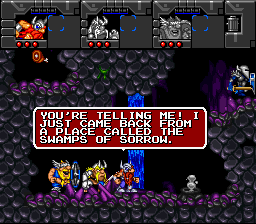 ◊ a Shout-Out or two to Blizzard's more famous series, Warcraft, which later returned the favor. Eventually, the trio made a comeback by being playable in Heroes of the Storm.
Not to be confused with the Starcraft II Mini-Game "Lost Viking", nor the Dethklok song of the same name.
This game provides examples of:
- Adaptation Expansion: The Genesis version of the first game has five levels that the other versions don't, and replaces the music from the demo in Wacky World with an awesomely bizarre remix of the SNES version of the Factory theme that suits the place perfectly, while also giving the Factory a new theme. It also allows three-player simultaneous co-op using the Sega Teamplayer multitap.
- Aerith and Bob: While the names "Erik" and "Olaf" have always been common in Scandinavia, Baleog is the only person (real or fictional) to ever bear that name.
- Alien Abduction: As the starting plot, some alien collects unique aliens for a collection.
- Ambidextrous Sprite: Played straight throughout both games, but curiously, Baleog's portrait in the first game shows his sword in the opposite hand from his sprites.
- In the second game, Baleog's robotic arm switches arms depending on which way he's facing. A bit more obvious when climbing ladders.
- Ambiguously Related: The manual for the first game refers to the three vikings as brothers, but this is never mentioned anywhere else and several pieces of in-game dialogue imply that this isn't actually the case (the vikings refer to each other as friends rather than brothers and Erik refers to his father as his father rather than their father).
- Anachronism Stew: Given the setting the vikings come from, this is often played for laughs. At the beginning of Candyland, Erik tries to quote The Wizard of Oz:Erik: I don't think we're in Kansas anymore, Toto.
Baleog: Where's Kansas?
Olaf: And who's Toto?- Gets all mixed up and swapped between characters in 2 and Norse by Norsewest. Considerably, Erik doesn't know what are donuts, and neither does the Transylvanian witch. Then there's one of the many retry messages in which the protagonists discuss (not in a preset order) whether they should build a rec room, relax and rent some videos, right until one of them asks: "What's a video?"
- Anti-Hero: The three leads are vikings who occasionally allude to engaging in typical viking behavior and regularly insult each other and the various people they encounter on their travels. That said, they are purely victims in the situations they find themselves in during the games themselves, and their sole motivation throughout them is simply to return home to their families.
- Arbitrary Headcount Limit: 3 max in the sequel. Lampshaded constantly.
- Justified in-universe by the teleportation magic/technology used by the various characters helping our heroes along being amateur or otherwise faulty; they all get where they're going eventually, but periodically a flub-up sends them off to the bean aisle.
- The sisters on the pirate ships aren't sending you straight to where you need to go because they wanna get rich. It takes a threat to convince them to get you there.
- Armor-Piercing Attack: Olaf's shield can block just about anything, but the buzz saw enemies in the factory will go right through him.
- Arrows on Fire: One of the powerups for Baleog in the first game, with which he can kill an enemy in just one shot for the rest of the level.
- A Wizard Did It: Parodied. The Cave Girl in the first game helps you get into the volcano by... Using her psychic powers to stop it erupting.
- Balance, Power, Skill, Gimmick: In the second game both Fang and Scorch qualify as the balance due to combining having an attack with some amount of vertical mobility, Baleog is the power for having the most versatile and effective forms of attack at the cost of minimal movement options, Erik is the skill for being a Fragile Speedster with plenty of maneuverability at the cost of having almost no offensive options, and Olaf is the gimmick for being a Stone Wall whose shield offers him a host of situational abilities.
- Better than a Bare Bulb: A sizable chunk of the game's dialogue consists of the cast mocking the level designs and game mechanics.
- Big, Thin, Short Trio: Olaf is the big, Baleog is the thin, and Erik is the short. While Erik and Baleog are both pretty ripped, Erik is a full head and shoulders shorter than the other two and both look downright svelte in comparison to Olaf.
- Blatant Item Placement: It's good that all the food being mid-air isn't taken by someone else.Olaf: If Tomator is so evil, then why does he leave these... Bombs and machines for us to use?
- Boisterous Bruiser: Baleog is the best (or rather the only) fighter of the vikings and is quick to brag about his strength and rush into any chance he gets to show it off.
- Bottomless Magazines: Quoting Baleog, "a lifetime supply of arrows".
- Bottomless Pits: Averted, since you may clearly see what is situated on the bottom of these, and in just half of the cases, these are shock barriers, lava or spikes.
- Bow and Sword in Accord: Baleog in the first game. He switches the bow for an extendable cyborg arm and the sword for a Laser Blade in the sequel.
- Bratty Half-Pint: In the second game, the vikings come across one of these a few times. He turns out to be Tomator.
- Butt-Monkey: In the second game, the vikings can't be bothered to even remember what species Fang is.
- Cartoon Bomb: One of the items you can collect.
- Chainmail Bikini: The second game has the Valkyrie, appearing in the game over scene, whose armor is hardly proper for the harsh Scandinavian climate.
- Character Roster Global Warming: Part one had only one clearly offensive guy, Baleog. The sequel adds Scorch and Fang, who are both able to attack as well as being more mobile than Baleog (with flight and wall-jumping respectively), leaving Baleog as the sole Mighty Glacier of the 5. However, Scorch only has a ranged attack and Fang only has a melee attack, and neither is as fast as Erik nor able to defend. The balance tends to stick.
- Circling Birdies: Or stars. They can be seen after a headbutt or fall from a great height. On Erik, specificially.
- Classic Cheat Code: On the second game, kill one of your vikings in the intro level. Every character will gain a new ability. To pull it off, have Olaf stand on the highest part of the ground with his shield up. Have Erik double jump off of him and land on the lowest part. Repeat two more times.
- Easy-Mode Mockery: Even though there's practically no way to do it by accident, the game treats it as though you're just that incompetent, and treats it like giving you the new abilities is taking pity on you.
- Color-Coded Speech: The game gives each character colored speech boxes to clarify who's talking in the end of level banter:
- In the first game, Erik's speech is colored red, Baleog's is colored green, and Olaf's is colored brown.
- In the second game, Erik's speech remains red while Baleog's is changed to blue and Olaf's is changed to orange. Their old green and brown colors are instead taken by newcomers Scorch and Fang, respectively.
- Comic Trio: Erik is the leader, Baleog is the complainer, and Olaf just goes with the flow. A variant in that Erik generally defaults to being the most sensible of the three.
- Conspicuous Electric Obstacle:
- Spaceship levels in the first game feature nodes that emit blue electricity that is deadly on touch. They either emit the electricity constantly, switch on/off on their own, or can be disabled by shooting a button.
- Similar electric emitters appear in the Future World in 2. However, there are laser detectors that temporarily disable some of the emitters when they detect the player.
- Convection, Schmonvection:
- The lava pits and fireballs, as per video game law, only hurt if you touch them.
- Subverted by one instance in the factory level, where the Vikings have to light the pilot on a machine in front of the exit. Getting near it will burn them alive, and most of the level actually involves finding the Flaming Arrows Baleog needs to shoot out the machine's gas supply.
- Cool, but Inefficient: Baleog's laser sword in the sequel; it looks cool, but his cyborg arm punch has a longer range and a faster attack speed at close range than the sword does. Or for that matter his sword in the first game. It's usually much better to shoot arrows at the enemy from a distance behind Olaf's shield, especially if you have flaming arrows (though there are some enemies, like mummies, immune to arrows but not to Baleog's sword).
- Crippling Overspecialization: Olaf can ward off any enemy's attack with his shield... but he has no way of actually disposing of them himself. Baleog can take out any enemy with his weapons... but he has no way of defending himself from ranged attacks. Neither of them can jump, leaving the bulk of the exploration up to the nimble Erik... who can kill some enemies by dashing into them but otherwise has no way of defending himself. Making use of each viking's strengths to cover the others' weaknesses is the main focus of the game.
- Crossover: With Interplay's ClayFighter series in the form of The Cameo:
- Olaf is mentioned in Helga's ending of the first Clayfighter as her boyfriend, but she dumped him in favor of the wrestler Tiny.
- Erik and Baleog's heads appear animated in Tiny's stage of the second game, C2: Judgment Clay.
- When Interplay started to work in Clayfighter III (later 63⅓), producers hinted to some magazines the possibility of having one of them in the next game, which wasn't made in the end.
- Cute Witch: The sorceress-in-training from the second game is an attractive young woman with a curvy physique. Her bubbly and bumbling demeanor keeps her from qualifying as a Hot Witch.
- Deadpan Snarker: Erik and Baleog constantly trade off cutting barbs at the expense of basically everything they came across.
- Death Trap: Lots of 'em. In the first game a lot of them are One Hit Kills, necessitating Trial-and-Error Gameplay.
- Dem Bones: Common enemies in Transylvania in the second game.
- The End... Or Is It?: The ending of Norse by Norsewest shows the Vikings' nemesis isn't done with them yet...too bad no third game ever came out.
- Eternal Engine: The Great Factory in the first game.
- Ethnic Magician: The sisters offering teleportation service in the second game's Pirate chapter are stereotypical old Gypsy women.
- Everything Trying to Kill You: Robots, blob things, slimes, mummies, scorpions, and odd creatures shooting musical notes. And balls which can bounce and throw themselves.
- Eye of Newt: Most of the gameplay in the second game comes from finding spell components and bringing them to some magical person to teleport the party members closer to the time machine they need to get home. Averted in the pirate world; the gypsies don't actually ''need' diamonds for their version of the teleport spell, they just said that to get the vikings to bring them free treasure.
- Eyes Are Unbreakable: When the vikings suffer death by burning, their bodies turn into ash in a cartoony fashion, leaving only the eyes.
- Fake Ultimate Mook: Tomator's robotic enforcer in 2. The robot is armed with a cutting edge sword, shield, extendable arms, and even rocket boosters installed on his feet (which would be very handy in handling the three Vikings). One blackout later, the trio of Vikings easily curb-stomp him into oblivion, looting the his gear for their own use.
- Fartillery: Olaf in the second game can use his gas for an aerial boost. He can also use it to destroy blocks!
- Fat Comic Relief: Olaf is the chubbiest of the trio, and so is naturally also the dimmest and most overtly comical.
- Fireballs: Some enemies and obstacles fire them, as well as Scorch.
- Flame Spewer Obstacle:
- In one of the levels of the Great Factory, there are several flame emitters. Baleog must disable them using his arrows.
- Third ares in Lost Vikings 2 occasionally has sections where flames are regularly emitted. Olaf can block the flames with his shield.
- Flaming Arrows: A power-up in the first game is this, letting Baleog's arrows kill any enemy, even ones that his attacks don't normally work on, with one hit for the rest of the level.
- Floating in a Bubble: One of the obstacles encountered in the first game.
- Fragile Speedster: Erik is the fastest of the trio and the only one among them who can jump, but has no way to defend himself. He does have an attack in the form of his charge, but it doesn't kill most enemies that aren't already damaged and leaves him vulnerable afterwards. Therefore, he must rely on the other two or his environment to overcome enemies.
- Freudian Trio: Impulsive and irritable Baleog is the id, lax and lackadaisical Olaf is the ego, and straight-laced and sensible Erik is the superego.
- Fungus Humongous: Prehistoria features mushrooms that are larger than the characters.
- Game Over: The usual game over sequence the player gets when they choose to give up with at least one active Viking alive shows an animation of the dead Vikings being placed on a burning boat out to sea, a traditional Viking sea burial. The active Viking stands on a cliff overlooking the boat's journey. Of course, nobody will be there if you got all the Vikings killed. And if you choose to continue, the dead Vikings return to life via thunderbolt. Finally, if none of the Vikings died (such as if the level was made Unwinnable and the player chose to give up), all three would be on the cliff and no burning boat would be on the water. In the sequel, instead they are in a purgatory-like location and a valkyrie revives whoever is dead.
- Gangplank Galleon: The third area in Lost Vikings 2.
- Gasshole: Whenever someone uses a food item, a burping sound is heard. Also, Olaf periodically belches while in small form in the second game, not to mention his new Fartillery abilities.
- Gentle Giant: Olaf is the largest of the trio, but also the most cheerful. Appropriately, his moveset is the most directly oriented toward teamwork of the three and involves using his shield to defend himself and his friends from obstacles and as a makeshift platform for the other two.
- Have a Nice Death: Fail enough times on a single level and the vikings'll complain about their defeat, eventually resulting in Thor himself berating you for your failure.Baleog: I'm so familiar with the beginning of this level, I could do my part blindfolded.
Erik: Yeah, it's too bad the player keeps trying to prove the same thing. - Here There Were Dragons: Notably absent in the first game, but all of the pre-modern settings the vikings visit in the second game contain supernatural elements that aren't present in any of the modern or future settings. These include werewolves, vampires, walking skeletons, wizards, magical shamans, and yes, dragons.
- Hitbox Dissonance: Those bubbles in prehistoric and wacky world. Many lives were lost when trying to get into/onto them. It helps if you think of them as simple moving platforms, the platform being at the bottom of the bubble.
- Hollywood Prehistory: Prehistoria in the first game, complete with dinosaurs and English-speaking cavemen.
- Hyperactive Metabolism: Because as we all know, food heals grievous bodily harm.
- I Am Not Weasel: Fang suffers through a lot of this.
- Idle Animation: Each viking has one that conveys their role in the party:
- Inept Mage: The sorceress-in-training from the second game comes across as a bit of a ditz, and can't remember the chants for her magic spells to save her life.
- Inexplicable Treasure Chests: In the third chapter of the second game.
- Jet Pack: Erik gets a set of rocket boots in the 2nd game, increasing his dash speed and allowing him to Double Jump and break certain ceilings.
- Jerkass: While none of the vikings seem like they'd be great company, Baleog is distinctly the most sullen and standoffish of the trio.
- Kaizo Trap: A nasty one in the last level of the Factory in the first game. Remember that furnace right by the stage exit? The one you had to light up to power a machine to build a part you needed to solve the puzzle? Did you shut it off again after it had served its purpose (by having Baleog shoot the gas tank)? If not then Have a Nice Death as your vikings burn to ash when they try to run by it on their way to the exit.
- Lampshade Hanging: The vast majority of the dialogue consists of the characters mocking the game mechanics.
- Lantern Jaw of Justice: Baleog's chin takes up a good half of his sprite and he is the most aggressive and physically powerful of the vikings.
- Last Day of Normalcy: The first game begins with the three Vikings leaving their village to go on a hunting trip, with each being given the chance the display their particular expertise: Erik the Swift's talent for running and jumping, Baleog the Fierce's swordsmanship and archery and Olaf the Stout's mastery of the shield. As the trio return home that afternoon, Erik declares how much he loves life in the village and hopes he never has to leave. That night, a Flying Saucer appears over the village and abducts the three heroes...
- Letters 2 Numbers: Some level passwords in both installments are written in this way, which makes it harder to guess them if you're an impatient (or just curious) player.
- Luckily, My Shield Will Protect Me: Most of Olaf's skill set revolves around the shield he carries with him.
- Manly Facial Hair: All three of the main characters sport impressive facial hair as a visual indicator of their skill and experience as vikings.
- The Many Deaths of You: Every different way to die has its own animation. The vikings can turn into skeletons, get burned with only eyeballs being "untouched", turn into a pile of ashes after an unsuccessful falling, get into the second dimension after being smashed by a crusher... you name it. The same type of death may also yield different animations from each of the vikings. For example: death by quicksand; Erik panics as he futilely tries to free himself, Olaf waves a meek "bye-bye" to the player, and Baleog just looks at the player with contempt and shrugs.
- Mayincatec: The jungle levels in the second installment, which include distinctive ruins riddled with traps and spear-throwing savages, and shaman brothers who need you to collect ingredients for teleportation.
- Medium Awareness: Very much so! The cast will discuss item placement, skill sets, and even the competence of the player (mostly, in cases where a level is repeated multiple times, the lack thereof).
- Mighty Glacier: Baleog has powerful melee and ranged attacks that can take care of most every enemy, but is completely incapable of any kind of vertical movement without outside assistance.
- Misbegotten Multiplayer Mode: The 16-bit games can be played with two human players, but the camera can only follow one player, and characters currently offscreen cannot be controlled.
- Misplaced Wildlife: There isn't a whole lot of realistic wildlife to misplace, but the second game does contain gorillas in the Amazon. Like all apes, they are Old World animals.
- Named After Somebody Famous: Erik the red-haired viking is an obvious reference to Erik the Red.
- Newbie Immunity: If you somehow manage to die in the first level of the second game, which takes active effort, you are rewarded with superpowers being unlocked.
- Nice, Mean, and In-Between: Gentle Giant Olaf is the nice, irritable egomaniac Baleog is the mean, and short-tempered Straight Man Erik is the in-between.
- Ninja Pirate Zombie Robot: The cast of the second game. While in the first game they're just regular vikings outside their natural environment, in the sequel the vikings enhance themselves with stolen alien tech and are joined by a werewolf and a dragon in their quest.
- No Celebrities Were Harmed: In Norse By Norsewest, Fang and Scorch's voices are impressions of Gilbert Gottfried and Sean Connery respectively, with the latter being a reference to Dragonheart.
- No One Gets Left Behind: Even if you manage to make it to the exit from a level, it's considered a loss unless all three characters get out alive.
- Obstructive Foreground: In a few places. Most notably in factory levels in the original game.
- One-Hit Kill: Spikes, grinders, electricity, and mummies oh my!
- Palette Swap: The Wacky world in the first game features enemies which look like Baleog but with a bizarre color scheme. They look more human (and by extention, less Obviously Evil) in the Genesis version, where they simply use Erik's palette.
- Parasol Parachute: Olaf does this with his shield, somehow. It's actually possible for him to do so while another Viking is standing on it. Or even both.
- Password Save: Each level has a four-character password, shown on the start of each stage. These passwords were usually words that were abbreviated, or had Letters 2 Numbers applied to them.
- Ping Pong Naïveté: The games constantly flip-flop on how aware the vikings are of modern day pop culture and conveniences. In fact, several of their conversations exploit this trope for comedic effect by punctuating them making an anachronistic pop culture reference by revealing that they have no idea what they're talking about.
- Plot Coupon: In the second game the party has to find three collectibles in each level to open the portal to the next one. They vary by time period, and in the last level of each one change to spare parts for the time machine.
- Plot-Driven Breakdown: This is how the boys escape ending up in a cell in the beginning of both games.
- Plot Tailored to the Party: Every level can be overcome by coordinating the three vikings' respective abilities in a certain way. The astonishing convenience of this is frequently lampshaded.
- Pop-Cultured Badass: Overlaps with Anachronism Stew. If the vikings aren't insulting each other or lampshading the game's design, they're probably making movie references.
- The Power of Friendship: Done as a game mechanic.
- Prehistoria: A separate world in the first game.
- Punny Name: The shamans from the second game's jungle world have such names as Comonawannago, Kumonankikme and Dakindagaiyuluftahait.
- Puzzle Boss: Tomator, in both games.
- Quicksand Sucks: There's only one pit of the stuff in the SNES game (more in the Genesis version, which has more levels), but other levels have different hazards that have the same death animation(s).
- "The Reason You Suck" Speech: Delivered by Thor, if you fail on a level 16 times. Goes straight into comedy, however, when the trio starts questioning parts of it.
- Regional Riff: "Egyptian Groove" starts with "Streets of Cairo" motif.
- Rock Beats Laser:
- The three Vikings have no problems taking on Tomator and his security forces, and winning (despite being far more advanced than the medieval-level Vikings only armed with primitive swords, bow and arrows, and wooden shields, at least in the first game).
- Despite the Factory level being implied to be set in the modern times (at the time of the release), the robots present are easily thrashed by medieval swords, and arrows (which serve as a precursor to the "Spearman beats tank" meme).
- Schmuck Bait: In one of the Egyptian levels, there's a sign that reads "(Skull and crossbones) ->, (Key) <-". True to form, smashing the wall on the right will cause a boulder to roll out and insta-kill Erik.
- Sdrawkcab Name: In Norse By Norsewest, one of the items you must collect for a potion in the first level is an Oiramrepus mushroom. Not surprisingly, it looks not unlike something out of that other video game.
- Selective Gravity: Lampshaded at the end of one of the prehistoric levels in the original game.
- Shifting Sand Land: Levels set in Egypt, a country in the naturally desert regions in North Africa.
- Shorter Means Smarter: Erik is the shortest of the trio and a skilled strategist, the de facto leader, and the game's most frequent Straight Man.
- Shout-Out: To Blizzard's other games and many more, with Lost Vikings II being loaded with them.
- The Transylvania stages have "CHA" written on the moon.
- One of the items the time machine requires is a "Flush Capacitor"
- In Smuggler's Cove, the "second" Gypsy says she's the first one's twin sister.
- At the beginning of the fourth Smuggler's Cove level, Baleog references the "it's dark and we're wearing sunglasses" quote from The Blues Brothers, replacing, among other things "sunglasses" with "armor".Scorch: Hit it.
- The dialogue preceding the first Amazon level in the second game contains at least three.Baleog: Arrrgh! Why did you say 'jungle,' Olaf? What is your major malfunction?
Olaf: Don't blame me. A time machine is like a box of chocolates...
Baleog: Yeah, your mouth gets going and no one else gets a chance. What are we going to do with him, Erik?
Erik: Olaf is as Olaf does. Get used to disappointment.
- Signpost Tutorial: The game uses squares with question marks that show an instructional text box when pressed. They are scattered throughout the first few levels before introducing every new ability. The very first such block activates automatically to explain how to read the other blocks.
- Single-Use Shield: Both games have a shield item that acts as a temporary extra hit point.
- Sir Cameos-a-Lot: The Lost Vikings haven't had a game since 1997, but are the most referenced characters across Blizzard's library. Every one of their games from 2004 onward has featured them or a reference to them in some capacity.
- Sizeshifter: In the sequel, Olaf gains the ability to shrink himself in order to travel through small passageways.
- Smart Bomb: One of the items you can collect.
- Smashing Hallway Traps of Doom: Crushers are present in some of the levels, most notably factory levels. Olaf's shield can stop small crushers but not the large ones.
- Spike Balls of Doom: In Lost Vikings 2, there are some spinning around on chains in water.
- Spikes of Doom: A common stage hazard.
- Springs, Springs Everywhere: One of the methods for those who can't jump to go up.
- Stone Wall: Olaf's shield can block most attacks, but he has to rely on either Baleog or his surroundings to actually dispose of enemies for him.
- Straight Man: Erik is the most sensible of the vikings, as well as the most focused on their goal of returning home.
- Stripped to the Bone: Happens in some death animations, but regardless of how they die, their portraits display their skeletons once you lose them.
- Stout Strength: Olaf seemingly possesses the strength to carry at least two other full-grown men on top of his shield. This runs into
 Fridge Logic when, in the second game, Olaf is still strong enough to hold at least two other characters on his shield, but somehow also lacks the strength to support his own weight when trying to hang from tightropes.
 - Super Drowning Skills: Everyone kicks the bucket as soon as they touch water. Exception is Erik in Lost Vikings 2.
- Super Not-Drowning Skills: Erik in Lost Vikings 2, thanks to his helmet.
- Sweeping Ashes: One of the ways the Vikings can die.
- Teamwork Puzzle Game: This is a primary gameplay mechanic, the key to beating the levels is to utilize the Vikings (and later, a werewolf and a dragon) strength's to cover their own weakness, working in concert as a team to solve puzzles, and to provide a defense against incoming foes.
- Temporary Platform: More prominent in the first game.
- Tempting Fate: "Life is good. I hope I never have to leave my beloved village." Ten seconds later, they were abducted by aliens.
- Three Plus Two: The three vikings are joined by the non-humans Fang the werewolf and Scorch the dragon in the second game. The two diverge from the strict specialization of the main trio's abilities by each having a way of attacking and moving vertically.
- Trial-and-Error Gameplay: Sometimes it can take a few playthroughs before you figure out which path which viking's supposed to take. More noticeable in the first game due to a higher prevalence of one-hit kills and Fang and Scorch in the second game.
- Unwinnable by Design: Several levels are at the Polite point of the scale - while you can screw up such that you can't reach the exit (even with all party members alive), you can always restart the level an unlimited number of times, and there's never a need to backtrack to an earlier level.
- Use Your Head: Erik uses headbutts to attack and smash walls. Ceilings are added to the list in the sequel. The sequel inverts this with Olaf, who can break floors by farting.
- Video Game Flight: Scorch can use his wings to glide as well as quadruple jump. Scorch can actually fly (not get tired) if the Classic Cheat Code is activated.
- Viking Funeral: Featured on the game over screen of the first game.
- Vitriolic Best Buds: Almost all of the vikings' dialogue consists of insulting each other, yet the central conceit of the games requires them to use The Power of Friendship to overcome every obstacle they encounter by skillfully coordinating their respective strengths.
- Wackyland: The second to last set of levels is split between striped levels with balloons, spikes, and pumps to turn the Vikings into balloons (to impale themselves on spikes), and levels made of chocolate and sweeties. Even what appears to be moving checkered background mix becomes a hazard.
- Wall Jump: Fang's unique ability is to jump between walls to reach unreachable areas.
- What the Hell, Player?: Played for Laughs; one of the possible results of continuing after dying is a sequence where the Vikings complain about having to play the level again and admonish the player for their incompetence. There's another if the player quits a level 50 times, with the trio saying that there aren't any further funny lines upon repeating a level, and that the game's really fun and should be played through. And one if the player quits the level one more time, noting the player is also bad at following directions.
- When I Was Your Age...: Thor's rant after you die 16 times in a single level wanders into this. Humorously, the Vikings start questioning parts of the story, to Thor's irritation.
- Younger Than They Look: With their Manly Facial Hair, wives, and children, you'd probably be surprised to learn that none of the vikings are even 30. The oldest of the three, Baleog, is only 25 in the first game while Erik, the youngest, is 19.
- Xenomorph Xerox: One of the enemies in the war-torn future era is an alien that bears a resemblance to a Xenomorph, protruding heads and a stinger tail and all.
