Like so.
"A lot of people say art should make you feel something. I don't feel like that's true, I feel like art should just kinda look cool."
They say a picture speaks a thousand words. Sometimes, they speak of awesome. This is the place for those pieces of art that happen to meet the requirements of being Awesome Art.
In other words, this trope is about the artistic appearance of a work that happens to be really great, detailed, beautiful, etc.
See the Sub-Trope Scenery Porn for really awesome background art. Compare Visual Effects of Awesome, which is limited to visual effects.
Example Subpages:
Examples: (Note: Get your cameras and sketchbooks.)
open/close all folders
Asian Animation
- The animation in Lamput is really fluid and nice to look at. It's often regarded as a shining example of Indian cartoons.
Comic Strips
- In its heyday in the 60s and 70s, British strip The Perishers had such beautifully-detailed artwork by Dennis Collins that you wondered how he ever kept up the standard on more than 300 strips per year. 60s Perishers strips are currently re-running in the Daily Mirror, though the continuity is a bit wobbly at present.
- Calvin and Hobbes, especially in its Sunday strips and during Calvin's more imaginative escapades. There are many creative designs, and the usage of color (For those that have color, of course) is fantastic. The background art in particular is very pleasing to look at.
- So much so, in fact, that Bill Watterson briefly came out of retirement so he could contribute to a week of strips for Pearls Before Swine. Everyone in the strip agreed that his art was superior to anything that Pearls creator Stephan Pastis could come up with, including Pastis himself.
- Any cartoon strip drawn by Ken Reid.
- Little Nemo.
- Krazy Kat.
- S1ngle
 (Netherlands) is not a particularly deep strip, but the line art is absolutely amazing — very minimalistic and calligraphic.
- MAD. Mort Drucker and Tom Richmond are some of the greatest caricaturists of all time, and special mention goes to Al Jaffee and his magnificent(ly hilarious) Fold-in.
- Prince Valiant. Hal Foster's art is considered the strip's strongest point.
Films — Animation
- The Adventures of Prince Achmed is the oldest feature-length animation movie still existing. And it is a glorious cutout movie with over 1600 unbelievably detailed figures that — up to this day — are mind-boggling in their beauty and fluidity.
- Belladonna of Sadness is filled with beautiful paintings and occasionally beautiful animation. Take a look at some of it.
- Legend Of The Guardians The Owls Of Ga Hoole. Full Stop. This is just plan breathtaking, and the music they choose for this scene just underscores how awesome and beautiful it is.
- Pixar. All of their movies have gorgeous art. From toys that can make you cry to expansive underwater landscapes to beautiful shots of a landfilled earth and space, every last one of their movies have fucking awesome art.
- Luca's animation is not only expressive, but it (and the posters seen in-universe) have a nice retro Art Deco feel to them.
- Turning Red similarly to Luca has a very expressive art style thanks to its anime inspirations. The cityscape of Toronto is beautiful as well, and the bright pastel color palette is very pleasing. Domee Shi has referred to the palette as an "Asian Tween Fever Dream".
- Disney Animated Canon. People think All Animation Is Disney for a reason.
- Fantasia came out only twelve years after Steamboat Willie, but it's hard to believe Disney animation could've advanced that much in such a short time, from jittery black-and-white with scratchy music and simple sound-effects, to lush, smooth full color and multi-channel stereo.
- Bambi and its sequel (yes there is one) deserve a mention.
- Any film with Mary Blair's influence: The Three Caballeros, Song of the South, Melody Time, Cinderella, Alice in Wonderland, and Peter Pan.
- Sleeping Beauty is definitely a great example with Eyvind Earle's influence all over it.
- The Little Mermaid (1989) is another great example, especially during the song sequences and the ending with the Giant Ursula and Ariel's wedding sequence.
- If you've seen any of the "making of" documentaries about the production of this and other films from the Disney Renaissance period, you know how much love and dedication was put into these films. The scenes of Howard Ashman and Jodi Benson working together from Waking Sleeping Beauty reveal enough artistic dedication to make a man weep.
- Beauty and the Beast to the point that it contributed to it being nominated for Best Picture Of The Year when it first came out.
- Aladdin: Gorgeously stylized character and background designs (influenced by Persian miniatures and Al Hirschfeld's caricatures), and perhaps the most extensive use of prismatic (ultra-saturated) colors in feature animation history.
- The Lion King (1994). Especially the opening sequence and the wildebeest stampede.
- Pocahontas: Say what you will about the plot and the writing, but you can't deny, the design of this film — both the characters (especially Pocahontas herself) and the backgrounds — is drop-dead gorgeous.
- Tarzan features Disney's most complex character (at the time, anyway); complex not just because of surface detail but because Tarzan was rendered with as much anatomical accuracy as possible. Tarzan moves like a gorilla and pulls off spectacular acrobatics and his muscles still flex and move believably. Not to mention the groundbreaking use of CGI for backgrounds that beautifully blended 3D movement with a classic hand-painted look. Tarzan garnered a Midquel a few years later which, despite being Direct to Video, had visuals of almost the exact same level.
- Lilo & Stitch: This film's art style stands out with interesting character designs (based on the personal style of writer-director, story creator, and Stitch's creator and voice actor Chris Sanders), unique yet fluid animation (including what has to be the best water in traditional animation), and gorgeous watercolor backdrops inspired by Disney's own Dumbo. Likewise, its direct sequel (actually an Interquel and the third film in its franchise) is liked for faithfully maintaining the art style, despite it too being a Direct to Video film.
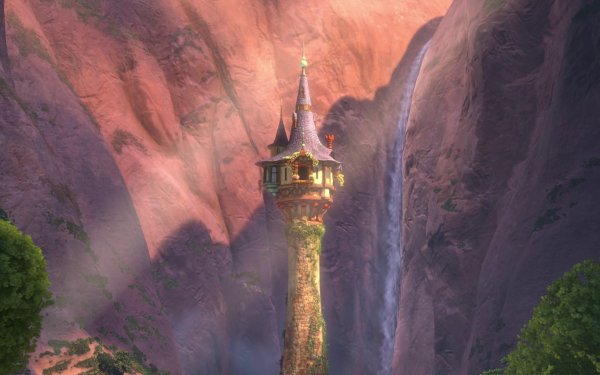
- Tangled although not hand drawn, proves how much CGI has evolved and grown since the early Pixar era. Just look◊ at◊ it◊. The character, hair and fabric animation is also quite awesome too and the lantern sequence is breathtaking.
- Frozen (2013) has a very similar art style to Tangled, but takes place in a region with a snow and ice theme, and is just as gorgeous as Tangled, if not more so.
- Frozen II is this even more-so from the teaser trailer alone. The opening shot of the ocean looks almost photorealistic. And the character models are becoming so detailed that one can actually see the peach fuzz on Elsa's cheeks◊.
- Frozen II is this even more-so from the teaser trailer alone. The opening shot of the ocean looks almost photorealistic. And the character models are becoming so detailed that one can actually see the peach fuzz on Elsa's cheeks
- DreamWorks Animation:
- The studio has some wonderful art in The Prince of Egypt, the first 2D film from the studio.
- The animation in The Road to El Dorado is absolutely stunning; from the busy Spanish ports, to the glistening golden city, which has heavy influences from Aztec and Mayan architecture, to the verdant and lush jungle of Central America.
- Also in the Shrek movies. The character design is distinctive (though some of the humans in the first two movies don't look as good as back in the day), and the environments look like a realistic fairy tale.
- As well as in How to Train Your Dragon, and its television series, Dragons: Riders of Berk. Just check the final battle with the Green Death , which seems to have received an Animation Bump from the already high quality in production of the rest of the film.
- Kung Fu Panda all but drops the mic on this. Its use of colour is particularly good — you can tell who's winning a scene just by how much of the screen is gold, blue or red.
- Spirit: Stallion of the Cimarron shows the wild west in all its beauty.
- Illumination Entertainment:
- The French feel and influence of the animation and character designs in Illumination's films (Illumination Mac Guff is in France, even though Illumination's headquarters are in Santa Monica, California) are very appealing.
- Sing: The animation in Sing is easily the best that Illumination has to offer. There are a variety of animals, from mammals, to reptiles, amphibians, fish, penguins, etc. The characters are very expressive and the backgrounds, like the Los Angeles-like city setting and the choreography in the final performances are breathtaking.
- The Thief and the Cobbler. The animation is amazing to look at - no matter if the imposed plot and voiceovers are underwhelming - showing why Richard Williams spent years working in the movie. The accurate use of 3D effects is made even more impressive by the fact that throughout the film's very long production, not a single computer was used.
- The Secret of Kells is breathtakingly beautiful. Watching this movie is like watching a living tapestry. When you finally get to see a page of the book of Kells itself, the gorgeousness will make you cry.
- Song of the Sea, from the same director as Kells, is no slouch either. If you wanted to see a moving watercolor painting looking like something out of a storybook, this movie is your closest bet.
- Mr. Bug Goes to Town. Some of the backgrounds almost look real!
- The Land Before Time features beautifully evocative background art.
- The characters and designs for The Book of Life were all clearly drawn first before being modelled on the computer, and, as a result, are absolutely gorgeous. Then again, would you expect anything less than this from the guy who did El Tigre?
- The animated films of Golden Films may have some Off-Model issues, but the backgrounds and other elements of the scenery are often well detailed, believable and vibrant.
- Patema Inverted: If you've seen the official trailer, you'll know what to expect (i.e. stunning visuals, ambient music, and an engaging narrative).
- Spider-Man: Into the Spider-Verse has its animation style as its main selling point. It features gorgeous color palettes, a distinctive cel-shading style, and stylized elements such as comic book captions and effects to make it feel like a comic book come to life.
- Tom and Jerry: The Movie: For all its problems, the fluid detailed art isn't one of them.
- The eighth Pleasant Goat and Big Big Wolf movie, Pleasant Goat and Big Big Wolf: Dunk for Future, takes on a very detailed, sporty art style to fit with the basketball theme, and looks quite distinct for it, especially compared to the previous seasons and movies. The animation during the basketball games themselves can get quite complex and beautiful, particularly when the players are pulling trick moves in order to score a goal.
- Eight Crazy Nights: The thing almost everyone seems to agree on with this movie (even people who hate Adam Sandler films, and this one in particular) is that the animation is really freaking good. It's more fluid and well-done than some Disney films, which gives an effective balance to the film's crude and vulgar tone.
- The traditional animation in The Iron Giant is some of the best to come out of a non-Disney animated film, but special mention goes to the giant, who, apart from being masterfully animated, had a special software developed for him to give him natural imperfections, helping him blend flawlessly into the 2D art.
- Many have praised the art direction of The Mitchells vs. the Machines, with the stylized designs giving it the feel of 2D animation while remaining a CGI-animated work. Having been animated using some of the same technology used for Spider-Man: Into the Spider-Verse (see above) may have helped.
- The Emoji Movie. For all of its problems, the character designs and backgrounds aren't among them (the occasional Unintentional Uncanny Valley of said designs notwithstanding). The backgrounds are thoroughly complex and colorful, giving off genuine technological vibes, while the designs have a lot of attention to detail applied to them.
- Klaus. The combination of Sergio Pablos's excellent character designs, "paperless" traditional animation (via Toon Boom) and the groundbreaking lighting effects make this one of the best-looking computer animated films ever.
- The LEGO Movie was computer-animated, but so much care is put into the character and object animation that you could swear you were watching a stop-motion film.
- While the Pokémon movies always have better animation than the TV series, there are some, such as Lucario and the Mystery of Mew and Giratina and the Sky Warrior, that really stand out.
- The King and the Mockingbird has exquisitely subtle character animation, detailed environments that look believable despite the surrealism, and a climax involving a Humongous Mecha that succeeds in looking 3D despite the movie being 2D. All this is even more impressive considering that the movie was animated in two separate chunks during the 40's and later the 70's, and despite the 70's scenes not always being as well-animated as the 40's scenes, they're generally hard to tell apart to the untrained eye.


Films — Live-Action
- Star Wars, both the distinctive original trilogy, and the prequels/sequels which used cutting-edge computer graphics to make worlds as beautiful as possible.
- Many of James Cameron's works, especially Avatar and Titanic (1997) have qualified as this.
- Just about any Terrence Malick film qualifies, particularly The New World (2005) and The Tree of Life.
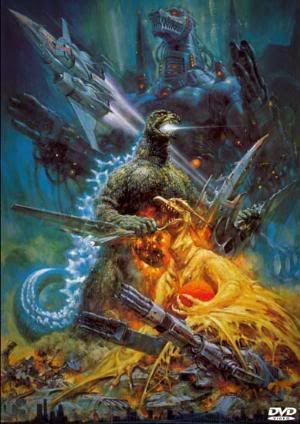
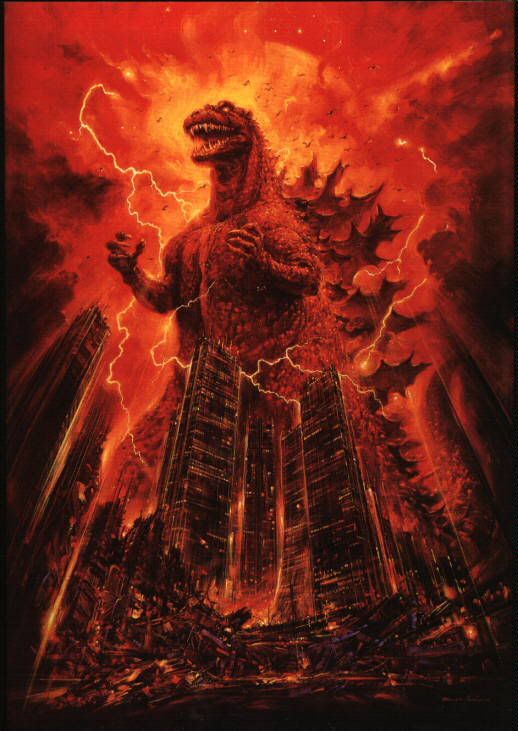
- The Godzilla films have some of the most incredible monster designs ever ranging from the beautiful Mothra to the horrifyingly evil-looking Destroyah.

Literature
- Warren the 13th: Will Staehle's lush illustrations are some of the most enjoyable parts of the book. Special mention goes to the beautiful establishing shot at the beginning of the book, as well as the surreal, sinister images in Aunt Annaconda's scenes.
- The Scary Stories to Tell in the Dark trilogy is (in)famous for its terrifyingly awesome illustrations by Stephen Gammel. They are amazingly detailed and horrifyingly surreal. The stories themselves are hit-or-miss, but every picture is guaranteed to give you nightmares.
- Similar to the above, the Goosebumps series owes a big part of it's success to the iconic cover art by Tim Jacobus. Whether it's tough-looking lizard aliens hanging out in a phone booth, or a boy with a Bee's body, each cover is beautifully unnerving and surreal, all in gorgeous, psychedelic colors. Whether the story is good or not, you'll still be tempted to open the book based on the art alone.
- John Rocco has been illustrating book covers and official art for Rick Riordan ever since the days of Percy Jackson and the Olympians. Some of his most impressive work include his illustrations for Percy Jackson's Greek Gods and The Lightning Thief: Illustrated Edition. His work is detailed, iconic, and faithful to the source material.
Magazines
- ZooBooks, a children's nature magazine, had detailed illustrations based on accurate animal anatomy. Just one example out of dozens is this two-page spread from the "Elephants" issue, depicting a stampede of ancient ancestors to today's elephants. Each one is drawn with wrinkles and fur for texture, and the dust clouds add to the implied action.
Manhwa
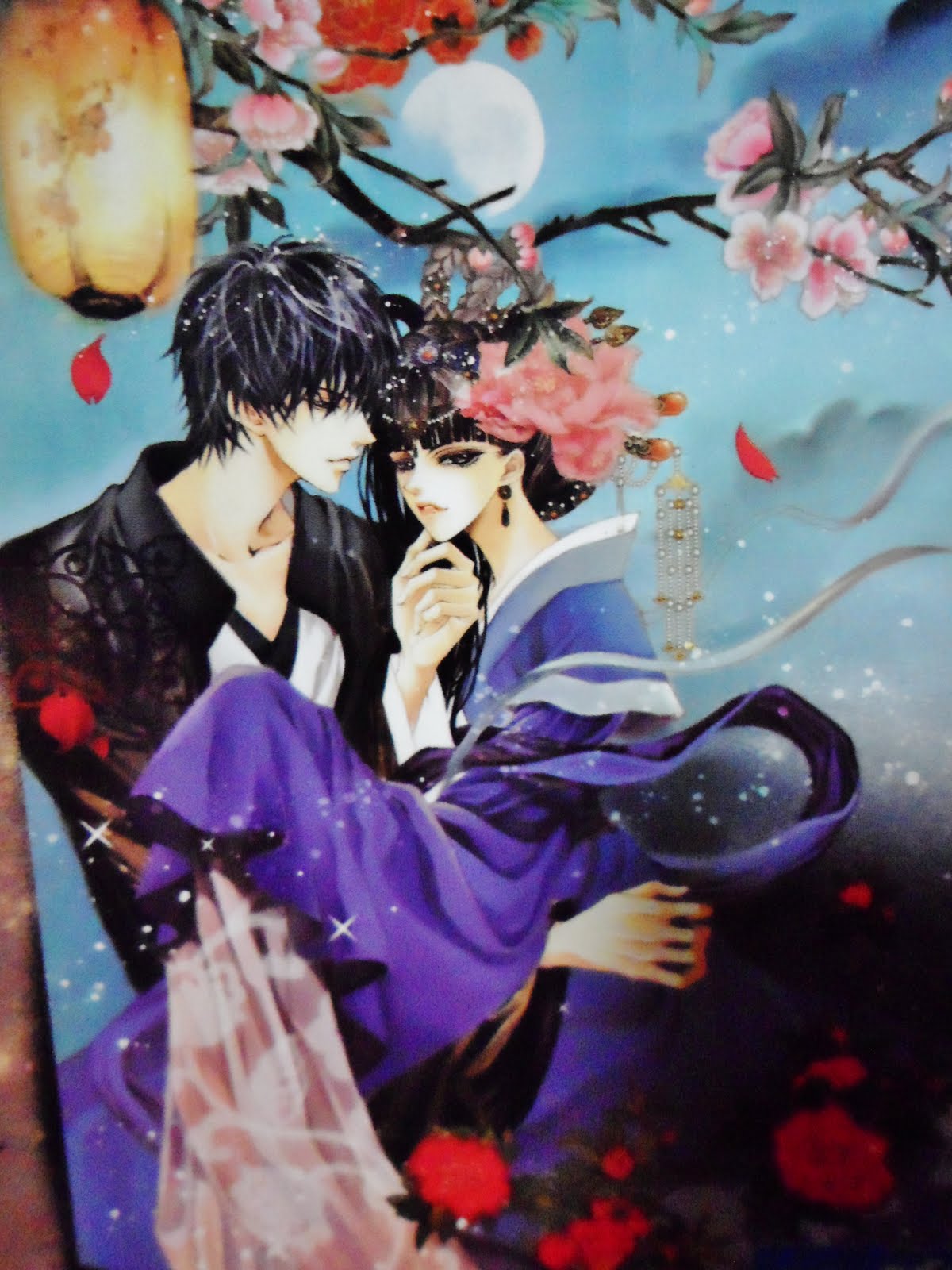
- Have to say The Bride of the Water God contains some of the most beautiful illustrations ever seen in a manhwa. Here◊ are◊ some◊ examples◊.
- Nineteen, Twenty-One is beautiful.
- Kiss Wood — A webcomic off Naver. Despite the name, it's actually about an old man who gets trapped in a lush forest dreamworld after his house is burned down. The art is, in a word, mindblowing.



Tabletop Games
- BattleTech: The artwork of the late, great Clint Langley helped define the setting's gritty, war-torn atmosphere; most notably in the card art for the CCG version of the game.
- Citadels has some truly excellent art, particularly on the various district cards.
- Dungeons & Dragons:
- The look and feel of the Dark Sun setting were defined by oil painter Gerald Brom. So much so that he basically guided the setting's developers.
- Ralph Horstley's artwork is so mind-breakingly lavish and detailed that it rivals the work of Adrian Smith (see below).
- Warhammer and Warhammer 40,000:
- By Sigmar/Terra, anything by Adrian Smith. His artwork really captures the feel of Warhammer and is honestly amazing in it's own right. You know that piece◊ of the Emperor confronting Horus? You have Adrian Smith to thanks for that.
- John Blanche's work is so unique, stunning and iconic that there's an art style named after him in the Warhammer fandom: "Blanchitsu". For a look at his work see the blog gothicpunk on Tumblr.
- By Sigmar/Terra, anything by Adrian Smith. His artwork really captures the feel of Warhammer and is honestly amazing in it's own right. You know that piece
Vanity Plate
- People may be surprised to hear that the 21 Laps Entertainment logo is actually one of the weaker ones in terms of artwork. Apparently.
- The Davis Entertainment logo. Enough to let you feel like you are far away in a beautiful place.
- DreamWorks Animation SKG has made a few logos in its lifetime that qualify.
- Their 2004 logo. One hell of a new way to get introduced to a totally new company.
- The one used for How to Train Your Dragon shows very well that they are considering to use drama in their films.
- Their 2004 logo
- Disney's post-2006 logo. It took the director of Rescuers Down Under Mike Gabriel and Weta Digital almost a year to create it and as you can see it paid off extremely well.
- The Lionsgate logo. Enough to blush hardcore fans of mecha anime.
- The 20th Century Fox logo in all of its variations. One of the logo's that gets fondly remembered for being the reason to pump themselves up for the film.
- Universal Pictures has made plenty of logos that could qualify.
- The 1990 75th Anniversary logo shows how well they developed over the years, ending with a beautiful model rendition of the Universal globe.
- Their 1997 logo is very well-made, and easy to use for qualifications.
- The variation of the 1997 logo as seen in Scott Pilgrim vs. The World will make you think that you are currently playing an NES game.
- Their 100th Anniversary logo. Making the awesome 1997 logo even more awesome.
- The 1990 75th Anniversary logo
- The logo from Pathe shows some shadowing that is so well done that it becomes its own art form.
- The 1996 Opening of VTM. Its obviously fully rendered with computer graphics, but it renders them exceptionally well.
- The 2010 ident of Studio 37 uses lighting to great effect.
Web Animation
- Dead Fantasy, Haloid and Red vs. Blue all feature the work of Monty Oum, and all happen to be paragons of Awesome Animation. Monty proceeded to surpass himself with his final series, RWBY.
- Foxy Gets Hooked: The hand-drawn animation is breathtaking. It's very lively and expressive throughout. Special mention to Freddy's animations in the climax. His exaggerated movements and expressions make him look like something straight out of The Ren & Stimpy Show, in a good way. The hard work that Harvey Rothman put into this film is evident throughout, and the results are stunning.
- RWBY has this and Awesome Animation, given this is Monty Oum. Each episode in later volumes ends with proudly shown concept artwork of the characters that were most prominent in that episode, and that's not saying anything about the superb animation quality in the fight scenes, and in general in later volumes.
- Volume 2 was for a while using Awesome Fan Art for the closing credits. This came to a close after Volume 3, what with more happening in each episode and many more artists for the crew to afford picking and choosing from.
- Rosto and his series Mind My Gap. A mixed medium "graphic novel".
- Nazo Unleashed, which takes advantage of awesome animation to deliver a high "Holy Shit!" Quotient.
- Daria Cohens The Vampair Series has beautifully illustrated, fluid animation that syncs up with the music perfectly. Even more amazing when you know it was all made by the one animator.
- Super Mario Bros. Z has ridiculously impressive battle scenes.
- Not enough good things can be said about the TIE Fighter Fanime, a passion project done at home by a professional animator. Every frame is done by hand, the vision and sense of direction is excellent, and a clear love of both the art and the subject comes through at all times. See it for yourself.
- Medium Awareness takes all new form in Animator vs. Animation. The concept of stick figures throwing down on a computer desktop has never seen such creativity and fluidity.
- Dear Rabbit: The artist is good at drawing wolves and rabbits. They're realistic enough yet still have an anthropomorphic, slightly cartoony look to them.
- Babushka: the Movie features over 650 individual frames of fairly detailed art, complete with characters having split second micro expressions, blink and you'll miss it bonuses, and the one or two cases of Art Shift to a highly detailed and realistic style, as with this frame◊ of Corpse Husband. Pretty impressive for a solo fan project on YouTube.
- "Steamed Hams But Every Scene is a Different Animation Style", like its title implies, is a recreation of the Steamed Hams skit from The Simpsons episode "22 Short Films About Springfield", with each shot using the artstyle of a different prominent animator/cartoon. Despite being a one-man project, it absolutely nails each and every style, mimicking their quirks expertly. It even manages to pick out the individual styles of four animators at Hanna-Barbera (Ken Muse, George Nicholas, Don Patterson, and Carlo Vinci).
- The Animated Adaptation of Rain looks amazing. Tresenella takes the comic’s minimalist yet expressive art style and refines to perfection with improved lighting and smooth animation.

Webcomics
- Ava's Demon: Every single page is colored beautifully, with a sort of serene atmosphere that contrasts the tumultuous events.
- Charby the Vampirate may not have stared out with the best art but these days the comic is gorgeous, with well rendered backgrounds and expressive characters.
- Cucumber Quest is beautiful, especially considering what we usually see from the artist.
- Daddy-Long-Legs, which is fascinating because it's done entirely in MS Paint and with a limited palette.
- Dragon Ball Multiverse: Chapter 29 Special has been praised for having a better art than the rest of the special chapters. It was drawn by a new artist on the team, and has made this special probably the best received so far. Here it is
- Dreamkeepers has this in spades along with a nice amount of Scenery Porn.
- The Dreamwalker Chronicles has wonderfully atmospheric color choices for each "book" that quickly pull the reader in and help set the scene and the urgency or lack thereof of the current situation.
- Dresden Codak has some reallygreat art.
- Drowtales
- Erma: The comics are very well-drawn and have some really cute designs.
- False Positive has top-notch artwork from the get-go.
- ''The Flower And The Nose
- Gone with the Blastwave
- While Gunnerkrigg Court started off as rather simplistic, it has gotten quite good over time.
- Hanna Is Not a Boy's Name
- Homestuck's guest art can be gorgeous.
- Homestuck's predecessor Problem Sleuth is just as gorgeous, especially the Playable Epilogue.
- In general, MS Paint Adventures uses a simplistic, unrefined art style in order to get as many updates as possible and get on with the story. But when the art it taken just as seriously as the story, it can be downright beautiful. Of note are the [S] pages.
- It's (Not) Your Fault's art is incredibly accurate to the source material, to the point where you might be able to convince someone that it is a genuine canon comic, and it is incredibly well done and detailed in general.
- Knite by deviantArt member Yuumei is an example of this.
- Lackadaisy: Considering that the artwork is beyond professional, and the countless hours spent on penciling, toning and rendering each page, this is expected.
- Especially when in color.
- Especially when in color.
- Las Lindas
- MegaTokyo's art is no great shakes to start off with, but it gets better and better with every chapter.
- Megan Kearney's Beauty and the Beast: The black and white art may look simple at the first look, but the pannels have a cynematographic dynamics. And the scenes in the castle are very detailed.
- Monsieur Charlatan: The entire webcomic is digitally painted, evocating the artistic style and the atmosphere of the 30s. The sceneries, particularly the night club, are breath taking.
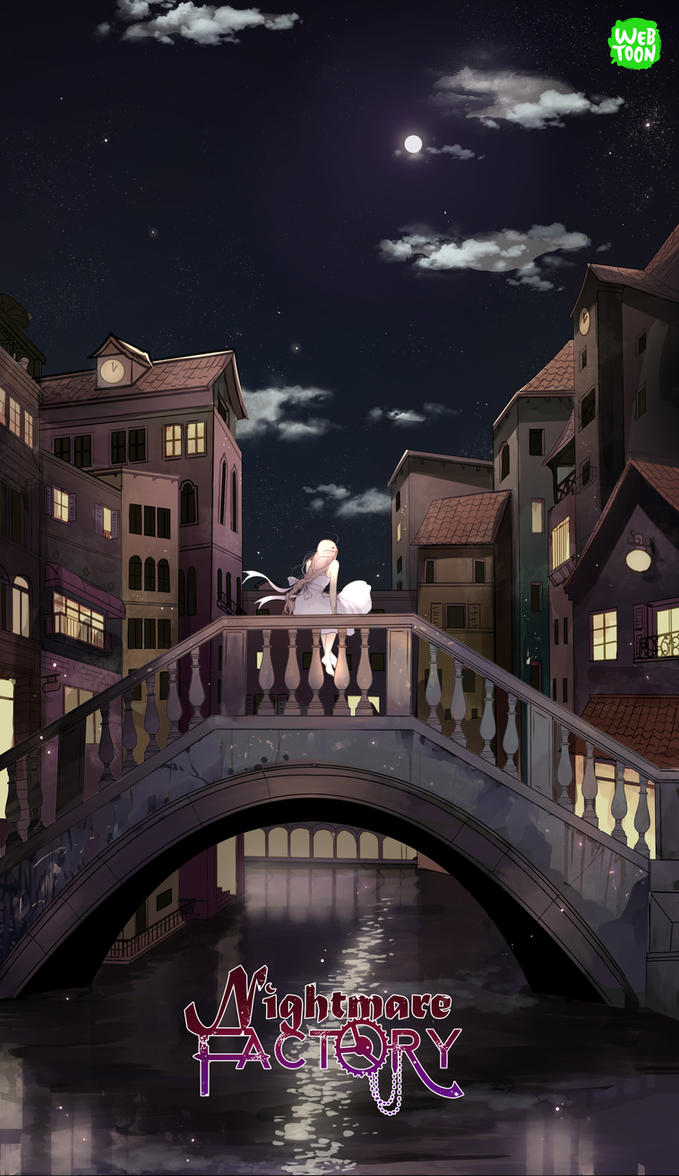
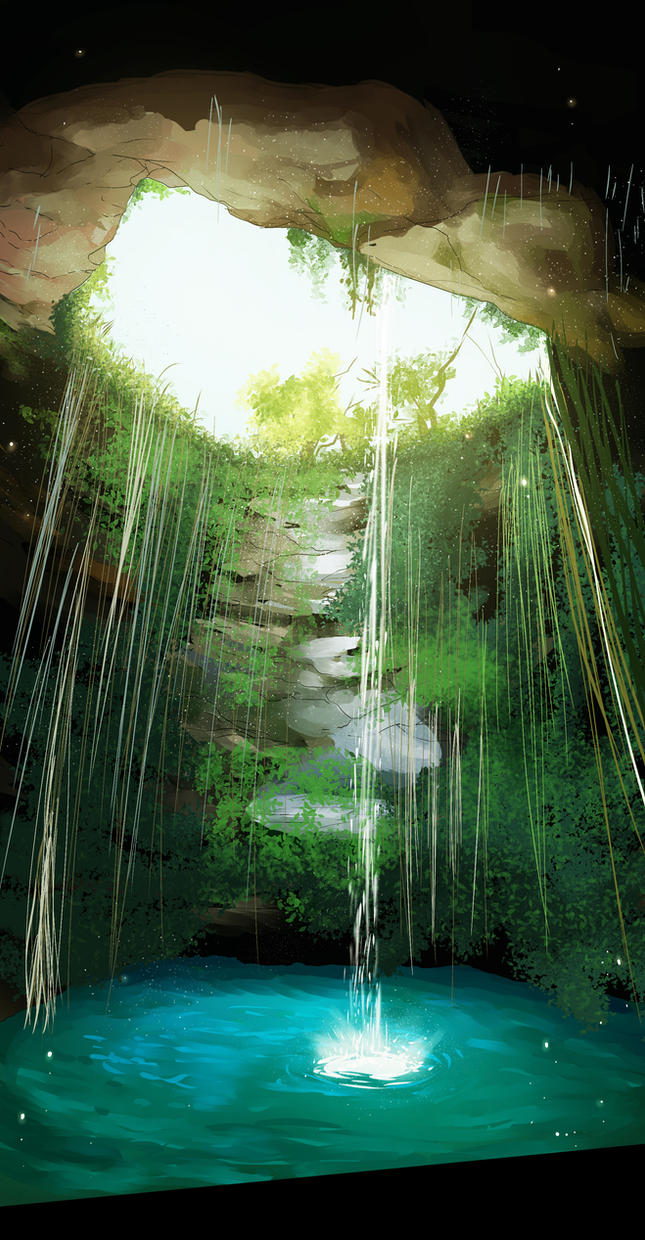
- Nightmare Factory has creative, beautiful character designs, with absolutely◊ stunning, detailed,◊ backgrounds.◊
- Off-White, once Art Evolution started to take effect. Just look at these pages.
- Paranatural: The art is so full of movement and energy, you swear you're watching a show instead of reading a comic.
- PepperAndCarrot: Take a concept artist into classic anime and video game design and get a colourful world that's cartoony yet intensely detailed.
- Power Nap. The lineart versions are added first, before updating to colour, and the strokes are confident.
- Romantically Apocalyptic: Awesome, even though it's photomanipulation (of which it is top-notch).
- Star Power: Say what you want about Mookie's writing, Garth's artwook could easily be mistaken for something found at DC or Marvel.
- Sleepless Domain: The first two chapters drawn by Oscar Vega, while a bit rough around the edges at times, are definitely by no means bad. However, after Mary Cagle takes over as lead artist starting with Chapter 3, the art rapidly goes from good to phenomenal — the vibrant colors set every scene perfectly, and Mary's expressive characters and signature rounded, almost chibi-esque art style are nothing short of adorable. And that's without even mentioning the chapter title pages, gorgeous full-page Splash Panels that could easily be works of art in their own right. See for yourself!
- Massive props should also be given to assistant artists Cheryl Young and Connie Daidone, both of whom provided Mary with the pencils for certain backgrounds and made quite a fair amount of Scenery Porn possible.
- Springtrap and Deliah: The art is incredibly expressive and vibrant.
- Starpunch Girl. The promotional art, doubly so.
- Sunstone. This comic looks amazing and vibrant, with beautiful character designs.
- The Abominable Charles Christopher
- The Meek
- The Wormworld Saga
- Unsounded: Made even more awesome when you know it's updated about three times a week.
- Zoophobia: The fluidity and vibrant colours are to die for.
- Hero Oh Hero's made completely of pixel art which was drawn from scratch in MS paint (aside from a few photoshop effects).
- Renova Caeli. Aside from the quite mastered manga-esque style, it has absolutely stunning colors. Just look at some pages. And the comic is still only beginning.
- The manhua Their Story is drawn with a stunning balance of detail and simplicity. The colors in particular are very gentle and pleasing to look at, and the character expressions convey emotion with startling effectiveness. The official side art brings it to a whole other level.
- White Noise
- Scurry is absolutely beautifully rendered, almost every page can be wallpaper-worthy.


Western Animation
- Many cartoons of the 1930s, especially the cartoons made by Walt Disney and their competitors such as Fleischer Studios and Harman and Ising, produced some of the most ambitious short cartoon films ever made, and set a technical standard seldom surpassed since. The characters move fluidly and gracefully, with their designs often featuring illustration level details (especially in the Happy Harmonies and MGM Oneshot Cartoons) there are countless crowd shots and impressive effects animation work, and the background art and colors have masterful craftsmanship and composition theory. Meanwhile, Fleischer Studios, prompted to emulate Disney, still held their own by incorporating brilliant color theory with their own stylized character designs and animation in shorts like the Color Classics and the three Popeye color specials, and they even used three-dimensional tabletop sets that they optically combined the animation with—and this predated Disney's own use of the multiplane camera in The Old Mill! Their short "Play Safe" even combines their tabletop sets with a stop motion train!
- Cartoons made during the 1940s weren't far behind. They used the same lush, beautifully-painted backgrounds as the 1930s, coupled with some of the most expressive character animation in history. In particular, Tex Avery's work at MGM was extremely wild and zany with hilarious and highly creative visual gags, which was definitely helped by MGM's relatively generous budgets. Much of Bob Clampett's later Looney Tunes cartoons from around the same time followed suit with extremely rubbery animation and highly exaggerated, fast-paced action, establishing the use of Off-Model from a stylistic standpoint.
- The work Chuck Jones is nothing to sneeze at either. He and his lifelong collaborator Maurice Noble set a new standard for highly stylized animation that took the Limited Animation techniques pioneered by UPA and pushed them to new artistic heights.
- The films of the National Film Board of Canada excel at this, but especially in regards to the work of Norman Mclaren, who may be one of the most innovative animators who ever lived.
- Animator Mark Kausler's independent short films "It's the Cat" and "There Must Be Some Other Cat". Besides being amazing one-man animation shows with hilarious 30s style cartoon animation, "Other Cat", along with the short films "The Last Belle" and "Imitation of Life", shares the distinction of being one of the last animated films ever made to use the menial, painstaking craft of traditonal hand-inked and hand painted cels and 35mm physical film—a true rarity in contemporary animation.
- The George Pal Puppetoons are some of the most ambitious, skillfully crafted stop motion cartoons ever made, much less for their time, and they can easily hold their own against more famous stop mo efforts like The Nightmare Before Christmas. The series used thousands of painstakingly crafted, custom made wood carved puppets (mixed with articulated rubber limbs) all to apply exaggerated animation principles to very stylized designs. Making even one of them was a Herculean effort; planning them required the patience and precision of an engineer combined with the mind of an artist, as each individual movement or expression of a puppet, be it a walk, pose or expression change, required either a new part or an entirely new puppet to be made altogether for the film. Each cartoon varies from 5 minutes and up in length, there are often numerous crowd scenes and customized character actions, and everything is animated on ones, it takes quite a bit of time to set up everything before even shooting one frame out of thousands, at a grueling, slow work pace. Oh, and the puppets were animated straight ahead, so if the artists goofed up a scene, it would risk having to reshoot an entire scene from scratch! And with all this, the films also pulled off extremely difficult camera moves (watch "Philips Cavalcade" and the jaw dropping, seamless pan shots of the restaurant and dancers), careful lighting, and tricky effects work (i.e. the water ripple effects and the girl jumping in mid-air in "Hoola Boola", the Witch flying through the castle in "Sleeping Beauty", Jasper doing stop-mo motion blurs, occasionally inserting hand-drawn animation with the puppets, such as Bugs Bunny's cameo in "Jasper Goes Hunting"). And not to mention the set pieces were exquisitely crafted (the eponymous rickety shack in "Jasper and the Haunted House" and the forest in "Mr. Strauss Takes A Walk" really show this off). This level of work forced the cartoons to be made on a very protracted production schedule and keep their releases sporadic, but as a benefit to this expensive, time consuming process, the Puppetoons achieved a cartoon like motion that allowed the characters to move very expressively and with vigor and vitality, and in very creative, funny ways, with the puppets constantly "breaking model" for humors sake.
- Hanna-Barbera. Despite their Limited Animation, it's amazing how the studio can have beautiful character designs (thanks to Ed Benedict) and colorful backgrounds despite having a very low budget. Ask John K. for more.
- Wakfu is animated in Adobe Flash and boasts some absolutely breathtaking scenes. Just take a look at the scene from the First episode.
- Most western cartoon series whose animation was done by Tokyo Movie Shinsha (now know as TMS Entertainment)/Telecom Animation Film (just brush most of the animation of Spider-Man: The Animated Series under the rug). Bonus points if it's from their A unit (being led by Toshihiko Masuda, Nobuo Tomizawa, Kenji Hachizaki, Kazuhide Tomonaga and Hiroyuki Toyama).
- Star Wars: The Clone Wars has an art style (along with brilliant character designs and high quality CGI animation) that looks very visually appealing in addition to being realistic, beautifully detailed yet stylized, and animesque.
- The whole DC Animated Universe, fondly remembered for bringing many young viewers into DC Comics, is also fondly remembered for its awesome art and animation. In particular, Batman: The Animated Series had a revolutionary background art style produced by drawing light colors on black paper, making the backgrounds as dark as possible. Justice League (Unlimited) also had beautifully detailed backgrounds, in particular the cityscapes.
- Spectrum Animation's work is so awesome that the creators of Batman: The Animated Series gave them a round of applause on the "Heart of Ice" commentary, and how the studio nearly went bankrupt just for that episode. Bruce Timm mentioned that Spectrum's staff in particular, who took it upon themselves to personally airbrush the slight "frosting" inside Mr. Freeze's helmet, and make sure it was consistent throughout.
- John Kricfalusi's The Ren & Stimpy Show. Finally after a long mainstream absence since the 1950s (besides the stuff TMS was animating) does a piece of animation made for TV reclaim the same artistic wild Bob Clampett-style or Tex Avery-inspired flair grace the screen, not to mention the return of storyboard-driven art, and subtle-yet-exaggerated acting and John K's strict policy of hyphenated, complex character expressions, color theory and general rule of never drawing the same expression twice. Or at least in the better produced episodes like "Big House Blues", "Stimpy's Invention", "Space Madness and "Sven Hoek". Ren & Stimpy "Adult Party Cartoon" raised the bar even higher by having some of the most ambitious, slick made-for-tv cartoon animation ever (episodes like "Ren Seeks Help" and "Fire Dogs II" not only have amazing hand-painted backgrounds, fluid walk cycles and amazing character acting, but even fully animated, three-dimensional backgrounds in some scenes) At times hit-and-miss, but especially in that highly valued second season. Never anything quite like it since the old Warner shorts (and the stuff TMS animated), and certainly nothing quite like it ever again (unless TMS starts opening up animation services for more Western Animated productions besides Green Lantern: First Flight).
- ReBoot, considering that it was one of the first (and arguably the best) shows completely rendered in 3D. The amazing thing about this show is while it may look pretty tame by today's standards, it was created in the early 90s when they only had Windows 3.1, the first version of Windows to work with, and still maintained a high level of quality which increased substantially in later seasons.
- And then we have arguably the most popular work Mainframe ever made, Beast Wars. It was made with the same tech, and actually won an Emmy and revived Transformers.
- Avatar: The Last Airbender:
- Avatar: The Last Airbender which starts out strong enough already, increases in both art quality and animation quality every season, which hits unbelievable levels in season three, especially during Aang and Ozai's final battle.
- Its spinoff, The Legend of Korra, increases the quality even further, partly due to a switch to HD. Along with much more realistic anatomy, and a different studio.
- The Boondocks. Taken up to obscene levels in season three, where its production crew hired an actual Japanese studio to animate it. There was a reason why it was nominated as the one of the best American cartoons after one season.
- Both the strip and the cartoon, the cartoon of which is based on Samurai Champloo
- Black Dynamite .has some of the absolute best animation to every grace [adult swim]. The character designs are very stylized and detailed and the fights scenes are something to behold. Special mention goes to both the intros, the second of which is animation by Studio TRIGGER.
- Samurai Jack which has incredibly fluid animation, and a cinematic style meant to evoke anime and Akira Kurosawa films, with geometric character designs and impressionistic/abstract backgrounds which really push the artists to use colour. Here's an example.
- Sym-Bionic Titan which managed to combine the flat, hand-drawn animation style of Dexter's Laboratory with 3D elements and make it look absolutely beautiful.
- Genndy Tartakovsky's latest animated series, Primal (2019), has absolutely stunning backgrounds and incredibly fluid animation where everyone have an actual sense of weight. This makes all the Gorn and fight scenes all the more intense and impactful.
- My Little Pony: Friendship Is Magic uses an older version of Flash animation to create a wonderful and detailed world with great backgrounds and colorful character designs in what can only be described as a massive Sugar Bowl of awesomeness.
- This is only further improved in Season 2, along with a boost in the quality of animation.
- The backgrounds◊ are gorgeous◊.
- The backgrounds
- And it looks like they're improving even more for season 3. Feast your eyes here and here.
- This is only further improved in Season 2, along with a boost in the quality of animation.
- The Adventure Time title cards look like high-price paintings.
- The Ruby-Spears cartoon of Mega Man was... rather lackluster, visually speaking. The pilot trailer, on the other hand, features incredibly slick animation the likes of which was usually reserved for high-end Japanese OVAs.
- Motorcity combines intricate urban background art with amazingly unique character designs and breathtakingly fluid animationnote . And whenever Mike takes out his dual-sided zippo lighter chainsaw staff, you can be sure that you're about to watch an incredibly animated fight scene.
- The Fleischer Superman Theatrical Cartoons (which had an influence on the aforementioned DC Animated Universe) had lavishly painted backgrounds as well as amazing use of Rotoscoping that didn't look creepy. It holds up well even with Disney's creations.
- While Sonic the Hedgehog (SatAM) and Sonic Underground had Off-Model animation and were very much In Name Only adaptations of Sonic, they had some lush and detailed backgrounds.
- While Beast Wars (mentioned above) revived the franchise and gave it their first Emmy, Transformers: Prime, released almost 20 years later, looks stunning for televised CG. While it's telling when the quality just keeps improving in every season (let alone every episode), the fact that it won four Emmys (all of them around the animation) should also say something. And before Prime, there was Beast Machines. Now say what you will about most of the other aspects, but there is no denying the animation looks just as good (if not better) as season three of its predecessor.
- The rejected Nicktoons pilot, The Modifyers, has great design for both background characters and the scenery that just screams British mod fashion. Not too surprising, considering it was made by the late Chris Reccardi and Lynne Naylor, who used to work on Ren and Stimpy.
- Gravity Falls:
- The animation on Rumble McSkirmish. Not only is the sprite art amazing, his attack animations are both fluid and detailed, not to mention looking like a legitimate video game character.
- The backgrounds in this show are stunningly beautiful.
- The animation in the intro is noticeably smoother than the animation in the show itself, and it's very expressive, too. Some scenes were even animated by Disney veteran James Baxter.
- The Mysterious Cities of Gold may not really be all that notorious for its art, but the 2012 remake which was a Franco-Belgian collaboration is, while static not really appealing, almost photorealistic when the whole thing starts moving.
- My Life as a Teenage Robot: Not only does the show's character designs are a unique blend of Rubber hose animation of the 1930s and UPA, but both the title cards and the stylized, minimalist backgrounds are lovingly done in Art Deco. Plus, the show's constant color shifts in certain lighting conditions is nothing sort of splendid.
- Over the Garden Wall has pretty slick animation and great art all around, but some moments deserve special mention, such as the animation for the Highwayman's song.
- Steven Universe: An early indicator of the series' general animation quality is the beach scene in "Laser Light Cannon," which features a gorgeous Color Wash of peach and orange across the entire screen as the sun sets. This was in the series' second episode. The colorful, expressive character designs and hand-painted backgrounds at times look absolutely stunning.
- Wander over Yonder: By just looking at the intro itself, you can notice that a lot of effort was put on backgrounds and character design, although the show itself doesn't disappoint because of the concept of the show; there are many different and unique backgrounds as well as wacky character design everywhere, each of them in different form in literally every episode, one scene alone can show a lot of different and creative background characters, each with their own unique touch that makes them harder than usual to get out of your mind and backgrounds that fit perfectly with the environment.
- The Loud House: The backgrounds look just like they came right out of a comic strip.
- The Simpsons: While some of the first- and second-season episodes suffer from some noticeably limited animation, and even the newer episodes seem a bit stiff, seasons 2 to 13 boast some of the best hand-drawn animation in a half-hour animated sitcom format. Highlights include Lisa's disillusionment fantasy in Season 3's "Mr. Lisa Goes To Washington" that looks like a political cartoon come to life, and any episode with Sideshow Bob, which sport some of the heaviest use of color contrasts and shadows this side of Batman: The Animated Series.
- Anything produced by (W)Holesome Products, Inc., most notably Life With Loopy and Phantom Investigators. The studio's main forte is blending stop-motion animation, live-action, and puppetry together, giving their shows and shorts a very artistic and unique look that set themselves apart from many other cartoons. Life With Loopy had some wonderful, imaginative character designs for the stop-motion characters and hand puppets, as well as having great stop-motion animation. Phantom Investigators managed to set the bar even higher, with more detailed designs to the sets and puppets, and even better animation as it didn't have the same budgetary and technical limitations as Loopy.
- The Amazing World of Gumball has to be one of most imaginative series in Cartoon Network's lineup. Courtesy of the network's European studio, the show is a potpourri of various individual art styles, from hand drawn to Claymation to hand-puppets to 8-bit to CGI to even live-action, and they mesh together beautifully, even in moments where one would be led to believe otherwise, even complimenting each other most of the time. Here's the show's full intro just to give you a flavor of what to expect from the series. Oh, and it only gets better with each passing season.
- One of the more widely-praised aspects of Spider-Man Unlimited is its comic-inspired visual style.
- Kipo and the Age of Wonderbeasts: While the original webcomic was already beautifully drawn in its own right, the art and animation teams behind the series takes Sechrist's artstyle even further to make the environments even more stunning.
- Glitch Techs: The show is beautifully colorful and vibrant, the animation is very smooth and fluid, and the geometric art style sports some highly appealing designs.
- The Dragon Prince: Jittery frame rate in season 1 aside, the backgrounds, lighting, and landscape shots look absolutely spectacular.
- Olan Rogers' Final Space:
- The series is very fluid in its style and the design of the background and the characters itself.
- The space backgrounds are all photographs taken by the Hubble Space Telescope.
- Ready Jet Go!: Although it had clunky animation in the earliest episodes, over time the lighting and shading became much better. There is also a lot of detail put into the character renders. For example, astute viewers will notice the stitching pattern on Mindy's bear hat, and her pigtails move and bounce with the slightest adjustment of her head. Standouts include the Milky Way song in "A Visit to the Planetarium", which has gorgeous colors and bouncy, expressive character animation that would make Tex Avery proud, and There's No Planet Like My Planet from "Back to Bortron 7", which makes great use of Queer Colors.note
- Looney Tunes Cartoons. After its predecessor caught flack for its flatter art-style, this series returned to the roots of the original shorts with fluid, zany animation and gorgeous backgrounds. The character designs also look just like the shorts from the early-to-mid-1940s (particularly, those of Bob Clampett's shorts).
- Rocko's Modern Life boasts brilliant character designs, delightfully wacky and rubbery backgrounds (which ignores parallel lines to attain great stylistic effect), and highly expressive animation.
- SpongeBob SquarePants (it's a given, being animated by Rough Draft Studios and having taken a few stylistic pages from The Ren & Stimpy Show, mentioned above). The backgrounds are all hand-painted and detailed, to gorgeous effect. The characters also have highly appealing designs and fluid movement, also lending themselves well to going intentionally Off-Model. This is especially noticable in Seasons 9B onwards, where the animation, while always fluid, is moreso than ever before. The close-up shots also have brilliant hand-painting similar to the backgrounds.
- Arcane: An absurd amount of money, time and effort went into Arcane and it shows in Every. Single. Frame. But not only can you randomly pause and get a wallpaper, the animation adds small touches to body language that helps add even more depth to characterization. Even small things like running up or down a staircase is used to showoff different personalities.
- Xavier Riddle and the Secret Museum is without a doubt one of the artsiest kids' shows. The character designs are a loving homage to Calvin and Hobbes and Peanuts, and they each have a distinct silhouette. The animation incorporates subtle Line Boil and can be rather fluid at times. The backgrounds are gorgeous with their colors, almost as if they were hand-painted. Standouts include "I Am Cleopatra", "I Am Harriet Tubman", "I Am Harry Houdini", "I Am Sacagawea", and "I Am Maya Angelou". All of this is made even more impressive knowing that the show is made on a budget of $3,000 per episode.
- The art of Let's Go Luna! is inspired by UPA cartoons, vintage travel posters, and Joe Murray's own style (he was also responsible for Rocko's Modern Life, mentioned above). Being that this is a comedy show highly driven by characterization, the animation is bouncy and expressive to convey the characters' quirks. The colorful backgrounds are hand-painted and accurately reflect real-life places. An example.
- While the art style for Smiling Friends is purposefully crude, it does a strangely good job at pulling that off. Plus, the show as a whole has a wonderfully surreal melting pot of different animation styles a la Gumball, including CGI and stop-motion. For instance, Mip's animation in Episode 6 manages to perfectly emulate the style of Rankin/Bass Productions' fantasy films such as The Hobbit and The Last Unicorn.
- The Big Nate cartoon is CGI-animated, but it very convincingly mimics stop-motion with textured models and realistic lighting. The style also complements the character designs very well.
- Cat Burglar: The animators obviously made sure that it looked as much like a Tex Avery cartoon as possible, with wild animation, character designs that accurately mimic Avery's Signature Style, and even digitally-added grain and cel scratches.
- The Cuphead Show!. Just like the game (though not quite to the same extent), the cartoon goes out of its way to faithfully recreate the style of late 20s to early 40s animation, nailing the look and feel of those cartoons very well (complete with digitally-added film grain!). Given that the show is co-produced by the creators of the game, this isn't surprising.
- Green Eggs and Ham (2019) boasts some incredibly fluid (paperless) traditional animation (around the level of some Disney films!) and a visual aesthetic which brings Seuss's one-dimensional style to 2D, especially the characters, who are not only shaded but have textured outlines. Combine this with the backgrounds full of bright Seussian colors and whimsical technology and you've got one of the best looking Seuss adaptations ever.
- The French studio Marlou Films largely specializes in producing stop-motion animated shorts. While the animation is impressive on its own, what makes them really notable is that several of their productions — like Soupe Opéra, their most well-known series — are animated using fruits, vegetables, and various other foods, giving them a unique look.
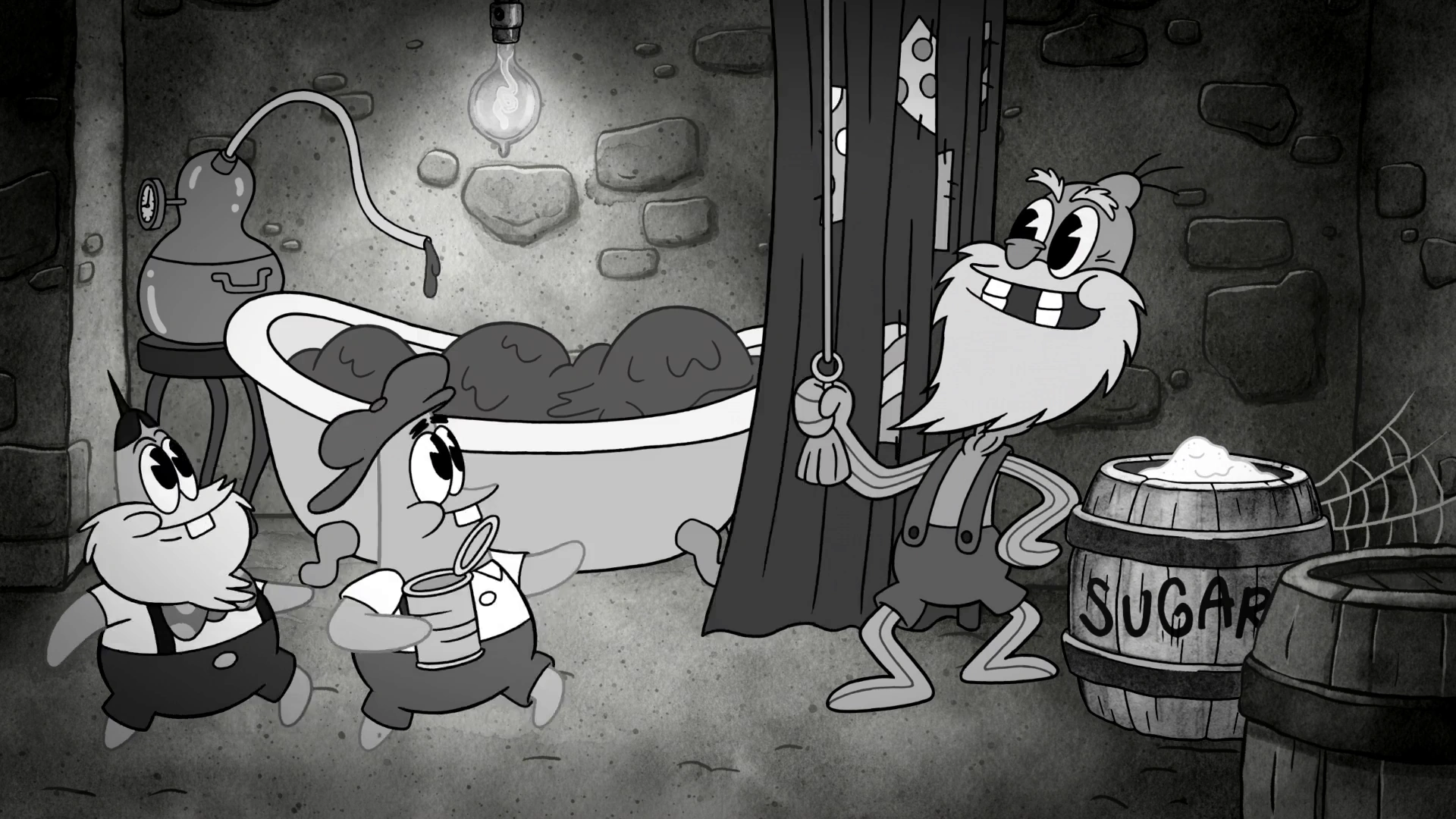
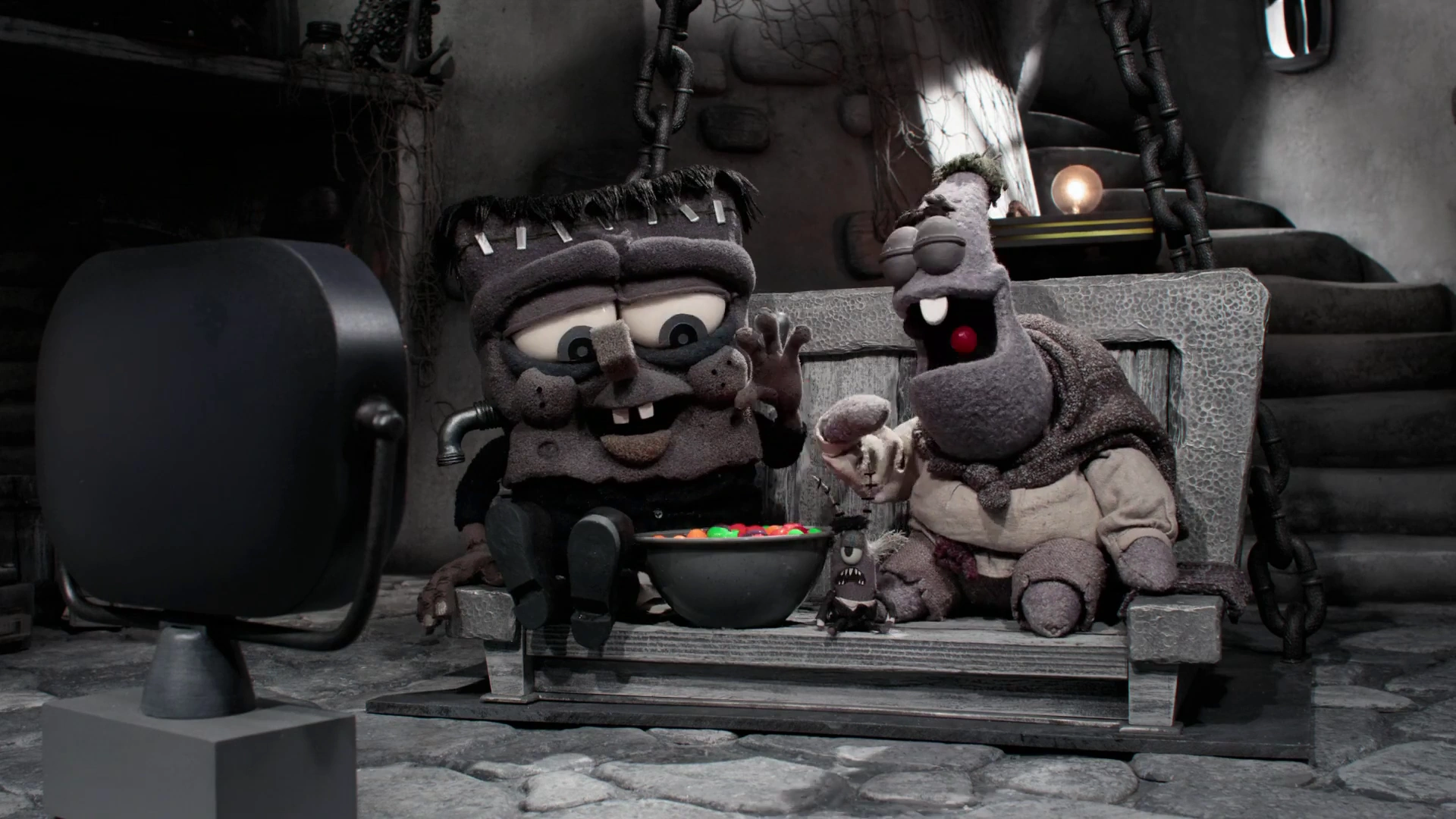
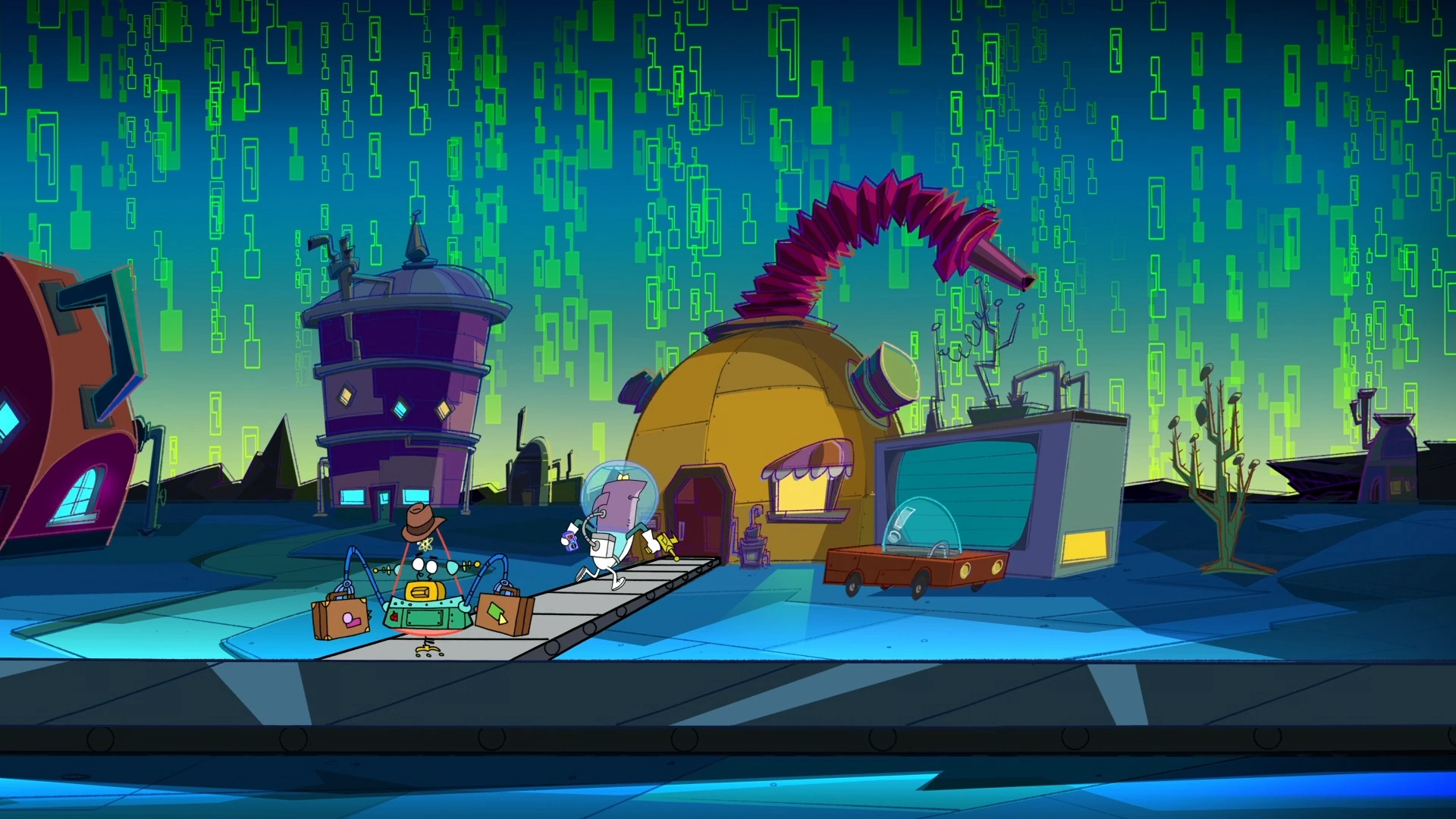
- The Patrick Star Show: Especially following the show's Growing the Beard, the Patrick Show has a beautiful, colorful, and engaging art style. Character motions are fluid and the designs are appealing. There's strong visual direction throughout the episodes, too. The backgrounds have a watercolor style that looks amazing, with each being painted in-person. The show also has a tendency for Art Shifts, that keep it visually interesting: take a look at the rubberhose style of "The Lil' Patscals", the stop-motion puppetry of Dr. Plankenstein's castle, or the geometric, sci-fi designs of Captain Quasar's segments.
- The backgrounds in Molly of Denali are beautifully colored and almost look like paintings. The aurora borealis in "Turn On The Northern Lights" was especially gorgeous.
- Family Guy episode "Road to the Multiverse" has Stewie and Brian briefly make an incursion into a Disney-inspired universe, complete with an Art Shift into a pitch-perfect recreation of Disney's classic animated style. The redesigns of the cast are spot-on and the animation is incredibly fluid, easily being one of the biggest flexes of the show's animation team ever.
- The animation in Tiny Toons Looniversity is very detailed and fluid (looking like a mix between the TMS Entertainment-animated episodes of the original Tiny Toon Adventures and Looney Tunes Cartoons), and the characters are very expressive, especially for a series animated in Adobe Flash. While there are some moments of tweening like in the latter series, the animation quality otherwise more than makes up for it.
- Infinity Train boasts some absolutely stunning backgrounds.
- You could put literally the entirety of Hilda on here. Every episode is stunning to look at, with virtually flawless animation and incredible backgrounds, often combined with extremely memorable soundtracks that give every scene they're in the perfect atmosphere. Of course, anybody familiar with the name Mercury Filmworks will have a complete understanding as to why that is.
- Animaniacs:
- As far as the original series goes, TMS Entertainment is widely agreed to be the best animation studio for the show for their episodes containing fluid and dynamic animation along with the characters' movements and expressions feeling lively. StarToons and Wang Film Productions are also up there with making the best-animated episodes.
- The reboot is no slouch either. Even detractors of the reboot agree that the animation is very nice and fluid, and is about on par with TMS's and StarToons' episodes of the original. The fact that some episodes were animated by Titmouse, a studio well-known for its excellent use of Adobe Flash, helps.