
A pair of characters (either rivals, best friends, siblings, lovers, or an otherwise closely-related duo) are given contrasting hair colors to signify their opposing world-views. The hair colors are usually blond and black or dark brown, but it can just as well be red and black, or blond and blue — the important bit is the contrast. Their respective personalities are then typically defined as follows:
- The fair-haired partner is the "good" one: younger, bright, hopeful, enthusiastic, naïve, helpful, innocent, tends to follow the rules.
- The dark-haired partner is the "bad" one: older, moody, testy, serious, cynical, often relishes in Angst and their Dark and Troubled Past, tends to break the rules and snap.
Of course, this isn't the only way the duo's contrasting personalities can be expressed. In Japanese Media, it is not uncommon to portray the blonde as a Western (especially American) Phenotype Stereotype or a delinquent with a wild streak — possessing frankness, openness, inventiveness, and ignorance of proper etiquette; while the brunette is a Proper Lady or gentleman, and is the more reserved, well-mannered, and manipulative of the two. It is also possible to invert the stereotype and have the fair-haired partner as the cool-headed and cynical one, and the dark-haired partner as the idealistic and cheerful one.
Due to their great difference in temperament and worldview, the duo might have a shaky and volatile relationship. The dark-haired partner may have an I Work Alone attitude and gets frustrated by the fair-haired partner's idealism and finds their hyperactive antics annoying, while the fair-haired partner may object to the dark-haired partner's lack of scruples, while grudgingly respecting the latter's competence. Ultimately, however, their differences would balance out each other's weaknesses, resulting in an Odd Couple.
Compare Light Feminine and Dark Feminine and Noble Male, Roguish Male, which frequently employ this trope to distinguish the partners (the Light Feminine and Noble Male usually have fair hair, while the Dark Feminine and Roguish Male tend to have dark hair). Evil Brunette Twin also employs this trope to contrast the twins' morality by their hair colours. Also compare Red Oni, Blue Oni and Cynic–Idealist Duo, which is how the pair's opposing personalities and philosophy may be manifested.
Contrast Betty and Veronica, which is about romantic rivals with opposite personalities and physical traits.
Examples:
- Berserk: Gut is an uncivilized Byronic Hero with short, spiky black hair. In contrast, Griffith is a genteel Bishōnen with long, wavy white hair.
- In Black Clover, the loud, excitable Asta has spiky ash blond hair while the quiet, composed Yuno, his best friend and rival, has messy black hair.
- Bungou Stray Dogs has a few examples:
- Brunette, manipulative, and suicidal Dazai and his ADA partner, blond, idealistic, rule-abiding Kunikida.
- Silver-haired optimist Atsushi and his Mafia counterpart, black-haired pessimist Akutagawa.
- Atsushi could also be paired with Dazai here, as well as with the quiet and stoic Kyouka.
- Dazai and his former partner, Chuya, a Fiery Redhead who wears his heart on his sleeve and cares too much about his subordinates, as opposed to Dazai's more closely-guarded emotions and detached nature.
- The leaders of the Armed Detective Agency and the Port Mafia, kind-hearted silver-haired Fukuzawa and Chessmaster black-haired Mori.
- The duo of mysterious and quiet Lovecraft (deep blue hair) and apparently cheerful Steinbeck.
- A Cruel God Reigns has Jeremy and Ian, the two protagonists who eventually end up in a relationship. Jeremy has very curly, shorter, black hair while Ian has blonde, stick-straight, long hair. Jeremy, who for the first half of the series is sexually and physically abused his stepfather and Ian's father, and falls into a pit of post-traumatic stress disorder, prostitution and drug addiction is the darker of the two. Ian, who is free-spirited and has trouble accepting the fact that his father abused his stepbrother, is the lighter of the pair. The two also fall under the One Head Taller rule: Ian is over 6 ft while Jeremy appears to be around 5'5"-5'7".
- The eponymous doctor from Dr. Ramune: Mysterious Disease Specialist is a blonde-haired Hot-Blooded Idiot Hero who can easily be mistaken as a delinquent. His assistant, Kuro, is black-haired and is The Stoic.
- FAKE partners light-haired Nice Guy Ryo with dark-haired Dee, the biggest, brashest and most temperamental cowboy in a whole precinct of Cowboy Cops.
- Fullmetal Alchemist has black-haired Colonel Roy Mustang and his oldest friend, the blonde Riza Hawkeye, who is also his devoted bodyguard and right-hand woman. Their outward personalities are as opposite as their hair colors; Roy is exuberant, charming, and flighty, while Riza is serious, hard-working, and stern. Behind the scenes, however, they're actually much more similar than people think, because Riza has a Sugar-and-Ice Personality while Roy is extremely dedicated to his goals.
- Used in Haikyuu!! to highlight Foils:
- Exuberant, inexperienced, friendly Hinata has orange hair, while aloof, prodigious, bad-tempered but otherwise collected Kageyama has black hair. These are notably the Karasuno team colors.
- Team Dad captain Daichi has brown hair, while Team Mom vice-captain Suga has ash-blonde hair.
- Managers Yachi (blonde) and Shimizu (brunette) form a Light Feminine and Dark Feminine pair.
- Stoic, demotivated Tsukishima is blonde, while his more personable childhood friend and constant companion Yamaguchi has dark hair.
- Takeda (their dark-haired faculty adviser) and Ukai (their blonde coach) are a Sensitive Guy and Manly Man duo.
- Hetalia: Axis Powers has many examples, especially since there are Plenty of Blondes.
- Germany and Italy embody this. Germany is a blond, Italy is a brunet, they are total opposites. Germany is a serious workaholic who always follows the rules, Italy is carefree and lazy, Germany is emotionally repressed, Italy is very emotionally open, Germany is tall, muscular and very masculine, Italy is effeminate and weak...you get the idea. They are a near Official Couple, confirmed to be at least one-sided on Germany's part. This Phenotype Stereotype has been lampshaded many times, such as a reference to the painting Italia and Germania, where the personification of Germany is depicted as an intelligent blonde, and Italy is depicted as a cheerful brunette.
- England, a blond snarky tsundere wannabe-gentleman, and Japan, a male equivalent of a Yamato Nadeshiko.
- Prussia, a white-haired Hot-Blooded jerkass with tremendous military experience and ability, and Austria, a dark-haired Princely Young Man Non-Action Guy.
- Poland, a Cloud Cuckoo Lander Dumb Blond (most of the time) who often behaves like a Spoiled Brat, and Lithuania, a humble, painfully kind and patient Brainy Brunet who's even more serious than Germany.
- The main duo in Hunter × Hunter. The black-haired Gon is the happy and optimistic magnetic and All-Loving Hero while his Best Friend Killua is the white-haired aloof Tyke Bomb who's a jerkass to anyone except for Gon.
- Subverted in I Can't Understand What My Husband Is Saying. Kaoru and Hajime appear to have blonde and black hair respectively, but Kaoru actually dyes her hair (her natural color being a very dark blue).
- i tell c:
- Ukon and Sakon Futatsuki are Polar Opposite Twins. Ukon, the older, is light-skinned and fair-haired and is shown to be cool and unflappable. Sakon, the younger, is dark-skinned and dark-haired, and is brash and enthusiastic.
- Sakon is later partnered with the white-haired Risa Aioi, who is an eccentric Cowboy Cop Guile Heroine who solves cases by stalking the suspects and breaking a few laws along the way. Sakon serves as both her Cloud Cuckoo Landers Minder and protector when the situation escalates to possible danger.
- K-On!: Mio (black) is graceful (most of the time) while Ritsu (light brown) is brash.
- JoJo's Bizarre Adventure: Phantom Blood: Jonathan Joestar (brunet) and his adoptive brother/enemy Dio Brando (blond) are strongly contrasted: Jonathan is a dorky Nice Guy All-Loving Hero born in an aristocratic family, while Dio is an ambitious evil since birth Card-Carrying Villain born to lower class. Jonathan wants to be "the perfect gentleman" and is willing to risk himself for strangers; Dio seeks to exploit and manipulate everyone for his own goals, culminating in his plan to take over the Joestar household (who willingly adopted him when his father died). As Jonathan and Dio gain supernatural powers, Jonathan wields Hamon to fight vampire Dio. Their appearances are further contrasted: Jonathan has Tareme Eyes and a blue shirt and is built like a Juggernaut, while Dio has Tsurime Eyes, red clothing and, in the anime, is more slender than Jonathan.
- The sequel JoJo's Bizarre Adventure: Battle Tendency has a heroic Bash Brothers version of this, with Joseph Joestar (brunet) and Caesar Zeppeli (blond). Joseph is a loud and hot-headed British guy with little training with Hamon but winging it for his purposes. On the other hand, Caesar is a sophisticated Italian lady-killer with plenty of training in Hamon and using it with finesse. It also goes deeper: Joseph may be rough, but he is actually a Jerk with a Heart of Gold (increasingly as series go on); meanwhile Caesar has deep issues with deaths in his family, which he keeps tightly under wraps unless he is pushed too far and he goes into Unstoppable Rage. Joseph's clothes tend to be dark, while Caesar has dominantly light, pastel-colored clothes.
- The main leads of Karakurizoushi Ayatsuri Sakon are the black-haired Shrinking Violet Sakon, and the red-haired puppet Ukon, who is completely his opposite. Together, they travel around the country to solve various mysteries.
- Kill la Kill has Genki Girl Mako Mankanshoku, with a neat brown bob cut, and Hot-Blooded Delinquent Ryuko Matoi, who has spiky black hair with red highlights. To a lesser extent, there's also Nonon Jakuzure and Satsuki Kiryuin.
- Lucky Star: Yutaka (pink) is cute and childish, while Minami (green) is cool and mature.
- Ludwig Revolution:
- Ludwig has blonde/light-brown hair and is a rude, selfish bully. His Beleaguered Assistant Wilhelm is dark-haired and is an Extreme Doormat.
- The two Albertinas from The Goose Girl chapter. The black-haired one is bitchy and ill-tempered while the blonde one is gentle and demure. The twist reveals that the blonde Albertina is a Bitch in Sheep's Clothing who is trying to replace the black-haired Albertina's position as a princes as a revenge for her mother's death.
- In the Lyrical Nanoha franchise:
- In Magical Girl Lyrical Nanoha, Nanoha is a cheerful auburn-haired Magical Girl, while Fate is a lonely, hurting blonde Dark Magical Girl.
- Magical Girl Lyrical Nanoha StrikerS stars the Hot-Blooded blue-haired Genki Girl Subaru and the careful, analytical red-headed Tsundere Teana. The two of them form a Tomboy and Girly Girl duo and are currently the most blatantly lesbian couple of the franchise.
- The Millionaire Detective - Balance: UNLIMITED partners up the black-haired Daisuke Kambe—the titular "Millionaire Detective" who is cold, detached and often relies on his vast wealth to achieve his goals—and the auburn-haired Haru Kato, a Hot-Blooded police officer with a great sense of justice.
- Miss Kobayashi's Dragon Maid:
- Tohru (blonde) and Elma (black) are arch rivals and former best friends. Just to drive the point home, their hair was the same length when they were friends (the only difference being that Tohru's was loose and wild while Elma's was neat and tied at the end), while Tohru ties her hair into pigtails and Elma cut hers to shoulder length in the present.
- Kanna has white hair while her (girl)friend Saikawa has brown hair.
- In The Morose Mononokean, the blonde Abeno is a grumpy and antisocial misanthrope who values demons more than humans. His dark-haired assistant Ashiya has the optimism and cheerful personality of a hyperactive five-year old.
- My Hero Academia:
- Nice guy protagonist Midoriya has dark, green-tinged Messy Hair, while his foil, the hot-tempered, asocial Bakugo, has light blond Shonen Hair.
- A fair example with the friendly, outgoing redhead Kirishima and the angry antisocial blonde Bakugo. They both have spikey hair, yet contrasting colors, which alludes to their similar yet wildly different personalities. This is later subverted when we find out in a flashback that Kirishima actually has naturally black hair that falls down his shoulders. His dark hair represents the angst and self-doubt surrounding his character in middleschool, and his feelings of being too plain. The change from his natural black hair to red spikes when he dyes and gels it is symbolic of his character change when he decides to say 'sayonara to his old pathetic self,' and move forward as a hero. However, it's clear those insecurities still haunt him after his fight with Rappa, just like how underneath that dyed and spiked hair is his same mop of black hair. Keeping that in mind, the contrast between Bakugo's blonde spikey hair and Kirishima's naturally soft, dark hair leads to a more classic example of this trope. The main difference being Bakugo's inate confidence and harsh attitude vs. Kirishima's self-doubt and more gentle nature.
- The lazy, slovenly black-haired Aizawa to his old friend, the upbeat and energetic blond Present Mic, as well as the heroically blond All Might, with whom Aizawa forms a The Cowl / The Cape contrast.
- After All Might's retirement, the new number 1 and number 2 heroes respectively, Endeavor and Hawks have contrasting hair colors with intimidating, rough-around-the-edges, big guy Endeavor sporting short crimson hair (which looks even darker when he is in costume) and popular, sarcastic, and carefree Hawks sporting messy golden waves.
- Deadpan Snarker Jiro has dark hair, while her vitriolic best bud, the overall sillier Kaminari, has spiky blond hair.
- Dr. Ramune: Mysterious Disease Specialist:
- Dr. Ramune has blonde hair and is a Hot-Blooded Idiot Hero, while his dark-haired assistant Kuro is The Stoic.
- At school, Kuro's closest friend seems to be the white-haired Aona, who is an excitable Eccentric Artist.
- Ramune also has a foil in the form of his master, the Tall, Dark, and Handsome Momiji. Unlike Ramune, Momiji is a Pragmatic Hero who keeps a distance from his patients and prefers to focus on simply working on a cure. He tells Ramune to do the same, telling that Ramune's tendency to get too involved in his patients' private lives is just going to hurt himself and others.
- Naruto:
- Naruto and Sasuke in part 1 play this trope relatively straight, especially at the beginning of their rivalry: light-haired Naruto is hyperactive and impulsive, while dark-haired Sasuke is cold and calculating.
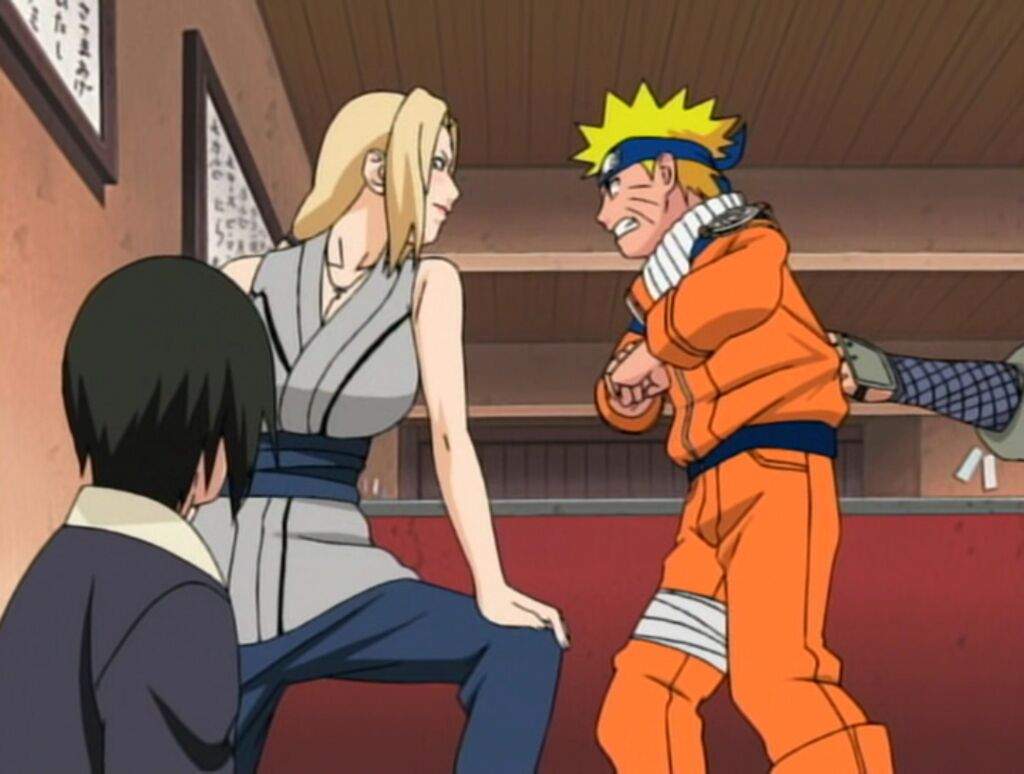
- Naruto's hair also contrasts with the hair of the women in his life: bright yellow against Sakura's cherry pink, spiky sunshine against Hinata's straight flowing midnight hair. Even when it's supposed to be the same color (blonde) like with Tsunade, it's such a different
 ◊ style and tone.
- Naruto's parents: "Yellow Flash" Minato and "Red Hot-Blooded Habanero" Kushina.
- The previous generation had Kakashi and Obito, the first with white/silver hair and the second with black hair. Interestingly the dark-haired one started out as the warm, good person whereas the white-haired one was cold and calculating, but as adults, they have switched roles, with Obito being the main villain and Kakashi a main character and one of Naruto's biggest supporters.
- Jiraiya's white hair and Tsunade's blonde hair are contrasted with their former teammate, Orochimaru's black hair. Jiraiya stays loyal to the Will of Fire, Tsunade starts out cynical but eventually comes around to it, while Orochimaru abandoned it years ago and never looked back.
- Then there is the dark brown-haired Hashirama Senju and the silver-haired Tobirama Senju, who are brothers but so diametrically opposed to each other in worldview and personality. In an inversion to most other duos, Hashirama is an energetic All-Loving Hero who despises violence and always sees the best in everyone, despite his harsh upbringing. Tobirama, on the other hand, is The Quiet One who has become so jaded by his violent childhood that he expects the worst in everyone.
- Natsuneko does this in every single one of her mangas:
- Killing Me!: Saki, who's serious and dedicated to her mission to kill vampires, has black hair, while the flirty, playful Miyoko has pink hair.
- Sweet Blue Flowers has black haired Fumi and the redhead Akira, with Fumi being a shy crybaby and Akira being more assertive and perky.
- Neon Genesis Evangelion:
- Shinji Ikari (dark brown) and Kaworu Nagisa (silver), who are also contrasted by their blue eyes and red eyes respectively. Shinji tends to be depressed and unenthusiastic whereas Kaworu is always smiling and often expresses admiration for life and culture. Also contrasted by Shinji being a human, progeny of Lilith, and Kaworu being an Angel, progeny of Adam. There is a considerable amount of Ho Yay between the two.
- Asuka and Rei are also examples of this trope, with the former being a Fiery Redhead and the latter a Shy Blue-Haired Girl.
- One Piece has many, but no real romantic examples:
- Longtime friends Shanks and Buggy are the literal Red vs Blue but also subverted as Buggy (Blue hair) is loud, aggressive and quick to anger while Shanks (Red Hair) is calm, easy going and friendly only becoming angry when his friends are endangered.
- This trope applies strongly to the Strawhats with the exceptions of the dark-haired crewmates (Luffy, Usopp, Robin, and Brook) and fur-covered Chopper, the vibrant-haired crew-members fulfill this trope.
- Zoro-Green (mellow, stubborn, driven).
- Nami-Orange (fiery, greedy, alluring).
- Sanji-Yellow (optimistic, loving, enduring).
- Franky-Blue (positive, relaxed, loyal).
- Really applies to Nami and Vivi◊ (Les Yay suggestible) as Nami the Fiery Redhead and Vivi Shy Blue-Haired Girl.
- Smoker's spiky short white hair to Tashigi's neat long black hair. Same goes for Zoro and Tashigi.
- The Vinsmokes Sibling have this◊ in full.
- In Ouran High School Host Club, Haruhi's (brunette) a Deadpan Snarker Bifauxnen who's very down to earth, while Tamaki (blonde) is melodramatic, hyperactive and often comes up with Zany Schemes for the Host Club. Though in the anime, at least the romance aspect is only one-sided on Tamaki's part.
- Common in Pretty Cure seasons with two protagonists. Nagisa and Saki (orange and light brown) are the outspoken tomboys, while Honoka and Mai (black and dark purple) are calmer and more elegant. On the other hand, HeartCatch Pretty Cure! inverts this and Suite Pretty Cure ♪ averts it.
- Puella Magi Madoka Magica: Madoka's worldview is "happiness for everyone", while Homura's worldview is "happiness for a specific person named Kaname Madoka".
- Kyouko's "for myself!" versus Sayaka's/Mami's "for justice!"
- In Ron Kamonohashi: Deranged Detective, we have Ron, a black-haired Brilliant, but Lazy detective who spends most of his days slacking off when he's not working on a case, who gets paired with Toto, a hapless officer who is often considered a hindrance at his work place due to his incompetence. And while Kamo's skills and eccentric personality often comes across as insufferable, Toto is a Nice Guy who is always ready to help, despite his otherwise lack of wits.
- Usagi and Mamoru from Sailor Moon: she's the perky blonde protagonist and he's her aloof, dark-haired love interest.
- In Sei Juushi Bismarck, as well in its Macekred Gag Dub version Saber Rider and the Star Sheriffs, there're Shinji Hikari/Colt and Richard Lancelot/Saber Rider, which are friends and one of them is The Protagonist and the other is The Lancer, depends on the version you know.
- Slayers has Xelloss and Filia. While not romantic (fandom aside), they contrast in most aspects of their designs, like hair (purple and yellow, complement colours), clothes (black and white), diametrically opposed species (demon and dragon), and their widely different personalities clash just about all the time they're on screen at the same time.
- Heterosexual Life-Partners Kotetsu and Barnaby from Tiger & Bunny completely invert the character dynamics associated with their hair colors (with the exception of age, as the former is about ten years older than the latter). Blond Barnaby is the troubled, socially isolated Defrosting Ice King, while brunet Kotetsu is the idealistic, energetic and impulsive Messiah who eventually manages to gain his friendship and trust.
- Witch Hat Atelier has Qifrey (white-haired) and his friend and neighbor, Olruggio (black-haired). Qifrey is a warm and affable but has a secret dark side and is willing to erase other people's memories to keep it hidden. Olruggio appears stern and gruff but is very kind and considerate towards others. This contrast is also reflected by their outfit's colours: Qifrey wears a black shirt with white robes and pants, while Olruggio wears white shirt and black cloak and trousers.
- Wotakoi: Love is Hard for Otaku: ALL of the main couples have contrasting hair colours:
- Narumi and Hirotaka has red and black hair respectively. Narumi is warm and sweet, while Hirotaka is The Stoic.
- Likewise Kabakura and Hanako. Kabakura is a Fiery Redhead, while Hanako is more cool-headed.
- Naoya is blonde and Kou is a brunette. The former is cheerful, friendly and easy-going, while the latter is shy and rather gloomy.


- Archie Comics, of course, has Betty and Veronica: Betty’s girl-next-door sweetness is matched by her blonde hair, while glamorous, spoiled Veronica has raven-black locks. They nevertheless identify each other as best friends.
- Harley Quinn and Poison Ivy, complete with the romance angle. Harley (blonde) is bouncing off the walls with energy and chiefly interested in having fun, while Ivy (redhead) is snarkier, more cynical and generally a bit more goal-oriented. Of course, they're both supervillains stuck in the Heel–Face Revolving Door, so whether either of them is "good" is debatable.
- Wonder Woman Vol 1: Blonde Lila Brown is the WAC secretary assigned to Major Steve Trevor while the brunette Diana Prince is the WAC secretary assigned to General Darnell. Lila can't stand Diana because she seems to be the only person to realize that Diana is highly suspicious and is definitely hiding something and because when Diana is at work and is not making up unverifiable excuses to bolt she is very prim, strict about regulations, enthusiastic and lighthearted while Lila is comparatively relatively laid back about rules and regulations and also far more cynical.
- Bruce and Thomas Elliot in Batman: Melody for a Mockingbird are a hero/villain example that plays with the dynamics: Raven-haired Bruce is an altruistic hero under a troubled, sullen outer shell, while Elliot has golden blond hair, but the outward charm and friendliness is a Mask of Sanity hiding his true, monstrous nature. The latter contradicts the comics, where Elliot is an Evil Redhead.
- Nova Shine and Twilight Sparkle in The Apprentice, the Student, and the Charlatan Nova's mane and tail are short, untidy, and a singular shade of blue. Twilight's is long, straight, and a neat navy-blue with streaks of purple and magenta in them. While both are intelligent, organized bookworms who are extraordinarily gifted in magical ability, they are at opposite ends of the Sliding Scale of Idealism Versus Cynicism, with Nova being a much more bitter, cynical, "dark"-haired Blue Oni, where Twilight is the optimistic, sweet, "fair"-haired Red Oni by comparison.
- Chloe and Lexi from Infinity Train: Blossoming Trail. Chloe has long maroon hair that she usually kept in a braid prior to entering the Infinity Train but keeps loose. She is a Shrinking Violet getting out of her shell who feels like she's different from everyone in her life yet is shown to be sweet, loves Alice in Wonderland and also has a hidden love for the macabre. Lexi is a book with a paper "human" form that, after a makeover from Chloe, has short ashen grey hair yet is known to be a gentleman with a teasing side towards Chloe and a personal grudge against Grace and Simon.
- Infinity Train: Boiling Point has the duo of Boscha and Skara: the latter has grey dyed hair and is more mellow and down to earth, while the former has pink hair, and is a Fiery Redhead, literally and figuratively.
- Xion and Daenerys from A Song of Ice, Fire and Heart. The brunette Xion has Boyish Short Hair, isn't afraid of fighting people and monsters alike and using crude language, and tends to be quite brooding and cynical regarding the world. The blonde Daenerys has flowing locks befitting a princess, is deeply fragile and insecure on the emotional level, and defaults to submissive when she's scared.
- In The Story of Apollo, Daphne and Luca: An Italian Tragedy we have the mild-mannered and soft-spoken brown-haired Luca and the prideful and arrogant blond-haired Vincenzo.
- The main leads of the Disney Animated Canon often have contrasting hair colors, typically with the "nice blonde" and "not-so-nice brunette" dynamic.
- The Hunchback of Notre Dame (Disney): Esmeralda and Phoebus. She's a raven-haired Roma who rebels against authority and becomes a fugitive, while he's a blond soldier who (at first) dutifully serves the law. Although since Big Bad Frollo is focused on the law, but also evil, Esmeralda's "bad" actions are actually good and Phoebus's Character Development involves him leaving the army and joining her.
- Hercules: Meg and Hercules. She's a cynical Defrosting Ice Queen with dark auburn hair, he's a friendly idealist whose hair is strawberry blond.
- Tangled's Rapunzel, a sweet, bubbly Ingenue with iconic golden hair at least before it gets cut, and Flynn Rider, a brown-haired Jerk with a Heart of Gold thief.
- Pocahontas: John Smith and Pocahontas. John, who starts out as a devil-may-care Innocent Bigot until he learns better from Pocahontas, has blond hair, while wise Friend to All Living Things Pocahontas is a black-haired Native American.
- Elsa and Anna of Frozen. Elsa has Mystical White Hair to go with her ice magic, stoicism, and Emotionless Girl façade, while Anna is a Fiery Redhead, outgoing, energetic, and warm-hearted.
- Bandslam: Outgoing and charismatic Charlotte is blonde, introverted and (seemingly) emotionless Sa5m is a brunette.
- Cinderella (2015) contrasts the good-hearted and idealistic Ella (blonde) with the cruel and cynical Lady Tremaine (redhead). To further this contrast, Ella's saintly biological mother and Fairy Godmother are both blondes too.
- The Drummer and the Keeper has Gabriel, a curly dark-haired drummer with bipolar disorder that's not very well managed, and Christopher, a blond teenager with Asperger's who's very orderly and relatively responsible.
- Peter Weir's classic Aussie war flick Gallipoli has the typical personality types in blond idealistic Archie (Mark Lee) and the more cynical Frank (Mel Gibson). NB: If you haven't seen this movie before, bring tissues!
- Godzilla: King of the Monsters (2019):
- Ex-spouses Emma and Mark Russell at first seem like a straight case: the blonde-haired Emma, though far from angst-free, is a lot more optimistic about the Titans to the point of arrogance, and she's proactive through her grief; whereas the dark-haired Mark is cynical, testy, moody, is much warier of the consequences of meddling with the Titans whilst hating the creatures for emotional reasons, and has pushed everyone away so he can wallow. Except it turns out that despite these contrasts, Emma is much more unstable and heinous than Mark is.
- Emma and her brunette daughter Madison, on the other hand, are an inversion. Madison wants to please her mother and starts the movie as something of a Wide-Eyed Idealist, to the point where she initially goes along with Emma's plan to set the Titans loose – Madison is also a notorious rule-breaker, and she's horrified when the bodies start dropping, realizing that what she and her mother are doing is wrong. Contrast that against Emma, who has gone so mad over Andrew's death and the knowledge mankind is engineering its own extinction that she's used Andrew's death to turn her back on morality, has a dim view of humanity, has no reservations about causing potentially billions of deaths, and barely displays any guilt for the morality of her actions.
- Kiss of the Damned: Vampire sisters Djuna and Mia are very much opposites, as signified by their respective hair colors. Redhead Djuna, who's a Vegetarian Vampire, gets into a loving committed relationship with Paolo. Brunette Mia though feeds lethally on humans and is a promiscuous bisexual, hypnotizing Paolo (apparently) to sleep with her so she can take what Djuna has.
- A Knight's Tale has the heroic idealistic William as a blond, contrasted with the cynical villainous Ademar as a brunet.
- The two rivalling main characters of The Legend of Frenchie King are the blonde Louise and the brunette Maria. Louise is coolheaded and sophisticated, while Maria is rough and hot-tempered.
- Two examples in Les Misérables (2012):
- The Ingenue Cosette has Hair of Gold, Heart of Gold, while Street Urchin Éponine, who secretly loves the same man, has dark brown hair. In the novel, both are described as having "chestnut" hair (presumably to highlight that they're actually similar), but the musical film opts for the classic contrast, as do many stage productions.
- The idealistic revolutionary leader Enjolras is blond, while the cynical drunkard Grantaire, who nonetheless follows Enjolras devotedly and ultimately dies by his side, has black hair.
- Let Me In: Owen has black hair, Abby has blonde hair. The stereotypes are reversed, as it's the raven-haired Owen who is a gentle, meek, shy boy, while blonde Abby is a ruthless vampire.
- Peter Jackson's adaptation of The Lord of the Rings.
- Troubled, self-doubting Frodo (brunette) and upbeat, down-to-earth Sam (blonde).
- Cool and elegant Legolas (blond), and aggressive and hot-tempered Gimli (redhead).
- In Maleficent and its sequel, we have Maleficent (the eerie brunette) and Aurora (the good-hearted blonde).
- Marvel Cinematic Universe contrasts brothers Thor as the "good blond" and Loki as the "bad brunet".
- In Midnight Cowboy, the naïve, not too bright, compassionate Joe Buck is blond, while sleazy Jerkass Woobie Ratso Rizzo has dark hair. They're also a classic Big Guy, Little Guy pairing.
- Dark-haired, brooding Adam is contrasted with his blonde, optimistic wife, Eve, in Only Lovers Left Alive. Yin-yang symbolism is everywhere in this movie.
- The Personal History of David Copperfield: David's two love interests: The blonde Dora is rich and slow on the uptake; the practical and down to earth Agnes is black-haired.
- The Disney film version of Pollyanna. Pollyanna is positive and blonde, while Aunt Polly is cold and brunette. Notably, light-haired characters (like Nancy and Tilly) defrost quicker than darker-haired characters (like Angelica and Mrs. Snow).
- Screen adaptations of Pride and Prejudice, most notably the 1995 miniseries and the 2005 film, usually cast the clever, impertinent Deadpan Snarker Elizabeth as a brunette, and her sweet, ladylike, idealistic sister Jane as a blonde. The book never mentions either of their hair colors, but in adaptations this trope appears. The 1995 version also gives the friendly, easily-swayed Mr. Bingley golden brown hair, while the 2005 version makes him a redhead, both in contrast to the Tall, Dark, and Snarky Jerk with a Heart of Gold Mr. Darcy. (Neither of the two men's hair colors are mentioned in the book either.)
- The Quiet: The blonde, talkative, popular Nina and the silent, dark-haired unpopular Dot.
- In Rags, Kadee's two best friends are a bubbly and Dumb Blonde, and a smarter, more alternative Brunette.
- Red, White & Royal Blue: The raven-haired Alex Claremont-Diaz is an extrovert while his blond boyfriend Prince Henry is an introvert.
- Scream (1996): Sidney (cynical and troubled brunette) and Tatum (care-free and bubbly blonde). Both actresses are natural brunettes, but Tatum's actress went blonde specifically to create the contrast.
- In The Sound of Music, the free-spirited Maria is a blonde while the broken and detached Captain is a brunet.
- Star Wars: The blonde-haired, naive and noble Luke Skywalker and the brunet cynical, snarky loner Han Solo who are The Hero and The Lancer respectively.
- Sweet, Sweet Lonely Girl: Blonde Adele is a more innocent, obedient and naïve girl. Brunette Beth by contrast is seductive, rebellious, and experienced.
- They/Them (2022): Veronica, a brunette, has a more fiery temper and rather butch style. She's contrasted to Kim, a gentle, shy femme blonde.
- There's Bruce Lee's Way of the Dragon which has his rival played by Chuck Norris, one of the most known rivalries in martial arts films history.
- Boys' Love Genre Ai no Kusabi gives us the Opposites Attract couple consisting of The Beautiful Elite, blond Iason with the younger Troubled, but Cute, Badass Biker Riki who is also a slum mongrel.
- The Anderssons: Ida Sofia is a cynical, brooding and introverted brunette, while Greta is a cheerful, impulsive and extroverted blonde.
- The Chronicles of Dorsa: Red-haired Tasia becomes lovers with Joslyn, who's black-haired. Tasia is more naive, innocent, emotive, having had everything given to her (she's a princess) and freespirited. Joslyn is very stoic at first, jaded from a tragic history, much more experienced with the world, and comes from a very poor background, having also been a slave once.
- The Heroes of Olympus has Will (blond) and Nico (brunette).
- Kind, gentle, peaceful Peeta (blond) and moody, brooding, unsociable Katniss (dark haired) in The Hunger Games.
- InCryptid: Sisters Verity and Antimony Price are blonde and brunette, respectively. Verity is older and more feminine (though she has a huge tomboy streak as well, and actually has shorter hair than Annie), but also rather irresponsible. Antimony is younger, more of a Tomboy with a Girly Streak, and doesn't get along with her sister.
- Jane Eyre has this contrast between Jane's two suitors, although they never meet each other: the passionate, morally gray, black-haired Edward Rochester contrasts with the blond, coldly pious St. John Rivers. Adaptations often make further use of this trope by making the beautiful Rich Bitch Blanche Ingram a blonde in contrast to the plain, humble brunette Jane, although in the book, Blanche has raven-black hair.
- Little Women: Of the four March sisters, Jo and Amy are the two whose personalities clash the most. The brash, independent, hot-tempered tomboy Jo has chestnut hair (brunette with undertones of Fiery Redhead), while the vain, beauty-loving, aspiring Proper Lady Amy has blonde curls.
- Of Fire and Stars: In a reversal from the usual connotations, the two protagonists reflect this. Redhead Mare is rebellious, less friendly and bolder. Denneleia, a brunette, is kinder, more dutiful and isn't very confident starting out in the story.
- Francis and Ross Poldark in both the Poldark book series and the show Poldark based on them. Their mutual aunt Agatha calls them "the Dark Poldark and the Fair Poldark," with dark-haired Ross as a broody Byronic Hero and light-haired Francis as his weak-willed cousin with self-confidence issues.
- The Queen of Ieflaria: Esofi is a blonde, dutiful Princess Classic who's betrothed to Adale, a brunette Rebellious Princess who's uninterested in ever becoming queen and spends her days indulging herself at first.
- Raffles: cynical, aloof Raffles is dark-haired; his friend and partner in crime — the naïve, emotional Bunny — is blond.
- The Snow Queen: The pure-hearted heroine Gerda has "long flaxen ringlets," and while the Jerk with a Heart of Gold Robber Girl's hair color is never mentioned, she is said to have darker skin and black eyes, and illustrations almost always give her black hair too.
- Sweet & Bitter Magic: Tamsin is a brunette and Wren a redhead. While the former is a powerful witch who's been cursed to not feel love, Wren's a source (living magic fuel) who deeply loves her father, caring for him in his sickness.
- The Story of Valentine and His Brother has stubborn, hot-tempered, dark-haired Val and laid-back, hard-working, blond Dick.
- Thais (bronze-skinned Brainy Brunette of Cretan origins) and Aegesichore (fair-skinned blonde from Sparta) from Thais of Athens. Despite lots of Les Yay between them, they are really Just Friends, though.
- Wuthering Heights has two hair-contrast households. The rugged inhabitants of Wuthering Heights are the Ambiguously Brown, black-haired Heathcliff and the brown-haired Earnshaw family (Catherine, Hindley, Hareton). In sharp contrast to them are the refined, blonde-haired Linton family of Thrushcross Grange (Edgar, Isabella, young Cathy, young Linton). These two groups clash with each other, yet are drawn to each other, throughout two generations.
- In Dragonlance Legends, Raistlin and Crysania; the evil mage Raistlin has white hair and black robes, while the good priestess Crysania has black hair and white robes.
- Dolphin Trilogy: Daughters of the Dolphin introduces the Phelan twins, outgoing dark-haired Vinca and introverted blonde Syn.
- Cool, blonde, Defrosting Ice Queen Sarah and Brainy Brunet Chuck from Chuck.
- Interview with the Vampire (2022): Louis de Pointe du Lac has black hair whereas his boyfriend Lestat de Lioncourt is blond; the former has a more docile and restrained temperament, while the latter is more assertive and flamboyant.
- Napoleon Solo and Illya Kuryakin from The Man from U.N.C.L.E. — inverted personalities with blond Illya being the more solemn brooding one of pair.
- The Lord of the Rings: The Rings of Power: Elrond and Durin's contrasting appearances and personalities create a dynamic duo. Elrond, with his dark hair, patience and dignified demeanor, is interested in scholarly pursuits. Prince Durin, a fiery redheaded Dwarf, presents a stark contrast with his boisterous personality and quick temper. Their friendship serves as a bridge between Dwarves and Elves.
- No Tomorrow: Blonde, updeat, optimistic Evie and sarcastic, brunette, nihilist Kareema are best friends.
- Done the other way around in Once Upon a Time. Emma Swan is the cold, cynical blonde. Mary Margaret Blanchard is the optimistic, loving brunette.
- Emily and Victoria from Revenge. The show plays with the above archetypes- Emily's blondness contributes to her Girl Next Door facade, whereas brunette Victoria's villainy is far more apparent.
- Sherlock: Sherlock (brunette) is a Nightmare Fetishist and self-proclaimed Nominal Hero. John (blonde) is the more down-to-earth of the two, relatively speaking.
- In Korean Dorama Tamra, the Island, there's Ahn Kawamura, a Japanese bodyguard of young British nobleman William (which is the only blonde in the series), both survivors of a shipwreck close to the Tamra (actually Jeju) island, known in that time as a prison island. Also, there's Park Kyu, an undercover government official who's also in love with Jang Beo-jin (also a brunette), becoming the rival of William in a Love Triangle.
- Since the Femme Fatale heroine of Carmen is a Hot Gypsy Woman and therefore almost invariably brunette, the Ingenue Micaela is often (though not always) cast as a blonde.
- In Così Fan Tutte, of the two young soldiers, the naïve, romantic tenor Ferrando is described as blond while the wittier, cockier baritone Guglielmo is a brunet, though whether this difference is natural or only true in their "Albanian" disguises isn't specified. Their fiancées, Fiordiligi and Dorabella, are also usually cast as blonde and brunette, though which is which depends on the production.
- Cross Road two Long-Haired Pretty Boy protagonists, not with colors, but with textures. Niccolo Paganini has lush curls, while the devil Amduscias, with whom he's made a contract, has silky straight hair.
- (Often) Inverted with Death and Elisabeth. Death can be played as either coldly villainous or at the very least inhuman, with Mystical White Hair or White Hair, Black Heart. His main love interest is the Eerie Pale-Skinned Brunette Rebellious Princess Sisi. note
- Gypsy has the two Hovick sisters: blonde June is perpetually cast as the cute, perky, innocent little girl, while brunette Louise is the initially unassuming tomboy who grows up to be the glamorous stripper Gypsy Rose Lee. Truth in Television, as they really were blonde and brunette.
- In La Bohème, the sweet, gentle ill girl Mimí is described as a brunette, so the feisty, sexy Musetta (whose hair color isn't mentioned in the libretto) is typically cast as a Fiery Redhead.
- Productions of A Midsummer Night's Dream typically cast the Tsundere Hermia as a brunette and her Love Martyr best friend/romantic rival Helena as a blonde. The play text already implies that Hermia's skin tone is darker while Helena's is whiter, so it makes sense that their hair should contrast the same way.
- Glinda (blonde, "good") and Elphaba (brunette, "bad") from Wicked. However, the hair contrast stands out less than Glinda's normal human skin tone vs. Elphaba's green skin.
- Castlevania: Portrait of Ruin Charlotte and Jonathan.
- Jonathan's father, John, inverts this, being brunet, but being the partner of Eric Lecarde.
- Dragon Age: Origins has this with the two female love interests. Morrigan is a black-haired Lady of Black Magic with a cynical disposition, while Leliana is a red-haired Chantry sister with a checkered past who desperately longs to find meaning in her own existence.
- Ensemble Stars!: The two closest to being the 'main' characters, Subaru and Hokuto, have contrasting hair befitting their Red Oni, Blue Oni personalities - stoic Hokuto has straight black hair, while energetic Subaru has fluffy orange hair.
- Final Fantasy:
- Final Fantasy VII has several by design, all with Cloud:
- Cloud (shortish spiky hair, golden blond, pragmatic but unstable) and his rival Sephiroth (really long flowing hair, silver, otherworldly, and collected).
- Cloud (short blond spiky hair, pessimistic, and more innocent) and his idol Zack (long black spiky hair, optimistic, and more experienced). Note also that Zack's hairstyle was actually based on an early design for Cloud's that was changed because it wasn't striking enough — Cloud is the main character, while Zack is a backstory character whose entire existence is obscured from the player, with the ironic concept that he's a more 'main character'-type person than Cloud.
- Cloud, (male, short blond hair, cool and collected when he's not being mind raped) and Tifa (female, long brown/black hair, enthusiastic (but keeps a lot of secrets to herself, and suffers for it).
- Final Fantasy VIII: Fujin (female, silver-haired, cool) and Raijin (male, brown-haired, enthusiastic).
- Final Fantasy IX: Zidane and Garnet. It's hard to get more worlds apart when one is a thief and an alien while the other is a princess.
- Final Fantasy X: Tidus and Yuna. Tidus is fun-filled, naïve, and energetic, while Yuna is serious to a fault at times, and is (very poorly) hiding her own melancholy. They have equally dark backstories. The fact that Tidus is from a dream-preserved memory of ancient Zanarkand helps the contrast along.
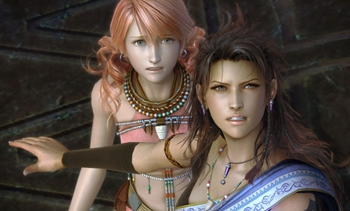
- Final Fantasy XIII: Fang and Vanille, as shown in the page image. Vanille is a happy-go-lucky and childlike Rose-Haired Sweetie who serves as The Heart for the main cast. Her childhood friend and fellow Gran Pulsian, the dark-haired Fang, is headstrong, wild, and mature.
- Mobius Final Fantasy has white-haired Wol, who is The Chosen One with Incorruptible Pure Pureness despite his mean streak, and Maia, a summoner, heretic, and witch.
- Final Fantasy VII has several by design, all with Cloud:
- The main characters of Gardens Inc have this going on. Brainy Brunette Jill starts the eponymous company and has a very sensible, level-headed disposition. Mike, her business partner and eventual husband, has blond hair, an excitable nature, and an occasional outburst of temper.
- Guilty Gear has brown-haired aloof, and thuggish Bounty Hunter Sol and blond Knight in Shining Armor Ky.
- Ditto for Axl Low and I-no. Both are time travelers, and one's good and the other is evil; however, there's a lot of Ship Tease between the two.
- Haven (2020) inverts this with its protagonists, with Kay being a black-haired and cheerful idealist and Yu being a white-haired, pragmatic realist.
- Horizon Forbidden West: Aloy and Beta have the same red hair {both of them being clones of the same red-headed scientist who brought life back from extinction) but differing hairstyles. The Action Girl Aloy wears her hair in long braids, while the non-action and smart girl Beta has a short and neat haircut.
- The Legend of Zelda:
- The Legend of Zelda: A Link Between Worlds has Zelda and Hilda. Blonde Zelda is the cheery leader of Hyrule, while purple-haired Hilda is the somber leader of Lorule who is also a less wise Well-Intentioned Extremist villain.
- The Legend of Zelda: Breath of the Wild has Link and Revali, though they're technically feathers on Revali's part. Blond Link is a stoic and selfless guy who wears his hair in a Samurai Ponytail and develops into The Confidant for Zelda, while blue-feathered Revali is a bombastic and self-centered guy who wears multiple braids and doesn't seem to get along with any of his fellow Champions.
- Metal Gear:
- In Metal Gear Solid, Solid Snake has short, dark hair and a more subdued, brooding personality. Liquid Snake has long blond '80s Hair and is usually portrayed striking poses or shouting.
- Metal Gear Solid 2: Sons of Liberty:
- Raiden, who is The Hero, inexperienced, mid-20s and out of his depth in a Sneaking Mission, has white-blond hair; Snake, who is Raiden's mentor, has dark hair, is more experienced and mature, and is the character to whom Raiden is the Contrasting Sequel Protagonist.
- Raiden and his girlfriend Rose. Early designs for the characters reveal that Rose was originally intended to be the blond and Raiden was to have dark hair; this was reversed when it became apparent that the idea of Raiden as a completely white, "uncoloured" character was symbolically interesting.
- In Street Fighter there's Ryu and Ken Masters, a Japanese fighter with dark hair (and sometimes brown skin) and an American one who's a blond and white. Both are friends and rivals, as well they have the same master: Gouken.
- Tales of Vesperia has its resident Heterosexual Life-Partners; blond, Knight in Shining Armor Flynn and dark-haired, Vigilante Man Yuri.
- In Daughter for Dessert, Amanda is the wholesome, “innocent” dirty blonde with long, straight hair, while Kathy is sexually open with short, black hair.
- Melody: The redheaded Melody is defiant and impulsive, while the blonde Sophia is sociable but level-headed.
- Sono Hanabira Ni Kuchizuke Wo:
- Mai and Reo, with Reo being the hot-blooded Tsundere with the lighter hair color and Mai being the cool and more collected dark-haired girl.
- RWBY: Blake and Sun: the Shadow and the Light. Blake is an aloof, moody, and reserved while Sun is overprotective, cheerful and outgoing. She is a black-haired, black-themed Faunus whose Semblance is based on defensive shadow-clones while Sun is a blond-haired, yellow-themed Faunus whose Semblance is based on offensive light-clones. She is an ex-White Fang member who still fights for Faunus rights but objects to mundane crimes such as petty theft; he views the White Fang as an unwanted, self-appointed cult who give Faunus a bad name, but enjoys engaging in petty theft for fun. Sun's role is to act as a counter to Blake, encouraging her to lighten up, loosen up and protect her back until she figures out her problems. In return, Blake encourages Sun to learn restraint and take responsibility for his actions. When they part ways in Volume 6 it's because they've both grown beyond the need for each other's support.
- Conor and Simon from Dark Heaven fulfill this trope during their band days with the former being the dark-haired guitarist to the latter's light-haired vocalist.
- Grey is... has the white-haired Black with his rash personality and quick temper, contrasted with the calm introspective White, who has black hair.
- Mias and Elle from Mias and Elle are the typical examples of this trope. Mias is the "dark" (dark-skinned, black-haired) lecherous "bad boy" and Elle is the "light" (pale-skinned, blonde-haired) "good girl" he kidnaps.
- On the Dream SMP, this is heavily zig-zagged regarding Tommy and Tubbo. Typically, Tommy is the younger and more energetic blond to Tubbo's older, more serious, and more cynical brunet.note However, who fills what role and how varies over the server's history.
- At the beginning of the Pogtopia arc, Tubbo filled the spot of the "blond" to Tommy's "brunet", being a lot more idealistic and innocent, hopeful to the prospect of L'Manburg's recovery while working as a Pogtopian spy in Manburg; whereas Tommy was banished from his country and forced to go into hiding, and also has to deal with Wilbur and his Black-and-White Insanity, and as a result was quickly forced to mature and support the rest of the Pogtopians.
- However, after Tubbo was elected President of New L'Manburg, Tubbo fell into the role of the "brunet", especially after having the harsh reality check of having to choose between his country and Tommy, giving up his more optimistic traits and becoming a lot more serious, having to make difficult decisions and losing his close friends and support because of it. On the other hand, Tommy, despite still being Hot-Blooded as ever, didn't quite fit the bill of the "blond" of the duo, mainly because he spends most of the season going through a massive Trauma Conga Line.
- After the Lockdown arc, the two both show shades of both sides of the spectrum. Tommy has bounced back to being the loud and energetic "blond" as much as ever, but it's incredibly clear that all his past trauma has affected him, causing him to become more wizened by experience; while Tubbo has holed up in Snowchester as a "brunet" who puts up the front of a "blond", his experiences as the President of a nation that he failed to save have evidently changed his demeanor a lot over time.
- Kontrola: Brunette Natalia is reserved, more unfriendly and prone to being morose. Redhead Majka is quite open, almost always friendly and smiles most of the time.
- The Runaway Guys invert this with two of their members. Chugga, the cheerful and energetic one, has dark brown hair, while the more irritable and snarky Jon has blond hair.
- Beetlejuice: Black-haired Lydia is a Nice Girl who simply happens to have a fondness for the weird and macabre. Blonde Claire is an overly tanned phony who enjoys being popular and looking down on those who aren't.
- The Flintstones: Large Ham Jerk with a Heart of Gold Fred Flintstone has black hair, while friendly, easy-going Barney Rubble is blond.
- Milo Murphy's Law: Cavendish has gray hair and an uptight personality, while Dakota has dark hair and is much more laid back.
