Apocalypse Now is a 1979 epic psychological war film directed by Francis Ford Coppola at the height of his career that very loosely adapts the classic Joseph Conrad novella Heart of Darkness, transporting the events of that book from late 19th-century Africa to 1970 Vietnam and Cambodia.
Special operations Captain Benjamin Willard (Martin Sheen) is sent to kill Walter E. Kurtz (Marlon Brando), a Green Beret Colonel who has gone mad and formed a personality cult in Cambodia. After Colonel Bill Kilgore (Robert Duvall) clears off his initial path, Willard and his crew — including George "Chief" Phillips (Albert Hall), Jay "Chef" Hicks (Frederic Forrest), Lance Johnson (Sam Bottoms), and Tyrone "Mr. Clean" Miller (a 14-year-old Laurence Fishburne) — go up a river and into the recesses of humanity.
Leading up to its release, Coppola workshopped an extensive number of cuts of the film that ran from 139 minutes to around 3 hours, the latter being its runtime when it premiered at the Cannes Film Festival, the first-ever instance of the festival showing an unfinished work in competitionnote and further awarding one the Palme d'Or. While it opened wide to mixed reviews, Apocalypse Now is now firmly considered one of the all-time greats. Packed to the gills with now-iconic scenes and quotes, it is a common choice for not only the definitive anti-war movie but the definitive cinematic depiction of war not as battle, or even as purgatory, but as an illogical fever dream.
The film is also legendary for having what is considered to be one of the most troubled productions in Hollywood history. To describe all of the mishaps that occurred on set would require an entire page, to the point where the film's nightmarish production was documented by Coppola's wife Eleanor, who would later use footage she shot on set to make the 90-minute documentary Hearts of Darkness: A Filmmaker's Apocalypse. The highlights can be read on the Trivia section.
In 2001, Coppola drastically Re-Cut the film once more, extending the running time by nearly an hour, adding scenes and re-shuffling some existing ones around. This new version was released as Apocalypse Now Redux to mixed reviews; some reviewers felt it was a beautiful expansion on the themes of the original, while others thought it diluted its impact and bloated its runtime. The film was recut again in 2019 as the "Final Cut", with a new runtime of just over three hours, nineteen minutes less than Redux.
Not to be confused with Apocalypse How or Apocalypse Wow, which deal with destruction apocalypses.
I love the smell of tropes in the morning:
- 20 Minutes into the Past: Released in 1979, set around 1970.
- Above Good and Evil: In a deleted scene Kurtz visits Willard while he is in captivity, bringing up the subject of how he thinks the Vietnam War could be won. A lecture ensues about how Americans care too much about their public image and how the rest of the world views them, it is a mistake to let public opinion prevent victory in a war. If war wasn't a popularity contest then America could do whatever was necessary to win. Willard calls Kurtz cruel and that his methods destroy all moral standards of right and wrong in appropriate conduct of warfare. Kurtz responds simply, "It is 'right' to win. And it is 'wrong' to lose."
- Actor Allusion:
- The picture of Kurtz in military uniform in the dossier is Marlon Brando in Reflections in a Golden Eye, for which Francis Ford Coppola had contributed to the screenplay.
- Dennis Hopper playing an unstable hippie photographer is quite fitting.
- Acoustic License: Kilgore has his air cavalry play "Ride of the Valkyries" from speakers attached to one of six helicopters as they ride in to bomb a Viet Cong base, saying his men use the music to psych themselves up and terrify the enemy. We hear the music from the perspective of the village as the choppers fly in. However, those speakers could not hope to break through the incredible noise that six attack choppers put out.
- Adaptation Title Change: Apocalypse Now is based on Heart of Darkness.
- Adipose Rex: Kurtz, although this was absolutely not the original plan. Kurtz was supposed to be a robust and fit middle aged man, but Brando showed up for the role at least a hundred pounds overweight. Coppola compromised by keeping him in the shadows as much as possible, but it's often obvious how obese the man is. It actually works well as it highlights Kurtz has completely let himself go and his pretensions to being a proud soldier are so much wind, much like the Kurtz of the novel.
- Alas, Poor Villain: There's a strong sense of tragedy regarding the death of Kurtz.
- Ambiguous Situation: Willard doing tai chi in the opening scene, as well as later in the boat prior to reaching Kurtz. It's unclear whether this is meant to inform how elite Willard is, showcasing his special forces martial arts training, or how mentally decadent has he become by this point, with many a reviewer having interpreted Willard doesn't actually know martial arts and is just absentmindedly goofing around (especially given that the opening scene has him drunk and grievously punching the mirror). It could be also meant to show both things, underlining that no amount of training could prepare him for the horrors of the war. Colby is shown doing much more orthodox tai chi himself in the background while Kurtz recounts his own horrors, but whether this is meant to have its own meaning remains equally obscure.
- Annoying Arrows:
- Subverted. Villagers (unseen at this point, as in Conrad's book) attack Willard's boat with arrows. Due to the 20th century setting, Willard does not take them seriously. He refers to them as "toy arrows," and in a shout out to Conrad, he says "they're just little sticks, they're trying to scare us!" After the sailors start shooting back, however, the villagers switch to spears, and one of the sailors dies as a result.
- Lance, at one point in the same scene, breaks an arrow in half and sticks the two halves in his hair.
- An Arm and a Leg: Kurtz tells a story about the time he was with the Special Forces and they inoculated children:Kurtz: We left the camp after we had inoculated the children for polio, and this old man came running after us and he was crying. He couldn't see. We went back there, and they had come and hacked off every inoculated arm. There they were in a pile. A pile of little arms.
- Artistic License – History:
- Historians generally agree
 that there's no evidence to suggest that North Vietnamese soldiers ever amputated arms of vaccinated Vietnamese children en masse. According to John Millius, it was recounted to him by Fred Rexer, who worked as a military consultant on the film and was a Green Beret in Laos who took part in the Phoenix Program.
 - While much of what the French patriarch is absolute nonsense meant to portray him as bitter and deluded, his allegation that the United States created the Viet Minh is the only one taken seriously by Willard, and appears to be supported by the film as fact. As the even older Frenchman claims, either President Truman or Roosevelt (likely the latter) opposed French colonialism and created the Viet Cong in 1945 to oust the French from their Indochina possessions. However, the Viet Minh were created in 1945, with their American support being to oust the Japanese as part of World War II; once the Japanese left, and the Viet Minh began fighting the French, America very quickly backed the French instead.
- Historians generally agree
- Asskicking Leads to Leadership:
- Willard's prowess is shown early on in Redux and Final Cut when he beats some sense into a military orderly who is red-taping fuel supplies.
- Kurtz gave up his life as a staff officer in order to join Special Forces as an active duty soldier. He graduated the grueling Airborne School at 38 years old, which Willard struggled to complete at 19. And despite his mental and physical decay after going rogue in the jungles of Cambodia, his army has a fanatical devotion to his leadership and view him as a god.
- Kilgore appears to be beloved by his men despite, or possibly because of, his willingness to send them into extremely dangerous combat zones. To Kilgore's credit, he leads from the front and does not appear the least bit concerned when shells explode right next to him.
- Ax-Crazy: Kurtz's idea of embracing "the Horror" in himself is putting on camouflage paint and chopping men's head's off. Willard does the same in the end.
- Beauty Is Never Tarnished: Subverted. Lance, the blond surfer boy and arguably the handsomest man on Willard's strike team, smears lots of dark camouflage makeup on his face and leaves it on for the entire film.
- Bilingual Bonus:
- Apparently Cambodian street kids ask foreign soldiers for money in Filipino.
- Also, the scenes in the Redux version that take place on the French Plantation. None of the French dialogue is subtitled.
- The Vietcong soldier killed by Roach is wounded and begging for his comrades to not leave him behind in Vietnamese.
- Black Dude Dies First: A particularly cruel example in that both black crew members die before the others. Way before that, a black soldier dies in the helicopter explosion in the village.
- Book Ends/Motif: "The End", performed by The Doors, is featured in the introduction and during Colonel Kurtz's murder to establish and reinforce the movie's underlying surreality.
- Break Them by Talking: When Willard is captured by Kurtz the Colonel asks a simple question, "Are you an assassin?" Willard's response is that he is a soldier. Kurtz mocks Willard by saying the following, "You're neither. You're an errand boy, sent by grocery clerks to collect the bill."
- Break the Cutie: Chef, Clean and especially Lance do not appear to be hardened soldiers. Willard remarks that Lance looked like he'd never fired a weapon in his life. Clean ends up massacring a sampan full of civilians before being killed himself, Chef suffers several mental breakdowns and Lance ends up completely detached from reality.
- Broken Ace: Kurtz was groomed to become a top military officer but something in him snapped after his first tour of 'Nam. Willard discovers by reading Kurtz's dossier that the Broken aspect was intentionally self inflicted by Kurtz. Kurtz was going to be a high ranking General in the "corporation" one day, but he was dissatisfied with being a desk jockey and decided to join the Special Forces. As a Lieutenant Colonel at the time Kurtz could have been anything he wanted, but being a Special Forces operative would put a nail in his career's coffin so deep that he would never go above Colonel. Willard is astonished that such a gifted officer would screw his own career over like that.
- Willard is one to an extent. While not as brilliant or accomplished as Kurtz, he's still a highly trained black ops agent and assassin who's well regarded for his skills and for the most part handles the chaos around him just fine. However he's also a combat junkie who can't function in civilian life and he's got a head full of broken glass.
- Broken Pedestal: There's a interesting example as much of the movie is about Willard reading about Kurtz and coming to believe they're not that different. Also, that Kurtz has a much clearer view of the Vietnam War than his superiors who are Mildly Military incompetents at best and Colonel Kilgore at worst (or maybe it's the other way around). By the time Willard actually reaches Kurtz, Willard finds Kurtz genuinely is insane and committing atrocities for flimsy excuses.Kurtz: Are my methods unsound?Willard: I don't see any method at all, sir.
- Bunny-Ears Lawyer: Kilgore wears a cravat and a civil war era cavalry officer's hat, and seems to be more focused on surfing than fighting the war. However, there appears to be no question of his competency by his superiors or by his men. During combat he's all business, calling out military targets and coordinating his troops. Upon landing, he leads from the front and even strides about in full view in active combat zones which is something field officers are trained to do in order to draw fire away from their men.
- By contrast, Kurtz is declared insane by his superiors for what he considers to be a methodical, pragmatic approach to counter-insurgency. Kilgore can kill civilians indiscriminately, whereas Kurtz is being charged with murder for killing Viet Cong agents that he spent months gathering evidence on. However, Willard's view of Kurtz's sanity changes once he reaches the compound.
- Calling Card: Colonel Kilgore throws "Death cards" with the emblem of his Air Cavalry Regiment around corpses to let Charlie know who killed them.
- Cat Scare:
- Quite literally, but with a considerably larger-than-usual cat. Hell, even the actors were scared!Chef: Fuckin' tiger!
- One during an inspection of a local boat ends tragically when Clean reacts poorly to it.
- Quite literally, but with a considerably larger-than-usual cat. Hell, even the actors were scared!
- Cavalry Officer: Colonel Kilgore, the commander of an air cavalry unit.
- Celebrity Paradox: Kurtz reads aloud from The Hollow Men (1925), which contains an epigraph quoting from Heart of Darkness (i.e. the basis of the movie), written twenty years earlier. The paradox was not present in the original script, where Kurtz was originally called "Col. Leighley". A scene with Harrison Ford has the original name redubbed.
- Cheese-Eating Surrender Monkeys/Vestigial Empire: In Redux and Final Cut, the declining might of the French Empire is discussed by the French plantation owner, who is ready to defy the defeat streak with a Last Stand at his home, if it comes to that.
- Chekhov's Skill: Chef's francophone background comes in handy when the party comes across a plantation full of wary Frenchmen.
- Chiaroscuro: We get a lot of this, especially in the scenes with Kurtz.
- Cloudcuckoolander: Colonel Kilgore and definitely the Photojournalist. Lance becomes one by the end of the movie, when he's on acid.
- Willard comes across several men at the Do Long bridge who have been driven insane by the surreal chaos.
- Cluster F-Bomb: It is one of the very earliest films to have frequent usage of the F-word throughout its entire duration.
- Cold Sniper: Roach is this with a grenade launcher.
- Colonel Badass:
- Both Lt. Colonel Kilgore, and Colonel Kurtz. Probably can be considered a Trope Codifier. Kilgore loses some badassery in Redux and Final Cut; he's pitiful when Willard steals his surfboard and his attempts to retrieve it are mocked.
- A notable aversion with Col. Lucas (played by perennial badass Harrison Ford), who is a meek Desk Jockey.
- Colonel Kilgore: The Trope Namer is introduced casually Strolling Through the Chaos of a vicious battle. He later speaks poetically about his love of napalm, which "smells like victory." He seems to share equal enthusiasm for combat as he does for his hobby, surfing. He attempts to indulge both pastimes at once, ordering his men to surf in a warzone despite their discomfort (and the bullets whizzing past them into the water). He looks downright sad when he says to Captain Willard and Private Lance that "someday this war is gonna end." Kilgore loves war as much as he loves life itself.
- Combat Pragmatist: Colonel Kurtz praises the tenacity and dedication of the Vietnamese enemy who are willing to do whatever it takes to win, even going so far as to cross the
 Moral Event Horizon if that is what it takes.
 - Crazy Bird Lady: One of the playmates love birds a little too much.
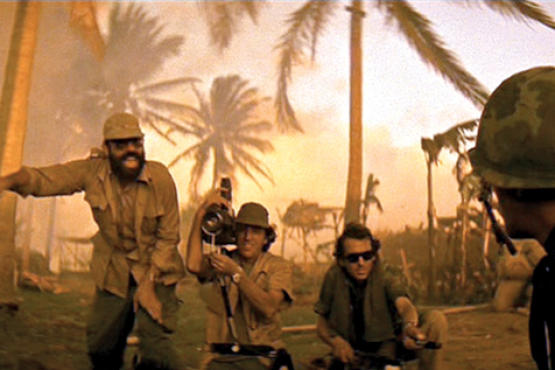
- Creator Cameo: Coppola appears◊ as the Bearded Director making a Documentary and is aided by key crew members Dean Tavoularis and Vittorio Storaro.
- Curb-Stomp Battle: The Air Cavalry attack on the VC Village. Armed with only their AK-47s and a few 12.7mm machine gun nests against a swarm of attack choppers (armed with much deadlier armament), the VCs are quickly torn to shreds.
- Although not shown, it is implied in the Do Long Bridge scene that the Viet Cong attempted to charge a .50 cal machine gun and were massacred. One VC remains alive by hiding under all the corpses."They're all dead stupid! Just one left alive underneath them bodies."
- Although not shown, it is implied in the Do Long Bridge scene that the Viet Cong attempted to charge a .50 cal machine gun and were massacred. One VC remains alive by hiding under all the corpses.
- Deadly Prank: The only time Chief's PBR comes across two other US patrol boats, the opposing crews taunt them...first by mooning and whipping up wake, and then by throwing an activated flare into the command deck, which could have easily, badly burned someone on Chief's PBR. Not that those other jerks cared.
- In the extended cut Willard steals Kilgore's surfboard and stows it on the PBR. Willard says that the Colonel would have shot him if he'd seen it happen.
- Death from Above:
- Behold. Kilgore orders and leads an attack by the Air-Cavalry and then a napalm strike on the jungle. The phrase is also seen written in the front of Kilgore's helicopter.
- Willard tells Chef to call an airstrike in case he doesn't make it. Coppola had to alter the end credits because the Stuff Blowing Up was interpreted by audiences as the air strike happening.
- Behold
- Decapitation Presentation: Marlow is tied up in a bamboo cage when Kurtz, done up in camouflage makeup for some reason, comes over and takes a look at him. He wordlessly leaves—then casually throws Chef's severed head at Willard's feet.
- Despair Event Horizon: Kurtz is a war hero who resigned from the officer class to keep his boots on the ground. From the very beginning of his tour, he was intent on insubordination. He believed his ex-colleagues were impeding the war effort. Then he lost his marbles after seeing horrors like the VietCong mutilating and killing a group of children who were being treated by Western doctors.
- Downer Ending: Similar to the vast majority of American soldiers who survived the Vietnam War, Willard leaves even more deeply disturbed than when we saw him, having seen how insane the war has become and watched three of his allies die and the only remaining one lose his sanity.
- Dramatically Missing the Point: The French plantation owner poignantly accuses the Americans of this. He believes that North Vietnam is not fighting for Communism but for national independence, and the Vietnamese hate the Russians and the Chinese more than they hate the Americans.If tomorrow the Vietnamese are communists, they will be Vietnamese communists [...] You are fighting for the biggest nothing in history.
- Dramatic Drop: Willard dramatically drops his machete, as he climbs down the steps from the temple after killing Kurtz.
- The Dreaded: Our first glimpses of "Walt" Kurtz come from second-hand accounts, grainy photographs, and a rambling, stream-of-consciousness cassette tape of Kurtz trying to document his delirium. When Willard is finally hauled off to see the Colonel, he's dragged into a blackened room, where the frame centers on a majestic, glowing doorway through which Kurtz is expected to pass through. However, Kurtz is already in the room with Willard, seated on the floor and rinsing his face, almost like a fellow prisoner.
- Dwindling Party: As soon as the squad gets upriver near Kurtz, they start dropping like flies.
- Earn Your Happy Ending: The Redux and Final Cut has an interesting implication of a possible "new life" for Willard, with the French girl at the colony. They have a melodramatic romance scene, and for all Willard's concerns about how he's got nothing to "settle down" to in the beginning, the fact that he has the option open of living with the woman in question gives the Redux and Final Cut an air of hope that the original doesn't have.
- The '80s: While Apocalypse Now is considered by many to be the ultimate '70s film, it inspired a very important '80s movie trope: synthesizer scores. Although synths had been used in Hollywood films before, Apocalypse Now started the trend of not just incorporating synths into the soundtrack but seamlessly integrating them as well, making them a "normal" part of the background instead of exploiting them as "science-fiction" gimmicks.
- Elites Are More Glamorous: Willard is with the 505th of 173rd Airborne Brigade assigned to MACV-SOG, ordered to assassinate Colonel Kurtz, who was Operations officer of the 5th Special Forces Group, and is helped by a Patrol Boat, Riverine, crew, and is escorted up the Nung River by Colonel Kilgore of the 1st Squadron of the 9th Air Cavalry.
- Elite Army: Colonel Kurtz points out in his dossier that an Elite American Army could win the Vietnam War easily if the Commanders were willing to put in the resources to train them. He scoffs at the idea that the drug addicts, party animals, and soldiers that just plain don't want to be there are going to help attain an American victory. Kurtz recommends that the American military downsize to approximately 200,000 or 300,000 highly trained soldiers and turn them loose on the Vietnamese enemy so they could win with quality over quantity.
- Emerging from the Shadows: Colonel Kurtz. It goes a great deal into establishing an aura of mystery and subtle evil about Kurtz's character.
- Erudite Stoner: Appropriately for Dennis Hopper's character, a half-crazed, stoned, hyperactive ex-hippie. He can quote Rudyard Kipling and T. S. Eliot, but his riff on dialectics (and most everything else) is pure gibberish.
- Face Framed in Shadow:
- Kurtz throughout his appearances. Brando himself wanted this for aesthetic effect, claiming that it suited the character of Kurtz because he's a person who is flirting with darkness and the primal instinctual fears of humanity. Brando wanted Kurtz to look like a man who is going to be consumed by the darkness, but he has enough mastery over it to (semi)safely dwell in it. (In the original theatrical cut Kurtz's face is always framed in shadow. The Redux breaks from this by adding a scene where Kurtz, in full sunlight, comes to an imprisoned Willard and reads to him TIME Magazine stories about the war.)
- There's also a shot of Martin Sheen with his face half-covered in shadow and half in light while another character is talking about how every man has both good and evil in them.
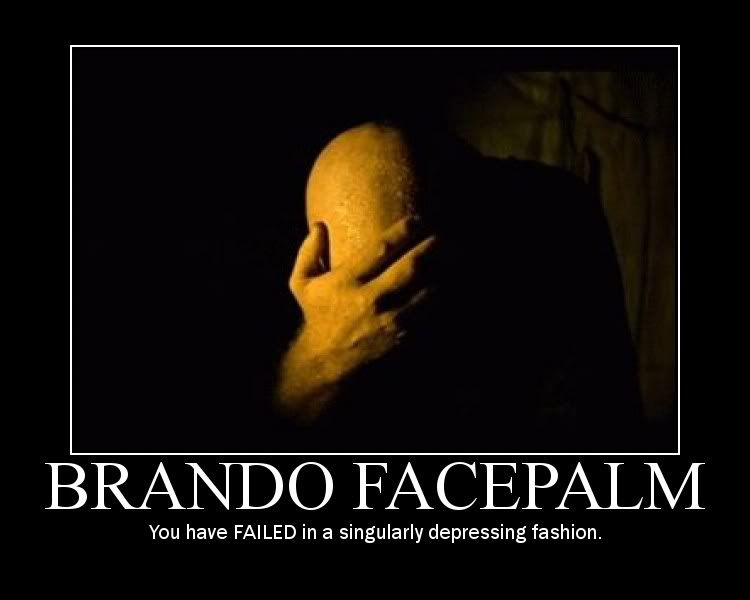
- Facepalm: Kurtz does an iconic one◊.
- Fake Shemp: While he was recovering from his heart attack, Martin Sheen was doubled by his brother Joe Estevez.
- Fanservice: The Redux version has a sequence where the Playmates, whose helicopter is grounded due to weather, are whored out to Willard's men in exchange for aviation fuel. Cynthia Wood and Colleen Camp appear topless.
- In the Redux and Final Cut, too, at the French plantation, Roxanne appears naked. Same as for the Playmates, it's weird, and tending slightly towards...
- Fan Disservice: Colleen Camp's character appears just fine with the above, though her parrot's antics and Chef's request to have her wear a wig quickly makes the scene feel bizarre. Cynthia Wood's character, on the other hand, talks about her miserable life and failed dreams as Lance has sex with her...unaware of the dead soldier a foot away.
- Same for Roxanne. The characters are drawn back to war, with the Meaningful Echo reminding that she is a widow, and that after loving, Willard will go back to killing. There is much despair in both scenes, emphasized by the characters being doped.
- Fatal Family Photo: A recording concerning Mr. Clean's family, but it has the same effect.
- Fighting for a Homeland: It's why the Vietnamese are disciplined and committed while the American forces are falling apart. It's really hammered home in the Redux and Final Cut when Willard arrives at a vestigial French plantation who view their situation as this, because they arrived in Vietnam and set up a rubber plantation with the Vietnamese as labor, which they held for generations. As a result, they consider Indochina as their true home, as opposed to France.
- Film Noir: In a sneaky case of Genre-Busting, the film follows the standard format of a film noir, with Willard as the Hardboiled Detective investigating a case (being sent on a mission). John Hellmann explains it all in "Vietnam and the Hollywood Genre Film: Inversions of American Mythology in the Deer Hunter and Apocalypse Now". It has the Chandleresque voiceover, the aloof superiors, the strange tangled plot...
- From Bad to Worse: Both in-universe, as well as the film production itself, where things just got worse and worse and worse.
- Front Line Colonel: Kilgore not only personally flies the lead helicopter into the attack, it's shown he's a pretty darn good pilot and an excellent shot.
- Gender Is No Object: During the Air Calvary Attack, several women are shown in the thick of the carnage, carrying ammo and stretchers. This is Truth in Television, as the Viet Cong frequently used women in combat.
- The Air Cav have no problem killing a female VC and her mother after the former throws a grenade into a medivac chopper.
- General Ripper: Deconstructed with Colonel Kurtz, a highly decorated officer (one scene has Captain Willard going over his dossier and marveling at Kurtz's accomplishments) who one day just snapped and went native, becoming as much a cult leader as a soldier, taking his orders from only the jungle, as Willard says. However, Kurtz is a unique example, being quite aware that he is in fact a General Ripper. He thinks that if America wants to win the Vietnam War, it cannot afford to "play fair"—it needs "Rippers" to do the dirty work and is acting hypocritically by pretending that the war can be won "cleanly" with nothing but a technological advantage over the enemy (and history tells us he was right, too). He basically gives his superiors two choices: either get the hell out of 'Nam, or embrace their savagery like he has. His final actions indicate that he prefers they choose the first option, or at least doesn't believe they can afford to choose the second.Willard: "Never get out of the boat." Absolutely goddamn right. Unless you were goin' all the way.
- Genre-Busting: "Film Noir Surreal Horror psychological thriller war drama" is about as close as it can be succinctly described.
- George Lucas Altered Version: Redux in 2001, ''The Final Cut" in 2019.
- The Ghost: Aside from the scene where the Air Cav is assaulting a village, the Viet Cong aren't directly shown, often hiding in the bushes or the cover of darkness to occasionally attack American soldiers. It keeps the viewer on edge, never knowing when they might strike next.
- Go Mad from the Revelation: Kurtz refers to it as "a diamond bullet right through [his] forehead," his epiphany that rules and morality had no place in war, and indeed, the fewer the better. Once he realized his special forces were no match for the VC killer instinct, he abandoned his principles and cobbled together his own unique "unit" out of the worst of the worst.
- Good Morning, Crono: We first meet Willard in a dingy apartment in Saigon. He tidies himself up before meeting with the Generals who are operating out of Nha Trang.
- The Gunslinger: Roach hits his mark on the other side of a wall with a small grenade launcher, at the first try, aiming only by sound and smell!
- Heroic BSoD: Chef has one after the tiger incident.
- Hidden Depths: Deconstructed with the playmates. Beneath the first impression of being a couple of pretty, braindead bimbos, one of them shows true enthusiasm for ornithology and the other has a deeply complicated and troubled personality...none of which the soldiers care about, as they're so tired, desperate, and horny they'd much rather let the playmates babble about their lives while they dispassionately have sex with them.
- History Repeats:
- It's discussed in Redux and Final Cut that the Americans are following the same path of the French, despite their superior might.
- Kurtz makes a point by showing Willard two almost identical and over-optimistic - if not Blatant Lies - reports in the media about the "improving" situation of the Vietnam War. The first one was written under LBJ and the second one years later, now with Nixon in power.
- Hoist by His Own Petard: Discussed in the plantation. The French patriarch accuses the Americans of creating the Viet Minh to undermine French imperialism, and now its offshoot, the Viet Cong, is giving the Americans hell.
- Happens metaphorically with Col. Kilgore. After firebombing a village, which results in a furious fight in which several Americans and countless Vietnamese are killed and a helicopter is lost, all for the sake of clearing up a beach to surf on (and after poetically professing his love for the napalm used to do so!), Kilgore discovers that the napalm fires have heated up the air so that the waves have died out. Of course, being himself, he's mostly pissed about not getting to surf.
- Holiday in Cambodia: Southeast Asia is portrayed as a war torn badland, savage and wild. Justified in that it's set during the height of the Vietnam War; of course it would be a war torn badland.
- One of Kurtz's criticisms in his dossier is that the American soldiers behave like tourists. They are given short tours of duty and receive luxuries that only remind them more of what they're missing at home. They cannot hope to win against a Vietnamese enemy who can tolerate all amounts of hardship. This is demonstrated by Kilgore and his unit, who have little strategy and behave like a rampaging beach party. Kurtz's suggestion is that most of the Americans should be sent home and replaced by a much smaller force with proper training and motivation.
- Hollywood Darkness: Averted — we get Chiaroscuro instead. When it's dark, it's dark.
- Hypocrite:
- Colonel Kilgore says that a dying Vietcong deserves to drink from his canteen for being brave enough to cling to life. He immediately forgets the dying soldier when he discovers that Lance, a celebrity surfer, is nearby.
- Colonel Kurtz goes out of his way to call the Commanders running the Vietnam War this. He detests how they refuse to do what is necessary to win and then lie to everyone about how everything they are doing is adequate. Multiple points in the movie have Willard reading excerpts from Kurtz's dossier where it's recorded that he had criticized the way the war was being run. Willard eventually comes to agree with Kurtz and wonders why the hell he is even meant to kill this man. This comes to a head in the ending where it is shown that Kurtz records his philosophy on war as a sort of auto-biography where he famously states this:Colonel Kurtz: We train young men to drop fire on people...and yet their commanders won't let them write, "Fuck!", on their airplanes because it's obscene!
- Becomes a subversion as Colonel Kurtz abandons all restraint he has left in him with no real loyalty to his country or ability to wage the war effectively. Not that his superiors were right, mind you, but Kurtz wasn't, either.
- Willard realizes that his superiors are full of it when he's assigned the mission to terminate Kurtz:Willard: Charging a man with murder in this place was like handing out speeding tickets in the Indy 500.
- I Warned You: Chief decides to stop and investigate a Vietnamese boat even though Willard asks him not to. Everything goes south and an entire innocent family ends up dead except for the mother, who's gravely wounded. Chief wants to take her to a doctor, but Willard, not wanting his mission delayed, shoots her in the head before reminding Chief that he (Willard) had asked him not to stop the boat in the first place.
- Impaled with Extreme Prejudice: Chief gets impaled by a native spear as they near Kurtz's lair. He tries to kill Willard with it by pulling his face down onto it, but expires before he can finish doing so.
- Improv: Entire scenes rely on it:
- Coppola granted Brando a lot of creative liberty out of necessity. Brando had experience writing dialogues for films before but was skeptical about Coppola depending on him. He did write a lot of material for the film, basing it on his reading of Hannah Arendt and other authors, all of which Coppola put to good use.
- Similarly, Dennis Hopper was allowed to forget the script (in the odd case he had learned it) because his quirky character worked better that way.
- Interservice Rivalry:
- Between the Army and the Navy.
- Kilgore and his Air Cav soldiers tease Capt. Willard for being airborne.note
- Kick the Dog: Kurtz gets one of these moments when he has Chef, arguably the most likable, relatable character in the film, ruthlessly decapitated to prevent him from radioing for help. Surely there were other methods that would have sufficed.
- Mr. Clean is a childish and carefree teenager who can barely comprehend the war going on around him. He ends up massacring a family of Vietnamese civilians after he is startled.
- Willard shoots the survivor of the Sampan massacre, instead of delaying the mission in order to evacuate her to a hospital. Its only then that the PBR crew realize just how ruthless and hardened their passenger is.
- Kill It with Fire: Plenty, with the "I love the smell of napalm in the morning" scene being the most memorable.
- Klingon Promotion: Willard predicts he'll be fast-tracked to Major for offing the renegade Kurtz. For a brief moment, he sits at Kurtz's desk, contemplating the opportunity to take the Colonel's place as a new god-king. The throng of natives lay down their weapons and bow as he leaves the compound.
- Large and in Charge: Kurtz, chieftain of the Montagnards, looks like a juggernaut. Angled camera shots and some body doubles reinforce this appearance. Brando weighed more than 300 pounds at the moment of filming.
- Large Ham: Colonel Kilgore is not exactly low-key.
- Lens Flare: Very common. When the Playboy Bunnies' helicopter arrives, we get horizontal flares over the whole width of the screen.
- Lethally Stupid: Lance foolishly and pointlessly making smoke signals in a hostile zone immediately costs the life of Clean. Ironically Lance is the only grunt to survive the movie.
- Madness Mantra: "Never get off the boat! Never get off the boat!"
- Male Gaze: In the director's cut, a Playboy bunny complains that no one sees her as a real person or respects her for her mind...all while Lance, and the camera, is focused on her breasts.
- Match Cut: The climactic scene where Willard kills Kurtz is intercut with a scene of the Montagnards slaughtering a water buffalo, with a series of match cuts between Willard striking Kurtz and the Montagnards hacking at the water buffalo, then both Kurtz and the buffalo collapsing to the ground.
- Mathematician's Answer: Roach gives a simultaneously funny and creepy one when Willard asks him if he knows who's in command of the bridge outpost."Yeah."
- Meaningful Echo: In the French plantation, during the opium scene.Roxanne: There are two of you, don't you see? One that kills and one that loves.
- Meaningful Name: The entire crew of the PBR have them, especially when you consider the order they die in. Clean is the most innocent of the crew, and the first to die (right after killing the people on the sampan, no less). Next is Chief, the one who kept order, and finally Chef, the one who made their food. It might be seen as a metaphor for aspects of civilization slowly chipping away during their journey up the River of Insanity. And the only one who survives, to be led back into the world after the climactic meeting with Kurtz, is called Lance.
- The name “Lance B. Johnson” is very similar to the name “Lyndon B. Johnson,” the U.S. President under whom the war in Vietnam escalated.
- The name “Benjamin Willard” suggests two 1970s horror films featuring rats trained to kill: “Willard” (1971) and “Ben” (1972).
- Lt. Col. Kilgore's name is appropriate for a General Ripper who loves killing and gore.
- Mercy Kill:
- A particularly brutal one when Willard shoots the wounded Vietnamese woman...not because she's dying, but because he doesn't want to take her along with them, most likely to prevent interfering with his real, but [still kept] secret, mission.Willard: I told you not to stop.
- Willard's justified his action from the hypocrisy of the crew that did this in the first place in his following monologue.Willard: We'd cut them in half with a machine gun and give them a band-aid.
- Willard's justified his action from the hypocrisy of the crew that did this in the first place in his following monologue.
- By the end of the story, Willard views killing Kurtz as a mercy on his part. Willard realizes that the mission to kill Kurtz is bogus because the Colonel isn't really any more insane than the commanders that want him dead. However, Kurtz is a thorn in the side of the American war machine, and they will inevitably send someone else after Kurtz if he doesn't do the deed. Furthermore, Willard feels that Kurtz is very broken up over what the war has turned him into, and that he actually wants the death that he has been marked for, as he would rather go out like a warrior by the hand of someone who can understand him (Willard being that person) than by some faceless, passionless assassin.Willard: Everyone wanted me to do it, probably him most of all. I felt as if he was waiting for me, waiting for me to take all the pain away. He wanted to go out like a soldier, not like some poor, wasted, rag-ass renegade. Even the jungle wanted him dead, and that's where he took his orders from anyway.
- A particularly brutal one when Willard shoots the wounded Vietnamese woman...not because she's dying, but because he doesn't want to take her along with them, most likely to prevent interfering with his real, but [still kept] secret, mission.
- Mighty Whitey: Thoroughly and surgically deconstructed. Kurtz was sent to Vietnam to defend it from communism. His experiences have led him to believe that the way to do this is to build a cult of personality around himself and behave like a tyrant king. His superiors have lost all control of him to the point that they order another officer to assassinate him. The American military is depicted as largely ineffectual, with senior officers designating targets not for their strategic value but because they have great surfing potential, while private soldiers spend their time getting high and shooting uselessly into the darkness. (Roach is a rare exception in that he's an incredibly good shot, but he's not exactly a model soldier. He has to be roused from sleep to kill an unseen VC soldier, simply because the guy's continual screams of abuse are annoying everyone.) To a man, the Americans hate and fear the very people that they are ostensibly there to defend, and the one time an American serviceman shows the slightest concern for the well-being of a Vietnamese person, it passes almost instantly.note In the end, the only solution the Americans have to the whole mess they've got themselves into is to bomb the shit out of everything.
- Mirror Character: Kurtz and Willard are more than a little similar, and both men pick up on it right away. While Willard may not have gone beyond the pale like Kurtz did, he does have some of the same big issues like becoming a Blood Knight junkie for combat, being fed up with the military command's bullshit, being deeply affected by the violence he's seen, and realizing that they are both screwed up in the head. Neither Kurtz nor Willard makes excuses for what he does and freely admits to his own reprehensible actions. This is one of the reasons why Kurtz takes special interest in Willard, who he sees as a kindred spirit and the only one who can understand without judgement just what Kurtz is going through.
- Mood Whiplash: All over the place. The film's scenes interchange between: hedonistic merrymaking like getting high, joking around, oggling women, shooting off weapons randomly for fun, surfing, etc; horrific violence; sensual intimacy; a classy political discussion over a posh dinner; deep, dark introspection and social commentary; mystery; and so on.
- Moral Event Horizon:
- While Willard refuses to disclose his mission with the PBR crew, he is relatively affable with them despite outranking all of them considerably. The crew realizes his true nature after he mercy kills the Vietnamese girl without hesitation or remorse.
- In his backstory, Kurtz goes over by killing four Vietnamese individuals he thought were spies, acting on his own. The military charges him with murder for that and later puts out a hit on him.
- More Dakka: The boat's machine guns exist to spray bullets everywhere.
- The Air Cav wields an incredible amount of firepower, as well as air support. Their Vietnamese opponents only have small arms and a few heavy machine guns.
- Motive Rant: Kurtz's monologue suggests he suffered a breakdown after Vietcong guerrillas came into a native village and hacked off the left arms of South Vietnamese children who had been inoculated against polio by Kurtz's special forces. This epitomized everything that was going wrong (in Kurtz's point of view) with the American war effort: over-reliance on science, cultural ignorance and blundering efforts at "humanitarianism" to win over the Vietnamese which have the exact opposite effect. Nothing short of total destruction will work.
- My God, What Have I Done?: Willard almost has a breakdown after sneaking in and murdering Kurtz.
- Names to Run Away from Really Fast: Kil-gore.
- New Meat: Willard comments that the members of the boat are "mostly just kids...rock 'n' rollers with one foot in their graves."
- No Celebrities Were Harmed:
- The photographer shows up looking like Charles Manson, which is probably intentional, but the character is also based upon legendary (and eccentric) war photographer Tim Page, author of the photobook Nam.
- Chef reads a newspaper article about Charles Manson after they receive their mail.
- Kurtz's backstory resembles that of Colonel Robert B. Rheault, a Green Beret commander involved in the execution of Chu Van Thai Khac, a Vietnamese informant for the CIA in 1969. Rheault and several of his subordinates were arrested for murder, but the case was ultimately dismissed at the behest of military higher-ups. The phrase "terminate with extreme prejudice" entered the public discourse thanks to press coverage of this incident.
- Many things, such as Roach killing the Vietnamese soldier caught in the wire and the general atmosphere of the movie, come from "Dispatches," a book by reporter Michael Herr (a friend of Tim Page) describing his own experiences covering the war.
- The photographer shows up looking like Charles Manson, which is probably intentional, but the character is also based upon legendary (and eccentric) war photographer Tim Page, author of the photobook Nam.
- No-Holds-Barred Beatdown: Willard gives one to Kurtz in the climax while using a machete.
- Noodle Incident: In his narration, Willard mentions that he's killed six different people, and all of them had been "close enough to blow their last breath in my face." No further details are given.note
- Nothing Is Scarier: The story Kurtz tells of the fate of the children inoculated by American medics — having their inoculated arms cut off by the Viet Cong — is scarier and more disturbing than anything actually depicted onscreen.
- Old Soldier: Kurtz's backstory. He was able to hack it at airborne training. At 38 years old, he was twice the age of the next graduate. An impressive feat.
- Only Sane Man: Played with, in tandem with Dysfunction Junction.
- Colonel Kurtz believes himself to be this, and is a subversion.
- Chief and Willard could also count as this.
- The Photojournalist is hardly sane, but he understands Kurtz better than anyone else does, even (at first) Willard.
- Pan and Scan: Every home video release prior to the 2010 Blu-ray cropped the picture from 2.35:1 down to either 1.33:1 or 2.00:1.
- The Paragon Always Rebels: Remarked with awe by Willard, who keeps poring through Kurtz's file in search of some sign of madness. Willard says that before he went off the reservation, Kurtz's record was flawless — a little too flawless, for his money.
- Passing the Torch: Kurtz to Willard, at the end.
- Pet the Dog:
- When he's not killing people or distracted by incredibly dangerous surfing, Kilgore cares for his men and for civilians; he is concerned about them receiving medical treatment as soon as possible.
- When leaving Kurtz's village Willard takes time to rescue Lance and bring him back to civilization. However he leaves Colby behind, considering him too far gone to save.
- Playboy Bunny: Cynthia Wood (Miss February 1973, Playmate of the Year 1974) and Linda Carpenter (Miss August 1976). Possibly examples of As Herself, since Wood and Carpenter are both playing Playmates.
- Pop-Cultural Osmosis: Many lines of this movie are downright legendary, in particular the "I love the smell of napalm" speech, and "The horror, the horror...", the latter taken directly from Heart of Darkness.
- Pretty Boy: Lance, the blonde California surfer whom Willard describes as "Looking like he never held a gun in his life".
- Professional Killer: Willard's shtick in the military. He has a history of at least three assassinations, but is uneasy about having to terminate an American, an unprecedented task.
- Punch-Clock Villain: Discussed by Kurtz. Kurtz recommends that you find men of strong moral fiber and who are loving and kind to their friends and family, but when push comes to shove are capable of putting that aside and killing for the greater good. He believes a soldier has to realize his job is to win, and that once he has won then he can go back to being a good person. Kurtz praises the Vietcong for getting it right for they were willing to commit horrific atrocities to demoralize their enemies, yet were still normal men who loved their friends and family after all was said and done.
- Pyrrhic Victory: Willard successfully kills Kurtz. But three out of four of his men are dead, he'll be forever scarred by what he's witnessed on his journey, and he'll eventually find that the entire war was fought for nothing.
- Colonel Kilgore clears out the Vietcong village with overwhelming firepower, climaxing with a massive napalm airstrike. The extreme heat ends up ruining the surf, which was the whole reason why Kilgore wanted to attack the beachhead.
- The Quiet One: Jerry, the CIA officer who silently eats his meal as Willard is being briefed on his mission. He doesn't say anything the entire scene until the end when Willard is told what he must do once he finds Col. Kurtz:Terminate. With extreme prejudice.
- Rage Against the Reflection: Yes, Martin Sheen really just punched a mirror, and it's not the kind made from Soft Glass. It wasn't staged as he was drunk at the time. Martin Sheen actually noted in later interviews about his involvement with the movie that he was struggling with personal demons at the time, so you could say that Willard's insanity/despair is actually Sheen's being imposed on the character. An unplanned Anger Montage is used for continuity issues because Sheen injured himself.
- Rated M for Manly: Ends up being Deconstructed, as even the manliest and bravest of men aren't immune to the horrors of war.
- Re-Cut: There are at least four versions.
- The theatrical cut ends with Stuff Blowing Up while the credits roll. This was widely misinterpreted as an air strike called in by Willard, so it was removed in other cuts.
- A version shown by some streaming services removes the credits sequence entirely, but is otherwise identical to the theatrical cut.
- The Redux has no credits, adds almost an hour of footage, and alters the order or pace of some scenes. Notably it puts back the French plantation scene, a contextual encounter that Coppola grudgingly had to cut due to problems with the illumination.
- The Final Cut, Coppola's preferred version of the film, uses most scenes from the Redux cut, but is shorter than the Redux version due to the removal of two Redux scenes, including the outpost scene and the scene where Kurtz reads the Vietnam reports on Time Magazine while Willard is imprisoned. This cut was the only modern version of the film to add ending credits.
- The Remnant: In Redux and Final Cut, Willard and the crew arrive at a plantation run by a large French family who have remained long after France abandoned Vietnam.
- River of Insanity: Which was codified by Heart of Darkness. The river is also one of metaphorical time travel, as the soldiers experience the history of Vietnam backward.
- Rule of Symbolism: The sacrificial ritual of killing the water buffalo is intercut with Willard killing Kurtz, stressing the ritual nature of the assassination.
- Sanity Slippage: The horror of the Vietnam War churns out sociopaths. Combine it with the apparent lack of mental treatment given by the American military and it's a World Gone Mad.
- The boat crew pretty much goes through this the further it goes up the river, all going steadily crazy and traumatized in their own ways...with the exception of Clean, the first to be killed, and thus, killed before he can experience any lasting trauma.
- Scenery Gorn: Mixed with Scenery Porn as well - the tiger in the jungle scene is something to behold.
- Screw the Money, I Have Rules!: Kurtz was earmarked for a big promotion, possibly even to the Pentagon, but hit a wall when he slammed the U.S. Military's inefficient and counter-productive tactics in Asia. In protest, he transferred to the Green Berets and, later, launched a wildly successful counter-insurgency op without letting his superiors in on his plans. They were forced to make him a full Colonel out of embarrassment, but the White House was beginning to tire of him even then.
- Screw the War, We're Partying:
- Willard concludes during a USO show that the Viet Cong will be victorious because, "Charlie's idea of great R&R was cold rice and a little rat meat."
- The scene in the Redux cut where the main characters trade their fuel for some private time with Playboy models.
- With his insistence on going surfing in the middle of a battle, the character of Kilgore definitely exemplifies this trope.
- Colonel Kurtz comments on this in his dossier. Kurtz expresses his concern to his commanders that having too many delinquent military personnel in Vietnam is going to compromise the war effort and that they should only utilize the very best trained men they can find.
- Secretly Dying: The photojournalist hints that this may be Kurtz's case, a nod to the original source left ambiguous in the film and discussed by Coppola during interviews.
- Send in the Search Team: More like send in the assassination team. The American Command has decided that Colonel Kurtz's continued operations in Laos and Cambodia are a threat to the war effort and want Willard to terminate Kurtz's command by terminating Kurtz himself.
- Shadow Archetype: Is Willard, in the last analysis, any better than Kurtz? Probably not. Kurtz points this out during his haunting monologue to Willard. Can Willard judge Kurtz when he's basically the same as him?Kurtz: I have seen horrors, horrors that you have seen. You have a right to kill me, you have a right to do that, but you have no right to judge me.
- Much of Willard's ongoing monologue is echoed, in so many words, by the Colonel once they finally meet (and vice-versa).
- Shirtless Scene: Sheen spends a lot of time shirtless, and is naked in the beginning. Robert Duvall, too, right in the middle of a battle. Vietnam is hot.
- Shout-Out:
- There are several to the Werner Herzog movie Aguirre, the Wrath of God, also based on Heart of Darkness and which, oddly enough, had a similarly troubled production. One scene (of the natives attacking with arrows) is a shot-for-shot remake of Aguirre.
- John Milius,
 screenwriter of the film and a close friend of Coppola's (and one of the two directors Coppola tapped to finish the movie if he died - the other was George Lucas), makes a fairly convincing case for the film's plot being based on The Odyssey - the analogy works better for Redux than for the theatrical cut.
 - General Corman's name is an homage to Roger Corman, Coppola's mentor. Colonel Lucas is named after George, Coppola's close friend.
- Clean sings a few lines of the titular Surfin' USA by The Beach Boys.
- The finale with Kurtz's murder intercut with the tribesmen slaughtering a buffalo is an homage to Sergei Eisenstein's Strike.
- Apocalypse Now in itself has been referenced and parodied many times. The Clash named one of their songs Charlie Don't Surf from Sandinista! after a famous quote from this movie.
- Signature Line: The film spawned quite a few:
- "Terminate. With extreme prejudice."
- "I love the smell of napalm in the morning." [...] "Smelled like...victory."
- "Charlie don't surf!"
- "The horror...the horror..."
- Skewed Priorities: Colonel Kilgore is annoyed with Charlie (who don't surf) because the VC are occupying a terrific beach that should be used for surfing. His Death from Above air-strikes are meant to clear the zone so he can exercise his hobby, military importance of the zone not being the issue. In fact, Kilgore never would have escorted Willard and his crew there if he hadn't gotten word of a nice beach being there alongside Willard's destination.
- Kilgore is hardly the worst example. The US Military thought it was a great idea to send a small patrol boat deep into enemy territory so they could assassinate one of their own officers. This war is so god damned insane that the US military is pitting its own troops against each other, when those allocations of resources could easily be directed toward fighting the Vietnamese enemy.
- Even Kurtz gets in on it when he mocks the policy of what fighter pilots are allowed to put on their airplanes. He points out that the Air Force trains young men to drop fire on people, but they won't allow those same pilots to write the word "fuck" on their airplanes because it's obscene! One would think that murdering people with bombs is far more "obscene" than a simple curse word.
- Sociopathic Soldier: Both Willard and Kurtz are Type 4, both broken by the insanity of the war, both consumed with completing their respective missions as they see them.
- The Stoic: Chief, although even he cries when Clean is killed.
- Subhuman Surfacing Shot: In the climax of the film, having sunk dangerously close to Kurtz's level of insanity, Willard is seen rising from a pool of water with his expressionless face daubed in camo paint, eyes snapping open as he surfaces. Having used this method to sneak into Kurtz's compound, he then completes his mission by brutally murdering Kurtz with a machete.
- Surreal Horror: The film's iconic depiction of war: not as battle, or even as purgatory, but as a nightmarish, illogical fever dream a la Aguirre, the Wrath of God, where the biggest threat to American soldiers is each other, commanding officers ignore the war they're fighting to film documentaries and go surfing, and the farther down the river they go, the crazier everyone gets. "The horror," indeed.
- Sycophantic Servant: Dennis Hopper's photojournalist character. He comes and goes with no rhyme or reason; apparently he was chronicling the Colonel's work for posterity, but even he knows the world won't listen to a burnout like him and demands that Willard return and tell everyone the truth.
- Taking You with Me: Chief's last-gasp attempt to impale Willard's face on the spear sticking out of his chest.
- Team Mom: Chief. He runs the boat and keeps the crazy kids in his crew from killing each other half the time.
- Tell Me About My Father: Inverted, as Kurtz asks Willard to tell the true story to the Colonel's son.
- There Are No Therapists: The mental state that many of the characters are in is deeply troubling. No mention is ever made of therapists, even in the off-hand, and the movie is filled with gung-ho, traumatized, and arguably sociopathic soldiers that could sorely use one. Upon seeing the unhinged Blood Knight insanity Kilgore lives by, Willard laughs at the notion that Kurtz is any sort of special evil if goons like him are fighting the war on a daily basis. Speaking of Colonel Kurtz, the events of the entire movie could have been avoided had someone sat down with Kurtz and helped him deal with the trauma of the deeply horrific things he had dealt with during the war. Even more troubling is that they send Willard, a recently divorced soldier and clearly traumatized veteran, to go out and kill Kurtz. All of these factors should give you an idea of how god-forsaken the field of therapy was in professional military settings back in that time period.
- There Is No Kill Like Overkill:
- The scene where the crew boards the Vietnamese cargo boat.
- Calling in an airstrike with napalm to kill some VC hiding in the jungle, a staple of the Vietnam War.
- Thousand-Yard Stare:
- Willard sports one right at the end, after he completes his mission.
- "The Roach" is catatonic until the gunner shakes him out of it.
- The Unfettered: The movie's central concept: exactly how effective a person with no restrictions can be, and how much of a monster, are intrinsically tied.
- Unusually Uninteresting Sight: The men sent to escort Willard to Nha Trang do not appear shocked when they find a 'wetwork' officer naked, hungover, and covered in blood.
- Virtue Is Weakness: Kurtz gives a Motive Rant which basically amounts to him saying this. He talks about how he and his Special Forces group had inoculated a bunch of Vietnamese children, only for the VC to come in after him and chop off all the inoculated arms. Kurtz describes a moment of clarity in which he realizes that the VC were stronger than him because they were The Unfettered and would stop at nothing.
- Visual Pun: Invoked by the young hot-blooded Frenchman in the plantation by breaking an egg: "The white leaves, the yellow stays."
- Visual Title Drop: Textually. The words, "OUR MOTTO: APOCALYPSE NOW," can be seen painted on a wall behind the Montagnards in the scene outside Kurtz's temple when Chef tries to convince Willard to leave. Supposedly this was to satisfy copyright requirements, since the movie lacked opening credits.
- Vitriolic Best Buds: Chief and Clean. They seem to be pretty close, despite bickering fairly often. Chief is extremely distraught when Clean is killed.
- War Is Glorious: Colonel Kilgore's take on the subject. Willard and his men would probably disagree, given what they go through.
- War Is Hell: One of the most iconic examples ever. A surreal experience full of horrors that transform sane men into madmen.
- Warrior Poet: Or so Kurtz's followers think he is (the photojournalist calls him "a poet warrior in the classic sense"). The reality is that, while he does have some poetic flair to his words and he is a good soldier, he has gone insane and has lost almost all decent sense of restraint.
- We ARE Struggling Together:
- Through stories told by Willard's escort, it's clear the South Vietnamese and the Americans are not getting along.
- The boat crew are not entirely thrilled with the assignment of escorting Willard up river, Chief in particular. When Chief is dying with a spear through his chest, he tries to impale Willard's face on it before finally succumbing to his death.
- Chef is appalled when he learns that the mission the entire time has been to kill an American officer. However, they are now so deep in the jungle that they have no choice but to stick together until the mission is complete.
- The troops at the USO show riot amongst themselves to try and get at the Playboy Bunnies.
- The U.S military is sending their own assassin to kill one of their own colonels gone rogue. The movie has Americans killing each other while trying to fight this damned war. It isn't like those resources couldn't be used fighting the Vietnamese enemy instead...talk about skewed priorities.
- Discipline and command have completely deserted the units at Do Lung Bridge. Half the soldiers are zonked out, and the other half are trying to desert.
- We Have Become Complacent: Kurtz can be viewed as a rational, if brutal, character—he realizes how the war can be won, but his commanders refuse to see things the way he does. His job as a soldier is winning the war, not being nice. Naturally the film leaves plenty of room for other interpretations such as The Unfettered and Knight Templar.Kurtz: Are my methods unsound?Willard: I don't see any method at all, Sir.
- We Used to Be Friends: When General Corman is relating how the brilliant Kurtz felt from grace, the tone of his voice and the sadness in his face indicate that they were close.
- What Happened to the Mouse?:
- Or rather, the puppy? The most asked question to all the actors from the film. Gets lampshaded at one point in the film. Given that it disappeared during the attack that killed Clean, it was most likely shot or jumped off the boat to escape the gunfire.
- In the theatrical, Redux, and Final Cut versions, the photojournalist tells Willard that he's getting out of the compound and that's the last we see of him. In the workprint, he gets shot to death by Captain Colby, who was largely cut out of all released versions. Willard promptly kills him by throwing a knife into his chest.
- "What Now?" Ending: Right after Willard kills Kurtz, he has a Thousand-Yard Stare, he makes his way back to the Army, and the movie just...ends.
- Why Isn't It Attacking?: "Why the fuck aren't they attacking?!"
- Worthy Opponent:
- Kilgore praises a mortally wounded VC soldier who has killed a lot of American allies and declares that he will give him water despite opposition to his doing so. Played with in that Kilgore gets distracted by the surfing and forgets to actually give the man any water.Col. Kilgore: Any man brave enough to fight with his guts strapped on him can drink from my canteen any day.
- Colonel Kurtz praises his Vietnamese enemy, saying that due to their unfettered resolve in doing whatever it takes to win, they're stronger than the Americans. He goes so far as to say if he had 10 divisions of men like his enemies, expressly the ones that were willing to butcher children to send a message, then he believes the Vietnam War could be won with alarming speed.
- Kilgore praises a mortally wounded VC soldier who has killed a lot of American allies and declares that he will give him water despite opposition to his doing so. Played with in that Kilgore gets distracted by the surfing and forgets to actually give the man any water.