
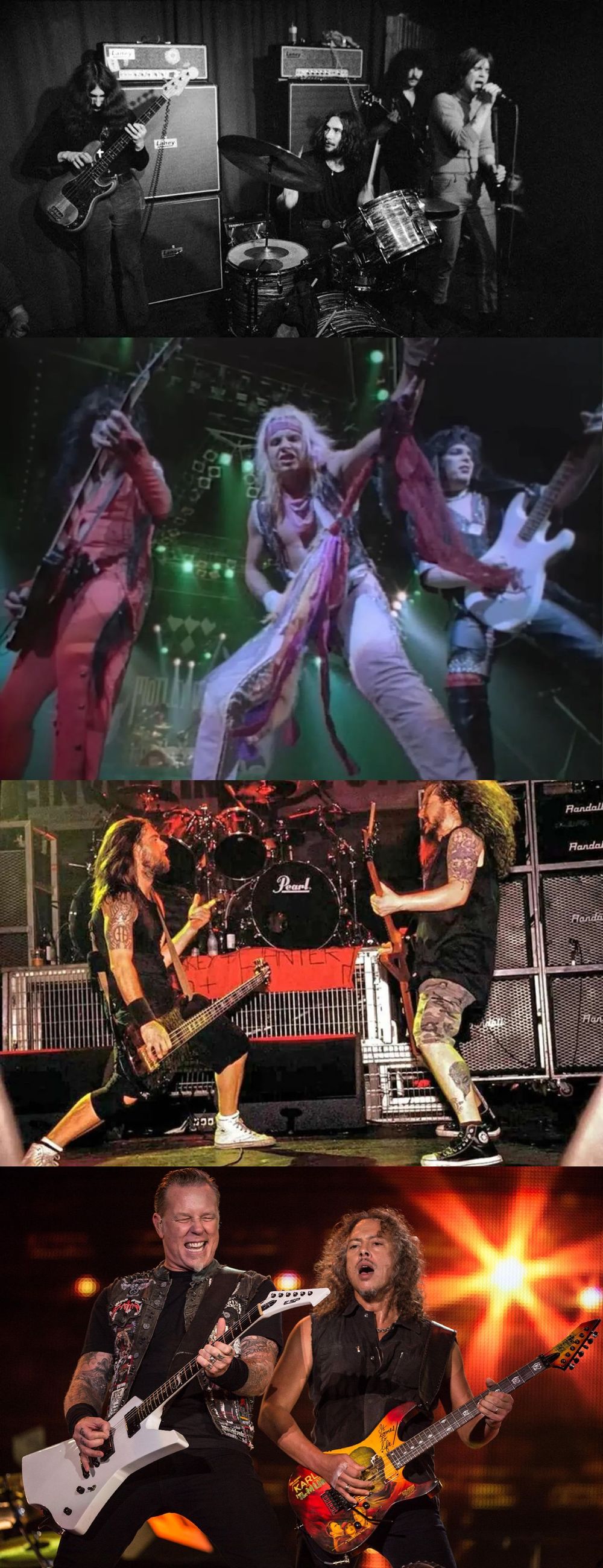
If you were looking for the music genre supertrope, go here: Heavy Metal
One of the most frequently misunderstood genres of popular music, tracing its origins back to the late 1960s, as the hippie movement rose and fell and psychedelic hard rock bands began to proliferate, bringing with them a new, hard-edged style of guitar playing. When the acid rock bands began adding more lightning and thunder to their music, something new was born. Something big.
And that something was Heavy Metal.
The source of the name "heavy metal" is, like most things to do with metal, hotly debated. Those who prefer a more "high culture" or "respectable" inspiration point to characters called "the Heavy Metal Kid" and "Heavy Metal People" in works by William S. Burroughs. More lowbrow types often point to the line "heavy metal thunder" as a metaphor for the sound of motorbike engines in the proto-metal hit "Born To Be Wild" by Steppenwolf. More generally, the word "heavy" had been used for a long time among hippies to mean "serious" or "depressing", and some people point as well to the group of often-toxic chemical elements known as "heavy metals" in chemistry. Some claim that "heavy metal" is merely a natural progression of heaviness from "hard rock" and "heavy rock" (i.e. suggesting an even harder brand of music) so the term was inevitable. When it was first used and when it gained mainstream use is debated, but few deny that it was a well-established term in music by at least 1975, though it was used interchangeably with 'heavy rock' and a multitude of hard rock bands from Rush, to Queen, to AC/DC were all labeled heavy metal, even if most didn't consider themselves such, tried to avoid the label, or weren't metal to begin with— even Aerosmith was at one point called an "American heavy metal-rock band!" This has led to a bit of confusion, with few of the aforementioned bands being mentioned in the same breath as metal these days.
But who strummed the first metal riff? Surprisingly, many consider The Beatles' "Helter Skelter" the first heavy metal song while the electric guitar legend Jimi Hendrix is credited as a major inspiration with the story that a supposed music magazine article described his music as "like bars of metal raining down on the stage." Other potential starters include Led Zeppelin in 1969, Blue Cheer in 1968, and, going back even further, Link Wray, who recorded the heavily distorted Proto Punk instrumental "Rumble" in 1958.
Few, however, deny that the undisputed forefathers of the genre were an obscure little band from Birmingham known as Black Sabbath, who fused these chaotic sounds with morbid Crapsack World imagery and galloping rhythms, as exemplified by the slow-building, satanic-sounding first track off of their 1970 debut album, which would in turn develop into the metal we all know and love on their following albums (their sophomore effort Paranoid sometimes being considered the first all-out metal record). Tony Iommi's distinctive crunchy, aggressive guitar riffs became wildly popular with young people on both sides of the Atlantic, much to the consternation of their parents and the newly un-hip '60s "flower generation". Despite the controversy (which would persist and mutate into different forms as heavy metal itself evolved), Black Sabbath enjoyed brisk album sales and a sizable fan-base as their mixture of dark lyrical themes, intense bursts of speed, riff infestation, plodding tempos, and technicality exploded forth into history.
If Black Sabbath were the Trope Makers of heavy metal, then the classifiably contentious Deep Purple could potentially be considered the trope codifiers, being held back by a keyboard-driven, catchier sound with a more old-fashioned, mid-boosted guitar tone but nevertheless influencing an entire generation of metal musicians to come. Providing a faster, smarter variation of Black Sabbath's crushing riffwork, they mixed razor sharp riffs, agile leads, and one of the earliest examples of the dramatic, high-pitched vocals and searing "Metal Scream" that became almost synonymous with metal in the mid-to-late 1980s. Fast-paced burners like "Highway Star" stripped away Black Sabbath's doomy blues baggage, providing a sound that was nothing short of revolutionary, later on being taken to the nth degree by the first self-conscious metal band, also often considered the trope codifiers, Judas Priest. Abandoning the more classic hard rock sound of their debut, they picked up where Sabbath left off on their sophomore album, Sad Wings of Destiny, with similarly plodding and bass-heavy guitar riffs. They would further innovate a punchier, gallop like sound on tracks such as "Dissident Aggressor" and "Stained Class" and a "rev your engines go" approach on "Exciter" that anticipated the speed metal and thrash metal movements of the 1980s. Unfortunately, the genre's sound turned out to be too revolutionary for the conservative '70s rock scene and heavy metal enjoyed limited mainstream success at this time, with almost all of the mid '70s metal bands remaining small, unsigned, and having been forgotten (and in some cases Vindicated by History) while leaving the progressive, glam, and heavy rock bands of the day to merely experiment with heavy metal but never adopting the sound in full.
Heavy metal largely fell under the radar in the mid to late 1970s as Deep Purple disbanded and Black Sabbath began to fall apart at the seams; both bands were considered the flagships of the genre with few others taking up the role. With heavy metal not only a dying trend but also an undefined label given to bands with negative press, there needed to be some sort of cohesive movement, one that would give heavy metal its own image. The new sensation of punk music provided much of the aggression of heavy metal in a more raw, stripped-down package to appeal to a music-buying public sick of the theatrics of Progressive Rock and sluggish tempos of the remnants of classic rock. However, the success of British punk bands was providing fresh inspiration to a new generation of metal musicians, who blended the gritty, street-smart anger of punk with the drama and thunderous bombast of heavy metal. In late 1979, the New Wave of British Heavy Metal (NWOBHM) exploded onto the British music scene, bringing with it new bands like Motörhead, Iron Maiden, Def Leppard, and more that were faster than Sabbath, louder than Priest, and angrier than The Sex Pistols. Soon, even the classic metal acts were signing into this new movement, with new and uncompromising releases from Judas Priest, Black Sabbath, and Dio. The collapse of the original punk scene brought even more wind into heavy metal's sails and metal bands began springing up, not only in the UK, but all over America and Europe, and as the genre's success grew, three very different movements were coalescing within a once more-or-less unified genre.
The first movement came from when punk rock's own offspring, the nastier, noisier, more aggressive Hardcore Punk, trickled down into a metal scene already amped up on punk rock rage. When hardcore punk bands such as Minor Threat and Black Flag brought heavy music to the fastest it had ever been, many within the metal scene decided to beat them at their own game and turn it up to eleven. British band Venom's 1981 album Welcome to Hell was perhaps the first prominent fruit of the budding extreme metal subculture. Blisteringly fast, stupendously aggressive, and unabashedly offensive with its lurid Satanic imagery and violent themes, Welcome to Hell was perhaps the most aggressive album ever released at the time, and became a lightning rod for controversy from people who claimed that it was subversive, Satanic, and encouraged all manner of social ills. This, of course, only made it more popular with rebellious youth. European Speed Metal bands began to one-up each other in aggression, creating a massive metal arms race of chainsaw guitar riffs, frenetic drumming, and new vocal styles that mutated the high-pitched wail that had now become the definitive metal voice into nearly incomprehensible shrieking and gibbering. These early extreme metal albums were raw, uncompromising, and hostile, attracting a small but loyal following of hardcore fans, but were too unpolished and off-putting to crack the larger music world.
Meanwhile, thousands of miles away in southern California, a clique of like-minded musicians were working on a curious fusion of socially conscious street punk and the more melodic, intellectual strains of NWOBHM as a second wave of social upheaval began to sweep America in the first half of The '80s. The seeds of what would become Thrash Metal were being sown with provocative, often sarcastic lyrics, a rigid, driving sense of rhythm, and extensive use of palm-muting, which was used to create long, choppy, often highly intricate staccato passages with a crunching, almost mechanical sound. This new sound had much of the aggression of European extreme metal (which was still several years away from achieving significant recognition in the US) but a much higher standard of musicianship and a more social, political bent (which would become Flanderized in the later 80s into what some called "CNN thrash"). Thrash metal baffled listeners upon first listen, and even followers of other, lighter forms of metal were perplexed by thrashers' penchant for the complex and the unstoppably fast.
Metallica were the first thrashers out of the gates with their 1983 debut Kill 'Em All. The distinctive guitar styles of James Hetfield and Dave Mustaine (the latter of whom had already been ejected from the band by that point, but arguably had far more impact on Metallica's early style than his replacement Kirk Hammett) and tougher, more masculine imagery of the band themselves were a hit, and they were quickly joined in the scene by bands like Exodus, Megadeth (masterminded by an enraged Dave Mustaine trying to one-up Metallica), Testament, Slayer, and others. The thrash movement spread across the US but truly found second homes in the East Coast, where Anthrax and Overkill infused an extra dose of punk elements to create a pounding, crowd-pleasing "mosh" rhythm and acerbic Deadpan Snarker attitude, and in Germany, where it intermingled with European extreme metal to fuse the best of both worlds, spawning bands such as Kreator, Sodom, Tankard and Destruction.
At the same time, the music industry had gotten wise to the burgeoning success of heavy metal and begun making a more accessible, radio-friendly version, infusing metal elements into glam and arena rock to create a form of music that has at different times and places been called "glam metal", "pop metal", "Eighties metal" (a serious misnomer as there were plenty of other forms of metal at the time), "Hair Metal", "cock rock," and other more unflattering terms (some, like glam metal, often get confused with '70s Glam Rock). Causing tension among metal fans as to whether it belongs as part of the genre, and more or less laughed at nostalgically in retrospect, Glam metal featured a bouncy, dance-friendly beat with an exaggerated, echoey snare tone, a mixture of loud distortion and radio-friendly guitar work, a scaled-back, more rockish variant of the Metal Scream, very polished, pop-esque production, a sleazy Hotter and Sexier image with androgynous musicians in highly sexualized outfits, and raunchy lyrics that often centered around prostitution, sex, drugs, partying, and L.A./Vegas nightlife. While reviled by the core metal faithful from its very inception, glam metal became outrageously popular, and many classic metal bands like Tygers of Pan Tang, the ever-changing Scorpions, briefly but by far most notoriously Judas Priest, and most successfully Def Leppard jumped on the bandwagon after the diversification of the metal genre took the wind out of NWOBHM's sails. And, despite its negative connotations, the genre gave rise to highly regarded musicians such as Sebastian Bach, Slash, and Rick Allen, and was the first major gateway into other forms of metal.
One far less known genre of heavy metal was born during this period and hailed little attention: Doom Metal. Doom arose directly from Black Sabbath and other '70s proto metal groups rooted in the blues, such as Pentagram, Sir Lord Baltimore, Lucifer's Friend, Captain Beyond, Blue Öyster Cult, and others, but it didn't truly grow until the early '80s with the arrival of Saint Vitus, Trouble, and Witchfinder General. It faced brutally stiff competition throughout the late '70s and '80s from genres such as glam metal and the emerging thrash, speed, and power metal scenes. Many doom metal bands relied on mid-paced to slower-paced riffs, and focused more on personal themes of sorrow, depression, and death, which were a departure from the usual themes of sex, drugs and rock n' roll, aggression, sword & sorcery, and anti-Christianity/Satanism commonly associated with the genre. The lack of speed in particular led to it being ignored by fans more used to the faster paced styles of metal, and it was generally ignored by mainstream media as well. It wasn't until Candlemass's 1986 album Epicus Doomicus Metallicus that doom enjoyed its first bout of commercial attention. Nevertheless, in the face of more commercial genres such as hair metal, more aggressive genres such as thrash and death metal, and more traditional genres such as power metal, doom metal remained a niche genre; though, with its dirges and sludgy guitar tones, it did wind up directly and indirectly influencing more than its fair share of genres and musicians, some of which would come back to haunt metal in the future.
The period between 1983-1991 is widely considered the golden age of heavy metal and was the zenith of the genre's popularity and influence and filled with many of the genre's most esteemed classics, but even in these heady years, there manifested the forces that would soon send metal spiraling downward. As the Eighties progressed, the formerly quite distinct divide between American and European metal blurred and the various strains of metal began to hybridize. In continental Europe, the "vanilla" heavy metal had taken a different path from that in the US, becoming more and more refined and intellectual in nature as a contrast to the raw fury of extreme metal. While the Power Metal Sub-Genre had analogues in American bands like Queensrÿche and Manowar, it was far more popular in Europe, where bands like Iron Maiden (not a power metal band itself, but the first significant "thinking man's" metal band and the most important progenitor of power metal), Helloween, Yngwie Malmsteen's Rising Force, and others were wowing metal fans with high-flying instrumental theatrics and escapist, fantasy-oriented lyrics. Power metal would eventually trickle back into the US and fuse with progressive rock, which was by then losing the bad reputation it had acquired in the 1970s, to spawn a host of new "white-collar" American metal bands like Queensryche, Fates Warning, and Crimson Glory.
Thrash metal also felt the influence of power metal. Thrash had always had a technical, "musician's music" streak with its penchant for lengthy compositions like Metallica's "The Four Horsemen" and Exodus' "Deliver Us to Evil" and noodly shred guitar solos, but a new wave of "technical thrash" or "tech thrash" bands took this to an extreme. Bands like Forbidden, Toxik, Watchtower, Coroner, and Heathen reveled in multilayered compositions and tricky, jagged rhythms, and even the more mainstream elements of the subgenre got in on the act — Metallica's 1986 and '88 albums Master of Puppets and ...And Justice For All had songs that approached the ten-minute mark and Dave Mustaine recruited a succession of guitarists from the highly musician-oriented jazz fusion scene (most notably neoclassical virtuoso Marty Friedman) for Megadeth, their practiced chops providing a striking contrast to his wild and creative leads. Two and three-guitar bands proliferated as guitarists throughout the metal scene reveled in playing off each other and dueling with elaborate solo passages.
The harsh, extreme metal-influenced German strain of thrash was now also taking root in America, and a number of bands in California and Florida were putting a violent new twist on it. The new Death Metal scene resembled thrash but was clearly not thrash, with heavily down-tuned, percussive, hammering riffs, a fixation on gruesome, horror movie-like violence, and the harsh screaming of ordinary extreme metal being further mutated into gurgling, monstrous growling noises. The impact of Possessed's Seven Churches and Death's Scream Bloody Gore was felt on both sides of the Atlantic, signaling a new wave of extreme metal as death metal took the US metal faithful by storm and Europeans, especially in Sweden, put out their own variations on the genre.
By 1991, hair metal was more hair than metal with the only judge of a band's worth being their flash and their love ballads. Fourth and fifth generation glam bands were incredibly processed and cookie cutter in nature, with their only resolve being 'make money and get women', leaving their musicianship to be a passing after thought and their song structures being very simple and corporate "Verse-chorus-verse-chorus-solo-chorus." The genre hollowed out, and as The '80s turned into The '90s, even as the record industry got drunk on the genre's success and former bad boys Metallica came within a hair's breadth of taking home a Grammy award, the scene suddenly collapsed.
Then came Nirvana. The Seattle Grunge band released their opus, Nevermind, in 1991, which signaled a sea change not just in hard rock, but in popular music in general. Suddenly the youth of the Nineties had found their icon, which not only reflected the angsty new cultural zeitgeist, but seemed simpler and more "authentic" than the glam scene which had now become the face of heavy metal to most people, and wasn't as unapologetically anti-mainstream and inaccessible as thrash and power metal. The scene initially brought in a wide variety of fans from all across the hard rock landscape, from the rawest of punk to the most meticulous of metal, with many metal fans even considering grunge to be a form of punk metal — but it soon became clear that something had changed. The grunge movement soared to prominence in the music scene with the same sort of overwhelming force as punk in the late 1970s and, ironically, heavy metal itself in 1979-81; many of the metal acts that were signed to major music labels were betrayed by their own publishers and sidelined in favor of hip new alternative rock bands. Some metal bands, most notably Metallica with their softer self-titled "black album" and former glam metallers Pantera, who abruptly broke all ties with their past in favor of a stripped-down, testosterone-heavy sound on 1990's Cowboys from Hell, managed to achieve commercial success during this time and keep the metal flag flying. Still, other metal bands, faced with the choice of abandoning their scene or being buried, simply quit. Grunge, once seen by some metalheads as a breath of fresh air and even a return to "real" hard rock and metal, had become the driving force behind metal's decline from mainstream relevance, and as a result the genre became the subject of backlash from the metal community. With the much more simple and down to earth Alternative Rock now the preferred form of rock music by the youth, metal had become irrelevant. Bands that had placed all their trust in their label, be they traditional, thrash, or extreme metal, had only two options: split up, or listen to record executives and "go grunge." By 1993, heavy metal was being used as a punch line on Beavis And Butthead, and 2 years later, Headbanger's Ball was abruptly cancelled. By 1996, with Alternative Rock, Pop Punk, and Hip-Hop the dominant forms of youth music, long hair and guitar solos were deemed "uncool" and metal was stuck between irrelevance and archaism.
The genre seemed dead.
The period between 1992 to 1997 was the Dark Age of Heavy Metal. During this time, anything that was once glorified by metal was now vilified, and the theatrical, technical, and excessive natures of metal became a reason for headshaking and scorn as Alternative's Three Chords and the Truth ideology became mainstream. Stacking the odds against metal further was the stratospheric success of hair metal in the '80s. This brand of metal was advertised extensively thanks to MTV, and thus, metal became heavily stigmatized in the mainstream with goofy connotations of big hair, macho posturing, overt sexism, pigheadedness, an obsession with destruction, and unrealistic opulence.
Despite this popular narrative, metal never actually died. The fall of mainstream pop metal resulted in the underground bubbling up and the creation of new and even more extreme subgenres.
Though pop metal was off the charts in the US, it was reaching its zenith in other parts of the globe. One such place was Europe, where glam metal and grunge had much less impact than in the US. Just as Britain was contending with Madchester and the earliest days of Britpop (essentially their own version of Grunge), German act Helloween rose from a second-tier speed/power metal act to an overnight success with their Keeper of the Seven Keys duology, which focused on catchy vocal melodies, a much Lighter and Softer tone, and influences from synthesizer-heavy European pop music, spawning hundreds of imitators throughout The '90s. Dream Theater created a modest but enduring fanbase by taking the progressive rock influences of power metal and running with them, merging metal and prog-rock into a unique sound that gained a following with people who wanted something "smarter" than grunge. Their sophomore effort Images and Words sold 800,000 copies despite being released at the height of the grunge craze. The success of Pantera is credited with having kept metal from completely vanishing from mainstream attention during this period, with the band's unique groove-laden style connecting with millions of fans and spawning the appropriately named Groove Metal subgenre (which would itself inadvertently lay the groundwork for another, much more contentious subgenre later in the decade). Industrial Metal rose to commercial prominence due to its strong association with alternative rock by mainstream listeners, leading bands such as Nine Inch Nails and Ministry to receive heavy MTV/rock radio airplay and play the main stage at Lollapalooza, while Rammstein emerged from Germany's Neue Deutsche Harte scene to become one of the country's most internationally successful metal bands. Black Sabbath survived by ignoring most of the developments of the 80s and returning to the stomping, bluesy proto-metal that had carried them through The '70s, culminating in a brief resurgence of fame as they reunited with former frontman Ronnie James Dio for the 1992 album Dehumanizer, which is still highly regarded to this day. Death metal, a niche genre to begin with, maintained a small but devoted fanbase, with an up-and-coming band from Long Island by the name of Suffocation making a particularly big splash in 1991 with their Roadrunner debut Effigy of the Forgotten, which combined extreme heaviness and technical proficiency to create a new style of death metal that would slowly but surely shape the scene to come. Also, a group of musicians in Norway had turned the chaotic extreme metal scene into a coherent musical movement that would gain notoriety far beyond its small fanbase.
This new movement was called Black Metal, an evolution of the violent extreme metal bands of The '80s that was fiercely independent, virulently anti-mainstream, and even more provocative than its antecedents. Many of them believed that metal was doomed the moment it courted the mainstream, and cultivated a sound that was as exclusive and "out there" as possible. With deliberately muddy production, extremely harsh soundscapes, and anti-Christian lyrics that ranged from God Is Evil to literal Satanism, black metal was the ultimate in cult fandoms (and some people have literally compared the early scene to a cult). While the movement was very small, often with album sales in triple digits, black metal musicians became most identified with a sort of cultural jihad against Christianity, with outrageous anti-religious statements, disturbing imagery featuring Satanic symbols, bondage gear, and ghoulish makeup, arsons and other attacks on churches and other Christian cultural sites, and identification with Norse mythology (whose association with Those Wacky Nazis was milked for all it was worth). The scene spread slowly but surely, first in Scandinavia and then worldwide, with black metal bands springing up in America, Eastern Europe, and Japan.
Other genres also began reaching their stride or were born during the Nineties, and it was during this time that metal's speed began to max out at abominably fast tempos. Punk had been mixed with metal as far back as the seventies to produce NWOBHM and thrash metal, but in the late '80s, metal started returning the favor and several new strains of "punk metal," such as Metalcore, Crust, Crossover, and Grindcore began to emerge, each varying in their proportion of metal and punk. Metalcore focused primarily on mixing the virtuosity of thrash with the rawness of hardcore punk (moreso than thrash already had), hence the term 'metalcore'. Compared to thrash, metalcore was more reliant on breakdowns and varying between clean singing and gravel growling. Crust focuses heavily on punk, and relies almost solely on guttural vocals. Crossover thrash is a more balanced mix of thrash and hardcore punk (moreso than metalcore), and follows thrash's jagged patterns with hardcore punk's straight-edge power. Grindcore emerged in Britain and the United States as one of the most extreme subgenres to date, with bands such as Napalm Death and Anal Cunt pushing punk and metal to their absolute limits of speed and aggression (often within absurdly short songs). While employing techniques such as guttural screaming, Grindcore introduced the blast beat, a form of drumming born from '80s punk with tempos reaching nigh-ridiculous levels, such as 250 bpm and higher. The stylistically closer to Hardcore Punk genre, powerviolence with punkier everything of what grindcore is, also began to emerge with Siege, Spazz and Man Is The Bastard first to play this style.
On the opposite side of the speed spectrum, the ever Sabbathine doom metal finally caught hold of a sizable underground market and saw itself expand, adopting sounds as far as Folk Metal and extreme metal. This update to doom's unapproachable sound widened its audience while its perpetual underground status kept it from being warped by the mainstream. From these points, doom metal began to evolve on its own and subsequently split into four more genres— Drone Metal, which featured drawn out chords and completely lacked traditional musical progression for the sake of hauntingly bizarre soundscapes; Gothic Metal, which fused doom's self-deprecating style with thrash metal and sometimes death metal to produce a symphonic mixture of Goth and metal; Stoner Metal, a fuzzy, sludgy genre which rose with stoner rock (a genre that gained quite a bit of popularity alongside Grunge) as an attempt to recapture the feel of Seventies psychedelic/blues-based heavy rock with occasional influences from hardcore punk; Sludge Metal, which fused hardcore punk and doom metal and often added in the fuzzed guitars of stoner metal to create what could be called a Spiritual Successor to the heavier, more abrasive side of grunge, while the lighter side evolve into Post-Grunge. Somewhere in between, a more pop-friendly counterpart of sludge comes Alternative Metal.
The few bands who were influenced by all that decided to experiment as much as they can while staying metal Taking Progressive Metal and added so much more prog elements, lo and behold, Avant-Garde Metal is born.
As new genres such as alternative metal and progressive metal thrived alongside the aforementioned scenes in the underground, and the decline of grunge began in the mid '90s, rumors began to circulate and speculation rose: was heavy metal about to stage a comeback?
The tide began to turn for heavy metal as The '90s gave way to the Turn of the Millennium. The resurgence of heavy metal had a start of sorts with Nu Metal (or Nü Metal), which is extremely controversial, to the point where (much like hair metal) arguments about its metal status even occur on this page. Nu Metal took all the disparate developments from the Dark Age of Metal and mixed them together, producing a nearly avant-garde mixture of Alternative Metal, Industrial Metal, Thrash Metal, Goth, Groove Metal, Grunge, Hardcore Punk, Hip-Hop, Post-Punk, Sludge Metal, and Post-Hardcore (though far from all bands would rely on each and every aspect). Nu Metal was unique for its time, at the very least, and its "chug" riffs, pseudo-death growls, extensive breakdowns, hip-hop influences, and angst-ridden themes of inner demons and personal struggles were popular among teens and tweens from the late '90s to the early 2000s, but never caught on with the actual heavy metal community, and the genre was slapped with the derisive label "mallcore" by its detractors. Despite this, nü-metal achieved a level of commercial success that simply hadn't been matched by other metal subgenres, with some bands even outselling '80s pop metal acts, registering it as the most successful 'metal' has ever been. During this time, even veteran bands such as Slayer and Metallica experimented with the genre, much to the dismay of diehard fans. Following the early success of Sepulturanote and Coal Chamber, and the meteoric rise of Korn and Limp Bizkit, a wave of Nu Metal bands erupted, and bands such as Slipknot, System of a Down, Deftones, Linkin Park and many others became the biggest 'metal' bands in years, and although some of these bands also don't consider themselves metal, nu metal remains a gateway for many, much as glam had been over a decade prior.
In 1999, the music industry reached its peak, with record sales generating $40 billion in revenue. Nu metal commanded and led this pop music blitzkrieg, and soon its nickname 'mallcore' played into effect as those who once shunned metal (i.e. mall dwellers such as jocks and preps) began following bands without knowing anything about the music, its history, or the style. Nu metal's blending of industrial, rap, and hard rock made it the darling on MTV. In fact, it was MTV that pushed this scene the most, marketing it as the faithful return of heavy music with a more musically diverse twist, and nu metal thus enjoyed much airplay. A new generation of fans were brought into the fold, many of whom had grown up never having heard of the likes of hair metal or NWOBHM. The divide between older metal fans was visible, as many of the supporters of traditional metal felt that this new style simply lacked the power, virtuosity, and draw that older genres had, while fans of nu metal thought that most old-school metal was simply "outdated." Coupled with Post-Grunge and the early days of Emo, though people were saying metal was back, it still seemed the classic idea of the genre was nowhere to be seen.
While Nu Metal died out by the mid 2000s, a more traditional form of metal with more focus on technicality and melody arose. Dubbed "The New Wave of American Heavy Metal", Metalcore bands such as Shadows Fall, Lamb of Godnote , Trivium, Chimaira, and Killswitch Engage became the metal of choice for the mainstream metalhead. Some of these bands, such as Avenged Sevenfold and Bullet for My Valentine, were much more radio-friendly and emo-influenced, and were derided by traditional metalheads as "mallcore"; while the heavier and more technically proficient bands such as the aforementioned Shadows Fall and Chimaira were all too often lumped in with the latter. This scene fell off in popularity in the early 2010s.
Three new subgenres of note emerged in The New '10s — Deathcore, a mixture of Death Metal and Metalcore which, like hair metal and nu metal before it, has become bitterly polarizing within the metal community, and Djent, a polyrhythmic style of groove metal highly influenced by bands such as Meshuggah and Periphery, while Dubstep artists took notice and created a Darker and Edgier, far more metal-influenced version of their own genre named "brostep", or better known as "metalstep". It was also during this time that a new generation of metal musicians took advantage of the rise of social media and established themselves as influencers, with creators such as Jared Dines, Stevie T, Bradley Hall, 331Erock, and others amassing large online followings with content that ranges from tongue-in-cheek metal covers of songs from other genres to comedic skits that poke fun at various aspects of the metal subculture. The trend of royalty-free and later fan projects using AI-generation metal songs has also saw its birth here.
Meanwhile in Japan, a unique subgenre known as Kawaii Metal arose, taking the country, East Asia, and eventually the world by storm. Groups such as BABYMETAL, Ladybaby and Deadlift Lolita made it possible to combine the cuteness of J-pop with the brutality of metal, and at least in BABYMETAL's case, received acclaim from Western metal acts.
Since then, we've seen a series of ups and downs in popularity but today, heavy metal continues to change with the times. With the popularity of the Internet, metal fans have largely eschewed music television and radio — which have become almost entirely centered on pop and rap — and instead focus their interests as a community and welcome those who find their way into this culture. Meanwhile, the mainstream has also embraced metal in most of its forms, with many celebrities being self-professed metalheads. Trends in metal change — from alternative metal to metalcore to deathcore to djent — but metal fans continue to expand their horizons while awaiting the "new Metallica's" arrival.
It's been 50-odd years. Things will change, but the spirit of metal lives on.
The exact definition of heavy metal is a point of contention even among metal fans, but it is generally understood that the most defining element of heavy metal is the "metal riff", a sequence of chords (usually power chords, but not always) that is both melody and rhythm, and exudes a sense of power, aggression, urgency, weight, or various combinations thereof (in simple terms, it's "heavy"). A typical metal song typically uses several riffs instead of the one or two featured in a normal rock song, varying from a mere three or four to more than 10. Vocal style varies widely, but medium to high, dramatic tenors and guttural growls or piercing shrieks or screams are the most prominent vocal styles. Thrash tends towards gruff shouting as part of its punk roots, and some very conservative metal bands have more traditional blues/rock vocals. Soprano and Gravel is popular among "gothic" and "symphonic" bands. Lyrics vary, but the most universal and popular lyrical theme for metal is death. Virtually every metal band that has ever existed has written at least one song concerning death, and it has a similar role as a dependable standby subject as love does in traditional rock music—you just can't go wrong with a song about death. Metal also comes with far more bombast than does hard rock or punk rock. Metal comes in many different speeds as well, from the most insane .0005 second-per-beat Grindcore bands to Drone metal acts who sometimes have no beats within an album at all.
Heavy metal is known for its diverse subgenres and styles, which include:
- Heavy Metal, also known as traditional metal, trad metal, or "true metal" (although that overlaps with American power metal or thrash metal), is the original style. It usually features medium to fast tempos (although some bands are slower) with a high degree of melody and clean vocals. Prominent examples include Black Sabbath, Judas Priest, Manowar and Iron Maiden. Note that what is called Heavy Metal can also be labelled as Power Metal by some, as many Power Metal bands make use of the same tempos as "trad" metal bands. Traditional heavy metal has, in recent years, undergone a major resurgence in the metal underground. This is typically referred to as the New Wave of Traditional Heavy Metal and is oft confused with American Power Metal.
- Speed Metal is relatively hard to pin down, but is generally faster and rawer than traditional heavy metal, with a driving feel. It ranges from relatively tame material like Helloween, to really raw stuff like Venom. It overlaps with both power metal and early extreme metal. Early (1985-1992) X is a good example of speed metal fused with thrash metal and infused with punk sensibility. This is not to be confused with thrash metal, even though their speed often matches each other- speed tends to feature higher vocal ranges and up-tuned guitars.
- Thrash Metal is characterized by its choppy rhythms, frequent tempo shifts, and typically large number of riffs per song. Lyrics tend to be more concrete and less fantastic than other types, often with a political or social bent. Prominent examples include Metallica, Megadeth, Anthrax, Slayer ("The Big Four"), Kreator, Sodom, Flotsam and Jetsam, and Watchtower. The more intellectual forms can overlap with aggressive power metal and the more aggressive forms overlap with death metal. Sometimes mixes with hardcore to form "crossover thrash", as exemplified by Suicidal Tendencies and D.R.I.. To differentiate from speed metal, thrash metal vocals feature more of a growl and the guitars tended to be downtuned in some respects. Expect fans to argue that this is metal at its purest.
- Power Metal has a sort of dual origin, having arisen separately in the US and Europe, and mixed later, which leads to a very sharp divide between US and European power bands. As a rule, power metal is more thoughtful and orderly than most metal, with an emphasis on instrumental ability (but not to the degree of prog metal or tech death) and fantastic lyrics. American power metal, typified by Sanctuary, Attacker, Iced Earth, Omen and Savatage, is usually more aggressive, with influences from thrash and Low Fantasy lyrics. European power metal, typified by Helloween, Edguy, Stratovarius, and Blind Guardian, is usually more melodic, with lots of synthesizers, a distinctive "double bass" beat, and High Fantasy or Sci-Fi lyrics. Some metalheads look down on the less aggressive European power metal and its fans for not being "metal" enough, referring to the genre as "flower metal". Think of American power metal as Robert E. Howard and European power metal as J. R. R. Tolkien. One might also say that power metal is also the most "traditional" (not necessarily retro) of all metal subgenres.
- Relatively recently, Japan's power metal scene has started to produce its own brand of power metal with bands that cues from European neo-classical metal bands such as Stratovarius and Yngwie Malmsteen's Rising Force. As with their European neo-classical metal cousins, Japanese power metal tends to be fast paced and song writing is based heavily on classical music. Examples of Japanese power metal bands include post-1993 X Japan (before 1993, as mentioned above, it was speed metal/thrash metal outside of ballads), Galneryus, Concerto Moon, and Versailles.
- Power metal is also known for the amount of ease that it can be fused with other genres. For this reason, there are umbrella terms like progpower metal for bands that are one part progressive metal and one part power metal such as Kamelot and Symphony X and thrash-power metal for bands that mix thrash metal and power metal such as Iced Earth and 3 Inches of Blood.
- It should be noted USPM and EUPM are actually not really related by origin anymore these days. They're different styles of power metal and there are bands from Europe who play the American style (Brainstorm) and there are bands from the US who are more into the European version (Virgin Steele).
- Early extreme metal is a very raw and chaotic style of music, often with little regard for instrumental proficiency and a fixation with being as aggressive and furious as possible. Venom is the Ur-Example, and Celtic Frost, Bathory (who are the sort of "missing link" between this and black metal), and early Mayhem (who later became a black metal band) important members of the genre. Later evolved into black metal, and mixed with thrash to form death metal. The term "extreme metal" in the modern sense is generally used as a blanket term encompassing black metal, death metal, thrash metal, metalcore, (some) doom metal, sludge metal and other "extreme" sub-genres, along with any other bands that don't neatly fit into any of the aforementioned.
- Venom's album "Black Metal" is often held to be the inspiration for all extreme metal. However, some black metallers have explicitly denied the impact of Venom's music on their work, Varg Vikernes for instance claiming that he thought of Venom as simply an American Motörhead (despite the fact that both Motörhead and Venom are British).
- Black Metal is a development of early extreme metal, featuring tremolo-picked riffs, harsh shrieking vocals, "fuzzy" production, and extremely anti-Christian lyrics (often in conjunction with similarly dark themes such as apocalypticism, misanthropy, and nihilism). The scene has a reputation for violence and criminal activity that is not entirely undeserved. This form of metal is a very niche product and proud to be so, but more commercial offshoots such as Dimmu Borgir and Cradle of Filth have seen some mainstream success. Unfortunately, this is the subgenre that far too many people think of when you mention metal nowadays, if it's not metalcore.
- Due to evolving directly into this genre, the early extreme metal scene is often called "the first wave of Black metal", even though their sound somewhat differs from the early Norwegian scene that codified Black Metal as we know it today.
- Many of the black metal bands who have run with Emperor's symphonic/melodic, synthy black metal sound have deviated so far from the blueprint that they sound more like power metal. Thematic pre-occupations with the devil generally only extend so far as the lyrics, and most modern popular black metal bands have little "kvlt" credibility. Black metal's influence can now be found in most extreme metal bands, and is far from a niche genre - everything from folk (Finntroll) to thrash (Aura Noir) carries examples of genre-crossing from black metal.
- Anti-Christian lyrics are not a requirement for the genre and there is, in fact, a strong Christian black metal scene that parallels the hardline occult side of the genre. However, many fans of the Christian portion of the genre prefer to call it either unblack metal or white metal.
- Despite black metal's connotations of intentional garbage-level production and musicianship, not all bands/musicians keep it tethered to Three Chords and the Truth, with some even bringing in melodic, even progressive, signatures and structures.
- Death Metal is a development of thrash metal, recognized by its gruesome themes involving corpses and gore, and low-pitched growled vocals. Death, Possessed, Morbid Angel, and Deicide are names to know in this style. Started as an American thing, but has a following in Sweden as well. Swedish bands, such as At the Gates, early In Flames, and Edge of Sanity, are lower-key and more refined. Death metal is related to a very extreme offshoot of hardcore punk called "grindcore" that carries a similar ethos. The two often mix to form "death/grind" or "goregrind" bands, which are basically Death Metal carried up to eleven and exemplified by bands with such charming names as Circle of Dead Children, Cattle Decapitation, and Anal Cunt. Death metal has a penchant for really disgusting album covers. This is one of the biggest metal genres today.
- Death metal is also known for its multiple fusion genres, such as with progressive metal (Opeth, later Death albums), NWOBHM (also known as Melodic Death Metal - At the Gates, In Flames, and Dark Tranquillity are generally regarded as the Trope Makers), or power metal (Scar Symmetry). Bands filed under death metal tend to be diverse enough, such that Cannibal Corpse (Trope Codifier for American death metal) might sound to some ears more like Kreator than At the Gates, even though the former is a thrash metal band and the latter, death metal of the more melodic variety.
- Death metal also introduced to the world the "death growl" (also known as 'cookie monster vocals', 'guttural screams,' and 'death screams') which is the aforementioned growled vocals. Whereas thrash metal featured graveling singing styles, death metal has become famous for its vocalists not even sounding human (for a comparison to any who are unfamiliar, imagine a low bear or a lion or, more accurately, a demonic growl although which term is most accurate depends on the vocalist in question)
- Doom Metal is essentially a development on very early heavy metal before Judas Priest and other mid-70s bands sped it up. The emphasis here is on slower tempos- already a huge departure from "traditional metal", huge, crushing riffs, and, often, extremely dark lyrics, with themes such as inescapable depression and the inevitability of death being common. Epic fantasy (of the darker sort) and occultism are also common themes, particularly in the more traditional styles. Black Sabbath is the archetype, with the actual style being codified by bands such as Pagan Altar, Saint Vitus and Trouble. A more "epic" style of doom arose with Candlemass's landmark Epicus Doomicus Metallicus, and was continued by bands such as Solitude Aeturnus and Solstice, and it remains the more popular form of traditional doom metal to this day. Has spinoff styles in the form of, sludge, funeral doom, and drone doom, each of which is slower, drearier, gloomier, and more unbelievably depressing than the last. Another spinoff style that is, surprisingly, less depressing is Stoner Metal, which subsequently spawned stoner rock, that came up thanks to doom metal's penchant for '60s/'70s psychedelic blues rock. There are often fusions with death metal (death doom, though many would owe more to Hellhammer and Celtic Frost than traditional doom) and black metal (often called "dark metal"). Unless it's truly traditional doom metal, this is not for the faint of heart. Alongside power metal, it is considered a traditional metal genre. In 2010, this subgenre, usually under the name "occult rock", has become increasingly popular, and may see an explosion of popularity if it manages to latch on to the previously Emo/Post-Grunge/Nu Metal audience.
- It's also worth mentioning that this genre greatly inspired Grunge music.
- While less of a subgenre than a style that is attached to a previously existing subgenre (usually power metal), Symphonic Metal has become increasingly popular in recent years. Combining aspects of heavy metal with the orchestral drama of film soundtracks and 19th-century classical, symphonic metal features lush orchestral textures, provided either by synthesizers or a proper orchestra, and often female vocals, which are rare in other forms of heavy metal. More extreme symphonic bands often pair a female clean vocalist with a male harsh vocalist for a Soprano and Gravel effect. Therion is the Trope Maker, Nightwish is a Trope Codifier, with other important bands including Epica, Within Temptation, and Rhapsody. Some (but by no means all) power metal bands add some orchestral sounds to their music, but it only really qualifies as "symphonic metal" if the orchestra is a dominant component of the music.
- Also related to symphonic metal and power metal is Progressive Metal, which combines the power and aggression of metal with the instrumental technicality and odd song construction of prog-rock. Some of the bands, like Shadow Gallery, also take on classical influences, while others such as Liquid Tension Experiment have a jazz-fusion influence. The genre tends to be focused on Epic Rocking and instrumental technicality. Some well-known bands in this genre include Dream Theater, Fates Warning, Queensrÿche, Symphony X, Pain of Salvation, Ayreon and the aforementioned bands. There are also quite a few progressive death metal bands around, including Opeth, Atheist, and Cynic.
- Nu Metal is a genre that is seen as a combination of various different styles, including grunge, hip-hop, funk rock, hardcore and groove metal. The guitars are usually downtuned, the riffage isn't particularly complex, and the lyrics are often quite angsty. The normally hip-hop based turntables are often (but not always) used. Rapping is occasionally used. The genre was at its peak in the late '90s and early '00s, where it was easily the most profitable metal genre out there. Bands that fall into this genre (at least at some point) are Korn, Slipknot, Deftones, Limp Bizkit, and Linkin Park. It died out in the mid-'00s, and most bands associated with it either changed their sound or faded into general obscurity. However, it's beginning to see a resurgence in the The New '10s as more and more bands integrate nu metal into their music, with successful results (though not nearly as successful as its prime). The genre is extremely controversial, and depending on who you ask, may not even be metal at all; its commercial success led to the derogatory nickname "mallcore."
- Alternative Metal is the genre from which Nu Metal originated. A rather diverse genre, which, as the title would imply, combines Metal riffs and darkness with Alternative Rock songwriting and musical touches. As mentioned, the genre is rather diverse- the aforementioned Nu Metal, Funk Metal and Industrial Metal are all arguably subgenres of it, and it overlaps quite a bit with Grunge and Post-Grunge, especially on the heavier end. There is also significant overlap between alternative metal, Progressive Metal and Avant-Garde Metal, with the genres forming a continuum for the more "unconventional" side of metal. While not as divisive as Nu Metal, it's still polarizing with more purist metal audiences.
- Metalcore, while immensely divisive among many metalheads, does occasionally fall under the heavy metal umbrella, having two flavors:
- "first-wave" or "traditional" metalcore, which is a fusion of hardcore and various genres of metal (frequently sludge) and which commonly features odd time signatures, astoundingly ferocious shouted/screamed vocals, and frequent experimental elements; as far as metal fans go, this variety is generally well-liked. Important bands in this category include Starkweather, Converge, and Shai Hulud.
- The other one is "melodic" or "pop" metalcore, which fuses Melodic Death Metal with modern breakdown-oriented hardcore music. Its most iconic features are chugging "breakdowns" (where the tempo and musical complexity are reduced for a period and the band rides only one or two chords), disjointed song structures, and hoarse, shouted vocals alternated with clean poppy vocals that tend to be far tamer in range and intensity than usual metal singing. Later bands also take Pop Punk and Emo influences. Bands that fall in this category include Trivium, Shadows Fall, As I Lay Dying, and Killswitch Engage.
- It has a derivative called "deathcore" that adds influences from down-tempo "slam" death metal and grindcore. Later bands also take some influence from nu metal, but not the extent of nu-metalcore (listed below). Notable bands include Suicide Silence, Upon A Burning Body, Job for a Cowboy, and Music/Whitechapel. Job for a Cowboy's debut EP is probably the definitive deathcore record.
- Recently many metalcore bands have begun taking in influences from thrash metal (probably in imitation of Trivium), but most dedicated thrashers are not impressed.
- The '10s have brought a new variation called "entombedcore", which fuses traditional metalcore (now known as metallic hardcore) with Swedish death metal and crust punk, to create an angry, dirty, and abrasive sound. However, rarely do entombedcore bands identify as metalcore, due to the negative stigma of the genre. It's become fairly popular as of late. Important bands include Trap Them, Nails, Xibalba, and All Pigs Must Die.
- There's another sub-genre created in the '10s that's unofficially referred to as "nu-metalcore", which, as the title suggests, is a hybrid between metalcore and nu metal. Specifically it combines the former's use of breakdowns, Soprano and Gravel dynamics, Harsh Vocals, and Metal Screams with the latter's angsty lyrics, rapped vocals, downtuned guitars, and electronic manipulation. Some bands also use turntables, but not all. The reception has been mixed, as you could imagine being a fusion of two controversial metal genres. Bands include Issues, Of Mice & Men, Emmure, and My Ticket Home.
- Sludge metal (found on the Doom Metal page) fuses elements of doom metal and crossover thrash with old school Hardcore Punk, with several bands being influenced by stoner rock and grunge (particularly, The Melvins). There are also several bands that played sludge while incorporating elements of genres such as Death Metal, Noise Rock, Grindcore and Crust Punk. Somewhat peripheral to the metal scene throughout much of the '90s, it was centered around a number of regional scenes, the most notable of which was the New Orleans, Louisiana or "NOLA" scene, which produced such acts as Eyehategod, Crowbar and Acid Bath, while a thriving North Carolina scene produced Corrosion of Conformity and Buzzov* en. The genre was brought to prominence in the mid 90s when now-former Pantera vocalist Phil Anselmo formed Down, a side project which brought together musicians from several major sludge bands. In the 21st century, a new scene emerged in Georgia which gave sludge metal with a progressive, psychedelic rock edge, including Mastodon, Baroness and Kylesa. Many bands, including Isis, Cult of Luna and Pelican, took a Neurosis-inspired sound and incorporated more prominent Post-Rock influences, forming a style now known as post-metal (found on the Post-Rock page), sometimes called "atmospheric sludge". Both of these newer styles tend to be looked down upon by sludge purists, and many would argue that the post-metal bands shouldn't be considered a part of sludge metal.
- It introduced the extremely popular D-tuned guitar tone, which is one cause of its fuzzy n' sludgy, tar-esque guitar work. Born with the punk acts of the early '80s and codified by Grunge bands such as The Melvins and Mudhoney, it was adopted in spades by Nu Metal and Post-Grunge, for better or for worse, which led to the chord ultimately becoming a staple of modern rock.
- Folk Metal is a style fusing the folk melodies, often (but by no means only) Celtic or Finnish, with metal, usually from one of the more peripheral genres. Its sound ranges a spectrum from black to power metal, with vocals also ranging from growl through Soprano and Gravel to clean singing. What's, then, characteristic of this style, lies (not unlike symphonic metal) primarily in the instruments and themes it uses; you can expect a folk metal band to use at least one violin, or some less common, often traditional, instrument. The lyrics tend to center around a given theme, related to the people whose traditional sounds the band is emulating. The genre started with Skyclad (1990) and Cruachan and Orphaned Land (1994), and earned its respect in 2000s.
- Groove Metal (also known as post-thrash metal) is a style that emerged in the early 90s which takes the guitar style, aggressive vocal delivery and technical skill of thrash and fuses with more hard rock-esque song structures and slower tempos. As its name suggests, it has a greater emphasis on rhythm and "groove" than thrash metal. Debates rage as to whether the true originator of the style was Exhorder or the Genre Popularizers Pantera, but in either case it was something of a commercial peak for the genre in the early 90s before the dominance of Nu Metal - Pantera's seventh album Far Beyond Driven debuted at no. 1 on the Billboard charts in the US, easily the most extreme album to do so at that point. Later notable bands in the genre included Sepultura, Throwdown, Machine Head, and DevilDriver.
- Related to groove metal is Djent, a style that fuses the slow rhythms and bending riffs of groove with the technical proficiency and odd time signatures of progressive metal. Swedish metal outfit Meshuggah are widely credited as its originators, with their blend of downtuned start-stop riffs, dirge-like atmospheres, and heavily syncopated drumming gaining a cult following among metalheads. Bands such as Mnemic, Scar Symmetry and Deftones drew heavy influence from the Meshuggah sound and combined it with more melodic and electronic overtones to create a sound more suited for an emerging tech-savvy milieu, who would later go on to self-produce their own music in the style. Referring to it as a genre tends to be rather contentious, as it is defined by a specific style of guitar playing more than anything else, and the bands classified as djent can range from mainstream-friendly metalcore, nu metal, or prog-metal acts such as Periphery and Architects, to more extreme bands influenced by death metal, drone metal, and industrial metal such as Vildhjarta, Humanity's Last Breath, Car Bomb, and Strapping Young Lad.
- Avant-Garde Metal, also called "art metal" and "experimental metal", is a subgenre of metal characterized by innovative, unconventional, and eclectic musicianship heavily influenced by Avant-Garde Music and World Music, resulting in a bizarre, abstract sound that is extremely difficult to pigeonhole. The genre has rather mysterious origins, with precedents in bands such as Celtic Frost, Dream Theater, and Therion, but it later came into being in The '90s amidst the rampant experimentation that also gave rise to Alternative Metal and Nu Metal. Korn, Mr. Bungle, System of a Down and Roots-era Sepultura have been credited for the genre's emergence in the West, while it developed independently in Europe and Asia thanks to more extreme acts such as Meshuggah and Dir en grey that sought to push the limits of what can be considered acceptable in metal. The genre experienced massive shifts in popularity throughout its history - it was an unfortunate casualty of the decline of its more accessible counterparts, but managed to explode back in vogue in The New '10s as many new metal bands sought to stand out in a scene dominated by retro-metal pandering and soundalike "mallcore" bands. Due to its postmodern aesthetic that seeks to defy genre stereotypes by way of Genre Mashup and Genre Roulette, it is often the go-to label for metalheads to label bands that are too difficult or too bizarre to be classified under any other metal genre, examples include Diablo Swing Orchestra, BABYMETAL, Sound Horizon, and System of a Down.
- Speaking of BABYMETAL, related to avant-garde metal is kawaii metal, which well, a metal genre where you take a traditional metal vocalist out of the band, and in their place you put a Japanese Idol Singer in, combining J-pop's idol culture and general cuteness with metal's aggressive instrumentation. It could range anything from Hair Metal to Black Metal or deathgrind. Beside BABYMETAL, there is also Ladybaby and Deadlift Lolita.
For related tropes, see Heavy Mithril, Epic Rocking, Soprano and Gravel, Metal Scream, Black Metal, Death Metal, Thrash Metal, Hair Metal, Doom Metal, and Progressive Metal.
