
Many magazines are created to fulfill a specific interest, and their name is Exactly What It Says on the Tin — Game Informer shows Video Game news and reviews, Shonen Jump shows Shōnen manga, and so on.
Some magazines, however, are not as wedded to their original concept as others. Meddling executives at your magazine realize that they could attract more people in your demographic by, say, adding some dirty humor to your video game magazine. Or adding celebrity gossip to your housekeeping magazine. After all, housewives like housekeeping and/or George Clooney, so why not combine them? (Adding in ever-more celeb gossip figures in more than half of the below examples).
Some changes can be chalked up to the changing landscape of print media, especially considering the competition with new media — traditional comics give way to Web Comics with an Infinite Canvas, news magazines give way to news websites that can be easily up-to-date, actual print gives way to e-books and the internet, and so on.
See Network Decay for the television and radio equivalent. See also Artifact Title, They Changed It, Now It Sucks!, and Bishōnen Jump Syndrome. Public Medium Ignorance may be a cause for some of the listed magazines. If it starts overlapping with politics, then it can cross over into Strawman News Media.
Nothing to do with characters having to reload their guns more frequently.
Examples (sorted by original media focus):
- Details was originally an independently-owned gay activist magazine. It was bought out by Condé Nast and relaunched as Vogue for straight guys.
- Newtype USA's last issue was in February 2008, due to the fact that ADV was stuck in a crappy contract with the Japanese (pay all the costs, get none of the revenue, you get the idea) and wanted out. It was immediately replaced with PiQ which covers not only anime and manga, but also American comics, movies, gaming, and similar subjects. While technically a separate magazine, Newtype subscriptions carried over to PiQ and since the Newtype name was licensed, it wouldn't have made sense to keep the name when changing the magazine content. At any rate, it only lasted four months.
- Animeland was the very first (1991) anime magazine in France. It dealt with Western Animation in addition to anime, and occasionally had articles on very old series. Since the 2000s, it's been imitating its rivals by solely focusing on recent Japanese shows, and adding more and more articles on Japanese culture.
- Megami Magazine had a major shift changed that pretty much reduced the amount of nudity shown in its eroge section to nothing while censoring all tits as well as removing the H-OVA section. While it still does cheesecake pinups, it has stopped doing Wholesome Crossdresser pinups. Nyantype, a spinoff of Newtype magazine except with more Mecha has picked up the slack for the cross-dressing part.
- Sport Compact Car, during the era Dave Coleman worked there, was notable for being pretty much the only "import car" magazine that didn't feature bikini babes sprawling over ridiculous show cars. Instead, you had a (often freakishly-thick) magazine filled to the gills with performance modified cars, generally featuring multiple pages of technical information. And columns explaining the maths behind key automotive performance parameters. And truly unusual (and interesting) project cars, rather than elaborate product placement features. Virtually nothing about the magazine was about the "import scene". However, after some management shakeups and multiple editor changes, turned into Import Tuner without training wheels. It finally died in 2009.
- Disney Adventures was once a nearly educational magazine aimed at children, covering varied and sundry topics (one issue, for example, covered the Vikings and Norse Myth). It also used to have a lot of comics of the Disney Afternoon properties, including one ambitious effort to tie all the different series together into a shared canon (The Legend of the Chaos God), despite how unlikely this seemed.
However, the magazine's switch from a glue binding to staples and a thinner, glossier paper in January 1998 (a literal decay, as the staple-bound issues aren't as durable as the glue-bound) coincided with the narrowing of its scope to the point that it became yet another facet of Disney's marketing department, but soon after it became reduced to featuring puff-pieces about popular non-Disney characters like Harry Potter and Spongebob Squarepants because of the company's inability to create popular new characters at the Turn of the Millennium, as pointed out by Roy Disney, Jr. (Walt's nephew) in an article for his "Save Disney" web site in 2004, reflecting poorly on the company's overall creative health at the time. After Michael Eisner was forced out in 2005, Disney Adventures was quietly and gradually phased out, putting out its last issue in November 2007. That last issue featured interviews with Patton Oswalt, Miley Cyrus, Jerry Seinfeld, and Amy Adams, as well as a DuckTales (1987) comic that appeared in the first issue and a collage of all the issues that came before. - Dinosaurs!, a children's magazine about, well, dinosaurs, started out as being solely about dinosaurs. Then it stretched out to other prehistoric animals at issue 45, with some dinosaurs thrown in. Then it broke from its tradition of having the main creature of the 'Identikit' section on the cover by featuring one of the two others. Unlike many other examples here, though, it was not canceled, and instead finished with an issue containing an index to the entire series.
- Materidouskanote is a Czech magazine for children founded in 1945. It's supposed to be for youngest readers — children from 7 to 10. It was initiated by poet Frantisek Hrubin and included lots of original illustrations, funny rhymes and poems, short comics, fairy-tales, and stories. The cover usually featured a picture by an illustrator, sometimes a renowned artist. In the early 2000s, the focus shifted and Hollywood blockbusters (usually CGI-animated movies) graced the cover, never mind it didn't go too well with the original gentle-looking logo (Compare
 ◊ the covers of the first issue and an issue from 2010). One issue caused a major "what the hell"-level uproar by featuring Edward Cullen on the cover (along with a blurb about "Vampiric Ten Commandments"... and Halloween is not even a well-known holiday in the country). Considering that we're talking about a romantic-horror film with abusive relationships and an infamous biting birth/miscarriage, this was not just held as a breach of good taste, but of common sense.
- Nickelodeon Magazine during the 90s and early 2000s featured lots of articles on things kids might find interesting or bizarre, interviews with popular stars at the time, comics, and content related to the channel. Approaching the end of their initial run in 2010, the magazine became a lot thinner and became 99% comics, not restricting them to one section of the magazine anymore and appearing more like the separate Nickelodeon Comics magazines. There was also lots of Wolverine Publicity for SpongeBob SquarePants around this time, since it's the network's most popular series. This might be justified, as those issues sold better than the others.
- A revival of the magazine launched in 2015 under the publisher Papercutz. It was still fairly thin, mostly just contained comics based on then-new Nicktoons (which meant no original comics or even SpongeBob comics) and cut many beloved aspects of the magazine such as the contests and the canine mascot Zelda Van Gutters. It only lasted eleven issues.
- Hungary's Tudorka, an educational magazine aimed at ages 7-13 went through a slight shift. Originally, a good chunk of its content was made up of comics featuring the publishers' original characters. The rest was divided into themes (history, dinosaurs, the human body, home craft, etc), and the pages of each section could be cut out to be collected into mini-encyclopedias. They also dedicated a page to parents, discussing various pedagogic topics. These were gradually phased out — the pages aren't collectible, the issues don't have a set selection of themes, the comics ended and their characters got either "relocated" to other magazines or forgotten (including Tudorka himself). The magazine also prominently features pop-culture, from the latest animated movies to whatever else kids are into, and introduced new "hip" comic characters to replace the old ones. However, it is still primarily educational, even if many pages are taken straight from books published by the company instead of being original content, and its biggest problem — that they get a lot of their info from outdated sources and most of the artwork relating to educational articles is plagiarized — has been there from the start.
- National Geographic has been good about avoiding this. The same cannot be said, however, for their children's magazine, National Geographic World, which was more or less a kid version of their classic magazine — articles about nature, travel, etc. Then in the early 2000s, it was changed to National Geographic Kids, and became more pop-culture driven, with lots of ads for video games, movies, and toys disguised as articles, as well as articles about celebrities like Avril Lavigne and Justin Timberlake. It also had the infamous feature on the movie version of Harry Potter and the Prisoner of Azkaban, which praised the movie for having "Harry and the gang now dress in hip street clothes instead of their stuffy Hogwarts uniforms." What educational content did remain usually took the form of word searches, puzzles, and the like (and was almost always much more simplified than the subjects covered by National Geographic World, despite ostensibly being aimed at the same demographic). Nowadays, it's more of an Entertainment Weekly for kids than anything else.
- Kodansha's Otomodachi and Tanoshii Youchien started out as unisex learning magazines for toddlers, having an equal mix of content aimed at boys and girls. However, after Pretty Cure became popular, the magazine slowly decayed into one appealing to girls exclusively, to the point where the boys' stuff moved to Television Magazine (which was also for both genders at one point). Features for boys can still be found in the magazine, but they don't take up as much space as the girl's franchises and rarely get any furoku included.
- Shogakukaun's rival magazine Youchien faced a similar decay once Pokémon hit it big with children, but its situation is worse. As of January 2017, the magazine's only feature for girls is Rilu Rilu Fairilu stories.
- British Pokémon magazine Pokémon World focused on the games, anime, movies, merchandise, etc., as well as reviewing non-Pokémon games and movies its young readership may be interested in. In January 2012, it relaunched as Pocket World after adding in coverage of Moshi Monsters, Yu-Gi-Oh!, Bakugan, though it still focused mainly on Pokémon. Its final issue was issue 174 in 2015.
- The Italian version of the magazine had a small deviation in its second relaunch as Pika Mania with the introduction of a 2-page article about a random non-Pokémon game in each issue, with sometimes thinly-veiled excuses to do so (such as comparing the symbiosis mechanic from the now cancelled Scalebound to Ash-Greninja), alongside the inclusion of non-Pokémon characters in the "cosplayers from around the world" gallery. They removed the former section after four issues, but the non-Pokémon content in the cosplay section stayed in until the magazine's final issue in early 2018.

- InQuest, a magazine covering the rise of collectible card games (especially Magic: The Gathering), started introducing content for RPGs. Still a good time. Then they began adding more and more content about computer games, eventually adding the word "Gamer" to its name. It died around the same time as its sister mags Wizard and ToyFare.
- After years of being a more or less open copycat of MAD, Cracked magazine began to slip greatly. Tabloid owner Dick Kulpa took over the mag in 1999 and cut pay to the artists and writers, causing longtime contributors such as John Severin to leave, and stuffing the magazine with filler out the wazoo. Newer issues were few and far between during Kulpa's tenure. The mag then retooled itself with Maxim-esque production values and adult lifestyle humor more akin to Spy in 2006 (It says a lot when a mag that was always considered an inferior Expy of MAD still manages to decay). It finally went to an online-only format in 2007, becoming the website that it is best known as today.
- MAD itself was accused of suffering from this at least since the late 1990s, relying only on gross humor when it's not aiming Take Thats at almost everything; the former is rather factual, while the latter fits more to its animated adaptation, itself Lighter and Softer than South Park or Robot Chicken. One major milestone of shame was the addition of actual advertisements in 2001, which were previously the subject of vicious lampooning. The pivot to political satire beginning with the 2016 election, has been credited with hastening the publication's demise (which all but occurred in 2019) instead of reviving it, though a last-ditch attempt at a reboot got Screwed By DC. Since then, it has switched to mostly reprints of older material.
- Wizard, once the most well-known comics magazine, went from a title with reviews and an actual focus on comics to "Maxim For Nerds", and their reviews were frequently little more than blatant toadying to comics writers. It became measurably thinner with each issue, going from issues that were as thick as dictionaries (as late as 1999) to issues in the late '00s that were only about twice as thick as the game manual for Gears of War. Maybe. Including ads, of course; remove those and it becomes about even. The magazine fired nearly everyone, to the point that one comics review podcast claimed that the only evidence there was still anyone working there was that they kept on firing people long after you'd have expected them to have run out. It finally died in January 2011.
- Now that Writing for the Trade is standard operating procedure, "mainstream" comic-books have turned into vehicles for shilling the graphic novels. Phil and Kaja Foglio came right out and said this when they converted Girl Genius into a Webcomic.
- Once upon a time, most comic books were anthologies with a number of different features in them in a variety of genres. As the superhero genre took over the comics market, most of them were cancelled, except for the ones that had superheroes, in which case the superhero would take over the book. Sometimes the book would be renamed after its star; other times, as with Detective Comics and Action Comics, the old name would be kept as an Artifact Title (as Batman and Superman, respectively, by that point already had long-running series of their own). In the case of Adventure Comics, while the star was originally Superboy, eventually the Legion of Super-Heroes took over the title, then proceeded to be swapped with Supergirl (which had been a backup in Action since her creation), who became the star from then on. The same thing happened with Superman Family, which was supposed to be an anthology featuring Superman's secondary characters before Supergirl took over the title. World's Finest (1941) was also an anthology title, featuring different characters living solo adventures, becoming a Superman/Batman crossover book in 1954 (thirteen years after its first issue). In a related phenomenon, at the end of The Golden Age of Comic Books, as superheroes fell out of favor, many former superhero books underwent sometimes-drastic and sudden shifts in genre (for example, All-Star Comics, the original home of the Justice Society of America, was renamed "All-Star Western", and Captain America Comics became Captain America's Weird Tales for two issues before being cancelled). Of course, these days almost all comics have only a single story in each issue, and oftentimes it's only a part of a longer story (see the bit about Writing for the Trade above).
- Tiger originally comprised a mixture of sports and adventure comics. Under Barrie Tomlinson's editorship, it shifted to focus entirely on sports stories. This was perhaps for the best, because it allowed Tiger to forge its own identity and adventure fans were already being serviced by Lion.
- Cosmopolitan used to be a well-respected sophisticated magazine that would cover a variety of topics and also included short stories — a mere step or two below The New Yorker and The Atlantic, and an excellent place to get your start as a journalist or writer (Ken on Mad Men gets a story published in Cosmopolitan in Season 2, and earns the envy of every male Sterling Cooper employee under the age of 35). The decline of mass-market magazines with the rise of television and the lesser need for serialized fiction in an age of paperbacks led to its revamp into a women's interest publication in 1965, focusing on feminism during the 1970s and "career housewives" during the 1980s. During the 1990s and 2000s, it increasingly emphasized sex and fashion overall; countless articles with titles like "9 Ways to Please Your Man" turned the magazine into a punchline about misinformed sex ideas. It's still popular, and worthy of your time if you get interested, but for very different reasons than before.
- Cosmo's youth-targeted sister Cosmogirl long averted this trope, as while they did have articles relating to things like celebrities and fashion tips, they still maintained focus on serious teen issues and in 2008 added a section called JSYK (Just So You Know) which talked about shocking real-life stories, how people fell in love, embarrassing stories, etc. They kept faithful to this aim up to their last issue in December 2008/January 2009. Cosmogirl lived on as a website for a few years, then decayed once it was absorbed into the Seventeen website; it's now a sad shell of its former self.
- SET was the most popular movie magazine in Brazil. It was common to see articles done with set visits and exclusive interviews. The magazine was accused of decaying in its last few years for various reasons — adding not-film-related music, questionable cover choices (Van Helsing and Sky Captain and the World of Tomorrow were covers instead of both Kill Bill parts, which were released around the same time), and excessive comic-book-movie covers. But all fans agreed that things went downhill once the title was bought by another publisher and done by totally different people for three issues in 2009. A third publisher bought SET, brought back the editor prior to the shift, and had a closing run where the improvements in article quality were ruined by not very frequent issues (only five of them between October 2009 and November 2010).
- Star Wars Insider used to have interesting articles that really were considered to be "insider" — concept art, exclusive features on the expanded universe, behind-the-scenes features on the "Lost Cut" of A New Hope and the marketing of the films, etc. Now, it's only good for retreading the movies and advertising Star Wars merchandise. Once in a while, the magazine will have a genuinely great issue (as they did with their issue-wide tribute to The Empire Strikes Back), but most of the time it's just promotion for another property associated with the franchise.
- Less well-known is Star Wars Galaxy Magazine, which hit this trope with record speed. When it premiered in 1995, the magazine focused on a variety of aspects of the Star Wars universe — toys, radio dramas, comic books, novel excerpts, and the evolution of the series over the years plus exclusive features and columns. The magazine also included rare collector cards, one-shot comics, and posters. After three years, the magazine changed to Star Wars Galaxy Collector and most of the content was jettisoned in favor of appealing to toy collectors. The "new" magazine was canned after eight issues.
- Pleasant Company and its daughter magazine, American Girl Magazine, focused heavily on the Historical Characters, excerpts or short stories from various media, and never before published short stories about the characters interspersed with select articles about modern day situations relevant to tween girls (such as fashion, crafts, stories about modern girls, or personal problems,) and some historical details. Each issue also included a modern paper doll based on a real girl who sent in information for the opportunity to be spotlighted. Around the year 2000—after Mattel fully owned the company—the Historical Character emphasis was removed fully and more emphasis was placed on the tween girl-focused articles; the paper dolls were phased out in mid-2000, and covers became more brightly colored instead of the white covers previously. However, the magazone never focused on situations like fashion, beauty (outside of some basic health and body discussions) or boy troubles. The magazine eventually terminated in early 2019.
- When it started in 1994, Girls' Life was aimed at 8- to 14-year-old girls and featured "regular" girls as cover models and had great, age-appropriate stories on how to deal with crushes and be assertive and how to deal with the usual things that plague late elementary school-aged/middle school-aged girls. They were even associated with the Girl Scouts for a short time in its early years (similar to Boys' Life's longstanding association with the Boy Scouts). But now it features "bikini body" tips, has celebrities on the cover and has put a laser-like focus on relationships and dating. It's aimed at 10- to 14-year-olds, so a small amount of articles devoted to boy problems is understandable, but devoting nearly every freakin' article to it is insane. It seems to think that all pre-teen and teenage girls are boy-crazy. The only redeeming quality is that they now feature an article about real issues in society in every issue, such as one about texting while driving.
- Beginning in January 1924, The American Mercury was a world-class literary journal edited by H. L. Mencken and publishing and promoting the likes of Faulkner, Fitzgerald, Hemingway, Saroyan, Sandburg, and Dreiser. Although the Mercury, like Mencken himself, maintained a fairly consistently conservative editorial line, in particular a proto-libertarian suspicion of government involvement in the economy, it was also open to other ideas (it merged with the democratic socialist-leaning Common Sense in 1946) and was suspicious of any form of hysteria. After the Stock Market crashed, the magazine began trying to keep with the times, and did so admirably; its most lasting influence came in 1945, when it debuted Meet the Press on the Mutual Radio Network.note Unfortunately, in August 1952 it was sold to Russell Maguire, the owner of the Thompson Gun Company and a virulent anti-Semite, who turned the journal into a vehicle for extreme-right politics and neo-fascism.note George Lincoln Rockwell, future founder of the American Nazi Party, became editor in 1956, while William F. Buckley Jr., a one-time writer, quit the magazine and founded National Review (a more anti-fascist and pro-Jewish conservative magazine) in disgust at what the Mercury became. Circulation and respectability plunged, and by June 1966 (after changing hands twice to other neo-Nazi and hard-right figures in the intervening years) the Mercury was a quarterly hardcore white-supremacist rag with 7,000 subscribers...and it only got worse as the years wore on. It finally ended in 1981 and, per The Other Wiki:
"The last issue concluded with a plea for contributions to build a computer index with information about the 15,000 most dangerous political activists, actual or alleged, in the United States."
- Gargoyle, a student-run magazine at the University of Michigan, started as a literary magazine with a jokes page. It has since turned into a humor magazine reminiscent of MAD in its prime. The transformation was Lampshaded in some issues, which poked fun at how it went from respectable to pandering to the Lowest Common Denominator, which could very well be an example of Tropes Are Not Bad.
- TV Guide was, for decades, a convenient source of regional program listings and articles about television; the program listing section made up the center of the magazine note . The "shell" (typically 30 glossy, full-color pages) included news and commentary about television programming and drew widespread critical acclaim for its content — serious reporting on the industry and its programs rather than fluff pieces, celebrity gossip, etc. In October 2005, the magazine was completely overhauled, changing from its classic "digest" format to a tabloid-like size, and eliminating the 140 regional editions then in place with two (one for the Eastern and Pacific time-zones, one for the Central and Mountain time-zones). Due to the prevalence of on-screen program listings and the internet (and the sheer number of channels that sprang up at the Turn of the Millennium, which included an actual TV Guide Channelnote ), the assumption was that people no longer needed a print magazine to find television schedules. The other major change was including fluff pieces, brief excerpts from interviews (which ultimately had little insight), photo spreads and celebrity gossip, the very content that — with very few exceptions — the "old" TV Guide strove to avoid.
- By the time it ceased publication in 2009, Tele-Guia, the magazine's Mexican version, could be best described as a gossip magazine with TV listings.
- With the exception of the Radio Times (which is obsessed with Doctor Who), all British listings magazines are obsessed with lifestyle and soap operas. The Radio Times also has an Artifact Title — it was originally just radio listings, but when The BBC added TV listings they kept the original title.
- Katso, which for a long time was Finland's primary TV magazine, similarly eventually transformed into a celebrity gossip magazine that also lists TV programs.
- This blog post complains that Soap Opera Weekly devoted most of its cover that week to American Idol, which is not (despite the cover) a soap. Or maybe it is — hard to tell with all the filler. In any case, the decline of U.S. network soaps made change inevitable. With only four such shows remaining in 2012, Soap Opera Weekly came to an end that year, making way for the unfortunate Reality Weekly, which completely flopped after a half a year of desperate cover price flailing.
- The UK's Heat magazine started out as the closest thing Britain had to Us, but then EMAP decided that in a magazine landscape filled with stuff about the soaps, fashion, gossip, and body Fascism (oh, and reality TV stars) what the people wanted was... another mag filled with stuff about the soaps, fashion, gossip, and body Fascism (oh, and reality TV stars). Unfortunately, they were right.
- HuffPost TV started life as TV Squad, which provided TV-related news, reviews, detailed recaps, and interviews. It also featured "TV Replay": short clips that let people catch up on watercooler moments or get a taste of shows they'd not watch normally. Once it was acquired by The Huffington Post (after a brief stint as AOL TV), the detailed reviewing and reporting gradually went out the window to be replaced by its parent's signature sensationalist headlines and perfunctory write ups. "TV Replay", meanwhile, transformed into news reports where reporters described TV highlights to viewers as if they were hard news stories.
- Popular Mechanics started as a magazine for mechanically-inclined people, and consisted primarily of plans for building stuff. Today, most of the magazine is spent shilling for gadget manufacturers with the remaining space devoted to stories about "cutting-edge" military technology and UFOs. You're lucky if you get 10 pages of plans in an issue.
- Penthouse was more or less Playboy with a racier edge -— full-on nudity, simulated sex, and slightly more "sophisticated" centerfolds. Then, somewhere around the late '90s, as men's magazines were racing to the bottom, it turned into a virtual fetish mag with golden showers, full-on hardcore sex, and porn starlets galore. After sales plummeted (a drop that the Gucciones still blame on the Internet), Penthouse actually regressed, eschewing even the softcore simulated sex of their heyday and going with photospreads (and models) virtually indistinguishable from any dozen high-end adult pay-sites. And the articles (which Penthouse did actually have) now read like rejects from Maxim's staff (a move which was duplicated by Playboy).
- Playboy once held as much of a sense of sophistication as it was possible for a magazine featuring naked women. It was once genuinely possible to say "I only read Playboy for the articles" and be dead serious. It's really quite astonishing to see some of the articles Playboy ran in the 1960s and '70s — interviews with Jimmy Carter, Martin Luther King Jr., Albert Speer, and Vladimir Nabokov; short stories by John Updike, Philip Roth, and Ursula K. Le Guin; political and cultural commentary by the likes of William F. Buckley Jr., Norman Mailer and Norman Thomas — basically, half the great American writers of the late 20th Century. And some non-Americans, too: Arthur C. Clarke and P. G. Wodehouse published a few stories then, as well, and two of George Macdonald Fraser's Flashman novels were serialized there (admittedly, the latter's a more comfortable fit). Hugh Hefner even half-jokingly told a group of Playmates, "Without you, I'd be the publisher of a literary magazine."
By the 1990s however, the "men's interest" magazine market became cluttered with the rise of far more low-brow upstarts such as Men's Health, Details and Maxim. In reaction, Playboy competed by ditching fiction and basically becoming a clone of porn magazines such as Hustler and Penthouse with a more recognizable name, setting in motion a decline of the quality of American magazines in general..
Nowadays, they actually show fewer naked women than they used to—the announcement in 2015 that, starting the following year, they would no longer have nude models (mostly because the magazine itself was not as important as its digital forays, which had some distribution problemsnote ) was merely the culmination of a long trend. But when that backfired, however, the nudes returned to the magazine in 2017, although only for the centerfold, and much softer. After Hugh Hefner died that year, the magazine changed course with a new management led mostly by young women, who have improbably revamped Playboy into a female-friendly, politically-outspoken publication. In 2020, it was announced Playboy would become chiefly a web portal with special print editions, a decision hastened by the coronavirus/COVID-19 pandemic making it basically impossible to produce and distribute a physical magazine.- The Brazilian version was accused of decay for both fewer naked women (and an obsession for Suicide Girls-style tattooed pin-ups) and more pseudo-celebrities (about four Big Brother contestants a year!), not to mention questionable cover choices (a surfer that some compared to Gerard Depardieu, and a female writer whose beauty merits were questioned by the fanbase◊, image is SFW). As circulation fell due to both less captivating cover models and internet piracy, the magazine got shorter and with fewer articles. Add this to the expenses of paying royalties to Playboy Enterprises, the Brazilian publisher eventually decided to finish their Playboy in 2015, just before the magazine's 40th anniversary. Another company took over and decided to keep the nudity in the reborn magazine - only they would not pay women for it. It started to publish fewer editions per year, and ultimately in 2018 announced that following the Summer edition published that January, it would be sporadic and mostly online... until the publisher went under.
- The Brazilian version was accused of decay for both fewer naked women (and an obsession for Suicide Girls-style tattooed pin-ups) and more pseudo-celebrities (about four Big Brother contestants a year!), not to mention questionable cover choices (a surfer that some compared to Gerard Depardieu, and a female writer whose beauty merits were questioned by the fanbase
- Giant started out as a men's magazine which, unlike the rest of its ilk, was presented intelligently, featuring interesting articles (one of its staff writers was Kevin Allison of The State) and good interviews, including one where rock musician Beck announced the existence of his then-upcoming album Guero. Then in 2006, it was bought by the former editor of a hip-hop magazine, who essentially turned it into an urban Maxim... but not before he fired all of its writers and canceled all subscriptions. The magazine folded in 2009.
- Esquire and GQ: The latter started out in 1931 as Apparel Arts, a fashion magazine for the men's clothing trade aimed at wholesale buyers and retail sellers. Its popularity among the public however led to the creation of Esquire in 1933 as a monthly digest that consisted mostly of short stories, humorous features and interviews from some of the top writers of the time (including Gordon Lish, William F. Buckley, and Truman Capote), becoming in the 1960s a fertile ground for the wave of "new journalism". Apparel Arts became Gentlemen's Quarterly in 1958 and turned into a monthly in 1970. The magazines' joint ownership ended in 1977 (when Esquire was sold and briefly became a fortnightly), Condé Nast acquired GQ in 1983 and Hearst took over Esquire in 1986. The changing tastes of the 1990s proved devastating to both publications, as Esquire's focus on literature and GQ's obsession for high couture did not click with a more casual generation that gravitated towards newer (and raunchier) publications. GQ soon turned around as the "Metrosexual Bible", while Esquire followed suit by the end of the decade, engaging in a mutual race to the bottom — containing similar feature stories, racy photoshoots of reigning stars and starlets and interviews with middle-aged screen studs taking turns at the cover, grooming tips, advice columns, reviews, human-interest stories, a "Sexiest Woman Alive" yearly poll, advertisements for sexual performance products (ranging from Viagra to squicky-sounding novelties). Beginning in 2015, both magazines increased their political coverage (at the same time their sex content was reduced—Esky ditched the Sexiest Woman Alive list and GQ's Men of the Year focused more on style and social relevance), leading a trend that was followed by almost every magazine in the US.
- Hustler's Taboo was published to show off the various sexual fetishes that would not "fit" into the traditional Hustler (BDSM, Latex, Smoking, Foot Fetishism, etc.), and to celebrate it. Then it featured a pictorial of urine fetishism and the proverbial floodgates opened. Urine fetishists flocked to the magazine in droves, the sales bump resulting in a heavier focus on such material, to the dismay of fans of other fetishes. It didn't help the editors of said magazine began to side with the Urine fetishists heavily when the other folks began to complain.
- Brazilian magazine VIP (published by the same folks that ran the local Playboy for 40 years) started as just a male-oriented spinoff of the local equivalent of Fortune until in 1997 it gained its own identity as arguably the Brazilian Maxim. In The New '10s, there was a slight slip with shorter pictorials - though they did manage to land the big names Playboy couldn't - but all fans agreed that things collapsed in 2017, with a return to men on the covers (which went terribly in 2018, as January had a woman in the cover, but the following three issues all stamped a man), even fewer women pictorials, and an editorial line on a way too sober GQ-esque approach reminiscent of the magazine's early years. Eventually the publisher closed VIP outright and just folded the remaining staff into the magazine it spun off from in the first place.
- The one competitor of the Brazilian Playboy, Sexy, started as a spinoff for the local Interview taking advantage of how the interviewees had no qualms talking about dirty stuff, and then became its own thing with nude pictorials racier than the competitor. The pictures became slightly tamer later, even helping the magazine get more known women, but decay really struck halfway through The New '10s, as the magazine was reduced to pictorials plus sponsored articles.
- Instinct started out as a general-interest magazine for gay men but by the end featured articles about the same expensive vacation spots and high-end consumer goods as its competitors. It also lost the cheeky tone it had initially had and stopped running humorous content and fiction.
- Maxim took a distinct drift from the fratboy targeting of its 1997 to 2010s circulation peak after its acquisition by Sardar Biglari in 2015, attempting to rebrand as a high-fashion prestige magazine of the GQ style. Perhaps it wouldn't have aged well during the cultural shifts of the 2010s as it was, but removing the humor definitely sucked it of its edge.

- Rolling Stone has done this several times over the course of its run: it began in 1967 as a rock version of older genre-specific music magazines such as Down Beat and Sing Out, with some pretensions toward being a hippie version of Newsweek. note By the mid-to-late 1970s, it became a corporate rock fanzine (they were notoriously slow to pick up on Punk Rock), and by the 1980s it was pretty much People for pretentious folks.
- The mid-1980s success of Spin forced Rolling Stone back into a music-heavy format, which it followed for the rest of the century. The rise of the internet gave them strong competition in the music coverage arena, forcing them to look for another hook...which they found in left-wing political reporting. Lately, they've been cutting down on the length of their news coverage and returning to music, which has drawn charges of decay from people who were fans of their political articles — they often exceeded "legitimate" news sources in scope, with Matt Taibbi in particular becoming a significant name in journalism.
- The Source can be called the GamePro of hip-hop. There was a time when it had journalistic integrity in its articles and reviews — albums that received five mics were truly regarded as classics. Its "Unsigned Hype" column featured up-and-coming MCs who actually grew to be famous (including Notorious BIG, DMX, and Eminem). The Source even dealt with social and political topics in every issue. Nowadays, it's entirely glossy and irrelevant, much like the rest of the rap industry. Anybody with the cash can get a cover photo and shining album review (Lil' Kim isn't physically capable of recording a five-mic album by the old standards). It doesn't help that the magazine was partly owned by rapper Benzino, who placed his own likeness on the cover despite being relatively unknown, gave preferential treatment to his friends, and brought his various feuds into the pages.
- VIBE magazine kinda got this hard when a new editor took over in the late 1990s. Then readers started seeing non-urban artists like No Doubt appearing on the cover, which is likely the magazine's attempt at avoiding Pop-Culture Isolation.
- After a regime change in 1996, Sassy, a teen magazine that had come to cater to female fans of indie rock music, became a bimbo teen-girl mag in the vein of Seventeen. Naturally, it failed pretty quickly with the audience it had before, and it was gone within a year.
- For almost the first year of its existence, Revolver was one of the most eclectic and cool music magazines available. Content to interview anyone from The Police to Korn, they also featured sidebars on Frank Sinatra, Niccolo Paganini, Fiona Apple and Jim Morrison. But it was not meant to last, and they abruptly changed to an all-hard rock magazine. Though worthwhile articles pop up occasionally, it hasn't been worth subscribing to for non-rock listeners in a long time.
- Alternative Press. What once started as a punk magazine and guide to indie bands is now pretty much a large advertisement for the Warped Tour and is increasingly promoting the same "scene" bands over and over now that Warped Tour is shutting down.
- Metal Hammer — as the name may suggest — the original intention was for metal (generally heavier than other magazines at the time), but it fell victim to mainstream influences, seeking a wider readership (which has generally not worked) at the cost of its main emphasis. Metal Hammer these days mostly covers Metalcore, Nu-Metal, and even types such as soft rock and indie, with the occasional nod to classic metal bands. Good bands are still found in it (although often not without some searching), but most former fans will say it's heading the same way, and it has largely been abandoned by its original audience and is a joke to much of the wider metal community.
- RAW was a British rock magazine launched in the late 1980s by some former Kerrang! writers who wished to explore areas of rock music beyond pure Metal; it lasted about a year before it was bought by the large publisher EMAP. Soon after, EMAP went on to buy Kerrang! itself and the decline of RAW was complete by the mid-1990s, as it was relaunched to capitalise on the Britpop boom. Having completely alienated its existing readership and totally failed to attract the Britpop crowd it was hoping for, the magazine was quietly closed after a handful of Britpop-oriented issues.
- Top of the Pops magazine started out as a magazine featuring backstage news on the show and the latest chart stars. Slowly, even before the show was canceled it started featuring more TV shows, fashion, and real-life stories. You can hardly tell it apart from all the other preteen magazines that surround it on the shelf.
- The country music magazines Country Music and Music City News decayed not because they stuck primarily to their original purpose (intelligent news and commentary about country music, frank album reviews, and such) but because they skewed in later years to older audiences who didn't accept many of the younger artists (in particular, Garth Brooks) as legitimate country performers. Meanwhile, weekly and semi-weekly publications (most notably Country Weekly) emerged that did appeal to the 18-39 age demographic. While Country Weekly (later Nash Country Weekly) did carry stories and features about pre-1990s artists regularly until it moved to web-only in April 2016, only one magazine — Country Music Greats — catered primarily to fans of classic country artists and is no longer published.
- Buzz Media also bought alternative Long Runner SPIN. The future of their print product, which was in the same boat as Rolling Stone but which had just gotten a widely praised redesign, is now uncertain.
- NME (New Musical Express) was pretty much the British equivalent of Billboard, covering the latest music news with a rock-heavy slant, also being an early champion of punk culture in the late 1970s. By the 2010s however, it began to focus more on pop culture in 2015 the magazine was rebranded into a free to pick up trends magazine for college boys before switching to digital-only in 2018.
- TIME Magazine. As recently as the 1980s, it was primarily politics and current events (with one section covering entertainment in a similarly thoughtful manner), and arguably superior to The Economist in its heyday. While politics is still a big focus, celebrity gossip with sensationalist headlines is also featured now, along with fluffy media reviews and whatnot. The Onion skewered the dumbing-down of Time in their video feature "Time Announces New Version Of Magazine Aimed At Adults".
- Time's annual Person of the Year award could be said to have undergone its own form of decay. The award wasn't originally meant as an honor, but was given to the person whom the magazine deemed to have had the most influence on that year's events, for good or for ill — it was given to Adolf Hitler in 1938, for example, and Josef Stalin in 1939 and 1942. The choices were often Americentric (every US President since FDR, apart from Gerald Ford, has won the award at least once), but that's a given for an American newsmagazine. Time consistently argues that being elected to the presidency of the most powerful nation on Earth is in and of itself a huge impact on the world.
However, the choice of Ayatollah Khomeini in 1979 proved to be hugely controversial, as many readers were disgusted with the magazine for "honoring" an enemy of the United States (even though Person of the Year was never meant as an honor). Decay set in as Time stuck with safer choices from then on, such as giving it to Rudy Giuliani instead of Osama bin Laden in 2001 in order to avoid a similar backlash, which only reinforced the false perception that Person of the Year was meant as an honor. The same issue named Albert Einstein as Person of the Century...and did so in an article that seemed to tacitly admit that Osama Bin Laden and Adolf Hitler would've been the most logical selections (under the official "not an honor" standard).
Another problem resulted from the magazine's increasing tendency to award collective "Persons of the Year," which began as far back as 1950. While early selections of this kind ("The American Fighting Man," "U.S. Scientists") were relatively uncontroversial, Time received a huge backlash for naming "The Inheritor" (i.e., the under-25 generation) as their "Person of the Year" in 1966. This, along with the 1969 award to "The Middle Americans," proved extremely controversial in the polarized '60s, while also generating criticism for seemingly missing the point of their own award. From there, such strange choices as "The Computer" in 1982, "The Endangered Earth" in 1988 and "You" (representing the rise of the online community) in 2006 proliferated. Which isn't to mention the creation of a hype machine around the award — the cover is now unveiled either on CNN or Today, as if they're naming the nominees for the Academy Awards. - Time artificially darkened the mugshot photo of OJ Simpson to make him seem scarier and were called out on it. Jon Stewart declared it the day Print Media "Jumped the Shark".
- They also lost credibility after they published their (in)famous cover story "51%" (% of American women who aren't married), claiming it was the death of marriage now that the majority of women are choosing to remain single; the count included 15-year-olds and widows.
- This infamous collage compares American Time covers to its foreign covers, showing just how far that magazine has gone with regards to this trope. For example, Time's Europe, Asia, and South Pacific cover story was the continued unrest in post-revolutionary Egypt. Its U.S. cover story? "Why Anxiety Is Good For You". While all four versions contained the same articles, the choice of which one to promote on the cover as being the main story speaks volumes.
- Time's annual Person of the Year award could be said to have undergone its own form of decay. The award wasn't originally meant as an honor, but was given to the person whom the magazine deemed to have had the most influence on that year's events, for good or for ill — it was given to Adolf Hitler in 1938, for example, and Josef Stalin in 1939 and 1942. The choices were often Americentric (every US President since FDR, apart from Gerald Ford, has won the award at least once), but that's a given for an American newsmagazine. Time consistently argues that being elected to the presidency of the most powerful nation on Earth is in and of itself a huge impact on the world.
- Newsweek, once situated just behind TIME Magazine as one of America's most respected news magazines, has fallen far from its once-lofty perch, causing detractors to nickname it "Newsweak". The decay began once the Washington Post Company (which owned Newsweek from 1961 until 2010) bought Slate from Microsoft in 2004, with staff writers like Daniel Gross and Dahlia Lithwick brought over from the site and the magazine starting to take on its style. Coverage drastically shifted away from firsthand and secondhand information gathering and towards opinion pieces, prompting one letter in the Feedback column to ask, "Where's the news?"
After a few years of rapidly shrinking circulation, combined with growing indifference for news magazines in general, Newsweek was sold to the 90-year-old founder of a speaker company, who paid a pittance of $1 plus debt for the title. Soon after, it merged with The Daily Beast, the current pet project of bouncer-around and failed CNBC talk show host Tina Brown, which is considered a highly inferior competitor to The Huffington Post. Not surprisingly, every name writer with the magazine fled anywhere else upon seeing the blood on the wall and facing Brown's diva reputation.
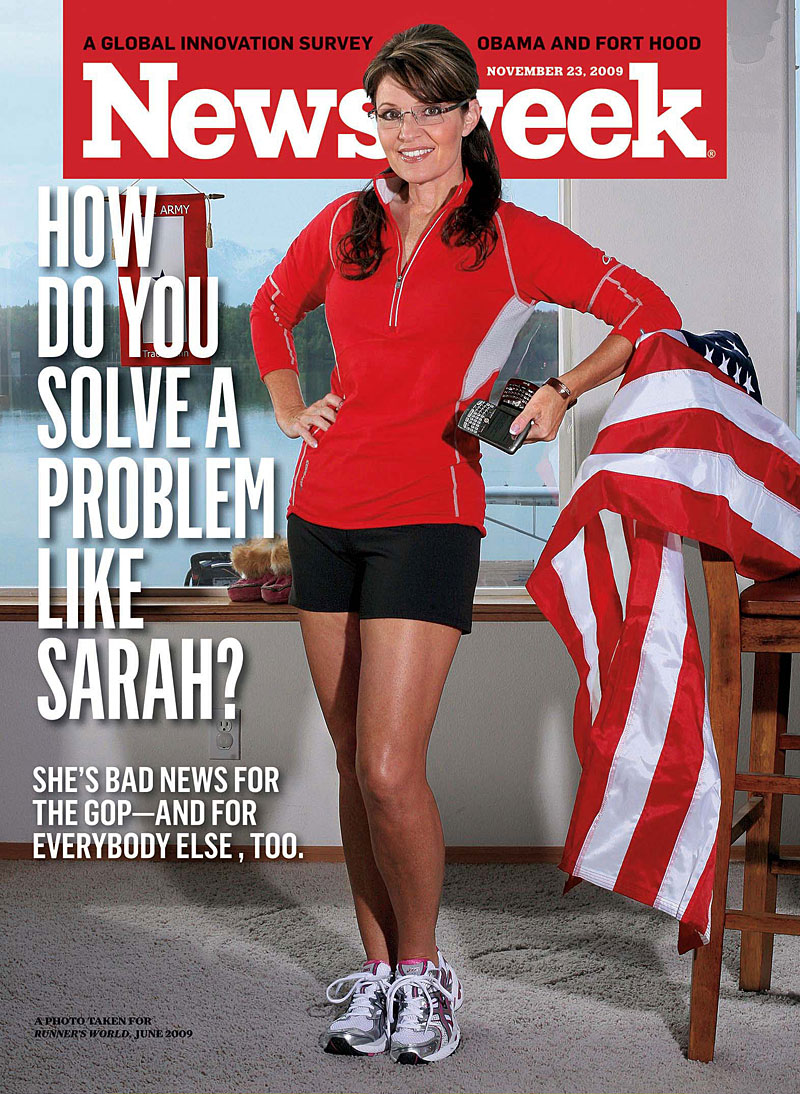
From there, journalism took a backseat to sensationalism, with the magazine devoting covers to stuff like the trashy erotica novel Fifty Shades of Grey, fanservice-y pictures of Sarah Palin in form-fitting workout gear◊, and headlines asking things like "is your baby racist?"◊ They also ran an inflammatory article claiming that openly gay actors like Sean Hayes and Jonathan Groff come off as self-hating, artificial, and too gay in straight roles, which sparked massive backlash from Ryan Murphy, Kristin Chenoweth, and other supporters of the LGBT community. They finally announced that they were following U.S. News and went online-only for a time.
In 2013, Newsweek was sold to the digital news organization IBT Media, which announced it would relaunch the magazine in print. Some expressed concern about IBT's editorial influence over the new Newsweek, as the company is indirectly controlled by a controversial Korean evangelist and runs right-wing religious news sites like The Christian Post. The relaunch turned into an embarrassment when it turned out the inaugural issue's cover story misidentified the inventor of Bitcoin. Under the management of IBT, Newsweek became a go-to example of what Alex Shephard, writing for The New Republic, called a "zombie magazine", a dying print publication bought up for scraps mainly for the prestige of its brand name and then turned into a forum for far-right politics.
- The Magazine Decay of both Time and Newsweek is made all the more ironic with the success in the past two decades of The Economist, which so far averts this trope pretty hard.
- U.S. News and World Report used to be even more hardcore hard news than Time in its heyday and TV ads for subscriptions presented that as a point of pride. But it too succumbed to the banal and shallow, in particular putting out a Special Christianity Issue every few months.
Then, the magazine began to put together lists of the best schools in the early 80s, turning what had been a simple process of a high school senior choosing a school into an entire industry where schools tried their best to impress the magazine to move up or maintain their ratings as if they were Michelin stars, along with the magazine dipping into college preparatory test preparation. This lead to an entire generation of students being pressured to be the best and to put their mental health last, because getting into, then being perfect at, a Top 10 U.S. News school was considered much more important.
Schools began to fudge their numbers to impress the magazine, and though it's shifted to digital-only and virtually an afterthought regarding actual American news or world reporting, the magazine's school ranking system basically overtook its mission. But by the 2020s, schools began to realize they were contributing to a negative environment of student engagement, and some began to hold their schools back from ranking. Its SAT and ACT prep products also took a hit when during the pandemic, schools just didn't do either test, and realized their history (as a measure to keep lower-income and minority students out of the American university system) and that they didn't actually contribute much to help students acclimate to higher education, and their high cost, made them an exercise which should be seriously reconsidered. Thus, U.S. News is beginning to have to reconsider its future. - Maclean's is roughly the Canadian equivalent of Time, and while it's always had a fairly prominent editorial board, it was seldom overt in its politics, which were moderately conservative. Accompanied with a questionable aesthetic makeover (very quickly dropped after many reader complaints) were fairly sensationalist headlines (generally about Muslims) and some genuinely controversial articles from a source that simply wasn't known for it. By the 2010s, its stance began to shift towards centrism, which alienated many right-wing readers. Its treatment of Stockwell Day practically finished any respect a lot of Western Canadians had for it.
- The Brazilian equivalent of Time, Veja. They used to be a standpoint of good journalism, especially as they started the same year the military dictatorship got stronger and censored the magazine copiously for about 15 years... but in the 2000s, it started being tarnished by both a right-wing political bias and questionable cover choices (which were at times done to avoid subjects they didn't want to talk about). Add that in 2012 the editors and journalists were accused of receiving influence of a convicted lobbyist... (on the other hand, the rise of an ill-prepared right wing politician up to the Brazilian presidency was not backed by Veja, who continuously bash him, showing Everyone Has Standards).
- One of Johnson Publication's flagship books, Jet, used to clock in at a decent 80+ pages chock full of interesting national news about black Americans and civil rights. For example, it published unedited photos of Martin Luther King, Jr. after his assassination while most media outlets glossed over his murder. It also had a bikini centerfold, usually on Page 43—which was itself something of a political statement, as in those days no black woman would appear in a centerfold, so having a bikini centerfold was a way to show that black women could be beautiful (and of course, sell more of the magazines to men). Nowadays, the centerfold pretty much appears anywhere near the back because the magazine on average barely reaches 35 pages anymore, and most of the civil rights coverage and national news has been shafted in favor of celebrity fluff.
- In a fictional example, on 30 Rock, Jack Donaghy once commented that Jet was originally a magazine for airplane owners and wonders how the editors could have made that drastic a change.
- The Huffington Post started out as an online newspaper with the intention of presenting a new independent viewpoint. Although frequently chided for being mostly made up of Associated Press articles, its political section attracted some top-notch talent and the investigative side continues to produce great work. However, the front page became increasingly tabloid-like to try and attract viewers, with titles incorporating words like "SLAM", "BLAST", and "ATTACK" in all caps to try and dramatize stories while the headlines got larger and more sensational for the slightest of reasons. The site also has a habit of trying to dictate how its readers should behave with an overabundance of articles about what readers "should" buy, do, etc. while holding up various celebrities as examples of how to have the "perfect" birthday, wedding, birth announcement, etc. It eventually devolved into a messy mass of stories taken from wire services, blog posts from unpaid writers, and superficial listicles. And because most of the writers aren't paid for their work, many have started accepting money and gifts from various companies in exchange for writing positive product reviews disguised as legitimate articles.
- The New Zealand Listener, since Pamela Stirling took over as editor in 2004. Its focus on serious current affairs was diluted in favour of an increased consumerist-lifestyle approach.
- Commentary was originally founded as an anti-Stalinist left-wing magazine centered around Jewish cultural affairs, founded in the wake of The Holocaust, the foundation of Israel, and the general post-World War II period. Under the influence of its longtime editor Norman Podhoretz and his own ideological transformation, as well as that of many other increasingly disillusioned Jewish leftists during The '60s, the magazine ended up being the birthplace for the neoconservative movement, and is today firmly on the right wing.

- Most of the earliest Entertainment Weekly readers remember it as the magazine that covered major hit shows like The Simpsons, Seinfeld and The X-Files since they brought the magazine the most success (along with Star Wars stories as The '90s wore on). But it also stood out from other entertainment industry-focused weekly mags (like People and US Weekly) with its in-depth coverage of movies and TV, treating celebrities as real people/artists rather than gossip fodder, and nurturing of under-appreciated hits like Futurama, Arrested Development and The Wire. But since a major administration change in 2008, the magazine got a bit wonky. With the decline of printed media, EW began to focus much more on their web content, and the mag's usual depth diminished as a result. Compare a 1990s issue to one from The New '10s, and the difference is noticeable. The TV coverage is mostly limited to longtime TV writer Ken Tucker, for instance. The coup de grace to many longtime readers, which coincided with the 2008 changeover, was an infatuation with The Twilight Saga, presumably to attract its fanbase into purchasing the magazine. While their borderline manic coverage toned down after 2010, the multiple covers and articles turned off non-fans before then — in the second half of '09, covers seemed to alternate between those and Michael Jackson retrospectives. Recently, it seems like the magazine's editor-in-chief (shared with People) is more obsessed about getting himself on television (an appearance by him on Younger with an accompanying editor's note in the magazine about how awesome he was could have been filled by literally anyone else) and about the People/Entertainment Weekly Network (an online attempt at bringing both magazines to television) than about the content of EW, and with how the election turned out, also took to political comments not really needed in an entertainment magazine. Sometime in June 2019, EW announced that it will become a monthly magazine instead of weekly. It was then announced in February of 2022 it would cease being a print publication and online only (which apparently was a surprise to the people putting together what they had no idea was going to be the final issue).
- US Weekly has spent so long being the trashy tabloid we all know and loathe that few remember that it actually used to be a pretty good monthly entertainment magazine called Us. By the end of The '90s, however, decay set in as they switched to pure cheap celebrity gossip and photos, then became a weekly.
- Radar magazine was intended to be a title about a smart and sarcastic look at pop culture when it launched in 2005. It attained that goal, but very few subscribers and newsstand purchases beyond the hip Manhattan and DUMBO fringe. Three issues later it was gone, then relaunched a year later with a different look but the same focus. This version did much better and attained accolades, but the economic meltdown doomed it from building any momentum, and thus petered out in November 2008.
Then the owners of the National Enquirer and Star bought the magazine's Radar Online website and were interested in launching a competitor to Perez Hilton, Jezebel, Gawker, and the numerous other gossip sites. The result is a site that's now your official and authoritative source to all things celebrity-related, including Octomom, Lindsay Lohan, Jon and Kate, non-political coverage of Sarah Palin, everything regarding Mel Gibson and his feud with his former girlfriend, and tons of random and pointless paparazzi footage note . The magazine eventually came back in 2011 under the title Radar Weekly which is very similar in style to celebrity mags like Star, a far cry from Radar's roots, nevertheless, it quickly became TV's #1 new selling magazine. - Speaking of Gawker, it used to cover primarily New York media, earning it exactly the audience you'd expect, but after several successive editorial changes — A.J. Daulerio taking over and explicitly saying the site would focus more on "traffic-whoring" and "SEO bomb-throws", hiring Daily What editor Neetzan Zimmerman to write significantly less snarky posts, etc. — it's now more comparable to a slightly meaner Buzzfeed. This is happening to most online news/pop culture magazines, but Gawker's the most open about it.
- WWF Magazine, in its early days, primarily catered to younger fans of what was then the World Wrestling Federation; even though most of the articles were written at the sixth-grade level and in kayfabe, they rarely deviated from the sport of wrestling. The coming of the internet age didn't hurt the magazine but change in its core content did: a large portion of what was WWE Magazine ended up dedicated to fitness, comics, video game reviews, and other material that rarely has anything to do with wrestling. The magazine would ultimately cease production in September 2014, one of the victims of the WWE Network budget cuts.
- Guideposts for Teens was once essentially filled with stories of a religious bent, but didn't come off as heavy or preachy about it. The interesting stories were slowly devoured, and it took on a more and more teenybopper-oriented bent. It's so decayed now that one can almost smell the festering.
- Omni started as a magazine combining science fiction and science fact. The portion dedicated to science fiction started to shrink, however, until it was mostly science with only a little bit of fiction. Then it became more and more dedicated to the paranormal, with actual science being squeezed out. Then it died.
- Brazilian magazine Mundo Estranho was originally a spin-off of Superinteressante packed full of trivia and answering scientific questions; now it's focused on young readers, full of articles about sex and other things that would catch the eye of a teenage boy. There's still trivia in it, and for the most part, it's an enjoyable read but female readers complain a lot about the shift towards male interests. That is, until it was canned in 2019 after 18 years running. (although 2022's Strange World, whose translated title was the magazine's own name, led to a one-shot tie-in◊)
- Superinteressante itself! In its origins, it was a magazine devoted towards explaining scientific discoveries, be they new or older, with a user-friendly approach (similar to the American Science News, with plenty of diagrams and illustrations). After some time, however, it was nothing more than a magazine devoted to random, useless trivia, ridiculous conspiracy theories, and harebrained pseudo-science. However, the aforementioned problems were somewhat solved by the end of the 2000s, leading to many quality articles (even if subjects such as Jesus and Nazism have been overused to death), and it's more reader-friendly than most science magazines in Brazil.
- Ditto for its Mexican counterpart Muy Interesante, except that the articles are not even worthy anymore.
- Originally starting as a scientific vulgarization publication, the French magazine Science & Vie became less and less rigorously scientific since being bought by Mondadori on 2006, said fall becoming noticeable by mid 2010s. After being bought by Reworld Media on 2019, the issue became important enough to see, by November 2020, the redaction voting an illimited strike to protest against online publication of content without being informed.

- Dragon Magazine, the official mag of Dungeons & Dragons, started as a general RPG culture magazine with ads for many systems, but went to a just-D&D mag during the 1980s. They then slowly added more and more features relating to non-D&D Tabletop Games, but later "recayed" by dropping all non-D&D content in what many considered a golden age.
After Wizards of the Coast bought out TSR, they contracted the writing of Dragon and its sister Dungeon to another company, Paizo. Around the time the 4th edition of D&D was announced, Wizards ended their contract with Paizo and relaunched the two magazines as online-only, as it exists right now. Paizo launched their own magazine, Pathfinder, which has everything they used to put in the other two magazines. - White Dwarf started out in the 1970s as a general tabletop RPG magazine; its transformation at the end of the 1980s into something dedicated to the tabletop battle games Warhammer and Warhammer 40,000 inspired They Changed It, Now It Sucks! reactions from British roleplayers for years after the event. That was an open change, though, and at least then it included such things as original stories, comic strips, pages on modeling ideas, strategies, and other original content, with an appendix at the end that dealt with listing new releases. It still has those things now, but in a much-reduced quantity as most of the magazine is dedicated to simply advertising Games Workshop's latest releases.
Even then, the decay proper didn't set in until Guy Haley left as editor. Soon after that, White Dwarf became a glorified catalog with even the editorial pieces previously used for a bit of humorous commentary given over to telling you what the new releases this month were (in case you missed the ten solid pages of them). Not only has the magazine become increasingly content-free, but it's actually been getting much slimmer, so the number of pages given over to advertising the latest shinies increases even while the total number of pages decreases. It's like magazine decay squared. Oh, and the price has been going up all the while.
In White Dwarf's defense, though, the cover does now read "Games Workshop's Monthly Hobby Supplement and Miniatures Catalogue". It also seems to be improving with the Spearhead expansion.
All of this changed in 2019: now the magazine doesn't promote at all the new releases (the most you see is a line mentioning that this or that army was recently introduced or got new pieces - but at least a month or two after the actual release, and there is not a single mention of prices) and the focus got back on the gaming, with each issue featuring a supplement for either 40k or Age of Sigmar featuring new stratagems or warscroll battalions representing certain subfactions of armies plus multiple additions for the other boxed games Games Workshop makes like new characters and missions for Warhammer Quest, additional factions and characters for Kill Team and Warcry (including synergy between them - such as rules for using Quest terrain and characters in Kill Team), short stories written by Black Library authors, painting and modelling suggestions (usually about tying your army to a certain kind of landscape or situation) and so on. - Related to the previous — this sort of thing isn't just limited to GW's tie-in house magazines, where you'd expect it. The nominally independent Wargames Illustrated magazine, which serves the wider wargames hobby outside GW, always appears to tie its major illustrated features into extended advertisements for one or two favoured figure and accessory manufacturers.
- More from Brazilian magazines, Info was about computers and technology. In the 1990s? Programming hints, tips for power users, reviews of useful and high-quality hardware and software, and ads for pretty much anything computer-related you might need. Now? The internet made the magazine pretty much useless and boring for anybody with computer-themed interests beyond gadgets and games.
- PC/Computing's decay from an irreverent hobbyist publication that featured Penn Jillette's industry satire on the back page to a more straightforward computer magazine was probably inevitable as computers became mainstream in the early 1990s. Much less so its abrupt switch from hardware and software reviews to buzzword-filled puff pieces on the "new economy" in 1999, especially considering how the "new economy" went belly-up a few months after the switch.
- This was pretty much universal for hobbyist-oriented computer magazines in general from the time they first emerged in the 1970s; each of them would start drifting away from hobbyists, geeks, and computer enthusiasts into the more lucrative corporate business computing market, but most would fail at this and go defunct, to be replaced by a new generation of magazines following a similar trajectory.
- This goes for Family Computing Magazine as well. It started as a magazine with topics for the whole family, with a focus on educational titles and games for the kids, and productivity for parents. Over time, especially in the aftermath of The Great Video Game Crash of 1983, the focus on gaming and educational software declined, and there came a greater emphasis towards the home office (a rising trend in the late 80s). It changed its name to Family and Home Office Computing, then completed the shift when it renamed itself again to Home Office Computing. This was less a decay, and more a shift in audience trends, since by the 1990s, computers were no longer the mysterious boxes that families wouldn't know what to do with. The publication has a longer publication history in its home office version than the family version.
- The ZX Spectrum magazine Your Spectrum was once a magazine discussing all sorts of software- and hardware-related issues, with type-in listings for every kind of application from games to business programs, and always a subtle undercurrent of subversive humour. When it was renamed and relaunched in 1986 as Your Sinclair (a change made due to reports that the replacement for the ZX Spectrum probably wouldn't be called a Spectrum — turns out it did), it became a magazine that occasionally discussed games and spent the rest of the time being completely off the wall (one issue came with a free copy of Viz!). The kicker? Most people think these changes were for the better. The rot set in for good around 1990 when Future Publishing bought the mag and prices started spiralling, page numbers fell, and the system itself was on the wane...although it took a further three years to finally fold, by which time the main discussions in the magazine were about PCs emulating it!
- In the early MacAddict era, they would do fun things like Photoshop the entire staff's facial features into a new person, videotape themselves destroying PCs, have actual children review children's games, allow users to write in their own "reasons why the Mac is better than a PC", and include funny stories and pictures in the letters section. They also had a stick-figure mascot named Max who was used in their ratings system ("Freakin' Awesome!", "Spiffy!", "Yeah, Whatever", and "Blech!"), and even included a full cartoon page in the back. By 2000, they began shifting more and more serious, culminating in the retirement of Max for a five-point scale, an overall more serious tone, and finally, a rename to Mac|Life.
- Computer Shopper started as a phonebook-size magazine with advertising from just about every computer-based company in the United States. Once the internet made it irrelevant, the magazine slimmed down and became a generic computing publication.
- Seventeen began in 1944 as a fashion magazine for teen girls, true enough, but with enough intelligent content to separate it from its rivals. Sylvia Plath got her start at Seventeen when they published her short story, "And Summer Will Not Come Again", in 1950. There was even a time when the magazine encouraged girls to be happy with the shape their body had taken, instead of shoving stick-thin models as an "ideal" down their throat. Even at the peak of the "valley girl" in the 80s, it was still highly-regarded—By the mid-1990s however, the rise of "bimbo" magazines in the vein of Tiger Beat led to a sharp decrease of circulation, leading to the "dumbing-down" of the publication. During the late 2000s and early 2010s, it became chiefly known as "the Twilight rag", while it later became obsessed with pop divas. All that jazz about loving your body whatever its shape? Pfft. Those real-life "it happened to me" stories that used to get featured and even blurbed on the cover? They've been reduced to a single page and less than 100 words. Fortunately, Seventeen stopped featuring Photoshop-retouched pictures of girls after an internet petition in 2012.
- In the 1990s, Twist had varied topics; sure it discussed celebrities and fashion, but it also had real-life stories and other features like relationships and self-help for typical teenage concerns. It decayed into a Tiger Beat clone, went online-only in 2016, and stopped updating in 2017 before becoming a redirect to the J-14 site.
- J-14 used to be geared towards pre-teens with stories about teens (usually about embarrassing moments or tragedies), and it strongly rebelled against the "thin" body type other magazines gave out. Nowadays, it focuses on celebrities like Miley Cyrus, Selena Gomez, Demi Lovato, etc. along with teen gossip, quizzes, and fashion-related articles; those all used to be part of the magazine, but now they're much more emphasized and the teen stories and self-help articles soon vanished.
- An inversion of the usual order would be Teen Vogue, which started in 2003 as, well, a teenage version of Vogue. In 2016, it hired a new editor and editorial director, and while it's still a fashion/celebrity magazine at its core, it joined the trend of branching out into political journalism from a teen POV (most notably an incendiary op-ed by Lauren Duca criticizing President-Elect Donald Trump in 2016). The shift has received both surprise and acclaim from old-guard journalists and pundits. The very name Teen Vogue would seem to indicate it's all lightweight fluff, gossip, and fashion tips, which is exactly the last place one would find the in-depth political commentary of its peers in 'serious' journalism.
- Game Players Magazine started as a straightforward game-reviewing mag. Eventually, the reviewers gained personalities and jokes were made about them followed by wacky humour and gag letters pages. After that, they started going completely nuts — often having video game characters do reviews or Gazuga the three-eyed demon monkey answer letters. Eventually, the craziness hit a peak and they suddenly turned to Ultra Game Players and became way more serious. They lasted another couple of years before rebranding as Game Buyer, which died after 4 issues.
- Most gaming magazines have gone through a form of proto-decay over the last decade, particularly since the rise of GameFAQs, IGN, Gamespot, and similar sites. Magazines that used to focus mainly on game strategies, tips and tricks, and whatnot have shifted more towards the review end of things ever since the information they provided was put up online for free. Things like exclusive strategies printed very close to the game's release date and maps that would be otherwise difficult to put online delayed the change, but even that content has found its way onto the Internet. Nowadays, most of the magazines' content is reviews, previews, and interviews with the actual tips and strategies relegated to a few pages. Oh, and Fanservice.
- It's also safe to assume that at least a few gaming magazines bit the dust thanks to the rise of free walkthroughs and previews on the internet. Electronic Gaming Monthly was bought out by another company which immediately axed all the staff of the magazine and canned the title. In 2010, they returned when the original founder of the magazine bought the rights to it back and rehired a bunch of the writers, as well as other respected game journalists.
- EGM itself was also a victim of this trope before its cancellation. It began as, essentially, "Famitsu America". However, as advertiser dollars dried up, the magazine employed numerous Maxim-like gimmicks to keep reader interest that were only tangentially related to video games (such as interviews with Henry Hill and various E3 "booth babes" who clearly didn't know how to use the medium they were advertising on their T&A).
- Amusingly, after it was canceled, it was replaced by Maxim. Without giving subscribers much notice.
- The magazine also got thinner and thinner over time, although a lot of this was probably the decrease in advertisements. Someone on the interwebs somewhere did a comparison — for some magazines, pagination has increased...but thickness has decreased due to using thinner, cheaper paper.
- Averted in the reincarnation of EGM. It's almost exclusively about gaming, even as it proudly lists "iPhone" and "iPad" as the consoles it covers. To be fair, mobile gaming is getting rather big, so long as EGM only focuses on the gaming part of it.
- Amusingly, after it was canceled, it was replaced by Maxim. Without giving subscribers much notice.
- Averted by Gamefan, which only had one botched scoring in its long run, they apologized for it, and then they died out due to oversaturation prior to the internet, though when they began adding an anime section there were fears of this. (Which turned out unfounded; the editor personally wanted them in to drum up sales of anime he liked/warn people about those he found terrible.) As costs grew so did the number of ads, but they tried their damnedest not to lose pages to the ads. Also, they had a comic series which starred the avatars of the reviewers, which caused cries of this when it ended as it put a handful of game refs in sequential order with what they were reviewing. Nifty idea.
- Like EGM, Gamefan returned in 2010 when the original owner bought back the rights!
- This was welcome for N64 Magazine, which slowly pushed its N64 coverage out in favour of the GameCube. Rather than go to all the hassle of launching a new magazine, the publisher just renamed it NGC and continued the issue numbering.
- However, if you want to consider SuperPlay -> N64 -> NGC -> NGamer as a Verse, you could argue that the decay from an import- and Japanophilia-centric games magazine to the straighter product it is today is worth mentioning.
- Some argue that IGN has seen a certain amount of website decay — what used to be purely a games website is now a general entertainment site aimed at men, covering gadgets, film, music, and so forth. However, the front page is almost entirely about games, and given how departmental the site's overall navigation is, coupled with the fact that being online means they can expand with their focus, rather than having to cram it into the same number of pages/hours of airtime it's not immediately obvious that this has come at the detriment of the (quantity of) games coverage, if it has at all.
- DailyRadar, however, is a different story — beginning as an IGN lookalike for the US market, the site closed, but not before extending the brand to the UK, which remained open. Eventually, the UK site rebranded to Games Radar, and reduced its original content in favour of reprinting content from FuturePublishing's print portfolio. After Future acquired Computer And Video Games, it took on the "all reprints" mantle, and GR re-focused to light-hearted features with the odd review to give Future three games sites — CVG in the comprehensive coverage IGN space, jokey Games Radar, and Edge doing industry news. Daily Radar soon re-emerged as an aggregator site for Future's male-oriented online content.
- Official Playstation Magazine dipped into this briefly, when it started giving increasing coverage to other products. A couple pages of DVD reviews made sense (the PS2 was the first DVD player many people owned and the cheapest investment in one at the time of its release), but did enough people really use the PS1's music CD playing function to justify a page of album reviews, even if all the albums were by artists whose songs were featured in skateboard games and the like? And two or three for toys, many of them not related to video games? And a page of weird weblinks? And a page or two on general movie news? Luckily, this decay was reversed a few years into the run of the PS2.
- Online magazines count! The Escapist, best known as the home of Zero Punctuation and Unskippable, has gone wildly off-topic lately. The News page (already known to some readers as the "why-is-this-news page") now features many stories about movies and TV shows considered to have geek appeal. They also have two video series by Moviebob, and neither of them is "The Game Overthinker" (which is a Screwattack exclusive for several reasons, all of which are beyond the Escapist's power).
- Nintendo Power for several years focused its content on game secrets, walkthroughs, and gaming news. On top of that, the magazine held monthly sweepstakes for pretty awesome prizes (such as a trip, a gaming console, and a game as an example for the grand prize) and had a monthly catalog to buy things such as strategy guides or Nintendo themed toys. Comics based on Nintendo's games were also published, such as Pokémon and Metroid Prime. As time went on, it was apparent that Nintendo was cutting its budget to the magazine and losing interest as the sweepstakes prizes were reduced to winning just games or a shirt, the comics were no longer made, the Nintendo catalog was no longer produced, and ads started to appear on many pages in the magazine. When Nintendo outsourced its magazine to a different publisher, the magazine content was reduced to just covering games and showing interviews with the game developers. After Nintendo no had any interest in renewing their contract with the magazine, Nintendo Power was canceled at the end of 2012 after over 20 years of publication.
- The outsourcing of NP also eroded some of the core features of the magazine. For instance, while Nintendo Power was originally famous for including mini-guides of recently released games (such as maps, FAQs, walkthroughs of early levels, etc.), and the writers typically wrote the official game guides (which were outsourced to Prima after the shift), the twilight years of the magazine omitted this entirely to the point where a game was almost never mentioned again after being reviewed (aside from the yearly awards). Articles which were not strictly focused on a new release were also cut (for example, the mock scientific article on turning a new gamer into a pro on the Wii, or the attempts to merge cooking game logic into the real world with predictable results, and community events like the monthly Caption Contest) had disappeared. By the time that the plug was pulled on NP's 24-year run, it had been reduced to a shell of what it had once been.
- Retro Gamer magazine. It was originally founded to cater towards fans of early 80s consoles popular in the UK, such as the ZX Spectrum, Commodore 64, Colecovision, Intellivision, and Amstrad CPC, to name a few. However, the magazine expanded the consoles it covered to include later ones like the Sega Mega Drive, SNES, Playstation, Nintendo 64 and Game Boy. It sometimes has features on modern games if they are sequels to older ones. Whilst many of is readership grew up with 90s consoles and have no interest in the 80s ones, fans of the 80s consoles believe it has gone into decay because of its reduced focus on them.
- Ironically, this complaint often comes from nostalgic people with short memories. The 16-bit consoles were part of the magazine's coverage from issue one, and the first year of the magazine included some coverage of Playstation and N64 games. There was even a feature on the Dreamcast as early as issue eight - less than five years after the system's local launch.
- Tips & Tricks was star-crossed from the beginning. If it wanted to survive, it had to sell out. It debuted in a time when it made sense to pay for gaming advice - and when free informative resources on games became commonplace on the Internet, the magazine increasingly struggled to keep up as at least three-quarters of its content was about tips, strategies, cheat codes, and the like. Towards the end, they had to put "Cheat Codes You Won't Find on the Internet!" on the cover, and to stay relevant they had to put things into the magazine that they explicitly said earlier they never would - op-ed columns & Letters from the Editor. Most of this happened after the magazine was placed under new management around 2006, and the new guy geared everything towards revitalizing the magazine. It worked so well that the monthly magazine was shut down the following year, and the CodeBooks went from twice a year to every other month and limped on until 2011.note
- Jetix Magazine:
- The Italian edition begun life as a magazine about the cartoons aired on Jetix during that period and other stuff. The latter half of the (shortly-lived) magazine had an abrupt tonal shift, where almost every article was wrote in Totally Radical slang and Xtreme Kool Letterz, they avoided talking about any Jetix show that wasn't Sonic X or Dragon Booster (with Case Closed, which never aired on Jetix in any country, getting a recurring column) and basically dumbed down its content. One peculiar case of "decay-in-decay" was a column called "The worst villains ever", which had a shift from being about villains from Jetix shows to being about fictional villains in general to feature dangerous animals - bringing to a situation where Shredder, Sephiroth and dust mites were all rated on the same scale.
- The UK version of Jetix magazine changed its name to Nitro and broadened its coverage to all kids franchises instead of just Jetix's, as a consequence of the Jetix TV channel's rebranding as Disney XD. They also dropped the comic strips at this point, making it just another generic boys magazine.
- Cosmopolitan used to have more articles about women's social issues. While they do still run such articles, they run fewer of them, and those articles are overshadowed by articles about fashion, makeup, celebrity gossip, and sex advice. See also "Fashion", above.
- This happens to a lot of women's sites too, sort of an adult version of "Teen Interest" above.
- Jezebel used to be more focused on mocking and satirizing more traditional "women's magazines," often featuring articles taking apart sexist and fatphobic language in magazines like Cosmopolitan or gossip rags like US Weekly and People. It also had a strong focus on feminist political reporting and non-judgmental "lifestyle" articles and advice. While it's kept the latter (the feminist reporting has since been copied by almost all women's/fashion magazines with varying degrees of success), it's largely abandoned the first (and originally, primary) part of its focus. It still has a generally feminist bent and tries to stay away from body shaming when it talks about celebrities, but has gradually moved toward more of the kind of the celebrity gossip reporting it used to lampoon.
- People argued this happened to Astounding Science Fiction when it changed its name to Analog back in 1961. Or when editor John W. Campbell died in 1971. Or at various other points in the past 40 years.
- UK magazine Bizarre started off as an uncategorizable melange of genres (the tagline was "For Humans", highlighting the fact that although it had a large amount of female fanservice, it was more about showing interesting things to everyone regardless of gender), usually with a common theme for the issue (e.g., the Crime issue would have articles on criminal slang, true crime photos, interviews with forensic crime scene workers, pieces on unusual laws across the world, plus an attractive woman clad in just a policeman's hat and a belt) along with other random articles about things you've never heard of and a healthy dose of anarchic humour. Around 2009 there was a change of staff, and it slowly became obsessed with tattoos, tattooed porn stars/pinups, and tattoo conventions. All sense of theming was lost, the interviews with the models devolved into soundbites to be posted next to their photos, and the sense of humour left with Chris Nieratko. Currently, it is essentially the same as lowbrow "Lad's Mags" Zoo and Nuts, with more tattoos. It has been accused, with some justification, of being a tabloid version of Fortean Times, focusing on the more sensational and sleazier forms of the Fortean with more pictures and a lot fewer words. Embarrassingly, it is a product of the same publisher.
- Belgian newspaper De oorlogskrant was, as of its launch in 2014 (100 years after World War 1), all about documenting the entire history of World War 1. Just a year later in 2015, however, they jumped ahead to start covering the period between the World Wars.
- Up until the 1980s, Reader's Digest was a monthly collection of articles from top magazines, original content and condensed novels with a wide readership base. The decline (both in quality and readership terms) of magazines during the 1990s led the magazine to focus more on human-interest stories, celebrity pieces and health-related articles, its readership skewed older and more female, being in-between Paradenote and Vanity Fair, the other two remaining American general-interest magazines.
