
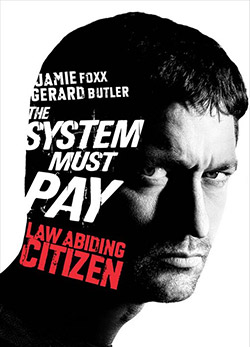
Law Abiding Citizen is a 2009 crime film directed by F. Gary Gray and starring Gerard Butler and Jamie Foxx as people on opposing sides of a justice system gone wrong.
Clyde Shelton (Butler), a talented engineer and family man, watches his life fall apart before his eyes when thugs Clarence Darby (Christian Stolte) and Rupert Ames (Josh Stewart) break into his house, which results in the death of his wife and child right in front of him. Prosecutor Nick Rice (Foxx) only has circumstantial evidence on Darby, who committed the murders, so, in order to maintain his high conviction rate, Rice gives Darby a sweet plea bargain in exchange for testimony against the less-guilty Ames (who receives the death penalty) – against Clyde's wishes.
Ten years later, Ames's execution goes awry and the police find Darby dead. Rice has Shelton arrested for the acts, and, to Rice's surprise, Shelton comes clean and admits to the killings. But he isn't done, not by a long shot, and he gives Rice an ultimatum: fix the system that destroyed his life, or he destroys everything. To back up his threat, several officials involved in Ames' and Darby's trial are killed — despite the fact that Shelton is still in custody. Rice begins to realize there is more to Shelton that meets the eye, and resolves to stop whatever plan Shelton has set in motion. But Shelton is a man who has lost everything dear to him, meaning he has nothing to lose...and his sights aren't just set on avenging his wife and child, but bringing down the entire system that robbed him of justice.
This film provides examples of:
- Abandoned Warehouse: Clyde liquidates his assets and buys a large number of abandoned factories so he can carry out his plans undisturbed.
- Alas, Poor Villain: Clyde dying by his own bomb and decides to Face Death with Dignity while he stares at his deceased daughter’s home-made bracelet.
- And I Must Scream: Clyde injects Darby with a paralyzing neurotoxin that keeps him helpless but fully conscious and entirely capable of feeling everything Clyde does to him. He also goes to great lengths to ensure that Darby stays alive and conscious as long as possible; he places tourniquets on Darby's arms and legs so he doesn't bleed out, administers a saline drip so he doesn't die of dehydration, injects him with adrenaline so he doesn't pass out, and inserts a mouthpiece to prevent him choking on his own tongue.
- And Some Other Stuff: No one's specific about what chemical Clyde used to make the lethal injection more painful (although the Body Horror that it creates implies that it's some sort of acid).
- Anti-Hero: Nick doesn't care nearly as much about justice as he does about his conviction rate. His flaws and mistakes may have created the villain – but he still tries to protect the innocent as best as he can.
- Anti-Villain: Clyde.
- Anyone Can Die: Nearly half the main cast dies by the end, including Shelton.
- Arc Words: "You can't fight fate."
- An Arm and a Leg: Clyde cuts off Darby's fingers, limbs, penis, and head in succession during his killing.
- Armor-Piercing Question:Nick: You think your wife and daughter would feel good about you killing in their name?Clyde: My wife and daughter can't feel anything. They're dead.
- Arson, Murder, and Jaywalking: Clyde concluding an insulting rant against Judge Burch by saying, "And I bet you take it up the ass, bitch!"
- Artistic Licence – Biology: The poison Clyde uses to paralyze Darby — tetrodotoxin — is real.note Only problem is it paralyzes all non-cardiac muscles, including the diaphragm. Without artificial respiration, Darby would've asphyxiated pretty quickly.
- Asshole Victim: No one feels sorry for Darby when Shelton kills him.
- Pretty much the whole plot of the movie.
- Downplayed with Ames — yes, he helped Darby rob the Sheltons, but Ames invoked Even Evil Has Standards against harming them, even trying to stop Darby.
- At Least I Admit It: Clyde doesn't try to pretend he's not a murderer and seems to be aware of his own hypocrisy, and uses it to try to prove his point about the corruption of the justice system.
- Ax-Crazy: Clarence Darby enjoys murder and rape as demonstrated when he does it to Shelton's family.
- Backwards-Firing Gun: When Darby realises the 'police officer' is Clyde, he pulls the trigger on the Glock he took off his gunbelt. The Glock is not only unloaded, but pulling the trigger releases needles in the grip, injecting Darby with a paralysing neurotoxin.
- Badass Boast: "I'm gonna pull the whole thing down. I'm gonna bring the whole fuckin' diseased, corrupt temple down on your head. It's gonna be biblical."
- Earlier – "And if we don't?" "Then I kill everyone."
- The Bad Guy Wins: Clyde is tricked into blowing himself up, but to do so, Nick has to trick him into killing himself via placing the bomb inside his cell, essentially committing vigilante justice just like Clyde did and proving that the system's flaws mean the only way to effectively stop criminals is to work outside it. Basically, even though he didn't intend to die, Clyde proves every point he wanted to make.
- Bad with the Bone: Clyde shanks his cellmate with the bone from his T-bone steak.
- Batman Gambit: Clyde plans and executes a very successful one. It still fails in the end, though.
- Best Served Cold: Clyde spends ten years plotting against the entire justice system.
- Beware the Nice Ones: Clyde.
- Bittersweet Ending: Clyde's Roaring Rampage of Revenge is stopped by Nick, who learns his lesson about making deals with criminals and finally attends his daughter's concert. However, a lot of innocent people are dead and Clyde's death is treated sympathetically. Even Nick learning not to make deals with Clyde, or other criminals, was actually one of Clyde's goals, and he only wins by murdering Clyde himself.
- Buried Alive: Clyde buries Darby's defense attorney with a tank of oxygen and an IV feed until a specific time. Nick arrives to the location eight minutes late.
- But for Me, It Was Tuesday: Nick has trouble recalling Darby's name despite his misdeeds.
- Counting Bullets: Darby empties his revolver at the police cars pulling up at his door. As he's escaping across the rooftops, the mysterious voice on the phone tells him to wipe the gun for prints and toss it.Darby: No way!Voice: You fired six times, genius.
- Create Your Own Villain: Nick giving the killer a plea bargain triggers the widowed Clyde's descent into villainy.
- Crusading Widow: Clyde lost his wife and daughter to an assault early on and spends the rest of the movie going after the killers.
- Deus ex Machina: Rice and the Justice System spend most of the movie without a clue of how Clyde is carrying out his plans until Sarah's boyfriend Chester, who we've only met through a couple emails, sends Rice critical information about Clyde's finances. We never learn how or why he would have this information.
- Disproportionate Retribution: This film could have had this trope name for its title. Clyde watches the murder of his wife and child, and Rice cuts a deal (against Clyde's wishes) that sends the accomplice to death row and the real killer back to the streets. Ten years later, Clyde gets his revenge (including a bonus punishment for the already-condemned man), then tries to destroy the entire US legal system, all while leaving Nick alive so he can witness the devastating consequences of the unjustifiable decision he made. He also kills a lot of people who had little to nothing to do with the deal, including Nick's assistant.
- Do You Trust Me?: Nick asks this of Clyde before revealing that the DA's office struck a plea bargain with the killer.
- The Dreaded: Clyde. Even the people who worked with him before the movie started are outright terrified of his ability to kill people without getting anywhere near them, and one of his former colleagues straight up says that if he wants anyone else dead, the only way to prevent it will be to kill him first. Nick eventually realizes that's the only way to stop him and plants a bomb in his cell to trick Shelton into blowing himself up.Jonas: Tell us what we're dealing with. Shelton was... a spy?
Bray: Look, spies are a dime a dozen. I'm a spy. Clyde is a brain.
Nick: That's just a fancy way of saying he kills people.
Bray: We kill people. He figured out how to do it without ever being in the same room.
...
Nick: You're saying we can't stop him?
Bray: Walk into his cell and put a bullet in his head. Aside from that, no, you can't stop him. If Clyde wants you dead, you're dead. - The Engineer: Clyde himself obviously, and he's an extraordinarily
 magnificent one at that.
 - Every Car Is a Pinto: The film averts this trope – even after taking several seconds of heavy machine gun fire, a van fails to explode. At least until Clyde nails it with a rocket.
- Exact Words:
- Clyde, to Darby: "I want to keep you out of prison." He didn't say what he wanted to do to him instead.
- When Nick first interrogates Clyde, Clyde makes sure to word all of his responses in such a way that Nick doesn't get a confession.
- Before he sets off his final bomb, Nick warns Clyde that "He'll have to live with the decision for the rest of his life." Nick is carrying a pistol and implying that he'll shoot Clyde if he triggers the bomb Clyde triggers it anyway, so Nick seals the cell door and says;Nick Rice: Like I said Clyde, it's a decision you'll have to live with for the rest of your life. Which I figure right now is about 25 more seconds.
- External Combustion: Clyde plants remote-control car bombs inside the gas tanks, where a search won't find them. The protagonist is Forced to Watch as the woman he mentored struggles to escape from a vehicle with sabotaged locks as the other cars explode one by one, before her car also blows up.
- Face Death with Dignity: Clyde. When it's made clear that he's been murdered by Nick planting the bomb in his cell, he just sits down on his cot and keeps fidgeting with his daughter's bracelet as the whole cell becomes a flaming inferno.
- Fate Worse than Death: What Clyde tried to put Darby through. He even gives Darby a dose of adrenaline to prevent him from passing out, and tourniquets his limbs to prevent him from bleeding to death prematurely.
- Failed a Spot Check: No one in the prison thinks to install a camera in Clyde's cell, or post a guard outside even as his murder spree continues.
- None of the cops or bodyguards in the funeral procession spot the machine-gun toting robot until it opens fire.
- Failure Gambit: Clyde Shelton confesses to a murder because he wants to be imprisoned, as that becomes key in his plan, while ironically giving him more freedom than he would have had otherwise.
- Though it's not explicitly noted, Clyde's main goal was to teach Nick a lesson about dealing with criminals and proving a point that the justice system was broken.
- Mr. Fanservice: Clyde, due to being played by Gerard Butler. He strips down to his birthday suit when SWAT raids his house to make absolutely sure that they can't consider him a hostile suspect (and gives the camera a very long look of his naked butt as well).
- Forced to Watch: Darby to Clyde, although he probably wasn't intending it.
- Clyde does this to Darby by suspending a mirror over Darby during his torture and cutting off his eyelids.
- Clyde's attacks in the second half of the film are specifically designed and timed so that Nick is present to witness them, but survives to watch his friends and colleagues murdered one by one right in front of him.
- Forgot About His Powers: Clyde – ordinary suburban homeowner, described as "a tinkerer", but turns out to be a genius in defence and violence whose abilities border on the fantastic. But he didn't bother to protect his own home from an intruder with a baseball bat. And why? Because he works best when he has prep time, not when he's surprised by said thug.
- Freudian Excuse: Clyde became what he is now after his wife and daughter had been savagely killed by Darby.
- Gambit Roulette: Clyde is at times just impossibly good at guessing exactly what everyone is going to do. At least partially Justified given that he’s implied to have spent years studying at he legal system so he can manipulate it to his benefit.
- Genre Deconstruction: Whether intentionally or not, it's basically a movie about a Super Villain who suffered great personal tragedy and is now trying to bring down the justice system that failed him.
- Get into Jail Free: Clyde's plan depends on allowing himself to be arrested so he'll be Beneath Suspicion as his planned killing spree continues. The plot provides a Red Herring or two about other people working alongside him to execute the plan, as he's considered a "brain" (gadget man and planner) by the CIA, but it turns out that, yeah, it's him all along — he made an escape tunnel on his cell.
- The Ghost: We never see Sarah's boyfriend, Chester.
- Gorn: Boy howdy...
- Gory Discretion Shot: The camera cuts away as Clyde begins his work on Darby, at least, in the theatrical version. The Director's Cut doesn't cut away...
- Gray-and-Grey Morality: Let's see. He's a Well-Intentioned Extremist, willing to kill anyone to make his rather simplistic political statements. They're the forces of justice, who start out incompetent and unable to put away the bad guys, and wind up violating civil rights at a blink of a eye and staging vigilante executions.
- Groin Attack: Offscreen, but...Clyde: (holding up a boxcutter knife) Now this is for your penis, but we'll get to that later.
- When Darby, or what's left of him, is later found, there is blood spatter on the waist of his shirt that looks like it came from his groin.
- And later when Nick tells Clyde he needs specifics about Darby's murder:
Clyde: (I took) his balls with a hacksaw, and his penis with a boxcutter. How's that for specifics? - Halfway Plot Switch: Played with: while regular "revenge" movie structure would have Darby survive for a long(er) time because of sheer luck, Magnificent Bastard Hidden Depths, or being connected to a bigger criminal conspiracy of some type, he (and Ames) dies very early and the movie instead focuses on Clyde's progression into an In-Universe Real Life "super-villain", mustache-twirling included.
- Handshake of Doom: Shelton glimpses Darby and Rice shaking hands outside of court, which convinces him that a Miscarriage of Justice has taken place and inspires him to begin a destructive campaign of terror to bring the entire justice system down.
- Harmful to Minors: Rice's daughter puts on what she thinks is a DVD of her cello recital, but it's actually a DVD of Shelton torturing Darby to death.
- Hate Sink: Darby is made to be as loathsome as possible. This is to make Clyde exceedingly easy to root for in comparison, and to give the audience the satisfaction when Clyde ends up torturing Darby to a well-deserved death.
- He Who Fights Monsters: Clyde. From family man (that had a pretty horrendous past, but that's something he'd retired from) to criminal mastermind that organizes one of the worst In-Universe terrorist sprees on American soil.
- Hoist by His Own Petard: Clyde is warned not to remotely activate his last bomb. He does so anyway, only to realize it was moved to under his seat.
- Hollywood Hacking: Implied, during one of this confessions, Shelton claims he killed Ames by hacking into the shipping company's server so the package containing Ames' lethal injection would be sent to him first. Clyde also describes this process as "easy."
- Hollywood Law:
- Ames must have had one bad defense attorney if he's put to death purely on the say-so of his partner, on the question of which one of them was a murderer, a partner who is implied to have a much longer and nastier criminal record to boot. Apparently he never thought to call the husband as a witness either. And the prosecution are the only ones who even remotely care about his opinion as well, and still dismiss it.
- The reason he's sentenced and his partner is effectively let off is a piece of evidence was contaminated by a CSU during the investigation, and all the admissible evidence is suppressed under Fruit of the Poisonous Tree doctrine. The problem with this is, Fruit of the Poisonous Tree only applies to evidence collected through rights violations, and more often than not it only applies to any confession made by the defendant. A piece of evidence contaminated during investigation of the crime scene isn't applicable.
- They should have been able to get both intruders convicted based on Clyde's testimony alone, even if the DNA evidence was contaminated. Ames seemed more likely to have rolled than Darby anyway, since he apparently didn't participate in the actual murders/rapes (though he would still be on the hook due to the Felony Murder rule) and appeared upset by them (though whoever rolls on their accomplice first often gets the deal).
- Nick claims Clyde's testimony would not be reliable because he blacked out, even though that was after he clearly saw their faces and saw Darby rape and kill his wife and carry his daughter off. That alone should have been enough. There is also the matter of the plea deal Darby makes. If he testified against Ames he would only have to plead guilty to murder in the third degree. In real life, no such deal would ever be allowed to be accepted, as just by admitting that he was there with Ames, Darby would effectively be admitting to guilt of the Felony Murder rule, which dictates anyone involved in a felony in which a death occurred is automatically guilty of first degree murder (unlike involuntary manslaughter, which covers misdemeanors). This means that just by proving that they were both present at the home invasion, Darby and Ames would have been found guilty of first degree murder. Neither would have been allowed to plead guilty to anything less than first degree murder, even though Ames was only guilty of attempted theft.
- While the City and County of Philadelphia are consolidated, which therefore gives the Mayor powers ordinarily wielded by the commissioners of other Pennsylvania counties, the District Attorney's office is independent. District attorneys in Pennsylvania are elected county officials, and the Assistant District Attorneys like Nick are county employees. The mayor of Philadelphia has no authority to fire an ADA, or promote an ADA to the position of county District Attorney.
- Hypocritical Humor: Nick keeps leaving his cell phone on while in court with a certain judge. While in a meeting with her later, her cell rings, and he calls her on it. Turns out there's a bomb in the phone.
- I Have a Family: Subverted. Darby is about to execute the police officer whose car he stole. The man says, "What about my wife, my little girl? I'll never see them again!" Darby is unimpressed… until he realizes the cop is Clyde in disguise.Officer: You know why I won't see my wife and little girl again? [takes off disguise to reveal himself as Clyde] Because you took them from me.
- I Was Never Here: The CIA assassin who meets with Nick and Cantrell opens by saying that this meeting isn't taking place. Also when Nick sees the final email sent to Sarah by her mysterious boyfriend, the subject of the email says, "You didn't get this from me".
- Idiot Ball:
- The whole plot could have been avoided if Nick had refused Darby's deal, and instead made a similar deal with Ames.
- Likewise, the authorities could have easily solved the mystery of how Clyde was committing murders while incarcerated by simply assigning guards to watch him 24/7 or by installing a camera in his cell, but no one even considers doing this.
- Impersonating an Officer: The tasered officer in the police car Darby steals turns out to be Clyde in disguise. The officer he's impersonating is in the trunk.
- Improvised Weapon User: Clyde shivs his cellmate with the bone from a T-bone steak.
- Instant Sedation: Instant paralysis, but close enough.
- Ironic Echo: Clyde deliberately repeats Darby's catch phrase "You Can't Fight Fate" just before dismembering him alive.
- Another one to Nick, "It's not what you know; it's what you can prove in court".
- It's Personal: Once Nick's understudy is killed, Nick is ready to go to war to take Clyde down.
- Janitor Impersonation Infiltration: Clyde plants a bomb in City Hall by smuggling it through security in his cleaning supplies.
- Jerkass: Nick Rice starts out as this, doing a very dumb legal move for (at least partially) the sake of getting more political power. By the time the Time Skip occurs, he's even more of a jerk, but the rampage moulds him into the kind of jerk Clyde wants — which is someone who will do whatever it takes to keep criminals down and out.
- Joker Immunity: A major point of the movie — the legal system is tied up in tons of red tape and thus no matter what they do, they can't get rid of Shelton or even move him somewhere secure, so he is continually able to commit murders with relative impunity.
- Just Eat Gilligan: The CIA agent that meets with Nick and Cantrell points it out in the simplest fashion possible: as long as Clyde is alive, he's a threat to everybody, and they should just walk into his cell and shoot him dead ASAP. By the time Nick goes around to pull an act in the spirit of the tip (the napalm bomb switcheroo) and decides to no longer give a damn about the legal repercussions, the body count at Clyde's hands is pretty extensive.
- Karma Houdini: Nick Rice is this, as his desire to have a spotless conviction record was the last push that drove Shelton into madness and thus indirectly responsible for all the deaths, including the innocent ones, but gets to walk away unharmed when people far less guilty died.
- There is also the napalm bomb trick at the end — even with extensive evidence about Clyde being the man responsible for the attack, Nick did enter Clyde's "base" without a legal warrant (though exigent circumstances or probable cause would apply) and allowed the man to die, even tricking him into activating the device that killed him. The last scene is him calmly enjoying his daughter's cello recital that same night, with no telling of how his decision to "fuck [Sheldon's] civil rights" will fly with the Pennsylvania governor and the Fruit of the Poisonous Tree articles.
- The jerkass Warden who delays Shelton's catered lunch and causes Bill Reynolds' death is never targeted by Clyde. Likely justified as Clyde wanted Bill Reynolds dead and the Warden had nothing to do with his family's killer getting away. Plus, Clyde was trolling the Warden so he'd get himself locked up in solitary, which is exactly where he wanted to be.
- Karmic Death: Darby gets dismembered alive by Shelton, who recites the same line that Darby did before he committed the murders.
- One judge scolds Nick repeatedly for not turning off his cell phone. She was killed by an explosive in her cell phone, which she hypocritically answered during a meeting with Nick.
- Clyde dies via his own bomb, courtesy of Nick's own Crazy-Prepared moment.
- Kick the Dog:
- Whenever Clarence Darby is onscreen, expect him to do a lot of this.
- Having your home being invaded is bad, and crippling you is worse, but the ultimate nightmare is when he rapes and murders your wife, then murders your daughter in front of you. Then, a killer gets off with a light sentence just to make sure the prosecution can get the other guy.
- Killer Robot: Clyde uses a heavily modified bomb-disposal robot to kill Jonas at the graveyard.
- Laser-Guided Karma: Less than 10 seconds after displaying flagrant contempt for duty, the rules, and even the Constitution itself a gun goes off directly in the judge's ear.
- Shelton himself gets a dose of this, as his termination of the understudy in the car bomb spree leads directly to the understudy's boyfriend risking his job to give Nick vital information, and Nick being willing to rig Clyde's super-napalm bomb to the underside of the prison cot.
- Though that information was sent to Sarah's email address, implying it had been sent before he knew she'd been killed.
- Ironically, this contempt for the Constitutional rights of the accused, putting stopping them ahead of the rules, is similar to what Clyde appeared to be trying to encourage. That, or simply trying to make Nick care about actually doing his job.
- Shelton himself gets a dose of this, as his termination of the understudy in the car bomb spree leads directly to the understudy's boyfriend risking his job to give Nick vital information, and Nick being willing to rig Clyde's super-napalm bomb to the underside of the prison cot.
- Locked Room Mystery: Inverted; Clyde is somehow able to orchestrate elaborate murders while locked in solitary confinement.
- The Lost Lenore: Clyde's wife, for whose killer Clyde plots a particularly Karmic Death. For an added bonus, his child is murdered too.
- Luxury Prison Suite: Clyde insists a special mattress and a porterhouse steak be placed in his cell in exchange for his confession. The other inmates all shout with rage when they see these delivered, and the warden pointedly says he'd hate to be the only one who has something in a wing full of the Have-Nots.
- The Man Behind the Man: Who's Clyde's partner? Turns out it's Clyde.
- Might as Well Not Be in Prison at All: Clyde still commits murders, even in jail. Turns out getting sent to solitary confinement was part of his plan, since part of the preparations he made before getting arrested included digging a secret tunnel accessible from there.
- Mission Control: Clyde pulls a dark version of this trope on Darby, helping him to evade the police and providing an escape vehicle, but only so he'll walk right into his clutches.
- Mood Whiplash: Clyde switching between his distraught Vigilante Man act to his much more confident and spiteful real personality during Nick's interrogation right after his "confession".
- Mugging the Monster: Ames and Darby just happen to rob the home of a retired CIA assassination expert.
- No Mercy for Murderers: Clyde's Rage Against the Legal System is an effort to get Nick to invoke this trope. After his family's killer is able to get away with raping and murdering his wife and daughter, Clyde kills the murderer and his accomplice before targeting everyone he blames for the Miscarriage of Justice, either by killing them or those they care about. Nick does eventually catch on to what Clyde is trying to do, and ultimately tricks him into blowing himself up with his own bomb.
- Oh, Crap!: Clyde's reaction to the revelation that the bomb had been moved to his cell.
- Averted seconds later, when he resigns himself to his fate, and utterly keeps his calm even with super napalm filling his cell.
- Ooh, Me Accent's Slipping: A couple times, Gerard Butler falls into a little of his native Scottish.Clyde: [to Darby] You know why I'll never see my wife and daughter again?Clyde: [removing his disguise] Cuz yew took them from me.
- "What about my iPod?"
- Pay Evil unto Evil: Clyde dismembering Darby for killing his family.
- Pet the Dog: During Clyde's plan to trap and kill Darby, it was revealed that he kidnapped a police officer by placing him in the back of his police car with a bag on his head and handcuffs on his wrists, as Clyde only needed the officer's identity and car as part of his plan. Following Darby's death, Clyde willingly spares the officer's life by handing him over the keys to free him and thanking him for the car, assuring that what he did was nothing personal.
- Pinball Protagonist: Nick doesn't really do anything until the end of the film. The plot is mostly driven forward through Clyde's actions instead. Nick spends most of the movie trying to keep up with him.
- Plea Bargain: A plea bargain given to the wrong party (the actual killer, who sold his patsy down the river) is the motive for Clyde to go on a Roaring Rampage of Revenge.
- Pride: The whole movie has plenty of prideful characters, and one might argue that pride is the true antagonist in the movie.
- Nick Rice: He starts debating with his boss about his almost spotless record of convictions (95%? Actually it's 96%!) and it is clear that the main reason for the deal which lets Darby free with a bit more than a slap on the wrist, ignoring Clyde's pleas, is to keep that record safe because it's all about him and that record. This decision is the start of everything. Then he goes on proving to be The Unapologetic, boasting that he made the right choice, even when, later, his own pupil shows doubts and regrets, saying that she was working as a prosecutor, not for a stupid record.
- The judge: one can argue that worrying more about a cellphone ringing, when one just witnessed, as a judge, to a rapist and murderer (by proxy, in this case) getting only three years, is already a great example of the messed up priorities of the people working for the legal system (and Clyde seems to be of that advice, and kills her when she replies to the phone, as a karmic retribution). But, more specifically, when the judge admits that Clyde has a perfectly lawful point about the right to be be released on bail, but then negates this right because Clyde insults her (instead of granting the rightful bail and condemning him for the offenses to the court), it is clear that the judge puts the law behind her own ego.
- The prison warden: even when hurried by Nick, who points out that the time granted by Clyde in their deal is almost over, the warden makes a point about being the boss there, delaying the delivery of the lunch, making arguably useless double checks, etc.. It's that delay that costs the life of the attorney, as Nick points out when they find the body.
- Clyde, of course. He does want revenge, but also wants both to teach Nick that he shouldn't make deals with criminals and to destroy the legal system. If he tried to accomplish that same result by hiding somewhere and leaving messages for Nick on the corpses, though, given his skills, he would have had better chances to survive 'til the end and to succeed. But, of course, he is too smart to make the obvious choice. Moreover, wanting to teach a lesson to Nick, he ends up killing a lot of people, even at least one who actually shows remorse for that deal with Darby, leaving alive and unscratched (and even promoted to District Attorney) Nick, the man responsible for that deal, and his family.
- Product Placement: Nick's understudy uses a Mac (apparently running Windows), and in one scene the staff prominently rolls in large amounts of Pepsi and Dunkin' Donuts. Every car is a Chevrolet.
- Pun-Based Title: The dash is missing from "Law-Abiding" to show that it's the law abiding the citizen, not the other way around.
- Put Them All Out of My Misery: Clyde Shelton seeks revenge not only on the man who destroyed his family, but on the entire system that failed to adequately punish him.
- Rage Against the Legal System: Clyde's reason for his Roaring Rampage of Revenge.
- Red Herring: Nick's understudy is a minor one — around the time Clyde starts amping up his attacks, she starts questioning Nick about whether or not he's in the right, and around the time they start questioning whether he has an accomplice inside their system, we learn more about her mysterious boyfriend who never shows his face and "isn't ready" to meet Nick — the audience is briefly led to believe that she may be working with Shelton, and the boyfriend stuff was just another trick of his. When she dies, that part of the audience who believed that may even think Shelton pulled a You Have Outlived Your Usefulness on her.
- Roger Ebert also thought this about Colm Meaney's character.
- Also, Nick has a wife and daughter just like Clyde used to. Especially after his daughter gets the DVD in the mail, it's implied Clyde might go after them so Nick will know how it feels to lose them. He never does.
- Retired Badass: Cylde, he was a former "brain" for an unknown government agency, performing untraceable (and virtually impossible) assassinations. Also a Gadgeteer Genius (the assassination the contact provides as an example of Clyde's intelligence is the creation of a tie that strangles whoever wears it, used to kill a man with absurd amounts of security).
- Roaring Rampage of Revenge: Guess who. It's quite the body count at the end for Clyde.
- Rube Goldberg Hates Your Guts: The movie runs on this trope. Even when it's explicitly shown and mentioned that Clyde took all of ten years to put every single thing in place, the whole situation is a Gambit Pileup that keeps rolling perfectly for Clyde.
- Screw the Rules, I'm Doing What's Right!: After Nick is sworn in as DA following the death of his mentor, he decides to forego protocol in finding evidence of Shelton's crimes.Dunnigan: What about his civil rights?
Nick: Fuck his civil rights. - Shout-Out: Clyde's "biblical" threat to "pull this [...] temple down on all your heads" is a reference to Samson. Who killed himself in the process, incidentally.
- Sleeping Dummy: Clyde uses a simple pillows under the sheet trick to hide the fact that he's not in his cell. Justified as the cell is dark and in solitary, so no one goes in to check.
- Snuff Film: Shelton makes a video recording of him torturing and killing Darby, then has a copy sent to Nick's house. Unfortunately, Nick's daughter, Denise, ends up watching it when she mistakenly believes it to be a copy of her cello recital.
- Spanner in the Works: Clyde kills Nick's staff, including his blonde understudy. Said blonde's boyfriend happened to have access to critical information that he wasn't willing to risk his job over… until his girlfriend was killed.
- Strawman Political: Although it shows up the dark side of vigilantism, the movie strongly suggests that the justice system is incapable of dealing with violent criminals, and "proves" this with some questionable logic;
- "Plea bargains are bad, because here are some arbitrarily bad plea bargains for no adequately explained reason."
- "The exclusionary rule is bad, because it got DNA evidence deemed inadmissible when there was no explanation as to what was illegal about how it was obtained."
- "The presumption of innocence is bad, because this guy who we, the audience, know committed a crime is being granted bail before his trial."
- Not caring about doing your job where you are supposed to care more about other people than yourself is going to land you in trouble.
- Strike Me Down with All of Your Hatred!: Potentially Clyde's motive (well, it's either that or he's genuinely an Omnicidal Maniac). Particularly suggested by this exchange:Clyde: Our final offer? Is that what this is?
Nick: I don't make deals with murderers any more. You taught me that.
Clyde: Finally. - Sympathetic Villain, Despicable Villain: Clarence Darby breaks into the home of Clyde Shelton, raping and murdering his wife and daughter, and escapes justice through inadmissible evidence and bureaucratic prosecutor Nick Rice offering a plea bargain. This leads Shelton to murder Darby in revenge before embarking on a Rage Against the Legal System murder spree aimed at everyone he holds responsible for getting Off on a Technicality.
- Tampering with Food and Drink: Clyde's first victim has the chemicals in his lethal injection switched so he'll die a painful death.
- This Is the Part Where...: Nick says to Cantrell; "Is this the bit where you tell some old fable or wise tale?" Cantrell does.
- Clyde asks his cellmate if he's about to threaten him unless he gets some of the steak and eggs meal that's just been delivered to his cell. The inmate gives a Cut His Heart Out with a Spoon threat, so Clyde calmly tells the man he's welcome to join him.
- Time Skip: After the sentencing of Darby, cut to 10 years later.
- Title Drop: Clyde in court, arguing to be granted bail."Your honor, I'm a law-abiding citizen, just a regular guy, and I am not a flight risk..."
- To the Pain: Clyde goes into great detail about everything he's doing and is about to do to Darby.
- Trailers Always Spoil: Clyde's past as a government weapon designer and "executive action" mastermind isn't revealed for over half the movie. The reveal itself is in the trailer, along with the Judge's execution, the mass car bombing, the drone attack in the cemetery, and Clyde's napalm-induced end.
- Unstoppable Rage: Clyde. A character who knew him before the film mentions the only way to stop him would be to shoot him in the head because 'If Clyde wants you dead, you're dead.'
- Villain-by-Proxy Fallacy: Clyde exacts brutal revenge against both of the burglars who were there when his family were killed, even though only one of them carried out the killings, and launches a campaign of terror aimed at bringing down the Justice Department to punish them for the miscarriage of justice that allowed the murderer to get a lesser sentence.
- Villain Has a Point: Despite the radical actions he takes, Clyde ultimately does have good reasons to be disillusioned by the justice system and to be angry at Nick and associates. After all, the murderer of his wife and child did get off what is practically a slap on the wrist and on deal that was made primarily because Nick feared that his near perfect prosecution record would be broken. Had there been actual justice, the entire plot of the film very likely wouldn't have happened in the first place. In the end, Nick is only able to stop him by extrajudicially killing him via tricking him into blowing himself up, proving the exact point Clyde wanted him to learn.
- Villains Never Lie:
- Clyde usually upholds his end of bargains (as long as the other side complies down to the minute), gives hints as to what he's going to do, and confesses when he's ready to. It's conspicuously averted when he tells the judge he's a law-abiding citizen, though (in other words, he tells the truth everywhere except in court).
- Clyde invokes this trope during the scene where he tortures and dismembers Darby. Pointing out he didn’t lie when he told Darby he wanted to keep him out of prison. In Clyde's eyes, the justice system already had its chance. He opted to just kill Darby instead.
- Darby, on the other hand, averts this trope; he outright lies and frames the murders he committed on Ames so that he could get off with a lighter sentence. Everyone sees through this too, though they lacked evidence to the contrary.
- Well-Intentioned Extremist: Clyde Shelton watched his wife and daughter get brutally murdered before his eyes, then watched the thug who did it get off with a slap on the wrist. His solution to this is to take his anger out on the justice system that let this happen... by killing everyone associated with it.
- What the Hell, Hero?: The entire point of the movie. Clyde is doing this to the entire Justice system, and especially to the prosecutor, Nick, who gave his wife's killer a plea deal to keep up his own conviction record.
- "Fuck [my] Civil Rights." Everyone in the courtroom is looking at Clyde like he's crazy.
- Woobie, Destroyer of Worlds: Clyde eventually tries to destroy the entire justice department of Philadelphia, because they failed to properly punish the slayers of his family.
- Xanatos Gambit: If Clyde doesn't get busted, good, but if he does, his escape route under the prison means he literally Might as Well Not Be in Prison at All.
- Nick later has his own: if Clyde doesn't trigger his bomb, good, but if he does, Nick snuck it from city hall into Clyde's own cell.
- Of course, even that is a part of Clyde's ultimate Xanatos Gambit. His complete plan revolves around either killing everyone involved not only in the crime that killed his family but also in what he sees as a corrupt or incompetent legal system that had failed him and his dead family, or he manages to make that legal system reform itself in order to effectively stop him, which would fix the flaws in the system that he blames for what happened.
- Nick later has his own: if Clyde doesn't trigger his bomb, good, but if he does, Nick snuck it from city hall into Clyde's own cell.
- You Can't Fight Fate: Darby's Catchphrase. Inverted in that it's simply his justification for doing whatever he wants, no matter how depraved. He comes to regret it when Clyde repeats it back to him, just before starting to work on him.
- You're Insane!: When Clyde deliberately blows his chance at bail with his Motive Rant, Nick asks him if he's trying for an insanity plea. Other characters speculate that he's gone insane, though if that's the case, it doesn't affect Clyde's ability to plan and execute his crimes.
- You Taught Me That: At the end, Clyde is finally cornered by Nick, a prosecutor who is responsible for starting the whole thing by making a deal with a murderer. When Clyde tries to negotiate, Nick says he doesn't make deals with murderers anymore and references this trope. Clyde is very proud that Nick finally is behaving the way Clyde always wanted him to, even calm and at peace, staring at his dead daughter's jewellery as he is blown up by his own bomb, which Nick tricked him into using on himself.

