A 2009 film directed by Guy Ritchie, and starring Robert Downey, Jr., Jude Law, Rachel McAdams, and Mark Strong, that updates (or maybe restores) Holmes and Watson as thinking men of action. A sequel, A Game of Shadows, was released in December of 2011. Both films are known for their humor and for using modern-day action film techniques (not to mention 3-D in the second film).When Holmes (Downey) and Watson (Law) interrupt a dark occult ritual and save a woman from being sacrificed, they find that the culprit is Lord Henry Blackwood (Strong). He's already killed five women in a similar manner and, before he is hanged, he claims to Holmes that he will kill three more times after his death.Soon, Blackwood's tomb is found destroyed and his body is missing, sparking rumors that he has risen from the dead. Holmes has other problems, as well: Watson is getting married and is moving out, making the Blackwood case their last case together, and Irene Adler has shown up to hire Holmes for her mysterious employer.A sequel in 2011 subtitled A Game of Shadows introduces Professor James Moriarty, a mathematician, former boxer and criminal mastermind behind a web of mysterious deaths and terrorist attacks across Europe. Holmes sets out to find out what he's up to but discovers Moriarty's mind is a match for his own, and a battle of wits across the continent begins as the two try to outsmart each other.A second sequel has been greenlit, with Drew Pearce on writing duties.
Adaptational Badass: Irene Adler. In the books, she was nothing more than an unusually clever opera singer who happened to get her hands on a compromising photograph, and was smart enough to prevent Holmes from stealing it back. Here's, she's a full-on professional thief and a Femme Fatale who's able to best Holmes in a fight.
Adrenaline Time: An interesting version, as Holmes imagines at least some fights before starting, pointing out the weaknesses he'll exploit, and then we get to see the fight again in real time. This is applied interestingly later in the film; in every fight where Holmes gets his ass kicked, the Adrenaline Time sequence is absent, implying he lost because he forgot to think — or didn't have time to; formulating a rational plan is one thing when you're lurking around a corner hiding from a drunkard lookout, but more problematic when a giant Frenchman is bearing down on your arse. Essentially, it's his eponymous Sherlock Scan, weaponized.
Guy Ritchie even calls it "Holmes-O-Vision." The whole second movie subverts his use of his Holmes-O-Vision. In the original, his senses are always on cue but in the second, they're always disrupted by something (in the Holmes-O-Vision for the fight with the Cossack, Sim simply throws a knife around his third or fourth planned move and the second time Holmes' attempt to dissect Moriarty's offense results in Moriarty mentally stalemating him at every turn, finally resulting in a theoretical loss for Holmes).
As is Watson's use of the word "masochist": the film is set in 1891 and the word was first recorded in 1890.
Holmes' beat-up fedora is of the period, though just barely: the play the hat came from was first performed in 1882, and reached the English-speaking world in 1889 (the novel Trilby didn't come out until 1894). Even so, it took a while for the particular style Holmes is seen wearing to catch on as a men's fashion; early men's fedoras more closely resembled a Homburg◊ than anything else. Since everyone else is dressed much more traditionally, Holmes' wardrobe choices were probably made to showcase his eccentricity.
Ambiguous Disorder: Jr.'s portrayal is more socially challenged than our usual Holmes, had some weird eye contact moments, and was implied to have issues with sensory integration.
Guy Ritchie explains in the Blu Ray special features that part of Holmes' social short-comings is that he can't filter out the many clues he picks up in social situations, for example his disastrous dinner in the Royale.
In the second film he mentions that seeing "everything" is his curse, as a scene similar to that at the Royale is repeated at the peace conference.
Attention Deficit... Ooh, Shiny!: The scene in the restaurant, Holmes' forgetfulness (even though that's often a ploy to get Watson to follow after him), and the way he seems more hyper than other incarnations, though not all. Downey's Holmes is just as frenetic as the Jeremy Brett incarnation, who would often crawl across the floor or fling papers in the air.
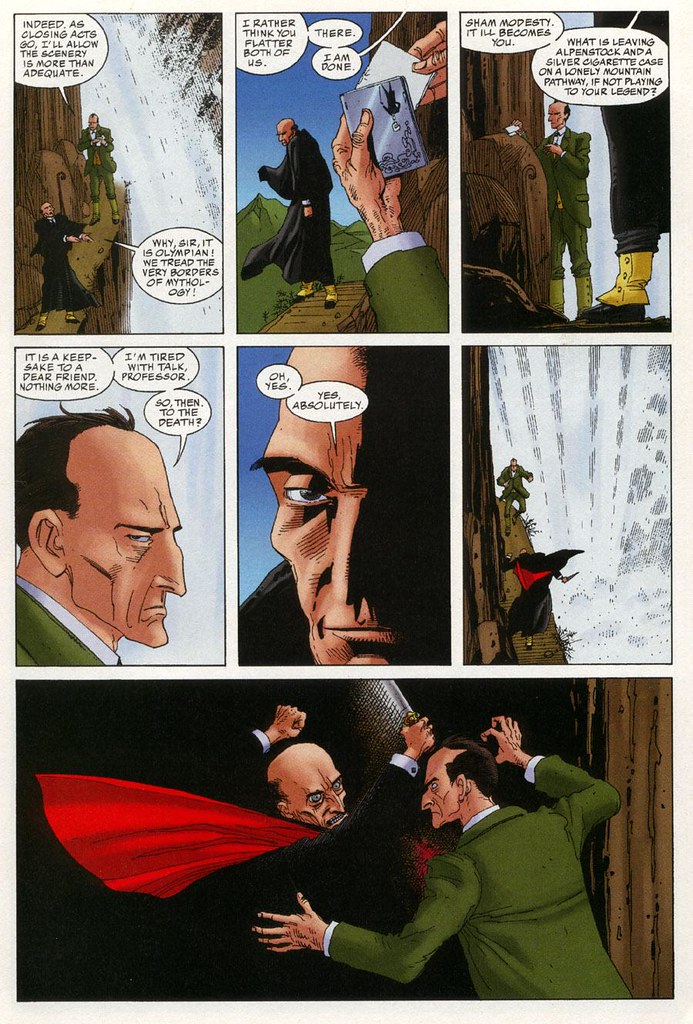
Whenever he has the time Holmes will use his famous intellect to analyze his opponents, predict their actions, and plan out, move for move, the ensuing fight. In Game of Shadows, Holmes and Moriarty play out part of a chess match and then an entire fistfight in their minds. They both realize Holmes will inevitably lose the latter because of an injury, which is why he decides to drag Moriarty down Reichenbach Falls with him instead.
Partway through A Game of Shadows, expectations are subverted when Holmes plans out an elaborate fight with a Cossack assassin, and begins the fight in real-time, only for Simza to hurl a few throwing knives at the Cossack midway through, in part because Holmes actually told her about the assassin's presence.
Badass Bookworm: This side of Holmes being brought up is a big part of this particular adaptation. Watson looks more this part than Genius Bruiser, too.
Watson and Moriarty also count as very well-read gentlemen who know how to handle themselves in a fight.
Bash Brothers: Holmes and Watson basically all the movie.
Bat Deduction: Averted. Sherlock's deductions are plausible and the clues to them are shown to the audience, it's just that you don't put it all together until he explains how he did such himself.
Batman Gambit: This is how Holmes' Awesomeness by Analysis fighting style plays out. Holmes can't account for every possibility, so he puts himself into positions where the most probable action by his opponent best suits his purposes. The audience has the benefit of sharing Holmes' foresight, while his opponents do not, and generally do none of the unpredictable things that could ruin his plan.
Beauty Is Never Tarnished: Irene gets dirty and a little bloody but her face remains unblemished, even after the explosion that almost kills Watson. Sim at least gets a bloody nose in her fight with the Cossack and again during the pursuit in the woods by German soldiers. Both of them are surprisingly clean for the Victorian-era.
Berserk Button: Harming Irene in any way is usually this for Holmes. Remember that he let Blackwood fall to his death and was willing to sacrifice his own life to kill Moriarty.
Similarly, harming Mary in any way is Watson's Berserk Button. And in the second film he mutely takes it when the gypsies loot his garb until one of them takes his scarf (Mary's gift). Then he punches out the perp.
Threatening either Watson or Mary is also this to Holmes.
On the evil side of things, Colonel Sebastian Moran's button is definitely when someone puts Moriarty in harm's way. When Watson drops a tower on him, the normally cool as ice Moran becomes pretty feral, threatening the German unit commander and his troops with death if Holmes, Watson and the gypsies get away. He also becomes a Determinator, charging into a hail of bullets to ensure their capture and even after being shot in the side by Watson, still trying to (and succeeding in) thin Holmes' herd by firing off a shot that picks off one of the unlucky gypsies.
Bullet Time: In both films, notably the pier explosion in the first and the forest chase in Game of Shadows, in which the sequence continuously moves in and out of it.
Character Exaggeration: Irene Adler is arguably a victim of this. In the Doyle canon, she was just an opera singer who was known for her cleverness, and she went down as an Ensemble Darkhorse for outsmarting Holmes by stopping him from stealing back a compromising photo that she'd gotten her hands on through pure happenstance. In the movie, she's made into a full-on Femme Fatale/Action Girl and a professional thief.
Clock Punk / Steampunk: Both Blackwood and Moriarty employ such devices, Blackwood building a cyanide gas spewing machine and Moriarty building time bombs and machine guns.
Not so in Moriarty's case: The movie takes place in 1891. Moriarty's weapons of war aren't so much steampunk or clockpunk as they are a little ahead of their time: the Mauser C96 pistol that Holmes uses during the film is only five years early! (Hence the '96' designation; 1896.)
The Coats Are Off: Watson removes his overcoat (keeps his suit jacket on) before every fight.
Watson. Holmes has some of this as well, being a master of calculated combat. When he uses the Sherlock Scan combo on his targets, it takes into account every reaction that the target would use; and shuts them down accordingly. The pragmatism in it is that it never lets the opponent get a hit in.
When Holmes is getting his butt kicked by the Chinaman, he doesn't hesitate to call on Irene to just shoot him.
In A Game Of Shadows, Watson is racing to Holmes' rescue. Except Moran is up in a lighthouse with a rifle and the light trained down Watson's only avenue of approach, keeping him pinned down. Then Watson realizes he's taken cover behind a naval cannon, which causes one of the best reactions from Moran.
Moran: That's not fair!
Shortly after that, our heroes are racing through the forest with Moriarty's men on their heels, trading gunfire. The bad guys decide turnabout is fair play, and the commander decides to deploy "Little Hansel". It's not clear what kind of gun it is, but individual shots fired out of it are powerful enough to rip apart trees.
Holmes and Moriarty both make liberal use of this trope during their final confrontation in A Game of Shadows; Moriarty by repeatedly attacking Holmes' wounded shoulder, and Holmes by blowing sparks in Moriarty's face so that he can Take a Third Option.
Cool Shades: Holmes wears a few pairs, though they would be very unusual for the Victorian era.
Crazy Jealous Guy: Holmes is not happy that Mary is diverting Watson's attentions from their partnership.
Crazy-Prepared: Anytime Holmes looks like he's in trouble he's already planned a way out of it.
Creative Closing Credits: Images from the film are rendered as Victorian era-esque pencil illustrations. Much like the kind you might find in the occasional novel, including the original stories (illustrated by Sidney Paget).
A Game of Shadows also has the actual text from "The Final Problem" (the story that the film is loosely based on) appearing around the illustrations and credits themselves.
Deadpan Snarker: Holmes and Watson often seem to be taking part in a sarcasm competition.
Holmes: What of the coffin? Lestrade: We are in the process of bringing it up now. Holmes: I see... [looks at the constables, all of whom are firmly rooted to the ground] Hmm... Right. At what stage of the process? Contemplative?
Later,
Watson:[when Irene opens fire on Blackwood's henchmen] She loves an entrance, your muse.
Disney Villain Death: Lord Blackwood seems set to fall victim to this with a rope and wooden planks dragging him off the bridge, but Holmes saves him. A part of the bridge's steelwork then collapses and Blackwood falls into a noose of chains.
Played straight with Moriarty in the sequel, as per the original confrontation.
Disproportionate Retribution: Holmes puts a man in the hospital ("Physical recovery: six weeks.") for spitting at the back of his head. Granted, it was in a boxing match, but the moment before Holmes was about to step out of the ring and end the match.
Flynning: Averted. Holmes actually uses a form very similar to Bartitsu, but with Wing Chun boxing, Brazilian Jiu Jutsu and swordfighting introduced (the choreographer even called it "neo-Bartitsu"). The fighting in the sequel even more closely resembles historical Bartitsu.
The Gambling Addict: Watson. Downplayed somewhat in that it never directly affects the plot as he's not allowed to actually gamble, the problem is only discussed, never seen.
Getting Crap Past the Radar: Even for a PG-13 rated movie, cocaine is never mentioned in the 2009 movie. However, at one point Watson looks at some bottles, picks one up and says disgustedly, "You do know what you're drinking is meant for eye surgery." Cocaine was used for anaesthetic in eye surgeries in the late 1800s. In the second movie Mrs. Hudson says that Holmes has been living on cigarettes, coffee and coca leaves. Cocaine is made from coca leaves. (Meanwhile, Holmes is shown drinking formaldehyde as Watson repeats his earlier comment, only this time reminding Holmes he's drinking embalming fluid.)
Though the effect of consuming coca leaves and cocaine are completely different. Coca leaves work like energy drinks and in this case makes more sense, considering Holmes energetic behaviour.
Go Seduce My Arch Nemesis: Again, Irene Adler (see Femme Fatale above). Hired by Professor Moriarty to, among other things, seduce Holmes. A bit of an aversion, as it's implied that Adler and Holmes were already involved in some fashion, and Moriarty just used Adler's pre-existing relationship with Holmes to further his own goals. He also makes it clear at one point that it's more a case of Go Seduce My Arch Nemesis (Who You're Already Kind Of In Love With, Or I'll Kill Him If You Don't).
Handicapped Badass: Watson is a very proficient and agile fighter with a war wound that gives him a limp. The limp seems to conveniently vanish in every action scene, however. (Not necessarily a error; people with limps are often able to run without the limp being apparent, depending on the nature of their leg injury/disability. Also, given the tongue-in-cheek nature of the films this may indicate Watson's limp is psychosomatic, or maybe even exaggerated.)
Hero Insurance: Played with; Holmes and Watson commit a few minor crimes (such as breaking and entering and withholding evidence) without receiving any punishment. However, after their investigation leads to the demolition of a shipyard and the earlier-than-scheduled launching (and not entirely unexpected sinking) of the ship under construction, Holmes and Watson spend the night in the pokey. This is apparently all the punishment they face. Then again, it's explicitly stated that powerful persons intervened to get Holmes out for the shipyard incident and considering that the end result of this investigation is the prevention of a gas attack on Parliament which would have killed most of the MPs and the government and a thwarted coup, it's little wonder that strings might be pulled to get him out of trouble.
The sequel later confirms that, as in the original stories, Holmes' brother Mycroft is "indispensible" to the British government, which would undoubtedly smooth such things over a bit.
"What was that about saving your bullets?" from the first film.
The second has Holmes chastising Watson for being rude to Simza, before Watson reminds him that he threw Mary from a speeding train.
I Drank What?: Holmes drinks a bottle of a chemical intended for use in surgery in the first film and is chastised by Watson. A similar exchange occurs in the second when Holmes pours himself a drink from a bottle of formaldehyde.
I Know Karate: Holmes' proficiency in martial arts; specifically, the British modification of Japan's Jujitsu known as "baritsu"*
In real life named "Bartitsu", but "Baritsu" was what Conan Doyle wrote Holmes having.
, taught by one Lord Barry. However, its application onscreen is liberally mixed with Wing-Chun Kung-Fu (Robert Downey, Jr.'s primary style of martial arts) and a generous helping of Brazilian Jiu-jitsu (director Guy Ritchie is a BJJ Brown Belt). Ironically, when Holmes fights a Chinese mook who also knows kung fu, he doesn't fare so well, apparently being used to opponents who use Good Old Fisticuffs.
Improvised Weapon User: Watson's weapon of choice appears to be his coat combined with whatever he can get his hands on. And he manages quite well at it too.
Not invoked by the film itself, unless you count Mary's comment that Watson's journals would make interesting reading, but the film's divergences from the Canon can be handily explained by applying the standard theory that Watson's published accounts were somewhat fictionalized (with the film, by this hypothesis, showing the actual reality). Considering what happened to Blackwood's poison gas device (confiscated by the military), it's possible that Holmes and Watson were sworn to secrecy for reasons of national security. Hence, Watson couldn't publish this one. This would explain why he ends up sneaking bits of dialogue into other stories (see Mythology Gag).
The second film opens and closes with him writing "The Final Problem", the actual short story that A Game of Shadows is loosely based on.
Meta Casting: As in his earlier Iron Man film, Robert Downey Jr., a guy known for being a brilliant but (at least in his younger years) troubled addict plays... a brilliant but troubled addict.
Many to the original canon, from re-appropriated lines, to Watson limping, to one or two references to cocaine use.
Watson: You realize what you're drinking is intended for eye surgery?
[from the second film] ...you're drinking embalming fluid?!
Mary quotes Watson as saying that his friendship with Holmes is "worth the wounds". Watson, in his narration of "The Adventure of the Three Garridebs", expresses a similar sentiment in similar words: "It was worth a wound - it was worth many wounds - to see [how much Holmes cares about him]".
Mycroft Holmes is also mentioned. In the second film he's an actual participating character.
When Mycroft is introduced he and Sherlock take turns Sherlock Scanning eachother, which Mycroft ultimately wins, a nod to the fact that Mycroft is actually smarter than Sherlock.
Near the end of the first movie, Mary Morstan sees all of Watson's journals about his and Sherlock's adventures, and says she'd like to read them. This, of course, is a reference to how almost all the Sherlock Holmes stories are told by Watson.
Similarly, the second movie is bookended by scenes of Watson frantically typing up the stories. It's implied that Holmes' death pushed him into it; this is in accordance with the real-life publication dates of the first two volumes of Holmes stories, which were all published between 1891 and 1893, when Watson would have believed his friend was dead.
Irene's photo from "A Scandal in Bohemia", which Holmes asked the King of Bohemia to give him as a souvenir, is seen.
Holmes shooting the initials "V.R." into the wall, mentioned in "The Musgrave Ritual" as his idea of patriotic decorating.
The talk about how you could tell that a drinker owned a watch is from The Sign of Four, although it was a different context.
Irene cuts Holmes off before he can finish mentioning the details of "A Scandal in Bohemia".
In the closing credits, we learn that the boxer that Holmes faces in the pit is a man named McMurdo. In The Sign of the Four, McMurdo was a bodyguard hired by one of that story's supporting characters, who decided to let Holmes into said character's house when he recognized him as one of his old adversaries from his prizefighting days.
The line "It does make a considerable difference to me having someone with me on whom I can thoroughly rely", which was given prominence in most of the trailers, is lifted wholesale from "The Boscombe Valley Mystery". The line, "There's nothing more deceptive than an obvious fact," is from the same story.
"Data, data, data! I can't make bricks without clay!" is similarly filched from "The Copper Beeches".
In a similar vein, "My mind rebels at stagnation. Give me problems, give me work..." is from The Sign of Four.
And "You have the grand gift of silence, Watson. It makes you quite invaluable as a companion." from "The Man with the Twisted Lip". Someone had fun.
Watson's injury was a Shout Out to Doyle's indecision about whether the bullet hit the shoulder or the leg. Fanon has different theories as to which, with both being a popular choice.
The comments Watson makes about Scotland Yard's rugby match are a Shout Out to A Study In Scarlet, where Holmes compares the officers to a herd of bison.
Holmes's reference to Don Giovanni is another reference to Fanon. Irene Adler was a contralto opera singer in "A Scandal in Bohemia", and some fans believe that Holmes frequented the opera in hopes of seeing her.
Holmes' use of disguise to sneak a peek at Irene's employer.
Conan Doyle described Holmes' fits of melancholy and many have speculated that Holmes was bipolar. Holmes seemed a little unbalanced at the beginning — "Is it November?" — although this was mostly played for laughs.
"Sherlock Holmes Aides Police" is a shout-out to the several instances in the books where Lestrade gets the credit for a crime Holmes solves.
Watson's bulldog is canonical but little-known, being mentioned once in the first chapter of the first Sherlock Holmes story, A Study in Scarlet, and then never again (among those fans who remember the dog at all, it's often assumed that Watson sold it or gave it away shortly after moving in with Holmes). The running joke about Holmes testing anaesthetics on the dog is also inspired by a scene in A Study in Scarlet, although that involved a different dog, an aged and infirm terrier that was waiting to be put out of its misery when Holmes appropriated it to test a substance he suspected of being poisonous.
Holmes looking up at the ceiling or absentmindedly plucking on the violin when deep in thought.
The film incorporates Holmes' line about keeping Watson's checkbook locked in his desk and adopts the interpretation drawn from that and other hints that Watson had a weakness for gambling.
A Game of Shadows unsurprisingly has quite a few to "The Final Problem." In particular, several lines of dialogue are lifted directly from the story:
Moriarty: Rest assured. If you attempt to bring destruction down upon me, I shall do the same to you. My respect for you, Mr. Holmes, is the only reason you're still alive.
Holmes: You've paid me several compliments. Let me pay you one in return, when I say that if I were assured of the former eventuality - I would cheerfully accept the latter.
And, later on:
Holmes: No possible solution could be more congenial to me than this.
Moriarty's monograph Dynamics of an Asteroid (from "The Valley of Fear," natch) makes a couple of prominent appearances in Game of Shadows.
His asking Holmes whether he has actually read the book may be a subtle one as well — in the stories, the monograph was so advanced that no scientist could understand it well enough to critique it. Especially considering that in "A Study in Scarlet," Watson makes a length of Holmes's strengths and weaknesses, noting that the detective knows absolutely nothing about astronomy.
The binomial theorem features on Moriarty's blackboard and as part of the key to the code in his notebook. In the books, his treatise on the binomial theorem, written at the age of 21, was the thing that won him his professor's chair.
There is a train chase in the original story, though it's SIGNIFICANTLY more...subdued.
The postcard from Holmes to Watson outside the weapons factory, "Come at once if convenient" and subsequently "If inconvenient, come all the same" is from the original Doyle story The Adventure of the Creeping Man.
Some street urchins are present at Holmes' funeral at the end of the second movie. The Baker Street Irregulars, perhaps?
Reichenbach Falls.
From the second film: the fake wax dummy of Holmes and the fact that Moran is still at large at the end and Holmes has been to his brother's safehouse (where he got the oxygen thingy) relate to "The Adventure of the Empty House".
The Diogenes Club, which Mycroft co-founded in the original canon, is mentioned when Watson deduces that, since Mycroft is not dining there, something serious must have his attention.
The description of Holmes near the end of the second film, "He played the game for the game's own sake", is what Holmes says of himself in "The Bruce-Partington Plans" when it's suggested he might get a big reward for solving the mystery.
When Watson comes to find Holmes after his boxing match, Holmes' experiment with his violin and a jar full of flies is a recreation of a similar scene in the Basil Rathbone film The Adventures of Sherlock Holmes.
Take a close look at Moriarty's little red notebook. Then go watch the Granada TV version of "The Final Problem" (with Jeremy Brett) - specifically, the scene where Moriarty visits Holmes in Baker Street and consults his notebook about when Holmes first crossed his path.
When Holmes is giving a "speech" at Watson's non-existent stag party, he is carefully eying a target moving through the club's crowd, and rather absent-mindedly refers to Watson as John "Hamish" Watson, referencing some confusion in one of the original stories when Watson's wife refers to him as "James" ("Hamish" being the Gaelic equivalent) and not "John".
Noodle Incident: Apart from various Mythology Gags mentioned earlier, there's also the second time Irene Adler outsmarted Holmes (assuming the first was a reference to A Scandal in Bohemia). Whatever happened apparently involved a stolen diamond and led to Holmes and Adler sharing a room in the Grand Hotel. The fact that Holmes prepares to defend his life when Adler reaches inside her Victoria's Secret Compartment indicates that things didn't turn out well.
Passing the Torch: It's subtle, but throughout both movies Holmes is often training Watson in his methods, like a school teacher with a student—note how many times Holmes lets Watson take first crack at a deduction, and in the climax of Game of Shadows, even leaves the final question up to Watson while he's out of the room. Likely, Holmes wasn't entirely confident of surviving Moriarty, and wanted to make sure someone could work in his stead.
Perma Stubble: The first time Sherlock Holmes has ever been depicted with it. You'll notice Holmes is somewhat more cleaned up after someone tells him to clean up. During the dinner with Watson and Mary, he is nearly clean-shaven... but not quite. In fact, his Perma Stubble may be constantly on his face, but it is done realistically.
"You know Holmes, in another life you'd make an excellent criminal."
"Yes, and you an excellent policeman."
Related to this; Holmes will frequently ask to borrow something from Lestrade (such as a pen or a handkerchief), use it to do something rather unpleasant (such as poking at a corpse or messily blowing his nose) and blithely hand it back, much to Lestrade's disgust.
Holmes twice attempts to stealthily break into somewhere, only for someone to abruptly interrupt him by opening (or kicking down) the door.
Holmes drugging the dog.
One that spans over two movies "Get that thing out of my face." "It's not in your face, it's in my hand." "Get what's in your hand out of my face."
The first film has Adler revealing she was working for Moriarity.
The second film has Holmes typing a suspicious question mark after Watson's "THE END".
Sherlock Scan: Holmes himself is in top form, of course, though one of his scans does get him in trouble with Mary towards the start of the movie. In the first film he makes a mockery of a Blindfolded Trip by completely ruining the Masons' attempt to disguise their identity and present location. Watson shows how much he's learned as Holmes's partner by pulling off several himself. Holmes even manages to weaponize his scans: in his first Awesomeness by Analysis scene, as noted above, he notes that his opponent is a "heavy drinker" and aims a shot at his bloated liver.
Combined with Continuity Nod, the Establishing Shot of Baker Street in the first film is almost exactly the same shot that opened the Granada Sherlock Holmes series with the seminal Jeremy Brett.
In the second film, take a close look at Moriarty's little red notebook. Then go watch the Granada version of "The Final Problem" - specifically, the scene where Moriarty visits Holmes in Baker Street and consults his notebook about when Holmes first crossed his path.
When Watson comes to find Holmes after his boxing match in the first movie, Holmes' experiment with his violin and a jar full of flies is a recreation of a similar scene in the Basil Rathbone film The Adventures of Sherlock Holmes.
"Dredger" bears some resemblance to Rondo Hatton, who played a similar hulking villain in the 1944 Holmes film Pearl of Death.
The scene where Watson tries to interest Holmes in some seemingly bizarre cases that people have written in to him about, only for Holmes to curtly reveal he's deduced the actually-very-mundane solutions from simply reading the letters, harkens back to a similar scene in Billy Wilder's The Private Life Of Sherlock Holmes.
A line from Henry V, Act III while leaving the cemetery: Watson: "Follow your spirit..." Holmes *joining*: "And upon this charge, cry God for Harry, England, and St. George!"
Of course, the most important part of this quote is the first line: "The game'safoot"...
A rather far-fetched Shout Out is the newspaper a certain character reads at one point. The headline says "Panic in the streets." It's a London newspaper. Does Guy Ritchie like the Smiths?
This is implied to be Holmes's general outlook, that he enjoys the chase and the intellectual challenges his work provides, and rejects cases that don't stimulate him. "My mind rebels at stagnation, give me problems, give me work."
Further emphasized in A Game of Shadows, at Holmes' funeral, where his epitaph reads: "He Played The Game For The Game's Own Sake"
Steel Ear Drums: Averted in both films. In the first, after the explosions on the dock, everyone's ears are shown to be ringing and Sherlock seems extremely dazed and barely able to stand, indicating possible damage to his inner ear. In the second, Watson takes care to put on ear mufflers before firing the cannon. Later on, it's shown in a first-person slo-mo shot that everyone is having trouble hearing, even their own yells, as they run through the forest trying to dodge the cannons and gunfire.
Stylistic Suck: Played With. All the music in the series is played quite elegantly on deliberately out-of-tune instruments.
Irene Adler's idea of an entrance is to start shooting and knocking people out.
Holmes could also be considered this too. Early in the film he was trying to construct a silencer and later in the film he empties his whole gun just moments after telling Watson to "save your bullets". Watson calls him on it.
Two Guys and a Girl: Holmes and Watson with Irene in the first film and Sim in the second.
The Watson: Watson performs his traditional service here, though the first film begins after many of their adventures, so Watson is allowed to make deductions of his own, told to Holmes.
In the first film, Holmes deduces that Riordan was killed as soon as his experiments were successful, for this reason.
Moriarty knows one simple rule: no loose ends. Which is why Rene is shot with a poison dart by Moran after his assassination attempt is stopped, and is also how Moriarty got Claude to kill himself right in front of Holmes, Watson and Simza.
quoted by Moriarty in the second film when he "dismisses" Irene from their lunch engagement, though on-screen Never Found the Body by Holmes, so who knows (see greenlighted sequel above).
Younger and Hipper: The films have been called this, though the actors are actually a good ten to fifteen years older than Holmes and Watson would have been when their partnership began (Sherlockians generally place Holmes and Watson in their late twenties to early thirties at the start of A Study in Scarlet) and just a couple of years younger than Basil Rathbone and Nigel Bruce when they started in their roles.
Sherlock Holmes
Action Prologue / In Medias Res: The movie starts with Holmes, Watson, and the Yard capturing Lord Blackwood after he murders five girls, and thwarts his murdering a sixth.
Affably Evil: Dredger — considering his interactions with Holmes generally involve them trying to beat the crap out of each other, he's unfailingly polite.
Holmes: "(in French) One moment, please." Dredger: "(in French) I'm in no hurry." (and while he advances after saying so, he did let Holmes climb to his feet and speak)
Blackwood is also quite polite, not to mention charismatic. Which is of course part of his scheme, that he's a showman who makes his scientific feats look like magical conjurations.
Almost Kiss: Sherlock leans forwards as if to kiss Irene at the end, then removes her stolen necklace instead. Before he leaves he quickly kisses her on the forehead.
And the Adventure Continues: Holmes, Watson and Mary are relaxing after the case is over when P.C Clark comes by with a summons from Lestrade: a police officer has been murdered and a vital element of Blackwood's device stolen, and Holmes recognizes the M.O as belonging to a certain professor who's recently been brought to his attention.
Holmes: Clarkie... case re-opened.
The Antichrist: Blackwood deliberately invokes all the tropes associated with the The Antichrist — witchcraft, raising from the dead after three days, grand plans for World Domination, disciples, etc. In one scene, he's reading from the Book of Revelation about the biblical Beast.
The Apple Falls Far: Irene tries to cross a bridge at the climax only to find just in time that it hasn't been completed yet. A length of chain falls off the gap in her stead.
Applied Phlebotinum: Holmes briefly uses a powerful electrode as a weapon which apparently needs to be charged with a hand-cranked generator.
Watson: Holmes, what is that? Holmes:Je ne sais pas! [subtitle: "I don't know!"]
To be more precise, this shocking device is perfectly possible (a powerful capacitor with two terminals). It is small size, and capability of delivering multiple shocks without reloading that makes it Applied Phlebotinum, at least for the time period. Today, it's completely plausible.
Art Major Biology: If someone is hanged there are physical signs — a broken neck or deep ligature marks from strangulation, bulging eyes, bowel failure, etc. Watson should have been just a little suspicious of Lord Blackwood's completely unmarked neck, at least.
Also the scene where Holmes blocks the chimney while talking with Lord Coward, slowly filling the room with smoke to escape. Both he and Coward keep speaking casually, even though with that much smoke around both should have been coughing their lungs out. Not to mention that Coward would have smelled the smoke sooner than he saw it.
Ascended Extra: Irene Adler only appeared in one of the original Doyle stories ("A Scandal in Bohemia", where she was the antagonist), and Holmes only briefly encounters her in it. Here, she's upgraded to a major supporting character with hints of a romantic interest in Holmes.
As Long as It Sounds Foreign: Averted. Robert Maillet, Dredger's actor, is French-Canadian, specifically from Acadia. Incidentally, Dredger is also supposed to be French-Canadian—the actor's accent may have inspired this coincidence of nationality.
Bastard Bastard: Blackwood was conceived out of wedlock during a "magical" ritual.
Batman Gambit: Blackwood's attempt to scare everybody into thinking he had great magical powers and thus he would rule England / the world. Of course, they may all be a part of the Evil Plan of Professor Moriarty by exploiting the confusion caused by Blackwood's plan.
Berserk Button: Blackwood needs Standish to try and shoot him so he'll become a self-inflicted victim of Kill It with Fire, so he drops a few threatening lines about conquering America while referring to it as a colony. Blackwood knows that Standish is a firm believer in Why Don't You Just Shoot Him?, and it works perfectly. Although this doubles as a Xanatos Gambit, since if Standish submits, it'll be taken as a sign that Blackwood is the one true leader.
Never, ever, spit on Holmes.
Bifauxnen: Irene Adler dresses in men's clothing in some scenes, probably referencing how she managed to get past Holmes in "A Scandal in Bohemia", where she says that she dresses as a man to enjoy the liberties to which she was otherwise not entitled in Victorian England. She even calls her men's clothing her walking clothes. (Though she doesn't bother to hide her figure or remove her make-up at all - she'd never be taken for a man.)
Bitter Almonds: How Holmes discovers the nature of Blackwood's weapon.
Sir Thomas: Mr. Holmes, apologies for summoning you like this. I'm sure it's quite a mystery as to where you are, and who I am...
Sherlock Holmes: As to where I am, I was, admittedly, lost for a moment, between Charing Cross and Holborn, but I was saved by the bread shop on Saffron Hill. The only baker to use a certain French glaze on their loaves - a Brittany sage. After that, the carriage forked left, then right, and then the tell-tale bump at the Fleet Conduit. And as to who you are, that took every ounce of my not-inconsiderable experience. The letters on your desk were addressed to a Sir Thomas Rotherham. Lord Chief Justice, that would be the official title. Who you really are is, of course, another matter entirely. Judging by the sacred ox on your ring, you're the secret head of the Temple of the Four Orders, in whose headquarters we now sit. Located on the northwest corner of St. James Square, I think. As to the mystery, the only mystery is why you bothered to blindfold me at all.
Beat
Sir Thomas:Yes, well... Standard procedure, I suppose.
Board to Death: What Blackwood intended to do to Parliament
Brick Joke: In the beginning, after Blackwood has supposedly come Back from the Dead, Holmes says they have to investigate it to preserve Watson's professional integrity as "No woman wants to marry a doctor who cannot tell if a man's dead or not." It goes unmentioned until the final scene where Holmes is doing the summation of how Blackwood faked his death, and begins his explanation of how he didn't have a pulse by saying he will now restore Watson's doctoral reputation.
Also, during the Action Prologue, Watson gets the drop on a Mook about to strike Holmes and covers his nose to render him unconscious. After a moment or so, Holmes remarks that Watson is a doctor after all. Near the end, Watson has Dredger in a choke-hold and says "Relax...I'm a doctor" before Dredger finally loses consciousness.
Bulletproof Human Shield: Happens during the first fight scene, when Sherlock spots a mook coming towards him with a revolver and uses some fancy martial arts technique to maneuver the mook he is currently fighting into taking the bullet for him.
Cane Fu: Holmes, Watson and Blackwood are all proficient.
Captain Obvious: Blackwood's coffin is opened to reveal the midget's corpse.
Lestrade: "That's not Blackwood!"
Holmes closes his eyes in exasperation: "Well, now we have a firm grasp of the obvious."
Carriage Cushion: The 19th century version. A burning Standish falls out of a window on top of a horse-drawn carriage.
The mentions of the bridge that's being built at the beginning.
Also Lord Coward's shoes.
The rat's tail that Holmes snips off at Blackwood's factory.
Choke Holds: A thug sneaking up on Holmes is put in a blood choke by Watson. To prevent the Mook from screaming, Holmes immediately pinches off his nose and mouth. They chat for a bit and, once the thug has passed out, move on. At the end of the film, a big mook has to be slowly air choked because he's just too darn big for anything else.
Climbing Climax: The final fight between Holmes and Blackwood on the half built Tower Bridge.
Cut Lex Luthor a Check: Among many of the technologies Lord Blackwood uses to simulate magic, the gas machine is a remarkable invention. Subverted in that Moriarty sees the value in the radio receiver and steals it.
The whole Blackwood plot, although haphazard at first, has a very practical goal: a coup d'état installing Blackwood's supporters in the highest seats of power.
Cutting the Knot: Holmes is trying to open a locked door with an array of lock picks. Watson merely kicks the door open.
Dark is / Not Evil: Everything connected with Blackwood is always associated with pure darkness. Also, Blackwood is always seen wearing a wicked-looking black leather trenchcoat while his minions wear dark cloaks. However Holmes himself is Tall, Dark and Snarky, and also dresses in gloomy black, complete with Sinister Shades.
Dark Messiah: Lord Blackwood would very much like to be thought of as one of these, and goes a long way towards convincing the entire country he is. But then, in the end, he actually isn't...probably.
Disproportionate Retribution: In the pit-fighting scene, Holmes gave up and walked away...at which point his opponent spat at the back of his head. The following No-Holds-Barred Beatdown / Curb-Stomp Battle was performed solely so that the opponent couldn't spit at him again. The fact that Holmes had spied Irene in the audience a few moments before probably had a lot to do with that. He couldn't exactly look bad in front of her. Again.
Doing in the Wizard : At the end of the movie, Holmes beautifully deconstructs Blackwood's every known act of sorcery, explaining exactly how each was done via friends in high places, applied science, and plain old theatrics. He also notes that Blackwood had better hope the occult parts were all baseless superstition, since he did the rituals perfectly.
Doomsayer: Crowds of of these are seen being broken up by mounted police outside the Houses of Parliament, indicating the "Panic, sheer bloody panic!" inspired by the villainous Lord Blackwood's return from the dead. One man really goes to town describing the terrible events to come.
"The end is nigh! Blackwood's come back from Hell, and laid a curse upon this land! He walks in every shadow, and every puff of smoke. Behold, he cometh with clouds, and every ene shall see him and every soul shall wail because of him! You cannot stop him! No one can!"
The Ending Changes Everything: During the final sequence atop the Tower Bridge, Holmes pulls back the curtain on all of Blackwood's supposed dark magic from his resurrection to his ability to "conjure" magic. See Once More With Clarity below.
Esoteric Motifs: The four murders planned by Blackwood correspond to the four classical elements:
Earth:Reordan is buried in Blackwood's dirt-filled coffin after being killed.
Water:Sir Thomas is drowned in his bath when when Blackwood sneaks a paralytic chemical into it.
Fire:Standish is burned to death when his pistol backfires.
Air:Everyone in Parliament is nearly killed by poison gas. Instead, Blackwood ends up hanging himself.
Additionally, the elements are paired with their opposites for each murder.
Earth:Reordan is buried in the earth and dies from a lack of air.
Water:Sir Thomas dies submerged in water that is heated by fire.
Fire:Standish is immolated by fire, hastened by the fact that he was soaked in a chemical he took to be water.
Air:Parliament would have been killed by poison gas pumped in from beneath the earth.
In addition, the four murders also correspond to four animals: the man, ox, lion, and eagle, which have various significances:
In The Bible, cherubim are described in the book of Ezekiel as having the faces of these four animals.
In early Christian thought, they represent the authors of the four Gospels.
They also represent the four classical elements, though their traditional attributions don't quite match up with the movie's elemental correspondences; namely, the eagle traditionally represents Water, but the victim in the movie who corresponds to the eagle is the Fire murder. Of course, since the eagle is also a symbol of America, it makes sense that the writers would have the American victim be the eagle, so that little bit of artistic license is pretty well justified.
Even the Dog Is Ashamed: The scene where Dr Watson realizes that Holmes deliberately forgot his gun to get him to come along, then almost immediately heads off after Holmes; cue Animal Reaction Shot.
Evil Sorcerer: Lord Blackwood. Although, he does not actually have any powers, just common sense, sleight of hand, and a well-tuned sense of theatricality.
Fandom Nod: In the extended preview (aired during the Monk series finale), there's yet another clip of the Holmes-Watson Vitriolic Best Buds routine, then a cut to Adler going "They've been flirting like this for hours." To the general public, a funny joke. To those aware of the Holmes/Watson-shipping fanbase, bloody hilarious. As it happened, this seems to have been a deleted scene referring to Watson's bickering with a boat captain.
Five-Bad Band: Split into two competing groups but otherwise fitting their roles.
Dark Chick— Irene Adler. Working for Moriarty against Blackwood's group.
Food Slap: When Sherlock implies that Mary is only in a relationship with Watson for his money, she splashes her wine on him.
Foreseeing My Death: Watson claims to have met a man in India who predicted the circumstances of his death, down to the number of bullets it would take to kill him and where each of those bullets would hit him.
Futile Hand Reach: Watson does one of these towards Holmes right before the pier blows up.
Gallows Humor: A very literal example at the end, when Holmes hangs himself as a forensic experiment, but never stops wisecracking.
Genre Savvy: Watson at the very end, who enters his lodgings to find that Holmes has apparently hanged himself. While his fiancee Mary is shocked, Watson just rolls his eyes and snarks a little. By this time, he (and the viewers) knows enough to recognize this as yet another Sherlock Holmes experiment.
Giant Mook: "Dredger," Blackwood's giant French enforcer.
Go-Go Enslavement: Beneath this pillow lies the key to Sherlock's release.
Go Look at the Distraction: Holmes sends the officers to find where Sir Thomas kept his bath salts while he looks for Thomas's occult paraphernalia.
Gory Discretion Shot: When Blackwood makes his short drop for real at the end, we are indicated that he's dead not by seeing him hit the sudden stop directly, but by seeing the chain that ended up around his neck going suddenly taut.
The Group: An exclusive secret society that supposedly rules the British Empire and manipulates much of the rest of the world. Blackwood takes over and uses it to attack Holmes. Possibly subverted in that the group is likely not as powerful as it likes to think, given the failure of the parliamentary coup and the death of several of its members. Something of a deconstruction as well; the supposedly all-powerful and omnipotent secret society is ultimately revealed to be little more than a bunch of superstitious and ineffectual old men who'll let any old charlatan with a theatrical manner and some admittedly impressive conjuring tricks seduce them with dreams of power and glory.
Hannibal Lecture: Blackwood tries this on Holmes before his execution.
Herr Doctor: Holmes disguises himself as a German-accented doctor after Watson gets caught in one of the villain's traps and winds up in hospital.
Hikikomori: Sherlock spent two weeks without leaving his room. That's a very hikki thing.
Holding the Floor: When left in prison, Holmes avoids getting beaten up by fellow inmates by telling jokes.
Hollywood Silencer: Holmes is trying to build one early in the film, much to the annoyance of Watson and Mrs. Hudson. Somewhat subverted, since the silencer does not work. At all. Sherlock should have known better, considering that he was trying to silence a revolver. The exposed cylinder makes revolvers near impossible to silence.
Hotter and Sexier: Robert Downey, Jr.. and especially Jude Law, who cuts a very different profile from the typical image of Watson. Of course, when you think about it, he couldn't have been drawing in women on moustache alone.
Insistent Terminology: Reardon is a midget, not a dwarf. Holmes is correct about there being a technical difference, a midget has the same body proportions as the norm and a dwarf does not. For the time the movie is set this is correct usage. "Midget" being used as a disparaging term and applied to all small people was a later evolution of language.
Interservice Rivalry: Very mild, subtle example: Dr. Watson and Captain Tanner (captain of the tugboat Holmes charters) are constantly bickering in the scenes they appear together in. Watson is, of course, an old army man, and Tanner was in the navy...
Jack the Ripper: It is subtly hinted that Blackwood may have been somehow involved ("Those five girls were not the first to be butchered... no one could prove anything, but we all knew.").
Karmic Death: Lord Blackwood's entire scheme hinges on him cheating the gallows and escaping a well-deserved hanging. Guess what happens to him at the end...
Kill It with Fire: Sort of. Lord Blackwood tricks one of his enemies into killing himself with fire.
Left the Background Music On: A minor example where Holmes is shown following Irene Adler and the music played during this scene is revealed to be him playing his violin.
And again, towards the end of the film, when he has a small case of Heroic Blue Screen Of Death, is wanted by the cops, and begins absently plucking his leif motif on a Room Full of Crazy.
Local Reference: The villain mentions during his Evil Gloating that he has plans to take over America as well as Britain.
Amazingly, this is actually an in-universe Invoked Trope because Blackwood really needed to push the Berserk Button of the American ambassador. Whether he meant to follow through on the threat is iffy.
Misapplied Phlebotinum: The Evil Genius has developed a method of radio control seven years before it was actually invented by Nikola Tesla. Blackwood uses it to pretend to have magical powers
He used it for practical purpose ( killing opposing politicians), magic was only the explanation for the public.
The Mockbuster: Sir Arthur Conan Doyle's Sherlock Holmes by The Asylum (The Asylum specialize in mockbusters), released in 2010 with Ianto Jones as Watson and Dominic Keating as Spring-Heeled Jack. Featuring Holmes fighting giant monsters.
My Death Is Just the Beginning: Invoked by Lord Blackwood before his execution. His death was faked, of course. His real death actually is the beginning, shortly after he dies we get a Sequel Hook featuring Holmes true nemesis Moriarty.
Names to Run Away From Really Fast: If your title is Lord Blackwood, it's almost a requirement that you'll be involved in the dark arts. Also, Lord Coward. To the general public, a funny, jovial guy. And neither does Standish's name sound very antagonistic, in comparison to Coward's.
Once More With Clarity: Holmes explains all of Blackwood's sorcery at the end with accompanying scenes that show the real "magic" at work.
Orphaned Punchline: "...to which the barman says, 'May I push in your stool?'"
Outrun the Fireball: Averted. As Team Holmes leaves a slaughterhouse, Watson pulls ahead and accidentally hits a tripwire. He realizes what's going on and tries to warn Holmes, so Holmes gets to watch his best friend get blown up. Then Adler. He then grabs a tray to use as a shield, and heads back to Irene while his shield is destroyed by the explosion. He picks her up, and they try to outrun the blast and save Watson, but get about two steps before they're both caught in it. All in glorious bullet time. And followed up by Shell Shock Silence.
Paying For The Action Scene: Holmes engages in a pit fight in a dingy pub and eventually knocks his opponent through the wood wall. He collects his winnings and leaves some of it on the bar counter, apparently as payment for the wall and the extra bottle he takes from the bar.
Posthumous Character: The Ginger Midget is dead before we even get to meet him, but the things he does in his experiments for Blackwood lie at the core of the film.
Ravens and Crows: A raven is seen every time someone is killed or implied to be killed.
Reality Is Unrealistic: Tower Bridge is designed so well to blend in with much older nearby buildings (like the Tower of London) that some viewers were shocked to see its half-completed steel skeleton form the setting for the final confrontation with Blackwood.
Reasonable Authority Figure: Both Clarkie and Lestrade continue to trust Holmes after a warrant is issued for his arrest; Clarkie makes sure he escapes the police at the slaughterhouse, and Lestrade slips him the key to his handcuffs.
Red Herring: You know that sinister looking black bird? The one that manages to show up whenever Lord Blackwood kills someone by seemingly supernatural means? It's a perfectly ordinary raven, similar to those commonly found all over the UK.
Romanticism Versus Enlightenment: Undertones in the main hero and main villain. Sherlock is very much Enlightened; believing in rationality and science, expressing awe and appreciation in the power of industry and believing in justice. Blackwood is very Romantic, having strokes of Ubermensch-ness, belief that Democracy Is Bad, and being very steeped in the occult. Seeing that the hero of the story is Sherlock, the movie seems to come off as pro-Enlightenment.
Save the Villain: Holmes saves Blackwood from being dragged off the bridge, if only so he can be properly hanged this time around. After Blackwood tries to kill him again, though, Holmes lets the hanging take place sooner than Blackwood had hoped.
Scooby-Doo Hoax: The truth about the strange phenomena around Lord Blackwood.
Screw the Money, I Have Rules!: When the Order approaches Holmes asking him to clear up the mess they ended up creating with Blackwood and offers to allow him to name his price, Holmes coolly remarks that the advantage of being a consulting detective means he gets to pick and choose his clients, and agrees to stop Blackwood... "but not for you. And certainly not for a price."
Sequel Hook: Irene's employer? None other than Professor Moriarty. Subverted slightly in that Moriarty's reason for being involved is not brought up in the sequel.
Slipping a Mickey: When Holmes goes to see Irene, she offers him a glass of wine from an unopened bottle. Then, after Holmes drinks it and collapses, we get to see a short flashback— of her doctoring the bottle with a syringe, and resealing it.
Smug Snake: Lord Coward, who is admittedly working with genuine Magnificent Bastard Blackwood. Even taking this into account, however, he seems to spend most of the movie doing little more than standing around looking rather smug; he does attempt to avert Why Don't Ya Just Shoot Him?, but fails miserably.
Snipe Hunt: Variation, in that Holmes sends the police to go find something that actually is there, but still used to get them out of the way so he can do his thing. And steal evidence.
Spontaneous Human Combustion: Ambassador Standish bursts into flames when he attempts to shoot Lord Blackwood. This is intended to be taken as a magical occurrence, displaying the dark powers Blackwood has protecting him from those who oppose him, but in the end a clear, external cause is revealed by Holmes that has nothing at all to do with magic.
Stunned Silence: Holmes' No-Holds-Barred Beatdown of the boxer who made the mistake of spitting at the back of his head reduces the crowd of spectators from howling for blood into stunned, meek silence within seconds — except for one chap who blurts out "where the hell did that come from?!" (not too loudly, though, presumably in case Holmes took exception and came looking for him)..
Tap on the Head: Avarted in the opening where Holmes takes out a man by breaking his leg, causing him to lose consciousness from the shock, and quickly afterwards suffocating another man to unconsciousness.
Tempting Fate: Blackwood's "It's a long journey from here to the rope." at the end of the movie.
After Holmes meets with Sir Thomas, he asks Sir Thomas how long he expects to live if the rest of Blackwood's family has been killed, and tells him to consider it as food for thought. It's Harsher in Hindsight given that Blackwood drowns him in his bathtub that night.
When Watson is choking Dredger, he reassuringly tells him, "Relax, I'm a doctor."
Unspoken Plan Guarantee: Averted in the boxing match to show Holmes' Awesomeness by Analysis: Holmes meticulously plans his beatdown of his opponent step-by-step, and it goes exactly as he planned it. Then again it was all in internal monologue so never actually spoken.
Holmes himself, as while he ultimately solves the plot through sheer genius and tenacity, the first two thirds of the movie has him falling into Blackwood's plan and pretty much doing as Blackwood expected. And he ultimately falls for the distraction that allows Moriarty to get what he wanted.
Utopia Justifies the Means: Coward's motivation for supporting Blackwood's scheme is 'to provide the weak masses with a strong shepherd.''
You Got Spunk: Holmes' reaction to seeing Irene's response to being mugged.
Holmes: That's the Irene I know.
You Just Told Me: "I don't care much what you think. I just simply wanted to know the location of Blackwood’s final ceremony. And now you've given it to me. "
A Game of Shadows
Actionized Sequel: This movie spends more time on the chase and action sequences than on deduction and mystery in comparison to the first film. This is actually an accurate reflection of "The Final Problem", the canon story that A Game of Shadows is loosely based on. That story had no central mystery and very little deductive sequences, and was instead concerned entirely with the Holmes/Moriarty conflict.
Actor Allusion: Jude Law being pinned down by a sniper and finding a 'creative' solution to help him escape is remniscent of his role in Enemy at the Gates.
Affectionate Pickpocket: Sherlock steals a message meant for Moriarty from Irene Adler, who tries to steal it back while kissing him, but Holmes just grabs her hand before it reaches its target.
Almighty Janitor: Mycroft is indispensible to the British government, even though no one knows what he exactly does.
Mycroft Holmes thoughfully explains that he can understand how a man of a particular disposition could enjoy the company of women. He's also completely unashamed to walk around naked in front of one. However, he's also a Cloudcuckoolander
Sherlock Holmes, who is extremely attached to Watson. He talks about their relationship, but Watson objects to the term, so Holmes calls it a "partnership." Later, they dance together. Holmes asks how Watson learned to dance like that and Watsons says that Holmes taught him. However, Holmes clearly has romantic feelings toward Irene Adler.
Anachronism Stew: All of Moriarty's new weapons (with the exception of the Gewehr 88 rifles fired by soldiers in the forests, Gatling and Maxim machine guns) are anachronistic. The Mauser C96 machine pistol that is fired by Holmes during the Heilbronn train yard shootout was not produced until 1896, for instance. The first mass-produced submachine gun appeared in 1915. Arguably subverted: since the entire basis of Moriarty's plot revolves around producing new, technologically advanced weapons so that he can turn an enormous profit by starting World War I, this makes perfect sense. Presumably the weapons are prototypes. It's not a stretch to imagine that other companies got their hands on the designs after Moriarty "died" and began producing them a few years later.
Watson and Holmes are seen driving a four-wheeled automobile in 1891, two years before the first four-wheeled models were introduced and four years before automobiles were commercially available in the UK.
Saved by being lampshaded by Watson, who clearly recognizes how noticeable the automobile is when Holmes suspects Moriarty has him under surveillance. To which Holmes replies, "It's so overt,it's covert."
When Holmes looks into the office in Heilbronn's arms factory, we see a map of Europe which shows, among others, Germany and Finland as players in Moriarty's World War, represented by their current flags. Germany wasn't using that particular flag in 1891, and Finland was a part of Russia until 1917.
Partially anachronism, partially anatopism (out of place) - the locomotives in the German train yard are from several decades later, and are British designs of the Great Western Railway.
And Your Little Dog Too: Moriarty makes a point of threatening Watson and Mary for no other reason than to get back at Holmes.
At The Opera Tonight: Holmes suspects the bomb is at the opera house where Don Giovanni is playing and Moriarty is attending. Then realizes that a few clues were actually Red Herrings.
Awesome by Analysis: Back again with Holmes' ability to play out a fight in his head before it begins to achieve victory. He even has a Battle in the Center of the Mind with Moriarty as they predict and counter-predict their movements in this fashion. Both times after the first, however, are subverted. Simza interrupts by throwing a knife at the cossack assassin and Sherlock goes off script by blowing ash in Moriarty's face, grabbing him, and leaping over the balcony.
Badass Bookworm: In addition to Holmes, we have Moriarty, a Cambridge boxing champion, university professor, and diabolical mastermind.
Badass in Distress: Holmes gets captured and brutally tortured by Moriarty and has to be rescued by Watson. He's in very bad shape afterwards, but he still manages to help fight their way out. Later, it turns out that he intentionally allowed himself to be caught and tortured in order to get close enough to pickpocket the notebook containing financial details of Moriarty's criminal empire.
Though the twist is that it's showing exactly how a real fist-fight would go if they went for it. They just both happen to be predicting the same sequence of events in which Moriarty wins and kills Holmes.
Bigger Stick: Moran has Watson pinned behind a covered piece of machinery, until Watson notices what it is he's behind—a massive cannon.
Blasting It Out Of Their Hands: An unusually lethal use of this trope occurs when Watson shoots a mook in the arm, causing him to drop a primed grenade.
Bomb Throwing Anarchists: Sim and her brother were a member of an anarchist organization before they grew too extreme.
Book Ends: Irene's handkerchief in relation to her entering and exiting the films' plots.
Boring, but Practical: The pony Holmes ends up with for the border crossing. Compared to the horses everybody else is riding, it's distinctly lacking in coolness. It's easily the most efficient mount in the mountains though.
Holmes's use of the pipe ashes to distract Moriarty is reminiscent of his use of Irene's handkerchief in the first film to distract a boxing opponent.
Watson is still good at kicking down doors.
Holmes talked about going to see Don Giovanni in the first film.
The large cove in the bowler from the prison yard shows up at Holmes's funeral.
"Always good to see you, Watson," is a bittersweet example, especially in light of the fact that Watson is the last thing he sees. He even closes his eyes to make sure of it.
The first time we get an actual glimpse of Moriarty, he's shrouded in all-concealing shadows, like his appearances in the first film.
Cane Fu: Holmes uses his umbrella to hold off a knife wielding Cossack.
Chekhov's Armory: Moriarty feeding the pigeons, the plants in his office, the equations on the board, Holmes's camouflage, the oxygen device, the twin Mooks, the wedding gift.
Chekhov's Skill: While describing him to Watson near the beginning, Holmes offhandedly mentions that Moriarty was the boxing champion of Cambridge.
The Chessmaster: Both Holmes and Moriarty, as per the norm. The climax of the film even has them playing chess outside the location of an assassination, their moves mirroring what their 'pieces' are doing inside. The game actually ends verbally, with them stating their moves aloud until one of them wins both the game and the game of wits they've been going at the entire film.
Chess Motifs: All over the place, especially in the Grand Finale, which consists largely of a literal chess game between Holmes and Moriarty.
Cold-Blooded Torture: Moriarty has Holmes suspended by a hook in his shoulder and knocks him around while singing along to opera.
The song itself is actually a lied of Schubert, called The Trout. Roughly translated, it's about a fisherman who tricks a trout into biting his line by muddying the waters and the fish is betrayed. The music editor was a little sadistic with his choices.
Complexity Addiction: Moriarty, with the means at his disposal, he probably could have killed Holmes any time he wanted. Moran could have done it without much trouble, if nothing else. He clearly wanted an opponent to make the game more interesting.
Continuity Nod: As in the first film, Holmes finds himself dining alone in a hotel.
CPR Clean Pretty Reliable: Averted. Watson's chest compressions do not revive Holmes, so he has to use adrenaline. After Holmes is revived, he mentions that his chest really hurts. Adrenaline is what's actually used to restart a heart that's completely stopped.
Cursed with Awesome: Holmes seems to consider his own exceptional perception abilities to be this.
Moriarty is perfectly aware that Holmes will figure out his plans if left to his own devices, so he leaves red herrings to distract him and lure him into vulnerable positions.
He also correctly figured ahead of time that Irene would want to meet him in a crowded, public area - her favorite restaurant. To solve that, he literally buys out the entire crowd to leave when Moran gives the signal (tapping his glass three times). It's also possible that he poisoned her tea strainer rather than her pot of tea knowing that she'd ask for a fresh pot when she arrived. It's also possible that he bribed the waiting staff to poison everything that Irene asked to be brought to her.
The Cossack sent to kill Sim put protection lining in his coat because he knows she uses throwing knives.
Moriarty's tendency to kill pretty much everybody that even has a vague idea of who he is means that Holmes has a very difficult time gathering evidence against him.
Deadpan Snarker: Aside from the snarkers from the first movie, Mary Morstan of all people has a few wonderfully snark-tastic moments in the sequel.
Deal with the Devil: The leader of the French Anarchists describes his alliance with Moriarty as this.
Demoted to Extra: Inspector Lestrade, who appears for all of about ten seconds and has one line in the second movie, after being a somewhat prominent character in the first. His sergeant gets about the same amount of screentime, though he had a number of scenes in the original film as well.
Determinator: The Cossack goes through a hell of a lot of punishment without slowing down.
Didn't See That Coming: For Holmes, that Moriarty had tricked him into going to Don Giovanni. For Moriarty, that Holmes noticed his red notebook and snatched it from him.
Disguised in Drag: Holmes. In fact, he does it so poorly, that he doesn't seem to have bothered to shave... though he is wearing lipstick. This is Played for Laughs, of course, but makes the train fight funnier.
Double Entendre: Holmes attributes Watson's weight gain since they last met to him 'noshing on Mary's muffins', and dislikes riding horses because he doesn't like the thought of something with a mind of its own between his legs...
Dramatic Irony: Holmes notes that Moriarty can spark a world war with a lone gunman and the right target. This is exactly how World War I started.
Dramatic Gun Cock: Holmes and Moran load visibly and audibly their Mausers with metallic magazines from below. This is completely impossible with any 1896 model, or any prototype made in the early 1890s, which were all loaded from the top down with stripper clips or individual bullets. Only a few full-automatic and semi-automatic versions made from the 1920s onwards had this loading system.
Dying Alone: Watson reveals one of the reasons he wants to get married so badly is to avoid this.
The End... Or Is It?: A Not Quite Dead Sherlock sneaks into the room where Watson is typing the story of their adventure and types a question mark after "THE END" in Watson's manuscript.
Everyone Knows Morse: Watson apparently, as Holmes has him send a telegram. He must have learned it in the service.
Everything's Louder With Bagpipes: Watson is so drunk arriving at the wedding that Holmes has to signal the bagpipe players to start playing in order to wake him up.
Evil Cannot Comprehend Good: This is the deciding factor in the 'duel' between Holmes and Moriarty at the end; Moriarty thinks, like Holmes, that he is guaranteed to win the fight because of Holmes' injury, but he fails to take into account the idea of Holmes sacrificing himself to kill Moriarty. Holmes even explicitly says that he'd be willing to do a Heroic Sacrifice if it completely assured Moriarty's destruction as well, and Moriarty still doesn't factor it in.
Moriarty to Holmes, with a mind to match his, fighting skills to the same, and he's even capable of the same Sherlock Scan Holmes uses to defeat opponents.
Moran is an Evil Counterpart to Watson. They're both reliable, competent, neat sidekicks, former military men (who fought in the same war), and they are both excellent marksmen. They both have a remarkable amount of devotion to Moriarty and Holmes, respectively.
Exactly What I Aimed At: Holmes chastises Watson for not taking the opportunity to shoot the mook who's keeping them pinned down with machinegun fire when his gun jams, not realising that the mook Watson shot instead was carrying a primed grenade — which he has now lost track of.
Exact Words: Rene's letter includes a sketched self-portrait and urges Sim to memorize his face, because she will never see it again. Much later, it's revealed that Rene has undergone Magic Plastic Surgery in order to impersonate one of the delegates at the peace conference.
Failed Attempt at Drama: "Perhaps you've heard of me. My name is Sherlock Ho_(bomb goes off) Ho-Holmes." Steps outside vault to find his would-be client has done a bunk.
Fair Play Whodunit: One clue is given to us, but not for Holmes. Moriarty is going to see Don Giovanni, but at the book signing, listen carefully: he apologetically tells Moran that he won't need his ticket. We see Moran backstage at the play later, getting up when Holmes, Watson and Simza come in. He is holding what looks like a concealed rifle. Turns out he isn't seeing the play not because he'll be backstage, but because he'll be someplace else entirely. Other clues and plot points, such as the key to the encoding of Moriarty's notebook, and Holmes' early efforts to pickpocket it from him, are also displayed for our benefit well before they pay off.
Also, half-naked, rather built Robert Downey Jr... wearing badly applied blue eyeshadow and lipstick.
Faux Affably Evil: Moriarty. He drops the act entirely during the interrogation scene.
Fiery Coverup: Played straight with Meinhard's murder midway through the film, where it turns out that a bomb was used to conceal a straightforward shooting.
Foregone Conclusion: The camera gives us a really nice view of Reichenbach Falls in the establishing shot of the castle just before the climax of the movie. Anyone familiar with Holmes mythology knows where they were headed.
Mycroft makes a quick mention of a peace summit at Reichenbach very early on in the film, right before Watson's stag party.
When Holmes first officially meets Moriarty, he mentions that if it one-hundred percent assured Moriarty's destruction, he would gladly accept his own. He follows this through to the extreme at the end when he does a suicide leap off a cliff and takes Moriarty with him.
Before that, when showing Watson his web of conspiracy, Holmes told him he'd give his life to see Moriarty's demise.
Also, the fate of the Parisian bomb-maker, who commits suicide in an attempt to save his loved ones from Moriarty.
The wax figure of Holmes may be this for the potential sequel — in "The Adventure of the Empty House" he used one as a bait for Moran.
Holmes warns Irene at the beginning that if she leaves his side, she'll be dead within the hour. An hour later, she goes to see Moriarty...
From Bad to Worse: Near the end of the film, while Holmes and Moriarty fight in their minds, Holmes starts by noting that Moriarty has a serious advantage from Holmes' disabled arm. Shortly thereafter, he thinks something we have never hear him say the like of in any fight in the two films: "Arsenal running low." Moriarty "kills" him seconds later. He is both physically and mentally incapable of beating Moriarty in hand-to-hand, and they both know Moriarty's going to try to kill him.
Game Breaking Injury: The way the final fight plays out is almost entirely determined by the fact that Holmes is still recovering from having a meat hook stabbed through his shoulder, and Moriarty has zero qualms about exploiting it.
Genre Blind: Irene, despite knowing very well that Moriarty doesn't like to leave loose ends, still works for him and knows that he'd kill her the moment he let her go. The point where this comes in is that while she's Genre Savvy enough to ask for a different pot of tea when she sees one setting at the table, she doesn't think twice about the second pot. Or simply not drinking tea.
Madame Simza Heron:[showing Holmes and Watson their horses, to Watson] The black one is yours. The grey one is mine. [to Holmes] And this is for you.
Sherlock Holmes:[clears his throat, uncertain] Ah, hm, right! Where are the wagons?
Madame Simza Heron: The wagon is too slow. Can’t you ride?
Dr. John Watson:[grimaces] It’s not that he can’t ride... How is it you put it, Holmes?
Sherlock Holmes: They're dangerous at both ends and crafty in the middle. Why would I want anything with a mind of its own bobbing about between my legs? Then I should require a bicycle, thank you very much. It’s 1891! Could have chartered a balloon! [He stalks off; Watson turns to Sim]
Dr. John Watson: How can we make this more manageable?
[Cuts to the group riding their horses through the woods, followed a few seconds later by Holmes - who is trotting on a little pony!]
Sherlock Holmes: Where's the fire?
There's also one earlier in the film when Holmes warns Watson against dancing with the gypsies, saying, "You know what happens when you dance." Cuts to Watson doing a particularly unusual jig with Simza as Holmes looks on and downs a bottle of hooch.
Go Karting with Bowser: While Simza and Watson try to stop the threat at the peace summit, Holmes and Moriarty play a round of blitz chess, although they also talk aloud about the more real-life version of it they're playing with the participants and events inside.
Good Old Fisticuffs: Moriarty has a more standard boxing style compared to Holmes' esoteric fighting skills. Holmes describes it as "feral", due to the fact that Moriarty was a bit out of practice at the beginning of the fight, but still good enough to get the job done, as Holmes was crippled and on the mend while Moriarty was fresh and unscathed. As the fight wears on, Moriarty's technique refines itself and gains more precision and calculation, prompting Holmes to say "Ah, there's Cambridge's Boxing Champion!"
Gory Discretion Shot: When Ravache puts the gun to his head and kills himself, the moment he pulls the trigger, we immediately cut to the patrons of the tavern upstairs reacting to the sound of the gunshot, grabbing their weapons and going to investigate, instead of actually seeing his head get blown off.
A Handful for an Eye: Holmes steals handfuls of rice and beans from a market stall, and later throws them in the face of Moriarty's thugs during the first fight. Later still, when he faces down Moriarty, he blows a cloud of tobacco ash into his face.
Heel Face Turn: A very minor example. Although you wouldn't call her an enemy, Mary is most definitely not a member of Holmes' fan club in the first film, nor at the start of second film (being thrown off a bridge by him, only to be rescued by his brother who has a penchant for nudism doesn't help either). But by the end of the film she trusts Holmes enough to follow his instructions re: Moriarty's vault, effectively becoming his agent.
Heroic Sacrifice: Holmes. Knowing he can't beat Moriarty in a straight fight due to his crippled arm, he takes a third option and chooses to take Moriarty with him. Perhaps cannier members of the audience knew how that one was going to end, but what matters is that Holmes thought he was going to die.
Historical In-Joke: According to Holmes, Moriarty was behind the Mayerling incident, in which an heir to the throne of Austria Hungary apparently murdered his mistress, then killed himself. Since the incident first occurred, there have been multiple alternate theories advanced, including that the two were murdered as part of a plot to cause a European War.
Hollywood Law: While it certainly made for a great climax, Inspector Lestrade and the police had absolutely zero legal authority to seize Moriarty's funds. Holmes and Watson admit that Moriarty is too good to leave evidence, so Lestrade and the police are essentially robbing him blind solely on the word of Holmes. It's a good thing Moriatry died, because with his connections the backlash from that would have been epic.
However, it's possible that his fortune was seized on account of being undisclosed assets and therefore tax evasion. They may not have had evidence of his murder spree, but that book held a detailed record of every business Moriatry secretly owned under pseudonyms that could otherwise never be connected to him. As Al Capone had the misfortune of proving, just because you can't be busted for the crimes you commit, doesn't mean you're safe from being found guilty of other crimes.
Moriarty uses this to force Claude Ravache, the leader of the anarchists to follow his orders, which apparently, as part of Moriarty's "no loose ends" deal, include shooting himself in the head.
However, just as well, Ravache's family might have already been killed by men working for Moriarty.
This is basically how Watson gets involved in the plot. Holmes tells Moriarty that Watson is not part of the game, Moriarty announces his plans to kill Watson and Mary anyway. It is averted, however: Moriarty expected Holmes to rescue Mary and John, it was one of many diversions the Professor planned to keep Holmes, the only man who could stop him, busy.
Indy Ploy: At their final confrontation, both Holmes and Moriarty mentally predict how their battle will end, with both concluding that Moriarty will be the winner. Holmes then takes the next best plan and throws the both of them off the cliff. However, subverted in the end when it is revealed that Holmes had prepared for that possibility.
Involuntary Charity Donation: The assets seized from Moriarty by the police are used to make an anonymous donation to the Widows and Orphans of War fund.
It's Personal: In their first face to face meeting, Moriarty reveals he killed Irene and Watson is next. Holmes goes from being almost giddy about his rivalry with Moriarty to being much more withdrawn, showing some Tranquil Fury, and decides that Moriarty needs to be stopped. No matter the cost.
Karma Houdini: Moran slips away after killing Sim's brother. This is consistent with "The Final Problem," as Moran still being at large was the main reason Holmes had to fake his death.
Kill and Replace: How Moriarty plans to smuggle an assassin into the peace conference.
Leaning on the Fourth Wall: Moriarty tells Holmes, "Let's not waste any more of each other's time. We both know how this ends." As do any viewers who have read "The Final Problem."
Magic Plastic Surgery: Sim's brother is made to look like one of the ambassadors as part of the peace summit plot. The "magic" part is averted, though, in that when trying to identify him, Sim and Watson look for exactly the sort of identifying features that this trope usually ignores. It also probably helps that the guest list uses sketched portraits, not photographs, so Renee's disguise doesn't have to be a perfect replication.
More Dakka: Including a gatling gun and an early LMG.
Naked People Are Funny: Mycroft apparently has a habit of wandering around his home stark naked. He has a cheerful conversation with a mortified Mary when she runs into him like this, while his servants, who obviously are used to this, don't even bat an eye when they come in to serve breakfast.
Neat Freak: Mycroft is implied to be this. Doesn't like to shake hands, barely goes anywhere other than his home and office, carries a personal supply of oxygen... even his habit of walking around his house naked could be a reference to Super OCD sufferer Howard Hughes.
Neutral Female: Averted. When Watson pins an assassin, Mary makes sure to grab his gun and hold it against his head.
Never Found the Body: Holmes and Moriarty. In the case of Holmes, he is revealed to be alive at the end of the film.
Nice Job Breaking It, Hero: Happens during Holmes and Simza's fight with the Cossack, when Simza pushes a pipe into the assassin causing him to fall out a window. She is unaware that there is a rope on the end of the pipe attached to Holmes's belt, and as a result, Holmes is pulled out the window a few seconds later. Similarly, Simza putting several throwing knives into him (for which he wore a protective undershirt) before Holmes can carry out his planned takedown forces Holmes to think on the fly when the Cossack recovers, ultimately making the whole fight a lot more drawn out and dangerous than it had to be.
Nice Job Fixing It, Villain: When Holmes, Watson, and Simza are trapped in the weapons factory, the guards try to take them out with an artillery cannon. However, they only succeed in blowing a hole in the wall that was keeping the trio inside, allowing them to escape into the forest. Had they closed in with small arms, they would have won.
No-Holds-Barred Beatdown: Even though it never actually takes place except in Holmes' and Moriarty's minds, the final confrontation definitely qualifies. It's not so much a fistfight as an excuse for Moriarty to repeatedly and brutally whale on Holmes' wounded shoulder.
No Kill Like Overkill: Moriarty arranges a bombing in a banquet hall at the Hotel de Triomphe to conceal the fact that Alfred Meinhard, the head of an arms factory, was in fact shot in the head by Colonel Moran on a rooftop on the other side of the square at the precise moment of the blast. The bomb alone would surely have been sufficient to kill him all on its own.
Sure the bomb would have gone off but there was no guarantee that Meinhard would have been killed by the blast. Having Moran shoot Meinhard right at the moment of the explosion was probably because Meinhard was the one person Moriarty wanted to guarantee was killed because that would allow him to assume ownership of Meinhard's factory. Plus, Holmes mentions that the bombing served two purposes: covering up the shooting, and also hiding the motive - making it seem like the blast was Germany retaliating for two other bombings arranged by Moriarty.
Not So Stoic: Moriarty during his chilling torture of Holmes. He's clearly enjoying it.
Holmes himself, during the same scene. Seeing the guy who has kept an almost-perfect poker face over the course of two movies - in the face of physical punishment, worry that he's losing his best friend to marriage, Watson almost being blown up by Blackwood's booby trap, the news of Irene's murder being sprung on him, Moriarty's threats toward Watson and Mary, Ravache putting a gun to his own head and pulling the trigger right in front of them, and carnage from a bombing that he could have prevented - break down and howl in agony while Moriarty tortures him is incredibly disturbing.
Holmes may have been playing this up a bit; he clearly possessed enough presence of mind to switch out the red ledger, and he may have been trying to get Moriarty to think he was hurt worse than he really was. Appearing weak is a common feint.
There wasn't much need to play it up, considering his heart stops not long afterwards. The not-so-stoic moment just makes his presence of mind that much more impressive.
Oh Crap: Moran's reaction when Watson reveals he's been hiding behind a giant cannon.
"That's not fair!"
Similarly, Moriarity has a brief one before their chess match when Holmes mentions "your bishop against mine" and deduces that Holmes means Watson. "That's not exactly fair." He has a much more real Oh Crap moment when he realizes that Holmes spotted (and subsequently replaced) his little red book with one that is a zoetrope that says, "Be careful what you fish for."
Later dialog makes it clear that Moriarty is being a Deadpan Snarker about Watson. He's not saying Watson being in the room isn't fair for him, he's saying it's unfair to Holmes. When the crowd noise from inside makes it clear the assassination attempt went awry, Moriarty comments "It seems your bishop was of some use after all." The only reason to phrase it like that is if he didn't actually expect Watson to be any help.
Moriarty has an even bigger Oh Crap moment when Holmes asks "Does The Art of Domestic Horticulture mean anything to you?"
Watson has one when his winnings get scattered across the floor due to Holmes and Simza's fight with the Cossack interrupting them and he realizes he's surrounded by a bunch of opportunistic gamblers. A new brawl breaks out.
Watson has another when he knocks out the head gypsy for taking his scarf, to look around him and see a whole bunch of knife carrying angry gypsies.
The assassin on the train who gets shot by Watson has just enough time to realize that he can't find the primed grenade he dropped in the satchel full of them and look at his comrade before the whole thing blows up and the train breaks in half.
Irene has a very subtle one when she realizes Moriarty hired everyone in the restaurant they were meeting in, and makes them leave on a code signal, meaning their public meeting is actually a lot more private than she expected.
Watson gets one after hearing the usually nigh-omniscient Holmes utter the words "I was mistaken."
As Holmes begins to run through his upcoming fight with Moriarty in his mind as he often does before battle. There is a beat where it cuts to Moriarty. His voice then takes over... "Come now, you really think you're the only one who can play this game?" It's certainly one for the audience.
Holmes realizing how insane Moriarty is, when he impales him with a hook and proceeds to twist it around while singing to an operatic piece.
Only a Flesh Wound: Moran got shot in the side, yet seems pretty fine just a few days later when he kills Rene at the peace conference.
Just about every wound in the film is brushed off, up to and including having a building fall on you - but Holmes's shoulder wound takes a serious toll on him, for plot reasons.
OOC Is Serious Business: According to Watson, it takes a very serious crisis to make Mycroft Holmes miss an appointment at the Diogenes Club, especially when his favorite dish, potted shrimp, is on the menu that night.
The Other Darrin: Moriarty played by Jared Harris, in a way. He appears in shadow in the first movie and is played by Ed Tolputt in an uncredited role.
Out of Focus: While he was never really a central character to begin with, Inspector Lestrade is almost entirely absent in this movie. The only time we see him at all is at the very end of the movie, and even then, he's only briefly seen a couple of times with almost no lines.
Le Parkour: The Cossack assassin uses agility to chase and fight Holmes and Sim. Real Cossascks, even today, are good at acrobatics.
Pietà Plagiarism: Sim and her brother after he collapses from Moran's poisoned dart.
Holmes and Watson share a dance together and get nothing more than a few odd looks in an age where homosexuality was illegal.
To be fair at the time, two male friends sharing a dance, would be considered more akin to a joke, than a statement of there sexuality. Its recently with the fact its now legal, and quite often encouraged, that we attribute any sign of affection or companionship as a sign of this.
Mycroft's casual nudity in front of Mary, something which the servants are so accustomed to that they don't bat an eye, is a lot more shocking when you consider just how much more strict Victorian England was about nudity and proper behavior around women.
Irene reasonably expects that she might suffer a sudden case of You Have Outlived Your Usefulness when meeting with Moriarty and has her drink switched for a fresh pot. She wasn't paranoid enough, though, because Moriarty had the entire restaurant in his pocket.
When Watson and Mary depart for the honeymoon (the first time), Watson is clearly suspicious of being ambushed after seeing soldiers loading equipment onto the train.
Reality Ensues: What happens when you put Irene up against a guy who is about as smart as Holmes, but with no moral compunctions or feelings for her? He outwits and kills her. That's it.
Red Oni, Blue Oni: Moriarty is blue. He lives in the dry, respected worlds of academia, politics and business. His servants are Germans. Holmes, on the other hand, is manic, full of energy, always experimenting and improvising, and spends his time getting into hijinks. He allies himself with a pack of unruly Romani, although that's because Simza's brother has ties to Moriarty.
Refuge in Audacity: An in-universe example. The car Holmes uses (and the great false beard that he wears) is 'so overt it's covert'.
Revealing Coverup: Moriarty blows up a room full of people to cover up the assassination of an important businessman.
Sacrificial Lion: Irene. She is built up to be an extremely intelligent and capable opponent for Holmes in the first movie, bordering on his equal. The second film shows how easily Moriarty has her killed, so her death serves to establish Moriarty as a credible threat (and possibly a superior opponent) to Holmes.
Scry vs. Scry: Holmes's usual Bullet Time battle analysis monologue is interrupted by Moriarty, who is also capable of this and counters his moves to the point of proving Holmes couldn't win a straight fight. Of course, Holmes doesn't fight fair. He fights smart.
Self Stitching: There's a brief shot of Watson stitching up his own side after a particularly harrowing chase scene.
Shaggy Dog Story: Moriarty's primary plan is to try and start World War I. As Moriarty lampshades (and the audience is well aware), Holmes has embarked on a futile endeavor: war will come, whether on Moriarty's schedule or of its own accord. Oddly enough, the first World War did not start between France and Germany, although they played a larger role in the second one.
However, as Moriarty soon learns, stopping the war is not Holmes' objective. His objective is to foil Moriarty, and he quite thoroughly accomplishes that.
Shoe Phone: Moran has a poison dart gun concealed inside a walking stick, which he uses when he needs to kill someone in public or a crowded place.
Shot to the Heart: Holmes invents an epi-pen. Watson later uses it to revive him after his heart stops from blood loss.
Mycroft's ( and Sherlock's) oxygen device is basically a steampunk version of the James Bond rebreather gadget from Thunderball, continuing the long fanon tradition of him being the head of British Intelligence (a idea that has in some cases gone as far as to saying he is the originator of the position of M.)
Holmes' make-up during the scene on the train to Brighton, blue eyeshadow and smeared red lipstick, mimics The Joker's facepaint from The Dark Knight. This is especially funny since RDJ plays the title character in Iron Man, which has a Fandom Rivalry with The Dark Knight Saga fans.
The final confrontation between Holmes and Moriarty plays out very similarly to a scene in Hero: They have a Battle in the Center of the Mind, with both of them using Awesomeness by Analysis to calculate each other's strategies and the most likely outcome of the fight, similar to how Nameless and Long Sky 'fought' each other.
Watson uses an adrenaline shot to revive Holmes after his heart stops, reminiscent of a similar scene in Pulp Fiction.
Skyward Scream: A variant is done by Sim, after her poisoned brother dies in her arms.
Smart People Play Chess: Holmes and Moriarty play a game, the winning gambit echoing the events happening elsewhere that the two have set in motion. They finish up the game without the board entirely, just talking to each other, and Holmes wins, foreshadowing the way they'll fight in their minds.
Soft Water: Falling hundreds of feet into a lake will not break your fall. At terminal velocity, hitting water would be only slightly better than hitting concrete. However, the water tension is broken by the waterfall; riding the stream down would severely soften the landing of moving water.
Holmes might have maneuvered Moriarty into hitting the water first.
Played straighter during the train scene. Regardless of how "perfectly timed" it was, Mary came out remarkably unscathed for someone who feel at least fifty feet into a lake out of a speeding train.
Soundtrack Dissonance: Moriarty plays (and sings along with) a cheery, innocuous little Schubert tune while dangling Holmes from the ceiling by a meat hook impaled in his shoulder. "Die Forelle" may never be quite the same.
String Theory: Holmes constructs a massive string spider-web in Watson's old rooms, with the various threads wrapped around a nail stuck into a photo of Professor Moriarty.
Sudden Sequel Death Syndrome: Irene Adler is killed off before the opening titles to make it clear how dangerous Moriarty is.
Swiss Bank Account: Heavily implied to be where Moriarty hides his many assets. He claims that he's rather fond of Switzerland, since they know how to respect a man's privacy there, especially when he has a large personal fortune.
Take a Third Option: Holmes realizes that if he directly fights Moriarty, he'll lose, and he can't escape. Cue blowing soot in his face and invoking Taking You with Me.
Tarot Troubles: Holmes takes Sim's Tarot deck and deals out a few cards to go along with his summation of her current predicament before naming his own goal with one final card: The Devil, Moriarty.
Throw Away Guns: Holmes tucks an extra Mauser Broomhandle into his vest in the arms factory. Justified as his shoulder has been severely injured so he doesn't have two hands to reload with.
Holmes: Has all my instruction been for naught? You still read the official statement and believe it. It's a game, dear man, a shadowy game.
Too Dumb to Live: Irene gets dangerously close to this in the opening. Despite Holmes hinting that her package is a bomb, she sits there and lets the doctor open it with only the slightest bit of trepidation (she did try to leave immediately, but he asked her to stay). Unless she was expecting Holmes to drop in, this is a serious lapse in judgement for an otherwise very clever woman.
Tragic Keepsake: Irene's handkerchief, given to him as a dog kicking by Moriarty. Subverted in that he disposes of it so it wouldn't cloud his thoughts in pursuing Moriarty with the full range of his intellect.
Understatement: When Moriarty sends thugs to kill Watson and Mary as they travel to Brighton for their honeymoon, Holmes attempts to empathise by describing the situation as 'terribly inconvenient.' It doesn't quite do their predicament justice.
The Unfettered: Moriarty at his core is a genius on the level of Holmes, yet completely lacking in ethics or morals of any kind. He will do anything to achieve his goals and he only allows Holmes to live because he respects him as a fellow genius and doesn't foresee Holmes being a large enough threat to his plans. When Holmes proves otherwise, Moriarty does not hesitate to go after everyone Holmes cares about and makes repeated attempts to kill him, too.
Up to Eleven: Almost every trope in the first film is cranked up in the second.
Villainous Breakdown: Moriarty has a subtle one when he realizes that Holmes has stolen his ledger, decoded it, and used it to dismantle his whole organization. It progresses to a much more direct example as Moriarty screams his brains out as he plummets to his demise, unlike the composed Holmes. Admittedly he has just had burning embers thrown in his eyes so they could be screams of pain.
Villainous Friendship: Colonel Moran and Professor Moriarty. Although Moran is referred to as a gun-for-hire, he is very loyal - at one point he vows to kill the heroes after digging Moriarty out of the wreckage of a building - and the two of them have plans to go to the opera together.
Villain with Good Publicity: Officially, Holmes can't touch Moriarty since he's a world famous mathematician and author, is a personal friend of the English Prime Minister, and has many business and political connections. A great deal of the plot is Holmes trying to obtain the necessary evidence to implicate him. (Ironically, these are often some of the benefits Holmes himself enjoys.)
What Happened to the Mouse?: Colonel Moran shoots Rene with a curare dart, then leaves the party. As far as the viewer knows, he gets away. Instead, he is saved as a Sequel Hook.
Also the Cossack, to the point of bordering Big Lipped Aligator Moment.
Wholesome Crossdresser: Holmes, to get in the train. (The original script had him as a priest, as in the original short story, but Downey Jr. asked to change for crossdressing as it was funnier.)
Wicked Cultured: Moriarty takes this trope to its logical extreme, torturing Holmes while listening to and singing along with Schubert on a phonograph. Moran also says he really wanted to see Don Giovanni himself.
Even the Mooks get in on it, whistling Mozart of all things while ganging up on Holmes in a back alley.
The Worf Effect: Irene Adler dies by Moriarty's hand to show how dangerous he is and to up the stakes with Holmes.
Worthy Opponent: Holmes and Moriarty both emphasize the deep respect they have for each other.
However it's kinda inverted - Holmes himself admits we would be quite happy to beat him.
Bear in mind, Moriarty is telling Holmes what the police think happened.
Wrong Genre Savvy: Moriarty made the mistake of thinking that Holmes was trying to stop his plans to ignite a world war. As it turns out, Holmes is working against Moriarty, and ONLY him. He knows that he can't stop the plans that Moriarty has set in motion, merely prevent Moriarty from profiting from them, so that's exactly what he does. He doesn't stop the plan, but he does stop his nemesis.