

Apollo 13 is a 1995 film directed by Ron Howard.
In 1970, the Apollo 13 mission was launched, headed for the moon. But this ill-fated flight would never reach its goal. Instead, its crew — Commander Jim Lovell (Tom Hanks), Command Module Pilot Jack Swigert (Kevin Bacon), and Lunar Module Pilot Fred Haise (Bill Paxton) — would have to handle another crisis, one which endangers not only the mission, but their very lives. When an explosion rocks the service module, the crew soon realizes that the oxygen tanks aboard the Command Module Odyssey are leaking, forcing Mission Control, led by Flight Director Gene Kranz (Ed Harris) to abort the landing. The crew shut down Odyssey and power up the Lunar Module Aquarius (which normally could only support two men for a little over a day) to act as a lifeboat as they slingshot around the far side of the moon. Only ingenuity and the ability to keep their wits about them will allow them to get home safely...
Based on Jim Lovell's book on his experience, Lost Moon. In an interesting example, he shot the book idea past publishers, publishers got excited and sent it to filmmakers who immediately started bidding on it, and then someone called Lovell and said Imagine Entertainment was going to make a movie based on it. He hadn't finished the book yet!
Howard, producer Brian Grazer, and Hanks went on to produce the HBO miniseries From the Earth to the Moon.
Others in the All-Star Cast include Gary Sinise (Ken Mattingly, a last-minute scratch from the mission who has to help figure out a way to get the astronauts home), Loren Dean as John Aaron (the engineer who works with Mattingly to come up with a flight plan), Clint Howard as Sy Liebergot, and Kathleen Quinlan as Jim Lovell's wife Marilyn. If you watch this on DVD, Blu-Ray, or the Signature Collection Laserdisc, make sure you listen to the commentary track by the real Jim and Marilyn Lovell.
Houston, we have a trope list:
- The '60s: The film is set in the transition between The '60s and The '70s. As exemplified by Barbara Lovell's hippie attire and her brooding over "The stupid Beatles breaking up" (Paul McCartney resigned from the band on April 9, 1970, two days before Apollo 13's launch).
- Ace Pilot: You have to be an ace pilot to be an astronaut, but Jim Lovell is talked about as one of the best even by other astronauts (who are more likely to praise their own skills than others'), having flown numerous successful missions for the Navy, Gemini, and Apollo 8. At the time of the mission, Lovell was the astronaut with the most flight time. Ken Mattingly is also considered to be up at the top — when informed that he's working on the power-up procedures, Lovell is somewhat reassured.
- Activation Sequence: Near the end, as they approach Earth, Ken Mattingly in Houston is in the simulator going through power-up procedures, trying to get enough systems up to run the module through re-entry, while not burning through their remaining power. The one we actually see him go through, obviously, is the one that works as the systems each come back up and monitors come back to life. Later he walks Jack Swigert through the procedure on the Odyssey, which had been shut down following the explosion days before.
- Actually Pretty Funny:
- On day 6, a fit of cabin fever leads to the crew ripping off their bio-med sensors. While Charles Berry was exasperated to say the least, Gene Kranz was rather amused.
- Kranz also can't help but mildly chuckle at the Literal Metaphor of the crew needing to put a square air filter into a round air filter.
- Adaptational Attractiveness: Gary Sinise is a lot more handsome than Ken Mattingly
 ◊ was.
 - Adaptational Angst Upgrade: No one, not in space or the ground, ever showed any emotion, let alone snapping or arguing at each other, regardless of the severity of the danger. All of the emotions in the film were Rule of Drama.
- Air Voyance:
- When Lovell takes off for Florida, his wife watches from the yard as his plane flies over the house. Justified by the plane being a white T-38 Talon, and also by the likelihood that Lovell would have set up his flight plan specifically to allow the pass. (NASA has maintained a fleet of T-38s, as chase planes and astronaut trainer/taxis, for a very long time, and the agency's fleet livery is white with sky blue pinstriping. NASA pilots often let their families know they were home by overflying their house, Air Traffic Control permitting. The more senior the pilot, the hotter the aircraft which might be available for personal taxi service, e.g at least one pilot at Dryden (Edwards AFB) often used an F-104 Starfighter for trips.)
- In a later scene, Lovell looks down at the Earth through a window in the lunar module, and his wife stares back up at him from her living room.
- Almost Out of Oxygen: Initially played deathly straight, as the Odyssey depends on the rapidly venting liquid oxygen for power as well as simple breathing. Inverted once Aquarius is online; due to multiple planned moonwalks (which would have required venting the entire LEM for each moonwalk, and repressurizing after each one as well), they have plenty of breathing oxygen, but they also have too much CO2 in their air. They need to MacGyver a carbon dioxide filter in order to avoid Hypercapnia.
- And Mission Control Rejoiced: They go absolutely nuts after Lovell's answer of the hail from CAPCOM confirms that the astronauts survived reentry.
- Artistic License:
- The three astronauts remained surprisingly cool under pressure in real life (let's face it, you don't get to be an astronaut if you don't have Nerves of Steel), but the movie ramped up emotional tensions between them for dramatic effect. If you're the space-buff sort, you can read the flight's entire transcript and compare it to the film adaptation. Although the crew had a tendency to cuss slightly more than NASA's PR team would have you believe, and complain they don't understand why Mission Control is having them do certain procedures, they only really had one argument during the whole six day mission transcript
- The film heightens what both astronauts and engineers were already contemplating before several of the film's crises actually occurred (such as CO2 scrubbing).
- A lot of the drama around Ken Mattingly in the film was contrived. In reality, he was actually at Mission Control when the incident unfolded.
- At the beginning of the film, the Lovell family are seen hosting a party for Apollo 11's landing. In reality, Jim Lovell was at Mission Control during the landing and moonwalk, as he was Neil Armstrong's backup for the flight.
- In a bit of Artistic License – Space, after the party has broken up and the guests have left, Jim is outside looking up at the moon and covering it with his thumb. The moon is depicted as being nearly full. In reality, on July 20, 1969 the moon was not quite half-full and only about 40% of it was visible from earth.
- On the commentary track, Jim Lovell points out that when leaving Earth orbit, you don't aim for where the moon is at the time but where it will be by the time you arrive days later, but admits that showing the spacecraft heading towards the moon makes for a better-looking image in the film.
- The Grumann representative was a lot less recalcitrant that portrayed on the film, and was actually eager to try out different things to bring the astronauts home safely.
- The Saturn V rocket for Apollo 13 is shown being rolled out to the launchpad two days before the launch. It was actually rolled out in December 1969.
- In real life, Apollo 13's launch happened during the shift of Flight Director Milt Windler and the Maroon Team. The film depicts Gene Kranz and the White Team working that shift as a means of introducing Kranz and several other important Mission Control characters to the audience.
- Alan Shepard's ear condition was fully cured after 1969, the switch between the proposed crews of Apollo 13 and 14 was issued to give more time to Shepard (whose only previous flight dated back to Mercury MR-3 in 1961) and his inexperienced crew.
- The first transmission from Odyssey after the radio blackout was not from Lovell, but Swigert saying "Okay, Joe."
- Jim and Marilyn talk to one another in person the night before liftoff.
 The tradition of astronauts saying their goodbyes to friends and loved ones at the launchpad the night before liftoff actually started with the space shuttle era.
 - When the crew is making the manual course correction, they ship is shown pointed toward Earth. It would actually be pointed roughly perpendicular to that.
- The three astronauts remained surprisingly cool under pressure in real life (let's face it, you don't get to be an astronaut if you don't have Nerves of Steel), but the movie ramped up emotional tensions between them for dramatic effect. If you're the space-buff sort, you can read the flight's entire transcript and compare it to the film adaptation
- As You Know: There's a fair amount of this to get NASA techno-speak across to a viewing audience. The emergency meeting where the Mission Control guys explain the meaning of terms they already know like "direct abort" and "free return trajectory" stands out.
- Author Appeal: Tom Hanks always had a deep fascination with the US Space Program. He would produce From the Earth to the Moon while the bandmates in The Wonders would have astronaut last names in That Thing You Do!.
- Badass Boast:
- Jim's mother, Blanche, is confident that he will get them home safely.Blanche: If they could get a washing machine to fly, my Jimmy could land it.
- Gene Kranz: The character's famous line is a bit of Artistic License as the real Kranz did not say this, but let's all pretend that he did, m'kay?note Gene: We never lost an American in space, we're sure as hell not gonna lose one on my watch! Failure is not an option!
- Jim's mother, Blanche, is confident that he will get them home safely.
- Badass Bookworm:
- It's NASA. This skill needs to be on the resume of each team member.
- The guy who comes up with the design of the jury-rigged CO2 filter earns the title of "Steely-eyed missile man".
- John Aaron, the original "steely-eyed missile man" from Apollo 12. His role in the movie is an expanded pastiche of himself and quite a few other people, but he really was there and played a critical role in coming up with the reduced-power boot-up sequence for the CM.
- The Big Board: Two different boards are used for this purpose:
- There's the more traditional (trope-wise) big board at the front of mission control showing, at various times in the movie, plot-relevant status updates of the mission (i.e., status of the main engines, the current position of the astronauts, etc.)
- After the explosion and Kranz calls a meeting in a side room, he uses a chalkboard to draw the Earth, moon, and the current position of the astronauts — for the audience, this is used to explain what is meant by "free-return trajectory" vs. "direct abort", as well as (later on) how far 45 hours would get the astronauts. (He first tried using an overhead projector, but, appropriately, it malfunctioned when he tried to use it.)
- Big "YES!":
- The entire world's reaction, in general, when, after more than 4 minutes of radio silence...Jim: Hello, Houston, this is Odyssey. It's good to see you again.
- The Grumman rep, after warning the LM was not built for making course-corrections, whoops it up, yelling "How 'about that LM, eh?!"
- The entire world's reaction, in general, when, after more than 4 minutes of radio silence...
- Billions of Buttons: So many, in fact, that NASA sent Dave Scott, the commander of Apollo 15, as a button wrangler to make sure they did it right.
- Bittersweet Ending: Apollo 13 was called a "successful failure", in that they returned home safely, but did not land on the moon as originally intended, making Jim Lovell the only Apollo astronaut who flew to the moon twice without landingnote . The mention in the end narration of Jack Swigert's untimely death from cancer in 1980 also makes the ending more bittersweet.
- Brick Joke:
- During the in-flight broadcast, Jack Swigert mentions that he forgot to file his taxes. (To which Sy Liebergot comments, "That's no joke, they'll jump on him!".) Later, he's informed that the president granted him an extension on his taxes, since he is "most decidedly out of the country."
- Ken Mattingly gets bumped from the flight of Apollo 13 because of exposure to the measles. Later, as they're preparing to reenter the Earth's atmosphere, Mattingly takes CAPCOM. Lovell asks him, "Are the flowers blooming in Houston?" Mattingly replies, "Uh, that's a negative, Jim, I don't have the measles," as he glares at Berry. The final narration states that Mattingly never got measles.
- The crew "mutiny" by ripping off their medical monitors. Guess what Haise can be seen throwing around later when the crew needs to adjust the weight on the ship?
- The confusion over VOX (basically, a toggled-on mic). Early on, right after the initial catastrophe, the crew gets frustrated about obvious things that Mission Control is telling them, and Mission Control breaks in to inform them that they're hearing every shout and swear. Later on, during another tense moment caused by stir-craziness (and possibly low-level CO2 poisoning), Mission Control chimes in again, and the first thing Lovell yells is "Are we on VOX?!" remembering the last time. They weren't, and he immediately collects himself.
- The film answers the question that Lovell declines to respond to the lady reporter: how does one go potty in space? (That joke was done specifically because that is one of the most often asked questions of astronauts.)
- There's a second, glossed-over reason for including that scene: note that it's Fred Haise that's using the pee tube; though not actually mentioned in the film, in real life, it was a urinary tract infection that made Haise ill during the voyage. (Not the measles, and not "the clap" as Fred jokingly suggested later in the film.)
- There's actually a third reason as well. After they've abandoned Odyssey and are in the process of powering down Aquarius for the coast back to Earth, Houston informs the crew that they can't dump waste overboard any more, as the venting could potentially push them off course and force them to expend very limited consumables to correct for it. Naturally the astronauts are less than thrilled by the prospect of bags full of their own waste products floating around the cabin for the next 3 days.
- Butt-Monkey: From getting crap for bumping Mattingly from the mission to a later "medical mutiny", Charles Berry can't catch a breaknote .
- The Cameo: Aside from Ron Howard's relatives, he also put in movie producer/his mentor Roger Corman as the congressman who questions continuing the Apollo program and the film's executive producer/second unit director Todd Hallowell as the guy that yells at Jim at a traffic light. Walter Cronkite does the prologue narration, and his news broadcasts for both Apollo 11 and 13 are used as plot points. On the astronaut front, the real Jim Lovell appears near the end as a naval captain shaking the crew's hands, while Apollo 7 commander and original Mercury Seven astronaut Wally Schirra briefly appears in one of Cronkite's news reports on Apollo 13 from the time.
- The Captain:
- Gene Kranz at Mission Control is a model leader who commands respect. Unassuming but firm, he's cool on many levels; he's calm and collected, exactly what is required when time is at the essence, makes critical, unprecedented and right decisions on his feet and never fails to be assertive but polite. When the occasion requires it he's stingy without being smug and proudly shoots down any defeatism. His empathy solidifies him as the perfect captain.
- Jim Lovell obviously, the savvy, competent and balanced commander of the Apollo 13. Fittingly, he was officially Captain James Lovell, United States Navy. Also fittingly, the real Jim Lovell wore his old Navy captain's uniform for his cameo appearance in the film.
- Captain Obvious:
- When Marilyn asks Jim why his mission has to be called Apollo 13, he replies, "It comes after 12."
- CAPCOM, which was just doing its job, but the astronauts were understandably tense. In another example of the attention to detail in the movie, Truth in Television. It was over 30 minutes before the astronauts realized they had their microphone set to VOX, and Jim Lovell really did say "frappin'" over the radio.CAPCOM: Aquarius, watch that middle gimbal. We don't want you tumbling off into space.
Jim: Freddo, inform Houston I'm well aware of the God-damned gimbals!
Fred: [calmly] Roger that, Houston.
Jim Lovell: I don't need to hear the obvious, I've got the frappin' 8-ball right in front of me!
INCO: Andy, we're on VOX.
CAPCOM: Aquarius, Houston. We have you both on VOX.
Fred: You want what, you want us to go to VOX?
CAPCOM: You have a hot mic, we are reading everything you say.
Fred: [giving a sheepish smirk] Sorry, Jim.
- Caps Lock, Num Lock, Missiles Lock: Defied. Swigert makes sure to place a bit of paper with "NO" written on it on the LM jettison switch so that he wouldn't accidentally jettison the thing with them on it.
- The Casanova: Jack is depicted in the film as a ladies man who is introduced using sexual-spatial metaphors with a girl. He's also remarked as the first bachelor in space — initially, NASA policy only allowed married men to be astronauts for PR purposes, and Jack was one of the first bachelors in the corps. This is referenced by Fred Haise after he starts coming down with a nasty UTI during the mission. He speculates that "Swigert gave [him] the clap" by urinating in his relief tube.
- The Chains of Commanding: Lovell has to choose between replacing Ken Mattingly or skipping the mission. Ken is not happy about the call, but recognizes it's a tough one and doesn't hold any grudge against Lovell.
- Chekhov's Gun: We see the crew using duct tape for fairly mundane jobs earlier in the mission (such as taping bags of waste to the cabin wall so they don't drift around). The fact that they have a roll of the stuff on board becomes far more important later when they need it to build a make-shift adaptor for the lithium hydroxide canisters to scrub CO2 from the LM atmosphere.
- Cold Equation: The lunar module was designed to support two men for two days. Now it had to support three men for four. Thankfully, there were enough resources to pull it off.Kranz: I don't care what anything was designed to do. I care about what it can do.
- Competence Porn: You already know how it ends. And you probably already know the gist of how three astronauts and their thousands of support staff on the ground cooperated to get a crippled spacecraft back to Earth. What the movie gives you is the chance to watch how they do it. At one point Jim mentions that they have half the PhDs in the country working on a solution, and they should take comfort in that.
- Composite Character:
- Loren Dean is credited as "EECOM Arthur", but is given the role of several Houston flight controllers and engineers, most notably John Aaron, Mission Control's premier "steely-eyed missile man" who saved Apollo 12 months before when their Saturn V rocket was struck (several times) by lightning. The character is referred to as "John" a few times in dialogue, too, reinforcing that this character is indeed meant to represent him.
- Ken Mattingly in the film was a composite of all the people who helped in the simulators to get the crew back.
- Conflict Ball: One arises by way of Jack Swigert trying to bring to the crew's attention to a prediction he made of the module not having a steep enough return trajectory, before hitting his head and cursing out of frustration. The ensuing argument tips them off that they were all thinking slightly less rationally than usual, by Houston alerting them to their high carbon dioxide levels, and Haise's math error in calculating CO2 ratios around two people's breathing, not three.
- Continuous Decompression: The dream sequence, apparently based on a real dream Marilyn Lovell had shortly before the launch.note
- Cool Car: Jim and Ken drive striking sport cars. Truth in Television, as auto makers at the time loved to give discounted (or even free) models to the astronauts so they could market their latest cars as "the choice of the astronauts!" Corvettes like Jim's were particularly popular with the astronaut corps.
- Crazy-Prepared:
- Averted in the movie for dramatic purposes; in reality, even the off-the-wall stuff was largely dusting off prepared contingencies and stringing them together.note
- As an aversion, Lovell himself has said, "If we planned for every single possible contingency, I'd still be training for this mission." Keep in mind that he said this in an interview thirty years later.
- Cyanide Pill: Lovell makes reference to the popular story around NASA regarding these in the memoir the film was based on. (They weren't real, though.)
- Damn You, Muscle Memory!: When preparing for reentry, Lovell automatically takes the pilot's seat before Swigert gets to it. Swigert looks hurt, assuming that Lovell doesn't trust his skills, but says nothing. When Lovell notices he apologizes — taking the pilot's seat is a force of habit, and he moves aside to let Swigert fly them home.
- Darkest Hour: The American space program is on the brink of one its major disasters, but it's successfully inverted.NASA Director: This could be the worst disaster NASA's ever faced.
Gene Kranz: With all due respect, sir, I believe this will be our finest hour. - Death Glare: Mattingly shoots one at the flight surgeon who was responsible for pulling him off the flight when he tells Jim that unlike the surgeon's prediction, he doesn't have the measles.
- Decomposite Character: The team of engineers who figured how to make the Command Module's air filters fit the (incompatible) slots of the Lunar Module were a decomposition of a single engineer who devised the solution while driving to work.
- Deliberate Values Dissonance: During the shift change in Mission Control after the launch, the camera focuses on the controllers emptying overfull ashtrays. Disconcerting even to 1995 audiences, never mind those in the 21st century.
- Disaster Dominoes: As explained in the book, the actual mission included two other course correction burns and at least one additional serious problemnote , not shown in the movie. Ron Howard said he left these out of fear that the real story would be too melodramatic.
- Disney Death: There is a communications blackout during re-entry, and all the audience can see is Mission Control and Lovell's family awaiting for contact to be re-established. After three minutes (the longest a blackout had been sustained before a prior crew arrived safely), still no contact. After four minutes, still no contact. Eventually, there's contact, but the movie makes sure to make every character and every audience member sweat it out. In real life, the actual blackout lasted six minutes, nearly a minute and a half longer than expected. This was due to the trajectory of the command module being slightly shallower than originally calculated, due to a steam sublimator on the LM pushing them slightly off course on the long trip back from the moon.
- Does This Remind You of Anything?: Done not-at-all-subtly by Jack when he explains to a woman how the ship will link up with the lunar lander. This foreshadows a later scene where he actually performs the maneuver in space and it causes a completely unsexual scraping noise.
- Dreaming of Things to Come: Marilyn Lovell has a nightmare where Jim and the crew suffer Continuous Decompression shortly after takeoff. This was not an invention of the movie for dramatic effect, she actually had that exact dream in real life.
- Drowning My Sorrows: After he gets scrubbed from the mission so soon before liftoff, Ken Mattingly drinks heavily, switching off his TV in disgust at hearing talk show host Dick Cavett talking about his replacement Jack Swigert. He gets over that after learning about the accident. The real Mattingly was at Mission Control when the accident happened.
- Duct Tape for Everything: Part of the solution for how they got home. It allowed the air filter for the command module to fit the (incompatible) filter opening for the lunar module, so that the astronauts would not choke on their own exhaled carbon dioxide. The duct tape was aboard the spacecraft in the first place simply as a means of stopping crap from floating around the cabin, a usage seen earlier in the movie. Reportedly, when the real life engineer who eventually came up with that contraption learned that there was indeed duct tape aboard Apollo 13, he knew it could be fixed.
- Emergency Cargo Dump: Inverted example when it comes time to being power-up of Odyssey just before re-entry. The crew is told to haul as much ballast as they can from Aquarius before they cut it loose, which here basically means whatever random junk they can take with them. The issue is that the trajectory burn calculations had assumed that the craft would have been carrying a couple hundred pounds of moon rocks, but since they never landed on the moon the craft is missing that mass and as a result they are at risk of coming in too shallow relative to the Earth and bouncing off its atmosphere.
- Epic Launch Sequence: The launch of the Saturn V rocket carrying the craft. Reportedly so realistic that Buzz Aldrin asked director Ron Howard during an advance screening how he had obtained the footage from NASA only for Howard to tell him they'd done it themselves.
- Establishing Character Moment: Gene Kranz's is the Saturn V engine failure during launch, showing that he's skilled at being cool under pressure when dealing with unexpected problems.
- Everybody Lives: As in the real-life disaster, the film ends with Apollo 13 making it back to Earth with all hands intact.
- Everybody Smokes:
- Mission Control is stuffed to the vents with smokers and ashtrays are as prominent as flashing lights. Each station has an ashtray built in, as did the seats in the viewing gallery behind the Mission Control room. Punctuated during the Go/No-Go sequence where Charles Berry blows out a huge cloud of cigarette smoke. Gene Kranz stated in a documentary that the "smell" of Mission Control was the mix of "cigarette smoke and boiled-over coffee pots" and given what they are going through the odds are that many of those engineers were lighting up more frequently than normal.
- In the last few scenes, several flight controllers are smoking cigars to celebrate Apollo 13's homecoming. This was a real-life NASA tradition at the time.
- Everyone Calls Him "Barkeep": A lot of the characters in Mission Control are known only by their positions (CAPCOM, RETRO, FAO, etc.) even in the film's credits.
- Excessive Steam Syndrome: Although the material being vented was oxygen rather than steam. As one of the flight controllers theorizes in the film, steam venting from a cooling system on the LM was responsible for the "shallowing" that threatened the re-entry. As water boils off into steam it takes heat with it, making it a pretty useful way of getting rid of excess heat in an environment where conduction and convection are out of the question. The LM was not meant to be powered up for the trans-lunar or trans-earth phases of the mission (it wasn't meant to be even attached any more for the trans-earth coast) so the effects of the steam vent had never been observed before. Furthermore, the reason they ran out of electric power was because they ran out of oxygen to feed the fuel cells, a technology first used on Gemini spacecraft and readied for Apollo. In the cell, hydrogen and oxygen are combined at high temperatures, producing electricity... and steam, which was condensed into water for drinking and cooling.
- Explosive Stupidity: Of the all too literal variety. The oxygen tanks used on Apollo 13 had originally been installed in Apollo 10 and were designed to run at 28 volts, the nominal voltage provided by the fuel cells. At some point it was realized that certain operations on the ground could be sped up considerably if the electrical systems were uprated for dual-voltage operation (28 volts on a mission, 65 volts on the ground) so a redesign was done and the electrical systems uprated. As part of this process, the Apollo 10 tank was removed from its service module and a new uprated tank installed in its place, whilst the removed tank was returned to the manufacturer to be refurbished for dual-voltage operation. The parts were all replaced to run at the new voltage — except for one thermostat. This switch was designed to protect the tank from overheating by breaking the circuit in the event the temperature rose above 80 degrees. 80 degrees is an utterly ridiculous temperature for an oxygen tank to run at, but, as luck would have it, Oxygen Tank 2 got knocked against the ground during installation into Apollo 13's service module and an oxygen drainage pipe was knocked partway loose, meaning that emptying the tank of O2 by standard procedures was no longer an option. The solution, when they discovered this issue, was to run the tank hot and boil all the liquid oxygen off instead. This seemed like a reasonable solution because the tank heater was protected by the aforementioned thermostat. However, when the boiloff procedure was executed and the switch tripped as it was supposed to, the tank was running on 65 volts. The switch arced and the resulting spark was powerful enough to weld it shut permanently, allowing the tank to get much hotter than 80 degrees. And because the tank's temperature sensor wasn't designed to go higher than 80, no-one knew that temperatures in excess of 1000 degrees had melted the insulation off the wires... until it was too late.
- Face Palm: Several. The level of frustration in the film runs extremely high, from malfunctioning equipment to accidents to outright stupidity, and the characters show it.
- At one point, Flight Director Gene Kranz reacts with a subtle one and some exasperated snarking on learning that the only available spare carbon-dioxide scrubbers on the stricken spacecraft (from the dead Command Module) are square, and the receptacle for the only working scrubber system (in the Lunar Module) is round.Gene Kranz: [facepalm] Tell me this isn't a government operation... I suggest you gentlemen invent a way to put a square peg in a round hole. Rapidly.
- Another one happens a little later on, when Mission Control MacGyvers a solution, which includes using their spare urine bag. Which leads to this exchange:Fred: Shit, I tore it.
Jack: Shit.
Fred: Houston, what do we do if we rip the bag? Can we tape it?
Andy (CAPCOM - WHITE): They just tore the bag.
Technician: Oh, no. - Gene does this at the end just after Odyssey has reestablished contact with Mission Control after reentry. However, this one is not out of frustration, just relief that the ordeal for everyone is over.
- At one point, Flight Director Gene Kranz reacts with a subtle one and some exasperated snarking on learning that the only available spare carbon-dioxide scrubbers on the stricken spacecraft (from the dead Command Module) are square, and the receptacle for the only working scrubber system (in the Lunar Module) is round.
- Failsafe Failure:
- "It's reading a quadruple failure — that can't happen." Normally true. The flight controllers normally see issues as matters of bad telemetry or sensors that fail. That's "instrumentation" problems. But when they verify their data to observation... This is another case of Truth in Television. After the mission, Jack Swigert told LIFE magazine that if the crew had been given this type of scenario during a simulation, they would have complained about it "not being realistic."
- The whole accident sequence was set in motion months earlier when a thermostat in the oxygen tank failed during ground operations, resulting in the tank's interior being overheated to the point where the insulation on the wiring melted off. The failed thermostat was supposed to act as a fail-safe against that exact event, but when it tripped it was running under a voltage it wasn't designed for and welded itself shut. The temperature probe, which might have alerted the ground crew to the problem only went up to 80 degrees F, which was the temperature they were expecting during the operation they were performing, so that system offered no warning of the problem that had been set in motion either.
- Failure Is the Only Option: The Inverted Trope Namer: "Failure is not an option!"
- Fanservice: It's clear Kevin Bacon's character is wearing his space jumpsuit with no shirt underneath judging by the white t-shirt and tank top necklines that are visible with the others. Kevin Bacon always showed off his chest on and off camera so this was a given.
- Fight to Survive: An epic struggle both in space and back in Mission Control to get the three astronauts back home alive.
- The Film of the Book: Started even before the book, Lost Moon, was finished.
- Flatline: Charles Berry, the flight surgeon at the control room, freaks out when the astronauts' monitors flatline, but they hear their voices through the radios fine, and the director assures him that the astronauts simply took their medical leads off. They did so because they were tired of hearing the operators fuss about their medical condition. Given that they were freezing, exhausted (unable to properly sleep), Haise was legitimately sick, and they were all under incredible stress, Berry had actual cause to be concerned for their health, but the astronauts were having none of it. (This was Artistic License in part. Jack Swigert couldn't use the biomed system because the LM only had connections for Fred and Jim.)

- Gallows Humor: When the Command Module got safely back to Earth and the astronauts were saved, the representative of Grumman (who designed the Lunar Module) gave the representative of North American Aviation (who designed the command service module) a bill. For towing expenses (with an added fee for "additional guest in room" since the Lunar Module was only meant for two, not three). North American responded in turn by stating that the CSM had already ferried three LMs (Apollos 10, 11 and 12) to the Moon with no such fees charged at the time.
- Genius Bonus: When Lovell is boasting that his landing will be "better than Neil Armstrong... and way better than Pete Conrad!" he wasn't just bragging. As Apollo 11 approached the landing site, the crew could see it was covered in boulders, requiring them to continue hovering until they could find a clear patch to set down, with only about thirty seconds worth of fuel remaining. Apollo 12 was actually a very precise landing, within a short walk to the Surveyor 3 probe, a major objective of the mission. But again, the original site was too rough, and Bean and Conrad ended up landing on the side of a hill, which caused the engine to cut off a little too early and left the LM sitting on an angle.
- Genius Thriller: The movie is all about astronauts trying to outsmart a problem.
- Glasses Pull: Walter Cronkite is seen doing this when announcing Neil Armstrong setting foot on the moon and rubbing his hands together in glee.
- Good Is Boring:
- All the networks dropped the Apollo 13 live broadcast — but took up coverage the moment things went bad. Viewer and network coverage complacency about the launch was made worse because Apollo 12's flight was virtually videoless due to the accidental destruction of their only video camera while on the moon (the camera was accidentally pointed into the sun). Almost two years passed before viewers could care about seeing a man walk on the moon again.Marilyn Lovell: [arriving at NASA to watch it] Where's their broadcast?
Henry: All the networks dumped us. One of them said we make goin' to the moon as exciting as taking a trip to Pittsburgh. - Later, Marilyn is understandably angry when she gets a request from the news networks to put a tower for live broadcast on her lawn:Marilyn: I thought they didn't care about this mission. They didn't even run Jim's show.
Henry: Well, it's more dramatic now. Suddenly people are...
Marilyn: Landing on the moon wasn't dramatic enough for them — why should NOT landing on it be?
Henry: Look, I, um, I realize how hard this is, Marilyn, but the whole world is caught up in this, it's historic-...
Marilyn: No, Henry! Those people don't put one piece of equipment on my lawn. If they have a problem with that, they can take it up with my husband. He'll be HOME... on FRIDAY!
- All the networks dropped the Apollo 13 live broadcast — but took up coverage the moment things went bad. Viewer and network coverage complacency about the launch was made worse because Apollo 12's flight was virtually videoless due to the accidental destruction of their only video camera while on the moon (the camera was accidentally pointed into the sun). Almost two years passed before viewers could care about seeing a man walk on the moon again.
- Good with Numbers: Lovell, while under the pressure of the accident and threat of imminent death, performs the required calculations to activate Aquarius, in his head, while trying to keep himself and the rest of his crew alive. He asks Mission Control to double check his numbers, which they do with freaking slide rules and pronounce his calculations accurate. In real life, the reason Lovell asked for his figures to be checked from the ground was because he'd actually failed tests of his math skills in less stressful situations, so he sure as heck didn't trust them in the midst of a disaster, at least without another set of eyes to check his work.
- Gosh Dang It to Heck!: "I don't need to hear the obvious, I've got the frapping eight ball right in front of me!" Truth in Television on this one. The crew of a previous mission (Apollo 10) had been admonished for using somewhat harsher language on the radio, so all the astronauts were told to avoid using profanities in transmission, and in the audio commentary track for the Laserdisc/DVD, Jim Lovell protests the inaccuracy of this line, claiming he didn't use any profanity. (Most likely, he was protesting the use of "god-damned" a few lines earlier in the scene, since "frapping" was also in the official NASA transcript.)
- Grasp the Sun: On Earth, Lovell closes one eye to "cover" the moon with his thumb. Later, from his spacecraft, he does the same to the Earth.
- The Great Repair: The second and third act involve keeping the spacecraft going on limited supplies while not having access to all the workings of the ship.
- Historical Badass Upgrade: Inverted. The level of stress, fear, and emotion that the astronauts express is exaggerated for Rule of Drama and what the audience would expect from someone in such a terrifying situation. In real life, they were totally calm and collected at all times.
- Historical In-Joke:
- During the live broadcast, the CAPCOM notes, "When I go up on 19, I'm gonna bring my entire collection of Johnny Cash along." Sadly, Apollo 17 was the last mission to go to the moon. (This was also a reference to the fact that all of the CAPCOMs at the time were fellow astronauts, either members of past Apollo missions or in-training for future missions.)note
- During the viewing of the Apollo 11 lunar landing broadcast, Pete Conrad jokes that it's a dress rehearsal of his Apollo 12 landing. Sadly, Apollo 12's camera was accidentally pointed into the sun during the broadcast, frying the camera and leaving them unable to broadcast the excursions.
- During the LM inspection TV broadcast, Fred sets a tape recorder going, playing Spirit In The Sky. Jim comments that it was meant to be the theme from 2001: A Space Odyssey in honour of Odyssey, their command module. The intended music was played on the real Apollo 13 broadcast.
- Hollywood Science: Mostly averted. One great example: After the explosion, pieces of debris surround and follow the spacecraft (as much of the drifting debris must share the same velocity as the spacecraft since there is no air to create drag). The debris logically disappears after the (off-screen) PC+2 burn to get the crew home as fast as possible.
- Hope Spot: Inverted during the reentry scene. Previously, no manned mission had gone through more than three minutes of radio silence during reentry, the state of the Service Module indicated that the heat shield may have been damaged, and the angle of reentry was much shallower than any previous mission, meaning there was a distinct possibility that the Command Module would burn up during reentry. When four full minutes of radio silence passed without contact being reestablished, it seems that there is no chance the crew survived. Cue Lovell's response of "Hello, Houston. This is Odyssey. It's good to see you again." And Mission Control Rejoiced.
- Humble Hero: Lovell. When Swigert introduces him to Tracy, he starts telling her about Lovell's impressive NASA record, and Lovell acts mildly embarrassed. He also tells a tour group that "the astronaut is only the most visible member of a very large team" and that everyone involved with the Apollo program is honored to be part of it.
- Ignored Vital News Reports: The grounded astronaut Ken Mattingly turns off his TV just before the ABC News special report comes on.
- Imagine Spot: When Lovell notices their landing site a short day dream sequence scene ensues, with Aquarius landed on the surface and Jim taking his first steps in the lunar landscape, as Annie Lennox sings..
- Is This Thing Still On?: Sometimes they turn the connection to CAPCOM on and off. Sometimes they forget.Jim: Are we on VOX?!note
- It Has Been an Honor: Jim comments on this as they are preparing to re-enter Earth's atmosphere.Jim: Gentlemen, it's been a privilege flying with you.
- Just Plane Wrong: Minor example. When Jim Lovell flies by his house in a T-38 there's a visible contrail, despite his low altitude. Ron Howard knew that, but had it put in anyway in a rare moment of Rule of Cool.
- Keep the Home Fires Burning: Marilyn Lovell's subplot starts with her shielding her family from media attention (and advising Mary Haise in the same). Once the mission goes wrong, she tries to hold her family together emotionally, despite the lack of updates from NASA, while still keeping press agents eager for a tragedy out of their home.Reporters: Mrs. Lovell! Mrs. Haise! Please wait a minute! Can we just have a word with you, please? Can I take a photograph?Marilyn: (softly) Remember? You're proud, happy and thrilled...Reporter: How are you feeling?Mary: We're very proud, and very happy, and... we're thrilled.
- Kinda Busy Here: Jack's called about replacing Mattingly during shower sex.
- Last Day of Normalcy: The third day of the mission begins with a segment showing the astronauts doing routine things, like going to the bathroom, and doing their broadcast. This also serves to illustrate how much the public has seemingly lost interest in the moon missions since after a grand total of two successful landings, they are apparently now "routine" to the point that none of the networks are even carrying the broadcast. Right after it ends, the crew performs a routine oxygen tank stir, and the rest as they say is history.
- Lecture as Exposition: Jim Lovell explains to his young son, and to the audience, how the LM is used to land on the moon, specifically noting that it only carries two people.
- Let Them Die Happy: A variation as the titular spacecraft is finally about to re-enter the atmosphere after so much has gone wrong, and mission control sees they are drifting off course.RETRO: Flight, they're still shallowing a bit up there. Do you want to tell them?
Gene Kranz: Anything we can do about it?
RETRO: Not now, Flight.
Gene Kranz: Then they don't need to know, do they?
RETRO: Copy that. - Literal Metaphor: The carbon dioxide levels on the Lunar Module are rising faster than the LM's air filters can handle. The Command Module's filters can handle it, but they're square, whereas the LM's filters are round. So NASA's engineers have to actually literally put a square peg into a round hole, promptly lampshaded by Kranz.
- Lost Wedding Ring: This sequence was only slightly exaggerated for drama, though the initial Los Angeles Times review criticized this "invention". Marilyn Lovell did drop her wedding ring in the shower, but she was able to retrieve it. Still, the experience was less than reassuring.
- Ludicrous Precision: When devising new protocols to accommodate what little power they had every little bit mattered, and they would yell at each other over the difference between 3 and 4 amps.
- MacGyvering: The engineers and the astronauts had to do this to adapt the lander's completely differently designed air filters with the command module's before the crew suffocated. They eventually put together a solution that involves duct tape, a plastic baggie, a sock, and the cover of their flight manual. (Unfortunately, the great scene where the engineers run in carrying all the gear that the craft would have and saying they have to make a filter adapter out of that pile didn't happen in real life; an engineer figured it out on the drive to his workplace when called up for the emergency.)
- Manly Tears: Gene Kranz sheds some when they regain communication with the Odyssey after the ship has safely survived reentry. However, Kranz isn't the only one: it's subtle, but if you look closely during this scene, you can see several other engineers wiping their eyes.
- Mass "Oh, Crap!": Lovell's report that the spacecraft is venting results in this, from his fellow astronauts and all of Mission Control.
- Meaningful Name: The Command Module is called Odyssey, in reference to 2001: A Space Odyssey, but it also refers to Homer's The Odyssey, a quintessential tale about an epic long voyage home.
- Midair Bobbing:
- An artifact of the filming process. The actors in the spacecraft really are in freefall, but the set is attached to the KC-135. As the plane is buffeted by the atmosphere, the set actually bobs around the actors, making it look like they're shifting about even when they're not touching any walls.
- A large portion of the spacecraft shots were done on a sound stage in normal gravity, with the actors required to fake weightlessness; however, because the actors had already filmed in freefall, they were able to adjust their behavior accordingly, and the intercutting of KC-135 and stage shots made the effects less noticeable.
- Midair Repair: Mid-space repair, as the crew has to nurse their stricken spacecraft around the moon and back home.
- Missed Him by That Much:
- Marilyn Lovell did come to Mission Control to see the astronauts broadcast. The explosion happened between her leaving mission control and getting home. Good thing they waited until after the broadcast to stir the tanks.
- Ken turns off his television just as the news breaks that Apollo 13's in trouble. If he'd waited a few more seconds he would have known what was going on a lot sooner.
- Missed the Call: If Ken Mattingly had had the measles like everyone else, he would have been clear to go. He's pulled and replaced by Jack Swigert two days before the launch. Mattingly eventually did fly Apollo 16, which successfully landed on the moon.
- Mission Control: Actual NASA Mission Control in Houston.
- Modesty Towel: Jack Swigert wraps a towel around his waist as he's getting out of the shower to answer the phone. A few moments later, his girlfriend walks into the room wrapped in another towel.
- Mood Whiplash:
- Smash Cut from Jack Swigert's Big "YES!" reaction to being told he's going to the moon to Ken Mattingly's reaction to being told he's not going to the moon...
- Happens twice during the "Where Are They Now?" monologue Jim Lovell gives for his crewmen. Firstly, it's implied that Fred Haise finally got to walk on the moon after all, until Lovell reveals that his Apollo 18 mission was scrapped due to budget cuts and the unsuccessful Apollo 13 mission marked the end of his space career. Likewise, Jack Swigert's future is initially painted quite brightly when Jim tells the audience he was elected to congress... before revealing that he never even got to take office due to his sudden death by cancer.
- Mundane Solution: The instruments are unavailable for re-entry, and Ground Control wonder how they're going to find their way back. Jim has the simple solution: use the terminator of the Earth.
- Negated Moment of Awesome: The mission was going to be flight commander Jim Lovell's moment of awesome. He was planning on retiring from NASA after this mission, and what better way to do it than by walking on the moon, after previously flying to it on Apollo 8. Unfortunately, an explosion in mid-flight means having to abort the moon landing, thereby making Lovell the only astronaut to travel to the moon twice without actually landing.
- New Meat: The Saturn V launch scenes make it very obvious that Lovell is the only crew member who has flown in space before (specifically, Apollo 13 was his fourth flight overall and his second flight launched on a Saturn V). He knows what all the pre-launch background noises are, and he knows when to warn the crew about "a little jolt."
- No Antagonist: The damage was accidental and not sabotage, the astronauts argue but cooperate, and NASA is honest and labors to get their men back. Characters such as the flight surgeon, the jackalesque media and the political liaisons come off unsympathetic or callous, but that's all. Everyone in the cast is doing whatever they can to get the crew home safely.
- Nobody Poops: Jim laments that they can't show how the bathrooms aboard the module work during their live broadcast. We then get a beautiful shot of his pee spraying out into space. They also have to resort to bagging their waste once the emergency occurs, as dumping it would only throw off their trajectory.
- No Celebrities Were Harmed: Joe Spano's character is listed simply as "NASA Director" but was apparently loosely based on Chris Kraft, the progenitor of the Flight Director program. For dramatic purposes the character is a bit of a doomsayer (in contrast to Gene "Failure is not an option" Kranz), so they probably left him unnamed because Kraft is simply too highly regarded for NASA to tolerate him being portrayed negatively.
- Noisy Shut-Up: Shortly after the explosion, everyone in Mission Control starts talking frantically at the same time. Gene Kranz has to stand up and yell "Quiet down!" a few times so that he can start giving them instructions. It works very well.
- Noodle Implements: The materials Mission Control tells the astronauts to gather (to MacGyver another air filter for the LEM) include suit hoses, a flight plan cover, 2 lithium hydroxide canisters, duct tape, and one sock.
- Nothing but Hits: Any time anyone is listening to the radio, and "Spirit in the Sky" on tape during the mission. (The last one gets a lampshade hung by Lovell, who mentions the soundtrack was switched. In real life, the music was Also sprach Zarathustra by Strauss, as Lovell in-film said it should have been.)
- Nothing Is Scarier:
- Three minutes of radio silence was the longest any previous mission had gone during a successful reentry. Apollo 13 was out of contact for four. With everything that had gone on up till then, this was the most nerve-wracking four minutes in NASA history.
- In real life the radio blackout was six minutes, nearly a minute and a half longer than expected due to the reentry angle being significantly shallower than any previous mission. More time in the low density upper atmosphere meant it took them much longer to slow down to the point that the air ahead of them was no longer being heated by compression into a plasma which radio signals can't penetrate.
- Not Me This Time: Fred Haise has been using the cabin repress valve, which causes a sharp banging sound, to mess with the other astronauts. When the oxygen tank explodes and the entire ship starts shaking, he rushes in saying, "That's no repress valve!"
- Oh, Crap!:
- The moment when everyone, crew and ground control alike, realizes that whatever has happened, it's a major problem. Which is absolutely true. According to Lovell in his book, the one thing no Commander on ANY space mission wants to see is his craft "bleeding."Jim: Houston, we are venting something into space.
- Moments later, the worst-case scenario is confirmed.Jim: It's got to be the oxygen.
- The moment that it really hits how screwed they are:Lovell: Freddo, how long does it take to power up the LEM?
Haise: Three hours, by the checklist.
Lovell: We don't have that much time.
Haise: Shiiiiiit... [hurries into the LEM] - This is followed moments later with:Lovell: We've got fifteen minutes, Freddo, it's worse than I thought.
- A bit later, they get a brutal lesson in exactly why the LEM power-up checklist is three hours long:Jim: Houston, be aware, our RCS isn't up yet! We have no attitude control on Aquarius!
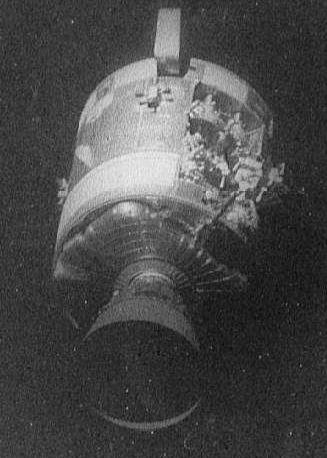
- And again, when they get their first look at the damage after separating the service module.Jim: Houston, we're getting our first look at the service module now. One whole side of the spacecraft is missing◊. Right by the high gain antenna, a whole panel is blown out. Right up... right up to our heat shield.
- A small one happens when Jim irately demands that Mission Control give them the command module power-up procedure only to have Deke Slayton cut in on the radio to tell him to be patient. The Apollo 13 astronauts knew full well that only the CAPCOM officer at Mission Control was supposed to communicate with the flight crew directly; so when their boss Deke broke protocol and personally got on the radio to talk to them, all three astronauts immediately realized the status of the power-up procedure:Jack: They don't know how to do it.
- Upon discovering their air in the LEM is building up CO2 faster than anticipated, Haise realizes he forgot to adjust his calculations to include a third person. Lovell confirms on his commentary that this really did happen.
- When Lovell's young son is told there's something wrong with Apollo 13, he asks wide-eyed with fear, "Was it the door?"note
- The moment when everyone, crew and ground control alike, realizes that whatever has happened, it's a major problem. Which is absolutely true. According to Lovell in his book, the one thing no Commander on ANY space mission wants to see is his craft "bleeding."
- One-Steve Limit: Averted. There are two Johns, John Young and John Aaron. Sometimes they're in the same scene and both respond when people don't specify which John they're asking for.
- One-Woman Wail: During the loss of communications as they pass behind the moon (courtesy of Annie Lennox)
- On Three: Jim invokes the trope when the crew jettisons the SM in preparation for the re-entry process.
- O.O.C. Is Serious Business: Throughout the movie Gene Krantz is the cool, calm leader of the Mission Control team. The one moment the facade cracks is when he is informed that there's still a delay in getting the power-up procedure for the Command Module, letting the audience know the situation is getting critical.Gene: Come on, I want whatever you guys got on the power-up procedures. We've got to get something up to these guys.
Deke: Gene, they're working on it.
Gene: I don't want the want the whole damn bible, just give me a couple of chapters. We've got to give these guys something.
Deke: They're working on it now.
NASA Engineer I'll get over there and get an estimate
Gene: (angrily kicks a trashcan aside) Goddammit, I don't want another estimate! I want the procedure! Now! - Opening Narration: Walter Cronkite describes how John F. Kennedy's plan to launch a man on the moon was "the most hazardous and dangerous and greatest adventure on which man has ever embarked", as well as how the Apollo 1 fire in 1967 nearly doomed NASA's Apollo program.
- The Perfectionist: Ken Mattingly. He's the only one in the crew who wants to run the simulation over and over to get it just exactly right.
- Parental Fashion Veto: Barbara Lovell wants to go to the launch dressed like a hippie, and at first her father cheerfully agrees, only to tell her she can't go out dressed that way after his wife firmly vetoes it.
- Pop-Cultural Osmosis Failure: Marilyn brings in Jim's elderly mother Blanche and introduces her to Neil Armstrong and Buzz Aldrin, who have arrived to stay with the family during this time. They are easily the most recognizable names of the space program, but Blanche asks if they work at NASA too.
- Practical Voice-Over: Used extensively here, as the crew's plight was a major news item. Some of the original news broadcasts, including Jules Bergman's interruption of The Dick Cavett Show, were used for the film.
- Pragmatic Adaptation: Several details are glossed over or left out, sometimes for time or story-flow reasons, other times because Ron Howard thought that detailing every problem that cropped up on the mission would lead to disbelief from audiences.
- An example of the former: Passive Thermal Controlnote is mentioned once but never explained, and the need to maintain PTC as part of the post-explosion survival strategy is left out altogether. With all the other problems they had to worry about it seemed like an unnecessary additional detail.
- An example of the latter: In real life one of the LM's batteries suffered a partial venting of its electrolyte, reducing its capacity and causing some anxiety on the ground that they'd lost precious power reserved. This was left out entirely as it was felt it would come off as too melodramatic to throw that into the mix as well.
- Precision F-Strike:
- By Jim Lovell, upon being told that Ken Mattingly has to be replaced less than three days before liftoff:Jim: I have trained for the Fra Mauro highlands, and this is FLIGHT SURGEON HORSESHIT, Deke!
- And later when there's problems in devising an ad-hoc power-up procedure before re-entry:NASA engineer: I'll get over to the simulator and get an estimate-
Gene: [kicking a trashcan] GODDAMMIT! I don't WANT another estimate! I want the procedure! Now! - Ken Mattingly can't figure out the Odyssey's re-entry sequence and it's starting to get on his nerves:John Aaron: The sequence looks good, we're just over budget on the amperage.
Ken: By how much?
John: Three or four amps.
Ken: Goddammit, John, is it three or four!?
- By Jim Lovell, upon being told that Ken Mattingly has to be replaced less than three days before liftoff:
- Punctuated! For! Emphasis!: Gene Kranz's most famous line of the movie is delivered like this to provide extra gravitas.Kranz: Failure. Is not. An option!
- Quieter Than Silence: The ambiance outside the capsule, as represented by wind.
- Reality Is Unrealistic:
- A preview audience member criticized the "typical Hollywood ending", and even those familiar with the basic story have assumed that certain historically accurate parts of the film (most notably the scene where Marilyn Lovell loses her wedding ring) were invented for dramatic reasons. The wedding ring shower scene was exaggerated somewhat. In real life, the ring did slip off her finger, but it was too big to fall through the drain cover and Marilyn was able to retrieve it.
- Similarly, Marilyn Lovell's nightmare about Jim's team suffering an explosive decompression accident was not invented for dramatic effect, but based on a real dream she had before the launch.
- On the other end of the spectrum, the astronauts were depicted more emotional than they actually behaved in order for the audience to connect with them easier. In reality, the astronauts kept a cool head at all times (all three had been test pilots, it comes with the territory) and no-one could afford to spend time worrying. This change was made likely because audiences would have a hard time believing that anyone (even trained astronauts) could be so badass under so much pressure and also because it would have been boring if they kept a cool head at all times. note
- The infamous quadruple equipment malfunction happened exactly as was portrayed in the movie. Jack Swigert even mentioned this trope directly during an interview shortly after they got back, stating that if NASA had handed them this exact scenario during a training simulation, they would all have complained about it not being realistic.
- At first stage ignition, the Saturn V launch shows great balls of fire blooming out from around the engines, and then shrinking right back down again. Jim Lovell commented on this, saying that many people believed that the film was merely being run backwards. However, actual footage of the launches shows the fireball retreating in this way, as the initial cloud of flames is sucked back through the base of the launch platform by the ever-increasing velocity of the exhaust plume. The unrealistic part of the film's launch (aside from the Saturn V's paint job for 13) were the holding arms, which all swing back simultaneously, not one by one.
- As portrayed in the film, the longest time Mission Control had ever lost contact with an astronaut crew was three minutes of radio silence. The movie depicts at as four, in real life it was six.
- Much of the astronauts' dialogue and their reactions are greatly exaggerated for drama. In particular, many comments by the cinematic Lovell were actually said by Fred Haise, according to the transcript. Also exaggerated for the sake of drama were the relative inexperience, compared to Lovell, of Swigert (the real Swigert was a solid pilot that also trained in many Command Module disaster scenarios) and Haise (who pointed out many problems in the real mission long before they came to pass).
- There were several other problems that didn't make it into the film (the biggest was one of the LM's batteries suffering a loss of capacity, causing mission control to fear that they'd lost some of their reserve power) because it would have simply come across as too melodramatic to believe.
- The real Gene Kranz switched roles with flight director Glynn Lunney as shown in the film but never manned the Flight console again until perhaps near the mission's conclusion, leading his White Team as a roving troubleshooting team while other directors were in charge.
- The way that mission control comes up with the plan to fit the Command Module's air filters to the mismatched slots of the Lunar Module was far more improbable in real life than in the film. In the movie, it's depicted as the efforts of a team of engineers working frantically to come up with a solution, in real life, the solution was thought up by one guy in his car on the way to work.
- Real-Person Cameo:
- The real Jim Lovell has a role as the captain of the aircraft carrier that recovers the crew after splashdown. This role is doubly appropriate, as Lovell is a retired Navy captain. He was originally going to appear as an admiral, but he told the producers something along the lines of "I retired as a captain so I'll be a captain."
- The real Marilyn Lovell also has a cameo as one of the spectators at the launch.
- Repeat to Confirm: Standard operating procedure for NASA. Lovell does this three times when Houston tells him to shut down the fuel cells, which is an irreversible procedure that would scrub their moon landing, in a desperate measure to contain the oxygen leak.Jim: Are you saying you want the whole smash? Closing down the react valves for fuel cells shutdown? Shutting down the fuel cells, did I hear you right?
- Recognition Failure: Lovell's senile mother doesn't recognize Neil Armstrong and Buzz Aldrin when they arrive to give support. This also counts as a Historical Person Punchline; while Armstrong is mentioned a lot early in the film (and the 1969 moon landing shown), he and Buzz only first appear as characters in that scene, and are named by Marilyn only after telling them what to do.Blanche: Are you boys in the space program, too?
- Reentry Scare: It didn't help Marilyn and family to see ABC's Jules Bergman demonstrate re-entry by putting a blowtorch to a sample of the spacecraft's ablative heat shield to show how it was supposed to work.
- Remote Vitals Monitoring: Done both straight and for laughs.
- In a fit of cabin fever, Jim Lovell removes his biomed sensors stating "I'm sick and tired of the entire Western World knowing how my kidneys are functioning!" After the Flight Surgeon has a scare that Jim's heart has stopped, but he's clearly still talking on the radio, Haise and Schweikart also pull off their biomed sensors.
- During the initial disaster, while the astronauts are calling out all the warnings and alarms that are going off and Houston is trying to make sense of the readings they're getting, the flight surgeon notes the crew's heart rates are skyrocketing.
- Retirony: Narrowly averted; Jim Lovell announces that Apollo 13 is going to be his last mission.
- Revealing Cover-Up: The Apollo 13 astronauts are constantly asking for the power-up procedure for the Command Module, not wanting to leave it last minute. When, instead of CAPCOM, its their boss, Deke Slayton, that tells them to be patient and they'll get it soon, they realise that they don't have a power-up procedure.
- Reverse the Polarity: Justified. Shortly before re-entry they needed "four more amps" to power up the Command Module. They used a circuit intended to provide power from the Command Module to the Lunar Module to do the opposite. It's mentioned that a lot of power is lost this way, as the circuit wasn't built for this, but it's good enough for what they need it to do here. note
- Rousing Speech:
- Gene Kranz makes the team's mission statement very clear.Gene Kranz: I want you guys to find every engineer who designed every switch, every circuit, every transistor and every light bulb that's up there. Then I want you to talk to the guy in the assembly line who actually built the thing. Find out how to squeeze every amp out of both of these goddamn machines. I want this mark all the way back to Earth with time to spare. We never lost an American in space, we're sure as hell not gonna lose one on my watch! Failure is not an option!
- Gene Kranz makes the team's mission statement very clear.
- Science Hero: The three astronauts and most of the personnel at mission control. Their ingenuity turns a doomed scenario into one of NASA's finest hours.
- Scotty Time: Played deadly serious here:Lovell: Freddo, how long does it take to power up the LEM?
Haise: Three hours, by the checklist.
Lovell: We don't have that much time.
Haise: Shiiiiiit... [hurries into the LEM]- In fact, they had just 15 minutes to power up the lunar module before the command module lost too much battery power to survive for reentry. They only succeeded because they were ahead of schedule and LM was already partially powered up for a systems checkout.
- Shoot the Messenger: Unsurprisingly, given the tense circumstances, those most aware of problems have to bear the brunt of others' frustration and impatience over things they have no control over. The astronauts get angry at Charles Berry, who was simply doing what he needed to do as a flight surgeon to keep them safe (you really can't risk your command module pilot coming down with the measles during lunar orbit rendezvous). Of course, nobody wants to hear John Aaron tell them they don't have enough power whenever they want to do something.
- Shout-Out: The scene where Jim's Corvette stalls at a green light is a reference to a similar scene in American Graffiti, which Ron Howard starred in.
- Shower of Love: Where Jack Swigert is when he gets the call that he's become the new pilot.
- Shown Their Work:
- There are some inaccuracies, but they were minor and primarily in service of the Rule of Drama. The greatest changes were in the mission dialogue. The real astronauts rarely quibbled, much less argued, per the mission transcript. Tom Hanks' character also "stole" lines that were often said by his crewmates.
- The spacecraft sets and mission control sets were so period accurate that they can be mistaken for the real thing. The space suits worn by the actors were practically exact replicas of the space suits Apollo astronauts wore. One person that visited the Mission Control set (a full re-creation), after leaving the set, was looking for the elevator afterward (the original Mission Control was on the third floor of its building; the set was built on the ground level) — the set was that accurate.
- There are some inaccuracies
- Space Is Cold: Justified as the real Apollo 13 did ice up. The spacecraft really did lose heat throughout the mission to the point where ice crystals were starting to form. The spacecraft designers knew that the electronics and fuel cells would generate a lot of heat, so they built the LEM and CM with plenty of radiator surfaces to dump the heat out into space. But with the fuel cells out of commission, and not enough power to run the electronics or cabin heaters...
- Space Is Noisy: Lots of booming and hissing noises from the spacecraft, as shot from outside.
- Spiritual Successor:
- The Tom Hanks produced HBO anthology From the Earth to the Moon covered the Apollo missions one by one, from one to seventeen. Obviously, it would have been redundant to retell the story of Apollo 13, so instead, the episode covered the media perspective of the potential disaster.
- Gravity (2013) could be seen as one, as it is a 'serious' space disaster film based on current technology and starring astronauts rather than a straight sci-fi. Ed Harris even resumes his role as Mission Control.
- The Martian could also be seen as one, with the problems cranked up to eleven.
- Stepford Smiler: The wives of the astronauts are very aware they should conceal their fears and put on a happy and cheery face for the media. Marilyn Lovell even schools Mary Haise about this.Marilyn: Remember, proud, happy and thrilled.
- Stunned Silence: Mission Control after Lovell tells them "we are venting something into space". Justified, as this is definitive confirmation that this is not going to be a minor problem, and the astronaut's lives are in serious danger.
- Sweeping the Table: After the situation with the CO2 buildup has been made clear, the NASA tech brings a bag full of stuff into a room (the stuff being everything the astronauts have in the ship), sweeps the table clear, and then dumps all the gear on the table. He then tells his crew that they have to make a filter out of that gear.
- Taught by Experience: Several of the procedures used had never been tested or even imagined, the technicians have to think on their feet.
- Techno Babble: An example of Real Life technobabble, as much of the dialogue was taken from the actual recordings of the conversations between the astronauts and mission control, and is used in a more-or-less correct way. Also counts as a Bilingual Bonus if you're an engineer.
- Teeth-Clenched Teamwork: Mild examples here and there during moments of tension. Gene Kranz quickly puts an end to any bickering and there are some doubts about Jack, as he was a member of the backup team. At one point Fred antagonizes and confronts Jack, but Jim makes it clear that bouncing off the walls yelling at each other doesn't change their situation. There was no actual animosity between the crew, and even in the film it's clear that they're just reacting out of stress and fear. By the end, they're Fire-Forged Friends.
- Tempting Fate:
- NASA's attitude towards the number 13 prior to the mission. The mission number, liftoff at 1:13 PM (1313 in 24-hour time) on April 11th, 1970 (4+1+1+7+0 = 13), entering lunar orbit on April 13th.Marilyn: Naturally, it's 13. Why 13?
Jim: It comes after 12, hon. - After a reporter points the 13 Is Unlucky trope, Mattingly mocks him saying that he made a black cat pass over a broken mirror under the lunar module's stairs - and everything still looks okay!
- NASA's attitude towards the number 13 prior to the mission. The mission number, liftoff at 1:13 PM (1313 in 24-hour time) on April 11th, 1970 (4+1+1+7+0 = 13), entering lunar orbit on April 13th.
- 13 Is Unlucky: Lots of joking about this being Apollo mission #13.
- Tim Taylor Technology: Inverted. The crew had to consume as little power as possible during the trip back to Earth as the LM's batteries and water were normally only for 2 men for 3 days, not three men for five days. Furthermore, they had to ensure that their improvised CM power-up sequence didn't draw more than 20 amps (instead of the usual 65) from the CM's batteries, or they wouldn't have enough power to last through the whole reentry.
- Typeset in the Future: The Eurostile Bold Extended font made popular by 2001: A Space Odyssey is used for the credits and on-screen messages like MANNED SPACECRAFT CENTER HOUSTON, TEXAS, THREE MONTHS PRIOR TO LAUNCH.
- Vertigo Effect: A dolly zoom on Gene Kranz's face when Lovell reports that they're venting something out into space.
- Victory Is Boring:
- A congressman mentions that his constituents remark that the space program is pointless now that the US has beaten the Russians to the Moon.
- Every single channel passes on the opportunity to broadcast the mission from the lunar module live. They only show interest when things begin to go bad.
- Vomit Indiscretion Shot: After launching, Fred Haise pukes out some small chunks of food, and some of it spatters on the camera lens. Yum.
- Waistcoat of Style: In both the movie and Real Life, Flight Director Gene Kranz's wife sews him a vest before each flight.Jerry Bostick (FDO White): Mrs. Kranz has pulled out the old needle and thread again.
Technician: Last one looked like he bought it off a gypsy.
Jerry: Well, you can't argue with tradition.
[later, after Gene finally puts it on, with applause from all the technicians]
Technician: Hey, Gene, I guess we can go to the moon now! - The Watson: Various characters serve as this to Jim Lovell in regards to space flight, particularly Jim's youngest son Jeffrey.
- We Interrupt This Program: Quite often, to bring mission updates. Dramatically well-done by using actual footage from one of the era's most knowledgeable journalist experts, ABC's Science Editor Jules Bergman, with dramatic footage of Walter Cronkite during the drama. A fictitious series of network coverage filled in any other needed dramatic commentary.
- Wham Line: "Houston, we have a problem" is the most notable, but also "Houston, we are venting something into space," and "a whole panel is blown out, right up... right up to our heat shield," which really makes everyone worry that all their efforts may have been for nothing.
- What Happened to the Mouse?: Marilyn's lost wedding ring in the shower at the beginning of the movie is never brought up again nor resolved. In reality, she did get it back.
- "Where Are They Now?" Epilogue: Narration by Hanks (in character as Lovell) describing the fates of the main characters.
- The Whole World Is Watching: The film deals with this trope before and after the oxygen tank explosion as a contrast about the world's reaction to what is now the third mission to the Moon:
- Only a couple hours before the accident, the astronauts are scheduled to do a live broadcast from the Odyssey to be relayed back to Earth. A brief scene at the Lovell's home shows Marilyn arguing with Barbara about going to Mission Control for it, with Marilyn insisting that the whole world is going to be watching Jim do the broadcast. This gets rather cruelly Subverted once they do arrive at Mission Control's public gallery and they find out from NASA's PR officer Henry Hurt that none of the television networks are broadcasting it live, Henry mentioning that by now the program's become so routine they've made going to the moon as exciting as a trip to Pittsburgh. Other aides in the room keep changing the television's channel to no avail — apparently watching a gorilla in a zoo throwing around baggage was more interesting.
- Afterwards it's played straight as the spacecraft circles around and approaches the Earth. News reports are shown of reactions from the nations of the world. Many offer help, but there's really nothing anyone outside of NASA can do except pray. Archive footage is shown of Pope Paul VI leading fifty thousand people in prayer at St. Peter's and prayers offered at the Wailing Wall in Jerusalem. Marilyn herself is rather bitter about the media's about-face of attitude when the networks wanted to set up broadcasting equipment on her lawn."If landing on the moon wasn't interesting enough, why should not landing be?"
- The World Is Just Awesome: In his Imagine Spot, Jim imagines himself staring in awe at the distant Earth.
