

Einstein: Hitler is... out of the way.
Assistant: Congratulations, professor! With Hitler removed—
(Einstein holds up his hand to stop the assistant from speaking, then starts winding his stopped watch)
Einstein: Time will tell. Sooner or later... time will tell...

Hitler's Time Travel Exemption Act: The Game
A Spin-Off prequel to the original Command & Conquer, using the same engine and gameplay to tell a story of an Alternate History WWII fought between the European Allies and Tesla-powered communists bent on world domination.
Red Alert, the first game of the series, provides a contrast with its successors thanks to a serious and mostly camp-free tone. Released by Westwood Studios in 1996 for DOS and Windows (in 640x480 VGA resolution, a major improvement from its predecessor) platforms. It later spawned its own sequels, each taking place in an alternate alternate timeline; for a while, an explanation some fans came up with was that the Allied ending of Red Alert led to Red Alert 2, and the Soviet ending of Red Alert led to Tiberian Dawn. Word of God, however, says that the Allied ending is canon in both timelines, meaning that something must have happened after Red Alert's conclusion to cause the timeline split.
The premise is simple: in 1946, operating out of a laboratory in Trinity, New Mexico, Albert Einstein uses a time machine to travel to Landsberg, Germany in 1924 and removes Adolf Hitler from history. While this prevents the Nazis from rising to power and keeps Germany relatively docile, unfortunately it leaves Josef Stalin with no obstacle to the Soviet Union's expansion. This sparks an even worse version of World War II during the early 1950s as the Allies try to withstand the endless hordes of the Red Army, backed by deadly Tesla-based technology.
In late 2018, Electronic Arts, current owner of the C&C franchise, announced they were working with Petrogylph Games, a studio formed by Westwood Studios veterans, to remaster Red Alert, alongside a remaster of Tiberian Dawn. Both games were released as the Command & Conquer Remastered Collection on June 5, 2020, nearly 25 years after the release of Tiberian Dawn.
EA declared the game freeware in 2008, and can be downloaded freely from CNCNet, whose distribution comes patched with support for modern PCs and access to their own fan servers. Failing that, there's also OpenRA, an open-source Fan Remake of this game, Tiberian Dawn, and Dune 2000 that rebalances and modernises the game, adding in features from later Command & Conquer games.
Shortly before the release of the Remastered Collection, EA released the source code for this game and Tiberian Dawn under GPL 3.0.
Please note that this page is for tropes specific to this game, the first Red Alert and its expansions. Please add tropes relating to multiple games to the Red Alert series page.
This game provides examples of:
- Action Bomb: M.A.D. Tanks in Aftermath.
- Action Girl: Tanya.
- Allohistorical Allusion: After the Allies start pushing back the Soviets, Stalin realizes that he can't win a conventional conflict anymore and puts all his effort into completing the Soviet atomic weapons program in time to start bombing enemy cities with them. This mirrors Nazi Germany's putting its faith into vaunted Wunderwaffen (wonder weapons) towards the end of the war that would turn the tide in Germany's favor. The difference is that Stalin can actually back up his threat, with an entire mission revolving around infiltrating a missile silo to destroy it.
- All Theories Are True: The Red Alert series uses Tesla coils in ways that were once thought possible.
- Alternate History: Red Alert being the result of Hitler's removal from the timeline. Furthermore, the game is a prequel to the Tiberium series.
- The game also neatly sidesteps a contentious point: the state of the Red Army and its ability to invade in 1941. On the one hand, from the late 1930s to 1941, Stalin's purges greatly weakened the Red Army's senior officer corps, particularly the highest ranking officers. Over 30,000 Red Army servicemen were outright executed, including including 3 of 5 marshals, 13 of 15 army generals, 8 of 9 admirals, 50 of 57 army corps generals, 154 out of 186 division generals, all 16 army commissars, and 25 of 28 army corps commissars. Many more were sacked from the Army or imprisoned, although Stalin's regime later reversed the policy. On the other hand, the reinstatement coincided with a massive increase in the number of divisions and mobilized manpower in 1940 and 1941. Combined with the best tank in the world at the time (the T-34, which spurred the Germans to develop the Tiger and Panther as a response) and superior amounts of tanks and airplanes, the Red Army, on paper, was the most powerful military force in the world. In practice, the ongoing reorganization, unresolved logistics issues, and many other problems that were unresolved in June 1941 allowed the Third Reich to defeat the Red Army in Operation Barbarossa. By removing the Reich from the equation, the Soviet Union completes its military reforms and goes on to build a war machine capable of conquering the Eurasian continent.
- The game also neatly sidesteps a contentious point: the state of the Red Army and its ability to invade in 1941. On the one hand, from the late 1930s to 1941, Stalin's purges greatly weakened the Red Army's senior officer corps, particularly the highest ranking officers. Over 30,000 Red Army servicemen were outright executed, including including 3 of 5 marshals, 13 of 15 army generals, 8 of 9 admirals, 50 of 57 army corps generals, 154 out of 186 division generals, all 16 army commissars, and 25 of 28 army corps commissars
- America Won World War II: A very notable aversion (especially given the game was made by Americans), with most of the Allied cast being European. The Allied ending features a soldier who definitely has an American accent and carries American weapons, and General Ben Carville, better known for his appearance in Red Alert 2, debuted in the Retaliation Playstation port—so while American involvement is never outright stated, they do have some sort of presence. Also, One-Woman Army Tanya Adams is an American mercenary commando working for the Allies. Later material indicates that they mostly just continued lend-lease support to the European Allies (as indicated by reuse of vehicles from Tiberian Dawn) and only directly joined in the fighting after the war was nearly over anyway, mostly just handling occupational duties afterwards.
- A Million Is a Statistic: Stalin (to whom the phrase is commonly credited, apocryphally) throws this line out there in the first Red Alert. It can also be heard in the remixed "Radio 2" song which is included in the CD of Counterstrike and Aftermath.
- Anachronism Stew: Although the game is set in the early 1950s and features characters like Stalin and Einstein, it also features modern and even futuristic military technology alongside older technology (for example, the Soviet airforce is a mix of Yakovlev airplanes from the 1940s, Tupolev bombers from the 1950s, and MiG jets from the 1970s). A good example which personifies this is the trio of soldiers who find Stalin in the Allied ending, who are dressed in World War II era uniforms yet carry M-16s (one of which even has an underslung grenade launcher) despite the in-game purchase icon for the 'Rifle Infantry' unit being instead shown wielding a WWII-era M1 carbine.
- Ant Assault: The secret campaign features giant mutant ants (as in, bigger than tanks) that have taken over an underground base.
- Artificial Insolence:
- Units tend to move towards the location of the unit they're ordered to attack rather than attack it at maximum range. Particularly visible with artillery units, who routinely get shot by the very defenses they're supposed to outrange. The only way to prevent this is to order the units to stop, then tell them to attack targets that are already within their range.
- Vehicle units tend to swerve around infantry they should be running over when ordered to move in a straight line.
- Artistic License – Geography:
- The mission where you massacre Toruń and the FMV that follows it show a small settlement in the mountains. Trouble is, Toruń lies on the shores of the Vistula river, in the northern plains of Poland. Looks like Westwood couldn't get its Poland right for two games in a row.
- Soviet mission 13, "Capture the Chronosphere" is shown as taking place on the coast of Portugal. However, the area is covered in snow; Serra da Estrela is a much more likely location for snowfall.
- Artistic License – History:
- Despite being an alternate World War II in the '50s, Red Alert features plenty of military hardware developed decades later in our timeline. Some of this can be explained as Westwood reusing art and graphic assets from Command & Conquer: Tiberian Dawn, but it's quite unsettling to see tanks and aircraft which were cutting-edge in 1997 suddenly appearing forty-plus years earlier.
- All of the countries in Europe are shown with post-World War II borders, but with the war having been averted due to Einstein's time travel, Europe should have the post-1918 borders (the timelines diverged in 1924). Most notably, the Baltic states are annexed to the Soviet Union, and the German-Polish border runs along the Oder-Neiße line, which was established after WW2 to give Poland territories from Eastern Germany. Oddly, in the opening cinematic and one of the early trailers there's a differently inaccurate map with borders from 1939, when Nazi Germany and its allies had just started to expand their territories: Austria and what is now the Czech Republic are annexed to Germany while Hungary owns part of Transylvania. Probably just a case of Westwood not paying enough attention to detail.
- The existence of the United Nations is mentioned in one of the mission briefings, but in real life the U.N. was formed directly as a result of World War II, which didn't happen in this timeline. The impotent, abortive League of Nations was the primary body of international diplomacy after World War I, and did not dissolve in our history until 1946 (at which time the United Nations had already replaced it). That said, it's likely a relic of a time when the game was intended to be the prequel to Command & Conquer: Tiberian Dawn.
- Albert Einstein being involved in a secret US military project like the Philadelphia Experiment would be extremely unlikely in the Original timeline as the US government didn't allow Einstein to work on top secret military programs like the Manhattan Projectnote because his pacifist views were seen as a security risk.
- Artistic License – Military: It is highly unlikely that the Dark Horseman atomic missiles would be able to be disarmed in mid-flight, as after launching an ICBM, the point of no return is already crossed - ballistic missiles use their rockets solely to get up to speed to lob themselves at the target area. The Allies aren't implied to have the ability to even intercept an ICBM, but if they did, then the resolution would be from successfully knocking the nukes out of the air.
- Artistic License – Nuclear Physics: In the 8th Soviet mission "Core of the Matter", if the Allied infiltrators succeed in triggering a meltdown, the nuclear reactor explodes in a mushroom cloud. A meltdown does not cause a nuclear reactor to explode like a warhead, because high-grade, weaponized plutonium isn't being used as its fuel source.
- Artistic License – Ships: The Allied Cruiser is portrayed in cutscenes by an Iowa-class battleship. The in-game sprite gets away with it, not being based on any particular real life warship, although its main armament would be in line with a (somewhat underarmed) cruiser of the era.
- As the Good Book Says...: In the end of the Soviet campaign, Nadia reveals herself as being an agent of the Brotherhood of Nod, quoting Genesis 4:16 right after poisoning Stalin and telling the player that Nod's plan to sow chaos in Europe is successful.
- Automatic New Game: For the original version that's also included in The First Decade and Ultimate Collection: The first time the game starts, it skips the main menu to play the intro and title sequence. Then it begins on Medium difficulty and the player is immediately given the first cutscene of whichever campaign disc is loaded (In the case of The First Decade, it auto-starts the Soviet campaign).
- Awesome, but Impractical: Unfortunately a lot of the cooler units aren't very useful in gameplay.
- The Mammoth Tank is expensive ($1700), too slow to dodge enemy fire or move around quickly enough to establish map control. Unfortunately, it's the Soviets' only mobile anti-air in the campaign missions.
- Shock troopers are another cool unit that is very expensive ($800) and can easily be overwhelmed by cheap basic infantry.
- Similarly, the Flame Trooper has the same issue as the shock trooper while also having the drawback of exploding when killed, which can take out entire platoons by accident. On top of that, the Flame Trooper is on the same tier as Tanya, meaning by the time you get access to it you'll already have the much more useful (and practical) Heavy Tank.
- The Allied Chrono Tank packs a powerful missile attack, but is expensive at $2400, very delicate for a tank, and easily overwhelmed by a swarm of conventional tanks, the later being a staple in most matches.
- The MiG attack jet is hampered by the need to build an Airfield ($600) for each $1200 jet, and each airfield taking up a notable amount of space. The MiG is also very paper-like, easily shot down by Anti-Air. As a result, the Hind helicopter is more likely to see play due to each helipad having a chopper included, their miniguns still being surprisingly good against vehicles in general, and more than four times the hitpoints of the MiG with the heavy-armor class as well.
- Bald of Evil:
- Kane.
- The Soviet Interrogator who tortures Tanya.
- Berserk Button: The invasion and destruction of his home country of Greece makes Stavros get a bit tense.
- Biblical Bad Guy: Kane is once again, and somewhat more blatantly, implied to be the Biblical one.Nadia: "And Cain went out from the presence of the Lord... and took up residence... in the Land of Nod!".
- Big Creepy-Crawlies: The secret "It Came From Red Alert" mini-campaign lets the player battle giant ants in an obvious homage to cheesy creature horror flicks from The '50s. Even the basic scout ant can chew through concrete walls in one to two hits, your infantry usually suffers a One-Hit Kill whenever an ant makes it into melee range, and the warrior ants can rip apart tanks in moments. And of course, being ants and all, they tend to come in huge numbers.
- Big Damn Heroes: The Allied Spy who rescues Tanya from a Soviet Interrogator. He's mortally wounded in the process, though, and uses his last few ounces of life to toss his gun to Tanya; allowing her to kill the Interrogator and escape.
- Bilingual Bonus: The exchange between Hitler and Einstein in the introduction is in German without subtitles. They say nothing plot relevant anyway:Einstein: Mr. Hitler!
Hitler: Yes? What is it? I don't have time to stand around here!
Einsten: [offers a handshake] Yes, I understand... - Bombardier Mook: The Soviet MiG is a jet bomber that drops all its bombs on the same target, and is fast enough that it can avoid most fixed Anti-Air defenses. The Yak deals less damage with its guns, but does so over a wider area, making it a better infantry killer.
- Boring, but Practical:
- The Allied pillbox, camouflaged pillbox, and gun turrets. While the gun turrets aren't as damaging as the Soviet Tesla Coil, they are cheaper, consume less power, don't get deactivated when you enter the low power state, and fire more quickly. They also pack a decent punch. Also, the two pillboxes use machine guns that are more accurate than the fireballs used by the Soviet flamethrower turret and are still frighteningly effective against infantry.
- The Soviet SAM site. Unlike their Nod counterparts from Tiberian Dawn the Soviet version stays above ground; so it's ready to attack aircraft at a moment's notice. Also, while the Soviet SAM site isn't as damaging as the Allies AA Guns, the SAMs have greater range and can stay active in low-power conditions.
- The Rifleman and the Rocket Soldier are likely the only footmen that you'll be mass producing for your army, the first because they're so cheap and reliable against other infantry, and the second because it's just about the only anti-air unit on the ground that's cut out for shooting down those birds (the Mammoth Tank's missiles are much more effective against infantry but not aircraft and the Chrono Tank is too expensive and fragile for such a purpose, plus you'll most likely be producing tanks with your War Factory queue).
- Bowdlerise: Herr Hitler is so gone in the German version that even his scene is cut from the game and is just mentioned when Einstein tells his assistant that he was wiped out from the timeline... If good ol'Albert only knew about retroactive meta-censorship.
- Bug War: There is a hidden campaign that pits you against giant ants.
- Can't Kill You, Still Need You: In the end of the Soviet campaign, Stalin and Nadia are both dead due to Kane's manipulations. He keeps the player character alive to serve as the new leader of the Soviet Union—and presumably his puppet.
- Capital Offensive: Both the Allied and Soviet campaigns culminate in a mission to capture the enemy capital, with the Allies launching their final offensive against Moscow and the Soviets staging an amphibious invasion near London.
- Chekhov's Gunman: Stalin's advisor, who appears rather familiar. By the end of the Soviet campaign, it's revealed that he is Kane, Nadia is a member of the Brotherhood of Nod, and they've been manipulating the Soviet Union for their own ends.
- Continuity Nod: No Pun Intended. Kane features as Stalin's advisor. Though if you watch the body language and finish the game, it's quite obvious he's the real power behind him.
- Cool, but Inefficient: Soviet attack dogs instakill any infantry unit and can sniff out Allied spies, but they're useless against anything else and go down in one to two hits from any unit. With the AI virtually never using spies and infantry quickly becoming obsolete once the first tanks become available, the cute dogs become pretty much uselessnote .
- Covers Always Lie: The game's box art shows a Soviet Hind helicopter using a missile to destroy a tank. In the game, Hinds only have machine guns and are nearly useless against tanks. This is probably just a simple case of Gameplay and Story Segregation.
- Creator Cameo:
- The game's music composer Frank Klepacki appeared as a guard in one of the cutscenes before he was choked and carried away by the spy. Also, in the briefing of the final Allied mission, many of the game devs appear.
- Joseph D. Kucan (who played Kane in the Tiberium Series) shows up as Stalin's advisor. This is not a coincidence, as the character in question is Kane himself. Kucan also plays the aforementioned spy who chokes Klepacki's guard character.
- Crippling Overspecialization:
- The Allied cruiser deals heavy damage and can hit targets at extremely long ranges. But on the other hand, it's expensive, moves very slowly, and is completely defenseless against air units and submarines. A cruiser that is not protected by gunboats and destroyers is unlikely to survive very long.
- Attack dogs can One-Hit Kill infantry, sniff out spies and... well, that's it. Infantry becomes more or less useless once tanks show up and the AI never uses spies, making dogs obsolete past the earliest game stages. Their only real purpose seems to be to annoy the player in infantry-only campaign missions where they show up as enemies.
- Critical Existence Failure: Infantry at one HP? Medic to the rescue. Vehicle almost about to explode? Mechanics and Repair Bays for the save. Averted in that vehicles with low health move slower and damaged buildings produce energy or units less efficiently.
- Cutscene Power to the Max:
- It is shown that saboteurs in dinghy rafts are available to Allies to demolish bridges, but this method is never seen in actual gameplay. In gameplay, it looks like Tanya is planting explosives all by herself and jogging away before the C4 goes off.
- A cutscene where a Spy rescues Tanya suggests that they can fight back with a pistol if they're forced to fight. In gameplay, Spies don't have any attack whatsoever.
- All superweapons are implied to be much more potent than their in-game usefulness (or uselessness) might suggest. The Allies are alarmed when they learn that the Soviets are about to launch four missiles that each have the power to wipe out cities, but in the Allied campaign gameplay, the Soviet nuke can do no worse than wipe out a section of your base.
- Averted with the Allied Cruiser. It has a very impressive attack range much like its cut-scene counterpart and is as damaging as the cut-scenes suggest they are. Albeit, they are very inaccurate the further away the target is and need some micromanagement to help them hit their targets.
- Day of the Jackboot: London and specifically Buckingham Palace is occupied in the Soviet Ending.
- Deadly Gas: In the first Soviet mission briefing, Stalin's inner circle are discussing the use of a poison gas on a town full of unwilling test subjects. Doubles as R-Rated Opening.
- Death of a Thousand Cuts: Riflemen spam.
- Defector from Commie Land: In the Allied campaign, one of the missions involves rescuing a Soviet general who is opposed to Stalin's methods and wishes to defect to the West. He later provides valuable intelligence on Stalin's plan to nuke the major cities of Europe.
- Dies Wide Open:
- Gradenko dies with his eyes open when Nadia poisons him.
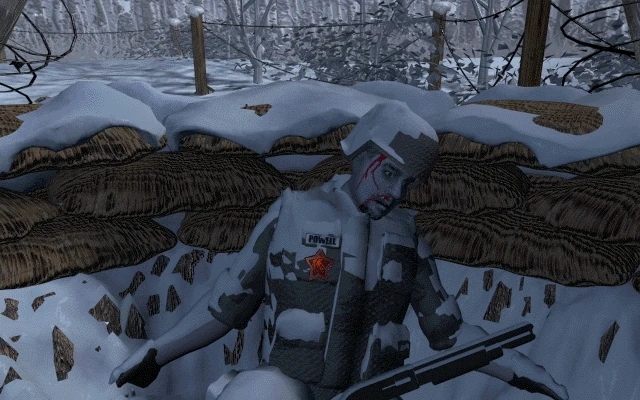
- Also, this cutscene showing a dead, frozen soldier in a foxhole. Here's a more detailed image.
- Dungeon Bypass: During the baseless Soviet mission where you're assigned to hunt down a defector, it's possible to kill the target at the beginning of the mission by using an infinite-range trick with grenade troops. Force-fire on the ground near the grenade troopers, then force-firing on the target while they're already in their grenade-throwing animation will cause them to lob their grenades all the way to the spot you target, regardless of range. This is a useful trick in the game in general, but in that particular mission it means you can beat it in only a couple of minutes.
- In another Soviet mission your objective is to destroy a truck which flees your base at the very start of the mission while Allied tanks attack the base. If you move quickly and don't bother about defending your base, you can slip past the tanks and destroy the truck (thus completing the mission) in the first few seconds.
- Early-Bird Cameo: General Carville is pretty much one of the few things that ties Red Alert with its sequel, although that's if you've seen the Retaliation expansion pack. For the first PlayStation.
- Early-Installment Weirdness:
- Red Alert actually tried to play the series premise entirely straight, with subtler performances and writing in line with the Tiberium Series. Afterwards,
 Executive Meddling caused the rest of the series to devolve into high Camp pretty much immediately.
 - There's no Allied Mission Control character named Eva, as a Mythology Gag to EVA from the original Command and Conquer games. Both factions have an unnamed male voiceover for UI functions.
- For some baffling reason, Engineers will simply damage structures above a certain health threshold; you can only capture buildings that are weak enough (akin to Pokémon captures). Later games would revert back to instantaneous captures (or at least captures without the need to damage the target structure).note Speaking of which, Engineers would share their same unique voicelines across both factions (later games would give them separate ones even if they were functionally identical); this would be the only time where the Allied Engineer isn't voiced by Phil Tanzini.
- Ore must be stored in silos lest revenue be wasted. Later games would ditch this entirely and only in the Tiberium timeline would it stick due to the Grandfather Clause.
- When vehicles are destroyed, infantry pop out (probably their drivers). Later games would abandon this.
- Attack helicopters must reload at a Helipad after delivering their payload, which essentially means that there must be one Helipad for each battle copter (akin to the Orca aircraft of the Tiberian series). While later games would have similar mechanics for jet-based aircraft and hold more than one plane per base (and they would never be able to park on the ground), helicopter aircraft would have infinite ordnance and no need to return to base at inopportune times. The Soviets would also gain the Twinblade in RA3, which functions like the Allied Apache but can also airlift vehicles and has a machine gun onboard.
- Air forces are a Soviet specialty in this game, but sequels shifted this attribute towards the Allies with the later even having the "Advanced Aeronautics" passive in RA3 to boost the stats of their air units. Again, Airfields may also only hold one plane (not included) in this installment, which makes amassing a squadron of Migs or Yaks somewhat Awesome, but Impractical in terms of cost and space.
- The Allied Destroyer can shoot at enemy aircraft in this game. Later games would give naval anti-air attacks to separate units while the Destroyer would focus on being a vessel-to-vessel fighter.
- The first game in the series is the only one which does not feature the dual-barreled Soviet Apocalypse Tank. Instead, they have its predecessor, the Mammoth Tank (which came from Tiberian Dawn). It is also the only dual-barreled tank which is effective against everything from the get-go (barring veterancy levels in later games), as the future Apocalypse Tanks became more specialised towards fighting vehicles with their more powerful cannons.note
- It also lacks a lot of staples that would be standard in later Red Alert games, such as the Conscript (both factions would use the same basic Rifleman), Flak Trooper, Kirov Airship, Mirage Tank, Attack Dolphin, Dreadnought, Aircraft Carrier, and Prism/Spectrum Tower.
- Both factions would have access to nuclear missiles. Red Alert 2 would give the Soviets nuclear exclusivity and the Allies would have their own unique offensive superweapon going forward.
- The Allies having flak cannons and the Soviets having surface-to-air missile launchers contrasts with later games where this is switched around. This is also the only Red Alert game to carry over the grenadiers from Tiberian Dawn; later games have both the Allies and Soviets only using evolutions of the rocket soldier for anti-armor work, grenadiers becoming an exclusive unit to GDI in the Tiberium series.
- When first introduced in Counterstrike the Tesla Tank borrowed its design from the rather useless Radar Jammer unit. Aftermath then made it a full skirmish unit and gave it a design of its own, although one that put a single truncated tesla coil sphere on top instead of having twin tesla coils where tank barrels would be.
- Speaking of, both the Tesla Tank and Shock Trooper require at least one Tesla Coil in order to be produced. In any other game the very idea of a base defense of all things being a prerequisite to unlocking a unit would be ludicrous.
- The Attack Dog has its own dedicated production structure in the Kennel. Later games would simply produce Attack Dogs from the Barracks. They are also exclusive to the Soviets in this game. The Allies would later get German Shepherds as their dog breed in RA2 and 3 and the Soviets got Siberian Huskies (replaced by War Bears in 3); both dogs would gain an additional niche in 2 due to being immune to mind control.
- The Soviets have access to training Tanya in multiplayer. Later games would give the Soviets their own commando unit to compete with Tanya.
- There are absolutely no amphibious units in this game. Not even the naval transports can traverse land; they are limited to parking at shores and dropping off their passengers that way. Red Alert 2 and especially Red Alert 3 would explore the idea of units that can traverse both land and water.
- There are dedicated mine-layer vehicles, their payloads differing depending on the faction you play as. Any other time such tactics would be used in future games would be as an ability from a different unit, as an upgrade for defending structures, or being its own dedicated structure, removing the pain of having to constantly refill a niche unit to build such defensive lines.
- Kane is much more low-key and vague on his intentions when he executes Nadia. In his later appearances, his executions would be much more ceremonial and he would spell out why one has failed his expectations.
- Red Alert actually tried to play the series premise entirely straight, with subtler performances and writing in line with the Tiberium Series. Afterwards,
- Earthquake Machine: This is how the Soviet M.A.D. Tank in Aftermath unleashes its Suicide Attack.
- Empathy Doll Shot: Right at the start of the Soviet campaign, as the Soviet air force strafes fleeing villagers a child drops their teddy bear on the ground. You gave the orders.
- Everyone Calls Him "Barkeep": In the Allied Campaign, the player's character is only known as "Field Commander A9".
- Expansion Pack:
- Two. The first, Counterstrike, just adds additional missions, but the second, Aftermath, adds both missions and units which can be used in skirmish mode. Both also add extra skirmish maps.
- And then both those expansions got combined into one, released exclusively for PlayStation, which is called Retaliation. If you forget about the new FMVs, remixed songs and less linear mission selection system, it's not quite different from the DOS versions of both Counterstrike and Aftermath, as well as the actual Red Alert for the PS1.
- Red Alert itself started as an expansion pack to Command & Conquer: Tiberian Dawn, hence the many similarities and Expies, but Westwood soon realized its potential as a standalone game.
- Faction Calculus: The Soviets are Powerhouse, the Allies are Subversive. A neat reversal of Tiberian Dawn as far as good and evil sides (by most definitions) are concerned, and about the only C&C game where the good guys are Subversive.
- Interestingly, Tanya's camouflage trousers apparently have the same colour (grey) and pattern as Nod camouflage.
- Failure Is the Only Option: Two missions of the Soviet campaign are devoted to capturing the Chronosphere from the Allies. In both, it is impossible to actually succeed.
- Fake Difficulty: Much of the expansion packs' increased difficulty isn't caused by larger enemy forces, more enemy players or smarter AI, but by most missions having instant-fail conditions that seem to exist for no other purpose than to annoy the player. The Allied campaign has a huge number of Escort Missions or the reverse, with multiple fast and durable enemy units that fail the mission if even one of them escapes the map. The Soviets have to put up with severely restricted build options much of the time, with one mission pitting you against a nuclear armed MiG and a whole host of attack helicopters without giving you access to even a single anti-air unitnote . Beating the expansion campaigns is thus more an exercise in Save Scumming and frustration than any actual test of skill.
- Fake Town: The Allies can erect fake buildings to set up decoy bases and deceive enemy forces.
- Fission Mailed: The penultimate level for the Soviet campaign requires you to destroy three radar facilities and then capture the Chronosphere for Stalin, but it blows up before you can do so no matter what you do. The next mission's briefing starts with threats for you to be shot for your incompetence, but then the blame is pinned on Kukov - turns out there were four radar facilities handling the self-destruct system, and he deliberately only warned you about three of them in an attempt to have you removed. You end up reinstated and told to command a final push into England while Kukov has his neck snapped. Due to a level-design bug, it is even possible to actually capture the Chronosphere by making it invulnerable with the Iron Curtain before the explosive detonates. Then you can capture it with your engineers, but get a real "Mission Failed" for going Off the Rails.
- Fog of War: Removed permanently from a zone after it is explored. The Allies can launch a GPS to reveal the whole map and their spies can reset the enemy's maps. If you want to complicate things a little bit, there's even an option in multiplayer to allow the fog of war to regrow.
- Game-Breaking Bug:
- Due to a glitch, the stat bonuses for the Allied subfactions in Skirmish and Multiplayer modes became minuses.
- Aftermath has the Negotiations level, where Tanya needs to rescue some hostages (with one being executed every five minutes). It's possible to get there in the nick of time and save them all, but if you do, the hostages stay where they are instead of following Tanya to safety.
- Game Mod:
- The infamous Rules.ini files allow the player to edit every single unit and building in the game. It also allows the addition of Dummied Out content back into the game, such as armed spies or the sniper rifle.
- Red Alert From The Ashes, a mod for the Remastered Edition, is a campaign pack that bridges the gap between the Soviet campaign's ending and Command & Conquer: Tiberian Dawn.
- The infamous Rules.ini files allow the player to edit every single unit and building in the game. It also allows the addition of
- Gameplay and Story Segregation:
- In the Soviet Campaign, the Allies rescue Einstein by Chronoshifting him out of a firing squad execution. However, using the Chronosphere on infantry will make them permanently disappear (a.k.a. die). Even if you put the infantry in an APC, they will still be lost when using Chronoshift on the APC (though this can be disabled in rules.ini).
- In the cutscenes, the Chronosphere and Iron Curtain projects are treated as powerful enough to turn the tide of the war, and both campaigns devote screen time to emphasize this, emphasizing how incredible these innovations are. However, in gameplay, both support powers don't have a much impact on the campaign difficulty, aside from the Allies having to deal with an invulnerable Mammoth Tank occasionally or being able to finally Chrono Shift shift single units in the Allied offensive against Moscow.
- Glass Cannon:
- The Soviet V2 Launchers. They do heavy damage to both buildings and infantry and can outrange a Soviet Tesla Coil. Problem is, their armor is so fragile that even the Technician with his measly pistol can do noticeable damage to it.
- Also for the Soviets is the M.A.D. Tank from the Aftermath expansion. When deployed, they produce a shockwave that can severely damage vehicles, buildings, and grounded aircraft in a very large blast radius. That being said, they are very slow and frail. Also, they're very expensive for a suicide unit, which makes them Awesome, but Impractical as well.
- For the Allies there's the Chrono Tank from the Aftermath expansion. They fire missiles that are quite potent against aircraft and buildings. But the Chrono Tanks have very weak armor and can be easily overwhelmed by pretty much anything.
- Guide Dang It!:
- The second-last Soviet mission requires the player to capture the Chronosphere within the Allied base and prevent its subsequent destruction. Except capturing the Chronosphere produces the comically frustrating "Objective Reached. Mission Failed." voiceover, presumably due to a bug where the game counts the Chronosphere falling out of Allied hands in any way - even capturing like the game tells you to do - just the same as if you blew the thing up. The only way to progress is through a roundabout solution that essentially requires you to capture an Allied Barracks and then use your combined units to kill them.
- Many of the infiltration missions have a huge number of event flags that trigger the programmed death of powerful enemies, spawn reinforcements or open up new sections of the map (in one case only an event trigger can let you move on; the unit you use despawns and respawns in a separate part of the map). Combined with their huge maze-like layouts and low visibility of your units, it often boils down to either looking up a guide or trial and error.
- Handshake of Doom: The game kicks off when Albert Einstein travels back in time to assassinate Adolf Hitler to prevent World War II. He meets Hitler when he was leaving Landsberg Prison and shakes his hand - erasing him from history. Unfortunately, this results in Hitler's place being filled by another horrible dictator, Josef Stalin, who declares war on Europe and began his own version of World War II.
- Heroic BSoD: Stavros suffers this as his home, Greece, falls into the vile clutches of the Soviet Union, and doesn't quite recover until the Allies are returning the favor to the Soviets.
- Historical Villain Upgrade: With Adolf Hitler out of the way, Joseph Stalin causes this timeline's version of World War II. Historically, Stalin was known for his policies of Realpolitik and "Socialism in one country",note and his purges involved secret policemen, show trials, and labor camps, and not outright massacres using chemical weapons that have more in common with Nazi war crimes. Ironically, Leon Trotsky, an advocate of global socialist revolution, would probably be a far better candidate for a Soviet leader bent on conquering the entirety of Europe.
- Hitler's Time Travel Exemption Act: In 1946, Einstein uses time-travel technology to locate Hitler in the one point in his civilian life where his location could absolutely be assured (20th December 1924, as he's released from Landsberg Prison ending his sentence for the failed the Beerhall Putsch), removes him from the timeline, and ends up creating an even worse war than the one he wanted to avoid.
- Hoist by His Own Petard: Flame Turrets, Tesla Coils and the like can damage your own buildings if you're not careful where you place them. The AI often isn't, which you can exploit by repeatedly airdropping sacrificial Paratroopers into the middle of their defences, and watching as the ensuing crossfire slowly tears their base apart.
- I Am the Trope: At the end of the Red Alert 1 Soviet campaign, we get this exchangenote :Nadia: Fight our battles where you must, and you will remain our loyal, and obedient servant. For the foreseeable future.
(gunshot, Nadia falls over forward)
The Adviser/Kane: The foreseeable future...? Comrade chairman, I am the future.
(fade to black) - In Spite of a Nail: Despite helping the Soviet Union conquer Europe, Nadia estimates that the Brotherhood of Nod will "tire" of the USSR in the 1990s. In our timeline, the USSR officially dissolved in 1991.
- Interface Screw:
- Allied Mobile Gap Generators create Fog of War around them just like their stationary counterparts. Unlike the latter, their fog doesn't dissipate when your units move into it - it simply stays where it is, covering your own units and buildings and making it nearly impossible to issue attack orders on anything inside the fog. The only thing you can do when this happens is make your units stop and hope that their auto-targeting singles out the gap truck(s) quickly.
- The final It Came From! mission takes place in a tunnel network whose lighting system has crapped out, which in gameplay terms means that the Fog of War is only lifted as far as your units can see. Once they move, the fog behind them reappears instead of staying lifted as it normally would. It's surprisingly effective at building a tense survival horror atmosphere.
- Irony: The timeline that leads into the Tiberium series implies that the Allies would later found the Global Defense Initiative while the Soviet Union is secretly manipulated (and discarded) by the Brotherhood of Nod. All the while completely swapping their battle doctrines and almost all their units and even defenses. Only the Medium Tank, APC, Flamethrower Infantry, and SAM Site would remain in heroic and villainous hands, respectively.
- Kaizo Trap: One mission starts a countdown once Soviet nukes are launched. While the countdown until the nukes hit is rather generous, what they don't tell you is that it applies to the following Baseless Mission as well, meaning taking your time mopping up the remaining Soviets on the first map will likely doom you in the second map.
- Karmic Death: Delivered nicely in the Allied ending onto Joseph Stalin by none other than Stavros, whose country Stalin destroyed in the war. Stalin gets to die alone and in darkness thanks to Stavros ordering away the troopers who found Stalin, putting a cloth in his mouth to keep him from screaming for help, and putting rubble over his face to hide him from discovery.
- Kick the Dog: The briefing of the first Soviet mission opens with Stalin and two other Soviet leaders discussing the testing of a new nerve gas on a few hundred innocent civilians before turning to you. Then you are assigned your first mission: killing the inhabitants of Toruń, Poland by strafing them with fighter planes.
- Kill It with Fire:
- Uniquely in the franchise, the Soviets rely on flamethrower turrets instead of machine guns for their static anti-infantry base defense. The things lob huge fireballs with a considerable splash radius, making them the bane of any clustered infantry assault. The Soviets also gain access to an infantry unit that does the same, although its surprisingly high tech level means that by the time you can unlock it, infantry has already been rendered obsolete by all the cool tanks that dominate the battlefield.
- One of the enemies you face in the It Came From! mini-campaign is the fire ant, a bright orange critter that uses the same attack as the one described above.
- Klingon Promotion: Nadia poisons Stalin at the end of the Soviet campaign. Her promotion doesn't last long.
- Leave No Survivors:Gradenko: Let's see how you handle this. Go at once to Toruń, destroy everything and everyone. No prisoners, no survivors. (continues to get back to his work, but after a moment he pauses after noticing the player character still sitting there, at which point he simply says, in a slightly annoyed tone, 'That is all')
- Let No Crisis Go to Waste: In the Soviet victory scenario in the first game, the entire Russian war effort was an Evil Plan by Kane to expand the USSR, then topple it, and use the ensuing chaos to strengthen the Brotherhood of Nod.
- Long-Range Fighter: The Allied cruiser has the longest range of any unit in the game, and it deals a lot of damage. It can hit targets nearly an entire screen away. A single cruiser can decimate an enemy base in minutes if not stopped.
- Map Stabbing: The opening cinematic ends with a short sword suddenly impaling itself in the heart of Germany on a map of Europe, the Soviet hammer and sickle prominent on the end of the hilt as red splotches break out and spread across the continent. The clip can also be seen if the player loses many of the
- Meaningful Echo: Stalin comments on how excellent the tea is and Nadia comments that she made it herself. She said the exact same thing when she killed Marshal Gradenko. Both cups were poisoned.
- The Medic:
- Literally, with the Allies. They have special Medic support infantry unit that can heal other infantry and keep them on the battlefield longer (for what it's worth). Medics, however, cannot heal themselves for some reason so it's best to have them work in pairs or groups.
- By some extension, the Aftermath expansion gives the Allies the Field Mechanic. He functions just like the Medic, but for vehicles. And, since the mechanics can fix tanks more quickly (and with no cost) than a Service Depot, they become a complete godsend for keeping the relatively weaker Allied tanks alive against the heavy Soviet armor divisions.
- Monumental Damage: The Soviets are shown blowing up the Acropolis of Athens during their invasion of Greece. This highly upsets General Stavros, who vows revenge on Stalin.
- Multiplayer-Only Item: Several units, buildings, and special abilities (Tanya, Soviet rocket soldiers and allied nuclear missiles, among others) are normally not available in the Singleplayer campaign, although they sometimes appear as unique units (sometimes even required to survive) in a couple of missions.
- Nerf:
- The Atom Bomb is a nerfed version of the Nuclear Warhead from Tiberian Dawn. While it can be used more than once, and every few minutes, it doesn't destroy enemy structures like nuclear warheads do. It is best used to vaporize any opposing infantry units and weaken enemy structures in hopes of running the foe's credits over time.
- The passive buildable barriers (sandbags, chain-link fences, and concrete walls) carried over from Tiberian Dawn also get this treatment. While bags and fences still act as a deterrent to infantry without explosives (such as engineers and spies), they can now simply be run over by vehicles instead of being forced to shoot them or blow them up.note Only concrete walls still require shooting and explosions to get past them. Furthermore, unlike Tiberian Dawn, the passive barriers no longer extend your building radius and you can no longer build structures off of them.note
- Nice Job Breaking It, Hero: Einstein travels back in time and erases Hitler from the timestream in an attempt to prevent World War II. But World War II happens anyway when Stalin decides to expand his empire by launching a massive invasion of Western Europe. Oops. Einstein himself even lampshades this in the game's intro video. When his assistant expresses joy at Einstein erasing Hitler from history, Einstein utters "Time will tell", implying that he's unsure whether or not he did the right thing.
- Not Completely Useless:
- The Soviet mission "Deus Ex Machina" in the Aftermath expansion pack is an attempt to rescue Volkov, who has been captured by the Allies. Unfortunately, once you do find him, he has gone berserk and is on a rampage to destroy everything in sight. He is Made of Indestructium: unless you've got something along the lines of dozens of Mammoth Tanks & V2 Rocket Launchers, you won't be able to stop him, unless you build a Kennel and throw a bunch of Attack Dogs at him. When's the last time you bothered to use an Attack Dog on anything?
- Rifle infantry can be useful for beating down a building just enough so your engineers can capture it. This can be handy for any missions that require you to capture a certain building since rifle infantry do mostly Scratch Damage (whereas some units are too powerful and might accidentally destroy the building). It's also worth noting that the Soviets can access paratroopers with an airfield that can give you rifle infantry on the fly and delivered to any location you want.
- Not Even Bothering with the Accent: While Soviet infantry and vehicles will speak with Russian accents, the Engineers will always speak with a gruff, American English voice regardless of which faction you're playing as.
- Nuke 'em: Employed by the Soviets in the Allied campaign. As the Allies turn the tide of the war and are steadily advancing across Europe into the Soviet Union, Stalin decides to destroy the primary capitals and cities of the European Allies with the atomic weapons his scientists have recently developed, while using his own forces as a sacrificial lamb to draw attention away from the missile sites. The player has to capture and then infiltrate the facility to safely disarm the weapons.
- Outside-Context Problem: On the skirmish map "The Hills Have Eyes", it, at first, seems like the usual skirmish map... until armed civilians deliver unexpecting ass-kicking to those unprepared for them, and this is all while trying to ward the normal enemy forces at bay, and even trying to eliminate their civilian-style "bases" isn't easy, since they have some civilians that are actually nuke suiciders. Oh, and their house structures repair over time if you fail in your attack to be rid of them. All-in-all, do NOT ignore those "eyes" on the "hill", hence the namesake of the map.
- Palette Swap: Three of the four enemy types in the hidden ant campaign are color-coded variants of the same model, with scout ants being brown, fire ants being bright orange and warrior ants being fiery red. Only the queen has a unique model.
- Percent Damage Attack: A single M.A.D. Tank deals about 35% of a vehicle or building's total health as damage. This means three of said tanks in the middle of a base will make all vehicles and structures in their extensive radius go bye-bye, which is generally only possible with the element of surprise.
- Piggybacking on Hitler: Kane is doing this with Stalin.
- Poisoned Drink Drop: The Soviet ending has Josef Stalin celebrating his victory of conquering Europe while drinking tea which was prepared by his aide, Nadia. Then, he starts to feel unwell, drops his teacup, and collapses on top of his desk. When he realizes that Nadia poisoned him, he yells "Poison?! You bitch!" and dies.
- Pose of Silence: Some of the Soviet cutscenes have Stalin's advisor (played by Joseph D. Kucan) leaning in to whisper in his ear while everyone else ignores him. At the end, he's considerably more proactive, holding a gun to Stalin's head and revealing that no, he's not played by the guy who played Kane in Tiberian Dawn, he is Kane.
- Private Military Contractor: Tanya is apparently this, as shown in the intro cutscene for her first mission, in which one of the officers present complains about having a "civilian" present in the war room. She quickly informs him that even if she is a civilian, she has top level clearance. Seems to be averted in the sequels, however.
- Puppet State: Nadia mentions her intention to turn the USSR into this for the Brotherhood of Nod. She foresees that the brotherhood will tire of the USSR by the 90s.
- Rank Up: In the Soviet campaign, the player Non-Entity General actually starts out as a Lieutenant and ends up as Chairman of the Soviet Union at the end of the game. Kukov starts out as a Captain, but is a General towards the latter stages of the game.
- Reinventing the Wheel: Every time the Allies launch a GPS Satellite, it somehow becomes lost after the mission and a new one has to be launched for the next mission. Either the satellite was specifically built to only work for the current mission area that you're in or the people in the Allied Space Program somehow forget the Satellite after you complete the mission.
- Russian Bear: The soundtrack includes a theme scored for choir and military band called
 Soviet March. This has undergone Memetic Mutation and has been used — both straight and ironically — as the backing music to videos displaying the might of the Russian armed forces. The lyrics keep returning to the might and hunting prowess of the Soviet bear.
 - Save Scumming: The expansion campaigns seem to be built around this concept. There are Escort Missions and Timed Missions galore, missions where specific enemy units must not escape a base with at least three exits you can't know about when you play the mission the first time, missions that spawn hostile units out of nowhere in the middle of your base, and more fun stuff like that. Beating these missions requires either multiple reloads or restarts, or having a game guide at hand.
- Schizo Tech: The technology is all over the place, with assault rifles from '49, helicopters from '69 and '72, jet fighters from '77, tanks from '80, and GPS mounted on Sputnik-like satellites. On a general scale, the tech level is that of 'Nam. Then there are units like the Mammoth Tank/Mobile Gap Generator and structures like the Tesla Coil or Chronosphere which would be a massive chore even for today's tech (2020s) to mimic.
- Shot at Dawn: One of the Soviet missions involves tracking down a traitor across the map. After he's captured, a cutscene shows him being executed by a firing squad.
- Shout-Out:
- Power plants look suspiciously like Battersea Power Station.
- Kane is very fond of George Orwell's Nineteen Eighty-Four: "He who controls the past, commands the future.". The quote was also paraphrased in Dune II, the spiritual predecessor of C&C.
- The PlayStation version includes a cheat that turns all the gems and ore into civilians, with a corresponding quote (which might also be a poke on the Tiberium Saga):
"SOYLENT GREEN IS PEOPLE!"- The Spy is, of course, based on James Bond. Specifically, Sean Connery's portrayal.
- Shown Their Work: Joseph Stalin's sociopathic behavior may appear like a caricature, but Red Alert provides one of the most accurate depictions of Stalin in any fictional medium, both in terms of actions and mannerisms. note . Which gives some unpleasant food for thought.
- Sliding Scale of Silliness vs. Seriousness: Compared to its two sequels in the series, this game retains the more serious tone of the Command & Conquer: Tiberian Series it spawned from.
- The Smurfette Principle: Both factions have only one female character each, with Allies having Tanya Adams, and Nadya Zelenkova representing the Soviets. Sure thing, this trope wouldn't even be mentioned due to the game's military nature, but when the female cast became bigger and bigger in the sequels...
- Southern-Fried Genius: Heavily implied by the Allied Field Mechanics from the Aftermath Expansion. They speak with a very strong American southern accent and use phrases like "Hot Diggity!" and "YEE-HA!". The genius part is from the fact that they are very skilled at fixing vehicles (almost instantaneously and at no additional cost aside from training them).
- Spiteful A.I.: The computer will sell off all of its structures and send everything at you when it becomes too badly damaged to continue rebuilding and unit production.
- Spreading Disaster Map Graphic: Some Game Over cinematics following defeat during an Allied mission will show the red of the Soviet Union submerging the entire European continent as parading soldiers can be heard in the background.
- State Sec: The NKVD. In the manual, their troops alone number 7 million at the beginning of the war. Compare that to the Allies, whose regular and irregular forces number about 5 million total.
- Swirly Energy Thingy: If you use Chronosphere-related abilities too much, there's a 20% chance of a Chrono Vortex to manifest somewhere on the map that takes the form of a vortex that bends the environment around it. While the vortex is slow, it is completely invincible and decimates any unit or structure in its way with reddish-orange lightning similar to Tesla Coils. The only choice one has is to evade it like the plague as it dissipates over time. There's even a small cutscene that shows it.
- Take Over the World: Downplayed, as the Soviets' goal is somewhat more modest than taking over the entire world. It is Stalin's objective to submerge all of Europe into the Soviet Union. In the Soviet campaign, you succeed.Stalin: Where the Romans have failed I will succeed. Russia's borders will stretch from coast to coast; for a united Russia is our destiny.
- Tampering with Food and Drink:
- At the end of the Soviet campaign, Nadia successfully kills Joseph Stalin by tricking him into drinking a poisoned cup of tea.
- At an earlier point in the campaign, Marshal Gradenko is killed by the same person in the same way. It even features the same dialogue.
- There is also an expansion mission where you have to poison the water supply of an enemy base.
- Taps: If Tanya is killed in one of her missions, a cutscene will play of her white cross in a cemetery as Taps is heard in the background.
- Tesla Tech Timeline: While relatively minor compared to later Red Alert games, tesla coils still feature prominently as the Soviet Union's iconic advanced base defense.
- Tricked to Death:
- At the end of the Soviet campaign, Nadia successfully kills Joseph Stalin by tricking him into drinking a poisoned cup of tea.
- At an earlier point in the campaign, Marshal Gradenko is killed by the same person in the same way. It even features the same dialogue.
- Unintentionally Unwinnable: It's technically extremely difficult to actually fail the first Soviet mission, as the bridge that connects your small base to the rest of the map that has anything even remotely threatening is destroyed at the start of the mission. The closest thing you can usually do is sell off your buildings, but even then you'll be left with one soldier trapped in the corner of the map, and you can only lose if all of your units are exterminated. This video does show that it is possible to fail the mission, through some meticulous planning.
- Unusually Uninteresting Sight: Kukov's only reaction to seeing Gradenko dead on the meeting table with Nadia is complaining that getting rid of traitors is his responsibility.
- Unwitting Pawn: The Soviet Union is being manipulated behind the scenes by the Brotherhood of Nod.
- Visionary Villain: Joseph Stalin believes that it is his sacred mission to make the Soviet Union stretch the entire European continent, launching a war that lasts years and leaves tens of millions dead. He was inspired after he witnessed himself as Europe's sole ruler in a dream.
- Walking Spoiler: The Brotherhood of Nod secretly controls the Soviet Union.
- Wham Line:Nadia: "This temporary chaos in Europe, will only serve to fuel The Brotherhood [of Nod]'s cause."
The Adviser/Kane: "Comrade chairman, I am the future." - Would Hurt a Child: The infamous Teddy Bear cutscene (which incidentally plays after you win the first Soviet mission). It's heavily implied that no one is spared by the Soviet forces, not even innocent little children. But, to be fair, this is none other than Joseph Stalin we're dealing with here.
- You Are in Command Now: In the Soviet ending, the player character becomes the leader of the Soviet Union after a series of betrayals and assassinations leave all other high-ranking Soviet government officials dead. Specifically, Nadia poisons Gradenko, Stalin kills Kukov for incompetence, Nadia assassinates Stalin, and Kane kills Nadia, leaving you as the boss and him as The Man Behind the Man. Even then, you're just a pawn of the Brotherhood of Nod.
- You Didn't See That:
- Stavros invokes this trope in the Allied ending, though it takes a repetition or two before the soldier to whom he's speaking gets his drift.
Stavros: I don't believe you heard me, private. I don't see anyone here... do you?- Kukov informs the player that he definitely wasn't privy to anything resembling a tryst between Stalin and Nadia in the Soviet campaign.
- Stavros invokes this trope in the Allied ending
- You Have Failed Me: Stalin warns the player: "If you fail, do not return.", and later snaps an underling's neck for faulty intelligence ("You disappoint me, Kukov."). This was just after he ordered your execution, before being convinced that it was the underling's fault, not yours.
- Zerg Rush:
- A popular multiplayer strategy for Soviet players is to simply spam a huge force of heavy tanks and swarm an Allied base. This is a very difficult tactic for Allied players to defend against.
- With their ground units being inferior to their Soviet counterparts through direct comparison in every way but speed, the Allies have no choice but to resort to this when it comes to their Light and Medium tanks to stand a chance.
- With ants being hive insects, the ones you fight in the It Came From! mini-campaign have a habit of appearing in groups of between 4 and 20 units. Individual ants are pretty fragile, but their attacks hit hard and they move very quickly.
- Black-out the base and nothing will stop you.
