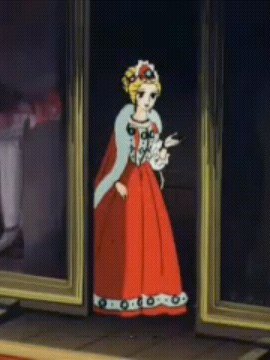
The Rose of Versailles (Berusaiyu no Bara) is a historical drama manga by Riyoko Ikeda, which was originally serialized in the shoujo magazine Margaret from March 1972 to December 1973. Influenced by Ikeda's experiences as a member of the Japanese Communist Party, the manga depicts the French royal court at the palace of Versailles from the last years of the Ancien Régime to the dawn of The French Revolution. Its central character is Oscar François de Jarjayes, a Parisian noblewoman who has been raised as a boy to provide her father with a "son" and heir. Oscar is made head of the Royal Guards of Versailles, and her first assignment is to protect and chaperon the new Crown Princess Marie-Antoinette.
If you were wondering about the scope of anime, this series places the bar well above your initial guess. Incorporating many French historical figures and the very real political nuances of the period, this series can be read either as a political (leftist and/or rightist) screed or as a heart-rending love story.
The manga has been adapted several times. It was first adapted to a 40-episode anime that aired from 1979 to 1980; originally directed by Tadao Nagahama for the first twelve episodes, Osamu Dezaki later stepped in to direct episode 19 and onwards after Nagahama passed away. There's also a Takarazuka Revue adaptation (which is quite popular on its own), and Lady Oscar, an obscure Live-Action Adaptation by French director Jacques Demy generally considered to be So Okay, It's Average. It is notable, however, in that it came out before the manga had ever been officially translated, resulting in famed translator Frederik Schodt having to scramble to make one for the production company. He did this by blazing through the manga and writing his translations right on the pages in pencil. In spite of the director's name, the film was never released in France.note The French dub of the anime kept that title.
The manga is notable for being a major landmark for the shoujo demographic; at the time it was first published, most shoujo manga were simple stories aimed at elementary school-aged girls, but The Rose of Versailles proved that manga aimed at teenage girls and young women, with more complicated plots to draw them in, could also be successful. As a result, it was the first shoujo manga to achieve mainstream critical and commercial success. Elements of it can be seen in shows like Revolutionary Girl Utena and Le Chevalier d'Eon. In 2009, a live-action series called Haken no Oscar aired in Japan, which constantly references The Rose of Versailles.
There is also a series of side stories which take place during the original manga's Black Knight arc; titled The Rose of Versailles Side Stories: The Great Detective Loulou, these focus on Oscar's precocious niece Loulou de la Laurencie, who often stumbles upon mysterious happenings around Versailles with the other main characters getting roped into solving them. These stories were published in Monthly Jam from 1984 to 1985.
While the anime and manga saw a wide release in much of the world during the 1980s under the name of Lady Oscar, one notable exception was in English. The first two volumes were released in the early '80s as a teaching tool for Japanese to English, but aside from this release, the manga has never been released in English officially. Similarly, the anime went unlicensed in English for over 30 years before Right Stuf International finally picked it up in late 2012 for a subtitled-only release in Spring 2013. You can watch it legally here.
In 2015, a Pachinko game based around Rose of Versailles was the source of creating new animations.
In January 2020, Udon Entertainment began releasing the manga in English, having announced it in 2015, five years earlier, with the entire series released in five omnibus volumes by April 2021.
On July 7, 2022 it was announced that a new animation project for the 50th anniversary of the Manga was underway.
Not to be confused with the Japanese Power Metal band Versailles, or Bara Genre.
The Rose of Versailles provides examples of:
- Adaptation Distillation: A couple of interesting side stories were removed in the anime adaptation and in addition many themes were oversimplified and outright altered such as feminism and Oscar's finding of a balance with it and traditional femininity as well as the complex love triangles around the characters (in particular Allain De Soisson's romances).
- Adaptation Expansion: The anime has more filler in the early series to fill out Oscar's childhood adventures.
- Adaptation Name Change: Perhaps to prevent confusion with her character Bernard Chatelet, Ikeda changed the name of the regimental commander of the French Guards from Duke of Chatelet to De Vouillet (no nobiliar title specified).
- All There in the Manual: Or in the History Book... it's surprisingly faithful to actual historical events. Oscar's desertion in particular is based on the entire regiment of the French Guard deserting to not attack the people in Paris and showing up just in time to storm the Bastille, with the minor character mentioned a couple times that take command after Oscar's death being the real life leader of the deserters during the storming.
- Alternative Foreign Theme Song: It's easier to count the countries that didn't use a new theme song. This is most likely due to the show receiving a new title overseas, Lady Oscar. What gets funny is that the Japanese theme is suitably dramatic and somber, while many of its dubs chose cheerful and happy theme songs... despite the content of the show still concerning the tragic lives and deaths of people living through the French Revolution. Even more amazing? The actual French dub probably has the perkiest song of them all.
- Anachronism Stew: While the manga, for its time, is historically accurate in regards to the French Revolution and the events leading up to it, there are still liberties taken in regards to the time period's fashion. There are characters wearing flared pants, women wearing dresses that show their bare backs, and dresses with puffed sleeves and frilled collars that are more inspired by the Victorian Era. Heck, even Oscar's uniforms are more based on military uniforms that wouldn't appear until a century later.
- Angry Mob Song: The manga has a scene where a group of Jacobins are singing the Revolutionary version of "Ça Ira" and one in which soldiers march to the front singing the "War Song for the Army of the Rhine", now better known as "La Marseillaise" (the French national anthem). If you don't know why these songs qualify, just know that they are mentioned on this wiki in the Angry Mob Song page for a reason.
- Arranged Marriage: Madame de Polignac tries to engage her kids twice to rich noble people, failing spectacularly and dramatically both times. At some point, Oscar's father attempts to engage her to Count Girodelle, but it also fails. Also, the main reason why Antoinette is the Queen of France is because of her arranged marriage to King Louis, staged by her mother.
- Art Evolution: Riyoko Ikeda's art style changed a good deal between the original manga's run from 1972 to 1973 and the Great Detective Loulou side stories published from 1984 to 1985. In Great Detective Loulou, the characters' faces are much narrower, with smaller eyes and more rounded noses, and Ikeda makes more use of screentones and shading for the backgrounds and clothing.
- Artistic License – History: Has its own page.
- Awesome Moment of Crowning: Louis XVI's consacration as King of France is briefly shown, with him wearing the traditional coronation clothes.
- Badass Army: The French Guards. All of the Household Regiments (each as big as a standard brigade of their specialty) are considered elite, but it's only when Oscar's regiment-sized company of French Guards grenatiers utterly curbstomps two regiments of the regular army (an unidentified infantry regiment and the Régiment de Royal-Allemand) that we get confirmation.
- The Beautiful Elite: At least when it comes to Versailles, but that was actually the point in the Real Life version.
- The Gards du Corps are considered the elite cavalry regiment of the entire French Army, not just the Royal Household, and are universally beautiful. This even gets lampshaded by many characters whose reaction on finding out that Oscar is in that regiment is to admit they should have guessed it from her looks (this number includes Fersen), Bernard (who compares them to good-looking dolls), and Girodelle (who flat-out admits that, having been accepted in the regiment, he has to be beautiful).
- Beta Couple: Rosalie and Bernard. Jeanne and Nicolas. Louise and Renier.
- Bisexual Love Triangle: There's a triangle with both Rosalie (female) and Andre (male) as the admirers to Lady Oscar (female). Both are forbidden romances — Rosalie because she's a woman, and Andre because he's a servant.
- Bishie Sparkle: Constantly.
- Black-and-White Morality: Not Saint-Just himself, but this is certainly his view of the world when it comes to the nobility. To him, they are all inherently corrupt and wicked and have to be destroyed, even the ones supposedly on his side (echoing the sentiments of his historic self late in life). On the other hand, when Bernard points out in a conversation that killing everyone that he disagrees with makes him a hypocrite at best and no better than the nobles he hates at worse, Saint-Just in no way denies this. He said that as long as the revolution succeeds, he doesn't care what history thinks of him.
- Blasting It Out of Their Hands: Oscar subverts this, because she's actually pissed at the guy, so she deliberately shoots his hand and cripples him to make sure he'll never get to shoot again. It's not like she didn't have a huge reason: she had seen him shoot a commoner child in the back just for kicks, despite Rosalie begging him to not do so.
- Bloodier and Gorier: Inverted. While the anime added some extra violent content, the manga actually manages to be gorier, and the anime even removes some open blood splatter in the final days of the Revolution.
- Bloodless Carnage: Used quite frequently, though a few brief instances of bloodshed can be seen early in the anime adaptation.
- Book Ends: The manga starts with showing the births, in the same year, of Fersen, Marie Antoinette and Oscar, and ends with a page-wide panel with Fersen's body and the words "On September 4, 1755, in Sweden, Hans Axel von Fersen was born. The following November 2, in Austria, Marie Antoinette Josèphe Jeanne was born in Austria. The following December 25, in France, Oscar François de Jarjayes was born in France".
- Breakout Character: The manga was originally intended to focus on Marie Antoinette, with Oscar as a supporting cast member, and hence the story arc of the manga begins with Marie's birth and ends with her death. Oscar became so popular with readers that she quickly took over the focus of the story, and other adaptations of the work focus on her as the main character from the start. In particular, the anime begins with the birth of Oscar.
- Break the Cutie: Oscar, Rosalie, André, Marie Antoinette, Fersen, Charlotte as a particularly tragic example... most of the cast, really.
- Bring It: The Storming of the Bastille is presented as this: after days of riots the Parisians notice the Bastille, that they had ignored the entire time, is pointing the guns at them, so, after a moment of freak out, they procured some artillery of their own and assaulted the fortress.
- Characters Dropping Like Flies: It's a manga/anime based on the French Revolution that largely used real people. It's no surprise the majority of the main cast ends up dead.
- Childhood Friend Romance: Oscar and André have known each other since childhood because André's grandmother is Oscar's nanny. André is in love with Oscar and she eventually falls in love with him too.
- Come to Gawk
- Costume Porn: Which actually borders on Shown Their Work. Many of the outfits were that elaborate in Real Life.
- Crippling the Competition: Oscar shoots a guy's gun hand in a duel, as this is the only way she can punish him for shooting a peasant boy in cold blood.
- Custom Uniform: Quite widespread, as usual for the period:
- During The Rose of Versailles, the various officers of the French army all wear different clothes, with Oscar having five outfits during her career (her initial white uniform as a lieutenant of the Gardes du Corps, a red one after being promoted to colonel, a white dress uniform, a blue one after transferring to the French Guards, and another dress uniform for a party), the only constant being a cross necklace on the service uniforms, her sword and the blue one being the only one that even somewhat resembles the uniform of her soldiers... In that they wore blue. Changing uniform with the rank seems a common practice, as lieutenant Girodelle of the Gardes du Corps gets a new uniform after being promoted to colonel.
- Oscar's French Guards dress uniform is actually a plot point: her father, having realized the French Revolution was coming, was trying to get her married so she wouldn't get involved in the fighting and threw a party so she could choose a fiancee, and she commission an outfit for it... And it being revealed as a dress uniform signaled her complete refusal of leaving the military and marrying.
- The various regiments all have different uniforms too, being in different colors and often with completely different styles, and of course their officers wearing something different. On the latter the French Guards are the closest to a standardized uniform, in that their officers all wear the same blue of the troops.
- The trope is also present in the sequel Eikou no Napoleon - Eroica, though in a different manner due the changed times: As it starts in the latter part of The French Revolution, the trope is initially Averted for the French, as the Republic standardized the uniforms... Or at least tried, as the Army of Italy, due its poor supply situation, has uniforms with various customizations up until Napoleon leads them to Milan and uses the money got from the Sardinian surrender to order new ones for his men. As Napoleon's rise to Emperor starts, however, the trope starts to reappear, with first regiments getting differently colored uniforms and later officers adding their own touches, culminating with the Empire when the officers wear customized uniforms that at least still resembles those of their troops... And Napoleon constantly wearing the basic uniform of an artillery officer.
- Played straight with non-French troops, where no two regiments have the same uniform and no two officers wear the same clothes.
- Darker and Edgier: The manga has many moments of slapstick humor, often with typical comedic manga expressions and symbols, and tends to use chibi drawings and starry eyes in some dramatic moments for added effect. Even late in the story, as the Revolution is brewing into more and more violence, there are still moments where characters will break into more comical expressions. The anime removes many of the manga's light-hearted, cartoony moments for a bleaker, yet more consistently dramatic tone, which is reflected with the anime's more realistic art direction.
- Deliberate Values Dissonance: This is pretty much inevitable when you're writing a historical drama set in the 18th Century:
- Severe homophobia is the norm, rather than the exception, and accusations of lesbianism hurt both Oscar and Marie Antoinette.
- Antoinette is occasionally referred to as a tomboy by other characters as a young girl, due to her desire to run around and play instead of adhering to court etiquette or studying. While her active personality does go against societal expectations for a noble lady, by modern standards she's really not very tomboyish at all and would be considered a Girly Girl with a Tomboy Streak at most, especially given her generally feminine interests.
- The story doesn't gloss over the fact that upper-class girls were frequently married off as young teenagers — or even preteens, as Charlotte de Polignac is forced into an Arranged Marriage by her mother when she's only eleven years old. Marie being lucky to have a husband in her age bracket is also touched upon, since many of these girls were married to much older men.
- As pointed out by the Duchess of Polignac, in 18th century France it was perfectly normal for married people to have lovers, as long as it didn't get in the way of generating a legitimate heir. In fact Oscar's parents are considered weird for being completely loyal to each other, and when a character who seems to be the Count of Jarjayes' illegitimate son shows up in a side story other nobles simply wonder why he was hiding it. There's actually a double dose of this, as Marie Antoinette, being born and raised in the more sexually upright Austria, has trouble accepting the very idea of sex outside wedlock. Early on this actually played a part in her hostility to Madame Du Barry, as she was openly the lover of Louis XV (a widower) and a former prostitute to boot, and while she became more tolerant of extramarital affairs she still refused to take Fersen as a lover.
- Soldiers of a Household Regiment at one point quip how weird it is that King Louis XVI would often wear modest and practical clothes and would try and help the poor (the occasion being his order to round up the unemployed men of Paris so they can clear away the ice and snow at Versailles, and make sure to pay them well). There's again a double dose, as Maria Theresa, Archduchess of Austria and Holy Roman Empress, is of the opinion a ruler should dress modestly, with only the barest needs in addition to their own dignity to indicate their position, and she's appalled at finding out that Marie Antoinette went native on this.
- The story doesn't gloss over the elitism and class prejudices that plagued pre-revolutionary France. For example, while there are plenty of legitimate reasons to dislike Madame Du Barry, many people at court disdain her at least partly because she's a jumped-up commoner whose relationship with Louis XV gives her a de facto higher standing than many among the "legitimate" French nobility.
- The instant assumption that a prostitute must be a terrible person raises a few eyebrows these days, but it was the prevailing attitude at the time the story is set, and it shows in the way many characters instantly assume the worst of anyone who is or was involved in sex work.
- Demoted to Extra: Poor Rosalie got this for being unpopular among Japanese readers.
- Didn't See That Coming: A lot. For example, Marie Antoinette didn't see Jeanne Valois successfully convincing the people that Marie was the culprit behind the Affair of the Diamond Necklace, and was rather shocked by it. She could have seen it coming, had she not been sheltered by most of the court and madame Polignac had not convinced her to isolate herself from pretty much everyone who wasn't part of her inner circle...
- Also, Jeanne and madame Polignac didn't expect to meet Rosalie at Versailles. This time they couldn't have possibly seen it coming: Jeanne knew Rosalie very well and expected her to remain in the slums of Paris as a working woman and had no knowledge of their mother's death, while madame Polignac, who had accidentally run over their mother and told Rosalie to visit at Versailles if she wanted to complain, couldn't possibly expect that, in the attempt to do just that, Rosalie would have befriended Oscar, who trained her to act as a lady and brought her in Versailles.
- Both Rosalie and madame Polignac didn't expect Rosalie to be madame Polignac's illegitimate daughter from Jacques de Valois de Saint-Rémy, last descendant of the House of Valois, and were rather shocked to find out: Rosalie when André discovered that of all the women named Martin Gabrielle in the peerage, Yolande Martine Gabrielle de Polignac, nee de Polastron, was the right one, madame Polignac when her daughter mentioned Rosalie's full name).
- Didn't Think This Through: A lot of characters end victim of this due to arrogance.
- Madame Du Barry arguably takes the cake on this. Namely, engaging Marie Antoinette in a pissing match without realizing that, once Louis XV (who was already in his sixties at the story's beginning) would inevitably die, Marie Antoinette would be the queen and capable of dishing whatever revenge she wished against her. Ironically, her undoing ends up being at the hands of the king's confessor, who convinces the ailing king to throw her out. She lampshades this later to Oscar.
- In this particular affair other people were equally guilty. First of all Marie Antoinette, who had married Louis Auguste as part of the deal that ended the centuries of rivalry between France and Austria, openly snubbed the lover of the King of France, jeopardizing the arrangement - though to her credit once the Count De Mercy points out she risks causing a war she immediately swallows her pride and determines to speak to Du Barry in public. And then there's the King's daughters, who not only had egged on Marie Antoinette from the start but when the latter was about to talk to Du Barry went and dragged Marie Antoinette out of the room, almost causing a war up until Marie Antoinette begged Louis XV for another chance to fix the mess.
- Cardinal Rohan did it big time due his attempts at getting in Marie Antoinette's good graces. Between Marie Antoinette being the daughter of Maria Theresa (who had very little tolerance for him and his womanizing ways), Antoinette having a personal grudge against him for both spreading rumours about her and talking bad of her mother, and her answers at his initial attempts he should have realized earlier that the letters given to him by Jeanne were fakes, especially given that they were signed "Marie Antoinette de France" (by convention, royalty only uses their given names when signing, and with the House of Rohan having prince étranger status he should have known). And yet he not only failed to do so, but got duped in the infamous Affair of the Diamond Necklace. To be fair he did find the difference between the queen's actions and the tone of the letters rather strange, but Jeanne had him meet a perfect lookalike of the queen to confirm her story...
- Averted by Oscar: she does make a point of thinking everything through, and was able to pull a lot of crap (including holding the lover of king Louis XV at swordpoint) and live to tell the tale (not that she was stupid enough to do it) specifically because she quickly thought it through before pulling it. Best showed by the pissing match between the Countess Du Barry and Marie Antoinette (also the only time Oscar has to think it long enough that we immediately see what made her decide that way): at the start Oscar just wanted to enjoy the show, and upon being forced to take sides she thought about the Du Barry being more powerful due being the king's lover, Marie Antoinette being the wife of the Dauphin (and thus both the future queen and, with the king's wife being long dead, the highest-ranking woman in the whole France), and the king already being rather old (he would live only two more years) before taking Marie Antoinette's side. After Marie Antoinette was forced to surrender and Du Barry tried to take revenge on Oscar by framing her mother for murder, Oscar spelled it out loud to the countess, causing her to realize she didn't think it though before engaging in a pissing match with the future queen and getting away with holding her at swordpoint in her own apartments.
- Madame Du Barry arguably takes the cake on this. Namely, engaging Marie Antoinette in a pissing match without realizing that, once Louis XV (who was already in his sixties at the story's beginning) would inevitably die, Marie Antoinette would be the queen and capable of dishing whatever revenge she wished against her. Ironically, her undoing ends up being at the hands of the king's confessor, who convinces the ailing king to throw her out. She lampshades this later to Oscar.
- Died Happily Ever After: When Oscar is fatally shot, she is smiling- because she sees that André — who had been fatally shot himself as well the previous day — had come back from above in order to bring her home. After they both die, they go retrieve André's grandmother, who also dies smiling.
- Distant Finale: The manga ends in an epilogue that briefly narrates Fersen's life and violent death after Marie Antoinette's execution during The French Revolution.
- Distracted by the Luxury: Justified, since the ring given to Marie is also meant to be a memento from her mother.
- Does This Remind You of Anything?: Episode 7 from Vol. 12 of the manga revolves around Oscar, starting from age 11 until adulthood, constantly seeing a version of her if she lived a life of a "woman". While it may be just coincidence, it sounds a lot like Oscar is suffering from the syndrome of subjective doubles.
- Downer Ending: The series ends with most of the main cast being killed during The French Revolution.
- Driven to Suicide:
- Early on in the story, Charlotte du Polignac throws herself off a building in her despair over her mother forcing her into an Arranged Marriage with a much older man.
- In the manga, André almost goes through with it, when he poisons Oscar's wine and plans to kill himself afterwards.
- Drowning My Sorrows:
- Jeanne takes to drinking vodka by the bottle after the Affair of the Necklace plays out.
- Oscar is seen surrounded by empty wine bottles now and then as the situation deteriorates.
- Dutch Angle: A highly distinctive element of the directorial style of Osamu Dezaki, who directed from Episode 20 onwards. Often used multiple times during a scene. Borders on overuse, depending on your taste.
- Elites Are More Glamorous: Most of the pre-Revolution regiments featured (and all the named ones: Gardes du Corps du Roi, Gardes Suisse, Gardes Françaises, Royal-Allemand, Royal Suédois, Royal-Cravate, Salis-Samade and La Fere) are considered elite. Goes double for Oscar's units: in the Gardes du Corps Oscar enrolled into (and later commanded the) Compagnie Ecossaise (Scots Company, so called due originally being composed by Scots emigrates), the elite among the Gardes du Corps, while in the Gardes Françaises (the elite infantry regiment of the entire French Army, not just the Maison Militaire) Oscar commands a grenatier company (by that time grenatiers had ceased to be grenade-armed infantry and were elite infantry).
- Special mention goes to the Swiss regiment Salis-Samade: some of their men, detached to reinforce the Bastille, are those who killed Oscar.
- Ermine Cape Effect: Marie Antoinette's dresses are rarely ever plain, even by royal standards. To be sure, the pageantry and ritual was half the point of Versailles and the clothes were a big piece of that. Blame Louis XIV.
- Even Evil Has Standards: Robespierre and Saint Just have a moment of this in the manga at Marie's trial: when Hebért accuses her of incest with her son, Robespierre berates Hebért for sullying the Revolution with the charge and Saint Just starts thinking about finding a reason to have him executed (historically, Hebért would give them an excuse, getting executed as a thief).
- Everything's Better with Sparkles: Bishie Sparkle being just one of many types this shows uses.
- Everyone Has Standards: In terms of wastefulness, Marie Antoinette compared to the Du Barry: whereas Du Barry cared only about showing off her power with loads and loads of jewels and expensive clothes without a care for the expense (doing a lot more than Marie Antoinette to bankrupt France in the process), Marie, even before realizing how much she was wasting, would always ask the price, and refused to buy the infamous diamond necklace (originally created specifically for Du Barry) because for its price you could build and equip a warship.
- Eye Scream: André loses vision in his left eye in very messy circumstances. When he dies, he had also lost half the sight of his remaining one.
- Faceless Masses: Grayed Colored Masses.
- Florence Nightingale Effect: Rosalie and Bernard fall in love while she's nursing him after he gets shot... By the nurse herself who was protecting Oscar.
- Flower Motifs: Even on dresses!
- Some of the female characters are represented by roses: Oscar is the white rose, symbol of purity and innocence, made red at the end of her life by both finding true love and her own blood; Marie Antoinette, dominated by the search for true love, is the red rose; Rosalie is the pink rose, symbol of either gratitude or youth, desire and energy depending on the shade; Madame de Polignac is the yellow rose, expressing both friendship, jealousy, and the deepest of both love and betrayal; her daughter Charlotte, innocent even beyond Oscar herself, is holding a white rose before falling to her death; Jeanne, finally, is the black rose of hate and death.
- Foregone Conclusion: The entire series is based on the life of Marie Antoinette... and takes pains to remind the viewer from time to time about the tragic course of her life.
- Foreshadowing: Some later events gets warnings. The most important bits of foreshadowing are Marie Antoinette accidentally staining her marriage contract (something that was considered an ill omen), foreshadowing the Foregone Conclusion, and Marie Antoinette naming the Salis-Samade and Royal Allemands regiments last when listing the regiments converging on Paris, foreshadowing the status as Hero Killers they would acquire by killing André (Royal Allemands) and Oscar (Salis-Samade).
- Gecko Ending: In an unusual example of this trope, an alternate version of Episode 24, titled "Portrait of a Burning Rose", was made specifically to wrap up the series in territories where the anime was cancelled due to scheduling issues. This episode hastily recaps everything up to Episode 35, ending with Oscar and André affirming their love for one another. "Portrait of a Burning Rose" was never re-aired or otherwise redistributed as a result of the circumstances behind its making, resulting in TV guide listings and screencaps from a VCR recording being the only evidence of its existence.
- Gem-Encrusted: The ermine on one of Marie's dresses, her bejeweled headdresses, and all the various dresses trimmed with pearls and jewels.
- Genre Shift: Subtly done, and since the anime had two directors (Tadao Nagahama directed the first eighteen episodes, while Osamu Dezaki directed all the episodes after that), the change was when it started; it was a historical type of account about Oscar enduring the endeavors of the court of Versailles and about Marie Antoinette's marriage and trials. Starting around the twentieth episode, the story became more politically charged and introspective and the focus shifted from the court at Versailles to the people of Paris, the French military and, eventually, Oscar and André themselves.
- Gorgeous Period Dress: Naturally required in Versailles.
- The Guards Must Be Crazy: Surveillance at Versailles is so lax that, as Jeanne put it, you only needed a sword and a hat to reach the queen.
- Truth in Television: Not only were Versailles' guards that lazy in Real Life, but the historical Jeanne Valois actually did it to try and become a friend of Marie Antoinette, who not only had more motivated guards following her but knew perfectly who Jeanne was and ignored her.
- Hilariously subverted by Oscar's company in the French Guards, who are very good at their job even without Oscar trying to catch lazy guards (and in fact take offense when she shows up by surprise) and caught Fersen trying to sneak out of Versailles after a night meeting with Marie Antoinette. Had Oscar not showed up right as they were arresting him, Fersen would have been thrown in jail without much fanfare.
- Then Double Subverted in the same scene when Oscar tells Fersen which gate was guarded by the laziest guards that night.
- Hammy Herald: The guys who announce the guests at Versailles.
- Heroic BSoD:
- In the anime, Charlotte spends her last moments in this state, acting like a madwoman until she commits suicide by throwing herself off a balcony.
- André also suffers a BSOD of sorts when he realizes he's going blind, then Oscar tells him she intends to live and die as a man. He absolutely loses it, forcefully kissing her and ripping her shirt; after realizing what he almost did, he tearfully confesses his love and walks away.
- Hiding Behind Your Bangs: André loses the use of one eye roughly halfway through the series, and subsequently covers it up with his hair for the remainder of the series. Perhaps unusually, he does experience problems with his sight as a result of this, which becomes a plot point later on.
- High-Class Fan: As the story takes place in 18th century France during the years leading up to the French Revolution, many female characters of noble blood carry fans as accessories to show their status. Marie Antoinette herself frequently carries one, as do the Duchess de Polignac and her daughter Charlotte.
- Historical Beauty Update: Nearly every historical figure is depicted as more conventionally attractive than they were in real life. A notable exception is the Count de Mirabeau, whose Gonkish design isn't far off from how he really looked; the real Count de Mirabeau was disfigured by smallpox as a child.
- Historical Domain Character: Everyone who actually existed; it might be shorter to list those who do not belong to this category.
- Historical Fiction: The story focuses on Marie-Antoinette's reign as Dauphine and later Queen of France, and the events that led up to the French Revolution.
- Historical Villain Upgrade: Since the series is told from the perspective of Marie-Antoinette, many of her political enemies got this treatment, notably Madame du Barry and Louis Phillipe II (Duke d'Orleans).
- Homoerotic Subtext:
- When Fersen meets Oscar, he initially thinks she is a man. Rosalie is also flat-out in love with Oscar for a good portion of the series and apparently retains some feelings for her into the Distant Finale after having married Bernard. In the manga, Oscar also appears to return Rosalie's feelings, to an extent.
- On the other hand, Oscar gets pretty mad about it when Jeanne publicly accuses her of being a lesbian. (Her reaction in the manga is even stronger than in the anime.) Of course, given the historical setting, she likely wouldn't want such a reputation, even if it was true. That, and Jeanne was accusing Oscar of being the lesbian lover of a married woman — not so much of being attracted to women in theory.
- In chapter 4, three ladies at the ball fangirl over Oscar who they clearly know is a woman. They call her dashing, wish that she would come over and talk to them, and then all subtlety is lost when one says that she wishes Oscar were a boy so that they could get married.
- Identical Stranger:
- Prostitute Nicole d'Oliva resembles Marie Antoinette so closely that the Lamottes are able to use her to impersonate the Queen as part of a con. This one is supposedly Truth in Television, too.
- In an anime-only episode, Duke Orléans also has a boy named Jean impersonate the Queen in a Wig, Dress, Accent disguise, and do it well enough to fool her maids and ladies-in-waiting.
- If You Kill Him, You Will Be Just Like Him!:
- Oscar refuses to kill Bernard "Black Knight" Chatêlet, the one to blame for André's Eye Scream situation, because of this.
- Bernard says this has long since happened to Saint-Just. Saint-Just however doesn't care.
- Incurable Cough of Death: Oscar gets tuberculosis, but unusually for the trope, she doesn't actually die from the cough (though she is informed that it's terminal) but in a far more suitably dramatic manner while storming the Bastille.
- In the Past, Everyone Will Be Famous: Oscar, besides working with Marie Antoinette and Louis XVI, randomly bumps into Robespierre and Louis Saint-Juste on many occasions. A very young Mozart makes a brief appearance in the first chapter of the manga (as Mozart really did meet the Austrian royal family in his youth) and his music is frequently mentioned throughout the story. Oscar also bumps into Napoleon Bonaparte; though he only makes one appearance, he later becomes a much more prominent character in the sequel manga, Eikou no Napoleon.
- Intrepid Reporter: Bernard, after his Character Development.
- I Want My Beloved to Be Happy: Girodelle/Gerodere.
- King Incognito: Marie meets Fersen when she's disguised at a masquerade ball. He takes off her mask and falls in Love at First Sight, but doesn't find out she's the Dauphine until a bit later.
- Kubrick Stare: Due to the character design, it happens quite often. Lady Oscar herself is particularly fond of the stare.
- Light Feminine and Dark Feminine: Sisters Rosalie and Jeanne respectively.
- Limited Wardrobe: Most of the cast, especially commoners, though Oscar does go through three different uniforms.
- Love Dodecahedron: Girodelle->Oscar, Alain->Oscar, André<->Oscar, Rosalie->Oscar, Oscar->Rosalie to a much lesser extent, Oscar->Fersen, Fersen<->Marie Antoinette, Bernard->Rosalie, Rosalie->Bernard to an extent, Louis->Marie Antoinette, and there's something more than a guard/charge relationship between Oscar and Marie Antoinette as well.
- Love Triangle: André/Oscar/Fersen/Marie Antoinette.
- Luke, I Am Your Father: A gender swapped version, played straight: Rosalie's adoptive mom died after being crashed by Mme de Polignac vehicle. Rosalie swears she will get revenge. The problem is, the answer to her You Killed My Mother could be "I am your mother!" Rosalie is really the illegitimate child of Mme de Polignac, who had to abandon her to a servant.
- Market-Based Title: The series was released overseas as Lady Oscar, though the English-language releases retained the original title.
- A Match Made in Stockholm: Rosalie gets kidnapped by the Black Knight and she shoots him to protect Oscar from him. While treating the wound that she gave him, Rosalie and the Black Knight whose true identity is Bernard discover they have similar backstories and they get married soon afterwards.
- Melodrama: If you could bottle and sell it, you'd make a fortune from just a few episodes.
- Mirror Universe: Episode 7 from Volume 12 involves this.
- Must Not Die a Virgin: Oscar and André have sex almost at the end of the manga and anime series, apparently losing their virginities to each other as well. Both die in the Grand Finale.
- No Sense of Personal Space: Countess Montclair is way to touchy-feely with Rosalie in the sidestory.
- Off with His Head!: The guillotine is featured during the late manga, once the French Revolution has started, and both Louis XVI and Marie Antoinette are seen walking to their executions.
- Oh, Crap!: We get a few, but the most notable are Oscar's when she realized Alain could actually defeat her in a Duel to the Death and Louis XVI's when he was told of the Storming of the Bastille.
- Mass "Oh, Crap!": The Parisians have one when they notice the Bastille is pointing its guns on the city.
- Only Six Faces: There's not that much variety in terms of facial features. Several characters look identical with their hairstyles and clothes being the only way to differentiate them.
- Parental Abandonment: André is an orphan raised by his grandmother, who works as the Jarjayes caretaker. Marie-Antoinette is distanced from her mother Maria Theresa, who marries her off to young Louis as a pawn in her European politics; Louis Auguste himself is being raised by his grandfather the King and his aunts. Rosalie was abandoned as a baby by her 14-year-old mother and raised by a peasant along with another girl, Jeanne; said peasant, Nicole, dies at the beginning of the story when run over by the carriage of Madame de Polignac... Rosalie's true mother. Bernard's mother dies when he is 5. Robespierre's mother dies when he is young. Averted- and how- by Oscar being outlived by both her parents. Downplayed by Alain's mother being alive until he is in his mid-20s.
- Pass the Popcorn: When the countess Du Barry (lover of then-reigning king Louis XV) and Marie Antoinette engage in their pissing match, Oscar, upon being asked which side she will take, starts laughing and states she will enjoy watching it, at least until Du Barry forces her to take a side (her friendship with the future queen will start only after the pissing match, and only after witnessing Marie Antoinette's reaction at being forced to surrender).
- Pastel-Chalked Freeze Frame: The anime frequently makes use of it whenever anything really dramatic happens. Unsurprising, since most of the anime was directed by Osamu Dezaki, who invented the trope.
- Pimped-Out Cape: Marie had the most, and her most pimped out was the one in the manga with the bejeweled ermine dress, because the cape was also similarly trimmed. But in the anime, it was just trimmed with thick, white fur (still enough to count as this trope of course). There is also the king's royal robes. And in the manga, Oscar even has a fur-trimmed cape she wears once. Rosalie either borrows that cape or has one of her own.
- Pimped-Out Dress: Plenty, given the setting, but given Marie's position, she gets the grandest dresses, even before she shows up in France (the dress trimmed with jewelry-tipped ermine, as seen on the page for PimpedOutDress.Anime And Manga). Also nearly as grand are DuBarry's dresses, Rosalie's dresses, and Oscar's dress.
- Pink Means Feminine: In the manga, Oscar's dress is a light pink.
- Please Spare Him, My Liege!: Marie successfully saving André from execution.
- Praetorian Guard: Oscar serves her career in the Maison Militaire du Roi de France (Military Household of the King of France, the collection of regiments guarding the King, including the Musketeers of the Guard), first in the Garde Écossaise (lit. "Scots Guard", a company originally composed of Scots expatriates) company of the Garde du Corps (lit. "bodyguards", the senior cavalry regiment) and later as commander of a grenadier company in the Gardes Françaises (French Guards, the senior infantry regiment).
- Pre-Climax Climax: Oscar and André finally sleep together just before they join the first battle of the French Revolution.
- Pretty in Mink: Marie wears a few other furs in addition to her ermine capes◊. In the manga, Oscar even has a fur she wears once, and Rosalie has a cape, and a jacket and muff◊.
- Princess for a Day: Oscar, the one evening she secretly went to the great ball dressed as a woman to dance with Count von Fersen.
- And darkly subverted in one of the anime filler episodes, when a boy named Jean dressed up and impersonated Marie Antoinette. (It turned out it was all part of one of the Duke of Orléans's elaborate schemes.) When Oscar outed Jean and Orléans feared he would reveal his involvement, he coldly killed him.
- Private Military Contractors: The regiments Royal Suedois, Royal Allemand, Salis-Samade and Gardes Suisses are composed by foreign mercenaries coming from Sweden (Royal Suedois), Germany (Royal Allemand) and Switzerland (Salis-Samade and Gardes Suisses). They are not the only foreign regiments in the army of the Ancien Régime, but they are the ones featured.
- Among them the Royal Suedois and Gardes Suisses are the most important, due to Fersen being the commander of Royal Suedois and the Gardes Suisses being an Household regiment and the ones who kill Oscar.
- Also, the Garde du Corps (Oscar's initial regiment) was created around the Gardes Écossaise, a unit of Scots soldiers entrusted with the safety of the King. While Scots had long stopped serving in the Garde du Corps, the first company (Oscar's command as a captain) was still known as Compagnie Écossaise due being the original unit around which the Garde du Corps was formed.
- The Queen's Latin: The live-action film has the characters speaking this, mostly down to the cast being majority British.
- Raised as the Opposite Gender: Oscar, of course. Oddly for this trope, she is completely open about being female and few make anything of it. But that could be due to the fact that by the time Oscar meets André at age 7, she already knows she is a girl.
- Red-Headed Stepchild: Madame du Barry consistently refers to Marie Antoinette as a redhead even though the latter is obviously a blonde. It's clearly meant to be an insult.Madame du Barry: Her tresses may as well be red compared to mine!
- Requisite Royal Regalia: Only occasionally worn, save for state occasions and particularly dramatic moments, like when Marie flung off her ermine cape when forced to speak to Madame DuBarry, signifying Marie's torment at having to give in to a commoner. Of course she was actually giving in to the King, but that wasn't the point.
- Royal Favorite: Madame du Barry is a favorite and mistress of King Louis XV. His daughter-in-law Marie Antoinette gets along poorly with her, and is humiliated when she has to treat her with the same respect as everybody else at court. Oscar de Jarjayes, who's Captain of the Guard, is also a favorite of Marie Antoinette herself, serving as a confidant for her woes. Oscar seems aware of this and tries to dodge some of her more overt demonstrations of favor, like when she rejects a gift of hers.
- Sequel Hook: Napoléon Bonaparte's two appearances serve to indicate that Ikeda will draw a sequel (the relatively obscure Eikou no Napoleon-Eroica, published between 1986 and 1995) and Napoleon will be the protagonist. The second is particularly blatant: it's Napoleon in the garbs of his imperial incoronation with the narration noting that, after the deaths of Marie Antoinette, Oscar, Robespierre and many other, France is waiting for the hero Napoleon Bonaparte.
- Stab the Sky: Such as when Oscar is pleading for André's life after Marie's horse accident.
- Standard Female Grab Area: During Oscar and André's argument, when André becomes very upset at her decision to live her entire life as a man he grabs her there, forcing her down. Justified, as this is less about Oscar going fail-tastic at fighting without reason, and more about André almost crossing the Despair Event Horizon when he comes to think she's throwing her life away, and Oscar being throughly shocked when unable to face a truth she has been avoiding for so long.
- Star-Crossed Lovers:
- Oscar and André are kept apart by their class difference. They do get together, but André dies the day after he and Oscar consummate their relationship.
- Marie Antoinette is the Queen, Count Fersen is a diplomatic agent from Sweden.
- Sympathetic Adulterer: As expected by French nobles at the time: they were all in marriages arranged out of convenience, so as long as they had a heir and a spare of unquestioned descendance nobody cared how many lovers they had, with the Duchess of Polignac flat-out admitting one of her lovers is her brother in law (and her husband knows). In fact Oscar's parents and Louis XVI are seen as weird for not having lovers, and part of the damage to Marie Antoinette's reputation is that the people don't believe she kept things platonic with Fersen even after having the required heir and spare.
- Their First Time: Oscar and André share their first and only night together right before the French Revolution begins.
- Together in Death: As she lies mortally wounded, Oscar has a vision of herself reuniting with her already-deceased lover Andre in the afterlife. The two are noted several years later to have been buried side-by-side.
- Tomboy and Girly Girl: Tomboy career woman Oscar- though most people can tell she is a woman from the very beginning- and Girly Girl Rosalie. Antoinette started off as tomboyish when she was a little girl, but when she became the queen she turned into a very frou frou girly girl.
- True Blue Femininity: In the anime, Oscar's dress color was changed from pink to blue. See also Pink Means Feminine.
- Ugly Guy, Hot Wife: Louis XVI and Marie Antoinette. He's more pudgy and plain-looking than strictly ugly, though; in this series, no one is a Gonk.
- Unsettling Gender-Reveal:
- Marie, when she meets Oscar. Repeated with Rosalie.
- The Duke of Orleans tries to do this to the king and the prince in a Filler storyline in the show. They get a teenage boy to dress up like Marie and impersonate her◊, so that he marries the prince instead, thus creating a huge scandal.
- Unwitting Instigator of Doom: The Duke of Orleans is this for the aristocracy. He styles himself as a liberal thinker, lets revolutionaries gather at his mansion, and secretly feeds discontent against Louis XVI and Marie Antoinette. The Duke's goal is to gather enough popular support to become King of France, but the factions he supports go on to entirely abolish the First and Second Estates, destroy the Bourbon dynasty, and found the French Republic.
- Du Barry had Louis XV commission a certain gorgeous diamond necklace, with no idea it would cause a scandal capable of undermining the very structure of the kingdom when the con artist Jeanne Valois got her eyes on it.
- Uptown Girl: Oscar is a noblewoman, André is a commoner.
- Very Loosely Based on a True Story: Oscar is very loosely based on D'Eon de Beaumont, a crossdressing late-18th Century French spy, the main difference being that D'Eon was a (rather androgynous) man posing as a woman, though he often claimed to be the opposite (either as a deliberate disinformation tactic, being a trans woman or simply suffering from an extreme case of Becoming the Mask). Fittingly, a later manga, Le Chevalier d'Eon, fictionalizing the actual D'Eon (more or less), takes a large number of cues from The Rose of Versailles.
- Well-Intentioned Extremist: Lots of those, specially Robespierre, Saint-Just, and Bernard before his Character Development.
- Wham Line: The line below appears after things have started going to hell and changes the entire relationship between Oscar and André.Oscar: I love you.
- Wheel o' Feet: In the manga, characters will sometimes run like this during more light-hearted and comedic moments.
- Wig, Dress, Accent: In an anime only arc, the Duke of Orleans plots to ruin the marriage by having a boy show up in Marie's place. The boy, Jean, already looks a lot like Marie, so the addition of a wig really isn't much of a stretch.
- Wise Beyond Their Years: The new Dauphin, Louis Joseph, was a nice and sweet kid. Too bad he also was Too Good for This Sinful Earth.
- The X of Y: The title is "The Rose of Versailles".