

They're animals who think, talk and act mostly like human beings. The Funny Animal has almost all the mannerisms of a human being. Sometimes, only their appearance distinguishes them from the hairless primates who draw them. Indeed, one of the main incentives in using such characters are that they are more distinctive, and hence easier to draw, as recognizable individuals than ordinary humans. Like the Civilized Animal, they can be anywhere on the Sliding Scale of Animal Communication.
On the Sliding Scale of Anthropomorphism, these fall somewhere between the Civilized Animal and the Beast Man. As there can be some confusion between all the anthropomorphism tropes, here's a guideline:
- The Speech-Impaired Animal, Talking Animal, or Civilized Animal has priorities and motivations that are still that of an animal despite their ability to speak. In other words, imagine your pet knowing English and you should get the idea.
- Funny Animals are bipedal even if their species is not naturally so, most Funny Animal birds have Feather Fingers, whether their wings look completely like wings or look (to varying degrees) like arms. Some Funny Animals can shift between using two legs and four. In most situations, they can be replaced by a human and the plot would be mostly identical. A good example from the Scooby-Doo cartoons: Scooby-Doo is a Speech-Impaired Animal. Scrappy-Doo, who might as well be a person in a dog suit, is a Funny Animal.
- The Beast Man is less anthropomorphism and more zoomorphism: instead of taking an animal and giving it more human traits, you take a human and give them more animal traits. Why? Well, this is usually because Beast Man tends to come with Intelligent Gerbil: need to come up with an alien or fantastical race? Just take an animal and use it as inspiration. Ask yourself this question: Are they considered to be a cat/dog/lizard or are they considered to be a distinct species in their own right? If the former, then it's likely this trope, if the latter, it's likely Beast Man. For a more detailed analysis, refer to the analysis page.
Practically any cartoon series from The Golden Age of Animation, or video games aimed at children younger than 13 have at least one such character.
Funny Animal is the technical term used by cartoonists to refer to the genre and characters. Note that the "funny" in the title isn't literal: Funny Animals can be serious characters too, and an animal who is funny is not necessarily a Funny Animal.
Also note that this is a character trope, meaning that the character isn't supposed to be a human + animal features In-Universe. For that, see Animorphism or Half-Human Hybrid.
Frequently overlaps with Animal Superheroes. May live in a World of Funny Animals. May suffer from Carnivore Confusion and Furry Confusion.
For further tropes pertaining to funny animals, furries and the tropes that appear frequently in their genres, see Funny Animal Tropes. Compare Intellectual Animal. Closely related to Beast Fable, which is the ancient form of the genre.
Example subpages:
Other examples:
- Elsie the Cow was a popular mascot for Borden-brand dairy products in the 20th century. In at least one of her incarnations, she was speaking, living in a house, and wearing clothes, and her son was riding a bicycle.
- Sexual Violence with the Birds and the Bees: The bird and bees are humanoid in shape and stature — two arms, two legs, and five fingers on each hand. The bees have human-like mouths instead of mandibles.
- Tommy McAnairey and his family are all anthropomorphic canaries. Tommy himself sings traditional ballads on the subject of carbon monoxide awareness.
- Beastars: The core premise of the series is exploring the idea of a world inhabited by funny animals taken to its logical conclusion. Almost every single world-building decision serves this fundamental concept... except Imaginary Chimeras... but we don't talk about those.
- In the first anime adaptation of Dragon Ball anthropomorphic Funny and Talking Animals are common. Oolong (a pig) and Puar (a cat) start off as two of Goku's close companions, and the King of the World (it's a Fictional Earth) is a dog. With a mustache.
- Pokémon
- In the anime, Meowth of the Team Rocket trio taught himself "human talk" and how to stand on his hind legs, all for the love of a female Meowth named Meowzie who said that a human could do more for her than anything he could (as in, the food, housing and adoration), only to be rejected as now she considers him a freak.
- In The Electric Tale of Pikachu, a story arc centers around the kitten of the very same Meowzie; she's found in a Poké Ball the gang purchases (unable to get captured herself, the mother pops her kitten into an unsold ball to ensure that whoever finds her will give her a good home). When Team Rocket, and thus Meowth, come around making trouble, Meowth meets this kitten and instantly sees her mother in her face and shining coin. Then she tells him it's creepy how he acts like he's a human. Oh heartbreak.
- Mewtwo seems quite human-like, but his psychic powers make that easy. In Pokémon Adventures, he actually has Blaine's DNA and is thus a Half-Human Hybrid.
- Princess Tutu's Mr. Cat looks exactly as his name implies, and occasionally meows and cleans himself with his paws, but is otherwise a marriage-obsessed ballet instructor. While he is the most prominent one and has the most screen time, there are other guest characters that also fall under this trope.
- Shirokuma Cafe is pretty much about this, as well as their interactions with humans.
- Inverted with Mr. Shoebill from Episode 8. He does not talk or act anthropomorphosized, but he is still sentient as the Funny Animal characters and is the editor in chief of a local food magazine.
- Is lampshaded in one episode where a nameless human (Nicknamed Mr. Necktie) visits from out of town. And is bewildered that animals can walk and talk and tries to study them. (Despite it's been shown that Funny Animals are everywhere in that universe)
- Twilight Star Sui and Neri: Animals in Tetsunagi are seen co-existing with humans in The Future. They all speak, wear clothing, do day-to-day duties and talk like humans. However, outside of Tetsunagi is the very opposite where virtually no animals are sapient in other cities. This is mostly due to Tetsunagi being firstly created from a union between sentient animals and humans originating from a research lab.
- Usagi-chan de Cue!!: Benten Chou is an irritable little runt who was merged with a dog. Unlike the nekomimi, his animal form has face fur, an elongated snout, and a dog's nose in addition to canine ears and tail.
- In Happy Heroes, there are several funny animals throughout the series, such as the anthropomorphic cows on Planet Xing and the dog and cat aliens from Planets Wangcai and Miaomei respectively from Season 7 (though the latter group has multiple moments of Furry Reminder).
- Looney Leo from Astro City is a direct Expy of Tawky Tawny. A Golden Age theatrical cartoon character brought to life by a mad scientist's machine, he's had a rough time of it, but seems to be getting by okay these days.
- Biffo the Bear and Big Eggo from The Beano.
- DC Comics' Captain Carrot and His Amazing Zoo Crew!, which contained several Continuity Nods to the other Funny Animal comics DC published.
- Cerebus the Aardvark as well as the other two aardvarks in the series.
- In Circles, species is purely aesthetic.
- Korky the Cat from The Dandy.
- Horndog: Creator Isaac M. Baranoff specifically states that Horndog and Here Wolf are "Funny Aminal" comics.
- Marvel's Howard the Duck is pretty grouchy about being "trapped in a world he never made!" and is mostly just trying to get by among us weird hairless apes.
- One of the earliest known funny animal characters would have to be Mr.Jack
 created by Jimmy Swinnerton which ran from 1903 - 1935.
- Pinky and Pepper Forever is a dark fan comic set in a world of Funny Animals and starring two of the three characters from the Pinkie Cooper and the Jet Set Pets line.
- The titular Rupert Bear from Rupert Bear.
- The titular duo of Sam & Max: Freelance Police. Some characters, like Sal from the video games, also qualify.
- Shazam!: Mr. Tawky Tawny is a very civilized version of this in the original Captain Marvel. His origin has varied over the years, but he's generally pretty cheerful about being a humanoid tiger living among humans.
- Superlópez: The Poet Ant is a humanoid radioactive ant from El castillo de arena (The Sand Castle).
- Mickey the Monkey from The Topper.
- Ziggy Pig and Silly Seal are two of Timely Comics' most popular funny animals from the Golden Age Of Comic Books. Marvel Comics has attempted to revitalize them several times, with cameos in Deadpool and one-offs like Ziggy Pig - Silly Seal Comics and Ziggy Pig and Silly Seal (2022).
- Animal Soccer World is inconsistent with the anthropomorphism of its characters, but one notable exception is Harry the pelican, who is the size of a human, wears clothes, and has hair.
- The chickens in Chicken Run are difficult to categorize—the humans treat them just like any other chickens, but most of them wear at least one article of clothing and the stupidest one is capable of knitting.
- The Great Mouse Detective: Apart from their size and Mouse World, the cast could be replaced by humans and it wouldn't make any difference at all. Well, except for Toby who is a dog and Felicia who is a cat.
- Characters such as Groucho Barx, Olivia Ostrich, Schnoz Ali, Zebra, and Dualot in Journey Through the Jungle of Words.
- The cast of Kung Fu Panda are living in a version of Ancient China where the citizens are sapient animals with varying level of anthropomorphism and amount of clothing. In particular, the characters use their animal attributes in their fighting styles, like Crane's wings or Po's body fat.
- Disney's Robin Hood (1973) is the story of Robin Hood but with anthropomorphic animal characters.
- The movie Sing consists of an entire cast of anthropomorphic animals including a koala, a sheep, some pigs, a gorilla, among many others. These animals live in a city, put on shows, and seldom have any furry reminders or even behavioral quirks/gags related to any of their species, save for Ash's quills (her being a porcupine) being a slight nuisance to others.
- Spider-Man: Into the Spider-Verse:
- Spider-Ham, unlike the other Spiders, is an anthropomorphic pig who was pulled from an Alternate Tooniverse. Because of this, he also happens to operate on Toon Physics, which he can weaponize to great effect.
- The sequel, Spider-Man: Across the Spider-Verse doubles down on this, with the appearance of Spider-Monkey, Spider-Cat, and to a lesser extent, the Werewolf Spider-Man.
- In Zootopia the basic premise is that human beings never existed and non-human mammals evolved to develop sapience, bipedal locomotion, opposable thumbs, and the ability to speak, ending up as civilized animals with very human-like lifestyles and society but still drawing much more heavily on their animalistic traits than is usually seen with this trope.
- The rabbits in HOP walk on two legs, wear clothes, live in houses, and can communicate with humans.
- Marvel Cinematic Universe:
- Deconstructed by Rocket Raccoon. He's a walking, talking raccoon that can stand on two legs, hold and fire heavy weaponry, pilot spacecraft, and so on because he had multiple painful experiments performed on him in the past.
Rocket: I didn't ask to get made! I didn't ask to be torn apart and put back together over and over and turned into some... some little monster!
- Played straight with Howard the Duck in his handful of short appearances.
- Guardians of the Galaxy Vol. 3 expands upon Rocket's past and reveals that the Big Bad, the High Evolutionary, engineers a race of intelligent anthropomorphic animals on "Counter-Earth" for his mad goal of creating perfected civilizations.
- Deconstructed by Rocket Raccoon. He's a walking, talking raccoon that can stand on two legs, hold and fire heavy weaponry, pilot spacecraft, and so on because he had multiple painful experiments performed on him in the past.
- Cheese the Dog and Rare Cheese from Takashi Yanase's Anpanman series are dogs that act like humans, but aren't fully capable of speaking like the other characters in the series.
- The animals from Animal Farm start out as Nearly Normal Animals that serve as livestock to humans, but they are intelligent enough to stand up against their human oppressors. However, as the plot progresses, the pigs pick up more and more humanlike characteristics; they learn to read and write, live in houses, sleep in beds, walk bipedally and ultimately wear clothing. By the end, as the book explicitly spells out, they are indistinguishable from humans.
- Black Dogs has Funny Dogs, Ferrets, Wolverines, Badgers, Polar Bears, Hyenas, Giant Ground Sloths, and it is implied that humans are just another breed of Funny Animal that resemble monkeys.
- Brave Story has quite a large population of these. Of course, they're looked down upon by some.
- Fairest of All: Animals in general seem to be capable of speech and human-like thought in the setting. Brogan, an otter, is the one that appears most but even some ants speak and help out in return for being done a favor in the past (along with a jaguar).
- The characters in the Geronimo Stilton series, who are mice but act like humans. The main character, for example, runs a newspaper agency. Interestingly, though the first books seemed to indicate it was a Mouse World, taking place largely on a fictional island and with the characters being scared of proportionally-sized cats, later books indicate that it's supposed to be "Earth, but everyone is a mouse", with characters visiting locations like London and Paris.
- Hilda and Richie are two cartoon foxes wearing clothes and living in a mansion.
- Katt vs. Dogg is set in a world populated by animal people, and not just cats and dogs (though there are those).
- Koziołek Matołek. Oddly enough, in the first few illustrations he is apparently an ordinary goat like the others, and suddenly becomes anthropomorphic once he goes on his quest.
- The bar in Didjabringabeeralong in The Last Continent is run by a crocodile, and the clientele includes a flock of sheep in t-shirts (one of which has a slogan advertising a brand of hay), and a giant wombat who gets into an altercation with Rincewind. None of this is entirely explained, although Scrappy hints it's got something to do with how time is mixed up in FourEcks.
- The nursery characters living in Reading in the Nursery Crime series include bears, tortoises and hares, with the bears at least living in human society (albeit with some prejudice and strict dietary restrictions).
- The Legend of Podkin One-Ear is a fantasy novel about rabbits. It wouldn't require much of a rewrite to make it about hobbits.
- Findus the cat in Pettson and Findus is this, he's basically a small child in a cat's body.
- Pride Wars: The Singas are a race of bipedal lions.
- All of the animals characters (With the exception of the Mcduff books) that appear in books made by Rosemary Wells.
- Sheila Rae, the Brave: The main cast are all anthropomorphic animals, though it's unclear if they're mice or rats.
- Spectral Shadows has a bunch of these in Serial 11. Going off the Synopsis Page on the Live Journal site, they're also slated to appear in other serials.
- The world of Alan Dean Foster's Spellsinger novels fall under this trope, with species that lack manipulative appendages (such as most hoofed mammals) falling more under Civilized Animal instead.
- The main character of The Straggler's Mask is some kind of a rabbit... dog... thing.
- In Summer in Orcus, the population of Orcus includes a nation of anthropomorphic birds. There was also a nation of anthropomorphic dogs, but they were wiped out by Zultan in the backstory.
- Who Wet My Pants: The main characters are animals but behave like humans.
- Wicked makes an important distinction between animals, who are your average unintelligent beings, and Animals, who are this.
- The Wild Ones features an entire city filled with animals who can talk, wear clothes, run shops, and even be part of a gang. Yet said city takes place within a much larger human city, and the animals frequently have to worry about traps the humans put out and getting captured by animal catchers.
- Later parts in the story The Wind in the Willows like Toad's car and Toad Hall.
- Adventures in Wonderland 's White Rabbit counted as this. Oddly enough, the March Hare in the same show was more humanoid.
- In the spin-off to Kabouter Plop called Plop & de Peppers all three of the animal friends that is with Plop appear this way.
- The Magicians (2016): Fillory has many, of every common species. Apparently many of them also have relationships with human Fillorians.
- With the exception of vocalist Ranko, every BUTAOTOME member has an anthropomorphic animal persona: Paprika is a cat, Comp is a polar bear and Ranko no Ane is a pink rabbit.
- Kids Praise:
- Charity Churchmouse is simultaneously a mouse and a gospel singer. She lampshades this at one point:
Psalty: My dog is flying the plane?!Charity: I'm a mouse. What's the difference?
- Risky Rat, the go-to villain for the series, also appears to be this. In his visual appearances, he's covered in fur and has a tail.
- Charity Churchmouse is simultaneously a mouse and a gospel singer. She lampshades this at one point:
- Older Than Dirt: The Ancient Egyptians apparently liked funny animals. The story of The Mouse As Vizier features talking animals who have a very human political system, and several papyri depict animals such as mice, cats, hyenas, antelope, crocodiles, donkeys, monkeys, and lions playing board games, using weapons, drinking out of goblets, and playing musical instruments. Except for standing on their hind legs, they aren't anthropomorphic at all. And they completely ignore natural predator-prey relationships. They even herd livestock and ride chariots pulled by normal animals.
- A fancy Sumerian lyre, dated to c. 2600 BCE, features inlay scenes that depict funny animals. A bear, jackal, and donkey play music, while a lion and an antelope serve beverages. Except for standing on their hind legs and having hands, they look like normal animals.
- In Police Force, almost everyone is a Funny Animal, wearing little to no clothing and exhibiting natural body proportions.
- Interstitial: Actual Play has the party visit a Sonic the Hedgehog world and thus change form accordingly. Marche becomes a Cockatiel, Edith becomes a mouse, and Criss Angel becomes a bat. Subverted with Roxanne, who is already an anthropomorphic dog-person. She becomes human.
- The Onion published an excellent article based on this trope in the editorial section, titled "Stop Anthropomorphizing Me", written by Gerald the Dog.
- Kermit (and other frogs), Piggy (and other pigs), Fozzie, Rowlf, and assorted other characters on The Muppet Show. (Scooter, Bunsen, the band and the Whatnots are probably meant to be humanish, Statler, Waldorf and the Swedish Chef are definitely Muppet humans, and Gonzo is ... whatever.)
- Le Bébête Show, a puppet show that satirized French politics of The '80s with a number of puppets being inspired by characters from The Muppet Show.
- Topo Gigio is an Italian franchise very popular in the Latin World about a funny mouse who uses different kind of clothes (including pajamas and a sleeping hat), lives in a house with proportionally made furniture and even has a miniature pet cat.
- The cast of Donkey Hodie is a group of animals who act like humans. Aside from the titular donkey protagonist, the series features animals such as pandas, dogs, ducks, dragons and cows, all of them which display human mannerisms.
- This◊ Dungeons & Dragons features an unusual example where the Funny Animal is just a normal animal who acts like a human in a world of humans. Bearington had maxed out his disguise skill to successfully make himself appear human, and his bluff skill to let him fake speaking English by growling and gesturing. He later hired a butler and gave him a magic item that let him speak Bear so he could act as a translator. Bearington would eventually be knighted by the queen for his heroic deeds. At the following banquet celebrating his knighthood, a random guest was the first and only person to ever make a high enough Perception roll to see through the disguise. He was arrested by the castle guards for his outrageous insult against the venerable Sir Bearington.
- In Wanderhome, the player characters and the NPC "kith" are animal-folk, who are depicted in the artwork as bipedal, capable of manual manipulation, and of human intelligence. Insects and other bugs stand in as the Fantastic Fauna Counterpart.

- Certain characters from Gogo's Crazy Bones are this trope. Case in point: Lucky Rab, an anthropomorphic rabbit.
- Pinkie Cooper and the Jet Set Pets is a fashion doll line featuring furry dogs.
- It'd be easier to list the few human characters in Animal Crossing as the sheer number of examples of funny animals in each entry in the series (including Japan-only villagers) put together could possibly fill up half of this page alone (let's just say the game's title is well deserved). The only human(s) in the games are the Player Character(s) and presumably their parents.
- Most of the characters in the Banjo-Kazooie series are this, including the titular bear and bird, Captain Blubber & Boggy.
- Beyond Good & Evil has these for most of the NPC's: Pig-men, shark-men, walrus-men, etc. Taking pictures of them with the camera names their species in the form of "[Species] Sapien." Beyond Good & Evil 2, a prequel to Beyond Good and Evil reveals that they were genetically engineered slave labor designed to withstand hostile alien environments.
- Brutal: Paws of Fury, a game that came out during the 16-bit fighting game boom, has a cast entirely made up of funny animals (most of them Half Dressed Cartoon Animals)
- Bug. Most of the arthropod enemies in the game aren't, though.
- The Mimigas from Cave Story are rabbit-people. Other than subsisting on flowers (and not wearing pants) they don't act any different than their human neighbors. (And at least two of them are humans who were magically transformed.)
- Cool Cool Toon has a pink and white rabbit-creature called Yusa who brings the human protagonists to Cool Cool Town. She stands out as one of the few residents of Cool Cool Town who isn't a monster.
- In Creepy Castle, a good part of the cast are bugs like the hero, Moth.
- Crusader Kings II: Any number of Good Bad Bugs involving Glitterhoof and Horse M.D., a pair of horses added as randomly generated characters in the Conclave and Reaper's Due DLCs. By abusing a couple of loopholes in the rulesnote , you can generate entire dynasties of horses that are as playable as any other, leading to such utter lunacy as Empress Rainbow Dash of the (restored) Roman Empire.
- Cuphead: Ribby and Croaks and Porkrind are examples of funny animals, and the DLC adds the Howling Aces to the list. The rest of the animal bosses are Civilized Animals (or outright Talking Animals in the case of Wally Warbles and Grim Matchstick) since their species informs their behavior and setting.
- In Frebbventure, pretty much the entire population of Earth has been transformed into beastmen, a form of animal-human hybrid. This includes catmen, deermen, possummen, and even anteatermen. Late game story cutscenes reveal this is the doing of Ulcethot, with the implication he mostly did so for a laugh. The implication that he was splicing his own DNA into the population does raise the implication this may have been done for experimentation with Xell. As well, Rose was around as a kitsune before Ulcethot even came to Earth, raising further questions as to whether or not this was due to genetic experimentation after all.
- God of War Ragnarök introduces Ratatoskr, the mythical squirrel that resides on Yggdrasil. He appears as a larger-than-average squirrel dressed in travel wear and with an eyepatch, and his animations and dialogue are overall more cartoony and whimsical compared to the gritty presentation the series is known for. (He's also voiced by internet comedian and voice actor SungWon Cho.)
- Happyland Adventures: The protagonist is an anthropomorphic dog, befitting their role in guiding the Happylanders to a safety zone like a sheepdog gathering and herding sheep.
- Inkulinati: The majority of the Beasts are animals of some variety, which walk around like people, wear a few articles of clothing, and carry weapons and other tools.
- Kero Blaster: The protagonist is a bipedal frog wearing nothing but a necktie, and his boss and his scientist co-worker are both talking cats that stand on two legs and wear a suit and a lab coat respectively.
- Lugaru and its sequel Overgrowth features a cast full of these, and it's heavily implied that the game takes place after the fall of mankind.
- The characters of Night in the Woods are all visually represented as funny animals, fittingly rendered in a charming Busytown-esque art style.
- In Odin Sphere, the Pooka are rabbit-folk the size of dwarves that talk and walk like humans. It makes sense seeing as they're actually humans who were cursed into that form.
- In Overcooked!, many of the unlockable chefs are animal people, such as cats and dogs, bears, lizards, and a raccoon in a wheelchair.
- Paladins:
- Pip the Rogue Alchemist is a vulpin, a species of humanoid fennec foxes who hail from a small agricultural village called Brightmarsh. While most vulpines are family-oriented and keep to themselves, Pip is an orphan with a desire to adventure outside his hometown.
- Pepper, a Distaff Counterpart to Pip, added in Battle Pass 3. Pepper comes from an alternate universe, and came into Pips Universe while he was experimenting in his workshop. While she is ostensibly just a very fancy skin for Pip, Pepper has unique character icons on related emotes and on the gameplay HUD, something no other character skin does. Because of this, the game treats the two as two separate characters.
- Moji is a leipori, a humanoid rabbit species who are attuned to nature. While the rest of the leipori fled to the forests to avoid getting involved in the war raging across the Realm, Moji took it upon herself to summon the great nature spirits to defend the world. Humorously, she gets really excited about meeting Pip, complementing his fur and tail.
- Penguin Diner: Penny and the customers are all penguins who wear clothing, and in the sequel as well, chefs are also a thing and they aren't penguins, the penguins have been seen watching TV, ordering off menus and paying according to their satisfaction.
- Morgana from Persona 5 is a Talking Cat that sits in chairs, picks locks, shows you how to make thief tools like smoke bombs, and learns to be an auto mechanic in his spare time. In the Mental World of the Palace, he also turns into an anthropomorphized form that walks on two legs, fights with swords and slingshots, and wears a bandanna and a Utility Belt.
- Roughly half the playable characters in Rivals of Aether: Zetterburn and Forsburn (lion and hyena respectively), Wrastor (Bird People), Absa (goat), Kragg (rhinoceros beetle), Maypul (raccoon), Clairen (panther), Ranno (frog), Mollo (moth), and Pomme and Olympia (mice). Orcane, Etalus, Sylvanos, Eliana, and Hodan are exceptions, being Civilized Animals instead (or an Uplifted Animal in Sylvanos's case). Ori is a Cartoon Creature, and Shovel Knight is... it's unclear.
- Several NPCs in Shovel Knight are anthropomorphized versions of such animals like horses, deer, peacocks, goats, roosters, frogs, hedgehogs, and rams. Shovel Knight himself may or may not be an anthropomorphic fish.
- Sly Cooper: Everybody — most are humanoid animals, with some variants as deemed stylistically appropriate. The Contessa is the greatest departure, being a spider-centaur creature, while Arpeggio the parrot and Sir Raleigh the frog are essentially unmodified animals.
- Sonic the Hedgehog stars various Funny Animal characters who live alongside humans. Sonic's "animal friends" from the classic games are the exception (they're Partially Civilized Animals).
- Tail Concerto, Solatorobo and Fuga: Melodies of Steel are set in a world of floating continents in the sky, populated by dog-people and cat-people. While they mostly act like humans, the dogs are prone to chewing on bones and their national pastime seems to be frisbee-catching.
- Toontown Online is an MMORPG based around Funny Animals.
- Ty the Tasmanian Tiger, much like Crash Bandicoot, both of them starring obscure Australian mammals.
- The majority of monsters in Undertale are anthropomorphized animals like goats, dogs, cats, fish, etc. Some of them play the trope fully straight while others are basically semi intelligent but still act mostly animal.
- Urban Rivals: Most of the cast is human, but all of the Jungo clan falls under this.
- Squeaker in Fleuret Blanc, a dog who acts exactly like a human except for the occasional bark. Le Neuvieme even says he is a "perfect French gentleman". Nobody except Kant finds this odd.
- Chicken And Moose are these, though they also appear to be made of metal.
- Happy Tree Friends: All the characters are cute, colorful anthropomorphic animals that talk in gibberish. They act very much like humans, although some have more animalistic traits than others (like the anteater trying to eat ants, who are also anthropomorphic).
- Musophobia:
- The main character is an anthropomorphic elephant who wears clothes, is bipedal, sleeps in a bed, has set up dozens of mouse traps around said bed, and displays very human expressions. If the character was a human, the short would largely stay the same, albeit loosing out on the reference to the Elephants Are Scared of Mice belief.
- A more humanoid, cartoon mouse character in a suit and hat appears throughout the elephant's nightmare and they end up vomiting dozens of rodents onto the latter.
- Rabbit Games: The main character, Percy, is an anthropomorphic rabbit.
- '32 Kick-Up is a Fighting Series that takes place in a world of 1930's-style funny animals living alongside humans.
- In Alice and the Nightmare, Rougina is served by a pack of fluffy, bipedal, talking and clothes-wearing rabbits.
- Bug Pudding, with its inspiration firmly rooted in The Golden Age of Animation, breathes this trope.
- Caribbean Blue 's primary casts consist of nekomimis, hybrids, and a talking cat. Everyone else is just a generic guy and gal.
- Practice Makes Perfect 's Funny animals are center stage.
- Chevalier: The Queen's Mouseketeer is a romantic fantasy adventure that features a cast of Funny Animals.
- In Corgi Quest, anthropomorphic corgis seem to have filled the niche that humans normally fill.
- Carson the Muskrat from Dork Tower. He doesn't wear clothes note , but otherwise uses computers, gets jobs, drives cars, and functions socially like everyone else.
- The Dynamite Twins and Friends. Many of the characters, even in the larger KGC Universe as a whole, are animals. Most of them have little to no clothing.
- Most of the cast in Endtown, created from humans due to a mutating plague.
- In Everyday Heroes, Summer's classmate is has a cow-like head and tail. She and her father are actually from another planet, yet no one comments on their appearance. Word of God has it that other alien races fall under this trope (for example, the "Dogs Of War").
- The Eye of Ramalach 's world is populated with anthropomorphic animals, most notably serpants and raccoons.
- Fillbert from Fillbert, a cat, is hired for multiple jobs, and at one point says they don't do catlike things while updating their resumé.
- The Fuzzy Princess is about a bunch of funny animals from a distant kingdom living with humans.
- George the Dragon is a Funny Animal, surrounded by Funny Animals.
- In Harkovast, every character is a talking animal person, with each nation being made up of a particular animal. The only possible exception is the Nameless, whose species is indeterminate at the moment due to their all covering armour and helmets.
- The Inexplicable Adventures of Bob! recently introduced a group of anthropomorphic talking animals of mysterious origins, the main one being a crow named Zimmy.
- The KA Mics Mr. & Mrs. Rockhound cartoons have anthropomorphic dogs in place of humans.
- Knighthood follows Joy's adventures to becoming a knight in the Las Lindas, which is populated with anthropomorphic animals.
- Lackadaisy is about a down-on-its-luck crime gang in Prohibition-era St. Louis. Oh, and they're all anthropomorphic cats.
- The story of Las Lindas follows Mora Linda's ongoing efforts to run a dairy farm. All the characters are anthropomorphic animals ranging from bovines to cats to rabbits.
- Loserz is not a furry comic, but occasionally Max and Cecil have an appearance.
- The pathologically enthusiastic sheep in Mr Square.
- The Skrii'qek of Nahast: Lands of Strife are a race of birds of prey who talk and act like humans.
- In the No Rest for the Wicked, Perrault is a Funny Animal — as opposed to the Talking Animal from the source Fairy Tale, Puss in Boots.
- The entire cast of Ozy and Millie.
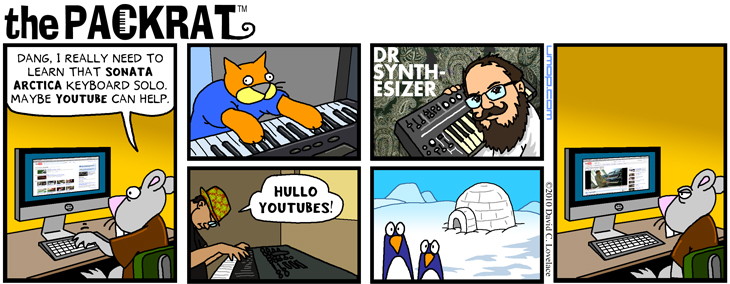
- Everyone in The Packrat except for the YouTube "celebrities" in the November 2010 strip◊.
- Paprika 's primary casts consist of nekomimis, hybrids, and a talking cat. Everyone else is just a generic guy and gal.
- Pinch is a food-themed Cyberpunk Dystopia with funny animal characters.
- Precocious features a large cast of "superintelligent" children that happen to be made up of anthropomorphic canines and felines.
- Outside the occasional human, the entire world of Rascals is populared with anthropomorphic animals with a focus on cats and rabbits.
- In Realm of Owls the owl people's appearance follows owl anatomy for the most part, but they have some human-like attributes, such as hands instead of wings. It is also hard to tell genders apart, for the differences are as minimal as with most of the real-life owl species.
- "Funny" may be a bit of a misnomer for Ruby Quest and Nan Quest, but they do feature animals who for all intents and purposes act as humans.
- Bun-Bun and Percy the Wooly Mammoth from Sluggy Freelance are half-way between this and Talking Animals. Percy even had his own psychiatric business.
- Three Jaguars. The jaguars are also personifications of the artist's impulses.
- Tina of the South 's world is populated with anthropomorphic animals.
- Tiny Kitten Teeth- There are animals that actually exist as animals, alongside funny animals, usually no distinction between species aside from stature. Don't try to make logic of it.
- In Urban Underbrush, the two rabbits dress in clothing and run an explosive business. The rest of the animals are Talking Animals.
- VG Cats: Leo and Aeris are a pair of anthropomorphic cats. Their families are also anthropomorphic cats.
- When The Whiteboard started, only the main cast were funny animals, while almost all of the rest of the cast were no-neck bubbleheaded humans with no distinctive facial features. The artist later experimented with more realistic humans, but then around 2012 went with the entire cast being funny animals, converting fan favorites Larry and Daryl from bubbleheads to squirrels without any commentary on the change In-Universe.
- In Yokoka's Quest, Yfa's siblings are nomadic animals who can talk, wear some clothes or accessories, stay in a furnished tent, own and presumably read books, make medicines, and so on. Yfa's family are later encountered living in an inn that the parents own and run.
- In The Impossible Man, Dom Coqui is a four foot tall talking frog.
- In Kid Time Storytime, the teddy bear brothers Pink Bear, Red Bear, and Green Bear, and their grandmother Abuela Bear, are depicted as talking and bipedal.
- A third of the population of Metamor Keep is like this because of an unbreakable curse, though there have been other reasons such as other forms of magic and being bitten a were critter for why they show up. The other two curses were being made several years younger and unable to age and becoming the opposite sex though it's the funny animal curse that's the most common amongst the Keepers due to a mix of the writers' preference and because Most of the writers are Adult Cisgendered Males
- In the Paradise setting, humans are randomly, permanently transformed into Funny Animals (and occasionally gender-changed) by causes unknown. A Weirdness Censor renders these changes Invisible to Normals, who continue to see the Changed as their original human selves (and genders), leading to a Masquerade on the part of the Changed in order to keep from being committed to mental institutions or worse. Eventually the Weirdness Censor comes down, leading to The Unmasqued World.
- CollegeHumor: Deconstructed and Played for Laughs with "Narnia Dogs Can't Stand", where the titular dogs not only try to stand but do other human things even though it's really unnecessary. When the children aren't looking they go right back to doing things like sniffing each other's butts or licking themselves.
- Plonqmas: Applies to Plonq and all the other characters except for Santa Claus, who is the only human in these stories. They wear clothes, walk upright, consume human food, have human jobs, and generally behave like humans.
- Jamie Barker has made a good few funny animal characters. Examples include characters from her games Moon Pup 2069, Rebel Kitsune and Kid Canary and the Midnight Tower, as well as half the cast of her webcomic Chillzoo.
