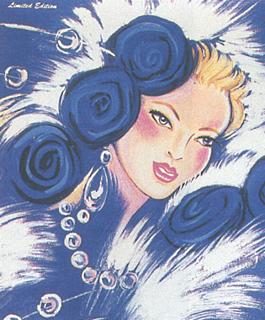
Her clothes and figure look so neat
Her dazzling outfit rings a bell
At parties she will cast a spell
A purse and hats and gloves galore
And all the gadgets gals adore!"

A popular doll line, manufactured by Mattel, that has been around since 1959. Partly a revolution in doll design, because until then most fashion dolls were made to look like little girls. Barbie was made to look like a young woman. When she was first created, her figure was more akin to that of a normal young woman, but later adjustments changed her dimensions in different ways so that she would maintain a more natural figure under the thickly hemmed clothes.
The original storyline attached to the dolls was that of Barbara "Barbie" Millicent Roberts, a teenager and the oldest of several sisters, and her career as a model. Her surname and original age are rarely brought up now, and she generally plays adult characters, being showcased in various careers.
Barbie is also the subject of controversy, due to her figure being stylized and therefore impossible in Real Life, and thereby supposedly giving girls an "unrealistic" role model, though her figure was slightly modified in the late 1990s in response to these complaints. Mattel is careful to make sure Barbie's image remains "wholesome" and getting dolls into roles that were once seen as unsuitable for women. Mattel featured a NASA Astronaut Barbie in 1965, just two years after Valentina Tereshkova (from the Soviet Union) became the first woman to go into space. She became a CEO starting in 1985, and Mattel has been releasing "Barbie for President" dolls since 1992.
Barbie has become a stock parody over the years; The Simpsons has Malibu Stacy (Lisa's frustration with a talking model that had the personality of The Ditz was the focus of a whole episode, inspired by a real controversy over a talking Barbie which could say, "Math class is tough!"), the Gwendy dolls from Small Soldiers are a blatant Expy, complete with P.O.T.U.S. and Astronaut figures, and Rugrats had Angelica's favorite toy, the Cynthia doll. Then she's finally parodied herself in Pixar's Toy Story 2 and Toy Story 3.
Since 2001, Barbie has also been featured in a long-running series of animated movies that aired on Nickelodeon and were released through home video.note The earlier movies were mainly based on Fairy Tales and famous ballets, but also included original stories like the Fairytopia series. The movies tend to be accused of being saccharine, especially the newer ones, but have surprisingly strong, positive portrayals of women: i.e., the girls help each other without second intention and don't always bond only over guys. Indeed, these films (and related media) have drawn a large cult following over the years, including a large LGBT Fanbase and various memes (most famously Preminger, the Big Bad of the movie with arguably the largest cult fanbase, Barbie as the Princess and the Pauper).
Barbie got her own webseries called Barbie: Life in the Dreamhouse in 2012, which features her and her family and friends in a Reality Show Sitcom with a wide demographic appeal. She later received a more down-to-earth fictional vlog series called Barbie Vlog.
A live-action Barbie movie was stuck in development for years; after the project landed at Warner Bros., Margot Robbie was officially cast as Barbie in January 2019, with Greta Gerwig as director and co-writer with Noah Baumbach. The cast also includes Ryan Gosling as Ken, Emma Mackey, Will Ferrell, Simu Liu, America Ferrera, Kate McKinnon, Michael Cera and Alexandra Shipp. The film was released in July 2023.
Currently the Barbie line has two main categories:
The Playline:
- The dolls who are usually seen in stores, this line has a few sub-categories:
The Style Girls
- Successors to the original Fashionistas line, taking over as the most poseable dolls in the playline. This line features a rotating cast of Barbie and her friends (Teresa and Raquelle being the most common, with Midge, Nikki, Summer and Grace from the now-discontinued So In Style line making occasional appearances).
The Fashionistas
- Became the basic line after the 2014 rebrand of the Barbie playline to counter declining sales. Features a bevy of characters at any given time (The current 2015 line features all of Barbie's named friends, both boys and two unnamed ones; a dark-skinned Christy-esque girl and a biracial girl with a massive afro).
The Collector line:
- Barbie has a huge Periphery Demographic who are in it for the fashion and wit, so Mattel created this half of the Barbie line specifically for them. The dolls are usually not sold in stores (unless it's a store exclusive) but on the Barbie collector Web site. Sub-categories include:
The Dolls of the World line:
- This line is well, dolls themed around different places in the world, the most recent dolls include the Samurai Ken and Kimono-clad Barbie.
The Look line:
- Replaced the Basics line of dolls, reducing the number of dolls in the line by a significant amount (from about 20 per release to four).
The Inspiring Women line:
- Another case of Exactly What It Says on the Tin. Focused on dolls depicting significant figures in women's history, namely Ella Fitzgerald, Billie Jean King, Florence Nightingale, Rosa Parks, and Sally Ride.
The Role Models line:
- A follow-up to the Inspiring Women line, focusing more on sportswomen, though non-sports figures weren't left out. A very incomplete list of subjects includes aviation pioneer Amelia Earhart, conservationist Bindi Irwin, artist Frida Kahlo, football/soccer stars Amandine Henry and Alex Morgan, late NASA mathematician Katherine Johnson, gymnast Gabby Douglas, and tennis star Naomi Osaka.
There have been a number of animated productions starring Barbie. The main index for the majority of films can be found here.
TV series, specials and webseries featuring Barbie include the following:
- Barbie and the Rockers: Out of This World (1987-88 special/intended pilot)
- Barbie and the Sensations: Rockin' Back to Earth (immediate sequel)
- Barbie: Life in the Dreamhouse
- Barbie: Life in the Dreamhouse, the TV specials
- Barbie Dreamtopia
- Barbie Vlog
- Barbie Dreamhouse Adventures (Barbie's first-ever regular TV series, running from 2018-20 as a Netflix-exclusive series in the US and on YTV in Canada; part of a unified continuity with the last three years of Barbie Vlog and several of the movies and specials)
- Barbie: It Takes Two (2022-, also set in the same continuity)
Other miscellaneous Barbie-related media includes the following:
- Barbie (the 2023 live-action film).
- Barbie Sings! (1961 tie-in album)
- Barbie Live (a series of live plays based on movies exclusively in the Philippines, except for Barbie Live! In Fairytopia)note
- My Scene (a quasi-spinoff line that featured Barbie as a main character; two direct-to-video specials were produced as well as a full-length DTV film)
- Barbie (1991)
- Barbie Super Model
- Secret Agent Barbie
- Magic Fairy Tales Barbie As Rapunzel
There have been various book series starring Barbie, such as:
- Barbie and Friends Book Club
- Dear Barbie
- Starring Barbie
Barbie provides examples of:
- Adaptation Dye-Job: Raquelle, who debuted as a strawberry blonde girl, is a darker haired brunette in every other appearance.
- Animated Actor: Barbie: A Fashion Fairytale features the actress Barbie.
- Action Girl: In Barbie and the Three Musketeers, and Toy Story 3.
- Art Evolution: The most noticeable change of the years was the change from the original "cat-eyed" Barbie to the modern open-eyed variant in the 1970s.
- Artist and the Band: The "Barbie and the Rockers" line, launched in The '80s.
- Artistic Licence – Anatomy: Generally, the proportions of Barbie and her friends are pretty stylised. This is because even the smallest seams will look bulky on a doll of her size if accurate, and the body shape is intended to allow the clothing to look more natural.
- Background Halo: The cape worn by Barbie as "Fantasy Goddess of the Arctic" has what appears to be a hood, but acts more like this.
- Barbie Doll Anatomy: The Trope Namer, as the dolls are infamous for it, especially poor Ken. More recent iterations have modeled patterns over their featureless groins to resemble underwear.
- Beware the Nice Ones: A common aspect in the movies. Do not threaten Barbie's friends if you know what's good for you.
- It is not, however, true that Barbie was the first child's doll made as a young woman or the "first doll with breasts". Dolls very much like Barbie, often made to resemble film stars, date back almost 100 years. They were apparently put out by dress pattern manufacturers as models for little kids learning to sew. You can just barely see one in the dime store scene at the beginning of the 1945 A Tree Grows in Brooklyn film version.
- Breast Expansion: Growing Up Skipper simulates growing breasts as part of the doll "getting older".
- Candy Striper: In between her many, many careers, Barbie seems to have time to volunteer at the hospital as a Candy Striper. Several outfit sets have been released, and even a book detailing her adventures was published:
- In Barbies Candy Striped Summer, the eponymous Barbie volunteers at a hospital, finds romance, and learns the value of community service.
- In 1964, a Candy Striper Barbie outfit was released (800 series, #889). The ensemble featured a red-and-white striped jumperskirt over a white blouse, with sensible white sneakers, a nurse's cap, and a tray filled with items for Barbie's patients (orange juice, a hot water bottle, a wash cloth, etc.).
- Mattel also released a 1973 Candy Striper set (#7709) for Francie Fairchild, a doll marketed as Barbie's cousin. The outfit was nearly identical to the Candy Striper set released for Barbie a few years earlier, with a few differences in the included accessories.
- In 2009, a "Barbie Fashion Doll Career Clothes" Nurse outfit and accessory set was released (model #R4259). The set featured a white dress with pink-and-white candy-striped fabric accents on the pockets, pipping, & hem, and an illusion neckline/ under-shirt of the same material.
- Canon Discontinuity: When Mattel resumed production of Midge dolls in 2013, they seemed to disregard her getting married and having two children, to make her Younger and Hipper.
- Chuck Cunningham Syndrome:
- Stacie and Krissy. Stacie was brought back and incorporated into the 'Barbie & Her Sisters' lines/media. Stacie's twin brother Todd however...
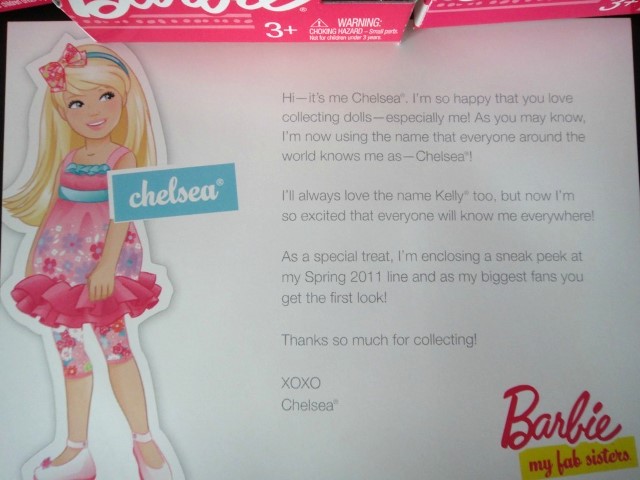
- For those who weren't aware that Mattel clarified Kelly and Chelsea were the same character,◊ it seemed like Kelly totally disappeared and Chelsea took her place.
- Ken's younger brother Tommy also vanished.
- Barbie at one point had a younger sister named Tutti, who was the original twin of Todd. She was effectively replaced with Stacie.
- Skipper's friends (Courtney, Nikki) and her boyfriends (Kevin, Scott) were phased out over time, along with all of Kelly's friends once she was replaced with Chelsea.
- Cloudcuckoolander: Teresa's movie roles tend to be this since Diamond Castle.
- Costume Porn: All of the specialty dresses are pretty detailed.
- Credits Gag:
- With the exception of The Nutcracker, The Barbie Diaries and The Great Puppy Adventure, the credits to each movie end with a moral by Barbie, referring to the overall theme of the movie.
- However, starting with Spy Squad, the same quote (""This is our story, what's yours?") is used at the end of each movie.
- The Dandy: Ken in Toy Story 3.
- Depending on the Artist: Is Ken brown haired, blond haired, or black haired and in what shade? The animated movies switched his hair color between brown and blond (more often brown in the earlier films), but later media (including Barbie: Life in the Dreamhouse and Barbie Dreamhouse Adventures) portray him as blond.
- Ermine Cape Effect: When it involves the royalty-related tropes mentioned here.
- Everyone Loves Blondes: Barbie is a blonde, as are two of her sisters (Stacie and Chelsea), and they are pretty well liked. (Skipper used to have varying hair colors, but since 2010, she's been a brunette.)
- Everything's Better with Sparkles: Glitter is a fairly common part of the Barbie toys. Sparkles are also often present in the films when something magical happens.
- Everything's Sparkly with Jewelry: The dolls have plenty of jewelry, as well as some jewelry themed dolls.
- Fairytale Wedding Dress: Some of the dolls are Barbie in a wedding dress.
- The Fashionista: Barbie herself and Nikki are the most obvious examples.
- Five-Token Band: Teresa's the Hispanic one, Raquelle's the Asian (sometimes) one, Nikki took over Christie's role as the black one, Summer's the Australian (in the dolls only) one, Midge is the Irish one, and Barbie's the white one, though you can get her in any ethnicity. Currently additional characters include Daisy, who's the plus-sized Greek-American one, and Renée who is the Japanese one. This turned out to be a problem when Mattel released Oreo Barbie with the African-American option. Oops.
- Fleeting Demographic Rule:
- Barbie as the Princess and the Popstar comes seven years after the first Princess and Pauper movie.
- Barbie and the Pink Shoes has a part in which Barbie visit the world of Swan Lake, a story that her franchise adapted 10 years earlier.
- The toys take advantage of this. Barbie has had so many friends and even family members disappear or be replaced over the decades. This is because most kids outgrow the toys by age 12, leaving room for new kids who don't know who "Kelly" or "Midge" are. The series also regularly reuses doll ideas due to this as well.
- Fluffy Fashion Feathers: Many of her outfits have feather trim. The "Angel Princess" doll wears a dress with shoulder straps of white feathers, as does the life-sized version for girls to wear.
- Framing Device: Several movies, especially her earlier ones, had Barbie telling the story to Kelly, and then it would cut to the actual story, and then Barbie would take up the narration again as the story ended.
- Gem-Encrusted: Many of her dresses have jewels sewn into them.
- Genius Ditz: Barbie is portrayed as a borderline Dumb Blonde in Toy Story 3 (albeit with redeeming qualities). And then wham, democratic philosophy out of nowhere:"Authority should derive from the consent of the governed, not from threat of force!"
- Giant Poofy Sleeves: A few of her fancy dresses have large sleeves.
- Going Commando: After 60 years on the market, Mattel has never made a Barbie doll with panties.
- Gold Makes Everything Shiny: Many outfits, including her 1994 holiday dress (a gold lamé dress with fur trim).
- Graceful Ladies Like Purple: Plenty of her outfits are purple.
- Green Aesop: Barbie Presents Thumbelina.
- Happily Married:
- Subverted with Barbie. There have been numerous wedding dolls however Barbie has canonically never tied the knot with Ken. They're always just boyfriend and girlfriend (and for a while in the 2000s, they were just friends).
- Midge married her long-time boyfriend Alan in the 1990s. They stayed together into the 2000s and even had children together, however when Midge reappeared in the 2010s Alan was Put on the Bus and their relationship retconned.
- Happy Holidays Dress: The "Happy Holidays" line is the Trope Namer, and the dresses in that line, and following holiday lines, are some of the fanciest of the franchise (as well as being festive).
- Hair of Gold, Heart of Gold: Barbie and her little sisters, usually. In the animated films, they are portrayed this way. Except Skipper, who is brunette in the films. She's still got a heart of gold though.
- Held Gaze: This happens several times in her movies, notably Barbie as the Princess and the Pauper after Dominik and Erika's love duet.
- Hidden Depths: See Genius Ditz above. Other Barbie movies and shows can reveal things about Barbie that aren't apparent on the surface.
- High-Class Gloves: Her formal outfits often include formal gloves, such as the white gloves in the "Enchanted Evening" doll.
- Hormone-Addled Teenager: Despite the fact that Barbie is technically an adult. One of her "talking" lines drew a lot of criticism for having phrases like "Let's go shopping!", "Math is hard!" and "Will we ever have enough clothes?" A group called Barbie Liberation decided to do something about that, swapping out Barbie's voice boxes with those from
 G.I. Joe, so Barbie instead said things like "Vengeance is mine!"
 - Hotter and Sexier: This occasionally occurs, such as with the "My Scene" spinoff dolls.
- It's Fake Fur, It's Fine: Officially, she wears fake fur. Of course, the fur actually is fake, but in the early years, that was likely for economic reasons.
- "I Want" Song: Several of her movies feature this, often as duets between the leads. An example is "I Need to Know" from Barbie as the Island Princess, amongst the more usual "I Want" Songs like "Free" from her first movie musical, Barbie as the Princess and the Pauper.
- Impractically Fancy Outfit: Even her more practical outfits can still be impractically fancy.
- Impossible Hourglass Figure: Tweaked around 2000 to be at least somewhat realistic, and this frame has been moved even further away with the new body types introduced in 2016.
- Invisible Parents: Barbie has many siblings (including toddlers) but her parents themselves rarely ever pop up. They do appear in some books and extended media, but never in the toys themselves.
- Music Stories: “The Diamond Castle” And “Rock N Royals” are set apart from other Barbie musicals, since all the singing occurred in-universe and deal with the concept of music and singing.
- New Job as the Plot Demands: The plot, or the merch, or the plot which exists to advertise the merch. Barbie has been so many things that it's a Running Gag in Barbie: Life in the Dreamhouse for Skipper to ask "Weren't you a [profession relevant to today's plot]?"
- Nice Girl: Barbie's most consistent personality trait in media (especially the movies) is her kind and friendly nature to everyone.
- Not Allowed to Grow Up: Barbie has a confusing history of this and Sudden Name Changes. Barbie was explicitly a teenager when introduced however eventually she fell into the range of "usually 19-30 except when needed". Her younger sisters however are perpetually stuck as children. Barbie can be president of America (you need to be at least 35) but Skipper and Chelsea will never hit 20. Skipper was originally a preteen who hit puberty in the 70s, however since then she's barely aged and likely never will (as Barbie is the adult doll in the family). Barbie has three sisters: Skipper, Stacie, and Chelsea... Except she also had a toddler sister named "Kelly" (who's officially the same character as Chelsea), an infant sister named "Krissy", a brother named "Todd", and another kid sister named "Tutti". Fans usually assume Tutti was just renamed "Stacie", but unlike Kelly (who had an official Mattel pamphlet◊ clarifying that Chelsea was the same character), nothing canon has been stated about Tutti.
- Odd Name Out: Barbie and her sisters' names all rhyme, except for one: Barbie, Stacie, Chelsea/Kelly, and Skipper.
- Official Cosplay Gear: So young girls can try on the outfits.
- Older Than Steam: Adult female dolls for children go back to the 14th century, and the Jumeau company turned out thousands of "Parisienne" fashion dolls in the mid-1800s.
- Only One Female Mold:
- Most of Barbie's friends have exactly the same body shape as she does. This was actually a selling point mentioned in the commercial for Midge; she could share all of Barbie's clothes, so you didn't have to worry about getting "Midge" clothes for her.
- Averted with the 2016 Fashionista line, which introduces 3 different body types to go with the standard, Curvy, Tall, and Petite.
- Ken used to be a Rare Male Example, with all of them sharing a the same muscular build, but 2017 introduced body diversity for the males, averting this.
- One-Steve Limit:
- The current line's Grace seems to be different from ‘’So in Style’’ Grace.
- Ryan has the same name as Allen and Midge's oldest son.
- Peacock Girl: In The Island Princess, Ro wears a peacock tail her peacock friend loans her. And a couple of her dolls have had this as an accessory.
- Pimped-Out Cape: A few dolls had some, notably the "Fantasy Goddess of the Arctic" doll.
- Pimped-Out Dress: She's been given loads of elaborate dresses over the years, although the fanciest ones come from the specialty lines.
- Pink Means Feminine: Barbie is all about piiiink. Her logo is pink. Her Dream Car and Dream House are pink. Packaging for most of the dolls and accessories are pink. One of her first outfits, "Enchanted Evening", has a pink evening gown. Her signature color is "Barbie Pink" and can't be used by another company without getting permission from Mattel. Therefor, when other products try to do the Pink Product Ploy, it's usually a very close comparison to Barbie pink (just a hair lighter or darker). It is very much the Gold (Pink) Standard to which other pink products aspire to. Hot Wheels is the contrasting "blue for boys" product line.
- Pragmatic Adaptation: Barbie in the Nutcracker and stories like Barbie as the Princess and the Pauper could count as this.
- Pretty in Mink:
- Loads of her outfits (officially being fake is the only nod to that trope, so the rest count as this) have fur, either as trim or fur garments. This started as early as the white fur wraps she wears in the "Enchanted Evening" and "Gay Parisienne" dolls, and the white fur jacket she wears for the "Icebreaker" doll.
- For that matter, it seems 90% of the time when one of her outfits has fur, it's white (which goes nicely with the bright colors motif of the franchise).
- Princess Protagonist: Barbie is this in about half of her movies.
- Princesses Prefer Pink: Some of the movies have princesses wearing pink clothes, especially if Barbie is playing a princess.
- Retraux:
- Mattel revived Barbie's original cursive logo in 2000, and again in 2009.
- Mattel has a history of remaking old dolls (usually as collector's items).
- The Rival: The recent movies (from The Barbie Diaries onwards) have Raquelle in this role.
- Rule of Glamorous: Why are her outfits, houses, and many other things, more pretty than practical? This trope.
- Sexy Santa Dress: Even she has worn some of those, like the "Festive Seasons" outfit, which is a green mini dress with snowflake designs and a white fur neckline.
- Sliding Scale of Shiny Versus Gritty: Guess which end Barbie is on.
- Stylish Protection Gear: A few, like her astronaut suit, which is pink and gold.
- Tamer and Chaster: The original Barbie doll was inspired by a German doll toy line (later taken over by Mattel and shut down) called "Bild (Picture) Lilli". Lilli was originally merchandising for the central character of a campy Newspaper Comic strip that included a lot of cheesecake and suggestive humour, and the dolls were marketed initially to adult men as kind of mascots, the way American and allied pilots often painted pin-up girls on their planes.
- Technicolor Death: Toward the end of Barbie & The Diamond Castle, Vain Sorceress Lydia tries to cast a spell on the protagonists, but it backfires and hits her instead, surrounding her with swirling green sparkles until she disappears in a flash of light. Though she turns out to be Not Quite Dead...
- Teen Genius: She has multiple degrees and is approximately 25. She's been an astronaut and the President of the United States. She's used those degrees to make fat stacks and settle down in a mansion by 30.
- Thememobile: Her Dream Car.
- Thou Shalt Not Kill: A Double Subversion in Magic of Pegasus, where Barbie's character Annika actually tried to kill the villain. Then it turned out that her newfound magical artifact couldn't be used to harm anyone.
- Totally Radical: A consistent theme in the franchise's advertising, as the creators always attempt to link Barbie to popular culture.
- Toyless Toyline Character: The villains from the movies rarely have toys made of them.
- True Blue Femininity: Blue is also a common color for her outfits. The very first Winter princess doll wore a blue dress.
- Transatlantic Equivalent: Sindy, which first emerged in 1963.
- Unlimited Wardrobe: One of the most of any fictional character ever.
- Vague Age: Barbie is constantly changing between being from someone in her early to late-20s to a teenager (sometimes even a high schooler). Some of her careers, such as being a doctor or dentist, imply she's in her later 20s and she has been friends with married parents, however she is also often explicitly a teenager. And considering she (and all her friends) run for President every four years, it seems that she's at least 35, too.
- Virtual Paper Doll: Some of the games include this at least as an option.
- Winter Royal Lady: Her line of "Winter Princess◊" dolls, among others.
- Workaholic: She's had loads of careers that her dolls have covered.