
Examples of Misaimed Fandom in Comic Books.
- Satirical depictions of politicians are almost inevitably popular with their targets (with the notable exception of Steve Bell's take on former British Prime Minister
 John Major.) Often, they will contact the cartoonist, or the paper it was published in, to ask for a copy or the original, probably thinking it's better if people are making fun of them than just ignoring them. Ralph Steadman declared he would only depict politician's arses to prevent this.
- Super-Mac by Victor Weisz, a parody of Harold Macmillan, was especially so. Maybe he shouldn't have compared him to a superhero.
- Controversial British politician Enoch Powell, well known for his anti-immigrational "Rivers Of Blood" speech, owned a lot of cartoons starring himself and had them framed at the wall. But this was mostly done by his wife. In the BBC documentary "Enoch Powell: Odd Man Out" Powell even expressed feeling embarrassed by some of these cartoons, but his wife very staunchly defended him on the matter. Many of these drawings were critical of his ideas, but the couple didn't seem to grasp this.
- Superdupont by Jacques Lob and Gotlib (and also Alexis and Jean Solé) is a French comic parodying the superhero genre and a satire of French jingoism. The title character is an over-the-top stereotypical French Jerk with Superman-like powers (which he loses when he hears the French anthem played in reverse) and battles "Anti-France", a shadowy group of people who all speak with a mix of all foreign accents at once and target French core values — such as replacing French wine with Italian wine and mass-producing berets made in China. The French extreme right-wing nationalist party Le Front National took Superdupont as their icon, which caused the authors of the comic to put it on hiatus for a few years. French far-right politician Jean-Marie LePen's approval was the main reason for the creators to do this.
- Super-Mac
- This happens with a lot of "satire" characters where the author "exaggerates" them just by taking all the elements that people seem to like in other shows and lumping them together without actually exaggerating anything. We've seen this in reverse with films like Sucker Punch, intended to "parody" exploitation literature but garnering reactions as if they were genuine because, well, the creators forgot the part where they make the thing they're parodying more ridiculous or extreme than the source material. And even if they do make it more ridiculous or extreme, then, considering they operate in a genre based on impressive and bizarre events, all they really did was top the original.
Creator Examples:
- This happened to R. Crumb a lot — most notably with his iconic "Keep On Truckin'" character/pose, which was adopted by many rock-loving hippies as their "mascot," as it were. The truth was, Crumb was making fun of rock music lovers, who in his eyes were doing "The Dance of Cultural Death" (as he put it). He even explained it in a comic in The R. Crumb Coffee Table Art Book and told his (probably now disillusioned) hippie fans: "KEEP ON TRUCKIN', SCHMUCKS!". (This was followed by Mr. Natural remarking: "Don't forget, Bob, that it was the compassion, the loving forgiveness, that they found so appealing in your cartoons, that made you so popular, that got you laid, that earned you a living. Keep it in mind!")
- Crumb has also drawn quite some controversial comics in his life. His Angelfood McSpade comics about a stereotypical African tribeswoman and the highly controversial two-parter comic strip "When the Goddamn Niggers Take Over America" and "When the Goddamn Jews take over America" have understandably been accused of racism, the latter two predictably being used by Neo-Nazis and far-right supporters. Crumb himself was absolutely horrified by this, because all his comics are meant as Satire. He is also a huge admirer of Jazz and Blues and drew many comic strips and album covers promoting his love for these Afro-American musical genres. Crumb also has many black and Jewish friends, including Art Spiegelman, and is married to a Jewish woman, Aline Kominsky-Crumb.
- Jhonen Vasquez repeatedly takes pages out of his Johnny the Homicidal Maniac and Squee series to Take That! to various people he feels are enjoying his comic for the wrong reasons. One extended story in Johnny the Homicidal Maniac is about a serial-killing fanboy of Johnny's. Since Johnny is a character who goes around murdering the most annoying people in the typical Vasquez Crapsack World, it's not hard to see why some people might get the wrong idea.
- Goths seem to treat Jhonen as their king, despite him constantly insulting them and his own hatred of the association. With that said, he doesn't necessarily hate Goths, but he doesn't care for catering specifically to them.
- Vasquez has also mentioned on more than one occasion how awkward it was to receive fan mail from young children that enjoyed Invader Zim and subsequently started reading his decidedly not child-friendly JtHM comics.
Comic Examples:
- 100 Bullets: Brian Azzarello was surprised and disturbed to find that the violent, amoral homicidal rapist and torturer Lono had a devoted fan following.
- The Addams Family: The comic strip is a famous example - the strip features the Ambiguously Human clan as a comedic inversion of what was considered a healthy, traditional family. But, since the Addams were portrayed as so friendly and loving, they quickly gathered a lot of fans - to the point that, in its many adaptations, their neighbors went from being clueless, but clearly well-meaning, to understandably bitter, to full-on villainous Stepford Smilers in the 2019 adaptation. It's not hard to see why - Gomez and Morticia are openly passionate and romantic, in a way that looked creepy back then, but heartwarming now; they have friends and family all around the world, as opposed to traditionally insular suburbanites, and they consider their children creative and clever, instead of trying to stomp them down. The daughter Wednesday, in particular, became popular among the goth subculture, going from Creepy Child to anti-authoritarian Little Miss Badass
- Asterix: Quite a few European far-right politicians or supporters have used this series to promote a romanticized idea of ancient Europe in a time when supposedly no immigrants crowded the country. It doesn't occur to them that Asterix is more historical fiction than anything else and that Asterix and his friends always get along fine with other nationalities. Even the Romans aren't always depicted as villains.
- Batman: The Joker - mass-murderer, torturer, Monster Clown, and has a MASSIVE fanbase.
- This goes for many popular monstrous characters: there is a difference between enjoying the character's appearance in the story (which, one must imagine, the creator wants you to do unless stated otherwise), and the kinds of interactions they bring, and seeing their crimes and psychopathy as something to be cheered on and supported or thinking the villain might be a cool dude to know, which is the main idea of this trope.
- This actually gives rise to an in-universe example. In Batman Child Of Dreams the Batman must go up against a series of imposters of his Rogues Gallery, created by a Mad Scientist out of self-described "pathetic losers." Where does he find these people? Answer: the INTERNET. It seems that Batman never noticed that the years had given rise to Joker Appreciation Societies and Riddler Fanclubs...
- A better example from the pages of Batman would be Harley Quinn. Although she is the girlfriend and accomplice of the Joker, and is often shown to be almost as Axe-Crazy as he is, fans often seem to forgive her actions, hold her up as something of a heroic or anti-heroic figure, and she is often a Karma Houdini in the actual stories.
- Her relationship with the Joker is also very prone to this. The tragedy of her love for him is that she thinks he's a decent person on the inside and she can redeem him by making him love her back, but that's simply not true. He's a coldhearted psychopath and he will always be one, and he views her as nothing more than a tool to manipulate. Basically, Draco in Leather Pants as reality.note However, Harley also happens to be living out the fantasy of an unfortunately large subset of female comic readers, who tend to take her side.
- Batman in general isn't necessarily immune to this. Mark Waid's JLA: Tower of Babel was designed to criticize the character's prep time paranoia tendencies by showing that he'd secretly been thinking up ways to kill or incapacitate his Justice League allies for years, only to have them fall into the wrong hands, thus placing the entire world in jeopardy. This was intended to show that such a man would be the worst kind of team member who would be impossible to trust and work with since his plans involved torturing them. But unfortunately, all some fans came away with was "BATMAN'S THE SMARTEST, MOST BADASS HERO EVER!!!" It was intended to show that Batman had at least the right idea: every superhero has at least one mind-controlling villain, at least one villain with the same power(s) as the hero, and at least one instance of losing their way and going at least a little too dark. Knowing what you'd do if you had to fight one of your teammates is defensible, but actually writing the manual and failing to keep it out of the bad guys' hands is another story, as well as personally insinuating yourself with them to carefully finagle their weaknesses is also a pretty low thing to do.
- Bruce Wayne’s not the only Batman to suffer from this. Jean Paul Valley practically owes his existence to this trope. During the early 90s, there were more than a few Batman fans who thought he WASN’T hard enough on criminals, and essentially wanted him to be more like The Punisher or Judge Dredd. This was one of the reasons for the Knightfall saga: to show what someone like The Punisher would be like if he became Batman. Jean Paul Valley was a take that to the rise of 90s era anti heroes, and sure enough, becoming Batman went to his head and he took it too far to the point where even criminals were calling him insane. He was popular among fans for several reasons: At first, both Bruce Wayne and Tim Drake endorsed him as Batman while Bruce recovered, he was brutally violent with criminals, he was Batman, he avenged Bruce at the hands of Bane, and (for a while) actually did a good job as Batman. His popularity with fans lead to him being kept on as a character.
- Chick Tracts: Readers are supposed to agree with everything the protagonists say, but there is a significant "fandom" that finds the over-the-top nature of these tracts unintentionally hilarious. In addition, on first reading them, many people assume that the tracts are intended as a parody of The Fundamentalist. They are totally serious. Even so, some people still insist that the tracts are all written as a massive Stealth Parody. While Jack Chick was notoriously hard to get info on, he was sincere about what he was trying to say, by all accounts. (Besides, considering that Chick died in October 2016, if the tracts are a parody, it's one that Chick kept going to his dying breath, which is extremely unlikely.)
- Of specific note is Dark Dungeons, a Chick Tract that portrayed fans of Dungeons & Dragons as a Satanic cult that wields real witchcraft to conquer and destroy the world. Between portraying roleplaying as hilariously and ludicrously over-the-top evil act and portraying the roleplayers as cool muscular leather-jacket wearing bad-asses, its entire fanbase is composed of the very people it was trying to shame. So much so that a crowd-funded live-action movie was made that mocks it by being a faithful and true shot-for-shot adaptation.
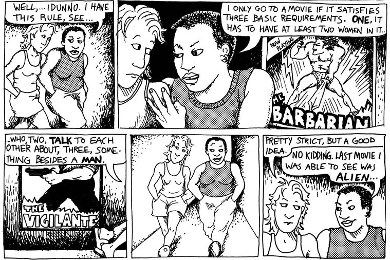
- Dykes to Watch Out For: The comic strip came up with◊ The Bechdel Test as a deliberately easy-to-pass test (passing merely required that a work have more than one female character, that the female characters have a conversation, and that this conversation not revolve around men) in order to demonstrate just how little effort movie directors and screenwriters put into developing female characters, but has since been co-opted by others as an all-purpose feminist-credentials test.Dane Cook: Always remember that the lyric 'Oh my God, Becky... look at her butt!' from Sir Mix-a-Lot's 'I like Big Butts' passes the Bechdel Test, folks. Always remember that.
- Furthermore, the original comic (which was described by the author as "a little lesbian joke") was more about compulsory heterosexuality in media - obviously, it's next to impossible to find a movie that depicts a romantic relationship between women if there's barely any movies that depict them in platonic relationships. That most people don't know this really speaks about the degree of misaiming that's occurred.
- Icon: The series was written by the late great Dwayne McDuffie and had a massive big name fan in the form of Supreme Court Justice Clarence Thomas. The problem: Dwayne McDuffie did not like Clarence Thomas, calling him Scalia's Lapdog among other insults. It was to a point the fandom of Justice Thomas gave McDuffie writers block with the question of if he was just giving Thomas and the black neoconservative movement quotes (as Icon was written as a conservative hero to contrast with a younger, liberal partner in Rocket).
- Judge Dredd:
- You'd be surprised how many people find the idea of the Judge system appealing and miss the strip's satire altogether. Judges are Judge, Jury, and Executioner, and the system is shown to be laughably open to corruption. Dredd himself is incorruptible, but Judges taking bribes or gaming the system is commonplace. Not exactly the sort of justice system that you'd want in the real world.
- Dredd himself will quickly let everyone know that "I am the law", but he's not Lawful Stupid. When Dredd enforces the law on everyone, it means everyone. Dredd might arrest someone who stole a loaf of bread to feed their starving family, because that's theft. But he'll also go after other corrupt Judges, no matter how high up the ladder they are. Some of the fandom for Dredd has taken this to mean All Crimes Are Equal (and Dredd has been known to fall into this Depending on the Writer), and that any lawbreaker should be arrested for any reason if they break the law. Not only is that not what the comic is trying to say, but it's trying to say that such rigid enforcement of the law, no matter how minor the infraction, leads to a police state and fascism.
- Kingdom Come: Some people read it just because they like the antiheroes. This is missing the fact that Kingdom Come was written as a criticism of that kind of character. Others miss the idea that a big part of the story is that Superman and the new League trying to bring about world peace works horribly and ends up getting everyone nuked, and wholeheartedly support/condemn them as Silver Age nostalgia.
- Some of that has to do with the concepts that Waid and Ross came up with being popular enough with writers that they were made canon. A few characters like Irey West, Jakeem Thunder and the female Judomaster ended up crossing over into the DCU, while Cyborg temporarily got his golden skin, Roy Harper became Red Arrow, and Wonder Woman got her sword, shield, and willingness to use lethal force (for a time she even was paired with Superman). Seeing as how those characters were generally not shown to be outright asses though, it's somewhat understandable.
- It got to the point that Magog, who existed exclusively as a self-righteous Take That! aimed at 90's antiheroes (Cable in particular), was given his own book that played his over-the-top attempts at badassery straight. The title itself was cancelled pretty quickly and Magog ended up being killed off shortly after it ended.
- Magog even got Misaimed Fandom from his creators. Waid and Ross tried to design his costume to include everything they hated about 1990s costumes, but ended up kinda liking it. The character also gets a clear shot at redemption.
- This attitude began even during the series' original publication. Both Waid and Ross were astounded that in the reaction of readers to the first issue, just about no fan understood that Superman's return was not a symbol of hope and things getting fixed but that Armageddon was on its way.
- Lobo: Lobo started as a generic mercenary before being retooled by creator Keith Giffen as a parody of eighties "grim and gritty" heroes like Wolverine and The Punisher in a series of mini-series books. Needless to say, Lobo became a big hit with fans who took the satire at face value.
- The Multiversity: The fifth chapter, Thunderworld Adventures, was intended to suggest the folly of the Nostalgia Filter belief that the way to "save comics" is to go back to the Silver Age, with the world depicted being a very subtle Crapsaccharine World with Monochrome Casting, Values Dissonance, a few Jerkass bits, and several abruptly dark moments. The entire plot of the issue is also based on the villain stealing time to unnaturally create the story's events, implying that nostalgia-focused storytelling is something that can't last. However, these subtle moments and undercurrents were completely undercut by the fact that it happened to be the best-regarded Captain Marvel story in decades, and people were more than willing to overlook the occasional disturbing undertone if it meant having a Captain Marvel who's named Captain Marvel, has wacky fun clever adventures, and fights his actual nemesis, rather than being stuck in an Audience-Alienating Era moping and doping while Black Adam hogs the spotlight.
- Nick Knatterton: The German comic was made as this, since author Manfred Schmidt considered comics a primitive art form. The fans took it straight and liked it.
- The Punisher: The Punisher is very popular with members of the American armed forces. This has proven very aggravating for Gerry Conway, who was a conscientious objector during The Vietnam War and intended for the Punisher to be a bad guy.
- Policemen have incorporated him too. Considering in-universe The Punisher does not approve of law enforcers doing this...
- Policemen have incorporated him too
- Scott Pilgrim: A significant amount of fans end up taking sides with either the titular character or Ramona Flowers because they see the opposite half is a heavily flawed, somewhat immature individual as well as a poor lover for a number of exes throughout the series. What they miss out on is that both of them need to sort their issues out, and while this is more overt with Scott Ramona needed to actually address what she did and is doing wrong too. The anime ends up addressing this for the latter, actually putting her in the protagonist seat to truly confront a number of her exes. As a side note, this also extends to Ramona's aesthetic, as (as depicted in the punk song "Scott Pilgrim Ruined An Entire Generation of Women") many girls were drawn to her fit and lifestyle only to make the exact same relationship mistakes as her.
- Spider-Man: Though the series was massively controversial, there were a surprising number of readers of Superior Spider Man who sided with Doctor Octopus and genuinely felt that he was indeed better at being Spider-Man than Peter Parker ever was. This is despite the series' final arc demonstrating in great detail why Ock's pompous, Darker and Edgier methods did not work, and even climaxing with him willingly relinquishing control and admitting that Peter was indeed the superior Spider-Man all along.
- Supergirl: The storyline Red Daughter of Krypton has the titular heroine becoming a Red Lantern after a severe breakdown. Her becoming a Red is in no way treated as a positive change but as a sign that Kara Zor-El had severe psychological issues dragging her down which she needed to overcome. Nonetheless, a number of fans chose to focus on how badass she looked, complained when she left the team, and later demanded a Red Lantern arc in her live-action show.note
- Superman: Lex Luthor: Man of Steel is taken by some as an excellent argument for why Lex Luthor is a hero, or at least believing that it brings up some intriguing Gray-and-Grey Morality and humanistic traits to the character because he honestly thinks that he is a hero and Superman is a villain. Many also agree with Lex's arguments against Superman's Chronic Hero Syndrome, which sees him rescuing Toyman from an angry mob, in this story a pedophile who had just (seemingly) blown up a daycare centre. Except for the fact that it is strongly, strongly implied that Lex himself blew up that centre, and is behind a bunch of other horrible things in the comic, and the real point of the story is that Lex is deluded and insane to boot.
- Teenage Mutant Ninja Turtles: The franchise's rapid transformation into the sort of Merchandise-Driven juggernaut it was originally meant to lampoon had a lot to do with this. The franchise as a whole began in 1984 as a parody of the '90s Anti-Hero by Kevin Eastman and Peter Laird. In fact, the entire premise of the original comic is built around the question of what happened to the radioactive canister which gave Matt Murdock (aka Daredevil) his superpowers. The original comic was at first largely an affectionate riff on Frank Miller’s ninja-tastic reinvention of Daredevil in the 1980s, mixed with just a little of the other most popular thing on the shelves — teenage mutants. The result was the public at large missing the aspects being parodied and making the book a smash hit well beyond what the creators could have ever expected. The original creators and later licensees decided to run with the misaimed version instead of trying to fight it, resulting in a Cash-Cow Franchise. That fandom mostly came from the TV series, which was entirely intended as such, so it's not so much Misaimed Fandom as it is Executive Meddling that took. The franchise has become pretty popular since becoming a franchise too.
- V for Vendetta: V is seen in heroic light as he actively undermines the Fascist government despite the fact that he is still a terrorist who puts innocent lives in danger. The entire premise Alan Moore was going for was to pit two sides of political extremes against each other. This trope is also the reason why Moore wasn't fond of the film version's unambigiously heroic V.
- Watchmen:
- As an '80s superhero deconstruction, Alan Moore heavily based the character Rorschach on Steve Ditko's Objectivist superheroes, specifically The Question and Mr. A. However, Moore had no affinity for their ideology, calling Mr. A "an absolute insane fascist" and Objectivism "laughable," and he wrote Rorschach as his own take on what an Objectivist hero would probably be like: a short, ugly, murderous sociopath. Despite this, readers saw Rorschach's uncompromising persona as endearing, and he became the most popular character of a landmark comic series. Additionally, as pointed out on the Unbuilt Trope page, Rorschach and the Comedian were intended to deconstruct the '90s Anti-Hero, and ended up popularizing it instead. Apparently, the series's beginning with the horrific death of the Comedian and ending with the even more horrific death of Rorschach wasn't enough to make people realize that these were not admirable characters.
- Several readers have idolized Rorschach and Ozymandias for their political beliefs whether it be Rorschach's refusal to compromise his values in the face of Armageddon or Ozymandias's willingness to make hard sacrifices to achieve world peace. Moore's own take seems to be that we're not supposed to like either of these characters; they are anti-heroes or anti-villains at best. Both of them take their respective ethical philosophies to unjustifiable extremes that render them callous to the actual human suffering depicted in the comic. A balanced ethical perspective, Watchmen suggests, needs to consider both the categorical imperative and utilitarianism, and since they're intrinsically contradictory stances, it can't take either of them to extremes.
- Rorschach is also a criticism of right-wing ideology in general. For context, Moore himself identifies as a Marxist but votes for the Labour Party out of pragmatism. Rorschach is an avatar for their blind devotion to "law and order". says things like "Goddamn liberals have gone and let another rapist off. If I had my gun…". He sees the world in black and white the way Moore thinks conservatives do. Notably in 2015, Ted Cruz wrote an article with Rorschach as one of his top five superheroes while he was running for president.
- Watchmen (2019) takes this in-universe. Rorschach's journal was ultimately published by the New Frontersman, a hard-right publication associated with cranks and fanatics. The Frontiersman was also popular with racists, alt-righters and white supremacist groups: a lot of these sympathised with him, leading to the creation of the "Seventh Kavalry" movement in Tulsa. On "Peteypedia", Special Agent Dale Petey speculates on why these people were so driven to the story of Rorschach, and that he served as a symbol of distrust in the government, the need to protect "the safety of their persons and belongings" in the face of a race "far less morally advanced", and as a way to "challenge an orthodoxy that makes them feel marginalized and obsolete" by imposing their own ideology through a costume.The Seventh Kavalry: Soon, all the whores and race-traitors will cry "Save us!" And we will whisper, "No".
- Doomsday Clock also plays with this; Malcom Long's son is fed a deeply skewed image of what Rorschach was actually like... which leads to him having a breakdown when he learns what Rorschach was actually like. Notably, what gets him out of his breakdown is the realization that while Walter Kovacs was a violent lunatic he doesn't have to be and that he can remake it into something better (which leads to him sparing Ozymandias so that he can stand trial for his crimes.)
- Rorschach (2020) is another meta-Reconstruction of Rorschach and the complicated moral legacy he left behind both in-universe and out. The antagonists of the series are a group of radicalized Conspiracy Theorists who — thanks to a muddling of various theories created before and after the squid invasion of '85 — believe some of themselves to be reincarnations of Rorschach, and that the only way to save the world is to assassinate a presidential candidate under his name. Drawing upon the 30+ year gap from his death, the characters end up picking and choosing how they interpret him and his well-meaning, but insane absolutist philosophy, ironically reinforcing both how mentally disturbed they fundamentally are, and how Rorschach's brutal anti-heroism was symptomatic of an ugly detachment from humanity, which — while sadly an inevitability for some — is absolutely not meant to be admired and sought after.
- X-Men: The infamous storyline Death of X was meant to be The Reveal for what infamous atrocity Cyclops committed that led to mutants being more hated than ever and him being viewed as a monster. The reveal that what he did was try to stop the Terrigen Mists that The Inhumans released that were killing mutants while awakening superpowers in Inhumans caused readers to feel that Cyclops was in fact a hero since he was trying to prevent genocide. Instead the event was seen as a Moral Event Horizon by the Inhumans since they murdered Cyclops for his actions or what they thought was Cyclops, simply for altering a Terrigen cloud so it wouldn't kill mutants while still giving Inhumans powers, something that the Inhumans don't even need.
- This happened earlier (albeit to a lesser extent) during the Decimation period and after, when Cyclops was being presented as an increasingly radicalised extremist, determined to do whatever it takes to protect mutant kind. But many saw his actions as completely justified in the face of what they were up against, especially as the worst things he did were against people who utterly deserved it. It also didn't help that much of the "horribly extremist" things he did were Poke the Poodle level at best, if not behaviours that the X-Men had previously employed without being seen as a problem. Essentially, while Cyclops was being more radical than Wolverine and Storm, to many readers, they agreed with his more radical position, especially as "playing nice" hadn't helped mutants much in the last few decades. It probably didn't help that Cyclops also Took a Level in Badass, became Crazy-Prepared, and was depicted as a Magnificent Bastard.
In-Universe Examples:
- Sonic the Hedgehog (Archie Comics): Mina Mongoose uses a concert to rally the people of Mobotropolis to start standing up for themselves and stop taking everything the Freedom Fighters say on faith alone.note Thanks to Ixis Naugus' manipulations, instead of the debates and civilian empowerment she was hoping for, the result is a divided and even more fearful kingdom and NICOLE eventually being evicted from the city.Mina: This isn't what my music was supposed to create...
- Batman: The Dark Knight Returns: The Sons of the Batman, a group of vigilantes inspired by Batman using incredibly violent methods against mostly petty criminals (ie, stopping a three card monte game with napalm, pumping a couple shotgun shells into a shoplifternote ). Needless to say, when Batman finally meets them, he sets them straight.
- Ex Machina: An artist is tired of being judged so does a big piece intended to lash out at her critics. Instead, they rave about it. So, the artist decides to put out what her friend calls "the most inane, hateful piece of cliched taboo you could imageine": A portrait of Abraham Lincoln with a racial slur painted over him. But (once more as the assistant nicely sums up) "instead of catching onto your little prank, they fell for it and hung it in a museum where it's currently delighting pretentious critics and alienating the real people you set out to reach when you started."
- The Flash: One early arc in The Flash (2016) portrays the Rogues' previous image as being sympathetic anti-villains this way, presenting Captain Cold as actually being a cold-hearted and selfish monster and the Rogues as damaged lunatics, but their prior image being just how many people saw them because they weren't as bad as Grodd or Thawne. To compound this, Barry Allen briefly meets a support group of people who had been left permanently injured by them, and after Barry foils what was intended to be their "retirement heist", Cold decides to reject his previous code of honour and start being as cruel and violent as he can be.
