


Through Applied Phlebotinum, Functional Magic, or some other means, our heroes travel back to the past. In the past, they wind up being responsible for the very events that underpin their own "present." This creates a chicken-and-egg scenario, in which the looping sequence of events has no clear beginning. The result of breaking the zeroth law of Time Travel: do not cause the event you went back to prevent.
This is also the basic premise of how Time Travel would work, according to Albert Einstein. Simply put, even if it were possible to travel back in time, you would not be able to change any events in the past, because your future self would have already caused them to happen in the way that they did. No matter your intentions, everything that you did would only fulfill the past. The only thing that would change is your perception of the events. (Thus explaining Hitler's Time Travel Exemption Act.)
This trope is actually Older Than Feudalism, since, while time travel is a relatively new concept, prophecy (which is basically information time travel) is not, and Self-Fulfilling Prophecy is the earliest form of stable time loop.
There are two basic types of time loop: a Predestination Paradox, in which knowledge of events in the future, even attempts to evade them, ultimately causes those events to happen (Sorry Oedipus. And John Connor.) and the even more mind-squirming "bootstrap paradox"note (also called the ontological paradox), in which the time loop allows for the existence of information or objects that have no origin. The classic hypothetical bootstrap paradox is to jump into the future, steal some wondrous gadget, come back to the original time, grab the patent on that gadget and start mass-producing them immediately. Eventually, they become so ubiquitous or so common that you, ten, twenty years younger (and thus from a time period where you aren't aware that you would go on to patent and mass-market them after returning to your present), show up and steal one. The simplest version is the one where the time machine itself is the product of the stable time loop — the character sees a version of himself pop into existence with a time machine, hand it to him, and press the button, only to be whisked into the past where he hands it to his past self and presses the button. This exact example is also an Object Paradox, wherein the time machine has no past and no future outside the loop, and therefore no origin. Such loops with physical objects (but not information) may be impossible due to violating the First and/or Second Laws of Thermodynamics: as the object comes from nothing and then vanishes, that would be creation and then destruction of mass-energy, and the appearance of a complex, orderly object by chance cannot occur because it would be a spontaneous reversal of entropy, which is vanishingly improbable at the macro scale.
A Time Travel-specific subtrope of the Chicken-and-Egg Paradox. Tricked Out Time is when you "change" the past on purpose to resemble this; Close-Enough Timeline is when you partially succeed but decide the end result will suffice. Time Loop Trap is when you use a time loop as a way to imprison someone or something. Compare You Already Changed the Past, which often results in this. A Wayback Trip usually implies this. If this occurs in a universe where you can Set Right What Once Went Wrong, you most likely have a Timey-Wimey Ball on your hands. See Retroactive Preparation for one way this can be exploited. For the Recursive Fiction variant of this, see Mutually Fictional.
Since many examples of this trope aren't revealed until late in the story, and the existence of a loop can itself be a Spoiler, consider yourself spoiler-warned.
This trope is not to be confused with "Groundhog Day" Loop.
Examples:
- Anime & Manga
- Comic Books
- Live-Action Films
- Literature
- Live-Action TV
- Video Games
- Web Comics
- Western Animation
- The Israeli satire series M.K. 22 featured an episode in which the resident Big Bad, a Bedouin who is secretly a terrorist, goes back in time to try and drive the Jews away from Palestine and prevent the establishment of the State of Israel in several different points in time: he tries to kill Moses with a bazooka, King David (before his coronation, during his fight with Goliath) with a rifle, and King Solomon with a thrown axe, and to convince Theodor Herzl not to found a Jewish state. All of his attempts have the opposite outcome, accidentally causing one of these: the bazooka hits the rock in the desert that produces water for the peoplenote , making Moses, who was planning to flee with his brother, a hero; the bullet hits Goliath instead of David; the axe cuts the baby from the Judgment of Solomon in half, portraying the inattentive King Solomon as a hero; and Herzl had never thought about founding a Jewish state beforehand.
- Subverted in Calvin and Hobbes. It's 6:30 and Calvin doesn't want to do his homework, so he decides to Time Travel forward to 8:30. Then he can pick up the now-finished homework, bring it back to 6:30, and goof off the rest of the evening. But it doesn't work. There's no homework to pick up at 8:30 because Calvin never actually did the homework — he went time traveling instead. The best part came, of course, when they BOTH decided to go after 7:30 Calvin, because he was the one who was supposed to be doing it. That didn't work either. Eventually, it indirectly does work. Both the 6:30 and 8:30 versions of Hobbes wrote a story about how stupid Calvin was to attempt this plan in the first place. It got Calvin an "A+" for creativity.
- Arrowhead: In one comic, Cody sees a comic book character that looks like Arrowhead, so he travels back in time to ask the writer where he'd gotten the idea for his character. The writer tells him about seeing a strange figure in the woods as a boy. Cody jumps back to the time he'd specified, and sees a meteor heading towards town. As Arrowhead, he deflects the meteor, and is spotted in the aftermath by a group of children, one of which would grow up to be the writer; Cody-as-Arrowhead himself had been the writer's inspiration.
- Daylight Burning: At the end of the story, Discord convinces Twilight and Celestia to retrieve the crystal where Celestia stores the Nightmare's soul, give it the "keys" of Celestia's mind, and send it back in time to the story's beginning to possess Celestia and be defeated as part of a convoluted plan to destroy it for good and avert a prophecy that it would destroy the world.
- Gemini: Defied by Invoking Timey-Wimey Ball: it's easier for the Daleks to change the past than it is for anybody else, so the military is trying to create super-soldiers that can change the timeline as easily as the Daleks can.
- My Little Pony: Friendship Is Magic has Que Sera, Sera. Celestia's ability to know the future is explained after she summons Twilight Sparkle and her friends to defeat a great foe — an ancient dragon who has awoken and gone on a rampage, but Celestia knows that it is all according to plan — and indeed, the rampage was a collaboration between the dragon and Princess Celestia, without even Princess Luna's knowledge. The reason is that the dragon is Spike, two thousand years older, and he uses his fiery breath to send himself and the Mane Six back over two thousand years into the past. Twilight at first worries about changing the future, but eventually realizes that they are permanently stuck in the past and relaxes. Eventually she has two children, naming one of them after Celestia, and the other after Trixie, though her sister mispronounces Lulamoon as "Luna-moon". When Discord shows up, she and the rest of the mane six expect the princesses to show up... but they don't, because they're still foals. Namely, Twilight's. And the Elements of Harmony, the only weapon that can beat Discord, don't even exist yet. Or at least, they don't exist in the form of the Elements... in the end, Twilight and her friends have to sacrifice themselves and BECOME the Elements of Harmony, entrusting Spike to help Luna and Celestia, and then eventually become the monster that sends them into the past in the first place, several thousand years down the line. The story ends with Spike having reverted to his child-like form and finally reuniting with Celestia, who has just had to send her own mother to her death.
- In the Homestuck fanfiction Hopeless and Heartless. there are several examples of stable time loops, all revolving around Dirk Strider's actions as the result of a Portal to the Past. It is revealed that Dirk is actually his own older brother (and subsequently the guardian who raised his younger self) Because Destiny Says So. In order to avoid creating a paradox, Dirk is forced to remain in the past and send Jake English, the love of his life, back to the distant future, creating a 1,00 year gap between them. See also: I Choose to Stay and Love Transcends Spacetime.
- The Harry Potter Slash Fic Mobius by geneticallydead.
- Harry Potter and the Methods of Rationality has four of these to date, the most notable one being when Harry pulled a prank on himself using a Time Turner, an Invisibility Cloak, two pies, and several sheets of parchment.
- His attempt to use Time Loop Logic (see Real Life below) as a manually-performed perfect algorithm was... less than successful. The output: DO NOT MESS WITH TIME
- Finally, there's the prophecies. Dumbledore listened to all of them, and then set the events in motion that would lead to Harry's birth and how his personality developed.
- Kyon: Big Damn Hero has these every few chapters, and so many that any unresolved ones are offering Kyon protection from the IDSE. As soon as he resolves the last one...
- Yabba Dabba Joes — Destro went through almost three dozen agents trying to kill members of the Joe team in their cribs before finally accepting that time travel in the Joe-verse doesn't allow changing the past.
- Paradox has a stable time loop despite the name. Shampoo strands Ukyou and Ryouga in the past, where they become the real parents of Ranma who is stolen at birth by Genma.
- One Harry Potter fanfic had a four year old Harry being sent back in time to when his parents were newly married. In the end Harry gets sent back to the present, completely forgetting everything that happened. Meanwhile in the past, Sirius convinces James to make Peter his and Lily's secret keeper so they won't be killed and the future Harry came from will never be. ...yeah.
- In the Hetalia: Axis Powers fic Chasing an Empty Dream, after a few characters end up centuries in the past curtsey of England's magic, Germany ends up saving Holy Roman Empire's life. Moments later, he's shocked to find out he had just saved himself.
- In another Harry Potter comedy (Harry Potter and the Sword of Gryffindor by cloneserpents), Hermione steals a time turner for the purposes of "kinky sex" that will also hurt Death Eaters. This is explained by Hermione at the time saying that she sort-of got it through a time paradox, but not to worry about it. Later, Harry is sent to put it back in the Department of Mysteries at the same time as stealing it in the first place. On the way, he runs into Mad-Eye Moody, who says that the DoM is being guarded after the events of Harry Potter and the Order of the Phoenix and that he should probably not venture in there. Upon exiting in failure, Hermione suggests that he just give her the one that he had to put back. This leads to Harry having a Logic Bomb moment along the lines of "But you gave this to me after traveling through time... and I just gave it to you... where did it come from?!"
- Time Anomaly:
- Amy learns that, after the current crisis is over, she and the Twelfth Doctor will have to go back to the nineties to make arrangements for an alliance with the Silurians living underneath America to help them fight off the current invasion.
- The epilogue reveals that River Song received information about her role in this crisis from a letter she found in the Eleventh Doctor’s TARDIS, which her adopted brother gave to the Fifth Doctor when he, Tegan and Turlough were visiting Cardiff in the 2050s.
- The Marvel-verse fanfic Dreams of the Waking Man is all about one giant stable time-loop. In the far future, Deadpool helps Cable and Hope to return to the present, which causes a chain of events that influences the entire Marvel universe and ensures Deadpool will always be in the Future to help Cable and Hope to get back to the present.
- In the Twilight Storm fic "The Future in the Past", Bella convince the Tenth Doctor to help her set up the events that will allow Esme to be in a position to be turned by Carlisle, and the two subsequently go back in time to investigate the origin of Bella's 'breed' of vampire. The Doctor and Bella thus end up contributing to the events that will lead to these vampires existing in the first place, to the extent that they 'program' the vampires to hide away from humans.
- The Stargate SG-1 fic "Turning Point" features Daniel Jackson accidentally activating a Furling time machine and being sent back in time to a point where he encounters Egeria, the Goa'uld queen who will go on to create the Tok'ra, and essentially inspire her to turn against the rest of her species. While Daniel later muses that it would have probably happened without him, after his Ascension Oma Desala confirms that the Ascended can see what would have happened in the past if certain events had turned out differently, and there is no timeline where Egeria would have created the Tok'ra on her own without Daniel to inspire her.
- In the Marvel Cinematic Universe fic "live not on evil", Peter Parker gets caught up in a complex time loop where he arrives in various different time periods in a relatively random order, allowing him to "borrow" the Time, Space and Soul Stone from the Avengers after the Time Heist, stop Nebula's cybernetics linking up to her past self, bring Vision back to life, steal an Arc Reactor from Stark Tower, and provide Clint and Natasha with the Soul Stone on Vormir. Many of these are only even attempted because Peter met someone during certain jumps who told him what he was going to do "next" as they had already experienced that event in their past and Peter's future. Peter notes later on that the time-loop angle is important to prevent this timeline being "pruned" by the TVA, as he's jumping around so much and doing things in such a random order there's no way any of their agents can step in and stop him without being sure they won't cause more damage by either preventing him from doing something he should have done already or stopping him gaining the knowledge of how to do something else.
- "The Third Life of Steve Rogers" establishes that Steve only went back in time to marry Peggy Carter post-Avengers: Endgame because he'd already found evidence that he did that anyway; the name of Peggy's husband is Grant Edward Buchanan (the middle names of Steve, Tony and Bucky), the man's birth and marriage certificates are written in the same handwriting, there is no record that he was ever in military service, and he even finds a rare photograph of Peggy with her husband and children that shows the man looked very like Steve. Over the next few decades, Steve and Peggy often take action to ensure that Steve's history plays out as he remembers, such as discreetly helping to keep Bruce Banner hidden from General Ross until he's ready to 'go public', and their various children take up positions that will help the Avengers be prepared for events such as the fall of S.H.I.E.L.D.
- The Buzz Lightyear of Star Command fic One Hundred Days happens because one long time-loop. Warp's canonical death-stunt sets up Buzz and Mira to work together as teammates, thus giving them the opportunity to know each other very well. Then, Warp's revelation of his parenthood drives the pair to marry and avoid a scandal, thus allowing him to be born in the first place. At some undefined point in the future, Buzz and Mira send a baby Warp back through time (the how remains unexplained) and close the loop, as remembered by Warp in the climax.
- Defied by Calvin in Calvin & Hobbes: The Series when Hobbes tries to do something that'll start one:
"If you do that, then you'll have to relive everything that happened after that. Then when we go back in time, you'll rope ugly again, and we might make time stuck on that one event forever!"
- The entire premise of the Facing the Future Series is dependent on one of these. When Future Danny and Sam travel back in time to fight Dark Danny, present day Sam is driven by the revelation that her future self is half ghost to gain ghost powers of her own, thus becoming Danny's new partner.
- The Pony POV Series has a rather complex one show up in the sub-arc following the conclusion of Dark World: When Twilight/Amicitia ascends, Cadence warns her that her greatest enemy awaits at the dawn of time. So she goes back then, where Mortis warns her that they're destined to one day fight each other as well, before helping her evade a sneak attack from a younger Cadence, who's convinced that magic is inherently evil and wants to kill Amicitia to prevent its existence. After Amicitia barely defeats her, she then hops back in time a bit and tells Mortis to warn her, before going on to traverse her own timeline to be the Benevolent Interloper and shield her mortal self from Nightmare Eclipse/Paradox's influence, thus insuring her own existence. And then she makes sure Razzaroo's Apocalyptic Log survives G3's Cosmic Retcon and sends it to the spirit world, where Razzaroo would then use it to nearly become The Magician Alicorn and challenge Dark World Twilight for the spot in the first place. Notably, Mortis at one point warns her not to do this too much, as it becomes complicated.
- Also, there's implication that Amicitia had to complete this because she and Paradox were two alternate futures Twilight could have become, and by closing the loop, she locked Paradox's defeat in stone.
- In Suzie's Adventure World, this is said to have happened with a card exchanged between Suzie and Ryo where the one Ryo gave Suzie is a double of the one she gave him years ago, and she gives it to him in Adventure...
- Suggested in the Empath: The Luckiest Smurf story "Days Of Future Smurfed" that Empath is supposed to create the memory artifact that will fall into the hands of Peyo, leading to his creation of The Smurfs, while Empath marries Smurfette, has a child through her as well as a grandchild and great-grandchild, the last of whom will become Traveler Smurf, who will travel back into the past to give Empath visions of the future that will lead to the creation of the memory artifact.
- Deconstructed in the Ranma/Sailor Moon crossover No Chance for Fate in the first chapter until a random factor breaks the loop, setting up the rest of the story with Sailor Pluto hell bent on preventing the situation that caused it in the first place.
- In The Apprentice, the Student, and the Charlatan plays with this. Nova Shine is named after one of the pioneers of magic, who happened to be Princess Luna's first Night Apprentice, a unicorn held in the same regard as Star Swirl the Bearded, and the patriarch of his family, the Novus clan. Then, Nova and Twilight discover journals belonging to every previous Faithful Student and Night Apprentice in history, one of which belongs to Nova Shine I, and in it, discovers that Nova Shine I, the first Night Apprentice, is none other than present Nova himself, who heads back in time in only a few days, meaning that Nova is named after, and idolizes, himself. Except not really, because Nova ends up returning to his own time without having done many of the things Nova Shine I was reported to have done. It turns out, however, that Clover the Clever, the mare he fell in love with and ultimately left, ended up naming her son after him, and that Nova Shine was the one who became patriarch of the Novus Clan and became one of the most famous and storied unicorns in Equestrian history. The Nova Shine from the present was named after a unicorn who was named after him.
- Jewel of Darkness has a small one in the Rivalry Arc. Midnight goes to steal the Clock of Eternity, only to find it already gone. After the ensuing confrontation with Warp and trip to the canon universe, she ends up back in the museum five minutes before her first arrival, allowing her to steal the Clock before she even shows up.
- At the end of the Doctor Who fic In This World You Cannot Change it's revealed that the heroes created a Stable Time Loop due to performing Heel–Face Brainwashing on The Master.
- In Strange Times Are Upon Us Ila'kshath thinks the crew is part of one because they have historical records from their future regarding the 1859 solar storm that they've apparently set off.
- A minor example from Rose of Pollux's fanfics concerning Jamie's nickname. As it turns out, the Doctor gave Jamie his nickname at their first meeting (from Jamie's perspective, which occurred when he was about two months old). Which he only knew because that was how Jamie introduced himself at their first meeting from his perspective.
- A reverse form occurs in Paradox or Pair of Twins? when Xander is sent to the future and has sex with the DeeDee twins. Xander later mentions they did things he had never even heard of before, while in the future the twins realize Xander is the guy who literally wrote the book on sex. In other words, they did things they learned from his book which he wrote after they did said things to him.
- Child of the Storm uses one of these to explain why Professor Xavier couldn't tell Harry about his relationship to Jean — fifty years before the start of the story, he met a time-travelling version of Harry from a few years into the story's future, who told him the things he had to do to ensure the closing of the loop (and thus avoiding a dangerous paradox), including swearing everyone present to secrecy until such time as Xavier could give present-day Harry a letter from his future self, that he remembered receiving from Xavier. Discussing this sequence of events gives everyone a headache.
- Yin and Yang Series: A few. It's only natural with a time-controlling alien as a major character.
- The Monkey D. Haru Series: In Prisoner of Azkaban, it's revealed that the reason why the Wizarding World knew Harry Potter was alive during his ten-year long disappearance is because Haru used his Portal-Portal powers to send a picture of himself back in time to Dumbledore.
- In On a Pale Horse, Harry Potter became the embodiment of Death after uniting the three Deathly Hallows. A few millennia later, while traveling through time, he comes across a trio of brothers who beat a riddle of his. As a reward, he makes them a wand and a stone that summons the dead and gives them his own invisibility cloak. It's only afterwards that he realizes he made the very Deathly Hallows that turned him into Death to begin with.
- On another occasion, Dementors tormented Harry so much when he was still human because he's the one who went back thousands of years and created Dementors. Death notes that his life seems to revolve paradoxes.
- In The Loud House fanfic Blast To The Past, Lincoln returns to the present from six years in the past via modifications to the time machine made by a future version of himself, Lisa then spends the next six years studying those modifications then send the now teenage Lincoln back in time to modify his younger selves time machine so he can return home so Lisa can study the machine and so on.
- In The Ouroboros, the turtles, April and Casey believe that they're in the process of completing one in order to ensure that their world stays saved. In reality, the other versions of them aren't from the future, but an Alternate Universe. The universe they left behind wasn't set right by their efforts, and is still long gone... so they lied to the native versions of themselves, tricking them into heading off into space so they could replace them.
- In Meetings Across Time, it's implied that the reason Kakashi reads porn so much is because his first pornographic book was a gift from Obito, but the reason Obito gave Kakashi porn in the first place was because Obito asked Naruto what he should use as a gift, and after hearing the gift is for Kakashi, Naruto gave him the idea to use porn because he knows how much his teacher loves reading it.
- In the Star Trek: Deep Space Nine fanfic The Bad Old Days, Bashir gets knocked a few years into in the past to when Deep Space Nine was still occupied by the Cardassians, and ends up being interrogated by Garak, who's still an Obsidian Order agent. Bashir manages to avoid giving away too many important facts, but after awhile, Garak comes to realize that his future self is in love with Bashir. This eventually leads Garak to releasing Bashir without permission from his superiors, which leads to Garak's exile on Deep Space Nine when it's taken over by the Federation, which leads to him and Bashir meeting in the first place. Garak even acknowledges that it's become a stable loop.
- As implied by the title, the events of the Transformers fanfic Vicious Circle are the result of such a loop. Basically - Galvatron kills Starscream, who is sent back in time and meets a young Megatron. After spending time together, the two mechs fall in love with each other, but Starscream chooses to return to his own time period, believing that Megatron becoming an abusive tyrant is inevitable. Not wanting to give up on Starscream, Megatron follows him to the future, where he helps the other mech escape Galvatron and return to the past, but once there, Starscream is killed. Megatron is so overcome by grief that he has both his memories of Starscream and a great part of his emotional system deleted, only to meet Starscream again years later - however, as this is their first meeting from Starscream's point of view, the Seeker has no memory of the time he and Megatron spent together. Unable to love Starscream the way he once did, Megatron beats and mentally tortures the mech, which causes Starscream to become the trope that he himself named. This, in turn, eventually leads to Starscream throwing Megatron out of Astrotrain, which leads to Megatron becoming Galvatron and killing Starscream, which sends him back in time to start the circle all over again.
- The Miraculous Ladybug fic When lightning strikes has Bunnyx sends Marinette, Adrien, and Kagami back in time for their anniversary. The three of them learn that they went back to the day that Marinette meet Adrien, though Future Marinette notes the lack of rain that lead to him lending her his umbrella and her falling in love. She has her Kagami use the Dragon Miraculous to create a rainstorm to make sure that moment happens, and thus set in motion the events that would lead the three to get together in the future.
- In the past of Jo Jos Bizarre Adventure Diamond Is Unbreakable, 6-years-old Josuke and his mother were saved from a snowstorm by a stranger in a pompadour, who helped push their car out of the snow so Tomoko can get Josuke to the hospital, which inspired Josuke to wear the same fashion and hairstyle as the man when he gets older. In This is my fault, how?, when Josuke is sent traveling through time, he ends up on that specific night and becomes the one to save the younger versions of his mother and himself.
- In The Eventide Verse oneshot Better To Ask Forgiveness, Discord time-travels back to shortly after his second imprisonment in stone to apologize for this rampage, and in the process tells Celestia about Fluttershy's success at reforming him. While she initially believes he must be trying to trick her, she eventually considers he may be telling the truth, and it becomes the nudge that convinces her to attempt his rehabilitation in the first place.
- The Palaververse: In The First Stitch, a discussion of Time Travel brings the idea of a stable loop up:
Clover: But I understood time to be a ... fixed loop. That what might be done by a chrononaut was meant to be done, that their present already depended on whatever malarkey they wrought.
Rarity: Sometimes. There is apparently disagreement on this, as I can make out. - Earth's Alien History:
- Katie Marek, as part of trying to avert her Bad Future, first takes steps to ensure that her parents meet in the first place, guaranteeing her own existence.
- The origins of humanity constitute one of these spanning galaxies, thanks to a Negative Space Wedgie transporting a colony fleet across the universe and back in time, and the intervention of several Sufficiently Advanced Aliens, among other things.
- The Master goes to Cybertron prior to the Great War in order to disrupt the timeline enough to get the Doctor's attention. But the presence of himself and the Legends just leads to the events that result in Orion Pax becoming Optimus Prime and Megatron going from peaceful protester to violent revolutionary, setting the stage for the war.
- Eobard Thawne's origin is this. He was inspired to become a hero by reading of Barry Allen's battles with the Reverse Flash, gained access to the Speed Force, and went back in time to become Barry's friend and sidekick. Barry disapproved of Thawne's brutal methods, and a dejected Thawne went to the Flash Museum, where he was driven mad by the fact the he was destined to be the Reverse Flash.
- The Legends Arceus arc sets one up. Early on in their trip to the past Satoshi, Hanka, and Inara encounter a time displaced Porygon, which Professor Laventon studies. The Monster Makers, the people who created Digimon, were inspired do to so by the centuries-old record of a being made of data on ARC3-US, and their successes with early Digimon inspired the creation of Porygon and its line, as well as inadvertently leading to the creation of MissingNo.
- In the Marvel Cinematic Universe fic A Little Red and Blue, Sharon is inadvertently sent to the year 1944 by Wanda. She later meets the past Steve, introducing herself as "Kate". Despite her initial hostility towards him due to her timeline's Steve seemingly leaving her behind after she had stolen his shield for him to stay in the past with her aunt Peggy, she eventually warms up to him, even giving him some advice on how to better help the common people, and the past Steve develops feelings for her. When Sharon is sent back to the present, she comes across the present Steve who explains that he didn't actually stay in the past and that part of what inspired Peggy, particularly founding S.H.I.E.L.D., was Steve telling her Sharon's advice to her.
- Miraculous City: In chapter 17, Ladybug briefly arrives a short time into the future, and runs into that times Rena Rouge and Carapace who embrace her in relief but, for the timeline sake, unable to tell her why. Chapter 36 would reveal that Marinette had feared something bad would happen to her. When the Disaster Team exposed Team Miraculous's identities, she took that as the sign that this isnthe incident and gave Socqueline the Ladybug Miraculous in case something happens. This would lead for the same events from chapter 17 to occur in chapter 34.
Socqueline: So wait? You gave your Miraculous to me because you thought something might happen to you because of the way Alya and Nino looked at you in the future?
Kim: My brain hurts.
Alix: You get used to it. - In Torque (Jak and Daxter), an interesting example, there is a lot of indication in the story that things should have been playing out like they did in canon, being an actual case of a stable time loop. Why they haven’t in this story is unknown at this time. The Oracle does tell Keira that she must complete the loop.
- In Free Birds, Jake reveals that, when he was little, the Great Turkey appeared to him in the sky and told him to find Reggie and use the secret government time machine to travel back to the first Thanksgiving and prevent it. Near the end, Reggie finds out that he's supposed to go back to Jake's younger days and pretend to be the Great Turkey with S.T.E.V.E. the Time Machine throwing his voice.
- Green Snake (2021) takes place in the dimension of Asuraville which functions on Year Outside, Hour Inside logic, allowing people from separate eras to live there at the same time. This becomes important during The Reveal that the Masked Man is a reincarnation of Blanca after Verta saved her by destroying the Leifang pagoda. Thanks to Verta saving Blanca, she was able to become the Masked Man, who went to Asuraville and became the ally whose help would lead to Verta destroying the Leifang pagoda.
- Meet the Robinsons is about a boy named Lewis traveling to the future and meeting a family that would eventually become his when he grows up. A few of the things that he sees in the future then influence some of the things that he does when he gets back to the past, such as to always agree with the girl who would become his wife and to invent Carl the robot. Lewis even learn his catchphrase (Keep moving forward) from his future self.
- At the end of Monster High Freaky Fusion, it's revealed that the reason Frankie's parents initially refused to tell her anything about her grandfather was because they knew that she'd try looking into it herself with the help of her friends, leading them to find Hexiciah Steam's secret lab where they'd accidentally be sent back in time. This would lead to a series of events that would lead to Frankie's grandfather learning the secret to creating life, ensuring the continued existence of Frankie and her parents.
- Another one also occurs when Robecca decides to leave a note for her father just before the girls go back to their own time. When Hexiciah returns to his lab shortly after they leave, he finds the note and is initially puzzled when he sees it signed "Love, your daughter", before then getting the idea to construct one.
- In live performances, the Flight of the Conchords song 'Bowie' is usually preceded by a description of Bret and Jermaine traveling back in time and meeting David Bowie, to whom Bret plays his Bowie's own songs, and even leaves an "easy to play Bowie song book".
- The Black Sabbath song "Iron Man" is about a person who travels through time "for the future of mankind" only to find that the world is destroyed in an apocalyptic event. Deciding to return to his present to warn the people of the coming disaster, he gets "trapped in a magnetic field" which turns his skin into metal. Thus, when he warns the people of the present, they are frightened by his appearance and too afraid to listen to him. Then, out of frustration that no one heeds his warnings about the forthcoming apocalypse, he causes the apocalypse.
- "One For the Vine", on the Genesis album Wind & Wuthering, tells the story of a soldier deserting from an army led by a messianic leader. The deserter finds himself on an icy waste populated by primitive people, who see him as a messenger of God. He reluctantly takes the role simply in order to help himself get home, but ends up becoming the very messiah from whom he fled. As he leads his army into battle, he sees one soldier run away from the host, and vanish...
- "The Bet" by Show of Hands is about a man who finds ten grand next to a car crash, takes it, bets on horses with it, wins ten grand and then... crashes his car.
- Possible example in the Cygnus X-1 duology by Rush: the narrator is pulled into the black hole known as Cygnus X-1, and arrives in a world ruled by the Olympian gods which may or may not be our own world in the distant past. He ends the war between Apollo and Dionysus by telling them his story. They dub him Cygnus, after the black hole through which he entered their word. He becomes a god, presumably the mythological figure the constellation Cygnus, and thus the black hole Cygnus X-1, is named after.
- Kids Praise: During a time travel plot in the seventh album, Psalty meets himself as a child and helps inspire him a little to become the praise leader he is as an adult!
- "Blood Red Head On Fire" by Big Dumb Face is about a heroic character, Duke Lion, doing battle with the titular disembodied head. "Magic Guillotine", released 13 years later, ends with Duke Lion being captured and dismembered by demons; just for fun, they turn his head red, set it on fire, and send it through a time portal to attack his past self.
- Loony Labyrinth and its sequel, Mad Daedalus, forms a Stable Time Loop with regards to the invention of the Loony Machine: the player travels to 2,000 B.C. with the Loony Machine, which Daedalus examines. After the player returns to the present day, Daedalus eventually (re-)invents it. However, Daedalus cannot power it because his assistant lost the Loony Stones that power it, so Daedalus places the machine in the Labyrinth. it is excavated several thousand years later, and the player finds the Loony Stones, then uses the Machine to travel back to 2,000 B.C....
- Former CHIKARA wrestler Archibald Peck was susceptible to Time Travel due to Eddie Kingston hitting him with the Backfist to the Future.
- Archie (as Mixed Martial Archie) was backfisted to the past in a backstage argument with Eddie Kingston during his Loser Leaves Town match at Chikarasaurus Rex in June 2012, becoming the Mysterious and Handsome Stranger. Meanwhile, a second Archie (as Archibald Peck) returned to finish that match and was exiled from CHIKARA after being pinned. Stranger!Archie (backfisted back to the present by Buford "Mad Dog" Tannen) appeared a while after Exiled!Archie started his walk, unmasked after slopping Veronica at the Season 11 finale, and was allowed to compete in CHIKARA by reasoning that he was not Exiled!Archie. Stranger!Archie, well aware that he was on borrowed time, still chose to compete against Kingston at the 2nd Stage of the 2013 Tag World Grand Prix, and was backfisted back to that Loser Leaves Town match, becoming Exiled!Archie and presumably closing the loop...
- The first time loop resulting from being backfisted took Archie to 2015, and due to both the future he went to changing (as evidenced by him being beaten by Tadasuke, an event that he claimed was in direct contradiction with the information he'd received) and CHIKARA's 2015 yearbook being postponed, may never be resolved...
- Then Archie appeared at the 2015 Season Finale Top Banana, took the sole copy of the 2015 yearbook, learned that he would perish at the hands of Deucalion, and fled the building. Hasn't appeared since, and is still at large. Doubles as The Cuckoolander Was Right.
- Later deliberately invoked in Archie's grand return at National Pro Wrestling Day 2014, as he returned from Parts Unknown (where he had claimed that time flowed differently) in a DeLorean with 3.0 in tow.
- Archie (as Mixed Martial Archie) was backfisted to the past in a backstage argument with Eddie Kingston during his Loser Leaves Town match at Chikarasaurus Rex in June 2012, becoming the Mysterious and Handsome Stranger. Meanwhile, a second Archie (as Archibald Peck) returned to finish that match and was exiled from CHIKARA after being pinned. Stranger!Archie (backfisted back to the present by Buford "Mad Dog" Tannen) appeared a while after Exiled!Archie started his walk, unmasked after slopping Veronica at the Season 11 finale, and was allowed to compete
- Big Finish Doctor Who:
- "Flip-Flop" takes this to a rather confusing extreme: Two time loops that feed each other. It's presented on two discs, a "White disc" and a "Black disc", and they can be listened to in either order (or indeed in a continuous loop), as each one follows a different timeline. To summarize: On both discs the Doctor and Mel arrive to find the planet Puxatornee on Christmas Eve just before midnight in a terrible way: On one disc, a radioactive wasteland, on the other controlled by a hostile alien species. They are forced to go back in time to prevent it, and go back to Christmas Day to find the planet worse: On one disc, controlled by an alien species, and on the other a radioactive wasteland. They are then forced to go back to Christmas Eve before they arrived, and leave just before their other selves arrive on the planet, beginning the adventure on the other disc. In essence it's two unstable time loops, each leading to the other one.
- In the Companion Chronicles audio drama "Tales from the Vault", a time-release capsule in UNIT's Museum of the Strange and Unusual reveals a message from the Doctor's companion Steven Taylor warning of an alien threat. When it gets Lost in Transmission WO Charlie Sato, against the orders of Captain Ruth Matheson, tries using a related item in the Vault to get more information in the process releasing the alien threat. After it's been defeated, he asks Matheson why the time-release capsule had opened today in the first place. She replies that the Doctor presumably read the report she's about to write.
- The Companion Chronicles drama "Return of the Rocket Men" begins with Steven on his twenty-first birthday, being tortured to death for fun by a Space Pirate before being unexpectedly saved by another pirate named Ramirez, who he then sees get shot by his Bad Boss. Older, experienced and now travelling with the Doctor, he ends up unexpectedly on the same planet on the same day, ends up in the suit belonging to Ramirez, and realises he now has to save his own younger self, even if it means him getting killed.
- The opening story of The New Adventures of Bernice Summerfield: Volume 2 The Triumph of Sutekh has Benny discover the Doctor in a Martian pyramid fighting Sutekh for possession of his mind. Then he dies. The final story has the Doctor, battling Sutekh in the far future, disappear as Sutekh attempts to take over his mind. He then gets pulled out of the loop by Isis, but Sutekh is left to repeat it forever.
- In The Legacy of Time: The Avenues of Possibility, the Sixth Doctor is investigating a number of cracks in time in 18th century London, each leading to a different possible future (including the "real" one). One leads to a totalitarian state in 1951, where the Doctor is horrified to discover the army is planning to invade its own past through the crack. He protests that they'll be changing their own history, and their commander replies that on the contrary, their history is the one where they did this. Although it turns out she's being lied to by creatures that feed on paradox.
- In the Companion Chronicles drama "Second Chances", the last of the "Zoe has her lost memories searched by the Company" subseries, it turns out the adventure Zoe remembers, which ended with everyone dying except her, Jamie and the Doctor, is happening now, and she decides she can try to save them. Unfortunately, the only reason her younger self survived was due to her own intervention, leading to the realisation that her current involvement was always part of the timeline, and she can't change anything.
- Parodied in the linking material to The News Quiz Best of 2023 Clip Show, in which Andy Zaltzman claims to have travelled to the year 3024, where he discovered a buried wax cylinder recording of The News Quiz Best of 2023, which he is now sending back to 2024, so that it can be broadcast at the very time it originally was. He ends it by reminding the listeners that someone needs to record it onto a wax cylinder and bury it.
- In Embers in the Dusk, Justicar Alarion's existence as a Grey Knight. While his squad visits Avernus to check for Chaotic corruption, they come across a young orphan, Markus Haanoc, who exorcises a daemon from his sister, displaying strong psychic abilities and somehow being able to recite the Grey Knights' litany. Alarion has him sent to Titan as a potential recruit. A few centuries earlier, the Grey Knights at Titan find a ship with a burnt out Navigator and a young boy in stasis. The boy withstands the trials, and is eventually renamed Alarion.
- Continuum is an RPG where the characters' entire goal is to make sure several overlapping stable time loops work out.
- Planescape: Faction War features a double time loop. Considering that the person stuck in it tried to overthrow the Lady of Pain, he had it easy.
- The Dark Eye: Time travel follows a simple law: you cannot change the past, as it had already happened and you'll just end up doing what you did to create the present you're currently living in. If by some chance the hero does discover some hopelessly contradicting action, be prepared for time to heal itself. Oh, and the universe has wardens against such misuse, too.
- Warhammer 40,000:
- An Imperial warship picks up a distress call from an Imperial vessel under heavy attack, and goes to respond. When it arrives, it finds no Imperial ship, but the warship itself comes under heavy attack... and sends out a distress call. Thanks to the ability of the Warp to mess with time, the ship went to its destruction answering its own distress call.
- The ork warlord Grizgutz and his army, after setting off into the warp, arrives shortly before they left off and decides to hunt down and kill his previous self so he can own a spare of his favourite gun. The confusion results in the war-band being stopped in it's tracks.
- House Khymere were a loyal Imperial Knight House, but when an army of them came out of the Warp and started attacking Imperial forces, they were naturally declared traitors. When the Imperium got to their homeworld, the nobles had no idea what they were talking about, and were forced to flee into the Warp to escape the pissed off Imperium, angry and bitter at having been betrayed despite their loyalty. They then emerged from the Warp to take revenge... in the past, unwittingly setting off the events that led to the whole thing in the first place.
- In Ever17, the main character (revealed to actually be a 4th-dimensional being known as "Blick Winkel") travels back in time from 2034 to 2017 to save two other characters from certain death, only to find that if he immediately reveals their survival to the others, that will create a Temporal Paradox preventing him from coming back in time in the first place — so instead he is forced to hide their existence and manipulate the others into setting up the event in 2034 that results in him being "summoned" in the first place.
- Remember11, the sequel to Ever 17 involves one too, carrying on the series' "infinity loop" motif. The plan behind the time-loop is hardly explained, as typical of the game. And the game also shows the many, many ways the entire thing could have failed. For one example, one ending involves the Yuni at SPHIA (in 2012) going into shell-shock after witnessing a murder. This means he's in no state to go back to 2011 after the events of the game. This means he's unable to lead Yomogi to the Cabin. This retcons Kokoro's entire chapter out of existence.
- Fate/stay night. The swords that Archer carries. Shirou can only create a weapon he's seen (most of the swords created in Unlimited Blade Works come from weapons he saw in Gilgamesh's Noble Phantasm, Gates of Babylon). However, in the case of his two main swords, Shirou learned to create them from seeing his future self wielding them. Shirou doesn't have to become Archer in the future for this to be valid, though; he just has to see the swords. In other words, whether or not it is a stable time loop is less important than the fact that it could be.
- Zero Escape:
- In Nine Hours, Nine Persons, Nine Doors, this is one possible interpretation of the ending: Akane worked her way through the Nonary Game 9 years in the past, transmitting the answers into Junpei in a possible future. When she reaches a puzzle she can't solve, she explores through possible futures until she figures out how to lead Junpei into one where he faces the same puzzle. He's able to solve it, and transmit the answer back to her, allowing her to avert her own death. But after this incident, she has to set up the second Nonary Game that Junpei finds himself in 9 years later, completing the loop.note
- In Virtue's Last Reward, there are several:
- One occurs in the path where the old woman does not die — upon nearing the end of the path to Phi's ending, Sigma and Phi go back in time and save her, thereby setting up the timeline in which she lives.
- One depends on the player's actions, but Phi will betray you at a critical juncture, in revenge for you betraying her at that same juncture in an alternate branch. It is extremely likely that you will play this branch before the branch where you actually commit this betrayal, and only do the latter at all because the first spoiler is blatantly railroading you into it, because without that as motivation, it would be completely ridiculous, cruel, and out-of-character. That said, if you did decide to be ridiculous and betray Phi first, then no time-loop is involved.
- Another one is how Sigma learns the code to Bomb 1. Dio planted four bombs throughout the facility, numbered 0-3. You get three of the codes out of Dio himself in three different timelines. The fourth is told to you in a recorded message left by Zero. Zero only knew the code because he is Sigma's future self, and therefore learned it from the same message when he watched it as Sigma.
- The second one is the cycle Sigma and Phi are going though, as explained by the diagram in the true ending route. However, the characters are actively trying to break the stable time loop, which is why they set it up in the first place, which continues on into the third game, Zero Time Dilemma.
- In Zero Time Dilemma, this is half of Zero's goal. He needs to create one so that he and his twin sister are born under specific circumstances to make them both ESPers.
- Time Hollow is one BIG Time Loop which is both stable and constantly shifting. The overarching plot is one huge example due to the protagonist sending himself hints and clues at the end of the game to his startgame self, but the events of both the past and present during certain periods is in constant flux, even though due to the looping nature, that flux is always in its own stable loop.
- Demonbane has a time loop as its central plot point: the entire universe has been time-looped an unknown (but very large... when an Outer God loses count, you know it's a big number) number of times, and the antagonists often refer to the looping as "the infinite spiral" and the "Wheel of Fate". The game's good endings involve the heroes breaking the loop. The ending and sequel imply that Nyarlathotep, the supposed architect of this time loop, was itself a pawn in an even bigger, trans-universal time loop, perhaps one orchestrated by Elder God Demonbane itself.
- The True Ending of Steins;Gate reveals that one of these has been ongoing the entire game. The whole plot starts with Okabe seeing Kurisu dead in a pool of blood, causing him to accidentally send the first D-Mail and reach the Alpha world line, where most of the plot takes place and Okabe gets to fall in love with the now living Kurisu. However, in the end, Okabe returns to the Beta world line, where the story started, but has to save Kurisu from her death at the beginning and stop World War III from breaking out. To do this, he lets himself get stabbed in Kurisu's place and then knocks out Kurisu and uses his blood to to recreate the scene his past self originally saw. Thus, Kurisu lives, and Okabe still goes through the events of the visual novel which ultimately lead to him working to save Kurisu.
- Emesis Blue features several accidental time loops, which is implied to be one of the side effects of the respawning process. As the events progress, we see characters go back in time to cause events that occur in the beginning, and in one case we see Soldier throw a crowbar to knock out his future self.
- In the Happy Tree Friends TV episode "Blast from the Past", Sniffles makes a time machine out of parts in his storage room to go back to before he accidentally knocked his glass of milk off his table and ends up in a loop wherein he accidentally drops the time machine on himself.
- Red vs. Blue:
- In Season 3, Church ends up Trapped in the Past due to explosion, and after taking the The Slow Path, decides to Set Right What Once Went Wrong. His attempts create an uncountable number of these as he fails his objective each time and keeps trying. Local Cloudcuckoolander Caboose makes the following unintentionally profound statement when Church talks to him about his experiences with the timeline: "Timeline...? Ehh, time isn't made out of lines. It is made out of circles. That is why clocks are round!" Subverted when it turns out Church was in a simulation designed to mentally torture him the whole time, and he never time-traveled to begin with.
- In Season 16, the Reds and Blues are each given a Time Machine Teleport Gun and free reign to run amuck through history. Their actions end up becoming You Already Changed the Past, Been There, Shaped History, or a combination of the two. Jax Jonez even states that the "Closed Loop" theory is how some sci-fi writers deal with paradoxes in stories.
- This is essentially one of Dr. Insano's backstories as part of The Spoony Experiment: Insano is an alternate-universe version of Spoony, who has grown so angry with the Final Fantasy franchise that he wants to go back in time to erase it from existence. Since being able to travel through time would require him to study science for decades, he decides to create a time loop just like that of the original Final Fantasy by studying science, travelling back in time and then obtaining all the knowledge he needs from his future self.
- In Illo Tempore contains at least two stable time loops across four millennia.
- The player characters in Pretending to Be People undergo multiple time loops as a means of setting up individual adventure hooks. Clark Bishop as the Overseer uses something similar to start the Circle of Knowledge. Keith Vigna also uses this to become Silas Cole, the founder of Contention.
- Robutt a robot is trapped in a time loop wherein it constructs itself out of junk, sacrifices its battery to power the new version, which gets in a time machine and goes back to do it again.
- A Very Potter Sequel features one within another — an impressive feat for a stage play.
- In We Are Our Avatars, Komatsu and the others teach a few of their moves to a younger Toriko, setting Toriko's path in becoming a great Gourmet Hunter. In fact, Toriko learned his Knife and Fork techniques from Grey Fullblaster.
- In Chronicle of the Annoying Quest, when the party reaches the Caverns of Time, Guy accidentally activates a rune that displaces him in time from previous points in the story, including his original warlock apprentice outfit, his tier 1 set ghost form, and his tier 2 set undead form. After a few confused remarks by the past versions, Guy casts a spell to send them all back. What makes it an example is present!Guy's reaction to the situation:
"Oh, so this is when all that happened! I thought it was just a recurring dream."
- Starwalker: Starwalker's drive allows her to travel through time. This gets the attention of some Space Pirates who take over the ship. They force her to use her drive to go to the Solar System. Using the ability to travel in time, Starwalker gets them to the appointment 40 years early. They return to the present. However, the ripples of their passage causes strange measurements to be made of our sun. This gives Dr Cirilli the idea that a star step drive could work. In the "present" they meet the person who hired the pirates. She turns out to be the avatar for our sun. She hired the pirates to end the Starwalker experiment because the star step drive has the side effect of Star Killing.
- Seen in the comments section of this Cracked article:
random_nerd: Completely ridiculous, I say! Everyone knows the Titanic sank from the added weight of all the time travelers trying to stop it from sinking.
- Happens in Tribe Twelve during the November 11th Livestream: on the night Noah is supposed to be taken and forced into the Collective, Firebrand appears in the corner of his bedroom and transports him to his own closet on August 1st of the previous year. Noah begins pounding on the door and shouting, dropping the rubber ball with the Observer symbol (which he found in his closet) as he teleports away — leaving the ball to be discovered by his past self, who was alerted by the noise from the closet. Present!Noah then finds himself in the hallway outside the hotel room where he stayed on his birthday the previous year; he opens the door, frightening his past self (and giving him his first sighting of Firebrand) as he's abducted by the Slender Man. Present!Noah is then returned to his bedroom — in time for his past self to get his second sighting of "Firebrand" in the corner of his room as he's teleported away.
- Troll Science teaches us how to make use of a stable time loop to acquire infinite money. Just spend your entire life saving every cent you can, hop in your time machine, and travel back to give your younger self all your savings and the time machine. Repeat as necessary. Since you've already been doing in indefinitely, all you have to do is wait for your future self to bring you that time machine and a fantastic pile of money.
- A web roleplaying forum had a story of myths of a terrible army of monsters known as the Zanik, who were supposedly born from a devil equivalent and forced the people of the world to climb on the back of a god equivalent and fly off into the sky to escape them; the myths, however, give no answer for what happened to the Zanik after that: they essentially vanish. An evil witch, discovering that the flying island exists (the myths being the supposed reason why there's a flying island in the shape of a dragon in the world), ultimately provides the reason that the Zanik vanished from the myths; she travels back in time and brings them to the present to wreck havoc, ultimately causing their complete vanishing from the myths that she studied that inspired her to go back and do that in the first place...note
- Protectors of the Plot Continuum agents Rina Dives and the Reader experience this: the Reader discovers the human-turned Time Lord Rina is actually her old nanny from Gallifrey who helped her escape the Time War, which led to her finding the PPC and subsequently meeting Rina, who was still basically a child and had yet to run away and end up on the Reader's home planet. The Reader ends up desperately trying to not let anyone know of what will have to happen in order to make sure time doesn't collapse. It leads to a lot of stress for both parties when they discover the other's deception.
- In the Mega Man games episode of The Angry Video Game Nerd the Nerd decides to go back in time to see past versions of himself. He goes back to 2007 and sees himself just having reviewed Independence Day on PlayStation, and tells him to review some crappy games based on The Simpsons. He goes back to 2006 and sees himself in his review of A Nightmare on Elm Street as "The Angry Nintendo Nerd" and convinces him to change his name to "The Angry Video Game Nerd". Finally he goes to 2004 and tells the version of himself that just finished ranting on Dr. Jekyll & Mr. Hyde to keep working on reviewing games he thinks are of poor quality.
- Parodied in one video by Chris Ray Gun. It begins with Chris rolling on-screen on a fast-moving swivel-chair, which causes him to immediately crash into a wall, and receive amnesia. He then tries to figure out what happened before he got amnesia, and immediately finds a YouTube video by Zarna Joshi, which becomes the topic of that Episode as Chris gives every criticism he has of that video. When the video ends, Chris regrets wasting his time watching it, and promptly builds a time machine out of his swivel chair, intending to use it to go back in time and prevent himself from ever watching it - and it is revealed that his crash at the start of the video was the result of him time travelling back to the past at the speed of light.
- In the sixth and seventh episodes of Jainko Stones Jo performs one when he randomly gets knocked down, only to find the Jainko Topaz, which grants the power of invisibility. He then realizes that he knocked himself down using a multi-stone ritual that allowed him to travel back in time, invisible, and knock himself down in the exact spot where he found it.
- In Season 6 on the Hermitcraft, Grian mysteriously loses several stacks of diamonds and a villager with no explanation. When he builds a time machine to reclaim the diamonds from the past, he realizes how he lost them in the first place.
- In Renegade Rhetoric, a Character Blog for Cy-Kill from Challenge of the GoBots where many posts had him describe the events of episodes from a non-existent second season of that cartoon, the post describing the fictional two-part episode "Renegade Victory" ends with Cy-Kill voicing his displeasure at realizing that his attempts at securing Renegade victory by kidnapping Leader-1's past self Luther Unum may have indirectly resulted in his enemy going down the path that would lead to him becoming the noble leader of the heroic Guardians.
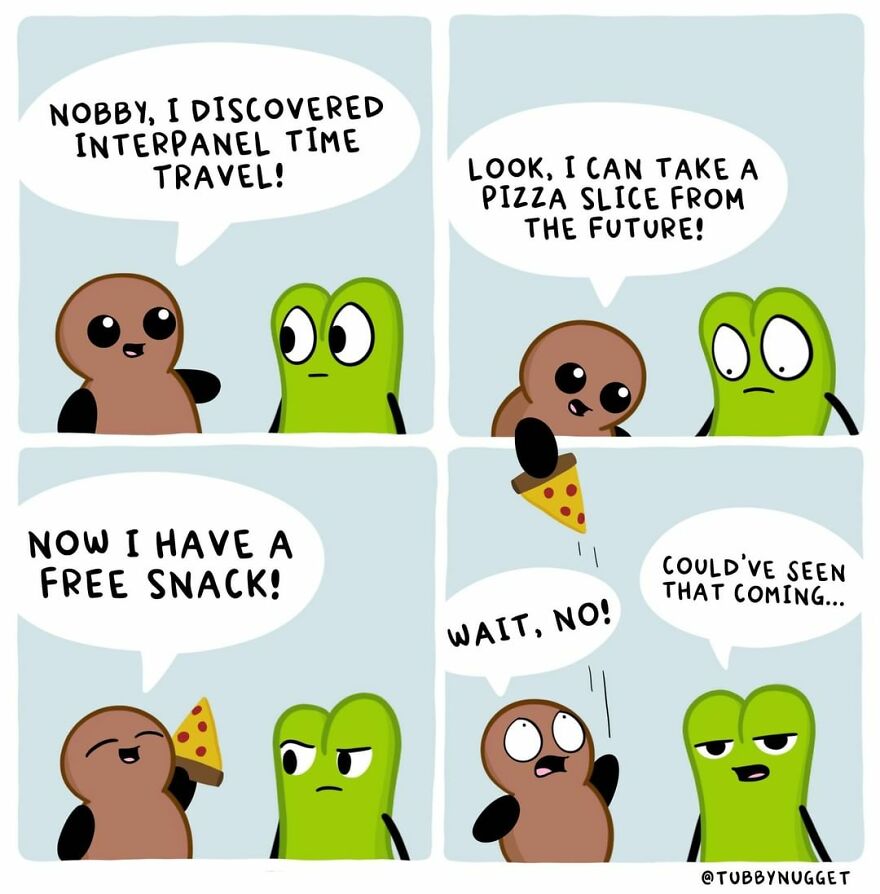
- In one Tubby Nugget strip, Tubby steals a slice of pizza from his future self and is congradulating himself on getting a free snack, when his past self steals the slice and closes the loop.◊ Nobby is unsurprised by the outcome.
- Back when the Large Hadron Collider was having a string of mechanical difficulties, some non-trivial physicists wondered aloud whether the future was actively trying to scuttle the LHC research project. The string of mechanical difficulties, they said, may be more than mere chance: Whether through [future] human intervention or the universe itself exercising some form of upstream-acting Ontological Inertia, the future was trying to make sure we don't mess with Higgs Bosons. Loopy? Literally. Crazy? Probably. Correct? Apparently not.
- In terms of the theory of relativity, time travel would take the appearance of a closed timelike curve, which is a series of events returning to its starting point — such as time travel returns to the past. That leads to the inevitable paradoxes, but some solutions claim that if time travel is possible at all, it's only possible in a stable form: the only form of time travel possible generates one.
- While that may seem supremely useless — what good is a time machine if it can't change anything? — that's not really true. A computer that could only build Stable Time Loops could run algorithms like "open time communication channel to 5 minutes into the future, receive answer from future, close channel, check answer (which takes 5 minutes in this example), if correct, send answer over the communication channel that was now just opened, if incorrect send different answer to past over the same communication channel", and then consistency would force the algorithm to return the output to some given puzzle. This is known as Time Loop Logic. Receiving an incorrect answer from the future would cause a paradox, and thus is impossible. Therefore either the answer will never arrive, or you will have created an ontological paradox, fabricating the answer from nowhere. The step of checking the answer is required for the algorithm to work.
- Less esoterically/more science-fictionally, a time machine that can't change anything would also be just dandy for observation, thanks. (Better, really, since you don't risk stepping on the Butterfly of Doom.) Video from 20,000BC anyone?
- Isaac Asimov and Arthur C. Clarke both tried that. Problem is, the past starts a microsecond ago, so it effectively ends any notion of privacy.
- Reginald Brettnor mentioned the same idea in "These Stones Will Remember". Unlike the Asimov and Clarke stories, this wasn't the primary purpose of the device.
- While that may seem supremely useless — what good is a time machine if it can't change anything? — that's not really true. A computer that could only build Stable Time Loops could run algorithms like "open time communication channel to 5 minutes into the future, receive answer from future, close channel, check answer (which takes 5 minutes in this example), if correct, send answer over the communication channel that was now just opened, if incorrect send different answer to past over the same communication channel", and then consistency would force the algorithm to return the output to some given puzzle. This is known as Time Loop Logic. Receiving an incorrect answer from the future would cause a paradox, and thus is impossible. Therefore either the answer will never arrive, or you will have created an ontological paradox, fabricating the answer from nowhere. The step of checking the answer is required for the algorithm to work.
- There is apparently a theory out there that human time travellers seeded the young planet Earth with life. This is sometimes known as the Completely Ridiculous Anthropic Principle.
- Some theories of particle physics hold that antiparticles (particles with the opposite charge and parity of a "standard" particle) travel backward through time. It's also widely believed that particle-antiparticle pairs randomly pop into existence from the Quantum Foam, and then feel their mutual attraction and annihilate each other moments later. It's also possible to see this as a single particle traveling in a loop through time: Forward as a regular particle to annihilate with its antiparticle, then backward as its antiparticle to annihilate with its standard particle, and repeat.
- A few theories state that, assuming time travel is possible, the big bang could have occurred by sending a time machine back to the starting point of the big bang, which would be a void before 'existence'. The sudden appearance of matter would then trigger the big bang, causing us to exist and said time machine to be constructed.
- There is another theory that says that if time travel is possible, it is only forward time travel — theoretically caused by time dilation when approaching the speed of light. The other way says that time machines are possible but that you can only travel to when the time machine was first activated and any time after that, but not before. That would explain why they aren't hundreds of time travelers at every major event in history... yet.
- The first isn't a theory as per the use of the term in the rest of this page, though some of the underlying physics has yet to be proved. It's how we are currently time travelling, and the change in rate can be demonstrated empirically by looking at the clocks on GPS Satellites and seeing that time passes differently on them and the surface.
