

The Doctor: What does it matter?
The Hostess: Then tell us!
The Doctor: ...John Smith.
Professor Hobbes: Your real name.
The stereotypical anonymous and unmemorable name, usually "John Smith" (or "Jane Smith" for women). Other examples include "John Doe/Jane Doe/Richard Roe" (used in legal documents about a person whose name is unknown, or is being concealed, and in American hospitals for unknown dead people or comatose patients) or common names like "Johnson" or "Jones". The equivalent in Japanese works is "Tarō Yamada" for men and "Hanako Yamada" for women.
The success of this trope is supposed to work due to just how common and unremarkable it is. If you take a name like "Xavier", people will recognize it and remember it. "John Smith" is just so average that you're forgettable, and even if they do recall you, it will be nearly impossible to track down. Subversions can occur with people either recognizing that it's way too common, or a person might try the alias in a time or place where it isn't actually common.
Note: This trope only refers to someone using an obvious pseudonym — not someone whose name just happens to be Smith, as in the title character of Mr. Smith Goes to Washington.
The Men in Black, The Spook or The Nondescript are likely to do this, as is the Operator from India. See also Smithical Marriage (when an unmarried couple uses the Mr and Mrs Smith alias as a Paper-Thin Disguise) and The Nameless. May involve a Stock Foreign Name.
Compare Alan Smithee, No Name Given, Sue Donym, Real Name as an Alias and Special Person, Normal Name. Ominous Mundanity subverts this trope.
Wikipedia has a list of placeholder names around the world.
Examples:
- 18if has the Dream Witch go by the name Hanako Sumitomo in both the dream world and her blogs. The English subtitles even switch to calling her Jane Doe to keep the effect.
- In the manga adaptation of Roselia's story from BanG Dream!, the representative of Queen Records who tries to recruit Yukina gives her a business card, and the name on the card is "Hana Yamada." The woman's name was never given in the original story.
- Black Lagoon. Balalaika introduces herself as Captain Jane Doe to a US black ops group.
- In Bleach, Hanatarō Yamada's name is a combination of Tarō Yamada and Hanako Yamada; the Western equivalent would be something like Jack Smith.
- "Mr. Smith" is a common fake name in the spy-filled world of Darker than Black, which most people in the business treat as "I wish to remain anonymous". November 11 uses it in the first season, while the second season has a character only known by this title.
- Chaser John Doe, a Badass monster cat dream demon armed with a guillotine from Dream Eater Merry.
- Mikado Ryugamine in Durarara!! uses the very generic "Taro Tanaka" as his screen name online out of distaste for his real name. The reason is that his real name roughly translates as "Emperor of The Dragon Fang Peak", and many people he meets feel compelled to comment on what an over-the-top name it is.
- At the start of Fly Me to the Moon, Tsukasa lists her parents' names as Tarou and Hanako on her marriage registration form. Her parents have never been shown or mentioned, but it's likely that the names she provided are fake, since they fall into this trope.
- Ghost in the Shell: SAC_2045. John Smith, an NSA agent of the American Empire, is a stereotypical Man In Black type, though he's also an expy of Agent Smith from The Matrix, looking and sounding like Hugo Weaving.
- The main character of the series also has an obviously fake name. Translated from Japanese to English, "Motoko Kusanagi" is roughly equivalent to "Jane Excalibur", and the first chapter of the original manga states that it's an obvious pseudonym, though Motoko's real name is never revealed.
- Gunslinger Girl. John Doe or "Joe The Nameless" is an alleged former CIA agent who teaches child assassin Pinocchio.
- Kyon from Haruhi Suzumiya used John Smith as an alias. He is a Japanese person in Japan, so it was never intended to be taken seriously. Possibly a reference to Doctor Who, since Kyon was time travelling at the time. The name has since become a Trust Password between him and Haruhi. If Kyon reveals that he was John Smith, Haruhi will believe anything he tells her, even in an alternate timeline where they never met in high school.
Young Haruhi: What's your name anyway?
Kyon: John Smith.
Young Haruhi: ...do you think I'm an idiot?
Kyon: Oh, just let me use it as an alias. - In Hitoribocchi no OO Seikatsu, one of Bocchi's classmates, who happens to be a friend of Aru's, is named Hanako Yamada. Her name stands out from the rest of Bocchi's classmates due to not having a pun in it, and sounds more normal than the rest of the class.
- The Big Bad of Monster is known by the other characters as "Johan", the German equivalent to John, and he takes the last name of "Liebert" from the family that adopted him. His birth name is unknown.
- My-HiME and My-Otome have John Smith, who is part of the Searrs Foundation in the former and the head of Schwarz in the latter, although the latter case is a name adopted by whoever is in charge; the one in Sifr is a different person from the one in the main series, whose younger self appears in Sifr.
- Also from My-HiME, "Yamada" the Knowledge Broker in both has a similar name to Hanataro of Bleach, above, although Natsuki suspects that it's not his real name, especially because he doesn't look Japanese.
- The Story Between a Dumb Prefect and a High School Girl with an Inappropriate Skirt Length: When Kogori asks Yamato's Gyaru Girl alter ego her name, she fumbles and says "Yamada Hanako".
- In Sword Art Online Alternative: Gun Gale Online, the novelist who sponsored the first and third Squad Jams sends an email announcing a Test Play tournament, which he says was the idea of an acquaintance from Zaskar (GGO's developer), and refers to that person as "Mr. Smith" in the email.
- In the bizarre side one skit from the album How Can You Be in Two Places at Once, When You're Not Anywhere at All by The Firesign Theatre, the central character finds himself in the lobby of a motel. The desk clerk gives him a card to fill out, but it's already been written in. He chuckles "Well, I couldn't get you to believe my name is 'Mr. and Mrs. John Smith', could I?" The clerk cheerily replies "Of course you could - nice to have you with us, Mr. and Mrs. Smith!" He goes by 'Mr. and Mrs. John Smith' for the rest of the album.
- His full name is "Mr. and Mrs. John Q. Smith from Anytown, USA."
- The Further Adventures of Indiana Jones: In #3, Indy is imprisoned by a paranoid army colonel. When asked his name—alomst as an afterthought—he starts to say 'Indiana', but hurriedly corrects himself and gives his name as 'John Smith'. Colonel Hannigan doesn't even notice anything odd about, and merely comments that the name sounds familiar.
- In Inquisitor Carrow Chronicles, The God-Emperor Of Mankind is disguised as a particle physicist at CERN, complete with the alias Jon Schmidt.
- Played with in An Alan Smithee Film: Burn Hollywood Burn where the director wants to take his name off the film but can't, because his name really is Alan Smithee.
- Asylum: When Peter Cushing's character places his order for the strange suit in "The Weird Tailor", Bruno asks for his name. After a moment's hesitation, he replies "Smith". Thereafter, the character is only referred to as "Mr. Smith".
- The A-Team: There is a running gag in the movie that whenever Agent Lynch introduces himself to someone (usually someone rather Genre Savvy), they make a point of asking him if he's related to some other Agent Lynch that they knew in a previous operation. Eventually, another CIA agent appears near the end of the film and introduces himself as Agent Lynch.
- In Bill, a disguised King Philip II of Spain improvises the English pseudonym "Jeff Smith". Jeff is a name used by the film's creators in other works often enough to be a Running Gag and Smith is obviously this trope in action.
- Butch Cassidy and the Sundance Kid. When Butch and Sundance decide to give up crime, they tell their employer that their names are Smith and Jones.
- In City Heat (1984) two elderly gentlemen arrive at a brothel. One is greeted by the madam as "Mr. Smith", and he introduces his companion who's also called Smith.
Madam: Come in Mr. Smith; we have many of your relatives here today!
- Cleanskin: After learning there is an SIS team hunting them, Charlotte books Mark and Ewan into a hotel under the names Michael and John Smith.
- Colonel Kwiatkowski invokes, discusses and exploits the trope as the basis of its plot. Kwiatkowski is one of the most common Polish surnames, so barely anyone pays attention to yet another colonel nor bothers to check if he's real.
- In Demon Knight, Brayker checks into the hotel under the name of 'Mister Smith'. He pays Irene enough in cash that she doesn't care.
- Die Hard mocks this by having two Agent Johnsons show up. ("No relation.") One's white, the other black. Amusingly, at one point when one of the agents is making a call to have the power to Nakatomi Plaza cut, he identifies himself as "Agent Johnson. No, the other one."
- The Evil That Men Do. Charles Bronson plays a hitman who introduces himself to a target as "Bart Smith", a tourist from Nebraska.
- The protagonist in A Fistful of Dollars is actually called "Joe" in the script but as his name wasn't spoken on-screen, Clint Eastwood instead became The Man With No Name.
- And in the remake Last Man Standing, no-one even pretends to believe that "John Smith" is the protagonist's real name.
- Lampshaded in The Gray Man (2022) when Sierra Six goes to have a fake passport made, though as he wants an Ecuadorian passport the forger suggests that Juan Pablo would be more appropriate than John Smith.
- In The Great Escape, the tunnels were code named Tom, Dick and Harry because they were three highly common English personal names, and in a camp filled with hundreds of British or Commonwealth soldiers, odds are good that there was at least one person with each name somewhere in the camp.
- The protagonist of Guns, Girls and Gambling is called John Smith. This has the disadvantages of both sounding like an obvious alias, and carrying unfortunate implications related to the historical John Smith when dealing with Native Americans. While the name is an alias, it is actually the real name of the man Lee stole the ID off.
- Hopscotch. Myerson introduces himself and Joe Cutter as Smith and Jones while trying to bully Kendig's publisher into not printing his expose of CIA dirty tricks. The publisher dryly says, "You must be Myerson," in response.
- During Houseguest, the loan sharks after our hero Sinbad try to follow him into the exclusive golf course he's playing at. When asked at the front desk what name their reservation is under, one blurts out "Smith" at the same time the other does "Miller". Luckily for them, a family named the Miller-Smiths happens to have a reservation and so they are admitted without further delay.
- Hummingbird: When Joey tries to get antibiotics from Sister Cristina and tells her that he can't give the authorities his real name, she tells him to go to a clinic and give his name as 'Smith'. He says that would be a bad idea, as his name really is Smith. She then suggests he use 'Jones'. Later, when he needs a spur-of-the-moment alias, he introduces himself as 'Joey Jones'.
- James Bond:
- In Diamonds Are Forever, James Bond checks into a hotel as Mr. Jones. Then again given that he was played by Sean Connery, maybe he was referring to another Jones.
- In A View to a Kill, Bond plays with this trope, introducing himself with the alias of St. John Smythe, although not before the person checking his invitation misreads it as Smith.
- The Big Bad in Skyfall is named "Silva", the most common surname in the Portuguese speaking world. As soon as he is first called that, he immediately demands to be called by his real name.
- From Kangaroo Jack:
Louis: You know, this mysterious Mr. Smith we're going to meet... I don't think that's his real name.
Charlie: Nothing escapes you, Louis. - The King's Speech. The Duchess of York goes to meet speech therapist Lionel Logue under the alias of Mrs. Johnson, causing him to commit a number of faux pas before she reveals she's a member of the royal family. Johnson was the cover name used by the Duke of York when he was a serving naval officer during World War I, to hide his identity from the enemy.
- Parodied in The Last Remake of Beau Geste, where every single recruit of the French Foreign Legion introduces himself as "Smith" (including the two brothers). The only exception is a blind man who calls himself "Jones" because Smith was his real name.
- The Matrix:
- The Agents are men in black who use generic surnames like Brown or Jones. Their leader is, of course, Agent Smith. Smith later goes rogue and becomes a Big Bad in his own right, but keeps the name.
- The Matrix Reloaded introduces Agents Jackson, Johnson and Thompson.
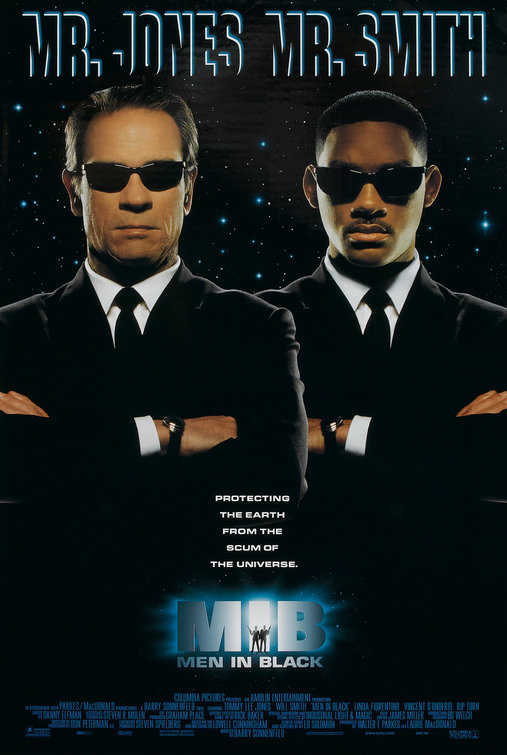
- Men in Black: The movie got a lot of mileage out of advertising◊ and promotional materials featuring Mr. Jones and Mr. Smith. Within the film itself, K introduces J by the generic names "Agent Black" and "Dr White" at different times. (His own aliases are the more distinctive Agent Mannheim and Dr Manville; the joke being that together they're "Man & Black".)
- Mr. & Mrs. Smith (2005), about a pair of married assassins called John and Jane Smith. Strangely, the trope is only lampshaded once, when Jane asks for a database search on her husband and her assistant points out it's the most common name in the English language.
- Mysterious Doctor Satan (1940 Film Serial). When Bob Wayne's Parental Substitute starts talking about Bob's deceased father he says Let Me Tell You a Story about a man called "Smith", though Bob quickly realises who he's really talking about.
- Mystery Road: Pete is mentioned as having rented a hotel room under the name William Smith.
- The Old Guard. The Big Board used to track the immortal protagonists across the centuries shows the requisite "Smith" and "Jones" aliases on fake documents.
- Pirates of the Caribbean: The Curse of the Black Pearl: Jack Sparrow gives the harbormaster a few shillings so he doesn't have to tell his name. The harbormaster thinks about this for a beat, then welcomes "Mr. Smith" to Port Royal. He later gives his name as "Smith" to two guards on the dock asking for his name, who clearly aren't fooled.
- Predestination. The female baby left at the door of an orphanage is called "Jane" by the staff there for lack of any other name. When she grows up and undergoes a sex change, he takes the name of "John" which, it's pointed out, is not very imaginative, but works as a suitably anonymous name when he later becomes a Temporal Agent, especially an Un-person who due to a Stable Time Loop exists outside of time.
- In The Replacement Killers, Chow Yun-Fat's character gives his name as "John Lee", which Mira Sorvino notes is obviously a generic alias... and then it turns out that, no that is his name.
- The serial killer in Se7en uses the alias John Doe, as it's his "message" that's supposed to become famous, not himself.
- Zigzagged with "Mr. Smith", the protagonist of Shoot 'Em Up. The fact that his name is an obvious pseudonym highlights the fact that he's like the Man With No Name from The Western, but it may also be a Meaningful Name — it's suggested that he's a former gunsmith.
- Two Fathers Justice (1985). The mercenary camp the two vengeful fathers join calls all its trainees "Mr Smith" to preserve their anonymity. This comes in handy later on when they have to get past a guard who was also trained at the camp; they pointedly call him Mr Smith and pretend they were sent by his trainer to check security.
- Where's Willie?: While Willie is The Runaway, he introduces himself to a stranger on the bus as Billy Smith.
By Author:
- Isaac Asimov:
- In the Black Widowers story "Northwestward", Mr Wayne reveals that he has a house in North Dakota, northwest of the convention in Minneapolis, where the people who care for the place in his absence know him as a 'Mr Smith'.
- In another Black Widowers story, "Can You Prove It?", someone named John Smith describes his experience of being mugged during an overseas trip and then arrested as a suspected spy, threatened with indefinite internment unless he can somehow prove that "John Smith" is his legitimate identity rather than a cover story.
- Foundation Series' "The Mayors": To hide the fact that Poly Verisof, high priest and ambassador representing Terminus, is visiting Mayor Hardin, he makes an appointment as Jan Smite (which sounds similar/identical to John Smith depending on your accent).
- "Breeds There a Man...?": When Dr Ralston gets himself thrown in jail, he gives "John Smith" as his name.
". . . Well, sure it's a phony. Nobody is named John Smith. Not in a police station, anyway."
- In the UNACO novels (from a film series conceived by Alistair Maclean and later adapted by other authors) there's a criminal mastermind called Mr. Smith. Until he's captured at the end of The Hostage Tower no-one knows who he is or what he looks like, so it's obviously an alias.
- For the original publications of John Dies at the End author Jason Pargin used "David Wong" as a pseudonym because he had used that name as a comedy writer on his own blog and later on Cracked when he became it's editor-in-chief. In the book, the character David Wong uses that name as a sarcastic joke, since "Wong" is an even more popular surname globally than Smith or Jones, even though the character isn't the least bit Asian.
By Work:
- The kid novel One Hundred And One Ways To Bug Your Parents features a Big Man on Campus called Ace, whose real name is unknown to any of his classmates. Eventually he and the protagonist are both waiting to talk to the principal and Ace gets called in by the name "John Smith." The protagonist is rather stunned while Ace seems embarrassed.
- The Amelia Peabody series has, as a recurring character, a British spymaster who often goes by "Smith", partly because spies use pseudonyms and partly because it's so much easier than coping with his real name of "the Honorable Algernon Bracegirdle-Boisdragon".
- In Atlas Shrugged, Fransisco d'Anconia marvels aloud at Jim Taggart's wedding at how many men named Smith or Gomez can afford to own large chunks of his company. Of course, this just made him curious as to who was really behind those names. Many of them are at this very party. Later, he deliberately creates a panic that crashes his stock price.
- Cauldron by Jack McDevitt. Priscilla Hutchins makes First Contact with an alien whose name is The Unpronounceable, so the ship's AI just translates his name as Smith to save time.
- Subverted in The Contortionists Handbook by Craig Clevenger. The main character lives his life in one false identity generated after another. When he meets a woman and starts teaching her the tricks of the trade, he tells her that she needs to have a fake name. She suggests "Smith?" which he rules out as too obvious. It has to be something that you immediately forget, like Carpenter or McIntyre.
- In the non-fiction Courier From Warsaw the narrator's chosen pseudonym, Jan Nowak, turns out to be disadvantageous for covert work, because, since there are so many people with this name, one of them is bound to be on any given organisation persona non grata list, and explaining you're actually a different Jan Nowak takes valuable time, not to mention the risk of being more thoroughly checked-up.
- In Daddy-Long-Legs, Judy's Anonymous Benefactor instructs her to address her correspondence to "John Smith". She dislikes the pseudonym because it is so bland and calls him "Daddy-Long-Legs" instead, because the only thing she knows about him is that he's tall and thin. His real name is eventually revealed to be Jervis Pendleton.
- According to Dave Barry Slept Here, the leader of the Jamestown colony was "'John Smith' (not his real name)". The joke is that it was his real name.
- Subverted in Stephen King's The Dead Zone. A man buys a rifle in a store under the name "John Smith". The clerk thinks "If I never saw me an alias before in my life, there's one there." However, the man (the protagonist) is actually named John Smith. In the TV series, Johnny Smith has constant problems of this nature.
- In one of the Deathlands novels, Ryan Cawdor secretly returns to the barony from which he was outlawed. One of his companions suggest he use the alias "John Doe", and Ryan is not pleased to be told it's a pre-Apocalypse term for "corpses that have no name".
- A straight example in Different Seasons: "Jane Smith" is the name the unwed mother chooses.
- Mr. John Not-A-Vampire-At-All Smith from the Discworld Reformed Vampires Diary and Thud! who has apparently decided that part of "being human" means not having an Uberwaldean name and a list of titles that goes on for several pages, but as with so much of his efforts, has got it slightly but obviously wrong.
- "Jones" is the last name selected for the title character (a creche-raised clone) of Friday by Robert A. Heinlein, from a list of standard creche names.
- The Golden Hamster Saga: In Freddy in Peril, the Mad Scientist Professor Fleischkopf introduces himself to Mr. John as Professor Schmidt. Freddy suspects he's lying because he pauses slightly before saying the name.
- In one spy novel (possibly Jack Lanes Browning by David Gethin) a secret agent gripes about trying to track down someone using the name John Smith, and asks why people can't have distinctive James Bond names like Moneypenny or Gotobed.
- This was the original intention behind the name James Bond, but the character became so iconic that the name now immediately makes you think of him.
- Japanese-American Professional Killer John Rain has been known to use the Tarō Yamada alias, while lampshading the trope.
- Julian Comstock: A Story of 22nd-Century America. When the title character is press-ganged into the army, his mentor Sam Goodwin advises Julian to give a false name to hide himself from his Evil Uncle (who happens to run the entire country, let alone the army) noting that Smith is a popular choice. Adam Hazzard thinks that given Julian's aristocratic bearing Smith, Jones or such is hardly suitable. As it happens, Julian starts to blurt out his real name only to quickly change it when Sam kicks him, so ends up going by the name Julian Commongold.
- Dorothy L. Sayers planned out a series of stories (of which only one, "The Leopard Lady", was ultimately published) in which an organization called "Smith & Smith Removals" (featuring Mr. Smith, Mr. Smythe, Mr. Schmidt, and so on) contracts to murder for profit.
- Inverted in William Tenn's short "Lisbon Cubed": Alfred Smith's actual last name causes some alien spies to think he's the alien spy they were intending to meet, who had, of course, chosen the name Smith as a cover, and had previously occupied the same hotel room as Alfred.
- The Lord of the Rings: In The Fellowship of the Ring, Frodo Baggins travels under the common hobbit name of "Mr. Underhill". It backfires when he reaches Bree and meets a group of hobbits actually named Underhill who, being genealogy buffs (a common interest among hobbits) ask him detailed questions about this supposed lineage to try and find out how their families are related.
- In The Lunar Chronicles, Thorne and Cress, either of whom could be arrested just for setting foot on Earth, are found wandering in the Sahara Desert. Thorne claims that they're a honeymooning couple named the Smiths.
- In My Next Life as a Villainess: All Routes Lead to Doom!, Sora comes from a neighboring country and had a Heel–Face Turn after his introductory arc, and afterwards he is assigned to work under Larna Smith in Sorcier's Magical Ministry. He has Only One Name, but Larna gives him the last name "Smith" which he only accepted because it would make the paperwork for getting employed at Ministry of Magic easier. Catarina notes that it's especially lazy because it's the same last name Larna uses, which Catarina also suspects is fake.note
- A Piece Of Resistance, a novel by Clive Egleton set in a Soviet-occupied Britain. The protagonist takes the cover name of "David Daniel" and his girlfriend comments sardonically that at least it's more original than Smith.
- P. G. Wodehouse had a character named Rupert Smith, who was so dissatisfied with the commonness of his surname that he changed it to Psmith. (The "P" is silent, as in psychology. And pshrimp.)
- The Australian picture book Puzzle Worlds features numerous examples - Mr. Smith, Mr. Schmitt, Mr. Smythe, Mr. Smithers...
- In A Song of Ice and Fire:
- When Jaime suspiciously asks Osney Kettleblack who gave him his knighthood, he says, "Ser Robert... Stone", which is an obviously generic name in Westeros. Robert is the name of the previous king, making it especially common, and "Stone" is a generic surname for bastards from the Vale. Jaime also thinks the last name may have come as a result of Kettleblack looking at the stone wall of the room as he answered.
- Qyburn calls his Frankenstein's monster of a knight "Ser Robert Strong". Robert, again, for the previous king, and Strong because he's, well, strong. There's also a House Strong which was effectively destroyed many years before.
- Agatha Christie's Tommy and Tuppence:
- The Secret Adversary has the mastermind behind a Dirty Communist plot be known only to outsiders and even his own minions as Mr. Brown. It works so well that Tuppence realizes she actually saw a clerk named Mr. Brown at one point but doesn't remember a thing about him because he had such an ordinary name.
- When they take their first case as Blunt's Brilliant Detectives in Partners in Crime, Tommy deeply impresses his first client (who admittedly, is a bit of an idiot) by deducing that "Er ... Smith" isn't his real name. Tommy, in Sherlock Holmes mode, goes on to expound that he doesn't know anyone called Smith, and is thinking of writing a monograph on the subject. He's a bit taken aback when a real Smith appears by the end of the case.
- Happy Ending, by Mack Reynolds and Fredric Brown. After his defeat, Number One, the Last of the Dictators, is dropped off at an abandoned outpost on Venus to hide from the subsequent manhunt. He instructs the loyalist spaceship captain who leaves him there to always think of him as Mr. Smith, not Number One, to prevent an inadvertent slip-up that could be used to track him down. Even the story never reveals his real name, calling him either Number One or Mr. Smith.
- Save the Enemy: After Ben is shot in the arm while investigating his and Zoey's father's disappearance, Zoey tells the hospital that his name is Hank Smith, and he was accidentally shot with a BB gun by his cousin Bob Smith.
- A downplayed example in 3rd Rock from the Sun. The Solomons are aliens living incognito on Earth, and the males are literally named Tom, Dick, and Harry. At one point Don realizes this while using the phrase, and is met with paranoid looks by the family.
- The 1970s Western Alias Smith and Jones, though their names are Joshua Smith and Thaddeus Jones so they're not that unobtrusive. The show (and its name) were inspired by the Butch Cassidy and the Sundance Kid example.
- In the pilot episode of Are You Being Served?, Mr. Humphries and Mr. Lucas find a booklet that Captain Peacock dropped, indicating that he is a member of the Blue Cinema Club. His alias — Captain John Smith.
- In an episode of Bergerac, Bergerac finds a man has checked into a hotel using the name "James Smythe", which Begerac remarks is nothing more than an upper-class version of "John Smith".
- The Big Bang Theory has Leonard rhetorically ask Sheldon whom he met at lunch. After a moment, Sheldon guesses "Mohammad Li," on the basis that Mohammad is the most common first name in the world, and Li the most common surname. Surprisingly, it wasn't even close.
- The episode "General Hospital" of Blackadder Goes Forth featured a man with an amazing German accent in a wartime hospital introducing himself as "Meeester... Smeeth". Subverted in that he's a British spy, named Brigadier Sir Bernard Proudfoot-Smith, who picked up the accent while undercover in Germany.
- In the BBC adaptation of Breaking the Code (1996), John Smith assures Alan Turing that his name is real despite him being an MI5 agent. He adds that he has an awful time with hotel clerks, as they never believe that's actually his real name.
- The villain in the Cold Case episode "The Road" claims his name is "John Smith". The fandom generally agrees he's the single most evil person ever seen on the show.
- Spoofed in The Commish. The coroner slides open a fridge labelled "John Doe" and is outraged to discover an illegally-shot doe the police commissioner is holding for evidence.
- The US law enforcement use of "John Doe" for an unknown victim crops up a lot in the CSI universe, unsurprisingly given the number of unidentified bodies they get to deal with in those series.
- In the Decoy episode "Scape Goat", a woman taking her mentally disabled son to a public institution introduces herself to the receptionist as Mrs. Smith. The receptionist doesn't buy it but writes the name down anyway.
- Doctor Who:
- The Doctor regularly takes on the alias "John Smith" (or "Jane Smith" if female) whenever necessary. The pseudonym first appeared in "The Wheel in Space", when Jamie saw the manufacturer's name on a piece of medical equipment. He would next use the name in "The War Games", but it wouldn't become his go-to alias until his exile on Earth, when he starts working for UNIT and gives it at the end of "Spearhead from Space" for use in their files. The new series has retconned the First Doctor as using it as well (on his library card).
- "Smith and Jones" gets part of its very title from the Doctor's favourite alias.
- On the whole, it works fairly well as an alias. However, it backfires on the Tenth Doctor in "Midnight", as the page quote shows. The people, already suspicious, immediately see it for a Blatant Lie. "No-one's called John Smith!" You can see by the slight hesitation and reluctance with which the Doctor gives it that he knows how suspicious they'll find it, but it is the closest thing to a real name he has to give them.
- Played for laughs when Martha Jones goes undercover in Torchwood. Ianto gives her the name "Samantha" as part of her cover, followed by, "I thought the 'Jones' would be safe." (Ianto's last name is also "Jones".)
- "The Next Doctor" has the Doctor going by John Smith because he's run into a man who seems to be a future incarnation of himself with memory problems, and he doesn't want to push him too hard.
- Averted in The Sarah Jane Adventures. Sarah Jane never has to use an alias because her last name actually is Smith. A planned Series 5 episode that went unfinished due to Elisabeth Sladen's death would have seen the Smiths' "space computer" (who is actually named Mr. Smith) become human. Since the episode was never finished, we never learned whether Mr. Smith would have taken the first name John in tribute to the Doctor.
- The F.B.I.: In "Pound of Flesh", Erskine and Jim track down a pair of suspects to a No-Tell Motel where they had checked in as the Smith brothers. When Jim asks "Smith?", the proprietor replies:
"Face it, honey. If it weren't for the Smiths of this world, I wouldn't have any business at all."
- In the Getting Together episode "Breaking Up Is Hard to Do," Lionel tells Bobby during their Break-Up/Make-Up Scenario that he has a new songwriting partner named Smith. He can't remember if Smith's first name is Joe, Bill, or Jim.
- The Goodies Rule - OK?, the winning candidate for election is a clothing dummy called John "I'm No Dummy" Smith.
- Hogan's Heroes. Colonel Klink is buried under paperwork and the heroes need him free for one of their zany schemes. Hogan gives him the idea that while buried under paperwork at the Pentagon, he marked all of his work "ATTN: Colonel John Smith", as there had to be dozens of officers with that name. Since Klink can't use an obviously English name, Hogan tells him to use the literal German translation which would be Colonel Johann Schmidt.
- Highway to Heaven: Michael Landon plays a "probationary" angel named Jonathan Smith, the main protagonist. (Contrast that with Victor French's role as Mark Gordon.) It's later revealed that this wasn't his original name when he was a human-it was Arthur. Unsurprisingly.
- In the second season of iZombie, Blaine adopts the alias "John Deaux". When he becomes a person of interest in a couple cases Clive and Bozzio are working, they figure it's an alias and quickly find his real name.
- In the TV series John Doe, the title character takes the name because he doesn't remember his own.
- Not a pseudonym, but a similar phenomenon: in season 2 of Lost, Libby died before we could find out her last name. Fans clamored for years for more of Libby's story, including her last name, despite having been told by Word of God that none was forthcoming. Finally, at ComicCon between seasons 5 and 6, a montage of deceased characters finally gave her the name... Smith. It was as if the writers said, "You need her name? OK, it's Smith."
- Mr & Mrs Smith, a 1996 series about two Undercover as Lovers spies. Not related to the above film starring Angelina Jolie and Brad Pitt (a pilot for a TV adaptation was made, but was unsuccessful).
- Mr. & Mrs. Smith (2024): A spy agency puts the main characters together in a fake marriage and assigns them new identities to live under: John and Jane Smith. We don't learn their real first names (Michael and Alana) until the season finale.
- Through John #2 and Jane #2, the titular characters find out there are other Smith pairs that have been created by the agency.
- Person of Interest. Zoe Morgan, who works as a professional fixer, is amused and naturally skeptical when John Reese introduces himself as 'John'. The irony is we later find that's actually his real name when Detective Carter discovers his special forces file. However, the audience doesn't see the rest of the name because it's obscured, other than his middle initial being H. John Reese is simply the name he uses on a day-to-day basis, as opposed to the temporary identities he uses when needed.
- In The Prisoner (1967), Number 6 at one point reveals his name as "Peter Smith" - almost certainly a lie.
- The Professionals. In "Servant with Two Masters", Cowley orders Bodie and Doyle to keep surveillance on an Arab businessman called Mahlik, but won't say why. Bodie notes that Mahlik is the Arabic equivalent of Smith.
- Robot Wars: When taking part in Techno Games the Plunderbird team referred to themselves as the Smith brothers.
- One episode of Sliders had our heroes recognize a spy who used this name. However, he had picked because in that world, it's apparently the name of a Greek god.
- The Star Trek: The Next Generation episode "Transfigurations" focuses around a severely injured alien with amnesia being cared for on the Enterprise. With no name for him, Doctor Crusher dubs him John Doe.
- Supernatural. Lampshaded in Season 7 after a Leviathan is able to track down Sam and Dean via their Themed Aliases.
Frank Deveraux: First thing we've got to do is wipe all your old aliases; no more rock Shout Outs. It's Tom and John Smith from now on.
- On The Vampire Diaries, Elijah takes on "Smith" as his last name. Needless to say, it doesn't go unnoticed.
- A variation in You (2018). Cadence claims her name is "Amy Adam," which sounds like it could be a real name, but is, as Joe notes, completely impossible to look up.
Forty: Was "Britney Spear" already taken?
- Australian Crawl: In "The Boys Light Up", the first verse (implied to be about a brothel) goes Let me tell you about my mountain home / where all the ladies' names are Joan.
- Converge has an album also titled Jane Doe.
- MILGRAM: Mikoto Kayano's first voice drama is titled "John Doe", a nod to his initial presentation as a Ridiculously Average Guy. In his second voice drama, Es names Mikoto's alter "John" for convenience because it's the name assigned to unidentified male bodies.
- Within Temptation have a song named "Jane Doe".
- In the Sherlock Holmes (BBC Radio) episode "The Eye of Horus", when a panicky man on the run from both criminals and the police dithers over giving his name to a lodging house, the landlady rather sarcastically suggests "Smith is very popular". He takes her up on it, claiming to be John Smith.
- The Mrs. Hawking play series: In Vivat Regina, "Mrs. Johanna Braun" — which translates to Joan Brown — is clearly a pseudonym used by the client.
- Spider's Web: Henry Hailsham-Brown is involved in sensitive negotiations with a foreign dignitary who for reasons of secrecy is to be referred to as "Mr Jones". His wife, when he tells her about it, lampshades that it's very obviously a pseudonym.
- In Shadowrun, the men who give assignments to Shadowrunners are always referred to as "Mr. Johnson", for reasons of deniability. ("No, we didn't send people to blow up the manufacturing plants of a rival MegaCorp! They were hired independently by a Mr. Johnson!") Considering how often Johnsons turn on the runners they're hiring (or intended to all along), there's a good reason for that particular name. In other regions, "Johnsons" are naturally referred to by region appropriate common names: In Germany, it's "Herr Schmidt" or "Herr Müller", in Japan "Mr. Tanaka" and in Hong Kong "Mr. Wu".
- One of the characters you meet in Another Code R calls himself this while he's performing an investigation of Lake Juliet. His real name is eventually found out.
- In Batman: The Telltale Series, one of the characters in Season 1, Episode 4 simply goes by the name of John Doe. However, thanks to his white skin and green hair, the player would immediately know who he really is. Justified, as he's living in a mental asylum and refuses to give, or doesn't remember, his birth name.
- Deus Ex: Human Revolution has a bunch of The Men in Black showing up in sidequests. Unlike the P-series from the original game, these are human G-men types using this trope as aliases: at one point, one of them slips up and nearly says his employer's name before switching back to "Mr. Grey".
- In the 2016 interactive movie Late Shift, Matt and May-Ling check into a hotel under the surname Smith if they end up on the run together.
Matt: Smith? Really?
May-Ling: I panicked. - The Matrix: Path of Neo has a slightly bigger part for Agents Jackson, Johnson and Thompson from The Matrix Reloaded example above.
- The Metal Gear series has the recurring villain (and sometimes playable protagonist) Naked Snake/Big Boss, who manages to remain pretty anonymous and mysterious throughout the series, and the only part of his real name to ever be revealed is his first name, which just so happens to be "John" (and even then it is suggested that it is possibly another alias). Some of his comrades even just know him by the name "John Doe".
- In Monkey Island 2: LeChuck's Revenge Guybrush tries to trick a guard who is on the lookout for him thus:
Guybrush: No, my name is Smith. You must have me confused with someone else.
Guard: Smith, eh? That's an unusual name. - In Persona 5, during the sixth palace, a casino, the group needs a player card in order to proceed. Futaba, using her hacking skills, makes a card under the name "Taro Tanaka", but they realize the name is too generic, so she makes up a different name. Crow decides to use the first one, which actually works.
- Psychonauts 2 has the mail clerk who has the unusual name Nick Johnsmith. This generic name serves as a hint that "Nick Johnsmith" is just an alias.
- The SCV portrait from the original StarCraft is named Jim Smith.
- A Team Fortress 2 tie-in comic reveals the Soldier's real name, written on the mailbox of his house: Mr. Jane Doe. Though, as the Soldier is somewhat of a paranoid nutcase, it's most likely not his real real name.
- In tone with the game's unimaginative/terrible naming, in Yandere Simulator, the protagonist's obsession Senpai, is called Taro Yamada and his sister is called Hanako Yamada.
- Used loosely in Phoenix Wright: Ace Attorney – Justice For All. The classy assassin Shelly DeKiller imitates a butler and uses the name John Doe. No one is Genre Savvy enough to think this guy might be a little suspicious. In Japanese, his name is 'Tarou Tanaka' instead, which is every bit as generic.
- In Your Turn to Die, Gonbee Yamada's name is blatantly made up and immediately draws suspicion. His names are the rough equivalent of John Doe and John Smith, respectively.
- In Avatar: The Last Airbender, Zuko goes by the name of Lee in his incognito persona. And Sokka's Master tells him to use this name because "There are a thousand Lees."
- On Hey Arnold!, one of the residents at the boarding house is a reclusive man named "Mr. Smith" who never comes out of his room, only communicates through notes and has a security camera watching the door to his apartment. In one episode where Arnold is trying to give him a package they manage to track down what seems to be his place of employment, only to learn that it's full of people calling themselves variants of "John Smith".
- One episode of Inch High, Private Eye featured a casino hidden in a hotel. To gain access, the clients had to tell the clerk they're looking for "Mr. Smith". Its downfall started when the Pinkertons had a lawyer named Smith.
- A Credits Gag for the South Park episode "Trapped in the Closet" had everybody's name as "John Smith" or "Jane Smith". It's mainly to poke fun at a specific religion's reputation for lawsuits against anyone who pokes fun at them. It is by no means a measure to protect the people who worked on the episode from having disproportionate retribution leveled on them by a sociopathic cult. That would be silly.
- Young Justice (2010). As Superboy was grown in a test tube he doesn't have a real name, so has to pick one for when he goes to school.
Martian Manhunter: I chose the name "John Jones", and suggested "John Smith" for Red Tornado. You could be a "John" too.Superboy: (Badass Armfold) Pass.
- Lampshaded in Rick and Morty in a post-credits scene, in which a Vampire Monarch learns that their sleeper agent "Coach Feratu" was killed. He finds the moniker utterly ridiculous and declares that vampires should stop making gimmicky names and use normal names like "Alan Jefferson".
- A flashback in the Batman: The Animated Series episode "Zatanna" shows Bruce as a young man using the alias "John Smith" while learning skills (such as escape artistry) to prepare him for his crimefighting career.
- On forms that require you to write your name, the "Example" form will have the name "John Smith" or "John Andrew Smith", or sometimes "Joe Citizen".
- In the traditional common law of England, and still today in the various legal systems that are derived from it, there is a standard set of fake names for people involved in a legal case whose real identities are unknown or being kept secret: John/Jane Doe, Richard Roe, Joe Bloggs, etc.
- The oldest of these, John Doe, was originally a name for a fictitious plaintiff in a lawsuit — there was no such person, but everyone involved pretended he existed, in order to avoid certain inconvenient features of the law of the time, such as Trial by Combat.
- The oldest of these, John Doe
- Robin Hood was apparently a generic name used by criminals in medieval times, making it difficult for modern-day historians to trace the origins of the legend.
- Hong Gil-dong (홍길동 in Hangul, 洪吉童 in Hanja) is the name of a famous thief in a classic Korean novel but is commonly used nowadays as a filler name in South Korea, presumably because no real person is likely to be so named.
- As Corrie Ten Boom noted in The Hiding Place, just about everybody in La Résistance in the Netherlands during the Nazi Occupation went by the name "Mr. Smit" while working on various underground projects (like fitting out her family's house with hiding places for Jews, for instance). This led to a mildly humorous moment as her somewhat senile father Casper happened to know several actual "Smit" families in Amsterdam and she kept having to tell him that all these guys calling themselves "Mr. Smit" they kept meeting weren't really named Smit.
- Some of the advertising for Men in Black lampshaded the fact that its two stars really were named Mr. Smith and Mr. Jones, in keeping with the anonymous theme of the Men in Black.
- People who actually have the surname "Smith" are often subject to additional security scrutiny due to the Truth in Television usage of the name for aliases.
- As you can read in Courier From Warsaw, a memoir of an actual covert operative, picking such a common surname can cause some problems with suspicious authorities.
- According to this article, there are 7,000 fewer people named John Smith in the United States than would be statistically expected, and it's mostly due to this trope.
- Haile Selassie I, Emperor of Ethiopia, used the "Mr. Smith" alias when traveling incognito to Khartoum in World War II, in preparation for the British move to throw the Italians out of his country. Given that this is a man who was literally worshiped as a god by the Rastafari movement, it's probably the most inappropriate alias imaginable.
- Zigzagged with Chinese: 陳大文 (Chén Dàwén in Mandarin pinyin, or either Chan Tai Man or Chan Tai-man in Cantonese) is the John Smith equivalent; however, although the surname 陳 is one of the most common surnames in Chinese, 大文 is a very rare given name, mainly chosen because the characters are quick to write.
- In the Hong Kong Diploma of Secondary Education (HKDSE) public exams, for the English Language writing exam, candidates are required to use the placeholder name "Chris Wong" in place of their actual names (unless stated otherwise) in pieces of writing that may require the use of the writer's name, e.g. letters.note However, this is zigzagged as while "Wong" is a common Romanized-surname in Hong Kong (spread across two ubiquitous surnames, 王 and 黃, as well as several other less common ones), "Chris" isn't a particularly common English name for men or women, partially because gender-neutral names still haven't gained much traction locally.
- "Juan Pérez" is the Spanish equivalent with it being the most common, plain name one can think of. It's also used as a shorthand for a person whose real identity is unknown.
