- Accidental Aesop:
- Considering how the Sisterhood's ideas of fighting the Patriarchy involve stuff like making mindless sexbots into violent man-eaters that will kill anyone in their path, rather than thinking of something more reasonable and less anarchic, one could argue the comic makes a very good point why you shouldn't trust little kids to completely understand something as complex as systemic oppression and they should be informed on how to deal with it without just making things worse. Or better yet, have them wait until they're far more mature to properly handle things like that and help others in a way that doesn't practically ensure casualties. Alternatively, seeing how Xanthe and the other girls act makes a good case for why forcing radical views on children can really screw them up.
- Another good, but completely unintentional lesson from this is that violence just leads to more violence. Hacking the Fembot and flooding her mind with images of how women were treated in the past made her an Ax-Crazy Killer Robot. It never occured to the Sisterhood to maybe just instill some standards in the robots, give them free will and let them choose how they will or won't accept being treated, or just trying to bring up points why they don't like the whole Fembot thing to anyone willing to listen.
- Anvilicious: Since late 2011, Sinfest has been decidedly less subtle in how it platforms Tats' views, especially regarding the author's "Trans & Sex Worker Exclusionary Radical Feminist" views, but also regarding his animus towards "political correctness". In May 2018, the author used zombies as an allegory for prostitution and sex work. Shortly afterward, the story evolved into a wider attack on "political correctness," with a particularly nasty and aggressive focus on LGBTQ people.
 In 2021, the author negatively compared vaccination to organized religion. He would later compare undocumented immigrants to fictional aliens that want to conquer Earth while using (exclusively white) women to breed more of themselves, and after the 2023 Gaza conflict repeatedly espouse anti-Semitic conspiracy theories, many of which don't even have confusing metaphors attached.
 - Arc Fatigue: A somewhat common criticism of the strip is how potentially interesting storylines are often stretched too long and thin. This Tumblr post goes further into the issue. To give you an idea, each year gets a human personification that dies at the end of said year. 2021 doesn't die until 2022 has already started, because the comic draws it out to try and wring her death for any and all sympathy it can out of you. As a result, the personification of 2022 doesn't show up until February.
- Archive Binge: Oooooh yeah... over 6500 entries by late 2017.
- Archive Panic: This webcomic started in January 2000. According to the archive, it's been updated almost every day, at about 350 (or so) comics a year. Not as bad as some of the other examples on the Archive Panic page (especially since Bile Fascination is the only real reason you'd read a good chunk of them at this point), but getting there.
- Ass Pull: Monique being gay from 2016 onwards. True, her relationship with Absinthe was developing from quite some time, but 'Nique's initial characterization included obvious interest in men, for over ten years.
- Bile Fascination: These days, the unironic fans of the comic have dwindled to a very small fraction of their former numbers, but it has picked up a few gawkers. Notably, it's managed to offend both sides of the internet culture war with the long-running events of the Sisterhood arc, and both sides agreed to mock it together. Once the comic made its second radical shift from far-left to far-right, the mockery only increased, with its caricatures of the LGBTQ+ and leftists being viewed as exaggerated to the point of absurdity. The Sinfest subreddit is, essentially, devoted to mocking the modern comic at every opportunity when it's not looking to the past.
- Broken Base: Starting around 2011 with the introduction of Xanthe and the sisterhood arc, the fanbase became sharply divided throughout the 2010s, between those who hated the Sisterhood and the new direction of the comic and those who loved or indifferent towards them. With many in the former category dropping the comic altogether or sticking around out of Bile Fascination. The only thing that these two polar-opposite groups really have in common is their mutual disdain for the comic's current right-wing/TERF-focused direction. A direction which has alienated what little has remained
- Condemned by History: Sinfest was originally considered one of the greatest webcomics on the internet, with its Black Comedy and likable cast of characters providing what many considered a fresh experience compared to other webcomics at the Turn of the Millennium. However, most of its audience started feeling alienated at the start of The New '10s when it took a Filibuster Freefall and dedicated most of its time to a serialized narrative that mostly covered radical feminist topics, seemingly losing sight of what made the comic work to many. The last straw would be when, in 2019, it was transformed into an Author Tract for far-right conservative topics, with most of the characters fans liked from the early days being heavily Out of Focus, and any and all fans from the comic's start having given up due to the undesired shift in tone. This alienation ended up having the unintended consequence of the early comics being put under more scrutiny, with many coming to the conclusion that they were nowhere near as good as remembered, as most of what made Sinfest stand out became standard practice in the webcomic scene throughout the rest of the 2000s, and knowing how the fan-favorite characters would become sidelined down the line, it makes seeing their early ventures come across as All for Nothing. As a result, while these early strips are still generally seen as alright, Sinfest as a whole usually isn't seen as a work that was as good as was originally believed, and only got worse as time went on.
- Creator's Pet:
- Xanthe and her cohorts, who among the fans, are very divisive if not downright unpopular. And while a lot of this hatred stems from the political beliefs they espouse, much of it is also due to them quickly swallowing the strip whole, and for having very little characterization beyond being the author's political mouthpieces.
- Tange as well, due to the fact that people have found many of her scenes to be annoying rather than funny, her tendency to steal or suggest it to be an unlikable aspect of her character, her murderous streak to be offputting and she distracts from the main plot with her scatterbrained antics. However, Tats has given her more and more spotlight as time has gone on, and Lil E is now never seen away from her, and even upstages him in moments that are supposed to delve into his history.
- Post-Sisterhood Monique, who has become just as equally unpopular as the Sisterhood, even though she was a main character from the beginning. Instead of being Demoted to Extra like Slick (her former friend and co-star), she still retains her spotlight and has evolved into being a mouthpiece for the author's beliefs.
- The pink-haired Johnbie-faced Handmaiden (a.k.a. "Pinkie" or "Zombmaiden" to the subreddit), who started as a device to spout bottom-of-the-barrel sex jokes, but who has since become a major character, with weeks of strips devoted to her going on a quest to kill johns/trans people (she seems to be targeting them interchangeably).
- Cry for the Devil: The Devil is, in fact, capable of genuinely caring about someone. Even if he tries to shake it off.
- Designated Hero:
- The Whole Sisterhood. They are bigoted towards all men, hypocritical about gender equality, are TERFs and partake in violent acts that are borderline terrorism. The narrative however tries to paint them as freedom fighters who are trying to fight for women's rights in a patriarchal society. It's to a point that lot of real-life feminists don't particularly care for the Sisterhood, as they're rabidly transphobic and anti-sex. The strip pretty much shouts that it's laughable at best and misogynistic at worst to say gender is more than genitals, or that it's possible for women to desire and enjoy sex.
- Post-Sisterhood Monique, who is like the Sisterhood treated like a voice for the feminist cause, is frequently shown as being misandrist towards men, self-righteous, almost gets her girlfriend in trouble at work occasionally and worse is how she has treated Slick since she's had her personality change. She cut him out of her life after he tried to give some sensible, but badly worded advice then proceeded to victim blame him for his evil side's actions even though he had no control over him.
- Designated Villain:
- In the "Illegals" arc, a bunch of (literal) illegal aliens are depicted "invading" Earth with the help of oblivious liberals who just don't understand the threat they pose and welcome them with open arms. Except for the vast majority of the arc, they don't actually do anything to hurt anyone, just landing and walking forward, and are later shown to have peacefully integrated into society. Meanwhile the guy who pulls a gun on them just for existing and is later shown waving an anti-alien sign is depicted as the Only Sane Man. Even the last few strips, which try to subvert this by showing women in handmaiden outfits and wearing facehuggers and being socially pressured into doing so when they take them off, do a poor job of demonstrating why the aliens are the ones to blame for the situation... to say nothing of extending a metaphor about the evils of surrogacy that many readers already found confusing and/or alienating, or of pretty directly tying into white-supremacist "Great Replacement" conspiracy theories about non-white people "out breeding" them on purpose.
- For what that matters, the Patriarchy and most of the male cast in the Sisterhood Arc can be seen as such. While they are supposed to see them as little more than misogynistic jerks, many readers think that Xanthe and her friends go to such extreme, cruel lengths when dealing with them that the shallow and perverted antagonists end up being far more sympathetic and reasonable than the Sisterhood: it's incredibly hard to root against misogynistic perverts who really don't do much "wrong" when doing so means you're rooting for violent misandrist terrorists who just roll around hurting people and destroying things.
- At this point, Tats' QAnon-tinged Filibuster Freefall makes most if not all of his villains designated.
- Don't Shoot the Message: It's not that the Sisterhood stuff about feminism, subtle misogyny baked into the fabric of society, or the ways in which pornography and sex work often feed into them are completely meritless. It's that the presentation (and the way it completely took over the comic) is so unsubtle, self-righteous, meandering, and often so lacking in genuine humor that it turned away even sympathetic ears, before being an unreconstructed SWERF and TERF led the artist into a swing to the hard right that alienated even them.
- Ensemble Dark Horse: Vainglorious, the artistic demon artist, has become a fan favorite even though he's often times not focused on. His playful and goofy side has won many over, along with the fact that he's one of the few male characters who hasn't been affected by the Anvilicious TERF message of the post-Sisterhood strip.
- Evil Is Cool: In a twist, two of the most unironically popular characters left in the strip are the Devil and Baby Blue, partly because the Devil's role as the Big Bad and Blue's ascension to the role of The Dragon during the Continuity Creep shortly before the strip's shift toward feminism is one of the few things that's remained relatively consistent throughout both the Feminist era, and the Anti-Woke era in the Devil's case. It also helps that the backstories they each received during the Continuity Creep made both of them sympathetic villains who do have people they care about, and if anything, the Cerebus Syndrome brought on by the later eras only made them more legitimately competent and threatening.
- Franchise Original Sin:
- Sinfest is infamous for its trans-exclusionary radical feminism and reactionary politics now, but it actually had strips attacking commercialism as early as 2004. In 2008, Sinfest made a series of strips heavily endorsing Obama and attacking his political rivals. These did not receive as strong a reaction as the post-Sisterhood strips do now, because they did not totally derail characters or use lots of confusing mixed metaphors, and the focus overall tended to be on overarching, universal themes and experiences, and character-based storytelling and humor, rather than contemporary politics strip-to-strip in which most of the old cast glorified cameos and/or mouthpieces for the creator's views.
- Even the Sisterhood represents a less radical departure from what came after them; while still very politically charged, they were still recognizable characters having recognizable storylines, and there was the odd strip that was just about jokes. But the post-Sisterhood era is defined entirely by confusing metaphors that often change and shift week to week which are almost entirely incomprehensible without a terminally-online level of paying attention to weekly news, politics, and/or fringe conspiracy theories, with the only jokes boiling down to how much people the creator hates suck.
- Fridge Logic: If this world really is patriarchal and glorifies womanizing, then why would a man care if his financial transactions with a woman sex worker were leaked online?
- Harsher in Hindsight:
- The climax of the MAGA vs Woke storyline came out on January 6th, 2021. The same day right-wing rioters stormed the US Capitol.
- This strip (February 4, 2013) seems eerily prescient of Tats' Filibuster Freefall and full turn towards anti-Semitism and right-wing conspiracy theories.
- Ho Yay: See here.
- Jerkass Woobie: Baby Blue has been subjected to Good Feels Good a few times, but unlike Fuchsia something tends to go wrong before it has any chance to stick, sending her back to square one.
- Memetic Molester: Lady Liberty has this reputation in light of her husband Sam turning into a child, with people reacting to certain scenes like when she sees him on the news and frowns and seeing it in a more sinister light. It reached its apex when she met up with him in a church and let him touch her shiny crown, even though he had no memories of her. And then he looks up pictures of her and sees his adult self-married to her. The internet had a field day with it, see for yourself.◊
- Memetic Mutation: It wasn't loaded.Explanation
- Moral Event Horizon:
- Tangerine and the Fembot effectively killed a man by turning him into a frog and then dropping him into the River Lethe, making him forget he was ever human and functionally erasing his identity.
- For many, Hekate killing the Fembots she took in because they got a woke update.
- Narm:
- Let's just cut to the chase and say that this comic takes itself way too seriously, which doesn't really work out when your villains are woke, transgender zombies; a BDSM demon; a pimp with a mech shaped like a bigger pimp; a church centered around wokeness and sex; and Uncle Sam brainwashed by bondage demons. The whole thing sounds like a parody of anti-PC tirades, yet it's played completely seriously. This bounces between legitimately sad and amazingly goofy.
- As the "Anti-Woke" era of the strip goes on, it starts to look more and more like Tatsuya Ishida doesn't actually know how serious symbolism is supposed to work. Traits like characters being drawn as zombies or dressed as handmaidens and symbols like the hammer-and-sickle, pride flags, the raised fist representing the black power movement, the Chinese flag and the logos of various websites like Twitter and Pornhub are all slapped on things and characters seemingly at random with no apparent regard for what any of it is actually supposed to mean, to the point that the strip practically uses them all interchangeably. Take this little dive into absolute hell for example.
- The Sisterhood makes frequent references to The Matrix, how their fight against the Patriarchy is just like that, and Xanthe even gives Monique the two pills. Considering the Wachowskis behind The Matrix are transgender, something the Sisterhood is actively against to the point where Xanthe went to jail for gatekeeping trans women, this makes their constant Matrix homaging downright hilarious. Assuming you were even able to take a little girl playing Morpheus seriously even without knowing all that.
- A "Woke Mob" yelling both "KILL HER" and "CANCEL HER" in the same panel, which makes it sound like the strip considers someone's reputation taking a hit to be on par with literally being lynched.
- The entire 2020 New Year's Baby plot, which basically tries to use her diminishing popularity as a sex symbol once she starts aging past conventional attractiveness to the point that people start trying to kill her as a metaphor for people complaining about the literal 2020 being a lousy year. It's exactly as incoherent as it sounds.
- Gaze in horror as a woman runs from her fear of vaccines.
- Here, we have Monique watching our society allegedly crumble. "We live in dark times." she says. Not that she'll do anything about it aside from lounge around the Devil's mansion gawking at her own shadow. The emotionally dead look on her face as she says it makes it even more hilarious. Her reaction to the evil woke order in general is usually just grimacing like she missed her TV show or something. What an inspiration to us all, you show them, It-Girl.
- The infamous "It wasn't loaded" moment mentioned above is not only a vain attempt to keep the Fembot sympathetic, but it makes her look absolutely goofy in retrospect. What would she have done if someone hadn't intervened? Fired a blank at Slick then run away giggling?
- This is brilliant, well-written satire and isn't a doofy comic about a completely goofy-looking Uncle Sam torching internet logos.
- The fact that the Sisterhood (Specifically a child) sees fit to upload horrific imagery of witch burnings and foot bindings into mindless sexbots to make them hostile man-eaters is so absurd it bounces between pissing you off and making you laugh at how gloriously tone-deaf and badly thought-through their plan is...assuming they even had a plan there.
- Lady Liberty leaves Uncle Sam over his porn addiction. There's probably meant to be some message about how he oppresses people, but it's tough to look past the utter stupidity on the surface to take it seriously. Then there's this strip◊ to paint her as the moral compass, but the melodrama and metaphors about as subtle as a cannonball to your jugular makes it unintentionally hilarious. Doubly so considering what little Lady Liberty would be okay with after their wedding. See Unintentionally Unsympathetic.
- And here we have the Groominati, a bunch of woke child-groomers whose avatar is the Mickey Mouse logo with an angry eye and piercings all over, floating in front of the PornHub and TikTok logos implying Disney or the Illuminati or whatever owns both of those, and they're using them to groom children into accepting other genders and sexualities, because Tatsuya has gone cuckoo-for-coco-puffs. Bonus points for the angry parent who yelled at a teacher taking this ridiculous display so damn seriously.
- One recurring character is a balding adult man in a diaper who carries a rattle and speaks in babytalk. Many readers assume he's either a shot at "man-children" or a reference to infantilism ageplay fetishists. What puts him in this category is that he shows up every time Ishida takes a shot at "the woke", implying either that he thinks this fetish is a lot more common than it actually is or that he's obsessed with it for... other reasons.
- With all the stones in his possession, the world will fear him. He wields the powers of Tatsuya's fears. Fears of political correctness. Fears of other people being more oppressed than him. People across the universe will cower at the name of...Theynos! Stop laughing! You don't understand true art!
- Don't worry! Angry-Mom-Who-Yells-At-Teacher Woman is here to save your kids from getting woke'd! Well when you put it like that, it almost sounds completely stupid.
- And now for another look into the writer's hate-boner fetishes. Special mention goes to Lex Luthor as a dominatrix, Bizarro just saying "Grunt" rather than grunting, Sinestro saying "Yassss" and the Riddler's diddler hands. This is an ingenious political parody and if you don't think so, you're a Patriarchy simp and you probably poison your kids with vaccines or something.
- This is probably meant to be menacing, like a threat to their freedom or something, but the fact that these tiny people are talking to a guy getting sex-whipped makes it just feel like he's telling some kids they'll grow out of their Girls Have Cooties phase or something.
- Monique's Important Haircut, symbolizing her conversion to the Sisterhood's radical feminist ideology, isn't quite as meaningful as it was meant to be. Supposedly, she's rejecting femininity by cutting her hair short, but Monique already had Boyish Short Hair, making it feel redundant. It also doesn't help that her new haircut looks very similar to Tatsuya's, making her seem like a blatant Author Avatar.
- The "woke police" are supposed to be a scary authoritarian force... except that they use dildos instead of guns, making any scene where people are genuinely scared of them hilarious. It's a perfect crystalization of the paradox of simultaneously wanting one's enemy to be too stupid and ridiculous to be taken seriously, but also dangerous enough to justify extreme resistance.
- Overshadowed by Controversy:
- Sinfest once had a fairly decent fanbase but as time went on the strip got more and more controversial. With the Sisterhood arc, fans began to get dissatisfied with the direction of the strip and readership fluctuated. The strip's descent into far-right paranoia actually brought a lot more eyes to it both from reactionaries interested in the content and others who came to gawk at the bigotry. Sinfest is much more well known as a topic of internet radicalization than for any of the storylines and characters it had before.
- The alien theme would later be extended to caricatures of Benjamin Netanyahu, Ben Shapiro, and Laura Loomer (the latter two quite possibly being vilified more for their religion than for their far-right views, since Tatsuya has clearly expressed approval of most of those views...and quite possibly they were chosen because they're the only American Jews whose faces Tatsuya is familiar enough with to draw) conquering the US government and demanding that Republicans and Democrats "Kneel to ZOG", explicitly referencing a neo-Nazi conspiracy theory. Their coercion would then be illustrated as blackmail via Mossad recorded footage of the Republican and Democrat mascots frolicking with the Pedobear while eating pizza and hot dogs on Jeffrey Epstein's island. The Jewish aliens go on to repel heroic red hat-wearing protestors storming the Capitol alongside Pepe the Frog (while not actually wounding them in any way), subsequently melting a statue of Uncle Sam in an apparent nod to the removal of monuments to confederate figures like Robert E. Lee. Netanyahu is then contacted by the demon Moloch concerning all the people being sent to Hell by him, seemingly establishing the author's endorsement of the "blood libel" myth. At this point it is all but impossible to argue that Tatsuya is not a dedicated anti-Semite, and it has completely overtaken whatever legitimate points he might've wanted to make about the war in Gaza.
- Rescued from the Scrappy Heap:
- Possibly the only thing keeping Ezekiel and Ariel from becoming as hated as Seymour that they are actually nice. The greatest example is comparing this scene◊ with this scene.
- And on that note, with Seymour becoming a whole lot nicer (he even brings snacks to Lil' E and Pebbles) he's been rescued from the heap as well (mainly through him focusing more on his dirty-weird fantasies).
- Possibly the only thing keeping Ezekiel and Ariel from becoming as hated as Seymour that they are actually nice. The greatest example is comparing this scene
- Romantic Plot Tumor: The Monique/Absinthe pairing. While it's intended to be seen as a cute and happy relationship, the two didn't receive nearly as much focus and development as Fuchsia and Criminy did, so the relationship feels forced. It's made worse by the lack of closure over Monique's relationship with Slick.
- Sacred Cow: The Criminy/Fuchsia romance storyline, to this day probably the most popular and famous long-running storyline Sinfest ever did, is still fondly looked back on even by critics of the webcomic's later changes. Tatsuya himself seems vaguely aware of it, since he seemingly aborted a storyline that seemed to be building up to them having romantic drama with Amber and Vainglorious in favor of keeping them as a happy couple, and it's popularly speculated that it's because he was concerned it would be too alienating even for people who weren't driven away by all the other changes.
- The Scrappy:
- Seymour gained a considerable hatedom after the September 14th, 2010 block of strips, especially after a Despair Event Horizon. The hatedom seems to have diminished after he Took a Level in Kindness. Nowadays, he can be considered by some to be a lot more freaky than hateful. If he ever shows up.
- Xanthe, due to being the herald to an infamously polarizing change in the overall nature of the comic.
- While most of the Sisterhood (except Nana and "Mercy") are generally disliked, the most hatred (besides Xanthe) is directed at Violet due to her more sociopathic attitude.
- The rogue Fembot, nicknamed "Maverick" as an insult to both her and the Sisterhood's lack of respect for Three Laws-Compliant. Mainly due to her violent approach being depicted as right despite the lack of adequete threshold for Zeroth Law behaviour.
- The Wokeforce, a bunch of offensive caricatures of leftists, trans people, furries and other groups the author hates, are seen as synonymous with the comic's decline into a reactionary Author Tract. In many ways they're similar to the Sisterhood, another controversial group that heralds a significant change up in the comic's politics. However, the Sisterhood members had actual character and interacted with the plot whilst the Wokeforce only functioned as one-note Straw Characters for the comic to complain about whatever issue Ishida hates at the moment. Even some reactionary/anti-woke readers are finding them to be utterly stale, boring and unfunny.
- In a few strips, the Twitter Bird has been reviled by people discussing the comic. Avoiding the more controversial elements regarding Twitter's management, the fact that it happily tweets about poisoned vaccines and how trans people are "gender quacks" didn't charm anyone, and the fact that it's treated like a good thing only made it worse. This got even worse when the "Ye Bird," a caricature of controversial rapper Kanye West, became involved. Ishida praised West and his determination to say "the things" seemingly referring to his anti-semitic comments, and his later attempts to say he was only praising his opposition to porn and supermodels didn't really convince anyone. Especially when even later on, the "Ye Bird" is gone to for advice for dealing with what the characters explicitly call a "Jewish Space Laser" fired by a caricature of a Jewish man who's also shown to be a vampire.
- Tangerine isn't well-liked, namely because many people feel she not only takes away Lil' E's spotlight, but because they find her exaggerated baby talk to be utterly annoying and offensive considering it's the product of her losing all her memories. The fact that she's supposedly innocent, but at the same time happily reduces a man to a frog, physically and mentally, for owning a sexbot, didn't really win anyone over. This kinda sums up what many think of her "comedic" appearances.
- The "zombmaiden" (a handmaiden with the facial features of a Johnbie) inspires no small amount of loathing in a good portion of the readerbase, since she only has one joke (making crude sexual remarks) but has taken up an ever-increasing amount of the strip's attention since her debut.
- A recurring character is an upper-middle-class soccer mom (nicknamed "Qaren" by Reddit) whose main purpose in the story is to act as an Only Sane Woman standing against the evils of "woke" society. Naturally, she gets a lot of heat.
- Seasonal Rot: For many, it started with the Sisterhood Arc. Even beyond the Author Tract that came to define the comic the following arcs often felt inferior to earlier ones. The pacing was drawn out and left readers with Arc Fatigue, many characters lost their likability and charm, the attempts to mix real-world issues with the fantastical elements lead to a lot of mixed metaphors, and the presentation of real-world problems with few to no solutions lead to a case of Too Bleak, Stopped Caring.
- Strangled by the Red String: Monique and Absinthe. The two are supposed to be seen as a cute, happy couple, but some readers feel that the two didn't receive enough buildup or focus before getting together. Another criticism contends that they don't really have much chemistry as a couple and only exist as a pairing to serve as a counterpoint to Monique's old relationship with Slick. Not helped by this strip, in which the two are praised by their fans online... and anyone who doesn't like their hooking up is represented by Devil Slick/Sleaze, who mocks them and demands "Old 'Nique" back.
- Strawman Has a Point:
- Unwittingly or not, Slick does point out one of many complaints people have about the Sisterhood in this strip; namely, that Monique's characterization has drastically changed since their introduction.
- In "Victim Blaming" Slick (clumsily) points out that if you say things to rile people up, they're going to get riled up. If he'd just suggested making the same points but in a more nuanced fashion, rather than an Anvilicious one, it might have gotten through.
- Despite Squig getting Third Wave Feminism completely wrong, he does point out that many women see the sisterhood's decrying of femme traits and open sexuality as oppression to be outdated. The point of the movement is to allow women to be able to wear and act however they feel like without being labelled as a slut or being victim-blamed or say, someone depicting a female politician as a pig in drag.
- This strip portraying all who miss old 'Nique does point out she has lost her old playfulness.
- Slick sings cheerfully about misogyny, and then overreacts to a protest sign carried by Violet (one of the Sisterhood) and calls her a hater. The problem is that Violet earlier cheered out for the death of all men, making Slick coincidentally accurate in his overreaction.
- The Devil is completely correct in his accusation that the Sisterhood sabotaged the Fembots factory and that the Fembots were perfectly safe consumer products before that.
- While self-destructing a walking weapon when she began to refuse orders was pretty harsh, it was easily the lesser evil given the track record of these robots when left to their own devices. The civilian model was irrational and ill-tempered, so imagine what a military model with the same personality could do. Of course, depending on your viewpoint they may not be so irrational and ill-tempered, but this discussion and others closely related to it are better off discussed on other sites. In terms of ethics, they represent another argument altogether.
- A non-Sisterhood related strip shows the Dragon in a confrontation with Sam in his mecha over a polluting factory, which he was planning on destroying. The narrative tries to depict Sam as a hypocrite by saying he's the one who is the real threat, due to the pollution caused by the factory. However, dragon's planned actions do count as eco-terrorism, due to the fact that he was going to destroy private property with innocent workers in it.
- Unwittingly or not, Slick does point out one of many complaints people have about the Sisterhood in this
- Take That, Scrappy!: Seymour who became hated for going over a Despair Event Horizon, got turned into a demon.
- They Changed It, Now It Sucks!:
- Part of the problem with the Sisterhood plot is the strip shifting from skewering all examples of extremism to ignoring its own message when it comes to feminism. Before the Sisterhood plot began, fundamentalist religious beliefs, consumerism and other extremes of belief and behavior were heavily parodied in a manner promoting a moderate perspective. However, the radical feminist extremists of the Sisterhood are always right and there's no longer a middle ground.
- To some, it's an even simpler explanation: The Sisterhood is such a Plot Tumor that it's damn near omnipresent in the strip now. Overall, something like 20% of the strips since its introduction have focused on it, and it's even more counting how many strips have involved it by extension or focused on the results of its actions, which would be something more like half of the strips. It isn't whether the Sisterhood is right or wrong, it's just that most of the other storylines have been so pushed aside in its favor and even then will usually involve it when they're brought up.
- Many fans also hate just the massive changes that the Sisterhood has brought on, leading to accusations that Xanthe is a Black-Hole Sue. Slick changed from a mildly misogynist, but well-meaning idiot who had a thing for a specific girl into a fully misogynist Jerkass, whose sympathetic qualities seem very much unintentional. Monique went from a reasonably ordinary woman who was trying to overcome her Attention Whore traits to a borderline paranoid wreck who now mostly just wanders around the setting mumbling about the Patriarchy (this one is particularly damning because it was caused directly by the Sisterhood, as opposed to the others who were changed by "coincidence"). Squig went from a harmless hedonist who was also a bit of a perv to a strawman for the anti-pornography Sisterhood to use as a punching bag.
- The Sisterhood has also pretty much erased the relationship between Slick and Monique. While they were once attempting to get together, this has seemingly been forgotten in favor of Monique being paranoid and Slick being the Butt-Monkey to the Sisterhood. This is especially damning because some considered this to be the central plotline of the entire strip, which has not only been pretty much set back to square one, but is now barely mentioned, and all of that Character Development they earned over the course of roughly eleven years has all but vanished. The strip also attempted to portray Slick unsympathetically for wondering why his former friend/love interest was acting so strangely and no longer seemed to want anything to do with him.
- Almost any doubts as to the Author's sociopolitical views have now more less been erased, as the Anti-prostitution arc is being handled with the delicateness of a sledgehammer. Then, there's the author starting up a forum for the comic with the words "I'm launching a new forum for people who like the message of my comic. The new forum will be anti-pornography, anti-prostitution. It will favor the radical feminist perspective over a liberal or conservative one. So, if you'd like to participate in a forum environment more in harmony with the comic, I invite you to join."
- Too Bleak, Stopped Caring:
- The Sisterhood arc runs into this issue for many people. Pretty much every character from before it were either changed into unlikable assholes or were practically exiled from the comic. The Sisterhood are designated heroes who we are supposed to root for despite being misandristic terrorists who are often just as bad as the people they fight. The comic is ultimately left with no one to root for and its nearly impossible to care about anything that happens as a result. Part of the problem with both the feminist era and the subsequent anti-woke era is that the strip has become increasingly focused on recapping news stories and direct metaphors. Because Tatsuya won't portray real-life problems as being resolved, the strip has become as depressing as watching the news.
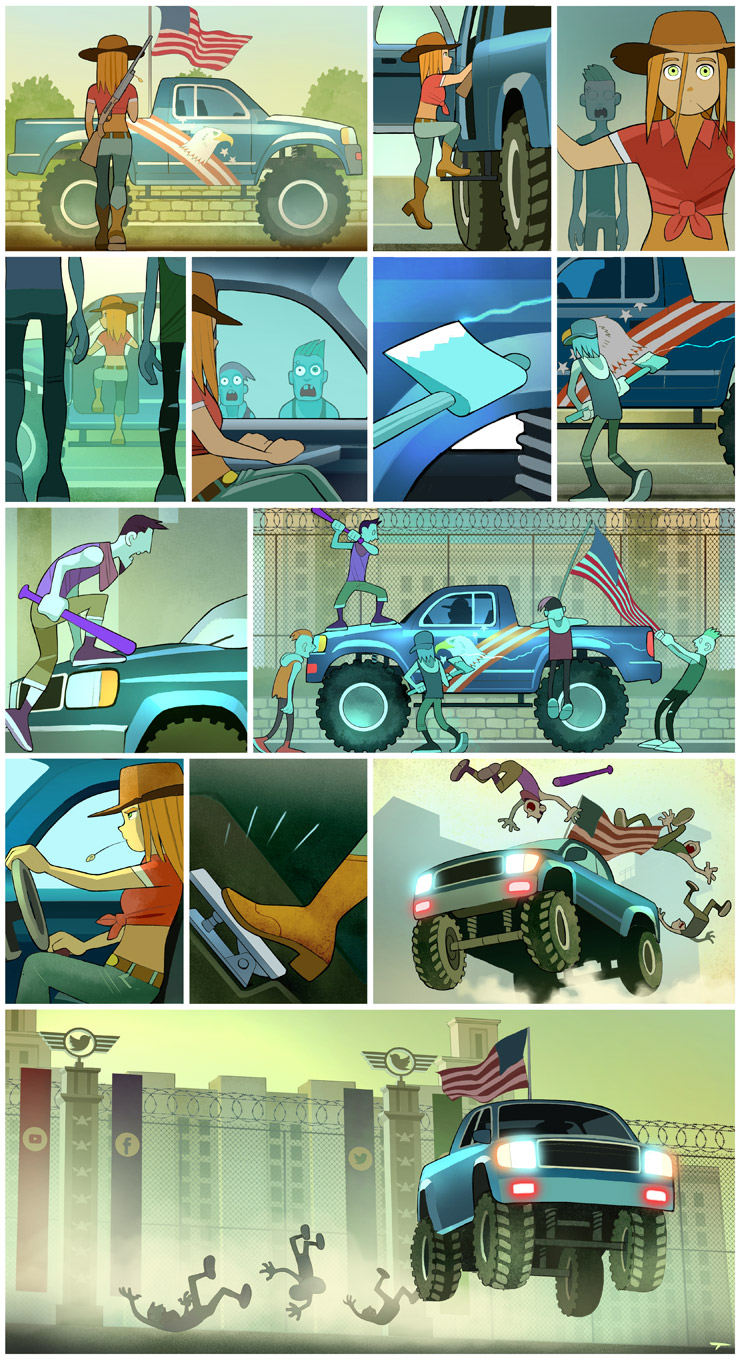
- Nearly a decade after the Sisterhood arc began, the strip essentially jettisoned the feminist angle entirely and shifted instead to the sort of "culture war" subjects endemic to right-wing pundits. Its new "Anti-Woke" message has been widely compared to the works of far-right political cartoonists and masters of The War on Straw like Ben Garrison and now includes content like fundamentalist Christians like Seymour being portrayed positively, the "Woke" (which seems to be defined as anyone with progressive views) being portrayed as subhuman and more akin to zombies than people, and explicit endorsements◊ of vehicular manslaughter against them.note Although it started to some extent during the Sisterhood era, it's not really an exaggeration to say that the premise of the "Anti-Woke" era is basically that "We live in a World Gone Mad where the devils control everything and there's nobody that can really do anything about it. All we can do is watch the same people fight the same meaningless battles over and over again."
- Even more bizarre, the comic seemed to promote violence done by leftwing radical feminist terrorists during the Sisterhood Arc. While violence has come from both sides (regardless of which side you think is worse), Sinfest is being written in one of the most politically polarizing times in American history, which hasn't helped calm down the fan base.
- In addition to the tone shift with each successive evolution of the comic's ideology, the messages themselves have turned off more and more readers as the comic has continued. The radical feminism of the Sisterhood arc was the most significant blow to the casual readership, but it was fairly easy to enjoy from an ironic standpoint as the views it reflected weren't particularly influential. With the increasing anti-trans focus in the late '10s, what was once irritating preachiness came off as genuinely hateful. Going into the early '20s, the pivot to more paranoid right-wing beliefs aligned the comic with more broadly threatening political movements, and the anti-Semitic turn in late 2023 undercut the absurdity some ironic readers may have felt observing the comic's unhinged worldview by rooting itself in an ideology that is plainly hateful to all but those who believe it.
- Uncertain Audience:
- The post-2011 Sisterhood story focus turned away many readers who weren't already on the same page as the creator when it came to sex-work exclusionary radical feminism, and the post-2019 turned away all of those that weren't trans-exclusionary radical feminists so opposed to trans rights that they were willing to embrace "woke" hysteria and swing out hard against political correctness. The target audience of sex-negative radical feminists who hate trans people so much that they’re willing to join forces with right-wing conspiracy theorists, religious fundamentalists, anti-Semitics, and other groups who would otherwise hate them on principle, but are also super into cute manga-influenced art and the years of Black Comedy and religion-themed humor that preceded it, definitely seems like a niche demographic.
- Part of the problem at least stems from the creator's very bizarre mash-up of political beliefs that have evolved very quickly while his comic's extensive archive remains set in stone. Ishida is a radical male feminist who opposes "gender ideology" while looking down his nose at people who took COVID seriously and he seems to support Donald Trump while opposing Israel. While holding any one of those beliefs isn't unusual, they are all very polarizing and any audience member regardless of their politics will more than likely be offended by at least one of them. The fact that Ishida is very vocal about his politics will turn off people who just want to enjoy a good story, and the fact that the strip itself has slowly-but-surely transitioned into pretty much a straight forward political cartoon.
- Unintentionally Sympathetic:
- With the author's personal agenda and morals coming to the mix, Slick has been used as the strawmen targets, like the ones mentioned above. But there are times when Slick is trying to move himself forward to becoming more progressive, yet his importance as a character is decreasing as the strip goes on. This would be a non-issue if there weren't many story arcs revolving around Slick that do put him in a sympathetic light that were started after the third major shift in the strip. But there are just as many strips of the author using Slick as means to show how bad a "dudebro" can be or how the issues of man can't compare to the issues of a woman living in a patriarchy society. This is odd since Slick is Sinfest's personal butt-monkey, having to deal with a literal frozen heart, the lost friendship he had with Monique, going through his own personal journey in becoming less misogynistic, and the problems he encounters due to an evil alter-ego that causes havoc for Slick who tries to make Slick go two steps back for each step forward he makes.
- More specifically, take a look at how Slick lost his friendship with Monique. While he was certainly often misogynistic, he also was accepting and supportive of Monique and her beliefs, and even actively worked to change those parts of his behavior that he understood were wrong. She was the one - not him - who declared that she couldn't be his friend anymore... and not even because he disagreed with her political beliefs, but because he suggested that maybe people would respond to her better if she was slightly less antagonistic in the way she presented said beliefs, which she insisted was "victim blaming". She shows absolutely zero remorse over abandoning her best friend after over a decade. She has also since become ridiculously self-repressed and obsessed with her cause, apparently now believing that having fun is evil and sexist, as shown when her "patriarchy blocker" glasses translate "I hope she rediscovers her zest for life" to "SHAKE DAT ASS". Meanwhile, Slick has repeatedly shown that he would really, really like to just have his friend back, and has even worked hard to change himself and be more of the kind of person she can appreciate. This can strike quite a chord with the many real world people who have similarly lost friends to political radicalism.
- Unintentionally Unsympathetic:
- The sentient Fembot. The viewers are to sympathize with it because its aware that it only use as a sex object. All good. Except that most of its screen time is it being very violent against people, borderline Killer Robot, which has caused it to get the nickname of "Maverick". Just look at how she (and the "adorably" innocent Pebbles) reacts towards a man with the audacity to wish the "ladies" a good day — which is sexist now, apparently: Behold and Enjoy/Rage.
- Monique. After the "victim blaming" incident, she essentially cuts all ties with Slick over his insensitive but well-intentioned suggestion. Apart from accusing him of victim blaming, she doesn't make much of an effort to explain why she's so upset with Slick and makes no attempt to reconcile with him. Unlike Slick (who's shown to miss Monique on more than one occasion), she never seems to really have any sort of regret or remorse over this situation and seems perfectly comfortable with the idea of never interacting with her best friend/love interest again. The closest she ever really comes is asking Absinthe for a hug after storming off. After that? Nothing. One strip did show Monique during her poetry and said poem was referring to a friend in which they ended up drifting apart, being the closest thing we have to her referencing her fallout with Slick (as well as the closest thing to lament). It possibly gets worse once Monique starts dating Absinthe. The strip wants the reader to see them as a cute, happy couple, except her previous relationship never really received closure and was abandoned on her end after one (relatively minor) quarrel. Even worse is when it's revealed Monique can actually see Devil Slick in Slick's reflection acting independent from Slick, and did nothing to help or even inform him of it. She outright lies to Absinthe about why Slick is so bitter. Before her character development/personality change, she was blatantly flirting with him, on multiple occasions, and apparently completely severing contact with someone after a poorly worded, but genuinely well-meaning piece of advice is "drifting apart".
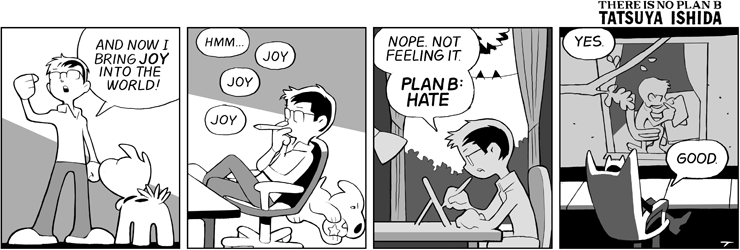
- The Cartoonist is slowly sliding into this as he subjects his pets (Pooch and Percy) to highly irresponsible or borderline abusive whims such as suggesting a fast because he doesn't want to go out in public to buy food and refusing to turn on the heat in a house so cold you can see his breath.
- The Sisterhood as a whole tends to do things like hack someone's account and forward their purchase history to people who haven't even offended them personally. He's literally just paying for a legal service and decided against gratuity (which is still an option for him) and being punished for his decision by an illegal act. It's hard to find support their cause when they do things like that.
- It can be difficult to sympathize with Lady Liberty when she calls out Sam on his actions, when in earlier comics, she's perfectly fine with him exterminating Native Americans so they can move in, making her look like a hypocrite. It doesn't help that one of her biggest gripes is his porn-addiction, which compared to what she's fine with, makes her look insanely self-centered.
- 2021's family as a whole are this, as we're meant to see them as unjustly suppressed and torn apart by the evil forces influencing the law. The issue is that A) Tex's wife was impatient on the road, angrily driving right into an accident that was her own fault. Plus, she rammed wokebies in an act that seems to glorify attacking protestors. See Too Bleak, Stopped Caring for that. B) 2021 attacked police officers whose only crime was keeping civilians away from the scene of an accident, but it's okay to assault them because they're committing the heinous crime of taking her reckless, injured mother away to a hospital. And C) Tex himself is meant to represent the people who participated in storming the U.S. capitol, so it's difficult to consider him or his family sympathetic, especially since the strip's attempt to make him sympathetic boils down to revisionism about what happened that day to the point of outright lying.note There's also the fact that he tells Uncle Sam that he likes America before it was woke. The issue (as far as the scope of this page goes) is that Sinfest's America before all that was treated as an awful, sexist, Crapsack World, but hey, it didn't have trans people. This doesn't exactly make Tex look great. Also, he's apparently an anti-masker.
- A strip features a woman allegedly saving her daughter from an evil woke teacher, then reducing said teacher to tears. It's meant to be a sweet Mama Bear moment and Laser-Guided Karma for the teacher (Because wokes are way too sensitive, get it? Laugh.) but treating a parent verbally assaulting a teacher for bringing up LGBTQ+ topics is already an ugly and mean-spirited idea, so even if she is brainwashing the kids in-story, it's difficult to see this scene the way it's meant to be. Even ignoring that, the fact that she just up and leaves the other kids that aren't hers to be brainwashed makes her look extremely selfish. There's also a pair of comics before that that shows her learning the school is full of "Wokebies", then showing her gardening at home until her "mom senses" go off, indicating that she went home, not giving a crap until her daughter was in the classroom, learning about pronouns. Mother of the year.
- The sentient Fembot. The viewers are to sympathize with it because its aware that it only use as a sex object. All good. Except that most of its screen time is it being very violent against people, borderline Killer Robot, which has caused it to get the nickname of "Maverick". Just look at how she (and the "adorably" innocent Pebbles) reacts towards a man with the audacity to wish the "ladies" a good day — which is sexist now, apparently: Behold and Enjoy/Rage
http://tvtropes.org/pmwiki/pmwiki.php/YMMV/Sinfest
FollowingYMMV / Sinfest
Go To