
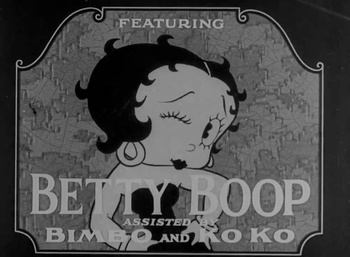
Pioneering cartoon series (from 1930-1939, plus a few one-off revivals) from Fleischer Studios, Betty Boop was the mirror of the stereotypical flapper, simultaneously looking for a good time and good-at-heart. In early cartoons, Betty's pals were Koko The Clown and Bimbo the dog; later on, Betty's grandpa Grampy, wild cousin Buzzy, and nonhumanized puppy Pudgy headlined episodes of their own.
The Hays Code essentially killed off all interest in Betty Boop — obviously, as a cartoon she couldn't wear such flamboyant outfits or maintain such a flirtatious attitude. The producers tried to make her more wholesome with more concealing clothes but this approach failed, it having been her flamboyant but sweet attitude that was so much fun to watch for her original viewers in the first place.
Despite not having a starring role since 1939, Betty remains a household name in the modern era due to the truly massive assortment of merchandise bearing her likeness, as well as her status as a sex symbol and a feminist icon.
As of 2013, Olive Films is releasing fully restored shorts of the series on Blu-Ray, culminating with four volumes. A live-action/CGI hybrid feature film based on the series was planned, and was to be produced by Animal Logic. However, this film (like most of the previous attempts at a film) has been cancelled.
Back in 2016, there were plans for a new animated series starring Betty Boop by Normaal Animation, however, very little has been announced since and according to concept artists who worked on the show, it has been reportedly cancelled.
A 4-issue comic book series was published by Dynamite in 2016.
In 2023 a new stage musical titled Boop! the Betty Boop Musical announced a pre-Broadway run in Chicago, which opened on November 19 with Jasmine Amy Rogers on the cast in the titular role.
1930
- Dizzy Dishes (Talkartoons) August 9*
- Barnacle Bill (Talkartoons) August 31
- Accordion Joe (Talkartoons): December 12: An episode believed to be lost until a print was found in 2023.
- Mysterious Mose (Talkartoons): December 26
1931
- Teacher's Pests (Talkartoons): Feb 7, 1931
- The Bum Bandit (Talkartoons): April 3rd
- Any Little Girl That's a Nice Little Girl (Screen Songs): April 18, 1931
- Silly Scandals (Talkartoons): May 23
- My Wife's Gone to the Country (Screen Songs): May 31, 1931
- Bimbo's Initiation (Talkartoons): July 24.
- Betty Co-ed (Screen Song) August 1, 1931
- Bimbo's Express (Talkartoons): August 22
- Minding the Baby (Talkartoons) Sept. 26
- Kitty from Kansas City (Screen Songs) October 31
- Mask-A-Raid (Talkartoons): November 7
- Jack and the Beanstalk (Talkartoons): Nov. 21
- Dizzy Red Riding Hood (Talkartoons): Dec. 12
1932
- Any Rags? (Talkartoons): Jan 2
- Boop-Oop-a-Doop (Talkartoons): Jan 16
- Minnie the Moocher (Talkartoons): Feb 26.
- Wait Till the Sun Shines, Nellie (Screen Songs): March 4
- Swim Or Sink (S.O.S) (Talkartoons): March 11
- Crazy Town (Talkartoons): March 25
- Just One More Chance (Screen Songs) April 1
- The Dancing Fool (Talkartoons): April 8
- Chess-Nuts (Talkartoons): April 13
- Oh! How I Hate to Get Up In The Morning (Screen Songs): April 22
- A Hunting We Will Go (Talkartoons): April 29
- Let Me Call You Sweetheart (Screen Songs): May 20
- Admission Free (Talkartoons): June 10
- The Betty Boop Limited (Talkartoons): July 1
- You Try Somebody Else (Screen Songs): July 29
- Rudy Vallee Melodies (Screen Songs) August 5
- Stopping the Show: August 12: Betty Boop's first standalone short. Talkartoons were replaced by the Betty Boop solo series from here on out.
- Betty Boop's Bizzy Bee: August 19
- Betty Boop, M.D.: Sept. 2
- Just a Gigolo (Screen Songs): Sept. 9 1932
- Betty Boop's Bamboo Isle: Sept. 23
- Betty Boop's Ups and Downs: October 14
- Romantic Melodies (Screen Songs): Oct. 21
- Betty Boop for President: November 4
- I'll Be Glad When You're Dead You Rascal You: November 25
- Betty Boop's Museum: Dec. 16
- Time on my Hands (Screen Song): Dec 23
1933
- Betty Boop's Ker-Choo: Jan 6 - Public Domain
- Betty Boop's Crazy Inventions: Jan 27 - Public Domain
- Is My Palm Read?: Feb 17 - Public Domain
- Betty Boop's Penthouse: March 10
- Snow White (1933): March 31.
- Popular Melodies (Screen Songs): April 7
- Betty Boop's Birthday Party: April 21
- Betty Boop's May Party: May 12
- Betty Boop's Big Boss: June 2
- Mother Goose Land: June 23
- Popeye the Sailor: July 14: Billed as a Betty Boop cartoon, but she only makes a brief appearance in what is otherwise a Poorly Disguised Pilot for the Popeye the Sailor cartoons.
- The Old Man of the Mountain: August 4
- I Heard: Sept. 1
- Morning, Noon and Night: Oct. 6
- Betty Boop's Hallowe'en Party: Nov 3
- Parade of the Wooden Soldiers: Dec. 1
1934
- She Wronged Him Right: Jan. 5
- Red Hot Mamma: 2 February
- Ha! Ha! Ha!: 2 March
- Betty in Blunderland: 6 April - Public Domain
- Betty Boop's Rise to Fame: May 18 - Public Domain
- Betty Boop's Trial: 15 June
- Betty Boop's Life Guard: 13 July
- Poor Cinderella: 3 August: First of the Color Classics series of cartoons, only Betty Boop cartoon in color. * - Public Domain
- There's Something About a Soldier: 17 August
- Betty Boop's Little Pal: 21 September
- Betty Boop's Prize Show: 19 October
- Keep in Style: 16 November
- When My Ship Comes In: 21 December
1935
- Baby Be Good: 18 January - Public Domain
- Taking the Blame: 15 February - Public Domain
- Stop That Noise: 15 March - Public Domain
- Swat the Fly: 19 April - Public Domain
- No! No! A Thousand Times No!!: 24 May - Public Domain
- A Little Soap and Water: 21 June - Public Domain
- A Language All My Own: 19 July - Public Domain
- Betty Boop and Grampy: 16 August - Public Domain
- Judge for a Day: 20 September - Public Domain
- Making Stars: 18 October: Not shown on American television due to racial caricatures.
- Henry, the Funniest Living American: 22 November: A Cross Over with Carl Anderson's "Henry" comic strip. - Public Domain
- Little Nobody: 18 December - Public Domain
1936
- Betty Boop and the Little King: 31 January: A Crossover with the then popular Newspaper Comic character The Little King. - Public Domain
- Not Now: 28 February - Public Domain
- Betty Boop and Little Jimmy: 27 March - Public Domain
- We Did It: 24 April - Public Domain
- A Song A Day!: 22 May - Public Domain
- More Pep: 19 June - Public Domain
- You're Not Built That Way: 17 July - Public Domain
- Happy You and Merry Me: 21 August - Public Domain
- Training Pigeons: 18 September - Public Domain
- Grampy's Indoor Outing: 16 October - Public Domain
- Be Human: 20 November
- Making Friends: 18 December - Public Domain
1937
- House Cleaning Blues: 15 January - Public Domain
- Whoops! I'm a Cowboy: 12 February - Public Domain
- The Hot Air Salesman: 12 March - Public Domain
- Pudgy Takes a Bow-Wow: 9 April - Public Domain
- Pudgy Picks a Fight!: 14 May - Public Domain
- The Impractical Joker: 18 June - Public Domain
- Ding Dong Doggie: 23 July - Public Domain
- The Candid Candidate: 27 August - Public Domain
- Service with a Smile: 23 September
- The New Deal Show: 22 October
- The Foxy Hunter: 26 November
- Zula Hula: 24 December:Rarely shown on television due to race caricatures.
1938
- "Riding the Rails": 28 January
- "Be Up to Date": 25 February
- "Honest Love and True": 25 March: Lost episode.
- "Out of the Inkwell": 22 April: An attempt at reviving the classic Fleischer series, although Ko-Ko does not appear in it.
- "The Swing School": 27 May
- "The Lost Kitten": 24 June
- "Buzzy Boop": 29 July
- "Pudgy the Watchman": 12 August
- "Buzzy Boop at the Concert": 16 September: Was thought to be lost for a long while until a complete print was found in 2020.
- "Sally Swing": 14 October
- "On With the New": 2 December - Public Domain
- "Thrills and Chills": 23 December
1939
- "My Friend the Monkey": 28 January - Public Domain
- "So Does an Automobile": 31 March - Public Domain
- "Musical Mountaineers": May 12 - Public Domain
- "The Scared Crows": 9 June - Public Domain
- "Rhythm on the Reservation": 7 July: Last of the theatrical Betty Boop cartoons.
- "Yip Yip Yippy": 11 August: A Betty Boop short In Name Only, as it is a western-themed short with no ties to the Betty Boop series.
1980
- Hurray for Betty Boop: After a package of colorized Betty Boop shorts (using the same South Korean tracing method some of the early Looney Tunes shorts received) failed to find television distribution, this feature-length Clip Show built from that package — redubbed and rescored to create a story of Betty running for President of the United States — was assembled in 1976 as Betty Boop for President (not to be confused with the short of the same name). Intended as a theatrical release, New Line Cinema sent it straight to early cable instead, and the 1984 Warner Brothers VHS is the only legit home media copy.
1985
- The Romance of Betty Boop: A made-for-TV special.
1988
- Who Framed Roger Rabbit: Voiced by Mae Questel herself, Betty has a cameo in the Ink & Paint Club as a waitress, claiming that while things have been slow since cartoons went to color, she's still got it. She can also be seen in the final sequence.
1989
- Betty Boop's Hollywood Mystery: A made-for-TV special. Betty was voiced by a young, pre-Cowboy Bebop, pre-Invader Zim Melissa Fahn.
Tropes found in Betty Boop cartoons include:
- Accidental Good Outcome: In "Betty Boop's Ker-choo", one of the many ways Betty wins the car race that she is competing in despite a cold is her inadvertently pushing her car along by sneezing.
- Action Mom: "The Bum Bandit" has Betty (or Nan as she's called in this one) as a badass with seventeen kids.
- Adaptation Dye-Job: According to her one colored cartoon, Betty is a redhead (as we see in Poor Cinderella). Her hair is colored black in all works afterwards because she's associated with dark-looking hair.
- Adaptation Personality Change: In "The Romance of Betty Boop" Betty is presented as a shallow Gold Digger.
- Advice Backfire: In "Making Friends", upon seeing Pudgy is down and lonely, Betty advises him to "go out and make friends with the world". Sure enough, Pudgy makes friends with a bunch of nearby woodland creatures. Unfortunately, when he invites them back to Betty's house, they proceed to trash the place.
- Ambiguously Jewish: Betty might be Jewish, and is hinted as such in "Minnie the Moocher", where her parents have Yiddish-sounding accents and her father wears a yarmulke. The Fleischers had Jewish heritage as well, and her primary voice actress, Mae Questel, was Jewish, so that could only support the case.
- Anthropomorphic Shift: She started out as a dog, if you can believe it.
- Ascended Extra: Ever heard of Bimbo? No? Bimbo was Fleischer's humanized dog hero starting in 1929. In 1930, Betty Boop appeared briefly as Bimbo's love interest (as an anthropomorphic dog) and quickly became a star. Bye, Bimbo. Hello, Betty.
- Ass Kicks You: Done by Betty to two other woman in her "I Wanna Be Loved By You" musical number in the animated special, "The Romance of Betty Boop".
- At the Opera Tonight: Betty and Buzzy attend one in the previously lost short, "Buzzy Boop at the Opera".
- A Weighty Aesop: In one episode involving Betty trying to exercise, a mishap involving her exercise machine makes her as skinny as a noodle, this makes Little Jimmy laugh in hysterics over her appearance. She ends up laughing as well, and then the furniture starts coming alive to laugh at her too. This laughing fit goes on to where they all start to get bigger in size! The furniture laughs even harder to the point of falling apart as Betty and Jimmy turn morbidly obese. To end the short they waddle dance and sing, "If you're thin, don't worry over that. Just begin to laugh and you'll grow fat!"
- Beanstalk Parody: The simply titled "Jack and the Beanstalk" is this with Bimbo as Jack and Betty as the giant's enslaved cook.
- Big Damn Hero: Grampy pulls this on the abusive farmer in "Be Human"—by running him down with his car, no less!
- Bizarro Universe: "Crazy Town" revolved around everyone doing everything backwards; fish fly while birds swim, banana peels are eaten, cutting your hair with scissors causes it to grow back, etc.
- Bowdlerise: The Hays Code cleaned Betty up.
- Black Comedy: In 1934's "Poor Cinderella", the anthropomorphic pumpkin laments how overjoyed he is to be used as a carriage- so he won't get chopped up for pie.
- Body Sled: In the Screen Song, "Wait Til the Sunshines, Nellie!" Betty and Bimbo ride down a snow-covered hill on a goat; the goat doesn't like it so he re-positions himself so his curved horns are sliding on the ground rather than his stomach. They lose him after crashing into a rock and switch to riding a pair of snakes like they were skis.
- Boot Camp Episode: The Screen Song, "Oh! How I Hate to Get Up In The Morning" has a boot camp as its setting with Betty making a small appearance as the camp's nurse.
- Bragging Theme Tune: "Made of pen and ink, she can win you with a wink", etc.
-
 Broken Aesop: "Be Human" has been criticized for its ending, in which the farmer who has been whipping his animals gets whipped himself by Grampy's machine. So beating someone up is okay as long as you're on the good side.
 - Broken Lever of Doom: The 1936 cartoon "Betty Boop And Little Jimmy" has Betty using a reducing machine (basically, an orbital motor agitates a leather belt that allegedly jiggles body fat away). Little Jimmy stumbles onto its control lever, both pushing the device to maximum and snapping off the handle. A desperate Betty sends the boy out to fetch an electrician. Y'know, instead of pulling the cord from the power socket himself.
- Car Fu: Used by Grampy to catch the abusive farmer in "Be Human".
- Cat Concerto: "Not Now"
- Cats Are Mean: Played straight in "Taking the Blame" and "Not Now"; averted in "We Did It", "Happy You And Merry Me" and "The Lost Kitten"
- Character Catchphrase:
- "Boop-boop-a-doop!" (Betty)
- "Okay, colonel!" (Bimbo)
- "Ahahahaah! I've got it!" (Grampy)
- Chess Motifs: The cartoon "Chess-Nuts" has chess pieces morph into our characters including Bimbo as the White King and Betty Boop as the Black Queen; unfortunately, the Black King, Old King Cole kidnaps Betty and tries to force her to love him.
- Chuck Cunningham Syndrome: Once the Hays Office grew its claws, interspecies couples like Betty and Bimbo were completely taboo, so by 1934, Bimbo was abruptly dropped from the cartoons. The film Who Framed Roger Rabbit has Betty slightly lamenting this in her first scene. He did appear in Betty Boop's Hollywood Mystery, however, and he still pops up in merchandise time and time again.
- Koko the Clown also disappeared from the Betty Boop shorts after "Ha! Ha! Ha!".
- Circus Episode: In "Boop-Oop-a-Doop", Betty and her friends are working at a circus, with Betty as one of the star performers.
- Clip Show: The short •Betty Boop's Rise To Fame puts together footage from three prior Betty Boop shorts with a framing device.
- Hurray for Betty Boop is a feature assembled solely from footage from the shorts, albeit colorized, redubbed, and rescored.
- Comic-Book Adaptation: Betty had a few comic adaptations including "Betty Boop's Big Break" in 1991 by First Publishing and Dynamite Comics's Betty Boop in 2016.
- Couldn't Find a Lighter: In I Heard a ghost lights his cigar off the lit fuse of a Cartoon Bomb.
- Courtroom Episode: The cartoon "Betty Boop's Trail" has Betty in a courtroom after receiving a speeding ticket from Fearless Fred.
- Creepy Jazz Music: A common occurrence in her old cartoons, especially when Cab Calloway played creepy characters.
- Crossover: With Felix the Cat in the ''Betty Boop and Felix" newspaper comic.
- Betty also did a crossover with Carl Anderson's Henry in "Henry The Funniest Living American" and popular newspaper comic character The Little King in "Betty Boop and the Little King".
- Damsel in Distress: Betty every now and then for very obvious reasons.
- Dastardly Whiplash: Heeza Ratt from the 1934 "She Wronged Him Right".
- The Dead Can Dance: "Minnie the Moocher" features Betty and Bimbo discovering a cave full of singing and dancing ghosts and skeletons.
- Also "Betty Boop's Museum" has dancing skeletons from a museum exhibit.
- Dean Bitterman: The principal in "Sally Swing" was against the swing band performing, until he learns to enjoy it.Principal: Stop! I am the principal here and this is entirely against my principal!
- The Dentist Episode: In "Ha! Ha! Ha!" Betty takes it upon herself to remedy Koko the Clown's toothache and draws up a dentist's office for her to use.
- Demoted to Extra: Bimbo was replaced by Fearless Fred in 1934.
- Deranged Animation: The shorts from 1930-1933 had some very wacky animation, typical of the work of Fleischer Studios. By the mid to late 30's, this was either toned down considerably or thrown out altogether.
- Digital Destruction: The "Definitive Collection" series of VHS tapes brings together almost all of Betty's original theatrical cartoons—but at the price of some of the most blatant DVNR ravaging of any old cartoon restoration! Also of note is that on one of the tapes, the print included of "Romantic Melodies" made the mistake of reusing a sloppily retraced recolor print of the cartoon, which has blatantly inferior quality to the actual film, and even de-colorizing it into black and white to pass it off as the real cartoon!
- The new Essential Collection bluray and DVD sets avert this by having pristine restorations completely devoid of DVNR. Unfortunately, the aspect ratio on some of the pre-1933 shorts tended to be cropped, most notably with the Snow White short, which had a good chunk of the top part of the picture inexplicably cropped.
- Distant Duet: The
 canceled Betty Boop movie was planned to have a distant duet between Betty and her father. See it here.
 - Downer Ending: The Screen Songs short "Romantic Melodies" (which is really a Betty Boop short in all but name) ends with Bimbo and his band getting hauled off to jail due to their dreadful music (probably for disturbing the peace) much to Betty's tearful despair.
- Dreadful Musician: Bimbo and his band in "Romantic Melodies"—they play so badly, the local scenery (fire hydrants, trolley cars) are repelled by them! Eventually the telephone calls the police on them, getting them hauled off to jail for disturbing the peace.
- Early-Installment Weirdness: The early shorts were much looser in terms of animation, particularly when Betty was animated by by Grim Natwick, and Betty was an anthropomorphized French poodle.
- Eat the Camera: Inverted in the opening of "Betty Boop's Museum", where the cartoon proper begins with the camera exiting out of Koko the Clown's mouth as he calls for people to board the bus for the museum.
- In "Betty Boop's Halloween Party" a singalong takes place and the camera zooms into the mouth of one of the singers, who has an intersection where his tongue should be and a sign on his uvula which says "Downtown."
- Used in The Old Man of the Mountain with the introduction of the titular character.
- Election Day Episode: "Betty Boop For President" has Betty running to become President of the United States... and she wins.
- Everything Talks: One of the common staples of the classic Betty Boop shorts was having normally inanimate objects briefly come to life and grow limbs or a face for the sake of a gag. Usually the objects would do everything possible to assist Betty in her day to day life.
- Evil Debt Collector: Heeza Ratt from "She Wronged Him Right".
- Excuse Plot: Most cartoons have a very thin plot line, simply intended to showcase wild surreal gags and catchy song and dance numbers.
- False Teeth Tomfoolery:
- The cartoon "Ha! Ha! Ha!" includes anthropomorphic false teeth when she and Koko dabble in dentistry.
- In "Boop-Oop-a-Doop", a trapeze artist swinging by his teeth ends up falling to the ground after his teeth fall out and stay clenched onto the trapeze bar.
- Fire and Brimstone Hell: The setting of "Red Hot Mama".
- Firehouse Dalmatian: In the short, "Ding Dong Doggie", Pudgy the Pup sees a Dalmatian marching outside a firehouse. When he catches the attention of the Dalmatian, the spotted dog then encourages Pudgy to join him, but Pudgy is unable to do so due to Betty's strict orders to stay inside. Eventually, Pudgy manages to sneak out of the house undetected and catches up to the Dalmatian riding on a fire truck, where they arrive at a burning store. However, Pudgy does a horrible job at fire rescue compared to the Dalmatian and is soon confronted by Evil Living Flames. The Dalmatian is last seen when Pudgy decides to run back home, laughing at his predicament.
- Friend to All Living Things: And pretty much everything in her world is living.
- Funny Animal: Betty Boop, initially. Betty's doggy pal, Bimbo, was the studio star at the time of Betty's creation. Betty was created to function as Bimbo's girlfriend, so initially she had a black nose and dog ears. After about 10 cartoons, these features vanished, leaving Betty human, though Bimbo is still quite plainly interested in her.
- Gainax Ending: "Betty Boop and Little Jimmy" features Betty accidentally getting trapped in an exercise machine and becoming ludicrously thin. As she and Little Jimmy laugh over her predicament, they both begin to swell up. Then all of the furniture in their attic comes to life to join in the laughter, making them both even fatter. While the weight gain is somewhat foreshadowed by an earlier song remarking "If you're thin, don't worry over that, just begin to laugh and you'll grow fat!", the sentient furniture, coupled with the fact that both Betty and Jimmy are huge at the end of the short, do feel like a bizarre ending, especially because they come right the heck out of nowhere.
- Greasy Spoon: Betty works in one of these in "Betty Boop's Bizzy Bee"; the food she makes ends up giving everyone stomach pain.
- Have a Gay Old Time:
- "Bimbo" was slang for a coarse, simple-minded male at the time these were made.
- "Ain'tcha kinda glad? And ain'tcha kinda gay? When you hear me say I loves ya...".
- Head-Turning Beauty: Betty got whoops and catcalls from nearly every male character she encountered before the Hays Code interfered.
- Hired for Their Looks: "Betty Boop's Big Boss" has Betty land an office job but only because her new boss is attracted to her.
- Human Snowball: Betty and Bimbo form one in the screen song "Wait Til the Sunshines, Nellie!" and Betty forms one in "Snow White".
- Idea Bulb: Grampy's "thinking cap" has a bulb on it that lights up when he's inspired.
- Inkblot Cartoon Style: All Betty Boop cartoons have this art style, just like most of the cartoons from that era.
- In Name Only: The final short under Betty Boop's name is "Yip Yip Yippy" which is a western-themed short with no ties to the Betty Boop series.
- Instant Gravestone: In the short Betty Boop, M.D., a wheelchair-bound elderly man takes a swig of Betty's patent medicine Jippo, dances around seemingly rejuvenated, but then lies down in the road and pulls the asphalt over his head, as a scat-singing tombstone pops up. The man's arm then pokes out of the grave to plant a flower on it.
- Intentional Weight Gain: "Betty Boop and Little Jimmy" involves Betty Boop and a young boy deliberately making themselves fat by laughing.
- Interspecies Romance: Between Betty and Bimbo.
- Jungle Jazz: "I'll Be Glad When You're Dead You Rascal You" involved Betty's adventures on a jungle expedition. Betty, Bimbo, and Koko the clown are menaced by tribe of cannibals—who are all caricatures of Louis Armstrong and His Orchestra (who also provide the cartoon's whole soundtrack).
- Kick the Dog: The farmer in Be Human
- Killer Gorilla: Gorillas were often used as antagonists in the shorts which included, "Dizzy Dishes", "Betty Boop's Hallowe'en Party" and a toy gorilla in "Parade of the Wooden Soldiers."
- Laughing Gas: The episode "Ha! Ha! Ha!" opens with supposedly Max Fleischer's hand drawing Betty Boop on a sheet of paper. When Max leaves the studio, Koko comes out of the inkwell for the very last time, and starts eating the candy bar Max had left on the table. Almost immediately he develops a toothache, so Betty draws a dentist room to operate on him, herself acting as the (most sexy) dentist. She first tries to pull Koko's tooth, but when that doesn't work, she tries laughing gas. The laughing gas soon pervades everything, causing not only Koko and herself to laugh, but even the clock, the typewriter, and outside in the real world, the mailbox, the cars and real people. Even a bridge and some graves join in.
- Lions and Tigers and Humans... Oh, My!: There were usually more Funny Animals than humans in the classic cartoons.
- Averted in The Romance of Betty Boop, which features only humans. Though Koko the Clown doesn't appear.
- Leg Focus: A lot of attention is paid to Betty's curvy legs and her short skirt.
- Living Toys: "Parade of the Wooden Soldiers" in which Betty is a toy herself.
- Loners Are Freaks: One could interpret the {lesson of Betty Boop's song in Making Friends as being this trope, though it could also be interpreted more benignly as "socializing is good for you".
- MacGyvering: Grampy was well known for building fantastic inventions out of whatever he could find lying around.
- The Man in the Moon: Like everything else, the moon comes to life in some shorts.
- Medium Blending:
- Many shorts in the series use the Fleischer-created Stereoptical Process, allowing for two-dimensional characters to appear in front of three-dimensional model sets.
- The short "Buzzy Boop" mixes a hand-painted train cabin with a live-action train ride in the background.
- And of course her cameo in Who Framed Roger Rabbit where she played alongside the live-action Bob Hoskins. What's more, she was the only monochrome 'toon in the film that we get to see.
- Mickey Mousing
- Mind Screw: Many of her cartoons were these, the most notable examples being "Bimbo's Initiation", "Minnie the Moocher" and "Betty Boop, M.D."
- Mr. Fixit: Grampy, an old man who seemingly can invent anything out of anything else.
- Ms. Fanservice: Betty is one of the pioneering animated examples. Pretty much every fanservice trope is present: Leg Focus, Dude Magnet... the list goes on.
- Musical Episode: Often. Even more than Fleischer's other cartoon series, which partook in this as well, Betty Boop often had cartoons based around musical numbers, typically sung by Betty herself as in "Sally Swing" or "Oop Boop a Doop." This especially became a series trademark once it started famously doing musical numbers with guest star musicians, such as:
- Any of the episodes featuring Cab Calloway - "Minnie the Moocher," "Old Man and the Mountain," and "Snow White."
- "I'll Be Glad When You're Dead, You Rascal You", featuring Louis Armstrong.
- "I Heard," which features a show-stopping number by Don Redman.
- Naturally Husklesscoconuts: In "Is My Palm Read", there are coconuts without a husk growing on palm trees. Bimbo uses one of such trees to catapult the fruit at ghosts chasing Betty.
- New Job as the Plot Demands: Even though she's usually a singer, Betty Boop is often shown working at different jobs in her cartoons.
- No Celebrities Were Harmed: Though singer Helen Kane lost her suit against the Fleischers, the resemblance to her is strong, especially when you hear her sing.
- Once per Episode: Every Betty Boop cartoon has at least one song in it with Betty singing it or at least one part of it.
- Out-of-Character Moment: In "The Romance of Betty Boop" Betty is depicted as a shallow Gold Digger.
- Panty Shot: In Pre-Hays Code cartoons, Betty's bloomers appear on-screen as a Fanservice moment.
- Phrase Catcher: Crowds of Betty's fans would often chant, "We Want Bet-ty!"
- Pie-Eyed: Most of the character designs.
- Poorly Disguised Pilot: The 1938 cartoon "Sally Swing" featured Betty presenting the eponymous Sally Swing, a Suspiciously Similar Substitute created for the swing era... but she didn't catch on.
- Public Domain Animation: Several of her cartoons have slipped into the the Public Domain, so it's not uncommon to see some of her old cartoons compiled onto Dollar Store DVD sets.
- Puddle-Covering Chivalry: In "The Old Man Of The Mountain", a bear takes off his fur coat to help Betty cross a puddle.
- Punny Name: A cat in the cartoon "Pudgy the Watchdog", gives Betty his card which reads, Al E Katz. Also Heeza Ratt from "She Wronged Him Right".
- Raven Hair, Ivory Skin: Although the studio's sole attempt to colorize her ("Poor Cinderella") revealed her to be—surprise!—a redhead. Fridge Brilliance in that she was partially modeled after the actress Clara Bow, who also had red hair, though many people didn't know it due to the black-and-white film.
- Repeated Rehearsal Failure: The 1936 cartoon Betty Boop and Little Jimmy has Betty using a reducing machine (an electric motor agitates a leather belt, purported to jiggle body fat away). The machine's control switch gets broken, leaving Betty with no way to turn the device off. She sends tot Little Jimmy to fetch an electrician. Being a young lad, Jimmy is easily distracted, and his mantra, "Gotta find an electrician, an electrician," devolves into seeking a musician, a politician, then a magician. Purely by accident, Little Jimmy returns alone, but stumbles over the electric cord, stopping the machine. Poor Betty is pencil-thin at this point.
- Repulsive Ringmaster: "Boop Oop a Doop" features Betty as a circus performer. The ringmaster of this circus begins to lust after her, and starts making advances on her. When Betty's friend Koko the Clown tries to stop the ringmaster, he starts resorting to violence. Fortunately, Koko wins the fight.
- Roger Rabbit Effect:
- Occured in a few of her shorts, such as Ha!Ha!Ha!. Also, Betty made an appearance in Who Framed Roger Rabbit, the Trope Namer itself, almost 50 years later — voiced by the same actress!
- Newer advertisements for Lancome's Betty Boop Mascara feature her interacting with real humans.
- Rotoscoping: Cab Calloway's dance moves were rotoscoped for his appearances in the cartoons, most famously as a dancing walrus. Calloway loved it and was said to have fallen out of his seat in convulsive laughter upon first viewing his animated Odobenus rosmarus counterpart. Calloway loved the cartoons that featured his songs ("Snow White", "Minnie The Moocher" and "The Old Man of the Mountain") for another reason as well; he had stated that his concerts enjoyed higher ticket sales in cities where the Betty Boop cartoons played before. Betty Boop became his "advance woman", introducing movie audiences to his musical style.
- Scarily Specific Story: In the episode "Baby Be Good", Betty is babysitting a little boy who seems to be about two years old and is misbehaving. She scares him with a story about a boy "just like him" who also misbehaved and it nearly cost him his life when a lion escaped from the zoo (and in the illustrations, the boy in the story looks just like the real boy).
- Sexy Backless Outfit: Betty, of course.
- Sexy Silhouette: Betty does this in two of her shorts (though not on purpose). In "Is My Palm Read?" after the room's lights turn off besides a lamp directly above Betty, Bimbo and Koko sneak a peek at Betty's figure through her hoop skirt dress. Also in Red Hot Mamma, while walking past some flames her figure is shown through her night gown.
- She Cleans Up Nicely: Betty was able to transform a plain looking cleaning woman into the stunning Sally Swing.
- Shown Their Work: "A Language All My Own" was made after discovering Betty's popularity in Japan. In the short Betty Boop visits Japan to perform, where at one point she dons a kimono and sings in Japanese. Animator Myron Waldman had his work reviewed by Japanese college students to make sure Betty's gestures wouldn't offend their Japanese fans. It's respectful in a time when Asian people were often portrayed as racist caricatures.
- Significant Green-Eyed Redhead: In her only color theatrical cartoon "Poor Cinderella", Betty's eyes were colored green and her usual black hair was colored red. This was all to take advantage of the Cinecolor process used to color the cartoon.
- Ski-Resort Episode: In "Thrills and Chills", Betty and Pudgy go on a ski trip and keep encountering a guy demanding a kiss from her.
- Snake Oil Salesman: Betty in "Betty Boop M.D.", selling a substance known as Jippo that basically does anything.
- Sneeze Interruption: In "Betty Boop's Ker-choo", Betty Boop sings, "I've got a cold in my—" but then starts singing gibberish and supposedly intends to say, "nose", but sneezes. This happens twice.
- Soundtrack Lullaby: The episode "More Pep" focuses on Betty and an offscreen guy named Uncle Max trying to make Pudgy the dog more energetic. Pudgy keeps falling asleep and whenever he falls asleep, "Brahms' Lullaby" plays.
- Stocking Filler: Betty is rarely seen without her signature garter on her left thigh, with the exception of cartoons under the Hays Code.
- Tamer and Chaster: Betty is possibly one of the earliest examples - the advent of The Hays Code forced the producers of the cartoon to change her from a flirtatious flapper in a very short dress to a much more conservatively dressed spinster/career girl. This was eventually undone years later. Betty Boop has since gone back to being a sexy flapper in a red dress.
- That Russian Squat Dance: Pudgy and the parrot do this while the other animals are tearing up Betty's house in "Making Friends".
- That's All, Folks!: A lot of Betty's cartoons ended with her saying her extended catch-phrase, "Boopy-Doopy-Doopy-Doop-Boop-Oopy-Doop".
- The Tease
- Threesome Subtext: Bimbo was, of course, Betty's original boyfriend, but Koko had a couple of romantic encounters with her as well. The two were shown on several occasions wooing her together (rather than a competitive Love Triangle). Bimbo never seemed to mind Koko's overt flirtations, and Betty herself responded positively to them.
- Tropical Island Adventure: The Betty Boop shorts that take place on a tropical island are "Betty Boop's Bamboo Isle", "Is My Palm Read?" and "Zula Hula".
- Tomboy and Girly Girl: Buzzy and Betty, Sally Swing and Betty.
- Unplanned Staycation: In Grampy's Indoor Outing, a rainstorm dampers Betty's plans to visit the fair with her nephew, so Grampy uses his MacGyvering skills to transform the whole apartment building into a fairground.
- Vaudeville: Betty performed in one of these in "Stopping the Show".
- Victoria's Secret Compartment: Pre-Hays Code Betty can often be seen retrieving items from the front of her Little Black Dress, usually a compact mirror with makeup.
- Wacky Racing: "Betty Boop's Ker-choo".
- Walk This Way: Used as a gag in Is My Palm Read.
