
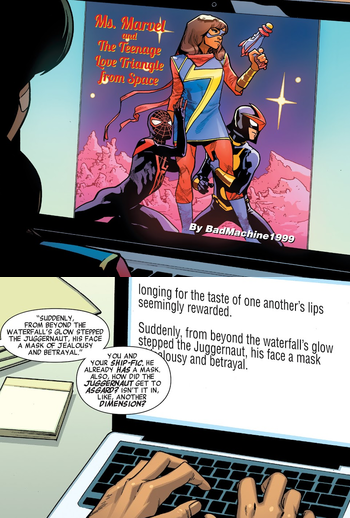
If you want something done right, do it yourself.
Fan Fiction is a form of Alternate or Expanded Universe created by the fans of a work, rather than the work's original creator. Fan Fiction stories, or "Fanfics" as they are often called, are written for any number of reasons, such as:
- to continue a story that ended prematurely (see Continuation);
- to redo a story the way the author thinks it should have gone (see Fix Fic);
- to see what would happen if certain characters are placed in unusual situations (see Alternate Universe Fic);
- to see what would have happened had events from canon played out differently (see What If?);
- to see what happens when the characters of one franchise encounter the characters of another franchise (see Crossover);
- to see who would win in an all-out throwdown (see Let's You and Him Fight and Ultimate Showdown of Ultimate Destiny);
- to imagine oneself in the fictional universe (see Self-Insert Fic);
- to get the characters to have crushes on, have sex with, date, marry, or have children with each other or the author/reader (see Shipping)
Due to the inexperience of many fanfic writers, fan fiction has gained a reputation for being a source of horrible, horrible writing. However there are fanfics out there that are INCREDIBLY good — sometimes arguably being just as good as, if not better than, the original work.
Saying "It was like a fanfic episode," though, is not usually a compliment.
Fan fiction is often the place where Epileptic Trees are planted and cultivated. Expect many, many, many more fics to star the Ensemble Dark Horse than The Hero.
Although fanfic exploded along with The Internet, it existed well before the Net did. Such luminaries as John Stuart Mill contributed unauthorized, original stories set in a fictional universe. Before medieval French troubadours were shipping Lancelot and Guinevere, the ancient Greeks were writing plays about relationships between characters in The Iliad. In Plato's Symposium one character complains that a play by Aeschylus got the characterization of Achilles and Patroclus wrong. Namely, that it got the Lover and Beloved dynamic backwards.
Not all fanfic is written, though that's the most common form. It can be in any format that can tell a story. In Japan, manga doujinshi (amateur "comic books") are a common vehicle; and with the increasing ease of their production on personal computers, Fan Videos (ranging from anime series, to Star Wars) have also appeared.
The distinction between fanfic and original fiction, as we know it today, is largely created by modern copyright law; much of classical writing is actually "fan fiction" based on older sources. The major distinction between fanfic and a story inspired by another story is that the story a fanfic is based on has one or more "official" versions, usually owned by a company, a creator, or both. Thus, things like The Infancy Gospel of Thomas , a piece of biblical apocrypha featuring Angry!Uber!Baby Jesus, or variations on Arthurian Legend where there is no Holy Grail and Lancelot's affair with Guinevere never happens, would not "count" by this definition.
No statement on the legality of fanfic, based on works still under copyright, has ever been given in American formal law or in its courts. The two most common arguments for fanfic being legal involve either implied consent — companies and authors have every right to enact a Fan-Work Ban as evidenced by FanFiction.Net's banlist but are mostly tolerant — or fair use — the non-profit, educational and transformative use of the work justifies its existence; see "Legal Fictions: Copyright, Fan Fiction, and a New Common Law". The first is something of a misunderstanding of how legality works; you would need active permission from the rights holder for fanfics to be legal and silence does not impart permission. The latter is the main argument that sparked the development of the Organization of Transformative Works, a fan labor advocacy site.
Authors often have conflicted reactions to fan fiction set in "their" universe, which sometimes leads to the aforementioned Fan-Work Ban. J. K. Rowling has largely embraced Harry Potter fanfics, albeit with certain limitations, for example, and Tamora Pierce advises aspiring writers that fan fiction can be a good way to hone one's writing skills. Sir Terry Pratchett acknowledged it exists and was cool about it, pointing out that everything works so long as people are sensible about it. He added two caveats: anyone doing Discworld fanfics shouldn't even think of doing it for money, and authors should take care not to put it where he might see it — since he didn't want to risk being accused of plagiarising his plagiarists (so to speak) for his own future plots, however inadvertently. George R. R. Martin, author of the epic fantasy series A Song of Ice and Fire, expressed his disdain for the practice, saying that "creating your own characters is a part of writing." He's even gone so far as to threaten legal action should he become aware of any fan fiction set in the Westeros universe. In contrast, writer/journalist James Bow makes a rather firm case for supporting fanfics, pointing out that it forms a stepping stone towards creating your own characters and setting. As far as media businesses are concerned, reactions have ranged from Archie Comics demanding immediate removal to Paramount taking some of the better Star Trek fanfics and having them published in print books.
It should probably be noted that several big-name authors are themselves writers of fanfics. Both Stephen King and Neil Gaiman have written (for example) stories dealing with Cthulhu, Dracula, and Sherlock Holmes, and label these stories fanfics. Contributors to franchises such as Doctor Who such as Paul Cornell have often posted wholly unofficial stories to their blogs and websites, above and beyond their fully licensed scripts and novels.
Some franchises — such as Star Trek — have actually turned fan fiction into a profit source by creating Tie In Novels. These books are usually penned by young and upcoming authors, often former fanfic writers, and represent an intermediate state between fan fiction and completely original fiction.
In the end, more and more media outlets are recognizing that fan fiction and other fan works are a simple fact of life. And as art imitates life, it's now possible to find fake fan fiction created as part of a marketing campaign. For example, the 2010 season of Showtime's United States of Tara introduced a new character, an artist who had created and published a comic book character named "Princess Valhalla Hawkwind". As part of the promotional buildup for this, Showtime actually created a "fan site" complete with fanfic, fan art, and fan video.
Some fan fiction becomes well-known enough to influence other fanfics, which themselves influence more fanfics, and so on in a domino effect. This can and does result in the creation and perpetuation of Fanon — when one author comes up with a "cool detail" and others blindly copy it without realizing it was a fellow fan's invention and didn't belong to the official source material. Furthermore, characters can become Flanderized by the feedback loops of fan fiction, sometimes changing dramatically from their original form.
Eventually, this accretion of fan-born details and mutations turns into things that "everybody knows" about the series. Those new to or unfamiliar with the original material are frequently confused into believing that it obviously must be Canon if so many people mention it, even "facts" of the Epileptic Trees variety. This is especially the case with series that have long runs and which gloss over details which are unimportant to the plot but are of interest to the fans and the fan writers.
One example is the Harry Potter fanfic The Draco Trilogy, which was apparently so widely read that details such as Blaise Zabini being female and Ginny's name being Virginia were taken to be canon, although they were both refuted by later books.
Another example of this is the manga/anime Ranma ½, released well before the Internet became ubiquitous and when many fans had no easy access to the original source material. All manner of detailsnote were never touched on in the actual show but became standardized in Ranma fan fiction over the course of approximately a decade. The process was accelerated and exacerbated by the appearance of fan fiction written by people who had never actually seen the show itself and whose only exposure to Ranma was other fan fiction.
It's not surprising that fans of some shows occasionally pen FAQs solely to reduce the accumulation of fanon in this way.
Another problem with fan fiction is sometimes writers don't do their research even when it is very simple. A common occurrence is when an author from a country other than the original work's country of origin writes characters as if they are from their own country. An example is Harry Potter where non-British writers (particularly American) make characters act and think like an American would; this also happens vice versa as seen in Fifty Shades of Grey.
Currently, the largest source of fan fiction on the Net (and probably anywhere else) is the aptly named FanFiction.Net, which as of 2022 offered approximately 14 million stories across all but a select few canons (which were banned due to creator request) and an automated system for posting. The fanfic-archive-turned-repository site Archive of Our Own, part of the larger Organization for Transformative Works, has over 10 million stories and less restrictions on what can and cannot be posted. In mid-2013, Amazon.com joined in the act with its Kindle Worlds program, which allows for the publication and sale (!) of fan fiction from specific 'verses, which was shut down in 2018.
See also Memetic Mutation and Shipping. For fanfic-specific tropes, see Fanfic Tropes.
Of course, the hive mind has a few favorites. There are also a few favorite unfavorites, if that doesn't confuse you too much. Some here have even written a few.
Note that since this is intended to be an index of fics with pages, a Red Link will be frowned on and given a very brief (week or two) grace period before being removed by your fellow tropers. Start the page for the fic if you think it should be in this index.
This page is for the sub-medium of literature. Other types of fan work belong on the subpages of Fan Works (Fan Film, Fan Vid, Fan Music, Filk Song, and so on). We're working on moving the misplaced works — help Fan Films, Fan Vids, and others get to their correct index!
Special note for authors of fanfics: The fact that you wrote the fic gives you no say in whether or not we have a write up on it, unless you create the page for it yourself. Furthermore, you do not have more say on the contents of the page than any other author. You quite expressly do not have the right to have our page taken down because you wish to disown your work or because you don't like the tropes we have found in it. The page here is ours. The fic is yours. Those are different things.
- After-Action Report: A fan fiction based on a game.
- Drabble: A fan fiction that is 100 words long.
- Lemon: A fan fiction which explicitly contains sex. Banned on FanFiction.Net if the sex is explicit enough to warrant an MA rating, though there has been some disagreement over where the line between M rated and MA rated content should be drawn.
- Lime: The fan fiction has sex in it, but it's not explicit; softcore Lemon.
- Log Fic: A story told in the form of a computer document.
- MST: Story in which characters riff a previously written work via snarky comments inserted into the original text. Banned on FanFiction.Net.
- Script Fic: A fan fiction in the form of a script. Banned on FanFiction.Net.
- Song Fic: Exactly What It Says on the Tin. Banned on FanFiction.Net if copyrighted lyrics are quoted within the text.
By genre:
- Accusation Fic: A fan fiction where an episode is rewritten so that the character the author blamed gets the worst of it.
- Betrayal Fic: A fan fiction where the main character is betrayed by their loved ones, usually resulting in a swift change of alliances and demeanor.
- Coffee Shop AU Fic: A fan fiction set at a coffee shop, usually in a romantic context.
- Crack Fic: Bizarre fan fiction.
- Curtain Fic: A fan fiction that has a domestic chore as the plot.
- Dark Fic: A fan fiction which is much more serious than the official work.
- Death Fic: Killing off a character in fan fiction.
- "Five Things" Fic: A fan fiction involving six (or more) similar scenarios, where the final scenario deviates from the others.
- Fusion Fic: A Crossover where the characters in Work A replace the characters in Work B.
- Gen Fic: A fanfic not focused on shipping.
- High School AU: Rewriting the characters as high school students.
- Historical AU: A fan fiction about placing the characters in a different time period.
- Hurt/Comfort Fic: A fan fiction about Alice comforting Bob who is emotionally or physically hurt. Sometimes focuses more on the hurt than the comfort, or vice versa, which can lead to the subgenres Hurt No Comfort and Comfort No Hurt.
- Kid Fic: A fan fiction where characters start a family.
- "Let's Watch Our Show" Plot: A fanfic where the characters are forced to watch episodes of their source material.
- Magical Girl AU: Rewriting the characters as Magical Girls.
- Modern AU Fic: Fics set in a contemporary (and often mundane) setting.
- Perspective Flip: A re-write of the original events, but from a completely different point of view — often that of the villain.
- Porn Without Plot: The story is dirty, but has no plot.
- Porn with Plot: The story is still dirty, but does have a plot.
- Rational Fic: A fan fiction written to reward the canon author for their good thinking.
- Recursive Fic: When a fan fiction gets popular enough to have fan fiction of its own.
- Series Fic: A series of fanfics.
- Slash Fic: Shipping of two characters of the same gender. Generally called slash for men and femslash for women.
- Soulmate AU Fic: A fan fiction that involves soulmates meeting each other.
- W.A.F.F. (Warm And Fuzzy Feeling): A fan fiction designed to be cute.
- War Fic: A fan fiction where the characters fight in a war.
- Zombie Fic: A Zombie Apocalypse in a fan fiction.
By relationship with canon:
- Alternate History (where "canon" here is Real Life)
- Alternate Universe Fic: The rules of the canon have been warped.
- Continuation: Continuing the story.
- Deconstruction Fic: Deconstruction through fan fiction.
- Elsewhere Fic: A fan fiction set somewhere that is not where the main characters are.
- Film Fic: A fan fiction which is the plot of a film.
- Fix Fic: The writer is re-writing the story the way they think it "should" be.
- Flash Forward Fic: A lot of time has passed after the events of the canon.
- Hate Fic: A "fan" fiction written by a member of the work's Hatedom to mock it.
- Original Flavour: A fan fiction that sticks as close as it can to the original canon material.
- Parody Fic: A fan fiction spoofing the original work.
- Patchwork Fic: Characters from different adaptations are in the same story.
- Peggy Sue: Character finds themselves back in time with the chance to change history.
- Pseudo-Canonical Fic: Expanding the universe.
- Revenge Fic: A fan fiction that has something bad happen to a character the writer doesn't like.
- Super Fic: The characters are re-imagined as superheroes.
- Troll Fic: A fan fiction that is supposed to be bad.
- Completed Fic
- Dead Fic
- Fan Webcomics
- Fan Works
- Fanfic Authors
- Fanfic Recommendations
- Fanfic Tropes
- Fanfics Pre-2000
- Fanfics of the 2000s
- Fanfics of the 2010s
- Fanfics of the 2020s
- Fanfiction Archives
- Fan-Work Ban — authors who forbid Fan Works. They tend to mostly be writers, and the type of fan work they tend to mostly ban are fanfics.
- One-Shot Fic
- Science Fiction Fanfic
Waldorf: What do you mean?
Statler: They make the source material look amazing in comparison!
Both: Do-ho-ho-ho-ho-ho-ho-ho-ho-ho-ho-ho-ho!
