

Stan Laurel (born Arthur Stanley Jefferson; 16 June 1890 – 23 February 1965) and Oliver "Ollie" Hardy (born Norvell Hardy; January 18, 1892 – August 7, 1957) were an early 20th century comedy double act famous for their slapstick brand of cinematic humor. Among the most enduringly famous of Laurel and Hardy's works are The Music Box, which features two workers' Sisyphean attempts to haul a piano up several flights of stairs, and Babes in Toyland.
Laurel and Hardy started their screen partnership with director Hal Roach's studio in the late 1920s, and occasionally worked with bigger studios such as RKO and Metro-Goldwyn-Mayer. Notable for their successful transition from silent-era film to "talkies", they were extremely prolific throughout the late '20s and the '30s and continued to make movies through 1951. In later years, they also toured extensively as stage performers in Europe.
Though the pair's sketches were often the result of a team of writers, Laurel was something of an idea person who rewrote segments of scripts and did a lot of improvising.
Unlike many comedy duos, they were best friends in Real Life as well; when Hardy passed on, Laurel was devastated and never again appeared on-screen.
They are fondly remembered in popular culture today, thanks to constant television showings, inspiring many other comedy duos and the techniques they pioneered in their films.
A 1999 attempt at a reboot titled The All-New Adventures of Laurel & Hardy in: For Love and Mummy features the duo involved in a plot by an insane Egyptian to rule the world by allowing a snake demon to marry an archaeologist's daughter. It was directed by Larry Harmon and John R. Cherry IIInote and stars Bronson Pinchot and Gailard Sartain as the titular duo alongside Oscar winner F. Murray Abraham as a museum curator.
The 2018 film Stan & Ollie chronicles their 1950s tours in Europe after their Hollywood movie career ended, with Steve Coogan and John C. Reilly portraying Laurel and Hardy respectively.
Laurel and Hardy works with TV Tropes pages:
- The Battle of the Century (1927)
- Big Business (1929)
- Double Whoopee (1929) — co-starring Jean Harlow. Really!
- The Hollywood Revue of 1929 (1929) — all-star revue with Stan and Ollie appearing in one sketch as incompetent Stage Magicians.
- Pardon Us (1930)
- The Music Box (1932) — winner of the Academy Award for Best Short Subject (Comedy).
- Pack Up Your Troubles (1932)
- The Devil's Brother (1933)
- Sons of the Desert (1933)
- Going Bye-Bye! (1934)
- Babes in Toyland (1934)
- Bonnie Scotland (1935)
- The Fixer Uppers (1935)
- Tit for Tat (1935)
- The Bohemian Girl (1936)
- Our Relations (1936)
- Way Out West (1937)
- Block-Heads (1938)
- The Flying Deuces (1939)
- A Chump at Oxford (1940)
- Saps at Sea (1940)
- Air Raid Wardens (1943)
- Nothing but Trouble (1944)
- The Bullfighters (1945)
- Robinson Crusoeland (1951)
Well, here's some other nice tropes you've gotten us into!
- Action Girl: Thelma and Rubie from Two Tars, who beat up the sweet shop assistant when he fights Ollie and Stan.
- Acrofatic: Oliver Hardy was a talented physical comedy performer and a graceful dancer, despite his size. He did many complicated stunts in his career, as his character suffered various pratfalls and disasters.
- Agony of the Feet:
- The Rifs in Beau Hunks have tacks assaulting their feet (which stops the entire army from slaughtering the whole fort).
- If there's someone who's most likely to recieve something heavy on one of his feet, it's Ollie. Complete with his trademark pain scream, and often with Hurt Foot Hop.
- Air-Vent Passageway: Busy Bodies ends with poor Ollie falling down a drain at a woodworking shop and getting sucked into an absurdly long and winding air vent. Naturally, it's not quite big enough at the end, leaving Ollie stuck in the exhaust port.
- All Just a Dream: The Laurel-Hardy Murder Case and Oliver the Eighth turn out to be this, fortunately for Oliver as they both ended with a razor-sharp knife held to his throat.
- Amusing Injuries: Frequently. It's mostly Ollie who gets injured, though.
- Aside Glance:
- One of Hardy's trademarks, turning to the camera with an expression that just reads, "Why always me?" Also used when he was baffled by Stan's actions, when it means "What is Stan doing now?" It was often used to pad out a gag to give the audience time to finish laughing so they wouldn't miss the next bit of dialog. note
- Stan himself would sometimes direct a befuddled gaze at the camera.
- Badass Army: The French Foreign Legion in Beau Hunks and The Flying Deuces are presented as tough-as-nails soldiers who keep fighting no matter how hopeless the odds.
- Badass Boast: Courtesy of Stan of all people, in Two Tars when he takes on the shop owner threatening him: "You're flirtin' with Death, son!"
- Battleaxe Nurse: Dorothy Coburn's character in The Finishing Touch — she looks more like a Hospital Hottie, but she quickly has Stan, Ollie and the local cop in terror of her.
- Bedsheet Ladder: In Laughing Gravy, Stan tries to hoist Ollie up via one of these, with the expected results.
- "Begone" Bribe: In Below Zero, the boys are attempting - with little success - to make money as street musicians. At one point during their performance, a woman calls down from a window and asks how much money they average per street. Ollie gratefully replies, "about fifty cents a street"...and the woman tosses them a dollar and bluntly requests that they move down a couple streets.
- Bizarre and Improbable Golf Game: At the conclusion of Should Married Men Go Home?, the "the ball must be hit from where it lands" variant sets off the final Escalating War.
- Blood Knight: In Two Tars
 , Stan and Ollie's girlfriends urge them on during the car wrecking and personally go to kick the ass of the sweet shop assistant when he beats both of the boys up.
 - Bloodless Carnage: In Beau Hunks, two Legionnaires get a few bursts from a heavy machine gun and fall off the battlements with no blood seen at all, despite one clearly wounded in the face and the other in the torso.
- Borrowed Catchphrase:
- In Dirty Work, Ollie's catchphrase is "I have nothing to say", which Stan borrows at one point.
- In Chickens Come Home, Stan interrupts when Ollie is about to blame him for his current predicament, cheekily finishing off the latter's long-running catchphrase.Ollie: Well...
Stan: Here's another nice mess I've got you into.
- Brick Joke: Almost literally in The Finishing Touch — at the beginning, Ollie puts a stone under their lorry's back wheel, since the brakes are faulty. The lorry isn't seen again until the end, when, in the middle of a stone-throwing battle with the irate homeowner, Stan and Ollie are in need of ammunition...
- Butt-Monkey: Both of 'em always tend to hilariously suffer injuries and damage like they were trouble magnets.
- The Cameo:
- Max Davidson's Call of the Cuckoo (1927) features Laurel and Hardy (along with Charley Chase and James Finlayson) as mental hospital patients.
- The all-star charity short The Stolen Jools (1931) includes a brief appearance by the duo.
- ZaSu Pitts and Thelma Todd's On the Loose (1931) ends with an appearance by Stan and Ollie.
- The Little Rascals short Wild Poses (1933) briefly features the duo as babies.
- In Charley Chase's On the Wrong Trek (1936), Stan and Ollie unsuccessfully try to hitch a ride from Chase.
- The 1936 Hal Roach feature Pick a Star includes the team (partially in character and partially as themselves) in several memorable scenes.
- Oliver Hardy briefly appears in the Frank Capra feature Riding High (1950).
- Character Catchphrase:
- "Well, here's another nice mess you've gotten me into!", often said by Ollie to Stan after things went awry. It's often misquoted as "another fine mess" (which was the name of one of their 1930 short films) or "...another fine mess you've gotten us into!"
- Laurel's tearful, high-pitched whimper of "Well, I couldn't help it!", often in response to the above accusation. Or as a variation "It wasn't my fault!" or "You always blame me!" or "I had nothing to do with it!"
- Also, Hardy's cries of "Why don't you do something to help me?" and "Why can't you be more careful?", the first of which usually prompts Laurel to ask, "Well, what can I do?"
- "I'm Mr. Hardy, and this is my friend Mr. Laurel," was Ollie's usual phrase when handling introductions for himself and Stan.
- Ollie's famous howl of pain ("OOOOOOOOH-hooh-hooh-hoooooh!")
- Frequent co-star James Finlayson had his trademark exclamation of "D'oh!" (Which, as you might possibly have heard, was appropriated decades later.)
- Character Tics:
- Ollie's bashful tie-twiddling and exasperated Aside Glances to the camera.
- Stan's idiotic grin, befuddled head-scratching, and impish grin-shrug.
- The forceful "Take that!" nods both would give to punctuate an Escalating War.
- Ollie's distinctive way of writing his signature: wielding the pen in grand flourishing motions, and finishing with a sharp jab of pen against paper.
- James Finlayson, a regular co-star in several of their films, was known for his wild double takes and one-eyed glares.
- The Chew Toy: Ollie, always on the receiving end of most injuries.
- Clothing Damage: Also very frequently, with both Fanservice and non-Fanservice examples. Instances of the former include Jean Harlow getting her dress caught in a taxi door and then torn off in Double Whoopee, and Thelma Todd having her dress set on fire and then removed in Unaccustomed as We Are; while examples of the latter occur in plenty of the duo's movies when they engage in an Escalating War.
- Comically Missing the Point: In Jitterbugs, released in 1943, Stan and Ollie declare that gas rationing is "The Greatest Threat Facing the World Today." Note the fact that gas rationing only took place because of the war, and that were a few slightly bigger threats at the time.
- Covered in Mud: The Escalating War at the conclusion of Should Married Men Go Home? is a mud fight.
- Credits Gag:
- Another Fine Mess has its credits recited aloud by a pair of twin usherettes (Beverly and Bettymae Crane).note
- The Midnight Patrol had the credits changer swish by an animated windshield wiper.
- Busy Bodies had the buzz saw switch the credits.
- The Chimp had the credits on the hoop drum.
- Dirty Work has liquid bubbling up and down as a credits changer.
- Crouching Moron, Hidden Badass: At the end of One Good Turn, Stan snaps and starts physically attacking Ollie while shouting threats. The boys added this in because Stan's little girl was scared of her "Uncle Ollie" (she thought the way he bullied Stan in the films was real); seeing a movie where her dad finally stood up to him completely fixed the problem. This was also an example of Serendipity Writes the Plot: The ending was improvised because Stanley's daughter was actually on the set that day and he wanted her to be happy.
- Curb-Stomp Battle: Seen in Beau Hunks. Once Ollie and Stan unleash tacks on the Rifs, the battle is immediately won by the French Foreign Legion.
- Dashingly Dapper Derby: Both of them wear derby hats, which became part of their Iconic Outfits.
- Deadpan Snarker: Ollie, usually towards Stanley when he says or does an idiocy. He can also be a silent one.
- The Dead Rise to Advertise: Long after Laurel and Hardy's deaths; throughout the '70s and '80s their likenesses (performed by uncredited impressionists Chuck McCann and Jim MacGeorge) would be used in numerous TV commercials for such products as Arby's restaurants and Anco wiper blades.
- Defeat by Modesty: In The Finishing Touch, they get a Battleaxe Nurse out of their hair by ripping a piece of sandpaper in two as she bends over to pick up a hammer, then making believe the back of her dress has torn open.
- Denied Food as Punishment: In Any Old Port, During the diner scene, After Oliver and Stan placed the order, Oliver told Stan that he can't have a meal because he has to fight tonight at the boxing. And Oliver leaves the poor and hungry Stan whining in a high-pitched voice.Oliver Hardy: You can't have a meal!Stan Laurel: What do mean I can't a meal?Oliver Hardy: Because, You gotta fight tonight! (To the waiter) Uh, One order, please?Stan Laurel: (Voice breaksdown) I thought you were fighter....Oliver Hardy: No, I am the manager and you are the fighter!*He leaves poor and hungry Stan sobbing in a high-pitched voice*
- Depending Upon the Undependable: Neither Stan or Ollie is very smart in most of their filmography (though Ollie assumes he's the smarter). However, out of character, Hardy claimed that his character was the stupider because he kept expecting Stan to manage things no matter how often Stan got them into "another nice mess".
- Dine and Dash: Their Purple Moment has Stan and Ollie attempting this to no avail.
- Doom It Yourself: Ollie's wife insists that Ollie should put up an antenna for her radio set in Hog Wild. By the time he and Stan are done, the antenna may be up, but the house is in need of several more substantial repairs.
- Downer Ending: There were several films with a Downer ending (usually known as the freak ending) where the boys' bodies are tortured (AKA Body Horror), and ends with Ollie telling Stan "Well, here's another nice mess you've gotten me into!" And Stan whines in a high-pitched voice "But I couldn't help it, you always blame me!"
- The Live Ghost has Stan and Ollie's heads backwards.
- Thicker Than Water has a botched blood transfusion switch Stan and Ollie into absurd caricatures of each other.
- Other endings that were not body terrors were included Helpmates (Stan accidentally burns Ollie's house down), Saps at Sea (Stan and Ollie are sent to jail at the Harbor Patrol Prison, and forced to share a cell with the man they just had arrested), and Atoll K (AKA Utopia/Robinson Cruesoeland) (the team's belongings are taken away by the authorities due to failure to pay taxes).
- In The Midnight Patrol, they are straight up shot dead by their chief of police!
- Driven to Suicide: The boys' landlord in Laughing Gravy, after his final attempt to evict Stan and Ollie fails. He angrily walks off with a rifle and shoots himself offscreen.
- Driver Faces Passenger: In Two Tars, Stan is so busy talking to Ollie that he nearly hits a light pole. A disgusted Ollie takes the wheel, says to Stan "first rule of the road — drive straight ahead", and immediately after he says this, hits a light pole.
- Dumbass Has a Point: In Brats, Stan mentions that treating kids with kindness is better than yelling at them, and Ollie agrees! Bonus points to Stan for using what seems to be another Malaproper saying, "You can lead a horse to water, but a pencil must be lead." However, Ollie doesn't pull off an Aside Glance; he chuckles and nods.
- Early-Installment Weirdness: In the earliest shorts the characters weren't completely defined. In the first "official" Laurel and Hardy short, Putting Pants on Phillip, Stan and Ollie aren't wearing the bowler hats, they aren't quite as dumb as they became in later shorts, and at the start of the film, they are strangers to each other.
- Prior to their official billing as a comedy duo, the two acted together in several silent shorts, but not yet as the partnered characters of "Laurel and Hardy." The first film they were in together, 1921's The Lucky Dog, featured Laurel as the protagonist and Hardy as a robber who accosts him at one point, the two only encountering each other by chance. However, even in those early days one can see hints of their characters' future dynamic in their body language during their brief interaction.
- When Ollie first started using his iconic catchphrase "Well, here's another nice mess you've gotten me into!" Stan would occasionally response questioning what he's done.
- Engineered Heroics: In Night Owls, Officer Kennedy blackmails Stan and Ollie into breaking into the police chief's house, so that he can stage their arrest and win the chief's favour. It doesn't work out quite that way.
- Escalating War: A frequent occurrence. Some good examples are the house and car getting wrecked in Big Business, the pie fight in The Battle of the Century, the second half of Two Tars, and the feud with a grocer in Them Thar Hills and its sequel Tit for Tat.
- Escaped Animal Rampage: In The Chimp, Laurel and Hardy inherit a chimpanzee from the circus. A lion escapes from the same circus and chases Laurel, Hardy and the ape.
- Fat and Skinny: The Trope Maker. The visual contrast between tubby Ollie and scrawny Stan was part of the humor. Oliver Hardy actually disliked being overweight, but the studios insisted upon his not dieting to maintain this trope.
- In Spanish they are known as "El Gordo y el Flaco" (The Fat and the Skinny).
- In Dutch too: "De Dikke en de Dunne" (The Fat and the Skinny)
- In Brazillian Portuguese, "O Gordo e o Magro."
- In European Portuguese, "O Bucha e o Estica" (The Chub and the Stretch).
- In German as "Dick und Doof" (Fat and Stupid).
- In Finnish as "Ohukainen ja Paksukainen" (Skinny and Fatty).
- Fat Idiot: While Stan is known to be stupid, Ollie has been shown to be no better and his actions only make the situation worse. Hardy explained that he played his character as an idiot who thinks he's smart, while Laurel's character was an idiot who knows he isn't smart.
- Failed a Spot Check: Hardy at the beginning of Hog Wild: "Where is my hat?!"note
- Failure Is the Only Option: Very few of the comedy team's films end with them achieving success, usually because Stan does something utterly boneheaded to snatch defeat from the jaws of victory.
- Funny Background Event: In Angora Love, the landlord that Stan and Ollie have been antagonizing storms into their room, shakes his finger at them, and says "I want you guys to know, this is a respectable hotel!" Directly behind him, through the open door, a lady in a tight dress can be seen walking by, followed by a sailor.
- Gainax Ending: Come Clean is fairly standard comedy involving the eponymous duo hiding a strange woman from their wives while trying to get rid of her. The short ends when the police arrest the woman for an unnamed crime and ask who brought her to the apartment. Oliver claims that Stan is responsible, and the policeman says he'll receive a $1000 reward. Ollie then pulls the plug on the bath that Stan is sitting in, causing him to be sucked down the drain. When his wife asks where he's gone, Ollie answers "To the beach."
- Grave Robbing: In "Habeas Corups" a Mad Scientist sends Stan and Ollie to the graveyard to dig up so body. It goes about as well as you'd expect, especially since there's a police informant there just to screw with them.
- Good Hair, Evil Hair: Hardy is the only one aside from Charlie Chaplin who gets a free pass for using the toothbrush mustache that Adolf Hitler made infamous.
- Hats Off to the Dead: After the landlord in Laughing Gravy walks off-screen and shoots himself, the boys and a cop on the scene take off their hats.
- Heterosexual Life-Partners: The characters they portrayed, more often than not. Stan and Ollie were always living together, working together, and going on adventures together. Even in films where their characters were married, they were always best friends hanging out together.
- House Squatting: Another Fine Mess involves Stan and Ollie running into a mansion to hide from the police. The owner of the mansion, Colonel Buckshot, has just left on a six-month hunting trip and his servants also leave on a short vacation themselves. Stan and Ollie decide to stay in the mansion for awhile, but Hilarity Ensues when a wealthy couple shows up interested in renting the mansion. This was a remake of an earlier silent Laurel and Hardy short from 1927 titled Duck Soup; the plot was nearly identical.
- Iconic Outfit: They often wear frock coats and black bowler hats. Ollie is also usually seen with a long tie while Stan wears a bow one.
- Idiosyncratic Wipe: Thicker Than Water parodied the wipes by having Ollie reach out to the edge of the frame and physically drag the new scene across the screen as he and Stan exit. Later in the film Stan tries it but in his haste the new scene slips from his fingers and slides back, and he has to double back and do it again.
- Implied Death Threat:
- In Me and My Pal, Ollie is set to be married, and best man Stan is responsible for ordering flowers for the ceremony. Ollie ends up running very late (he got distracted by a jigsaw puzzle), and when the flowers are delivered to the wedding venue while everyone is waiting, they turn out to be a funeral wreath (because, well, Stan). The incensed father of the bride storms off to confront Ollie himself... then briefly returns to grab the wreath before he goes, remarking, "I may have some use for this!"
- Mae Busch's character in Oliver the Eighth delivers one, though downplayed on the "implied" in this case, as her butler had just finished spelling out her intentions to Ollie.Busch: Good-bye, Oliver the eighth. I hope you have a nice. Looooong. Sleep. (walks off with an Evil Laugh, while her butler begins playing "Taps" on a trumpet)
- Informed Species: Ethel the ape from the 1932 short The Chimp, as the title suggests, is a chimpanzee, but she looks a lot more like a gorilla.
- Iron Butt Monkey: Both of them in most of their films. They can take pianos crushing them, ladders in the eye, houses collapsing on them and truncheons to the groin with only minimal pain, then go back to what they were doing in the first place.
- Jerk with a Heart of Gold: Despite going as far to hit and outright bully Stan, Ollie will not hesitate to help Stan when he's in danger, and in Liberty, he takes Stan's hand and helps him walk across the girders, when Stan's sobbing and shaking because he's terrified that they'll fall.
- Laser-Guided Karma:
- In "Oliver the Eighth", Oliver doesn't mail Stan's response to a "lonely hearts" writer to increase his own chances. It turns out that the writer is a Black Widow.
- In Swiss Miss, the boys are having dinner at a fancy Swiss hotel and insult the chef for not having the desert Ollie wanted. A moment later, they learn that the only money they have is fake and they cannot pay their bill, and they are put to work under that same chef, with an added caveat that if they break any dishes they will work an extra day for each one. The chef immediately instigates them breaking two dishes and promises them that they won't be leaving until their beards are trailing on the floor.
- Large Ham: Hardy, who shouts a lot at Stan and bellows when he gets hurt.
- Legion of Lost Souls: Beau Hunks and The Flying Deuces have the boys joining the French Foreign Legion. The army's presented as a Badass Army, BUT an entire, well-stocked fort is reduced to 10 soldiers, including their commander, within 20 days under siege.
- Leitmotif: "The Cuckoo Song."
- Lethally Stupid: Their natural gift for self-inflicted disasters is topped by The Three Stooges alone. Oliver Hardy once remarked that his character was actually the more thickheaded of the two, because he would always place his complete faith and trust in Stan no matter how invariably Stan led them into disaster.
- Like an Old Married Couple: The "bickering but inseparable" kind.
- Literal-Minded: Stan could usually be counted on to misinterpret turns of phrase in this way.Ollie: What causes [gout], Doctor?
Doctor: Too much high living.note
Stan: Well maybe we'd better move down to the basement. - Logo Joke: Many of the MGM shorts have a cute lion cub in the MGM logo in place of Leo the lion.
- Mad Scientist: Doctor Noodle in Dirty Work, who is working on a rejuvenation formula.
- Malaproper:
- Stan, often."We floundered in a typhoid.""A terrible cat's-after-me!" (Instead of a terrible catastrophe.)
- Ollie as well, often when trying to correct Stan.Stan: I heard the ocean's infatuated with sharks.
Ollie: Not "infatuated"! He means infuriated.
- Stan, often.
- Man in a Kilt: Stan's title character in Putting Pants on Philip.
- Marilyn Maneuver: Done for laughs with Stan, wearing a kilt, in Putting Pants on Philip.
- Misplaced Retribution: In Oliver the Eighth, the Black Widow villain was abandoned on her wedding eve by a man named Oliver, and so now she seeks out other Olivers to court and subsequently murder.
- Ms. Fanservice:
- Jean Harlow in Double Whoopee, where she comes out of a taxi wearing a slinky dress, and has even that torn off her when Stan and Ollie shut the taxi door on the dress.
- Thelma Todd in several L&H films before her untimely death. Todd was always wearing cocktail dresses or winding up in a Lingerie Scene or somehow injecting fanservice into Stan and Ollie's antics.
- Name and Name: Laurel & Hardy were their own names. That way they could control copyright over their public image.
- Never Bareheaded: The duo always wore their trademark bowler hats everywhere they went, but took them off when at home. Stan sometimes keeps his hat on more than Ollie, even at home.
- Never My Fault: When things (inevitably) go wrong, Ollie will always blame Stan. It's right there in his Catchphrase: "Well, here's another nice mess you've gotten me into!"
- No Fourth Wall: Ollie broke the Fourth Wall in nearly every single film, while Stan pulled off an Aside Glance a few times.
- No-Holds-Barred Beatdown: Everybody in the restaurant subjects the boys to this in Below Zero.
- Once an Episode: Ollie's annoyed/disgusted Aside Glance at the camera can be pretty much counted on at least once an episode, and even more in the features.
- One Dialogue, Two Conversations: In Men 'o War. A pretty young woman has lost her gloves in a public park. Ollie thinks she has lost a pair of panties that he just picked up off the ground (the panties actually came from the top of a load of laundry that a maid was carrying). What follows is the sort of ribald dialogue that would never be allowed after the Hays Code was imposed in 1934.Woman: I hated to lose them. They were so easy to pull on!
Ollie: [smirking] I bet you miss them!
Woman: Well you can imagine how I feel without them!
Ollie: Good thing it's warm weather, isn't it? [laughs] - On One Condition: An alternate, three-reel version of Laughing Gravy has Stan getting a letter informing him he's inherited $1,000 from a deceased uncle...provided he severs all connections with Ollie.
- Overly Long Gag: The boot routine that takes up the majority of Be Big!. Because of it, Be Big! is generally considered the worst of their shorts and sometimes even the worst film they ever made period prior to leaving Hal Roach.
- Pie in the Face:
- The Battle of the Century climaxes with a massive pie-fight involving dozens of participants.
- Their Purple Moment features a more limited exchange of these.
- Pintsized Powerhouse: Stan, who can punch a man in the chin hard enough to knock him out.
- The Pratfall: There's even a fan magazine for the pair called Pratfall. It's also one of their trademarks.
- Puddle-Covering Chivalry: Stan does this for the girl he's been chasing after in Putting Pants on Philip. The girl jumps over his coat and then laughs at him. Then Ollie insists on stepping on the coat—which, naturally, is covering a five-foot deep hole filled with water.
- Recycled Soundtrack: In Beau Hunks, the French Foreign Legion's March is a brass band version of Stan and Ollie's theme, the Cuckoo Song.
- Red Oni, Blue Oni: Ollie is frequently harsh and boisterous, Stan mostly calm and submissive.
- The Remake:
- Their first non-Roach feature, The Flying Deuces is generally called a partial remake of their earlier four-reeler Beau Hunks, using the same basic set-up—Stan and Ollie enlisting in the foreign legion after a woman breaks Ollie's heart—but not any of the earlier film's gags or plot developments.
- Laughing Gravy is a remake of the silent Angora Love.
- Running Gag: There's a lot of those throughout most of their movie library. In most movies, Stan and (primarily) Ollie will often be victimized by a water gag, like Stan stepping on a hose which sprays water in Ollie's face in Night Owls for example.
- "Shaggy Dog" Story: At the end of Hog Wild, after all the shenanigans the boys go through trying to fix Mrs. Hardy's radio, said radio ends up getting confiscated offscreen.
- Shockingly Expensive Bill: In Their Purple Moment, Stan – who has already discovered he doesn't have the money he thought he did, and will therefore be unable to pay the check at the nightclub he and Ollie are dining at with a couple of girls – is further confronted with a taxi driver, who has been parked outside with his meter running the entire time and has run up a fare of $22.10 (equivalent to nearly $400 in 2024 money) and counting. Then, to make things worse, Ollie – who is unaware of the money situation as yet – generously invites the cabbie to sit down and have a steak... on them. When the dinner check finally arrives, it comes to another $28.10 (about $510 in 2024 money).
- Slapstick: Appears a lot, and is also one of the things the duo is primarily remembered for. Even after they switched to sound, loads and loads of slapstick appeared in their shorts and features.
- Smart Jerk and Nice Moron: The Trope Codifier in film. Every other variation in comedy pays lip service to them. Though it must be said that Ollie really isn't that much brighter than Stan; he just assumes he is.
- Soft Glass: Ollie goes crashing through the roof of a greenhouse in Dirty Work but suffers no ill effects.
- Stage Magician: All-Star Cast sketch film The Hollywood Revue of 1929 includes one sketch with Stan and Ollie as incompetent, bumbling Stage Magicians.
- Straight Man and Wise Guy: Hardy as the grumpy, no-nonsense straight man and Laurel as the bumbling, foolish wise guy. However, they suffered equal amount of Amusing Injuries.
- Strong Family Resemblance: Exaggerated in Brats: Stan and Ollie's kids are basically miniature versions of them, although Ollie's son doesn't have a mustache. Equally in Twice Two, where the boys are married to each other's sisters, again played by themselves.
- Super-Strength: Both are surprisingly strong-they can haul pianos up stairs again and again, tear down doors and push a man into a car hard enough for the car to tip over as well.
- Superhuman Transfusion: Variant— in Thicker Than Water, a botched blood transfusion (too much donated from Stan to Ollie, then too much put back from Ollie to Stan, and so on) results in Ollie's excess weight being transferred over to Stan. (Of course, in reality, Hardy had simply shaved his mustache and Laurel was wearing a false one, to appear as each other.) See here.◊
- Suspiciously Similar Substitute: In 1939 Stan Laurel's contract with Hal Roach had expired and Laurel was haggling. So Roach made Zenobia, a film starring Oliver Hardy and Harry Langdon, who sort of looked like Stan Laurel with a rounder face.
- The Take: In various forms, including all manner of Spit Takes and the hilarious Delayed Reaction take that was Laurel's specialty.
- Theme Serial Killer: In Oliver the Eighth a demented rich lady has a habit of inviting men named Oliver to her mansion so she can slit their throats.
- Theme Tune: The "Cuckoo Theme" for the opening credits of many of their sound shorts.
- Throw the Pin: Stan in Beau Hunks.
- Tranquil Fury: When Stan snaps in One Good Turn, he shows no external anger whatsoever.
- Uncanny Family Resemblance: Brats has Stan and Ollie babysitting their lookalike children; Twice Two has them married to each other's lookalike sisters; Our Relations has them mixed up with their identical twins.
- Unconventional Food Usage: In The Hoose-Gow Stan and Ollie, having accidentally damaged the radiator of the prison governor's car, attempt to plug the leak with rice.
- The Unintelligible: Stan everytime he's crying.
- Unscrewed Salt Shaker: In 'You're Darn Tootin', Stan, unable to get any salt out of the shaker, unscrews the top. Then Ollie tries to use the shaker, not realizing what has happened, and the entire contents end up in his soup. He promptly changes plates with Stan, only for the whole process to be repeated with the pepper.
- Unsuspectingly Soused: Mae Busch's character in Them Thar Hills (thanks to moonshiners dumping their brew into the well); Mrs Beaumont in Scram!
- Vagabond Buddies: Two traveling guys, often at odds with each other but ultimately inseparable, taking on various odd jobs and other schemes to make money (and often having it backfire)... yep, that's them.
- Vandalism Backfire: In You're Darn Tootin', Stan and Ollie knock each other's hats off as part of an Escalating War. Then Ollie stamps on what he thinks is Stan's hat. It turns out to be his own.
- William Telling: In Do Detectives Think?, Ollie wants to show off his skill with a gun, so he has Stan put the apple on his head. Then Ollie winces, closes his eyes, fires, and hits a statue a good eight feet away.
- Work Off the Debt:
- Averted in Below Zero; the duo treats a cop to a meal in return for helping them earlier. It turns out that if you can't pay your bill in said restaurant, you don't wash dishes; everyone in the restaurant subjects you to a No-Holds-Barred Beatdown. Guess what happens to Laurel and Hardy when it's revealed that they can't pay their check?
- Played straight in Swiss Miss, with the added caveat that the boys must work an extra day for any dishes broken in the course of their work. The chef they are put to work under, whom they had earlier subjected to a barrage of insults for not having the dessert they wanted, is only too happy to take advantage of this.
- Wrong Bathroom Incident: This happens in a short movie, where Stan Laurel plays a visiting Scotsman. Seeing what looks like a kilted person in silhouette on the toilet door with what he reads as "LADDIES" underneath, Stan looks down at his kilt, compares it to the picture on the door, grins with relief, and walks in...
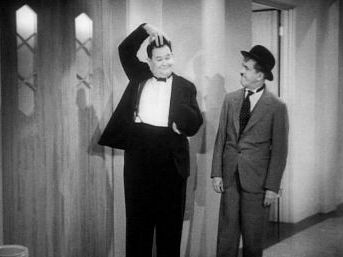
- "Well, there's another nice TV Tropes page you've gotten us into!"
[Whimpers] "Well, I couldn't help it! I thought TV Tropes wouldn't ruin our lives..."
