

Just as a gamemaster in a tabletop game may create artificial rules, boundaries and obstacles to keep his players on the game track that he has designated (a procedure known as Railroading), so too a video game may employ such tactics in order to force the player down a specific path or method toward the goal. And one of the easiest ways to keep a player from wandering off is, quite simply, to give the player nowhere to wander to.
Technically, this trope is the polar opposite of the Quicksand Box; it describes level architecture which forces the player down a singular path. This trope is most common in First- or Third Person Shooters (except, usually, tactical shooters) and platform games, wherein the challenge is generally supposed to be the enemies and/or obstacles, not in figuring out which way to go. It can also crop up in Role Playing Games as a very visual form of Railroading. The trope is forgivable in 2D Platform Games such as Super Mario Bros., which allow only forward progression due entirely to the limitations of the geometry; not everything is a Metroidvania. It only applies in situations where, intuitively, you'd think there might be other areas of a place to explore, but these are not implemented because they are not plot-important.
The most common incarnation is to simply have several rooms chained, each with a single entrance and a single exit, or to have long corridors with no side branches and few if any side rooms. The only options for progress are "forward" or "backward." This applies even when the rooms are tightly packed together and should have (you'd think) some degree of interconnectivity; imagine living in a New Orleans shotgun house, where you have to travel from the front porch into the living room, then through the kitchen, to the dining room, through the spare bedroom, and finally into the den, just to get to the bathroom. Every time you wanted to go to the bathroom. No shortcuts.
Note that these layouts do not necessarily preclude entirely the presence of side rooms or hidey holes. However, these are usually just little culs-de-sac with a weapon, power-up or treasure chest, or maybe a switch to allow continuation down the main path.
This was especially common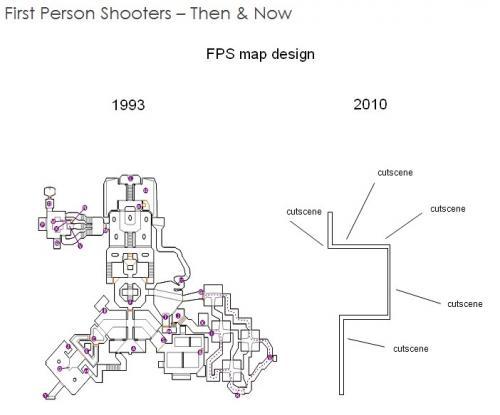 ◊ during the Seventh Generation of Consoles thanks to the industry-wide leap to HD increasing the budgets of that era's level design, limiting the number of paths that can be made at the required quality. Even with the rise of the Wide-Open Sandbox starting late in said generation, if the game designers want to keep a tighter, more evenly-paced story even today, sometimes this is the best design method to ensure that.
A popular method for enforcing this type of level architecture these days is by the use of Locked Doors, which adds a bit of verisimilitude by suggesting that, yes, other areas do normally exist in this location, but due to game constraints you won't be going in there; this can still be jarring if you're armed with powerful explosives or weapons designed for breaching doors and still can't get by a flimsy door, and more so if you destroy some such doors during the game but can't do anything to others.
In the 3D shooter genre, games that prominently feature this kind of architecture are sometimes called "Corridor Shooters".
Railroading is the Tabletop Game equivalent, where a Game Master tries to keep the party from deviating from his set plot.
As usual, Tropes Are Not Bad. Keeping gameplay linear makes introduction of gameplay elements easier, as a designer can be certain that the player has learned a skill from the previous room, and that they will not be thoroughly confused when the following room uses the same skill.
Compare with Follow the Plotted Line which pursues the same goal but tries to be more subtle about it.
Not to be confused with scripted games such as Adventure Games or Action-Adventure which use more subtle techniques to keep the player from going Off the Rails of the game's plot. Some of them do have levels that resemble this — Compare The Maze — or a Closed Circle series of rooms; but it's generally frowned upon in Interactive Fiction unless it's essentially a Cut Scene.
A Sub-Trope of Reduced-Downtime Features.
See also Broken Bridge, The Law of Conservation of Detail, Space-Filling Path, One True Sequence, Rail Shooter, Master of Unlocking, and Insurmountable Waist-High Fence. Quicksand Box is when developers go too far in the other direction. Video Games and Fate can be a way to justify this in-universe.
Examples
- In the Blades of Avernum community, anything designed by Terror's Martyr. The Avernum series is known for its huge outdoors and nonlinear approach to play... meanwhile, Terror's Martyr designs tiny, tiny outdoor sections, and scripted blocks to your path everywhere, so that you don't wander off the correct order of completing his scenarios.
- The Xbox game Breakdown has one single path and instead focuses on immersing you into its Mind Screw storyline rather than exploration. You get a few dialogue choices from time to time, and get to make a big decision to determine which of the two ending sequences you get to see, but that's the extent of it.
- Breath of Fire: Dragon Quarter is extremely linear in comparison to the rest of the Breath of Fire series, with no sidequests to be had and very limited chances to backtrack. Fridge Brilliance sets in once you remember that 2 of your 3 your party members will die if you don't reach the surface in time with one of them being the main character, and his limited amount of time being enforced with an everpresent counter that ticks up at varying rates depending on how much he uses his new powers. You simply do not have any time to mess about.
- Bulletstorm is extremely linear. There are invisible walls everywhere, even on ledges that are only a few centimeters high. Environmental hazards that harm the enemy do not harm you at all. For example, you can knock enemies into bottomless pits, yet you can't fall into them because an invisible wall blocks you.
- Call of Duty from Modern Warfare onwards. The original Call of Duty, United Offensive, Call of Duty 2 and Call of Duty 3 actually gave objectives that could be completed in any order the player desired, and there were often many alternate paths to an objective, each with their own pros and cons.
- Castlevania: Order of Ecclesia has many levels that are very short and only have one path from left to right. It's a departure from the usual Metroidvanias, but not too different from the 16-bit and earlier entries in the Castlevania series.
- Clive Barker's Jericho has monochrome and identical layouts and shallow sidelets that are fruitless to explore. There are no pickups in the game and plot coupons are only delivered on the intended track.
- The Conduit has this in its single-player campaign. It's all the more noticeable because the first two-thirds of the game are set in locations with lots of corridors (office buildings, underground bunkers, etc.). The last few levels of the game offer significantly larger areas, but progression is still very linear.
- The original three Crash Bandicoot games have 3D levels that are linear pathways with enemies, items and obstacles. Naughty Dog chose that kind of structure because they aimed to maintain the meticulous design and fast-paced rhythmic challenge of classic 2D platformers that had been lost in sandbox-y collectathons like Super Mario 64 note . The various limitations of both the PlayStation and its early controller also contributed to the trilogy’s signature linear structure. The second and third games open things up a little bit more by offering the player multiple sets of 5 levels that can be tackled in any order and are filled with branching paths, backtracking, hidden routes, and secret warps that reward players with a keen eye for cryptic clues.
- Several levels in Dawn of War II: Retribution. You notice this very quickly if you add Jump Infantry or teleport infantry to your squads, as they will magically — and for no reason whatsoever — be unable to use their abilities outside the one true path through the level. This gets especially bad during the Exterminatus level, which teases you with multiple alternate paths that all get blown up immediately when you get close to them.
- Descent 3. Gone are the vertigo-inducing maze maps of the first two games, replaced by Rail Shooter-style corridors. The outdoor sections only make it more jarring.
- Doom³: Downplayed. Compared to the abstract layouts of the classic games (including Doom 64), the Doom 3 levels are pretty linear, but they still have plenty of secrets, and sidepaths, especially with the optional vaults and P.D.A's. The Hell levels, especially in The Lost Mission, are a bit closer to the level design of the classic games and can easily feel non-linear on a first-time playthrough.
- Dungeon Siege is one of the biggest offenders, mainly because the required path is very, very long. The game also has only one Door to Before, meaning that backtracking from the end of the game back to the very beginning could easily take over half an hour real time.
- The Elder Scrolls V: Skyrim: While the large world is the polar opposite of this, its dungeons are almost uniformly single-path affairs with only one way to proceed and no meaningful branches,. There are exceptions, but very few (not including Labyrinthian, a dungeon from Arena noted for being very unlinear).
- Enslaved: Odyssey to the West couples a really pretty looking world that you would like to explore with the only path you can take highlighted for the player.
- The Operation: Anchorage DLC to Fallout 3 plays out this way, being almost completely linear, in contrast with the main game and other DLCs. Similarly, the final core quest, "Take it Back!", is a straightforward gauntlet, and you can't leave once you start it. Same with Fallout: New Vegas' Lonesome Road expansion pack, which also throws a sizable number of insurmountable waist height fences in your way but unlike Operation: Anchorage, you can leave. Even the theme of Lonesome Road is that "men change through the roads they walk".
- The original Far Cry, while having some choice of paths, was still highly linear, in contrast to the Wide-Open Sandbox gameplay of the Ubisoft Montreal-developed numbered sequels. The Xbox adaptation Instincts, and its sequel Evolution, were even more strict due to processing limitations.
- In Final Fantasy, beginning with the first game it's traditional to start with a nearly linear path, and either ease up over the course of the game or just dump you into a 'sandbox with a story' after a few hours. Once you get the ship or airship, the world opens up and Sequence Breaking is sometimes possible.
- Final Fantasy II is the only one that gives you total freedom of exploration at the start, and even then, accomplishing that is a feat in itself. If you move so much as 5 squares west of the starting city, you'll be fighting level 30 monsters. The game gives you very little indication of where to go next. You'll be told to go to X, but the game won't tell you HOW to get to X.
- Final Fantasy X, the first game in the series not to feature an Overworld Not to Scale, has very tube-like pathways, even in places like forests, with strictly controlled camerawork, features a disturbingly linear path through the vast bulk of the game's landmass. Even villages are corridor-like, and the game features a minimap that tells you which way down the one giant path to go to finish the game. The temples you have to stop at are also just rest stops along the predetermined path. There is, however, one notable wide-open field near the end of the game/long corridor... which turns out to have only one entrance and exit again. While there is some side content, most of it is found in the aforementioned wide-open field or after getting the airship at the very end of the game. Except for those moments, it's mostly a tube.
- Final Fantasy X-2 features the same areas as in the first game, but is broken into separate locations, along with the addition of several alternate side areas and a jump button make it a lot more fun to explore. Furthermore, you start the game with an airship and can explore any area at your leisure.
- The bulk of Final Fantasy XIII is this. There are occasional minor branches, but it's usually for treasure. Out of the 13 chapters, Chapter 11 (Gran Pulse) is the only one that does not follow this rule, but ironically, it's more of the opposite. Shopping is done at save points, and while there are towns, they're no more interactive or open than any other area. Word of God states that the linearity was a story-writing decision and had nothing to do with fanbase opinion or development issues, but fans tend to think it had more to do with complaints over XII being "too open".
- While the first half of Final Fantasy XV is a Wide-Open Sandbox, the second half becomes a linear and story driven path to the end of the game. However, you also gain the ability to return to the open world portion. Updates have also added a branching path at one point and a more exploratory final dungeon.
- God Hand is strict Point A to Point B. There's occasionally space to look around for breakable objects to maybe get items from, but besides that there's exactly one entrance and one exit with no possibility of backtracking, other than a single time you need to make a detour in Stage 3 to get the key for a locked door.
- Grandia:
- The first game gave very few opportunities to backtrack and limited exploration. Ironically, the main characters are explorers. From a narrative standpoint, though, this has the advantage of making the world seem much bigger than is usual for an RPG: exploring the entire world is an impossibility, just like it would be impossible in real life for one person to go everywhere. Thus, things like crossing oceans (which in the typical RPG would be work of a few minutes at most) is a very non-trivial undertaking.
- Grandia II is so linear that there are times that your compass can point either forward or back, and the game generally only allows you to backtrack to the last town you passed.
- Ironically, this is enforced in two Grand Theft Auto games for certain missions.
- In Grand Theft Auto: San Andreas, Carl has fly to Liberty City to kill Forelli gangsters at the St. Mark's Bistro. Once Carl wipes out the Forellis, he immediately files back to Las Venturas.
- In Grand Theft Auto V, two missions, specifically the Prologue and Bury the Hatchet, take place in Ludendorff, North Yankton. Ludendorff is not intended to be explorable and deviating from the prescribed course during these missions can result in failure.
- Half-Life usually justifies this with such things as collapsed ceilings, Broken Bridges and Locked Doors.
- According to some Epileptic Trees, the strictly linear gameplay of the game is an actual story theme, representing Gordon's powerlessness as he is forced to take the path the G-Man has planned for him. Also, note the ubiquity of trains and other rail vehicles throughout the series.
- According to Valve, they did this because they found that given two (or more) paths, play testers would go down one path, turn around, and then go down the other path(s), presumably to make sure they saw everything. Thus they decided to give the player just one path so that the player could proceed with the story without missing anything.
- And then there was the time they thought to include a choice of two paths where one path was a trap that looped back around to the beginning of the area. After watching one playtester repeatedly take this path for half an hour straight without ever realizing that they were going in circles, Valve was convinced that making the game as linear as possible was the only way to go.
- Halo:
- Halo: Combat Evolved:
- "Assault on the Control Room": Hallway, bridge, hallway, nondescript circular room, hallway, canyon, hallway, underground room, hallway, canyon, ad nauseum. Complete with the usual Copy-and-Paste Environments. It doesn't help that it's the longest level. And then, a couple hours later, you have to go through it again. The only difference is you're coming the other direction and now it's full of Flood enemies, quite a few of which have rocket launchers and will not hesitate to fire them in close quarters.
- "The Library". A series of long, identical, Flood-infested, albeit spacious, hallways.
- Halo 2: Sacred Icon/Quarantine Zone, especially the vehicle sections, is one big gauntlet, i.e. sticking around to fight the enemies will just get you killed repeatedly.
- Halo 3:
- In the final battle against the Prophet, you have one long hallway to the battle, one long hallway back.
- "Crow's Nest" is somewhat this, but has an unusual amount of Backtracking.
- Halo: Combat Evolved:
- Jade Cocoon, despite being a Mons game that somewhat emulated Pokémon, gave you no freedom to explore. You were given 4 forests which you explored one after the other in order. Once that was done you were faced with color swapped versions of the same forests with new enemies, and this time you couldn't even backtrack: you were given one forest and when it was beaten you could only play the next one, and could never revisit the old ones, the original four, or the village.
- Kingdom Hearts:
- Kingdom Hearts II has more than a few levels like this or close to it (i.e. not a lot of exploration). Such is the case of The World That Never Was and Disney Castle. Allegedly done because the original was more in the opposite direction, to the consternation of many players.
- Kingdom Hearts: 358/2 Days is even moreso of this trope. Since you play as Roxas going on specific missions assigned to you by Saix, it is largely linear and one-goal based. Because of this, in almost all missions, they even block off some of the paths of a world that "are not necessary for the mission." The only extras you really get are going around to find extra Heartless to fill up your Bonus Gauge.
- Allegedly, Left 4 Dead would've been more open to go along with the AI director giving a different experience every time, but someone on the dev team eventually realized that it was pointless to do so, because someone would inevitably determine what the best/fastest possible route through each level is, and then nobody would ever do anything else again.
- The Legend of Zelda:
- The Temple of Time from The Legend of Zelda: Twilight Princess has eight floors, being the tallest dungeon in the game (along with the City in the Sky, which has five floors and three basements, for a total of eight as well). However, it's the most linear dungeon due to the straightforward path between the entrance and the top area where the missing statue is. All Link has to do after reaching there is escort the statue back to the first floor with the help of the Dominion Rod, and the only detour he needs to make is in the sixth floor, when he has to reach and explore the lone room that houses the Boss Key.
- The Legend of Zelda: Phantom Hourglass has very linear dungeons that feel claustrophobic as a result, although the world is a little less linear. The distant sequel The Legend of Zelda: Spirit Tracks has more open dungeons, but you're literally railroaded through the overworld.
- The Legend of Zelda: Skyward Sword has this within the surface regions (Faron Woods, Eldin Volcano and Lanayru Desert) due to their dungeon-like structure. When Link reaches a new area, he has to tackle all sorts of obstacles and puzzles to reach the next dungeon, but the geography makes it so he's unable to take any alternate routes along the way (indeed, the shortcuts are available after Link takes the long route the first time, so they act more like Doors to Before instead of being quicker alternate routes). This contrasts with the Sky areas, since only Skyloft, the Lumpy Pumpkin and the Isle of Songs are required destinations, and the first two still have plenty of side content. The main story only gives leeway once the first six dungeons are conquered and The Imprisoned is defeated for the second time, letting the player tackle the three locations for the Song of the Hero in any order, and the final dungeon (Sky Keep) being very non-linear.
- The Legend of Zelda: Breath of the Wild mostly averted this, as the executive team wanted to re-think how the game was played. Instead of the traditional linear route, the player is allowed to venture across Hyrule in any direction possible. Before that however, Link will be temporarily stuck on the Great Plateau and must complete the required tutorial shrines in order to gain access to the rest of Hyrule.
- The Legend of Spyro: A New Beginning is like this; despite being based on an open-ended 3D platforming series, the game became more of a very linear beat-'em-up with a few platforming aspects. It didn't even have a level select to go back to previous levels! Later games in the series were better about this, with the third game having fully explorable open levels more akin to those of the original games.
- This became a big problem with the later Lone Wolf gamebooks. Deathlord of Ixia was pretty typical of most of the later books in the series. There are several points where the path through the book appears to divide, but the apparent choices very quickly lead to the same place. There are no meaningful choices in the book. Compare this to the first book and the difference is obvious.
- Most of Makeruna! Makendou Z, with the exception of the jungle towards the end (where you could end up going in circles). Only one item pickup in the game, and you can't even revisit old areas. It's even mentioned in the review
- Mass Effect 2. In Mass Effect, sidequests were done in wide-open tank sections where you could explore an implausibly rough square mile of terrain, and occasionally, you'd get out to shoot some guys in the same three buildings on every planet. They've been replaced with linear corridors filled with guys to shoot. While this means you don't have to drive around in a not-so Awesome Personnel Carrier that moves like a drunken rhino and has tissue paper armor, it also means the open world segments should have handled better.
- The Medal of Honor series, except for European Assault, Vanguard and Airborne, which occasionally let you pick your way through many of the levels. Mind you, they're still often rather structured.
- The Mega Man (Classic) series often does this, how severely depending on the game.
- Mega Man requires the player to go out of the main path all of one time, and that's to obtain the Magnet Beam required to complete the game. It otherwise is as linear can be.
- In Mega Man 2 and Mega Man 3, all mandatory items are given to you automatically throughout the game, but there are a couple more paths in the levels.
- Due to the addition of more items to collect this trope started getting phased out in Mega Man 4, but Mega Man 9 completely got rid of these for level design inspired by the early games. Mega Man 10 does have larger and more branching levels akin to the later classic games, but is generally linear. Mega Man 11 features more linear stage design again, but the larger screen and greater tendency toward open layouts gives you more freedom to approach things.
- Metroid:
- In every game Tourian is featured, it is a linear, straightforward level with no collectibles, where your only goal is to fight your way past the Metroids, reach Mother Brain and then destroy her.
- Metroid Fusion is far less open-ended than other games in the franchise, but Metroid: Other M goes further. The game consists mostly of corridors with one entrance and one exit and leaves virtually no room for exploration at all except for the post-game.
- The first Xbox/PS3 Ninja Gaiden, while mostly linear, still allows for a bit of exploration and you can return in previously visited areas for hidden items or challenges. Its sequel however, plays this trope straight: don't think, just go forward and slaughter everything that crosses your path! Points Of No Return are frequent not only between but also inside the chapters, and exploration elements are kept to the very minimum. Even the puzzles are never more complicated than opening a door with a key that you can find effortlessly. The first half of the last but one chapter consists of nothing but going through a completely straight corridor. In the PS3 port Sigma 2, not only are the already petty puzzles outright removed, but the doors open by themselves, so combat is the only thing you have to do.
- The multiplayer of Modern Warfare. There are many areas that look like they would make for a great alternate route through the map, but as soon as you try to go there yourself you'll find that, at best, there's only one entrance or, at worst, there's more than one and none of them lead anywhere else. This is less of a problem in the multiplayer of later games.
- Heavily present in the Build Engine FPS games Nam and World War II GI to a comical degree since both games share the same end of level stats screen as most Build Engine games, so in most of the levels of the game, you'll proudly see how your secrets were "Found 0 Left 0" as most levels don't even have a single secret and are mostly linear shooting galleries.
- No More Heroes: The Rank 5 stage consists of a long, grey, linear corridor. However, that level and the following "boss" are both like that just to screw with the player.
- Among Pinball games, Operation: Thunder is noted for its very linear progression, which requires players to advance through all of its missions in order.
- Painkiller: Resurrection attempted to avert this by giving a more open-ended level design compared to previous installments. It didn't work out that well. Painkiller itself uses this trope to it's advantage as the game play boils down to "kill everything that moves" and "complete these optional objectives for power-ups" while still being entertaining.
- PN03's level's each have a strictly linear path to the goal, with occasional dead-end rooms.
- Pokémon Strangled Red gives us the eponymous hacked game in which there are no gameplay choices in the aftergame.
- Pokémon Sword and Shield, outside the Wild Area and the two DLC regions which allow the player to roam freely, are a very, very linear pair of games. Almost every route in Galar is a straight (occasionally curved, but still uninterrupted) line to the next town or city and their respective gym, maybe with one or two small side areas to pick up an item if you're lucky. Towns and cities are just fancier-looking parts of the hallway with more buildings and NPCs, and more natural areas like caves and forests are still glorified tubes with no real puzzles. Even the Big Bad's headquarters is just a long elevator ride through a series of empty gray rooms with some trainer battles to break things up. To make up for this glaring lack of exploration, you're dragged into cutscenes by the rest of the cast whenever you want to actually take a moment to look around what little space the game gives you. Looking at a map of the region◊ makes it especially obvious how linear Galar is.
- While Portal's test chambers are deliberately designed as well, a test, once Chell escapes the paths are even more railroaded, especially in the office stages. There's a Lampshade Hanging in Portal 2:
Wheatley: ''Look at this! No rail to tell us where to go! OH, this is brilliant. We can go where ever we want! Hold on, though, where are we going? Seriously. Hang on, let me just get my bearings. Hm. Just follow the rail actually."
- The Taisho Adventure scenario in Power Pro-kun Pocket 7 is a parody of the RPG genre. All dungeons in it are narrow paths that you can only walk foward to bosses, or backward to retreat the missions. And once you choose to retreat there's no turning foward again.
- Prince of Persia: The Sands of Time and The Forgotten Sands, for most of the arcade sequences. One ledge, one ladder, one column to climb. The games have a story being told by the prince and he can't talk about hidden rooms he never found.
- Rayman 2: The Great Escape, despite not being completely linear, is a notable example since it was one of the first 3D games that deliberately aimed to recreate the fast-paced, single-direction feel of 2D platformers from earlier times (in contrast with Super Mario 64 and its multitude of clones).
- Red Faction, made even more tragic by the primary feature of its engine. The game allows backtracking, but this is rarely necessary. Inverted by Red Faction: Guerrilla. One guy with a sledgehammer note laying waste to an entire planet.
- Remember Me is one of the straightest platformers in video game history. Which is a major disappointment, seeing as how the game is about an outlaw who has the power to rewrite memories to her whim, which are also pre-scripted events.
- Return to Castle Wolfenstein's levels, while having many side rooms and the occasional Door to Before, are more or less linear in path. This is exacerbated in the PlayStation 2 port with its more constrained level designs due to hardware limitations.
- The games Ringworld and Ringworld II: Revenge of the Patriach surprisingly had this, despite the mind-boggling vastness of the source material. You never really get to explore the Ringworld. Your ship essentially took you directly to the location of your next mission or subquest. So you mostly end up exploring primitive villages and caves that look like they're out of any other adventure game.
- Rockman Xover. You move automatically, only jumping and shooting at enemies, then arrive at a boss (which turns into a turn-based fight that's hard to lose).
- Silent Hill:
- A variant is present, which the protagonists themselves will usually attempt to justify with "I don't need to go that way" or something similar; however, since the town itself is (at least in 2) a proven Genius Loci, it's possible that the protagonists are being purposely railroaded into going where the town wants them to go, whether they're aware of it or not. You can backtrack to areas you've visited before (minus any plot-important ones, for obvious reasons), but there's usually no point in doing so.
- Silent Hill: Downpour. When you meet Bobby Ricks he tells you he has a boat out of town but you need to find the key that was taken. Murphy tells him he can hot wire it no problem, and Ricks tells him it won't work because 'they have to play by the town's rules'. Then monsters burst in and abduct Ricks, with him never being seen again, to prove the point.
- Many levels in the Soldier of Fortune series, including Siberia, Sudan, Colombia, the Hospital, and the entirety of Payback's levels.
- Sonic the Hedgehog:
- Sonic games released between 2007 and 2009 are sometimes criticized for being a speedy game with some platforming rather than the other way around (i.e., too much running). Sonic Colors averts this with a decent number of alternate routes, and in some levels, two goal rings, as does Sonic Generations.
- Speed-oriented levels in Sonic Adventure 2 tend to be extremely linear, usually consisting in a single path with very few or no alternate routes.
- The Classic Era had some of this trope too. In particular, Carnival Night Act 2 in Sonic 3 & Knuckles is one long winding path from beginning to end, lacking the forks and junctions in possible paths that are characteristic of 2-D Sonic stages. The same applies to Sandopolis Act 2 from the same game, Metallic Madness Zone 2 in Sonic the Hedgehog CD, and both Acts of Titanic Monarch in Sonic Mania, though all of them have shortcuts that are either hidden or difficult to execute, whereas Carnival Night Act 2 has none whatsoever.
- Every level in Soul Calibur Legends is one of two scenarios:
- Scenario 1: Start at Point A, then run to Point B while killing everything that gets in your way.
- Scenario 2: Stand in one room and finish a Boss Fight.
- The one exception is a single level where 4 bosses must be fought, which plays out very similarly to Scenario 2 in practice.
- Splinter Cell is a particularly bad example of this. The main character is acrobatic and skilled in making stealthy entrances but is blocked by cleaning equipment and "jammed" locks that make the game extremely linear. Blacklist, however, rewards the player for choosing to search around the level or try alternate paths via "Exploration" bonuses.
- Surprisingly common in games based on the Star Wars franchise:
- Shadows of the Empire is notorious for this; its depiction of Echo Base on Hoth is a long hallway leading from the starting point to the ending point, with only a couple of side rooms at the beginning (admittedly, there is one alternate corridor early on, but it quickly loops back in and joins the main path forthwith). The other levels in that game fare no better, the only upgrade being that they aren't all closed-in corridors.
- The Jedi Knight series often uses the Locked Door / Door to Before method of forcing you to take the long way around. A section in Jedi Knight: Jedi Academy lampshades this when the player, controlling a new character as they are accompanied by the previous series-wide protagonist, encounters a locked door, and said previous protagonist makes multiple jokes about how a key for the door existing would be "too easy" and that the console to unlock it is "probably hidden in some room twelve floors up or something".
- Star Wars: Episode I - Jedi Power Battles, in classic platformer style.
- Knights of the Old Republic averts this, however, even though compared to previous Bioware titles like Baldur's Gate and Neverwinter Nights each area is very spartan and compact, there's a single path through each one, and planets (the only major choice the player has) are completely self-contained.
- The somewhat dubious on-foot and in-walker sections of the Rogue Squadron sequels feature this - on levels like Jabba's sail barge, it's reasonably forgivable given that they're fairly limited environments. But on the various levels where you're progressing through large facilities or ships (like Hoth Station, or Yavin Base) or planets like Dagobah or the Hoth exterior level, it's a bit more irksome. Part of the walker sections become literal on-rails shooters, too. A few of the ship-based levels are similar.
- This criticism has also been leveled at both Star Trek: Elite Force games.
- Strife initially tries to present itself like some kind of proto-Deus Ex FPS/RPG-hybrid, throwing the player into a wide open town and immediately giving them a choice as to which quest they want to partake in (kill a prisoner in an Order-controlled facility on behalf of La Résistance, or steal a chalice from the same building.) Unfortunately, the former quest is the only "correct" one, and the latter will quickly render the game Unwinnable. This sets a precedent for the rest of the game, giving the player the illusion of freedom when in reality they have no choice but to perform an exact series of tasks in an exact order, or risk rendering the game Unwinnable, either deliberately or via Script Breaking. There's only one true choice the player can make, and that's just if they want the good ending or the bad ending.
- Super Mario Bros.:
- Mario & Luigi: Partners in Time. Unlike the other Mario Role Playing Games, there's no real 'overworld' so to speak, you access areas through time portals in the present-day version of Peach's Castle, like a mix between Super Mario 64's castle and The Legend of Zelda: Skyward Sword's overworld system. It makes for a very linear RPG.
- Paper Mario: Sticker Star does this as part of its ill-received attempt to be closer to the main platform games. Instead of a large, connected overworld, the game consists of many small areas linked together with a world map, complete with Level Goals. There are relatively few side areas, which are usually only there to give you rare stickers, or "things" that can be turned into rare stickers.
- The original Super Mario Bros., which prevents the player from being able to backtrack. At most there are the three maze levels, each one a total Guide Dang It!, where if you pass the point where the level registers that you took the wrong path (easy to do accidentally), you get forced along it even if you backtrack. This also applies to Super Mario Bros.: The Lost Levels as well as the first Super Mario Land, as the former shares the same gameplay engine as its predecessor, and the latter was fundamentally modeled after it despite being a handheld game.
- Super Mario Galaxy 2: While the first Super Mario Galaxy already introduced a more linear level design than Super Mario 64 and Super Mario Sunshine (though it still has relatively open levels like Beach Bowl Galaxy and Sea Slide Galaxy), it is the sequel which further embraces this style; not only because of the design itself (in fact, the levels are even more course-type), but also because the galaxies have fewer stars (three at most, not counting the Green Stars), the Hub Level was replaced with a 2D-inspired world map (indeed, the galaxy clusters are called Worlds), and the only instances when you need to backtrack for new Stars are when a Prankster Comet appears in a cleared galaxy or when you receive a letter from a character who wants to meet you there (either needing help or inviting you to a challenge). Both Super Mario 3D Land and Super Mario 3D World continue with this style, even having the 2D flagpoles as the actual goals in most levels.
- Yoshi's New Island is noticeably more linear than the two games before it. Many side areas are only one screen wide, most only exist to provide a hiding place for collectible items, and almost all exit to the same pipe or door they were entered from, if not nearby. On top of that, the series' trademark ability transformations were reduced to a short trip through a long hallway (even when this makes no sense, such as with the helicopter).
- Mario Party 9: Unlike the first five boards, Bowser Station and DK's Jungle Ruins are completely circular boards with no branching paths.
- S.T.A.L.K.E.R. despite offering a sandboxy degree of freedom in most of its gameplay, nevertheless often reverts to very linear corridor-style environments for its many Abandoned Laboratory dungeons. Not all of them are linear, but most are, or offer two or three paths that quickly meet at the same place. After the boss/treasure/etc is looted, players reach either a Door to Before to the entrance, or a separate one-way exit.
- Tales of Legendia has, for the most part, very linear dungeons. Almost any time there is a fork in the path, one way will lead to a dead end, so there is really only one path to the end of the dungeon. Even the world map tends to have constricted, corridor-like paths instead of allowing more open exploration. The first half of the game especially gives the impression of being ushered through a very pretty tunnel.
- The linearity of Tomb Raider: Legend was a frequent complaint amongst both reviewers and fans. While frequently linear the earlier games tended to at least provide a couple of choices of where to go at a given point, whereas all but a couple of Legend's levels were almost a straight line, which drew several complaints and some attempt at averting it in Anniversary and Underworld.
- The Uncharted series. The game's missions and puzzles are all played in a set order, following closely the plot, and there are no sidequests, exploration, or the ability to stray from the path set by the story.
- Warhammer 40,000: Space Marine follows through with linearity on par with the original Super Mario Bros. There are just so many "sawteeth" (the 3D-equivalent of Ratchet Scrolling). Thankfully the levels are designed well enough that you will rarely actually feel constricted; you're still fighting on full-fledged battlefields, not in hallways.
- Most of WinBack, which often combines this with space filling paths for Fake Longevity.
- While many dungeons and raids in World of Warcraft have somewhat branched hallways and options on choosing the bosses you fight, others are simply long corridors leading to a final boss in a set procession of other bosses. Perhaps the most obvious example of this is the Deadmines, which is really little more than a long hallway with a boat at the end.
- You Are Empty is the epitome of this trope. Whenever it seems like you might have more than one choice (two paths, two corridors, two doors...) expect one of them to be blocked by collapsed walls and ceilings, fences, gates, locked doors and... furniture.

