

That thing's turning radius must be bigger than most superspeedways!
This trope is for when a ship in the story is hugely (and in some cases, comically) oversized for the crew or purpose it currently has. The large size may have had an original use, but in the story it's being vastly underutilized. Though mainly a sci-fi trope usually involving spaceships, it can apply in other situations as well (i.e. boats, hovercrafts, etc.).
What happens when Bigger Is Better is applied to ISO Standard Human Spaceship. May overlap with Starship Luxurious. May involve an Enormous Engine. For things that are larger and have even less use, see Big Dumb Object. Compare Unnecessarily Large Interior, Mile-Long Ship, Planet Spaceship and Awesome, but Impractical.
Examples:
open/close all folders
Anime & Manga
- The Mammoth Car from Speed Racer. Possibly subverted, since its constructed out of stolen gold. Gold which was stolen and shaped into the form of a vehicle to smuggle it out of the country. So there was a reason for its size.
- The original SDF-1 Macross from Super Dimension Fortress Macross. Its original users were a race of giants, but for the purposes of humanity, who rebuild it and start flying it around, it is much, much larger than it has to be. To the point that the civilians who wind up on it build an entire metropolis inside the ship, multi-story buildings and all. In the end, the only reason it was decided to be used is that it's the best ship available to humanity at the time. Averted in later Macross shows for both Macross-class and New Macross-class ships, which are similarly big but also intended to service giant-sized crew if necessary.
- The Portent of Darkness from Space Battleship Yamato is about two orders of magnitude bigger than any other spaceship seen in that universe up to that point. Any one of its turrets compares in size to the Yamato/Argo. Indeed, it's so large that the only known way to launch it is to destroy the space-city surrounding it.
- The true size of the alien ship seen in Project A-Ko is carefully concealed from the audience until the moment it's hovering over the city — at which point you see that it puts most of the city in its shade.
Comic Books
- Subverted with the larger Evronian ships in general and the motherships and the Planet Spaceships in Paperinik New Adventures: while they are immense (a mothership being 200km long and tall, and the planet spaceships being actual planets converted into spaceships, the fact is that the Evronians are a nomadic race that need such huge ships to move in interstellar space, and their huge reproduction rate and peculiar sociology making converting a planet in a spaceship a necessity every time their population grows too much and they have to "swarm" (the alternative being a suicidal civil war between the competing emperors).
- X-Men: The Starjammers are a band of rebel Space Pirates who fly around using the Starjammer, a hijacked Fearless-class Shi'ar Dreadnought. Said dreadnought is around 38.2 miles in length and weighs a whopping 1.2 billion tons. For a ragtag crew of five to six, they seem to have no trouble piloting around a warship that is longer than the width of Rhode Island.
Fan Works
- In Fractured, a Mass Effect/Star Wars/Borderlands crossover, we are introduced to the Revenant-class Star Dreadnaught, a 35-kilometer-long behemoth that can do virtually anything from cracking small planetoids to launching hordes of starfighters or glassing a planet. All because the Spacelane Protection Force decided to build big ships for... reasons. It becomes useful later, though still lacks an In-Universe justification — and is even called out as being unnecessarily huge by the more physics-respecting races of Mass Effect. It has, among other things, swimming pools, civilian-grade entertainment centers, and Admiral's quarters that are a ship unto themselves. Why did the Trans-Galactic Republic build multiple technically-non-military ships that are so heavily armed and so gigantic? Because they could.
- For the Star Wars: Saga Edition RPG, a fan-made, impossibly humongous ship apparently dubbed the Imperium "Ultra" Class Star Destroyer with all the fixin's inspired someone to write a status report
 concerning the maiden flight of the SDSD Freudian Nightmare and all the problems that would come with maintaining said impossibly huge ship. It's hilarious.
Films — Live-Action
- Even allowing for lots of cargo room, the ship the movie Alien takes place on has an astonishing number of empty corridors, service passageways, and xenomorph-sized hiding places.
- In Explorers, the kids build a tiny spaceship — smaller than an Apollo capsule. When they get to space, an alien spaceship takes control of it and sucks it into a docking bay. That ship is depicted with an interior big enough to get seriously lost in. Then a few scenes later, a much larger alien ship comes around and drags the first alien ship into one of its docking bays. Each alien ship appears to run just fine with a crew of two. The corridors and rooms in the alien ship are depicted as being vastly larger than the aliens themselves. At the end we learn the reason: the aliens are actually young children. The adults find the large spaces slightly cramped.
- The Götterdämmerung in Iron Sky is the monstrous flagship of the Nazi space fleet (It Makes Sense in Context). Its guns can take out a tenth of the Moon with each shot, however, the ship is too overpowered. Since the Nazi computer technology is so far behind, their ENIAC-sized machine can't hope to run all of the Götterdämmerung's systems. Then they get ahold of a smartphone. The sequel provides a possible explanation: Kortzfleisch needed a big enough ship in order to face his brother's giant Vril ship.
- Parodied in Spaceballs with Dark Helmet's ship, which just goes on and on and on and on and on.... Mel Brooks said that if he could have gotten away with making the ship long enough so that the whole movie would have consisted of the first scene of the ship passing by, he would have.
- In the reboot Star Trek films, Starfleet ships from the 23rd Century are as large as, if not larger than, their 24th Century counterparts in the original timeline. The new Enterprise is of comparable size to the Galaxy-class, although much of it is Unnecessarily Large Interior. Main Engineering is a cavernous space and the ship even has what looks like a shopping mall style atrium many stories high.
- Star Wars:
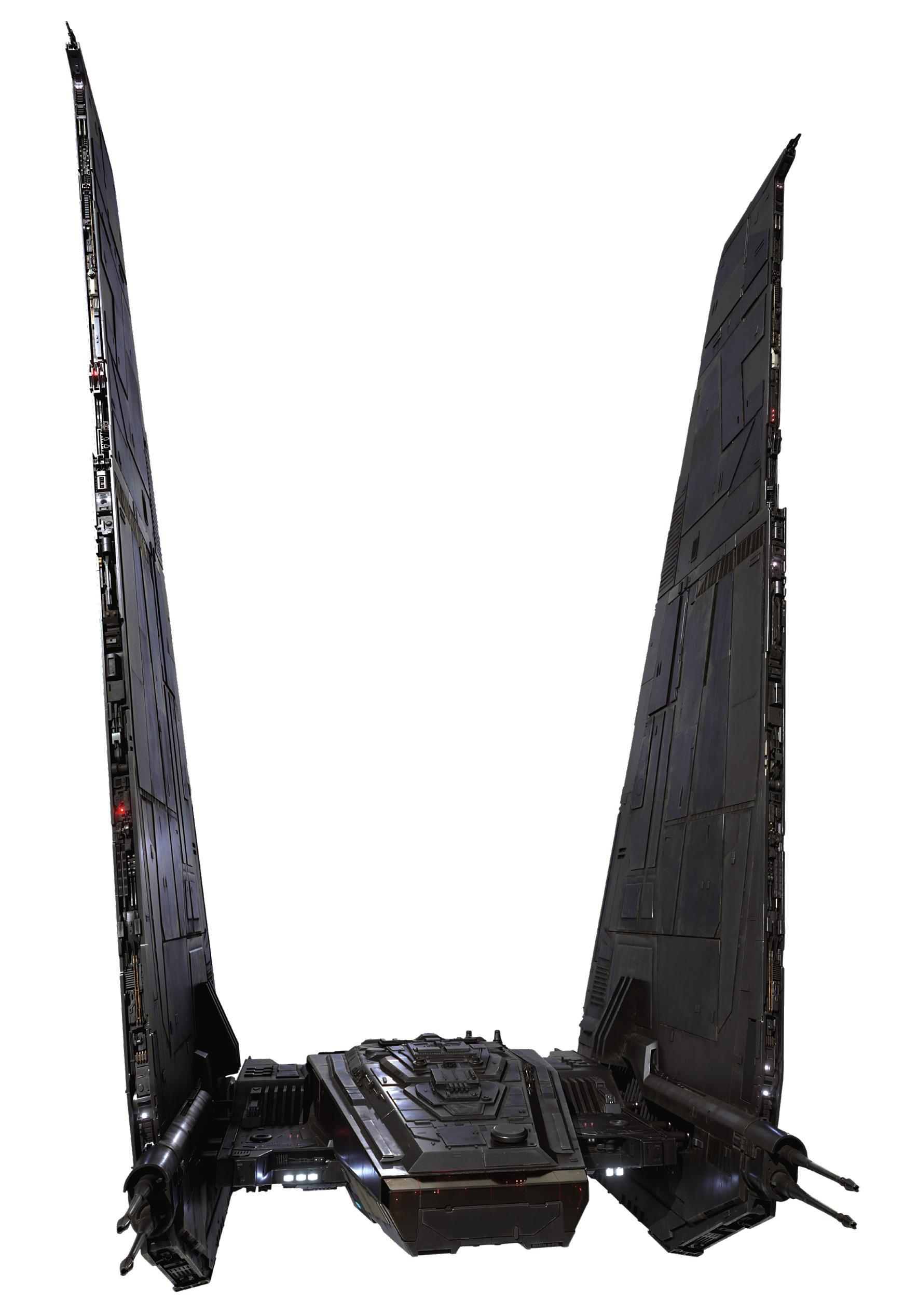
- The Imperial Shuttle has very large, folding "wings" and a large dorsal fin. Despite this, the shuttle itself can only carry a few people, and with the technology of the Star Wars universe, the wings are completely unnecessary anyway (it's shown multiple times taking off and landing while the wings are still folded). Kylo Ren's shuttle in The Force Awakens looks even more ridiculous◊.
- The Super Star Destroyer Executor. It is canonically 19 kilometers long, and while it is a fully functional warship, its purpose is clearly more symbolic of The Empire's vast resources. A fleet of smaller ships could easily accomplish the same thing with more flexibility and without being taken out of an important battle by a stray A-wing to the bridge.
- For a close second in length, we have the Eclipse-class super star destroyer from the Dark Empire comics (17 km, and outmasses the Executor-class by a factor of almost 2). And by the New Jedi Order series the New Republic has a few such vessels of its own, specifically the Viscount-class battleship, expressly designed as a counter to the Super Star Destroyer and its ilk.
- A good while back, StarWars.com had a Databank entry which stated that even the regular Star Destroyers were unprecedented in size and absolute overkill for what the Empire needed. This appears to have been retconned however, with the Star Destroyers being treated more as a standard ship size, and with similarly large vessels popping up elsewhere in the Expanded Universe and elsewhere in the galaxy's history. Even in the films, the Trade Federation battleships and Admiral Ackbar's flagship are both significantly larger, while the Mon Calamari cruisers, the Venators, and the Providences are all only marginally smaller. The difference seems to be more in the fact that the Empire tends to just use the Star Destroyer as a baseline ship (it's by far their most commonly-appearing large ship), where a ship of its size would ordinarily be used as a flagship or a heavily-built overkill option.
- The Death Stars are far larger than is strictly necessary, as you could just as easily mount the superlaser directly to the reactor core and have a perfectly operational battlestation without needing to build what amounts to an artificial planetoid around it (this was actually done with the Darksaber in the book of the same name). As with the Super Star Destroyers, it seems they intentionally made them the size of a small moon just for the symbolism and the intimidation factor. It is also implied that Death Stars function as the support facilities (repair and refit docks, construction yards, supply/weapons/fuel depots, and so on) for their own support and screening fleet. That still doesn't come close to justifying the sheer volume of the things. The first one had a volume of more than 2 million cubic kilometers, and the second would have, if completed, had a volume more than 380 million cubic kilometers. The sheer size does, however, make them damn near indestructible to anybody that doesn't have their own superlaser on hand, barring Force-guided torpedoes or destroying the thing while it's only halfway built (which are of course the way they actually do get taken out).
- Suffice to say, the Empire really loves this trope — befitting for entity that rules more through terror and disenheartening of the enemy than through practical combat. Imperial Star Destroyers aren't all that efficient as starships, as it's repeatedly shown that two Victory Star Destroyers — about half the size — are more effective, more resource-efficient and an altogether better idea, to say nothing of the Supers and even more massive ships. But they absolutely trash enemy morale, simply because there's so much ship to get through before you damage them enough to take them out of the fight. And things like the Eclipse are instant "this planet is now mine" buttons; even if you could win fighting them — and it's pretty damn unlikely — you'd expend so many resources doing it that nobody could possibly afford the cost.
- The Imperial Shuttle has very large, folding "wings" and a large dorsal fin. Despite this, the shuttle itself can only carry a few people, and with the technology of the Star Wars universe, the wings are completely unnecessary anyway (it's shown multiple times taking off and landing while the wings are still folded). Kylo Ren's shuttle in The Force Awakens looks even more ridiculous
Literature
- The Moon (as in, Earth's actual moon) turns out to be a giant starship in Empire from the Ashes by David Weber. It's revealed to have been an ancient human starship, and all humans on Earth are the descendants of its crew. David has said that, when designing it, he put in all the engines and weapons and defenses and armor and living space... and discovered he'd used less than half the Moon's actual volume. So he added more armor & weapons, then gave the crew accommodations fit for kings. Rich, important kings. All this lead to the ship having an Unnecessarily Large Interior, which is lampshaded at least once. Not that all the parks and gardens aren't appreciated, of course... For bonus points, Dahak is actually just a border picket. Other ships are much larger.
- In Tom Holt's Flying Dutch, after the Flying Dutchman discovers that he's the richest person in the world, thanks to compound interest, he trades in his old ship for a used aircraft carrier. For his crew of less than a dozen. This was done so that these dozen immortal people who've been stuck together for over four hundred years can finally have some personal space.
- In Sergey Lukyanenko's novel Genome, the Taii are an ancient galactic superpower whose strength waned after a devastating war with another equally-powerful race. Their colossal ships are still allowed to patrol space that now belongs to younger races, but they are little more than relics of ages past. It is mentioned that a tiny by comparison human destroyer is able to completely incinerate one of these Taii battleships with a single volley.
- In Cordwainer Smith's short story "Golden the Ship Was, Oh, Oh, Oh!" the Earth's ultimate weapon is a gold spaceship nine million miles long with a crew of one.
- The eponymous starship in the Great Ship universe is a massive vessel larger than Jupiter which has hundreds of thousands - or millions - of massive caverns, vacuum tube trains, and with space ports large enough to fit entire worlds inside. Even with billions of paying passengers aboard, most of the ship's space is almost totally unused. Since it was discovered streaking towards the Milky Way with signs of having flown through intergalactic space for at least a billion years, with no crew or even any records, the original purpose for its size is totally unknown.
- May or may not be the case in The History of the Galaxy, at least according to the author's website. Flagship-class cruisers are noted as being nearly 7 kilometers (4.3 miles) long with a crew of about 150, and can actually run with no crew whatsoever thanks to Instant A.I.: Just Add Water!. Nowhere do the books justify ships of such size. One novel mentions that these cruisers carry a Wave-Motion Gun that takes up a fifth of its size but that's no justification for the rest of it. Another novel mentions a normal-sized cruiser (still over 5 kilometers) with a crew of 2000. For reference, the Real Life USS Nimitz is about 330 meters long and has a crew of 3200, and that's not even counting the air wing complement (2480).
- Ellis Billington in The Jennifer Morgue has a yacht called the Mabuse. For a certain value of "yacht", anyway: the thing is a demilitarized former Russian Navy Krivak III-class missile frigate. She basically exists to say that Billington is richer than Croesus. With the missile tubes and other armament having been removed, she has more than enough space for a luxurious suite of rooms and a well-equipped occult surveillance operation.
- Justified in the My Teacher Is an Alien series with the starship New Jersey, despite it being the size of its namesake: it's actually almost as small as a warp-capable ship can be built.
- Alastair Reynolds is fond of this trope:
- The novel Revelation Space features a kilometers-long spaceship called the Nostalgia For Infinity that, despite being built to hold over a hundred thousand passengers, is crewed in the story by only a handful of post-humans.
- In House of Suns, each of the main characters has their own kilometers-long ship that they fly around in alone most of the time. One tense scene in the novel takes place in the cargo hold of a ship, which itself is akin to a vast cavern kilometers across.
- Subverted/handwaved in the Skylark Series book Skylark of Valeron: while the eponymous vessel was a sphere over 1000km in radius and has a crew of four, it needed to be that big to contain the navigational instruments necessary to cross intergalactic space.
- Lampshaded and called out in Star Wars Legends. When a side character gripes that if the Empire were still around, they'd be better able to handle the latest galactic crisis (the Yuuzhan Vong invasion), Han Solo snaps and says no, the Empire would have built some humongous, gaudy superweapon with a ridiculously foreboding name, which would then have been destroyed through some glaring weakpoint.
- Time to Orbit: Unknown: The Courageous is very, very large for its intended 20-man crew, because it's intended to double as a colony base once it actually gets to Hylara.
- In Stephen Baxter's Xeelee Sequence universe: the Xeelee Nightfighter. The cockpit is small, about the size of a room, but it's wings stretch out for kilometers in either direction, like vast sails. The purpose of these wings are never made evident, as the ship itself travels via teleportation.
Live-Action TV
- The Andromeda Ascendant originally had a crew of around four thousand, and now has... six. In fact, many of the hardships of the ridiculously small crew (for most of the series) are the fact that, even with a shipwide AI and a supply of humanoid android laborers, there are simply not enough real people around to do everything. Several times the crew either gets whipped in combat, or has to resort to trickery, because they don't have the crew to man fighters, conduct repairs, or the 800-strong contingent of elite shock troops the ship used to have.
- Blake's 7. The Liberator dwarfs the prison transport ship that encounters the alien spacecraft adrift in the second episode (so much so the Stock Footage was reused for a later episode in the hope the audience wouldn't notice the tiny ship docked with it). As the title indicates the crew never exceeds seven crewmembers, one of which is its Master Computer Zen which is perfectly capable of piloting the vessel by itself. It's never revealed what the original crew size and purpose of the vessel is.
- Doctor Who:
- The Doctor's TARDIS: It's Bigger on the Inside. It's designed to be piloted by six people and is only ever really operated by one. It's usually inhabited by only 1-3 people. Although the series has been inconsistent on this point, the most recent on-screen statement regarding its interior proportions (in "Journey to the Centre of the TARDIS") is that it's infinitely large on the inside. Expanded universe stories have established it is filled with far more than just one person could realistically make use of, including a zoo.
- "Revenge of the Cybermen" has a space station that normally has a crew of 50 being run by a crew of three, the rest having died from a plague.
- The Lexx is so large that small aircraft are used for internal transport, and has a crew of three, plus a disembodied robot head, and the ship itself. Justified, since the Lexx is a giant biomechanical insect which was designed to serve as the centerpiece of a small fleet. It was to be staffed by an untold number of people, and was so large because that was how large the bug had to be to power its planet-killing beam. The reason it seems unnecessarily big is the reliance on strange biotech instead of just building a ship; the reason it seems woefully understaffed because it was stolen in the opening miniseries movie by two people and a robot head (with an undead assassin in tow). That said, being a living starship, it actually only needs one crew member (the captain) to run, with nearly all its biomechanical functions are self-maintaining. The Moth shuttles on board do die eventually, but it has partially-robotic maintenance units to replace those.
- The Red Dwarf is a mining ship quoted as being 6 miles long, 5 miles wide and 4 miles high, that originally had a crew of hundredsspecifically. Three million years later it's crewed by a slacker who was in stasis for bringing a cat on board, a being that evolved from said cat, the ship's somewhat senile computer, a hologram of one of the dead crew, and, from series 3 onward, a robot butler they picked up on a passing asteroid. This is very much Played for Laughs, as the express elevators have movie screens in them so you'll have something to watch while you wait a few hours to reach your floor.
- In the Stargate-verse, the Asgard are all over this trope. Their standard ships are just under a mile long, and each ship has a total crew of one. The Asgard are a dying race, so they don't have a surplus of manpower, but you'd think they would take that into account when they build their warships. Not to mention the ceilings are human-height, even though the Asgard themselves are about three feet tall, making it the equivalent of a human spacecraft with a cathedral roof. Presumably this is a throwback to before the Asgard race's genetic degradation, as millions of years ago they were of human-like stature. It's originally stated that Thor's flagship Beliskner had a normal crew complement, but Thor evacuated everyone, after the ship was infested with Replicators.
- The Tulip in Starhunter is a retired luxury liner repurposed as a bounty hunting vessel. Since her crew currently consists of three people and an AI, she has so much unused space that the crew hasn't even bothered to explore the entire ship. Which led to a rather weird turn of events in one episode when a Human Popsicle in an unexplored corridor thawed out.
- Star Trek: The Original Series: In "The Corbomite Maneuver", Enterprise encounters the First Federation ship Fesarius, a spherical craft over a mile in diameter. It turns out to have just one person on board, who is three and a half feet tall.
- Invoked in Star Trek: The Next Generation episode "Remember Me". As the Negative Space Wedgie of the week Ret Gones the crew of the Enterprise one by one, leaving only Beverly with any memory of them, she's eventually left questioning the logic of a starship normally crewed by around 1,000 people now having a crew consisting solely of herself and Picard (then just herself). Neither Picard nor the ship's computer see anything weird about it, leading Beverly to realize that she's actually trapped in an unstable Pocket Dimension.
- Star Trek: Discovery has the ISS Charon, the flagship/palace of the Terran Empire. The thing is enormous, even accounting for the giant empty space with a star-like object in the middle. In fact, the ship is so big that they needed a special power source in order to be able to even power the whole thing. The ship is also extremely deadly, being able to devastate an entire hemisphere of a planet with a single barrage of torpedoes. The ship is eventually destroyed, and it's implied that no other such craft will be created by the Empire.

Tabletop Games
- Warhammer 40,000:
- While all Eldar vessels have smaller crews than the Imperial ones (which have comparable crew densities to modern warships), the Wraithships fit this trope. They are several kilometer long capital ships that might only have a single living soul on board. note
- For that matter, virtually all Imperial ships are unnecessarily large. Even smaller escort vessels are between half to two kilometers long, and they only go up from there. Their crew is similarly large, and scales with their size. Most of these ships are ancient, but built on chassis so tough that a ship can be damaged to the point of being adrift and repaired to full functionality later, so many have had countless generations of wear and repair and additions over time. This results in some ships having entire decks being sealed off since they are not worth the effort to reclaim. The huge crew is often the result of ships with advanced automated systems getting damaged and removed since the ability to build more of them has become Lost Technology, and the extra crew is needed to do the job the now-useless automation was meant for.
Video Games
- Referenced in Mass Effect 2: the Normandy SR-2 is considerably bigger than the first Normandy, and comes equipped with a spacious Captain's cabin. Several characters comment on the fact that, while the Alliance builds its ships for efficiency, Cerberus (being a criminal organisation with no oversight) can build to impress. Also, the SR-2 seemingly has fewer visible crew members than the SR-1. Exaggerated when the crew of the SR-2 is abducted by the Collectors. Once unshackled, their tactical AI, EDI, is fully capable of running the entire ship by herself. (She can even fly it, although she isn't as good as Joker.) On the other hand, Shepard does put the internal space to good use when collecting their Ragtag Bunch of Misfits — the second game's squad simply would not have fit in SR-1's crew spaces, even before their various interpersonal issues came into play.
- The Polaris Raven in EV Nova is tied with the Auroran carrier for the title of longest starship in the setting at 1,200 meters in length, and is considerably wider. For all that size, it has a mere 30 crew, making one wonder exactly what it's doing with all that space when the Federation carrier is only 500 meters long but has a crew of 200, and the aforementioned Auroran version carries a crew of 250. There are three reasons given for this: one, the Raven's length is exaggerated by the two "prongs" of its Capacitor Pulse Laser system, which account for a good half of its length; two, it has black hole generators for engines, a technology so advanced the Raven is the only ship ever to use it; and three, most Polaris ships including the Raven are to some extent living organisms, and so are probably capable of handling their own internal organs with minimal human intervention, explaining the low crew count.
- In X3: Terran Conflict the Dummied Out ATF Valhalla super-destroyer is easily the biggest ship in the game. In fact it's so big that A) it has serious issues with the firing arcs for its turrets, and B) it's wider than the jumpgates, meaning that if the player cheats one in and has it pass a gate while he's in the same sector, it bangs into the gate rim and DIES. The expansion Albion Prelude fixed the second behavior but not the first, and that, coupled with the fact that it's not much better of a Mighty Glacier than conventional destroyers, means that it's largely Awesome, but Impractical. It is, however, the game's only Battlestar, as it is just as heavily armed as all other heavy-destroyers, and can carry 50 fighters plus up 10 corvettes, bombers or freighters (which solves the potential problem of running out of cargo space for fighter supplies).
- Specifically averted in Sword of the Stars, where the smallest controllable ships are the destroyers, which are roughly 30 meters in length (for reference, a Space Shuttle is 56 meters long) with each subsequent class being 3 times the size. The only things smaller than destroyers are assault shuttles, boarding pods, and Attack Drones. The sequel plays it straight with the Leviathans, which are triple the size of dreadnoughts and are a huge investment of resources. It still takes a turn (which some people have calculates is equivalent to a year based on Hiver sublight movement) to build a destroyer by a single planet devoting considerable percentage of its industry to it.
- The "Rebellion" Expansion Pack to Sins of a Solar Empire adds the Titan class, which are truly enormous ships that dwarf the previously-huge Flagships. Notably, you can only build one, and it takes a long time to complete.
- One of the main selling points of Star Ruler is the ability to build a ship of any size, from the size of a soda can to larger than the galaxy. Beyond size ~2500 (about the size of a planet), any larger simply becomes total overkill unless you wish to destroy the quasar in the center of the galaxy (which requires a size >10000 ship) to annihilate anything within several lightyears in a wave of expanding radiation. Once you start getting past size ~5000 ships, you can accidentally destroy entire worlds when you only meant to take out the enemy cities on it
- Metal Gear Solid 2: Sons of Liberty: Arsenal Gear appears to be three times the size of your typical real-world nuclear aircraft carrier, and is capable of fielding an army of soldiers and a full complement of Metal Gear RAY mechas. However, the ship is so large that as Solidus points out, without proper support from an escort fleet, the ship is "nothing more than a giant, floating coffin." Outer Haven, to a lesser extent, since it's smaller and built for a different purpose, but it is still large enough to include a miniaturized replica of Mount Rushmore. Both can also function as submersibles.
- Entirely possible in Kerbal Space Program. You can land on the Mun in a simple one-person lander launched on a modest rocket. Or you can build a ship that's several times the height of the building it's supposedly constructed in. The game performance suffers with large ships though, making them often Awesome, but Impractical.note
- The Voth Fortress Ship in Star Trek Online is 134 kilometers long, with cavernous interiors so huge that any other ship featured in the game can casually fly inside. Despite its incredible size, it's practically unarmed, with only a few short-ranged turret clusters protecting its weak points. It's only ever used to deliver ships or troops into battle...in a setting where even the smallest spacecraft are FTL capable by themselves.
- Eva's Hammer from Wolfenstein: The New Order and The New Colossus is a gigantic submarine armed with a nuclear cannon. While we only get a glimpse of its size in The New Order, come The New Colossus, we discover it has a huge landing bay for helicopters, a cantina and can house enough crew members that the Kreisau Circle can all live on it and use it as their mobile base. The sheer size of the ship is a problem for the Circle, however, which they find out when they discover, much to their shock that there is an entire deck of the ship they didn't discover, which is where the remnants of the old crew are hiding out and transmitting their position to their Nazi comrades.
- Noah's Ark would already have to be a pretty huge vessel to hold all those animals, but Super 3D Noah's Ark, being a religious-themed family-friendly total conversion of Wolfenstein 3-D, naturally replicates its sprawling, maze-like level design, and as such gives us an Ark with an interior full of huge, mostly empty rooms and long, twisty corridors.
- The Delphinus from Skies of Arcadia starts out this way: The heroes, numbering four people, end up 'borrowing' the intended flagship of a major world power, designed for a crew close to a hundred. An optional mechanic for the game allows you to seek out experienced sailors to serve aboard the ship as crew (granting you bonuses in combat and access to on-board merchants), without whom the Delphinus will remain hilariously empty for the rest of the game.
- The Argo from Battletech is a 100,000-ton heavy colonization vessel intended to carry pre-fabricated housing and years' worth of supplies to frontier colonies, alongside the hundreds of colonists and dozens of construction vehicles needed to keep a colony going. By the time it's excavated and put to use again, the Argo becomes the flagship of a mercenary company that numbers around 20-50 people on a good day, and has around six battlemechs. In-game, the humongous amount of superfluous space on the Argo is used to justify your essentially unlimited storage space for 'mechs and equipment not currently in active use — Murad notes that with 54,000 tons to spare you'll never run out of places to store 'mech parts.
Web Animation
- In Clear Skies, the titular ship is a Tempest-class battleship, approximately the same size as a Star Destroyer. It has a crew of less than five.
Webcomics
- In Commander Kitty, Zenith Central is a moon-sized research facility with a crew of one, not counting the handful of android assistants on board. It turns out that Zenith Central also stores around 45% of the galaxy's population, though most are stored as transporter patterns in a hard drive small enough to pick up and carry.
- In Nip and Tuck's Show Within a Show "Rebel Cry" the Federation's new flagship the Cygnus was referred to as a "grotesque example of government waste". But the rebels found it an ideal long-range colony ship when they hijacked it.
- Schlock Mercenary:
- Pretty much every ship Tagon's Toughs has owned since their first one was meant to house a lot more than the under 100 troops the company comprises. Including an Ob'enn Superfortress, a Drop Ship from said superfortress that was rated for 25,000 men (needed some sleeping space though), and then a cruiser meant for 6,000. They rely pretty heavily on the ships' A.I.s to run things.
- Tagon actually considers this roominess as a downside most of the time, recounting a story from his military service about the grunts having too much room to spread out and complained about having to go back to smaller quarters.
Some of the men lodged their complaints with rocket launchers.- Most recently, the Toughs who were active in Sol system during Book 15 - a group unlikely to reach triple digits, put it that way — are operating a UNS battleplate, a triangular ship with 8km sides. However, they're only manning it on behalf of their current clients and because their much more reasonably sized ship, the Neosynchronity, was destroyed during the climax of the previous book.
Western Animation
- Duck Dodgers: Dodgers' ship isn't particularly huge, but for its crew complement of two individuals there certainly is a lot of empty space...and a huge workload (for the Cadet).
- The "So Beautiful and So Dangerous" sequence of the movie Heavy Metal includes a spaceship which dwarfs the Pentagon. It then docks with a space station so big, that the spaceship rattles around in one of its smaller landing bays like a pea in a cereal box.
- The episode "Battle of the Planets", from Invader Zim, has the entire planet of Mars being converted into a giant spaceship, piloted by Zim. Later on, Mercury is also revealed to be a spaceship, which Dib promptly uses to fight Zim, leading to a hilarious montage of Zim and Dib bumping the planets into each other and actually dogfighting. With planets.
- The Absolution from Toonami is incredibly huge, but it only has one operator (TOM), the AI (SARA) and a handful of assistants (the Clydes and/or DO Ks). Considering it's only used as a broadcast center, who knows what they need all that space for. The Absolution 2 and 2.5 ships were a lot more compact, and its' hangars were shown to be far smaller (one on the bottom routinely released swarms of Clyde 53s, while the other one, located at the back, was even smaller and only held TOM's personal fighter craft), but it still likely had a lot of unused space. Averted by the Absolution 3, which was far more compact, but played straight by the current ship, the Vindication, which is pretty damn big (it was in fact thought to be an abandoned base on the desert planet of Shogo 162, until outside circumstances revealed it was in fact a massive ship that had been buried in the ground; TOM and SARA then had the ship break free of the now-dying planet).
- Dr. Zok's ship in the Danger Mouse arc "Close Encounters Of The Absurd Kind" is so friggin' huge and detailed it looks like most of the story's animation budget went towards it.
Real Life
- There is a rule of thumb in sailing: the larger the yacht, the less it is sailed. The reason is that sailing is manpower intensive activity, and the practical hull length limit for single-handed sailing is 35 ft and that of crew of two being 45 ft. The larger yachts require larger crews, and while a married couple can easily head for the sea for the weekend, it is far more difficult to gather the crew at the same time on the place.
- The Hindenburg ended up as one of these. As a luxury liner and the largest aircraft ever to fly, she had a huge amount of space to begin with- the A deck alone was larger than an entire 747 in floor space, all dedicated to just 100 passengers and crew. She was designed to use non-flammable helium as the lifting gas, but the company had to settle for flammable hydrogen due to an embargo. Coincidentally, this change also meant she had roughly 10% more lift per volume- a sum which, considering the ship's astronomical weight, was nothing to sneeze at. The extra lift was used for the addition of first-class cabins. Its sister the Graf Zeppelin II could carry nearly twice as many passengers.
- The Great Eastern was launched in 1858 and was bigger than any ship built for the next half century. She was a commercial failure in part because there simply wasn't any need for such a huge ship in the 1860s — the main reason for her size was the dearth of coaling stops along the route to Australia, her proposed destination, and she was designed to be able to carry all the coal for her horrendously inefficient engines herself. However, between her being laid down and being launched a source of coal was discovered in Australia, rendering her instantly obsolete. Finally the development of transoceanic cables gave the giant ship a purpose, as she could carry an ocean-spanning spool of cable in one trip.
- The Boeing 747 became this for a number of airlines, particularly Braniff International, which was operating flights with the huge planes nearly empty, and was probably a contributor to the airline's eventual collapse. Other airlines, notable American Airlines, purchased it but found it to be too much airplane for their needs and sold them off in favor of smaller wide bodies such as the DC-10 or L-1011. The improving efficiency of smaller planes meant that flights could still be profitable with smaller passenger loads, and ETOPS rules allowed twin-engine planes to make trans-oceanic flights, eliminating some of the 747's primary advantages. Most 747s currently flying are freighters, where Bigger Is Better still holds true.
- Emirates Airlines has the largest fleet of Airbus A380s in the world. However, that means the low-demand seasons see very large planes with very few passengers. They are purchasing smaller A350, Boeing 777x and 787-9 jets to ease this problem.
- Knock Nevis (AKA ''Seavise Giant'', AKA ''Happy Giant'', AKA ''Jahre Viking''), the largest ship ever crossing the Earth's oceans, was a supertanker so enormous that she couldn't even sail through the English Channel due to her 26.4 m draught, and because of her single bottom she was latter banned from entering European ports, making her Awesome, but Impractical. She was later converted into a floating oil tank and was moored near the coast in Saudi Arabia, until finally being scrapped in 2010.
- Limousines, particularly of the super-stretch variety, tend to invoke this trope intentionally.
- Russia's Typhoon-class submarines, built in the 1970s-80s, are the largest subs ever built, but the newer and smaller Borei-class outshines them in pretty much every way. One proposal for the remaining Typhoon subs that haven't already been scrapped is to convert them into cargo ships, due to financial difficulties.
- The Japanese battleship Yamato (yes, that one) and her twin sister Musashi. The true embodiment of Awesome, but Impractical, their nine 18.1-inch main battery guns were the largest ever put to sea, but Japan's poor radar-based targeting systems meant they would much less effective than Allied battleships. Their anti-aircraft guns were too small and again, lacked useful radar-directed fire control. Furthermore, the ships were so huge that even at slower speeds used enormous quantities of fuel. It was the fuel consumption that ultimately kept them from earlier battles. Yamato and Musashi both ended up fighting in the Battle of the Philippine Sea and the Battle of Leyte Gulf, where Musashi was sunk in a air attack by 19 torpedo strikes and 17 bombs. Yamato did get to engage US warships in combat, albeit small escort carriers and their escorting ships, succeeding in crippling destroyer USS Johnston and escort carriers USS Gambier Bay and USS White Plains and sinking destroyer USS Hoel. Yamato was sunk later in a Suicide Attack, also by aircraft, taking 13 torpedoes and 10 bombs before sinking. The US forces sank her quicker, due to hitting her mostly on one side.
- Their triplet sister, Shinano, was hastily converted to an aircraft carrier during production but remained just as big as her two sister ships. She was sunk a meager 10 days after commissioning by the US sub Archerfish with only 4 torpedoes, ringing the death bell of the idea of super-battleships.
- Though not to the same levels of the Yamato class, the German and Soviet warships of the same era were very consistently heavier than their similarly-equipped counterparts in other navies. The infamous Bismarck, for instance, was arguably no better than the King George V-class battleships sent to fight her despite being a good 5,000 tons heavier. This can be put down to the fact that both navies took a twenty-year involuntary hiatus from not only building, but designing warships due to treaty and economic damage, respectively.
- The unfinished Sovetsky Soyuz (literally Soviet Union) class battleships would have weighed more Yamato but have been less capable than the much smaller American North Carolina class battleship (which the Americans themselves thought was unnecessarily big and switched to the slimmed down South Dakota class). All the extra weight was due to the Soviet Union being utterly unable to make half decent armor of the thickness a battleship required. It instead had to use nearly unfathomably thick plates of shoddy brittle steel. This, combined with the lack of Russian experience with large ship building lead to a true titan of a design, that could "only" fit a gun a two inches smaller than Yamato and fired a relatively light shell for a gun of its size. When Stalin pressured the Soviet Navy to finish one of the incomplete hulls after WWII, the navy countered that finishing the project would be one of most embarrassing things the country could do.
- Some officers in the US Navy believe this to be the case with the modern supercarriers. They claim that Technology Marches On, and so must military doctrines. The aircraft currently being used by such carriers are outranged by land-based ship-killer missiles already being fielded by such countries as Russia and China, defeating the whole purpose of having a carrier. Basically, a carrier can't get close enough to deploy its own aircraft without being hit by such missiles. A better strategy would be to scrap the ginormous supercarriers and switch to a greater number of smaller carriers that field longer-range aircraft. Naturally, the brass shuts such thinking down, lest the Congress pull funding from the $37 billion Gerald R. Ford-class carriers being built to replace the Nimitz-class carriers. On the practical front, arguments over economic-logistical and tactical economies of scale of large vs small carriers - as the latter still need complex, expensive radar and other electronics that don't necessarily downscale in cost proportionate to size - and whether said missiles live up to the hype under combat conditions have been had for years if not decades and are beyond the scope of this article.
- The oil tanker Esso Northumbria was the largest ship in the history of British shipbuilding when she was launched in 1969; unfortunately, she was designed by simply scaling up a much smaller ship and built by the lowest bidder. Her short career was marked by frequent cracking of her single hull and problems with her fittings, and she was broken up for scrap after only twelve years in service. At least The Dreadnoughts got a good song out of her.
