

Illumine, what is low raise and support;
That to the height of this great argument
I may assert eternal Providence,
And justify the ways of God to men."
Paradise Lost is John Milton's sprawling epic poem which explores the Fall of Man and reconciles God's omniscience with Free Will. First published in ten books in 1667, the twelve-book version modern readers will be familiar with came out in 1674.
Notably focusing largely on the infernal Serpent, Paradise Lost is a retelling of the third chapter of Genesis in the form of an epic poem with the addition of flashbacks to the war between Satan and the angels, clear references to the Son of God, and visions provided by the Archangel Michael that show Adam what happens in later parts of The Bible. In epic theory (and yes, such a thing exists), Paradise Lost is the final epic, as it has elements of everything from The Odyssey up through The Divine Comedy and The Faerie Queene.
Famously illustrated by Gustave Doré two centuries later, providing our page image. It can be read online for free , courtesy of Dartmouth College. It inspired French Renaissance painter Alexandre Cabanel to create The Fallen Angel.
Paradise Lost contains examples of:
- Adaptational Heroism: Genesis portrays the Serpent as being chiefly responsible for his action, and in the last book of the standard Christian canon it is implied that the Serpent was Satan all along. In Milton's mind, the serpent was just a mindless animal whose body Satan possessed to carry out his plans. The serpent is just a hapless victim of the Devil's scheming, more innocent than even Adam and Eve.
- Adaptational Early Appearance: Raphael and Michael both talk to Adam in the Garden of Eden, even though both are first mentioned long after his death in the biblical canon.
- Adaptation Expansion: John Milton took the first 80 lines of Genesis and adapted them into a 10,565 line epic poem. The brief dialogues of Adam and Eve are now giant monologues while entire narratives about a War in Heaven and the Serpent's plans are invented out of whole cloth.
- Adaptational Sympathy: While in the Bible Satan hardly receives any characterization at all, and what he does receive paints him as a heartless and petty manipulator, here he is shown as a complex and tragic figure who has lost everything. There are times in the story where he is struck by the deep beauty of Eden and the universe, and desires desperately to be a part of it, and ponders whether he could repent and ask for forgiveness. But his pride won't let him. All the beauty of God's creation does is fill him with bitterness that he can't have it. And if he can't have it, no one can.
- Alien Blood: The angels and demons all have golden blood that looks like ambrosia to highlight their god-like power.
- Alien Geometries: An early example occurs in Milton's description of Chaos' domain. It isn't easy for even a former archangel like Satan to navigate before he builds a bridge between Hell and Earth.
- All-Loving Hero: The Son, aka Jesus, is of course the redemption of all mankind.
- Anachronic Order: Like many other epics, Paradise Lost doesn't just begin In Medias Res, it uses non-linear time extensively. The poem begins after Satan's army has been cast into the newly created hell, nearly halfway through the story, chronologically speaking. Roughly the middle third of the poem is occupied with various flashbacks to before this point, narrated by the angel Raphael, who describes the creation of the universe, the coronation of the Son, the war in heaven and Satan's defeat, as well as the creation of the Earth. The rest of the poem follows chronologically from there, except for a few flash-forwards.
- Angels, Devils and Squid: Yes really, although the focus is very much on the former two. The "squid" faction is represented by Chaos and his courtiers.
- Anthropomorphic Personification: The two other members of Satan's incestuous parody of the Trinity represent Sin and Death. There are also the briefly touched upon entities Chaos and Old Night.
- Anti-Villain: Satan is a persuasive and often pathetic individual whom the reader is often encouraged to admire or pity. Large portions of the work are dedicated to his rousing speeches as well as his anguished self-reflections.
- Archangel Gabriel: Gabriel is a total badass, and the trumpeter and chief guard of all the angels. His guards catch Satan sneaking into Eden and cut through his rhetoric to send him running with his tail between his legs.
- Archangel Michael: Michael is a total badass and the Good Counterpart to the Serpent. Michael cuts off the Devil's entire right side to introduce him to pain and helps Adam adjust to pain by showing him that salvation will be offered in the future.
- Archangel Raphael: Mr. Exposition here spends two whole books (of twelve) telling Adam how Satan fell and fought the War in Heaven.
- Arch-Enemy: Satan's Meaningful Name is derived from the Semitic "Shai'tan" meaning "adversary," and he builds himself up as the greatest opponent to God. In reality, he's nothing compared to Heaven's might.
- An Arm and a Leg: Satan has not just his right arm, but the entire right side of his body cut off in an ill-planned duel with Michael. Though his spiritual nature allows the injury to heal, this introduction to pain marks the loss of his angelic power, life, and goodness that will spur his envy for man's paradise.
- Ascended Extra: The Son of God gets far less lines than Adam, Eve, the Father, Michael, and especially Satan, mainly existing to give someone for the Father to talk to and to kick the demons out of Heaven. Come the sequel, Paradise Regain'd, the Son now goes by Jesus and is the main protagonist.
- Author Appeal:
- The poem is filled with references to light, illumination, and color — appealing to the blind John Milton for bittersweet reasons.
- Satan talks about democracy and egalitarianism, arguments that would strike close to Milton's heart due to his political beliefs.
- Bad Is Good and Good Is Bad: Satan famously proclaims, "Evil be thou my good."
- Battle Aura: Listen, Jesus is a swell guy, but just know he's going to beat the piss out of you as soon as he starts effusing "smoak and bickering flame, and sparkles dire." If you don't buy it just ask Satan, or don't, since he still blushes when you mention how Jesus scared him out of Heaven.
- Because Destiny Says So: Hell wants nothing to do with the fallen angels and tries to move away as soon as they start coming near "her" but Fate apparently built Hell too steadily for "her" to escape.
- Biblical Bad Guy: As an epic rendition of Genesis Chapter Three, Paradise Lost naturally features the Devil corrupting humanity for the first time.
- Bittersweet Ending: As in the Bible, Adam and Eve disobey God and become tainted by sin. They are forced out of the Garden of Eden to live in the new flawed world they brought into being; however they repent and are comforted by God and His angels, with Michael showing Adam the future showing him humanity will survive (though also simultanesouly warning him of their future mistakes). The closing lines invoke this: "The world was before them, where to choose their place of rest, and Providence their guide. They hand in hand with wandering steps and slow, through Eden took their solitarie way."
- Bizarre Seasons: Hell only has weather in the extremes, revolving between hailing whirlwinds of torturous ice and raging fires in such a hurry that no demon can become accustomed to their torture.
- Black-and-White Morality: With God is good, even if you have trouble accepting that. With Satan is evil, even if he seems appealing.
- Blind Seer: At the beginning of Book III, the narrator references his own blindness, like that of poets like Homer and prophets like Tiresias, to pray that God will give him inner light to replace his outer light.
- Blood Knight: The demon Moloch fell because of his lust for power and war. He advises against taking revenge against God by guile and instead argues the demons should again take arms to battle the Omnipotent, even if it leads to the Cessation of Existence or worse.
- Blow That Horn: Michael wields the ethereal trumpet to let the Heavenly Host know when battle has begun, striking dread into all who hear it.
- Bolt of Divine Retribution: Satan refers to God as "the Thunderer" for good reason. When the fallen angels tried to imitate God's power with cannons, the Son knocked them out of Heaven with a glance that had the force of ten thousand thunderbolts.
- Brains Evil, Brawn Good: The rebellious angels use their cunning and skill to invent guns, and turn back the loyal angels for a moment. The loyal angels respond with brute force: ripping up mountains and throwing them at the rebels. Jesus ends the fight the next day just by charging at the rebels with his overwhelming power.
- Break the Haughty:
- Only a few days after leading a war into Heaven, Satan has to retreat from Eden when five angels threaten him. As he creeps away, they remind him of how hideous and weak he's become, realities he's too arrogant to grant.
- Satan arms himself with a chariot in an imitation of the sun-chariot of the Son of God. He boasts from atop the chariot that he created himself and that he's invincible, only for Michael to come up to him and cut off the right side of his body. This introduction to pain leaves the Devil whimpering in agony as his foot soldiers carry his body away from the battle."[T]here they him laid
Gnashing for anguish and despite and shame
To find himself not matchless, and his pride
Humbl'd by such rebuke, so farr beneath
His confidence to equal God in power." - The Devil sneaks back into Hell in an attempt to make the announcement of Man's fall as dramatic as possible. He takes his giant golden throne and yells to all his demons of the mighty victory won by his efforts alone, only for any praise he might win to be silenced when every demon in Hell is turned into bestial serpents as a consequence of Satan's attacks on humanity.
- Braids, Beads and Buckskins: This 1667 English epic compares the fallen Adam and Eve's mad attempts to cover their newly-found nudity to how "Columbus / found th' American so girt / With featherd Cincture, naked else and wilde."
- Byronic Hero: Satan is an exceptional, extremely charismatic and deeply flawed creature who rebels against his society (Heaven) and grapples with his morality. As with many examples of this trope, in spite of the name, Satan is an Anti-Villain.
- Cain and Abel: No not the originals, but rather The Son and Satan. Satan was God's favorite child until He created The Son and began to pay more attention to Him. This drove Satan mad with jealousy and in desperation for His attention he decided that if he couldn't be the God's most beloved child, he would be God's most hated enemy.
- Cardboard Prison: The physical location of Hell is actually pretty easy to get out of, and Satan slips out to mess around with Earth. Unfortunately for the Devil, the mental state of Hell is not so easy to get out of.
- Card-Carrying Villain: After realizing he can't fight fate and he isn't willing to say he's sorry, Satan gives a memorable speech which includes the line "Evil, be thou my good."
- Casting a Shadow: The mystical fires of Hell are so far from God that they do not cast light, but instead project pure "darkness visible."
- Cessation of Existence: Moloch, one of the high-ranking demons, proposes launching a second assault on Heaven since there may be some chance God will wipe them out of existence. The demon prefers not to be than to continue to despair in Hell, although he also suspects their essence may be unending.
- Chest Burster: In an appropriation of the Athena myth, Lady Sin burst out of Satan's skull, horrifying all the host of Heaven.
- Circling Vultures: A simile in Book III compares the Devil circling around Night to find a way into the universe to a vulture searching Chinese plains to find a corpse or a newborn to consume.
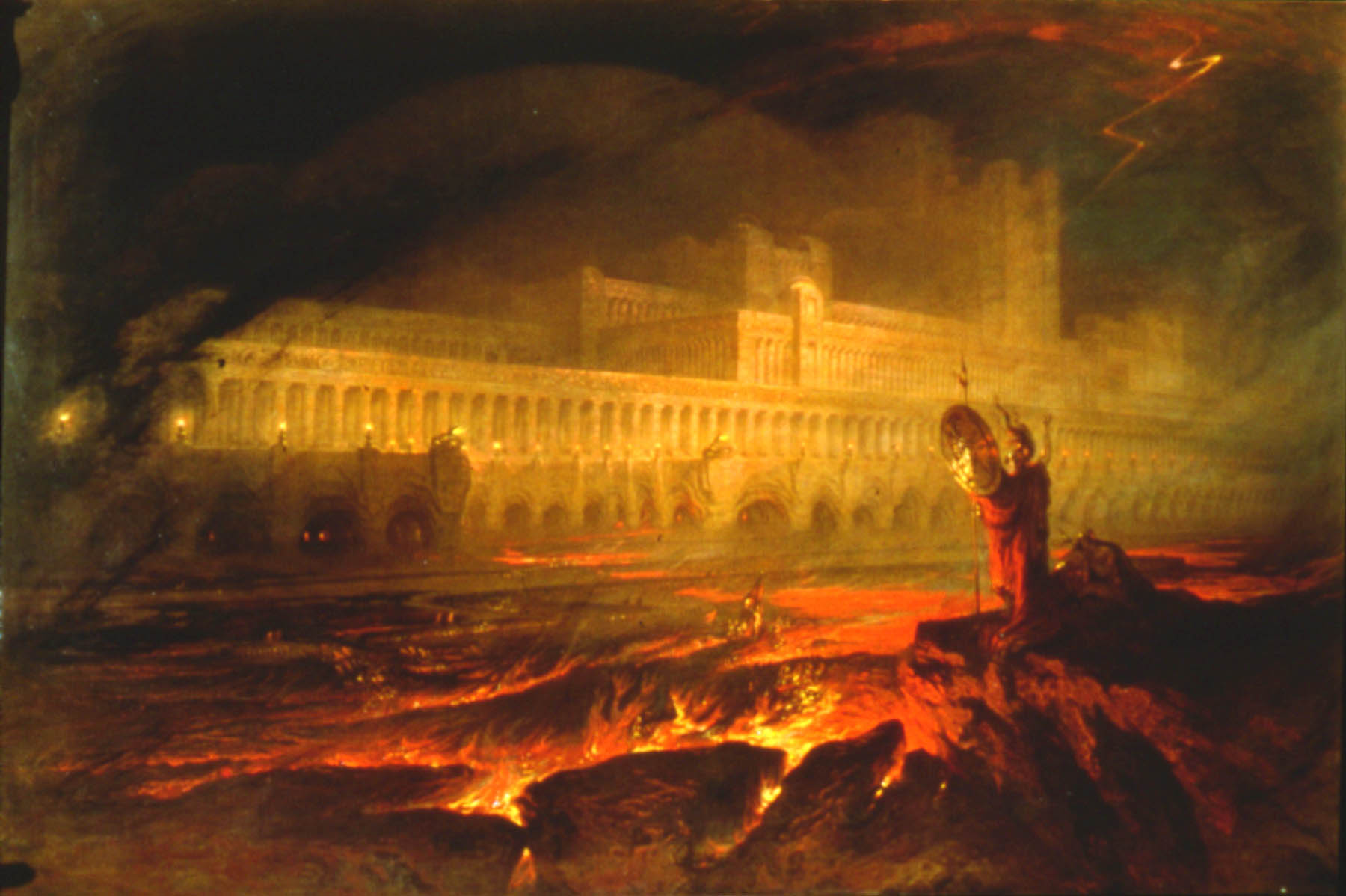
- City of the Damned: Pandemonium was a city made of gold that was commissioned by Mammon and designed by Mulciber (who was an architect in Heaven before the rebellion) to act as Hell's capital.
- Contemplate Our Navels: Eve gets bored and steps out when Adam starts doing this during Raphael's visit.
- Crapsack World: After the Fall, the Earth itself sighed and expressed woe as the thousands of demons of Hell poured out into the Earth to reign while man and woman feel hatred for the first time. Book 11 shows the full scope of the world's horridness in a vision Adam sees of Earth seven generations in the future, where the world's lush fields are now barren except for the animal corpses and siege weapons strewn around in the never-ending war humanity fights within itself. Rectifying this situation is takes a whole other epic to get to.
- Creepy Catholicism: An English Protestant through and through, Milton goes out of his way to make Hell as Catholic as he can by describing their demonic meeting as "synods" three different times and comparing Sin and Death's invasion into the Earth as something quite "pontifical," connecting all human suffering to The Pope.
- Crossover Cosmology: Subverted; only the Christian creation story is portrayed as true, but Milton names many of the The Legions of Hell after preexisting pagan gods. It was common at the time for Christians to claim that pagan gods (including Mesopotamian, Canaanite, Egyptian, and Roman gods) were actually demons.
- Crucial Cross: The Archangel Michael comforts Adam in the face of his newfound mortality by prophesying that the Son of God will die on the cross and that through that cross Death will be killed. Adam is awestruck and is able to leave Eden in hope of dying for something greater than Paradise."Henceforth I learne, [...] that suffering for Truths sake Is fortitude to highest victorie, / And to the faithful Death the Gate of Life; / Taught this by his example whom I now Acknowledge my Redeemer ever blest."
- Crush Blush: Eve ends up "blushing like the morn" on becoming Adam's wife.
- Cue the Sun: As the angels force Satan to flee Eden, the darkness flees with him and the next scene starts at the beginning of the morn. Somewhat implicitly, the rising of the sunrise corresponds with the defeat of evil.
- Curb-Stomp Battle: God makes things interesting by only fielding exactly as many angels as Satan has demons to keep the battle at a stalemate until the Son takes the field and wipes the floor with the entire rebel army on his own. The Son is so terrifying that the rebelling angels throw themselves to Hell to escape him.
- Darkest Hour: The Father recognizes in His omniscience that Man will freely decide to Satan's temptations and bring Death into the world and no one in Heaven accepts His call for someone to bear the burden of death for them. For that agonizing moment of silence, it seems like humanity is doomed forever... until the Son steps in.
- Dark Is Evil: A frequent image of Hell, starting early in the poem, is pure darkness."No light, but rather darkness visible"
- Deadpan Snarker: "To whom thus Satan with contemptuous brow./Gabriel? thou hadst in Heaven the esteem of wise,/And such I held thee; but this question asked/Puts me in doubt (Book IV, 883-886)."
- Decomposite Character: Milton takes the Serpent from the Genesis story and turns him into both an actual serpent as mindless as any other and the Devil, who possesses the serpent to carry out his revenge.
- Despair Event Horizon: Satan gets one when two cherubs rebuke him for having changed into his demonic self:"Abashed the devil stood
And felt how awful Goodness is
And saw Virtue in her shape how lovely
Saw, and pined his loss..." - The Devil Is a Loser: Despite the story's famous Anti-Villain portrayal of Satan, it ultimately takes this position, especially as the story goes on as Satan becomes ever more cowardly, hypocritical, and petty. Even when Satan is giving his most rousing and introspective speeches, it is made clear Satan is only an epic hero inside of his own mind and these self-defeating speeches only prove far he has fallen from the heights of glory he once occupied.
- Did We Just Have Tea with Cthulhu?: The Son of God spends the first five books talking about His love for His Father, volunteering to suffer a Heroic Sacrifice, and all around being incredibly kind until the Father charges Him to end the War in Heaven. The Son then turns into an indescribable terror "Gloomie as Night" whose glare strikes plagues against all the Devil's army with the strength of ten thousand thunderbolts. With this one conviction, He did more damage to the entire demonic army than every angel could do together with two full days of combat. The Devil's soldiers are so horrified that they throw themselves into Hell rather than wait for Christ to be done with them."Yet half his strength he put not forth, but check'd
His Thunder in mid Volie, for he meant
Not to destroy, but root them out of Heav'n." - Distracted by My Own Sexy:
- Eve sees her reflection and is stunned by its beauty, although she doesn't realize it's her at first. She's so taken that she neglects to go meet her husband, Adam, until God calls to her.
- Satan is turned on by his near-identical daughter, named Sin.
- Divinely Appearing Demons: The Devil has increasingly grown hideous and small upon falling, but in order to sneak into Paradise, he takes an angelic appearance. It fools the all-seeing Uriel. His disguise only falters when his chaotic and tortured emotions cause his disguise the fluctuate at the edge of Uriel's vision.
- Dramatic Pause: When the Father asks who will take the penalty of death so Man can live, there is a deafening silence in Heaven as no angel takes the call. The narration laments that in this moment, it seems that Satan has become victorious and that Man will be forever enslave to Sin and Death... only for the Son to break the silence and to selflessly put forward his own life for the sake of Man's.
- Driven by Envy: Satan is first driven to rebel against Heaven when the Father tells the Angels to bow before the Son, a glory far greater than the role of Arch-Angel. Being cast out of Heaven does little to mitigate this, as the Devil travels across the incomprehensible realm of Chaos just so he can keep Adam and Eve from being happier than him.
- Earn Your Happy Ending: By Book IX, the human race has been corrupted by the Devil and the last two books show all the horrors humanity will have to suffer, including a global disasters, endless war, innumerable diseases, and even the death of the Son of God. In the end, though, Michael reveals all those terrible things will be instrumental to turning the whole Earth into a greater Paradise than Eden, which gives Adam the hope to live on knowing that one day paradise will be regained.
- Easy Evangelism:
- Satan manages to convince an entire legion of loyal angels to rebel against God with a single speech that only one person is left unconvinced by.
- Eve laughs at the idea that the Devil could ever tempt her, but as soon as she finishes saying that to Adam, she goes on her own and trusts a contradictory talking snake about rebelling against God.
- Eldritch Abomination: Chaos and Old Night are beings that represent the world before creation, where fire and earth change into water and air before switching places and on and on in endless anarchy.
- Eldritch Location: As described above, primordial chaos is an extremely strange place where the laws of physics do not apply. But Hell qualifies as well, since it has three gates and somehow also stretches out at the edges into an infinite landscape of snow.
- Empathic Environment: In Book II, Death is so fearsome that Hell's land begins to quake in fear. As his spawn, Pestilence and War, take aim at Satan, Hell again trembles and darkens in terror of the coming battle.
- Escaped from Hell: Satan himself had to escape from Hell before he could truly rule it, doing so by making a bargain with Sin and Death, who had been placed there to guard the exit. He tries to brag about it later, but Gabriel sees through his act and realizes that Satan will always be tortured in his mind no matter what realm he's in.
- Evil Counterpart: God, the Son and the Holy Spirit face the Anti-Trinity of Satan, Sin and Death. Satan is Sin's father. Sin is Death's mother. Satan is Death's father. Death is the father of Sin's hounds. It is appropriate to feel
 Squicky once you realize what it all means. Of course, this is very much intentional, portraying a perverted Trinity.
 - Evil Makes You Ugly: The angels patrolling Eden cannot recognize Satan as the beautiful angel who rebelled, owing to the corrosive effects of sin.
- External Retcon: For The Bible and for various myths from other cultures.
- Eye Beams: The Son of God uses all of his eyes to glare lightning and fire at the demonic soldiers with such intensity that all their strength and life is lost to them.
- Fainting Seer: Of the many visions Adam receives in Books 11 and 12, the sight of a quarantine where men die of more diseases than he can count causes him to break into tears and beg never to have been born at all.
- Fame Through Infamy: Michael shows Adam a vision of a descendant of his who will form an empire in the hopes of making his name famous, regardless of whether he be famous for good or evil. Michael goes out of his way to avoid saying his name, but context makes it clear that the descendent is Nimrod, the character who tried to build the Tower of Babel in the Book of Genesis.
- Fantasy Counterpart Culture: Not in the poem itself, but in the paintings of John Martin inspired by it, the Pandemonium (Palace of Demons) looks suspiciously Roman and Satan himself is depicted as a man (not as the traditional horned monster) in a Roman Emperor's ceremonial uniform◊. Perhaps influenced by Paradise Regain'd, where Rome seems to be Satan's favorite Earth culture, the one which he spends more time tempting Jesus with.
- Fantasy Gun Control: Averted Trope; after being badly beaten in the first day of the War in Heaven, the demons use unstable elements to create cannons and gunpowder to even the odds for day two of the war. With this in mind, the creation of guns precedes the creation of the Earth.
- Faster-Than-Light Travel: The blow Abdiel land to begin the battle in Heaven is said to be faster than sight, meaning that Abdiel moved his sword more quickly than the light the moved from his sword to the eyes of those around him. It's subtler than most examples, but this certainly paints the angels at war as exceeding the speed of light.
- Final Battle: Adam is excited to hear that someday a Messiah will defeat evil and speculates about how this hero will do battle to Satan and his followers. Michael cuts him off and tells him no such battle is to take place, as the Messiah will not destroy the Devil in battle, but rather destroy his works by dying so humanity will not.
- Five Stages of Grief: Despite predating the Kübler-Ross model for more than a hundred years, this is the summary of Satan's storyline.
- Denial: He used to be God's first and most favourite creation, the Archangel Lucifer, but was supplanted by the Son. He could not believe it, that God would love someone more than himself.
- Anger: Out of envy, pride and rage, he waged a War in Heaven and got kicked out and sent to Hell
- Bargaining: He thinks that the next best way to get revenge on God is to screw over His most new favoured creation (Mankind) and bargains with Sin and Chaos for this.
- Depression: Upon arrival on Eden he angsts painfully on how even though he had literally escaped Hell, the true Hell is the misery, rejection and abandonment that forever defined him. Despite being the ruler of Hell, he can never enjoy the rays of the sun, or the lusciousness of Eden.
- Acceptance: He embraces his evil, "Evil, be thou my Good!" and thus proceeds into his plans to tempt and destroy humanity.
- Flashback: Three full books of it, documenting the War in Heaven and the creation of Earth, all of which is being told to Adam and Eve by the angel Raphael.
- Flash Step: Abdiel's first strike is so fast that no one could see his sword be lifted up before Satan's helmet had already been struck with swiftness greater than thought.
- Foregone Conclusion: Satan will fall, and humanity will follow him. In Book Three, God and Jesus lay out the entire sequence of events, going far beyond the specific events of the poem: Jesus (or "The Son"), realizing that humanity will fall, offers to sacrifice himself to save them.
- Full-Circle Revolution: Satan leads a revolt against God and the Son in the name of equality, and, of course, puts himself on a pedestal and appoints himself king after the revolution.
- Fusion Dance: Yes, you read that right. Angels are said to make love by spiritually fusing together. "Total they mix, Union of Pure with Pure..."
- Futureshadowing: Sin describes the Devil's first injury in the Book Two, before the scene is described with in the context of the War in Heaven in Book Six.
- Gambit Roulette: Justified Trope. God's plans for the universe are extremely long-term and mind-boggling circuitous but unlike a mortal planner, he already knows how all of it is going to work out.
- Garden of Eden: Eden is the main setting for Book IV, VIII, IX, and X and is favorably compared to the Hanging Gardens of Babylon and the lush wilds of the then-largely uncolonized Americas. Of course, the entire garden is corrupted upon Adam and Eve's fall.
- Glamour Failure: When Satan is despairing, his angelic disguise "slips" just enough for Uriel to recognize the failure and call for back-up.
- Glory Hound: Moloch doesn't care if the entirety of the demonic legion gets erased from history so long as he gets to engage in glorious combat against the angels of God.
- God: God here is the Victor of the War in Heaven who creates the Angels, the Earth, and Man. He only interacts to other characters through His Begotten Son, who Milton seems to treat as a separate being. Through His conversations with His Son, we learn that God has His creations best interests and allows them freedom to stand or fall by their own convictions.
- God Is Good: God is a wise and kind ruler who explains that he has given his creations free will, making them "fit to stand but free to fall" and that he forgives those who sincerely regret their betrayals.
- Good Is Not Nice: God does throw Adam and Eve out of Paradise, despite their repentance for disobeying him.
- Good Wings, Evil Wings: In the first twenty lines, God is described as "with mighty wings outspread dove-like" as an immediate sign of his innocence. From there, comparison of angelic and divine wings to eagles and pure white birds are common to indicate regality and goodness. In contrast, the demons have Red and Black and Evil All Over wings that make them look like swarming bees.
- Gravity Is a Harsh Mistress: Perhaps the Ur-Example; Satan boldly leaps out of the gate of Hell to fly through Chaos as he begins his odyssey to destroy Eden. The whole thing is quite dramatic until the Devil realizes he's fluttering his wings in a void without any air to fly through, causing him to drop "plumb down" thousands of fathoms through Chaos.
- Harmless Villain: For the books dealing with the War in Heaven, Satan and the rebellious angels are completely unable to injure the immortal, untainted angels or their Omnipotent Lord. God even laughs at the vain threat Satan presents and no one imagines he could touch Adam and Eve. The only injuries they have to worry about are self-inflicted ones.
- Have a Gay Old Time: Of Enoch, one of Adam's only just descendants, the narration says that "him old and young / Exploded." This bizarre sentence to modern ears only makes sense upon realizing "explode" is meant in the sense of "jeer" or "mock."
- Healing Factor: Fallen Angels lose their invulnerability, but they still can heal all their injuries, making the war in Heaven pretty brutal. Becomes an instance of And I Must Scream when the rebellious angels are cast into the lake of fire, to be incinerated, reformed, and incinerated again for all eternity.
- Heaven Above: God's divinity is immediately established in Book III when he sits "High Thron'd above all highth." He looms over all things below Him under His authority before explaining how all things that will come to happen in the poem is known to Him by omniscience.
- Hell Invades Heaven: It's the trope codifier/forerunner by depicting Satan's rebellion against God.
- Hell of a Heaven: After losing the war, Satan states that "The mind is its own place, and in it self. Can make a Heaven of Hell, a Hell of Heaven."
- A Hell of a Time: Mammon suggests making Hell look like Heaven by applying "Gemms and Gold" to the realm as the demons grow accustomed to their tortures. The trope is subverted when Beelzebub points out that God didn't put the demons in the Inferno to create a happy empire, but to imprison them in a dungeon still under the rule of his iron scepter. Whatever they design, Hell will always be Hell.
- Hijacked by Jesus: Milton places the gods of the ancient Egyptians and Greeks in Satan's army, holding that those cultures were fooled by demons into idolatry.
- Hope Is Scary: Satan decision to forgo any beauty and goodness leads him to decide hope to regain those things is too terrifying to tolerate."So farwel Hope, and with Hope farwel Fear."
- Horrifying the Horror: The Devil and his army of semi-gods are so horrified by the gaze of Jesus that they throw themselves into Hell rather than wait for the Son of God to annihilate.
- Human Sacrifice: Moloch is identified amongst the demons for being covered in the blood of children killed by his worshipers in honor of him and the tears of their parents.
- Hurricane of Puns: Although there is wordplay throughout, Satan and Belial have the most impressive example of this when they make a long series of puns about their new cannons, pretending they are talking about negotiation but using terms that also have artillery-related meanings. Perhaps most cringe-worthy is the use of "understand" both in its normal meaning and as if it meant "to stand under..." the ammunition. The bad taste is almost certainly deliberate.
- Hypocrite: Satan's arguments against God are founded largely on principles of democracy and egalitarianism, but he himself is an absolute monarch in Hell and asserts that everybody agreed to make him leader without asking anyone to vote. The demons are all too stupid to notice the hypocrisy, but Gabriel exposes the Devil's lies with every verse he gets.
- If I Can't Have You…: Eve's motive for giving the apple to Adam is murder — so he will not be happy with another woman God could make.
- Ignored Epiphany:
- Satan is deeply moved by the beauty of Earth when he sees it for the first time and contemplates how happy he might have been if he hadn't rebelled.
- And when Satan falls in Love at First Sight with Eve, leaving him so enchanted that, for a moment, he becomes "stupidly good". But then he realises he can never have her and carries on with his original plan out of spite.
- I Fell for Hours: It takes nine days for the rebellious angels to fall from Heaven into Hell.
- Inbred and Evil: Death is the result of Satan's incestuous affair with his daughter Sin. Death would later violate his mother/sister, causing her to give birth to hell hounds who constantly gnaw at her midsection.
- Industrialized Evil: The fallen angels attempt to recreate God's thunder by creating war-machines and cannons from the Primordial Chaos that precedes the Earth. Satan and Belial immediately brag that these machines make their victory eternally certain, just before the loyal angels figure out that giant hills (i.e. symbols of nature) make better projectiles than cannonballs.
- In Medias Res: The story begins with the immediate aftermath of the War in Heaven, which is retold in the middle of the story, as Satan plans what to do in his exile. This thematic device calls to mind the classical epics of Homer and Virgil to establish the Devil as an Odysseus or Aeneas-like hero before deconstructing that pagan notion of heroism.
- Ironic Hell: When Satan returns, a copy of the Tree of Knowledge of Good and Evil appears in Hell, but when the demons try to eat the fruit, they taste ashes. Also, since Satan debased himself by entering and possessing a snake, they all have to turn into snakes on the anniversary of his return to hell.
- The Juggernaut: When the Son takes the field, his terrifying and unstoppable charge causes all the rebelling angels to throw themselves into Hell to flee him.
- Kirk Summation: When Satan gathers the angels under his command to make his campaign speech for rebelling against God, Abdiel is the only one present who refutes his arguments and declines to join the rebellion.
- Lazy Bum: Belial uses his silver-tongue to counsel the demons into giving up on battling against Heaven, not in order to return to Paradise, but to lazily remain in the fires of Hell under the false pretense that the torture will lessen with inactivity."Thus Belial with words cloath'd in reasons garb / Counsell'd ignoble ease, and peaceful sloath, / Not peace[.]"
- The Legions of Hell: Satan recruits his rebelling angels with a New Era Speech and forms them into an army to attack Heaven.
- Let's Split Up, Gang!: Eve suggests that she and Adam can get more gardening done if they work separately. This is just after they have been warned that Satan is somewhere in the garden.
- Liberty Over Prosperity: Satan would rather reign in Hell, than serve in Heaven, and his minions go right along with him. They are all in a literal Self-Inflicted Hell, yet are staunchly determined to remain free in the "universe of Death."
- Light Is Good: Light is frequently used as imagery for Heavenly creatures, including unfallen angels and the pre-fallen demons. God is unseeable in the poem because He is the logical conclusion of this trope, radiating so much light that even angels can't see past it to whatever divine form is within.
- Light Is Not Good: In Paradise Lost, the Serpent from Genesis 3 was the brightest of the angels before his fall. When waging War in Heaven, Satan rides in a chariot as bright as the sun adorned with cherubs and gold, showing that the Devil worships himself as God.
- Love Makes You Evil: Adam's fall, and thus the fall of all mankind, comes about as a result of his absolute adoration of Eve, without whom he can't bear to live, not even in Paradise. As soon as he falls for her, Adam blames Eve for his own decision, and he insults her until she bursts into tears.
- The Many Deaths of You: Upon seeing a vision of Cain killing Abel with a rock, Adam asks if that is how every man will die. Michael helpfully answers by listing off deaths like violence, fire, flood, famine, and intoxication before deciding it would be simpler to show Adam a vision of death. Adam then bears witness to every disease that could possibly kill a person, knowing that these ghastly spasms and racking tortures all exist because of his Fall."Death thou hast seen
In his first shape on man; but many shapes
Of Death, and many are the wayes that lead
To his grim Cave, all dismal; yet to sense
More terrible at th' entrance then within." - Malevolent Masked Men: One of the main differences between the armies of loyal and rebellious angels is that the rebellious ones are described with rigid helmets that dehumanize them into a crowd of soldiers, while the angels are described with no such collectivizing armor. The narrative also emphasizes Satan's crest, a type of helmet, which is the first thing in history ever to be attacked.
- Mammon: Mammon is one of the many fallen angels, one who spent more time staring down at the golden roads of Heaven than at the glory of God above. He contributes to the demonic counsel in Book II by advising the devils remain in Hell and gild it with all matters of gems and metal so they can at least pretend to not be tortured.
- Meaningful Name: A few, even disregarding the fact that "Adam" means "mankind" or "a human" in Hebrew. "Abdiel" is particularly apt—he's the only angel loyal to God among Satan's original troops, and his name means "Servant of God."note It's actually a human name in the Bible, but apparently it fit so well that Milton chose to use it for the angel.
- Meaningless Villain Victory: Satan, who knows and laments the fact that any victory he achieves is purely out of spite and does not improve his situation.
- Might Makes Right: God's authority derives from his overwhelming power, and rebellion against him is taken as self-evidently wrong.
- Mook Horror Show: The wrath of God has always been a popular topic, but Milton uniquely describes God, specifically God the Son, as a monster of "terrour" and "night" as He battles the demons to show how scary an all-powerful enforcer of justice would be to those as unjust as the demons of Hell.
- Motive Decay: Satan opens with a lot of stirring rhetoric, but by the later books he's mostly just trying to piss off God in any way he can, no matter whom he has to hurt to do so. Interestingly, this may have been intentional, as part of the story's philosophy is that evil degrades the sinner—as he sins Satan is becoming less of a person, and thus less developed. Also note his size throughout the books: he starts out as indescribably large, larger than Titans or Leviathan (both have no definite size), but he shrinks down bit by bit, until he takes the form of small creatures on Earth.
- Motive Rant: Part of justifying the ways of God to Man is giving a clear a picture of God's (and Man's) enemy, which means explaining the Arch-Enemy's motive in full.
- The Muse: John Milton asks for Urania, muse of astronomy (and thus, knowledge of God's creation) to inspire him. He clarifies that he's not actually invoking a pagan goddess, just the represented idea.
- Mythology Gag: When he realizes that Eve has Fallen from grace, Adam wonders aloud whether the whole human race is now doomed or whether God will create a second wife for Adam to replace his first, evil wife. The whole idea of God replacing an evil first wife of Adam comes from the medieval folk legend about Lilith, a biblical demon that folklore says is the damned soul of Adam's original partner.
- Narcissist: The first thing Eve does after being created is look in awe at her own beautiful reflection. God calls her to look away from herself and towards Adam, but Satan uses the first woman's vanity to eternal consequence.
- Neologism:
- Lent the very word "pandemonium" to the language. We use it in English to mean chaos, but in the story it's actually an ordered, reasonable place. One demon suggests it so as to make a Heaven out of Hell.
- Adam mentions that everything Eve said appeared to be something called "veruousest." That isn't a real variation of "virtuous" and according to the Dartmouth commentary, it is "perhaps the ugliest word in all of Milton's poetry."
- New Era Speech: Famously, Satan gives a speech in Book I to the demons tying to convince them their imprisonment in Hell marks the foundation of a new kingdom for them where they can be free. Free that is, from celestial light and happy fields.
- Nice Job Breaking It, Hero: Adam and Eve are called out for eating the fruit of knowledge. This is the story of the fall of mankind, after all.
- Noble Bird of Prey: The nobility of lady Victory, who sits on the right side of Christ's sun-chariot, is indicated by her eagle-wings that call to mind the Roman insignia.
- Odd Name Out: All the angels have Hebrew names ending in "-el" like Abdiel, Gabriel, Michael, Raphael, Uriel, etc. (Hebrew Names), except for Satan, who is referred to with the Latin name "Lucifer" once or twice when angels are talking about how he was before the fall.
- The Omniscient: From His throne above the universe, God can look down and see all things with perfect clarity. Within seconds, the Thunderer notices the Son at his right hand, each angel circling like constellations in Heaven, the first Humans gardening on Earth, and Satan ascending from Hell to the Primordial Chaos.
- Only Known by Their Nickname: None of the fallen angels (besides maybe Satan) are given actual names and are only referred to by the names humanity will give them as they worship them over the centuries. Although, Gabriel refers to a few of the demons by their human-given names before any of their worshippers even born, so who knows.
- The Only One: Among all the war and greed of the world seven generations after Adam, the only man to remain just is Enoch, who made it his mission to preach righteousness and pass on justice to his descendants. He prefigures Christ, The Only One able to save man from their sin come Paradise Regain'd.
- Our Orcs Are Different: Just so you know that modern orcs are largely J. R. R. Tolkien's contribution, Milton's orcs are giant sea monsters similar to whales that are mentioned to abide by the beach where Noah landed his ark.
- The Paragon Always Rebels: Satan was God's greatest angel, but he rebels against God's authority to "reign in hell."
- Parental Incest:
- The Devil gave birth to the personification of Sin from his head and took so much joy in her resemblance to him that shortly after their first meeting, they conceived a child together, Death.
- Death rapes his own mother and she gives birth to hounds who attack her.
- Pop-Cultural Osmosis: The book is so well-known that the old arguments about Satan as the book's hero are Played for Laughs in an early scene in Animal House.
- Power Levels: Since every creature is given their power by God, He can compare and expose their power levels by weighing them on the scales of the Libra constellation. This trick comes in handy when Satan and Gabriel are about to tear apart Eden in battle, since the scales show Satan that his power could never overcome the heavenly Gabriel's.
- Pride Before a Fall: We meet The Legions of Hell just after they fall from Heaven; Raphael tells us about the Devil's disastrous War in Heaven in Book VI.
- Primordial Chaos: The vast, violent and unpredictable gap between Heaven and Hell, which Satan braves through in order to invade Paradise.
- The Quest: Satan takes off a long, dangerous journey through Chaos, the gap between Heaven and Hell, in his mission to find Eden and corrupt the new creation.
- Rage Against the Heavens: Satan has whole speeches railing against God.
- "The Reason You Suck" Speech:
- In Book 4, when two Cherubs fail to recognize Satan and he insults them for it. One angel, Zephon, rebukes that Satan was no longer the brilliant, beautiful archangel he once was and thus unrecognizable. At that moment, Satan realizes what he'd lost.
- Before the battle begins in Book 6, the loyal Abdiel calls Satan an idiot out of touch with faith and reality who was dumb enough to think he could take God's throne without opposition and then be a better ruler than the Almighty.
- Rebellious Rebel: Abdiel joins the rebelling angels to listen to Satan's speech, but he rejects it.
- Reconstruction: Of the classical, pre-Christian epic poems, using many of the same tropes and narrative devices — such as the opening invocation of The Muse and beginning the story In Medias Res — in the service of a Biblical story and Christianity.
- Red Is Violent: The angelic guard lead by Gabriel transitions from dialoging with the Devil to preparing to battle him by exploding into a fiery red form exposing the fullness of divine wrath.
- Red Right Hand: The devils are all marred somehow by the Fall. Belial actually uses the phrase to refer to God's anger, a Shout-Out to Horace.
- Revenge Through Corruption: Satan mentions rumors about God planning to create man in order to rouse the fallen angels, a rumor Beelzebub spins into a battle plan to do as much damage to God as possible by turning His beloved creation to evil and take away His joy. Of course, it's impossible to make an immutable God less of anything or to thwart an omnipotent one, so the effort is pointless while also being doomed to fail.
- Revenge by Proxy: Satan can't hurt God, so he'll go after His beloved Adam and Eve instead.
- Rousing Speech: Beezelbub delivers a rousing speech in the first book to the rest of the fallen angels on what they should do.
- Run or Die: Satan vainly hopes to get in a fight with Gabriel and his angelic guard, but upon seeing the constellation of the scales weigh the contest in Gabriel's favor, the Devil murmured to himself to soothe his injured pride and fled Eden without offering resistance.
- Satan: Generally read as either a Byronic Hero, an Anti-Hero, or just a Villain Protagonist. Maybe more than one.
- Satan Is Good: Invoked, Deconstructed, and finally Subverted; Satan presents himself as an epic hero trying to overthrow an undeserved tyranny. This is challenged as the books move on and it becomes more blatant Satan is corrupting humanity for no other reason than envy while undermining his democratic rhetoric by declaring himself emperor of Hell.
- Scaled Up: A seminal example — Satan turns into a large snake when tempting Eve with the Forbidden Fruit. He also (involuntarily and temporarily) turns into a snake in Hell when cursed by God, as do The Legions of Hell.
- Self-Inflicted Hell: The main point of Satan's story is to show that damnation is the will of the sinner, not God, who is always ready to forgive. Satan and his angels pointedly cast themselves into Hell after losing the War in Heaven.
- Self-Made Man: Exaggerated Trope; Mammon is so unwilling to owe anything to anyone that he refuses to be eternally happy in perfect communion with creation and instead hopes to make his own empire in Hell just so he can say he did it by his own power. Of course, all his power is derived from God and Beelzebub makes it clear his hope of making an empire in the universe's dungeon is delusional."Let us not then pursue / By force impossible, by leave obtain'd / Unacceptable, though in Heav'n, our state / Of splendid vassalage, but rather seek / Our own good from our selves, and from our own / Live to our selves, though in this vast recess, / Free, and to none accountable, preferring / Hard liberty."
- Sensory Overload: The realm of Chaos produces a ringing sound from all the crashing and mixing proto-elements that shocks Satan upon his hearing it. The sound is so great to dwarf any made by the battle-machines of an imperial War God. Once he actually leaves Hell, the noise only gets louder and more stunning as he ever approaches the throne of Chaos.
- Sequel Hook: Book Twelve concludes with Michael describing Christ to Adam and Adam responding that he will faithfully await the coming of the Savior. This sets up Paradise Regain'd, where Jesus publicly takes on the role of Christ despite the efforts of the Devil.
- Series Continuity Error: Gabriel refers to the demonic legion in Book 6 by names that the narrator makes clear back in Book 1 only come into existence thousands of years after the Fall of Adam.
- Shed Armor, Gain Speed: The angels of God adapt to the satanic invention of artillery by throwing away their swords, spears, and shields to allow them the speed to zip past enemy cannon volleys and surprise them. To further the anti-weapons point, the armor the demons wear prevents them from dodging the swift angels' surprise attack."Thir Arms away they threw, and to the Hills
Light as the Lightning glimps they ran, they flew." - A Sinister Clue: Sin specifically came from Satan's left side, providing a cosmic explanation for why the left hand is associated evil.
- Sinister Scythe: Cain is described as using a scythe to reap his fields shortly before he murders Abel, both to indicate his role as a farmer and as an indication that Cain is about to cause the first death in history.
- Sleazy Politician: The demon Belial comes across as rhetorically-minded politician in the speeches in Book 2. He may seem noble, but every word of his is a lie to allow him to fulfill his vices."But all was false and hollow, though his tongue
Dropped manna, and could make the worse appear
The better reason, to perplex and dash
Maturest counsels: for his thoughts were low
To vice industrious, but to nobler deeds
Timorous and slothful." - Snake People: Satan's daughter/lover Sin has the face of a woman, but below that, she has a serpentine body that makes her foul nature clear.
- Snakes Are Sexy: Satan and Eve's interaction comes across as quite sexually-charged, with Satan taking a while to drink in Eve's beauty, beguiling her with his own gorgeous appearance (at which point the metaphor of snakes as phallic symbols undeniably comes into play), then proceeding to flatter and pervert her. Blake's illustrations even show the snake wrapped around Eve while feeding her the Fruit of Knowledge with its mouth.
- Snakes Are Sinister: The serpent is just another animal before the Fall, but after Satan possesses it to tempt Eve, God curses the serpent so that it loses its pre-Fall dexterity and gains a special animosity with the whole human race. Soon after that, all the demons in Hell are reduced to snakes as they storm the Earth.
- Sole Survivor: Abdiel is the only angel who listened to Satan's speech to remain in Heaven.
- Start My Own: Used almost word-for-word when the demons propose creating a "Heaven in Hell" as an alternative to rebelling against God. Had blackjack and hookers existed at the time, they certainly would have been signature attractions.
- Start of Darkness: Book V and Book VI are prequels to the rest of the narrative and recount how the highest of the angels became Satan and rallied other envious Angels to overturn God's omnibenevolent reign. That went as well as any other swing at the Omnipotent and Hell got a lot cozier for the rest of history.
- Sympathy for the Devil: Milton lets you hear Satan's anguished thoughts, wrought in beautiful poetry, to move the reader to pity Satan as he steers irrevocably toward eternal evil.
- Take That!:
- The narration frequently compares epic protagonists like Achilles to the Devil, implying that ideas of violent heroism are satanic in nature. Michael makes this all the more explicit when he describes the fallen men who live before the Flood, who similarly tell stories of strong men as if they were somehow more virtuous than the weak.
- Also, the gods worshiped by the Egyptians, Babylonians, and Canaanites are grouped among Satan's followers.
- That Man Is Dead: The reader is frequently reminded that the names of all the fallen angels have been erased from heaven, and that what they are called is what humans have named them to be, not their 'real names'.
- Then Let Me Be Evil: "So should I purchase dear short intermission bought with double smart. This knows my punisher, therefore as far from granting he as I from begging peace." More directly: "Farewell, remorse! All good to me is lost. Evil, be thou my good."
- These Are Things Man Was Not Meant to Know: How angels "express" love.
- This Is Your Brain on Evil: The Forbidden Fruit makes you feel happy, invincible, and horny, and it also leaves you with a "My God, What Have I Done?" hangover the next morning.
- Throne Made of X: After ranting for all of Book I about how God arrogantly sat on His throne above all creation, Satan begins Book II by creating and taking his own throne in Hell, which is made from more pearls and gold than India, the trade kingdom of Ormus, or any land in "the gorgeous east" could ever muster.
- To Create a Playground for Evil: Satan knows he can't beat the Almighty, so he instead plans to just ruin the lives of men and make their lives miserable and painful enough that they can be easily manipulated and tortured by his demons.
- To Hell and Back: Sort of — the whole thing opens on The Legions of Hell immediately after being tossed down there, but Satan does come back as far as Earth.
- Tragic Villain: Satan has several low points where he reflects on how stacked the divine deck is against him, but his hubris is so great that he just can't bring himself to accept that he was wrong and repent, and has no choice to but to continue on doing evil and being punished for it. The best he can do is convince himself that it was his own idea.
- Truly Single Parent: Sin bursts out of Lucifer's head in a parallel to Athena's birth from Zeus.
- Übermensch: Satan loves to reimagine himself as this, as coming from the guy who proclaimed he'd rather reign in Hell than serve in Heaven.
- The Unapologetic: Satan refuses to repent. He'd rather take over Hell.
- Unbuilt Trope: This is the first work of fiction to depict Satan as an empathetic character, but it also viciously subverts and deconstructs the idea of him actually being a good person. For starters, he's a hypocrite who justifies his rebellion against God using democratic and egalitarian ideas, but nevertheless rules Hell as an absolute monarch. When his justifications aren't hypocritical, they're fallacious and self-defeating. He even gradually admits to himself that his rhetoric is just him lying to himself and others, and that at the end of the day, he's just a petty, sadistic, vindictive rebel without a cause trying to bring everybody else down to his level.
- Vanity Is Feminine: It is Eve, not Adam, who is captivated by how she looks.
- Villainous BSoD: After he first enters Eden, Satan has one and starts questioning his actions. It passes pretty quickly.
- Villain Protagonist: Much of the poem is from Satan's point of view and he his often compared by the narrator to Aeneas, Ulysses, and other Epic Heroes.
- Villain World: The Devil, Sin, Death, and all the demons claim Eden as part of their Infernal Empire after Adam and Eve reject God's rule, thus allowing them to spend the next six thousand years or so bring Hell to Earth.
- Well-Intentioned Extremist: How Satan portrays himself to the other fallen angels.
- What You Are in the Dark: At the beginning of Book IV, when Satan arrives on Earth, he is completely alone (save for God's presence, of course) for the first and only time, left to his own thoughts. This gives him the opportunity to reflect on the mistakes that brought him this far, and he actually considers repenting before deciding it would ultimately be pointless.
- Word Salad Philosophy: After Satan leaves to invade Eden, a few of the demons bide time for his return by prattling on about free will and fate, an exercise the narrator lets us know is entirely useless. The demons don't truly philosophize, they only manage to create a false hope to distract from their eternal anguish by entering a maze of poor reasoning.
- Yin-Yang Bomb: The Lord's throne is secured upon a cave where light and darkness turn around each other infinitely, creating in Heaven something like day and night or maybe morning and twilight.
- You Are Worth Hell: Adam recognizes that Eve damned herself by eating from the forbidden fruit, but he feels so connected to her that he eats the fruit and falls so that he can continue to be with "the flesh of his flesh." The logical consequences of this trope follows when the evil and selfishness Adam accepts by falling immediately turns him against Eve, whom he sees now as an inhuman devil entirely to blame for his fall.
- You Can't Fight Fate: God knows exactly how all of Satan's schemes will fall apart before he even thinks of them and talks at length about it.
