that you don't understand then you suffer.
Superstition ain't the way!
Stevland Hardaway Morris (né Judkins; born May 13, 1950), known professionally as Stevie Wonder, is an American singer, songwriter, musician and record producer. He was born premature, and was blinded due to a medical mistake while recovering in intensive care. He first became famous as "Little" Stevie Wonder as a supporting act on the Motown Records roster. He could play keyboards and various percussion instruments, but it was his harmonica talents that most impressed Berry Gordy, and featured in Wonder's first hit, "Fingertips Part 2" (1963), a live recording of a mostly impromptu performance. (Listen closely, and you'll hear the bassist for Martha Reeves and the Vandellas stammering, "What key? What key?" after he got on stage thinking Stevie was done performing.)
Even at his young age, Wonder attempted to be progressive with his singing and song choices, notably his recording the Bob Dylan song "Blowin' in the Wind", which some at Motown thought was a mistake. While several of his 1960s hits, particularly "Uptight (Everything's Alright)" and his cover of "For Once In My Life", have proven durable, it's his material starting with 1972's Talking Book up through 1976's Songs in the Key of Life that is probably his most popular and well-regarded by critics. These songs even broke the alleged Album Rock "color barrier", thanks in no small part to his performing the Talking Book material on a tour with The Rolling Stones at that time.
Today, although his days as a major radio force are over, Wonder is still revered by many. He's also known for his political activism, from his criticisms in-song of Richard Nixon; to his song "Happy Birthday", which popularized the idea of Martin Luther King Jr. Day; up to his very vocal endorsement and support of Barack Obama. Wonder was inducted into the Rock & Roll Hall of Fame in 1989, and is also a member of the Songwriters Hall of Fame and the Rhythm and Blues Music Hall of Fame. In 1985, he won a Best Original Song Oscar for "I Just Called to Say I Love You" and received the Presidential Medal of Freedom in 2014.
Albums by Wonder with their own page:
- Talking Book (1972)
- Innervisions (1973)
- Songs in the Key of Life (1976).
Don't want nothing to be wrong with my part-time troper:
- Age-Progression Song: "Living for the City"
- Alliterative Title: Music of My Mind, Fulfillingness' First Finale
- As Long as It Sounds Foreign: Wonder does this hilariously in the intro to "Don't You Worry 'Bout A Thing".
- Blessed with Suck: His blindness was the result of getting too much oxygen while in the ICU after being born premature. He was lucky to be alive at all. And later, he discovered that another baby born premature that day had gotten only slightly less oxygen and died mere days later.
- Blind Black Guy and Blind Musician: Together with Ray Charles probably one of the most iconic examples.
- Child Popstar: He started when he was seven.
- Child Prodigy: Began his career at a young age and topped the charts with the live album The 12 Year Old Genius. He still holds the record for the youngest artist to get to number one.
- Childhood Friend Romance: "I Was Born To Love Her" (starting out as Puppy Love and ending up the Victorious CFR subtype).
- Cover Version: Being both a writer and performer for Motown, this was often inverted. Two examples:
- He wrote "Superstition" with the intention of giving it to Jeff Beck (whom he was collaborating with for the Talking Book album), but his record label
 released his version first. ...Which went to #1 and became a Signature Song for Stevie.
 - And in 1966 (at the age of 16), he wrote "All I Do (Is Think About You)" for Tammy Terrell to record
 . But it largely flew under the radar; his own version recorded in 1980 is much better known.
- He wrote "Superstition" with the intention of giving it to Jeff Beck (whom he was collaborating with for the Talking Book album), but his record label
- Disabled Snarker: He's known to occasionally make jokes about his blindness such as criticizing US President Donald Trump by joking that "letting him be President is like letting me drive" and, after he once lost in his place in a speech, jokingly asking where the cue cards are.
- Double Don't Know: Shows up in "Lately."Far more frequently you're wearing perfume
with, you say, no special place to go,
but when I ask "Will you be coming back soon?",
you don't know, never know... - Downer Ending:
- "Living for the City" from Innervisions. In spite of a solid upbringing from two loving parents who taught him responsibility and a strong work ethic, the protagonist of the song is convicted of drug possession after being tricked into being a mule, spends ten years in jail, and winds up destitute.
- "Part-Time Lover". A man is cheating on his wife and then finds out she was cheating as well. Their marriage is pretty much ruined.
- Early-Installment Weirdness: Executives at Motown had no idea what to do with Wonder at the beginning of his career. They started out by branding him as "the next Ray Charles" (his second album was even called "Tribute to Uncle Ray"), before he was rebranded as a lounge singer. When that failed, he was given a bunch of surfer anthems to sing. Once his voice changed in puberty, he penned 1965's "Uptight (Everything's Alright)" and became a hitmaker for Motown from then on. Tellingly, despite releasing five albums prior, "Uptight" would be his second single to chart in the United States.
- End of an Age: His last US #1, a 1985 collaboration with Dionne Warwick, Elton John, and Gladys Knight on "That's What Friends Are For", was the last such hit for any artist who had topped the Billboard Hot 100 before the British Invasion.
- Epic Rocking:
- "Living for the City", "Love's in Need of Love Today", "As", "Another Star".
- The instrumental for "Isn't She Lovely" from Songs in the Key of Life runs so long that the song needed to be cut in half for radio play.
- The album version of "Do I Do" goes past the 10 minute mark; the single edit is only a little over 5:00.
- Even Evil Has Standards: Invoked in Apartheid (It's Wrong), when he says that even the Devil frowns upon the Apartheid government's actions.
- Genre Buster: Although most of his music is classified as soul or funk, it's actually a lot more complicated than that. Think of it as R&B and Rock mixed with the sophistication of Jazz-Fusion.
- Girlish Pigtails: "I Was Made to Love Her".I wore hightop shoes and shirt tails
Suzy was in pigtails
I knew I loved her even then - Handicapped Badass: Being blind hasn't stopped him rising to fame and becoming one of the most well-known names worldwide!
- Happy Birthday to You!: His "Happy Birthday" is a common substitute in many movies and TV shows that cater to a black audience, even though it's more obviously under copyright than the traditional song.
- I Am the Band: Literally! He plays keyboards, bass, drums, and harmonica. Many songs are all him except for backing vocals, guitar, and horns.
- Irony: "Part-Time Lover" features a man who is cheating on his wife only to find out that his wife is cheating on him as well.
- Lighter and Softer: The majority of his output post-Songs, epitomized in 1983's "I Just Called to Say I Love You."
- Lyrical Dissonance:
- "Part-Time Lover" is a catchy upbeat song about a man who shamelessly cheats on his wife and discovers his wife is doing the exact same thing.
- The verses of "If You Really Love Me" are slow and anguished, as fits a song sung by a victim of a Master of the Mixed Message, but the chorus is downright exuberant. It even has handclaps!
- Melismatic Vocals: "Part-Time Lover". "Chasing love up against the su-u-u-un!"
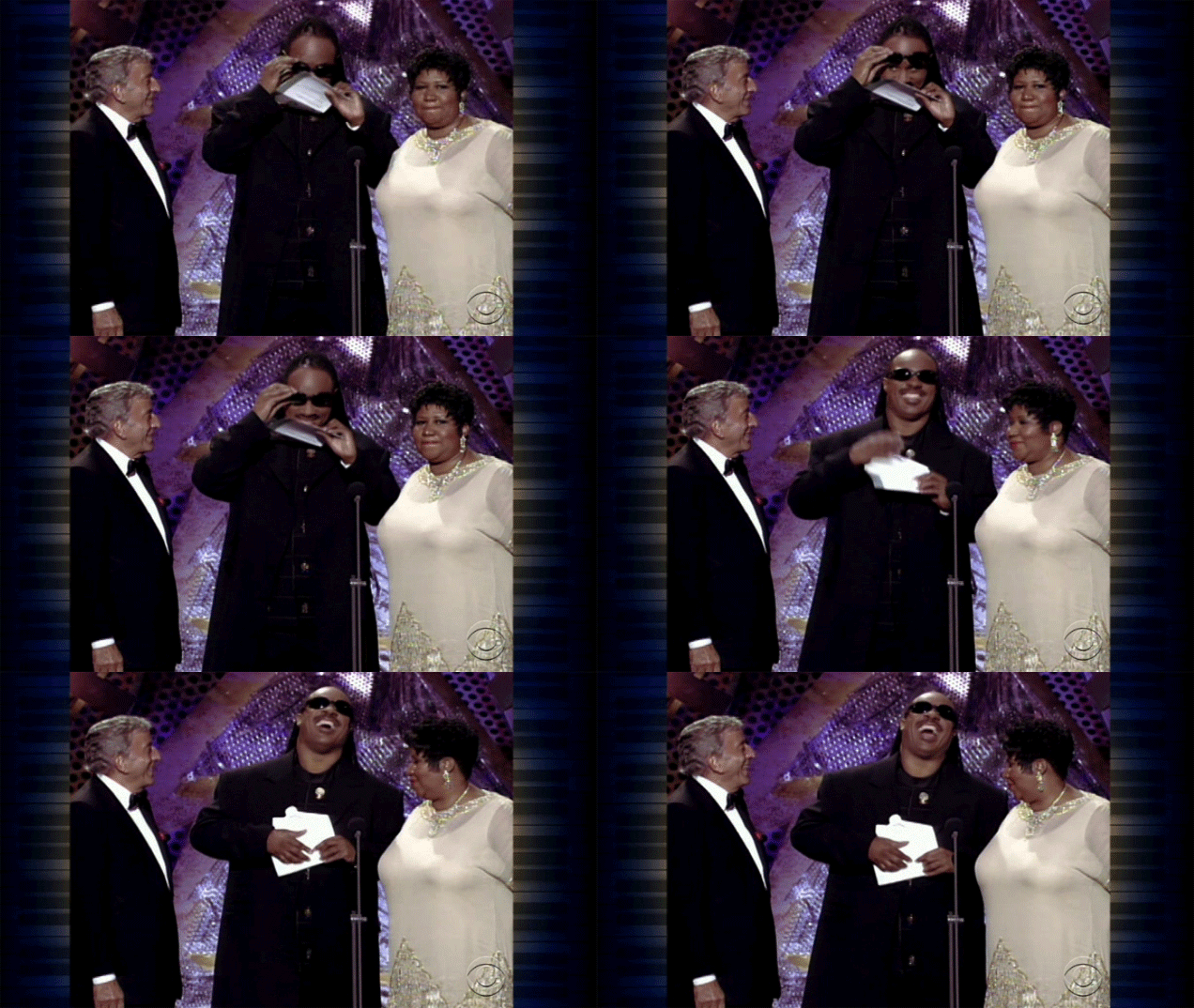
- N-Word Privileges: Nobody makes more jokes about his blindness than Stevie himself. Notable examples include a crack about all races being the same to him because he can't see them, asking where the cue cards are during TV appearances and this moment when presenting an award at the 1998 GRAMMYs.◊
- Never Had a Birthday Party: "Happy Birthday" note argued that it's a shame that Martin Luther King Jr.'s birthday wasn't a holiday for everyone to celebrate. It later was made a holiday in large part because of Wonder's advocacy for the issue. The chorus is catchy enough that it's become a birthday song in its own right.
- Piss-Take Rap: Wonder pulled off a masterful one in "Do I Do"."I know I cannot rhyme 'cause I ain't like a friend of mine
but I hai, ha, ha, ha, ha, ha ha ha…" - Pop-Star Composer: Wrote the music for the documentary The Secret Life of Plants, plus The Woman in Red and Jungle Fever.
- Protest Song: Released many socially-conscious songs throughout the 1970s, including songs that criticized Republican politics (particularly those of Richard Nixon), and addressed racial inequality and civil rights issues.
- Real Life Writes the Plot: "Isn't She Lovely" is a celebration of the birth of his daughter, Aisha. The song starts with a baby crying and the second half of the song features sound clips of Aisha playing with him.
- Rhyming with Itself: Each line of the second verse of "I Was Made to Love Her" ends with the word "years".
- "Sesame Street" Cred: His 1970s appearance on Sesame Street where he performs "Superstition" and the theme song is one of the classic moments of the series. Fellow performer Donny Osmond remarked that when he saw Wonder, who was his musical icon, perform on the show, it made the series great, as opposed to only good before Wonder appeared.
- Silly Love Songs: His stock in trade. In the chapter "Who Put The Bomp? (The Writers)" in the 1994 book The New Book of Rock Lists, he is ranked as the #1 songwriter for The '70snote and called "the best love songwriter, period."
- Spoken Word in Music: "Living for the City".
- Stop and Go: "Visions".
- Take That!: "He's Misstra Know It All" and "You Haven't Done Nothin'" from Innervisions, about Richard Nixon.
- Teen Genius: "Fingertips – Part 2", the song alluded to in the "Child Prodigy" item above, was only the start of his youthful success. He recorded nine more Top 10 hits on the Hot 100, five of which got to #1 on the R&B chart, before exiting his teens.
- Telephone Song: "I Just Called To Say I Love You" is about calling to express one's love even if there's no special occasion.
- Truck Driver's Gear Change: Frequently. "Summer Soft" does this no less than four times!
- Uptown Girl: "Uptight (Everything Is Alright)" by Stevie Wonder.