

Without Princess Peachy or Luigi
But he has "Superballs"
(Seriously, that's what they're called)
In video games, there is a tendency for characters' proportions to change considerably between their official artwork and their in-game appearance. It's quite frequent to see box art with relatively realistically-proportioned characters, while the same characters appear with large heads and small bodies when they're in game.
In older games, the reason for this was usually graphical limitations. When you only have a 16 x 16 block of pixels to work with, trying to make a sprite with realistic proportions will result in a character with almost no visible face to speak of. This was especially true in video games (especially licensed games) appearing on fourth-generation and older game consoles; only a few games (like Rolling Thunder) seemed to avert it. Strategy games on home computers of the time were more likely to avert it.
Keep in mind that this may not apply to Japanese games where the artwork was changed to appeal to American and European sensibilities; the graphics might reflect the Japanese art perfectly fine. This can be seen in games where Super-Deformed characters were a deliberate design choice, like River City Ransom.
Mostly averted by early Western video game designers who tried to use proper proportions, and thus wound up with faceless "stickman" characters.
This can be considered a specific type of Artwork and Game Graphics Segregation. Should a large graphic of a character use much more detail compared to those used in gameplay, then it's a case of an Unexpected Art Upgrade Moment. See Super-Deformed for other uses of big heads and small bodies. For the artwork changes that can't be chalked up to graphical limitations, see Covers Always Lie and American Kirby Is Hardcore.
Examples:
- Characters in Freedom Planet have rounded, chibi-esque sprites that although not quite to this trope's extent, still have larger heads and stubbier limbs to work within the lower resolution. With a much larger budget, the sequel has given the heroines longer proportions with more detailed limbs and general proportions. This is most notable with Lilac, who has a more mature and less cutesy appearance, justified in-universe as the characters undergoing more combat training in a two-year Time Skip. The best comparison could be made between the NES Mega Man (Classic) games and Mega Man X.
- Ghostbusters (1990) for the Sega Genesis uses super-deformed sprites, but characters are normally proportioned in portraits and cutscenes.
- The Binding of Isaac: Rebirth features an Isaac with a very large head and very large tears to shoot things with.
- The Legend of Zelda:
- The original in The Legend of Zelda game uses this style.
- Also, the Game Boy games Link's Awakening and the Oracle duology: while the manuals and other artwork weren't deformed, in the color remake of the first game, it crept from the sprites to the photographer's pictures. All these games, including the first above, used 16x16 sprites. This art style proved iconic enough that it was kept for the Switch Video Game Remake of Link's Awakening, despite being released for significantly more powerful hardware.
- The Legend of Zelda: A Link to the Past, while still a bit deformed, was more reasonable, not unlike Chrono Trigger.
- That said, you did have things like this
 ◊.
◊.
- That said, you did have things like this
- The use of this in Zelda I actually influenced the designs of the Guardians in The Legend of Zelda: Breath of the Wild. While the Octoroks in the first game look Link's size or bigger, later games without the same graphical limitations depicted them as typically around half his height. Eiji Aonuma looked at those early Octoroks and thought about what it would be like if there was some similar-looking monster that really was as big as they looked there. Hence the enormous Starfish Robots in Breath of the Wild.
- In Golden Axe Warrior, a Legend of Zelda clone for the Sega Master System, the hero is depicted as a shirtless gladiator on the game's cover illustration and title screen, but looks more like a cute knight in the actual game.
- Cave Story provides the page picture. Apparently, the chibi sprites have become iconic enough that the higher-resolution WiiWare port used the same proportions—and the Nintendo 3DS remake also uses those proportions for character models.
- Metroid: There are many glaring examples, most obviously being the Metroids themselves. Official art depicted them with tentacles but the sprites made it look more like them latching on with teeth/mandibles. Official art of later games actually did give Metroids mandibles rather than tentacles, both in official art as well as their sprites/models, but their Kid Icarus counterparts Komayto, continued to be depicted with tentacles, while Metroid Prime and Metroid Prime 3: Corruption added three tentacled Metroid offshoots.

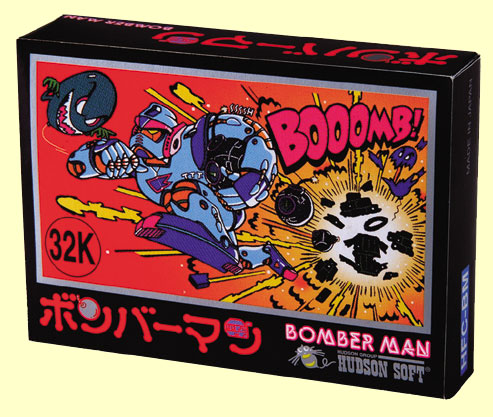
- In Bomberman, this actually affected its future style a lot. The Japanese◊ and American box art◊ of the NES gamenote shows Bomberman as a realistic human in Power Armor, then subsequent releases made Bomberman look cartoonier and closer to his game sprite. The U.S. covers of Bomberman and Bomberman '93 for the TurboGrafx-16 also featured non-super-deformed characters that didn't look much like the in-game sprite (the first looked more like some sort of Red Ranger, the second more like Mega Man). The one serious attempt to use the realistic character style, the Darker and Edgier Bomberman Act:Zero, was swiftly rejected and quickly abandoned. Even the American-made Atomic Bomberman used a chibi style, albeit slightly more detailed.
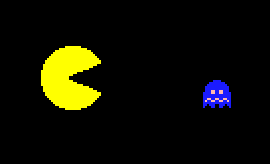
- In official illustrations, Pac-Man has never looked like the partially eaten pizza◊ we all know. He's always had legs◊ and looked like the form you see in cartoons and later installments.


- Scott Pilgrim vs. The World: The Game renders the characters as somewhat chibified compared to the comic versions.
- The comics themselves are slightly chibi as a reference to this trope.
- The character sprites in the NES version of Double Dragon, while not super-deformed per se, are greatly simplified and rather cartoonish compared to the illustrations in the game's manual, which made the characters look like they came out straight from the pages of Fist of the North Star. Some of the character sprites only vaguely resemble their illustrated depictions in the manual (Abobo doesn't sport his trademarked mustache in the manual for example). However, the in-game sprites are actually more accurate to the character designs in the original arcade version than the illustrations were.
- Any Neo Geo Pocket version of an SNK Fighting Game turned the cast super-deformed in battle.
- Super Smash Bros.:
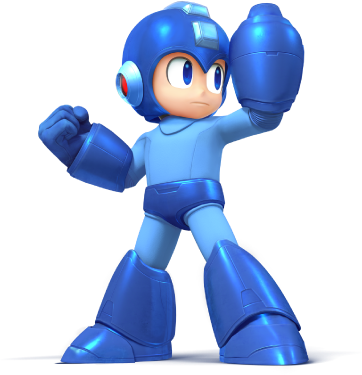
- Mega Man, as he appears in Super Smash Bros for Wii U and Nintendo 3DS, maintains his proportions from the 8-bit games, making him appear somewhat stubbier◊ as compared to his official art◊.
- The above-mentioned Pac-Man invokes this, changing between his normal "ball" form and the more iconic "disc" form in many of his attacks and special moves.
- Mega Man, as he appears in Super Smash Bros for Wii U and Nintendo 3DS, maintains his proportions from the 8-bit games, making him appear somewhat stubbier

- Cael Cyndar has this problem in Dragon Rage.
- La-Mulana: In the Updated Re-release on WiiWare, the character's head is indeed smaller compared to the Retraux-PC-MSX version due to having more pixels (480p/480i on Wii vs. 240p on pseudo-MSX).
- Super Mario Bros.:
- Apparent in the original Super Mario Bros. when grabbing a Super Mushroom. Mario's proportions change by head getting smaller relative to body. Even more pronounced in Super Mario Bros. 2.
- According to the developers of Donkey Kong, most of Mario's facial features and his overalls were due to technical limitations at the time of its release.
- The Blaster Master games, where the in-game main character's head is about as big as the rest of the body.
- Psychosomnium. Everyone has really big, rectangular heads on tiny bodies; one character even looks like they should, by all logic, fall over from the sheer proportional weight of their cranium.
- The original Mega Man (Classic) series. Apparent when it reached its 7th installment, especially by comparison with Mega Man X.
- And mimicked in the doujin RosenkreuzStilette, though in this case the cutesy appearances are more deliberately drawn with the Moe esthetic. This is most apparent with fairies Lili and Strudel, who look like Cyber Elves in sprites but show more humanoid features in their dialogue portraits.
- Also done in The Legend of Dark Witch games, which give its characters chibi proportions for their sprites and more realistic, anime proportions for their portraits.
- Averted in the NES versions of the Contra. The 8-bit hardware couldn't replicate the distinct character designs that were given to Bill and Lance in the original arcade version, so instead the designers concentrated on making them both into musclebound shirtless commandos, with the colors of their pants being the only difference.
- All characters in the gameplay of Chip-chan Kick, barring Warbit (who had already grown extremely huge in his world's respective cutscene).
- Inverted in The Legendary Starfy. Sprites portray characters more realistically proportioned than their portraits do.
- The Umihara Kawase series has the titular character, who is a buxom nineteen-year-old woman in character art, but in most games could easily be mistaken as a small child with an oversized backpack if you were just going off of her in-game sprites. This might have been the inspiration for a younger version of herself being playable in Sayonara.
- Secret Agent: The title screen and the cutscene pictures show the secret agent with normal human proportions, but his in-game sprite has his head take up half of his body.
- Crystal Caves: On his in-game sprite, Mylo Steamwitz's head is about half of his body, and his arms apparently reach all the way to the ground.
- The NES version of Lode Runner uses the same sprites that Hudson Soft would later use in Bomberman. Most computer versions, however, averted this, having sprites more reminiscent of stick figures.
- Money Idol Exchanger has it both ways at once. The Super-Deformed sprites are what players (and AI characters) actually control, while their Character Portraits in the background have normal anime proportions.
- Panel de Pon uses the same system as Money Idol Exchanger, although in this case the super-deformed style, as seen in various in-game graphics and official artwork (particularly the single-player stages), is actually the default and it's the character portraits that are unusual for deviating.
- Protagonist's head in Pâquerette Down the Bunburrows takes up a third of the body in the title screen and game cover art. In-game sprite's head takes up more than half of the character.
- Disgaea, Super-Deformed as in-game characters, relatively normal in portraits in cutscenes.
- Downplayed in Disgaea 4, due to the new high definition sprites allowing for much more detail on the characters, though the body proportions are still a bit off in the case of the humanoid characters.
- Attouteki Yuugi Mugen Souls has every character appear like this in game and during cutscenes that use the in-game model.
- Seen in-game in Final Fantasy VII: Overworld/dungeon/towns use Super-Deformed models to keep the polygon count down. Battles and FMVs note use realistic models.
- See also every Final Fantasy game that uses 2D sprites. VI and the PSP version of IV, like the Chrono Trigger example below, are slightly more proportionate, but it's still very noticeable.
- Chrono Trigger is a less egregious example than most; the game's sprites are fairly proportionate except for the heads (some enemies are closer to reality there, but they're bigger). Portraits are still done in a radically different style.
- The Super Robot Wars series probably followed this trope from its early days on the Game Boy but have since taken the concept to heart, with only a few exceptions (Shin Super Robot Wars and both versions of Super Robot Wars Gaiden). This is used to keep the sizes of the varying Humongous Mecha reasonable. For example, a Zaku II is 17.5 meters tall, while Eva Unit-01 is about 70 meters tall. Though it should be noted that when attack animations go into a close-up of the robot, they're in their proper proportions. The series usually uses proper proportions when it duplicates iconic footage from a robot's original series.
- Half-Minute Hero plays this straight.
- Tales of Symphonia has a bit of this, much like the FFVII example. It's not nearly as extreme as it would be with 2D sprites, but in portraits, anime cutscenes, and the OVA, the art is definitely more realistically proportioned than the cel-shaded gameplay models.
- Pokémon:
- Some games have this; the portable games started out this way but grew less top-heavy as hardware power increased (Pokémon Black and White are the most proportionate so far sprite-wise, although this trope is still in effect; the difference between fully-proportioned and super-deformed character is even more subtle in Pokémon X and Y). The console games don't use this at all, though. In fact, all of the games introduce you to your character's in-game battle sprite, and signal the start of gameplay by the sprite morphing into the smaller in-game sprite.
- As of Pokémon Sun and Moon, this trope is averted with 3D models gaining realistically proportioned overworld models. (Prior to this, the realistic models were used only in battle and in certain cutscenes in the overworld).
- Pokémon Brilliant Diamond and Shining Pearl intentionally use chibi overworld models and realistically proportioned in-battle models for trainers to reproduce the style of the original Diamond and Pearl.
- Golden Sun has all the characters appear to be as big as Chrono Trigger characters are on the SNES, but once a battle starts, everyone appears in proper proportions and looks. This is more evident in Golden Sun: Dark Dawn where the characters look a LOT younger than how they appear in their artwork due to using low polygons in the overworld maps and the new graphics style. However, they resemble their artwork appearance more closely once they enter a battle.
- Most character sets created for non-3D RPG Maker video games are this, especially when they're made to resemble anime or film characters.
- The first four Dragon Slayer games, through Legacy of the Wizard, had all character sprites fit the size of a single tile. Sorcerian moved away from Super-Deformed sprites, but The Legend of Heroes brought the look back.
- Overlapping with Art Evolution, as technology improved, the Trails Series gradually changed its style over time. Trails in the Sky has very cutesy, somewhat simplistic sprites (technically rendered models) with stubby limbs and somewhat cartoony colors. The portraits are a lot more detailed and expressive, however. Trails from Zero uses a different art style that gives the characters slightly thinner, taller proportions with much more detailed shading and higher quality sprites. With the series' Video Game 3D Leap in Trails of Cold Steel, the models still keep the characters on the small side, but with much more distinct appearances that further refined the taller appearance of characters, albeit at the cost of the smoothness and fluidity of the rendered sprite style. The difference in anatomy is most noticeable with characters who crossed over from their original games, such as agate and Tita, who now have more obvious variations in height, their limbs are much longer and thinner, and subtler physical features.
- From its earliest days, the Lunar games used relatively realistic character proportions in anime-styled cutscenes that transition to squat super-deformed character sprites during gameplay. The games that avert this trope are Magic School Lunar!, Lunar: Dragon Song, and Lunar: Silver Star Harmony.
- Indora no Hikari, a Famicom game by Kemco, has the hero's in-game sprite looking more Super-Deformed and less badass than his depiction on the cover.
- In Faria, characters have super-deformed sprites that stay within size limits, but they are drawn with more normal proportions in dialogue windows.
- Lufia: The Legend Returns, despite being a Game Boy Color RPG, averts this...by giving party members' portraits eyes that take up most of their face. It looks...a little creepy.
- The eight protagonists of Octopath Traveler are all given impressionist artistic depictions in the manual, while being given chibi-style sprites in the game. Major enemies such as bosses are also given this treatment, appearing as similarly chibi sprites on the overworld, but shifting to highly detailed, animated sprites in battle, scaled up to take up nearly half the screen as to demonstrate the threat they pose. Many of them also bring similarly detailed henchmen into combat with them who weren't in the room when they picked a fight.
- Harvest Moon games often have this style to varying degrees. It's most noticeable in Harvest Moon 64 and Harvest Moon: Back to Nature, where the characters are styled as super-deformed due to hardware limitations but their character portraits have their normal designs. Console games drifted away from this starting with Harvest Moon: Save The Homeland but handheld games kept to this trope longer.
- Maxwell from Don't Starve appears with fairly realistic proportions in the promotional art for the first game, and even in-game when he greets the player upon entering the game world or when you discover his real body on the Nightmare Throne, but when he appears as a playable character he has the same Super-Deformed proportions as the other player characters because he needs to fit onto the same animation rig.
- Battle for Wesnoth, where Character Portraits are done in a realistically proportioned style, while sprites are much more cartoony.
- Rondo of Swords: Characters' portraits and battle sprites depict them in semi-realistic anime proportions (the former of which are illustrated by artist BUNBUN), but their overworld sprites are Super-Deformed.
- Utawarerumono does this during the battle segments.
- Bally/Midway's Mr. & Mrs. Pac-Man Pinball goes as far as this trope can get, reducing Pac-Man and a Ghost to flashing lights.
- Homestuck has this, being an adventure game / RPG pastiche. The art for the main characters consists of copy/pasted "sprites" about knee high to most adult characters. However, when depicted in hand-drawn action shots, they suddenly gain much more realistic proportions, sometimes even lapsing into Noodle People. An excellent demonstration of the style is this animation from the fourth act. (Warning: sound.) Given it's a work with Medium Awareness, this is lampshaded several times, and the non-deformed style has a name: Hero Mode
