
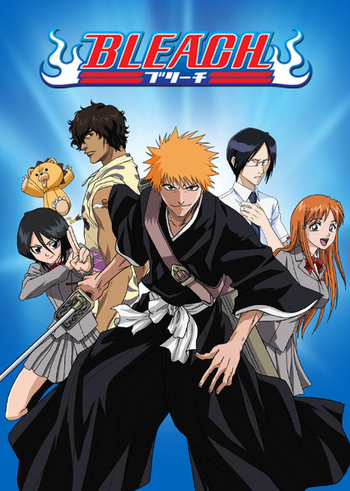
Ichigo Kurosaki would have liked to have been an Ordinary High-School Student. Unfortunately, his ability to see and hear ghosts (and his orange-colored hair) kept getting in the way of a normal life. This is all he knows of the spirit world until the day he encounters Rukia Kuchiki, a Soul Reaper whose profession requires her to destroy evil spirits ("Hollows") and send good spirits ("Pluses" or "Wholes") to the afterlife. When Rukia is injured while trying to slay a powerful Hollow about to kill Ichigo and his family, she offers the boy a portion of her powers to defeat it in her place. Unfortunately, his abnormally-high amount of spiritual energy absorbs all of her power instead, forcing him to take up her duties until she can recover and return home. What follows are adventures within the realms of the spirit world and facing the dangers that produce them.
Written by Noriaki "Tite" Kubo, Bleach starts off as a quirky Urban Fantasy action-comedy, but soon becomes a much more standard Shōnen Fightin' Anime with the start of the Soul Society arc. In it, Rukia is arrested by her fellow Soul Reapers for the crime of transferring her powers to a human, and taken back to the afterlife ("Soul Society") to be executed. Naturally, Ichigo wants to mount a rescue. Training montages, Next Tier Power Ups and ridiculously complicated plans ensue.
That said, this change of direction has led to not only one of the most ludicrous dramatic moments in manga history, but many an awesome moment as well, and its continued popularity speaks for itself. Hell, it even has musicals! For most of its run, it was one of the "Big Three" long-running shonen manga/anime in serialization alongside Naruto and One Piece, and it inevitably gets compared to its colleagues, as well as Dragon Ball (which Kubo is inspired by) and YuYu Hakusho (which shared the same director, and also dealt with supernatural themes). It's also notable for having one of the largest Periphery Demographics in the history of shonen manga — it has not so much an Estrogen Brigade as an Estrogen Legion.
The manga was serialized in Weekly Shonen Jump from August 7, 2001 to August 22, 2016, spanning 15 years and 686 chapters that were compiled into 74 volumes. The anime ran 7 1/2 years, from October 5, 2004 until March 27, 2012, after the completion of the manga's penultimate (Lost Agent) arc, giving way to the Naruto spinoff Rock Lee's Springtime of Youth. Some plot points were further expanded upon in Bleach: We Do Knot Always Love You and Bleach: Can't Fear Your Own World novels.
In July 2018, Kubo released a one-shot spin-off manga called BURN THE WITCH; set in London, England and dealing with the Western branch of Soul Society.
The anime remained an incomplete adaptation for years, ending where Chapter 479 of the manga does. On March 21st, 2020, it was confirmed on the AnimeJapan livestream that the anime would return with an adaptation of the final arc, Thousand-Year Blood War. The adaptation began airing on October 11, 2022 and is set for four cours.
On August 8, 2021, Weekly Shonen Jump released "No Breaths From Hell" - a 73-page special chapter of Bleach, helmed by Kubo, continuing after the ending of the series and beginning a new arc that involves the Soul Reapers fighting against the denizens of Hell.
There are five manga story arcs expanded into seventeen anime story arcs, including the anime-original Filler:
- The Agent of the Soul Reaper Arc (Volumes 1-8; episodes 1-20)
- Soul Society Arc (Volumes 9-21)
- Soul Society: The Sneak Entry Arc (Episodes 21-41)
- Soul Society: The Rescue Arc (Episodes 42-63)
- Bount Arc (Filler; episodes 64-109)
- Arrancar Arc (Volumes 22-48)
- Arrancar: The Arrival Arc (Episodes 110-131)
- Arrancar: The Hueco Mundo Sneak Entry arc (Episodes 132-151)
- Arrancar: The Fierce Fight arc (Episodes 152-167)
- New Captain Shuusuke Amagai Arc (Filler; episodes 168-189)
- Arrancar Arc (continued)
- Arrancar VS Soul Reaper arc (Episodes 190-205)
- 110 Years Back arc (Episodes 206-212)
- Arrancar: Battle in Karakura arc (Episodes 213-229)
- Zanpakuto: The Alternate Tale arc (Filler; episodes 230-265)
- Arrancar: Deicide arc (Episodes 266-310)
- 13 Court Guards Incursion Arc (Filler; episodes 311-342)
- The Lost Agent Arc (Volumes 49-54; episodes 343-366)
- The Thousand-Year Blood War Arc (Volumes 55-74; episodes 367-?)
See the recap section for more.
The English dub is licensed by Viz Media and aired on [adult swim] (later, Toonami) from September 8, 2006 and ended its run on November 1st, 2014.
During its run, Bleach has had two live action adaptations planned. On February 22, 2012, Warner Bros. Studios announced the licensing and planned development of a live-action Hollywood movie although plans for that seem to have fallen through the cracks. However, with the release of the final chapter on August 18, 2016, Tite Kubo himself confirmed that a Japan-produced live-action film adaptation would be released some time in 2018. The movie, simply titled Bleach was released in theatres on June 20, 2018 in Japan and distributed worldwide by Netflix on September 14, 2018.
Speaking of movies, there are pages for all of them, both the live-action and four big-budget animated ones:
- Memories of Nobody (2006)
- The DiamondDust Rebellion (2007)
- Fade to Black (2008)
- Hell Verse (2010)
- Bleach (2018)
Bleach is amongst those few anime that earned its own Die For Our Ship, Ho/Foe Yay and Fan Nickname pages. It also has twenty character sheets.
It now has pages discussing one of its DS outings, Bleach: The 3rd Phantom, and the Light Novels: The Death Save the Strawberry, We Do Knot Always Love You, and Can't Fear Your Own World.
Note: This article is not about a laundry detergent or Nirvana's first album, even though the franchise was named after the latter. It also (usually) has nothing to do with Brain Bleach ("We stand in awe at that which cannot be unseen").
Please revamp the main trope pages by moving all character tropes to their respective characters.
If you haven't read the manga, there are major spoilers below.
Bleach is the Trope Namer for:
- Flash Step: A favorite combat maneuver of most Soul Reapers, called 瞬歩 (shunpo) in Japanese. The Arrancar have their own move called Sonidonote , the Quincy have their 飛廉脚 (hirenkyaku)note , and the Fullbringers have Bringer Light.note Despite the different names (and claims by various practitioners that their version is better), the only apparent difference between them is the sound effect each one makes, with the exception of Bringer Light which emits a green flicker. This is even Lampshaded by Gin Ichimaru in one of the omakes (before the introduction of Bringer Light).
It also provides examples of:
- Tropes A to B
- Tropes C to D
- Tropes E to G
- Tropes H to K
- Tropes L to N
- Tropes O To R
- Tropes S to T
- Tropes U to Z
Show me your bankai, TV Tropes!
