
Alice needs to decide between buying a strawberry cake or an apple cake, but she really can't make up her mind. So, she tries to decide by... flipping a coin. Heads, strawberry. Tails, apple.
Flipping coins to decide on an action has been a practice that, according to The Other Wiki, dates at least back to Ancient Rome. In fiction, it usually happens in the following situations:
- A character is unsure whether the option they are considering is the correct one, so they leave it up to fate.
- The Powers That Be dictate what action must be taken.
- A third party is trying to solve a dispute between two other people or factions. Often happens in contests when there is no clear winner.
Note that this trope can be used when deciding between two characters, things, or virtually anything. It can be a very common form of the Life-or-Death Question, due to that also being a very high-stakes binary choice.
A Born Lucky character will almost always get the result they want in this. A staple feature of The Gambler and The Trickster, who frequently settle their disputes this way. Occasionally a character will pick a course of action with a coin flip because he wants to prevent his enemies from figuring out what he'll do (that is, to counter I Know You Know I Know)—they can't predict it if he doesn't know himself. Cheaters tend to use a Two-Headed Coin. Heads, Tails, Edge is a subtrope. Heads I Win, Tails You Lose does not necessarily involve a coin flip but is derived from this terminology.
In technical terms, such play is a Bernoulli trial , which describes any random experiment with exactly two outcomes. Note too that a coin toss is not exactly a 50/50 probability: barring the possibility of a trick flip (and yes, people can train themselves to make a coin land a certain way) and ignoring weight (typically the heads side is heavier resulting in a lopsided spin), a coin is more likely to land on the same side it was initially flipped from due to simple physics.
Examples:
- A 1990 PSA from the Canadian organization Companies Committed to Kids "Moe Funky" encourages kids to not play games when making important decisions and to "use their heads" instead. Flipping a coin is one of the games depicted.
- One commercial from the Shaw Delivery Bots try this trick, but it doesn't land because there's no gravity in space.
- In Demon Slayer: Kimetsu no Yaiba, Kanao Tsuyuri initially uses a coin flip to make all of her decisions. Tanjiro helps her break out of this after befriending her.
- In Hunter × Hunter, members of the Spiders (aka the Phantom Troupe) flip a coin to settle disputes. This is because it's forbidden for Spiders to fight each other (they only murder outsiders, after all) and thus a non-violent way of settling internal disagreements is needed.
- In MOON – Subaru Solitude Standing, Minmin uses a coin toss on deciding her future: if she gets 'the side with the design', she'll give up her whole life in China and follow her dream of becoming a professional dancer.
- In Pokémon: The Series, Dawn has a Poketch app to flip a coin which she sometimes uses to make decisions, for example the episode in which she got the Poketch she used it to decide whether to go left or right at a forked road. The app is the same one that's available to the player in Pokémon Diamond and Pearl.
- Yakitori: Soldiers of Misfortune. During their training on Mars, the Yakitori are (as usual) arguing over what to do, so they toss a coin. It makes no difference because (as usual) they get 'killed' because they're not cooperating with each other. In the Season One finale, they're shown playing Rock–Paper–Scissors instead.
- In Season 7, Episode 19 of Happy Heroes, Careless S. is turned into a ditherer after an incident that left a girl mad with him after he couldn't fulfill her wish to sing her a birthday song due to the amount of problems occuring at the same time. Careless S. gets the idea from Ambassador Wang to flip a coin to finalize his decisions when he can't figure out whether to step with his left foot or right foot first in order to cross the street, and he relies on that coin for most of the episode until Headmaster Tele convinces him not to.
- Bill Cosby's "Toss of the Coin" sketch is about what might've taken place if they flipped a coin during the American Revolution and the Battle of Little Bighorn.
- Two-Face's signature item in Batman is a Two-Headed Coin, except one side is all scratched up. This lets him easily identify which side landed. In most portrayals, he is completely unable to operate without the coin; when he flips it, he absolutely must act on whichever side came up, and is literally unable to do otherwise.
- In a Disney Ducks Comic Universe story by Carl Barks, "Flip Decision", Donald Duck is conned by a charlatan into believing in Flipism: the idea that all of life's choices can be made on the flip of a coin. Despite it being a con, the coin does show uncanny predictive power.
- In Marvel Comics Presents #53, Silver Sable and Black Widow chase a common target to the top of the Eiffel Tower, but once they have him cornered, they clash over who gets to take him into custody. Just as they're about to flip a coin for it, he stumbles over the side and falls to his death. With a mutual win and loss behind them, the two heroines opt to flip again over which restaurant to go to celebrate/drown their sorrows.
- In a Richie Rich story, the same coin ends up deciding whether Mr. Rich should invest a billion dollars in a new company, and whether a hobo or tramp ("I can't decide... let's toss a coin!") should buy a soda or a candy bar. (The actual tosses' results are unknown, but they each read the result of it flying out from under the moped seat and into the window of the mansion.)
- A coin flip decides the fate of an entire world in The Trigan Empire. The Lokan dictator is wondering who to crush next; the nomadic warrior Vorgs or the cultured Tharvs? Expecting to conquer both in good time, he tosses a coin to settle the matter. It's the Tharvs, and their refugees flood into Vorg territory where they form an alliance with the Proud Warrior Race that defeats the Lokans and establishes the Trigan Empire.
- In The Cursed after witnessing Snape and Quirrell's confrontation in the Forbidden Forest Harry and Ron flip a knut to decide whom to follow.
- In Family is Everything Harry flips a knut to decide whether he or Annabeth will tell their story first.
- In Harry Potter and the Prince of Slytherin Padma mentions that her father flipped a coin when he was trying to decide whether her or her twin sister Parvati would become betrothed to the son of a wealthy Indian wizard when they were three.
- This is how Gladion and Lillie decide who'll join the Ultra Rangers in Infinity Train: Crown of Thorns. Whatever they picked, Lillie wound up being the one to join.
- In Mega Man Reawakened, Gemini Man uses coin flips to make decisions at times.
- In The Memory Harry and Ron flip a knut to see who goes to check whether the basilisk is dead after seeing its reflection.
- In A Shadow of the Titans, this is how the Chaotic Neutral Gadjo makes up his mind on the decision of either pledging loyalty to the Oni and their plan to Take Over the World, or fighting against them, since both ideas appeal to him.
- Assault on Precinct 13 (1976). Rejected by Wells when he and Wilson have to work out who'll make a risky attempt to escape the besieged police station and get help. Well claims he always loses a coin toss, so they play an altered version of "Potatoes" instead. Which Wells also loses.
- Battle For Sevastopol. Lyudmila Pavlichenko's friends are divided over whether to go to the shooting range or the movies, so they tell her to toss a coin. Lyudmila lies about the result because she wants to go to the range. Her shooting impresses the range officer and she's selected for a marksmanship course, causing her to be sent to the front line as a sniper when the war breaks out shortly afterwards.
- Circus: Throughout the film, Leo makes several important decisions by tossing a coin. This includes whether he is going to shoot his wife Lily.
- In Coming to America, Prince Akeem flips a coin to choose between traveling to New York or Los Angeles to find himself a bride.
- In Crooked House, Roger admits that he had not read Philip's screenplay before deciding not to fund it; instead opting to toss a coin. When asked why he tossed a coin, he replies that he couldn't find a die.
- In The Gay Divorcee, when Guy arrives at Mimi's hotel suite, he flips a coin, apparently deciding whether to leave or stay. He doesn't like the answer, so he flips it again and stays.
- Ghost Lab (2021):
- At one point, while searching for evidence of ghosts, Wee and Gla come to a fork in a hallway. They decide to flip a coin to determine which way they will go.
- In the middle of the movie, they decide to have one of them die and appear to the other for research purposes. They decide which one it will be via coin flip.
- The Iron Claw: When he needs to decide whether Kevin or Kerry will compete for the world title in David's place, Fritz opts to flip a coin, claiming it to be the only fair way to decide. The camera focuses on the coin in the air before cutting to Kevin patting Kerry on the back as the latter heads into the ring.
- Mr. Tako habitually does this in King Kong vs. Godzilla to make decisions. He even does it when the two monsters first confront each other in an attempt to predict the winner.
- At the start of Last Man Standing, John Smith chooses to take the road to Jericho by spinning a flask of whiskey, then going in the direction it points. As a result, a lot of people get killed.
- In a timeline explored in Mr. Nobody, the protagonist is utterly unsatisfied with his wealthy life, to the point he decides to leave everything and determine his fate by taking this trope to the extreme.
- Babe, in No Man of Her Own, always flips a coin to make a decision that he can't decide on. He mentions that he never goes back on a coin, either.
- Rat Race: Owen Templeton, played by Cuba Gooding Jr., is a disgraced NFL referee who fumbled the coin toss at a crucial game. He insists that the coin he was given was a commemorative one which made it hard to tell which side was heads and which tails. The public don't care and mock him whenever they recognize him. During the race he gets into a taxi driven by a guy who lost a lot of money on the game he screwed up. When the driver works out who Owen is he dumps him on the side of the road.
- In Scarface, Guino Rinaldo was the one to popularize this trait as a quirk of gangster and gangster movies in general.
- Screamers. When we're introduced to the protagonist, he's examining an ancient Roman coin. In the climax, he and his Love Interest have got to an escape rocket, but there's only room for one. Both insist the other should go, so he says they'll toss the coin. But as the coin is spinning on the ground, he just tosses his glove on it and says it's meaningless because she's going anyway.
- In The Sentinel (2006), the Secret Service, aware that an assassination attempt on the President is imminent and that there is someone in the Secret Service helping, are trying to take every precaution possible. The President's personal bodyguard Montrose suggests a coin toss. That is they create two plans for how the President travels, and right before they leave he tosses a coin to decide which one they do. That way, no one has advanced knowledge.
- Parodied in the film Some Like It Hot where a character played by the same actor who played Guino in Scarface (1932) asks a fellow gangster (who is flipping a nickel) "Where did you pick up THAT cheap trick?"
- Ghost Train, your character decides to flip a coin to decide whether to follow a farm track to the north or south, believing this to be a far more sensible way to make a decision than Miss Crumble's special dice.
- In Barefoot Boy With Cheek by Max Shulman, the protagonist decides to flip a coin to answer the question vexing him: "Yetta or Noblesse?" The coin disappears in a snowbank.
- In Battle Royale, Kiriyama flips a coin to decide whether he'll participate in the Program or not. We later learn that he has no emotions and simply "chooses" what to do. It turns out he couldn't care less what it lands on, and simply decides to kill his classmates mercilessly, because it lands on tails.
- In Bud, Not Buddy, Bugs and Bud arrive at a Hooverville and can't agree on who should go in to ask for help. Bugs says, "Heads I Win, Tails You Lose," flips a coin, gets tails, and sends Bud in.
- At the end of Cry Wolf by Wilbur Smith, there's an aircraft that can be used to escape the advancing army of Fascist Italy, but it can only take one passenger due to weight limitations. The two male protagonists flip a coin to decide who gets to stay behind for a Last Stand. The Loveable Rogue pretends to lose only to be exposed, so he just knocks out his friend and shoves him on the plane.
- In the short story "The Golden Judge" by Nathaniel Gordon, a man sitting in on a negotiation between Israel and Jordan makes the flippant remark "Why don't they toss a coin for it?", and to his surprise both sides agree. He has a special golden coin made for the flip, and the "Golden Judge", as it becomes known, soon becomes an official method of resolving international disputes.
- Halo: The Fall of Reach opens with Halsey first meeting John, the boy who would eventually grow into the Master Chief. She tests his reflexes by telling him to guess which side a coin is going to land on after she flips it. John makes his guess, snatches the coin out of the air, and opens his hand to reveal his guessed side. Halsey speculates that John is either very lucky or good enough to actually grab the coin at the right time so it would land with the correct side up; either way, she decides to keep an eye on him.
- Isaac Asimov's "The Machine That Won the War": After winning the war, a bunch of politicians and scientists gather around MULTIVAC, to celebrate the titular machine for calculating their army's strategy. But Henderson, the programmer who took in the raw data from the field and fed it into MULTIVAC, explains that he knew how unreliable that data was (people covering their mistakes, telling their supervisors what they wanted to hear, making their own guesses about other work, etc.) and so he began adjusting and manipulating the data according to his own theories. This prompts Jablonksy, who was Chief Interpreter of MULTIVAC's output, to reveal that the machine itself was not reliable anymore due to inadequate parts and operators, so it did not matter what kind of data was fed into it and he changed the final output himself based on his own theories. Then Lamar Swift, Executive Director of the Solar Federation, the man who had to actually make the decisions in the war, reveals that he never trusted MULTIVAC's final output at all. Not completely, not when there were lives on the line. At the end of the story he reveals the method he used every time he had a particularly hard decision to make. "Heads or tails, gentlemen?"
- This happens twice in The Mote in God's Eye, in both cases to avoid having one's actions anticipated by superintelligent aliens:
- While the midshipmen are trying not to be captured, Horst Staley proposes flipping a coin when deciding what to do so his Mediator Fyunch(click) can't predict his decisions.
- When the human expedition prepares to leave the Mote system, the Moties send them a gift ship full of alien technology. The human leadership decides to randomly cut up the technology into pieces in case the Moties designed any of it for nefarious purposes. While Lady Sally is directing the procedure she flips a coin to decide how many times to cut.
- No Country for Old Men: Anton Chigurh flips a coin to decide whether to kill a potential victim. Those that choose not to take the chance are killed anyway, because they refuse to submit to the Powers That Be. One victim calls him out on it, saying it's just a way for Chigurh to pretend he's not responsible for his actions.
- In the book Q & A Ram flips a 'lucky coin' to make important decisions throughout his life. As it turns out, Ram's coin was a trick coin and he was fully aware of what life-changing choices he made throughout the story.
- A Piece in the Game of Gods: From Part 44:
There was a French maid costume that had been tossed on the floor, and which had actually looked really nice on Cassandra. We’d flipped a coin over who would wear it, and fortunately, I’d won the toss, though next time, I might not.
- In Protector, a superintelligent alien (sort of...) needs to fight a space battle with similarly intelligent aliens. He knows what the ideal weapon is for the circumstances—but also knows that the enemies would know what that ideal weapon is, and could use countermeasures. So instead, he comes up with four pretty-good weapons which would each require different countermeasures, and rolls a die to pick which one to use. (The enemies would be able to predict that he'd do that, too, but they wouldn't know which way the die came up.)
- In the first Soldiers of Barrabas novel, Billy Two walks in on Alex Nanos while he's having sex and announces he's going to re-enlist with the Marine Corps. Alex starts to argue, and eventually they decide to settle the matter with a coin toss. Unfortunately they don't have a coin as they're both naked, so they decide to flip the woman Alex was having sex with ('boobs or butt' instead of 'heads or tails'). She is not amused.
- From The Stainless Steel Rat:
I flipped a coin to decide, and of course won since I had palmed the coin before the toss. It was going to be action.
- In Andre Norton's Storm Over Warlock, Shan and Thorvald are trapped in mists, with no sense of direction. They have an artifact rather like a bone coin, which has shown strange powers before, and decide to flip it as they have really no other alternative — heads this way, tails that way. It flies off through the air, and they chase it instead.
- In The Wheel of Time books, Mat, and sometimes Rand, uses this method to make decisions. Since they both have luck-bending reality powers, this has extra significance. Mat in particular has a tendency to get coins landing on their edge.
- Frequently used to settle haggling debates on Bargain Hunt when the team's expert and the seller cannot agree a price.
- Played for Laughs in Derry Girls. While on holiday in the Republic, the titular girls go to make a coin toss. However, they have to do it using Irish Punts, as opposed to the Pound Sterling coins that they're used to, so nobody seems to know which side is heads and which side is tails. Incidentally, with Irish Punts, "Heads" was the side of the coin with the animal (Stag, Kingfisher, horse, fish, or bull) and "Tails" was the side with the harp.
- Doctor Who:
- In "The Three Doctors", Two and Three flip a coin to see which one is going to go outside the TARDIS to confront the Gell Creature and buy time for the other to do the whole Doctor-y thing to thwart Omega. Three loses, and the creature zaps him and Jo to Omega's antimatter domain, with Two, the TARDIS, the Brigadier and Sgt. Benton following shortly after anyway.
- In "The Pirate Planet", the Doctor flips a coin to make a decision, then reveals that the coin is from a planet with two monarchs, so both sides are heads.
- In "Warriors' Gate" there is a lot of coin flipping, which is tied in with the story's themes about predestination.
- At the end of "Thin Ice", Nardole gets annoyed at the Doctor for nicking off to have another adventure in time and space instead of staying on Earth like he promised. The Doctor promises to stay if Nardole wins a coin toss. However earlier in the episode he got the secret of winning a coin toss out of a conman who was using this trick, so Nardole loses.
- At the start of Dragnet episode "The Subscription Racket", Bill attempts this to decide whether he or Joe goes to speak on The Jerry Dexter Show. The chief ends up catching the coin and deciding himself that it will be Joe.
- Farscape: In the third season finale Aeryn wants to go off on her own to deal with her grief over watching one version of Crichton die in her arms. The surviving Crichton wants to go with her and doesn't want to take no for an answer. He eventually suggests they leave it up to fate and toss a coin. If Crichton wins they leave together and if Aeryn wins he stays behind. The scene cuts away with the coin still in the air but Crichton evidently lost as Aeryn leaves without him.
- Frasier is trying to decide which of the two women he's currently seeing he should break up with. Niles pulls out a coin but, due to being The Klutz, turns it over on his hand instead of throwing it in the air. He looks at the result and then asks which one Frasier wants to hear because that's clearly who he wants to be with. Niles then decides to try a proper toss to help Martin decide which flavor of jelly to put on his toast and ends up hitting himself in the face with the coin.
- Friends:
- Chandler and Joey accidentally leave Ross' infant son on a bus. When they go to collect him from the depot there's two babies and they can't tell which is Ben. Joey suggests they flip for it based on the kids' shirts, ducks vs clowns.
Joey: Ducks is heads because ducks have heads!
Chandler: What kind of scary-ass clowns came to your birthday? - Rachel suggests she and Phoebe flip a coin to decide which of them gets to be Monica's Maid of Honor. Phoebe refuses and claims that "coins hate me". Eventually Rachel gets fed up with Ross and Joey's attempts to help them choose and pulls out a coin. Phoebe ends up winning and joyously declares that the coins must have forgiven her.
- Ross attempts to start the Guys vs Girls trivia game with a coin toss. Cue all four players silently watching the coin fall and then looking up at Ross expectantly.
Ross: (picking up the coin to try again) Okay, somebody call it this time!
- Chandler and Joey accidentally leave Ross' infant son on a bus. When they go to collect him from the depot there's two babies and they can't tell which is Ben. Joey suggests they flip for it based on the kids' shirts, ducks vs clowns.
- Subverted in an episode of Gilligan's Island. Gilligan was slated to duel with a native by throwing spears. Skipper had a coin to toss to determine who went first. He kept trying to get Gilligan to pick heads (it was a 2-headed coin) but Gilligan kept insisting on tails. In the end, the native (translated by the Professor) told Gilligan he could go first.
- Although jokes involving such a show have come up before on sitcoms, there actually was a real Heads Or Tails Game Show.
- Speaking of game shows, they tend to do coin tosses backstage before a show to determine who goes first in a game, most often when there's no returning champion- due to either the format not using them, or because a champion retired the previous episode- or when it's the first episode.
- On Human Target Gurerro solves a Wire Dilemma over the phone by flipping a coin.
- It's Always Sunny in Philadelphia: At the end of a game of Chardee Macdennis, the gang breaks out the "black card" with great ceremony to read what the rules are for resolving a tie. Having forgotten what they wrote on the card when they invented the rules, they're all disappointed to learn that they're just supposed to flip a coin.
- The series finale of JAG ends with Harm and Mac (who finally tied the knot) flipping a Challenge Coin to decide which of them will leave the military and live with the other, so they don't have to be stationed apart from each other.
- The Mentalist: An episode of Season 2 features the protagonist winning a bet this way. It landed heads 20 times in a row. No wonder they thought he was cheating.
- Miami Vice: Crockett and Tubbs would flip a coin to decide who would carry out certain tasks, either when multiple things needed to be done simultaneously, or simply when neither officer wanted to carry out the task at hand. It is worth noting that Tubbs always seemed to end up losing — both in terms of betting on the result of the flip, and also in terms of the outcome of losing that bet.
- "Milk Run" — to decide who would question Angela and who would distract her boyfriend Zeke in the meantime; Crockett won and pumped Angela for information while Tubbs talked to (and was all but assaulted by) an angry Zeke.
- "Red Tape" — to decide who went to serve a warrant with Detectives Eddie Trumbull and Bobby Cruz; Crockett won and sent Tubbs into the building. The apartment was booby-trapped, and the resultant explosion killed Trumbull and wounded Diaz and Tubbs.
- "Freefall" — to decide who would see Johnny Miranda and who would see the accountant Max Flynn; Tubbs caught the coin in mid-air and decided to go see Miranda, but ended up losing anyway as the decision led to his capture by Caesar Montoya.
- Night Court, in its very first episode, had newly appointed judge Harry Stone pull out a coin and declare it the "Coin of Justice". First he says that if it's Heads, he stays a judge, and if it's Tails, he'll resign. It's Heads. Then he tells a prostitute involved in his first case that if it's heads, he'll merely fine her with time served, but if it's tails, he'll send her up the river. It's heads. After a series of decisions that were all Heads, the defense attorney calls out "The defense wants Heads, Your Honor!". It's later revealed that it was a Two-Headed Coin, and that Harry was deliberately setting the more lenient penalties to heads for that reason.
- Invoked very dramatically by Tommy in Peaky Blinders.
Before the war, when I had an important decision to make, I used to flip a coin. Perhaps that is what I will do again.
- The Professionals. Bodie and Doyle toss a coin to decide which of them gets punched in the face (in "The Untouchables") or goes to investigate a house where a couple of hitmen might be lurking (in "A Stirring of Dust"). In both cases Doyle loses.
- Sabrina the Teenage Witch: Sabrina learns that the first time a witch kisses a mortal the mortal will be turned into a frog. As she's half-mortal there's a 50/50 chance that when she kisses Harvey he won't be transformed. Sabrina spends a day repeatedly flipping a coin to test whether she can beat the odds, but after 100 flips it's still 50/50. She finally decides to kiss Harvey...and he turns into a frog.
- In an episode of Scrubs, J.D. and Kim can't decide if they want to keep their baby, so they leave it up to a coin toss. It lands on its edge.
- Squid Game: A coin toss is used in the final round to decide which of the two finalists gets the choice between playing offense and defense in the titular Squid Game. Seong Gi-hun wins and picks offense.
- On one episode of Star Trek: The Next Generation, two different groups of scientists wanted to use the ship's detector array at the same time, and Data couldn't decide which group should use it first. Geordi suggested flipping a coin.
- Walker, Texas Ranger:
- The B-plot of Season 9's "Medieval Crimes" had the Rangers having to go to Buell to bring a witness named Morris Dobbs (who claims he is a jinx) back to Dallas to testify in a murder trial. Gage, Sydney and Trivette decide to flip a coin to see if one, two or all three of them would do it: whoever got heads got to stay behind in Dallas, while whoever got tails had to pick up Dobbs. Sydney and Gage get heads, while poor Trivette, as expected, ends up with tails.
- Rolf Harris' rendition of "Botany Bay":
Now my crime against the whole British nation
Was to take some dry bread one fine day,
T'was death, or it was transportation,
So they tossed up a coin and sent me away. - "Bob Dylan's 115th Dream":
I decided to flip a coin, like, either heads or tails
Would let me know if I should back to ship or back to jail
So I hocked my sailor's suit and I got a coin to flip
It came up tails, that rhymes with... sails, so I made it back to ship - Jo Dee Messina's "Heads Carolina, Tails California," a Wanderlust Song about needing to get away to anywhere but here so badly that the destination can be decided by a coin-flip.
Heads Carolina, tails California
Somewhere greener, somewhere warmer
Up in the mountains, down by the ocean
Where, it don't matter, long as we're going
Somewhere together
I've got a quarter
Heads Carolina, tails California
- From The Bible: "Flipping a coin ends quarrels and settles issues between powerful people." (Proverbs 18:18, God's Word translation)
- Several characters in The Bible make a decision by "casting lots", basically the ancient version of this. For example, in the first chapter of Acts, Jesus's disciples pick two nominees to fill Judas's recently-vacated spot among the twelve apostles, then they pray and cast lots to determine the winner.
- World Cup Soccer simulates its parent sport's coin toss every time you launch a new ball.
- A radio play Heads I Win Tails I Lose is about a young woman who flips a coin to decide everything, including whether or not to keep the baby from an unwanted pregnancy.
- In The Men from the Ministry the "old and traditional way" to make difficult decisions at the General Assistance Department is to toss a coin over it.
- In international soccer/football, the referee does a coin toss with the captains of both teams before the game. The winning captain can decide whether to take the kickoff or choose which half of the field his team will defend. The losing captain then takes the remaining option.
- Euro 1968. Italy, against the Soviet Union, won by this after none having scored in the semi-final match. It was the first and only time that this method was used.
- In American Football in general and the Super Bowl in particular, a coin flip decides who gets to choose one of the following first: which goal to defend and whether to kickoff or receive. The winner usually decides to receive and the other team gets to choose which goal to defend; but sometimes the winner will decide which goal, leaving the choice to receive or kick to the loser. At the start of the 2nd, 3rd & 4th quarters the direction of play reverses, and at the top of the 3rd quarter whoever received at the beginning of the game now kicks off. If there's overtime they have another coin toss.
- The league has a long list of tiebreaks for two (or more) teams with equal records attempting to secure a playoff spot (or, in some cases, a specific playoff spot). In the unlikely case the teams make it all the way to the end of a tiebreaker list, the final tiebreaker is a literal coin toss.
- The league has a long list of tiebreaks
- Nightmare has a plastic coin to flip when attempting to collect a key for drawing the "Chance" card bearing the player's character and number, or steal another player's cards per certain keys' powers.
- Magic: The Gathering has a few cards that require you to flip a coin.
- This is very common in the Pokémon Trading Card Game. Each player has a coin of his or her own. Players flip to see who goes first. Then there are several cards where the player flips his or her coin to determine the number of cards they draw from their deck or the amount of damage a move will do etc.
- A few Tabletop RPGs call for the fairly rare d2 roll, which can be simulated by a coin toss.
- In Albert Herring, Albert takes a sovereign out of his prize purse and flips it to decide whether or not to have a wild night on the town. When it comes up heads for yes, he almost has second thoughts about it.
- Played With in Rosencrantz and Guildenstern Are Dead. They periodically flip a coin to make a decision, but it is established early on that the coin always lands heads up, as a symptom of You Can't Fight Fate. Until the one time it's tails.
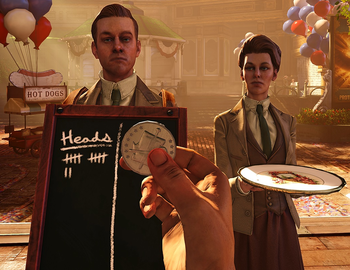
- In BioShock Infinite, Booker DeWitt runs into Robert and Rosalind Lutece for an obligatory "heads or tails" coin flip, in which Booker chooses randomly and flips the coin, only for it to come up heads. Rosalind records on the sandwich board Robert carries, showing that all previous (127) attempts have always come up as heads.
- Dante picks up this quirk in Devil May Cry 2 for unexplained reasons, using his coin to determine whether or not he'll help Lucia and Matier, most notably when deciding who between him and Lucia will go into Demon World and slay the recently-revived devil king Argosax and most likely be trapped there for eternity. Lucia notices in the epilogue that it's a trick coin and the coin itself later comes in handy when Dante switches his own lucky coin with the Arcana Medaglia to fool Arius near the end of the game. Dante retains this trait during his guest appearance in Shin Megami Tensei III: Nocturne. Savvy players can actually recruit Dante for only one Macca if they know about the trick coin.
- In Fear & Hunger coin-flipping is an important mechanic of the game which determines the outcome of encounters, loot discoveries and enemy attacks. Successful outcomes are when the coin lands on the position that the player selects. Unsuccessful outcomes can range from finding nothing of interest in crates and to an attack leading to an instant Game Over. A later patch introduce the Lucky Coin item, which can be consumed to toss two coins at once and keep only the best result.
- Final Fantasy VI:
- Edgar and Sabin flip a coin to determine who will be king of Figaro — or, more specifically, the winner would choose their own path. Edgar flipped a Two-Headed Coin, but called "heads" for Sabin; Sabin chose to leave the castle. Later, Celes borrows the same coin against Setzer. He falls for it. If you bring both Figaro brothers to that cutscene, Sabin is rather appalled to learn the truth about the coin (and it is that coin, because Celes borrows it from Edgar before she makes the offer).
Celes: If it's heads, you help us. If it's tails, I'm yours. Well, Mr. Gambler?
Setzer: [after the flip] ...A valuable trinket indeed. I've never seen a double-headed coin before.
Sabin: [realizing which coin was used] That coin...!? Edgar! Don't tell me...!
Celes: I'm afraid you've been hustled, Mr. Gambler. But that's part of the game, now, isn't it?
Setzer: Ha! How low can you stoop? ...I love it! - Subverted in the ending of the game. When faced with two paths, Setzer flips a coin, and the group starts down the path it bounced. Setzer stops them and decides to go the other way, which turns out to be correct.
Setzer: Sometimes you just have to feel your way through life.
- Edgar and Sabin flip a coin to determine who will be king of Figaro — or, more specifically, the winner would choose their own path. Edgar flipped a Two-Headed Coin, but called "heads" for Sabin; Sabin chose to leave the castle. Later, Celes borrows the same coin against Setzer. He falls for it. If you bring both Figaro brothers to that cutscene, Sabin is rather appalled to learn the truth about the coin (and it is that coin, because Celes borrows it from Edgar before she makes the offer).
- A Running Gag for the character Joshua in Fire Emblem: The Sacred Stones. In fact, his recruitment conversation has him propose to Natasha that he'll join her if she wins on a coin flip. Support conversations with other characters reveal that he cheats on this on a regular basis, and might have used it as an excuse because he didn't want to kill her.
- In the Dynamix game Heart of China, after narrowly avoiding a disasterous landing in Kathmandu, "Lucky" Jake Masters and Zhao Chi need to decide who will go to find help and who will remain with the ill Nurse Kate. One of the ways this can be resolved is with a coin flip. This can be subverted as well.
Lucky: Oh really? Well, a coin has two sides. Heads and tails. I'll flip it. If it's heads, you go. If it's tails, I'll stay.
Chi: Why bother then? Result the same. - Religious Idle: The final battle of your religion and Christianity is a coin toss. You pick heads and you win, securing world domination by doing so.
- Eizen in Tales of Berseria caries a rare gold coin which he is frequently seen flipping. He never actually uses it to help make a decision since his Reaper's Curse ensures the coin will always land on tails. When he tries to flip some Two-Headed Coins they are prevented from landing in increasingly dramatic fashion.
- One of the first parts of the Decision Game of Zero Time Dilemma is Zero challenging Carlos to Heads or Tails with a multi-colored coin. If Carlos gets it right then he and Zero's other captives will be let go while losing causes them to play the full Decision Game with humanity's lives on the line. Carlos can actually win and Zero honors his side of the agreement.
- In Freefall, Florence tries this more than once. On one occasion, Sam catches the coin in midair, and another time, she thinks as she throws that if she really wanted it to be fair, she wouldn't use one of Sam's coins.
- Hardcore Leveling Warrior: Hardcore Leveling Warrior has a skill which lets him flip a coin for the chance to get a stat boost to any stat of his choice.
- Homestuck:
- Played with in this instance: Terezi will sometimes make decisions with a coin flip. (The coin is two-headed, but one side is scratched) However, she more often than not ignores the result and just does what she wants. That's because — more often than not — the result doesn't make a difference.
- Quarters of the Felt has special coins with the numbers of the Felt engraved on them. If the coin is flipped by its corresponding Felt member and lands on the opposite number, they swap places with the opposite number member. If the coin lands on the side corresponding to the member who flipped it, they die. Only Clover is trusted with his own coin because he's Born Lucky.
- Subverted by Rhea Snaketail in Slightly Damned. She flips a coin to decide if she will help Kieri, but lies about the outcome and decides to help anyway.
- In episode 34 of campaign 3 in Critical Role, Fearne has the though decision of deciding which one if her two friends she's gonna revive, as she only can bring back one person. It comes down to a coin toss.
- Episode 18 of World's Greatest Adventures begins with Rufus trying to use this method to decide where to go next on an exploring venture. (He keeps losing the coin in the foliage, and ends up landing it in a bush of nettle.)
- In the prologue to the Arthur episode, "The World of Tomorrow", Arthur wants to go to the grand opening of the new Bionic Bunny store, while D.W. wants to see Mary Moo Cow's Ice-cow-pades. Their father decides to settle their dispute with a coin toss. Arthur calls heads and D.W. calls tails. The coin lands on the tails side and Arthur is forced to go to Mary's Ice-cow-pades. Arthur uses this example to explain to the viewers what could happen if they got stuck in a really bad day.
- In one episode of Batman: The Brave and the Bold Batman faces down Two-Face whose henchmen have Batman dead to rights. But when Two-Face flips his coin to determine whether Batman will live or die, the coin comes up "live." When his henchmen protest, Two-Face ends up teaming up with Batman against them. After they're defeated, Two-Face flips the coin again to see if he can kill Batman. But Batman just punches him out while the coin's spinning in the air.
- The Beatles cartoon "Devil In Her Heart" had Ringo losing his way to the picnic grounds and approaches a fork in the road. He flips a coin to decide which route to take, and the coin sprouts vampire wings (he and George are in Transylvania) and flies away.
- The Code Lyoko episode "A Fine Mess" opens with Ulrich tossing a Euro coin to guess whether Odd or Yumi will come out of the scanners first. He calls Odd as coming out and at first, appears to have lost when Yumi is in the first scanner open... except it's Odd in her body. At the end of the episode, Ulrich flips the Euro coin at the vending machine to guess whether Odd or Yumi will appear first. He calls Odd coming out, and he wins.
- One Family Guy Cutaway Gag has the Founding Fathers of America flipping a coin to decide what to name a new state — heads for "Rhode Island", tails for "Cacapoopoopeepeeshire".
- In an episode of Futurama , the main characters enter an alternate universe where coin flips have opposite results causing decisions to be different. For example, that universe's Bender chose a gold paintjob instead of our Bender's gray, the Professor underwent an experiment to remove his own brain, and Fry and Leela are married.
- Kaeloo: When Stumpy and Pretty get into an argument, Stumpy pulls out a coin so they can toss it and see who wins. He then says "Heads I win, tails you lose." He wins, obviously, and Pretty tries to attack him.
- The Scooby-Doo, Where Are You! episode "Haunted House Hang-Up" had Shaggy flip a piece of baloney with one side covered in mustard to decide which side of a forked road the gang should take. Scooby promptly ate it before it landed.
- "Which Witch Is Which?" zig-zagged this with Shaggy flipping a coin to decide who would enter a spooky shack. Shaggy's options were "heads I win, tails you lose."
- In "Ghastly Ghost Town," Shaggy flips a coin as to whether or not to enter an abandoned saloon (heads for no, tails for yes. "The fact that it's a two-headed coin is beside the point!").
- The "heads I win, tails you lose" trope also appeared in an episode of Speed Buggy between Speed Buggy and Tinker. Tinker lost when the coin came up tails.
- The Sonic Boom episode, "Unlucky Knuckles" begins with Sonic and Knuckles playing Gopher Ball. To decide who goes first, Sonic flips a coin and Knuckles calls, "Tails!" ...to flip the coin, since he doesn't trust Sonic to be fair.
- Tiny Toon Adventures:
- At the beginning of the episode, "Thirteensomething", Plucky does this to help Buster and Babs decide what to watch on TV after school, as Buster would rather watch a football game, while Babs would rather watch the titular teen soap opera. Buster chooses the heads side, and Babs chooses the tails side. The coin lands on the tails side, and Buster is forced to watch Thirteensomething, much to his disdain. It is then revealed that Plucky's coin was double-sided, but he forgot which side was doubled.
- Played straight in the opening wraparound to the episode, "Weekday Afternoon Live", when Buster and Babs argue over who gets to host the episode. Buster chooses the heads side, and Babs chooses the tails side. This time, the coin lands on the head side, meaning Buster gets to host the show.
- Total Drama:
- In "The Chefshank Redemption", Lindsay suggests that the team flips a coin over the argument whether or not they should pick Gwen as their prisoner for the challenge. However, due to her short attention span, she assigns "we win" to heads and "victory is ours" to tails. The Killer Grips are not amused.
- In "Lies, Cries, and One Big Prize", Chris makes it seem that the one who first gets to pick a helper will be decided with a coin toss. However, he doesn't assign heads or tails to either Shawn or Sky, but rather flicks the coin at them. It hits Shawn in the eye, making him the first to pick.
- At least one U.S. state has it written into its constitution that, in the event of a perfect tie during an election, the outcome may be decided by a coin flip if other alternatives (run-off, voting by state legislators) are unfeasible or likewise deadlocked.
- In the UK, if an election is tied, the result can be legally decided by either flipping a coin or drawing straws. An example of this was for Bassetlaw District Council in 2000 when tie was broken by flipping a coin.
- In 1845, pioneers Asa Lovejoy (of Boston, Massachusetts) and Francis Pettygrove (of Portland, Maine) both wanted to name a new city after their hometown. They flipped a coin and the city has been known as Portland, Oregon ever since. The coin they used, now known as the "Portland Penny", is on display in the Oregon Historical Society Museum.
- Vitriolic Best Buds Roger Ebert and Gene Siskel often used a coin toss to resolve disputes. Notably, this explains why their TV show was titled Siskel & Ebert: despite having the more prestigious credentials of the pair, Ebert lost the coin toss to decide whose name should go first.
- It is actually a good way to find out if you have any unconscious preferences when you flip a coin to help you decide between two things. If you feel unsatisfied with the result the coin tells you, you know that you actually want the other.
- In some provinces of Canada, a coin is flipped to decide between two candidates who poll equal number of votes in an election, or two companies tendering equal prices for a project. The latter occurred on 2003 in Toronto when, for painting lines of city streets, two companies ended up with equal bids.
- In Melbourne, Australia, on March 27, 1986, two police officers flipped a coin to decide who would get lunch. Constable Angela Taylor lost, so she went to the police canteen... and was killed by a carbomb that had been parked outside the police station.
- In competitive high school debate, during elimination rounds a coin toss will be done beforehand. The winner gets to decide whether they want to affirm or negate the resolution. In Public Forum debate, a coin toss is done before every round. The team that wins the toss gets their choice of either selecting which side of the resolution to debate or whether they will speak first or second. The losing team then gets to pick whatever the winning team didn't.
