- Back in the 90s, companies in general attempted to appeal to younger demographics by refreshing their mascots, turning them into rapping, skateboard-riding monstrosities. These mostly failed to capture their attention, and made older people think of mascots as incredibly silly, and mascots became limited to kid-targeted products (at least in the West, in Asia they are still ubiquituous).
- Sony was particularly bad about this with their PlayStation Portable advertising.
- An advertisement for the "Slim and Lite" revision of the PSP suggests that players can "put it where they like", which typically means "shove it up their ass". Sony seems to be getting annoyed at its customers.
- At one point, an incredibly poorly-disguised viral marketing campaign attempting to masquerade as a fan website noted of the PSP, "I'd hit that." Does it even have the right ports for that?
- Disney Channel has been guilty of this twice:
- One ad encouraged people to stay for the upcoming shows, because after whatever was coming next, "Then it's off the heezy with The Proud Family."
- A promo for a Saturday night rerun block stated that the only thing better than shaking it up on live TV is "sharing it with your biffle". Your guess is as good as ours (it may be a failed attempt to phonetically pronounce "BFFL").
- Despite trying to win over — presumably — the kid demographic, consider how anachronistic the Chuck E. Cheese mascot is with his depiction as a "Sk8r" boy, over a decade after that fad has run its course with young kids. The mascot originally started as a suspendered, straw-hatted barbershop-type performer, appeared in the 1980s as a skateboarding mouse, went out of style, then swerved right back into relevancy when the Sk8r boy image appeared, and is now fading back out of style — all without any changes ever being made to the character itself. By the time skateboarding bert-slided itself back into relevancy again, it was in the form of edgy street skating, and an edgy street skating Chuck. E. Cheese probably wouldn't go over too well with the parents of most kids.
- One ad campaign has a child badly rapping over the beat to The Cupid Shuffle
 (which is only ever heard now at weddings alongside The Macarena and The Electric Slide), and then exclaiming that a thousand tickets is "like, a gazillion!"
 - The July 2012 campaign reimagined the mascot as a CGI rocker with the voice of Bowling for Soup's Jaret Reddick.
- One ad campaign has a child badly rapping over the beat to The Cupid Shuffle
- Boost Mobile briefly retained a commercial gimmick which involved elderly people talking like teenagers. (One features an old black woman who uses street vernacular and says stuff like "Where you at?"; in another, an old white lady makes frequent usage of "like", "whatever" and "totally"; apparently, this commercial presumes that old Generation Gap stereotypes will die out, but racial ones never will.) Later referenced on the The Simpsons:Marge: Yeah, I'll bet there'll be old people talking like young people, like those cell phone commercials everybody hates.
- Around the same time T-Mobile played it for laughs in somewhat a parody of "hip", "urban" mobile operators in their Poser Mobile commercials. Five, well, posers in baggy pants with blings randomly interrupted people talking on their phones with "Poser Mobile says you're out of prepaid minutes, yo".
Person: I've just bought minutes!Poser: Fees, shorty, fees! - Around the same time T-Mobile played it for laughs in somewhat a parody of "hip", "urban" mobile operators in their Poser Mobile
- Parodied in a series of Volkswagen commercials which would end with a grey-haired, thickly accented Peter Stormare "un-pimping" someone's ride...which is a fancy way of saying "trashing it in spectacularly hilarious fashion (and replacing it with a sober, sensible VW)."German Guy: Yo, Mike, you vant us to un-pimp zis ting, let me hear you say 'vhat'?Mike: What?Car is launched from trebuchet
- The Cliff's Notes banner ads, some of which were, at the time of writing, visible on this very site. Among their misinterpretations of textspeak are spelling "who" as "hoo", a Zero Wing reference, and the mystifying term "xcore" (which is possibly "score" spelled with Xtreme Kool Letterz). Xcore sometimes means "hardcore."
- Gas stations advertising "We got the hooch" after the popular '90s song.
- EA's initial teaser for Skate 2 announced "We're dropping the deuce." While this can be read as "releasing #2", its slang meaning is "taking a shit".
- Parodied in an Aim Trimark ad, where some executives, upon being told that their new shoe design is "sick", take most of the commercial to puzzle over whether or not that's a compliment. Then the Aim Trimark guy comes and says that he's not going to invest your money in a company run by these idiots.
- "It's The Legend of Zelda and it's really rad! Those monsters from Gannon are pretty bad! Octoroks, Tektites and Leevers too, but with your help our hero pulls through!" For the Nintendo Entertainment System, Your parents help you hook it up. note
- Smokey Bear:
- A billboard ad for forest fire safety: "Get Your Smokey On", making it sharing a sign with an anti-drug ad more hilarious.
- Defied in this PSA. Smokey tries his hand at this as rapper "Smokey B," but couldn't continue because he didn't feel comfortable spreading his message that way. So he takes off his rapper outfit, dons his traditional hat, and gives his message the way he knows best.
- A sign for youth sports that says "Be a Playa". While it obviously was meant to say "Be a player of sports!", what it actually said was "Have promiscuous sex!"
- In 1968, Columbia Records ran a notorious ad in Rolling Stone showing a bunch of picket sign-toting young radicals in a jail cell with the caption "But The Man can't bust our music." For extra hilarity, the albums shown in the ad are all Classical Music. (Wendy Carlos' early electronica Switched-On Bach was a bit more far out then.)
- In a commercial for Lunchables' newest product, "Wrapz", three kids lousily rap about the wrap. Possibly intentional, but still full of fail, and with slang like "A'ight" pronounced "Ah-Ite.".
- An Australian example for a rather mediocre car combines this with Buffy Speak, explaining that the Holden Astra "has extra features to an exclamation mark".
- A poster advertising the Slush Puppies sold there. The right side of the poster is a generic image of some Slush Puppie cups, but the left side is in a league of its own. It consists of three open cell phones with text messages on them. They read, in order, "LuVN DA CHiLLLLLLLLLLLL TASTe and FLAVZZZzzzzzzz" "REal FRUIT JUICE ITS GOT VITA C!!!!!!!!" and "GOTTA GET A SLUSH PUPPIE PLUS!!!!!!!!!!!!!!!!!!"
- The similar Icee cold drink at some point replaced its old bear logo◊ with a snowboarding one◊, and its current slogan (at least at Burger King franchises that sell it as of 2013) is "CHILL OUT WITH UR FAV FLAV."
- Similarly, Big Daddy Pizza posters saying Narmful things like "Every other slice is a sliver", "Wanna Piece of Me?", and "Show Your Hunger Who's Boss".
- An ad for Progressive seems to be an inversion. Flo, the company's mascot and resident Genki Girl tries helping out an elderly customer who uses outdated slang from the mid 20th Century. Needless to say, she has no idea what he's talking about.
- There is a German PSA about hepatitis that features a hip-hoppin' syringe (filled with a hepatitis vaccine), singing about using it to protect yourself. Yes, it's as bad as it sounds.
- Special mention must be made of K-Mart's Back to School 2009 ads; not one but two horrendous pseudo-slang words that no decent human being will ever utter without monetary compensation: "Blingitude" and "Rockstare".
- McDonald's
- The phrase "Maccy D's" as a nickname.
- The McWorld kid-targeted campaign from the early to mid 90's, which had the theme of "a world run by kids". The commercials depicted very stereotypical kid-instigated changes, with the big one being McDonalds food and restaurants becoming the centerpiece of the world. Mind you: This was the decade before Super Size Me premiered.
- A short lived banner ad, apparently intended to appeal to the "urban demographic" (read: black people) had the brilliant dialogue: "Double cheeseburger? I'd hit it". That does not mean what they think it does.
- Wendy's jumped on the bandwagon in the 2010's with their ad telling customers to "Do a spicy chicken sandwich." It has a "memer" praise the sandwich with "Eat spicy goodness LIKE A BOSS," as well as a bunch of girls taking "selfies" of their sandwich. The last guy is a "behind the timeser" who uses outdated slang like "da bomb" and "raise the roof," and everybody looks at him like he's lame.
- A TV ad for the Game Genie in the late '80s featured a pair of Bill-and-Ted-soundalikes and opened with the phrase "Yo video game dudes, talk to me!"
- An ad for an electronic diary for girls has one girl saying "And you can plug in your MP3 for major tuneage!
- In Italy they started adding in the buses ads reminding people to leave your seat to elder people. One of them just says "Be polite - leave your seat", while the other one says "leaving your seat is TOTALLY RAD!"
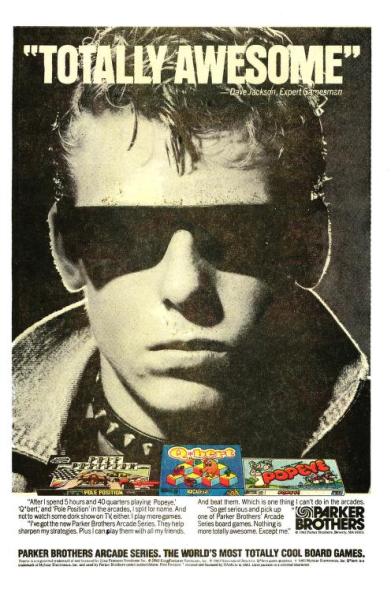
- Not only is this 1983 comic book ad from Parker Brothers◊ a nearly-perfect example of the trope, it was a trend-setter, as to this day, the ginchiest teens totally dig board game adaptations of arcade classics.
- A UK Pizza Hut billboard gives customers the instruction "Max Your Chat", leaving most people over the age of 0 utterly baffled.
- As if Ovaltine's advertising were not bad enough, there were a series of ads featuring Radio Ovaltine, which was basically run entirely by kids using "radical" lingo and playing nothing but the Ovaltine jingle sung by different kids, each one in a different style. Each performance was followed with the kid DJ saying something along the lines of "Totally radical!"
- Old Israeli toy and game advertisements frequently used the word madlik (מַדְלִיק), a ‘90s word for ‘cool’, entirely obsolete in modern Hebrew.
- The official website for Space Jam has this gem:Click above to find out more about our sponsors and the various hip sites that make WB Online the jammin' place that it is.
- A 2011 ad for the new Hot Pastrami melt from Subway claims it has power chords of tasteocity. If you were to say "Power chords of tasteocity" in conversation, people would probably assume you're having a stroke.
- For more Subway slang fail, there's one ad, in their long-running "fast-food will make you a fat slob" campaign, in which a burger combo is stated as giving someone a "badonkadonk butt". Three things: 1. Fast food wouldn't give you a badonkadonk butt, as it connotes a big, shapely butt, not a flabby one; 2. Badonkadonk is usually used positively; 3. The phrase "badonkadonk butt" is redundant.
- There was a hilarious(ly awful) Duncan Yo-Yo commercial made in 1994 that showed two different kids: One was a stereotypical nerd sitting on a chair in his living room playing a Sega Genesis (with Atari 2600 sound effects, of course) and a stereotypical cool kid with a backwards baseball cap "enthusiastically" playing with a Duncan Yo-Yo. The commercial ends with the kid saying, "You want speed, action and excitement? Get a Yo-Yo!"
- This ad for the boardgame Crossfire is an interesting variation. How do corporate advertising geniuses imagine a future that would appeal to the target audience (pre-teens and teens) while also promoting their new product? By showing kids in leatherjackets playing the game like a Rollerball/Thunderdome-style deathmatch of gladiatorial combat (the loser spins into oblivion), surrounded by their cheering fans, while a cool hard rock song is playing in the background. The Angry Video Game Nerd even made a video about it (as his alternate persona Board James)
- The commercials for Kellogg's Frosted Mini Wheats that ran in the early-mid 1990's, such as this one, which showed conflict between the kids' love of the frosting (with bad "heavy metal" music in the background) and the adults' love of the whole wheat (with boring "adult music" playing in the background). Noticing a chronological pattern here?
- Advertisements for Young Adult novels can fall into this, especially those done by Fierce Reads. Take, for example, this oppressively narmy ad, complete with the most banal attracting phrases and a stereotypically pop song about the joys of reading. There's not much else that could make a 16-year old not want to read.
- A '90's Pepsi commercial tried to convey that Pepsi drinkers are cooler than Coke drinkers by giving Coke to a group of teenagers and Pepsi to a group of senior citizens. The result was that the teenagers took to sitting around playing chess, while the seniors began skateboarding and dancing. The last scene showed an elderly man taking a swig of Pepsi and proclaiming, "This stuff is really radical!"
- The Burger King Kid's Club commercials of the mid-90's (again: noticing a common time frame here?) were particularly egregious examples. Their spokesperson was a "cool kid" with all the necessary "makings" of one (shades, a greaser jacket, a backwards baseball cap, etc.). The commercials themselves often depicted kids doing everything from playing in rock bands to being disgusted by their relatives just for showing them affection.
- Quaker Oats tried to reach the young crowd in the mid-90's with its "What's Hot, What's Not" commercials, using footage of hip young athletes and rock stars to show that their instant oatmeal was cool, and showed old timey things to prove that regular cold cereals were lame. It never seemed to occur to the advertisers that by their own logic, the portly, old, 18th Century Quaker Oats guy on the box would fall firmly into the "not" category.
- Honey Nut Cheerios, during the early/mid-90's, attempted to market their cereal to a younger demographic by ditching the warm and friendly tone of their 80's commercials for a more hip and edgy style: they retooled Buzz Bee into an arrogant Jerkass who talked like Roger Klotz and challenged people (including Sonic The Hedgehog) to races, with a bowl of Honey Nut Cheerios as the prize. The retool didn't sit well with audiences, and by about 1995, Buzz Bee was given a much nicer personality akin to the 80's.
- A particularly egregious example was a commercial for Twix that aired in early-1997. Its jingle went like this: "Some people like... peace and quiet" ::cue four shushes:: "... and some people like things to be LOUD! LOUD! LOUD! LOUD!" ::cue some stereotypical mid-90's grunge/alternative music:: The shortened version of this commercial was even weirder, with the lyrics going: "There once was a boy... who wanted everything... to be LOUD! LOUD! LOUD! LOUD!"
- Cartoon Network seems to think the way to relay a message to 2010s kids about bullying is with painfully bad hip-hop that wouldn't have been "cool" even in 1991.
- Invoked for humor by Sprint with their 2013 commercials featuring James Earl Jones and Malcolm McDowell. Totes magotes!
- A 2014 American Family Insurance Teen Safe Driver Program radio advertisement in Northern Colorado has the female teen narrator use "like" with the frequency of an article. Her friends suggest going to "the mall" as she now has her license, which is a radical idea... for 1995.
- Advertisements for Alfred Chicken were full of radical slang, making the game seem much edgier than it was."Are you ready to play the ultimate game of chicken?"
- Vitamin Water does this a lot, with one notable ad referring to "zero womp-womps". They also awkwardly put regional references in their ads, telling Philly residents to "get that jawn" (Philly slang that's basically a placeholder for any noun).
- The infamous Transformers Generation 2 commercial for the Aerialbot and Combaticon action figures referred to Combaticon leader Onslaught as "a metamorphing dudicus." Nobody has ever quite been able to figure out exactly what that is.
- Invoked with Keebler's Twitter account, which features the Keebler Elves trying to keep up with current social media trends and falling short."Keebler elves. Cookies, they know. Social media, not so much."
- A 2017 advertisement from Nintendo invites players to "find totally tubular offers for the Virtual Console".
- Spoofed with the Sprite soda "What is Cool?" commercial from 1994, where a teenage boy on the street wonders how he should try to be like one of the "cool" stereotypes, with amusing results.
- This was parodied in one commercial for the Seattle Mariners baseball team, in which, at the advice of a PR person, "Old School Kyle Seager" re-invented himself as K-Swag, a jewelry-wearing, slang-spouting walking stereotype.
- BIONICLE's world mostly takes place in a reasonably serious Low Culture, High Tech fantasy world, but when it came time to show off the Piraka (a group of villains who took the form of an evil gang), they decided to advertise them the only way such a group could be advertised... with a rap song. YO YO, PIRAKA!
- AOL News and Joyus, has clickbaity article: "Star Wars fans will flip out over this collector's edition gift", in which fans "flipping out" is supposed to be a good thing.
- Absolutely Rose Street is a 1994 infomercial meant to advertise the Sega Genesis' 32X add-on. It has a very mid-1990s South California aesthetic. Max, the "cool" hot-shot main male with a backward baseball cap and earrings, is the most blatant example.
- The Vive Sin Drogas ad campaign from Mexico features a flower who raps about how Drugs Are Bad. Predictably, the rap contains radical-type dialogue (for example, at one point the flower says "If they offer you drugs, they will tell you that it feels really padre", with "padre" [Spanish for "father"] being a common slang word for "cool" in Mexico).
- One of the advertisements for Disney XD's anime block is "Anime: It's not about being otaku. It's about being you". "Otaku" isn't really a positive term and most people would say "an otaku".
- In The '90s there was a Dutch ad campaign to keep kids from smoking. Since Smoking Is Cool they tried to showcase that cool people don't smoke. What the makers of these ads thought kids considered cool included: a waiter urinating in somebody's bottle of "apple juice", a guy punching his own father in the face for no reason whatsoever and another guy who made his mother believe his father had cheated on her and messing up their marriage For the Evulz. After performing these outrageous acts, the character would always turn to the camera and say: "Hey, but I don't smoke." Let's just say the campaign was controversial.
- Kellogg's attempted to do this with Toucan Sam in the late-1990s for Australia by revamping him into an more hip and cooler character who wears sneakers. Suffice to say, this did not last long as by the early-2000s, Toucan Sam reverted back to his more traditional self. See for yourself.
http://tvtropes.org/pmwiki/pmwiki.php/TotallyRadical/Advertising
FollowingTotally Radical / Advertising
Go To