
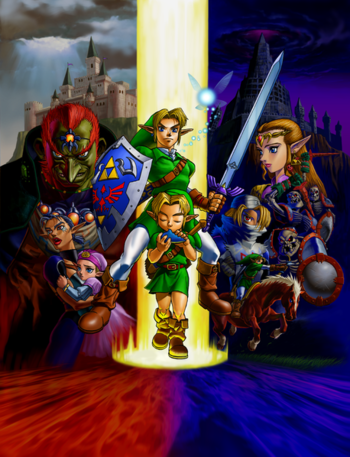
Ocarina of Time is the fifth entry in The Legend of Zelda series. It was the first 3D game in the series and the first Fifth Generation title, and it set the standard for all the later games in the series, with its then-unheard of style of cinematic presentation and for introducing many mainstay elements of the franchise.The story follows a young boy named Link, the only member of his forest village without a fairy. Following some prophetic dreams, he is gifted a fairy named Navi by the Great Deku Tree — the guardian of the forest — and asked for his help to remove an evil curse. This is merely the start of an epic journey that takes Link from the sanctuary of his Hidden Elf Village to the magnificent Hyrule Castle and then to all points of Hyrule in a quest to stop the evil thief-king Ganondorf from seizing the power of the omnipotent Triforce.Unfortunately, things don't go according to plan. Link falls into a deep coma, and when he wakes up seven years later, Hyrule has become a dark and twisted version of its former self. All is not lost though: there exists one final hope in Link, who is now old enough to wield the Master Sword and accept his true destiny as the Hero Of Time. Using his new powers, Link must travel across the broken Hyrule, and across time, to re-assemble the shattered forces of Good for an epic final showdown with the King of Evil.According to Hyrule Historia, this game takes place fourth in the overall timeline of the series and its events cause a three-way split in time, with each Alternate Timeline branching off from its events. Its immediate chronological sequel starring the same Link is Majora's Mask, which takes place after Link has been sent back in time and is transported to Termina while on a search for Navi.The game has had numerous rereleases — in particular, Master Quest, a preorder bonus for The Wind Waker which included the original game along with a second version (originally intended for release on the 64DD add-on) with harder dungeons.The game had a remake produced by Grezzo for the Nintendo 3DS, titled The Legend of Zelda: Ocarina of Time 3D, which updated the visuals and controls, but left the story, musicnote save for a newly orchestrated piece over the porting team's half of the end credits, world, and even some of the glitches and bugs intact. The Master Quest version of dungeons was also an unlockable in the 3DS remake- this time adding an extra twist by flipping the entire game world horizontally, in the tradition of the Wii version of Twilight Princess.Due to the insane popularity of the game and the fame of its various plot twists, expect unmarked spoilers.
The Legend of Zelda: Ocarina of Time provides examples of:
open/close all folders
A-D
Ability Required To Proceed: A staple of all Zelda games, you'll need certain items to advance further in each dungeon. Most notoriously, the hookshot, without which you cannot even enter the Forest Temple.
Accidental Proposal: Inverted - when Ruto gave the Zora Sapphire to Link, in the eye of a Zora, his acceptance of it would mean that Link accepts her proposal. However, Link only needs the sapphire to open the inner chamber of the Temple of Time. So Ruto proposed to Link, but he interpreted it in a different way.
Zelda in her Sheik form, though not for combat. She also has hints of this in the final battle, when at the end, when the ring of fire is gone, she uses a spell to freeze Ganondorf in place so Link can finish him off, and calls the Sages to seal Ganon away.
Impa, who apparently taught Zelda (as Sheik) all she knows.
The Gerudo guards that Link fights when rescuing the carpenters from the Gerudo Fortress.
The rest of the Gerudo women might also count; the archery training course suggests that they all have at least some combat training.
Zelda: "Ganondorf, pitiful man. Without a strong, righteous mind, he could not control the power of the gods."
After Boss Recovery: After fighting each boss, you get a Heart Container. As well, all of your health is restored after fighting Ganondorf.
All of the Other Reindeer: Link is the Boy Without A Fairy, and thus teased by all the "other" Kokiri...in the Back Story, at least. The game begins with Navi bonding to Link. In a subversion, most of the Kokiri are happy for him. Only Link's rivalMido continues to be a douche about it. In the future, on the other hand, he's still the odd one out as the only outsider who does have a fairy.
All There in the Manual: The Kokiri with blonde hair is called Fado. Her name was only ever revealed on the old Zelda64 site.
Alternate Timeline: As noted above, confirmed with Hyrule Historia. Later games confirm a split in the Zelda universe's timelines, as a result of the Time Skip in this game—one where Young Link returns to his own time and grows up normally, the other where Adult Link disappears (when he returns to his own time as Young Link). The former leads into Majora's Mask, Twilight Princess, and Four Swords Adventures, while the latter leads into Wind Waker and its sequels. A 2011 encyclopedia revealed a third timeline, created if Link failed to beat Ganon in this game, which leads to A Link to the Past, the Oracles games, Link's Awakening, and the two NES games.
Aluminum Christmas Trees: Ocarinas were real even before this game came out. But now you can buy ones that look just like Zelda's.
Always Close: No matter how much time you had left, Link and Zelda always manage to get out of Ganondorf's castle immediately before it explodes and crumbles into itself.
When racing the Running Man, he will always reach the goal one second before you do.
Ambiguous Innocence: Fado, the blonde Kokiri girl. She has a childish and innocent quality to her, and often relies on Mido. Yet once you reach adulthood she disappears from the forest, with no reference from anyone. You only see her during the Biggoron's Sword quest, where she makes you give her a dead guy's medicine. She then gives you his item, with an eerie view on people and Stalfos, complete with her giggling about it.
Ambiguously Gay: The four carpenters from Kakariko Village. Made more obvious in the remake.
Anti Poop Socking: In the remake, Navi will complain about feeling tired periodically.
This becomes silly when she tells you to take a rest as you reach the door to the final boss, after all the Sages have been urging you to hurry.
Apathetic Citizens: In Kakariko Village, after Bongo Bong wreaks havoc in the village, no one seems to care that it happened after you came back over there.
Bizarrchitecture: The Forest Temple has some wonderful mind-screwing corridors that can twist 90 degrees. Depending on if the corridors are twisted or not, the gravity in the rooms immediately after can go in two separate directions.
Bonus Dungeon: The Gerudo Training Grounds — a maze of puzzles that earn you keys to solve a maze of locked doors. The prize at the end is the Ice Arrows. Useful for 100% Completion and extra attack power, not particularly useful for anything else in the game.
Book Ends: Link's meeting with Zelda in the castle. Possibly even the same one only this time it will turn out differently...
Boss Arena Recovery: There's frequently junk around the periphery of boss arenas that can be used to restore health.
Boss Rush: The remake adds an option to rechallenge previous bosses, with only the number of hearts gained from the previous bosses and minimal items, with the ability to save your best time to beat each boss. Beating all the bosses in this way unlocks the Boss Gauntlet mode, in which you fight every boss from Gohma to Twinrova, starting with only five heart containers and some items and earning one item per boss, which becomes three hearts in the MQ version, in which enemies also inflict double damage, just to make things interesting....
Boss Subtitles: Every boss is described with one, starting with "Parasitic Armored Arachnid: GOHMA". It also subverts it to great effect at the end of the game; as the final boss towers over you, it's as though the game itself is incapable of describing the behemoth as anything else than "GANON".
Originally, Ganondorf coughed blood shortly before the castle escape, and Ganon also bled with the final few hits. This was recolored green in later versions of the game, so when Ganondorf coughed up that blood...it looked more like throw-up, and green slime poured out of Ganon in the final blows. Surprisingly, all blood when Link is hit, as well as the bloody spots and skeletons in the Bottom of the Well, as well as the bones in the graves, are kept, E-Rating and all!
In the Fire Temple, the original version specifically sounds like the Arabic for the First Pillar of Islam ("There is no god but God, and Mohammed is his Prophet") and "God is great." All of these changes were only made in game v1.2, not the gold cart (v1.0) and first run regular carts (v1.1).
The Gerudo crest and the Mirror◊ Shield◊, much like the Fire Temple theme, were altered because the Gerudo Crest was too similar to the Islamic Crescent Moon. There's ONE spot in the game where they forgot to change the symbol: the ceiling of Dampe's tomb in the room where he gives you the hookshot.
Brats with Slingshots: The first dungeon item is a slingshot. And true to the trope, you can only use it as a child.
Broad Strokes: The general plot is similar to the back story for A Link to the Past. The official timeline confirms that the earlier game takes place in a timeline where the Hero of Time fails to stop Ganondorf.
In the future, the drawbridge to Hyrule Castle Town is broken, preventing Link from entering the area astride Epona.
The bridge to Gerudo Valley is also out, but there is a simple solution: you can leap over the chasm on Epona.
Or if you don't have Epona, or don't think she can make the jump (she can, always), you can grapple over with the the Longshot. The sign hanging over the other side even looks kinda like a bullseye.
Pulling out the Master Sword allows Ganondorf to take over since you're hurtling through time for 7 years. Even if you know that though you can't progress without opening the Doors of Time.
Many of the characters will ask Link yes or no questions; however, choosing no will either lead to an infinite loop or being forced to do it anyway. There is even a literal example where the Deku Tree asks Link to listen to a story and if you pick no he says, "but thou must listen".
Butt Monkey: What did that poor musician in the windmill ever do to you?
Cape Swish: Ganondorf does one of these right before you fight him.
Captain Obvious: Navi, most of the time. This is made even worse by the fact that the game has no script in place to recognize where you are when she's giving advice. "There's a cold breeze blowing from Zora's Domain" notes Navi, as you stand in the middle of its icy ruins.
This is taken to the logical extreme when Navi blatantly says "You should go Kakariko Village" as you're standing in Kakariko Village.
Navi's third most common phrase (after "Hey!" and "Listen") is what she screams when an enemy is attacking you and you Z-target. "Watch out!"
The talkative owl, KaeporaGaebora, is not of much help either; the information he gives you is mostly trivial and only helpful to amateur players. Veterans will usually spam A to get through his text as quickly as possible and — well, you all know what happens after that:
Charles Atlas Superpower: Link might need quest items to perform some feats of strength, but as a boy he can already pick up football-sized boulders, hold them above his head, and hurl them a good ten feet.
Chekhov's Gunman: Both the Skull Kid in the Lost Woods whom you teach Saria's Song to and the Happy Mask Shop owner become pivotal characters in Majora's Mask.
Cherry Tapping: A lengthy yet surprisingly effective method of battling Dark Link is using the broken Giant's Knife. Using the stab attack with Link's default sword will make Dark Link jump onto the blade and deliver an unavoidable attack. However, since the broken sword has no blade to jump on, the stab will always hit. Just be prepared to do it a lot.
While Ruto and Nabooru are the only ones actively expressing romantic interest in Link in the game, it's speculated that Zelda, Saria, and Malon might be into him as well.
Word Of God also claimed that Navi was in love with Link too.
Incredibly early discussions of the design of the game hinted that there would be a "choose your girl"-style romantic subplot between the number of girls. Likely scrapped not long later when the story would make most of the girls unreachable for the last majority of the story.
Thanks to the Time Skip, Link gets confronted with his wholly accidental promise sooner than the trope would normally require. Luckily, Ruto being the Sage of Water means it has to be called off.
The player can choose to agree to marry Malon if they talk to Talon as a kid. Talon laughs that Link is too young for marriage; even later when Link ages, he doesn't bring it up again.
The Chosen Zero: Navi wakes Link up, not succeeding for a while, then wonders out loud if Hyrule is really supposed to be saved by such a lazy boy.
Continue Your Mission, Dammit!: Navi is perhaps most known for her habit of routinely nagging the player about the current major quest objective, regardless of where (or when) they are or what they're currently doing. This can result in her telling Link to check out the strange clouds over Death Mountain when he's already standing at the summit, or when he's a child and there are no strange clouds yet.
Convection Schmonvection: Played straight in most of the game (especially Dodongo's Cavern) but despite the series's track record with this trope, it's subverted inside Death Mountain, in which it's so hot that Link requires the flame-retardant Goron Tunic to be able to survive for more than a minute or so.
The Creepy Undertaker: Dampé. He himself dies during the Time Skip, but he took his treasure, the Hookshot (which is later outclassed), to the grave, and invites anyone who reads his diary to visit him. It's subverted though, since he's not a bad guy at all. He gives you the Hookshot if you can keep up with him in a race, and a Heart Piece if you finish in under a minute.
Anyone used to the Ocarina controls from the original version may have trouble getting used to the Ocarina controls for the 3DS remake, as the button layout for each note is totally different.
And of course, the mirrored Master Quest in the 3DS remake also messes with long-time players' reflexes.
Dance Party Ending: A sequence during the ending credits roll shows all secondary characters (even the Kokiri, although they'd already been living just as dangerously during the Time Skip) partying in the Lon Lon Ranch.
Darker and Edgier: Ocarina of Time is easily darker than the previous games in the Zelda franchise, as it deals very explicitly with subjects like war and the large-scale devastation caused by it. It is especially prevalent in the latter half of the game with Adult Link: the moment you first step into Hyrule Market seven years after drawing the Master Sword is quintessential nightmare fuel. And from there, you rediscover Hyrule in its newly distorted form, with perennially ominous skies consuming the land and at least one genocide in the making (ie. the Gorons on Death Mountain are slated to become lunch for the ancient dragon Volvagia, revived by Ganondorf as a warning to any who would dare oppose him). Then you come across such settings as the Forest Temple, Shadow Temple, the nether regions of Kakariko Village's well, and Ganon's Castle (erected where Hyrule Castle once stood). Although it was subsequently surpassed by its direct sequel Majora's Mask in terms of overall darkness, there can be little doubt that the first 3D Zelda had plenty of creepiness to go along with the softer nuances it carried over from the NES/SNES games.
Dark-Skinned Redhead: The Gerudo people, including Ganondorf prior to his becoming Ganon, although even at the beginning Ganondorf's skin has a sickly/undead-looking greenish cast, which becomes outright Hulk green or even blue in many of his appearances (not all of which are humanoid, of course) later on in the series's chronology.
Defictionalization: At least one company that manufactures ocarinas makes ones that look just like Zelda's, and they come with a song sheet that contains all your favourites from the game.
Die, Chair! Die!: Most forms of object only react to being picked up and smashed or hit with your sword.
Difficulty Spike: Most players who played this game as kids would agree that the first couple of dungeons are relatively straightforward, and the bosses both have a single, exploitable weakness. Jabu Jabu's Belly is the first dungeon where it isn't as clear as to which direction to head and takes a bit more intuition.
Disc One Final Dungeon: Hey once you get through this fish's insides, you'll have all the stones and can save Hyrule now, right? ... Right?
Drop the Hammer: Adult Link gets to mess around with the Megaton Hammer. It's more powerful than the Master Sword, can open up holes in the ground like bombs do, can destroy rocks you can't destroy with bombs, and is useful for caving in several of the tougher boss' skulls.
Dual World Gameplay: You can use the Temple of Time to go back and forth to do things like plant seeds that grow into flying platforms to get Pieces of Heart. You also have to trick out time to get the Song of Storms and get through the Spirit Temple.
Dude, Where's My Reward?: For every ten of the first fifty Gold Skulltulas you find, you get a significant reward. For finding the other fifty, a task that requires you to scour every nook and cranny in the land, you get... money. By that time you'll essentially have done everything in the game that requires money anyway.
Quite a few things. Most notably the Wind and Ice Medallions (and their associated Temples, although the Wind Temple survived in a somewhat altered state as the Forest Temple, and the Forest portion of Ganon's Castle and the Ice Cavern have more in common with the scrapped Wind and Ice Temples than the Forest and Water Temples) and... an Arwing as a fightable enemy, which was originally used to test Z-Targeting in early development.
The English-language release contains the original Japanese version, which can only be accessed by using a cheat device or an emulator to change the game's region code. The same is true for both GameCube rereleases as well as Master Quest.
E-H
Easter Egg: In the remake, one of the rooms of the Thieves' Hideout (specifically, the one that is above the room closest to the cell you are thrown into if you are caught) contains a poster of the Link from Skyward Sword behind two crates. Similar posters can be found on the wall of the Bombchu Shop in Hyrule Castle Town, and in the bedroom at Lon Lon Ranch as an adult.
Everyone sells things that are handy for your quest, and all trading between other people is done via Link moving goods and money around.
Played straight with the Fisherman (the guy in the Fishing Hole at Lake Hylia), who actually tells Link that he's his only customer.
Eldritch Abomination: Bongo Bongo. This "Phantom Shadow Beast" is by far the most alien enemy Link faces throughout the game. Although it takes on a vaguely anthropomorphic form, it's doubtful if it was ever even remotely human. Considering it manifests itself as a super-fast liquid monster outside of the Shadow Temple, it may not even have a true form. The only upside is that since it is a boss, it can be defeated.
Eleventh Hour Superpower: After Link has the Golden Gauntlets from the final dungeon, he can go back outside to find the final Great Fairy, who gives him "damage reduction." Or, in simpler terms, doubles his health. Since Ganondorf is balanced for Link not doing this, things don't exactly go well for him.
The Ice Arrows. Optional weapon you get really late in the game. Gives your Arrow equal force with a Jump attack.
Enemy Without: The return of Dark Link as an opponent.
Nabooru: Though we're both thieves, I'm completely different from Ganondorf. With his followers, he stole from women and children, and he even killed people!
Expansion Pack: Ura Zelda for the Nintendo 64DD was supposed to be this for this game, but it never got finished. Its levels were eventually turned into Master Quest.
Final Boss Preview: The scene where Link encounters Ganondorf in front of the Castle Town drawbridge and gets thrown off his feet with a magic bolt. The next boss after that scene is literally a preview of the final boss. Phantom Ganon's 2nd stage fights exactly the same as Ganondorf, but lacks a few attacks and is weaker.
Free Sample Plot Coupon: The objective for Adult Link is to rescue and help awaken the Six Sages. Fortunately, the first sage (Rauru) is already in the Sacred Realm, and after telling Link about the importance of rescuing the other sages, he proceeds to give him the Light Medallion.
Gender Rarity Value: The Gerudo have only one male child every century, who becomes their king.
Nabooru promising you as a kid to "give you something special". It seems innocent enough until you're an adult and she says this little tidbit: "If I'd known you would have grown up to look this good, I would have kept my promise." Yes, Nintendo got a sex and Shotacon reference past the radar.
Pretty much everything involving the Great Fairies.
You can hookshot onto the nipples of the statue in the Spirit Temple (the one at the entrance of the boss room). Only the nipples and only while directly looking at them.
And then there are the belovedReDeads. They attack by paralyzing you with fear, climbing onto your back, and then what appears to be humping you to death. Though they are in fact biting Link's head and neck, this is not very apparent in their attack animation.
The Radar finally caught up with the remake: the ESRB rating now mentions "Suggestive Themes."
It gets worse: she and Link have what looks like a Two-Person Pool Party, with her flirting with him and talking about marrying him. They are both about 11 years old at this point. After she gives him the Sapphire, she says "don't tell my father..."
Giant Mook: Kill enough Stalchildren in Hyrule Field at night and a bigger one appears. Ditto for Leevers in the desert and Guay at Lon Lon Ranch at night.
Girly Run: All the carpenters do this. It's quite unsettling.
The Beamos enemies can sometimes be stunned by shooting them in the eye with the slingshot, hookshot, or fairy bow.
The eye switches. To trigger one, you have to shoot an arrow into it. Similarly, the "blind the eyes of the statue" stage in the Gerudo Training Complex.
You can't reach King Dodongo without bombing the eyes of a huge Dodongo skull.
Good Is Dumb: Despite that basic Gerudo guards are one of the weakest enemies in the entire game (taking one hit from anything to knock out) and Link could probably take on the entire Gerudo Fortress and win, if he's spotted he will always raise his hands and let himself be carted back to his cell. Though since the Gerudo themselves aren't evil (except for Ganondorf and Twinrova) it comes full circle, as they just throw him with all his gear into the same pit he's escaped from the last sixteen times they did that.
Good Morning, Crono: Navi flies into Link's house to wake him up in the beginning.
Gotta Catch 'Em All: The three Spiritual Stones and six Sage Medallions are mandatory, the one hundred Gold Skulltula Tokens and thirty six Pieces of Heart are not.
Ground Punch: The Din's Fire spell involves Link punching the ground to create a large dome of flame around himself.
Happy Ending Override: The opening sequence in The Wind Waker reveals that after the events of this game, Ganondorf eventually escapes his prison, and conquers Hyrule easily, because Link was not there to stop him. The gods then flood the earth and Hyrule is lost forever. Things didn't go well in the other timeline either, but at least Hyrule stayed dry.
The game's ending itself actually has quite a few shades of bittersweet: Zelda (from the adult timeline) and Link have to say goodbye, as do the friends and family of the sages. Navi also leaves for unspecified reasons, which impels Link to leave Hyrule in search of her, setting up for Majora's Mask. Additionally, given the horrific damage Ganondorf caused during his time as tyrant, we can presume it took quite awhile to rebuild everything. In light of what happens in both timelines and the nigh unending strife Ganondorf causes in years to come, the events of Ocarina of Time are fairly tragic.
The A Link to the Past branch of the timeline also counts in that it's caused by Link dying in his battle against Ganon.
Ironically, the "Downfall" timeline probably gets the happiest ending of them all considering it leads to a Hyrule whose Kings and Queens have the power of the Triforce itself at their command and leading to a Golden Age. Whereas it's lost entirely in the "Adult" timeline, and its fate is left ambiguous at the end of Twilight Princess.
Several bosses, particularly Gohma where the boss fight won't trigger until you look up into her eye.
Dark Link takes the cake, as he is Link's reflection, literally having been with Link his entire life until the Water Temple brought it to life. When you enter the room (which has an illusion cast on it to resemble a foggy lake), there is a lone island in the centre of the lake. Link's reflection is blatantly visible on the mirror-like surface of the water until he steps on the island, after which point his reflection has completely vanished. Dark Link appears by the tree on the island as soon as Link turns his back, attacking only once he's been spotted. And once he's been defeated, the illusion fades, revealing that the very solid island - which you could physically stand on - was never there to begin with; it was a spell that served to turn Link's reflection against him.
Hello, Insert Name Here: Almost every Zelda game does this. Often a cause of some problems for those who don't understand that "Zelda" is the princess' name and not the hero's, given it turns key speeches into yuri slashfics.
Zelda: What's your name? ...Zelda... Strange, it sounds... familiar.
also
Nabooru: Nabooru?! What kind of name is that?
And the rather famous screenshot taken where it shows Zelda with her hands clasped together, with a smile on her face, telling Link "Okay, then, Assbag...◊"
The Hero's Journey: Even more literal than usual. The 'Belly of the Whale' stage of the journey is a dungeon inside a giant fish, and the hero, thanks to the timebending, literally Comes Of Age when he draws the Master Sword from its pedestal.
Holy Hand Grenade: The formerly silver arrows in the previous games become arrows of weaponized light here.
100% Completion: If you want to get everything in the game, you had better scour every single area with the most precise attention to detail and logic possible, or have a trusty player's guide at your side - you have a LOT of ground to cover. Besides the crucial items, there are the side-quests, finding all of the fairy fountains, the bonus items like a bigger arrow bag and the bottles, the heart pieces, the mask subquest, and let's not forget those bloody Gold Skulltulas.
I-L
Idle Animation: Link will: fidget, glance about, tap his feet against each other, yawn, hike up his belt, swing his blade if it's unsheathed, clutch his stomach queasily (inside the windmill), shiver and sneeze (inside cold areas), or wipe sweat from his brow (inside hot areas). (Put on the Iron Boots and the boot tapping animation becomes particularly funny.) Link may also fiddle with his shield when he has his sword out as well, or gasp for breath when he's low on hearts. He'll also periodically blow on the ocarina if it was the last item selected. Video for all (or at least most) of them.
Impaled with Extreme Prejudice: Rather surprisingly not only is it done in an E-rated game, but it's done by Link of all people. His finishing blow to Ganon is to shove the blade of the Master Sword down his throat.
Infinity+1 Sword: Biggoron's Sword. Story-wise, the Master Sword fits.
Insecurity System: The entrance to the Sacred Realm has some pretty nifty security features, such as needing three magical Plot Coupons, a magical ocarina, a magical song and to top it off a final seal that can only be broken by The Chosen One.... but with the option of putting said Chosen One in stasis for however long it takes to make him mature enough, the fact that the entrance stays open while the Chosen One is in stasis, and apparently a lack of documentation on those little tidbits of information. At least, Zelda didn't know it.
Insurmountable Waist High Fence: Used to keep Epona out of town areas; it's reasonable enough that a horse can't climb stairs to get to Kakariko village, but Hyrule Castle's busted drawbridge is a particularly weak case since Epona can jump over a canyon elsewhere.
Interchangeable Antimatter Keys: A standard for the series; the "small keys" do this, though there's sometimes one-off puzzles requiring more specific keys.
Interspecies Romance: Link and Ruto. It's confirmed in the sequel that Zora lay eggs.
Item Get: The most famous version is born in this game, to the point where it's reached levels of Memetic Mutation.
Jaws First Person Perspective: Used with Morpha, the boss of the Water Temple. Played with a bit, since the boss actually is the water.
Jerk Ass: Mido. His walk seems designed to say "I have a stick up my ass", at least until you meet him in the future, where he seems to regret how mean he was to Link.
Jerkass Has a Point: Mido has a slight example of this, although his "point" is not intentional; at the beginning of the game, Mido refuses to let Link see the Great Deku Tree until Link gets a sword and shield. Mido made up that requirement on the spot just to be a thorn in Link's side; however, it turns out there are Deku Babas in the way who attack Link, so Link ended up needing that shield and sword after all! Thanks for being a jerk, Mido!
Joke Item: Zig-Zagged with the Stone of Agony. It would make the controller rumble when Link was near a treasure chest. However, the Virtual Console rerelease removes the rumble feature, making the item useless. Even the operations guide says that its useless in context.
Just Friends: Saria. As a sage, she will remain forever out of touch with the corporeal world.
Kick The Horse: This is how Ingo in the Bad Future is able to coerce Malon into doing whatever he wants; either Malon does what Ingo says, or Ingo will "mistreat the horses!" (It's never made clear exactly how, probably by refusing to feed them, whipping them, etc.)
Kleptomaniac Hero: In classic RPG tradition, Hyrule apparently lacks any laws against casually ransacking a stranger's house just because you can.
Last Villain Stand: After all of Ganondorf's temple bosses are destroyed, his soldiers have all been eliminated, and even his castle is demolished, he flies into a Villainous Breakdown fueled rage and uses the Triforce of Power to transform into Ganon for one last battle with Link.
Laser Sight: The Hookshot/Longshot is aimed with a red laser-like dot. Upgraded in the remake: the red laser-like dot was changed to a red laser line showing the path of the chain. The dot itself was also changed to indicate if something can be latched onto.
Limited Wardrobe: Everyone is still wearing the same clothes after seven years, meaning Hyrule must be an extremely smelly place to live.
Load-Bearing Boss: Ganondorf. Except he's Not Quite Dead. Justified, since the reason the castle collapses is that Ganondorf uses his powers to try and take you out with him
Lolicon: An indirect example. There's a couple dancing in Castle Town, and each comments that the other is "handsome like the King of Hyrule" or "prettier than Princess Zelda". You know, the princess who's less than ten years old at that point.
Walking through the cheery castle town and either (a) finding the poor dying guard left to tell you what was going on or (b) going to the future where it's been razed to the ground by Ganondorf's evil.
Learning a rather unpleasant fact about your previously-harmless home village during the Biggoron's Sword quest. Specifically, that every non-Kokiri who gets lost in the woods becomes a Stalfos. You know, those things you've been killing without a second thought? And, oh, hey, Link isn't a Kokiri either! Which does seem to imply that Fairies are what protect people. So what would happen if a Kokiri and their fairy were separated? It's implied that Skull Kids are that.
Go strolling through the completely happy and normal Kakariko Village and into the graveyard, which is fairly harmless as well (it even has a cute child playing in it). Then fall down a tomb and meet your first ReDead.
How about when you first go out into the sunny, wide-open, and peaceful-looking Hyrule Field, only to find that when the sun sets, creatures come out of the ground and start attacking you?
In addition, when you first leave Kokiri Forest and are awestruck by the wide open world, the first thing you are likely to investigate is the pretty giant flower immediately outside the forest. Soon after you spend about a minute running and screaming from whirling blades of death.
The triumphant obtainment of the Master Sword...followed by dire consequences.
Money for Nothing: Rupees are easily and rapidly obtained from the surrounding environment, whether from breaking pots, killing enemies, or occasionally even finding them in treasure chests. The same goes for every form of ammunition except the seldom-used Bombchus. Combine this with the fact that nearly every piece of equipment in the game can be obtained for free, and money becomes very nearly useless. Even if you're going for 100% Completion, the only other places where you need to spend money are a handful of minigames. Money can still be useful if you want to buy potions, which you can't get any other way, or if you manage to use up all of the Bombchus you get from treasure chests.
Motion Capture: Some of Link's moves were mo-capped from live actors performing his stunts.
Mundane Made Awesome: "Saria's Song" is an upbeat little tune. Darunia, the Goron leader, reacts to it like someone just dropped a rock concert on his head.
A castle guard says "KEEP IT A SECRET FROM EVERYONE," not unlike the friendly Moblin in the first game.
At one point, Mido says "Grumble, grumble..." an infamous line uttered in the first game at a frustrating Guide Dang It moment.
The Sages and Mido are named after the towns from Zelda II The Adventure Of Link. The same game is also the source of Volvagianote The Zelda II version was originally translated as Barba, but the Japanese version and the Collector's Edition release use Volvagia, Dark Link, and Iron Knuckles (which are used instead of the Darknuts used in 2D games other than the second game as well as later 3D games).
In the remake, the Happy Mask Salesman has the masks that were attached to his pack in Majora's Mask.
In the remake, when you visit the bedroom of Lon Lon Ranch, you can see on the wall some of Malon's paper drawings. One of them is Marin.
In the remake, Impa's house has a book on the table that resembles the Book of Mudora from A Link to the Past.
After you unseal the Temple of Time and grab the Master Sword, Ganondorf shows up to claim the Triforce ahead of you, thanking you for doing all the heavy lifting for him. Oops. Zelda laments this as well: She didn't expect the Master Sword to suddenly spirit Link away seven years into the future while Ganondorf conquers all of Hyrule in the meantime.
Considering Ganon's ties to the royal family, and the fact that all of the guardians of Sacred Jewels are about to die because of his magic, it is entirely feasible to see him getting into the temple within a few years. Only then you wouldn't be there to stop him.
As an adult, Link learns from the man in the windmill that years ago a kid played a mystical song that broke the windmill and drained the well. This kid is Link himself who goes back in time and plays the song the man taught him as an adult to drain the well to enter a dungeon under it. Thing is, later as an adult Bongo Bongo is released from its sealing, which was under the well. Though not directly stated, there's a good chance that Link's actions that broke the windmill and drained the well helped free Bongo Bongo...and then you realize the only reason Link needed to drain the well in the first place was to get the Eye of Truth from under it to enter the Shadow Temple to fight him.
Nice Job Fixing It, Villain: We can't believe we're saying this, but thanks for being a prick and not letting us see the Great Deku Tree without a sword and shield, Mido! While Mido was doing it just to be a pest to Link and bar his way like a schoolyard bully, the sword and shield do turn out to be necessary both to kill the Deku Babas on the way to the Great Deku Tree and to kill the enemies inside of the Great Deku Tree.
New Game Plus: In the 3DS remake, completing the game unlocks the Master Quest mode.
Nintendo Hard: As explained before, the remake adds the Boss Rush mode. Oh boy...the Master Quest's Boss Gauntlet does away with recovery items between bosses. Made even worse when you're only given three hearts to fight all bosses who can potentially kill you with one hit due to double damage. Yes, the game is forcing you to do a Minimalist Run.
Master Quest in general, which redesigns the dungeons to produce trickier puzzles and more confusing layouts (with the major exception of the Water Temple, which was made easier).
No Fair Cheating: Using a teleport song while delivering a time-sensitive item as part of the Biggoron Sword quest will reduce the timer to 1 second upon arriving at your destination, causing it to immediately spoil. Likewise, if you use a teleport song during the Running Man contest, the timer will skip ahead to several seconds before the time you're supposed to beat.
No OSHA Compliance: It's no wonder the Sheikahs aren't around anymore if their idea of a good place to build a settlement is the base of an active volcano and then keep it there on top of a reasonable facsimile of hell.
Novelization: The strategy guide was sort of written as one of these. There was also a more straight-up novelization. You're probably better off not reading the latter.
Oh Crap: The moments right before the final boss battle. You watch Ganondorf die, you escape the tower and watch it collapse on him. As Link and Zelda are celebrating, they hear a noise, and Link goes to check it out. Suddenly, the pile of rubble explodes, and Ganondorf flies out of it. He flashes his Triforce, and then transforms. Then he knocks the Master Sword, the only weapon that can kill him, out of Link's hands and outside a wall of fire. Of course, it helps that this is one of the few times over the course of the game that Link's facial expression changes.
Ominous Floating Castle: Ganon's Castle, hovering above a pit of lava where Hyrule Castle used to be.
Ominous Pipe Organ: When you confront Ganondorf in his chamber, he's playing one.
Overly Long Gag: King Zora moving aside. "Wib." <shuffle> "Wib." <shuffle> "Wib."
Pause Abuse: You can use a variant of this when racing the ghost of Dampe. Since his tomb is one of the few locations that warp songs won't work in, you can abuse the error message playing one generates. You are free to move during the textbox, and it won't deduct time from the countdown.
Pimped-Out Dress: The first canonical appearance of Zelda's current dress.
Planet of Copyhats: Ganondorf had been established as a thief in A Link to the Past. This time around, he is revealed to have been part of the Gerudo tribe, who are all thieves.
Plucky Comic Relief: The Gorons are, on average, probably the most cheerful, friendly race in the game. Which only makes it even more disturbing to see them begging for mercy in the Fire Temple, where they're about to be fed to a dragon, as a "warning" to those who might oppose Ganondorf.
Rewarding Vandalism: In Hyrule, money literally grows on trees. And under bushes. And, um, inside pottery and rocks. They have yet to perfect a method of getting into any of these without destroying them in the process. According to The Minish Cap, the Minish put them there.
Scenery Porn: The entire game has lovely scenery. Taken up a few levels in the remake.
Scenery Gorn: The Bottom of the Well, Shadow Temple, and Castle Town post-Time Skip.
Scrolling Text: One of the game's major drawbacks; the speed of scrolling text is vexingly slow, coming up one letter at a time. There is no real way to speed it up; sometimes you can get a section of it to be skipped over entirely (and completely miss what's said) by spamming the A button, but usually only if you have already spoken to the person in question, and sometimes there is no way at all.
Sequence Breaking: To the point that you could finish the game without going to any dungeon or temple if skilled enough... in little more than an hour. "Normal" sequence breaking includes finishing (not going to) Lord Jabu-Jabu before Dodongo's Cavern, doing the Fire Temple before the Forest Temple, doing the Water Temple before the Fire Temple, doing the Spirit Temple before the Shadow Temple, and completely skipping the Bottom of the Well. It's also possible to save all four carpenters and get the Gerudo's Membership Card before even setting foot inside any of the temples.
There are so many possibilities for sequence breaking in this game that speedrunners master different "categories", such as complete (all 3 stones) Young Link runs, Any% runs where only getting to the ending matters, 100% runs where a player must complete everything, the list goes on. There's even bingo card generators with a series of objectives competing runners must complete.
To give an idea of the possibilities that people keep finding about, a speedrunner without any assistance beat the time of an early TAS of the game. By several hours.
Shall I Repeat That?: The owl — Kaepora Gaebora — gives Link advice throughout the game, giving Link the option to have him repeat himself afterwards. That's all well and good, though — wait, what do you mean that the default is "Yes, I do want to hear that again" and "No, I don't understand"? It is very easy to rush through his text and make him repeat himself over and over and over again, especially when you consider how slow the text scrolls unless you mash the A button.
In the German translation, the four carpenters (Ichiro, Jiro, Saburo and Shiro) are called John, Paul, George and Ringo.
Also in the German translation, Ingo is referred to as Basil, though the Manual still calls him Ingo.
Also there are four Mario references: outside Link's house is a drawing of a knight fighting Bowser with a mushroom dropping from above him, Malon and Talon have Bowser head brooches and there are pictures of Mario, Luigi, Peach, Bowser, and Yoshi in the Castle Courtyard. Then there's Talon andIngo themselves...
The remake does away with the paintings in the Courtyard, but looking through the window does show what looks like a level from New Super Mario Bros.
If you play The Song Of Storms to the group of frogs in Zora's River, they sing the opening lines to "Singin' in the Rain".
Source Music: That organ playing in the background in Ganon's Castle? That's Ganondorf.
Spoiler Opening: The artwork on the side of the box reveals adult Zelda. Likewise, the title screen shows adult Link.
Sprite Polygon Mix: Outside, sprites are used for effects and some flat-but-detailed objects. Most building interiors have 3D characters and objects, but a totally 2D background with fake perspective which hides parts of Link to allow him to walk "behind" objects. Averted completely in the remake, where all backdrops are polygonal models due the more powerful hardware on the 3DS and to it being obviously fake when viewed with stereoscopic vision.
In the future, Link meets an irritated musician who accidentally teaches him a song a young boy played in his windmill seven years ago by recollecting it. Of course, it's then your mission to go back and play it to him so he can later teach it to you in the future. Not to mention Master Quest's subversion of this: In the Spirit Temple, you create a chest as Adult Link then go back in time where it's somehow still there. Note that it wasn't there the first time you visited the Temple.
The Song of Storms may've also lead to another one. Though not directly stated, there's a good chance that Link's actions that broke the windmill and drained the well helped free Bongo Bongo. And the only reason Link needed to drain the well in the first place was to get the Eye of Truth from under it to enter the Shadow Temple to fight Bongo Bongo, who wouldn't have escaped if Link didn't need to get the Lens of Truth, which he only needed because he needed it to defeat Bongo Bongo that only escaped because... oh no, I've gone cross-eyed!
Stay on the Path: Hyrule Field at night. At least for Young Link.
Stealth-Based Mission: Getting past the guards at Hyrule Castle. Also, rescuing the carpenters from the Gerudo compound. And, to a lesser extent, the maze to get to the Forest Temple.
Less famous for it, but the owl is at least as bad, due to his unskippable speeches, his "Do you want to hear everything again?" question being set to 'Yes' by default while you're mashing the A button to get through it and the fun that he occasionally asks "Did you understand?", meaning you need to answer Yes to continue instead. Shame that the cursor defaults to 'No' in this scenario.
Symbolic Blood: After you defeat Ganondorf he falls to the ground, his red cape unfolding around him in a way that makes it look like blood is flowing out of him.
Tennis Boss: Phantom Ganon and Ganondorf, to the extent that this trope is sometimes referred to as "Ganonball".
The Bad Guy Wins: although there is not a gameplay option that provides this, one of the canonical timelines resulting from this game happens because of this scenario.
Theme Naming: The four kidnapped carpenters are named after Japanese numbers: Ichiro (Ichi, 1), Jiro (Ni/Ji, 2), Sabooro (San, 3), Shiro (Shi, 4).
The poe sisters in the forest temple are named after the sisters from Little Women by Louisa May Alcott.
Timey Wimey Ball: The Master Sword allows you to travel back in time. Sometimes you actually can change the past from the future (such as Heart Pieces and other collectibles), other times you can't. One plot event depends on creating a Stable Time Loop. Word Of God confirms that the time travel at the end of the game created a split timeline explicitly because Link changed things.
Trope Codifier: For better or worse, this is the game that codified the entire franchise and itrs tropes. Ganon as an incarnation of Ganondorf, the Master Sword, the Seven Sages, etc, debuted in Link to the Past, but Ocarina of Time sealed them in canon, and also introduced the Gorons, the Gerudo, the Kokiri and made the Zoras into a race instead of an enemy type. Gameplay wise, the series's use of Magic Music, two rounds of dungeons separating by acquiring of the Master Sword or other Sword of Plot Advancement, recurring types of enemies, and the targeting system also came into play. These things all seem old and formulaic now, but for the time a lot of Ocarina of Time was new ground for the series.
Ultimate Blacksmith: Biggoron. His little brother is the penultimate blacksmith, too.
Unbreakable Weapons: All swords except the Giant's Knife, and all items except the Deku Stick.
Underground Monkey: Many enemies come in assorted colours, sometimes indicating vulnerability to elemental attacks, others just to indicate they're not the same enemy.
Navi counts too since you've known her since the beginning of your journey and Word Of God is that she had feelings for Link.
Unnecessary Combat Roll: Link's "attack" default move is a short forward roll. It can break crates, knock stuff out of trees, and give you some extra distance in jumping, but that's about it. The only combat purpose it is good for is rolling under Ganon's legs. It gets you in position to attack his tail without shooting him in the face or taking time to circle around.
Unwinnable Joke Game: The infamous Marathon Man challenge. Don't listen to any fans claiming to have done it or have found some way to do so, or even people who have cheated and beaten it with 0:00 on the time or less, the Marathon Man will ALWAYS beat you to the Kokiri Forest bridge—even Word Of God has confirmed that he cannot be beaten.
Unwitting Pawn: By getting all of the Spiritual Stones and taking the Master Sword, Link allows Ganondorf's plans to come to fruition.
Updated Rerelease: A version of the game that was packaged with certain copies of The Wind Waker, and in other regions was a preorder bonus, featured "Master Quest", which is similar to vanilla Ocarina of Time but reorganizes puzzles inside the dungeons, making them more difficult. This mode was later included in the 3DS remake with a few additional changes.
Variable Mix: In Hyrule Field, the music is made up of 21 different segments that are about 15 seconds long and shift around depending on whether Link is standing still, moving, or near an enemy. According to the developers, the Variable Mix program for the music was quite intensive on the N64's hardware.
The Very Definitely Final Dungeon: After the Sages you spent most the game bringing together make that light bridge leading to Ganon's castle, it's pretty obvious the plot ends here.
The Cuccos, of course. This time around, you can laugh at Video Game Cruelty Punishment in one location by trampling over them in Lon Lon Ranch with Epona and watching the entire flock chase after you from horseback — they can't actually harm you as long as you're on your horse.
The Poes. Link can move a grave, disturbing the soul's rest; he can then defeat it and trap it in a jar. From there he can either sell off the soul, or consume it to (have a chance to) revitalize himself.
Ganondorf has one of these after the first round of his final battle with Link. After he's defeated and his castle collapses around him while Link, Zelda, and Navi escape, he bursts out of the rubble in a rage. He then uses the Triforce of Power to change into the feral, dual-sword-welding, boar-like Ganon. His breakdown continues even after he reverts back to his human form as he angrily vows revenge against Link, Zelda, and the sages as they imprison him in the Sacred Realm.
A really weird example happens to Ingo after beating him in a horse race with Epona. First he becomes desperate because Link gets to keep the mare that was originally meant to be a present for Ganondorf, so he locks him up. What happens after Link escapes, anyway? He suddenly becomes nice the next time you enter the ranch.
Apparently, the plan was to have Ingo burn down the ranch in a fit of madness after you beat him, but then someone asked what would happen if you re-entered the ranch, so it was dropped.
Vomit Indiscretion Shot: When Ganondorf dies. In the gold-cartridge version, he vomited up red blood, which was bowdlerized to green in subsequent versions.
Warp Whistle: Adult Link learns six songs that teleport him to various places throughout Hyrule. They also double as an Escape Rope in the sense that they will even work when played inside a dungeon.
Weapon Jr.: Link gets the slingshot, and uses it until he can get the bow (which he can only use as an adult).
Though Ruto seems a bit oblivious to the fact that Link has no idea what he agreed to, which is fair given the fact that any grade school kid can understand she's alluding to marriage. Link probably would have understood it too if he didn't lead a sheltered life living in a forest with a bunch of kids. It doesn't help that Link's confusion is only made explicit through a piece of internal dialogue as he's holding the stone over his head! Link's just too quiet a guy to ask what she means.
The King is mentioned in the cutscene where you meet Zelda for the first time and later by Darunia (who refers to him as his "sworn brother".) The soldier in the Back Alley tells Link that Ganondorf betrayed the King. He's never mentioned after, not even in the context of what happened to him when Ganon took over.
Lord Jabu-Jabu seems to have met some diabolical but undefined fate in the future, too.
Navi. She just...flies away. It's likely she goes to the new Deku Tree's side, since Majora's Mask begins with Link searching for her in the Lost Woods.
As Link enters the barren wasteland of the Market, several people Link normally sees seems to have disappeared until the credits.
Wicked Cultured: Ganondorf. He's playing the organ while awaiting being confronted by Link but aside from that, he has strong knowledge of both the societies and the supernatural phenomena of the in-game world.
Wrecked Weapon: Using the Giant's Knife several times will cause the blade to fly off, leaving you with a 200-rupee pocket knife. The real Infinity+1 Sword is unbreakable.
The Great Deku Tree speaks like this, probably to signify just how old he is. The ad campaign (linked to in the first page quote) also liberally applied this trope.
You Have to Burn the Web: Thanks to this game, no one knows that spider webs aren't actually flammable — not even other game developers.
You Shouldn't Know This Already: Even if you hit the right notes, the special effects associated with a given ocarina song (like the Sun's Song, which changes from day to night) won't activate until you've been officially taught the song by another character. Likewise, although the Scarecrow lets you play him a song as a kid (which becomes the Scarecrow's Song as an adult), it has to be a custom song — if you play a song that you're supposed to learn later (such as the Bolero of Fire), he won't remember it, but only tells you he can't say why. (He also says this to any song that's fewer than eight notes long.)
Younger Than They Look: When Link turns into an adult, he looks about 20 or 21. However, Word Of God states that he's only 16. His title of 'Adult' Link didn't really help.
Kaepora Gaebora: Would you like to play this game again? No ← Yes
alternative title(s): Ocarina Of Time; The Legend Of Zelda Ocarina Of Time; Legend Of Zelda Ocarina Of Time; The Legend Of Zelda Ocarina Of Time 3 D; The Legend Of Zelda Ocarina Of Time 3 D; Ocarina Of Time