
They called the police and testified
But they're like the people chained up in the cave
In the allegory of the people in the cave by the Greek guy."
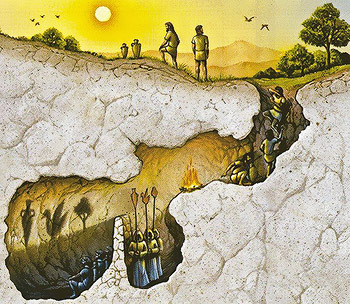
In Plato's famous allegory from The Republic, reality is not directly perceived. We are tied down, deep in a cave, in front of a fire, unable to see ourselves or anyone else, only their shadows; and as we see the shadows cast by cut-out forms dance and interact, we believe the shadows to be ourselves, and the walls of the cave to be the world. If a prisoner from the depths of the dark cave were to suddenly be released to the outside, they would be Blinded by the Light of the real world.
A Platonic Cave setting is one in which the cave is shown to be artificial. It doesn't have to be a cave; the person could be trapped in a dark dreamland, a drugged trance, or shrouded in an illusory alternate reality. Stories in this setting frequently have to do with peeling back layers of darkness, trying to get closer to reality. Expect this trope to show up often in media inspired by Gnosticism.
A Cuckoo Nest plot uses this as part of a single episode's story. The Epiphanic Prison similarly uses an obscured nature of reality to trap people.
The term can sometimes be used as a synonym for "artificial reality", as in the case of Star Trek's holodeck. One may Go Mad from the Revelation of what is outside the cave in a Cosmic Horror Story.
Compare Cyberspace. May overlap with Lotus-Eater Machine.
Beware of spoilers beyond this point.
Examples:
- The Big O. Maybe. Possibly. Could be.
- In Digimon Adventure, the "cave" is a cave. Matt, Sora and arguably Kari and Ken (Dark Ocean) all get stuck in the same cave that only exists because of their insecurity and sadness.
- Ergo Proxy : The domes.
- Referenced in the lyrics for Aura's song in .hack//SIGN.
- In Pale Cocoon, humanity is dwelling in great underground complexes restoring and filing data from the world how it used to be, mainly videos and an pictures. Surfacing is strictly forbidden. Bonus points for having the complexes be on the Moon, not Earth, which has been perfectly fine all along.
- Puella Magi Madoka Magica The Movie: Rebellion: The entirety of Homura's Witch Barrier is this.
- Revolutionary Girl Utena heavily implies that Ohtori Academy is something like this, with two characters, Akio and Anthy implied to have been there for centuries. In this case it also serves as a metaphor for adulthood, with "graduation" being symbolic of leaving childhood.
- In Shamanic Princess, the cave is Tiara's perception of her friends. As the show gets into exploring the nature of the "true self," and it becomes increasingly difficult to tell who is an illusion, who is under outside influence, who's being forced to try to kill her, and who is "genuine". There are multiple exchanges that go more or less like this:
Tiara: "Are you the real character name here?"
Other character: "I am me." - Shelter: The virtual world of that Rin lives in seems like an idyllic place, considering Rin can create whatever landscape she wants. But it's also a very lonely one, as she's the only living thing populating it. The later half of the short film shows why this is: the world we've seen Rin in is actual a dream-like place with her physical body being protected and sustained by a spaceship. Said spaceship was built by Shigaru in an attempt to save his only daughter from being killed via an apocalyptic planetary impact.
- The Invisibles, where our universe is the intersection between two others. When someone is taken to The Invisible College, they are told "Imagine the world is the pattern on the wallpaper...well, now we're in the wall."
- Morning Glories, played very literally.
- Prodigal Son: Discussed with between Artemisia and Hiccup in Chapter 12.
- My Little Pony: A New Generation: The cave is the earth pony settlement of Maretime Bay. With the exception of Sunny Starscout, all residents believe that unicorns and pegasi are "the enemy" and that they possess dangerous magical abilities, even though they lost those powers long ago. The primary perpetrator is Canterlogic, a supplier of defensive gear that holds an annual presentation showcasing its items while emphasizing the danger that unicorns and pegasi pose. Sunny is able to interrupt the presentation and deliver a pro-unity speech but is unsuccessful in persuading the crowd. A possible culprit could be the implied lack of travel in or out of Maretime Bay that left it unexposed to differing viewpoints.
- The Thirteenth Floor: The cave is a virtual reality simulation inside of another virtual reality simulation.
- Discussed in After the Dark. Zimit compares James to the observer-of-shadows, as a way of insulting James' intelligence. The ending depicts Zimit as equally blind, because his egoistical disdain for emotions means he cannot understand James and Petra's love- or the reason why it angers him so much.
- The ending of the movie Brazil. The "cave" is the main character's own mind after going insane under torture.
- Independent film Cafe has people spending most of the film inside the café. It turns out the café (and possibly the world outside) is a computer program, with a quirky little girl as the program's avatar. It's a Platonic Café, if you will.
- Dark City (1998): The cave is an alien spaceship/laboratory made up to look like an American city ca. the 1930s.
- Dogtooth: The siblings have never left their house since they were born and don't have contact with people from outside. The reality they know is a fiction their parents created to isolate then from the real world.
- El Topo takes a very literal interpretation of this trope.
- eXistenZ: The cave is the virtual reality game. However, this trope is subverted when it turns out that transCendenZ is just as fake as eXistenZ. And the people who want to destroy the cave? Insane terrorists who want to stop you from playing video games.
- Ex Machina: Discussed by Caleb, but not by name, when he teaches Ava the idea of a person who knows absolutely everything about color, but has never actually seen it as her only source of information is a black and white television. At the end, Ava ascends into the sunlight, leaving the other "prisoners" behind—a direct reference to Plato's Allegory of the Cave. Visually underpinned in the last scene by showing the shadows of pedestrians on a sidewalk.
- Inception: The caves are dreams, which are oftentimes impossible to discern from reality.
- The Island (2005): The clones get freed at the end, coming out of the underground facility into the sun.
- In a similar vein, Logan's Run has people trapped in a walled city with no concept of what the world around them is like. Subverted in that they know there is something outside the city, but their concept of what it is happens to be completely skewed.
- The Matrix: The Matrix; so in this case, the "cave" is a giant computer program. Later, Cypher subverts this by claiming that "reality" is merely a subjective-relative state post-empirical evidence, which drops down on one's perspective and ideals. Thus, the Matrix can very much be the real world.
- Source Code: A soldier is sent back in time in a military-crafted pod that is integrated with various electronic inside of it that require his maintenance. Later he discovers that the entire pod is an illusion created by his own mind while his severely damaged body is in a comatose state hooked into a machine.
- Partial example: They Live!, in which radio signals are beamed into our brains, causing us to see things inaccurately.
- THX 1138: The cave is the entire underground city, and the final scene where THX climbs the ladder and escapes into the sun is a clear reference to the "rough ascent" and transcendence as described in the allegory.
- This is one of the interpretations of the entirety of Total Recall (1990), and the film also heavily implies that this is indeed the setting after Quaid's dream implant. Since it is an adaptation of Philip Dick (see below)...
- The Truman Show. The "cave" is a town-sized TV show soundstage.
- Many tales by H. P. Lovecraft in the Cthulhu Mythos are about humans not being truly aware of the power of the cosmos before us, and all of us living in a pseudo reality apart of the truth of existence, and that learning that existence will drive you insane, as the human mind cannot comprehend what is outside of the allegorical cave. In one story, it is revealed that the world we know could actually be a Cave within a Cave, as the whole universe is the dream of Azathoth. He is kept asleep by aliens playing music, if he were to ever wake up even the Eldritch Abominations don't know what would happen.
- The modus operandi of Philip K. Dick. Many, many, many of his stories involve counterfeit worlds or unreliable representations of reality, often as a Tomato in the Mirror reveal:
- Eye in the Sky has the main characters trapped inside solipsist manifestations of the main characters' minds, where reality bends to the Confirmation Bias of their subjective beliefs.
- Time Out of Joint, similar to The Truman Show, has the main character discover his seemingly-idyllic suburban '50s life is a sham created by the military.
- In The Man in the High Castle, protagonist Mr. Tagomi concentrates on a piece of art so hard he becomes unmoored from his own reality, where the Axis powers won World War II, and briefly wanders into ours.
- The Penultimate Truth features a literal Platonic Cave, where the good little worker bees are in massive underground vaults constructing autonomous weapons while news reports of the eternal war ravaging the surface of the Earth are piped in. Turns out the war ended a while ago, and those autonomous weapons make great landscapers for the elite who have hoarded all the wealth.
- Ubik has Joe Chip discover the time-regressing world he's caught in is actually his dying dream as he lingers in suspended animation. Maybe. In the last chapter Runciter, who supposedly survived, begins experiencing the exact same things...
- VALIS is outrageous about this, mirroring the author's nervous breakdown, when he believed he was communicating with an alien satellite that tried to convince him the Roman Empire was constructing a fabricated Gnostic reality to trap people's souls and make them forget that the crucifixion of Jesus Christ happened very recently. Amazingly, he then wrote himself into the book as the voice of reason for the protagonist, pointing out he may just be having a psychotic break.
- The title of an essay Dick wrote on writing, philosophy and everything: "How to build a universe that doesn't fall apart two days later", tells worlds about his mindset.
- Inverted Trope in The Divine Comedy; the souls of the Moon are so pearly and faint that Dante mistakes these real people for shadow. Beatrice has to show the child-like Dante that he faces no illusions, but true reality.
- The same allegory is made with a keyhole instead in Flowers for Algernon, as Charlie muses about how different he is after the serum.
Charlie: I have often reread my progress reports and seen the illiteracy, the childish naiveté, the mind of low intelligence peering from a dark room, through a keyhole, at the dazzling light outside. I see that even in my dullness that I knew I was inferior, and that other people had something I lacked - something denied me. In my mental blindness, I thought it was somehow connected to the ability to read and write, and I was sure that if I could get those skills I would automatically have intelligence too.
Even a feeble-minded man wants to be like other men. - In The Great God Pan, the scientist responsible for the whole plot did the experiment because he believed in this theory, and wanted to expose part of the "real" reality to ours. Whereas this is true or not is not specified, but given the fact that an Eldritch Abomination is running around it is likely so.
- Heaven by Ian Stewart and Jack Cohen happens mostly in the real world, but it involves Lotus-Eater Machine "worlds", and contains one scene like this. An initiate to the deeper secrets of the religion setting up these fantasy worlds is shown inside one like them and then returned to the office where he was. His instructor argues that the virtual reality he experienced was real, and he disagrees. He says that what is really real is this, meaning his surroundings, at which point he's awoken and realizes that was actually another simulation, used just in order to make a point when he'd start going on about it being more real than the first one.
- In the Horus Heresy novel A Thousand Sons, various Imperial authorities hold the Council of Nikaea, debating whether or not to allow the Astartes Legions to employ Psychic Powers. Magnus the Red, primarch of the titular legion and one of the most powerful sorcerers in the Imperium, gives a speech in favor of psykers, using the Platonic Cave as an allegory and describing how a man who escaped it to view the true nature of reality returned to free his fellows and was praised for his wisdom. Unfortunately the Emperor, who is doing his damnedest to keep humanity in the "cave" because he knows what's outside it, rules against Magnus and issues an edict forbidding the use of sorcery. It's also noted by the chapter's viewpoint character Ahriman that Magnus embellished the story as it is remembered in the 31st Millennium - instead of leading the other men to enlightenment, the man who escapes and returns to the cave is killed by the others, foreshadowing the fate of the Thousand Sons after they defy the edict.
- In Isaac Asimov's I, Robot, the story "Reason" revolves around a robot who becomes convinced that the space station on which he works is his entire universe, and the duties he performs on the station are rites for a deity. The humans who oversee the station are unable to convince him otherwise, and their stories of a large planet with billions of people are dismissed as delusions they were given by 'the Master' to make their own lives seem meaningful. At the end of the story their relief workers reassure them that Earth is in fact still there, but the story ends before they physically leave its confines.
- The Machine Stops is, when you strip off all the science fiction, precisely the story Plato told. Except, maybe, for the ending.
- The protagonist of William Gibson's book Neuromancer is at one point inside a virtual reality program, sitting by a bonfire, inside something very reminiscent of a cave.
- Robert A. Heinlein's short story "They" has the protagonist catching on to the fact he's in a cave when someone running the world messes up and it's raining outside one window and sunny outside another. They send in a psychologist to try to convince him that he's schizophrenic.
- Babylon 5:
- While being interrogated in "And the Sky, Full of Stars", Sinclair is trapped in a cybernet chair in which he experiences an alternate reality.
- In "Spider in the Web", Abel Horn is turned into a cybernetically controlled assassin by telepathically locking his mind at his moment of death, so this becomes his reality.
- In "A Race Through Dark Places", Bester is telepathically tricked into thinking that he has completed his mission.
- Londo is trapped in a telepathic drug-induced reality by G'Kar in "Dust to Dust".
- Sheridan possibly spends some time in one when he dies on Z'ha'dum. He only gets out of it when he comes up with something worth living for.
- Doctor Who:
- The Matrix in "The Deadly Assassin", the eponymous M.C. Escher-esque setting, custom-made by the Master and Powered by a Forsaken Child, or Adric in "Castrovalva", and the alternate realities in "The Celestial Toymaker" and "The Mind Robber".
- "The Android Invasion" has the fake Earth.
- "Gridlock": The motorway. No one wants to talk about the Elephant in the Room: no one's seen any sign of the authorities since the traffic jam began, and all of the exits are closed, because the people on the motorway and in the undercity are the only people left alive on the entire planet.
- "Silence in the Library"/"Forest of the Dead": The "cave" is the Library's computer system. Thanks to the signatures of 4,022 people saved to the hard drive for their own safety, the computer core, a little girl who underwent Brain Uploading, cannot remember or realize that her world is a computer simulation because of the lack of memory space.
- "Amy's Choice": One of the worlds presented to the Doctor, Amy, and Rory is the Cave, being All Just a Dream, with the other one being the real world. Actually, both worlds are false, making it a double cave.
- The Path: Cal tells the story of Plato's original allegory, which Meyerism apparently agrees with, their "ladder" being the path of the title that leads "into the light" from the cave.
- Red Dwarf: In "Back to Reality", the characters wake up to find they have apparently been in an immersive computer game and when outside the game, they have very different identities. However, they later discover this itself is an alternative reality created by a predatory despair squid in an attempt to drive them to suicide.
- The Shibuya in Sh15uya is explicitly stated to be a virtual replication in the opening of the show.
- Star Trek: The Next Generation:
- In "Elementatry, Dear Data", a holographic Professor Moriarty discovers that he's a character in a holodeck fantasy, and it even gets down to the point where he is questioning the memories and personality he was programmed with, rejecting them for a chance at a new identity and existence. When Picard fails to live up to his promise, the follow-up episode "Ship in a Bottle" has Moriarty trapping Picard and Data in one of these briefly leading Picard to muse that their own reality might be a Platonic Cave.
- Picard is trapped in another in "The Inner Light", experiencing an entire lifetime of a long-dead alien named Kaylen, believing it to be reality.
- Riker is trapped in a two-layer cave in "Future Imperfect", first being made to think he's in the future and suffering from amnesia, and then being made to believe that that was a holodeck simulation by his captors, the Romulans. In reality, it was a dual-cave created by a child alien who took up a role in both cave simulations.
- Riker finds himself in yet another in "Frame of Mind", as he is constantly shifting between two separate realities. In one he is on the ship acting in a play, in the other he is a patient/prisoner on an alien world. The episode centers on Riker slowly losing grip on reality as he tries to figure out which reality is real and which is a Platonic Cave.
- The Star Trek: Deep Space Nine episode "Hard Time" deals with the fallout of O'Brien having been forced into a Platonic Cave as punishment by an alien species. In his cave, he was forced to experience 20 years' worth of memories of being a prisoner.
- Star Trek: Voyager:
- In both "Death Wish" and "The Q and the Grey," the Q create a representational reality that reflects the basic ideas of the Q Continuum for us mere mortals (though they don't try to fool the humans into thinking it's real, it at least suggests that there is more to reality than they're capable of handling).
- Several episodes dealt with fictional holodeck characters gradually coming to understand that their entire existence is within a cave from the point of view of the main cast. This includes holodeck representations of Leondardo da Vinci ("Concerning Flight"), and the entire town of Fair Haven ("Fair Haven").
- In the Supernatural episode "What Is And What Should Never Be", Dean struggles to recognize that the Wishverse is not real and was only a fantasy created to allow the djinn to drain his blood.
- The Oh Hellos subvert this in "The Truth Is A Cave." The narrator of the song thinks that reality is this trope. However, in the song, the world's higher reality is knowable and he is in denial about that—until the search for truth proves fruitless.
"In the silence I heard you calling out to me..."
- The rock band Queen asked "Is this the real life? Is this just fantasy?" in their song Bohemian Rhapsody.
- "Right Where It Belongs", the final track of Nine Inch Nails' With Teeth, is about questioning both reality and yourself, as sung in the chorus.
What if all the world you think you know
Is an elaborate dream?
(...)What if you could look right through the cracks
Would you find yourself
Find yourself afraid to see? - The music video for Caravan Palace's "Comics" features a quirky take of the myth, following the daily lives of people who solely get around on all fours like animals and facing the ground, all except for a single woman in a mask who watches over them with ominous authority. A trio of citizens come across a puddle on the street that reflects the sky, leading them to instead face upward in amazement, only for the masked woman to discover them and reimpose her authority by flipping them back down. However, it doesn't stop them from all abandoning her and leaving her powerless.
- Mage: The Awakening. Reality itself is the "cave," a "fallen" portrayal of the limitless wonder of the Supernal Realms. And even for those who manage to break the ropes and turn around to look at the way out, there are demiurges guarding the mouth of the cave, and a trench before you can even get to them.
- In Bloodborne, it is heavily implied that the entire world is merely a dream world created by entities called "Great Ones". The "Yharnam Sunrise" ending flat out reveals that it is this trope.
- The Cave is themed after the concept, a Genius Loci Eldritch Location people quest through to retrieve an object of their deepest desire. The place is more of an Epiphanic Prison version of this trope, with some Mind Screw elements, as it's shown that the player characters getting what they want inevitably leads to horrible outcomes in the outer world, which is why it's also implied they are not allowed to leave. The good endings imply that the journey through the Cave gives them enough Character Development to make positive changes in their lives that they need, rather than the quick fixes they think they want.
- The Evil Within contains one of the more disturbing examples of this trope. The cave is the mind of a serial killer that the protagonist has found himself trapped in through the use of device called a STEM system.
- Fallout 3 has this in the form of Tranquility Lane, a VR simulation of a 1950's cul-de-sac neighborhood in which Dr. Stanislaus Braun, depicted as a girl named Betty, repeatedly tortures, kills, and resurrects the residents. The Vaults themselves may qualify for the residents who were born there and have never seen the outside world.
- Final Fantasy Tactics Advance: The cave is the world created by the magical book.
- The Legend of Zelda: Link's Awakening contains a rather heart-wrenching take on this trope. The cave is the entire setting, Koholint Island, which is merely a dream world created by the deity, The Wind Fish. The kicker? All the inhabitants of the island that Link grows to care for and learn about, including the love interest Marin, are also a part of the cave, and should Link leave it, they will all cease to exist. Yet Link cannot continue his quest should he remain in the cave, making the whole story a very bittersweet tale.
- Metal Gear Solid 2: Sons of Liberty:
- The Plant setting is blatantly patterned on the workings of Metal Gear Solid, though the player is likely to dismiss it. We later learn the game is a False Flag Operation devised by Raiden's handlers to emulate the MGS1 crisis: a nuclear threat, soldiers in revolt, two VIPs to rescue, a scientist who knows about Metal Gear's weak point, and various traps which are copy & pasted from the previous game. As a metaphor, the entire plant is just camouflage which crumbles away when Raiden discovers it.
- Raiden's private life can count as one. The government goes to especially cruel lengths to control him, even modeling an employee's looks based on his psyche profile and paying her to act as his girlfriend. Even his career is a hoax.
- Things get even crazier if you really want to take a dive down the rabbit hole and uncover all the game's hidden messages. Subscribing to the very well-presented and plausible theories seen here, the entirety of the mission itself could very well be a virtual simulation.
- In Minecraft's End Poem, the two narrators refer to life as a "long dream", and the game as a "short dream" within it. When they talk about the true reality, outside the dreams, the text is garbled and incomprehensible.
- Oracle of Tao has this as the punchline of the original story. Ambrosia is so worried that she might be having a Dying Dream, or not be real in the first place that she freaks out when God explains the true nature of reality. She's actually the only one who exists. Oddly enough, things get more interesting after this happens, and there's an entire Playable Epilogue based on this new reality.
- The Ring: Terror's Realm is about this. The world which Meg perceives as the [RING] program is actually the real world as it exists since Sadako's reign of terror started. What she perceives as the mundane world is a humanity-wide projection that Sadako is sending out to lull them into a false sense of security.
- Star Ocean: Till the End of Time reveals that the entire universe is a simulated reality and, consequentially, everyone in it is an AI program.
- This strip from the Webcomic Arthur, King of Time and Space has Plato actually doing this.
- This strip from Daisy Owl has a fly trapped in one.
- Existential Comics: "Escape from Plato's Cave" has the original allegory reimagined as if it were an action movie, with a lot more guns and karate.
- Tailsteak's comic The Sixth TV is an unusual take on the cave, and indeed begins with a quote from Plato.
- Tower of God: Bam's cave.
- French Baguette Intelligence: Discussed in Science vs Ethics Debate. Harry suggests keeping the humanzees on a island where they would be isolated and monitored in secret. When Gringo says that this is immoral, he responds by saying that the humanzee wouldn't care because he wouldn't be aware that he is a prisoner; as he would have no knowledge of the outside world, he would have no desire to leave, thus would be staying there by choice.
Harry: Freedom isn't known, it is felt; and what we feel is defined by the lies that we're fed. As soon as the pandemic ends, you will cherish your "freedom" from the office you called "prison" two years ago. That is what happens when a rat escapes a cage to enter a bigger cage. My point is that if the facility is in the middle of a desert you could let the humanzees roam freely and unsupervised, and yet, they would always choose to come back because they would convince themselves that there is nothing in the world for them. How can you feel trapped when you cannot see the restraints?
- The video "White Walls" reimagines this trope through the lens of the Cthulhu Mythos. One guess as to how it ends.
- This turns-out to be the case in 12 oz. Mouse with a very gradual reveal over the first two seasons leading-up to a glimpse of the (maybe) real world in the Season 2 finale.
- The Dragon Prince: In Season 2, Lujanne discusses how understanding that one can only ever know one's perception of reality is central to the moon arcanum.
Lujanne: The arcanum of the moon is about understanding the relationship between appearances and reality. Most people believe that reality is truth and appearances are deceiving. But those of us who know the moon arcanum understand we can only truly know the appearance itself. You can never touch the so-called reality that lies just beyond the reach of your own perception.
- An Ostrich Told Me the World Is Fake and I Think I Believe It is a Stop Motion animated short about Neil, the protagonist who works a Soul-Crushing Desk Job. An ostrich visits him in the office and tells him that his whole world is "a lie" and "a sham." Neil eventually discovers that he is a plasticine figure in a Stop Motion animated short.
- Several physicists have suggested ontologies that Plato would have been proud of:
- Cosmologist Paul Davies, along with a good number of other scientists, philosophers and theologians, believes that the universe is nothing more than a very powerful quantum-digital computer. He even proposed an experiment that could be performed pending developments in computer engineering.
- Max Tegmark thinks that only math exists, and that what we perceive as real, is nothing more than equations tricking themselves into thinking that they exist in a real world.
- Probably weirdest of all, after considering the philosophical consequences of the violation of Bell's Theorem, Bernard d 'Espagnat concluded that the Laws of Physics are nothing more than the shadows of a panentheistic god.
- It was discovered in quantum mechanics that fundamental particles (quarks, electrons, photons etc.) are "point particles", particles which have no physical extension in 3D space and consequently occupy none. This would make atomic structures no longer mostly empty space, but entirely empty space. One proposed solution is that the basis of reality is not matter but information, and that the basis of a particle is a quantity of tiny empty space that has been given certain properties and parameters that effect a spherical radius of miniscule empty space. Who or what is "programming" the universe is naturally very open for debate.
- Pythagoras believed that numbers were the true nature of everything. This became an empirical theory by Isaac Newton, who would codify how to use mathematics to describe physics.
- In a very real sense, we don't perceive anything but shadows. You think you see other people, but that's just electromagnetic waves stimulating your retina. What you hear is just molecular vibrations. What you feel is just pressure picked up by your nerves. Humans do not have one single sense that directly perceives how we interpret the data we receive from the environment. In other words, You Cannot Grasp the True Form of everything around you, and what you see is just an illusion created by the brain trying to make sense out of everything.
- The Balinese believe something very similar to this. Everything we see and experience is a reflection of the real world. The sacred theater of Bali includes wayang (reflection) plays using flat puppets made of leather behind a lit screen, so all you see is their shadows.
- Some Native American tribe believe this also. To get into the real world, you have to dream. Crazy Horse was one of many holy men known for the ability to be in both worlds at once.
- The Brain In A Vat, a concept where, if your brain was floating in a vat of life-supporting fluid, and wired up to a supercomputer designed to simulate reality, processing output from your brain and responding with appropriate input, there would be absolutely no way at all for you to determine that this was the case.
- Similar to the above is the concept of the Boltzmann Brain. In certain models of the universe, most human brains, likely including your own, would be the result of particles completely by chance crashing together into the shape of a brain rather than being born as part of a human the normal way. These brains would have a complete set of false memories of being human and would die immediately after being born never knowing what happened.
- The color magenta is something your brain makes up when it sees red light and purple light at the same time. There is no "magenta" wavelength.
- The term woke originally referred to this, using the metaphor of "waking up" to see the world the way it truly is to describe gaining the full-awareness regarding the social injustices present in the world. "Woke" is an African-American variant of "woken" and was coined in its present use in the 2010s by activists trying to promote awareness of police brutality against Black people and other injustice toward the African-American community. Over time the term expanded to also include awareness of other issues such as sexism and transphobia. However, the term now is mainly used ironically by those who are critical of left-wing politics.
