

A (subtle) 1943 British World War II propaganda film whose protagonist does not die during the film, is not a colonel, and is not surnamed "Blimp". Despite this triple deception, it is very good.
In the midst of the war, a group of British Army soldiers think they are very clever when they set out to capture the commanders of the local Home Guard units so that they can easily defeat their leaderless forces in a wargame that starts later that day. They capture the Home Guard commander, Major General Clive Wynne-Candy (Roger Livesey), while he's in a Turkish bath - mocking his outrage at their invalidation of the exercise, his fatness, and his moustache. An enraged Candy begins beating the stuffing out the British Army commander, the young Lieutenant Wilson, and segues into the story of his life. Flashing back 41 years to 1902, we see a young Clive Candy, newly returned from the Boer War and wearing his new Victoria Cross. A visit to Germany at the behest of Miss Edith Hunter (Deborah Kerr), ostensibly to 'refute anti-British propaganda', and a duel with Prussian officer Theodore Kretschmar-Schuldorff (Anton Walbrook) ensues. Over the next forty years Clive and Theodore meet several more times, including in World War I, and Clive will always be on the lookout for other women like his idol, Edith.
The film was released in 1943 in the United Kingdom, at the height of World War II, and two years later in the United States (in heavily edited form).
The film was commissioned by the Ministry of Information to influence British public opinion, and was part of their general efforts to persuade the British public that the RAF's 'Strategic Bombing' campaign was effective and morally justified. The film's underlying message is that the British military's use of deeply immoral methods is both morally justified by the nature of the enemy and necessary to actually win. Unfortunately, after the war it transpired that the campaign's slight reduction in the increase of German industrial output in the final months of the war had at best been a poor return on Britain's massive investments of aircraft production and lives.
Interestingly, when they got wind of the script the Ministry of War and even Winston Churchill himself tried to prevent the film from being made. This was initially because they feared that it would mock the leadership of the British Army, as Colonel Blimp was a well-known satirical newspaper-cartoon character who expressed reactionary, jingoistic, ignorant, and frankly moronic views:
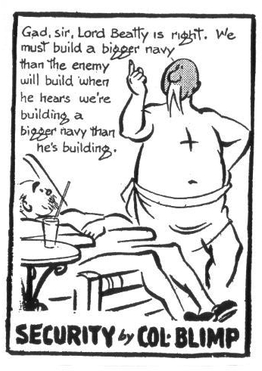
Upon examining the script, they continued to obstruct its production out of fears that it would might instill doubts about whether all Germans were inherently thuggish and brutal, as in all the propaganda produced during the war so far and in World War I. This was done because it was not felt that ordinary British people were capable of understanding nuance. Together they successfully prevented Powell & Pressburger from hiring Laurence Olivier for the role of Blimp and legally using military equipment and vehicles (which had to be stolen). At the time of its release critics also attacked it for mocking the British Army and/or being "pro-German".
It has subsequently been considered one of the finest British films, and to have taken anti-Nazi wartime propaganda to much subtler and more ethical level, which was arguably more effective for those very reasons. It was the fourth collaboration between writer-directors Michael Powell and Emeric Pressburger in their production company, The Archers. The duo would go on to make several more films, including The Red Shoes and Black Narcissus. Also notable for being the breakout part for British actress Deborah Kerr, who was only 21 when the film was made.
Contains examples of:
- Actor Allusion: Early in the film, Clive Candy tells Col. Betteridge that he has been speaking with Arthur Conan Doyle. Betteridge, an avid fan of Sherlock Holmes, turns and quotes to his subordinate, Major Plumley: "Lovely evening, my dear Watson..." Plumley is played by Ian Fleming, who earlier portrayed Dr. Watson in Sherlock Holmes' Fatal Hour (1931), Sherlock Holmes and the Missing Rembrandt (1932), The Triumph of Sherlock Holmes (1935), and Murder at the Baskervilles (1937). His Holmes, Arthur Wontner, also appears in a small role later in the film.
- All Germans Are Nazis: Averted! One of the main reasons Churchill disliked the film was the character of Theo, a sympathetic German (though explicitly anti-Nazi). He remained in the story thanks to Powell and Pressburger's artistic commitment. Anton Walbrook, the actor who plays Theo had Immigrant Patriotism for England noting the fact that their refusal to indulge in stereotypes was why they were better than Nazi Germany.
- Amoral Afrikaner: Downplayed. When Candy departs and leaves Van Zijl behind to interrogate the prisoners, Van Zijl notes that he's South African, not British, and so has no compunctions about seeming like a "gentleman"; he then uses the threat of torture to try to squeeze the information out of them.
- Beauty, Brains, and Brawn: In a meta-example, the three characters that Deborah Kerr plays. Edith is the Brains, the most intelligent and socially engaged one, who encourages Clive to cause a diplomatic incident because she resents anti-British propaganda; Barbara is the Beauty, the most mild-mannered and sweet-natured one; Angela is the Brawn, a chirpy, direct, uncomplicated MTC driver who manages to knock out her own boyfriend so that she can escape in time to warn Clive that he's about to be taken prisoner.
- Be Careful What You Wish For: When they're first married, Barbara begs Clive to "never change." Unfortunately, he takes this literally.
- Big Fun: Clive Wynne Candy, as played by Roger Livesey is perhaps the embodiment of this trope at its finest.
- Bittersweet Ending: A lovely one: Clive has lost the war game in a very humiliating way, and his own approach has been shown up as outdated, but on the other hand he's finally accepted that he himself can't change and that officers like Spud are what the war effort needs, so as Spud and his men march past, he salutes them, grinning.
- Call-Back: The memorable last line. When Clive and Barbara come to their house in downtown London, she says it's a fine house on a firm foundation. Then she makes him promise that they'll both stay there and never change, even if there's a Great Flood. Clive jokes that if the floods come they'll have a lake in the basement. 20 years later, at the very end of the movie, Clive goes back to his home, which has been destroyed by bombing. The house's foundations are subsequently turned into an open emergency water tank. He remembers the exchange with Barbara, looks down into the basement, and says "Well here is the lake—and I still haven't changed."
- Character Development: Enormously deferred in Clive's case, but it's there. He finally recognises that he needs to change, but can't, and that his dream—that he still might make a major contribution to the war effort other than training the Home Guard—is not going to happen. He accepts this, and cheerfully salutes Spud's men as they march past.
- Also Theo: he goes from a loyal German officer with a conscience, who will fight a duel on someone else's behalf even though he doesn't really believe in duelling, through being an embittered WW1 veteran, to being a melancholy emigré who's left Germany because it no longer stands for anything he can support.
- Compete for the Maiden's Hand: Invoked. Clive and Theo fight a duel over political issues, but as this could cause problems with their superiors they pretend they're doing it for the honor of a woman they both know.
- Cool Old Guy : The film manages to make Clive Wynne Candy, a caricature of the Colonel Blimp cartoons, into this. Or as Johnny Cannon says, "He's such an old darling."
- Credits Gag: The zoom-in to the tapestry at the end says "Sic transit gloria Candy"—"here passes the glory of Candy".
- Deadpan Snarker: Theo, Spud and Johnny, but even Clive gets in a couple:Barbara: We must go, darling, we're having the Bishop for lunch.Clive: I hope he's tender.
- Deconstruction: The original Colonel Blimp character, created by left-wing cartoonist David Low, was meant as a satire of conservative Army officers, but Powell and Pressburger deconstructed it by examining how the character would have got that way in the first place—of course, giving him a rich and interesting early life made him much more sympathetic. Indeed, it is a Reconstruction by showing that even if Blimp is an outdated, old caricature, he still embodies some of England's greatest virtues of friendship, fair play and common decency.
- Defeat Means Friendship: Sort of. Clive and Theo become lifelong friends after their duel, but the film never tells us who won (or whether either of them did). Later, Clive takes this attitude toward Germany after the 1918 Armistice.
- Doppelgänger Replacement Love Interest: The whole plot turns on this, although Candy never really realizes it.
- Dramatically Missing the Point: Given that, unbeknownst to him, Van Zijl has used the threat of torture to get information from the captured Germans, Clive draws an entirely erroneous moral from the Armistice:Clive: Murdoch, the war is over. The Germans have accepted the terms of the armistice; hostilities cease at 10 o'clock. It's nearly that now. Murdoch, do you know what this means?Murdoch: I do, sir. Peace. We can go home. Everybody can go home.Clive: For me, Murdoch, it means more than that; it means that right is might after all. The Germans have shelled hospitals, bombed open towns, sunk neutral ships, used poison gas, and we won—clean fighting, honest soldiering have won.
- End of an Age: The film covers forty years and is, essentially, the story about the end of the British Empire and its regimented class system and the breakdown of society that happened during the Second World War — in other words, the "old" Victorian and Edwardian England becoming 20th-century England.
- Evil Only Has to Win Once: Theo, in imparting the deadly seriousness of World War II, emphasizes that the Nazis do not give clemency, mercy or second chances to those they've conquered, and certainly will not to a nation that humiliated Germany at Versailles like Britain.Theo: Clive! If you let yourself be defeated by them — just because you are too fair to hit back the same way they hit at you — there won't be any methods BUT "Nazi methods"! [...] Dear old Clive... this is not a gentleman's war. This time, you're fighting for your very existence against the most devilish idea ever created by a human brain: Nazism. And if you lose, there won't be a return match next year. Perhaps not even for a hundred years.
- Fatal Flaw: Clive's is a non-standard one, No Self-Awareness. He never realises what he wants until it's too late for him to have it.
- A Father to His Men: Candy. It is implied that he hires his Great War batman, Murdock, as his Butler to ensure him steady work.
- Flanderization: The film is in part a Deconstruction of the process of Flanderization, showing how with each bad decision he makes (such as not telling Edith that he loves her, or failing to realise that warfare is becoming progressively crueler and more brutal), Clive Flanderizes himself, turning from a romantic and impetuous young man with zero self-awareness into a lovable but self-important old fool. Fortunately, he acquires enough self-awareness that, by the end, he realises that it's happened and that the best thing he can do is give his support to those who can fight the war better than he can.
- Foreign Ruling Class: Clive is such a quintessential old English colonialist that he doesn't think his wife passing away in Jamaica counts as dying in a "foreign country".note
- Good Is Old-Fashioned: Candy thinks that attacking innocents and torturing POW is deeply immoral and unjustifiable, but he lives into the age of Total War wherein both become common practices.
- Honor Before Reason: Candy would rather lose the war than win by stooping to "dirty" methods. Theo states his views that the British are so close to losing that, if they do use these ill-defined "dirty" methods, then the Nazis will win. The fact that the government doesn't share Candy's views leads to him being forcibly retired again. When the film was made the Ministry of Information was not just trying to convince the British public that the Strategic Bombing campaign was effective, but that it was so effective that the Soviet Union would lose the war without it. As they say, go hard or go home.
- I Have No Son!: Theo becomes estranged from his two sons when they join the Nazi Party.
- Identical Stranger: Three different woman all played by Deborah Kerr.
- International Showdown by Proxy: The duel is a fight between a British soldier outraged by German accusations of atrocities in the Boer War, and a German officer selected by lot to fight him.
- Killed Offscreen: We're told of Barbra, Edith and Murdoch's deaths via obituaries in The Times.
- Long Speech Tea Time:Clive Candy: The Kaiser spoke, and the Prince of Wales spoke —Barbara Wynne: Spoke about what?Clive Candy: Nobody could remember.
- Non-Indicative Name: The central character is not called Blimp, he never achieves the rank of colonel, and he doesn’t die.note
- Averted on a metaphorical level: Candy was intended as a deconstruction of the "Colonel Blimp" character, who was originally intended to be a satire on useless and incompetent generals, and since Candy recognises that he's not actually much use to the war effort and had better leave it to others, it could be argued that the film does depict the "death" of Colonel Blimp as a phenomenon.
- Oblivious to Love: In 1902 Berlin, Clive completely misses the obvious love signals that Edith is giving off.
- Officer and a Gentleman: Deconstructed. As gentlemanly and sporting as Candy is, and how admirable his complete unrelenting morality may be, it's not only unsuited for modern warfare, but his inability to see the necessary side of fighting dirty against great odds makes him counterproductive and naive.
- The Oner: The emotional scene where Theodore tells a British bureaucrat how he came back to England to live, after his wife died and his sons went over to Hitler, runs three minutes without a cut.
- Physical Scars, Psychological Scars: The reason for Clive's stereotypical mustache? To hide a dueling scar.
- Propaganda Piece: What the Ministry of Information wanted and paid for. They got one, but (as with so many other Powell & Pressburger films) one with subversive implications regarding German culture and the use of immoral methods by the British military.
- Red Oni, Blue Oni: Despite being a Stiff Upper Lip, Candy is a solid Red (all red cheeks and nose) to Theo's Blue, to everyone's blue basically.
- Replacement Goldfish : Candy's wife Barbara and his ATS chauffeur Angela (aka Johnny) are these for Edith, though in Johnny's case Candy is too much of a darling to make it more than platonic. What makes them this trope is that
 they're all played by the same actress. Theo lampshades it.
 - Separated by a Common Language: A comic relief bit has Candy struggling to get words like "chit" (message) and "pub" across to an American officer in charge of railroad transport. Candy uses "cafe" as a synonym for the latter, which works.Candy: Dash it, we don't speak the same language.
- Significant Double Casting: Deborah Kerr plays Candy's first love - and she then appears as two more women he meets in his life that remind him of her.
- Sliding Scale of Idealism Versus Cynicism: Candy is idealistic, Theo and most other people are cynical. Although it's inverted in that all of Candy's friends, including Theo love him for truly embodying his beliefs of fair play, friendship and Stiff Upper Lip. The film itself is very much on the idealist side.
- Spiteful Spit: Kaunitz, who had been a German prisoner of war during the Boer War, has published accusations that the British have committed atrocities in South Africa; when the film's English hero, Candy, calls him out on it, Kaunitz spits in his face, and Candy punches him.
- Stiff Upper Lip: Colonel Blimp embodies his country's national stereotype in the way that Theo with his angsty and serious demeanour embodies Germans have No Sense of Humor. Though it's highly subverted.
- Suddenly Bilingual: Played realistically. Theo's English improves dramatically between the times we see him — from a halting but earnest attempt at the language to eloquent and poetic fluency — but it's over a period of decades, he learns better English in the POW camp after the war, and has since taken (and buried) an English wife. He even seeks to become a British ex-pat after the Nazis' rise to power.
- Time-Passes Montage:
- A series of animals' heads that Clive mounts in his bachelor pad in London, with the dates and places where he killed them below, mark the passage of time from the 1902 Berlin part of the story to the Western Front in 1918 part of the story.
- 1919-1926 is summarized by a hand flipping through a photo-filled scrapbook, combined with various invitations by and to Mr. and Mrs. Candy. Then, after a newspaper clipping letting the audience know that Candy's wife died in 1926, we go back to the heads on walls, which take us to 1938.
- Token Enemy Minority: Theo, who fights Clive in a duel in in 1902, and is on the other side of the First World War. By the time World War II starts Theo, an anti-Nazi, is a refugee in England.
- Tomboyish Name: Angela "Johnny" Cannon.
- Waxing Lyrical: Clive Candy is referred to by Spud as "the Wizard". This turns out to be a Shout-Out when Spud tells his men that they have to rush to Candy's HQ "because of the wonderful things he does".
- When I Was Your Age...: Candy invokes this at the end of the film, in his dealing with Spud.
- While You Were in Diapers: Candy takes this even further."I was a soldier...when you were nothing more than a toss between a boy and a girl's name."
