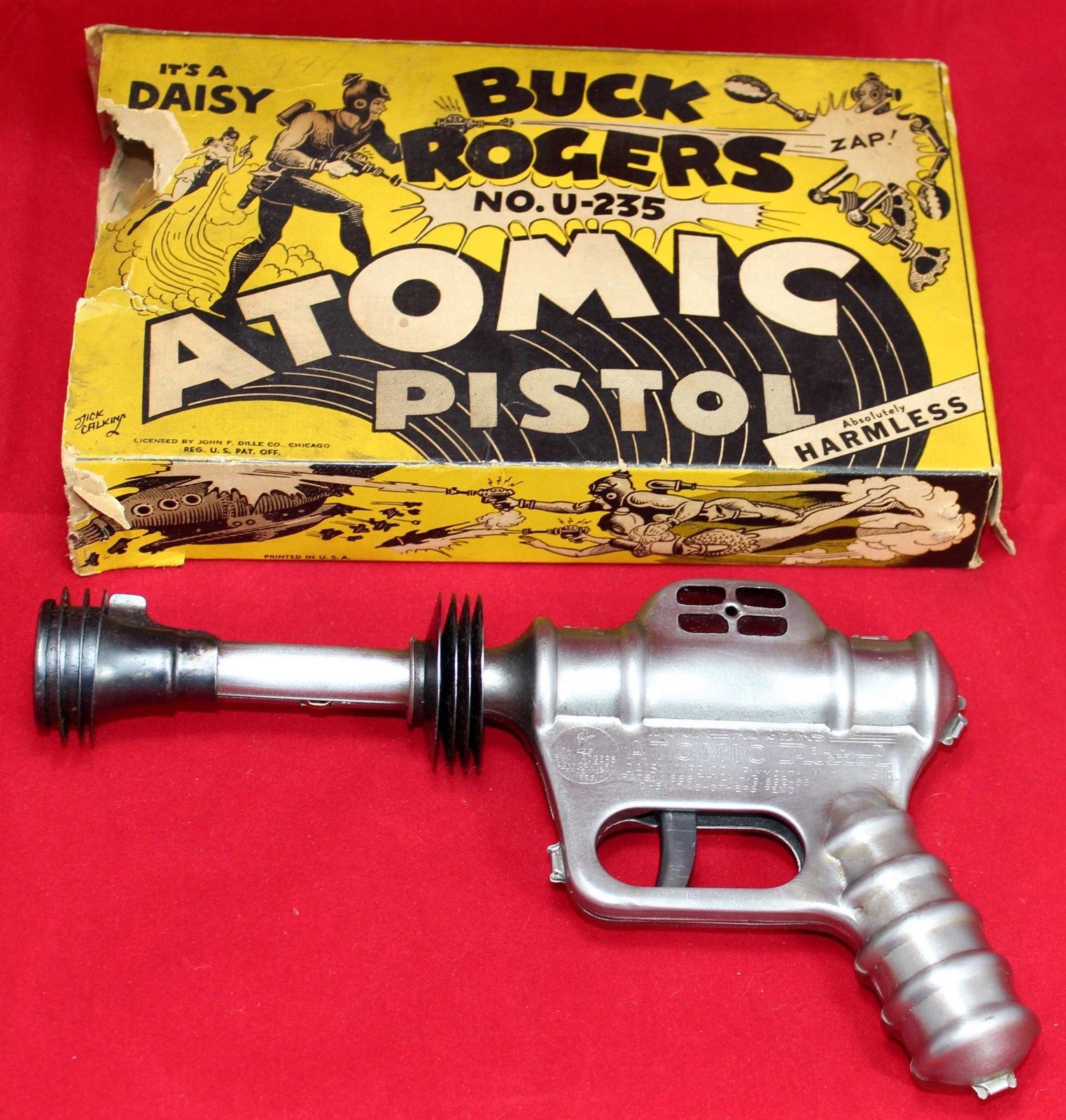
Buck Rogers is an adventure series about a modern man (mining engineer in the 1920s, astronaut in The '70s) who is put in suspended animation, wakes up in the 25th century, and then spends his time as a hero in space.
Has been seen in various media — Pulp Magazine, Comic Book and comic strips, film serials, role-playing games, video games, radio, movie and TV series all stemming from the popular 1928 novel Armageddon 2419 A.D. about a time-travelling mining engineer named Anthony Rogers by Philip Francis Nowlan. John F. Dille, the head of National Newspaper Service, convinced Nowlan to turn his novel into a daily newspaper comic strip (changing the lead character's name to "Buck" in the process) and the rest, as they say, is history.
The series has had a number of adaptations, each with its own spin on the tale. these include:
- A 1932 Radio series
- Buck Rogers: The 1939 Film serial, where Rogers and his teen sidekick Buddy are dirigible pilots who crash in the Himilayas, and wake up to fight the gangster Killer Kane.
- Buck Rogers in the 25th Century: The 1979 television series where Buck is an astronaut who defends Earth from the Draconian Empire.
- Buck Rogers XXVC: A Tabletop RPG by TSR, where Buck is a fighter jock who fights to free the solar system from RAM, the former Russo-American Mercantile corporation that dominates Mars, and extends that influence across the system.
Parodied by Daffy Duck in Duck Dodgers in the 24½th Century and subsequent sequels.
Trope codifier for Space Opera and Raygun Gothic, along with Flash Gordon and Dan Dare.
This comic-strip provides examples of the following:
- Action Girl: Wilma Deering.
- Alternate Continuity:
- Unlike his comic page contemporary Flash Gordon, who tends to stay visually recognizable in most incarnations, Buck and his world have undergone major overhauls in almost every updated version, starting with the Disco-era aesthetic in the 1970s TV series, through TSR's hard s.f. "XXVc" role-playing game setting, to the Tron Lines outfits in the Dynamite Entertainment comic. TSR averted this with the "Cliffhangers" version of the RPG, which was very faithful to the original comic—perhaps to a fault, since it started at the mostly forgotten, politically incorrect beginning of the comic's timeline, before the iconic space opera elements had even been introduced.
- The (unsuccessful) attempt to revive the novel series (publishing rights being held by Ace, which hired Larry Niven to work out a rational universe based on the original novel) was also as faithful to the original novel as they could be without letting it continue to have a lot of plainly stupid errors in it. (Most of the things that are obvious nonsense now were explained away as Rogers being an Unreliable Narrator due to his own limited scientific knowledge, and learning better by the time he was the old man the new novels began with.)
- Always Identical Twins: Even deadlier than Killer Kane is his Mad Scientist brother, Nova Kane, who greets Rogers under the guise of one Dr. Zero (complete with a false beard). When the beard comes off, Rogers instantly assumes that it's Killer Kane again, brewing yet more evil.
- Angst: Goes with being a Fish out of Temporal Water. Everyone Buck ever knew or loved from his old life is dead.
- Artificial Gravity: In the comic and novel, much of the technology is based around the other-dimensional substance called "inertron," which reacts negatively to gravity. Strapping a weighted chunk of it to a vehicle makes it light enough to fly easily, and strapping some on your back (a "jumping belt") allows you to make giant leaps across the landscape or fly with a low-powered jet pack. Of course, if you let go of a piece, it will zip up into the sky and you'll never see it again. Similar to H. G. Wells' cavorite (or upsydaisium, for that matter).
- Attack Drone: A very early example in the original novel, with the rebels' remote controlled flying spheres.
- Beard of Evil: Killer Kane had a mustache of evil, originally.
- Braids, Beads and Buckskins: the comic strip featured an enclave of Native Americans (identified as Navajo but depicted more as generic Indians common to the media at the time). The 'Navajo' fight as part of the resistance against the Han, resulting in such bizarre imagery in the strip as characters wearing buckskins and having feathers in their hair firing rayguns at the invading airships.
 Fair for Its Day in that the Native American characters are considered full and equal partners in the resistance, have all the advanced technology of their white counterparts, and (at least at the beginning) are empowered to arrest Buck and Wilma when they go AWOL.
 - Canon Immigrant: The 1970s revival of the comic gave Twiki a one-panel cameo.
- Casanova Wannabe: In the short-lived 1970s revival of the newspaper comic, Kane came off kind of like an evil version of Larry from Three's Company. And the funny thing is, it kinda worked.
- Cat Folk: The Tiger Men of Mars.
- Chosen One: Buck, obviously, though not much is made of it.
- Cool Airship: The comic's steel airships, supported by magnetic force beams.
- Dastardly Whiplash: Kane, in the comics.
- Darker and Edgier: TSR's XXVc role-playing setting, a "Harder" Sci-Fi version of the story.
- Disintegrator Ray: The Trope Namer.
- Domed Home Town: In the comic strip, the germ-free "aeseptic cities" in Asia. The inhabitants all have enormous lifespans because of the lack of contagions.
- Face–Heel Turn: In the comics, Kane started out on the good guys' side, but he turned traitor very early on.
- Femme Fatale: Ardala Valmar.
- Fish out of Temporal Water: In the comics, this disappeared fairly quickly, though it showed up in just about every episode of the TV series.
- Heel–Face Turn: In the comic strip, Buck and Wilma visit the Han capital to try to negotiate America's independence. The Han Emperor turns out to be a genius scientist and a thoughtful, philosophical man who readily hears the envoys out after he learns - to his horror - that the occupying forces have not, as he had been falsely informed for many years, bestowed the benefit of the Han Empire's advanced technology on its American subjects. He calls his prime minister in to find out the truth of the matter and, after a wild series of events involving an attempted coup and brain surgery on the wicked prime minister to deprive him of his capacity to lie, restores America's freedom and vows peace and friendship with the reborn USA.
- I Call It "Vera": Kane's pistol, "Baby."
- In a Single Bound: Jumping belts.
- Made of Phlebotinum: One of the earliest examples.
- Mythology Gag:
- The Dynamite Comics version has several references to the TV series, along with other incarnations of the franchise.
- The TV series restores Anthony to Buck's real name by making it "William Anthony".
- Nephewism: Wilma's nephew Buddy.
- Newspaper Comics: One of the iconic examples defining the mid-twentieth century golden age.
- No-One Could Have Survived That: Killer Kane survived a few scrapes.
- Only Known by Their Nickname: Depending upon continuity, "Buck" is either a legal name or a nickname.
- Opening Scroll: The serial was an early Trope Codifier.
- Pocket Rocket Launcher: In the novel Armageddon 2419 A.D., which later inspired the Buck Rogers comics, semi-automatic rocket launchers the size of assault rifles are the signature weapon of the American gangs fighting the Han Empire. The 1960s re-release has a note that the weapon is descended from the bazooka, which protagonist Anthony Rogers (from 1927) remembers as a comedian's musical instrument.
 In the comic strip, Buck uses rocket-pistols until he decides the Han's Desintegrator Ray is superior.
 - Print Long-Runners: The newspaper comic ran from 1929 to 1967 with a brief revival from 1979 to 1981.
- Ray Gun: Has probably the most instantly recognizable ray pistols in all space opera, because tin versions◊ were a popular toy back in the comic's heyday. The Dynamite Comics version uses the same design for them.
- Real Life Writes the Plot: Niagara, New York, was made the capital of Earth's government to thank/promote a paper in the area that ran the comic.
- Rip Van Winkle: Buck Rogers was a mining engineer who mustered out of the air service at the end of The Great War. He was surveying the lower levels of an abandoned mine near Pittsburgh when the roof collapsed and a strange gas seeping out of the rocks put him into suspended animation. He awakens and emerges from the mine in 2429 AD, in the midst of another war.
- Rival Turned Evil: In the original stories, Killer Kane.
- Rock Beats Laser: A subtle example. In the novel, the rebels' rocket launchers are clearly less advanced tech than the bad guys' disintegrator rays, but the rebels discover that the disintegrator rays have a disadvantage in that they form a giant cone of light pointing straight at the projector device, making an obvious target. By contrast, the rockets can be fired from cover (at the ray projector) and it's not immediately clear where they came from.
- Scrolling Text: The film serial is the Trope Codifier.
- Slept Through the Apocalypse: In a mine in the book and the comics and in orbit in the TV series.
- Space Opera: Perhaps the Ur-Example. Probably shares the spot with the early works of E. E. "Doc" Smith.
- Space Pirates: Black Barney, of the heroic rogue variety.
- Star Killing: Nova Kane planned to turn off the sun, destroying the solar system and turning Earth into a lifeless snowball, all while Rogers is imprisoned in orbit and helpless to do anything.
- Technobabble - Star Trek has nothing on Buck Rogers in this department.
- Tron Lines: The outfits in the comic book from Dynamite Comics.
- The Vamp: Ardala— yes, she does predate the TV show. Though she wasn't a princess in the comics.
- Yellow Peril:
- The first bad guys Buck fights in the early novels are the Han Airlords, Chinese who invaded America with zeppelins and ruled it for a couple of centuries until Buck shows up and leads La Résistance against them.
- One of the novels does note that the Han Airlords were probably the result of a meteor or probe that crashed in Mongolia. The alien object apparently took possession of the inland Chinese and Mongolians and turned them toward conquest. The Airlords of Han specifically mentions (in a throwaway paragraph at the end) that the Japanese and coastal Chinese were unaffected, although the 'gangs' of North America approached them cautiously (it also notes that the 'blacks of Africa' are now 'one of the leading races of the world').
- And it doesn't end there. Later comics took the Martians, who had usually been considered native to Mars, and changed them so they were the Japanese who had fled into space at the end of World War II. Then they did it again with the Monkeymen of Planet X.
- Zeerust: The Buck Rogers comics originated, codified or popularized much of the Raygun Gothic aesthetic and practically defines "retro future" to this day; The Planet Express spaceship from Futurama is a prominent modern example of the classic Buck Rogers style.